Episode Transcript
[00:00:02] Speaker A: Time for the Pro Wrestling Time Tunnel podcast.
[00:00:05] Speaker B: We've got lots and lots of things to talk about and to do today
[00:00:08] Speaker C: covering the territories from the 1940s to the 1990s. It's the best thing going today.
Interviewing wrestlers, referees, authors and other media
[00:00:22] Speaker A: personalities that have made the sport of professional wrestling great.
[00:00:27] Speaker B: The cream, yeah, the cream of the crop.
[00:00:30] Speaker C: And now here's your host, Tony Richards.
[00:00:35] Speaker A: Well, hello everybody. Welcome to another edition of the Pro Wrestling Time Tunnel Territory History Show. I am so glad that you decided to join us again either by audio and listening to our show on your favorite podcast application or by video, which we show here on our substack channel and we email out to all our subscribers. And also you can catch it on the Pro Wrestling Time Tunnel YouTube channel where we have a entire playlist called Whole Shows where we put every episode of the history show up in its entirety. We also have a playlist video clips of our show which we update almost every single day. There's also a playlist for I decided to create a WWE Vault playlist.
So everything that the WWE Vault is releasing territory related like the Omni shows and the the old championship wrestling WWWF television shows and things like that. I've curated a playlist on our Pro Wrestling Time tunnel channel for YouTube so that you can just go to that playlist and find all the territory stuff that they're releasing.
So you know, I'm not discouraging you to go to the WWE Vault, but if you just want all the territory information in one place, you can come over to our Pro Wrestling Time Tone YouTube channel. It'll be there for you. Also, there's a playlist with all of my shows that I have done for stories with Briscoe and Bradshaw. So on that new playlist you'll find the the Dory Funk senior episode that I did. You'll find the series on Jim Barnett, the Wizard of Professional Wrestling. I think that was five or six episodes long. And you'll find the 11 episode Welch Legacy series that we produced.
You'll find the Elwood, the Elwood episode, the Bass Player from ZZ Top, which I was invited to be on that show by Jerry and John.
And then all our new episodes from the brand new series I'm doing called the History of Texas Wrestling.
We've done two episodes so far and both of those have been based on how wrestling started in Texas all the way back to 1845 through the Civil War and through up through the 1880s. And also another episode we released last week, episode two with my good friend Mark Hewitt, where we talked a lot about the carnivals and the athletic shows and we talked about Gotch and Hackenschmidt and a lot of those early wrestlers and even some of the people that you may have heard of in territory wrestling, like Sputnik Monroe and Billy Wicks and several other people that Mark actually interviewed about their days in the carnivals and the athletic shows. It's a really interesting episode and you should check it out. We're doing episode three this week and I'm going to talk about that in just a second.
As far as our show here, the Pro Wrestling Time Tunnel Territory History show, we just did our second mailbag show of this year. We do a mailbag show at the end of every quarter. So at the end of March, at the end of June, at the end of September, and coming up toward the end of December, we will do the mailbag shows. And those have been really, really popular and you have really responded. Our listenership and viewership reflects you really like the mailbag question and answer format.
And so I'm considering doing those a little more often.
But you let me know in the comments and feedback channels that you have, either through my X feed or the Facebook group or the substack chat.
Let me know if you if you'd like to see those mailbag shows more often, we could definitely do them more often.
George Shire Read a couple of things that I've gotten. George, who is on the show here when we do the AWA history shows. We just did the 1976 AWA show and that was very well watched and listened to.
George listened to the show and he sent me a note. He says, I love your discussion on the grand wizard on the mailbag show.
You failed to mention that he also had been a manager earlier in his career, calling himself J. Wellington Radcliffe. And he managed the team of Magnificent Maurice, which was Gene Dubuque, Handsome Johnny Baron.
I met and chatted at length with the Grand Wizard. His real name, of course, is Ernie Roth in Boston in 1972 and always count on George, he says. You also mentioned Gary Juster. He's a friend of mine also, since his days up in the awa. He grew up here in the Twin Cities area.
He and I caught up with each other last summer when he was in town.
Loved your mention of Les Thatcher. He and I have some great adventures together. Man, I love this business.
And he goes on to say Red Bastine, which I mentioned. George and I did a Red Bastine tribute show that has never been released and so I need to release that. Coming up, maybe this, this quarter, we'll get that put out. Red Bestein was the primary guy that got me on the board of directors of the Cauliflower Alley Club back in the early 2000s. He was also the first guy to allow me in a wrestling locker room and we shared beers on the deck at my house. I'm loving this podcast you and Steve are doing.
And then he follows up. His last comment is, I'd forgotten about the Red Bastine podcast. You and I did until you mentioned him on this one. Hope you get around to releasing that soon. Sorry to ramble here, but this Mailbag episode, it is a goodie.
Thank you, George. I appreciate it. I always appreciate George Shire. He's always been one of my biggest supporters and such a resource of information and discussion.
I always enjoy that. I just wanted to share that little email note that he sent. Clark Hogue sent me a note, says, thank you so much for selecting my question on your recent podcast with Steve Giannarelli on the Mailbag Show.
I know it was a hypothetical question about Junkyard Dog, but I was interested in somebody else's opinion on jyd. I think he had a good run overall for a time. Do you think he was the biggest star in Watts Mid south promotion?
Well, Clark, he was definitely the biggest star in New Orleans.
I'm not sure I'd have to go back to the roster to review it, but I mean, certainly from the time they did that Free Birds angle where he got blinded with the hair cream and Michael Hayes and Terry Gordy against he and Buck Robley in the Superdome, drew such a large crowd.
And of course the downtown auditorium there, which they called the the Dog's House. He was the biggest star in New Orleans. And I don't think they ever drew in New Orleans quite like they did when the Dog was there. Of course, then he left to go to the wwf. Clark follows up and he says, I know you're from Kentucky, but did you ever make it to the Indianapolis area for Dick the Bruisers promotion? I'm originally from Indianapolis, but I didn't start watching wrestling until 1984.
No, I'm about 200. I know Jim Cornett talks about Dick the Bruisers Indianapolis show, and that's where he saw Bobby Heenan and he used to watch that. And Jimmy, Jim and I are almost the same age. I think he's a year older than I am. So we both were sort of in our parallel fandom and he was able to, I think, get a some aluminum foil on an antenna and kind of stand on one leg and be able to pick up the Indianapolis show through Snow.
But I'm 200 miles or so south of Louisville, down in the western end of the state and definitely too far away to pick up the Indianapolis show.
I was such a big fan though if I would have been aware of it, I probably would have built some structure or something with balin wire and boards with a television antenna to try to pick it up.
So I didn't get any of the Indianapolis show when I was developing as a fan. I just got the Goules Welch show out of Nashville and then I got the Goules Welch Show. That was the Memphis show, but it was being presented and promoted in Evansville, Indiana, which is where I went to Goulas Welch shows on Wednesday night.
But I didn't get the Indianapolis show. I didn't know anything about it and I was too far south for it.
He had stopped running Evansville by 72 when I became a fan and Goulas Welch was in there running it. Jerry Jarrett and Christine Jarrett had picked it up and they had started running Evansville. So I wasn't aware of a bruiser back when I was a fan.
Listen, I want you to like subscribe share our show here, the Pro Wrestling Time Tunnel History Show.
I want you to hit the like button and the subscribe button or the Follow button or whatever the button is on your podcast app where you can hit it so you don't miss a single episode. We always drop on Wednesday morning at 5am Central Time, 6am Eastern Time with a new episode of the History show every single week. And if you have that button pushed, then it will let you know that I am there in your podcast app and ready to talk to you with more of Pro Wrestling's territory history. If you love territory History as much as I do, you're going to want to hit that subscribe button and that bell so you never miss a trip through the Time Tunnel back to the Territory days. If you're listening on Apple or Spotify or any of the other podcast Apple, smash that button that makes sure that you get the notification that there's a new show ready for you. And if you can do me a favor and give us a five star review, we're steadily growing in five star reviews and that's making a huge difference in our listenership and our viewership because that helps people find our show. The more 5 star reviews we have, we show up more in searches about pro wrestling history and things like that and this show is totally dedicated to pro wrestling history. We don't discuss the modern product here at all. I have been on some shows here lately as a guest talking about it, but typically I am just focused on the territory era of professional wrestling. What else do I have to tell you here? Oh, I really am proud of the Jackie Fargo life and career piece I did in the Daily Chronicle that came out on June 27th and that was issue number 436.
So if you're a brand new subscriber this week to the Daily Chronicle, go back and look at issue 436 because I really put a lot of blood, sweat and tears into that Jackie Fargo feature. And of course he's the baby face hero of my fandom.
And I go into when he and Don Fargo were selling out Madison Square Garden as the Fabulous Fargo's and they came to Nashville in 1958.
Goulas Welch had just started producing television wrestling on WSIX in Nashville in 1955.
So this is three years into that show.
And there was an amazing stretch there in 1958 where they had I think 18 sellouts at the Hippodrome in a row in Nashville that included either the Fabulous Fargo's or the Corsican Brothers. Corsica Gene and Corsica Joe, those were the two big heel teams. And then of course the babyface teams were the Welch, some combination of the Welch brothers.
And the last sellout I think on August 24th or 27th, I can't remember I mentioned it in the, in the feature piece.
But in that last sellout at the Hippodrome it was Roy Lester and Herb Welch on one side of the ring and Jackie and Don Fargo along with their brother who was their manager. He usually dressed in a top hat and tails and a tuxedo at ringside. But it's the first time he made an in ring appearance of Roughhouse Fargo. And it was a six man tag in that last sellout of the 18 sellouts in a row at the Hippodrome. Also in that whole stretch there from May to around August, the end of August, two other amazing things happened for the Gulas Welch territory, Tennessee territory. One was the WSIX expanded the Saturday night television another 30 minutes.
And so they were on live studio wrestling Saturday nights W6 from 8:30 until 11:00pm so it was the entire Saturday night you got wrestling in Nashville. And then also the announcement was made in late June, I believe that they had just acquired the rights, the promotional rights for Memphis, Tennessee in that summer of 58.
So not only were the Fargos and the Corsicans and the Welches selling out the Hippodrome in Nashville, they got an extension on their television show another 30 minutes.
They also acquired. They had acquired the booking rights in 57, but they didn't start promoting it when they bought it from les Wolf until 58.
And then they joined in with the American Legion Post Number one as the sponsor of the matches and the official promoter of the matches with them, because you had to be associated with a nonprofit organization in those days to promote a wrestling show. And John Regas was the president of American Legion Post Number one.
And John Regas, unfortunately, is a forgotten character in the history books of pro wrestling. But there through about the middle part of the 60s, from 1958 till around 1967, John Rigas was the television figurehead. He would come out on television and he would promote the Monday night matches at Ellis Auditorium in Memphis.
And just a fantastic run there in that period of time, led by the fabulous one, Jackie Fargo, who turned baby face in 1961. They did two different baby face turns. They did one in Birmingham involving Lynn Rossi, who was the number one baby face in the territory at the time. And that led to Fargo and Rossi becoming a tag team of being the number one Babyface tag team through most of the middle part of the 60s, holding their version of the world tag team title. And then they did the.
The turn in Nashville where Lester Welch was in a tag team against the Green brothers, Don and Al Green and Jackie Fargo. I think Jackie Fargo was in the tag team against the Green brothers. And Lester Welch came in and substituted and made the baby face save and basically turned Jackie Babyface in Nashville. And he was the number one babyface hero for the next, oh, 10 or 12 years, from 1961 till around 1974 or 75, when Jerry Lawler came back. And Jerry was a heel through most of the 70s, but Jackie definitely mentored him as the lead star and passed the torch to him there in 1974 when they had a great series during Lawlor's quest for the title. This is all in that feature, so you need to read that in the Daily Chronicle because I really, really was proud of that.
Trago Stairs hall of Fame is coming up and I'll be inducted, winning the the James Melby Award for Journalism.
And I'll be going into the Trago Stairs hall of Fame. It's one of the biggest honors of my career and I am certainly thrilled and excited for that weekend to be coming up next weekend. In Waterloo, Iowa. I'm also going to be doing a session there on Saturday, July 11 about the greatest wars in pro wrestling history.
And Greg Klein, who's just written a book on the Texas wrestling wars of the 1950s, will be one of my guests during the session and my other guest. We're going to talk about the Texas Wrestling War.
And then the second part of my session is going to be about the Atlanta, Georgia Wrestling war between the NWA and Anne Gunkel, who formed an outlaw wrestling office, Gunkle Wrestling Enterprises, in 1972 when every wrestler walked out of the NWA office except two, including the announcer, the referees, the ring crew, the office, everybody.
And Roy Lee Welch was there working in the office. Of course, his father, Lester Welch was one of the partners in the ABC booking office.
And so Roy Lee is going to be there in Waterloo and he's going to be my guest talking about the Atlanta wrestling war of 72 to 74.
So it should be a great session. It's 2:30 in the afternoon on Saturday, July 11, and I want you to come and be a part of that. If you're coming to the Trago hall of Fame weekend, we're going to have a little discussion between Greg and I about the Texas Wrestling War and then a little discussion with Roy Lee Welch about the Atlanta Wrestling War and then we'll open it up for your questions to me or my guests there on the panel. So I'm looking forward to that session and I hope that you can be there if you're coming to Waterloo.
Speaking of that, my Trago says 2026 hall of Fame series starts today and I've got two great guests on the show.
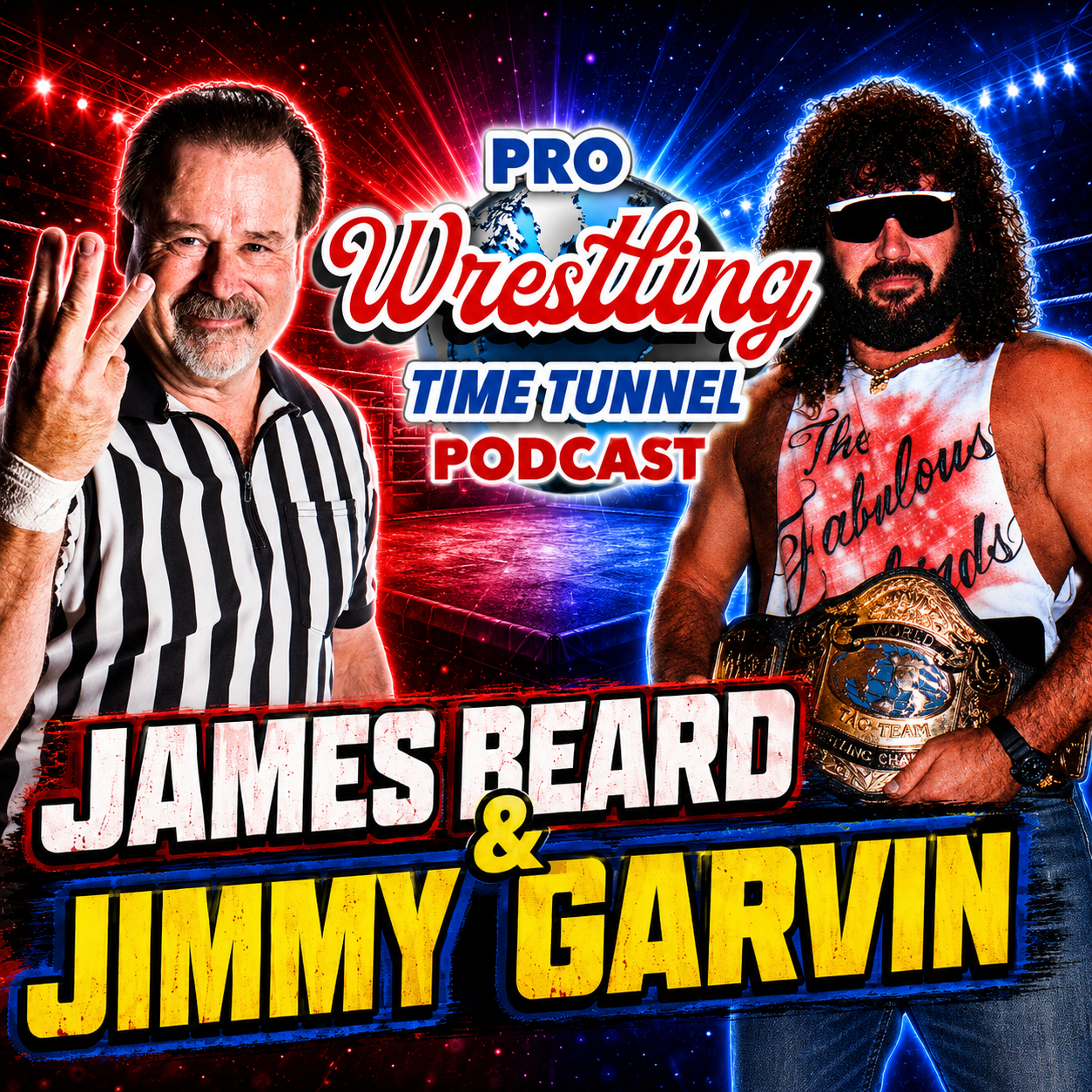
One of them is the Impact Award winner, which is James Beard, fantastic referee, involved with the wrestling promotion down in Texas right now, doing a fabulous job and growing like a weed. Texas style wrestling. And so James is going to be here in just a second and my second guest on today's show will be Jimmy Garvin and Jimmy is the Jack Briscoe Award winner at this year's Trago's Thes hall of Fame weekend. And I know you'll be looking forward to to my conversation about that.
Going back to the Briscoe and Bradshaw history of Texas wrestling.
There is I'm going to be talking about five guys for sure that I know of in that episode three that we've recorded by now and will be coming out on Thursday.
Briscoe, Bradshaw dropped their shows on Thursday morning at like 6:00am and so on that episode number three, I'm going to be profiling at least five guys, maybe more. But I'm going to be talking about Cal Farley and Dutch Mantel, and we're going to be talking about the years of 1900 to about 1925 in this segment in Texas wrestling history.
And so Cal Farley and Dutch Mantel, who would eventually be the promoters in Amarillo, I'm going to be talking about Carl Sarpolos, who was an amazing innovator in professional wrestling. Got a picture of Doc Sarpolos right here. It was his nickname was Doc. There he is, Dr. Carl Sarpolos.
And he was a wrestler in the teens in 1910 to around 1920. He eventually became the booker in Morris Siegel's Houston wrestling office. They formed a booking agency called the Texas Wrestling Agency, and they booked talent all across the state of Texas. They pretty much controlled wrestling in the state of Texas. And so we'll be talking about Dr. Sarpolos in that episode. We're also going to be talking about the two brothers who brought wrestling in formalized and brought it out of the carnival system and into the City Auditorium in Houston for a regular weekly entertainment event, which had not necessarily been done before. It was sort of a one off. It was part of the boxing, it was part of carnivals and athletic shows. But the Siegel brothers, Morris and Julius. And Julius Siegel is the one that took the lead on it and promoted boxing in Houston and then brought in wrestling on a regular basis there at the City Auditorium.
And so just a little bit about Julius Siegel that I'm going to share on the Briscoe and Bradshaw show, but I also wanted to talk about it today here on my own show. And there was an interesting. I found an interesting ad in the Houston Chronicle, if I can find it.
If I can find it, because I wanted to share it with you.
Here we go.
There we go. And for those of you who are watching video, you're going to be able to see this.
But for those of you who aren't, I'm going to read it to you. But it's an ad that I found.
Here we go.
It's an ad that I found for Julius Siegel in the Houston Chronicle on 7-24-1920.
And its vote for Julius Siegel is the headline for the Office of Justice of the Peace Precinct position number one. And he says, my record is as follows. I've lived in Houston about 12 years and believe I'm qualified in every way for the position of justice of the Peace. My discharge from the United States army reads character, excellent service honest and faithful.
While I am in office, there I will be no prejudice shown for or against any religion or nationality, all being treated alike, and the duties of the office will be performed without fear or favor. As proof I do not try to shirk any responsibility of a citizen, I refer you to the Houston papers of August 27th and 28th, 1917, which correctly state that when the negro soldiers were marching on the city, I was riding on a streetcar and the motorman being shot, I took his place at the controller and brought the car into the city. This is not referred to as a boast, but to show that in a sudden emergency I can think and act quickly and do my full duty as a citizen. Respectfully submitted, Julius Siegel.
So Julius Siegel, who is bringing boxing in in 1915 in Houston and was the brother who was basically the tip of the spear and getting wrestling presented as a regular weekly attraction in Houston, is running for the justice of the peace here in this ad. So that caused me to think I got to look into this whole Houston riot of 1917, and it was also called the Camp Logan Riot or the Camp Logan Mutiny. And it was one of the most significant racial conflicts in the United States during the period of World War I. As a matter of fact, it highlighted deep tensions between black soldiers and white civilians and police in the south, which was segregated at the time, which all happened in the spring of 1917, shortly after the U.S. entered World War I.
The army built Camp Logan in the northwest edge of Houston to train the Illinois National Guard and to guard the construction site. The army sent The All Black 3rd Battalion of the 24th Infantry Regiment, which was part of the. You may have heard of the Buffalo Soldiers. This was a battalion that was part of that Buffalo Soldier's outfit from New Mexico in late July of 1917.
And Houston was very strictly segregated in these days. Black soldiers, many of them were from the south and they expected better treatment in their uniform, but instead they got harassed just as bad, maybe more so, which stirred up a lot of segregation, harshness and unrest. And so soldiers were often forced to back the to the back of a streetcar, even when seats were available in the white section.
And racial slurs and abuse from white civilians and workers at the camp were common. Tensions escalated throughout the month of August. Black soldiers resented their unequal treatment, while many white Houstonians viewed black troops as a threat to the racial order.
So about the middle part of the day of August 23rd of 1917, Houston police arrested and assaulted a black soldier.
Rumors quickly spread through Camp Logan that the soldier had been killed. And then that night, a false alarm about a white mob approaching the camp caused panic. Soldiers broke into supply tents, seized rifles and ammunition, and defied orders.
Sergeant Vida Henry. It might be pronounced Vida. I'm not sure it's Vida Vita or Vita Henry.
About 150 armed soldiers marched from the camp into Houston, along San Felipe street, into the Fourth Ward, and for about two hours, they clashed with police and civilians. They fired on streetcars, police officers and bystanders. Fifteen or 16 white civilians and police were killed. About 12 to 20 others were wounded, and four to five black soldiers died from the incident. The mutineers eventually dispersed or returned toward camp, and Sergeant Henry reportedly advised the men to slip back and then took his own life.
So here's how Julius Siegel fits into this.
He was the. Of course, again, he's the. He's the pioneering boxing and wrestling promoter. He was not a soldier, nor was he in the military or in the mutiny. He was just a civilian passenger on this Houston Electric company streetcar during the chaos that night. And according to these records he referenced in his political ad, documents say that the streetcar's motorman, who was named W.H. burkett, was shot and wounded by the rioters, and Julius Siegel, who was a passenger in the streetcar, took the controls and drove the streetcar safely into town.
In that political advertisement that I showed you and read to you for the justice of the peace, he talked about that event, and he said that Houston newspaper coverage from August 27th and 28th of 1917, and described it as proof of his ability to think and act quickly and do his full duty as a citizen in a sudden emergency.
He did not frame it as a boast, as I read to you, but evidence of his character and quick thinking under pressure. The civilian act of bravery during the riot was real and documented independently of his political ads. So the 1917 Houston riot was a tragic, tragic explosion of long, simmering racial tensions between black soldiers expecting to be respected in their uniforms in a hostile, segregated city, and resulted in significant loss of life, harsh military justice, and lasting historical memory. And Julius Siegel had a role in it. He was an ordinary citizen who stepped up in a moment of crisis in public transportation. And he later cited that when he ran for that just of the peace office in 1920. And so who says wrestling promoters are not good people and won't do the right thing? Julius Siegel. Wow.
Kind of a hero in that moment. All right, so I just wanted to share that with you a little bit of history about Texas wrestling and about one of the Brothers Julius Siegel, who you don't hear as much about. You hear more about Morris and we're definitely going to talk about Morris.
Julius also played another really important part in the history of wrestling and involved another territory outside of Texas. And I'm definitely going to talk about that as well on episode three of the History of Texas Wrestling on stories with Briscoe and Bradshaw. Let's get to today's first guest here on the Pro Wrestling Time Tunnel territory history show. And it's my dear, dear friend. We've gotten to be very close the last couple of years. I think the world of this fella. And he loves dogs, at least his wife does. She's constantly adopting rescue dogs and he's got a whole Texas house full of them right now. And so we may hear the dogs a little bit during our conversation. But let's go here at the Richards Ranch where my first guest is. This year's 2026 Tregostez hall of Fame Impact Award winner James Beard was a conversation that I've been wanting to have for quite some time. We just spent some time together in St. Louis and we're going to be spending some time together coming up in Waterloo, Iowa. It's always a wonderful time there. My guest today on the Pro Wrestling Time Tunnel is my dear friend, James Beard. How you doing, James?
[00:32:43] Speaker B: Great to be with you, Tony.
[00:32:44] Speaker A: Absolutely, man. I am so glad that you're here.
For those who don't know James is going where it's going to be the 27th annual Trago says Professional Wrestling hall of Fame induction weekend coming up in Waterloo in July. And James is going to be getting the Impact Award.
Congratulations, man.
[00:33:05] Speaker B: Well, thank you, Tony. And the same to you. That, you know that, that the Historian Award, the Melville Award is really, it's, it's, it's special because that's a special thing for our industry.
[00:33:16] Speaker A: Oh my gosh. When I sit there and I look at the guys names that have won it before and my really close friend Tim Hornbaker won it last year, right? And, and we were sitting there Saturday night at the wrestling card and I was sitting there helping him. They send those posters around for people to sign, you know, And I'm, I'm holding his, and I'm handing him a poster one at a time. He goes, well, you're going to be doing this next year. And I'm like, I'm like, you're crazy. I'm like, you're nuts. I said, you know what? I might be able to do it 10 years from now, but not next year. And I'll be. Gosh, look, look what happened.
[00:33:54] Speaker B: Well, you deserve it, I can tell you that for sure. Some of the, some of that stuff you did with the, on the, the podcast with John and Jerry is just, it's incredible. I'll listen to every bit of them.
How many, how many what? 10, 10 episodes on one one subject.
[00:34:13] Speaker A: Well, we did the Welch family. We did 11.
[00:34:16] Speaker B: 11. Yeah, yeah.
[00:34:17] Speaker A: And we're about. And I don't think I've announced it, so this is a good as time as any, but we're getting ready to do a big series on the history of Texas wrestling, so.
[00:34:26] Speaker B: Oh, yeah, I know a little bit about that.
[00:34:27] Speaker A: Yeah, I know you do talk a little bit about that today. What, what first drew you in to, to pro wrestling? What caught your attention and made you want to be around it at all?
[00:34:40] Speaker B: Well, you know, I, I think I'm like a lot of people. I didn't have any connection to it whatsoever, you know, family wise or, or otherwise.
Lived about 90 miles away from Dallas and, and back in those days, I'm, you know, I'm, I'm getting on up there so I'm, I can. Our tv, the first TV I remember us having was a little black and white thing. You know, we had an antenna and most days, on most nights and sometimes days were a challenge, but most, most nights we could get some of the Dallas station and, and a couple of those. One was channel four, which was CBS, and the other one was KTBT which is channel 11.
And both of those had wrestling on them.
That thing channel CBS had a little studio wrestling program that, that a lot of people don't even remember that that came from the Southwest sports, which was. Same as the sport coiam promotion.
[00:35:38] Speaker A: Yeah.
[00:35:39] Speaker B: And of course KTVT was the, was the one on Saturday night that was filmed in Fort Worth.
It was, it was an hour and a half or maybe two hours. I can't remember now.
[00:35:48] Speaker A: I think it was, I think it was two.
[00:35:50] Speaker B: Yeah, it might have been. Yeah. And of course it was in black and white. Even if I had a color tv, I could have seen it. But, but I can remember just as a kid, we sit around watching with my folks, you know, and I don't know what made them care about it, you know, but, but maybe it's just because it was the only thing we could get. I don't know. But you know, I watched it. I watched it from the time I was just a little kid and it was always fascinating to me and I was always after I got a little older, I was in athletic, so that. That probably enhanced that a little bit. And. And I never. I never really. I mean, you have those little thoughts about how would it be to be a. A wrestler, you know, like my. One of my heroes, like. Like Red Bastine or Bob Ellis or somebody, you know, the guys that were around the time.
[00:36:38] Speaker A: Yeah.
[00:36:39] Speaker B: You know, and my folks actually took me to the Sportatorium a couple of times. I was probably, I don't know, 9 or 10 years old, something like that. And I'll never forget the way that thing felt, the smells and the. And the atmosphere that was there. And, you know, back then, I didn't notice that it was just a big old tin building, but it was something special. And then seeing them in color, you know, and all this time I'd been watching it on black and white tv, and all of a sudden there they are, live and in color, and it just. It changed everything for me.
[00:37:12] Speaker A: And.
[00:37:12] Speaker B: And so I was a fan from then on.
[00:37:14] Speaker A: And you had no. You had no idea that you were going to be working in that same building?
[00:37:21] Speaker B: No, no, I didn't know I did. I may had. You know, I might have had a little passing dream somewhere that, you know, that would be cool to do or something. Like, probably I probably wrestled a few teddy bears and pillows and that kind of thing, like a lot of guys do when they're younger, you know, but, you know, being in the business was way off, you know, And I was. I was. Like, I said I was in athletics. I played. I played most sports and. And. And I got involved in music. That was something that just kind of came to me. And. And so it was kind of a. That was kind of a pipe dream if I'd ever had it, you know, And I don't know. I don't think I ever seriously thought that would ever happen until later on. And I met some of the guys that I'd watched on TV or got to know, coming to some of the places I played music in Dallas, and they started.
The conversation would always come around us wrestling. At some point, they're interested in music. I was interested in what they were doing.
And.
And some of them kind of had a feeling that I had a clue, you know, because I. I can remember. I can remember when I was even pretty young, watching it and dissecting it a little bit, you know, not just. Just like, I'm a fanboy, like. Like, you know, I think this might happen, or this would be cool to happen, or I can see what they're trying to do here, that kind of thing. So I don't know, something. Something about.
Something about watching wrestling made me want to look at it a little deeper, I guess, than just being a fan.
[00:38:57] Speaker A: And most everybody. Most everybody has.
You know, one of the things I think is common is you end up having a relationship with somebody in the business and. Yeah, that's the person that sort of ushers you in or. Who was your relationship with?
[00:39:14] Speaker B: Well, there were several of them that would come around to the.
To the places where we'd play, you know, occasionally. Not every time, but occasionally. And I get to know him here and there.
So I got to know several of the guys, but Bruiser Brody's the one that really kind of told me, you know, do this.
Bridger had a way of telling you things that, you know, you go, yeah, well, maybe, you know, if he's. If he's serious about it, maybe. Maybe there's something there. And so I stuck my toe into business for a little while and I worked a few. They put me in a few shows here and there, and they're outlaw shows, I guess you'd call them.
[00:39:48] Speaker C: Yeah.
[00:39:48] Speaker B: And, you know, the next thing I know, I'm in a sportatorium.
[00:39:51] Speaker A: And what were you doing back then? What did they have you do? What was your job?
[00:39:55] Speaker B: Oh, they put me in the ring.
[00:39:57] Speaker A: Oh, they did?
[00:39:58] Speaker B: Yeah. First time I did anything, it was. It was refereeing matches, you know, it was. It was like throw it in and you get your singer swim. And I don't know, I just had kind of a natural feel for it, I think.
[00:40:11] Speaker A: Now, what'd you play in the band? What. What was your instrument?
[00:40:15] Speaker B: Played keyboards and sang. I was a front man for nearly every band I was in.
There was one band, the basic parts of it. Three or four of us stay together for 15 or 16, 17 years, something like that.
Two things changed, but mostly I was a lead singer and I played some keyboards.
I played horn back years and years ago, but it made really hard to sing and play horn at the same time.
[00:40:45] Speaker A: Well, playing in Texas bars, I mean, so what. What were you.
[00:40:51] Speaker B: Not too much. Too much for horn players in Texas bars.
[00:40:54] Speaker A: Yeah, that's right. What. What songs, kind of songs were you playing?
[00:40:58] Speaker B: Well, I mean, we. I'm a guy, I grew up in the 60s, so, you know, we. We were all kind of rock and roll guys.
Classic, you know, that plot Everywhere on top 40 back in those days, you know.
But eventually we. We smartened up and figured out that if you're going to play in Texas, you don't necessarily have a. Have to have a fiddle in the band, but you do have to play country music.
[00:41:19] Speaker A: You probably need to know a Bob Wills song or two or something.
[00:41:22] Speaker B: Yeah, something. Something akin to that. So. So we. We started kind of moving that direction and eventually we ended up working a lot of the big places, a lot of the big bars and clubs and opening for a lot of acts. Worked for Charlie Pratt's company, Chardon. They booked us.
And, you know, I worked for just about. I opened for just about every major act that you could think of coming through Texas back in the. In the early 80s and even some of the late 70s. But in fact, we were playing it.
Tim Storm likes to tell this story, and it's kind of a weird deal, but that we were playing this one bar in. In Texas and bigger. Bigger club, and the. The. The bar owner, that he would go out and book some acts that had like one or two songs out at the time. You know, that a lot of them used to do that and. And they. They'd commit them for like a year, like two or three bookings, hoping that they would have hit big. And, you know, they get them cheap. Then, you know, when they came back and we were playing this one bar and the. The bar owner had booked George Straight after he had. Had had one song out at the time, I think. Yeah, I figured it was one song out. And we were standing around before the. Before the. The night started, and the bar owner, I think George said something like, you know, how do you want us to do this? Or whatever like that. And the bar said, well, most of the people came to see these guys talking about us.
[00:42:52] Speaker A: Yeah.
[00:42:53] Speaker B: You know, they didn't know who George Straight was, or a lot of them didn't. And they said, if you don't mind, just open up for.
So I can honestly say George Strait actually opened up for us one time.
[00:43:04] Speaker A: Oh, my gosh.
[00:43:06] Speaker B: But that's the kind of crazy stuff that happened back in those days, you know.
[00:43:09] Speaker A: Yeah.
The whole urban cowboy thing was exploding too. And yes, you know, it was make. It was making all of that. I mean, it's always in style in Texas, but it was really making it in style all across the country back.
[00:43:24] Speaker B: Absolutely. Yeah. Yeah. And. And of course, he turned out to be a.
I guess as big as stars you could ever dream of. But. But yeah, and that happens sometimes. You know, we'd open for guys like Randy Travis and then Steve Warner, and I can't remember everybody, but the work with a lot of Them. And it was. It was an interesting, interesting little run there for a while.
[00:43:51] Speaker A: You know, you mentioned a name and I don't, I don't want to go too far away from it because I really want to get your thoughts on it.
You mentioned Red Bastine. And yes, you and I have talked about Red before, just in our private conversations.
Tell everybody a little bit, because he's one of those guys that we've gotten a few far away from in history that is not remembered as well as he should be today.
What was special about Red?
[00:44:19] Speaker B: Well, I mean, of course, as a kid, watching me became kind of one of my first heroes.
And I think a lot of it had to do because of his athleticism. He was different.
You know, he. They, you know, call him the flying redhead and he literally did that. I mean, you know, some of the things he did were just not seen typically in wrestling at the time.
You know, a few guys could do those things, but not very many.
You know, we see it all the time now. It's just one spot after another. But back then, Red did some things that just. It was special. And I think that probably drew me to him more than anything as far as a hero type thing goes.
And then, you know, after. Later on when I got to know him and he became really one of my mentors, I found out just how smart he was. He's just one. He's one of the. One of the great booker, you know, just an intelligent guy and, and really probably.
Probably one of the best ambassadors for wrestling in that's ever been, you know, after he retired and he was. He was the president of the Cauliflower Alley. He would. He would go all over just visiting guys, you know, just show up, you know, and I'd get calls from him from who knows where. Sometimes just out of the clear blue, you know, he'd just say, hi, you know, how you doing? And that kind of thing. But he was a special friend and a guy that I learned a lot from.
[00:45:48] Speaker A: Yeah, I was going to say that, you know, when. When, when the conversation turns to great bookers, you don't really hear his name that much. But you really should. You really.
[00:45:58] Speaker B: No, you really should.
[00:45:58] Speaker A: Yeah, he was. He was a Texas institution.
He booked a lot of fantastic years there in the 70s for Fritz in the Dallas.
[00:46:09] Speaker B: Right.
[00:46:10] Speaker A: Booked a lot of great Houston matches and was a great Texas heavyweight champion as well.
[00:46:17] Speaker B: Yeah, several times. And of course he and Red Lions were a great tag team.
Just an incredible person.
One of the nicest guys you'd ever want to meet.
[00:46:31] Speaker A: Who were some of the other people that you really enjoyed working with? Because when you broke in there around that. It was about 40 years ago, right around 1986, right?
[00:46:42] Speaker B: Yeah, something like that.
[00:46:44] Speaker A: I mean, so when you broke in there, I mean, the world class was. I mean, on fire. Who. Who did you like. Who'd you like being around back then?
[00:46:53] Speaker B: Well, you know, I think the promotion had kind of.
I kind of missed the really huge part of it because it was so hot back in 83, 84, 85.
[00:47:06] Speaker C: And.
[00:47:06] Speaker B: And then some things happened, and of course, you know, David's death and Carrie getting hurt and all that stuff. And so I'm. I'm. I really kind of missed out on being a part of some of the biggest parts of it. But it was still, you know, it was still cooking.
[00:47:21] Speaker A: Yeah.
[00:47:21] Speaker B: And, you know, I enjoyed. I always enjoyed working with. With the technicians, you know, the. The guys that really knew how to put a match together. And then they were just so much more fun to me.
Of course, I enjoyed working with Yvonne Erickson, the Free Birds and all those guys, you know, they were wonderful.
But, you know, I guess.
I guess I don't know what it was about it, but I just always enjoyed the technicians and then the guys that really were fun to work with that maybe weren't the top, you know, the top stars there at the time. You know, you know, guys like Gary Young or.
Or John Tatum, I mean, they were. They were stars, but they weren't working at the top. Usually Black Bart guys like that. I just. I just. I don't know. I always gravitated toward that.
[00:48:11] Speaker A: Of course, back in that time, Kayfabe was still big.
[00:48:15] Speaker B: Yeah, yeah.
[00:48:16] Speaker A: And so a lot of referees back then carried the finishes between the guys and this, that and the other. Was that something that you.
[00:48:24] Speaker B: You did?
Yeah. No, if you did, you don't go to the Sportatorium.
[00:48:29] Speaker A: No, I was never in there.
[00:48:30] Speaker B: Okay. It's a lot. Of course, a lot of people don't know how it was all laid out and everything. The. The Sportatorium had two exits or entrances for the baby faces in the hills. The one went down one aisle, one went down the other aisle, but there were. The. Inside there. There was just one big, huge dressing room and. And there were two or three other little rooms around, you know, like booking rooms and that kind of thing, but offices. But for the most part, everybody was in that one big place, so that really wasn't so much necessary. There. There were places I worked that it was, you know, like, in Nashville.
In Nashville, you. You'd be on this end of the end of the building and then go to the other end of the building.
[00:49:15] Speaker A: That's right. Yeah. You know, I was in there a lot. I was in that building a lot. So.
[00:49:20] Speaker C: Yeah.
[00:49:20] Speaker B: And worked in Japan. It was like that. You know, they were very separated, so I'd have to kind of make my way one way or the other and. And get things across, if there was anything to get across. Sometimes they just take. Get in the ring and do this.
But. But. But, yeah, I've had that experience several times in several places.
[00:49:41] Speaker A: What. What. Who really kind of took you under their wing as far as being a referee? Like, how. Who. Who mentored you in that? Or did you just kind of go along learning as you went?
[00:49:55] Speaker B: I learned by listening more than anything else, and I tell guys that all the time. I learned more listening than I ever learned in the wrestling ring.
But. But, yeah, I had guys like Skandar Akbar, Bronco, Lubich around, you know, and when. When somebody asked me who trained me, I tell them everybody I worked with, because that's really true. You know, I really learned from everybody. And. And some of them, of course, I learned to listen to a little bit more than others. But. But the guys there were all. They were all very helpful if, you know, if they say, hey, you know, do maybe this or that or the other. But I don't know, Tony, And I'm not saying this to boast or anything, but I always had a. Always had a real good feel for it.
I understood positioning and pacing and that kind of thing.
[00:50:48] Speaker A: I don't.
[00:50:48] Speaker B: I don't know where it came from, if it came from athletics or sometimes maybe some of it was from music, you know, because all those things fit together somehow.
And I just. I just always had a really comfortable feel in the ring from the very first time.
[00:51:06] Speaker A: I've talked to Bobby Simmons about it quite a bit. He was a referee in Georgia for so many great years, and he said, right guy. He said, I just learned to stay out of the way.
[00:51:17] Speaker B: Yeah, well, that's. That's. That's the first thing you learn. Yeah, absolutely. You know, you definitely don't want to get in the way.
I was always pretty athletic, so I could. I could kind of add a little, but a little bit sometimes, but definitely got to give them their space. Yeah.
[00:51:34] Speaker A: And so for fans who are just kind of curious, I mean, you just go in there and call it like you would, like, you just do what's natural. As far as these are the rules that wrestling is governed by, and you just enforce them. Right.
[00:51:51] Speaker B: I tell guys all the time when I get in the ring with them, if I've never been in the ring with them before, I tell them, look, I work this like a shoot, you know, and I've had. I've shocked a few guys a few times, you know, that aren't used to somebody who would maybe get on them a little bit more than normal or been a little more aggressive with them sometimes. But then when they figured out that I was trying to help them, it all worked out really well. But, but yeah, I work it exactly like a shoot. If a guy does something that's against the rules and it doesn't me, I'm going to get on him.
[00:52:25] Speaker C: So.
[00:52:27] Speaker A: So if you counted guys out, and that was.
[00:52:30] Speaker B: Oh, yes, I have.
[00:52:31] Speaker A: And that was. That. That wasn't the finish, but that was absolutely.
[00:52:34] Speaker B: I've, I've changed. I've changed a couple of angles because of that.
Yeah. And the good thing about it back in those days is that the people who, who were booking and ran things supported you.
[00:52:45] Speaker A: Yeah.
[00:52:46] Speaker B: If you did that, if you did that today, I'm sure you probably get fired some places. But, but.
Which is a shame, really. But, but yeah, I've always had the support of the office and that, that, that makes that a lot easier.
[00:53:01] Speaker A: Well, if you think about it, if you count a guy out, if he don't get back in by the count, or if you. Or if he don't get his shoulder up right, that just increases. That increases the legitimacy of the sport.
[00:53:14] Speaker B: Yes, absolutely. Yeah. Or it doesn't break when I tell them, you know, if I start counting and, you know, and I always, I always tell, I always allow guys to get their heat and I tell guys, I always tell the heels, you know, if you'll just work with me, I'll give you plenty of opportunities to get heat, you know, whether it's my positioning or whether it's my timing or whatever, you know, if you get a guy in a corner and you're doing something that's illegal, I'll do. I'll. I'll work with you a little bit trying to get you to break it, give you a chance to get heat. But when I start counting, you need to back off, you know, or, you know that old thing where all I used to pull their hair and that kind of thing, you know. Yeah, they do it right in front of you, you know, and I don't look, you know, if you'll give me a minute, I'LL work my way around a little bit and you pull his hair. I don't see it. They're mad at you, they're not mad at me.
And that's stupid.
[00:54:06] Speaker A: And that's a real important nuance, James, that.
Not to get the heat on the referee.
[00:54:12] Speaker C: Yes.
[00:54:13] Speaker A: You know, don't put the heat on the referee. Put. Keep it on the heel.
[00:54:16] Speaker B: Absolutely.
[00:54:20] Speaker A: That can get, that can get messed up.
[00:54:23] Speaker B: Yes, it is a candidate does all the time.
You know, unfortunately these days, I don't think half of them even give a second thought to the referee is, or what a referee's role is.
And of course, a lot of times the rules don't mean anything anyway because one match it looks like it means something, the next match it doesn't. You know, that's one of the things that, what I'm, I try to do in Texas when I'm in charge of something is make sure that there's some consistency there and that, you know, if the rules are always the rules, no matter what, unless, unless we do a stipulation or something.
And that's, you know, that should be something special, not something you do every day.
[00:55:05] Speaker A: You know, Texas has always had the reputation of being a snug environment. I mean, of the way the matches were worked.
And you also mentioned working in Japan.
[00:55:17] Speaker B: Yes.
[00:55:18] Speaker A: Was that pretty similar?
[00:55:20] Speaker B: Very similar, yeah. I felt really comfortable over there because the style was very similar.
Some of the difference was that a lot of times, a lot of times in Japan, there wasn't anything called here or there. It was just you just catch and catch can, you know, you act and react.
And sometimes in Japan, one of the differences is they, they would do all that all through the match and then they'd have a finish that lasted five minutes. You know, it was a whole bunch of things going on, you know, but, but, and in Texas, he's usually a lot more simple than that. But, but, but as far as the style goes, it was very similar. It was a very snug, very believable.
And, and that's what I tell guys all the time. When, when, when, when I'm talking to them, especially our crew, even our crew now I'll tell them, look, guys, I don't care what style you work. I don't care if you're a brawler or high flyer or technical guy. I don't really care as long as whatever you do is believable. If it's not believable, I'm going to get upset, you know, and that's really what Texas Style wrestling is. Yeah.
[00:56:25] Speaker A: Mentioning that we're going to get to that famous name that you've brought back here in just a little bit. Well, you know, we've talked about it just in our conversations about the Iron Claw movie.
What was that whole experience like for you?
[00:56:42] Speaker B: Oh, man, I tell you, you know, it was.
It was so unique. I'd done a couple of TV shows, you know, and I'd done some commercials and things, but making a movie is a whole nother ball game, you know, the whole experience, you know, it is a lot of sitting around waiting, you know, that kind of thing. It's true.
But to me, it was all really interesting. You know, I never got bored with it because I. The whole process just fascinated me. But, but that movie in particular, because I. I knew the guys that, you know, that. That it was about. And because I had experienced a lot of the things that I. That. That he. That were in the movie. Even though, you know, the. The movie was not historically accurate as far as timelines and as far as some of the things that happened, you know, nor was that.
[00:57:34] Speaker A: Nor was that the purpose of the movie.
[00:57:36] Speaker B: Absolutely not. No. I tell people, if you want a documentary, watch a documentary. This is a movie. And. And really. And I talked to Sean Durkin, the director and the writer about this. The movie was really about Kevin and about his issues with being the older brother left and kind of getting bypassed, you know, when. When opportunities came up and also dealing with a relationship and also dealing with his father and all that kind of thing. Now, some of those things were exactly the way they happen, but that's what the movie was about. It wasn't really a wrestling movie.
It is that. Wrestling. Wrestling in it and wrestling people in it. And if you just sit back and watch it, if you can do that, not as a fan or a historian or anything else, and just watch the movie as a story and forget that any of it's supposed to be based on anything real. It's an incredible movie.
[00:58:35] Speaker A: Well, it's very difficult for wrestling fans to.
[00:58:38] Speaker B: Oh, I know.
[00:58:39] Speaker A: You know, Yeah, I know now you.
And we've talked about that. I mean, the whole purpose was to tell a dramatized story.
[00:58:48] Speaker B: Absolutely.
[00:58:49] Speaker A: And if. And I actually, when I went into it, I was going into it for that, thinking, this isn't, you know, this isn't supposed to be a factual documentary. This isn't, you know, this is just. This is just taking one of the most fantastic stories in the history of pro wrestling and turning it into a dramatized. Dramatized thing, which if you look at it that way, I thought it was pretty good.
[00:59:15] Speaker B: Yeah, it got great reviews.
The overall, it got really good reviews.
There was a lot of talk even about it being nominated for some awards, but the release date came so late. I think that hurt it some for that, but it was. You know, Zac Efron did an incredible job as an actor. I mean, yes, he looked different from.
And obviously there are things in there that weren't exactly the way things happen with Kevin, but. Well, of course, you know, as an actor, he did an unbelievable job.
[00:59:55] Speaker A: Your book is one of my favorite wrestling books, the Third man. And thank you. There's so much in there that I learned, I learned so much reading your book about the referees perspective.
What did you really enjoy when you're putting that book together? What was a part of it that you were really proud of?
[01:00:17] Speaker B: Well, of course I have a lot of passion for that role. So that, that, that chapter in there that I wrote about the referees meant a lot to me. Even though I think a lot of people ignore that these days.
I, I hear from a lot of referees who read it and they, they, they just love it because it actually, it actually gives them that, that, that, I guess that, that pride of being that part, that role, you know, even though they don't get to do it that way a lot of times, you know, they, they understand that that's the way it's supposed to be.
But I, I think, I think some of it I enjoyed was kind of telling the positive side of some of the guys that I knew.
You know, not, I didn't try to, I didn't try to write it as an expose.
There were a lot of things, there were a lot of things I could have written in that book that, that, you know, that probably a lot of people would have really enjoyed reading and gotten off to, you know, but, but that's not what. That wasn't my point. Yeah, you know, I wanted to, I wanted to try to tell would and still be honest and try to be as positive as I could be about most of those guys. You know, there's, there's some stories in there that, that a few things were hard to write, you know, the, the Chris Adams thing for one.
You know, because Chris and I were very good friends, you know, but he was a flawed guy, you know, and, and, and, and he had some, had some demons and, and you know, the, the, the thing that made me feel good about it is, is Jeannie, after she read the book, she, she gave me a call. She said she Said I just want to thank you because you really told, told it the way it was, you know, without, without trying to bury Chris, of course, you know, you know, and so those, those are the kinds of things I really enjoyed in, in that part of that book itself, you know, and, and, and that, and, and, and being able to kind of express my feelings about the, the guys that kind of got lost in our business.
You know, the, the, there was a time, you know, when the territory started dying and, and you know, Vance started kind of taking things over. WCW was there and all that. The cable, cable companies and, and a lot of guys just left the business or, or they started working, you know, part time in it or something like that. And, and a lot of things didn't get passed along like they used to be.
You know, there, there were, there wasn't any such thing as a wrestling school back in those days.
[01:02:52] Speaker A: Oh, of course not. You know, on the job training.
[01:02:55] Speaker B: Yeah, you own a job training and you'd have one guy or two guys somewhere maybe that take a guy and work with them and that kind of thing, but not wrestling schools, not like you have today.
And I'm not, I'm not saying anything negative about them at all. There's some very good ones. But, but a lot of, a lot of the language, a lot of the history kind of got lost to a whole generation of guys.
And some guys kind of took a lot of guys that probably were just fans before ended up getting into the business either as trainers or promoters or sometimes wrestlers.
And they didn't really know all those things.
They didn't get trained that way or they didn't get exposed to the things that we used to get exposed to by professionals. And so a lot of things were lost in that little period of time. And it's amazing that so many things even made it through that.
[01:03:55] Speaker C: That.
[01:03:55] Speaker B: Yeah, but it's, it's. I've kind of, I kind of wanted to give a nod to some of those guys that hung around and tried, you know, and there's a little bit in that book about that too that I was, I was kind of happy to be able to do that.
[01:04:11] Speaker A: Yeah, that's one of.
[01:04:12] Speaker B: Even though a lot of people probably don't even understand what I was doing.
[01:04:15] Speaker A: Yeah, well, that's one, it's one of the things that's important to me too. Like I, beyond just the historical facts about the business, I really like showing people that these people are real people.
So many times in the entertainment business, whether it's music or movies or Wrestling or any of that.
These people seem to be the stars, let's say. They seem to be so far removed that if they were really your friends or you really knew them, you wouldn't talk about them the way you do, and you wouldn't spread the things that you spread about them.
But when you get to know them as people and they get humanized to you, I think it really helps people be more balanced in the way that they think about these folks.
[01:05:07] Speaker B: Yeah. Yeah. And, you know, social media so much. Oh, my gosh, you know, you know, it's. That's a.
There's. There's a lot of good things about social media, but, man, it can be such a bad thing, too.
And when I wrote that book, and even that was in 2013, I believe, when it was published, and we think today that everything's really common, you know, the way it is. But even back, even that, just that far back, social media was still kind of new to me. I mean, and I know a lot of people had gotten into it and that kind of thing, but it was, you know, the early 2000s and stuff. I didn't know anything about it hardly, you know, and. And back in the days when I was traveling on the road all the time, we didn't even have cell phones, you know, so it's just such a different world now. And that being able to kind of tell the truth about some guys, you know, instead of just rumors, you know, that. That. That. That kind of was a good part of writing that book, too.
[01:06:12] Speaker A: Well, we talked about. And I want to bring it up again here in a minute. We talked about the Trago Says coming up here in July, but you're also a member of the Texas Pro Wrestling hall of Fame. What. What did that. What did that mean to you? I just got to imagine growing up as a kid in Texas and watching it when you were a kid and loving it and all of that. To then be honored as one of the very few people who get. Who get put in something like that. I mean, that just probably was awesome.
[01:06:41] Speaker B: Yeah, yeah. Very special. Yeah. I mean, because I'm a Texas boy, and I got a lot of pride in that, and being a part of that is really meant a lot.
The thing about that, dad. And really, any honor, I've been lucky to have received a few things. Most of them are like promotional deals or regional things or something like that.
I always tell people that, that if it's given to you and it's sincere and they're doing it in the right way, then all of them mean just as much. You know, that's kind of a lie, but it's true in a way too. I mean, yeah, there's some that have to absolutely mean more than others, and that would be one of them. And of course, this one coming up, that's a whole nother level, you know, that and the cauliflower alley thing, that, that was, yeah, that was really special because it's a, it's a industry wide recognition, you know, and, and I'm standing there in front of, literally in front of some of the greatest names in wrestling.
And the WWE had bought two or three tables right in front of the podium there, you know, so all those guys were sitting there and I'm, I'm just, you know, that was, that was amazing as well.
[01:08:11] Speaker A: You know, one of the things I've noticed because I get asked all the time, like, oh, wow, you get to work with Jerry Briscoe and jbl, like, what's that like? Well, one of the things I've noticed is you and Jerry don't quite go back and forth on Texas and Oklahoma quite like Jerry and JBL do. Like, so I can't hold a candle.
[01:08:35] Speaker B: Yeah, I can't hold a candle to John about that. Oh my gosh, so much fun to just sit around, watch those two. It's like a couple of kids.
[01:08:42] Speaker A: Well, when people say that, like y' all have so much fun on the show when you're on there, I'm like, well, if you think that's fun, you ought to be part of our text messages.
[01:08:52] Speaker B: I mean, oh my God, you should.
[01:08:53] Speaker C: Yeah.
[01:08:54] Speaker B: Or just hanging around them, it's unbelievable. Yeah, yeah. And they're both just brutal with each other.
And you can, you can, you can. If you know them, you know how much they love each other, you know, very much. So, you know, and, and, and it is so. It's so much fun just to hang around with them and hear that stuff. And that's why I, you know, I don't get involved in it that much. I'll get a little zinger in once in a while. But for the most part, you know, Jerry, Jerry tries to use me to get to John sometimes, you know, he'll say, you know, what was it like when he was a greenhorn? He did this and he did that and you know, and I got a few of those stories too.
[01:09:31] Speaker A: But, well, we're going to do this history of Texas wrestling, which I know without a doubt it ain't going to be long. We're going to have to Have a history of Oklahoma wrestling too. I mean, because that ain't going to fly. But anybody who's ever got a message from Jerry along those lines knows he has a special way of spelling Texas.
And so.
[01:09:54] Speaker B: Oh, yeah, yeah, yeah, yeah. And pronouncing it. Yeah, yeah.
[01:09:57] Speaker A: So he, he writes, he goes, I can't believe we're going to do a history of Texas wrestling.
[01:10:04] Speaker C: Yeah.
[01:10:04] Speaker B: Of course, John, John would come back and say, well, you can't spell very well when you're, when you're sending things with smoke signals.
So, so, you know, it's, it's.
Those guys are. They never stop.
[01:10:16] Speaker A: I love those. I love them. They're just so, they're such good friends of mine. And yours too, I know.
[01:10:23] Speaker B: Yeah. Yeah. You know, a few years ago at, well, actually at the, at the Tragus Fez, Jerry had a, he'd been traveling and he got, he got sick and, and just passed out. I was sitting right next to him, John sitting on the other side of him. And we thought it was something really, really, really bad, you know, like a heart or something like that. I called, I ended up calling the, the 91 1. And John took care of him. He hardly left his side that whole time, you know, so, you know, that, that shows you that other side of it, too, you know, so it's, we
[01:11:01] Speaker A: had such a great class this year. Jeff Jarrett is going to be going in. Jimmy Garvin is going to be going in, the entire Welch family, which, the Ron Fuller will be there and Roy Lee Welch. I'm actually going to be doing a session this year on Wrestling Wars. We're going to be talking about the Atlanta Wrestling War. Roy Lee Welch, who worked in the office in Atlanta during the wrestling war. He's going to be there as part of my session. So we just got such a great class this year as it is every year there in Waterloo. But of course, because of this and because you're going into it and I'm going into it, this is special to me. But what's your, what's your feeling? I know it's special to you.
[01:11:46] Speaker B: Oh, it's, it's unbelievable. You know, I, I, I got involved with the Tragus, this Hall of Fame in that weekend several years ago, mainly from Troy Peterson and James Jeffries, you know, and, and those guys that, that, the fact, I think I met them at Cauliflower Alley in Vegas and, and they, James was such a big fan of, of World class and Carrie Von Erich and all that. He named his son Carrie Gene. You Know, so.
[01:12:18] Speaker A: Really?
[01:12:18] Speaker B: Yeah, yeah.
And. And so they invited me up and I went the first time, and I was hooked. You know, it just. It was special. And. And Jerry got me more involved in things, you know, as. Pretty, pretty quickly after that, and it just became kind of a passion for me that whole whole weekend, you know, that whole experience.
And when Jerry told me that I was going in with this honor, it was just, I can't even tell you, as special as anything I could ever think of in this business. It's almost like the cherry on top of the cake.
[01:13:01] Speaker A: You were around back in those days, just breaking into the business and around that whole situation. Of course, you were around later on when the. They brought it back and everything.
[01:13:12] Speaker C: Right.
[01:13:12] Speaker A: But, I mean, you were close to the family.
[01:13:15] Speaker C: Yeah.
[01:13:16] Speaker A: Tell me what Fritz Von Erich was really like as a person.
[01:13:21] Speaker B: Fritz was.
He was a no nonsense kind of guy, but not a. Not mean, you know, not. He wasn't. And the movie made him. Made him look like he was. That was. That was one thing about the movie that I know Kevin was a little upset about and, and kind of bugged me a little bit too, but it's. I mean, it's just. It's. It is what it is. But he wasn't.
He wasn't the. The pushy, domineering kind of guy that it made it look. Look like he was.
He. In fact, if anything, I think he probably.
He probably tried to hold the boys back a little bit.
And Gary Hart was more. More the guy that was. That was in control of pushing them, and rightly so, because he understood what the value was.
Fritz wanted them to pay their dues and have to work their way up because he was old school, you know, he. He. He was. He was one of those guys that believed that you had to work your way up, you know, And. And Gary saw the writing on the wall. You know, he saw that these guys are gold and.
And Fritz was a little resistant to that.
So the movie made it look just the opposite, you know, like. Like, you know, Fritz was really the instigator, the pusher, the guy that. That wanted this and that now.
But. But personally, you know, I wasn't. I wasn't what I call close to him or anything. I didn't deal with him a whole lot, but, you know, he knew what he wanted. And, and if, and if he. If he, if he believes something, he'd let you know. But. But he wasn't. He wasn't a bad guy at all.
[01:15:06] Speaker A: You mentioned Gary Hart. Tell me about Gary.
[01:15:09] Speaker B: Oh, man, what a smart guy.
Unbelievably smart.
I learned so much from getting another one of those guys that I learned from listening and being around him. And, And I still. I still pattern a lot of the. A lot of the things I do from him as far as booking and all is concerned.
Just an unbelievable career path that guy had. You know, he. He tried to be a wrestler, but he wasn't really very good at it.
[01:15:40] Speaker A: Yeah.
[01:15:40] Speaker B: And.
And a lot of people don't understand what a catalyst he was for the whole world class thing.
You know, when, When Fritz. When Fritz realized that his boys were getting a little older and he needed to.
To find a way to kind of distance himself from that Nazi evil German image that he had. Yeah, he. Gary Hart's the guy that. That he utilized or Gary's Booking utilized to get that. That changed over, you know, and, and put French in a different light with people. So Gary's. Gary.
Gary's a big part of wrestling history in Texas when it comes to that, that changed everything.
[01:16:25] Speaker A: Gary just was one of those guys where, I mean, it's amazing to me how a booker can be really, really effective in one area of the country, but maybe not in another one. But he was just. He had such a keen understanding of what a Texas wrestling fan wanted.
[01:16:43] Speaker B: Yep.
[01:16:44] Speaker A: And he was able to hold it out here at arm's length from them and just kind of sort of give them a little bit of it at, you know.
[01:16:52] Speaker B: Yeah. Yeah. Gary had a lot of patience and, and, and, and, you know, he was a. He was a study of. Of contrast, too, because, you know, a lot of heels were always, you know, loud and obvious.
Gary was just the opposite. You know, he was. He was more the.
It was more like a. A guy who, who.
He kind of talked you into trouble.
You know what I mean?
[01:17:22] Speaker A: Yeah.
[01:17:24] Speaker B: And. And you know, and it just.
He was almost a guy that you, you know, you heal it. You'd almost kind of like. I kind of like to like this guy, but I can't trust him.
[01:17:34] Speaker A: Yeah.
[01:17:35] Speaker B: You know what I mean?
[01:17:35] Speaker A: Sure.
[01:17:36] Speaker B: And that, and he knew how to. He knew how to play that off so well.
[01:17:41] Speaker A: Well, like so many.
Go ahead.
[01:17:44] Speaker B: You know, one of the most under. Under appreciated, I think, angles and turns in wrestling, really, and especially in Texas, was when Chris Adams turned.
And a lot of people think, you know, the thought is Gary did that. Well, Gary took him under his wing and tried to keep him as a baby face.
It was Chris's ego that changed everything.
And Gary thought, well, you know, okay, we'll just go with it then, you know, but, but he did it so subtly that, that it just meant so much more because it was real, you know, it wasn't just some guy influencing another guy. It was a guy taking a guy and kind of giving him the opportunity to be bigger than he was.
And, and his, his ego took over and Gary just kind of went, okay, here we go, you know, and, and, but it was such an incredible way of turning somebody.
[01:18:43] Speaker A: Gary had been under those, those days of Bill Watts and Eddie Graham in Florida, where Dusty had the big turn in 74, where Dusty was part of Gary Hart's stable and Eddie allowed the crowd to turn Dusty. Like, he didn't. Yeah, he didn't force it. He just let it happen. Sort of like what you're saying with Chris.
[01:19:06] Speaker B: Exactly. Yeah. Yeah. It's so, so natural. And it just, it was almost like that' that's why it was so believable and that's why fans were so emotionally attached to it, which is what wrestling is all about. It's about making them care. And it was, you know, it was like the, you know, hey, this, this is one of our heroes and he's going off the deep end.
Some of them wanted to blame Gary Hart for it, but it wasn't Gary Hart. It was, it was Chris.
[01:19:37] Speaker A: Well, you know, you mentioned earlier about how you learned and about, you know, becoming a better referee just by listening and watching and paying attention.
And usually those are the attributes of someone who eventually, after you spend so much time in the business, you, you kind of eventually become a teacher yourself and that's kind of where you are today. So tell us about the story of, of Texas style wrestling. How did that all happen?
[01:20:09] Speaker B: Well, I had, I had gotten involved in, in the creative side of things, the booking side of things, way back even before a lot of people even knew that, you know, it actually happened in Japan.
It started there anyway.
And it was always my goal to be on that side of things. That's, that's the thing I was always most interested in.
The referee role was kind of almost in my, my view was always kind of a vehicle to get to that at some point.
And also the reason I didn't go and work for a lot of the other, like WWE or wcw, I knew if I did that, I'd probably be, I'd probably be a referee the rest of my life. And nothing wrong with that. I'm not, you know, a lot of guys did, and I have all the respect in the world for that, but I had a Different goal.
I wanted to, I wanted to be able to do that, to get into the creative side of things. And some things happened over in Japan that put me in a position to where I could do some of that.
And also the teaching thing happened over there.
Tim Storm will do clinics and Tim Storm will tell people that I wrote the book of wrestling in Japan, which is, which is a real stretch. But my second trip over there, I, I was asked to sit in the training center and write down every term everything I could think of. Even, even ring parts and moves hold everything I could think of.
And, and they would translate into Japanese to help train the younger guys when they're working with.
A lot of, A lot of wrestling hoes are in, in English anyway. A lot, a lot of moves are in English because they don't have words for them in Japan.
[01:22:02] Speaker A: Yeah.
[01:22:02] Speaker B: So that was to help teach these young guys, you know, when they're working with somebody from.
They spoke English or even anybody that learned regular wrestling terms, how to, how to relate, you know. And so I spent three or four days doing that. I was amazed how many things I could come up with.
[01:22:21] Speaker A: There were two, two big examples. Just to jump in here and interject something. Yeah, there were two big examples I can think of of bookers who also refereed.
And one of them was Doc Sarpolos, who basically invented Texas wrestling. He was Morris Siegel's booker in Houston. He pretty much controlled most of the talent in Texas through the 30s and the 40s. He ended up buying the Amarillo territory. But one of the things that was interesting about him being a booker was he also refereed the main event and Leo Garibaldi used to do that as well. Like he was the booker in Georgia and he was booker there in Texas for a while. And he was also the referee primarily in the biggest match of the night, which was the big match that needed to be the payoff. Right. And so there's so much about the referee position and the booking that I think is interconnected, that it would only lead to you wanting to be someone who then went on to be a teacher.
[01:23:23] Speaker B: Well, it only makes sense if you look at, look at all sports, really.
Some of the best coaches are guys who weren't competitors or at least they weren't high end competitors because they sat around and listened and learned and they studied it. You know, they didn't learn just what made them, what made them get over. They learned what got the whole promotion or the whole team over. And that's, that's something that, that I've seen happen so many times where the.
Some guy come in with money, you know, and he'd hire all these big name guys to come in and pretty soon the money's all gone. And main reason is because nobody can see the whole picture. Well, they would trust these guys.
[01:24:09] Speaker A: Yeah, yeah. Michael Jordan and Magic Johnson were just huge failures as coaches.
[01:24:14] Speaker B: Absolutely. Yeah.
[01:24:15] Speaker A: But.
But your Tony LaRussa's big World Series winners, you know.
[01:24:21] Speaker B: Yes, exactly. Yeah. And. And that's. That's kind of. That's kind of been the history. I mean, there's exceptions obviously, but. But that's. That's kind of. My thing is that's what I wanted to do. I wanted to. I wanted to get into that side of it. I wouldn't really hadn't planned on being trainer or anything, but. Or I got it because I did that thing over in Japan.
They had one guy that had retired from sumo and they were really concentrating on him and trying to get him ready to debut.
And you Remember Hito? Yes, Mr. Hito, yeah, he was the head trainer there. And Hito said, look, you get in the ring with me and we'll help you teach this guy this and that. So I got in a ring with him, I started to show. I'd show him this and show him that, and that started my training, getting involved in training. Pretty soon I was doing the same thing with a lot of the younger guys there.
And then a situation happened over in Japan Randy Savage was involved in. And I ended up coming up with a good idea that kind of popped over there.
And after that, they started to kind of come into me for finishes and ideas. And it just changed my whole way of being perceived, I guess. And that also kind of translated over to the States.
And so I was, you know, even when somebody else was a booker, I'd be a guy that was pitching ideas or, or maybe tweaking things or that kind of thing. And I did that for a long time before I ever got the opportunity to just do it myself.
So that was something I always wanted to do.
And I've always had this goal of, I guess, or creating an alternative wrestling promotion that was a little more believable, a little more based on traditional.
And I've come close a couple of times. And Texas style wrestling is the latest. The latest attempt at that. And right now it's. It's going pretty well.
[01:26:40] Speaker A: Now, I. Here's something I want to get from you. So I'm a young guy and I'm wanting to get into wrestling. And I know you have this Texas style wrestling. And so I'm wanting to get into the business. So I come to you and say, I want to be in pro wrestling. Which is. What's, what's your response then?
[01:27:01] Speaker B: Well, right now what we're doing is before every TV taping, we take once a month right now, and before every TV taping, we do a clinic.
[01:27:11] Speaker A: Oh, nice.
[01:27:11] Speaker B: And we'll have anywhere from 30 to 40 guys there.
And, and I always, when I, when I do that, when I write it, I write the tv, but lay it out.
Two.
And I tell them, you know, if you, if you impress us enough, we'll give you a shot on television. See, so that's one way of doing that, you know, and then that's happened a couple of times with a couple of guys that just became so dedicated that to, you know, they're, you know, we just had to use art in Texas style wrestling. If you come to those clinics or if you, if you keep, you know, if you just keep at it, you know, with us and let us have put eyes on you and work with you a little bit. And you know, I'm all about building, building new talent. Well, I mean, opportunities that work.
[01:28:16] Speaker A: If you think about it, when I was coming up in sports, that's, that's how legit sports was done.
You would go to a clinic or for a football clinic or a baseball clinic or something, and they work with you a little bit. They say, well, you know, you, maybe you ought to try out, you know, for the team or whatever.
That's just such a smart way of doing.
[01:28:36] Speaker B: Yeah, yeah, yeah. And if you don't make the team that time, then learn from it, come back and do it again. Yeah, you know, that, that's, that's what we kill guys, you know, and, and like I said, you know, I'll leave that spot or two open on tv. And, and sometimes, sometimes I put a guy in there because he impressed us and he fits the spot, you know, not ne. And there may be another guy that I was more impressed with that I didn't put on tv, but I didn't put him on there because he didn't fit the spot. Yeah, but I'll, I'll, I'll bring him back and use him maybe the next time. So, you know, the there that I always try to be honest with him about it, you know, but there are opportunities to, to. I'm sorry, there's a, I got.
Okay. But anyway, we, we try to give guys opportunities. That's this, that's what it's about, you know, building new, new guys and we got a few guys who have, have experience and been around a while and, and, and, and have worked some major promotions and that kind of thing. But, but for the most part we're using a lot of young them the way we want to teach them.
[01:29:50] Speaker A: What I love about that Texas style
[01:29:52] Speaker B: wrestling, a good place to start out,
[01:29:53] Speaker A: what I love about that is it gives them feedback, you know, and it either encourages them to keep going or it lets them know maybe this might not be for you, you know, but,
[01:30:06] Speaker B: and that's, and that's what we do. Yeah, that's what we do on matches too. If, when, when they get through with the match and they come to the back, they get critiqued, you know, either by me or one of the other guys that, that I trust to do that.
So it's a, and, and you know, we're part of the NWA now, so you know, we've got that tradition thing, you know, and I've always kind of been proud of the nwa, even though it's going through, you know, it's going through its ups and downs and that sort of thing. But you know, I, I've kind of take a little pride in that, you know, that, that we've got that tradition behind us and then, and try to use that as a, as a positive thing for voting.
[01:30:46] Speaker A: Well, I think, I think we're at a time where that's going to become.
While the actual ways that the territories operated before it will probably never be back, there's still a spot and a way for it to do what you guys are doing. I mean.
[01:31:04] Speaker B: Right, right.
[01:31:05] Speaker A: I mean there and there, and there's plenty of interest out there of people who want that as well. They, they want that sports based type presentation.
[01:31:16] Speaker B: Absolutely. And you know, and there's a, there's kind of a hometown pride thing involved too. I think, you know, if you can, if you can get the people behind you and, and, and supporting you, the, the communities that you're working in, you know, that's kind of what world class was.
That's why, why it was so popular. It became, it was, it was, it was a hometown thing. You know, it spread out and got really big. But, but that's where it started. That's, yeah, that's where where that huge push came from. You know, those guys were so big in Dallas, you know, that you could ignore them everywhere else.
[01:31:54] Speaker A: Well, that's what made territories special was the fact that they were uniquely for the people who live there.
Yes, it was for for Texas people or it was for Carolina people or it was Georgia people or Tennessee people.
Yeah, that. And they didn't concern themselves with anything outside of that.
[01:32:16] Speaker B: Yeah, you had your own. You had your own champions, you had your own, you know, favorites and that kind of thing. And, you know, that's something I've always missed, kind of. I think that's the one thing that the national promotions just this impossible for him to get.
[01:32:32] Speaker A: Yeah.
[01:32:33] Speaker B: Really is.
I mean, yeah, you got guys that become huge stars, but there's. There's a pride thing involved there that, that you can't get with that.
[01:32:44] Speaker A: Well, it's the difference between your local pizza place and going to a national.
[01:32:49] Speaker B: Yeah.
[01:32:50] Speaker A: You know, chain restaurant. You know, I mean, everybody almost agrees that they'd rather go to the local place, you know, but I mean, there's still going to be room for that national.
[01:33:03] Speaker B: Absolutely.
[01:33:04] Speaker A: Brand. It's just going to be limited because it can't be specifically for a specific people.
And I think that's where you're. I think that's where your strength is going to be.
[01:33:16] Speaker B: Yeah. In all honesty, I don't really care about being any bigger than that.
[01:33:19] Speaker A: Yeah.
[01:33:20] Speaker B: You know, if, if I can, if I can get this thing in Texas. Right. Or Texas and Louisiana and Arkansas and Oklahoma and, you know, that area, you know, then if we get that support, then I'm. That. I think I've done what I intended to do.
[01:33:36] Speaker A: Well, I, I'm. I'm all for you, brother.
Go for it.
[01:33:41] Speaker B: I appreciate it.
It's, you know how wrestling is. It's here one day and gone the next. But we're, we're doing our best and we've got, you know, we're on. On TV and all the major markets in Texas now on Saturday night in prime time.
And, and of course we got streaming thing like everybody else does. And, and there's another streaming that tied to it that'll be. Be online before too terribly long. That's even going to be bigger than that. So, you know, there's a lot of good things going for us if we can just sustain and, and get that whatever it is that hooks everybody and, and brings them in. You know, I think once we do that, then we can keep it going for a while.
[01:34:24] Speaker A: Well, congratulations. Well, that's one of the reasons why you're winning this award. That's one of the reasons why. Because you're having such an impact on, not just on wrestling, but on your community as well. And so I'm just so proud for you to get this Impact Award at the Trago Stairs. And we're only a few. I mean, I see you on social media. You're counting down the days, you know, because you like it. You love it as much as I do. We can't wait to. Because we're so many people there that we like, like, you know, and we love.
[01:34:53] Speaker B: That's the truth. It's like family. Family reunion, really, every time you go there. And. And. And being able to. To do this in front of family and friends is. Is. Is even more special.
And, and like you said, the fact that that's an Impact Award and not a. Not just a referee award, you know, that. That it has a little more meaning, I think. Yeah, that kind of. I, I always. I always took a lot of pride in being. Being a referee and being a good one, hopefully one of the better ones. And that's something I'll always have a lot of pride in, but I also have a lot of pride in being able to touch people in a different way in this business, you know, not just in the ring, but out, too. Well, and that means a lot to me.
[01:35:39] Speaker A: Well, thank you so much for coming by and spending time with me here.
[01:35:43] Speaker B: Absolutely. My pleasure.
[01:35:45] Speaker A: And as always, give my best to your wife, the biggest dog lover in the world.
[01:35:50] Speaker B: I mean, I'll do that. I'll do that. She. I'm surprised she hadn't come out here and yelled at me about something already, but, yeah, absolutely. I'll certainly do that. Tony, appreciate you.
I'm looking forward to seeing you. Thank you, man.
[01:36:03] Speaker A: Hey, I hope you enjoyed that visit here at the Richards Ranch with my good friend James Beard. I love that guy, and he is more than worthy and deserving of the Impact Award this year. I can't wait to be there in Waterloo and be a part of his receiving that. And I'm also excited that he and I are in the same Trago Stairs hall of Fame class, and we will be for all time. And that. That's certainly a joy for me and highly, highly appreciate it that I am able to do that and be there with Mr. Beard.
Okay, so I did a poll this week on the Pro Wrestling Time Tunnel Facebook Group, and here's the poll. In an alternate world where there are no plane crashes, no injuries or deaths, excluding Harley Race. In other words, take Harley out of this equation.
Who do you think would have been the most likely NWA champion after Terry Funk's reign ended in February 1977?
And I put some prompts in there. I put Buddy Colt in as an option in the poll. I put Bobby Shane in, I put Nick Bockwinkle in who's actually the current AWA champion at the time. I put Jerry Lawler in, I put Dusty Rhodes in.
Steve Giannarelli who joins me here on the show added in Ric Flair, Christopher Goss, Todd Goss who does the Jim Crockett Promotions show with me, added in Bob Backlin, Mark Logan added in Mr. Wrestling number two.
Mark Matsuo who contributes a lot of magazine scans and such in our Facebook group does a great job, added Johnny Valentine and Rick Fields added Dick Slater to the poll.
Here are some of the comments Steve Giannarelli said, I added Ric Flair as he already had his coming out party and was sent to New York a couple of times to introduce him to the rest of the wrestling world.
The Crocketts would have supported him and Robert Black replied and said I think that without the change of style because of the crash, Flair would never had rose from mid card. Let's face it, this guy doesn't scream face of the company or 19 time world champion and Steve responded and said that's something we can all agree on. Kevin McCombs said, I believe Buddy Colt, while a heel would have traveled well and would have been a Harley race kind of champion.
Todd Goss says, if you look at the Missouri title picture and who's being brought to St. Louis on a regular basis in 75 through 77, if you take Harley out of the equation and former NWA champions then Bob Backlund and Dick Slater are getting the biggest pushes. Rocky Johnson as well, but given his skin color and the era, it's highly unlikely he's in consideration. Bock Winkle is in St. Louis a lot as AWA champion but he stated he wasn't interested due to the schedule. Colt, Shane, Dusty and Lawler aren't being brought in at that time. Flair is on the ascent already as were Adebiase and Patera, but it's still early in their careers. I think Bob Backlin is the most likely which alters a lot in our alternate universe and if not him then Dick Slater. Howard Baum who's on here with me doing the Florida shows says Buddy Colt was not a great interview but he was definitely similar to race and toughness and look very believable. Shane and King are too small for me as world champions. Bockwinkle could be could do anything and was an elite talker. He gets my vote.
I agree with you on all that Howard.
Ricky Fields says, I was going it was going to be Harley all along and then I reminded him that we excluded Harley from the whole situation and he said, oh, it would pay me to read the entire post, my friend.
We're all guilty of that. Sometimes, Rick, we just jump to the whatever it is we're looking at and we don't read the instructions. We just start putting the parts in together without reading the instruction manual. Scotty Lich says I say Bobby Shane just on the fact he was a proven draw in multiple territories already, so he was probably going to get a more get more support from the committee for the same reasons I almost chose Buddy Colt. I really thought about adding Ray Stevens to the poll.
Great poll. Looking forward to the podcast. I hope you're here with us Scotty. Mark Matsuo says I added Johnny Valentine because he could have had a one year reign. David Brown just says Buddy Colt. Jimbo White says Buddy Colt Bobby Shane were great heels, but in my humble opinion he was too small to carry the world title.
Ricky comes back Ricky Fields and says in 1977 Colt would have been good for a year or two.
Shane would likely be considered too small and likely Booker down south. Nick preferred the AWA schedule in regards to money. Lawler wouldn't get two votes, much less the required amount. Dusty Flair Backlin not ready yet. But what about Dick Slater? I don't know if he was a Terry clone yet. Was he still establishing himself as a top guy in Georgia? Especially with the new satellite feed here. My just I'll give you my quick thoughts on this. I thought it was an interesting poll and it got a lot of action, as you can tell in the Facebook group.
I always thought Buddy Colt could have been an NWA champion if not for the 75 plane crash where he got crippled and had to leave the business. He was injured and couldn't return.
Of course Bobby Shane died in that plane crash, which I also made an option here. But just because every time you talk about this stuff, Bobby Shane gets brought up by people. So I thought I'll just put him in there because I know people are going to bring him up. I think he was too small also to have been very credible in the world title picture.
But he did get the most votes of anybody in the poll. He got 40% of the vote.
I just thought Buddy Colt was on his way. He worked the powerful corridor. He'd worked Georgia, he'd worked Texas, he had worked Georgia, he had worked Florida, he'd worked a little bit in North Carolina. Those were the really strong block of people that typically had a lot of people on the Committee.
I thought his interviews were fine. I didn't think he was a bad interview. I didn't think he was necessarily stellar. But he ended up being the color commentary for Gordon on the championship from Florida show.
Nick was not going to do it, but this is just fantasy, alternate universe kind of stuff.
He was making equal to or more of money maybe equal to as AWA champion, as was the NWA champion and working like a third of the schedule.
So he was happy with his workload and defending the title anywhere between four and eight times a month and working in tags a lot of times and having plenty of time off every single month and for the same money. So he wasn't going to, he wasn't going to trade that. Lawler was another one that I thought could have been NWA champion. And I understand why people say, you know, he got a little stink on him because he never could get the votes or support. Jerry Jarrett really tried hard and that's one of the reasons they pulled out of the NWA and went to the awa.
Because when you have. And it's one of the reasons why Dusty got a short reign as NWA champion and it's why Tommy Rich got a short reign as NWA champion. When you have a baby face that's at over and that hot. And in 76, going into 77, there wasn't a hotter baby face than Dusty Rhodes.
He was doing the Stand Back headache powder television commercials. In 77, he was going for that string of matches with Superstar Graham in Madison Square Garden.
The Championship Wrestling from Florida television show was being shown on the Spanish station in New York City. So people knew who Dusty was.
So.
And Dusty had been a draw in the AWA and through a lot of NWA territories. And he had just really started, I know he turned in 74 in 75, he kind of had a mixed bag of things that he was doing, including being a tag team partner of Superstar Graham in the AWA. But at 76, he really locked in and was really over in Florida, was really over in Georgia. Won the Georgia title at the beginning of of 76 and was on a strong run. And so I do think he could have been the champion in 77 for a very limited amount of time.
Ric flair wasn't ready.
76 was the year he came back from the plane crash and it was the year that he won the Mid Atlantic title, which was his first championship.
So he had a string of progression. Back in those days that they put you through, he had to win the United States title. He had a lot of times I Don't know if he ever won the Missouri title or not. That's where Bob Backlin comes in. And Todd Goss has an excellent case for Backlin, although, and he laid out, I read his post to you, which great thinking. I mean, Todd's just a great wrestling history analyst. I love having him on the show.
The only thing I would say is I think Vince McMahon Sr. Has already communicated to the power brokers of the nwa, which is why Bob is getting this push into the Missouri title in St. Louis and also in Florida, is because I think McMahon has already communicated to Eddie Graham and Sam Mushnick that he's going to go with Backlin in 78.
And so they're getting him ready and building him up. And I don't think that would have gone over if they would have said, oh, change of plans, we're going to make Backlin our champion instead of what you're playing. I don't know if that would have flown.
Mr. Wrestling number two, the NWA and that famous angle with Dusty and the Midnight Rider. You find out that it's an NWA bylaw that masked wrestlers cannot be the world championship.
So Mr. Wrestling number two would be out. As a matter of fact, they did a whole angle about that.
If he won the world title, would he unmask?
So it's a good choice. And he was really over in Georgia.
I don't know that he was over necessarily in other parts of the country, but he was super over in Georgia. And of course, Jimmy Carter's mother favorite wrestler, Johnny Valentine, if he hadn't been in the crippling plane crash in 75, would have made an excellent NWA champion. I think his style got over in Texas and it got over in North Carolina. He had exposure in other parts of the country in the 60s.
So I think Valentine could have done it if in this alternate universe of a perfect world he wouldn't have been in the plane crash. And then Dick Slater, Dick Slater, I think was on target and they put the Missouri title On him in St. Louis, I think, in 77, 78, somewhere around in there. But that's also around the time they had that horrible car wreck with Terry Funk and Dick Slater and I think Tully Blanchard.
But anyway, Slater got very, very, he got very injured.
And everybody that I've talked to or heard talk about says he was never the same after the car accident that the Dick Slater we saw post car wreck on the interstate in Texas was not the same Dick slater of the 74 through 78 run. And yes, he did get over in Florida he got over in Georgia. Jim Barnett loved Dick Slater and put every kind of title on him and gave him every kind of push in the Georgia territory. And of course Eddie Graham did the same for him in Florida. And yeah, pre car crash before he kind of turned into a Terry Funk imitation, Dick Slater would have been an excellent choice. So in an alternate world where there are no plane crashes, no injuries, no deaths, and taking Harley out of the equation, who do you think would have been the most likely NWA champion after Terry Funk's reign in February 77? Feel free to comment on that poll in our Facebook group. Come over and join our Pro Wrestling Time Tunnel Facebook group if you're not a member or feel free to shoot me a comment on my X feed or in our substack chat. I'd love to hear from you about this particular situation.
Get to my second guest of the show. I really, really think a lot of this guy and I enjoyed our first time conversation as I hosted here at the Richards Ranch. Jimmy Garvin. We talk about breaking into the business in the late 60s. We talk about how he got involved in wrestling. It's a great story about how he got involved as a youngster with coach John Heath in Florida and the guy who took him over there and introduced him to wrestling, it was a friend of his dad's. And we talk about all of that. We talk about his work with his kayfabe brothers, Ronnie Garvin and Terry Garvin and some of his very unique experiences as their very, very young manager in that three man team who they don't get a lot of recognition today, the Garvin brothers back then and I enjoyed talking to Jimmy talk about Precious and her reluctance to get in the business in Texas when they had the big Chris Adams and Sunshine angle. We talk about all that. He's the Jack Briscoe Award winner for the 2026 Tragos Thes hall of Fame. And I hope you enjoy this conversation that I had with my new friend Jimmy Garvin.
Well, the Jack Briscoe Red Belt Award is named after the legendary Jack Briscoe, an NCAA champion and two time All American at the Oklahoma State University and of course also a member of the George Tragos Luthes Professional Wrestling hall of Fame and it recognizes individuals who've made significant contributions to the industry in various roles. And this award has been around for four years. This will be the fourth recipient. Les Thatcher won it in 2023, Tony Guerrero won it in 2024. Eric Bischoff won it last year in 2025, and this year, the 2026 Jack Briscoe Red Belt Award winner is my guest today.
Coming to me live here at the Richards Ranch, my friend Jimmy Garvin. Jimmy, how you doing, man?
[01:52:21] Speaker C: Doing great. My friends, thank you for having me.
[01:52:23] Speaker A: You bet. I know this is a special award. We've talked about it privately that, you know, Jack was your hero when you were coming up, and I know that this is a special thing for you.
[01:52:37] Speaker C: Well, it's, it would be anything would be an understatement to the feeling that I have in my heart over this. I mean, I love Jack and, and, and, and Jerry, too. Both of them were always real good to me and real supportive, and I just have such fond memories of Jack and just some good, good times and he's. I can't say enough good things about him, really.
[01:53:00] Speaker A: Tony, what, what's, what's the first memory that comes to mind about Jack for you?
[01:53:07] Speaker C: I, I think just when I was, just when I was younger in the business, was just watching how he carried himself, you know, during that time that he was champion and just, just, just in, you know, just kind of keeping track of, you know, where he, where he was at, how he was doing type of thing. Not real crazy like. But, you know, I always, if I followed anybody around or wondered how, you know, they were doing it, it would probably be Jack, you know, I mean, Jack was just a great guy, you know.
I can't say enough good things about him, really.
[01:53:39] Speaker A: Well, your whole journey in this whole thing with wrestling and everything started in Florida, right?
[01:53:45] Speaker C: Yeah. 106 North Albany. It sure did. I was nine years old. Joe Scarpa took me down the Sportatorium because they had a amateur wrestling program at the time. Eddie Graham's son Mike was in it and a list of other guys. But that's, that's when it all started.
[01:54:03] Speaker A: The ortons, Bob Orton Jr. Yeah, they
[01:54:06] Speaker C: came along after, in that camp. The coach, John Heath, was our coach, and he stayed coach for probably just about the whole length of the program, I think.
[01:54:16] Speaker A: Boy, there's a guy who. I have never heard one bad word ever said about him as coach John Heath.
[01:54:22] Speaker C: No, I have to agree with you. I haven't. I haven't heard anything either. He, he was always a good guy.
[01:54:29] Speaker A: So how'd you get connected with Joe Scarpa?
[01:54:33] Speaker C: Well, in West Tampa, my dad had built a.
A nice little apartment place. I don't want to say it wasn't like in a complex or anything. It was a big house and the main house. And then there was apartment above and then apartment on the end, and there was a little cottage in the back. It was on some property. And, and it just so happened he, he would rent it out to, to two or three of the. There was the main house and the other three units and he would rent, rent them out. And at this particular time, Joe Scarpa and, and his wife moved in there and stayed in there. For every time Joe was in Florida and came down to Florida for any length of time, they stayed there. And that's kind of what, what set it off from there.
[01:55:19] Speaker A: Jack is, as has gone on record, Jack Briscoe's gone on record saying that he learned how to be a baby face from Joe Scarpa.
That Joe was one of the most amazing baby faces in Southern wrestling back in those days before he became Chief Jay Strongville.
[01:55:40] Speaker C: Yeah. Don Curtis, Joe Scarpa, that era there, the Great Malenko, you know, names that I, you know, Eddie Graham himself at the Fort Homer Hesterly Armory on a Tuesday night. I mean, I sell popcorn there too.
[01:55:56] Speaker A: You did?
[01:55:56] Speaker C: Yes, I sure did.
[01:55:58] Speaker A: Oh, wow. How long did you do that?
[01:56:00] Speaker C: Just maybe one, you know, one summer. Yeah, I didn't do it. Long time.
[01:56:06] Speaker A: But you, you debuted 1968 and you were only like 16, right, when you went.
[01:56:12] Speaker C: Yeah, 11-1-69, actually.
[01:56:14] Speaker A: Oh, 69. Okay.
[01:56:16] Speaker C: I think that, I think that's, Yeah, I think 69. I don't think that was 69-11-1 in Arizona for Ernie Muhammad.
[01:56:24] Speaker A: Oh, yeah.
[01:56:25] Speaker C: For goodness sakes. Did you, have you heard of him?
[01:56:27] Speaker A: I have heard of him.
[01:56:28] Speaker C: I know you've heard of everybody, but.
[01:56:30] Speaker A: Well, I have heard of Ernie Muhammad. There's not that many people that can tell anybody about that old Arizona territory, though, you know.
[01:56:40] Speaker C: Lord have mercy.
[01:56:41] Speaker A: So you worked around there. You, I mean, you worked around Phoenix and you worked Tucson.
[01:56:46] Speaker C: Yeah, that was, you know, maybe a little town in between, but those were the only two towns.
And then, and then I was getting like $25 a night or something.
[01:56:57] Speaker A: And in Phoenix they had Madison Square Garden. Right.
[01:57:01] Speaker C: Well, I don't know. I was always really.
[01:57:06] Speaker A: So, so you started in Arizona. So when did you kind of fall in with Terry and Ron?
[01:57:14] Speaker C: Well, because my father died when I was 12. 12.
[01:57:17] Speaker A: All right.
[01:57:18] Speaker C: So then my mom remarried and she happened to have married Ronnie, so that's kind of was the tie there.
But then, you know, I, I, you know that we didn't get real close till later on, I guess, till, till after. But, you know, Terry helped me out, you know, he Caught. He knew the people to call, and they called. He. He helped me a lot getting started.
[01:57:42] Speaker A: And so the three of you were.
You guys were the heels, right? You traveled together?
[01:57:48] Speaker C: Yeah, in Tennessee, that one territory, or it wasn't Georgia, I can't remember. Tennessee, I think.
[01:57:52] Speaker A: I think. Tennessee.
[01:57:53] Speaker C: Yeah, yeah, yeah. That was the time that all three of us were together. That was probably the. Maybe one of the only times was that territory.
[01:58:02] Speaker A: And you really. You really started developing, though, when you came back to Florida, right?
[01:58:09] Speaker C: Yeah. Yeah. I think I go through the. You know, after Arizona, you know, I went to Alabama with. For the fields.
[01:58:17] Speaker A: Yeah. Lee Field.
[01:58:18] Speaker C: And I was trying to think of the grandfather's name, and it was just on the tip of my tongue, something.
[01:58:26] Speaker A: Oh, Speedy Hatfield.
[01:58:27] Speaker B: Speedy.
[01:58:28] Speaker C: Yeah. Doggone it.
[01:58:29] Speaker A: Speedy Hatfield was a referee.
[01:58:32] Speaker C: Yeah, yeah. And he was. He was. He was a wild one, you know?
But those were good times, too. Those would have been like. That would have been like 70. 70.
Somewhere around 70, maybe.
[01:58:44] Speaker A: And that was always a great territory because the trips were short. And you got to live on the Gulf coast, too.
[01:58:51] Speaker C: Yeah, yeah, yeah. Then from there, went to Oklahoma. For goodness sakes.
[01:58:55] Speaker A: That's a. That's the opposite.
[01:58:59] Speaker C: Leroy McGurk. And when he was alive, who brought.
[01:59:02] Speaker A: Who brought you into McGurk's territory?
Was it Bill?
[01:59:08] Speaker C: It. Yeah, yeah, it must have been.
It must have been. Because, you know, at the time, I was managing, too, so. Because I didn't have a big career wrestling, I was kind of small, you know, so mostly I managed, you know.
[01:59:22] Speaker A: And who'd you manage in Oklahoma?
[01:59:24] Speaker C: Terry.
Terry Garvin. Yeah, sure did.
[01:59:29] Speaker A: And he.
His programs were. Who was he working with out there?
[01:59:34] Speaker C: Shoot. Yeah. I'm trying to think. I.
I don't. I. Of course he. Oh, you know who. I know who he worked with, because I remember get. Getting tangled up with him. Was Danny. Was Danny Hodge.
[01:59:47] Speaker A: Oh, my gosh.
[01:59:48] Speaker C: You know, and no less in Oklahoma City.
[01:59:52] Speaker A: Oh, my gosh.
[01:59:53] Speaker C: Okay, so that Keys at home, almost his hometown, you know.
[01:59:56] Speaker A: Yeah.
[01:59:57] Speaker C: Lord have mercy. And. And then with me being managing, and then Danny Hodge. The deal. The deal was if he beat Terry, he got like, five minutes with me, you know, the old thing.
[02:00:07] Speaker B: Oh, yeah, yeah.
[02:00:07] Speaker A: Manager. Five minutes.
[02:00:09] Speaker C: Lord. Listen, I was in. I was.
I'd have been.
I was, like, 18 years old, I guess, because I wasn't married yet. I got married when I was 19, so I was 18 years old looking across the ring. Didn't know my ass from elbow.
Excuse my language, but. And then there's Danny Hodge.
[02:00:32] Speaker A: Oh, my God.
[02:00:33] Speaker C: Well, buddy, he turned me every which way but loose. I. I'm so proud. I've never been stretched so bad in my life.
[02:00:44] Speaker A: The stories are legendary about Danny Hodge being able to crush an apple in his.
[02:00:48] Speaker C: Oh, shoot.
Anything he wants.
[02:00:51] Speaker A: Yeah. Break wire pliers.
[02:00:53] Speaker C: That was horrifying.
You know, I'm. I'll be 74 pretty soon. I don't. I remember that moment pretty good.
[02:01:03] Speaker A: I bet.
[02:01:05] Speaker C: Oh, Lord, it was that I had. I have to only laugh when I. When I say that, too, because I think about guys like that Danny Hodge and. Yeah. I also think about one time in Kansas City somewhere in my. I was a little bit older, but. But still.
And I. I got. I had. I had to wrestle Luthers.
Well, actually, Luther's wrestled me, and it was horrifying.
That was another one.
Well, I went to school, you know. I went to school, you know, and I was a young guy and one. You know, that was just. All I can say is that was an experience.
[02:01:44] Speaker A: I bet. So.
So. So how did Lou treat you in the ring? You remember?
[02:01:50] Speaker C: Yeah. Oh, I remember. Do I remember? I still have nightmares, Tony.
[02:01:54] Speaker A: Yeah, I bet so, man.
[02:01:56] Speaker C: No, I'm just kidding. He was good, but he let me know, you know, really, really, really fast, how little I knew.
[02:02:03] Speaker B: Yeah.
[02:02:04] Speaker C: In. In. In a. Not so, you know. I mean, he let me know which. That's good, you know.
[02:02:10] Speaker B: Yeah.
[02:02:11] Speaker C: Good, good.
[02:02:13] Speaker A: I've always heard that he would start out just trying to figure out how experienced the guy was, you know? Or maybe he would ask before the match who trained you, and depending on your answer is how the match would go.
[02:02:26] Speaker C: Yeah. I think at that time, he just looked at me and went, oh, boy. Yeah.
But those are two. I remember. Well, I just. I can't help but laugh about it, you know?
[02:02:37] Speaker A: Yeah.
[02:02:37] Speaker C: Did you.
[02:02:38] Speaker A: Did y' all do that gimmick around the five minutes with the manager thing around, or was that just an Oklahoma.
[02:02:45] Speaker C: Thank goodness that we didn't do that around. Yeah, no, that was just like, around. Around Oklahoma. Tulsa. Oklahoma City.
[02:02:52] Speaker A: But Terry was a heat magnet, right? I mean.
[02:02:56] Speaker C: Yeah, Terry, too.
[02:02:57] Speaker A: So later on, when you were a heel, did you learn from him, like, watching him every night, or kind of
[02:03:04] Speaker C: the psychology in those days, I learned really a lot at ringside because there was such a.
Psychology was so in depth, you know, it was.
That you had to have it. There was nobody writing a script. There was nobody saying, you got to do this at this time or that, and. You know what I mean?
[02:03:24] Speaker A: Sure.
[02:03:25] Speaker C: Yeah, it was. It was psychology and it was between whoever was in. There was a whole different ball game back then, I think.
[02:03:34] Speaker A: And your.
Your abilities in psychology or your abilities to work with the crowd, it was going to be determined in your paycheck.
[02:03:44] Speaker B: Yeah.
[02:03:44] Speaker A: Because depending on how good you could use those psychology tools, you. Your draw, the way you drew was your living. So.
[02:03:53] Speaker C: Yeah, that and the fact that you also could.
Could really get into a dark spot if you. If you got a little carried away with the heat, you might have some company in the ring. And we. And we hadn't had that. A lot of times they just hit, hit. The fans would just hit the. Hit the ring, you know, and yeah, there was.
[02:04:15] Speaker A: There wasn't as much security or ring barriers like there are now.
The ringside chairs were just right there.
[02:04:24] Speaker C: Yeah, yeah. And the folks was into it back then, too.
[02:04:29] Speaker A: Oh, yeah.
I would imagine. Especially down then those Louisiana towns.
[02:04:35] Speaker C: Lord have mercy. New Orleans and everything like that.
Man, I've been stabbed in the back, I've been shot at.
That's about that. Those are the two. These two worst things, I guess.
[02:04:48] Speaker A: You went to Japan too, didn't you, in 1980 cup a couple of times.
[02:04:52] Speaker C: Went there in 80 with Hogan and Kern and all of us, and. And then Patty and I went back Precious and I went back in 84 over there for a little while.
[02:05:04] Speaker A: How'd you like Japan?
[02:05:05] Speaker C: I like Japan a lot. I. I'd like to go back just to visit, you know. Obviously to visit. That was. I enjoyed it. One of my. It's one of my favorite countries, actually.
[02:05:16] Speaker A: Yeah, that.
[02:05:18] Speaker C: In Australia.
[02:05:20] Speaker A: You remember who you worked with over there?
[02:05:24] Speaker C: Not really. I remember. I've worked with that one shooter.
What the heck. Do you remember that famous shooter that was over. There were so many. All of them were shooters, actually.
[02:05:34] Speaker A: Would you work for New Japan or all Japan?
[02:05:37] Speaker C: Worked for both of them. Each time I worked for one and the other time the other, I can't remember. Fujiwara was one and that was.
That was for the first time, I think. Was that. Was that all Japan?
[02:05:50] Speaker A: Fujiwara maybe would have been.
[02:05:52] Speaker C: Yeah, yeah, Fujiwara was once, but there was a couple of them but.
[02:05:57] Speaker A: Famous for the Fujiwara arm bar.
Well, I mean, it's all. It's pretty stiff there, right? I mean, the Japanese, they work pretty.
[02:06:07] Speaker C: Yeah, yeah, yeah, yeah, yeah, yeah, yeah. Boy, you know, you don't, you know, you work for your money over there.
It just depends too, you know. I guess it depends, you know, the way, you know, when I was. That I was young and, you know, I had pulled my Oats. So they probably thought, well, let's just. Let's. Let's do it. Let's have fun with this guy for a minute. I mean, they didn't abuse me, but, you know. You know what? You know, I wasn't that serious.
[02:06:39] Speaker A: Yeah. Yeah.
[02:06:40] Speaker C: You know, I just.
Gorgeous Jimmy was not a serious character anyway, so maybe they did. They didn't. Couldn't get into that. That part, you know, but that's okay. We. I. We had a good time over there, and I just missed the boat on it, though. I should have had, you know, Precious slap Anoki or kick him in the nuts, and we could have made a fortune.
[02:07:01] Speaker A: Yeah, no doubt about it.
[02:07:03] Speaker C: But I was too busy having fun, so I didn't care.
[02:07:07] Speaker A: How did you. So I.
I mean, I think most fans and. And people really became super aware of you when you went to Texas.
And so that. That program out there in Texas was pretty fantastic. In World class from. In 1983, was that the best stretch of your career? You feel like that was.
[02:07:32] Speaker C: That was the. Yeah, that was the. We didn't have it. That was no speed limit, no time limit and nothing. There was no rules.
It was all straight ahead. Go straight as hard as we could go.
As far as the way we. The way Michael and I would talk about, you know, the way we booked our, you know, ourselves, you know, as far as angles that we would do.
Michael and I worked a lot with each other and with. With especially my angles with the girls and stuff like that.
[02:08:01] Speaker A: How'd you like working with David Von Erich? What kind of worker was he?
[02:08:04] Speaker C: He was a great worker. He was a good guy. I worked with a lot with him and, well, in Florida, he was a heel. So we just traveled together a lot.
In fact, him and even Kevin, they stayed at the. They call it the Ivy Street Castle, but it was on Ivy Street. That's where that.
That place where my dad built and which later on, you know, in life, I mean, so many guys lived there. John Studd lived there.
Angela Mosca lived there.
A lot. A lot. A lot of them. Because it was a great. It was privacy. It was really nice. You know, it has a swimming pool. And I mean, it was a nice, nice private property and. Which was. Suited the wrestlers.
That's perfect. That's what they want.
And we didn't. And I didn't charge him an arm and a leg. It was very, very affordable.
[02:08:56] Speaker A: So you had a Precious before Patty, right?
[02:09:00] Speaker C: Yeah, yeah, I did. That was Dusty and Crockett and them.
I think they. Now they didn't really approve it. She was. She came in through Eddie Graham and the boys down in. In Florida. Eddie Graham contacts and got hooked up. You know, that's how she got hooked up with me.
But that didn't last too.
[02:09:24] Speaker A: Right, right.
[02:09:25] Speaker C: That didn't get over. That didn't get over. Anyway, at home.
[02:09:29] Speaker A: Right.
[02:09:30] Speaker C: Then.
[02:09:30] Speaker A: Then you. You started working with Sunshine. Now she related to you?
[02:09:34] Speaker C: My cousin.
[02:09:36] Speaker A: So how did that come about where you got.
[02:09:38] Speaker C: Well, because, you know, you know, I'd go on the road, but, you know, the. The girl would show up and the limo would stop and she'd come to the door, ding dong. And then here I go off to, you know, Miami or wherever I'm going for a couple of days and. And you know, a wife don't probably. You know what?
That didn't. That. That wore out. That wore thin pretty quick, I would imagine. Yeah. You know, so therefore it became the cousin because, you know, it's my cousin. So. Yeah, it's pretty. Pretty safe.
[02:10:14] Speaker A: And. And did she have any. I mean, she have any idea what kind of star she was going to become when she.
[02:10:20] Speaker C: She didn't want nothing to do with that.
[02:10:22] Speaker A: Yeah.
[02:10:22] Speaker C: Nothing to do with it.
In Texas. I had to talk her into it. I said, you got to do it. I said, the gimmick and character so hot that you just have to do it. And of course she told me, I don't want to do it a thousand times.
And then finally she did because she loves me so much.
[02:10:40] Speaker A: Yeah.
[02:10:41] Speaker C: We'll be still 57 years coming out.
[02:10:45] Speaker A: That's fantastic. That's fantastic, man.
Good for you. Good for you guys.
[02:10:51] Speaker C: She's my baby. Yeah.
So she did it for me and. And we. It worked out okay. But. Wow. She didn't want. She didn't have. She was. Just stayed home and took care of me and took care of the kids one day, and then the next day she's on TV in Texas and fighting for her life in Laredo with me.
[02:11:11] Speaker A: Yeah.
[02:11:12] Speaker C: Because it was tough down there and there's border towns and as Patty and I go down there, Lord have mercy.
[02:11:20] Speaker A: I bet you. I bet you had to talk her into staying in after you got her in. You probably had to talk her into staying in after all that.
[02:11:28] Speaker C: Yeah. Yeah. Just. Just kept throwing as much money as I could find.
[02:11:33] Speaker A: I mean, she's. She's out there again. We talk about now in at the Sport a Torium, they had the cowboy hat guys that.
[02:11:40] Speaker C: Yeah.
[02:11:41] Speaker A: The security. But. But in a lot of those places, like I said, the Security was thin, and she's out there by herself at ringside with the fans right there.
[02:11:53] Speaker C: And we were in hot angles, too, like with Chris Adams. And plus, we were going to St. Louis with the angle, because out of Dallas, we went to Kansas City and St. Louis. And I remember one time in St. Louis when I was wrestling Chris Adams. I always kept an eye on her. I knew, you know, I knew where she was supposed to be, and I always kept eye on her. One time I looked over there and she wasn't there, and I thought, holy crap, where is she? You know, because I'm in the ring, she's on outside. So I start looking around, I go look over there, and she's on the ground fighting like a. With this woman. They going at it like hell, having a big fight.
I thought, lord have mercy, this ain't gonna be good.
[02:12:43] Speaker A: Well, I just can't imagine what's going through her mind because she says, I knew I didn't want to do this, but, you know, now I've got to do it, and I'm fighting for my life.
So when you guys left down there, you had a loser leaves town cage match.
Was it time for you to go?
Or how did that.
[02:13:02] Speaker C: Yeah, no, it was time. It was time.
[02:13:04] Speaker A: You said you guys pretty much booked yourselves, so you. That was your kind of idea, right?
[02:13:10] Speaker C: Yeah, that was how it worked with us. And when I say us, I think Michael, too, is.
We in our mind, we knew.
We knew how long we could run this storyline out, and we didn't want to just run it into the ground.
We'd run it. We'd run it as. We'd run it good, like a. Like a movie.
And then we'd find a good exit, and then we'd exit with it. And that in our minds, that's how the. The angles that we would work would come about. And that way, you know, I already had AWA lined up, you know, prior and all that was going to be my next move. So we just timed it where it was about. It was right. Timing.
Timing is everything they say, and it's true, you know, and you look at the overall territory, too, at the same time, you know, but you. You know, it's just a time, you know, it was time.
And when you think about it, when Michael and I, I left Texas.
Texas wasn't it. It didn't keep going. It didn't keep flying high like it was when we were there.
[02:14:19] Speaker A: No, no.
[02:14:20] Speaker C: Things like that or things like that are special anyway. They're not. You're not supposed to be able to fly that fast, that hard for that long.
[02:14:27] Speaker A: Right.
[02:14:27] Speaker C: It just don't work. Everybody's got a time and all the
[02:14:32] Speaker A: things that come together at the right time, too.
Yeah, it's like you say, timings, everything. Yeah, we. Last year, we did 1985 in the AWA. We covered that pretty extensively. And you had some really, really strong world title matches with Rick Martell before you. Before you and Regal teamed up. I mean, you were a very, very good challenger for him. I thought you guys worked well together.
[02:14:59] Speaker C: We did.
Real smooth guy. Real smooth.
Just a good head on his shoulders, a good athlete.
And I did.
We had some good matches. And I'm glad. He's a great worker and I was glad to work with him.
[02:15:16] Speaker A: Him. I always thought he was very underrated as a world champion.
[02:15:19] Speaker C: Yeah, they. They could have pushed him harder. Yeah, they could have pushed him harder.
[02:15:24] Speaker A: So you end up working with Mr. Electricity.
[02:15:27] Speaker C: Yeah.
[02:15:27] Speaker A: Boy, what kind of guy was Steve Regal? He lost him last year.
[02:15:32] Speaker C: I know, I know. He was a great guy. He. He was a good family man. He's. His daughters and his wife and always talked about them and he didn't. And he. He was a good little worker, too. You know, he was. They. They didn't pay attention to him enough either. You know, he could have. He could have done more, but, yeah, he was a great guy. I loved working with him. Great teaming with him.
[02:15:58] Speaker A: I went. I went to some. I went. I went to some shows that Crockett did in 86, and Regal was there at the same time you were, and they were having him work with Denny Brown and guys like that in the first match or two, and. And, man, Steve Riegel could work. I mean, they would go out there and have a good wrestling match, you know.
[02:16:21] Speaker C: Yeah, yeah, he sure could.
And we beat the Road warriors, too, in Minnesota.
[02:16:27] Speaker A: Well, I was gonna. I was gonna bring that up. I wanted to know, though, if.
When you went to Crockett, did he follow you there or was that separate deals that got made that just.
[02:16:36] Speaker C: That was separate.
[02:16:37] Speaker A: Just happened to be at the same time?
[02:16:39] Speaker C: Yeah, yeah, yeah, yeah.
[02:16:43] Speaker A: So you guys beat the Road warriors for the AWA World titles?
[02:16:49] Speaker C: Well, I guess.
[02:16:52] Speaker A: Well, they worked it out, so you won.
[02:16:54] Speaker C: I sure appreciate that.
[02:16:56] Speaker A: Yeah.
[02:16:57] Speaker C: Now, we were good friends with Hawk and Animal and, you know, all them. You know, we were just good friends with them. And. Yeah, I thought it was a great angle. You know, they wanted. They had to drop him anyway, so. What? Two of the most unlikely guys. Unlikely guys.
Would you drop Them to, you know,
[02:17:15] Speaker A: and how are we going to figure this out? Right. Because. Yeah, it's to keep it real, you know.
[02:17:22] Speaker C: Yeah. And then, of course, Michael Hayes was there. What he didn't. He run in and do the. Do the thing again? See, so again, that. That was just the right thing to happen. You know, it didn't hurt that it didn't See, the whole thing, too, was, how do you get the Road warriors to drop the belts? Well, maybe to start with, but how do you get the Road warriors to drop the belts and not hurt them?
[02:17:42] Speaker A: Right, right.
[02:17:44] Speaker C: So that was that there. Didn't even put a scratch on them.
[02:17:48] Speaker A: Do you remember whose idea it was to do it that way?
I always wondered that, like, who came up with that? It was a slick little deal.
[02:17:57] Speaker C: Yeah.
Well. And probably, you know.
[02:18:02] Speaker A: Did you.
[02:18:02] Speaker C: I was not. I wasn't on the. I wasn't in on that particular thing, so. But I would say Michael had something to do with it. Of course, this Michael, that's what he lives and breathes, you know, so he probably.
[02:18:13] Speaker A: He's still. Still doing it today.
[02:18:15] Speaker C: Yeah. Yeah. I talked to him probably there four times or five times a month, I guess.
[02:18:21] Speaker A: Yeah.
[02:18:22] Speaker C: I'm gonna see him down here in.
In the July because we've got the Gathering, I think it's called.
[02:18:28] Speaker A: Yeah. In Charlotte.
[02:18:30] Speaker C: So him and I, we've never. We haven't been there together in a long time.
[02:18:35] Speaker A: That's a great event.
[02:18:37] Speaker C: Yeah. Yeah. So. But. But the Minnesota thing. Yeah, I think that couldn't have worked out any better for everybody involved, I think.
[02:18:45] Speaker A: Did you like your time there?
[02:18:48] Speaker C: I did. I did. It was a little weird, you know.
You know, it was towards the end of the AWA kind of, you know, it was winding down because it was losing all its talent to vent. Right.
Am I saying that? Is that history about right?
[02:19:04] Speaker A: Yeah. And, you know, everybody was at the time. I mean, most.
[02:19:09] Speaker C: Yeah, they were all going. But in there. In there in particular. So now they were trying to make stars and try to carry the load and have the wattage that they had when they had Ventura and Hogan and.
[02:19:22] Speaker B: And.
[02:19:22] Speaker C: And Lord only knows the other great talents that was there at the time.
So it wasn't. You know, it was okay, but it was. It was. It was the end. You know, you knew you were working at the end of.
You were getting the last spark, you know.
And then I think that it truly ended up that way when the Road warriors left and we left.
I don't know. There wasn't much left after that.
[02:19:48] Speaker A: Well, and Then. And then you go down to.
To Crockett country and you find out that Dusty's gonna put you with Wahoo, the big chief.
You're gonna get the big chops.
[02:19:59] Speaker C: Yeah, boy.
[02:20:02] Speaker A: And you're gonna end up working in a strap matches.
[02:20:05] Speaker C: Heck. Yep. Yeah, I'm gonna get the hell be out of me again.
[02:20:08] Speaker A: And you sure did too. I.
I think I was at three of those.
[02:20:13] Speaker C: Were you?
[02:20:14] Speaker A: Yeah, in the summer of 86 for the bash.
[02:20:18] Speaker B: Yeah.
[02:20:18] Speaker A: Yeah.
[02:20:19] Speaker C: I'm so glad you got to see that because honestly, goodness, you. You won't see nobody get their ass whipped more than that than I did by Wahoo McDaniel.
That just about to bring tear to my eyes. Almost.
[02:20:34] Speaker A: Well, I can just. It kind of helps me understand what Danny Hodge put you through. Because Wahoo threw you around like a rag doll. Pretty much. I mean, you.
You bumped your butt off for him.
[02:20:45] Speaker C: He was, he. He was thick.
[02:20:47] Speaker A: Oh, yeah. And winding down close to the end of his career too. But still, I mean, he, you know, I think that was his last really kind of big run there.
[02:20:58] Speaker C: I think, I think it was. I think it was the last big angle, you know? Really. And you know, with Patty there too. I mean, how classic. There's the. You know, that's almost a classic shot in my mind is the Chief and then Patty poking her finger right at him.
[02:21:14] Speaker A: Yeah.
[02:21:14] Speaker C: And boy, you know, that was it. That was a. That was a moment there. That was a heat getting moment.
[02:21:20] Speaker A: Oh, yeah, his face. I can remember his face just kind of breaking out red, you know, just
[02:21:26] Speaker C: being mad because everybody in the world has seen that wanted him to do something.
[02:21:31] Speaker A: Yeah, yeah, yeah. Well, they, they had seen Dusty do something to Baby Doll too, and so they just. I kind of thought, you know, that, oh my gosh, the Chief is gonna. He's gonna do something with her, you know.
[02:21:44] Speaker C: Well, you know what? You remember Magnum is the one that turned her over his knee and spanked.
[02:21:48] Speaker A: Yeah, yeah, I do.
[02:21:49] Speaker C: Because, see, Magnum and I, which I talk to him every week here. He lives in Charlotte too, and we talk all the time. And we were getting ready to have a really big angle with Patty and
[02:21:59] Speaker A: me, and, and we just, we just talked about that. He was just on the show a couple weeks ago.
I had him. Well, we didn't talk about it in detail, but he and Nikita were on because we were talking about their best of seven series.
But, but what do you remember about it?
[02:22:17] Speaker C: I had his last match in Greenville, South Carolina that night and worked with him throughout the territory, getting ready For. For the thing with Patty and all of us and stuff. And that was just. Just going to be.
That was really going to be huge.
It really was going to be huge. But.
[02:22:33] Speaker A: Yeah, I always thought the way that 87 kind of turned out, it was sort of missing something because Magnum was supposed to be in the mix with all that. Right.
And it ended up being flare. I mean, it wasn't supposed to be flare at the beginning. Was supposed to be Magnum.
[02:22:50] Speaker C: Right, right. So they put flare in and we did, which was okay, too. You know, flare's such a character, such a gimmick. Right. So that worked out okay.
[02:23:01] Speaker A: Yeah. Yeah.
What.
What do you. What do you remember about. I mean, did Dusty talk to you much about that, what you were going to do?
[02:23:11] Speaker C: Dusty and I didn't talk much. Dusty and I didn't talk much at all.
[02:23:15] Speaker A: You didn't.
[02:23:16] Speaker C: You know what I mean?
Yeah, yeah.
[02:23:20] Speaker A: You. You didn't.
[02:23:22] Speaker C: We didn't hit it off.
[02:23:23] Speaker A: Didn't hit it. That's what I was trying to think.
[02:23:27] Speaker C: Yeah. And don't ask me why.
You know, I think, to be honest with you, I come to. I'm thinking about it because I knew him in Florida, too.
[02:23:34] Speaker A: Well, that's what I was thinking.
[02:23:36] Speaker C: Right. So.
But I did know him in Florida. I knew him well. So, I don't know. We just. We clashed. I'm. You know, unfortunately, I don't know any other way to say it. You know, I know that when I got on TBS and I was doing those interviews, you know that with. If I mentioned his name or something, or when I was even with. Doing them with Terry, when I had that angle with Magnum, remember, I. I talked poop about Dusty and Magnum and, you know, I would say some pretty rough. I would say some pretty rough stuff. Shooting, kind of.
[02:24:11] Speaker A: Yeah.
[02:24:12] Speaker C: And he knew. And he knew I was shooting, but I, you know, I didn't care. You know, it was. It's. It was kind of funny, you know, some of this stuff. It was. I thought was kind of funny, but.
[02:24:22] Speaker A: But I mean, even though you might have been upsetting him or maybe hacking him off a little bit, I mean, still, in 87, I mean, you were.
You were at the top of the cards. I mean, you were working with flair. And you. You guys had that big angle with Cornet where he threw fire at Ronnie's face, and that kind of. That turns you.
[02:24:42] Speaker C: Yeah, no, that could. That was hot. That was hot. You know, there was no doubt, but there was always, you know.
Yeah, it was okay. It was okay. It wasn't it wasn't a fun time. It wasn't because it wasn't fun doing, you know, the office wasn't exactly, you know, Jimmy Crockett didn't even. Didn't have the greatest personality.
[02:25:03] Speaker A: Oh, super, super dry.
[02:25:06] Speaker C: Oh, yeah. So it was contagious or something? I don't know.
I don't know.
[02:25:13] Speaker A: Well, I think, you know, there's a thing that we, when we're talking about executives in a company, we talk about them getting hubris of success where they just start thinking anything they do will work because they've had a good year or whatever. Net 86 was such a great year that I just feel like that going into 87 and 88, they just kind of lost their way a little bit because they had such a great year the year before.
It was always interesting to me that obviously in kayfabe and in storyline throughout the years that you and Ronnie were always brothers and I always thought that was interesting. You were heel and he was a baby face and you guys never really. There wasn't any cross things between you or anything when all that was until the cornet angle.
[02:26:10] Speaker C: Right? Well, you know, we were never that real, really that close in private life either. That close.
I mean, I talked to him to today, to this day, I talked to him at least a couple of times a month, you know, but still, you know, talk. But, but business wise, we didn't, we didn't really, you know, we had that angle with him and, you know, and Flair and me and Patty and all that kind of stuff, but we didn't, we didn't have, you know, he was my stepfather, but that was all.
There was never a relationship there.
[02:26:48] Speaker A: How'd you like working with Flair that year?
I mean, you're in a cage match at the bash for the, for the NWA World title.
[02:26:57] Speaker C: Yeah, yeah, it was, it was, it was. It was okay. It was all right. It was okay.
You know, and that, you know, and I don't want to sound silly about it, but I don't know, I mean, I just, I enjoyed much working with the Chris Adams or those guys was, you know, Claire was okay.
[02:27:24] Speaker A: You matched up and connected with Martell better?
[02:27:27] Speaker C: Oh, absolutely, absolutely. You know, because I knew where everything. I knew where things, you know, in Crocketer territory. I knew how long the rope that I had was on what I knew how long the rope was.
And in, in the AWA with Martel, there was no rope, if you understand me. To me, you know, just.
I do. Just so I knew the sooner or later that I was going to be running and then I was going to have to be stopped because the rope was going to run out, you know.
[02:27:59] Speaker A: Did you get hurt during that match?
[02:28:02] Speaker C: No, I was. It was. That was the angle.
[02:28:05] Speaker A: Right. But it. But it was. You were working.
[02:28:08] Speaker C: Yeah, yeah. It looked like I blew out a knee or something like that.
[02:28:10] Speaker A: It did.
[02:28:11] Speaker C: It looked, yeah. Yeah. Which I have. Most of them have been operated on, but not. Not that night.
[02:28:16] Speaker A: You did a great job because. Well, I could have sworn you got hurt.
[02:28:21] Speaker C: Yeah, no, no, thank goodness I didn't, you know, but, Lord, like I said, I've had both of them worked on. They're still good, though. They're hanging in there.
You know, I had my. My back fused.
The list goes on and on and on.
[02:28:37] Speaker A: Well, that. The second question that every wrestler asks another wrestler. Well, the first question is, how you doing? And the second question is always, how's your body?
[02:28:45] Speaker C: And then.
[02:28:46] Speaker A: And then you get the list of aches and pains and surgeries.
[02:28:50] Speaker C: Yeah, I just came back from the chiropractor today, you know, but I. I
[02:28:55] Speaker A: don't know what I'd do without my chiropractor.
[02:28:58] Speaker C: Yeah. Yeah. Every day is a gift and most things don't matter, you know.
[02:29:02] Speaker A: That's right.
[02:29:03] Speaker C: I've just got to enjoy life.
[02:29:06] Speaker A: Well, if the flare angle and all that wasn't sort of personal and. And, you know, he's wanting to go out on a date with Precious and all that, I mean, then you get a Kevin Sullivan coming in claiming he's got a past relationship with her or whatever.
[02:29:22] Speaker C: Yeah, that was a great angle. Now, that was one, too, that we could pretty much do.
We weren't confined as hard, but then again, remember, it can only go. Here's the. Here's the. Here's the.
I don't know if there was a book about this, this would be the title, I guess it would be. When I did the thing with Kevin and then some, we had the big confrontation at the ringside and guess who came out and took over the angle and the heat. That Dusty, remember that one?
[02:30:02] Speaker A: Yeah, sure.
[02:30:04] Speaker C: Memory came out, you know.
[02:30:06] Speaker A: Sure do.
[02:30:07] Speaker C: You know, I guess when you can't get your own, you got to get it from the. You know, get it. Go rob it from somebody else.
[02:30:13] Speaker A: That. That's been told a few times for sure.
But that. You're right. I mean, I. I thought when I was watching it in real time back in the day, I thought that that whole storyline with Kevin and the way. I mean, Kevin's just a great worker, you know, Especially in psychological angles like that. I mean, you just get engrossed, like, oh, my gosh, what is the story here? Like, what.
What is he talking about? What happened?
[02:30:41] Speaker C: You know, that's a real believable. That's a good. That really was. And Kevin was a genius that way.
[02:30:47] Speaker A: You bet. Yeah.
[02:30:48] Speaker C: You know, he was the one conducting. He was conducting that. That orchestra. I mean, he knew.
[02:30:54] Speaker A: I mean, he had you right, staring at the television going, what happened after that? You know?
[02:30:59] Speaker C: Tell us, how did we. How did we end that? Do you remember?
[02:31:02] Speaker A: Yeah, you did the Tower of Doom.
[02:31:04] Speaker C: Oh, that's. Well, okay.
[02:31:06] Speaker B: There we go.
[02:31:07] Speaker C: Now, remember that what's his name came in on the interview, right? And he was in a big gun in town or whatever.
The Tower of Doom had every guy in the territory in it.
Yeah.
Wait a second.
[02:31:24] Speaker A: Three cages stacked on top of each other.
[02:31:26] Speaker C: Yeah, it was me. Kevin and Patty were the only ones, you know, as far as me, Kevin and Patty, because she was like, at. Gonna be like at the top, right. And then we would fight him and I. This was the angle, the way it was supposed to be.
But somehow the whole territory got into that one.
[02:31:53] Speaker A: Yep.
[02:31:54] Speaker C: So there he was again, pencil in hand, you know. You know, I just. I didn't. I didn't think that was very respectful, really. Right.
[02:32:05] Speaker A: No, I understand.
[02:32:06] Speaker C: Okay. But it would have been much better if we could have done it the way he wanted to do it, you know, then the drama and stuff could have been there. You can just imagine Kevin making his. Climbing his way up and no telling where it would have went from there. But.
[02:32:22] Speaker A: Well, Kevin was. Kelvin was brilliant. I mean.
[02:32:25] Speaker C: Yes, he was.
[02:32:26] Speaker A: He really was. He had a sharp mind for the business, for sure.
[02:32:30] Speaker C: He was Michael Hayes the same way.
[02:32:33] Speaker A: Oh, yeah, yeah. Both those guys, for sure.
[02:32:35] Speaker C: Just a natural.
[02:32:40] Speaker A: So you. You were there, Came back or something after the sellout, you know, after WCW bought Crockett out. And that's when you and Michael teamed
[02:32:51] Speaker C: up and 88, I think.
[02:32:55] Speaker A: The fabulous free 89. Fabulous 89, yeah. Yeah. Turner bought Crockett in the fall of 88. And you guys.
You guys won the World Tag Team Championship together.
[02:33:08] Speaker C: Yeah, yeah, we. We had a pretty good run, you know. We did. We had a pretty good run.
Lord have mercy. I'm glad we're still alive.
[02:33:17] Speaker A: Did you always want to do that? And this was just an opportunity to do it? Did you want to work with Michael like that?
[02:33:24] Speaker C: I was always. Yeah, I would.
Yeah.
[02:33:26] Speaker A: I knew you guys were close, you know, before, I mean, all the way back To Texas. Did you. When did you first meet Michael?
[02:33:33] Speaker C: It was in Atlanta and it was at Tommy Rich's birthday party.
And. And it must have been the year that I was in Atlanta or something, right. Because I didn't fly to Atlanta to go to Tommy's birthday party. So I must have been there. And then that's where I met him.
[02:33:50] Speaker A: And
[02:33:53] Speaker C: we hit it off. Right, right away.
Right, right, right away. And was always really close. In fact, him and the birds lived at the Ivy Street Castle. In fact, they almost burned it down.
It's because they partied there and, you know, thank.
Only he could get away with that. But I mean, they were. They were terrible tenants, you know, they really were. In fact, they only were there one time and I was there. They couldn't come back no more.
[02:34:24] Speaker A: Then you. I mean, you guys. You guys collaborated and worked on ideas and stuff in Texas. But, I mean, this is the first time you guys are actually going to be like in a story together.
[02:34:35] Speaker C: Yeah.
[02:34:36] Speaker A: As far as a team being part of the Free Bird.
[02:34:38] Speaker C: Yeah. Yeah. Well, it seemed to work out okay, you know, it seemed to.
[02:34:43] Speaker A: Yeah.
[02:34:44] Speaker C: But, you know, it's. You know, I don't know. It was. It was a good time.
[02:34:48] Speaker A: How was it. Whose idea was it to put Brad with you guys?
He put in there as Bad Street.
[02:34:58] Speaker C: Yeah. It might have been dusty because we also had. What's it. What was the young black guy's name?
[02:35:03] Speaker A: Oh, yeah. Richard.
[02:35:06] Speaker C: A Little Richard.
[02:35:07] Speaker A: Little Richard Marley.
[02:35:08] Speaker C: Little Richard Marley. I mean, like, Brad wasn't. We didn't. We didn't call that shot, you know?
[02:35:18] Speaker A: Yeah.
[02:35:19] Speaker C: So I think it's like if you got a bird flying really high and you don't want him to fly too high, throw some stuff on him or something that'll bring him down.
[02:35:28] Speaker A: I mean, you guys, at a time, you guys had Little Richard, you had Humper Dink for a while. You had Dallas.
[02:35:35] Speaker C: Dallas Page.
[02:35:36] Speaker A: Yeah.
You even had Precious. You even had Precious for a little bit. I mean.
[02:35:42] Speaker C: Yeah.
[02:35:43] Speaker A: Came in there.
[02:35:44] Speaker C: Yeah. Very, very, very short time. But, yeah, they tagged everything onto it. But it was a. It was just one of those things, you know, we weren't. We weren't office, you know, obviously, you know, by now that Michael and I. Well, Michael, he works well at the office. I never was an office type guy. I was.
[02:36:07] Speaker A: Yeah.
[02:36:07] Speaker C: A little bit of a rebel, kind of. What.
[02:36:10] Speaker A: What caused you to take off?
[02:36:12] Speaker C: What, from? With. From Crockett?
[02:36:16] Speaker A: No, from wcw.
[02:36:19] Speaker C: Oh, you mean when they signed with. When I left for about a year or two or Something.
[02:36:23] Speaker A: Yeah, yeah. Yes. Yeah. You.
[02:36:25] Speaker C: You took off like it was.
[02:36:27] Speaker A: I wondered if it was Watts because you.
[02:36:30] Speaker C: Yeah, yeah, it was one of the two. Watts was in there, right? Because.
Yeah, because we were under contract and.
And Watts watch said to pull me in and said.
And I just think he just didn't want to mess with the angle. But, you know, he just said, look, you gotta hope we'll pay you for, you know, a year that you got left on your contract. You don't even have to work. We'll get. We'll pay you.
I said, okay.
You know, that's what I did.
[02:37:00] Speaker A: That was when he was trying to manage the expenses or whatever, I think.
[02:37:04] Speaker C: Yeah, it was all a big, you know, that, you know, the. The business is the business, you know.
[02:37:10] Speaker A: Yep.
[02:37:11] Speaker C: It has good side.
[02:37:14] Speaker A: What caused you to want to fly?
[02:37:18] Speaker C: I always wanted to fly. Always. I. I'm. When. If they scraped everything down. I'm an aviator more than I'm a wrestler.
But I. But I just happened to could wrestle and had an art of talking a little bit.
I started taking lessons when I was about when I first start. I got on the road because Sam Manaker, who was working for Oklahoma. So whatever year, like 71 or 70, remember, nobody would know Sam Manneker but
[02:37:49] Speaker A: me and you, Sammy Menaker, man, isn't that the truth?
[02:37:52] Speaker C: I mean, who would know Sam Manica's name?
Sorry for my moving camera, but you're all right. I'm doing it the old way.
So I started taking lessons in Oklahoma.
Anytime I got near airport and anytime I was off on the weekends or during the week, I'd go get any airport, get an instructor to take me up. And so eventually, you know, I was flying, I got my private.
And I started building time, you know, over the years.
Holy smokes. By the. Because. Because see, when I. Here's. Here's. Here's the key to the whole thing. Here, let me get. Let me get a drink of water.
When I say the key. The whole thing. I don't. I don't know how to. I'll tell you the story and you decide.
But I was. I was about 26 years old and I had about every rating you could. You could get as far as instructor rating, multi engine, blah, blah, blah. There was no more other ratings that at that time.
So I said when I. When I was 26. I said when I turned 40, I'm going to retire and fly airplanes.
I was 26.
I retired on my 40th birthday.
[02:39:15] Speaker A: Wow.
[02:39:16] Speaker C: Three years. Because I'm a little OCD. So I really plan stuff. Three years prior to that four years, Ronnie and I bought a Cessna 401.
And because, because I got him into flying.
[02:39:31] Speaker A: I was going to ask you who came first?
[02:39:33] Speaker C: Yeah, I, I did and I got him interested. So we had that 401. We flew that thing on the bashes all around the country in the, on the loops.
We would take it and we would contact the office and we'd say, okay, we could take 1, 2, 3.
We could take four guys in the back. And Precious because she's sit back there. So that's five. And then Ronnie and I seven. But we don't count us because we're flying it. So we tell the office, you know, but, but they have to pay for us to get around. Right? So how much are the commercial tickets it's going to cost to get seven of us around on this loop?
And they'd give us a number and then we'd just go under that number enough to where the airplane was making more money than we were, so to speak.
And we were flying our butts off. We, I mean, we went. We were in LA. We were every. With 401 that we had, man, we were. It had a bathroom on it, it had a bar on it. And Ricky Morton and Robert Gibson would fly with us all the time. And Lord only knows what they'd be doing in the back or, or you know what I mean?
[02:40:43] Speaker A: Yes.
[02:40:44] Speaker C: I mean, because it was, it was an open bar and it was whatever you wanted to do because it didn't matter to us. We shut the little curtain and keep on going. Well, we did that for a few years. We, I mean, I had thousands of hours. When I quit, first thing I did is I went and got me a job in Rock Hill, South Carolina as a flight instructor.
Well, that lasted for about a year. I just couldn't, didn't get into the flight instructor part.
I, you know, I just couldn't do it. It was no fun. So then I got into Southeast Aeromotive Flying Freight. Well, Ronnie was already flying freight for the other company next door. Opposition. They were opposition to each other. And he was flying DC3s and old Beach 18s that were about ready to fall apart.
And, and we were, we had Arrows and Senecas and stuff like that.
[02:41:34] Speaker A: And
[02:41:37] Speaker C: I flew with them for five years.
And then one day I got out of that plane down in.
I forget where I was, Eastern Carolina somewhere.
And there were some boys I knew that were flying for us, Air, CC Air.
And they saw me fall out of this airplane more or less.
And they come over to talk to me and they said, you need to quit. You need to get out of there. You're going to get killed. That's what's going to happen. You're going to fly. Because I'd been up for like 24 hours. There was no rules. And I, I was, I was tired, you know, and they said, you give us your. Give us. They said, give us your resume and we'll take it in and we'll get back to you. So make a long story short. I give them my paperwork, they took it in. I got hired with usa.
[02:42:23] Speaker A: Wow.
[02:42:25] Speaker C: So I flew with them for a while and then Midway opened up in Raleigh.
Did you want me to tell this whole flying?
[02:42:32] Speaker A: Yeah, yeah. I want to hear it all.
[02:42:35] Speaker C: So then I ended up. Then I went to Midway.
I was flying RJ up there and. And then 911 came in. Oh one.
Well, heck, the mid. I got, Midway went, you know, they shut down.
Well, I had a friend of mine that was working for Net Jets Aviation, which is owned by Warren Buffett.
[02:42:55] Speaker A: Yeah.
[02:42:55] Speaker C: God bless his heart.
They said, Cindy, say my buddy said, send me your stuff and I'll see if I can get you on.
And I sent my stuff and sure enough, they did. I, they wanted to see me and stuff.
[02:43:09] Speaker A: And how about that?
[02:43:11] Speaker C: I did the interview and damn, man. They. I got hired, you know, and I was there 20 years for NetJets. Yeah. Yeah. Had a, just had the most fabulous aviation career working for Warren Buffett and his people.
I mean, I can't tell you how great it was. I mean, it was this. I flew state of the art equipment, you know, and all the place.
[02:43:39] Speaker A: One of my heroes.
[02:43:41] Speaker C: Yeah.
[02:43:42] Speaker A: Oh my gosh, he just, I mean,
[02:43:44] Speaker C: he's my hero too, you know.
Yeah, we had Bruce Springsteen. We flew a lot of the, A lot of people like that and. But we don't, we don't talk about it, but it was a wonderful.
What, what a what, what a way to end my career. I think I did 23 years or something.
[02:44:01] Speaker A: 20.
[02:44:01] Speaker C: No, 20 years. 20 years with them and it was 23 years wrestling.
So I should be tighter than I am, I think.
[02:44:11] Speaker A: Well, now we're getting. You're getting the big Jack Briscoe award. So.
[02:44:16] Speaker C: Well, and that. What an icing on the cake, you know, because honest to goodness, when it, when the, when the rubber meets the road starting the way I started and you know, young, I, you know, left home early and my wife, she's from Northern Ontario and I'm From Tampa, Florida. And of course, Ronnie went up there to go fishing at. Larry Kazaboski was running the territory in the summertime. Yeah, you remember that name too?
[02:44:40] Speaker A: Yeah, I do.
[02:44:41] Speaker C: Larry Kazaboski.
[02:44:43] Speaker A: Yeah.
[02:44:43] Speaker C: He went up northern Ontario and. And that's how I met my wife up there. And I. And when we went up there as a family in 67, we went back up there in 68, and then in 69 when we went up there, I stayed. I stayed. Or 68 when we went up there, I stayed up there and went to. Because I met my wife and went to school up there and. Yeah, blah, blah, blah.
[02:45:08] Speaker A: So when you went down to the Carolinas, is that where you just made your home there then from then on, or did you guys move somewhere else?
[02:45:16] Speaker C: Yeah, yeah, no, we've been here now. We were talking about the other night. I think 30 years we've been in Charlotte and, you know, it's just been a real nice place to. To settle down. You know, the weather's nice and that's just a nice place.
[02:45:37] Speaker A: Got a couple more questions for you. Who's the number one hero in your life? Jimmy?
[02:45:50] Speaker C: Well, you know, I think I had. I think I'd have to. I think I'd have to say my dad. Yeah, I didn't know him long, but I knew him long enough.
[02:46:00] Speaker A: What's your best memory about him?
[02:46:05] Speaker C: Well, he. He would. He would.
When I was amateur wrestling, we had a big old field next door to that house I was telling you about.
And he built a. Probably be a 40 by 40 shed with walls and roof, and he built a ring in there too. And he had three rows of ringside all the way around it, and it was like a little arena. And on the weekends what we do, it was in West Tampa. And on the weekends we'd put the word out. Joe Scarpa would too, put the word out in the neighborhood that if anybody wanted to make 25 cents or, you know, 25 cents was what you got paid to work out with me for a few minutes.
[02:46:55] Speaker A: Yeah.
[02:46:56] Speaker C: And then 50 cents if you could pin me, really. So the, the, the neighborhood I didn't worked, the neighborhood I was in was a. Was a blue collar neighborhood.
And the, and the young kids back then, you know, cigarettes were 18 cents a pack and you could get a. A Coke for 7 cents.
So 25 cents. Even though it's not much today, back in, back in 1961, 62.
And, and the fact that they could just come in there and see if they could beat me up, you Know, well, I did, I did that for about.
And I. You'd ask me about my dad and favorite thing would be how he, he would be just that he would be with me every time going through what I'd go through in that camp and, and I, and, and I'd make him proud too. Boy, we only paid that 50 cents one time.
[02:47:46] Speaker A: Oh, wow. Only time you guys were doing the Tim woods and gimmick of, you know, beat him and you know, put a hundred dollars on his chest or whatever.
[02:47:56] Speaker C: Yeah, yeah, I used to run. I used to run on the weekends. I'd run six miles at once and, and then, you know, you know, did, did all right in the tournaments, you know, around Florida and stuff like that with the AAU and.
But yeah, yeah, it was a good time.
[02:48:15] Speaker A: So did Eddie Graham know you at that point? I mean, I mean, he knew me, yeah.
[02:48:21] Speaker C: Yeah. When Joe Scarpa brought me into the program that he, you know, because he had the. What was that thing for the, the kids program, Eddie Graham's camp or something?
[02:48:31] Speaker A: Yeah, the thing that they did with he. Coach John Heath.
[02:48:34] Speaker C: Yeah. So. So Eddie Graham was pretty closely connected to the, the, to the young wrestlers that he had that. It was a wrestling school.
[02:48:43] Speaker A: Yeah.
[02:48:44] Speaker C: And he, so he, he would know of me. Plus I was friends with Mike Graham.
[02:48:50] Speaker A: Yeah.
[02:48:51] Speaker C: So he would know me and he would know that Joe Scarpa, you know, was.
Joe Scarpa kind of was my, was my backup guy. I mean, he's, he's what got me in. And so that, that helped me as far as I wasn't just the run of the mill kid, you know, I was.
[02:49:07] Speaker A: Eddie was big time into that. I mean he, he got. Even got connected in with the Olympics. And Don Curtis, was he the chairman of the Olympic Committee? I think at one point.
[02:49:18] Speaker C: Yeah.
[02:49:19] Speaker A: Wrestling.
[02:49:20] Speaker C: Yeah, that's a, that's a, that's a funny story if I, if I can tell you one because if you were going to say something, you remember too.
[02:49:27] Speaker A: Okay, yeah, I remember
[02:49:31] Speaker C: because in Florida Eddie Graham would fly us sometimes to the towns in that beach craft he had. Would you ever hear any stories?
[02:49:42] Speaker A: Oh my gosh. Oh, yeah, yeah.
Lots of them from Terry Funk. Lots of them from Briscoe. Yeah, lots of.
[02:49:50] Speaker C: Yeah. So we're flying back from Miami.
We're flying back from Miami and I always like to sit up there. I. In the co pilot seat because I, I could fly and I just, I just, I just look at you. I just wanted to be up there. Well, this one time we take off from Miami and we Get a cruise flight. And he says, okay. He says, I'm gonna go the back for a little while. Of course, before that, he'd have him a little. Sit down there beside him. And then he said he's gonna go the back. And he just said, you see that? You see way out there, it really bright light, Looks like a bright dome light. He says, I'm gonna go back here for a while. And he says, you just head for that. Okay?
And I said, okay.
So he just.
[02:50:39] Speaker A: He just gave you the yoke then?
[02:50:41] Speaker C: Gave me. Yo. Went in the back and I wasn't. You know, this wasn't.
This wasn't. When I was. Had a bunch of time, I could fly. You know, I could fly a little bit, but I mean, I. I wasn't as skilled as I had become at that time. And he let me fly that plane. And finally we get. So we were getting right close to Tampa. I knew it, you know, And I had to get him back out, holler at him, say, you need to come up here and land this thing. Because I. I ain't gonna land it. You know, everybody in the people in the back, humans back there. And bad enough I'm up here pointing it towards that bright light, for crying out loud.
[02:51:19] Speaker A: Well, according to some guys I've talked to, they would have rather you've been flying it than Eddie at times.
[02:51:25] Speaker C: Oh, I know, I know. He's taking off from the taxiway and all kind of horse.
[02:51:28] Speaker A: Oh, my gosh. Flying away from Florida instead of toward it.
Going out toward the ocean instead of going the right way.
[02:51:36] Speaker C: Oh, my gosh.
Amazing.
[02:51:40] Speaker A: You've traveled quite a bit and everything. What's the most beautiful place you've been? Ever been to?
[02:51:45] Speaker C: Australia was really nice. I liked it. I liked Australia.
[02:51:50] Speaker A: And would you go? Did you go over there to wrestle or did you just go?
[02:51:53] Speaker C: No, went over there. What would that be? It was sake, because Frankie Kane was over there.
Mephisto.
[02:52:01] Speaker A: Yeah. So that was after Barnett then, wasn't it? If Frankie was there.
[02:52:07] Speaker C: Yeah, yeah.
[02:52:08] Speaker A: We just lost to him, too, not long ago.
[02:52:12] Speaker C: Oh, yeah, I know. Well, he kept. So he kept away from her. He kept us secluded.
[02:52:17] Speaker A: He did.
[02:52:18] Speaker C: He was hard to reach. I talked to him a few times, but not in a few years, though.
[02:52:22] Speaker A: I was so thankful. Scott Teal had a lot of time with him and wrote. You know, they broke two books together.
Frankie was so.
I mean, he was so knowledgeable. I'm so glad we got those books out of his brain, you know, because he just.
[02:52:38] Speaker C: What a great guy. What A great guy. James Alt. What a great guy. Honestly, I had. I spent a lot of time with him too, in Oklahoma, going up and down the road. That's how him and I had talked for hours and hours and hours.
[02:52:52] Speaker A: What did you enjoy about Australia?
[02:52:55] Speaker C: I think just the openness of it. The people were really decent, nice people.
It just. It just was vast and you could never.
You had no boundaries. It was just vast and the beaches were nice. Just a nice place.
[02:53:13] Speaker A: Yeah.
A lot of distance between cities.
If you could.
[02:53:18] Speaker C: Well, that's the truth.
[02:53:19] Speaker A: If you could go back and talk to a. A young Jimmy, what would. Advice would you give them?
[02:53:27] Speaker B: Wow.
[02:53:31] Speaker C: Lord, you know, I don't know. I really. That's a good question. And it's a. It's one that. What advice would I give a young Jimmy, knowing what.
[02:53:44] Speaker A: You know now?
[02:53:46] Speaker C: Be careful.
[02:53:48] Speaker A: Watch your step.
[02:53:50] Speaker C: For God's sakes, be careful. Yeah, because I. I guess, you know, because. And really and truly I've really been blessed, you know, but with all the experiences and the things I kind of done and seen and this and that, I've really been.
I've really been blessed.
And I guess that's, that's. That's. I hold that close to my heart, you know, it's special. I'm. I really. And I'm very appreciative for, for everything.
[02:54:19] Speaker A: After you spent so much time with net jets and, you know, flying and all that, did you regret your time in the business? Did you. Do you wish you would have flown your whole career? Or were you.
[02:54:31] Speaker C: No.
[02:54:31] Speaker A: Or were you happy doing. Doing the half and half?
[02:54:33] Speaker C: I'm happy doing the half and half because I think. And I think.
I think it was meant to be that way.
I had, I. I had.
I guess in my mind it was boxed up as an expression to do this, to do the, the character or the work, to develop a character. And in the very beginning, I didn't even know what character, which, you know, Ernie Ladd. I was, I was. I was wrestling as Jimmy Garvin. That was it. Right. So. And I managed
[02:55:06] Speaker B: what.
[02:55:06] Speaker C: I managed Buddy Rogers for a while when he was down in Florida, or Buddy Rogers managed me. That's what it was. And, and I, And. But I was like, I wasn't doing anything to really not make. Not really making any marks.
And I was coming back from Miami and I was riding with Lester.
Not Lester Washington, heck was it?
And one of the old timers, I'll try to remember his name, and he said, kid, he says, you know, you, you got, you Got a good background, you know, you got this, you got that. He said, but people ain't gonna come and pay to see you. He says, you. You. You know, you're a little boring. You know, what, are they going to come and? He says, you need to. You need a gimmick.
And see, I never was a gimmick. I was just, you know, straight. No girls, you know. Yeah, I wore the sweatpants jacket. There wasn't nothing to it. And there wasn't to. There wasn't nothing to the character either, you know.
[02:56:05] Speaker A: Sure.
[02:56:07] Speaker C: And he said, you need a gimmick. And ever since then, when he said that Ernie Ladd was. Who told me that that's who it was, I just. I thought, well, there's really no. You know, and I started thinking about it, and then, you know, and then. Then I built the character, and that's how that kind of came about. But.
[02:56:30] Speaker A: Did you ever fly with Lester Welch?
[02:56:32] Speaker C: Yeah, sure. Did he.
[02:56:35] Speaker A: Gosh, he started flying really young.
Yeah, because they had that huge territory in Tennessee, and they had all those live television shows on Saturdays they had to get around to. And Lester would fly the top guys around all those live shows.
[02:56:51] Speaker C: Yeah, he could fly. Lester could go.
[02:56:55] Speaker A: So out of the wrestling business, did you take any lessons from it that you still live by or the things that you learned?
[02:57:08] Speaker C: Well, I don't know if I learned to be grateful through that, but. I mean. Or just, you know, I think grateful. Just grateful to be alive, for one, and grateful to have experienced what I experienced, to see both sides of everything, you know, the good side, the bad side.
[02:57:31] Speaker A: Being in the entertainment business, any kind of entertainment business, is very interesting.
[02:57:37] Speaker C: It's vast, you know, and it. Actually, it's a. It's a thing that, you know, as we sit here and talk, you know, we'd. We'd probably have to sit here. If we sat here for a few more hours, we could. You know, there'd be other stuff that would cut. That would come out of the ground, almost like. Like planting a garden or something, because there's. Because it's so vast, you know, you think about the people that you met, the people that you saw in all the. In all those years, and then growing up yourself of things you went through.
Where do you categorize all that? Where do you put a lot of that you got to put away, you know, because you don't want to remember a lot of it. You. A lot of it you do want to remember, so.
And then you try to. If you can, pass it on to save Somebody a lot of grief, you know, you try to maybe do that if you can, but.
[02:58:23] Speaker A: Yeah, I don't know.
[02:58:24] Speaker C: I know.
[02:58:25] Speaker A: Did you have any guys in the business that you sort of mentored or you gave advice to that were young when you were of business?
[02:58:30] Speaker C: If I couldn't really recall any other names, but if I had the opportunity and I saw somebody that was in that position and I had a little bit of advice, maybe I might tell them, you know, and then, and then that would just all depend, you know. Some guys don't take advice that good.
[02:58:49] Speaker A: What was your most memorable flight?
Who did you take that sticks out in your mind?
Well, you mentioned Springsteen before. I mean.
[02:59:00] Speaker C: Yeah.
[02:59:01] Speaker A: I mean, flying for NET jets, you had all kinds of people.
[02:59:05] Speaker C: Yeah, yeah, we, we had, we had, we had all. Everybody just.
Again, that's.
I don't, you know, I don't. We see when we flew those people, we, we never bothered him.
[02:59:24] Speaker A: Yeah, yeah, right. You were up front.
[02:59:25] Speaker C: We didn't get to know him that way. It's not like we got to know him.
[02:59:29] Speaker A: Did you ever get to fly, Warren?
[02:59:32] Speaker C: No, I flew his family, though.
[02:59:33] Speaker A: Yeah.
[02:59:35] Speaker C: Flu is kids and Lord, what a great company though. Holy smokes.
[02:59:42] Speaker A: Yeah, like a.
[02:59:43] Speaker C: Wonderful equipment. Wonderful equipment and, and the, the best. The pilots are the state of the art pilots too. I swear they are.
[02:59:52] Speaker A: Go ahead, Jimmy.
[02:59:53] Speaker C: Just the training. I recall the training. I recall the training at all the places I was at, but the training at NetJets was just the state of the art.
[03:00:03] Speaker A: Just. I mean, all the, the years that I, you know, all my business experience and executive. I mean, I learned how to be a higher level leader or manager just from Warren Buffett. I mean, just from reading his books and watching him and the things that he would do or whatever. Just a quality individual, you know.
[03:00:25] Speaker C: Yeah. They don't make him like him anymore. I mean, they just don't. Right, right.
[03:00:30] Speaker A: Yeah. He and Charlie Munger, they are, they were. They were. Well, Charlie passed away.
Warren is still around and in the same house.
Same house.
[03:00:41] Speaker C: You know, he just, he just. When I was there, he just recently got rid of that car he had and bought him another one. And it. I think it was used.
Yeah, I mean, I. And you know what?
I. I think I learned that from him too. You know, it's. I learned that from him too.
You know, I don't, I don't.
What a great way to live. You know, it's not, it was not about all that stuff.
[03:01:04] Speaker A: Right.
[03:01:05] Speaker C: There's something down.
[03:01:06] Speaker A: It's. It's just the Utility right to him. It's not a status thing or no, whatever. It's just. I need a car. This is a good car. I'll drive it as long as.
[03:01:15] Speaker C: Yeah. You know, my truck, I got a 05 Ford pickup truck. You do an O5 and it looks like brand new.
The only thing I ever did was drive it from my house here to the airport.
[03:01:28] Speaker A: Yeah.
[03:01:28] Speaker C: Then I'd park it, then I'd bring it back home. I mean, it just turned a hundred thousand miles too. And my wife's car is a Volkswagen Passat. It's a 07.
[03:01:38] Speaker A: Wow.
[03:01:39] Speaker C: That's kind of give you an idea. Yeah. You know, that's it.
[03:01:43] Speaker A: Right in with Warren's philosophy.
[03:01:45] Speaker C: That's it. That's what I learned.
[03:01:47] Speaker A: It's just. It's just a tool, you know, it's just a tool.
[03:01:50] Speaker C: And that's. That's what I learned. And, you know, not thanks to wrestling too much, but thanks to Warren and NetJets, I don't have to worry about nothing, you know?
You know what I mean? Like, I didn't. I mean, wrestling was entertaining and fun, but, you know, when I was. When I. In my era, it wasn't like the guys today with Vince, you know, making whatever that, you know, money they're making. But it was certainly a lot more than guys like us in our period.
[03:02:27] Speaker B: Yeah.
[03:02:27] Speaker C: Making that mega money, you know, and then, hell, you had to spend most of it to stay alive.
But no, Warren Buffett, he's like, yeah, you were.
[03:02:38] Speaker A: You worked twice as much and made half as much.
[03:02:41] Speaker C: Yeah. Yeah. I learned so much from that operation.
[03:02:45] Speaker A: You bet. Well, Jimmy, listen, thanks a lot for spending time with me.
[03:02:49] Speaker C: Yeah, you're welcome.
[03:02:51] Speaker A: I'm excited to be in Waterloo with you. I can't wait to.
I mean, we had a good conversation here, but I can't wait to spend more time with you out in Iowa.
[03:03:00] Speaker C: I can't wait for it. We're gonna have a good time. And Gerald will be out there too.
[03:03:04] Speaker A: Oh, yeah, right. He will. Gerald, jbl and the whole fam. Family.
[03:03:11] Speaker C: Oh, man. Well, you better hold on now. And we all get together.
[03:03:15] Speaker A: Jody Simon will be out there and.
[03:03:17] Speaker C: Will he?
[03:03:18] Speaker A: Yeah, Joe. Jody Malenko.
[03:03:21] Speaker C: Jody Hamilton. Right.
[03:03:22] Speaker A: Joe Malenko. Boris Malenko's son.
[03:03:25] Speaker C: Right, right.
[03:03:27] Speaker A: All right, man. Well, listen, thanks for spending time with me.
[03:03:30] Speaker C: It was my pleasure. And I'm sorry about my bad camera work. You know, I'm sitting here with my iPad, holding on to it, moving everywhere. So I apologize to the people and just. Tony, I look so forward to getting to know you more. And you bet, you know, you're not that far away. So if you're ever in Charlotte, you know, you have to stop by.
[03:03:49] Speaker A: Yeah, I will. Thank you, Jim.
[03:03:52] Speaker C: Yeah, it was a pleasure. You have a nice day, man.
[03:03:54] Speaker A: I hope you enjoyed that. I enjoyed that conversation thoroughly. And I appreciate Jimmy Garvin taking out a little bit of time to spend with me here at the Richards ranch and talk about his Jack Briscoe Award. And you could hear in his voice the emotion and the feeling in his heart about how special Jack Briscoe and Jerry Briscoe have been to him as a person and also as a person in the wrestling business. And I talked about him off.
Talked to him about it off recording.
And he is just so grateful and thankful to be receiving this red belt trophy.
I got to hold it last year. I think I might have mentioned that in the. In the talk that I had with Jimmy. I got the whole of the Jack Briscoe Award, the red NWA belt.
And if I can, this year, I'm going to get it, and I'm going to get somebody to take my photo with it. Maybe I'll get it with Jimmy. That'll be it. Like me and Jimmy, we'll take a photo of us holding his.
Holding his Jack Briscoe Award and me holding my hall of Fame and maybe show my new hall of Fame ring, too. This year, we're getting rings for the hall of Fame. So I'm excited about all that at the Trago Stez hall of fame coming up July 9th, 10th and 11th in Waterloo, Iowa. And you need to be there to help celebrate with us with James Beard and with Jimmy Garvin and myself. And coming up next week here on the show, I'm going to have Ron Fuller on again, and we're going to talk about the Welch family, and we're going to go into detail about the Welch family. And the Welch family are going in as a group to the Trago says Hall of Fame. And I can't wait for that as well. I've been pushing for that for a while, as have other historians. And we want to get Roy Welch in the Wrestling observer hall of Fame this year, too. Hey, I want to thank you. I'm going to list off where we get listeners for our show, of course, all across the United States. Every state in the United States tunes in either to the audio version of our podcast show or the video version.
We are also big in Canada. We are big in Great Britain. We are big in Australia.
We're big in France, we're big in the United Arab Emirates.
We are big in a lot of different. I think I counted, let's, let's count them up here. 1, 2, 3, 4, 5, 6, 7, 8, 9, 10, 11.
About almost 50 countries represented who listen to our show or watch our show. Thank you so much. And a big shout out to Ashburn, Virginia. Thank you so much for sending us a note here just a couple of weeks ago. Thank you so much to Dixon, Tennessee, Minneapolis, Minnesota, Clifton Forge, Virginia. We see you, we hear you. Albuquerque, New Mexico. Cincinnati, Ohio, Singapore. Thank you so much. New York City, Atlanta, Georgia. Concord, Ontario, Canada. Brampton, Ontario, Canada. Thank you so much. Orlando, Florida. Dunbar, West Virginia. Roseville, Minnesota. Blacktown, New South Wales, Great Britain.
Humphrey, New Brunswick, San Marcos, California. Williamsville, New York, San Francisco, California. Of course, the music city capital of the world, Music City, usa. Nashville, Tennessee.
Also North Little Rock, Arkansas, Aiken, South Carolina and many, many others. Thank you so much for watching and listening the pro wrestling Time tunnel History show. And I want to say a special thanks to our sponsor, the Grizzly Up Soap Company. A quick shout out to them. Grizzly up out of Hopkinsville, Kentucky. If you're like me and you've gotten tired of those big box soaps that leave your skin feeling stripped and dry, you're gonna love these guys. I mean they're a small family owned shop that handcrafts everything in small batches using real goat milk and real clean skin loving ingredients. Their goat milk bars give you that rich creamy lather that actually leaves your skin feeling soft instead of tight. And the scents, oh my God, they're seriously good. I have been hooked on the pina colada.
I got a tropical vibe in my shower now with the pina colada soap. The oatmeal milk and honey is super comforting.
And their new one, may your weeds be wildflowers is a really nice sweet floral that's become a fast favorite around here. Several people that I know have been getting grizzly up soap and they love may your weeds be wildflowers. They've also got rugged options like tobacco and bay leaf. And you know I shower a lot of times with Kentucky bourbon and loaded weapons.
Well, I got Travis was just here the other day. Travis and Chastity that that owned the Grizzly up soap company. Travis comes around the Richards ranch and helps me with a lot of my chores and things that I got going on. He brought me a new grizzly up soap gift bag and inside, two brand new soaps.
I'm going to show you these and talk about them. We got Fierce with grit.
Look at that. Isn't that cool? Looking fierce with grit.
Oh, smells so good. And live wire.
Live Wire with Grit.
And these scents are just amazing. Everything is made with that same if you're going to be a bear, be a grizzly attitude.
Bold, natural and made to last. You can swing by their shop at 200 E. Ninth St. In downtown Hopkinsville or grab whatever you need online at Grizzly Up Soap Company.
That's Grizzly Up Soap Co.com Grizzly Up Soap Company supporting a local Kentucky family while treating your skin right. And I highly recommend checking them out and getting yourself some Grizzly up soap. Thanks, everybody. Appreciate you. And what a great show today. My guests were James Beard and also Jimmy Garvin, two guys that are going into the hall of Fame with me at the Tregostez hall of Fame in Waterloo. Coming up next weekend. Not this weekend, but next weekend. Don't forget to check out our YouTube channel, the Pro Wrestling Time Tunnel. YouTube. Check out our substack, tonyrichards4ubstack.com where we have our postings about the Daily Chronicle and all the great history documentation and writing that I'm doing over there for my subscribers. And if you haven't yet become a subscriber, you need to sign up. You'll get the Daily Chronicle absolutely free every single day in your inbox. If you want to support my pro wrestling historian stuff that I'm doing, I mean, it takes money. It costs money to produce this show and to pay my producer, Dominic d' Angelo and to have a Google Drive and to get different things going here. I mean, all this doesn't just happen.
So we appreciate every dollar that you send to support our show and to support me and my history work, acquiring a lot of the historical information and all, a lot of it costs money. And so if you want to sign up for a paid subscription that supports me as a pro wrestling historian, you'll get the extra value stuff that I write at the Pro Wrestling Time Tunnel, like the evolution of wrestling, like family tradition, tracking the world champions, and a whole lot more. It comes to you at least six or seven times a month as well as the Every single day history newsletter, the Daily Chronicle. You can get that at my substack channel. And let me just tell you this too, if you're going to subscribe, be sure and download the substack app onto your phone because, man, there are a lot of great, a lot of great writers, a lot of great information on substack not just me. There are a lot of great guys writing about the current product and about some other things that are located there on Substack. And if you have the app, you can get the Daily Chrono will come to that app every single morning.
And you can also listen to it. There's an audio version of my newsletter every single day. And, you know, that's another thing I wanted to mention. Then I'll get on out of here because it's been a big show today.
Recently, I narrated and read the piece I did on Dick Murdoch, the life and Career of Dick Murdoch. And I read that piece and sent that out as an extra to our subscribers.
I'd like to hear from you about that. If you liked that and you liked hearing me read the newsletter or hearing me read those biographical pieces that I write, you want to hear me read them in my voice with my inflection, how it was coming across in my mind when I wrote it out? I'd love to hear about that. You can comment down below in the comment section here on YouTube or on substack.
Or send me an email tonyrichards4mail.com Tony richards4mail.com is my email address and you can send me that. If you liked that narration of the life and career of Dick Murdoch and you want to hear more of those, I'll do more of those. All right. All right. Well, that's it for our show this week. I hope you enjoyed it. It was a big show. Two great guests, a great history lesson on Julius Siegel and Houston Houston wrestling. And we're going to get into more of that, too, as my series on Briscoe and Bradshaw progresses. Thank you very much for listening. Thank you very much for watching. I appreciate you from the bottom of my heart. Don't forget, if you want better neighbors, be a better neighbor. Thanks, everybody. Tony Richards saying so long from the Bluegrass State.
[03:14:24] Speaker B: Thanks for tuning in to the Pro
[03:14:25] Speaker A: Wrestling Time Tunnel podcast.
[03:14:28] Speaker C: Tune in for another great episode next week, interviewing wrestlers, referees and media personalities
[03:14:35] Speaker A: that have made the sport of professional wrestling great. We'll release a new episode soon.
[03:14:40] Speaker C: Don't you dare miss it.