Episode Transcript
[00:00:02] Speaker A: Time for the Pro Wrestling Time Tunnel podcast.
[00:00:05] Speaker B: We've got lots and lots of things to talk about and to do today,
[00:00:08] Speaker A: covering the territories from the 1940s to the 1990s.
[00:00:13] Speaker C: It's the best thing going today,
[00:00:18] Speaker A: interviewing wrestlers, referees, authors and other media personalities that have made the sport of professional wrestling great.
[00:00:27] Speaker C: The cream, yeah, the cream of the crop.
[00:00:30] Speaker A: And now here's your host, Tony Richards. Well,
[00:00:33] Speaker D: hello again, everybody. Welcome to another edition of the Pro Wrestling Time Tunnel History Show. This is episode number 87. I'm your host, Tony Richards, coming to you live from the Richards ranch in Western Kentucky. And I'm so glad that you made the decision to join us again this week because we've got some great 1976 territory reviews to cover with you this week. We've got three of them on the show.
We're going to visit three territories, three different companies, all in the year 1976 with two fabulous experts. We're going to kick off the show with Fumi Saito and we're going back to Japan.
And Fumi helped me out with all Japan earlier in the year, and so he's helping me out today with New Japan.
And then we're also going to have the great Bobby Simmons on in segment number three, because we're going to be talking about Georgia Championship Wrestling from Georgia, based out of the Atlanta, Georgia booking office and Jim Barnett, which Bobby was the guy there in the office working with Barnett and working with the booker, Tom Renesto, who's about to take an exit here pretty soon.
I can't remember whether we discuss that today in today's show or not, but I know we're going to be talking about up really soon. We talk about, I know we talk about the HBO special and some other things that happened at the end of 76, but I think we might have recorded this prior to the passing of our dear friend Jerry Oates.
So there might be a reference or two to Jerry during our conversation. I can't remember. I know we do talk about the Oats brothers because they won the Georgia tag team titles and then lost them to Black Gordman and Great Goliath that year and then went on to Japan to win the All Asian tag team titles. But I can't remember whether Bobby and I mentioned Jerry or not. But, you know, just letting you know.
And then in between there, in between that new Japan and Georgia championship wrestling sandwich, I'm going to have segment number two and I'm going to review me, Tony Richards. I'm going to review the year of 1976 in the NWA Tri State Wrestling Company owned by Leroy McGurk and Bill Watts. So I'll be going through the year of 1976 there in Oklahoma, Texas, Louisiana, southwest Missouri, that huge territory that was covered by NWA Tri State back in 1976 before the split. We've got several splits that are going to be coming up here over the next couple of years. We've got the Watson McGurk split coming up. We've got the Jarrett and Gulas split coming up. So there's a lot of things as this fragmentation, you know, in my seven stages of the Territory era, stage six, which we're in in 1976, is fragmentation.
And part of the reason it's called that is because the territories started to fragment. Some of them started to close, some of them started to really scale down their operations, some of them split. And so fragmentation is the story of 1976-19 or 1975-1985 is the 10 year period for stage six fragmentation.
And we certainly have a lot of that to discuss in the. In the year ahead. Should be an exciting day.
We've lost some people in recent weeks. Again, we've tried to keep up with all the memorials and all the stuff that's been going on, but I wanted to tell you that it has been released. There will be a celebration of life for the WWE Sign Guy, Rick Ekberger, who passed away this last September.
They're going to have a celebration of life for him November 27th from noon until 2 in the afternoon at Kelly's Restaurant and bar. That's at 3191 Preston Road in Frisco, Texas, so just north of Dallas there. And the celebration will be held in the venue's private side room. And anyone who knew the Sign Guy who knew Rick is welcome to attend. A number of WWE stars have paid tribute to the well known front row fan. And of course we've talked about it on stories with Briscoe and Bradshaw because JBL knew Rick and knew Sign Guy and they had a interesting relationship back and forth when JBL was in the wwe.
So a terrible loss from the wrestling business and the whole wrestling ecosystem.
So that's Saturday, November 27th from noon until 2 at Kelly's Restaurant and Bar in Frisco, Texas. The celebration of life for the WWE Sign Guy.
Also, we lost Jumbo Beretta. I don't know if you know Jumbo or have heard of Jumbo, but he died October 25th. He was just 59 years old.
He was a Florida circuit Regular going back to championship wrestling from Florida. He was an NWA Florida Tag team champion with Dennis Knight.
He had WCW matches against Sting, Road Warriors, Rock and Roll Express.
He did some WWF work and he had a run in Japan's UWF and PWFG under the name Johnny Barrett. He was trained by the great Professor Boris Malenko and. And the Cauliflower Alley did a nice announcement and eulogy on him.
So Jumbo Beretta passed away October 25, 2026, age 59. We don't have any information on any arrangements for him, but if we see those, we will get those to you. So another sad passing recently here in the pro wrestling business.
All right, let's get this show started and let's go to Tokyo, Japan. Man, what a city with some wrestling history, huh? Tokyo, Japan. And my good friend Fumi Saido. And we're going to talk about New Japan Pro Wrestling. Antonio Inoki's company in the year 1976. Let's go to Fumi now.
Welcome back to the Pro Wrestling Time Tunnel History Show. This is Tony Richards at the Richards Ranch in Western Kentucky with my good friend coming to us live from Japan, Fumi Saito. How you doing tonight? Hello
[00:07:32] Speaker C: from Tokyo.
[00:07:34] Speaker D: And so we did All Japan Pro Wrestling in 1976. And now we're going to go to new Japan in 1976. Founded in 1972 by Antonio Inoki. And they were running good and hard in 1976. Right? Foom?
[00:07:51] Speaker E: Yeah, yeah. So it was as if we had kind of like National League and American League.
[00:07:59] Speaker D: Yeah.
[00:07:59] Speaker E: Two major promotions. Yeah. Running well. Actually we had third company which was older than, you know, Old Japan and New Japan. It was an IWE international wrestling enterprise. We'll get to that. Because it's good to know that not always have Old Japan and New Japan, but there were third company, that oldest company, but the third company that Iwe still acting active. Yeah.
[00:08:27] Speaker D: So let's look at the champions.
We have the NWF heavyweight title which Antonio.
Yeah,
[00:08:35] Speaker E: yeah.
[00:08:38] Speaker D: NWA
[00:08:39] Speaker E: PWF.
[00:08:40] Speaker D: We have the Asia heavyweight championship. Tiger 2
[00:08:45] Speaker E: version of it. All Japan recognized Kintaro Oki as Asia Champion. And there was a tournament that. That Sakaguchi Sage Sakaguchi against Tiger Jitson. And Tiger Jitson became Old Japan New Japan version of Asian Tag team, Asian Heavyweight Champion.
[00:09:01] Speaker D: And then we got two tag titles. One is the NWA North American Tag title. Yeah.
Asia Tag Team Championship.
[00:09:10] Speaker E: Two version of Asia Tag Team, New Japan version. Sakaguchi and strong Kobayashi. And Old Japan version of a tag team was a. Was a Kojika and Okuma at the time or Kutuada and Takachiho
[00:09:23] Speaker D: and as we. Or
[00:09:24] Speaker E: the O brothers.
[00:09:26] Speaker D: Yeah, as we've explained before,
[00:09:29] Speaker E: that's how they competed. You know when they, when they announced that they reviving that the Yos Yosato from JWA or Nippon Pro Wrestling Company reviving Asia single title and Asian tag team title. New Japan said no, no, we recognize New Asia Tech, you know, single title and tag team. That's how much they're competing in 1976.
[00:09:53] Speaker D: And so these, we explained there's these tours that take place anywhere from 20 to 22, 23 shows. They sometimes would run
[00:10:01] Speaker E: 30 shows.
[00:10:02] Speaker D: Sometimes, sometimes they would be in one month and sometimes they would run across months.
Yeah. January
[00:10:09] Speaker E: Extremely sometimes. Yeah,
[00:10:10] Speaker D: yep. January kicked off the year of 76 with the new Year Golden Series.
[00:10:15] Speaker E: Golden Series, yeah, always Golden Series. Yeah.
[00:10:19] Speaker D: And so we have this
[00:10:21] Speaker E: of course
[00:10:21] Speaker D: ongoing Antonio Inoki and Tiger Jeep sing rivalry tag matches with Sakaguchi and Kobayashi versus the Infernos or Singh and Malumba is in the.
Yeah, big, big Malumba, man. He. He worked a lot in Vancouver and some other territories here in the United States.
We also have Otto Vons, Steve Wright who was an English British wrestler, I believe.
Well, Malumba was actually called in Japan he was called Brutus Malumba.
[00:10:57] Speaker E: Brutus Malumba. Yeah,
[00:10:58] Speaker D: yeah. And then Inferno 2 and 3.
And so there's this martial.
Martial arts. Martial
[00:11:08] Speaker E: gold medal. William Ruska. Yeah,
[00:11:10] Speaker D: yeah. Willem Ruska. And of course Anoki was very much emphasizing the martial arts credibility.
And you mentioned that, you know, Anoki insisted his was real, right?
[00:11:24] Speaker E: Not in that word, but it was like a bring wrestle back to what it was before. Well, when was it real?
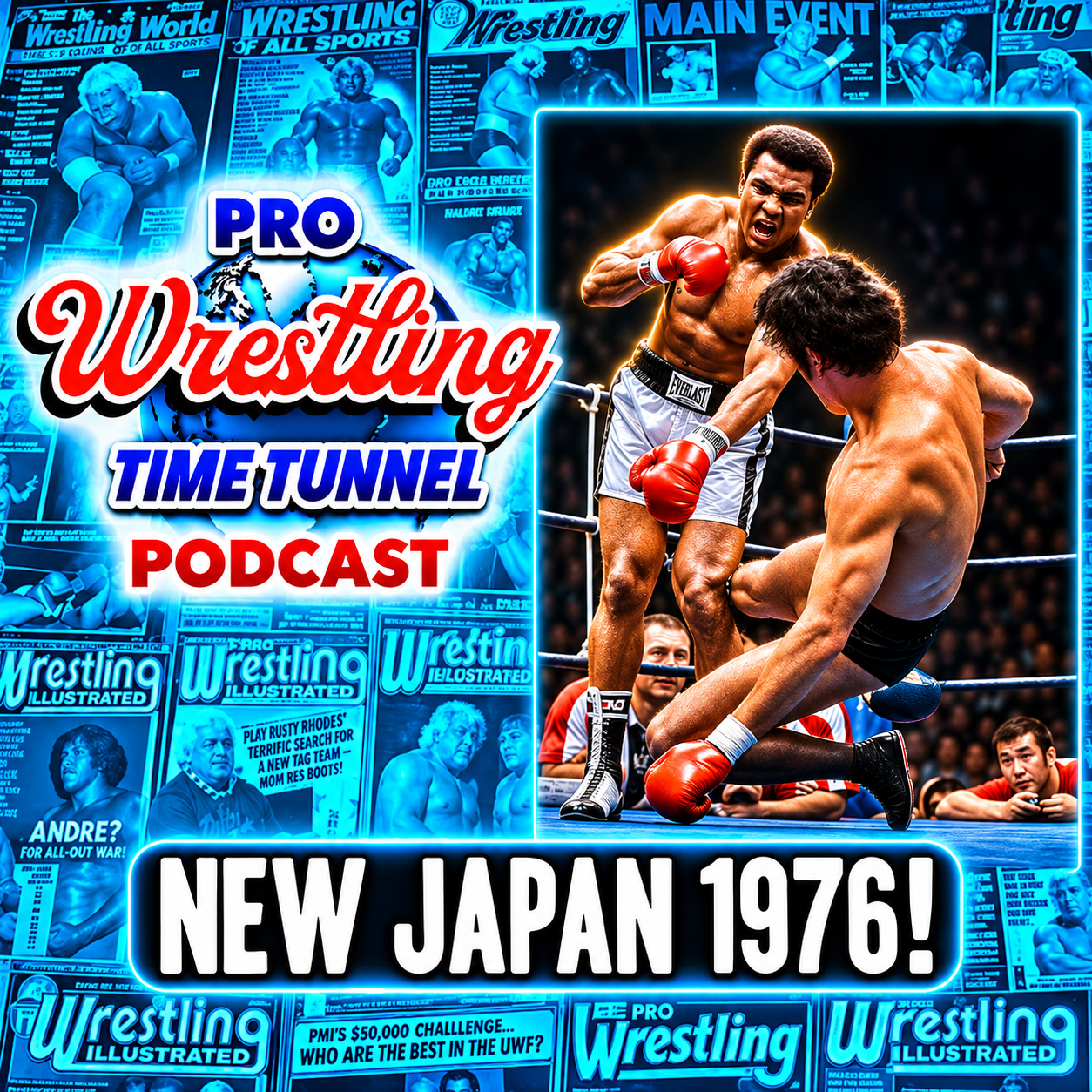
But yeah, that was Inoki's image. And actually by this January of 1976 that this communication and negotiation against. With. With Muhammad Ali people was ongoing from the previous year. You know, he took. It was like the one whole year project to make that Muhammad Ali fight actually happened. And this was 1976. June, June 26th. Was it? Was that it?
[00:12:01] Speaker D: Yes,
[00:12:02] Speaker E: was actually Antonio Noki against Muhammad Ali fight really took place. Yeah.
[00:12:10] Speaker D: Boxer versus wrestler
[00:12:12] Speaker E: and the boss world champion at the time. How's that? Yeah,
[00:12:15] Speaker D: yeah, that's right.
[00:12:17] Speaker E: But this NWF and the PWF thing was also a story in New Japan. Antonoki against, you know, Old Japan Jan Baba. The. The PWF Pacific Wrestling Federation.
That Jan Baba's championship belt was coming from like supposedly hon. Hawaii with Lord James Blairs, you know, and recognized by pwf. But people knew he was kind of new. But NWF title Inoki held forever was actually from America, you know, from Cleveland, Ohio, the Buffalo, New York that the NWF National Wrestling Federation. Was that it?
[00:13:04] Speaker D: Yes, we
[00:13:05] Speaker E: always call the nwf was that National Wrestling Federation.
[00:13:08] Speaker D: That was it.
[00:13:08] Speaker E: But anyhow that the company actually existed and people didn't think Enoki could win what actually exists in America.
He beat Johnny Powers in Japan in a title. Actually, you know, this physical belt actually stayed in Japan. Of course Inoki purchased it, you know, but
[00:13:29] Speaker D: I started to say he actually bought it, bought the title, bought the company too, I think didn't he
[00:13:33] Speaker E: bought the whole company and the nwa. But it was very exciting that, you know, it was the way of being way of Enoki telling people that, see, we can win American title and championship belt can stay in Japan, whereas Baba can win NWA title but will never stay here. Right?
Yeah, he never said it indirectly, but people figured out right, you know, he can beat American champion and the actual championship belt can stay in Japan.
[00:14:04] Speaker D: The, the match we're talking about, the Ali Anoki match was part of the Golden Fight series. And
[00:14:11] Speaker E: I wasn't. It was special.
[00:14:13] Speaker D: June 26 at the Budokan was the real.
[00:14:16] Speaker E: Yeah, yeah. It was treated as one night very special thing.
[00:14:20] Speaker D: Real world Martial Arts championship. Right.
[00:14:24] Speaker E: Wasn't part of the. Part of the tour.
[00:14:26] Speaker D: Okay, separate Antonio Antonio Inoki and Muhammad Ali. Boxer versus wrestler. 15 rounds ended in a draw after Anoki spent most of the match on his back.
[00:14:40] Speaker E: Educated. I. 50 years later.
Oh, I. I've watched it at least 20 times. Entire 15 rounds of it, you know, over and over. But now that the people's eyes are very educated with, you know, mma watching mma now that what Inoki did, what Ali was doing made so much sense as that's what it looked like when you actually fight.
[00:15:03] Speaker D: Yes.
[00:15:04] Speaker E: And now it looks so much better with educated eye and. And all these, you know, added knowledge to the, you know, what can happen in the ring, you know, in that under the circumstance. But at the time, yes, it was written by the act. All the new actual news and even you know, the network news from network channel that didn't even cover wrestling. You know, every channel and every actual newspaper covered it, you know, as a.
As a something very like a disappointing thing, you know, expected fight. Inoki laid there kind of thing.
[00:15:47] Speaker D: Yeah, it was on wild wide World of Sports here in America covered big, big time. It's a huge hyped thing.
They drew a 14,000 two and a half million at the gate, which was a record at the time. And they had the worldwide closed circuit television. Closed
[00:16:06] Speaker E: circuit television? Yep.
[00:16:08] Speaker D: Hundreds of million to almost a billion people.
Japanese television ratings were extremely high for the event.
And
[00:16:17] Speaker E: they, they aired it twice actually. It was Saturday, Saturday morning.
Believe it or not. Back in 70s Japanese school.
We. We had school Saturday morning until noon. You know what I'm
[00:16:33] Speaker D: saying? No, I didn't know that. Wow.
[00:16:35] Speaker E: Yeah. So Saturday, it was Saturday morning. So I was ninth grade. And the Saturday you have like a half day, you know, that the class was on until like 11:30, you know, as, you know, just as soon as you finish your, you know, your fourth, you know, fourth, you know, class, you just ran home. I, I never stopped. I ran home, you know. It was 11 o' clock in the morning, Saturday morning in Japan. Only because it was Friday night primetime special in New York City.
[00:17:09] Speaker D: Yes,
[00:17:10] Speaker E: it was American oriented product.
[00:17:13] Speaker D: Just, Just curious, Fumi, but is that still the case today? Do they have school on Saturday?
[00:17:18] Speaker E: No, not anymore. Not anymore.
[00:17:20] Speaker D: About how long did it
[00:17:21] Speaker E: last?
Huh?
[00:17:23] Speaker D: How long did it last?
[00:17:25] Speaker E: Oh, it was how it was until all. I mean, I don't know, from 18th, 19th century all the way to like, like 80s. Yeah.
[00:17:37] Speaker D: Yeah. Wow.
[00:17:38] Speaker E: Saturday morning. Yeah, it's different.
Different common sense, different custom, you know that the Saturday morning we always had school in Japan. But not. It's. We don't have that anymore, you know. But when I was a kid, there was a school Saturday morning. Kind of. Kind of like you go in church in the Saturday morning, you know. But the Muhammad Ali in Oki fight was Saturday morning. Oh my gosh. And that the, the match start at noon. Oh my God, we have to be home. All the kids, every kid I remember, everybody ran home, you know, couldn't wait for bus, anything. We ran home, you know, to watch, you know, Keali fight. But they aired it again that, you know, same night in Japan, you know, rerun, not a rerun, but the taped version of it, you know. And it was because they had to do it Friday night, you know, prime time special from Shea Stadium, New York. You know, you get a big screen set on the pitcher's mound or something and you know, they were showing it. And the live special from Shea Stadium, live show main event was Bruno San Martino against Stan Hansen. Bruno's come with a comeback match from it.
Yeah,
[00:18:51] Speaker D: well, as, as you mentioned, it was criticized heavily as being boring.
[00:18:57] Speaker E: Yeah, boring at the time.
[00:18:58] Speaker D: Yeah. And you know, the US closed circuit
[00:19:03] Speaker E: Ali people didn't allow wrestling people to wrestle, you Know, it was really like almost political.
And Ali people said no karate job, no actual kicking, no actual wrestling, that the Enoki cannot wrestle standing.
But Inoki didn't want to get punched. You know, this is really serious thing. The Ali people, when they came in 10 days before the match, they asked when are we going to have rehearsal? The Enoki people said there's no rehearsal.
Then they started thinking they, they all came in to have this big TV special exhibition, you know, you know, like wrestler against, you know, wrestler against, you know, boxer. And it's going to be all choreographed and all right.
[00:19:54] Speaker D: Yeah.
[00:19:54] Speaker E: And all the, all the people ask, you know, when are we going to have a rehearsal?
Or too many people, too many people, press photographers is surrounded by media that they all watching. And Enoki people never want, you know, was going to have rehearsal. They really wanted to go in there. But don't let Ali people pack up and leave.
They were ready to leave anytime, you know what I'm saying?
[00:20:20] Speaker D: Yeah. And, and they got to thinking that the Anoki people were going to pull something.
So they
[00:20:26] Speaker E: don't really trust. Yeah,
[00:20:27] Speaker D: yeah,
[00:20:27] Speaker E: yeah, yeah. And Also it was 1976, the communication was that goes both ways. You know, these people didn't trust Ali people, these people didn't trust Inoki people. But that had to happen because this is TV Asahi special with big budget.
And Ali people told, you know, TV Asahi that okay, we have to make 6 million dollar.
But what was like how started like a joke.
What was 6 million dollar was like the, the most expensive man you can imagine. Remember that the very popular TV show at the time, Six Million Dollar Man.
[00:21:07] Speaker D: Oh yeah.
[00:21:09] Speaker E: It came from that, you know, well, you have, you have to pay Ali 6 million dollar and Tbsah hit done.
You know, they really wanted to make it happen. Initially it was Muhammad Ali against Takamiyama, the sumo wrestler Jesse from Hawaii. Takamiyama against Muhammad Ali charity event.
But the sumo people didn't want to have anything to do with it. And TV Asahi people was going like this. Inoki heard about it. Right, Let me do it. This 30 year old Anthony Noki thought it was the greatest opportunity of all time. Inoki actually step into the ring against people like Muhammad Ali and worldwide audience.
Before pay per view. I was gonna say pay per view, closed circuit all over. Yeah, yeah. And that made Inoki even more popular. Enoki wasn't the big star in America at the time. Right,
[00:22:14] Speaker D: right. That's right.
[00:22:15] Speaker E: Yeah. Yeah. So. Or the promoters like Vern Gagne, the Vince. Oh, Vince. They enoki and Vince McMahon Senior had, you know, partnership, you know, but people like Fern Gaga, the Dicta Bruiser, the Chic, you know, the, you know, territorial promoters.
Yeah. Who is Anthony Yogi? I thought that when you say Japanese wrestling, you thought it was Baba.
[00:22:39] Speaker D: Yeah,
[00:22:39] Speaker E: you know.
[00:22:40] Speaker D: Yeah.
[00:22:40] Speaker E: And you find out no, Baba and Enoki actually is pretty equal in Japan. Oh, yeah. I didn't know that kind of thing.
[00:22:48] Speaker D: Yeah. All those, all those NWA members were accustomed to Baba.
[00:22:53] Speaker E: Oh, definitely. Most definitely. Yeah. But the Enoki had a bigger picture, you know, or like, like think thinking out of the box kind of thing, so to speak. Right.
And it was 50 years ago now, but we still talk about Enoki Ali thing and the people who came after that, they're looking at this Inoki Ali fight as that was the birth of mma.
[00:23:19] Speaker D: Yes, it was.
[00:23:20] Speaker E: You know what I'm saying? Yeah. At the time was a joke. Right. But to make this thing happen, Inoki knew it was gonna be criticized and it wasn't going to be good fight. But you can have so much more after that, you know what I'm saying?
[00:23:39] Speaker D: You bet.
[00:23:40] Speaker E: Yeah.
[00:23:41] Speaker D: Going back to the run up to the June fight.
Starting out the year with the big fight golden
[00:23:49] Speaker E: series.
[00:23:49] Speaker D: Big fight series.
[00:23:51] Speaker E: Big fight series.
[00:23:52] Speaker D: Actually, let's see.
[00:23:53] Speaker E: Johnny powers. Yeah,
[00:23:54] Speaker D: yeah. February 6th in the Budokan. We. I don't know if we mentioned or not, but that was when Anoki defeated the Olympic judo
[00:24:03] Speaker E: will very first. Very first that the mixed martial arts fight prior to Muhammad Ali fight.
[00:24:12] Speaker D: Yeah.
[00:24:13] Speaker E: But when you do that with judo and that William Ruska had a judo ghee, you know, and you know, he was doing, you know, was able to do all kind suplex, you know, the, the ones you know, you can do is, you know, Ali. But William Maruska was really, you know, willing to this grappling thing. It looked good though. Really. Yeah, it was very exciting match.
[00:24:38] Speaker D: February toward the end starts the big fight series. We've got who we got here. We got Black Gordman and Goliath
[00:24:45] Speaker E: Goldman. Goliath, yeah.
[00:24:47] Speaker D: We got Ron Starr, Johnny Powers.
[00:24:50] Speaker E: Yeah. My Mountain cannon.
[00:24:52] Speaker D: Yes.
We've got
[00:24:55] Speaker E: Dancer. I know.
[00:24:57] Speaker D: Sakaguchi and Kobayashi winning the vacant North American tag titles.
Getting into March, the, the tour rolls on. And Noki is the NWF champion. Beats Johnny Powers in two falls. And Sakaguchi and Kobayashi beat Gordman and Goliath who were a major tag team.
Yeah,
[00:25:21] Speaker E: yeah, yeah. From la. Yeah.
[00:25:23] Speaker D: Yep.
[00:25:24] Speaker E: Yeah. It was good though.
[00:25:25] Speaker D: Getting into April and May we got the third World League tour
[00:25:32] Speaker E: competing with champion Carnival of World Japan.
[00:25:35] Speaker D: Round robin tournament. April 2nd
[00:25:38] Speaker E: comes. It's a serious, serious singers tournament. Yeah.
[00:25:43] Speaker D: And the World League. That was something that goes all the way back to JWA, right?
[00:25:49] Speaker E: Yeah. Ricky Dozens. Yeah. Like 1959, you know, till 1963, you know, you, you had Ricky Dozen against.
Look at people like Enrique Dorris, the JI Jesse Ortega, the Big Mill, Bill Miller, the Freddie Blassie Luthers, the Killer Young, Killer Kowalski. It was a real big thing. A real big thing. And Enoki revived it, you know.
But it was, you know, didn't have that many, you know, big superstar. The first two years were Enoki against Killer car crop, you know,
[00:26:23] Speaker D: and Killer Carl is in that again this year.
[00:26:26] Speaker E: Yeah, but you had the Pedro Morales for the first time, you know, like a real superstar. Yeah,
[00:26:31] Speaker D: and he, and he had 13 points.
Then he had Sakaguchi, you had Krupp, you had Victor Rivera who scored all scored 10 points.
[00:26:41] Speaker E: The story was that Inoki had to withdraw from that round robin tournament to concentrate on, you know, to upcoming Muhammad ali fight.
And March 25 he flew to New York. Inoki and, and Muhammad Ali with all the press at the New York Plaza Hotel they had a huge press conference to announce that actually in Oki Ali fight actually happening. So he left. You know, Inoki left Japan during this store, you know. But it was, it was good that the final was, you know, that the Sakaguchi against Pedro Morales. So it's convincing tournament final.
[00:27:20] Speaker D: And Sakaguchi was.
Saruta was right under Baba in all Japan. And so Sakaguchi was right under Anoki in New Japan. Right.
[00:27:29] Speaker E: They're trying to make it equal
[00:27:31] Speaker D: because.
[00:27:32] Speaker E: Okay, yeah, Enoki and Sakaguchi made New Japan together. It's like, you know what I'm saying?
Actually Sakaguchi coming from JWA saved New Japan, you know. And Sakaguchi himself was a, you know that the world class judo champion. You know, before wrestling he was the 1967, 1968 Golden Rookie. Just like Jumbo Torudo was, you know, and, and also perfect lieutenant for Enoki's company. You know, everybody knows that, you know, he's a president of New Japan Pro Wrestling. But you don't expect Enoki to do the desk work, you know.
[00:28:12] Speaker D: Right.
[00:28:13] Speaker E: He's Hulk Hogan and Ric Flair and you know what I'm saying that he is a superstar. But you expect Sakaguchi to be sitting behind the desk much like you're, I don't know, Grizzly Smith or somebody like that, you know.
[00:28:29] Speaker D: So May 11th at the Tokyo Metropolitan Gym we have Sakaguchi defeating Pedro Morales by count out. Count out.
[00:28:37] Speaker E: Yeah. But it was good because it was like a body slamming, body slamming the. The Pedro must over the top rope, you know. So it's like a very convincing.
People start realizing that it's very hard to have counter three, you know what I'm saying?
Educated wrestling fans in 70s start thinking, is this gonna be a 1, 2, 3, pinfall finish?
Can he beat him? Or the, you know, some submission like a covert twist abdominal stretch kind of finish or the count out or dq or you, you expect, you know, half the time. Jan Baba and Abdullah the Butcher. Double, counter double. It's a time to go home, you know, kind of thing. People are so educated, you know what I'm saying?
[00:29:25] Speaker D: Yeah.
[00:29:26] Speaker E: But in their own way. You know, when you talk about, when you talk, you know, wrestling with wrestling fans, each and every one of them have their own definition of how. What it is. Right. So it was like, it was good that Sakaguchi didn't really beat Pedro Males. One, two, three. But it was convincing enough finish that he body slammed Pedro Morales off the top rope. Pedro Morales didn't, you know, make it back. So Sakaguchi won the tournament. It was good though.
[00:29:57] Speaker D: So Sakaguchi wins the third annual World Killer Carl Krupp does not go three, three in a row. He.
[00:30:04] Speaker E: Right, right, right.
[00:30:05] Speaker D: So
[00:30:07] Speaker E: much bigger star than the people thinking,
[00:30:09] Speaker D: oh my gosh, he was huge there and, and he didn't work very well here. But he still has the best look of a heel. I mean just, he looks like a.
July and August we have the Asia League and this is where the, the titles get. No,
[00:30:26] Speaker E: you, you had the Golden Fight series after that, after the World League.
[00:30:29] Speaker D: Yeah, we, yeah, we, I thought we talked about that, but maybe we did
[00:30:34] Speaker E: Jerry Brown and Buddy Roberts, you know,
[00:30:36] Speaker D: Hollywood Blondes. Yeah,
[00:30:38] Speaker E: yeah. They were pretty big deal there for a while. Yeah. Yeah.
[00:30:44] Speaker D: So let's see. Then we got, then we go to the Asia. Yeah. Asia League and the, and the titles get created July and August, July 29 in Osaka. Tiger Jeet Singh defeats CG Seji Sakaguchi two out of three falls to become the first Asia heavyweight champion.
[00:31:03] Speaker E: He never defended that much after that, you know. But it was for New Japan's purpose to create their own Asian title single and tag. Because Baba was recreate, you know, reviving that same name title. Interesting.
[00:31:18] Speaker D: Anoki was very fond of Tiger Jeep Singh.
[00:31:23] Speaker E: Yeah. But they was convincing enough that they made it look like they really hated each other.
[00:31:28] Speaker D: Right.
I
[00:31:29] Speaker E: mean aggressing 101
[00:31:31] Speaker D: yeah, you bet.
Asia Tag League Sakaguchi and strong Kobayashi beat Singh and Gamma Singh.
[00:31:39] Speaker E: Yeah.
[00:31:40] Speaker D: Become the first Asia tag team champions.
[00:31:44] Speaker E: Yeah. And also that tour had the single boro mango before Mass Superstar, you know.
[00:31:52] Speaker D: August 5, Anoki versus Singh for the NWF title in double count out. And it's
[00:31:59] Speaker E: okay.
[00:32:01] Speaker D: Other, other. The Mongols are there. Ali Baba is there.
There were some also dates,
[00:32:10] Speaker E: different kind Gamma scene in different Alibaba and I don't know who they were but they brought in this Asian wrestlers and Henry from Mexico. You know.
[00:32:19] Speaker D: I think Anoki runs some shows in Brazil that month as well.
September and October is the Tucan series. Is that
[00:32:29] Speaker E: series. It's a fighting spirit series.
Oh yeah.
[00:32:33] Speaker D: So
[00:32:34] Speaker E: is fighting spirit. You know, Inoki's image. Fighting spirit Tokon.
Whereas Giant Baba has giant series same time. It's so much rivalry though, you know what I'm saying? Even the name of the tour.
Yeah.
[00:32:49] Speaker D: So Anoki, the real world martial Asia arts champion defeated Andre the Giant by tko. And the referee decision.
[00:32:58] Speaker E: It was mix martial arts fight. The title still wasn't created yet.
Yeah, yeah.
[00:33:06] Speaker D: Do you remember much about the match with Andre?
[00:33:09] Speaker E: They treated this Andres. Well they've done it 10, 15 times before that. But they treated this very Inoki under match as this is going to be mixed martial arts rule. What's the death? Right, but at the time Andre was moving real well, you know, doing the reverse suplex, you know and that the Andre tried to get this, you know, back breaker, you know, body wise thing. And he said it back and actually Enoki throws big hundred suplex in.
You know, he gives him, you know, short arm scissors the key lock.
Andre picks him up and they actually really worked well together, you know. And this 1976 version of Andre was able to move really and big juice. Well, I shouldn't say it, you know, the bloody, you know, bloodied up Andre and then they stopped the message. What was the record? That it was a D double DQ finish.
[00:34:16] Speaker D: The technical knockout.
[00:34:18] Speaker E: Technical knockout. Okay. Referee called the match because bloody stuff. Andre bled too much that he had to stop it. I mean you have to come up with some finish, different finish, you know.
So at the time even you know, like in 70s referees sometimes stop the match, you know. No, no, you can't continue. You can't continue. Therefore the winner, Antonio Inoki for that evening. Yeah,
[00:34:43] Speaker D: yeah, it was
[00:34:44] Speaker E: one of the better Andre Inoki match though, I believe. Well, they did it like what, 20 times, you
[00:34:50] Speaker D: know. So yeah, it's a lot, A lot.
Yeah. November, December, we got Toucan Series 2.
[00:34:57] Speaker E: That was pretty good one too. Yeah. Ivan Cola, Superstar Billy Graham,
[00:35:00] Speaker D: Pat Patterson, Larry Ricky Hunter.
Anoki worked a lot of multi fall tag matches and singles matches. Carl Gotch Cup. Follow that with the finals around early December.
[00:35:19] Speaker E: Much like your Young lion cup. Yeah,
[00:35:21] Speaker D: yeah. December 9th, we got Willem Ruska in the match and also Sakaguchi beating Larry the axe hitting 11,000.
[00:35:34] Speaker E: Patterson was on the tour.
[00:35:36] Speaker D: Yeah, Pat Patterson was on the tour.
December 12, Anoki defeated local fighter Akram Paliwan or something like that in
[00:35:47] Speaker E: Pakistan. That's a historical match. You know, it was like 50,000 people in the audience, you know. Yeah. Very serious situation. We didn't know there was professional wrestling in Pakistan. Well, it's like there is no concept of professional wrestling. They were like your local folk wrestling hero, you know. And Inoki actually, actually went in. You know, what was interesting in 76 was that Enoki had a William Riska fight. Right. And Muhammad Ali fight, of course. And he went to Korea and had a very serious bloody match against Pakistan.
The Pakistan works in America as big. I mean, looking almost like Jan Baba. But he went back to Korea and had a serious single match, bloody match against Antoninoki. That was also 76. Then this Akram Paun that the folk hero from Pakistan. And actually there was like politicians, you know that, the senators and very, you know, serious people and audience that Fujiwara told me, you know, the Yoshiaki Fujiwara, you know, they don't. He was actually seconding Inoki and actually attending his. Carrying his, you know, his suitcase and everything that he didn't think he could get out of the building because, you know, this is not what you think is your everyday professional wrestling atmosphere or the environment.
They've never seen anything like it. Of course they believe he was all serious, you know what I'm saying?
And Inoki actually dislocated this guy's shoulder, you know, because he. This guy couldn't get, you know, tap. I mean it could be accident, could be shoot, could be something more complicated. But they had to stop the match. With Inoki's double, the struck arm lock, something happened and he snapped the shoulder. But it was actually like very right way to finish the match or nobody doing jobs. Right,
[00:37:58] Speaker D: right.
[00:37:58] Speaker E: Or there's no concept of putting anybody over or the. This Paxton audience didn't know what wrestling meant, you know. And after the match, Inoki became their religious hero too. They Inoki actually be their local hero. Borrow family, borrow bro brothers. And they became friends, much like Ali. That Ali and Enoki for lifelong friendship after that. So they really share this like athletes, professional athletes, camaraderie kind of thing. Does that make sense?
[00:38:36] Speaker D: Yes.
[00:38:36] Speaker E: Yeah. Something they shared in the ring that they could only share in the, in the ring.
[00:38:41] Speaker D: And
[00:38:42] Speaker E: they really understood each other despite the language. And Inoki really walked on the thin ice like that.
Yeah, Baba wouldn't do it.
[00:38:53] Speaker D: The Anoki's martial arts legitimacy was the core of what New Japan really was. And the biggest long term story for the year, of course is the Ali and Inoki match. But it was surrounded by this, the Ruska and the match we just talked about from the guy from Pakistan. The hard
[00:39:12] Speaker E: one. Yeah,
[00:39:13] Speaker D: yeah. And of course the one little thing that was a little different was the Sakaguchi win for the World World League tournament that didn't focus on Anoki. But overall, I mean, where do you, where do you put 76. What, what kind of year was it for New Japan in its history?
[00:39:31] Speaker E: It was very interesting and a very special year. That of course Inoki Ali fight, you know, happened. It made Inoki even worldwide, you know, that the figure that the people in America, not just the, the closed circuit audience, but the American traditional promoters, like guys you and I talked to, like people like Verngaganya, the Victor Bruder, they really recognize they carried the Inoki Ali the closed circuit in, in their territory. You know, that very same night, AWA had a Chicago International Amphitheater. You know, Ver G Binko, Ray Stevens, Dick Mordock.
Yeah, Dick Mordoch, Dusty Rose against, no, probably not, not the time. The Dick the Bruiser and Crusher against people like Bobby Dunham and Lanza or somebody. They had a big fight. The Houston, Texas, they were showing Enoki Ali on screen. But the live event, they had Terry Funka against Rocky Johnson, NWA title match all over this Americans wrestling territory had their own big matchup. And Enoki Ali fight on screen. It really, they, they really were part of it, you know, and they recognize, you know, his, you know, like his like recognized name in Japan. They really recognize Inoki as somebody special for the first time. They didn't even think of him all that much up until then.
And yeah, it was like everybody knows Muhammad Ali, you know, and only wrestling fan knew Anthony Inoki, huh? So it was the night that really made Enoki even more special. That was 1976.
[00:41:17] Speaker D: Well, one of the things I wanted to ask you about too, and we mentioned his name briefly when we talked about the cup, but we haven't really talked about Carl Gotch's influence on Anoki. And that was really huge, right?
[00:41:31] Speaker E: Huge. Huge.
Yeah.
[00:41:33] Speaker D: So the whole martial arts presentation and the whole background of his training,
[00:41:39] Speaker E: you said it's martial arts, but Enoki was never martial arts master. What background does he have?
A little bit of a karate maybe.
[00:41:50] Speaker D: Yeah.
[00:41:50] Speaker E: And
[00:41:51] Speaker D: the years he grew up in, lived in Brazil, right? And.
[00:41:55] Speaker E: Oh, two years,
[00:41:57] Speaker D: right?
[00:41:58] Speaker E: Yeah. The. The Carl Gotch wasn't martial arts, he was wrestler, you know, Wigan.
[00:42:05] Speaker D: As a matter of fact, it was called the God of Wrestling. Right?
[00:42:08] Speaker E: In Japan. Yeah,
[00:42:09] Speaker D: in Japan.
[00:42:11] Speaker E: But it was created name like a nickname God of Wrestling on 75 on. But when I was a little kid, Coral Gotch uncrowned champion.
You know what I'm saying? Uncrowned champ. I mean champion without actual championship belt, you know. And Carl Gach was the image that when he. When Carl was wrestling, wrestling was real.
That that's how story. Then when Inoki opened New Japan Pro Wrestling 1972, he went straight to Kach. Please help me open this company.
And the march.
March 1972, the very grand opening of New Japan Pro Wrestling at the Otaku. You know that the gymnasium. Inoki against 47 year old Kach match. Single match, no championship belt, nothing. Single match. Inoki against Korogach. And Kach beat him. You know what I'm saying? Very smart.
Grand opening of New Japan Pro Wrestling. You would think Inoki be beating Korogach for the first time. Right,
[00:43:12] Speaker D: right.
[00:43:12] Speaker E: Instead Coral beat Antonoki. It made it so much harder to conquer Kot. You know what I'm saying,
[00:43:20] Speaker D: right? Yeah.
[00:43:20] Speaker E: And Korogach is the one who had this, this m. This like a almost mysterious, magical
[00:43:29] Speaker D: mystique,
[00:43:30] Speaker E: mystique aura about him. And he spoke English but with German accent and Flemish. And he was a war survivor. And it just goes all the way back to this, this his very background, you know. And this Carl Gotch, I mean he looks, stands and looks so dignified.
He wrestle like, like. You mean it? Of course, you
[00:43:58] Speaker D: know, there's a. There's a little relationship with thes also. Yeah,
[00:44:03] Speaker E: yeah. When I was fifth grade. That's a long time ago. When I was fifth grade, I went to watch second version of Inoki Ali. I mean Inoki Koroga single match. Inoki beat Coral. Count out,
[00:44:17] Speaker D: count
[00:44:18] Speaker E: out finish.
And the next year when I was sixth grade, it came back with Inoki Sakaguchi against Korogachi. Luther's tag team match. 90 minute time limit. 2 out of 3, 4 match.
And the first time I watched this, no coming in. You just Tag in, tag out. You know, you would think somebody gives big move and you cover one tuning, somebody comes in and kick them and break it. Right,
[00:44:45] Speaker D: right.
[00:44:45] Speaker E: None of that happened. None. Not once. Sakaguchi waiting for Inoki to tag in, tag out and you know, Carl Gotch wrestling and Luthes, you know, wait in the corner, just clean come in and come out and wrestle again and come, you know, tag out, tag in, you wrestle again. And just the cleanest thing you ever seen. I mean, when you watch, you know, Abdullah the Butcher against Jan Baba bloody match on TV the same very same week, you would think this is wrestling.
[00:45:17] Speaker D: Yeah, right.
[00:45:18] Speaker E: That was my, my sixth grade experience,
[00:45:21] Speaker D: of course. And
[00:45:22] Speaker E: big karach fan all my life.
[00:45:24] Speaker D: I mean you got the. Oh my gosh. Yeah, me too. And so when you talk about these big things. Three matches in 76, the, the Ruska match in early
[00:45:34] Speaker E: match
[00:45:35] Speaker D: in February. Then you got the Ali in the summertime. And then in the end of the year,
[00:45:40] Speaker E: June. Yeah,
[00:45:41] Speaker D: yeah, June you got the Pakistan match toward the end of the
[00:45:44] Speaker E: year, December. Yeah,
[00:45:45] Speaker D: yeah. Was this kind of the peak of this different style type thing that was going
[00:45:50] Speaker E: on. It just so happened 76 was the initial year that.
Well, it's a two reason Inoki and New Japan Company owed so much money to TV Asahi. TV Asahi channel 10 at the time, that's 5. But channel TV Asahi covered all the expense for Muhammad Ali. I mean, six million dollar wasn't joke. They had to pay Ali people. Not just Ali, but the whole network of Ali people. Right,
[00:46:20] Speaker D: right.
[00:46:21] Speaker E: That TV as I covered it. So they came up with this strategy Inoki in the next course of next three years or so, twice, three times a year they'll have network special Inoki against world martial arts kind of guys, you know, Enoki against monster man. Kickboxer Inoki against Kim CRO Kade,
[00:46:44] Speaker D: Willie Williams.
[00:46:46] Speaker E: Yeah, of course, all the way to like 1979.
[00:46:49] Speaker D: Yeah, you got Chuck Webner. They're gonna have Alan Co.
[00:46:54] Speaker E: Yeah,
[00:46:55] Speaker D: bad news Brown. You know,
[00:46:56] Speaker E: by then it became work, of course, you know, just like professional wrestling. But it was convincing enough. Inoki against named like kickboxer karate fighter. Chuck weapon of heavyweight boxer separate from wrestling program. They did that on network special on weeknight a couple times.
And that's how Inoki in new Japan repaid TV Asahi that the billions of. Not billion but six million dollar back in 1976.
[00:47:31] Speaker D: A
[00:47:31] Speaker E: lot
[00:47:32] Speaker D: of money. A lot, a
[00:47:33] Speaker E: lot of money. And Enoki and New Japan kept paying back TV Asahi until 79 or so. So Enoki had To have a lot of mixed martial arts fight, of course, for his image. He wanted to do it, you know, because it made him a little bit above. It's not good, but above pro wrestling or something.
[00:47:53] Speaker D: Yeah.
[00:47:53] Speaker E: It
[00:47:54] Speaker D: differentiated him into being more
[00:47:58] Speaker E: real looking.
[00:47:59] Speaker D: I started to say legitimate, but. Yeah, yeah, real. Real legitimate. Yeah. It was exactly what he wanted the company to be known for.
[00:48:07] Speaker E: Yeah. Yeah.
How
[00:48:09] Speaker D: did that. Let me ask you this.
How did that affect the undercard? Like, how did the undercard function with this different styles on the. In the main event,
[00:48:21] Speaker E: not everybody. Not everybody had the Enoki style, you know, that was it. More wrestling.
[00:48:27] Speaker D: It was
[00:48:27] Speaker E: like pro
[00:48:28] Speaker D: wrestling. Right. Pro wrestling.
[00:48:29] Speaker E: When you have, you know, Black Gortman and El Goliath, you have their kind match.
[00:48:34] Speaker D: Yeah.
[00:48:35] Speaker E: When you have Jerry Brown and Buddy Roberts, Hollywood Blondes, they'll do the Hollywood Blonde thing, you know.
[00:48:40] Speaker D: Right.
[00:48:40] Speaker E: And it's okay. Tiger G Sing won't be doing martial arts.
He'll be throwing cheer and he'll be doing, you know, just, you know, the foreign object out of his tights. I mean, Tiger G swing will always be, you know, kicking the people's gut. Tiger J. Sing, actually, when I was kid, I was so sick of Tiger G again and again and again. But when I grow up, watch now I watch Tiger GC on YouTube all the time. This guy, I enjoyed it.
[00:49:09] Speaker D: Yeah.
[00:49:09] Speaker E: And I Now, I like this. This.
This guy always looks like Tiger Jeep Singh. And he was so believable in his own way, you know?
Yeah. Crazy guy, you know that two or three guys holding him. No way. Nobody's crazy like that. But the Tiger 70, 1975, 677 version of Tiger. Jason come out of dressing, they might jump on audience, you know, you might get hurt. And young wrestlers holding him and holding him, or Tiger start running and he start hurting people or something. This is some crazy idea, but it was believable in his own way, you know,
[00:49:51] Speaker D: it's just kind
[00:49:51] Speaker E: of St. Henson learned it from Tiger G. Singh walking into audience with his cowboy and.
[00:49:58] Speaker D: Yeah.
[00:49:58] Speaker E: You know. Yeah. It went on. Yeah. Believability.
[00:50:03] Speaker D: It was just kind of interesting, the two different paths that these two giants of Japanese wrestling decided to, no pun intended, decided to take. I mean, Baba when he founded all Japan, he reached out to the nwa, he reached out to the Funks, he reached out there for connection.
And also Bruno and some other American wrestlers, the Noki reached out real business.
And Anoki connected with Gotch and
[00:50:30] Speaker E: Sure.
[00:50:31] Speaker D: And. And connected with him to give New Japan the. The mix.
[00:50:35] Speaker E: Everything's real
[00:50:37] Speaker D: yeah. Did you stay a Carl Gotch fan for most of your life?
[00:50:42] Speaker E: Yeah. Yeah. And then also he was God. Oh, I should. This. I wouldn't say God enough is a bad way to put it, but when I met him in the person finally in, in, in early 80s, he didn't disappoint you? He was exactly what I expected. He was Carl Gotch, you know. So I started visiting just about every, you know, every other year and went to, you know, Odessa, Florida to visit him, you know, and just sit down and talk to him for a couple hours.
Korgach did not really disappoint you? He really talked like Korgach.
No, nobody's watching. But Kargach gets up in the morning and does two hours of his conditioning, you know, and he goes to bed when sun goes down, you know. Then I asked him, why are you still training, you know, like, you know, like early morning. He has his morning dozen and.
Because I eat a lot.
Oh yeah, I eat a lot. I drink too. Okay, sir. And he was every bit Korogach and his home garage that his friend Jeff Ports. English, lesser.
[00:51:54] Speaker D: He
[00:51:55] Speaker E: was also carpenter.
[00:51:56] Speaker D: Yes.
[00:51:56] Speaker E: They together build up their. Just their original, you know, push up, you know, push up machines and pull up machines and they came, they. They build their own equipment. You know, they just did, you know, that. And his. All this, you know.
[00:52:12] Speaker D: Yeah.
[00:52:13] Speaker E: Chains and the pull up machines and the, you know,
[00:52:17] Speaker D: I remember, I remember hearing the stories about the deck of cards thing.
[00:52:21] Speaker E: Oh yeah, yeah, deck of card. Until.
Until all the cars are gone. That's crazy. You doing two hours push up and two hours, you know, Hindu squads.
[00:52:30] Speaker D: We were
[00:52:30] Speaker E: talking.
I do it. You know what I'm saying?
[00:52:33] Speaker D: We were talking about our mutual friend Jody Malenko. And he was, of
[00:52:37] Speaker E: course,
[00:52:37] Speaker D: he was in Waterloo in July. And I always enjoy talking with Jody. And he was about to get his surgery for his various joint issues. And I'm like, so was it just the wear and tear of wrestling that caused your, your problem? He goes, two words. Carl Gotch. Carl Gotch. Carl Gotch. That's the way I got some of this, you know. So it's just funny.
[00:53:01] Speaker E: So it's like the modern day monk of wrestling or is like a real priest of wrestling, really. He didn't make whole lot of money, but he was so dignified and just Kach doesn't disappoint you because he's Kocach 247
[00:53:20] Speaker D: and I, I'm not the, the. I. I rely on you so much for some of this history stuff. But it's fascinating to me how one guy influenced so many different things in one country later on
[00:53:34] Speaker E: different generation. From Enoki generation to Fujinami to
[00:53:38] Speaker D: all
[00:53:38] Speaker E: the way to, you know, Sayamara. Yeah. You know all the way to Pancras.
[00:53:45] Speaker D: Yeah. Well I started saying and whole companies are created out of this, you know with pancreas and rings and pride and all these different things. That's. That's just
[00:53:55] Speaker E: we had dream that is wrestling real is like initial question as a kid. Right.
You kind of quest that it's okay if it wasn't real but there's a group of guys like you know, male that I want to make this into real. That the Akira Maeda's dream of you know Minor Suzuki's dream and went straight to Carl, you know. And then the car aged Korgach in in late 60 made name your company Pankras. Pankras. Okay sir. Then it's therefore there's a pancreas. It's crazy like a comic book, you know.
And there's
[00:54:37] Speaker D: a guy that I've always been a little curious about. Just while we're talking here. Talk about Akira Maeda a little bit.
[00:54:43] Speaker E: Yeah, Akira Maida was. Yeah, he was, you know he was discovered, you know in. In Osaka High school. The tall guys and karate guy, you know. Of course.
[00:54:53] Speaker D: Of course he's. He's infamous for shooting on Andre the Giant.
[00:54:59] Speaker E: Yeah, he wasn't.
[00:55:01] Speaker D: I mean back in the 1980s. Fumi. That's the tape we all traded for. We wanted to see.
[00:55:05] Speaker E: Yeah, yeah. But the 1985 version of Andrew wasn't you under the Giant, you
[00:55:10] Speaker D: know. Right.
[00:55:11] Speaker E: And somebody whispered, you know, somebody whispered in under his ear that Akira Maeda is cocky. So teach him, you know, teach him lesson. Right. And words goes around and you know in the dressing room saying that Andrew is going to do something to you today. It's like no Kira Madison, you know. Well at the time 28:20, 27:20.
[00:55:35] Speaker D: I
[00:55:36] Speaker E: can take care of myself.
Start kicking him. Right. And Andre lay did. It's none of my business. Right. So it wasn't like decorated shoot story if something really went wrong backstage. Somebody whispered somebody weird in their eyes and somebody whispered aide or something and it's like.
It's almost like wild west. Right. It shouldn't be. And there was no actual shoot fight in there. You know there. Something actually really went wrong and somebody like referee, you know and the match had to stop because Andre said they ain't doing it.
Yeah.
[00:56:18] Speaker D: Back at the time it was so unusual to see People not follow along with the match, you know, and for it to go.
[00:56:25] Speaker E: You had Brody and Luger match.
[00:56:27] Speaker D: Yeah, yeah.
[00:56:27] Speaker E: Around the
[00:56:28] Speaker D: same time. Brody and Luger in the cage in Florida,
[00:56:30] Speaker E: kind of similar thing around the same time.
[00:56:33] Speaker D: And it was
[00:56:33] Speaker E: just
[00:56:34] Speaker D: cause people to go, what happened? You know, it didn't. It didn't go like it was supposed to. And then you get all the crazy stories.
[00:56:40] Speaker E: But that reminds me that wrestling is still very human.
[00:56:45] Speaker D: Yes.
[00:56:46] Speaker E: You know, now that this guy way too choreographed, you know, the N WWE entire match. Terry Funk used to, you know, say that this, you know, conversation was Terry Funk.
Since when? Since when?
Since when did people make matches for you?
Wrestlers made match or they just knew few spots and called in the ring because wrestlers knew it.
[00:57:13] Speaker D: Yeah.
[00:57:13] Speaker E: But it's now it's music hit the curtain opens, goes to ring, have a match and comes back. You have seven minutes every step the way choreographed. And Terry Funk was going. Since when
[00:57:28] Speaker D: did
[00:57:28] Speaker E: people make matches for you? He don't think it's wrestling anymore.
[00:57:33] Speaker D: Right. I understand
[00:57:34] Speaker E: that's today's wrestling,
[00:57:36] Speaker D: of course.
[00:57:36] Speaker E: So yeah,
[00:57:38] Speaker D: Japan
[00:57:38] Speaker E: always had that though, you know, this human.
And it's almost like something above what you expected, you know, or beyond, I should say.
[00:57:48] Speaker D: I mean the guy had, you know, in those days that we're talking about in the territory era, wrestlers had a bunch of tinker toys and they could take those tinker toys and make whatever they wanted to make in the ring.
And however the flow of it went and whatever the crowd was reacting to, that's what they did. They just sort of created the art on the fly.
[00:58:12] Speaker E: And there was a real chemistry between two guys too.
[00:58:14] Speaker D: Yes, that's right. Or there wasn't.
There wasn't.
Which became obvious. Right, okay.
[00:58:21] Speaker E: And that makes like believable.
I watched Inoki against Tiger jitsim at least 50 times.
Probably like a 30, 40 single match. Right. But until you get the single match, you have tag team match Inoki and Tiger GC involved. So every week you are watching Inoki against Tiger G Singh, you know.
[00:58:43] Speaker D: Well, I
[00:58:43] Speaker E: do appreciate it.
[00:58:45] Speaker D: Well, the same thing here, like growing up in Kentucky when the PAFOs had their promotion. ICW, I must
[00:58:51] Speaker E: every week same
[00:58:52] Speaker D: guy. I saw Ronnie Garvin and Randy Savage every week for, you know, two years. Three young
[00:58:58] Speaker E: skinny Randy Savage. I wish I was. I was watching it. Yeah,
[00:59:02] Speaker D: yeah, I saw that. I saw those two guys for three years, week after week after week. And
[00:59:07] Speaker E: you
[00:59:07] Speaker D: know, after a while you just didn't appreciate it. And now,
[00:59:10] Speaker E: now it's a Great fun memory.
[00:59:12] Speaker D: It is.
[00:59:13] Speaker E: Yeah.
[00:59:13] Speaker D: Yeah. And I love going back for any footage that's available, I go back and watch it again, you know.
[00:59:18] Speaker E: Sounds good. Sounds good.
[00:59:20] Speaker D: All right, Fumi. Well, listen, man, you've been great. You've been great and generous and thank you for educating me and all our watchers and listener on Japanese wrestling in 1976. You're the man.
[00:59:33] Speaker E: I really appreciate that people want, you know, interested in Japanese wrestling and what it. What it is.
You don't get so much from just by watching video. You do, but you want to know more about it and then we're here to share it, you know, and then we. I even understand more by talking to you.
[00:59:53] Speaker D: Yeah, and. And we want to record the history, too. And all of the people in our community, they're interested in the history. Young, medium, old, they're. They're all interested and they're interested in wrestling in other places like Mexico and Canada and Japan. And I'm hoping I can get a British wrestling expert to come on here pretty soon. So I appreciate you. I appreciate what you have given us and thank you so much.
[01:00:20] Speaker E: Let's do it again.
[01:00:20] Speaker D: I appreciate you and your friendship.
[01:00:23] Speaker E: Okay, so long from Tokyo.
[01:00:25] Speaker D: Many, many thanks to my good friend Fumi Saito in Tokyo, Japan, for joining us here at the Richards Ranch.
Isn't it amazing technology today that I can sit here in this.
It's hard to even call it a town. It's more like a little village that I live in here in Western Kentucky, way back beyond the sticks. And I'm able to connect with Fumi in Tokyo, Japan, and we are able to have the conversation you just had. I don't know that constantly. Just. I guess it's because that I grew up just fantasizing that one day we'd have video phones.
When I watch a Star Trek or.
Or Voyage to the Bottom of the Sea or one of those futuristic shows of my youth where they were doing that. And I always thought that'd be cool to be able to do that.
And so it's amazing if you're born in the 2000s.
It's just that we've always had this stuff and you are going to grow up believing that that's just always been part. It's like the kids who were born in the mid to late 90s who.
Cell phones were always a thing, you know, but we didn't have cell phones before that. We barely sometimes had just phones before that.
Fumi did a great job, as he always does, and I enjoyed that trip through New Japan, I always learned so much and I've got a real interest in Japanese wrestling in the 70s.
And so I'm always glad to connect with Fumi and get educated on what was going on in the Japanese companies.
Well, if you want to check out what's going on in the Grizzly Up Soap Company, I'm about to tell you because man, Grizzly Up Soap Company got all kinds of brand new stuff.
They're in fall mode. They got pumpkin spice and everything nice. They got flannel fresh, they got orange and clove. They got apple of my eye.
All these new scents and flavors of soap.
And if the laundry pile is starting to look like a wrestler's car, then you can grab Cabin Escape laundry soap. Cozy, clean, no grocery store aftertaste. It's small batch and it's Kentucky made. Built for mama bears, daddy bears and every cub you have in your den. If you're going to be a bear, be a grizzly and smell good while you do it. And of course they're located at 200 East 9th street in Hopkinsville, Kentucky. They want to bring pro wrestling territory history to you because that's why they sponsor our show.
And they are open Wednesday through Saturday.
So fall is now here. You need to grizzly up. And they are going to be hitting the road this weekend.
So on the 7th of November, they're going to be at the Sportsplex center in Madisonville, Kentucky for their arts and crafts fair.
So you'll be able to see and sample and touch and smell all the great products from Grizzly up. And then on the 14th of November, they're going to be at the Holiday Artisan Market in Grand Rivers, Kentucky. That's located right here in Livingston county, the same county that the Richard's ranch is in. And of course Grand Rivers is over.
It sets between two lakes. It sets between Kentucky Lake and it sets and Lake Barkley and Grand Rivers is on this little 1 mile strip of land in between the two lakes over there and has grown to be quite the tourist and recreational town.
And there's several little restaurants that I love going to over there and this, that and the other. So if you're going out to the holiday Artisan market this weekend or not this weekend, but the November 14th this weekend they're going to be in Madisonville. But on Saturday, November 14, they're going to be in Grand Rivers. And if you're going out to the Holiday Artisan market, you want to check them out. They got brand new holiday gift baskets of Grizzly UPS best sellers now available all their soaps and lotions, all your favorites and possibly many that you've never tried before. They've also got loose leaf teas.
Yeah, they're making tea now, loose leaf tea, like you drink tea. And they have recycled sorry kimonos.
Now I was on the phone here, Travis was here at the Richards ranch when I called Chastity to talk to her about what she wanted in the commercial this week.
And when she said they had these sorry kimonos, I looked at Travis like, you mean like a kimono? And he said, yeah, like a kimono like you wear. So they got these kimonos that you need to check out as well as they got nativity soap.
So with Christmas holiday coming up, the nativity scene is stamped right into the soap. What better way to remind yourself what the holiday, Christmas season and holiday is all about than having Joseph, Mary and baby Jesus right there in your soap.
And not only that, but I want to tell you about their four year old son, Dane.
Dane has been through quite a bit. He's been through several surgeries. I want to have Travis and Chasity on the show here to talk about Dane. But he just had his last surgery this spring and he did a great job, came through it. Everything's great.
He's got more energy now than he's ever had before.
And now he's come to Travis and Chastity and he wants a GoPro camera.
And they're trying to teach Dane some things. Like if you want something, it's good to work for it.
And so Dane came back with the idea of creating slime like you buy in a kid toy store, right? And so he's created his own company and it's called Kid Crew Creations.
Kid Crew Creations.
And the first product he's coming out with is called Ocean Ooze and it's blue like the ocean and it smells like chocolate.
And every jar comes with its own bag of accessories of cute little seashells and pom pom balls and glitter and resin sea creatures.
That's all in the ocean ooze Slime, which is created by Kid Crew Creations, which is Chastity and Travis's son Dave Dane's little company under Grizzly Up Soap Company.
So they're an enterprising three person family there in Hopkinsville, Kentucky, 200 East 9th street or go online at Grizzly Up Soapco.com. that's Grizzly Up Soapco dot com and we appreciate them sponsoring us here at the pro wrestling time tunnel. Thank you guys very, very much.
All right, let's get into 1976, and we're going to the NWA Tri State Territory in Oklahoma, Louisiana, with towns in Arkansas, some in Mississippi. This is a huge territory, and it was run by Leroy McGurk, who was a former NWA world junior heavyweight Champion. Of course, Leroy was blind, and he, of course, came out of Tulsa, Oklahoma, and his partner, Cowboy Bill Watts, who was not only a partner in the territory, but he was the top draw at the time, and he was the booker. And after he came back from Florida and working with Eddie Graham, he came back right after the big plane crash that took Buddy Colt's career. And it, you know, hurt Gary Hart and several people. Austin idle after that plane crash, Watts came back to Oklahoma, and he already had some points in the territory, but he gained some, bought some more points. He bought out Fritz Von Erich and he bought out Vern Ganya.
And he started booking Oklahoma very much similarly to what he had learned when he was working under Eddie Graham in Florida and he was working under Roy Schier in San Francisco.
It was a very stiff and bloody and territory proud kind of circuit.
And the core circuit rotated around the same programs through Tulsa, Shreveport, Monroe, Louisiana, Alexandria, Louisiana, Baton Rouge and New Orleans. They ran a couple of buildings in New Orleans. They ran the St. Bernard Civic Auditorium in Calmette. And then they would. 1976 would be the first year they would have a special Superdome show where they would run the Superdome. Can you imagine how much confidence you would have to have as a promoter that you're angles and your television were strong enough when you've been running the St. Bernard Civic center and some of these other places on the outskirts of New Orleans. And now all of a sudden you're going to move right into downtown New Orleans and put on a show in the Superdome.
They also ran Lafayette, Louisiana, Jackson, Mississippi, Greenville, Mississippi, Greenwood, Mississippi, Hot Springs, Arkansas, Fort Smith, Arkansas, Oklahoma City, Houma, Louisiana, Laranja, Louisiana. That was the thing, too, about being involved in the Louisiana Athletic Commission.
The athletic commission there wanted to make sure that all the towns in Louisiana would have access to wrestling.
So that's why they ended up running the Laranges and the Houmas and the some of those towns like that, because in order to be licensed by the State Athletic Commission, they insisted that those towns get weekly shows. And so they were at the mercy of the commission, so they ran those.
And you'll notice that later on after the split, Watts works a deal or something, because they don't. They don't run those Towns as much.
They also ran Springfield, Missouri.
They also ran Joplin, Missouri. At times, cards were built around the North American heavyweight title which was held by Watts for most of the year. The United States tag team titles and of course the NWA World champion, Terry Funk would come in a couple of times a year. The junior heavyweight title was a big deal. As a matter of fact, in Tulsa was where the NWA World Junior heavyweight title was primarily controlled there.
But Danny Hodge, of course, was injured and his career was put in jeopardy. And so the NWA World Junior title was not as prominent for the rest of 1976.
Watts had won the North American title at the end of 75, November 26th of 75 in Jackson, Mississippi by beating killer Carl Cox.
The United States tag team titles ran from Greg Valentine and Bill Watts on January 7th to Greg Valentine and Gorgeous George Jr. After Bill Watts was injured by Waldo Von Erich. Hollywood Blondes, Jerry Brown and Buddy Roberts came in and won them on March 18th in New Orleans.
Buck Robley and Bob slaughter, that's, that's. Sergeant Slaughter would be later on March 29th in Tulsa.
And then the young fresh face Ted Dibiase and the older Dick Murdoch would win them April 28th in Fort Smith, Arkansas.
Cox and Bob Sweet Tan would win them on May 11th in Shreveport and Cox and Ken Patera would win them on October 19th.
And then Billy Robinson and Bill Watts would win the TAG titles around November 10th in Shreveport.
And Watts would hold the North American title up until November 9th in Shreveport. So you can see they use the United States tag team titles as a much more frequent switching device where the North American title was pretty stationary. All right, let's talk about January.
So the year kicks off. In January 76, Watts and Valentine beat the Hollywood Blondes for the US tag titles. Watts was then sidelined briefly. Gorgeous George Jr was put in as Valentine's partner and the belts were defended against the Hollywood Blondes and others.
Late in January, Terry Funk made a visit into the territory. World title matches included Terry Funk vs Dick Murdoch in Tulsa on January 26th at the Fairgrounds Pavilion, Shreveport, January 27th, and Funk vs Greg Valentine in the New Orleans Building the St Bernard Civic center on January 29th. A Lafayette show on January 30th featured Terry Funk vs Bill Watts in a hard fought time limit draw.
Parallel programs were Watts versus Waldo Von Erich, which were power matches built around the Iron Claw and Watts Oklahoma Stampede and the early stages of the Ted Dibiase and Dick Murdoch versus Killer Carl Cox feud with Buck Robley in his corner, often in Monroe, Alexandria, Baton Rouge, Greenville and Hotel Springs ran the same rotating undercards. In February, the circuit stayed hot with the same top programs.
Shreveport, February 24th at the Municipal Auditorium had DiBiase surviving a 15 minute handicap challenge against Killer Carl Cox. Cox failed to pin him inside the time limit, so he had to pin him inside the 15 minute time limit match.
He couldn't do it. It went to a draw. Ken Patera, who just arrived in the territory, was squashing mid card talent and climbing. Ratings compiled for the week of February 8th put Watts Murdoch, Waldo Von Erich Cox and Sonny King at the top of the ratings with gorgeous George Jr. And Valentine still the top tag team and the Blondes close behind. Midget matches. Little Coco, Little John, Little Louie, Billy the Kid filled out a lot of the cards in Tulsa, Shreveport and those Louisiana Mississippi towns. Springfield, Missouri and Hot Springs, Arkansas had the same talent in March. On second in Shreveport, Danny Hodge beat hero Matt Suda in a no disqualification match for the NWA World Junior Heavyweight title.
And on the night of March 14th he wrestled in Houma, Louisiana. And early on March 15th he fell asleep at the wheel on US 165 south of Monroe and crashed through a bridge railing into the swamp water. He broke his neck and swam out holding his neck. Doctors said his career was over. The junior title was then vacated.
He'd also missed time earlier in the month after his mom had passed away, Terry Funk returned for a week of world title defenses. By the way, if you're interested, I wrote an entire feature on that Danny Hodge accident in the pro wrestling Time Tunnel. So if you go to pro wrestlingtimetunnel.com and you search for Danny Hodge, that feature piece should come up and I go into big detail about what the doctors told him, what the doctors said as far as his status, what his physical therapy regimen was going to look like and what he ended up doing.
And we know he ended up making a comeback later on, so he didn't take the doctors prognosis as final.
On March 18, the Hollywood Blondes took the US tag titles from Valentine and Gorgeous George Jr. In a two out of three fall match with Interference.
On March 29 in Tulsa, Buck Robley and Bob Slaughter beat the Hollywood Blondes for the titles. And Watts, Waldo, DiBiase and Cox. These were ongoing feuds along with Mr. Ito and Rick McGraw, which was would later be judo jacket matches in Monroe, Alexandria, Baton Rouge, Greenville and Fort Smith, which all carried versions of these programs. Watts and Waldo, DiBiase and Cox, which I can see how they are. They Are working with and training the young Dibiase with the veteran killer Carl Cox. In April, Dibiase and Murdoch team up and they win the US tag titles from Robley and Slaughter on April 28th in Fort Smith, Arkansas. Watts continued as North American champion, working Waldo and rising powerhouses. Ken Patera's push was accelerated. The Louisiana Loop of Shreveport, Monroe, Alexandria, Baton Rouge, New Orleans and the Oklahoma Arkansas stops of Tulsa and Hot Springs kept The Dibiase Murdoch vs. Killer Carl Cox program hot and the new tag champions in the main events. Bob Sweetand came back to the territory and was put in as a heel in May. The major angle of the spring, NWA World champion Terry Funk placed cash bounties on both Bill Watts and Dick Murdoch.
If somebody would take out Watts and take out Murdoch that way they won't be challengers to Terry Funk's world title. Killer Carl Cox threw a foreign substance into Dick Murdoch's face, specifically in his eyes, injuring him.
The truth was that Murdoch was leaving on a tour of Japan, but on television the angle was that Cox was throwing a foreign substance into Murdoch's eyes and he claimed the $2,000 cash bounty.
Leroy McGurk then find Carl Cox and his associates. $2,500 for the attack.
So the heels came out $500 in the hole there. The dispute spilled into a split between Carl Cox and Bob Sweetand and their manager Buck Robley.
Robley turned baby face on May 11th in Shreveport, Cox and Sweet and beat Dibiase and Murdoch for the US Tag titles.
And the bounty fine and turn angle played across Tulsa, Shreveport, Monroe, Alexandria, Jackson, Greenville and the Arkansas towns and is an early example of the layered Watts special booking storytelling that would be very prominent later on in the mid South Wrestling.
In June, there was a regular house show grind building to the massive Super Dome show in July, Murdoch's return from Japan and the continuing Killer Carl Cox feud which was headed toward a blindfold payoff.
Watts, North American title defenses and Robley's new babyface status filled up the cards in Tulsa, Shreveport, Oklahoma City, Alexandria, Baton Rouge and Hot Springs. Patera was now a consistent upper card heel in the territory by the time July rolls around.
The centerpiece of the entire year is July 17th at the Louisiana Superdome in New Orleans.
And of course, as I mentioned, this is the territory's first Superdome extravaganza. Drew about 17,000 fans, $75,000 at the gate.
Pat Barrett Irish Pat Barrett's pinned Tom Jones, Ted Dibiase and Jay Clayton beat Randy Tyler and Bobby Jaggers. You Remember the Dory Funk Jr tribute special.
I asked Ted DiBiase about this show and he could. He could just barely remember it. And I mentioned that he was partners with Jay Clayton and he could remember Jay Clayton. Clayton. But he didn't remember very much about this match.
Bobby. See, they beat Randy Tyler and Bobby Jaggers, who was very young in the business at this point. Nelson Royal, who was a Grizzly veteran here pinned Ron Starr. Grizzly Smith beat Siegfried Stonkey and the midget wrestlers. Bobo Johnson and Farmer Pete beat Little Tokyo and Billy the Red.
Dick the Bruiser and Abdullah the Butcher double disqualified.
Andre the Giant and Buck Robley beat Ken Patera and Bob Sweetand. Dick Murdoch beat Killer Carl Cox in a blindfold Jim Bowie death match.
And NWA World champion Terry Funk beat Bill Watts by technical knockout.
Watts was bloodied and he. Terry kept the NWA World title because Watts could not continue the match because of the blood and the injuries.
And so they continued on with shows after this to reinforce what happened at the weekly Tulsa shows. Back in these days, they ran Tulsa. They ran all these towns every single week. Tulsa was a Monday night town.
In August, with the Superdome momentum underway, Watts kept the North American title.
Tulsa results include Ken Patera beating Bill Watts by disqualification on August 2nd.
Watts beat Patera on August 9th and on August 10th in Shreveport. Watts retained his North American title over Harley Race, who came in for a special appearance that was by count out. Harley was counted out of the ring. Dibiase, Murdoch, Robley Nelson, Royal, Killer Carl Cox and Bob Sweetand rotated through tag team matches and singles matches the women were in. In August. Kitty Adams, Vivian St John, Leilani Kai and Tony Rose all appeared on some Tulsa cards in September.
Watts remained the anchor in Tulsa, Shreveport and the Louisiana Mississippi towns. Dibiase's singles spring push continued to build.
The Spoiler began appearing more regularly seating the fall title program. It's no wonder that Watts had so much confidence in dibiasi later on in Mid south because he's. He's basically building him up here so young in his career.
In 76, this is Debiasi's first real territory.
Cards had mixed title matches. The Murdoch and Killer Carl Cox continued into September.
New Orleans and Arkansas stayed in the rotation. October.
On the 19th of October, killer Carl Cox and Ken Patera won the US tag team titles. They beat Bob Sweetand and Randy Tyler. The North American program headed toward a change.
Tulsa, Shreveport, Monroe and Jackson were the main markets in October. Greenville, Alexandria and Baton Rouge carried undercards in the B teams.
Scandor Ackbar was being positioned for the later months of 76. In November, the Spoiler defeated Bill Watts for the North American heavyweight title. So Watts has held this title for almost a year.
And he fought off Murdoch in the early going. He fought off Killer Carl Cox, he fought off Waldo Von Erich. But now he's been defeated by the Spoiler, and a dispute followed. The Brute began being recognized with the title around November 23rd after defending or substituting for the Spoiler.
The exact switch and all that is kind of muddy to track down. But around November 10th in Shreveport, Billy Robinson and Watts had the US tag team titles.
So three baby face turns are noted here.
Tulsa and Louisiana featured the title fallout. Okay, December.
Ted Dibiase won the North American title in mid December. December 15th.
Later in the month, Waldo Von Erich, working masked as the Great Zim, beat Dibiase and unmasked himself. Killer Carl Cox and Ken Patera's tag reign ended and transitioned toward the new year. Skandor Akbar and Choi sun would be recognized in January 1977 in Shreveport as the champions.
So the year closed with the territory still Watts and McGurk in charge. DiBiase was elevated and the same town rotation continued, carrying the programs into 1977.
So I want to talk about the booking here. That was done with Bill Watts. So Bill Watts, as many bookers will do. Now, you don't really ever hear this because I think after Watts, after we had moved into the video era, there's not much video here of 76 of Nwa Tri State.
So Watts doesn't ever really get accused of being the booker and pushing himself. Not like Dusty does. Right. But Watts was the booker and pushed himself for well over a year from the time he got there.
I mean, he was the guy who was building the territory back up after it had fallen on hard times after he left in 72.
So he comes back to the territory in February or early March of 75, immediately starts using himself on top, and pushed himself with the title from late 75, all through 1976.
But he doesn't really get the rap of putting himself over or being the booker that pushed themself. But he's got a financial interest here in the territory and he knows what he's capable of and what he's not capable of. He knows what he can draw, he knows what he can do in the ring and can't do in the ring. He knows he against Funk was going to be a huge draw for the Superdome.
So Watts pushed himself there, and he was hardly Ever pinned clean. Most of his losses were disqualifications, count outs. We mentioned the one tko, technical knockout.
Those all kept him strong, you know, no contest stopped by blood.
Dq, double dq, count out of the ring. All of those finishes were used regularly in 1970s territory wrestling. And those finishes kept the baby faces strong. And they didn't hurt the heels, even though there were clean pins from time to time. But they were done when it was time to do them.
The clearest Watts special was the May bounty angle.
Funk put cash bounties on both Watts and Murdoch. Cox blinded Murdoch with a foreign substance, claimed the $2,000 and then was fined $2,500 by McGurk. So the heels lost money on the deal. And that whole thing split Cox and Sweetand from Buck Robley and turned Robley babyface.
One of those incidents produced a title program paused because Murdoch was going to Japan.
It was a fine angle. It was a manager turn. And it put fresh matches on television for the next several weeks and in the arenas.
The July Superdome blindfold Jim Bowie death match, which Dick Murdoch won over Killer Carl Cox, was the blow off for that same feud.
Other recurring things that Watts would use in his booking were the handicap time limit challenges.
Cox had to pin DiBiase in 15 minutes or lose the match.
And that was all done to build the Dibiase as a younger baby face without the clear pin.
Disqualification and over the top finishes in world title matches. So the local star won while the champion kept the belt. Managerial interference and post match attacks that required Watts or another top face to make the save. Quick baby face turns when a heel faction fractured Robley in May turned baby face against the heels that he was managing. Town finishes were not identical. A first fall pin plus a second fall DQ in Shreveport could be a draw or a different stipulation in Tulsa. Or it could be a draw or a different stipulation in Jackson, Mississippi. The towns were booked differently so that audiences didn't see the same thing across the territory. Different towns saw different variations on matches and different finishes in matches.
Definitely a lost art.
Advance ads sometimes still list Hodge after the accident because the papers had already gone out and Danny Hodge had his car accident. So Hodge was still being advertised for weeks after that.
I think another thing, and this would definitely show through once Watts becomes the founder of Mid South Sports.
But territory pride over national title changes. Funk was brought in to draw, not to drop the world title. So the local titles, the North American title and the U.S. tag team titles changed hands in their big buildings, you know, they would change hands in Shreveport, Tulsa, New Orleans, Fort Smith. So the payoff happened where the gate mattered and the next generation inside the existing structure. So DiBiase's 1976 path, where he's the handicapped survivor in a match with Killer Carl Cox, he's a tag champion with Murdoch, he's the North American champion. In December. You could see him being pushed up the pyramid here on this side and then immediately dropping the title to the great Zim, which turns out to be Waldo Von Erich. Under a mask. Murdoch stayed a top baby face for most of the year. Robley flipped from heel manager to face Ken Patera. And the spoiler were the imported heels that drew heat.
They had money and rules, not just blood. Bounties, fines, time limit, challenges. You cost us money, manager splits.
All of those things are classic Watts booking.
The limitation they had was depth.
Once Danny Hodge was gone and Murdoch was out for Japan, the main event pool got thin all of a sudden. So the Killer Carl Cox, Bob Sweetand, Ken Patera heelside.
And then you basically just had Ted DiBiase climbing on the face side. And Watts was kind of a tweener. He was kind of a heel and a face.
The Superdome show brought, of course, Andre the Giant, Dick the Bruiser, Abdullah the Butcher. I mean, they made it special. And I'm sure Watts was calling on his years of booking the Omni in Atlanta for some of these names, because it's almost like when you read down the card for the Superdome, it looked like a 1974, 1975 Omni show.
So by the end of the year, the office was already turning the North American title over after a year.
And that was all done in a dispute as well. The brute dispute, along with Dibiase and the masked Waldo Von Erich. It kept. Kept things fresh.
But. But for the year, the singles rankings were probably number one. Bill Watts was clearly on top. He was the clear ace in the territory's biggest draw.
He held the North American heavyweight title, like I said, from the end of 75 until the end of 76. He main evented the July 17 Superdome show against Terry Funk.
17,000 fans in New Orleans. At the Superdome, he was booked to win earlier Funk matches on disqualifications without taking the world title.
And the houses had dropped. I mentioned this earlier. The territory had really dropped while he was gone from 1973 to 1975.
So Leroy really needed Bill Watts to come back to the Oklahoma office office.
And in coming back, he not only got a great wrestling mind that had been educated by Some of the finest bookers and finest wrestling minds in the territory era. But he also got a star in the ring.
The number two guy is definitely Dick Murdoch here in 76, he's the number two babyface. He's Watts regular partner.
He's a constant main event and semi main event worker. He was a US tag champion with Ted DiBiase in April. And the baby face in the year's biggest personal feud, Killer Carl Cox blinding him to claim Funk's bounty.
He also got world title shots against Terry Funk as well.
The number three star. And this, this is painful. But the number three star in the territory at the time and was a really big loss was Danny Hodge.
He's still the most beloved long term local star.
His 1976 card position was lower because just when he won the NWA World junior heavyweight title for his next big run, he beat Matt Suda for it in March.
He broke his neck in that car accident March 15th south of Monroe. After that Houma, Louisiana show and never wrestled regularly again.
His name on A card still meant something. The younger heavyweights did not yet match. They didn't yet have someone who could fill that spot. The number four guy in the company is definitely Ted Dibiase.
The rising babyface. The office was building early in the year. He survived those handicapped time limit match challenges with Killer Carl Cox.
He and Murdoch have held the tag team titles and he held the North American title. And then number five has to be Sonny King.
The fifth main event babyface in the early 76 rankings because he was trusted with a funk world title match in Greenwood during the March tour and held a steady upper card spot before the Dibiase push and the post Hodge shuffle move. The focus around Grizzly Smith was the other reliable veteran, especially on Louisiana shows. But Sunny King was the one ranked with the main event group.
The top heels, Waldo Von Erich, Killer Carl Cox, Ken Patera, they were all heavily featured and very over as opponents. But they were not the popular side.
Watts and Murdoch were the two wrestlers the territory actually sold as its stars. And honestly the top program of the year probably was Dick Murdoch and Killer Carl Cox.
They probably had the A program because Watts, you know, he had lots of programs with the North American title. They were primarily though with various challengers. And of course he was put with Funk and also Waldo Von Erich, but he was also booking, which is a job in and of itself. And he was also rearranging towns and buildings and working constantly on the schedule and managing more of the business side of the territory. That was Taking him more and more out of the ring.
And so even though Watts was the top baby face and definitely the a number one guy with the North American title, I would still say the number one program for the year would have been Dick Murdoch and Killer Carl Cox with that whole bounty angle, blinding angle, and all of that. So that's a look at 1976 and NWA Tri State with Leroy McGurk and Bill Watts. I hope you enjoyed that.
Let's now shift gears and go a little farther.
Well, we can't go much farther south than Louisiana and Mississippi, but we can go kind of over toward the east a little bit. Southeast. We'll move southeast. And let's go to Championship wrestling from Georgia in 1976 and my good friend Bobby Simmons. Let's welcome Bobby in here now. So joining me, we're going to talk about Georgia championship wrestling in 1976, and my guest for that, as usual, is Bobby Simmons, who's done everything you could possibly do at Georgia Championship Wrestling. He's hauled the ring, he set up the ring, he's refereed, he's worked in the box office, he's worked in the administrative office. He's done just about everything. Bobby, how you doing today, man?
[01:40:52] Speaker F: Tony, I am doing wonderful. It is a joy to be with you again today. And let me just start out by congratulating you on your hall of Fame induction and very well deserved, my friend. You do our business credit by keeping it alive, and I appreciate you.
[01:41:08] Speaker D: Well, thank you, man. I was telling you before we went on, I wish you could have been there because you're one of the people that if I had to make a list of people that have helped me and given me so much content and helped me out so much, you'd be on my list. And I really appreciate you doing that.
[01:41:26] Speaker F: Thank you, man. I appreciate that very much. Always a joy to be with you.
[01:41:30] Speaker D: We talked about our. Our mutual friend James Beard, too. And I know you're happy for James to get.
[01:41:36] Speaker F: I am tickled. I think that the referees are overlooked by everybody except the people in the business that were there.
Two guys can have a great match, but if you got a bad referee, he'll destroy it. And it takes that third band to make the dance go well. And I really wish, and I hope at some point, somewhere down the road, my friend Charlie Smith will get some recognition for the many, many years he was in the business and just being the ambassador for the business that he was. But, yeah, I'm tickled for James. James is, well deserving and at the Cauliflower Alley Club. James was the original recipient of the Charlie Smith referees Award. And I was blessed to get the second one. So, yeah, it's. I'm tickled for him.
[01:42:28] Speaker D: We were talking to about a couple of guys who are here in Georgia in 1976. As a matter of fact, they're the Georgia tag team champions at the beginning of the year. Tony Charles and Les Thornton. And you were telling me that they, when you were in the match with them, a lot of times they'd turn the match over to you.
[01:42:47] Speaker F: Yeah, they, they were. After they dropped the title, they, they started booking them against each other in opening matches, especially a lot of the spot shows.
These guys would go out, they would usually put them on the first, second match. They'd go out and do a 15, 20 minute Broadway. And, and they, they worked together so much that they got bored, I guess, and they would tell me, look, you know, you call a match, you tell us what to do and we're going to do it. If we succeed, it's your. You get the credit. If we don't succeed, then you blew it. So. But yeah, they let me in and I learned how to.
Going back to the early 70s when I was working for Ann Gunkel. I probably learned more about crowd psychology from anybody than Rock Hunter. Rock Hunter was a master at it, and I tried to do that with anytime I was involved in calling a match like that. And yeah, Tony and Tony and Les were great guys and they taught me a lot and gave me a lot of experience in things that I probably wouldn't have had otherwise.
[01:43:55] Speaker D: And tell me a little bit about the thinking of why Rinesto would put him in the opening match.
[01:44:02] Speaker F: Well, you got to go back to the real old school guys they call the opening matches. They used to call the guys carpenters because they build the foundation for what's going to happen the rest of the night.
Tony and Les were super workers, but they were just as proficient at actually wrestling.
And they, when they went out and did a match, it was so believable and so basic. I mean, they went out and wrestled. And I go back, I think Tom being old school, they laid the foundation of what was going to happen the rest of the night. And that's my thinking. I can't read Tom's mind, but I just knowing he was very old school, that's, that's kind of what I think.
[01:44:59] Speaker D: Well, I had that discussion with Ron Fuller. Did you ever work with George McCreary?
[01:45:04] Speaker F: Yes.
[01:45:05] Speaker D: Yeah. Yes.
Ron said, you know, he had Been down in the Florida territory. And when he went and bought the Southeastern up in Knoxville, he wanted to establish wrestling. And so George McCreary was a guy he brought up there to just. That's all he wanted him to do was work the opening match.
Because George.
[01:45:24] Speaker F: First time I ever met George McCreery, if you ever seen George, George looked like an old hippie, beard, partially balding.
The first time I met him was at the TV studio in Atlanta, Georgia. Gary Hart was brought in to help. Tom was an assistant booker. And he brought George in. And George walked in the dressing room and Gary said, george, just. Everybody, this George McCreary, just make your.
And I remember him opening his bag and he threw clothes everywhere. He had them hanging on lamps just everywhere. And he said, well, I feel at home now. That was my introduction to George. I had no idea who he was, knew nothing about his background. And I found out real quick he was like an all army champion or something in amateur wrestling. And he was. Yeah, George didn't look like it, but he was probably as dangerous. Dangerous is a stick of dynamite. And most of those guys that were like that, John Foley's another one. You would never in your life look at John Foley and think, man, this guy's that dangerous. But, oh, they were great wrestlers, great wrestlers. And everything they did was believable and it was solid. And everybody I know that ever worked with them loved working with them.
[01:46:42] Speaker D: At the beginning of 76, the Georgia champion is the spoiler, Don Jardine, and he's there with Gary Hart. And they have a little program, January and February with Dusty. This is Dusty really starting to come into Georgia.
And they switched the title between the spoiler and the. And Dusty there for just a couple of weeks, I think maybe even one. One week in Atlanta.
And I know Mr. Barnett really like Dusty, didn't he?
[01:47:12] Speaker F: Dusty was. Dusty was.
He was probably the preeminent star of Florida. When Florida began to take off, and we would. He would come in here. Dusty originally came into Atlanta because he could. When. When we were working for Ann there again back in 73, 74, we had thunderbolt Patterson. And Thunderbolt was. Was. Could talk the jive. He could do the talk. And he. And he was a good wrestler and good performer. And we got. They brought Dusty in and Dusty started doing a jive talking and he got over.
And mostly he worked on Fridays in Atlanta. Sometimes he'd come in for a day or two. Mostly it was just he would come in here on Friday because he was so on top and doing everything In Florida. But yeah, they'd bring him in on Friday nights and they worked the program with him and Don and I think, yeah, the title only switched for like a week because Dusty wasn't here. He couldn't, he couldn't be the champion in the other towns.
And him. And him and Don had a decent program. Don was. Don was a nice guy. I like Don, but Don was hard to work with and he. But Dusty had good matches with him. So, yeah, that was a.
It was just strictly an Atlanta thing though.
[01:48:29] Speaker D: There was always a good relationship between Mr. Barnett and Gary Hart, right?
[01:48:34] Speaker F: As far as I know, yeah, they always got along. He brought Gary in to help Tom with a book.
Just to I say help Tom. Tom didn't really need any help, but he brought him in as a. I think. I think possibly it was to give Gary some experience with booking this kind of territory because Atlanta was a unique to anything else in the wrestling world because of the tv. And Gary came in and Gary did quite well and, and he brought.
He brought Jardine in. Gary, Gary brought.
Brought Brute Bernard in and he.
Gary had some influence in some of the programs we ran here. But yeah, Gary, Gary and Jim always got along. I never knew him to have a problem.
[01:49:19] Speaker D: Well, I only mentioned that because I think Gary has at times had the reputation of being a little hard headed, a little hard to get along with.
But it seemed like he and Mr. Barnett always got along well.
[01:49:33] Speaker F: You know, I don't throw people under the bus. I don't speak ill of the. Of the dead. But Gary, Gary was.
Gary was known to imbibe in the wild weed, if you will.
And you never.
Sometimes he was you. When you dealt with him. He was a little.
What's the word? He was kind of on another planet.
The only, the only problem I ever, ever had with Gary Hart was at Atlanta TV and I don't remember. It might have been in 76.
He. We shot an angle on TV, might have been for wrestling two against.
I don't know what it was for. But anyway, it was a big schmazz in the middle of the ring and it was kind of near the end of the show.
And I asked Gary point blank in the dressing room before I went to the ring. I said, gary, do I raise John's hand when this is all over or do I not?
Do I raise his hand? And he goes, yeah, raise it.
Well, I did. And when I got back to the dressing room, he was just irate. He said, I killed the whole thing by raising his hand.
And you Know, I said, well, you told me to. No, I didn't. He. So sometimes he would.
That was the only problem I ever had with him. But, yeah, Gary was. Gary was a good guy. He. Yeah,
[01:50:58] Speaker D: I mean,
[01:50:58] Speaker F: I love working with him.
[01:50:59] Speaker D: I like them and. And I admired him. I thought he was a really smart guy as far as business was concerned, but he had his principles and he had the things that he thought were right, and every now and then that would come conflict with other people. And I always, always thought it was interesting that Don Jardine had much the same reputation, but the two of them always seemed to get along great,
[01:51:21] Speaker F: always got along. They always made money anywhere they worked together. Don was.
Don was just. He was kind of in his own little, little world sometimes, and he just, He.
Don was very stiff with the people he could get away with it with.
I know him and him and Bob Armstrong had a little run in here where he tried to stiffen up on Bob a little bit, and Bob, you know, took offense at it and it. But it worked out. It was nothing major. But, yeah, he would. He would.
He knew who he could do it with and who he couldn't do it with, so.
But he was a very talented worker. And when he, when he wanted to work, man, there wasn't anybody better than Don Jardine and I.
He just. But, yeah, he. He had his moments.
[01:52:11] Speaker D: Could Bob get stiff if he wanted to?
[01:52:14] Speaker F: Yes, sir. Bob was, you know, Bob was a Marine, and he was. He was tough as nails. And matter of fact, when that incident took place, Bob requested a meeting with Barnett. And I remember I was working in the office. I remember him and Jardine and Gary and Jim were in the office, and I heard Bob tell him, he said, look, we can work. We can make money together. We can work. But if you ever stiffen up on me again and do that, he says, you're going to regret it. And that was pretty much the gist of the meeting, other than Barnett said, hey, guys, we're here to work together. We're here to make money.
And that was kind of the end of that. But, yeah, Bob could. If he wanted to. He could. He was. Bob was a tough guy.
[01:52:56] Speaker D: You know, one. One place I'm kind of fascinated by, and I hope I get to go see it sometime in my lifetime. But I'm fascinated with Griffin, Georgia, and I know you probably work down there, but, but. But I was with Ron Fuller and Roy Lee Welch this weekend in. Right. Waterloo and Roy Lee lived there when they, when they swapped. When Buddy Fuller went to Florida. And Lester came up to Atlanta. Roy Lee lived in Griffin at that place that Buddy Fuller, I guess he built it. Right? But. But what, what. Tell me about your memories of. Of Griffin.
[01:53:34] Speaker F: When I went to work for the wrestling office, I was 14, 1969, and I started out running errands. And a friend of mine that I grew up with, he was a little older than me, but we were acquaintances to start with and became great friends. His name was Larry Nichols. Larry refereed for Dunkle and he also refereed. So I got him some stuff with Georgia championship later on. But he.
Larry was put the tv. He was in charge of the TV ring and he also worked in Griffin on Saturday nights to tearing tickets.
And Charlie Harbin, who hired me and also promoted Griffin on Saturday nights back then.
So I started going every Saturday night with Larry. After the tv, we'd go to Griffin and I would sell programs.
It was a.
It was an old.
It was a metal.
They used to call them Butler buildings. I don't know if that's familiar term to people or not, but it was.
[01:54:33] Speaker D: It is to me. I know exactly what it is.
[01:54:36] Speaker F: Big metal building, metal roof, very little insulation, very basic, nothing elaborate about it. It had a dirt floor because when Buddy built it, he built it where he could have horse shows, you know, whatever it had. It had wooden bleachers that ran the length of the building on both sides or pretty much the length of the building. And then it had ringside seats in the ring and that was it. That was kind of like an auction barn? Pretty much. Pretty much, yeah. But it was pretty good. It was a big place. They called it Sports palace.
And the great atmosphere and great matches and always a great crowd there. People from Atlanta came down and of course the local people there ran it every Saturday night and ran it for years.
Did very well there.
I loved it. I loved it.
Did the
[01:55:31] Speaker C: boys like working there?
[01:55:33] Speaker F: Oh, yeah, yeah, it was great atmosphere. It was a short trip, 40 miles from home and normally you were either coming from. You were either coming from Columbus TV or you were. If you were, didn't have to make Columbus tv. It was a short trip from Atlanta down there. And if you were coming from Columbus TV, you were only 45 minutes from home. So everybody liked it. It was always good.
It ran for years and then eventually the building sold and I don't know who owned it or who did what later on, but they sold the building and it became a manufacturing plan of some sort. The building is still there. They built onto it a little bit, but it's still there in the 90s.
My mind is crazy, Tony, as far as dates, but I'm thinking In the late 90s, Doug Smith, who was the office manager before I. When he left, I took the office manager's job with Georgia Championship Wrestling. Doug built a smaller butler building down there across the street from the old Sports Palace.
Now, he built. He had a concrete floor, and he had smaller, but built very much the same way.
And he ran for a while. It never did as well as it did before.
Why? I don't know, but it just did all right for a while, but it just never clicked like the other place did.
And one other thing I'll throw in. Speaking of concrete floors, that building, the original Sports palace, me and Larry went down, took the ring down. The ring had been there so long, and it was so caked with dirt underneath, we had to beat it apart with a hammer.
And we took it down, took all the chairs down, and they actually had the floor paved.
Put a concrete floor in that building. When I'm assuming that, I don't know if.
I really don't know who owned it, but they put the concrete floor in it, and we went down, reset it up again. So there, toward the end, it did have a concrete floor, but that's kind of the history of Griffin, and I loved it. I got to referee in that building. I wrestled in that building.
[01:57:58] Speaker D: Did you guys just have a ring that stayed there, or
[01:58:00] Speaker F: ring stayed there? It was there. Yeah. We never took it down. It stayed there. It was set up for wrestling, and that's pretty much all they did with it for. From the years I was involved
[01:58:10] Speaker D: and about how many people could be there.
[01:58:12] Speaker F: Oh, geez. If that thing was full and it was full, couple of times, you could probably put 2,500, 3,000 people in it, maybe.
[01:58:22] Speaker D: So it made money?
[01:58:23] Speaker F: Oh, yeah. Oh, it made money. It was. Yeah, it was a. It was a profitable thing.
[01:58:28] Speaker D: How did it compare with what you did? Because the other Saturday night town was Carrollton for a while. Right before. Before Marietta came along.
[01:58:35] Speaker F: Yeah. The promoter over in Carrollton was a guy named Hugh Butler, and Mr. Butler was a. He was a prominent citizen of Carrollton. The first time I ever went to Carrollton, the building was. Was an old fairgrounds building, and. Oh, it was. God, it was.
It was a dump. I mean, it was. You know, it was an old building, and it was. It had been there so long, it had no emergency lighting. I remember one night the power went out, and they had to come down there with Coleman lanterns.
Because they had no lights in the building. I mean, it was pitch dark. I was refereeing when the lights went out. I got out of the rain because, you know, we didn't know what was going on and you didn't know what anybody else was. Was going to do. Found out later on the two guys in the ring got under the ring too. We didn't know. None of us knew the other one was under there.
If we'd have bumped into each other, it would have been a heck of a fight. But it was just an old building and a very low ceiling. Very low ceiling. There again, I had the privilege of refereeing there and wrestling in that building. Loved it. It was a great atmosphere. Then he sold that building and he moved up the street again. A butler building. He put up a little building there and the fairgrounds moved little further out of town.
We worked there for a while. Same. Pretty much the same kind of setup they had in Griffin, just a much smaller venue, probably wouldn't hold, but maybe a thousand people.
[01:59:58] Speaker D: And did you all run them both at the same time on Saturday night?
[02:00:01] Speaker F: Ran up every Saturday night, yeah.
When I first went over to Georgia Championship and well, Dunkle had Carrollton to begin with in when the split occurred, we had Carrollton, they had Griffin because Griffin, the building was owned. It was either owned by Ray Gunkel or by the wrestling office, I'm not sure. But they had Griffin, we had Carrollton. Then eventually Carrollton switched over and went to the NWA. When I went there in November of 74 as an employee at Georgia Championship, our regular Saturday schedule was Atlanta tv, Columbus tv, either Griffin or Carrollton, and it stayed that way for years.
[02:00:44] Speaker D: So you. Did you run them on the same night or did you run every other.
[02:00:48] Speaker F: No, no, every Saturday night they both ran.
[02:00:51] Speaker D: Okay, so you sent one crew to Carrollton and one crew to Griffin,
[02:00:55] Speaker F: Right?
[02:00:57] Speaker D: Well,
[02:00:59] Speaker F: about a. About a 50 mile ride from Atlanta. Maybe. Maybe 45. So pretty much same distance.
[02:01:06] Speaker D: Yeah. Back in the territory days, in the booking office days, they typically. Every booking office had a Saturday night town that wasn't very far away.
[02:01:15] Speaker F: It was. We weren't running on Sundays then. So yeah, we had a day off on Sunday back then. So it was. It was.
[02:01:22] Speaker D: The Gulas Welch office had Columbia, Tennessee for a long time. Then it became Jonesboro and the Amarillo office had Hereford, Texas. That's what they ran on Saturday night. So lot of these offices had.
You know, sometimes the Dallas office would run Denton, which is where the Von Erichs lived.
There would always be a Saturday night Town not too far from the office, you know, that people ran because they did their television on Saturday. So,
[02:01:49] Speaker F: yeah,
[02:01:50] Speaker D: you know, I think the Tennessee territory, as it grew and developed, or they had such a big television loop that guys were worn out by the time they got to the Saturday night town. But
[02:02:01] Speaker F: I know we're talking Georgia, but Tennessee, but back when.
I don't know if you ever listen to it or not, but me and Michael Norris and Jerry Oates did a show called Peach State Pandemonium. I
[02:02:11] Speaker D: got every one of them on
[02:02:12] Speaker F: my hard drive. Well, we did those. We did those for nine years. And I met Bill Bowman, Joe Turner when they were here. And we just talking about Tennessee. They said on a Saturday, on a Saturday, if you were being featured up there, they did Memphis, Tennessee at 10 o' clock on Saturday morning.
Then they did Nashville TV was. And it was live back then. And then you had Nashville TV, which was like from 1 to 2 or 2 to 3. And he said you had to. You would leave, they would put you on early at Memphis. And then you drove back to Nashville to get there just in time, mostly to do interviews because you, you couldn't get there in time to wrestle.
When Nashville was over, Chattanooga TV was live from 5 to 6.
And he said then you had to. You either worked Chattanooga or you went to Anniston, Alabama, which they ran on Saturday nights. He said, and then either one of those, you left and drove to Birmingham. And Birmingham TV was live from 11 at night to 12:30. It
[02:03:22] Speaker D: was
[02:03:22] Speaker F: an hour and a half joke. And he said then you had to drive back to Nashville. And he said they were, back then, they were so protective of the business. If you were in Birmingham on Monday night, they wouldn't tell you you had to drive back to Nashville to get your bookings. And a lot of times on Monday go back to Birmingham. But Joe and Bill both told me on Saturday you could drive 600 miles.
[02:03:45] Speaker D: Yeah.
[02:03:47] Speaker F: So.
[02:03:47] Speaker D: Yeah, yeah, I know, I know. That's why Lester Welch started flying.
[02:03:51] Speaker F: Yeah,
[02:03:52] Speaker D: he got his own plane and he started flying because he'd fly the main event, guys around all the TVs.
[02:03:57] Speaker F: Oh, geez. It was crazy. I mean, that was nuts. We. We were so blessed here in Georgia. Our longest trip was Savannah and It was about 261 way, but yeah, we were.
[02:04:07] Speaker D: But. But you kept it on a single night of the week. Yes.
[02:04:12] Speaker F: Yeah.
[02:04:12] Speaker D: Whereas, you know, the Saturday night trips were, you know, really.
[02:04:15] Speaker F: Saturday was close. Yeah, we were. In which we were all thankful. And then, of course, we started running on Sunday, so it didn't matter.
[02:04:22] Speaker D: Well, I'm, you know, you know, I'm a big fan of the Funk family, and I. I really admire them, and they're. They're high on my list of guys in the business. But 1976 is the year that Terry Funk is the champion.
[02:04:36] Speaker F: Right.
[02:04:37] Speaker D: And that was the start of a little bit of a change in the way the champion worked in main event matches. Would you agree with that?
[02:04:45] Speaker F: Yes.
[02:04:47] Speaker D: I mean, before that, you had Dorie Funk Jr. And you had Jack Briscoe for, like, seven years.
[02:04:53] Speaker F: Right.
[02:04:54] Speaker D: Then we made the change. Sam Mushnick retired in 75 and as president of the NWA and then Terry was elected champion, and Terry was champion for about 14 months.
[02:05:05] Speaker F: Right.
[02:05:06] Speaker D: But the way. But the way Terry worked in the champion role was different.
[02:05:11] Speaker F: He.
Well, Terry.
Nobody knew what Terry was going to do because Terry didn't know what he was going to do.
[02:05:20] Speaker D: Mm.
[02:05:23] Speaker F: He.
He would come in and, you know, Barnett was booking a champion, and, you know, Jim was trying to figure a day off here and there for the guy. You know, some of them guys would go, you know, 30 weeks without an off day, and they were traveling constantly. But when Terry came in, they started.
He was. He was just.
I don't know. He.
Like I say, you never knew what he was going to do.
I was.
We were in Savannah, and he was wrestling Abdullah, and he had. He had knocked Abdullah out on the floor, and he started toward him, and he told me, he says, wrap your arms around my waist and push me back.
Well, I did. Well, the next thing I know, my feet are straight up in the air in a suplex position. And he whispered in my ear, have you ever done this before? And I went, well, no, there's a perfect time for everything.
And so he was.
Terry was.
The finishes were a little different than they had done with other champions, and he was very well liked by everybody. He was just.
Terry was. Terry was a little different.
[02:06:36] Speaker D: Did he go ahead and suplex you?
[02:06:38] Speaker F: Yes, he did. Right in the middle of the ring. And of course, back then, you know, at suplex was a finish. I laid there and made him come tote me out.
Yeah, it was.
He. And of course, after I did it one time, he wanted to do it every night, but it was.
Yeah, he was.
You know, Terry ran.
He was in the Dick Slater mode, and they were.
Him and Dick were a lot alike, and they just. They were good guys. And it just. He was just.
I think this is my opinion, the greatest example of what a world champion should be was Luthez second on that list would be Dorie Funk Jr. He carried himself like a champion. And then Jack Briscoe would be in that vein too. They carried themselves like champions.
With Terry, man, he may show up at the matches in a pair of blue jeans with a hole in the knee and you know, but that was him, that was his personality. Nobody thought much about it.
[02:07:45] Speaker D: Yeah, what I was really just trying to get across to people is the fact that it just fundamentally changed, you know, the way that, you know, from, from Funk, Terry Funk to Harley to Ric Flair, the championship changed and you got different kind of finishes and all the matches that they wrestled where, when, when Sam was president and the champions that were under Sam, the finishes were, the champion went over pretty much, I mean that, that was pretty much it. You didn't get many screwy finishes.
The champion pretty much won clean or it was some kind of DQ that helped elevate the challenger.
But you, but you didn't have. The champion wasn't getting saved by run ins and things like that.
[02:08:33] Speaker F: No. Well, the, the champions, you know, under Mr. Mushnick, you know, there were, it was not unusual for the world champion to do our time limit draws five, six nights a week.
If a champion, if a champion did, if you did do something kind of hinky with the champion.
One of the greatest finish here. Again, we got to go back a little bit, but when I was a kid and I didn't, of course I didn't know it was a finish then, but Tim woods got his finger bit off by a spectator about a guy challenged him in Columbus, Georgia on a Wednesday night.
[02:09:12] Speaker D: Yeah.
[02:09:12] Speaker F: And he was working with Gene Konitsky, something they had been building toward for months here in Atlanta. And Leo Garibaldi was a booker, he was a referee that night. And for about the first 25, 30, 40 minutes of the match, Wrestling 2 was just eating his lunch. I mean, Tim Woods Wrestling 1. Mr. Wrestling, he was eating his lunch.
And all of a sudden, which, I mean it perfectly makes sense, but for a champion to do this, it was something that was just so extraordinary.
Kaninsky grabbed his, went to work on his finger that he had got bit off. And everybody knew it was bit off because there'd been a big article in the paper about it.
And Garibaldi stopped the match.
It didn't hurt. It didn't hurt Tim Woods.
It made Kaninsky the heel that everybody, you know, he quit wrestling, started going after that finger.
Greatest finish ever seen. And then we get into the Terry Funk era. We did a deal In Atlanta that we did. Was done more than once, but did the deal in Atlanta where Ronnie West.
I forget what they did. They did something to Ronnie. They hit him. They did something. A legitimate punch. Whatever. Ronnie went to the floor. I ran from the stage to the ring just as. Just as Dusty put a figure four on Terry, and Terry gave up.
So I ring the bell, Dusty jumping around.
I reach over, I get the world title belt.
I go over, I hand it to Dusty. I raise his hand. And just as I'm raising his hand, Ronnie comes back in the ring and goes, no, no, no, no, no, no, no, no. I got a disqualification.
I actually have a picture of me handing Dusty the belt with Ronnie stopping me. And then I have a picture of Dusty hitting me with an elbow on top of the head where he went crazy when we told him he didn't win the title.
[02:11:16] Speaker D: But
[02:11:17] Speaker F: those kind of finishes were. You know, we. When. Once Terry came along, we started doing a lot of that stuff.
[02:11:24] Speaker D: Well, I'm glad you brought up Kaninsky.
You know, there's not that many people around anymore. They even saw him. What did you think of him as a champion?
[02:11:32] Speaker F: He. I thought he was a great champion. I thought he was a great champion. He.
Big guy. Big guy. He.
And he wrestled. He was. He was. But he
[02:11:43] Speaker D: was. He was. He was really mobile, wasn't he?
[02:11:46] Speaker F: Yes. Oh, he could do anything. He could do anything.
And I never was in the ring with him. I never had a chance to be in a ring with him. I did get to meet him one time, but he just.
Everything I ever saw about him. I mean, he could do whatever he wanted to do, and he carried that title very well later on. Of course, he owned that territory out in the Northwest out there, but he was. Yeah, just.
Most of the guys that they put that belt on could do whatever As a champion, you had to be able to be a baby face in some cases. You had to be a heel in some places.
In some places, you had to be middle of the road. I mean, you had to be a very talented individual and a tough individual to keep up with a schedule that that belt entailed.
I remember conversation that with Nick Bockwinkle.
Nick was offered the belt one time, and he turned it down because he said the travel, the wear and tear, he can make more money staying home over the course of the long haul than he could being a world champion.
So, of course, later on, he became world champion at Verne, but Verne had his own little deal there. But, you know, that NWA belt, it took A very.
It meant a lot back then, but it took a very special individual to be able to pull it off.
[02:13:17] Speaker D: Well, Georgia is one of those places where it seemed like to me, just as an observer, of course, I wasn't there, but you were, so that's why I'm bringing this up. But it seemed like before 76 that the title meant more as far as when you were promoting the Omni, for example, if you had the NWA champion, that seemed like that meant more than it did after 76. Because listen, listen to the main events in, in the Omni. In April of 76, you had Dusty Rhodes and Thunderbolt Patterson versus the spoiler and the Chic.
You had Dusty Rhodes and the Spoiler in a Texas Death Match.
Bob Armstrong, Mark Lewin, Mr. Wrestling 2 against Moondog, Maine Black Gordman and Great Goliath.
You had a cage match with the Spoiler in Wrestling two. And underneath that you had Dusty Rhodes and the Bounty match with Stan Stasiak. And then the other April Omni card, the main event was the Chic and Thunderbolt Patterson and Dusty Rhodes and the Spoiler in a Texas bull rope match. Coach, you're not missing the NWA champion at all in any of those cards, are you?
[02:14:33] Speaker F: No, no, not at all.
The, I
[02:14:37] Speaker D: mean, I understand that the NWA wanted to bring the world title in there when the Gunkle thing was going on and that meant something.
But. But it does. It seems like now you guys have got so much talent on the roster that it, you don't really have to have the champion to draw a big crowd in the. Do you?
[02:14:56] Speaker F: Well, no, no, we didn't.
And I'm not, not belittling anybody, but, but, but the, the champion. You're right, it meant something.
You didn't see that in Atlanta.
And understanding that. I started going to the matches when I was about 7 years old and I was like, there almost every week.
I was blessed that my uncle was a fan and I just, you know, I fell in love with it.
They would, they would build up a guy. Tim woods is a great example. Mr. Wrestling first big baby face with a mask on, white mask, quite the good guy. You know, he had runs with El Mongo, he had runs with the Butcher, he had runs with this one, that one, that one.
The.
When the champion came, they had built somebody up to. You actually thought this person might just beat this guy.
And all of a sudden we started seeing the champion more often.
And when, you know, when you start seeing something more often, it sort of takes the shine off of it,
[02:16:12] Speaker D: right?
[02:16:13] Speaker F: And I think that's what happened with the World championship. We started seeing, you know, you the chance. And of course, you know, when you're, When Barnett was booking, we got him anytime we wanted him. But if, if you got a guy in here five, six times a year, as opposed to when you used to see him once, twice a year, all of a sudden it doesn't mean as much in the NWA title. I think it, especially later on, it changed hands so many times that it became, I don't know, it was just.
It didn't mean what it did, you know. You know, out of all the. If you look back, if I'm not mistaken, out of all the years up until Dusty won it from Harley and the Omni, that's the first time the world title ever changed hands in Atlanta.
[02:17:04] Speaker D: Right?
[02:17:05] Speaker F: And just, I don't know, as a kid, it just, it when the champion came and I was a fan and I thought whoever was wrestling the champion had a chance to be it. It meant something.
[02:17:21] Speaker D: Well, it's always been my thought, and I, I could be wrong, but it's always been my thought that that title change. When Dusty won it from Harley in the Omni, when Tommy Rich won it.
Those are two of the most over baby faces of all time in Georgia. And at some, at some point, don't they have to win it or the fans are going to lose confidence that they could ever win it? I mean, isn't that kind of the thought process?
[02:17:49] Speaker F: Well, it could be, yeah.
Tommy, Tommy was given the title for the purpose of legitimacy. Legitimate. That ain't the right word to make him legitimate as, as a top contender around the world because that TV was so strong.
[02:18:07] Speaker D: Right.
[02:18:08] Speaker F: When Tommy won that title, he wanted in Augusta, Georgia, he worked Augusta Monday, Macon Tuesday, Columbus Wednesday, Thursday.
I want to say he was in Rome, but I may be wrong there.
Friday night, he was somewhere.
To the best of my knowledge, if I remember correctly, Tommy was never seen on Atlanta TV with that belt.
[02:18:31] Speaker D: I think he did one. I think he did one. He
[02:18:34] Speaker F: may have did one interview.
[02:18:35] Speaker D: I think he did one interview, but that was tape that was taped even after he lost it.
[02:18:40] Speaker F: Yeah, he was never, he never that very well when he, when he had that belt. He never, he never put him on tv. We never, he never wrestled in Atlanta. It was never, it was never done to make him a great champion. It was done to make people know, well, he won it, he might win it again.
[02:19:01] Speaker D: Yeah, that's right. That's. That's what I'm saying. And I think Dusty Was kind of in that place too, where it's like, well, you know, Dusty's been after this title. He did it in Florida as well, where it's like, well, we gotta have him win it at some point or people are going to think he's never going to win it. I mean, I know that's, that's why Jerry Jarrett left the nwa, because he couldn't get Lawler a win.
[02:19:23] Speaker F: Yeah.
[02:19:23] Speaker D: And he's like, I got it. You know, Lawler's my top baby face here in IT in Memphis. And if fans start thinking he can't win the world title, he's going to lose some shine.
[02:19:34] Speaker F: Yep.
Well, it was, you know, and Dusty didn't keep it very long, but he. Yeah. At least you. You thought he could win it.
[02:19:45] Speaker D: Right.
Another thing I wanted to bring up here, about 76 is good friend. You've already mentioned his name one time, but a good friend of ours, Jerry Oates, he and Ted come home from Kansas City in 76.
And somehow or another, and I don't really have the records on it, somehow or another, the titles got from Tony Charles and Les Thornton over to the Oates brothers.
And so what were your thoughts about Jerry and Ted as the Georgia champions?
[02:20:14] Speaker F: They were, well, there again, they both could work and they were over hometown boys, if I'm not mistaken. I may be wrong here.
I can't remember what I had for lunch yesterday.
They did a round robin tournament in the Omni in Atlanta.
And if I'm not mistaken, that's where they put the title on them. I think it was like Less and Tony and it was Black Gordman and Goliath and Ted and Jerry.
It was. I think that was the Gordman and Goliath were there because that's the next question I was going to have. Yeah, yeah, that was that they might have been big stars in California, but I thought they were, well, overrated.
That.
[02:21:02] Speaker D: That is. I tell people that all the time. And they can't believe it. Especially. They
[02:21:05] Speaker F: were hard, hard to work with. And, and yeah, it was. I mean, you.
Yeah, I just. I don't know. I was
[02:21:12] Speaker D: having a conversation with somebody the other day and they're from California.
[02:21:16] Speaker F: Yeah.
[02:21:17] Speaker D: And. And they, and they said, you know, gosh, Gordman and Goliath are top five tag team of all time. And I said, well, I don't think that people in Georgia would say
[02:21:26] Speaker F: that. No, no, no, I, I didn't.
[02:21:28] Speaker D: And they were, they were big in Amarillo.
They were big out there on in the Western Part of the United States, for sure.
[02:21:35] Speaker F: Yeah.
[02:21:36] Speaker D: But Jerry has told me before that he, he was real excited about working with them, but then when he got in the ring with him, it was, you know, not. Not what he thought.
Not.
Not. What about here? The Sheik is still hot. Is he coming in here in 76?
[02:21:57] Speaker F: Oh, yeah, he was, you know, wild man. He was. You know, we had Abdullah here and then they started bringing Sheik in and. And yeah, he was, he was.
People were excited, especially, you know, they had a good dad, Matt. Several matches with a sheik against Abdullah and, you know, we. We did everything.
I mean, the only time I ever got a week and a half off with pay in the wrestling business, we worked a deal in the Omni where I got burnt as a referee.
We had.
We. They put him in a cage and then they put him in a cage with barbed wire around it and own it. And we did everything with them, but, you know, God, here again, I don't try not to knock, but was like Ringling Brothers. Once you've seen him, you've seen him.
[02:22:50] Speaker D: What version of Mark Lewin was here at this time?
[02:22:53] Speaker F: Mark came in. Mark worked as a baby face some. And I think. I pretty much think the whole time I worked with him, he was a baby face. He wasn't. He hadn't done the crazy thing yet, but he was there again, great worker and he came in and then of course, later on they switched him heel and he started doing the maniac thing. But most of the time I worked with him, he was baby face here.
[02:23:18] Speaker D: Bill Watts was still coming in from time to time, as he
[02:23:23] Speaker F: would
[02:23:23] Speaker D: do.
[02:23:24] Speaker F: He was a boss. He was a shareholder in Georgia Championship Wrestling. So Bill was over here both as a baby face and a heel. And he came in, worked however they needed him to work. And of course, you know, he.
He booked here a little bit every once in a while when. When needed somebody. Then
[02:23:44] Speaker D: there's. There's another unusual tag team that win the titles. As a matter of fact, they beat Gordman and Goliath in the summer.
Dean Ho and Ken Mantel as a tag team.
[02:23:55] Speaker F: Yep.
There again, Ken Mantel, great wrestler. And he later on, of course, he became a junior heavyweight champion for the nwa. But yeah, Ken. And they teamed him up. This was after, I want to say, Dean came in here with Tony Guerrero as a team when they first came here, and then I think Tony left and then they teamed. Dean was a great single wrestler, but he was a better tag wrestler. And they teamed him and Mantel up And they put style on them and they had a little bit of a run, but they were. Yeah, they were okay. I mean, they were good wrestlers and good former. So it was anything. Anything was better than those other two.
[02:24:36] Speaker D: I just don't remember him being a tag team anywhere else.
[02:24:39] Speaker F: It could. Could have been just an Atlanta thing. I don't. I don't remember they get the title long, but it was probably just an Atlanta thing.
[02:24:47] Speaker D: Yeah, I mean, he and Tony Guerrero tagged almost in every territory. I saw Tonya this last weekend, and gosh.
Oh, he's still in good shape and just a happy fella. I mean, yes.
Good. Good to see him and talk to him. The.
The.
Shortly after that, another tag team that does not, in my mind, go with Georgia. The Valiant brothers were there.
[02:25:14] Speaker F: Yeah, they came in. They came in and they were.
Has a decent run here. They.
They were a little different, but yeah, I love Jimmy. Well, I love both of them. I didn't have a problem with either one of them.
I remember when they first got here, they didn't have a car. And I showed up, I took the ring to a spot show one night, and when I got there, they were sitting on the porch of the building and they had spot cars there, and they were on the porch and they had rode a Greyhound bus to the town.
But, yeah, they made a couple of. They rode a couple of towns with me and I enjoyed my time working with them and of course, became friends with Jimmy and over the years and just good guys.
[02:26:03] Speaker D: I mean, they're kind of quiet guys compared to, you know, you get. They go out there on their interview and jive it up, and then in the. Just in the car, they're probably not.
I always heard that. That they were.
[02:26:16] Speaker F: Yeah, they were very, very, very pleasant to make a trip with. I mean, we, you know, we talked about, you know, just things you talk about. They were a couple of good guys and yeah, they. But they weren't. No, they. Their Persona on the camera was nothing like what they were in person.
[02:26:31] Speaker D: I don't know that they ever recaptured. I mean, they were so over in New York for the WWWF and Madison Square Garden and all that. And then, you know, when in the AWA and some of the other Georgia. I mean, I think they meant something, but I don't think they ever recaptured being over like they were in New York City
[02:26:52] Speaker F: when. When there again, too, when you make the kind of money they were making in New York because the size and the volume of those towns. And when you leave and go somewhere else I mean, you know, financially we, Georgia couldn't pay what New York paid.
Even though the guys made good money here for what we did. But, but you couldn't compete with what they made up there. And a lot of times when those guys were so over and they made money and they were on top up there and they went somewhere else. I remember reading a story about the Fargos, Donnie and
[02:27:27] Speaker D: Jackie.
[02:27:28] Speaker F: Jackie, when they left New York and they came to Tennessee and they seen the difference in. I mean they said we thought we was going to starve to death and they were making money,
[02:27:38] Speaker D: they were going to leave after a week.
[02:27:40] Speaker F: Yeah, so it's.
That might have happened with John and him too. But of course Jimmy went on to make a lot of money when he became the Boogie Woogie man or Jimmy.
[02:27:49] Speaker D: Oh yeah. Well, the other thing is too, and I try to get this across to people who did not grow up there or go to cards like you did. The Georgia was a place that pretty much saw everybody that was big.
And so when you've seen that much talent over a 20 year period, I mean sometimes guys who are really big in one place don't impress the fans in Georgia. Is that. Would that be fair?
[02:28:17] Speaker F: Very much so.
And not only. I mean, it's here again.
Our style of wrestling in Georgia was a lot different than their style of wrestling in New York.
[02:28:28] Speaker D: Of course,
[02:28:29] Speaker F: Tennessee was known as a territory that, you know, chopped meat, stomped, kick punched, did a lot of wild stuff here in Georgia.
Most of the guys here, they were, you know, we did a lot of high spot, guys could wrestle, they could move.
So yeah, it was some of the guys that came in here and me personally, I mean, I never met him. I heard that Bruno Sammartino was one of the nicest men you could ever meet in your life.
And he was so over in New York and me reading wrestling magazines as a fan and you know, and I'll never forget the first time I saw him in person. I was so disappointed because the style of work they did up there was so different than what we did here.
And it wasn't his fault, it was just, just the difference.
I'll give you a story. We did a.
My phone's beeping. I hope it doesn't go dead on me here. But there was a.
We did a joint thing with New York.
I can't remember what the deal was, but we did some closed circuit matches from up there and they did some closed circuit matches from here.
Main event that night was Terry Funk against Wrestling 2 for the title.
And They.
I can't remember if they went an hour. I think they went an hour.
The fans here were so convinced who was going to title because when they got to the auditorium at night, there's TV lights and cameras and they thought, oh well, this is it, you know. Well, I think they went an hour.
But our style was so much more action packed and moving and doing things than the New York stuff was.
We were never able to do it again because once they saw what we were doing here, people wanted that kind of action in New York and it just didn't. Wouldn't work.
[02:30:34] Speaker D: So you think Vince Sr. Got some feedback about the matches and decided. I
[02:30:39] Speaker F: think so. I think so. That's kind of the impression everybody got.
I wasn't on the inside to know what was said and what was done, but I just. The original concept was they were going to do that, you know, every once in a while and it just never happened again. So I think just the difference in the styles and people were excited about what they saw here and not that we were any better than they were, but it was just, you know.
[02:31:04] Speaker D: Well, I mean, I mean they took advantage of that the next year because that's when the superstar Graham and Dusty stuff in the garden started happening, right. And that those matches were a little more like the Georgia style,
[02:31:19] Speaker F: right. When they started bringing guys up there and they would let them do what they, they knew how to do, it just, it made a difference.
[02:31:28] Speaker D: So the spoiler, the spoiler. We talked about Jardine, he's the champion for most of the, of the sum. Through first the year through the summer, Dick Slater beats him for the Georgia title. And then Slater again, I think another one of Mr. Barnett's favorite guys. He becomes a centerpiece. He had been the tag champions the year before with Orton a whole lot,
[02:31:50] Speaker F: right.
[02:31:51] Speaker D: So now he's moved into the singles spot.
Did you think Dick was a good Georgia champion?
[02:31:58] Speaker F: Yes, he was.
Dick was over here tremendously. Probably. This is,
[02:32:03] Speaker D: this is before. This is before that car accident too. Yes.
[02:32:07] Speaker F: Yeah, he was, he was, he was over. He was he, was he there again? Dick's one of those guys that could do anything and during his runs here, he was a heel. He was a top heel. He was a top baby face, he was a top tag guy. He did. Dick could do just about anything he, you know, you wanted him to do and Dick was in that line of Terry Funk. You never. Dick really didn't know what he was going to do until it just happened and. But it was, yeah, great matches and he Was able to. He could, he could adapt to work with anybody.
So, yeah, he had a good run. He was a good champion, very well respected.
Never know anybody to have a problem with him.
[02:32:51] Speaker D: I, I wish there were more video of Dick before the car accident.
[02:32:56] Speaker F: Yes,
[02:32:56] Speaker D: because. Because after the car accident, he almost like duplicates Terry's work. I mean, it looks like. He looks like Terry in the ring, down to the head shaking and the leg whack, leg waggling and all that. But before the car accident, everyone I've ever talked to, and unfortunately, I never got to see him because I didn't live in that part of the country. Country. But everybody that I've ever talked to said he was really, really good worker.
[02:33:22] Speaker F: Yes, he was. He was.
He.
He just.
I hate. I hate the car accident happened and, you know, we just.
And he had. I guess after the accident, he had to kind of adapt to be able to continue to do what he did for so long. The last picture I saw, Dick later, I would not have known it was him if somebody hadn't told me it was him.
[02:33:49] Speaker D: Yeah, yeah, he, He. He really got in bad shape and I think he had to go to some kind of facility in his later years.
The Andersons come back.
They. They're back, Oli and Gene, and they will win the Georgia tag team titles toward the end of the year.
And they beat Tom Jones and Bobby Cash. I don't remember Tom Jones and Bobby Cash tag team, do you?
[02:34:17] Speaker F: Yep, they were. They were a team here for a while there. Again, they were.
They were the.
You had to have a black tag team here with the.
In the south. And they, they were a good team, both of them. Good workers. And Tom was originally from Savannah, if I'm not mistaken. And of course, Bobby Cash from Mississippi, and he was a great workers, had a good run. If I'm not mistaken. When Oli and Gene came back, that was when Gene was supposed to be the booker. And of course that, you know.
[02:34:50] Speaker D: Yeah, I was going to ask you about if that was true that I'd. I'd heard that Gene had actually accepted the booking position going into 7, going into 77. But it never really. It never really happened that way. Oli kind of took over.
[02:35:04] Speaker F: We had a meeting.
I don't. We had a meeting at Sports arena there. And Gene was entered. Tom. They told us Tom was leaving and Gene was going to be the new booker. And Gene was there and he said, hey, we're going to have a run. Said, ole's going to be my assistant. We're going to do this and do that. Okay. Well, Gene came to the office. He was at the office, you know, three or four days a week.
But it became quickly apparent that Ole was behind most of the booking decisions.
And then, of course, he was just.
Gene was a super guy. He was a smart guy, but Ole was the loud one, and the loud wheel gets the most oil. And I think that's what happened. It just eventually became Oli's deal. Gene eventually went back to Charlotte later on. But, you know, they were.
Gene was the booker.
[02:36:04] Speaker D: Yeah, I just. I just saw that card we were talking about was December 10th at the omni that aired on HBO.
[02:36:12] Speaker F: Right.
[02:36:12] Speaker D: And that was what you were talking about as the. That's the only one that happened because the WWW F was starting to be seen on hbo. Hbo, right.
So they put you guys on there, I guess, that one time. And I don't know that anybody has ever seen a tape of that.
[02:36:31] Speaker F: I don't know. I don't. I don't know what happened to it.
[02:36:35] Speaker D: Another combination that came in toward the end of the year. Just a couple more guys I want to ask you about, but one of them is the mongolian stomper with J.J. dillon.
Dylan had just started managing the Stomper in Texas. That was kind of his first. First out of the ring, starting to manage. And so he came in with the Stomper there, right?
[02:36:55] Speaker F: Yep, yep. That was the original. When Stomper got here, and of course, they. They started pushing Archie and, you know, Dylan, good mouthpiece and. And things started working. And then, you know, I loved Archie Goldie to death. He was a pleasure to be around, pleasure to work with. But, you know, he. Every once in a while, he'd just get a wild air and say, I want to go home. He'd leave. And that's what happened here after that little run started there
[02:37:22] Speaker D: very early on in his career, Ricky Steamboat is there. Do you remember Ricky in his early days?
[02:37:29] Speaker F: I sure do.
We had a.
God, what a crew we had during that time span.
Ricky Steamboat was here.
[02:37:40] Speaker D: Did you have Gino Hernandez, too?
[02:37:42] Speaker F: Gino was here for a while. Yes.
He didn't stay long, but he was here. But during that same time, Scott Irwin, who later became the Super Destroyer, who became the Road Hog, you know, he was just getting started. He was here. Paul, unfortunately,
[02:37:59] Speaker D: passed away very young.
[02:38:00] Speaker F: Yes, Paul Orndorff was here.
Merced Solis. Who?
Tito Santana. He was working here as Richard Blood, which is Ricky Steamboat's real name.
[02:38:13] Speaker D: Right.
[02:38:13] Speaker F: But Tito was here working as Richard Blood. We were. All those guys were here at the same time. They were all just getting started and they were all. I mean, I was such a pleasure to know that I was in the ring with all those guys, but they were. I mean, they were. Opening match, second match, third match. They. They were just getting started, but they were all here about the same time.
[02:38:35] Speaker D: Tony Atlas is there early on in his career as the Black Atlas. Black
[02:38:41] Speaker F: Atlas,
[02:38:41] Speaker D: yeah.
Saw Tony this weekend in Waterloo too.
[02:38:45] Speaker F: Super guy.
[02:38:46] Speaker D: He looks good.
[02:38:47] Speaker F: Yeah, he's a. I'm glad Tony got his life together and got straightened out.
[02:38:53] Speaker D: Killer Tim Brooks.
[02:38:55] Speaker F: Brooks was here. Yeah,
[02:38:56] Speaker D: was there. And Joe Leduc was there. And Joe Leduc had a run with the Stomper, with Archie.
[02:39:02] Speaker F: Yep, yep. Leduc was. Yeah, he was a big baby face here and he was, you know, he come in, did all the strong man stuff and. And he had a. He had a good run here.
[02:39:15] Speaker D: It's just, Just crazy how much talent you guys had. I mean, if you look at. Just. Just randomly pull up an October card at the Omni, you got Raymond Rougeau and Stan Stasiak in the opening match and then. And then Ricky Steamboat against The mass wrestler Mr. X, which was Heath. I can't think of his first name.
[02:39:41] Speaker F: Ted Heath.
[02:39:41] Speaker D: Yep, that's right. Then you had Killer Tim Brooks and Tony Parisi, Mongolian Stomper and Joe Leduc. The Andersons. This when they won the titles from Tom Jones and Bobby Cash and then Dusty and Dick Slater in a Texas death match. I mean, goodness gracious, what a stack to. I mean, that's not stacked for Atlanta. That's just a Friday night.
[02:40:03] Speaker F: Was that, Was that, Was that an Omni card or auditorium car? That
[02:40:06] Speaker D: was a City Auditorium.
[02:40:07] Speaker F: City Auditorium, yeah. I mean, you know, you look, you just, you look at Stasiak in opening. This is a guy was a headliner at Madison Square Garden.
[02:40:18] Speaker D: That's right.
[02:40:19] Speaker F: I mean, it was just.
We had a lot of guys wanted to come here because it was short trips.
The pay was good for the size territory. We were also. We got a lot of guys that were on the way to Florida. A lot of times in the winter they'd want to go to Florida and work.
So maybe if they'd get a start date in Florida, they'd come in here and work three or four weeks or a month or six weeks or whatever on the way to Florida. So we got just about anybody that was. Anybody passed through here.
It was a good place to work. I mean, I, of course, I lived here and grew up here, but I loved it here. I mean, I had the pleasure to go other places and work other places, but I just.
This was.
It was just. It was. It was fun.
Go ahead. Yeah, I was just going to say, you know, one thing about this territory was, is we had a.
It was.
There was very little political garbage going on here with people trying to step over each other and whatever. You kind of knew what your spot was and, you know, you stayed in your lane. And I think that's what made it so everybody liked to work here. It was just. I'll never forget Bill Howard, who I loved, God rest his soul. Bill Howard was one of the funniest people I ever met.
He was here and he lived up somewhere around Kansas City and he had to go home. So he left here and he went up there for six weeks and he came back. And during the time he came back, the territory, all territories, kind of took on the personality of whoever was on top at the time. And Jardine had come in during the six weeks Bill was gone. And of course, like I said, Jardine was a little stiff with different people. And when he got stiff, everybody else got a little stiffer. And I remember Bill. Bill come in, worked first Saturday, came back on tv and we got out of the ring, go to the dress room. Bill said, what happened while I left? Did somebody get mad at somebody?
So it was just a.
It was a good place to work. It was great.
[02:42:32] Speaker D: City auditorium on December 10th.
Raymond Rougeau and Bill Howard in the opening match, Black Atlas and Scott Irwin, who we talked about earlier. Mike Graham and Bob Orton Jr.
Mongolian Stomper beat Bill Dromo. Dick Slater defeated Mr. Wrestling number one for the. For. That wasn't the tie, it was a title match. But Dick Slater was champion. He beat Tim, I suppose. The Andersons defeated Ricky Steamboat and Dusty Road. So they have moved Ricky now up to the semi main. So somebody figured out this kid can work.
[02:43:10] Speaker F: Yep.
[02:43:11] Speaker D: And then on top is a no disqualification for the NWA world title. Terry Funk and Johnny Walker, Mr. Wrestler number two. So,
[02:43:18] Speaker F: yeah,
[02:43:19] Speaker D: I mean, and the other thing that's happening here toward the end of the year is you're going to make the transition to the satellite.
And I think that might be one of the things that had to do with the HBO thing was this is going to go. This show is going to go up on satellite here. So this HBO thing is a way for us to get national exposure.
But that. That sort of changed your television taping. When you had to go, had to go.
Now you're going to be distributed on the satellite, right.
[02:43:53] Speaker F: Things got. So when we went to the satellite, I don't really think that we realized just how powerful this thing was going to be.
The first thing that happened to us, we're on a local show, nobody paid any attention to us. Now all of a sudden, the FCC is breathing down our necks.
We're used to. We could talk about anything we wanted to and nobody said anything. Now all of a sudden they're telling us, look, you got six minutes commercial time total for six minutes. You can talk about your. Maybe it was less than that, but you can talk about your towns. You could specifically say this week at the Omni, tonight in Carrollton, tonight in Griffin, if we went over that, man, we were subject to fines.
And I mean, they just.
It was awful compared to what it was to begin with.
And then again, too, we really didn't. The national exposure.
All the other promoters now are upset because our show is airing in their markets. And, you know, we didn't have anything to do with that. It just happened to be that the station we was on, that Ted Turner was a lot smarter than a lot of folks and got that thing up on a satellite and became a superstation.
[02:45:20] Speaker D: Mr. Barnett was always somebody, though, that respected the NWA territory lines.
[02:45:25] Speaker F: He never. We would never. We never, ever. There was no. I mean, when that thing went crazy like it did, he could have done what Vince McMahon did, and we could have moved in on everybody and it wouldn't have been a thing in the world nobody could have done. We'd have just went and run towns.
You know, when we finally.
The Columbus, Ohio thing was the first town we ever ran off the satellite. We did that because we figured we found out that if you remember, this may be old news, but the Champion of Champions cup, you remember that deal we did with.
Okay, that was a Bill Watts ideal.
And we, some way or another, we, you know, need you guys to write letters, tell us what you want us to do, who you want to see, blah, blah, blah.
We were getting mails by the truckload.
I mean, there were.
I mean, the mail truck would back up in the morning and he would drop 5, 6, 7, 8, 50 pound packs, sacks of mail in the lobby.
And we paid a guy. All the guy did was to go through the sacks, didn't open none of the letters.
All he wanted to do was make a list of the postmarks.
And we determined Columbus, Ohio, in that area was where we got the most mail from.
So that was the first place we ever ran. Ran it on a Sunday night.
The building up there, the Ohio center, the grand opening. They had a Conway Twitty show on Saturday night. Sold about a half a house.
And we ran on Sunday night and sold out the building in 13 minutes.
And Barnett, that afternoon of that show, met the Sheik at a restaurant in.
In Columbus, Ohio. I was sitting in the room on the other side of the room where I could be a witness to the transaction.
And he paid the Sheik. I don't know what he paid him, but he paid him for the right to run that town.
And we ran the town that night. And then we, of course, began to run it on a regular basis.
We ran some joint shows with the Sheik.
And there again, I don't like speak ill of folks, but bottom line is, Sheik stole the house.
[02:47:46] Speaker D: His girlfriend, Right,
[02:47:48] Speaker F: girlfriend, Settled up while I was downstairs. The guy at the building told me, said, I'm sorry, there wasn't I could do, he said, because he had the contract. So I called Barnett. Barnett's so mad, he's wanting to fire me. And there wasn't I could do about it. I got back to Atlanta the next day and of course we. It all. But that's when we started running the towns. We just said, hey, if he's going to do that, we're going to run the towns.
[02:48:10] Speaker D: So let me ask you this question. So when. When the show went on satellite.
[02:48:15] Speaker F: Mm.
[02:48:16] Speaker D: Did that hurt? The regular old Georgia loop that you had before, like when you started running and sending guys up north, did the old Georgia towns like Macon and Augusta and did those start to get hurt by that?
[02:48:31] Speaker F: No, no. We were only running tours one, one week a month.
We weren't doing it every week.
And, and, And Ole was a smart enough booker that he divided the talent.
We'd only send 10, 12 guys up north, and the rest of the crew was here, and we had so much talent, we could, you know, you just. You shot your angle so that the talent you had here and you know, you didn't.
It just worked. But no, it didn't suffer here at all.
And we always made sure that we had the guys back on Saturday mornings for tv.
They always flew back in Friday night after they worked wherever we worked up there, or early Saturday morning so they could make the tv.
[02:49:21] Speaker D: I was just wondering because, you know, one thing I do know is after the Briscoes and Barnett sold their shares to Vince and we had that whole thing that that territory never drew the way it did before.
[02:49:36] Speaker F: Well, this could be
[02:49:41] Speaker D: even when Crockett got it, you know. Well,
[02:49:43] Speaker F: this could be a whole nother show. We got one
[02:49:47] Speaker D: of them.
[02:49:48] Speaker F: Well, one of the things that happened and is when.
When Oli.
God love him, when Oli stole the territory. And that's exactly what he did. He stole it.
He was. He thought he could do business, do business the way he wanted to do business, and it didn't matter.
And one of the problems you had was he lost all his. He lost all the towns up north because he didn't know how to do business. And Vince did. And Vince went in and greased some palms, and when he did, of course, people gave him the dates and we didn't get the dates.
We took care of certain people that helped take care of us.
[02:50:39] Speaker D: And of course, Vince's big advisor was Barnett.
[02:50:43] Speaker F: Yes. And Jim knew that. See, Jim. Yeah. I mean, when Ole crossed Jim Barnett, he thought he had done something. And. And, you know, Barnett, from a business perspective, was smarter than Ole ever was or could have been.
And he just. It was just a.
It was a bad time.
When Ole took the business over, I stayed three, four days. I quit. Left. He said he fired me. I say I quit. Doesn't matter. I left.
Me and Ole were friends then. We were friends. When he died, it was just. It was business. He knew my loyalty was to Barnett, and Barnett was gone, and I knew what he had done and how he was doing, and just. I mean, when I left there, I was gone about 10 days. And he called me and wanted me to come back because he says there's things here we don't understand. He said, we don't know why certain things are being. You know, things aren't working like they were, and we need to know why. And I asked him, I said, what does it pay? This is a consultant's fee, right? And he said, don't pay nothing. I said, well, I ain't coming,
[02:51:52] Speaker D: right?
[02:51:52] Speaker F: So, you know. But it just.
It was a difficult time. But, yeah, it never drew again because everything.
When Crockett took over, Crockett was concerned with Georgia, was like.
I don't want to say it was on the back burner, but Crockett, they made more money in the government in the Carolinas, in that territory up there. I mean, they were drawing. They were making money. And then you get Atlanta, and Ole was booked in Carolinas and Georgia there for a while, and you just.
Everything we used to do here was personal. It was geared toward Atlanta, toward Macon, toward Columbus, toward whatever, you know. And all of a sudden, now it's no longer geared personally.
It's got to be Broad because you got to.
You're trying to cover so much area and do so much stuff and using the TV to not only take care of Georgia, but whatever else you were doing.
And I think that was, I think that was the biggest issue. And of course I'm not sure exactly when the Internet actually hit, but people, I don't know, people got smarter, I guess.
[02:53:14] Speaker D: Yeah, the early 90s.
[02:53:16] Speaker F: Yeah. And you know, it was just. Yeah, it never.
You could. You've got tons of people running independent shows in Georgia.
Buddy of mine, Scott east is running, running a little town called Temple. He runs it once a month. He's drawn a couple hundred people.
If you're drawing a couple hundred people once a month, you're doing something now because you just.
I'm excited.
I don't know if you've ever. I'm sure you met him last week. You talked to Bo James.
Bo has opened up North Alabama. He's got a TV show.
He's got good ratings on it. It's a 30 minute show on Sunday nights. He's getting good ratings. He started running some towns up there and he's doing pretty good, but he's doing it the old way. He's trying to establish some stars through his TV and then gearing issues for that local market and I hope he's successful.
Yeah, that's, that's the way it, that's the way it works.
It's a proven thing. And you know,
[02:54:23] Speaker D: now, and Bobby, I think now that the WWF or what wwe, I guess now that they're not running much of a house show schedule, I think that's going to open up some space for people to do what Bo's doing.
[02:54:36] Speaker F: It's. Yeah, you're going to have to, you know, the TV is the key. You got to get a following and without it and you know that WWE has never been geared for house shows, it's always been geared for tv.
And there's a difference in trying to draw a TV audience than there is getting a guy to buy a ticket and go down to the matches.
[02:55:01] Speaker D: Right.
Well, listen, Bobby, thank you for your time today as always and thank you for all the great stories from your career.
I appreciate it so much and I'm sure we'll be back pretty soon with another show, so thanks a lot, man.
[02:55:16] Speaker F: Thanks, man. Anytime. Always enjoy it, Tony.
[02:55:19] Speaker D: Well, that's our show today, everybody. I hope you enjoyed our trip to the three different territories in 1976. We started out all the way across the world in Japan with Fumi Saito and New Japan Pro Wrestling in 1976, we came back to Oklahoma and Louisiana and Texas and talked about Bill Watts and Leroy McGurk's Tri State Wrestling, NWA Tri State in 1976, which was a phenomenal year there, as they are setting the foundation for some major changes that are coming up real soon. And then we finalized everything with my friend Bobby Simmons. Just such a. He's got a million stories, and I love talking to him because he's got different stories every time we talk about different people.
He was there in Georgia for so long and has had such great relationships with the people there. But we talked about championship wrestling from Georgia in 1976, which was a very interesting year there for the Georgia territory as well as they're getting ready to go uplinked on the Bird and go satellite there at the end of 76, which is going to cause not only big changes in Georgia, but it's going to cause big changes in the entire territory system, which I'm looking Forward to doing 1977, because some of these cracks in the territory system are going to get bigger and more visible as we go here. Hey, if you'd like to support me here at the Pro Wrestling Time Tunnel, there are today, and I'm thinking about doing another membership level in 2027.
But as of right now, 2026, there are two membership levels to the Pro Wrestling Time Tunnel. The first one is free.
You go to the pro wrestlingtimetunnel.com pro wrestlingtimetunnel.Com and you put in your email address and sign up and you will begin receiving my daily territory history newsletter called the Daily Chronicle.
And so to give you an idea about the Daily Chronicle, here's basically what the weekly format looks like on Sunday.
I review a territory in 1976, and I do it by quarters. So right now we're in fourth quarter of 2026. So I'm talking about fourth quarter of 1976. And so far we've done the Los Angeles territory, we've done the San Francisco territory. So every week we do a different territory. And this week it was championship wrestling from Florida, where we talked about October, November, December, and man, was there ever a territory as stacked as Florida in 76.
So that's Sundays. Monday we do seven stages of the territory era, where I talk about my framework, the seven stages.
And depending on how many weeks there are in the month, depends on how many years that we cover. But we cover the month we're in, which now we're in November.
So November has five weeks in It. So that means we'll be able to do 1946, and then the next week we'll do 1956 and 1966 and 1976 and 1986 for the month of November. So every Monday you'll get a worldwide analysis of the pro wrestling business for that particular month and year. And I tell you the one that just came out day before yesterday on Monday, where we're talking about November 1946, where we were talking about the biggest draws in wrestling, we're talking about Wild Bill Longson, we were talking about Yvonne Robert, we're talking about Buddy Rogers and Luthez and Orville Brown, and we've got a couple of other things that we're going to be doing on that.
We Tuesday we did a seven Stages of the Territory era, and we talked about the greatest what if matches that didn't take place. And I give you a list among those six or seven big draws that would have been amazing matches if they had taken place, but they didn't.
And then on Thursday is kind of an open day where we. I do all kinds of things. In October, I did case studies for Wrestling observer hall of Fame candidates. So I did a case study for Cowboy Bob Ellis, and I did one for June Byers, and of course, I did one for Roy Welch. And then on the fourth Thursday, I published my Wrestling observer hall of Fame ballot with my votes and my logic of why I voted that way.
This week we're going to do the five biggest gimmick matches ever in St. Louis, which, if you know anything about St. Louis and the way Sam Mushnick booked St. Louis and promoted the town, you know, he wasn't very big on gimmick matches. So it took me a little bit of research to find five big gimmick matches. Two of them took place in 1976, believe it or not. Three of them I believe took place in the 70s, maybe four.
So you can tell as Sam got closer and closer to the end of his promotional career, he got a little more lax.
And as he gave up the NWA presidency at the end of 75, he felt that he didn't have to uphold the standard as much maybe in St. Louis as he had before.
So there were more gimmick matches starting to appear.
Like I said, at least two of them, I think, were in 76. So that comes out on Thursday.
Friday we do a mini bio. And this week we're doing the life and career of Jose Lothario, one of the biggest baby face stars ever in Florida and one of the biggest Baby Face stars ever in the state of Texas, especially in Houston and Corpus Christi and San Antonio.
He also drew money in Dallas and Amarillo as well. But we will have a full length bio of Jose Lothario in Friday's Daily Chronicle. And then on Saturday, it's one of the first big female African American stars. The life and career of Babs Wingo. And on Saturdays I try to highlight female performers and also some of the little people performers that were in the business during the Territory era.
So last week we did the life and career of Cowboy Bradley, who Cowboy Bradley was a former NWA Midget world champion, which was a legitimate title belt that Lord Littlebrook I think controlled.
And Lord Littlebrook was the world champion a couple of times, but Cowboy Bradley got that title put on him and we had that last Saturday. So that's the kind of stuff we do in the Daily Chronicle and you get that for nothing.
All you trade is your email address and then I start emailing you and you get our email features of the Daily Chronicle. Now if you want to support me financially and you want to support the research we do here at the Pro Wrestling Time Tunnel and help us get more quality information and stuff. Some of this stuff, you know, costs money and you help us offset some of our costs, which we greatly appreciate. You can do the $5 membership level. So if you do that, we call that the premium membership. And you want to do that at $5 a month or you want to do it at $50 a year and save yourself to $10, you can do that as well. It will give you the option to do $5 a month or pay the whole $50 when you sign up. And for that you get my premium features. You get Family Tradition, which is my series about the families of pro wrestling. You get my Evolution of Pro Wrestling series, which I'm just starting to write the the year end series features. We just came out with 1926 series the other day and in each one of these we put in there, these are the evolution keys of how the business changed in 1926 and the things that people did that caused it to change, that it would equal this down the road. It's. I think it's an interest. Of course I'm writing it, but I think it's an interesting series into the as you watch the business change over its 90 year territory, ERA, history and how it evolved and what the circumstances were that caused that evolution.
So we'll be coming out with 1936 here in November and our premium $5 a month, folks get that. And you also get our popular series Tracking the World Champions where we take that month for a world champion. So this month will be November and we'll take a champion from 56 or 66 or 76 or 86 and we will do their schedule and we'll do an analysis of their schedule, analysis of the booking, analysis of the matches, the opponents and all of that stuff. And it's amazing to see the world title, especially the NWA World title.
It's a lot of work to do analysis on an NWA world champion for a month based on that crazy schedule they were working. But you get that too. Tracking the World champions is part of the $5 a month or $50 a year membership level. And as I contemplate adding another level to the membership and what it would be as far as the investment and then what you would also get. I'm open to suggestions if you're if you want to suggest what you would like to see as a Pro Wrestling Time Tunnel member and what you would invest in to get from me, I am open to hear that. You can email me@tony richards4mail.com that's also the email address that you will want to use to send questions for the mailbag here on the show or anything else as far as pro wrestling history. Or if you want to share something with me or you have something you think would be interesting for me to look at, that is the email address.
Do not messenger me on Facebook.
I get you. You can't imagine the amount of messenger messages that I get on Facebook. And it's all just a big jumbled mess in there. Some of it is scammers, some of it is all kinds of people trying to sell stuff and product and all that kind of stuff. And really, honestly I don't really look at it that much.
So if you want to have some communication with me, the best thing to do is to email me directly at Tony Richards 4 or Tony Richards. That's my X handle at Tony Richards 4. But my email address is Tony Richards 4 Tony Richards the number4gmail.com if you're listening on Apple or Spotify you can follow the show. That would be helpful to us. Just hit the follow button or the subscribe button and then also drop us a five star review.
It's a small thing to you, but it's a big thing to us because it will help more fans discover our territory show here at the Pro Wrestling Time Tunnel. And so a lot of the podcast SEO and podcast charts measure velocity and velocity is the amount of momentum your show has.
And so we know we're never going to be in the top 10 of the podcast because those are always going to be people who talk about current wrestling and wrestling that's going on now.
However, I'm very proud of where we are. We're usually in the top 50 podcast shows because we only talk about the territory era and we only talk about territory history.
So the fact that we're in the top 50, 50 and we only talk about that tells me that you are very interested in what we do here. And if you drop a five star review in, it'll help more people like you find us and it'll help us get more velocity and then we'll have more possible sponsorship opportunities and other stuff. So really would appreciate it. And if you go to our YouTube channel and you like our YouTube channel, you like our videos that we drop, I do subscribe some special things over there that I don't do anywhere else on YouTube. I do Tony's Treasure Chest and some other stuff.
If you like what we do over there, hit the subscribe button on that as well. We've got a lot of Momentum on YouTube and so your help and support helps us do that. Also, I saw some data recently that over 50% of the people that come and watch our YouTube channel are not so subscribers.
So if that's you, please hit the subscribe button and that would help us out a great deal. Okay, that's all I got for this week. Thank you everybody. I appreciate you even more than you know and I thank you for dropping into the ranch today. I hope you enjoyed the show that we had for you next week here we got episode number 88 coming up and we're going to be going to Toronto, Ontario, Canada.
My good friend Wes Maidment will be here to help us go through Toronto and the province of Ontario in the nation of Canada. And we'll also have Greg Klein here and we will go through the Dallas, Texas Territory from 1976 and you never know what else we'll have in store for you. But that's part of what we'll have here on episode number 88 next week here on the Pro Wrestling Time Tunnel History show live from the Richards Ranch in Western Kentucky. This is your friend and your neighbor, Tony Richards, reminding you that if you want better neighbors, be a better neighbor. So long everybody. Take care. Now from the Bluegrass State,
[03:10:27] Speaker A: Thanks for tuning in to the Pro Wrestling Time Tunnel podcast. Tune in for another great episode next week. Next week, interviewing wrestlers, referees and media personalities that have made the sport of professional wrestling great. We'll release a new episode soon. Don't you dare miss it.