Episode Transcript
[00:00:02] Speaker A: Time for the Pro Wrestling Time Tunnel podcast.
[00:00:05] Speaker B: We've got lots and lots of things to talk about and to do today.
[00:00:08] Speaker A: Covering the territories from the 1940s to the 1990s.
[00:00:13] Speaker C: It's the best thing going today.
[00:00:18] Speaker A: Interviewing wrestlers, referees, authors and other media personalities that have made the sport of professional wrestling great.
[00:00:27] Speaker D: The cream, yeah, the cream of the crop.
[00:00:30] Speaker A: And now, here's your host, Tony Richards.
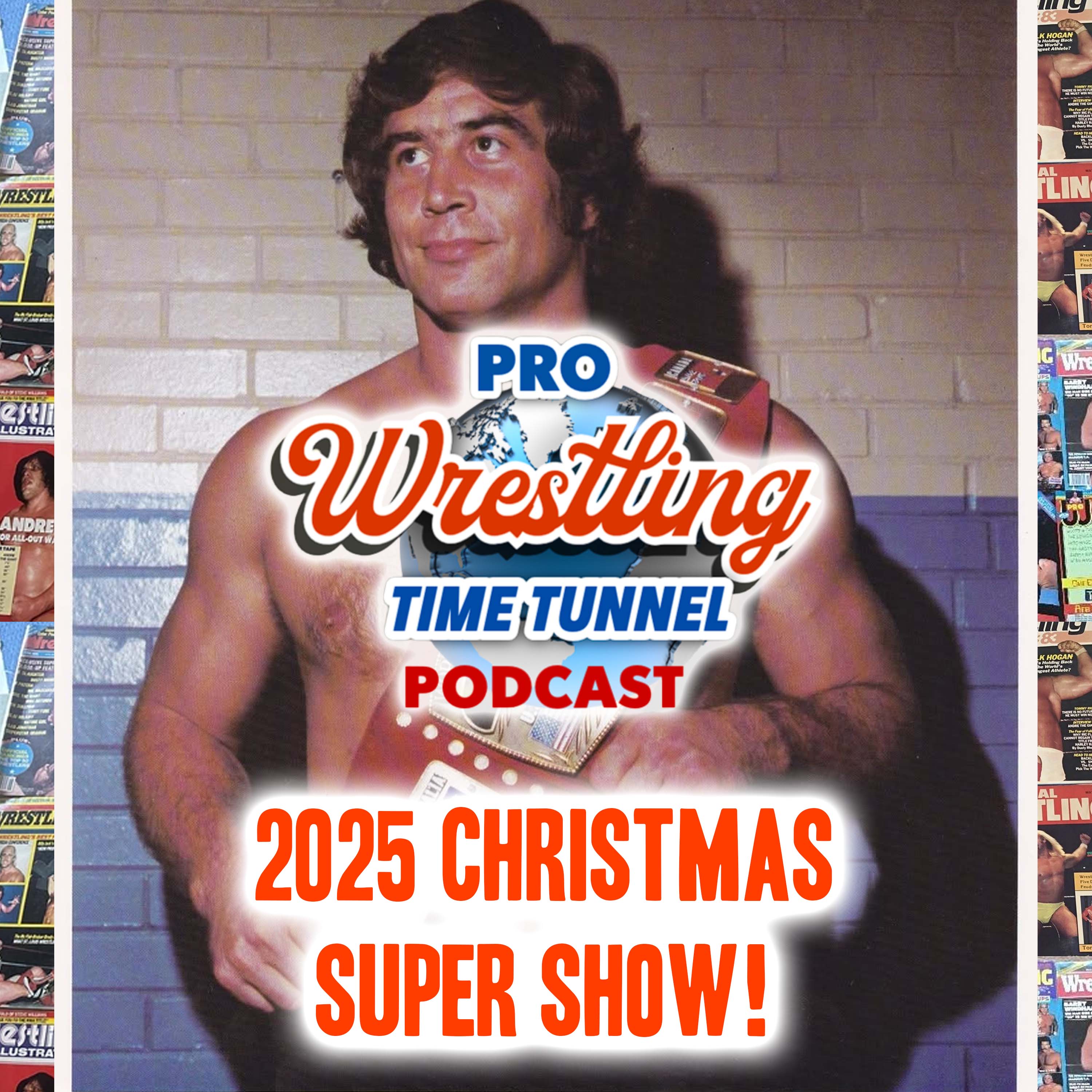
[00:00:37] Speaker C: Well, ho, ho, ho, everybody. Welcome to the Christmas super show here at the Pro Wrestling Time Tunnel. Greetings, holiday greetings and salutations to all of your family and friends from all of us here at the Richards Ranch and the Pro Wrestling Time Tunnel. Man, what a super show that we have lined up. I've been thinking about this show all year long from the very beginning of the Pro Wrestling Time Tunnel Podcast. I've looked ahead to what was going to be going on at the end of this year, and then we'd be coming to the culmination of all of our shows about 1975, 50 years ago in pro wrestling history. And I've been thinking and planning this show for months and it has come together beautifully. I hope you enjoy it. It is going to be a pretty long show, but I have four outstanding guests here at the Richards Ranch to talk to you about some things and I'll get to that in just a second. Let's get the the promotional items out of the way because there's a lot going on. First thing I want to tell you is we're up to show number six on the Stories with Briscoe and Bradshaw podcast that I am guest on. And we've been talking about the Roy Welch family legacy now, and we're up to episode number six. And on that show, which is coming out the same time, this one is going to be coming. I think this show will be out on Christmas Eve and Stories with Briscoe and Bradshaw will be out on Christmas Day. And Les Thatcher is going to be there as a special guest on the show.
And Les came into the Tennessee Territory in 1968 about the time that Roy Welch and Jerry Jarrett were taking car rides together.
Jerry was wrestling a little bit and he was refereeing in Memphis, and Roy was slowly but surely turning the booking over to Jerry Jarrett in Memphis. And then when he did that, three of the top baby faces left the territory. Les Thatcher, Dennis hall and Ken Lucas. And so we're going to talk to Les Thatcher about all of that that was going on in the Tennessee territory at the time. And then we're going to work our way through in that stories with Briscoe and Bradshaw show and culminate at the end with the Mario Gallento incident, the famous incident where Mario Gallento attacked Jerry Jarrett and Jerry Lawler in the ring live on Memphis television.
And I've got a little bit different spin on that story that I think is worth considering that ties back to Roy Welch. So that's on stories with Briscoe and Bradshaw here on the Time Tunnel. You can download the audio version of our podcast now on all the major platforms. We have several of our archived shows from this year there. We're constantly adding new ones from the library in from this particular year. You can do our podcast on Apple, podcast on Spotify, on Podcast Addict, Pocket Cast and all the others. You can still see all of our shows on our Substack channel, both the audio and video versions. And we have all the video versions plus clips of our show on our YouTube channel, the Pro Wrestling Time Tunnel. And so just real quick, I've also been doing here at the year end, I've been doing year reviews of the major years in pro wrestling territory history on the fives.
So this is 2025. So I've gone back to 1925 on the evolution of Wrestling series that I write and I completely analyzed and put out how the territories were foundationally forming in 1925 and the things that were happening that were leading to that. Also I have 1935 out and just yesterday I sent out 1945.
So still to come, I have 1955, 1965, 1975 and 1985 still to come on the Evolution of Wrestling series that I'm writing at Substack. And that is for our premium investors, our people who have invested their money in for a subscription and to support me as a pro wrestling historian. And and the work that I'm doing, it's easy to do. It's $5 a month or $50 a year if you want to save $10 on an annual subscription. I'm also doing a salute to territory era television wrestling show commentators and announcers and that's going out to all our free subscribers. And there's 31 of those. And we just are releasing number seven this week. And so we'll be doing that even on through the end of the year and on into 2026. And plus we have our flagship free subscription article, the Daily Chronicle that I put out the Pro Wrestling History newsletter that is based on that day in pro wrestling history where we run down a lot of things. And I've started writing some articles on the life and career of several of the Territory ERA stars. And that has gotten good reviews and a lot of support. So now we got all that out of the way, let's get to our first guest. We have four big guests on the show today, and the first one is Steve Giannarelli. And in the show today, we're going to talk about all the world champions in 1975. We're going to talk about Bruno Sammartino, and that's what Steve is here to talk about. We're going to talk about Vern Gagne, who dropped the AWA title to Nick Bockwinkel in February of 1975. George Shire will be here. Always a good time to talk about that.
Then Jerry Oates will be here as a guest. When Terry funk won the NWA world title from Jack Briscoe on December 10, 1975, in Miami beach at the Convention Center, Terry Funk got on a plane and he went to Kansas City. And his first opponent in Kansas City the night he was first NWA Champion was Jerry Oates. And Jerry's going to talk about that night that he wrestled Terry Funk for the NWA title. And finally, to cap everything off, Jerry Briscoe, my dear personal friend, will be here. We're going to talk about Jack Briscoe's NWA world title reign from 1973 to 1975, and also the circumstances around him dropping the title to Terry. So that'll be coming up here in our show. So it's a big Christmas super show, y', all, and I'm excited about it. Let's get it underway. Let's start with our first guest here to talk about the WWW F3WF World Champion, which he was only called the WWW Champion at this time. Bruno Sammartino, my good, dear personal friend Steve Gennarelli is here. Let's go to that conversation right now.
Well, the Christmas super show here at Pro Wrestling Time Tunnel is well underway, and I've invited on our WWWF analyst and commentator Steve Gennarelli to join us here during the happy holiday season. Merry Christmas, Steve.
[00:08:16] Speaker D: It's great to be here with you, Tony. Christmas is one of my favorite times of the year, and it's great to look back on 1975 one final time before we get to 1976.
[00:08:27] Speaker C: Yeah, on the here on the Christmas Super Show, I thought I'd have three of our most trusted guests on to talk about the world championships that were. And we're not talking about all of them because Mil Masqueris had a world title.
Giant Baba had the PWF title in all Japan. And Antonio Noki had the NWF championship for a while, so did Tiger Jeep Singh. So we're not talking about those, we do recognize them, but we're going to stick with the ones that we saw in the magazines, the most here in North America. And of course, Bruno Sammartino had a fantastic 1975 and that's what I've invited Steve on to talk about today. So Steve, I'm ready to go when you are.
[00:09:13] Speaker D: Well, it's a pleasure to talk about Bruno, my all time favorite wrestler. And I went back and did research and I looked at 1975 and I was curious to know, like, who were his most frequent opponents. I mean, you and I have reviewed most of this year, if not all this year, and we talked about most of these folks, so it's going to be no surprise. But his most frequent opponent was Spiros Arian, who he wrestled 24 times. Now, as anyone listening to this probably knows, you have to buy into these numbers.
You know, there's got to be a margin of error there, but at least we have 24 recorded times of him against Spiros Arian.
His number two opponent was Bobby Duncomb, who he really had started feuding with at the end of the prior year. In 74, I have him listed as Wrestling Duncombe 18 times.
Number three was Waldo Von Erich, a bit of a drop off in numbers only nine times.
And then the final two to round out the top five, George Steele and Blackjack Lonzo, more of a tag team guy.
They Both wrestled Bruno six times each in 1975. And I would say was, was a very important year for the Worldwide Wrestling Federation and also for Bruno as well, because this is probably the first year that they started to sell out not only the Garden, but the felt Forum of Madison Square Garden, the theater that is in, you know, next to the building and would draw another 4,000 fans. And, and it really, you know, Bruno had a first reign and now he's back. This was really year or two of his second reign and he really kind of re established himself and was definitely a box office force in the pro wrestling and definitely in the Northeast.
[00:11:09] Speaker C: Yes. And if, if I'm thinking right, I think he went on a tour of Australia and found Bobby Duncomb.
[00:11:20] Speaker D: That's right, I heard that too.
[00:11:22] Speaker C: And came back and suggested him as someone he could work with on top. And obviously Bruno had an eye for that. I mean, he could see people that he could see himself working with.
And I've also just recently confronted my own bias with Bruno Sammartino, but because I think up until.
Well, I think putting the focus on these years that we put on them this year, and I watched a lot of tape and all to get more familiar with what we're discussing that's available.
You know, one thing that I noticed that I just never noticed before, I think I had it in my mind that Bruno was more of a brawler and that his main strength was to go out there and basically have a fight.
But honestly, one thing I discovered as I watched different matches with different type opponents, he was really good at adjusting.
He adjusted to his opponent really, really well. He wrestled Spiros a little bit more.
[00:12:31] Speaker D: Right.
[00:12:31] Speaker C: Where a Georgia Animal Steel was just a fight, you know, it was just a brawl, you know, and I never really gave him credit for that flexibility before.
[00:12:41] Speaker D: And no, I think that's a great point on your part. I know, you know, in his retirement years, people, when he started doing shoot interviews, that was one of the things he said about himself, is that he tried to adjust his performance to the opponent rather than have the opponent work his style.
So he felt in that way he'd always remain fresh and wouldn't be, you know, so repetitive, like so many wrestlers are.
You know, I. I gotta not just make this all about Bruno. I mean, Jack Briscoe's performance in 1975, as I'm sure you have had other people on to discuss, it was just a remarkable year for Jack Briscoe.
And I have his numbers right here. I'll just briefly talk about that because I want to give him credit too.
His top opponents were Dory Funk Jr. 13 times Bob Roop, one of the top legitimate wrestlers of that era, 10 times Terry Funk, nine times Wahoo McDaniel, seven times, Harley Race, Ron Fuller and Mongolian Stomper, six times each.
So that's. This is an amazing variety of opponents for Jack Briscoe. I mean, I guess if you were to ask me, like, what were the differences between these promotions.
Yeah, Bruno is mainly wrestling on the east coast and he's wrestling a number of opponents repetitively, but Jack Briscoe is going to all the different territories and even going to places outside of the US in wrestling, just a variety of opponents. I have a paper in front of me here with all the opponents listed, and I would say it's got to be about 40 some odd different opponents he faced this year. Bruno's total opponents, I would say maybe about 15 different opponents for the most part.
They did have a couple in common.
Bruno Wrestled Stan Stasiak a couple of times.
Jack Risker wrestled him, I think just once.
Jack Briscoe also wrestled Spiros very. On a show.
It's quite interesting to. To know. Know that.
[00:15:02] Speaker C: But would that have been in Australia?
[00:15:06] Speaker D: That could have been. That. That could have been. And it was. It's interesting. Going back to your show, Tony, I think you had Mike George on the show recently and he did talk about wrestling in Japan. And at the time, I don't think he can remember Bruno's name, but he said that guy from New York who was on top for a long time, they. They teamed up together and. And I think Bruno may have done a job for Baba or maybe it was Mike George that did. But it's interesting that those two got paired up together.
[00:15:36] Speaker C: Yeah. And just to give Mike a little slack, he really didn't talk about wrestling much with anybody, you know, in the last several years. So I came around and started prompting him on things that he, you know, kind of. He's not like us, you know, we're like doing it every day, you know.
[00:15:53] Speaker D: Sure.
[00:15:54] Speaker C: The thing I would say about Jack, too, is his most frequent opponents.
Dory Funk was first, right?
[00:16:03] Speaker D: That's right. Thirteen.
[00:16:04] Speaker C: Yeah. So he would have wrestled him both in Texas and in Florida.
[00:16:09] Speaker D: Right.
[00:16:10] Speaker C: Bob Roop would have been a Florida, only Harley would have been Florida because Harley was booking Florida in most of 75.
Who was the 4?
[00:16:21] Speaker D: Wahoo.
[00:16:22] Speaker C: Wahoo would have been Charlotte.
So Wahoo was in the Carolinas. So that would have been in the Carolinas. And five was Fuller.
[00:16:32] Speaker D: Yeah. Fuller is tied with race. And Stomper is also in there too.
[00:16:36] Speaker C: Okay. Stomper would have been in Florida, Fuller would have been in Tennessee.
And Ron only worked Memphis and Louisville. He. The rest of the week he worked in his Knoxville territory. And he might have wrestled Jack in his Knoxville territory, but I know he wrestled a series in Memphis of, I think three times, maybe four, where they did a match, it went to time, limp draw. They came back the next time, did a no dq, they came back the next time.
So most of the time that was in Tennessee, either on one side or the other of the state.
So his most frequent opponents were in pretty concentrated areas, I guess, is what I'm saying. The guys that wrestled him a few times were the territories like Vancouver and Calgary and places he maybe went twice a year because.
And I think, and I'm going to ask Jerry this question, but I think Jack was getting worn down in that last year that he had the belt of everything. And he lived in Florida, so I think they were trying to keep him in Florida as much as they possibly could without shortchanging the other promoters.
[00:17:52] Speaker D: Oh, yeah. And I will say that, you know, the wwf, even though that's my home promotion and my favorite promotion, it was, it was more formulaic as far as the scenarios.
Yeah, Bruno is the hero. Baby face going up against a different group of heels.
This was the 1975 group, but I got to give Jack Briscoe credit because when you look at all of his opponents, including the ones we just mentioned, you have baby faces in there, you have heels in there. And you know, that wouldn't have worked in the WWW if they didn't want to see Bruno defend the belt against chief James Strongbow. You know, I mean, there may have been a small minority that would have been clamoring for that, but Mr. McMahon, Vince's father, definitely made it clear that he didn't believe in scientific matches. He wanted to see good versus evil, and he felt that's what the fans really wanted to see.
[00:18:51] Speaker C: I'll give you just something I think is, is kind of funny, but in 1986, during the national expansion, after Flair had pretty much become a company champion, sure, I think 85 was the last year he kind of toured.
I don't think he toured as much in 86. I think he mostly did Crockett in 86. But when the great. And this is the difference between an older type fan and a brand new fan in 1986, okay, Great American Bash, 1986, Ric Flair is going to. Is going to defend his title 13 times in the month of July against somebody different every night. And this was supposed to be a big angle.
And I thought, doesn't the NWA champion face somebody different every night all year long? Like, why is that such a big deal?
But it got, it got over with people who, in 1985 and 1986, there were a lot of new people discovering wrestling and they didn't know the difference. They thought, oh, my gosh, he's going to wrestle Road More Animal tonight and he's going to wrestle Magnum TA tomorrow night and Ricky Morton the night after that and Robert Gibson the night after that. And I'm like, that's been going on since 1948, you know. But newer fans, they loved it and they sure sold a lot of tickets in 1986. So who am I?
[00:20:10] Speaker D: No, no, it's really, that's really interesting what you just said. I mean, what, what was the norm? Just, you know, we're talking about 75. It's definitely the norm. He's wrestling a different person every night with. With, you know, exception here and there. But, yeah, that's definitely kind of the downfall of that whole national expansion thing. I mean, from a fan perspective, I mean, you'd rather see the variety and, you know, not just the same feud like WWF did was, hey, you know, Hogan's on the road. He's on the road, he's married to this opponent for three months, and then he's going to be married to another opponent for four months. And it just got old and predictable and. But that was the national thing, I guess so.
[00:20:59] Speaker C: And Bruno had.
Bruno had. And I've talked to Herb Simmons. We talked about a little bit on my show when we talked about St. Louis in 1975, where Bruno didn't draw well.
So he had a little bit of a negative connotation there, like, well, of course he draws well in the wwwf, but in the other towns, he wouldn't have gotten over, because just look at St. Louis, he didn't draw well. But I will say this, I probably had a little bit of that bias. But this year, and looking at all his matches that I could look at that were on video, one thing I did not give Bruno credit for, along with him having the flexibility, was he made his guys look good.
[00:21:46] Speaker D: Yes, he was always good.
[00:21:47] Speaker C: So he was. He was the overpowering hero, baby face.
But he knew when to make the comeback, and he knew when to turn it on and come back and have the crowd in the palm of his hand and win the match, because you were pretty.
Pretty well convinced, or else people wouldn't be coming back to buy tickets that, oh, no, this is going to be the time where this person is going to get Bruno. And that takes a lot of skill. A lot of skill.
[00:22:17] Speaker D: Yeah, yeah. He was a master storyteller in that regard. And I think I'm sure you know the famous story, there was a time in the early 70s in the NWA where there was some friction at the top about who is going to be the title holder. And I think it was coming down between Jack Briscoe, Harley race Dory Jr.
And it was a time that, I think this was after Bruno's first reign, and Sam Mushnick had Bruno come in, and he really liked Bruno as a sportsman type, like the sports theme of St. Louis.
He'd come in wearing a suit, he could talk to the media. He was presentable.
And I think he was.
I think Mushnik briefly, was flaunting Bruno like, hey, you guys, if you don't want to operate, if you don't want to be an NWA champion in the mold I want you to be in, I could take Bruno from New York and put him in this role.
[00:23:17] Speaker B: Right.
[00:23:17] Speaker C: Because New York had come back to the NWA, they were an NWA member and there for a few years. I think 75 is one of those years where they're just calling him the WWF champion. They aren't calling him the world champion because to be an NWA member you have to relinquish that recognition. And yeah, and Sam was doing that, he was saying, hey, we there a member, I could always put the belt on Bruno and he could just be the champion. And you know, that was sort of his keep guys in line type strategy. But I agree with you, I, and I have gained a lot more respect for Bruno because of, and I got to tip my hat to thes because he's the one that started all that. He's the one that started being a professional as the world champion. And Bruno and Jack did a good job of that. You see a lot of pictures of Jack being interviewed in a suit and looking like, looking like what the world championship look like.
[00:24:19] Speaker D: Oh, absolutely.
[00:24:21] Speaker C: Bruno did that also.
And he was a businessman.
[00:24:26] Speaker D: Oh, absolutely. And then that's what wrestling needed. I mean, people, people sneered at wrestling, they laughed at wrestling. Here's, you know, you can count them on one hand, but you have a Bruno, a Jack Briscoe, Dory Jr. These are people you can be prideful of and respectful of their athletes and highly skilled, just like, you know, top car race car drivers or top baseball players or football players. And Sam Wishnick could appreciate that. Maybe, maybe some of the other promoters didn't put much stock into that, but he certainly did.
[00:25:01] Speaker C: Well, he proved that your audience will reflect back to you what you give them.
So if you're in the ring and around the wrestling business and on your television show and in your interviews and whenever you present yourself, whatever forum it is, if you present yourself with a disrespect or with a lower level than what you should feel like you should have, that's what the audience is going to get back to you.
If you, if you disrespect the business, they're going to be disrespectful because that's where you're leading them, right? That's what they see in you.
And that's what. Sam didn't like gimmicks, you know, and he wouldn't let Von Rashke be Baron von Raschke and he Wouldn't. He didn't book Dusty a lot because he thought Dusty was more gimmick than wrestler.
So I can see where the Madison Square Garden audiences and the Baltimore audiences and the Philadelphia and the Boston audiences, when it was the main event, they were rowdy and they were rooting for Bruno, but they weren't disrespectful.
[00:26:10] Speaker D: Right, right. Well, you.
You know, like you said earlier, 1975 was remarkable, both for all the federations, really. I mean, we didn't talk about awa, but, you know, they went through a transformation at the end of the year with Nick winning the title from Vern. And.
But. But I just wanted to say. And. And I know we're not going to be talking for a lot tonight, but, you know, 1976 gets to be even more interesting, in my opinion, as far as what happened in the wwf. Well, three wf, you know, this is the year that Bruno gets injured by Stan Hansen in a match. And as we end 1975, superstar Billy Graham has had one match with Bruno right at the end of the year or close to the end of the year, and he's going to become one of the major challengers of 76, along with Ivan Koloff, Ernie Ladd, a little bit more of Arian, Bugsy McGraw still around.
And then when the handsome thing happens, he goes on the shelf for about two months, and then he comes back. He does wrestle Hanson a bit, but then he's wrestling Brody and Patera and von Raschke and Stasiak. It's really an interesting year, and I. I really look forward to reviewing that with you, Tony. That's going to be a lot of fun.
[00:27:33] Speaker C: You bet. And I. I will say this, to your point, I feel like all those positive attributes we said about Briscoe and Sammartino could go for Bockwinkel as well.
[00:27:44] Speaker D: I mean, yeah, Bach Wiggle. Oh, my God, what a champion he was.
[00:27:47] Speaker C: I thought he presented himself in all of those great positive attributes that we mentioned, Verne. And I'm going to talk to George about this on the show.
Verne held the belt from 1968 to 1975.
I mean, that was a long time, and there were some years where he didn't really wrestle that much. He picked up his frequency a little bit heading into the Bockwinkel title change, but I don't know. I want to hear George's perspective on that. When you look at the. When you look at the top people that Bruno worked with in 75, what's your favorite?
[00:28:28] Speaker D: I guess I would have to say Arion, he just seemed like, like kind of like Bruno's evil twin brother. They were very similar, you know, both ethnic, you know, both European.
But Bruno was the good guy you could trust in. And Arian all of a sudden was this devious, mischievous guy with Lassie by his side and he just looked like he was ready to kill somebody. And he did a number on a lot of the enhancement guys and some of the lower level guys like your, Kevin Sullivan's and people like that.
And yeah, that's a very memorable feud. I know that. I mean, there's not a lot of us Bruno fans still around. It's been, you know, over 50 years now. But, but for those of us that are still here, that area on feud does get talked about a lot. So that's probably the most memorable one of this year, with Koloff probably in second place, because I know a lot of the fans were fearful that Bruno might lose the title of Koloff, just like he had a few years earlier.
[00:29:37] Speaker C: How many times he wrestled Koloff again.
[00:29:41] Speaker D: This year, I have, I have only doubt for 4 and 75.
[00:29:45] Speaker C: I know they, I think that's about right.
[00:29:47] Speaker D: Yeah, yeah, it wasn't, wasn't a lot. They do pick it up in 76. And as the top heels at the time would say, when the Hanson injury happened, it really did a number on the paydays for Koloff, Graham and Ernie Ladd, because they were supposed to wrestle Bruno around the horn in those other big cities like the Baltimores and Landover, Maryland and Providence, Rhode island, and a lot of those shows had to get canceled or rescheduled in some way. So a lot of those guys pretty much left the territory and wouldn't come back until the Backlin era.
[00:30:23] Speaker C: So trying to put myself in McMahon, Vince Senior and Gorilla Monsoon's head, I think, I think they were smart in that after the title change between Koloff and Bruno, they only brought him back three or four times a year.
Like he would only come back just a few times to make it hot and fiery and then they moved on to somebody else.
[00:30:45] Speaker D: That's right.
[00:30:46] Speaker C: But. But it created this great heat and drama, like you said, of people going, oh my gosh, it's Ivan Cole Koloff, he beat Bruno before this could happen again. And just about the time you think it is going to happen, then he's wrestling somebody else. Like I. It's a great example of really good booking, of having callbacks to something else, but also having something new and having Something fresh and knowing when to move on. And that. That. That's a really great, great example there. Let me ask you this question, and I'll preface the question by saying I love Freddie Berlassi.
I love him as a heel. I loved his LA stuff. I loved his Georgia stuff. This week on the Briscoe and Bradshaw Show, I was just talking about his run in the Gulf coast where he wrestled Buddy Fuller and Lee Fields and people like that. But let me ask you this. Did Spiros Aragon need Freddie Blassie?
[00:31:44] Speaker D: You know, that's a great question.
He did it only from the sense of the New York fans were used to that formula of every heel has a manager. It's kind of like superstar Billy Graham. On some of his shoot interviews, he said, like, I don't know why they gave me the Grand Wizard. I could do an interview. Yeah, yeah, he could. And he didn't really need a manager, but grand wizard did accentuate, and he enhanced Billy Graham, you know, the way he would, like, struggle to pull his shirt off. And, you know, they kind of hinted at some kind of a, you know, relationship between Billy and the wizard. And, you know, and. And that all added to the package. And. And Arion had been a beloved good guy for a long time, but now he was with this hated, venomous manager, this Fred Blassi, who everybody hated. And he wore, you know, audacious clothes, and he had a cane. He jabbed the enhancement guys with his cane. And so it just added more heat. And Blassy added to the package. That was Ariane.
[00:32:49] Speaker A: I guess.
[00:32:50] Speaker C: I.
I totally see that. At the same time, when the match is going on for what you become accustomed to managers doing while the match is going on, they don't really do. I mean, they're not. They don't really. They're not at active, I guess, is what I'm saying. And, yeah, was that guy who could do an interview, you know.
[00:33:12] Speaker D: Well, this is one thing you may not be aware of, Tony. Like in New York, the managers, they would come out, they would get introduced with their charge, but they had to immediately go back to the dressing room. In those days, they had to just go back because that was the State Athletic Commission rules.
I know, that loosened up around the time of the national expansion, and then everything got really loose and a lot of offside interference and lots of nonsense. But, yeah, in those early days, they just couldn't have that happen, I guess.
[00:33:44] Speaker C: Right, right. Well, it was a fantastic year. Do you think Bruno's second reign was better than his first.
[00:33:53] Speaker D: You know, I, I've talked to a buddy, a buddy of mine who I met and another wrestling guy, and he told me that you couldn't even compare second reign Bruno to the first DM. He, I mean, he lived through those 60s and he saw the Bill Watts, he saw the Gene Kinisky and the Chic and Monsoon and, you know, all the other opponents.
He, he, he wasn't denigrating Bruno's opponents. He just felt like it was different. I mean, Bruno, Bruno had lost a lot of weight. Like, he was much more speedier and aerodynamic. He was much more bulky and power lifter looking in the first reign.
And I know I prefer the second reign because I can see the matches easier. They're in color. There's very little of the first reign other than the match with Baba in Japan and maybe a smidge of one with Bulldog Brower, But I just like what I'm familiar with. But it would have been nice to have been able to see those older matches as well.
[00:34:58] Speaker C: Yeah, I just love we have what we have to look at and I, I with the advantage. And I think this is true, and this is what I feel is a shame, is that if more people could see more of the old guys, they would appreciate them more.
Because, because as I watched more Bruno than I probably have ever watched in my life in the last year as we've been doing this show, I gained a lot more appreciation for him.
[00:35:29] Speaker D: Yeah, yeah, he was, he was really no frills. I mean, he didn't wear knee pads, he didn't wear, you know, tape on his wrist, he just had the boots, he had his tights on. No other frills, no jacket, no robe, anything. And I think that's why people loved him so much. He was just, just believable.
Just. I mean, he would just get in the center of the ring, he would tie up with his opponent, and after that, it was, anything could happen. It was, could be a melee, it could be a match, it could be whatever. But the fans were just so into it and so anticipating what was about to happen.
Those were very interesting days.
[00:36:08] Speaker C: You might, because you have seen probably all of his shoot interviews and I've seen hardly any, but he's got such a symbiotic relationship with the crowd. I mean, right. He, you know, every move he makes, it causes the crowd to do something.
[00:36:27] Speaker D: Right.
[00:36:27] Speaker C: And so my question to you is, has he ever talked about who called the match?
Did he call the match or did he'll call the match? Because the way he's got a relationship with the crowd. It's almost like he's probably calling it because.
[00:36:43] Speaker D: Yeah, yeah, honestly, you know, you know, he, he did open up a little bit, but he, he was, he wasn't at the Ed Farhat level of keeping kayfabe, but he never talked about that kind of a thing, like, well, I call it. Or the heel called it, but you make a good point. I mean, he was his own talent scout. He pretty much picked his own opponents.
He may have, he may have carried the match or called the match. That part I really don't know, honestly.
[00:37:16] Speaker C: I know with Jack in the nwa, he had a varying degree of opponents skill level, and if they couldn't basically go with him, which very few people could, but if they couldn't go with him, he'd take over and start calling the match, you know, and, and he would, you know, wrap it up or do whatever he wanted to do with the match because he just lost confidence in them. I was just kind of curious because his matches are so.
For the style that he worked. His matches are so beautiful. I mean, they, the. And the crowd makes the match. I mean, the crowds with him and supportive and they react to everything the heel does. They react to everything Bruno does. And he, And I just kind of thought, well, he, he's probably, to use the word in a productive way and not a negative connotation. He's the manipulator here.
But I don't know, I was just curious.
[00:38:16] Speaker D: No, no, yeah, he never really came that clean on that. But, but, but I, I think he, I think it was much more intelligent than people ever gave him credit for. I mean, he really could read the room or read the arena and know what they wanted and just I think he, I think he inertly wanted to make the fans happy and satisfied with the product that he put out there. He was never one to like, try to chip them or shortchange the fans. I think he always wanted to make sure they got their money's worth.
[00:38:50] Speaker C: And I just think in St. Louis, he didn't have time to make the connection. Like he wasn't on the TV all the time. He was a special appearance, you know, and there was not that same connection that he had with the east coast fans, wasn't there? Right, right.
[00:39:08] Speaker D: Well, well, there was a story on, I know on Brian last show, the 605 Super Podcast, he had this one fellow on who's since passed away, but he said that, that during that brief period where Bruno did go to St. Louis and this is when he was going to wrestle Harley at 72 in between his WWF reigns.
I think Bruno had a match against somebody and it didn't really go over in. And so they were going to have this big match with him against Harley.
And, and I think somebody talked to him or said, this is what you have to do in St. Louis. You have to work a different style. And he did do more holds and did more methodical things and, and they ended up having an hour draw. So it had to be, you know, a lot more into the match than just your regular 10, 15 minute Bruno style match. And, and they made it happen. They made it work.
I mean, there's been people that said like Bruno and Bruno was like sucking sweat off of Harley just to keep going, but they got through the match. And the guy that gave the story or told the story on the 605 show, he said it was in his opinion the greatest match he'd ever seen. And he'd been to St. Louis for many title matches. So I mean, I think just, just seeing Bruno San Martino famous from the magazines from New York against, against, I was going to say Jack Briscoe against carly race in St. Louis, that must have been a thrill for anybod.
[00:40:37] Speaker C: Yeah. And Sam was going for that thing in St. Louis that Vince went for in Massive Square Garden to where you didn't always know who was going to be on the card. It was a constant revolving door of performers. It wasn't the same guys all the time, so. That's right, that worked. You know, but I'm glad you told that story because that just adds to my admiration because when a guy says that he's a veteran of St. Louis and that was the best match you ever saw, that, that carries some weight.
[00:41:09] Speaker D: Yeah. And I'll find. I'll find an episode of 605. I even send that to you so you can listen to it. This is very, very interesting. I know, I listened to it a few times.
[00:41:18] Speaker C: Well, thanks, Steve, for running down the 75 one last time here at the end of the year talking about Bruno's most wrestled opponents and your favorites.
I know our audience values your opinion and your input quality quite a bit. So I thank you for coming on and doing that and I want to wish.
[00:41:38] Speaker D: It's my pleasure.
[00:41:39] Speaker C: I want to wish you and Erica a merry Christmas and happy holiday season from the Richards Ranch.
[00:41:45] Speaker D: Thank you, Tony. And thank you for having me on, not just today, but for all the shows we've done this year. It's been a real pleasure I'm proud to be a part, even if it's a small part, of the Pro Wrestling Time Tunnel. And hopefully we can keep going and doing more. And Merry Christmas to you as well, and Happy New Year.
[00:42:03] Speaker C: Well, as far as I'm concerned, we're going on to 76, man.
[00:42:07] Speaker D: All right, let's do it.
[00:42:08] Speaker C: Thank you, Steve.
[00:42:10] Speaker D: Thank you, Tony.
[00:42:12] Speaker C: Wow, what an amazing conversation. That's the thing I love about this show. I love to talk to my friends about pro wrestling history, and I love the fact that you guys can sit in on the conversation here on the Pro Wrestling Time Tunnel podcast. Bruno Sammartino had a fantastic year in 1975 as the 3WF champion. And what a lineup of great heels he had to draw in Baltimore and Philadelphia and Boston and New York City and Pittsburgh and all the great towns and buildings part of the 3WF in 1975. Thank you, Steve, so much for stopping by and spending some Christmas time with us here at the Pro Wrestling Time Tunnel. Okay, on to my next guest. He is a very noted pro wrestling historian.
When you want to talk about pro wrestling history, he is known for the awa, the American Wrestling Association. But this guy knows a lot about pro wrestling history, AWA notwithstanding. I mean, he just a great guy to talk to. I always look forward to my conversations with George Shire. And George has stopped by here at the Richards Ranch, and we're going to talk about Vern Gagne, who held the AWA world title from 1968 all the way to 1975, and that November night that he dropped it to Nick Bockwinkle. George was there at the show and we're going to talk about that night. We're going to talk about Verne's title reign. We're going to talk about that that night that Verne dropped the title to Nick Bockwinkle there in St. Paul, Minnesota. Let's go to that conversation now with my Dear personal friend, Mr. George Shire here at the Richards Ranch. Well, Merry Christmas, everybody. We are continuing on with our Pro Wrestling Time Tunnel big Christmas super show. And I love to welcome in my dear friend George Shire. And we're going to talk about the AWA world title in 75. And Vernon, you held it most the year, and there was a historic title change at the end of the year. But before we get to that, George, let me wish you merry Christmas, man.
[00:44:28] Speaker A: Hey, same to you. You know, this is the time of the year where I really like it seems to bring everybody a little bit closer. And we need that. We need we need peace and closeness.
[00:44:38] Speaker C: That's right.
[00:44:38] Speaker A: Merry Christmas to you, too.
[00:44:39] Speaker C: You bet. You bet. Yeah. It's a happy holiday season. I got my tree up and got that the Richard's ranch all decorated and my mom's all happy. So that's. That makes me happy.
[00:44:52] Speaker A: You know, I got to come up with a neat name for the Shire household. You always say the Richard's ranch. You know, this is just our home. I got to get something clever like that Richard's ranch thing.
[00:45:02] Speaker C: You bet, man, that's good. Yeah. The Shire estate, maybe, something like that.
[00:45:07] Speaker A: Who knows?
[00:45:08] Speaker C: Who knows? All right, well, let's talk about.
Vern held the title for a long, long time. He won it. What was it? 68 was his latest ran and it lasted till 75. Is that right?
[00:45:22] Speaker A: Yeah, yeah. And you know, as I was thinking about that when you had told me this is what we were going to discuss, I always found it interesting, Tony, that Verne won the title, the AWA title, back for Mad Dog Vachon after a three year hiatus, that he had given it to vashon in the mid-60s.
And Verne won it back on his birthday, February 26, 1967, from Mad Dog.
And he held the title then for, I guess you'd say, about a year and a half, because it was August 17th of 68. So a year and a half or so later, he dropped it for two weeks to Dick Beyer, who was Dr. X under the mask at the time.
He dropped it to Dr. X for two weeks and then won it back on August 31st of 68. And then he had that run until the loss to Nick in November of 75. So I often thought, and the reason I thought about it too, was because I had talked with Dick Byer about that one time.
And you know why it was such a short reign? Because Doc was so hot here at the time as our heel.
And he told me, he says, Vern just said, this is what we're going to do to keep you hot for another year and we'll drop the belt to you. Because then Doc was here another additional year before he eventually left for a while.
So, you know, when you talk about Vern, he really did. He took care of Doc by putting him over.
And in the meantime, you could say he interrupted what would have been an even longer reign as a W A champion if you added the full year and a half to that reign when he lost the Nick. And he certainly. I remember folks saying that, was he ever trying to beat Bruno's title reign at the Time.
I don't know if there's any truth to that or anything, Tony, but I honestly, if I was, to be fair, I don't think Verne ever thought about it.
I don't think he ever gave one iota about Bruno San Martino's title ring.
[00:47:35] Speaker C: Well, I was going to ask you about Lou says because it, like I've heard people say, he was trying to beat Lou. Thes is longevity of a singular long run with the title because of the animosity that Fez never put Vern over. I was going to ask you, is any validity to that?
[00:47:55] Speaker A: You know, that is an interesting question and that wouldn't surprise me.
I wish, Tony. I went to the 1999 inaugural opening of the.
It was the Newton Museum at the time, the one that's in Waterloo now. It was in Newton, Iowa, opened up the Luther or the George Tragos Luthez Professional Wrestling hall of Fame. And I was at the inaugural one in April of 1999 in Newton.
And of course, the two first wrestlers inducted in there were Vern and Lou.
And so it was so unique that that whole weekend because they were actually chatting together. They were, you could see them laughing together. They, they, they, they just, it seemed like they were old army buddies or something.
And that was one of the times when Vern had said, you know, I could beat you today and I could take you today. And he was doing that. And I took, and I'll share these with you privately.
I took three or four photos of Vern and Lou inside the ring at that inaugural event.
And they were doing the poses together like we're going to go at it, you know, and then they raised each other's hands and.
But then, you know, later on, Lou had told me and I shared this, I think, with you one time that Domi says, you know, I wasn't very nice to Vern Gagna through the years, you know, but I really do think they had just a tremendous respect for one another. And, you know, you talked about how things worked out. We talk about working out with Jack Briscoe and things getting the title eventually.
You know, I think if, if Verne wouldn't have had that opportunity to buy into the Minneapolis Wrestling club at that late 59 time period.
I mean, he'd always been in the background, but never an owner. And I think when that opportunity came up, that just put him his own mindset in a different direction. And he probably at that point just said, the hell with Luther as yeah, you know, and I'm going to I'm going to start this company and. And we know the story, how it goes from there. So.
And then, you know, it's interesting because in 67, Lou says had come in to the.
After he had lost the title to Gene Kinisky, the NWA title.
And Lou had been in the way and he had some matches, and I have a program for Minneapolis where it really states that, you know, they KFAB these things, but this was reality coming through.
[00:50:41] Speaker E: And.
[00:50:42] Speaker A: And Lou says in there, in. And I could share that little article with you, too.
[00:50:46] Speaker C: That'd be awesome.
[00:50:47] Speaker A: He says that. He said that. I hope that Verne doesn't dodge me and. And overlook me the way I rubbed him in the time I was champion.
And this was still in the time period where they putting NWA and AWA in front of the world title. When they were talking world champions, Lou was referred to at that time as a former world champion.
And so then they did have a match.
Was it one or two matches in the awa? But one of them was Chicago, and Verne did go over.
But we all know that by that time, Lou was no longer involved and was never going to get another NWA run. And, you know, maybe that was the passing of the torch from Lou. Who knows? You know, he just.
But I really do. I think that they did really respect one another despite that professional animosity where.
[00:51:41] Speaker C: Oh, I think by that time, Lou was more focused on the paycheck than, I'm sure, than he was the keeping the legend alive.
[00:51:52] Speaker A: Well, and, you know, he had taken the title from Buddy Rogers, the NWA title from Buddy Rogers, and he held it for a couple, three years there until he dropped it to Gene in 1966.
[00:52:06] Speaker C: Yeah, that's right. Yeah. We're coming up on the anniversary of that in January.
[00:52:10] Speaker A: Yep. And he dropped it to Gene Kaniski, and. And then, you know, basically he was done. I mean, and he was a lot older than Vern. I mean, what. Lou was born in the early 1900s.
[00:52:23] Speaker C: Right.
[00:52:23] Speaker A: Reverend was in 1926.
So, you know, he had maybe 15, 10, 20 years on him. I don't know. I don't remember what.
[00:52:33] Speaker C: Lou started wrestling at such a young age. Yeah, yeah. Hey, I was going to ask you, like, the AWA title changed hands fairly frequently in the 60s, but not so much in the 70s. What was the. What was the big difference there?
[00:52:50] Speaker A: Part of it was, Tony, that in the. In the initial onset of the AWA in 1960, Verne, aside from having Minneapolis, which we'll always call the headquarters, and that includes St. Paul, but he had a lot less exposure and cities. The AWA wasn't in Denver at that point yet. It wasn't in Milwaukee and some of the other cities. He had Omaha, the Omaha territory and Chicago, etc. But a lot of it had to do with Verne.
As much as people will say he didn't like to put people over, he did put people over. He did it to build them up. And a lot of them were his friends. You know, when Bill Miller as Mr. M had his. Actually Miller got about an 8 month reign from January of 62 to August of 62.
I don't know the exact dates off the top of my head, but those, you know, that was a time where he put his friend Bill Miller over as Mr. M.
And then, you know, when the Dog came in, Mad Dog, there was a mutual friendship there.
And again, you know, you talk about when you have a chance to sit with the wrestlers. Mad Dog said to me one time, he said, in his usual Mad Dog way, he says, I didn't like Fern Gagne. But he said, Vern always took care of me in the next breath. And he said Vern was always. This is, this is a fact. Vern was always true to his word. That's what the Dog told me. And so verne realized in 1964, 65, when it got time to put the title on the Dog for a while, he drew so darn well, right? You know, Mad Dog was putting people in the seats and Vern could be the persistent challenger. The storyline was good that the Dog was dodging him. Mad Dog will wrestle anybody, but he won't wrestle me.
And so Mad Dog had that three year run with a little bit of a bump in there, like losing it to the Crusher for a coffee break. You know, they. But again, that was in those days. Verne was interested in building rematches and keeping a program going between two big names. And so that's really what it was. And Verne, in the back of his mind, I think he always said, I'm the champ anyway, so nobody doesn't matter.
[00:55:19] Speaker C: You know, I've got to, you know. So I was just going to say that the World Wrestling Worldwide Wrestling Federation was just like maybe two or three guys and Vince Senior having the majority say about who his champion was going to be. And then the National Wrestling alliance was such a political machine with several people on the championship committee. But Sam really was the last word. And Sam was usually the one who was putting forth the guys names and things like that in the awa it was Vern and Wally Carbon. Did they agree on things like that or did Vern pretty much. Was he the one who made the decision about who the champion was going to be or how did that work?
[00:56:07] Speaker A: Once, once Verne took over the Minneapolis territory, which became the AWA in August of 60, Verne had the majority say in everything.
And you know, it's funny when you look back in hindsight, because you would have never been able to figure that out because Verne never ever was on screen as the background or the promoter or having any say. It was always Wally. Wally was the front man, he was the voice and. But they were, they had a friendship at that point in their lives. They'd been together for a lot of years, Wally and Vern, because Wally was involved with the nwa, you know, with Dennis Stecker and even Tony previously, before that, Tony Stecker.
So Verne had the final say, but Wally was very respected to Verne until in the 80s. They had, they had a falling out, which you know, happens to a lot of people in partnerships, marriages, whatever, things like this happen. They did have a falling out. But in the end, even that was put aside, the very end. You know, they came back together. But Wally was his right hand man and Vern, Verne always wanted to be the champion.
And I really think his mindset, Tony, was what I said a moment ago. Even when he had the title on the dog or whoever it was briefly in his mind, he still, he was the champ.
And you know, they referred to him that way, the champ. He was always the champ.
[00:57:36] Speaker C: We covered before in a previous podcast we did this year about how Hercules Cortez car accident played a role in Vern putting off the title change for a while.
But in 75, he decides, okay, this is going to be the year Buckwinkle and Stevens have been the tag team champions for a bit.
And so now he's decided he's going to go with Nick as a single. And at the beginning of the year they have that amazing match that survives on videotape in Chicago, where the, the people were so. It was so exciting and electric. There were people who got shot at the matches.
[00:58:22] Speaker A: Was that the January 26th Chicago card?
[00:58:25] Speaker C: Yeah, in Chicago, which I did a, a an article for Wrestling Playlist. Charles over there writes about the history of wrestling on video and he makes these compilations of all the historic things. And on those best matches is 75. Since we don't have the Vern and Nick title change on video, I put that January match in there as one of the best matches of 1975. It's a great, great match.
[00:58:56] Speaker A: Yeah, by all means.
[00:58:58] Speaker B: So.
[00:59:00] Speaker C: Why did Verne want to wait until November?
Because Nick and Ray kind of broke up as a tag team in the summer, Right?
[00:59:09] Speaker A: Yeah, but they did. Ray was kind of in and out for a little bit there, and Ray.
[00:59:15] Speaker C: Had bought points in the Amarillo.
[00:59:17] Speaker A: Amarillo territory. Yeah, yeah, yeah.
Stevens, if you look at Knicks or Vern's record, first of all, let's just say that in 75, they wrestled Vernon. Nick wrestled five times in singles matches.
And so that one in January was the first one.
[00:59:38] Speaker C: And. And a couple of those were in Chicago. I mean. Yes, several of those. How many did you say? Five?
[00:59:45] Speaker A: Yep. There were the one on January 26th of 75 in Chicago, and then there was a rematch in March.
Yeah, it was March 15th or something.
[00:59:56] Speaker C: Yeah.
[00:59:58] Speaker A: Did I have breakfast this morning, Lorraine? I can't remember. And then I come out with a.
[01:00:02] Speaker C: Date of March 15th, and that's exactly right. It was March 15th.
[01:00:07] Speaker A: Okay, well, so I know there were the two Chicago matches, and then if you look at the. If you look at the results record of Verne defending the title in 75, his singles matches were prime. His single title defenses were again, Two more after that, the two we just talked about to Nick. And then he also defended to Von Raschke, which got a few. Baron got a few shots, and Baron was really hot at the time.
He. In 1975, he had a huge program against Billy Robinson, and he had a few. Another feud with Pampero Furpo, who was babyface at that point.
[01:00:49] Speaker C: Also that summer, he defended it against Nick's tag team partner, Ray Stevens.
[01:00:53] Speaker A: He did a couple. Three times. Yeah, yeah, yeah. I think there was one. I think there was one in. In July of 75. I know he wrestled Ray.
I want to say Milwaukee or someplace without looking.
[01:01:13] Speaker C: I think it was in. Well, one of them was in Omaha. It was a two out of three fall match, and the other one was in a town called Beloit.
[01:01:21] Speaker A: Maloit, Wisconsin. Yeah.
[01:01:23] Speaker C: That.
[01:01:24] Speaker A: Yeah, that's a little tiny. It's a kind of a small suburb of.
It's not as far as Milwaukee, but. Yeah, that's a smaller town. I don't know if that would have been a spot show or not, because Beloit did run semi regularly, and I think that match probably took place in.
Again, probably June sometimes.
[01:01:44] Speaker C: Mm.
[01:01:45] Speaker A: For Stevens.
[01:01:47] Speaker E: Yeah.
[01:01:47] Speaker A: And then. And then Ray was a little bit gone after that again.
What you have to think about, too, is that Verne wrestled in tag team matches that year with Greg, and they were against Bockwinkel and Heenan. A few. Couple of them were Bockwinkel and Stevens. So that match for the November, I think Verne was really just playing it out and making sure that because Vern could win these other matches and he could lose and Nick could brag in a tag match that they beat him. And I mean, it was. It was a psychology game, which we know wrestling is.
[01:02:26] Speaker C: Oh, yes, absolutely.
Now that the match that he had with Nick in.
In June in Iowa, was that the match where the belt got stolen?
[01:02:36] Speaker A: Oh, yeah, that was in Davenport on July 25th.
July 25th. And that was the one where he was defending the title to Nick. The AWA title belt was on the ringsider announcers table and this guy runs up, grabs it, heads for the exit, and got out of the building with it.
[01:03:02] Speaker C: By the way, if you haven't checked out my show with lib, a YouTube about the AWA title belt book and all of the police reports and all are printed in the book. It's a fascinating story.
[01:03:15] Speaker A: Yeah. And I. I want to commend him again, too, because Lib is. He did it. He did an excellent job, and I was proud to be part of it with him on different things that, you know, he kept saying, I want to get it right, I want to get it right. And I said, man, you. You nailed it. But, yeah, get it. Get. It's. It's all about the belt. That's the name of the book.
[01:03:36] Speaker C: And we want to say that our thoughts and prayers are with Lib. Also this holiday season. He just lost a very close family. Family member and.
[01:03:44] Speaker A: Oh, I'm sorry. I didn't know that.
[01:03:46] Speaker C: Yeah. And it's been hard, so.
[01:03:49] Speaker A: Okay, well, I'm going to reach out to him then. Do you know who it was in his family or.
[01:03:53] Speaker C: Yeah, it was his mom.
[01:03:54] Speaker A: It was. Okay, well, I will reach out to him. I didn't know that, Tony, and I know you're very close to your mom, so I totally understand.
[01:04:03] Speaker C: That's why it's really important to me. And I've been talking with them and I just want him to have a peaceful holiday season.
[01:04:11] Speaker A: Good. I'm going to reach out to him again then. But yeah, that's what they were doing. It really was. There were a lot of Greg and Verne matches with Bockwinkle and Heenan as a team, and they had a couple with Stevens and.
But that July 25 match in Davenport, that.
That was interesting. I tell you, it's such A story.
[01:04:34] Speaker C: I mean, so Heenan played that. That trio of Heenan and Stevens and Bachwinkle were just box office as far as Heel Heat. And then Heenan plays such an important role in the feud with Verne over the title.
But another guy that was involved in their feud, too, was Bobby Duncomb, right?
[01:04:57] Speaker A: Yep. And that's very true. And it's interesting because when Nick finally got to the title on November 8th of 1975, the night he was going to win it.
And I want to talk about how they played that up, too, but it was interesting because we were never told.
They never announced that Bobby Heenan would not be with Nick at ringside, not even on television.
And Nick show. It was just assumed because Bobby was always at his side and Nick showed up with Bobby Duncomb and. And Bobby had come into the AWA shortly before that, and he was. Bobby had an. Or. Heenan had announced that if. If anybody wants to get it Nick or get it me, they're going to go through Bobby Duncombe first. So it was kind of like he was a policeman for. For Nick, but he come out at. At ringside on that title night.
And Vern had brought Greg with him that night.
And so no. No explanation at the arena either why Heenan wasn't there.
And to be honest with you, I sat ringside that night for the match, and I would have never. I would have never guessed that that was the night it was going to happen. I didn't know.
[01:06:12] Speaker C: I was going to ask. I was going to ask you what was the significance of having it change hands in St. Paul?
[01:06:20] Speaker A: Vern, if you look at his title wins and losses of the title, if you look at his results record, you'll see most of them were in the Twin Cities.
[01:06:30] Speaker C: This was his home, I figure Minneapolis. But I wasn't sure about the St. Paul connection.
[01:06:36] Speaker A: Oh, they were running back in 75. They were running both St. Paul and Minneapolis on a regular basis.
I mean, it was. If it wasn't in Minneapolis this week, It'd be in St. Paul and Vice versa. So that wasn't unusual.
And, you know, he'd won it from Mad Dog, as we talked about earlier in St. Paul in 67.
And if you look back at his other matches with Mr. M, et cetera, usually they were in the Twin Cities.
Was loyal to his hometown fans.
[01:07:08] Speaker C: Yeah. Was that just a case of him saying, well, we haven't done it in St. Paul for a while, they're due for a change, or something like that was so.
[01:07:17] Speaker A: I mean, I don't know if that would have been the mindset. I don't know.
[01:07:20] Speaker C: Yeah. I'm just curious. I mean.
[01:07:22] Speaker A: Yeah.
[01:07:23] Speaker C: You know, I know when every territory. Every territory has towns that play roles within the territory. Right. I mean, it's interesting to look at it like, in the Crockett territory, that Charlotte was the home of the territory, but Greensboro was the big town where a lot of things took place.
[01:07:43] Speaker A: Yeah.
Usually, though, Verne's title wins, losses, or biggest matches were usually, you know, like you look back at his retirement match In May of 90 or of 81. May of 81. That was in St. Paul.
Now, Grant you, they were running more regular in St. Paul at that time period in the way.
But it plays out where most of the matches that he won or lost were St. Paul matches or Minneapolis, if the other alternative.
[01:08:17] Speaker C: Another example of that. We just had Don deleon on the podcast last week, who was the only photographer at the Miami Convention center the night Terry Funk won the title. And he said, I knew the title was going to change hand the minute I saw the television camera show up, because the title changes typically always happened in Tampa, but in Miami, I show up this night to take these photographs like I always do. He was the regular photographer. And they said, you can't be at ringside because unless you take your flash out of your camera, you have to shoot without a flash because of the television. He said, I know something's going to happen here tonight.
[01:09:03] Speaker A: Well, see, and that's what's interesting to Tony, because on that night of November 8th in St. Paul, as you had mentioned earlier, there was no television. There's no taping of it. We had no cameras.
[01:09:17] Speaker C: Right.
[01:09:18] Speaker A: The only two.
The only photographer that was around ringside, which was one of our regular photographers at the time, was a guy named Kris Kristofferson.
[01:09:29] Speaker C: Art Christofferson helped me make it through the night.
[01:09:32] Speaker A: Yeah, it was Art Christofferson, and he was taking pictures for Norman Keatser's magazine at the time. He was a regular photographer.
And I believe, and I didn't concentrate on this at the time, but I believe Mick Karch may have been at ringside, but then I'm not sure because Mick didn't shoot.
He shot for every once in a while, some of the newsstand magazines, but I. I can't. I don't think he was there. If he was, I missed it. But I know Chris.
Chris Christofferson. Let's leave it at that. It was Art. I can't get over that. Art Christofferson was one of my Buddies and the late Jim Melby, good buddies. The three of us did some fun things together back when we were goofy kids. So Art.
But yeah, he took pictures. But again, the reason you would think nothing's going to happen, it's just going to be another ordinary Verne vs Nick match was there was no. They didn't even announce Paul Pershman as being really any kind of a special referee, special troubleshooting referee.
[01:10:48] Speaker C: I was going to ask you about the referee.
[01:10:50] Speaker A: Yeah. Paul, of course went on to become but playboy Buddy Rose, as fans know. But he had shortly before that, maybe just mere months or probably only going on a year, he had come out of Verne's camp, Paul Pershman did, and he was trained by Verne and he basically was still in, you know, as far as we could tell, he was. We knew Verne always put his rookies, his trainees into refereeing positions here and there. If you look at old tapes of matches, you'll see a lot of his rookies, Jim Rashke, Dennis Stamp, you know, a lot of guys are in those referee roles. So that even wasn't a clue.
Paul hadn't done anything to be noticed at that point. He had, you know, pretty much done a job for all the higher up guys, but he was getting training. That's what the deal was.
So I really never gave it a moment's thought.
And maybe that's why it becomes even more special when I've always looked back on it, because they surprised me and I like to be surprised sometimes. I knew what was going to happen.
And this was one time, I admit, I had no clue.
[01:12:03] Speaker C: The AWA would run typically somewhere between, let's just say 18 and 20 shows a month.
And is that about right?
Yeah, they bet about 250 shows a year. Yeah, but how many title change or title matches did you say vern had? Six.
Five. Six.
[01:12:24] Speaker A: He had five. He had five in 75 count. Five, counting the November loss. But he had five matches, singles matches with Nick then. I told you. He also defended the title to Von Raschke. He defended the title to Stevens that year a couple of times. He defended to Billy Robinson a couple of times, so. And then the tag team matches that you throw in there.
Vern was pretty busy actually that year.
[01:12:55] Speaker C: Yeah. My question is, with six to eight title matches versus 250, how short shows that's not a lot of times for the World Championship to appear, but it seemed like the title was still really over in the awa. What do you attribute that to?
[01:13:15] Speaker A: Let me look at something here. Hold on. Hang on.
[01:13:22] Speaker C: Because I. I've always subscribed to the theory that in wrestling, less is more generally, but that's really less. I mean, six to eight title matches, and in the course of a couple of hundred house shows, that's. That's not many times for fans to see the world title get defended, which I guess is a good thing, because, I mean, the title and Vern really. Over, of course.
[01:13:48] Speaker A: Okay, I just counted. I grabbed it over here. I just counted. Vern defended the title 15 times, okay. From January to the November title loss. The match that he lost right before or the match he won right before he lost to Nick.
He beat Ox Baker in Chicago on November 1st.
[01:14:18] Speaker C: Yeah, Ox was the Big Heel and Bruisers promotion.
[01:14:22] Speaker A: Right.
[01:14:23] Speaker C: And so they were doing a lot of matches in Chicago.
[01:14:26] Speaker A: Yeah, that was that. That was the last title defense.
[01:14:29] Speaker C: That's about, you know, 11, 12% of the shows have the world title on them, which is not very much. But, you know, he was curious about your. You were there at the time, so.
[01:14:41] Speaker A: Well, here. Here was another thing. Vern had the.
The idea back in the day that you didn't want to have the world champion on every single car.
He kind of went into that mindset that when the world champ is in town or the world. Because it was always said that Vern is. You know, they'd say the heavyweight king is defending the title. All over the country, fans and promoter Wally Carbo is trying to get this match signed, of course. And so that was the. That was the mindset they wanted fans to believe.
And so, which, you know, when you looked at the NWA Champion formula, it was rare when the champion came into a town.
[01:15:21] Speaker C: No, maybe twice, three times a year, maybe.
[01:15:23] Speaker A: Exactly. And so Vern did have that mindset that he wanted his appearance. Vern, you know, you can never. You can never get upset with the guy. He knew how to promote himself.
He wanted to always be over.
And he said, I won't be in town every week defending the title, because in his way, that kind of cheapened the title.
Then it takes away from the illusion that, you know, he can't be everywhere else in the country if he's here every Saturday night.
So that's really what it was. And if you think about 15 title defenses from January to November 1, when he had that match with Ox BAKER, and then 16, if you count the Knick match, you know, when he lost on November 8th. So 16 title defenses in 11 months, you know, if you broke it down, that's one a month for the champ. That would be probably good. I don't know. Yeah, I mean, he's got tag team matches in there. There's. He had a whole slew of tag team matches that always involved Back Winkle, Heenan or Stevens.
So he was keeping that rivalry going.
And Nick and Heenan could win some tag team matches and Vern would be the one that lost the fall. I mean, that was played up. So Nick had victories over him. Not to mention, I'll point out to you, that one of Nick's biggest boasting points leading up to his final title match, he had always bragged that he had no less than five wins over Vern Gagne throughout the time in the way. And yet Verne still held the title because Nick got victories in some tainted way or whatever it was.
So Verne was smart. He built it up over a long period of time. And then, you know, like I say, Tony, as a fan, you know, we talk about. We've heard the stories for years, how when Ivan Koloff beat Bruno In January of 71, how it came out of nowhere. There wasn't a fan there that had expected Koloff because he'd lost a Koloff many. Or lost to Bruno many times before.
Bruno was unbeatable for eight years, almost eight years.
And, you know, maybe that's the. When you think about it, that's what makes all of this even more exciting. There was, like you said, you walk in and you see TV cameras all over and. And officials all over you. Right away, the light goes on. Well, we're here for something big. But Vern didn't do that.
[01:18:02] Speaker C: Well, except for nowadays, I mean, modern times, television cameras are at every show.
Back then, that wasn't the case.
I want to ask you about something else.
The next night, after Bachwinkle beats Verne for the title, he's got a tag team match in Milwaukee where Paul Pershman, who was the referee in the match, is his partner. Partner, yeah.
[01:18:28] Speaker A: Yep, yep. And they went against Greg and Brunsell.
[01:18:31] Speaker C: Right.
[01:18:32] Speaker A: Now, I will tell you that it was announced right away that Verne had lost the title.
And that next night, for Milwaukee fans, that would have been a sort of a kind of a revenge match. You know, Greg, if you were at the Vergania loss, Paul Pershman, though he wasn't any supposedly special type of referee, it came out later, they wanted to try and push that he was in cahoots with Nick.
[01:19:03] Speaker C: That's what I was going to ask.
[01:19:04] Speaker A: Or, you know, or did Bobby Heenan, Pay Perishman. You know, those little comments were, were made. And what had happened was, is when Paul was being distracted by Greg and Verne on the side or Nick on the side of the ring, Duncombe took a shot at Verne and he became an easy pin for Ver or for Nick. That's how it ended up.
So Duncan didn't technically interfere because the referee never saw it, but they let it stick. And that was another thing. When we left the arena that night, at least I did.
And I was with Jim Melby that night. We went to the card together and we talked about it. That while they're probably gonna reverse the decision here because Duncombe actually got that sucker punch in, you know, but it never happened.
[01:19:54] Speaker C: So you.
[01:19:55] Speaker A: But that was Vern's way of not typically losing. He had that little background where I didn't really get beat because.
[01:20:02] Speaker C: Right. You mentioned earlier how hot Baron von Raschke was in 75, and he had several title matches with Vern. Why. Why didn't Verne feel that that Baron could be the champion?
[01:20:16] Speaker A: It wasn't that Verne didn't feel he could.
I mean, obviously he had a lot of. He took care of Baron pretty good because he brought him into the business.
[01:20:27] Speaker C: Right.
[01:20:27] Speaker A: But I don't know that Verne ever considered putting the title on him. I don't.
I think that Baron was so hot at that time.
[01:20:38] Speaker C: You and I have discussed many times about Billy Robinson. You can put it on him, but how do you get it off of him?
[01:20:44] Speaker A: Right.
[01:20:45] Speaker C: But we've never talked about Barron, so I was just curious about your thoughts on him.
[01:20:48] Speaker A: Yeah, well, and I don't think Vern had the mindset again by the time he had gotten to Nick. And though it got derailed a little bit in the first part of the 70s, and that's a true story, that probably the title change would have happened sooner, but Verne found the golden goose with Heenan or with Buck Winkle and Stevens together. And that allowed him then to do what he had intended to do when he was going to lose the title, is to wrestle less, take care of behind the scenes promoting, etc. That was Verne's plan all along. So even though he had 15 title defenses in 75, now when he got to 1976, you know, he could wrestle even less. And when he did, he a lot of tag matches, if you look at his results, he. He would team with Greg and Jim or one of them, or he'd be in six man tag matches that, you know, he didn't have to work hard.
[01:21:44] Speaker C: How long do you think. How long do you think it was before Vern decided that November was going to be the day in St. Paul?
[01:21:57] Speaker A: Knowing that they planned usually, and Vernon Wally always did this, knowing that they usually planned out a program about six months down the road where they wanted to be.
And, you know, Nick had gotten title shots and some tag bouts and things throughout the year.
I'm going to guess that when it, when it get to the November date, I'm going to guess that it was for sure back in May or June or maybe just a month earlier that Vern had. They had this figured out that the fall was going to be. And here's the other thing. The fall of the year, Nov. 8, is still fall here.
That's when our attendance picks up. The people are coming back. So he knew. He was. He did it during the summer. We had lighter attendance, etc. All the time.
[01:22:44] Speaker C: The reason I ask is because Bock Weekl and Stevens have another main event title match in Chicago with Bruiser and Crusher a couple of weeks after. So I was wondering that.
[01:22:55] Speaker A: Typically, though, if you look at, there was a couple of other times where Crusher had title match or tag team matches against Nick after he became champion. I think he teamed with Furpo in a couple of them.
Crusher did, and that barely was just to get Crusher over because he was going to be one of those consistent challengers to Nick because they had a good chemistry together.
[01:23:18] Speaker C: Right?
And then Larry Hennig has taken his summer vacation in Florida and he came back and he's. He's Buck Winkle's first title defense now.
[01:23:32] Speaker A: Now that's interesting when you say that too, because I had thought even for a little bit that maybe Verne was going to put the title on Larry for a little bit. You know, there's a study in relationships between Vern and Larry.
They didn't do a lot of talking outside the ring. They had this. This animosity towards one another. And Larry, you know, he would tell you he hated the ground Verne walked on.
But the truth be told, they had another mutual respect for one another because they each knew they could use each other.
And this is fact.
Verne never. I've talked about this on other podcasts. Verne never buried Larry Hennig in the AWA. He was main event from the. From 1963 on, even as early as 62, Larry was a main event guy and Vern used him for that reason. And Larry had the advantage because he didn't want to normally leave for long periods of time. He wanted to be home, wanted to be here in the awa.
And, you know, we've talked about that. Larry was so good, he could have went to any territory and probably been their main man. And every time he went to a territory, he got a decent push, but he was never going to be there forever. So a lot of times you're not going to, you know, push the guy that hard, because it's always about the guy that's going to be the one making the money for you.
[01:25:00] Speaker C: Oh, it's interesting.
[01:25:01] Speaker A: Larry made money.
[01:25:02] Speaker C: What was interesting in Florida was that Hennig was in cahoots with Bob Roop, and he was one of the top heels down there.
[01:25:10] Speaker A: Yeah, he was working as a heel again.
[01:25:11] Speaker E: Yeah, yeah.
[01:25:12] Speaker A: But up here, that was a year into his.
Well, he turned. He changed. He went to the Axe deal just the. The year before, shortly before that. And he was so over as Larry the Axe. I mean, every fan had forgotten the Dolly Sisters and forgotten his escapades with Harley Race and Lars Anderson. And, you know, Larry was over.
Technically, he was as hot as the Crusher was for a good period of time there as being the baby face on the card.
And Vernon, Larry even teamed up a little bit there.
[01:25:47] Speaker C: Yeah.
[01:25:48] Speaker A: For some matches.
[01:25:49] Speaker C: And then in December, Nick defends the title against Furpo and some more matches with Hennig to wrap up the year.
But Nick Bockwinkle, Even though it's 1975 before he gets the title, is he thought of more as the champion of the 70s than Vern?
[01:26:14] Speaker A: Well, I never thought about that.
It actually puts them almost 5050.
[01:26:20] Speaker C: Right.
[01:26:21] Speaker A: Because Verne had it for the first five years, and technically, well, four years, I guess Nick would have had it.
[01:26:28] Speaker E: Well, you.
[01:26:29] Speaker C: You and I both know how much videotape influences people's thoughts and feelings. And there would be much more video of Nick as the champion.
[01:26:37] Speaker A: Oh, yeah.
Yeah. Maybe in that sense. Yeah. If you put the video aspect into it.
[01:26:44] Speaker C: Because a lot of people didn't see Verne in his prime years as champion.
[01:26:48] Speaker A: Yeah, yeah. I think in that. The way you put it that way, I think maybe Nick definitely would be the person that represented the AWA and was thought of as the awa. And definitely even that year after he lost it back to Verne in 1980 and lost, you know, till 1981, even then, Nick was considered the champ from 75 through 1986 or whatever the final time was.
[01:27:15] Speaker C: Yeah, that. That quintessential big silver AWA belt. I think in Nick Bockwinkle just kind of go together, I think.
[01:27:24] Speaker A: And, you know, it's so interesting, too, Tony, because I had talked at the onset when we talked about Vern putting the title for two weeks on. On Dick Buyer, Dr. X.
Vern wanted to take care of his guys. And like I said, he, Dick and him knew when his program was coming to an end. And this was a way to keep him hot for another year, because now he'd had the title, he had beaten the champ, and then it set him up for a long run with Billy Red Lions when Lions came in the night that Verne won the title back from Doc.
So they had that all set up, too.
[01:27:59] Speaker C: Right.
[01:27:59] Speaker A: And. But with Nick, I mean, it just.
It made Nick better because he didn't get the title right away, and Vern knew how to make that program.
And again, I think that's what we alluded to a minute ago with Bruno and. And Koloff. You know, the mutual respect was that when I dropped the title, I'll drop it to Koloff. And Nick was Vern's heir apparent. Yes. And Vern or Nick told me one time, he's. Or he said this many times, actually. But he said Vern and him always had the best professional relationship. And Nick says, although I always knew that it was his company.
So Nick said, I never let up my guard, that, you know, on a given notice, Vern could change plans. But he said, I never had a problem with that. Yeah, Vern took care of me, and he said, he gave me the belt. And at any given time, at any point in time, if Vern would have said, nick, I want. You know, when you talk about the infamous Stan Hansen, Nick Bockwinkle thing a decade later, if it would have happened that same way for Nick to be called into the locker room or the shower and all the stories, if he'd have been called in on the night of a match and Vern would have said to him at any given time, hey, Nick, I want you to drop the title to whoever the heel or the babyface was at the time.
I promise you, Nick would have not had a blink.
He would have went out and done what he was asked to do. And we know that wasn't the case with the Hansen situation, and that's how that happened. Hansen got blindsided. Had Nick been blindsided during his reign, Nick would have handled it in a better way and probably a more professional way. But we're talking different characters here.
[01:29:55] Speaker C: Sure, sure. Well, I tell you, that's a great way to wrap up our special episode for Christmas talking about the title change between Vern Gagny and Nick Bakugo and George. I can't wait, because pretty soon we're going to get over into 1976, and that is going to be a lot of fun working with you on that.
[01:30:17] Speaker A: Well, I'm looking forward to it. You know, you're talking my prime years here, I tell you. I want to just say one more thing before we close on the Nick and. And Vern.
[01:30:26] Speaker C: Yeah, go ahead.
[01:30:26] Speaker A: No, Nick. Nick had complete support from Vern, and it was discussed in 1980, and this was definitely discussed between the two of them. Verne told Nick that he was going to retire from wrestling officially, and he wanted to get that title back one more time. Verne had this storyline in his head. He wanted to go out as the aging champion.
Can he be beat? Can he go out as world champion? So he had to get it back from Nick one more time. That added to his legacy. And it had been six years or five years at that point that, you know, Nick had dodged him, etc. They could use that story.
And so when Verne took it back In June of 80, I think it was without looking.
And he held it for the next nine, 10 months, 11 months.
He announced right away, I'm going to retire.
And he set up his own retirement program.
And it was a big deal, Tony, if you were here. In May of 81, the governor of Minnesota named it Vern Ganya Day proclamation. The newspapers had big stories on Vern Ganya because this was his home, Minneapolis St. Paul. And they had stories about his long run in the wrestling business.
And Ken, you know, has Father Time finally caught up with him? Will Nick take the title from him that night and ruin his retirement party?
And, you know, it was a clean. It was a clean win.
Nick lost to Verne that night.
But again, you talk about Vern taking care of Nick, a lot of people right away said, well, we should have had this big tournament and this guy should have had a shot at this. And, you know, whatever. Verne just immediately announced through Stanley Blackburn that a tournament would have taken too long.
We need. The AWA needs to have their champion defending the title. And because of his long years of service to the awa, and there's a video of that out there. You can find that on YouTube.
Stanley Blackburn is talking with Nick and Bobby Heenan. Because of the long record, Nick is being given the title back.
Verne took care of him.
[01:32:52] Speaker E: Yeah.
[01:32:53] Speaker C: And Vern had been. That's 31 years in the business by 1981. I mean.
[01:33:00] Speaker A: Yeah, he started on May 3rd of 1949. And, you know, that's. That's the story, too. His retirement match was on May 10. They made a big deal of that, that this was the day he started in the business 30 some years before, on May 10th. And he'd gotten out of the army on May 10th, and I guess he said he'd gotten married on May 10th, and it really was. His first match was May 3rd.
[01:33:25] Speaker C: Oh, wow.
[01:33:25] Speaker A: I think I told you that story, didn't I, what Greg did at Vern's funeral? Yeah, yeah, he told me. He says, wasn't Vern born on or did. Wasn't. Wasn't his first match May 10th? I said, no, that's what you said. I said it was May 3rd. And I. I have the program. I gave it to. I gave a copy to Greg.
[01:33:42] Speaker C: That's funny.
[01:33:43] Speaker A: Debuted on May 3 against King Kong Kashi in St. Paul or Minneapolis? Minneapolis, you bet.
[01:33:50] Speaker C: Well, George, thank you so much. Another great time spent with you. One of the best Christmas presents I could have just to sit around talk wrestling with you.
So thank you and give my best to your lovely wife and happy holidays to the Shire Home.
[01:34:05] Speaker A: My thanks to you. I love talking with you, man, and.
[01:34:08] Speaker C: Right, man.
[01:34:08] Speaker A: Yeah. Merry Christmas again to you and your sweet mom. And I'm looking forward to 76.
[01:34:13] Speaker C: Wow. I'm having a great time. That was a fantastic conversation with my buddy George Shire about Vern Gagna and Nick Bachwinkel and the American Wrestling association and the world title situation in 1975, and the transition finally, to Nick Bockwinkle, so Nick can have his run starting there in November 1975, you know, for Christmas.
As I've gotten older, you know, when I was a young kid, I was just like everybody else. I look forward to the presents and the arrival of Santa Claus and all the wonderful things that I had been wanting all year long to be under the tree. Sometimes, you know, I'd run in from the bedroom that morning and Santa had been there the night before and there'd be a new bicycle under the tree. Wasn't wrapped or anything. Just be there.
I remember the first Christmas present that I ever got from my mom.
And I think I was about three or four years old, and we lived in a little bitty house that my mom and dad could just barely afford.
And we were. We were very, very poor, you know, but as a kid, I didn't realize that. And I wanted. My dad, of course, was a cowboy, and he was A quarter horse trainer. And we are always around horses.
And so I wanted a rocking horse on springs, you know, rocking a toy horse that sat on a spring frame, and you got on it and you rode the horse, Right? And so my mom got so excited.
So my mom would have been about 22 years old at the time, and I would have been about three, maybe four. But I can remember there was an upstairs to this old house that maybe had three rooms downstairs and then an upstairs attic. And my mom took me up there about three days. She was so excited, she couldn't wait. She took me up there and put me on that horse and let me ride the horse before Christmas time.
And then Christmas morning, of course, I couldn't wait to see my horse underneath the tree. And that's the excitement of Christmas when you're a kid, right? As you grow up and you become an adult, relationships become so much more important, and you become more thankful that you still have great friends and great relationships, and just spending time with them is the Christmas gift that you like most of all. And that's like it is for me here at the Pro Wrestling Time Tunnel today, because my next guest is a very close friend. We have gotten to know each other very well. We enjoy calling each other, texting each other, and talking. Sometimes we record those conversations for the podcast, and sometimes we don't. My good friend down in Georgia, Jerry Oates, who had the very first match with Terry Funk after He won the NWA world title in 1975. And I'm going to. And Jerry was working in Kansas City. And I want to talk to Jerry about that match, about his conversations with Terry and about those two or three days that Terry Funk was in the Kansas City territory immediately after winning the title in Miami. Let's go to that conversation at the Richards Ranch right now with my good friend Jerry Oates. Well, we're doing the Christmas super show here at the Pro Wrestling Time.
Tony Richards back here again at the Richards Ranch. And I couldn't think of anybody better to have as my guest this evening than my good friend Jerry Oates. Jerry, how you doing tonight, man?
[01:37:44] Speaker B: I'm doing good.
[01:37:45] Speaker E: Cold down here in Columbus, Georgia.
[01:37:47] Speaker C: Oh, man, I tell you, it's supposed to be warmer the further south you go.
[01:37:52] Speaker E: That's what I heard.
[01:37:54] Speaker C: I moved 300 miles south, but it's still just as cold as it was when I lived up there in Missouri, so I'm sure. But it's been an unusual year, I think, for the. For the weather. It's been a little colder than usual, especially in the South.
Hey, I want to go back. We've been all year now, this year, we've been talking about 1975, and something really good happens here at the end of the year. Terry funk wins the NWA World Heavyweight Championship in Miami, Florida, on December 10th.
Then he leaves there and comes to Kansas City to Memorial hall the next night on December 11, where you wrestle him in a match. Did you see Terry before the match or anything?
[01:38:46] Speaker E: No, when I got there, I'm expecting to wrestle Briscoe.
[01:38:50] Speaker C: Right.
[01:38:52] Speaker E: And I was there quite a while, and somebody came up. The referee came in and said, you know, terry Funk's here. I said, terry Funk? I said, what's he doing here?
I said, is Briscoe over there? He said, no. He said, terry's the world champion.
I said, what then? Right then I knew I was gonna wrestle him.
[01:39:14] Speaker C: Yeah. Yeah. I just posted in the Facebook group that. That Tuesday, the advertisement said, you and Briscoe in the paper.
[01:39:24] Speaker E: That is correct.
[01:39:25] Speaker C: And then even right up until the day of it, they still were advertising Briscoe because you had to get the ad in. And Terry didn't win the title till that late that night, Wednesday night.
And then, of course, Fritz Von Erich sends a telegram out, but you're in.
You're in Kansas City. I don't know if they would have sent that telegram to Kansas City or if they'd have sent that to St.
[01:39:49] Speaker E: Joe, but I have no idea. I'm sure Geigo knew it.
[01:39:54] Speaker C: Did you? Did, so. So you find out that Terry's there instead of Jack, but you never talked with him until you got in the ring.
[01:40:02] Speaker E: Right.
[01:40:04] Speaker C: Did. Was. Did you say anything or did he say anything when you. When you got there?
[01:40:08] Speaker E: Congratulations. What a shock.
[01:40:13] Speaker C: Because back in those days, and a lot of fans now who watch wrestling don't really know this, but back in those days, you got in the ring and the referee you met in the center of the ring, and the referee checked you and gave you instructions. And so a lot of times when you went to the middle of the ring, you said hello or talked or whatever. And that was probably when you congratulated him, right?
[01:40:35] Speaker E: I did, yeah.
[01:40:38] Speaker C: What was his reaction to that?
[01:40:41] Speaker E: He just grinned. And then for the bell, we shook hands, you know, and then we had our match.
[01:40:46] Speaker C: Yeah, we had. On a show last week, we had Don deleon on, and he was the only photographer in Miami that night, and he was backstage when Terry came through the door, and he said he had never seen Terry Funk so genuinely happy in his life. When he came through the door with the world title.
[01:41:08] Speaker E: Well, I mean, that's, you know, if. If. If you want it.
I mean, that's the ultimate back then, that was the ultimate title. That. That thing Buckwinkle had. I didn't put any stock in that. You know, I just.
[01:41:24] Speaker C: Well, you were NWA guy. I mean, you grew up in Georgia, and that was you.
[01:41:30] Speaker E: That was.
[01:41:31] Speaker C: Well, yeah, you grew up seeing the champ. You grew up seeing Gene Kaniski and Luthors and.
And Dory junior.
[01:41:39] Speaker E: Junior, yeah.
[01:41:41] Speaker C: Who I've got a lot of respect for as a champ.
[01:41:44] Speaker E: Oh, he was.
You know, that's like asking people today who's the best running back in NFL ever. Well, you know, over the years, things change, but to me, Dory was the ultimate champion.
Didn't throw a lot of punches.
Fantastic in that ring. You know, he was a ring general.
No clowning, no cutting up. I mean, you know, he had it four years.
[01:42:16] Speaker C: Right, right. There's a story that I was talking about, and I was put. I put it in the Dory Funk Senior book that I'm writing.
Excuse me. Right before they walked into the 1968 NWA Convention, Senior and Terry and Dory Junior were meeting and talking, and Senior said, I think I can get the world title for one of you.
And he said, terry, you'd got the interview like you. You. You would be the best on television for interviewing Dory. You've got the work, like. You work like a world champion.
[01:42:56] Speaker E: You've did.
[01:42:57] Speaker C: You've. You've got the work. And Terry said, let's go with Dory Junior.
And so Terry just kind of backed up and just said, I think Dory should get it. And so he got.
Senior went in, lobbied for him, and.
[01:43:12] Speaker E: He got the title and really never heard of him.
[01:43:16] Speaker C: Yeah, Terry had not been around very, very long.
[01:43:19] Speaker E: Dory.
[01:43:20] Speaker C: Oh, Dory Jr. You mean?
[01:43:21] Speaker E: Yeah, I mean, they say that in Amarillo, but what a shock that was that.
That was the best choice ever, in my opinion.
[01:43:30] Speaker C: Yeah, yeah, go ahead.
[01:43:33] Speaker E: Good.
He was an old nonsense champion.
[01:43:38] Speaker C: Who did you say?
[01:43:40] Speaker B: Harley.
[01:43:40] Speaker C: Oh, yeah, yeah.
So did you see Terry after the match in Kansas City?
[01:43:46] Speaker E: Yeah, I went over. Well, I went over and congratulated him. I told him, I said, you'll make a good champion, man. You know, I mean, I've known him. I knew him before even got in the business, and I respected that.
[01:43:58] Speaker C: You guys had had matches all that year over the international title, right? And you guys had had a couple of. You went Broadway a couple times, right?
[01:44:09] Speaker E: Exactly, exactly.
[01:44:11] Speaker C: And Terry was not necessarily. And I want everybody know, I'm saying this with the utmost respect, but Terry was not known to be a Broadway wrestler. I mean, he. He, you know, was a 15, 20 minute. A lot of action, a lot of.
[01:44:28] Speaker E: Brawling, and when that bail rang, he was wide open.
[01:44:31] Speaker C: Right, right. But you and he, you guys had some fantastic matches that went the full hour over the international title. And so they got confidence that this is going to be a great match, even though I don't know if they knew it was going to be Terry or not, but turned out to be. And so you guys had a great match there in Kansas City. And so you. You go over after the match and you congratulate him.
Terry. Terry's always kind of in a good mood and laughs.
[01:45:02] Speaker E: He's always in a good mood. He was always in a good mood. He.
He was a very likable guy.
And Dory was. Dory was likeable, but Dory was quiet, very. He didn't get in a hurry.
I knew we was at St. Louis TV one time on a Sunday, and he had to catch a plane in, like, 30 minutes, and he's still getting dressed. They said, come on, junior, hurry up. We got to go to the airport. He said, we'll be all right. I mean, he just didn't get in a hurry. Yeah.
You know, and it was hard on them getting home when they had time off for where they lived, to Amarillo.
That's why Briscoe moved to Atlanta.
You can get in out of Atlanta 24 hours a day.
[01:45:50] Speaker C: Right.
[01:45:51] Speaker E: And Harley lived in the perfect spot, Kansas City in the middle of the country.
[01:45:55] Speaker C: Yeah. There were a couple of times where they were supposed to wrestle in St. Louis, but the flight was late and they weren't going to be able to make it. And they had Dorie seniors got mad because he had to get a private plane to take them to St. Louis a couple of times, you know, from Amarillo, because, you know, just.
It's kind of like the Columbia where I lived.
The airline would be late because it wasn't one of their main places or whatever. Or maybe a flight would get canceled and everybody would get mad at the airport.
[01:46:29] Speaker E: The cancellation.
[01:46:30] Speaker C: They get mad at the airport. Well, it wasn't the airport's fault. It was the airline. But it's funny how people think about the airport being the, you know, being the problem.
And Amarillo, they verbally ran into the same thing where some of their flights got misdirected or changed or canceled or whatever.
So. So the next night Terry wrestles a guy that you had their program with that year over the Central States title, Ed Wiskowski, who a lot of later fans know as Colonel De Beers, but he's a local St. Joe guy. So do you. Were you there for that match at all?
[01:47:06] Speaker E: Yes, it was, it was a good piece of talent.
[01:47:12] Speaker C: He could work, right?
[01:47:13] Speaker E: Yeah, he was awesome. He was awesome.
I didn't like that Colonel De Beers crap.
[01:47:19] Speaker C: No, I liked.
[01:47:23] Speaker E: He was out in Oregon when I was there.
Yeah.
[01:47:27] Speaker C: And so then after that Friday night, the next night, usually Saturday night, was Des Moines, and you wrestled Terry again. So do you remember anything about the Des Moines match?
[01:47:41] Speaker E: Yeah, he got his hand raised.
[01:47:43] Speaker C: He's a world champion. Right.
[01:47:46] Speaker E: He rode back with my brother and I back to Kansas City. I don't know where he was, you know, after that, but.
[01:47:55] Speaker C: So you remember anything? I mean, that's a couple hour car ride. Do you remember anything about the car ride?
[01:48:01] Speaker E: Yeah, he said, he said that belt was already wearing him out and it's.
[01:48:05] Speaker C: Only been three days.
[01:48:07] Speaker E: Yeah, I mean, you gotta hustle.
I know the first time I met Harley, when he won it, the first time, he had had it nine days and that's the first time we had ever been to the Omni in Atlanta. And I never met him.
And so I went up and talked to him, I said, what's it like being the champion? He said, daddy, I've had this thing nine nights and I've done nine hours.
Yeah, because a lot of people didn't know Harley, right? You know, I mean.
[01:48:43] Speaker C: Yeah, it was, it was early on and he, and he had been a tag team wrestler for a lot of that with Larry Hennig and, and he had been out West Texas a lot, which a lot of people hadn't seen him at that point in the other territories.
Terry left Des Moines then and went, flew back to Florida and he had, of course, the return match with Briscoe is going to be money. So they got him in Orlando, he goes against Rocky Johnson. Then Tuesday night in Tampa, they have the return match with Jack Briscoe and then it's funny, in Miami they don't come back with Briscoe. They come back with. With Cyclone Negro and he has a couple matches with Negro and then they go to Atlanta to the city Auditorium and have Matt Terry and Jack have a match.
And then Terry goes back to Florida again to wrap up the year and he has a match with Dusty and Dick Slater, of all people, and then back to Georgia for a couple days and then, you know, he's off the wrap up the year, but his. His travels are just beginning.
[01:50:00] Speaker E: Yeah, yeah. Because, you know, back back then, they went everywhere, like you said. Australia, New Zealand.
Everywhere, everywhere.
[01:50:09] Speaker C: And since we're talking about the world title, we've talked about this before, but I wanted to bring it up again because we're talking about world titles on this particular show.
But you shared with me, and it's in one of our podcasts we had before, but we're always getting new listeners, so I want to just say it again here. But they talked to you briefly about getting the NWA world title, right?
[01:50:30] Speaker E: They did.
[01:50:32] Speaker C: And that was Bob. Bob Geigel talked to you, right?
[01:50:35] Speaker E: He asked me.
It was in Kansas City.
He came down to the dressing room. He said, I need to talk to you. I said, okay. So we went up on the stage.
It was just he and I.
He said, they're getting ready to make a switch.
Talking about the title.
[01:50:56] Speaker C: Yes.
[01:50:58] Speaker E: And he said, they need a drop guy.
And he said, would you be interested?
I said, are you talking about for the world title? He said, yes. He said it would be for six months.
And I'm thinking, in six months, I'll go everywhere with that title.
And I knew the traveling, but not in detail, what it would really be like. You know, once you win that thing, you're gone.
[01:51:32] Speaker C: Right. You got to go with the schedule.
[01:51:34] Speaker E: Wherever it's at, whatever it is, the champions bookings.
And then he told me, he said, I'm gonna see what I can do about that. He said, would you. Would you be interested? And I said I would.
He said, you know, there's some money that has to come with that.
[01:51:54] Speaker C: The bond you'd have to put up the bond, yes.
Which I think was 25,000.
[01:52:01] Speaker E: It was. And he told me, he said, can you get the money? I said, the money is no problem.
He said. He said they paid. He said, that money will go to St. Louis and they pay 10% on that money until you get it back.
And then he asked me, he said, where will you get that kind of money?
I said, I have two options.
And he said, what are they? I said, well, my dad is one of them and Fred Ward is the other.
Either one of them would have done it for me because I didn't have 25 grand.
[01:52:40] Speaker C: Right, well, sure, sure.
Now, if you would have gotten the title for six months, and we're talking about back in the 70s, where the NWA title pretty much was defended almost every day and everywhere, how much you think you would have made in six months?
[01:52:58] Speaker E: You Know, I often wondered that.
I often wondered. And see, I would have been somebody that nobody would have known, except in the South, Georgia, because I had been nowhere.
And I think sometimes that's kind of good.
This guy from nowhere, all of a sudden, the world champion, you know. But I could have made my mark in that six months with it.
My name, you know, really, the name. And anytime you'd have went back to Japan, the money would have been more. Because you're the former world heavyweight champion, you know, I mean, the money, I guess, back then, six months, I just don't know.
[01:53:44] Speaker C: But, Jerry, let me ask you this. Was there anywhere you wrestled?
Because I'm just thinking. You mentioned Japan. You went to Japan, you got over.
I mean, they put the Asian tag team titles on you guys. Was there anywhere you went in your career where you didn't get over?
Because there were places Terry didn't wrestle before he got the title.
[01:54:08] Speaker E: The only place I.
When I started. I started in Florida, came to Georgia, and then they sent me to Mobile.
I'd only been wrestling maybe.
Maybe a year, so they sent me to Mobile from Georgia, and I really didn't like that.
[01:54:31] Speaker C: Was that for Lee Fields?
[01:54:32] Speaker A: Huh?
[01:54:33] Speaker E: Lee Fields, yeah. Yeah. And that's kind of like two territories in one.
You got, like, the Dothan side, then you got the Mississippi side.
And so they put me.
I'd wrestle in Mobile and, like, Hattiesburg, Meridian, that side.
[01:54:55] Speaker C: Gulfport. Do you wrestle on Gulfport?
[01:54:58] Speaker A: Not.
[01:54:58] Speaker E: The only place at the time I wrestle on Gulfport was for Watts. I see where down there on the Florida town, The big town.
[01:55:11] Speaker C: Pensacola.
[01:55:12] Speaker E: Pensacola, yeah. Russell Baird. And that was such a click, you know, And I love being there with Ken Lucas. I thought the world of him. He was a great guy.
[01:55:25] Speaker C: What a baby face.
[01:55:26] Speaker E: Yes. Gosh. But Bob Kelly was doing the booking, and here I am, young. And so all this time passed, and I finally go to a reunion in Florida. Florida and Mobile, rather. I'd never been to one. And Bob Kelly was there. He. He said, I need to talk to you a second.
He said, oh, Greg Peterson was there.
What a worker. He was. Oh, yeah, they had some workers, you know, but those guys have been there forever. And here I am young, and I'm not gonna get any push. And he. You know what he told me? He said, you know, I missed the boat with you.
I'm going. We talk 35 years later.
[01:56:10] Speaker C: Right, right.
[01:56:13] Speaker E: And. But. But I enjoyed it. But no, I didn't get over there because I didn't have a chance.
[01:56:19] Speaker C: But, Jerry, I Mean, it's hard for people who, who didn't. Who wasn't around then. I was around then, you were around then. So we know how over the title was.
I mean, I mean, you, the wrestler was over because he had the title. I mean, if you weren't known in an area coming in as the champion, the NWA champion, you were almost automatically over because the title was over.
[01:56:45] Speaker E: People wanted. Who is this guy?
You know?
[01:56:49] Speaker C: Yeah.
[01:56:50] Speaker E: I mean, made you like this guy.
[01:56:54] Speaker C: Must be good, right?
I mean, thes and Mushnik did such a great job of holding up and putting that title over that it was over for 30, 40 years.
[01:57:07] Speaker E: I mean, and of course it didn't happen, but I thought that was an honor.
[01:57:13] Speaker C: Oh, yes, very much.
[01:57:14] Speaker E: I don't know if Barnett didn't want that.
You know, me being from Georgia and the connection I had with the promotions and the east coast of Georgia and my brother with the west coast, you know, married. He was married to Fred Ward's granddaughter.
You know, Barnett was funny like that, you know.
[01:57:34] Speaker C: And then your family was in Savannah.
[01:57:38] Speaker E: Yeah, east coast over there.
[01:57:40] Speaker C: So.
[01:57:41] Speaker E: But it didn't happen. But.
[01:57:45] Speaker C: Yeah, but I mean, the fact that you were. I mean, that was a short list. I mean, of people, it always is, of people that they would even think about or talk about, you know, I.
[01:58:00] Speaker E: Mean, I was very excited, but I probably had no idea what was involved with that. I mean, you got to make your own book. I mean, your own flights, you know, that's on you.
[01:58:16] Speaker C: Do you have a. Do you have a world title match that you remember as one that you'd never forget that. I mean, I asked you, you remember these with Terry, but was there another world title match that was probably the one that was in your mind the most, that you liked the most, picked up the most?
[01:58:37] Speaker E: It was with two different champions.
But the one that sticks out the most was my first world title was Jack Briscoe, I'm thinking, and he was in Florida when I started, you know, he wasn't a world champion Now I started 70 and I'm thinking, this guy here, I didn't think I'd ever wrestle somebody like him, you know. Two time NCAA heavyweight wrestling champion, never defeated, from Oklahoma State, and now he's the world champion. I was a nervous wreck, to be honest.
[01:59:17] Speaker C: And how long had you been in the business then?
[01:59:20] Speaker E: Up to 74, wasn't it?
Wasn't Jack the champion in 74?
[01:59:25] Speaker C: 73 and 74 and 75. But the first time you wrestled him was probably 74.
[01:59:30] Speaker E: Maybe it was 74 in St. Joe, Missouri. Yeah, Power with him, and.
[01:59:41] Speaker C: We get.
[01:59:41] Speaker E: We get out there, referee gives us instructions and hook up and blah, blah, blah.
He snatched the headlock on me, so I called the spot.
He said, no, I never opened my mouth the rest of the hour.
[02:00:05] Speaker C: That's the only time I would imagine the guys that Jack didn't like working with was the guys that were lazy, like the guys that would just lay on the mat or whatever. And you weren't ever that way. I mean, you wanted to move, you wanted action. So he probably really enjoyed working with you. He did.
[02:00:25] Speaker D: He.
[02:00:26] Speaker E: He did. And when it was over, we got together. He said. I told him, I said, I thank you for that, sir.
He said, I enjoyed it, but I figured when he said, no, he's the world champion, it's going to go the way he wants it to go.
[02:00:39] Speaker C: Oh, sure, yeah.
[02:00:40] Speaker E: But any. But I worked with him again.
[02:00:45] Speaker B: In Des Moines.
[02:00:49] Speaker E: And.
[02:00:52] Speaker C: He.
[02:00:53] Speaker E: He was coming in from Portland, and so he was late getting there.
So when he got there, Gago said, I need an hour.
He said, I can't. He said, I can't do it.
He said, I left Portland this morning at 9:30. Getting here.
[02:01:13] Speaker C: Wow.
[02:01:14] Speaker E: Had to fly here yonder, everywhere, layover.
He said, I got something better than that.
Goggle said, well, let me have it. He said, We go rock and roll for about 25 or 30 minutes.
He said, I'm gonna do everything I can to you. You make a comeback.
He said, you throw me from pillar to post.
Then he said, we're gonna be parallel by the ropes. He said, I want you to give me a standing suplex.
[02:01:48] Speaker D: Boom.
[02:01:50] Speaker E: You turn and cover me.
Referees in there. He said, you go 1, 2, 3.
But he said, as you're coming down for three, my foot's gonna go in that bottom rope.
And the referee said, what if your foot's not there? He said, that's on me.
And he said, jerry, I want you to. When you hear three, you don't know my foot's in the rope. But the referee has hit three. You jump up, go to the timekeeper's table, run around the ring with that belt over your head.
Running around, and I'm on the referee's go. Tell me I didn't win. Your foot was in the rope. He said, I'm going to come in behind you, push you in and roll you up.
He said, but I want you to still be holding on to that title when the referee goes, 1, 2, 3.
[02:02:44] Speaker C: Oh, what a great finish.
[02:02:47] Speaker E: Yeah, that's better than an hour.
[02:02:51] Speaker C: What a great finish.
[02:02:53] Speaker E: And, and I always respected him.
[02:02:56] Speaker B: He, he.
[02:03:00] Speaker E: You didn't mess with him. Nobody messed with him.
[02:03:05] Speaker C: I bet every one of your matches with him Drew after that.
[02:03:08] Speaker E: Yeah, I mean I always had good.
[02:03:11] Speaker C: Matches with him because everybody thought you just one count away from winning.
[02:03:16] Speaker E: Exactly. Yeah, exactly.
[02:03:19] Speaker C: And so I better go to the matches tonight. He could win it tonight because he was just one count away from winning it last time.
[02:03:24] Speaker E: I was treated good by all the world champions I work with.
Did I tell you the story of me and Harley?
[02:03:35] Speaker C: I don't think so.
[02:03:39] Speaker E: I'm in Louisiana for Watts and.
[02:03:45] Speaker A: Before.
[02:03:45] Speaker E: I went out there I didn't want to go and they told me Watts wanted me to call him and I said I'm not going out there. But I already knew Bill from when he was here and he took care of me. I should have gone but there was some health issues and my mother in law and I couldn't leave and he knew that. He said, you stay as long as you need to stay. So anyhow I go out there for him. He did everything he said he was going to do for me.
So we're at TV in Shreveport, Harley's at TV and I'm the North American champion, right.
So Ruffry came in and said Bill wants to see you down there in the men's bathroom.
I said okay. So I went down there, Harley's in there.
And Bill said, you and Harley uggle rustle on TV today.
I'm like oh.
So Bill said this is what he wants.
Talking about Harley.
He said you're going to have your match.
Boom, boom, boom.
Harley's gonna pick you up and slam you.
You do something to you, boom. Then slam you. He's going up to the top row, he's going to come off and cross body block you.
You're going to hook him and you go roll over on top of him. One, two, three.
I'm going.
Harley said you know what? I'm doing this. He said I'm coming back in two, two weeks and you and I are working everywhere.
[02:05:35] Speaker C: So as a non title match on tv.
[02:05:37] Speaker E: Yes. Called business.
[02:05:39] Speaker C: Yeah, yeah, yeah.
[02:05:40] Speaker E: Now how many guys would do that?
[02:05:41] Speaker C: Yeah, well when you're the world champion you constantly got to be thinking about the return.
[02:05:46] Speaker E: He thought me to do that he didn't have hundred other things. DQ whatever.
[02:05:53] Speaker C: And, and I, I get heat for this sometimes from from the thes fans.
But that's the one little thing that bothered me about Lou as the champion was he didn't always make the Other guy look great, like, especially if he.
[02:06:10] Speaker E: Didn'T respect him, you know, I heard that. I heard that from an old timer.
Where was he, in Kansas City or Georgia that worked with him.
He said when he left, you meant nothing.
That's what he told me.
[02:06:33] Speaker C: Yeah. And that was part of the responsibility, especially after Lou passed on the title.
Part of the responsibility of the champion was you got to make your opponent look like they could have beaten you.
[02:06:48] Speaker E: Exactly.
[02:06:49] Speaker C: Because you got to work, you're going to have returns.
[02:06:52] Speaker E: Exactly.
But, you know, I respected Luther's.
I was tag partners with him one time, I wrestled him one time. I was horrified on Atlanta tv. I'm young as I don't know what they said. When he gets it goes for that double wrist lock, you better be ready to go. I mean, he didn't. He didn't play in there.
[02:07:16] Speaker C: Right, right.
[02:07:17] Speaker E: That's you around and all, but, I mean, he was who he was, you.
[02:07:21] Speaker C: Know, And I was just thinking about this with the Briscoe match.
I mean, when you were the champion, much Nick drilled it into your head, you cannot let somebody take it from you. Like you can't be. You got to watch out for the double cross, you know?
[02:07:38] Speaker E: Right.
[02:07:39] Speaker C: And so he doesn't know, when you wrestle Briscoe, that was the first time you ever met him. Right.
And so you got in the ring with him, y' all hooked up and you called a spot.
[02:07:49] Speaker E: I met him in Florida.
[02:07:51] Speaker C: Oh, you met him in Florida, Just.
[02:07:53] Speaker E: You know, first, second match, you know.
[02:07:54] Speaker C: Yeah. But you'd never worked with him before.
[02:07:57] Speaker E: Oh, no.
[02:07:58] Speaker C: Yeah. So I'm just thinking when you called the spot, he probably thought, I better wrestle with this guy for a little while before.
[02:08:05] Speaker E: Exactly.
[02:08:05] Speaker C: Before I let him start talk, you.
[02:08:08] Speaker E: Know, I know anytime I would work with Harley, he said, give me anything you want.
Call anything you want, because, you know, I know he gave me a spot one night in New Orleans. We're going through, we come up and he said, take me over. He said, I forgot it, give it back to me. He said, I've gone to the next one.
You know, we're all human, you know. Yeah. But I enjoyed working with Harley Jackson, Terry Russell Race, I mean, Flair one time when he was champion, I wasn't impressed with that.
[02:08:54] Speaker C: So one question I was just thinking about when you're talking about when you wrestled Terry or Jack or Harley, and then you wrestled three or four times. So, like, do you remember, was the finish in Kansas City different than the one in Des Moines? Or. Or did you guys do the Same finish.
[02:09:10] Speaker E: I think we did something a little.
[02:09:12] Speaker C: Different because that's the thing that always amazed me was the champion always had to come out of it pretty clean, but they also had to make their competitor look like they were going to win or could have beaten them.
But the finishes had to be different, you know, to do that. And Dorie Jr. And Jack were the ones that amazed me the most. They wrestled over 200 and something times, and so many of the matches had different finishes. And I mean, that's being creative.
[02:09:45] Speaker E: There's one match, I've got it saved on my phone where they were in Japan, and it's highlights of their match.
There were moves in there I've never seen before.
I never seen.
But to me, this. Where Jack really learned to work, was working with him. Yeah, that's my opinion. Yeah. I mean, you get on the mat, that's the horse with a different color.
[02:10:13] Speaker C: Well, you know, the people have criticized Dory Jr. Over the years because he didn't lose to Jack and he lost to Harley because of the truck thing, the pickup truck accident. But really the fact that Jack Never beat Dorie Jr was a great draw for their second with Jack as the champion.
[02:10:33] Speaker E: Exactly.
[02:10:36] Speaker C: Turned out to be great for business.
[02:10:38] Speaker E: You know, But I think that's where Jack really learned to work, working with him.
[02:10:42] Speaker C: Yeah.
Well, man, I've taken up plenty of your time, and I really appreciate you joining me. What's. What's your favorite just thing that you remember either going to matches as a fan or. Or working or whatever? What was your favorite NWA World Title thing?
Match.
Anything. I mean, could have been an interview, could have been a match. Could have been, you know, who'd you see in Columbus when you were just going to the matches?
[02:11:17] Speaker E: Oh, my gosh.
[02:11:19] Speaker C: I mean, you saw. I guess there's. You saw Kaninsky.
[02:11:23] Speaker E: Yeah. Freddie Blassie.
[02:11:25] Speaker C: But as the world champion.
[02:11:27] Speaker E: Oh, as the world champion.
Kaninski was the first one I remember.
[02:11:33] Speaker C: What'd you think of Gene?
[02:11:35] Speaker E: I was too young to really know.
I don't know what kind of champion.
[02:11:41] Speaker C: He was, but there again, you just knew he was the champion.
[02:11:45] Speaker E: Right.
[02:11:47] Speaker A: But.
[02:11:51] Speaker E: You know, I.
I just love what I did.
I loved it.
[02:12:00] Speaker C: You still do.
[02:12:02] Speaker E: I still do.
[02:12:03] Speaker C: That's why I love talking with you on these shows, because I can just tell you love it. I love it. We all love it. We just have a ball talking about it, you know.
[02:12:12] Speaker E: Ever complained about the truth trips? When I was in these long territories, I knew that was part of it.
That's what I chose to do. Nobody made me do that.
That's what I chose to do.
I, I wanted to do something different than everybody else I went to school with.
I knew I wanted to travel. I knew God had blessed me with athletic ability, and that was what I chose to do, and it was the right choice for me.
[02:12:43] Speaker C: Yeah.
[02:12:44] Speaker E: Now, some guys got in, In. In this business and they said, this ain't for me. You know, somewhere different every night or that's just the way it was. But that was, that was. That was what I chose to do. But this. There was so many things. It'd be hard to say what was my favorite. Of course, having world title matches with these great guys, being honored to be able to do that. But there's nothing I didn't like about it.
[02:13:12] Speaker C: Certainly isn't a very long list of people who got to do it. So good for you.
[02:13:18] Speaker E: And, and, you know, it's.
That's what they say about the NFL. It's not for long. But my career, I look at it, it went by just like that.
[02:13:27] Speaker C: Yeah.
[02:13:27] Speaker E: And I look back and where did it go?
And it's something that I miss every day.
[02:13:34] Speaker C: Well, what's going to be great about it is we're going to go into here pretty soon. We're going to be on here. We're going to go into 76 and talk about that. So I can't wait to spend time with you next year and talk about 76. And you're going to be leaving Kansas City and where are you going in 76?
[02:13:55] Speaker E: Where did I go with 76?
[02:13:57] Speaker C: You go to Portland or did you go to Texas or Where'd you go?
[02:14:00] Speaker E: No, 76.
We left Kansas City and came back here.
[02:14:06] Speaker C: Oh, okay.
[02:14:08] Speaker E: I left here in the end of 76 and went to Louisiana. 77.
[02:14:13] Speaker C: All right. Well, I haven't even. I haven't even looked yet, but I, you know, I'm excited about it. I'm excited to talk about.
Talk about your career in 76.
[02:14:23] Speaker E: Well, it's. It's an honor for you. For me. For you to ask me to be on your shows.
[02:14:27] Speaker D: I love it.
[02:14:28] Speaker C: Thank you, man. I appreciate it. I love you and give my best and happy holidays and Merry Christmas to your wonderful lady there. And y' all have a great holiday season.
[02:14:41] Speaker E: You, too, Tony.
[02:14:44] Speaker C: Wow. How fortunate are we to be able to talk to Jerry about being the first guy that Terry Funk wrestled after he won the NWA title.
Terry wrapped up the night in Miami and he took some photos with our good friend Don deleon, who was on our show last week.
And then he did some television interviews with Gordon, solely setting up a return match with Jack Briscoe in Tampa.
And then he jumped on a plane immediately and started the NWA World title schedule. And that flight went to Kansas City, Missouri and Memorial Hall.
And Jerry Oates thought he was wrestling Jack Briscoe that night, right up until the time somebody came in the dressing room and said Terry Funk was there. What a great story.
I'm having a blast today. Merry Christmas to you and all of yours. I hope you're having a good merry Christmas and happy holiday time with us here today at the Pro Wrestling Time Tunnel. And we're going to roll on to our fourth guest and our main event, a good friend, Jerry Briscoe is here to talk about his brother Jack and his run as the NWA World Heavyweight Champion, culminating in that night in Miami where Jack was so ready to get rid of that title and give it to Terry Funk down at the convention center on December 10th of 75. Let's get some of Jerry Briscoe's thoughts about Jack being the champion, about Jack as a person, about Jack getting the title and all the circumstances around that. I think you're really going to enjoy this wonderful conversation here at the Richards Ranch with my good friend Jerry Briscoe. Let's go to that right now. Well, here on the Pro Wrestling Time Tunnels Christmas Super Show, I am excited to welcome my Dear close friend, Mr. Jerry Briscoe. Jerry, how you doing today, man?
[02:16:40] Speaker B: I'm doing great, man. We're not talking about the Welch's today. Well, we're doing this powerful family, right?
[02:16:46] Speaker C: We're doing this big old series over on the Stories with Briscoe and Bradshaw show on the Roy Welch family and his legacy. And we're not. We're not talking about that today. We're going to talk about something different, but something close and near and dear to your heart, for sure.
[02:17:01] Speaker B: Yeah. My brother Jack, brother Jack, man, he was known in the ratchet circles that Brother Jack, because everybody got along with Jack. Jack got along with everybody.
Respected my brother. He was. He was a hell of a. Hell of a leader in a locker room and even bigger leaguer in that ring there. So, yeah, I'm proud of it. Called him my brother, my big brother.
[02:17:23] Speaker C: That's fantastic. Now, when did he first start thinking about or having the idea that he might become the NWA champion?
[02:17:33] Speaker B: NWA Champion or just in Pro Rising?
[02:17:36] Speaker C: Well, he broke in in 65 with Leroy McGurk's Tulsa territory, right?
[02:17:44] Speaker B: That's correct. And, you know, kind of chuckle Nowadays they send these kids to all these advanced training centers and all that where they got all the bells and whistles on them. They're fantastic, man. You know, you think back, man, I kind of wish, you know, you'd had the opportunity. But things were different back then. Jack won a national championship. I believe it's in March or April of, of 65.
And then May of the same year, 65, he had his first TV match, first match ever on, and it was on TV against the great Ronnie Garvin.
They would end up having. And great story there, I don't know if you've ever heard of, but Ronnie threw an elbow and busted Jack thigh open his very first match. Jack was so proud of that. I couldn't wait to get back to Stillwater in the university to show all of his, his friends and his teammates. Look, wrestling real. I've got busted off. Yeah.
[02:18:41] Speaker C: Yeah.
[02:18:42] Speaker B: And so, you know, that was a big deal. But Ronnie, back in those days, even a tv, the wrestlers were in separate parts of the station, so they couldn't communicate. So Ronnie was leaving the territory that night. So he got in his car and took off to wherever he was going. Never had a chance to tell Jack he was sorry or, you know, that it was an accident, all that. But Jack knows that accident, you know.
[02:19:04] Speaker C: Sure. And then, and then he worked with. I mean, so Garvin left the territory, but they put him with Tretch Phillips right away.
[02:19:11] Speaker B: Right away, right away. What a, what a great guy. We've talked about Trent, of course, in our, in our Welsh series, you know, one of those awesome Tennessee guys that, that, that, that Roy and her broken in the Tennessee area and, you know, along with Buddy Monroe and all those guys, all those Tennessee guys, they come along and they were feared. I mean, you knew they were something special. You knew they could, they could hold their own against anybody you put them in the ring with. So, yeah, Jack had a lot of experience with Roddy Hutchison, another old tough Tennessee dude that come along, don't get much air time, but he's a guy that ought to dig into and see a little bit about him because he was one of those really tough, tough guys that come along everywhere, watch a while.
[02:19:57] Speaker C: But.
And, and Leroy was of course a world junior champion for the nwa, and he really liked pushing the junior heavyweights. And I, I don't know if you know or not, but he put what they were calling the Missouri Junior title onto Jack there for a little while. So I think he knew Jack was going to have a lot of potential as far as the alliance was concerned. Concerned. But in 69. In 69 he went to Florida and Eddie saw something in him and really started pushing him. Right?
[02:20:34] Speaker B: Yeah. You know how he got to Florida, right. And it's interesting story. It would. He was working for Fritz and Fritz of course Fritz, you know that old Oklahoma Texas thing Fresh wasn't really treating Jack good. Jack was a not a rookie but probably in a second year of the business.
So he wasn't getting much much traction going there because Fritz had so many other guys he pushed him. Jack was getting frustrated. Jack was wanting to teach and coach all that stuff. He'd already had one, one setback when he went to Tennessee and a boulder fell off of top of a mountain and rolled down on his car, totaled a car out. And he did have funds to. To drive around or anything like that. Ended up I think it's button world giving him $35. He bought a bus ticket back to Oklahoma. Was going to finish school up and start teaching and coaching. But they were already talked him out of thank goodness and kept him on the path. But he was in Dallas working and. And he befriended a guy by the name who would change his name and become a heck a lot more popular. Joe Scarborough and and Texas injected. You know our scarper said you ought to go to go to Florida. I know the promoter down there. If you want I'll give him a call. And Jack that I've never been to Florida. I always wanted to go to Florida. And on a large Jack packed it bagged and Joe made the call to Eddie and got Jack booked down there. And immediately Eddie fell in love with Jack. And Eddie was in one of those days. Eddie.
Eddie really was ahead of the curb on a lot of stuff there. You know Eddie, I like Eddie. Eddie came into Florida and it was blood guts. Blood guts. And he saw that, you know during the, during the early 60s and mid-60s he saw society kind of changing, you know and what. What they were changing to. And so Eddie changed his dog, went back into. Went into scientific, you know that what we call them. Scientific what? Scientific wrestling. You know that's a term but that was like a baby face, good guy type characters. So Eddie built his territory around Jack and then when Jack got champion, Eddie decided he wanted to go back to the blood guts and he brought Dusty up. So Eddie, Eddie was always changing his product. But the dirt we're talking about Jackson dirt, Jack, of course the time Eddie decided he wanted to go that scientific route and he chose Jack as, as his soldier to Lead away.
[02:23:04] Speaker C: And it. And at that time did Eddie start thinking that he was going to champion the push for Jack to get the title at that time, when.
[02:23:14] Speaker B: I don't think Tony in the beginning, Eddie really knew Jack had that much drawing power about him because he was still really young in the business. You know, just a couple of years, two or three years in the business. And so he, I think as time went on and he saw Jack's reaction, saw the different type of crowd that Jack was drawing and he was drawing a younger audience into the. Jack, you know, coming out of college, he had a long hair and a mod dress and all that stuff that, you know, the flare pants, all that. He was part of society's growth at the time and part of what society would turn into.
And as Jack started gaining ground, guys like Don Curtis, John Heath, some of Eddie's main, main brain trust guys are, hey, take a look at deep. Look at Jack. You know, Jack can go, let's put the Florida Tide on him and confident to those other guys, put the com. Put the title on Jack. And Jack just started selling out everywhere he went and then started getting requests. Eddie started shipping him out to Carolinas, to Georgia and, and they saw how he was drawing there and that, that kind of put the light switch on Eddie's head and said, you know, Jack could be a good world champion. So he started politic for Jack to become world champion.
[02:24:38] Speaker C: And that whole Funk and Briscoe feud started there too, in Florida, where Dory Jr. Was the champion and Old Man Funk was doing the interviews and, and then Terry was getting involved as kind of the policeman. And then you were kind of the counter guy on Jack's side. And then that, that whole Funk and Briscoe feud started drawing in Florida. And then Jim Crockett wanted it and then other people wanted it. And then I think that helped boost other people too when they saw that and, and wanted. Wanted that Briscoe funk thing to just keep going.
[02:25:15] Speaker B: You're right, Tony. Exactly right. And Jack, Jack and Jack book. You know, Bill Murdoch wrote a wonderful book on called Briscoe the Makings of a World Champion. But he asked Jack, what's your biggest moment in your career? And you know what Jack said? You've read the book?
[02:25:36] Speaker C: I've read the book, yeah.
[02:25:38] Speaker B: Jack said the night Dory Funk won the world title, because Jack knew then that Dory Funk Jr. Was opening the door for guys like Jack, who was young, athletic, and not, not six foot. Six, not six foot, you know, weighed 320 pounds. But an athletic guy like Dory was, you know, in his prime. Dory was a hell of an athlete, you know, a college football player. I'm a terrible. But. But he, Jack claimed that that was, that was his deal. But that Funk Briscoe deal.
We were fortunate. We had four great. Terry and I used to rib each other about that all the time. We had four great athletes that had no ego in the ring. All we wanted was a good match out of each other and we knew that we didn't have to push each other again. We knew that competitive nature and what a better, better setup. Natural gimmick that they call it in our business. You had four athletes.
You had two from Texas, two from Oklahoma. Natural brothers. Both of them were. Both teams were natural brothers. Yeah, yeah. You had a cowboy versus the Indian, Oklahoma versus Texas. So we had all the ingredients, great rivalry and really didn't even realize what we were getting into with those.
[02:26:48] Speaker C: Yeah, I think from 1970 to 1976, there was a Funk or Briscoe on the annual Thanksgiving card in Charlotte.
Crockett's really, really took advantage of that. Even when you guys weren't regulars in the territory.
[02:27:08] Speaker B: Jack up and you know, that was a blessing too, you know, that, that Jack and Jack and I, we kind of saw. Saw the business as a business when we're getting into it. You know, Jack would always. Gerald, this is not, that's not real. It's a business. So we got to do things that we wouldn't normally do. We got to work with guys and, and let God beat us. That really couldn't. Could be in the same room with us if we wanted not to be, you know.
[02:27:35] Speaker C: Right.
[02:27:35] Speaker B: And so we realized it was a business right away. So it kind of, kind of, kind of said set us up for that for, for the, for the whole Funk Funk deal. But we realized it was a business. So I would, I would. So Jack Jackson, we, we. If we want to make it in this business, we can't be tag teamed in the beginning. We gotta, we gotta go your way and I gotta go my way. And at first, you know, I'm a little brother. I don't want to lose my brother, my partner.
So. So he chose Florida. And I got, I got fortunate enough I ran into Rip Hawk and in Australia and worked with Rip for about three months down there. And Rip got me booked in Charlotte and Jim Crockett Senior. So I mean saw the ability I had was wise enough to know, hey, his brother just right down and play short plane ride to Florida. So I Can bring him up here anytime I want to, and they can go to Florida anytime I want to. So that, that Jim Crockett senior is really the one that kind of started that, you know, bringing Jack in, came with him and Eddie saw the.
He'd bring me in and I team with Jack there.
[02:28:44] Speaker A: So.
[02:28:45] Speaker B: So yeah, it through, through the years, Greensboro was, it was a Briscoe staple for main events, you bet.
[02:28:53] Speaker C: And that whole NWA world title changed with Dorie Funk Jr also because Jim Barnett's Australia came in as a member and then you had the Japan guys too. So there was a. It really became a world championship because that schedule really got Harry starting with Junior. And then of course, when Jack got it in 73, he then started on that same schedule.
And how long did it take him to just kind of get tired of it.
[02:29:31] Speaker B: Right away? I mean, Jack, you know, you're used to working a Florida territory, you know, or Georgia territory, where you're home basically every night that you want to be home, you know, and the trips are short and, and pleasant and everything. You, you're not beat down that airport, you're not running up and down that Concord trying to catch a plane, all that stuff. So Jack, Jack was really Jack.
I think if he could have had that world title and just stayed in Florida, Georgia and Carolina is an every once in a while venture. I think he would have kept it as a long. A lot longer than. Than he wanted wanted to keep it. But the traveling part of him and you know, the family life had gone through one. One nasty divorce already and didn't want. He didn't want to go through another one and everything. And it. But about, about a year I, I could look at Jack's face and I could, you know, I've known him, of course, all of his life. I could see the road miles was starting to get to him. His temperament. It wasn't, wasn't easy going Easy Jack as a. He wasn't Easy Jack anymore. He always had that edge to him where, you know, he's on guard against something. So it started to get to him fairly early and he just kept sticking it out. He actually, he actually was, you know, the year he decided to drop, you know, they're getting ready to have their big convention out there and he did a no no for, for the NWA champion. They'd always gone out there. Jack had made the first couple as champion. And then he said, you know, I go out there and all I do is shake hands and smile and all that stuff. You know, I don't get up, I don't talk and nobody, you know all this stuff. So I'm not going this year. So he calls me and said Gerald, I'm going out to the lake. He just bought himself a little 30 foot boat. Lake boat for the, for the lake Lanier out in Georgia. I'm gonna put my boat in the water. No telephones, this record free cell phones days. No, no phones out there. He says if anybody calls me just tell him I went to Bahamas or I went, I went to Puerto Rico or something like that. Don't tell them I'm out to lake or they'll send somebody out to church me down. So Jack didn't go to the NWA convention.
He told Barnett that he wasn't going to go. He called Eddie and told Eddie that he wasn't going to go. Both of them talked to and during that week I got 15 called. Even though they knew. Where's your brother? Where's your brother? They knew where, they didn't know exactly where he was at, but they knew he wasn't coming. I said what they. Because I asked Jack, did Eddie and Jim know? You know I told them both and they're, they're both pissed off. So please don't tell them where I'm at. So of course being the brother I, I didn't, I didn't stooge him off.
But that's kind of when he decided I don't want this thing anymore. You know he had bought stock in both Georgia and Florida. Would make him money. We had a real estate company would make him money. Of course we had Briscoe Brothers body shop that he would make him some money on. So it wasn't a financial thing and Jack was a very frugal guy and saved his money very, very, very tightly, very close. So he was financially, he was all set up especially with the other business that he was involved in.
So that's basically when he decided when he didn't show up at the convention he got all kinds of heels and.
[02:32:50] Speaker C: He got a little side, side piece of money for dropping the title to baba there in 74 too, right?
[02:32:56] Speaker B: Yeah, he got pretty good chunk of money there. And sneaking that money across the border back then you could only bring 10, 10 I think it sell the same guy. Right. 10k across the border there. But they didn't have all the security checks, all the, all the X ray machines and everything. It's basically gosh in there. You got cash on? Yeah, I got a couple thousand on it. Okay, go through. So it's Sort of deal like that. But yeah, he got it, got him. Really. He got him. I guess you could, what he got, he could probably all with inflation, everything probably say close to a million current dollars.
[02:33:30] Speaker C: And, and the Funks were the bookers for Baba. So did Terry set up that deal for Jack?
[02:33:37] Speaker B: Terry and Dory both did. And they both, they both tell the story exactly like I'm telling you. So I'm not exaggerating people. Oh, you exaggerated. That's impossible. What, what benefit? But they got to realize Baba had, Baba had competition over there and Japan more so than the US or any other country. It's a press siege type deal over there. Baba, they figured if Baba had that world championship, even if it's just for a week, if he won that world champ, that would separate him from all the competition. It did. So they worked out. The Funks called Jack had started out with Terry and Jack had a week off. And of course Terry being close to Sam, Fonks being close to Sam, they had Jack's schedule, all the promoters had Jack's schedule. So they knew he had that week off. So they called Jack. Jack, you got a week off. Would you go over Japan and work a deal with Baba and Jack? Terry, it's my week off. And Terry hadn't, wasn't champion, of course at the time. He said, you know how your brother valued his time, time off? He said, I gotta have this time off. I gotta recharge. Well, how much would you want if you did want to go there? Jack said, terry, I don't want to go over there. Terry too or just make a deal. Just, just put a figure out there. So Jack put this obnoxious figure out there, figured Terry would, oh no, we can never go for that. Terry said, I'll get back with you. Well, Terry shared it, shared a figure with Dory and Dory called. Then Dory took over. Dory called Jack.
So Jack, just name an outrageous price so I can give them a price anyway if they turn it down. Great. At least we tried. So Jack threw out a quarter of a million dollars after thinking, no way in hell they're going to pay me that. That's this one. 19. What?
[02:35:16] Speaker C: 1974.
[02:35:18] Speaker B: 74. So a quarter million dollars. Oh, Jack. Well you told me to throw a figure out there. So he threw that quarter million dollars out there.
So they go back and forth a couple more days and finally one day Terry and Jack, Terry and junior called Jack and Jack. You got it. Wow.
You got it. So Jack said, okay, I'll go, but this is the condition, Joe. And he laid out his conditions and everything.
[02:35:43] Speaker C: Yeah. And it actually caused Enoki, who was Baba's competitor over there, he went out and made a deal with the National Wrestling Federation to get their world title so they, he could say he had a world title too.
[02:35:57] Speaker B: Yeah, well, that was just trying to copy but nobody had to proceed that you know and, and the press, he's getting it from Jack Briscoe who was an amateur champion and you know how amateur wrestling is in Japan. It is revered and like.
[02:36:10] Speaker C: Sure.
[02:36:11] Speaker B: So that it is there.
[02:36:13] Speaker C: You know, Jack was.
I always thought it was ironic that Sam retired at the same convention that Jack turned in his notice that he wanted to get the title off of himself.
And let me ask you this. I mean Sam we've talked about before how he, what he wanted a champion to look like and wanted him to be like. And he finally got, he got close with Dory Jr. But I think he got his perfect champion. If he could pick anybody to be the NWA champion, he got Jack because Jack checked all the boxes. He, he used his real name. He had been a collegiate champion. He could wrestle and have great matches as the NWA champion on top. I mean, wasn't Jack sort of Sam's perfect view of what a champion should be?
[02:37:04] Speaker B: Yeah, Sam told Jack that day several times and, and Jack and Sam had a very tight business relationship and, and a lot of respect for each other. But Jack was that perfect guy that you wanted. Like you said, collegiate champion. He was clean cut, good looking, young guy. A lot of people called him Handsome Jack.
Zach had that movie star look and he had that long wavy curly hair of his.
And so he was just a perfect athlete. He could go all day long and he was not, not an ego type guy at all. He, he was a very, very modest guy. Up until the day he passed away, he was just so modest, you know, that, that people, just people outside the business. He could talk with the CEO of any, any corporation in the United States and, and be impressive. He could, he could talk to a, to a first grader, he could talk to a middle school. He, he just had that perfect ingredients of everything you're looking for a champion. He changed a lot of, lot of opinions on how a champion should be.
[02:38:13] Speaker C: Yeah, I've always heard, and I don't know I want to ask you about this, but I've always heard that Vince McMahon Senior really liked Jack the way he looked as a champion and that's one of the reasons he wanted Backlin. Is that true?
[02:38:29] Speaker B: That's exactly right, Tony. He said, you know, he'd had the.
[02:38:33] Speaker C: All.
[02:38:33] Speaker B: All these big ethnic type guys and everything. And, you know, he saw the success that Eddie was having with, with Jack and, and Vince Senior had a home over in Fort Lauderdale or Fort Lauderdale area.
Every time Vince Senior was down there and Eddie knew about it, Eddie would invite him out to the, to the, to the masses. If it was in Miami or Hollywood or Fort Lauderdale, wherever we're at in South Florida, he would invite. Invite the McMahons out. So Vince Senior came out several times, saw Jack, met Jack and saw the reaction. So he started thinking, you know, this is where I want to build my territory on. I need a guy like a Jack Briscoe guy. And he went. He went all over the place looking for that guy. And he ended up finding Bobby Backlin and Back. Backlin, the back. And we'll tell you that same exact story that if I hadn't been for Jack, Backlin might not ever got that opportunity in New York.
[02:39:30] Speaker C: Yeah, I'd always heard that Eddie had suggested either Steve Kern or Bob Backlin.
And Mushnick ended up putting the Missouri title on Backlin, which is usually the title you get before you get the NWA title. And McMahon liked what Backlin had drawn in St. Louis and how he had been in St. Louis. And so the rest is history.
[02:39:54] Speaker B: But rest is history. You mentioned the name there also, Steve Kern. I mean, a lot of people don't give Steve. Steve Kern was one hell of a performer in his young days. When he first got into business, he was just a natural. Of course, he had been around Mike for years and years and years and knew a little bit about the business. But Steve's often overlooked, you know, as a. As just a gimmick. But Steve could get the job done.
Steve's name was mentioned several time.
[02:40:20] Speaker C: Yeah, Eddie had mentioned, you ought to take Steve because of his dad's, you know, was a POW in two different wars and, you know, had all the patriotic stuff and all that, but perfect store.
[02:40:32] Speaker B: But.
[02:40:32] Speaker C: But McMahon ended up going with Backlink.
[02:40:36] Speaker B: Was a little bit taller.
That's the bottle Black. Right. That's how they got picked over for.
[02:40:42] Speaker C: And I've done a lot of research into the Funk family as you. You know, after Dory Senior Old Man Funk passed away, it really, really, really played hard on Terry.
He. He actually was having anxiety attacks. He thought he was having a heart attack. Like, like Funk Senior had and really bothered him a lot. He was under a whole lot of stress. That's one of the reasons he went down to Florida to get out of West Texas. And he was having relationship issues with Vicki and they were getting a divorce and Terry was not doing all that great financially. Ended up selling his part of the Amarillo territory to Ricky Romero and Ray Stevens. And he had a breakdown in Pueblo, Colorado one night in the locker room and he told Junior, Don, the lawman Slatten's doing better financially than I am and I want, you know, to do, to do better. And so Junior decided he was going to try to go to the convention and, and it really goes back to the 68 convention. Because at the 68 convention they had a family meeting and Senior told both of them, I think I can get the world title for one of you. And Terry, you got the interview and you've got the champion look and Dory, you got the work of the world champion. You, you, you can work in the match. And Terry said, well, I think we ought to go with Junior. And so he stepped back so Junior get the title. And so Senior got that done.
But then, so Junior felt like he owed Terry something for that, right. And so he wanted to get the title for him. He went to the championship committee meeting. They had it at the airport in Dallas because Fritz had taken over for Sam Muchnick and it was heavy for Harley and Harley had been the in between guy in 73 to get the title from punk junior to jack. And they had promised him that he would get another run later on. And so he got the book in Georgia for Barnett and then he got the book in Florida for Eddie. And then at the end of 75 he moved on back to Kansas City thinking he was going to be the champion. Matter of fact, the Barnett filled out the schedule for Harley to be back in Kansas City. That's why Terry had to fly to Kansas City the next day after he won the title in Miami. But Junior got, got the vote kind of swayed. Mike LaBelle voted for Terry, Jim Crockett Senior or junior. Jim Crockett Jr. Changed his vote to Terry. And so they had a tie and they had Fritz as the president had to break the tie and Fritz went for Terry. Did Jack have an opinion about who should get it after him?
[02:43:31] Speaker B: Jack's Jack's hand picked successor, honestly. And I think it, what, what really cared about was Terry Funk and that, you know, everybody well, why would he pick Terry after what the Funks did, that did to the Briscoe? But you know, that, that was, that was just something that was so political that Jack never forgot it. But yet he also was Was involved in the business as a promoter so much, you know, with Georgia Florida, that he realized Terry was the way to go. Because Terry, Terry, Terry could, was easily could switch back and forth from baby face to hill. And I think that's really what we're.
All the promoters were kind of looking this guy versatile. We could book, bring him in here and book him against our top heel or book him against our top baby face. I think that's really a way to do. But Terry was Jack hand picked guy. That's who Jack wanted to drop it to.
[02:44:27] Speaker C: And, and he did let the other guys know that's who he would pick if it were up to him, that he would drop it to Terry.
[02:44:35] Speaker B: That's true, yes. He let everybody know he'd drop it. Terry with no issue at all.
[02:44:39] Speaker C: So after Miami, he had a rematch with Terry the next week in Tampa. Terry had to fly to St. Louis. I talked to Jerry Oates. He had the next match with Terry the next night in Kansas City. Then they had another match Saturday night in Des Moines. Then Terry had to fly back to Florida.
By the way, there were some weeks in 1975 where Jack would wrestle Dory Funk Jr. In El Paso and then fly to Tampa on Tuesday and have a match in Tuesday. Both of them would have a match there and Tuesday. Then they'd go back to Lubbock on Wednesday back to West. I mean it was brutal there for.
[02:45:16] Speaker B: A while in 75 schedule. I mean I and I and they did this. It was the same way of tag teams too. We would work here one night and be by Texas or Kansas City the next time. But I remember I picked Jack up in the airport in Richmond, Virginia.
He worked an hour draw I think that night with Johnny Weaver.
That night I had to drive him to Washington D.C. so he could get on a plane and fly to Tokyo, Japan. He flew to Tokyo. He worked an hour match, I think within Oki. The next night I picked him up in the airport in St. Louis and he did an hour Broadway that night with, with Hardy Race. Now imagine that, three straight hours you're going from Richmond to Tokyo, from Tokyo back to St. Louis. And after St. Louis, I can't remember where he went after that, but it's probably another hour draw somewhere else.
[02:46:11] Speaker C: But he wrestled another nine years after he dropped the title that night in Miami. The Dory Funk Jr. Was the advertisement for the match. It was a Jack Dory Jr. Match that was advertised. And then you know, the announcer comes out and we had the photographer on last week who took the photos backstage. And he said he'd never seen Terry Funk so happy as he was when he came through the door with the title.
[02:46:39] Speaker B: And I've seen nights and I've seen.
[02:46:47] Speaker C: You comment before that Jack did the interview where he was all down about it and frustrated and all with Gordon. But he was really happy too.
Really. In real life, he was super happy to get the title off himself. Is that right?
[02:47:03] Speaker B: Guys were saying that night they didn't know who were happier, Jack Briscoe or Jerry.
Jack was ready to party. I mean, he was happy. He was a happy camper, you know, at weight of that title and all that airport running back and forth was lifted off him. Guys, people got to realize airports are flying, you know, in that time wasn't as simple as it is nowadays. I mean, there's one flight somewhere and you better be on that flight or, you know, you're, you're out of luck till the next day.
[02:47:34] Speaker C: And that might be at midnight after.
[02:47:36] Speaker B: You'D wrestled just the pressure of catching on flights every day and there was every day. I mean, you're, you're, you're. I read somebody stupid reports, remarks on social media. Well, he was a nwa was a local champion. BS that was probably the local champion was up north. I mean, they didn't get out of the Northeast.
[02:47:57] Speaker C: You know, I, I can't remember if I read it in his book or if I just heard it, but that after he dropped the title, he took his watch off and said, I. I don't have to, you know, watch this.
[02:48:10] Speaker B: Look at this damn lake. Or I. Right about two miles from where I live. Jack had a house over there on a lake there that way. He lost it. He had a big party and he burned. And he burned all of his tights. He burned his boots. And he took his watch off and he said, I'll never wear another watch the rest of my life. Took that watch off and threw it in the damn lake and never bought him another watch for the rest of his life.
[02:48:33] Speaker C: He, he. So he retired in 84 after you guys went up north for a while at the wwf. But those nine years, from the time he lost the title in Miami that night until he retired from the wwf, what were those nine years like for him? Did. Did he enjoy just his part in the wrestling business then?
[02:48:52] Speaker B: He enjoyed it for the most part, Tony. But, you know, towards the end, I mean, when we're making that he did not want to work anymore after, after we with Darry said, you know, Carolinas is our last go round and they extended that they kept it because we were just doing such great business with Steamboat Youngblood, right. And both Ricky and Jay and Jim Jr. Were. Jack, please just stay another one. We got this big show.
[02:49:19] Speaker E: Please.
[02:49:19] Speaker B: Just.
So they, they talked it out.
That's when they started talking about how big Starcade was going to be because we were supposed to be gone six months before that.
And Jim Jr. Promised Jack all this, all this paydays and all this stuff he would stay on. So Jack decided he would stay on till then so that, that Starcade was supposed to be our last, last door. We had a few remaining shots left as a tag team left in Georgia that, that we wanted to fulfill because we're, we're owners there and we didn't want no show the boy be the one that no showed our own territory.
[02:49:58] Speaker A: Right.
[02:50:00] Speaker B: We filled those in.
So that's when we worked a deal with Vince and we were off probably six months. And then I was enjoying it. I was remodeling my house.
I was doing a body shop. And the body shop which is growing like hell, I think we went from like 13 people employed up to like 30 employees during the that time frame because we're so, so big and so fast. So Jack was enjoying that businessman style life. And, and Vince, Vince Jr called call me one day at the shop today.
We just had to let a couple of teams go. We really need you guys. Would you come on.
I don't know. I got to talk to Jack. So I hung up from, from Vance and, and about five minutes later George got called. He said I don't know if you realized what, what's going on, but this, you guys can make some serious money if you come up here. So I went out, I talked to Jack. Jack was not. Jack did not want to. It wasn't New York. He just didn't want to work anymore. It could have been Florida. Yeah, he just didn't want to work it. He didn't want to put those boots on anymore.
[02:51:09] Speaker C: But the weather didn't help any.
[02:51:11] Speaker B: And the weather didn't help any. So he said as a favor for you, I'll do it for a short period of time. It's just we're filling in for somebody when they, when they get the right circumstances going back, you know, or I'm quitting, you do whatever you want to do. I said okay, I'll call George. So I called George from George event from Jack's house and we agreed to come up there and just give for a short period of time. Hell, it ended up almost 11 months. We stayed up there because the deal with Murdoch and Adonis was going so well.
George Scott came to us towards the end of the run. He said, listen, he said, I'd like to kind of repeat what you guys did and did in Carolina with Ricky and Jay, only with Mike Rotundo and Barry Windham.
Jack, Jack, I don't know. I don't think so. And I was all for it, of course, because I saw some more dollars coming.
Jack said, I don't know. So we got the flight home from wherever it was and Jack said, man, Gerald, I'm too, I'm too old and I. 41 years old, I'm too old, you know. But Jack was prideful. He's one of those guys, you know, great athletes when you lose a step, you know, you lost that step and you're not, you don't have that same, same tone and everything in your body. And Jack, Jack realized that and just realized it was time for him to hang it up. He said, I'm just, I'm burnt. I'm ready to go home. I can't, I can't. We can't go through work. Look at those two. They're both of them £275 and they're young. Okay, We, I can't, I can't keep up with those guys. So he decided it was time to take a pound. He did, Yeah.
[02:52:55] Speaker C: I remember thinking at the time I was hoping that was going to be. What would happen is that you guys would get booked back because you just looked like you had so much fun being heels.
[02:53:07] Speaker B: For me, it was, it was the most enjoyable feud I ever had. But you know, too, you know, you think back, it was that first time he healed, it was full time. But you know, with the Funks in Florida, we were the baby faces. Of course we'd fly out to Texas, do the same matches, the same TV match and everything else. Just different commentators voicing a little bit different. And we were healed out there because we're from Oklahoma, you know, we'd work healed for several years to get the Funks on a limited basis.
[02:53:39] Speaker C: Well, last question for you, but did Jack ever comment or say anything about what he thought that 14 month run?
What did he think about Terry as the champion?
[02:53:50] Speaker B: He loved Terry. Terry Funk. I mean, he thought Terry did a great job. And he was, Jack was a big, big fan. He was a big Harley fan and a big Terry fan. And I mean, he was, he would, it was, he was behind both of them. He would, he would have Given the shirt off his back that Harley or Terry won either one. He loved Terry because, you know, just when Jack was working program with. With Junior, I mean, senior would always down Jack, you and Terry stay away from each other. Well, hell, of course they couldn't say away away from each other. You know, they totaled out three cards one day and Terry was afraid to go tell his old man who he driving with because they would break a K fave. Yeah, I get fired by his own old man.
[02:54:37] Speaker C: Yeah.
All right, Mr. Briscoe. Well, I appreciate you spending some time with me today to talk about brother Jack. And his title run was spectacular. Those two and a half years. He had the, he had the belt. I mean, it was, it was amazing.
[02:54:53] Speaker B: You're the best in the world when you hold that title there.
[02:54:58] Speaker C: Tony.
[02:54:58] Speaker B: Thank you so much. And, and once again, let's plug stories Briscoe, Bradshaw. We're getting such great positive feedback on our, on our series about the Welch is Ron Fuller. Welch has just gone out of his way to be helpful on this. On this project that we're doing here. It's, it's, it's educating a lot of people on the history of our business. We appreciate you and your, your, your thorough research people. Tell me, man, that Tony, what research that guy does, man, I hope when I grow up I can be just like you on the research. Oh, my gosh.
[02:55:32] Speaker C: Well, thank you so much. And it's, it's, it's really a lot of fun to dive into the, the most influential and large, largest family that's ever been in the pro wrestling business. And Ron's been so happy about it and Jimmy golden has been so happy about it and a lot of other family members I've talked to, they've been really, really happy about it to see their family get recognized. So. And I appreciate you guys.
[02:55:57] Speaker B: You guys were bridge on Bradshaw.
[02:56:00] Speaker C: That sounds good. Thank you, Mr. Briscoe. Well, wow. Wow. What a great conversation with my buddy Jerry Briscoe about Jack Briscoe and his NWA world title run from 73 to 1975. Well, that's our Merry Christmas super show here at the pro wrestling time tunnel. It was a. As my friend of mine used to say, it was a big old gooden or it was a good old big. And I don't know which it was, but it was good and it was big and it was fantastic and it was a super show.
And I hope you enjoyed all the wonderful guests we had today and all the work and investment from everyone here at the pro wrestling Time Tunnel, our fantastic producer, Dominic d', Angelo, who puts our show together every single week, who does the clips on our show and it just does a does a fantastic job.
Our graphic artist, Jake Hamer, who does our graphics for the Time Tunnel that you see on all our logos for the Daily Chronicle and for the Evolution of Wrestling and for the Announcer series. All those great graphics are done by Jake and he is a wonderful person. He's been with me on the Time Tunnel since day one. And all our great guests that are on the show with me all the time. And we've had some fantastic guests this year in 2020, 2025. We have our special guests that we've had and we have our regular cast who shows up. Howard Baum comes and Tim Deals and all the great historians that join in. And today's guests were fantastic. I will say one more time. Steve Genarelli, George Shire, Jerry Oates and Jerry Briscoe all took time to spend with me and here on the Time Tunnel for you this Christmas and I hope you've enjoyed it. All right, well, that's what we got for you today. I'm most blessed of all to be here in Western Kentucky and to get to spend Christmas this year. Several days since I live here now. I missed so many Christmases in my life. Traveling due to snow and weather a lot like the guys who were in the wrestling business who missed a lot of hobby holidays with their family because they had to work and they had to travel. I did that for a long time as well. Usually got home. I've never missed a Thanksgiving here my whole 62 years. I'll be 63 next year. I've never missed a Thanksgiving here at the Richards Ranch, but I missed a whole bunch of Christmases and it's nice to be back here during the Christmas season and get spent spend time with my wonderful family. That's the biggest blessing of all. And all my friends who I get to talk to on a regular basis and share stories with and that are all part of bringing you every feature that we have here at the Pro Wrestling Time Tunnel. And I just want to wish you from our house here at the Richards Ranch to your house where you are. Merry Christmas everyone and have a wonderful happy holiday season season. I'll see you back here next week on the Pro Wrestling Time Tunnel podcast history show. Bye bye everybody.
[02:59:17] Speaker A: Thanks for tuning in to the Pro Wrestling Time Tunnel podcast. Tune in for another great episode next week. Interviewing wrestlers, referees and media personalities that have made the sport of professional wrestling great. We'll release a new episode soon. Don't you dare miss it.