[00:00:02] Speaker A: Time for the Pro Wrestling Time Tunnel podcast.
[00:00:05] Speaker B: We've got lots and lots of things to talk about and to do today.
[00:00:08] Speaker A: Covering the territories from the 1940s to the 1990s.
[00:00:13] Speaker C: It's the best thing going today.
[00:00:18] Speaker A: Interviewing wrestlers, referees, authors and other media personalities that have made the sport of professional wrestling great.
[00:00:27] Speaker C: The cream, yeah, the cream of the crop.
[00:00:30] Speaker A: And now, here's your host. Hello
[00:00:31] Speaker D: everybody.
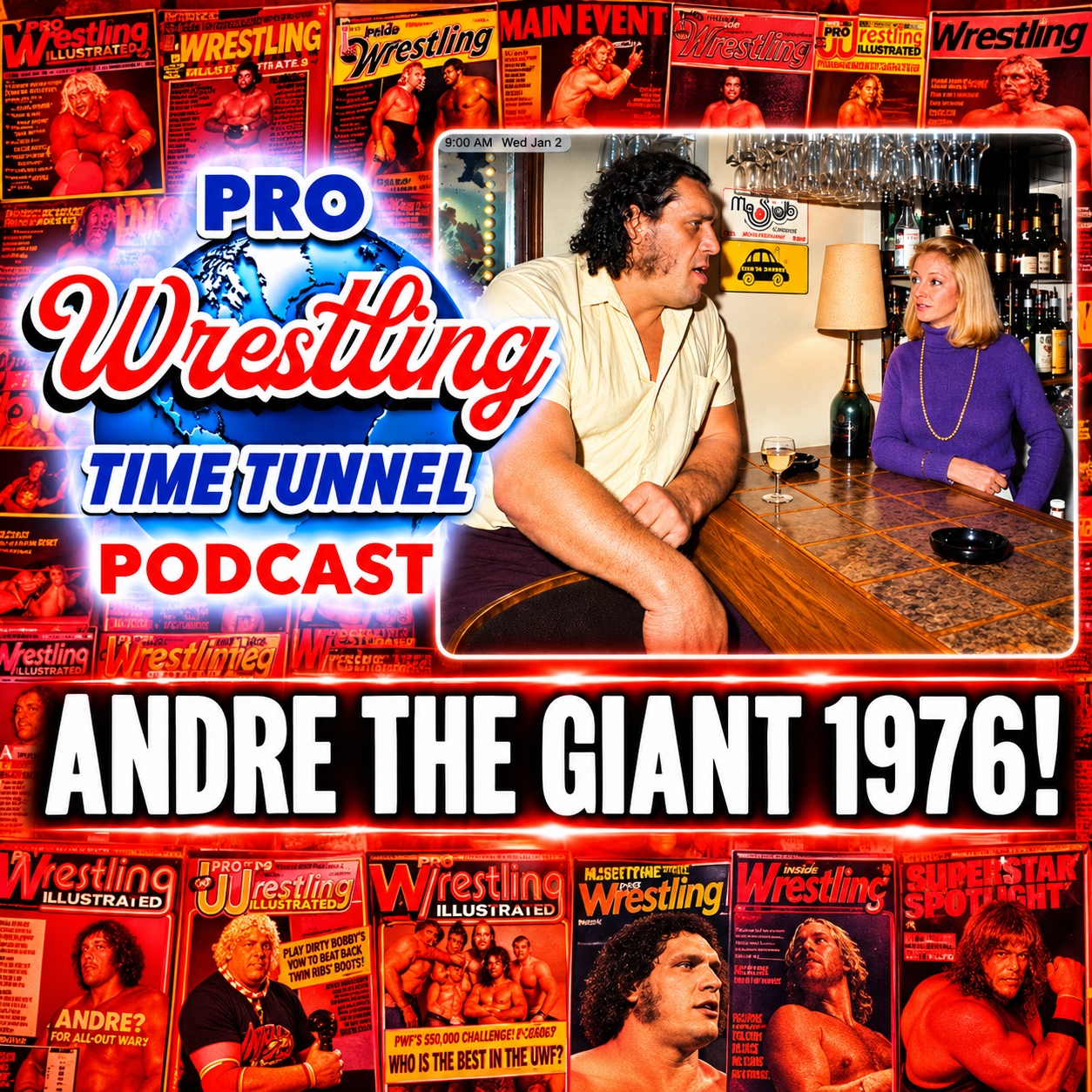
Another edition of the Pro Wrestling Time Tunnel History Show. This is your host, Tony Richards, and I'm coming to you live from the Richards ranch here in Western Kentucky. Thank you so much for joining us here again this week on the show. And my goodness, what a show we have lined up for you this week, especially if you're an Andre the Giant fan. You're really going to enjoy today's show because I have, my good friend Chris Owens is going to be here joining along with Steve Giannarelli. And we're going to be talking about the year of 1976 for Andre the Giant. And you know, about this time in 76, you've got two people who are traveling almost to the extent of NWA world champion.
Of course, you got Bruno Sammartino, who is the WWW F champion in 76, and he's working that WWWF Northeast Corridor of Boston, Philadelphia, New York City.
So there's some travel involved there, of course. And then you've got Nick Bockwinkle, who's the AWA World Champion in 76, and he's working maybe 12 or 13 dates a month for the AWA and he's probably making somewhere between five and six title defenses perhaps.
Then you have Dusty Rhodes, who is just starting to travel somewhat in 75.
He's in the AWA working with a, in a tag team with superstar Billy Graham, and also in a six man tag with Billy Graham and Andre the Giant.
And then in 76, Dusty starts working more in Crockett, he starts working more in Georgia, and he starts becoming the traveling attraction in the late 70s to early 80s that he would become.
But the guy who's traveling the closest to the NWA World Champion, Terry Funk, who is traveling to Japan and he's traveling to Canada and he's traveling all over the continental United States and his schedule is just brutal. Well, the next guy who's closest to that is Andre the Giant. And I think you're going to find today when we go through Andre's schedule in 76, you're going to find that he's got almost as grueling of a schedule as an NWA champion. And it's not organized or booked nearly as efficiently as the NWA champion because we're going to find Andre in one place and then back to the WWF for one television taping and then back to a territory for one shot. And then. Well, we'll get into that and I think you're going to enjoy us going through 76. And then we have listeners and viewers who have submitted questions for our special Andre the Giant Mailbag, which we're going to dive into here in just a little bit. And Steve Giannarelli has all those questions in the Andre Mailbag and is going to be asking Chris that. Now, Chris is.
He is the foremost collector of Andre the Giant memorabilia. It's just amazing the things that this guy has in his possession that were somewhat connected to or were personally owned by Andre the Giant. And we're going to be talking about those items and some of the stuff and Chris is going to show us some things that he can show us on screen. And we get a little glimpse inside the the Andre the Giant memorial there at the home of Chris Owens. But it's just fantastic and I can't wait to get to that. And then in the second part of our show, my good friend Larry Lane, the Red Dog, is back once again for another visit here at the Pro Wrestling Time Tunnel Territory History Show. And we're going to be talking Amarillo 1976.
Larry Lane was there and he was touring through Amarillo and also making a couple of shots in Canada, but he was very closely connected to the Funks. The Funks got him into the business and so he has quite a 76 here in the Amarillo territory. And we're going to visit with Larry about that coming up in the second part of our show.
Thank you so much for joining us again today. Again, I can't begin. We're coming into Thanksgiving and I am this way a lot of the time, but especially when it gets around this time.
I just got a heart full of gratitude for everyone. I mean, so many great people who give of their time and their memories and their expertise to come on as regular guests and regular analysts here on the show.
And I'm just thankful for every single one of them.
We are closing in very close to 1,000 subscribers to the Pro Wrestling Time Tunnel and the Daily Chronicle, my territory wrestling history newsletter that I write every single day, is now almost going out by email every morning at 5am Central Time.
It we're closing in. We're only about 100 subscribers away from having a thousand subscribers and I am so thankful and I have such gratitude for every one of you who subscribe.
And then of course, within that group of subscribers, we have our premium subscribers and we have a five dollar a month level for people who want to support me and my work that I'm doing. And they help offset some of the cost of producing and putting on the Pro Wrestling Time Tunnel. And so for all those people who pledge of their finances and you're a $5 a month level premium subscriber and you also, of course, get some of this premium content, the Tracking the World Champions Series. I just finished the Gene Kinisky in November 1966, and going through and tracking his schedule and his matches and reliving all that that just went out to our premium subscribers this week.
Last week we had Whipper Billy Watson and Lou Thes NWA title Transition and Change in November of 1956.
And we've written about the Paramount antitrust case from the Department of Justice that they patterned their approach as far as going after the National Wrestling alliance in the mid-1950s as far as being, you know, this, this entity that manipulated wrestling talent and blacklisted wrestling talent. And so that antitrust case that, that was put out by the Department of Justice and they went hard after Sam Muchnick in the nwa. And so I've written a lot about that in the last a couple of months because the NWA then came out and changed their bylaws and they wrote and signed a consent decree that they wouldn't do those things anymore. And so it's just, it's interesting for me and I'm so thankful for you subscribing to the Daily Chronicle and to the Pro Wrestling Time Tunnel because you provide the means for me to be able to do these things. And there's nothing at this particular point in my life that I would rather be doing than doing these things and reliving this history with you and having these conversations with you and doing these shows. And they've all been made possible by you.
And so thank you so much.
As an executive coach with my executive clients, you know, one of the best practices that I would always encourage them to do was to have a gratitude list and to just have a numbered list and just number a piece of paper or put it in your phone or your computer and just name as many things as you possibly can that you're grateful for right now. And I've been doing this now for over 20 years and maybe longer, it might be closer to 30 years that I've kept a gratitude list. And I think there's almost 400 things on my gratitude list now that I'm thankful for. And when I'm having a bad day, or when things aren't going the way that I would wish they would go, or there's a little bit of, you know, and life is that way. You have highs, you have lows. You go through happy things, you go through sad things.
You go through struggling with health issues, or you struggle with relationship disappointments, or someone in your life that you're close to passes away or you lose your job. I mean, there's so many things that can happen that can cause you to go into a negative place in your life. And when that happens, the first thing I do, if I can be of mind to do it, I eventually get there. Sometimes I get there very quickly, and sometimes I have to be reminded to go get my gratitude list and pull it up on, you know, and I've got it on my iPhone, I've got it on my iPad. I've got it in my computer. Everywhere I am, that I'm carrying a device. I have that gratitude list in the cloud.
And I'm telling you, I can't get to number 10 when I'm having a bad day or when I'm in one of those valleys of life.
I can't get to number 10 without changing my whole attitude.
And after I've, you know, and again, I've got 400 things on it. But when I get to number 10 and I look at the things that I have in my life that I should be thankful and grateful for, that whole negative situation starts shrinking.
And it goes back to a principle that I have taught for years as a coach. And that is that wherever you put your focus, that's where your energy goes, and that is going to cause that thing to grow.
So if you're going through a rough spot in your life, if that's all you think about and that's where your focus goes, and that's where all your energy is being expended. You're going to cause that negative thing to grow, and it's going to get bigger, bigger and bigger and bigger because you're giving focus and energy to it. It's just like pointing a telescope at the sky. It all magnifies and gets bigger. It's like taking a microscope, and the little small particle or whatever that you're looking at on that slide through that microscope expands and magnifies and gets bigger. Because those things, the telescope, the microscope, they are focusing devices.
And you are inside yourself. You have a focusing device.
And when you put that focusing device on the negative thing, the negative thing is going to grow, it's going to get bigger. And when that thing gets bigger than you are, you got problems.
So what the gratitude list does is that when you flip your focus and all your energy and focus goes to that gratitude list, those wonderful and awesome things that are on your list grow, magnify.
And the things that you should actually be thankful and grateful for begin to get big and huge. And that negative thing becomes a small thing that you can step over.
And so I just wanted to share that with you today, that as we enter into this holiday season of thanks and giving, being thankful and being given or giving that I wanted to give that piece of wisdom to you that a gratitude list is worth its weight in gold and can help you in so many situations where it may look like it's terrible and awful and gosh, when are we ever going to come out of this?
And it flips your focus over to things that are really important in your life that we treasure and that we admire and that we are thankful for. And I'm thankful for you.
So let's get on with this show today.
And I am happy to welcome in my friend Steve Giannarelli, my regular co host here on the show, and my friend Chris Owens as we look at Andre the Giant 1976.
Well, the Pro wrestling time tunnel history show rolls on and I'm excited today because I back when I was thinking about all the shows we wanted to do this year, we had to put in our regular 1985 reviews. We put in our regular 1976 reviews. And then I started thinking about special shows that I wanted to do. And there were five special shows I wanted to do for sure.
I want to profile the three world champions from 76, which we always do in our Christmas show. But then I also wanted to put two of the biggest draws of the territory era in as special shows. So Dusty Rhodes in 76, which we had that show with Howard Baum and Bruce Owens. And then I wanted to do an Andre the Giant 1976 show to talk about Andre's 76. And I couldn't think of anybody better to have than my good friend Chris Owens, who might be the foremost Andre the Giant memorabilia collector. Is that fair, Chris?
[00:15:22] Speaker E: I think that's fair, yeah. It's been a labor of love for, gosh, well over 45 years.
[00:15:28] Speaker D: And I was just saying we get a little bit of a glimpse of the Andre the Giant museum there.
And then of course, Steve Giannarelli is Back my frequent co host to jump in here with us. And then following this segment on the 76 with Andre, we have listener and viewer questions that have been submitted over the last couple of weeks for a special Andre the Giant mailbag segment where people have submitted their Andre the Giant questions. And Chris is here as our all knowing, all seeing Andre the Giant wizard. Who can answer all those questions? Steve, how are you today, man?
[00:16:07] Speaker F: I'm doing good. And if, if I may, could I ask Chris a question of my own?
[00:16:12] Speaker D: Absolutely, yeah.
[00:16:15] Speaker F: Chris, it's so nice to meet you. It's our first time talking with each other.
I just want to ask the easiest question of all. How did you become a big fan of Andre the Giant? And was there ever a question in your mind that he was going to be your favorite or there other wrestlers that could have been your favorite?
[00:16:37] Speaker E: Yeah, I think the earliest recollection I have is, you know, I started watching wrestling probably around 1980 when I was a child and I grew up in Iowa, so we didn't have a lot of problems. Pro wrestling that came through, I think central states ran that area for the most part. So my first introduction was the magazines. You know, I was lucky enough, my dad would take me to the store each week and we'd buy magazines. And so I'd flip through the pages and see all these, you know, wonderful characters. And Andre was one of those guys early on that obvious, for obvious reasons stood out. And my dad had told me little stories about seeing him on TV in the 70s and you know, the popularity of them.
And with the rise of cable tv, I was able to catch more wrestling. And so I would say by 1981, I was really kind of starting to follow Andre's career, tracking it through the magazines, the different territories, promotions he went through.
And then as the 80s rolled on and with tape trading becoming more popular, I was able to trade tapes with people. I could see promotions from, you know, different parts of the country, different parts of the world, which really opened up my, my research to Andre. And since then I've been blessed with getting to know many of his close friends over the years. And they've shared stories with me, personal stories of Andre really building that picture more than just who he was as a wrestler, but as a, as a person. And that's kind of what I gravitated towards more was just, you know, knowing his real backstory, not necessarily what we read about in the magazines, but how he got to be where he was. That was a fascinating life and just a real fascinating person.
[00:18:10] Speaker F: It's very good to know.
I mean, just to let you know, I mean, I had seen him wrestle in the WW in the late 70s in my hometown, Binghamton, New York. I did get to see him wrestle Hogan in Binghamton in 1980, which was a really good match.
And then, you know, living in the WWF area, I got to see him numerous times over the years to come against Jake Roberts, against other people. But yeah, fond memories of Andre and Tony. You take it from here and tell us what you want to tell us.
[00:18:43] Speaker D: Well, it started with Chris. 76. Is this the third year that Andre is basically touring? Did he start in 74 or 73?
[00:18:55] Speaker E: Actually this marked his 10th year
[00:18:57] Speaker D: as
[00:18:58] Speaker E: a pro, so he started in January of 1966.
[00:19:02] Speaker D: But when did Vince McMahon Sr. Start booking him
[00:19:06] Speaker E: in 73.
[00:19:07] Speaker D: 73, yeah, that's what I was thinking and talking about. So in 73, did he work a full schedule or did it take a year or so to build up?
[00:19:19] Speaker E: No, as far as working the territories,
[00:19:22] Speaker D: yeah,
[00:19:24] Speaker E: you know, really one of the first territories he sent him to towards the end of 73 was Texas. So he'd worked New York area mainly after he came down from Canada, worked a little bit up in Minneapolis, kind of got a little bit of exposure in the United States. And then in like November, December of 73, he sent him down to Texas. So when we pick up in 70, I think this was his seventh tour of Texas already, so the fans down there knew him.
[00:19:52] Speaker D: Yeah. And so that's where we kick off in 76 with the Dallas office working for Fritz Von Erich's territory there.
And he wrestles Stan Hansen in Fort Worth. He wrestles another big, heavy, big boned wrestler, the Mongolian Stomper, multiple times, including a match in Houston at the end of the week.
And so I don't know if there's anything notable about this particular Houston tour, but I would say that would have been great, a great match to see because both wrestlers at the time, Andre and the Mongolian Stomper, were both very still very highly mobile at this part in their careers. And so I would imagine that two big guys like that probably would have been a better match than you normally think of two big guys having.
[00:20:52] Speaker E: Yeah, when I was doing my research, you know that battle royal that kicked off the month, that kind of set up the storyline for that the next few weeks. So what happened was, and it would happen every once in a while in a territory, Andre accidentally eliminated himself by going after Stompers manager J.J. dillon out of frustration, and then Stomper eventually won that Battle Royal, which then set up those singles matches which mostly ended with Andre winning by disqualification because Dylan would interfere on the part of his protege.
[00:21:24] Speaker D: I'm glad you threw that in because that's something I'm always curious about. When I see a result that particularly in LA or somewhere like that where Andre's in the Battle Royal but he doesn't win, I'm like, how didn't, how did they get him out? Like, how did he not win the Battle Royal, you know, in that match?
So thanks for filling in that, that detail and that makes perfect logical sense because J.J. dillon, that was his first run as a manager in Dallas in 76 for the Mongolian Stomper. And he was, he was not the slick Four Horsemen manager that we would see later in the 80s. He was a cigar chomping, sunglasses wearing type manager back at that time. So he leaves the Dallas that week and then goes to NWA Hollywood, which is in Los Angeles, where he has a couple of interesting partners in a couple of matches. He's partners with the High Chief, Peter Maivia, and he's also with a perennial LA and San Francisco star in Pat Patterson.
And I know in a couple of those matches they were three on two matches with Andre and Patterson or Andre and Maivia. And on the other side of the ring was a young Don Morocco in some of those matches. Anything particularly notable about his LA run there,
[00:22:52] Speaker E: Steven?
[00:22:54] Speaker F: No, no, I didn't have anything to add there, but it's a very, it's just cool to imagine a young Morocco in a match with these guys.
[00:23:03] Speaker E: Yeah. So Andre, Andre, you know, was very close with the Mayavia family, so he oftentimes would work with Peter and obviously he was close with Pat too. He had known Pat over the years by that point and they did several tag team and six man tags like you said. Tony often working with like Morocco. I think Fuji Saido was in a few of those matches too. And one of the things I've learned about Andre over the years was, you know, one of the values that he held close to his heart was trust.
And once he could trust somebody in the ring, you would notice a pattern over time. No matter what promotion he would go to, his opponents oftentimes were the same guys that he trusted that he knew that he could do a good match with Fuji, Sado Morocco, all those guys would follow him into different promotions and he request matches with them.
[00:23:52] Speaker D: It's a fairly easy jump from Dallas to Southern California, then Northern California in January, in February though, for a short month he sure got around. He started in San Francisco territory at the end of January into the first week of February.
Then he goes to Canada, he's in London, Ontario, he's in Kitchener, he's in St. Catharines, then hops down to Detroit where he's in a six man tag, or actually he's in an eight man tag. With his partners are Bobo, Brazil, Dominic Denucci, who just went in the Wrestling observer hall of Fame, and Chris Taylor where they defeated the Canadian Wild man, the Wolf Man, Chris Colt and Kurt Von Hess, which would have been an interesting tag team match there. But he also has some matches with Chris Taylor I believe this year, which another couple of big guys.
Taylor not quite as mobile as the Mongolian Stomper though. Do you know much about the matches with Chris Taylor?
[00:25:04] Speaker E: A little bit.
So one interesting point about that eight man tag that happened on Valentine's Day night at Kobo. And I was thinking what greater way to spend the date night, taking somebody to Cobo hall to watch that match. But yeah, you know, Andre and Chris did get along. And I had a chance to talk to Chris's widow some years ago and she had some good memories with Andre. She said when Andre would come through, oftentimes he would stay at their house, spend the night.
One of the fun facts she shared was that, you know, being that big back then, it was hard to find clothes. And she said at the time Chris and Andre wore the same size T shirts which for 5xls. So every once in a while she's like, Chris would float him a few T shirts and Andre would reciprocate with Chris. So they would travel together, they had a few singles matches which I'm sure were just, you know, classic big guy matches. Maybe neither one getting a clear cut win over. Obviously not wanting to kill off Chris that early in his career and he wasn't going to beat Andre. But yeah, they did have a few singles matches.
[00:26:09] Speaker D: On the 15th he's at the Maple Leaf Gardens and he beats the Wolf man and the Wild man in a two on one handicap match.
And then he goes the next day on the 16th to a city he has a long history with in Montreal where he has a match where he defeated Abdullah the Butcher by referee stoppage.
He that Montreal was his gateway to the States, right? I mean to North America, I guess I should say.
[00:26:38] Speaker E: Yeah, he always held Montreal very close to him. It was probably the city that really opened up and rose him to fame when he came over.
Paul Vashon was one that was responsible for taking him from England and France at the time and flying them over to Montreal back in 1971 I think. And he would oftentimes, you know, throughout his career go back up to Montreal and help as best as he could. And we could talk about that a little bit later on. But yeah, he was always very close to that promotion of those fans up there.
[00:27:12] Speaker D: Then he goes all the way south to Georgia and Florida before the month is over and he has a week in Georgia where he continues to wrestle Abdullah and then he also has some matches with Don Jardine the spoiler which I could only imagine were really good matches as well.
And actually there's a date in there for the ww. It's not like he just went from Georgia to Florida.
At the end of the Georgia week he goes back to White Plains, New York to wrestle in the WWW F for one night where he's in a tag team match with Dominique Denucci where they beat Crusher Blackwell and Lewis Cyr in a two out of three falls match. So travel was always difficult for him I'm sure. But how did you know much about. How do you handle those one night long hops like that from. From Georgia to New York back to Florida?
[00:28:14] Speaker E: It was incredible. And one of the things that I've done over the years is, is to compile what I believe is probably one most comprehensive record books of Andre.
I've estimated he probably had over 5,000 matches in his career and I have probably 95% of it completed. And the thing that stood out to me especially during those early years was you know, there was a cadence to his travel after a period of time where he would see, you know, starting off in Texas and California to kind of work through. But there was no rhyme or reason to often these, these one night stands where they would take them from Atlanta and. And fly him up to White Plains the next night and then back to Augusta or someplace like that.
It had to have a lot of pre plan.
I mean, you know, Vin Senior obviously was helping with the bookings, keeping track of that. One thing that Andre was well known for was he was making his shots. Very rarely missed his shots. But I can't imagine that life of work living out of a suitcase with very little time off, very little time off.
[00:29:18] Speaker F: We'll say that White Plains is actually Arnold Scholin's town. And maybe that was the beginning of that tight friendship he'd have with Earl Scholin
[00:29:28] Speaker D: who would been managing his travel. Very true all that. Chris
[00:29:35] Speaker E: at the time, you know, his travel companion was Frank Valois.
He would travel with Frank quite often, not only managing it, but also within the translation. Because Andre's English was very limited. He was able to speak okay by 1976.
But again Frank was one that was kept pretty close to him. And Senior, you had to go through Senior to get his bookings. Obviously
[00:29:58] Speaker D: going back and then he goes back down to Florida.
And this is interesting. He's in Florida for 1, 2, 3, 4, 4 dates. He's in Tampa, Miami, Ocala, Tallahassee, back to Philadelphia and then also in South Orange, New Jersey and then at a TV taping in Philadelphia, then back to Florida for one night in Miami and want to specifically talk about that night.
And then back to Worcester, New York, then to St. Louis.
So my gosh, it's almost like you just took an ink pen and drew lines on a map for his travel schedule.
[00:30:45] Speaker E: And that continued through the mid-80s before Vince really took over strictly his bookings. I mean it was non stop going from coast to coast.
[00:30:55] Speaker D: We earlier this year when we did our Florida night, One of our Florida 1976 shows, Howard Baum was at this match in Miami. It took place at the Miami Dade Junior College. Terry Funk defended the NWA World title against Andre the Giant.
And I'm probably one of those sticks in the mud that I probably wouldn't. Maybe at the time, as a fan, I would have enjoyed that match.
But later on now, with a little bit more mature thinking head about the wrestling business and more modern eyes on it, was that a good idea to have a world title match with Andre at that point in his career? I mean, because logic would tell you there is no way that he doesn't get the title if he wants it, you know what I mean?
And they talked about how great a match this was. Like Terry really had his working shoes on. So he really flew for the Giant and he really. They did a real strong wrestling match.
Like I'm not real big into the star system, but I mean it would have been a four, five star match between the two of them. Like they went out there and really worked the match which does it seem like what you normally saw with the Giant, you know.
So what's your opinion about titles and Andre?
[00:32:25] Speaker E: Well, a couple things. When I went back and was looking at that, I'm pretty sure that was his first shot at the NWA title and it came against Terry.
Like you said, it was held at that community college. The attendance was a little over 4, 000 people and I think Andre ended up winning him by disqualification. If I remember
[00:32:47] Speaker D: because it said
[00:32:48] Speaker E: Terry threw Andre over the top rope.
You know, it was one of those things that periodically afterwards you would see Andre have a title defense against maybe a Bachwinkle or a Harley race or Ric Flair in the early 80s.
As a fan I always, I never expected him to win the world title. I don't think he needed it. That wasn't his niche. But it was always that at the time.
Maybe we'll see the champion lose tonight because nobody can beat Andre and this is going to be a tough title defense. So I think it was a good one off every once in a while for Andre to come into the territory, take on the champion and you know, he, he would leave so the champion would stay strong, but he still held his role as the Giant. Maybe he would win by count out disqualification.
So I think a one off match with Terry, I could see those two guys gelling very well in the ring, especially in 1976.
[00:33:42] Speaker D: Well, we have another one with Bachwinkle coming up in the summer. What's your thought about that, Steve? What, what do you think about Andre and titles?
[00:33:52] Speaker F: Kind of like Chris, I mean was probably a unique and, and the promoters are probably trying to pop a house.
But yeah, and I'm like you, Tony. I mean I, I don't see how you can really believe that Andre is not going to win. And then there's a kind of a screw job ending at the end. I mean, I'm not really big into those kind of finishes but, but you know, I mean it only made sense to have Andre wrestle the champion because he's undefeated. I mean, I guess that in itself gives wrestling credibility. Let's have the undefeated Giant wrestle the world champion.
[00:34:32] Speaker D: I know, I know Bruce Owens said Eddie Graham was not there that night, but if he would have been there, he'd have been furious because it just wasn't logical, you know. And I'm all, I'm also one of those sticks in the mud that I don't think anybody should have ever slammed him. But that's just, you know, that's me and my logical head. Like once, once somebody slams him, which I guess l Connect did it first, then Harley Race.
But it's almost like how can someone slam Andre the Giant without cooperation?
You know, and it just doesn't make logical sense in my head. And it takes away stigma and uniqueness from the Giant. And you know, I know that was something Vince McMahon Sr. Was really, really strong on, was you never do anything to hurt the image of the Giant.
[00:35:27] Speaker E: Yeah. And you definitely saw a difference like, go back and we find footage now of Andre in the late 60s in Europe where he was wrestling very much a European style, taking bumps. He was very quick back then. And even some of those early shows when he went over to Japan in 70, 71, 72, still taking bumps, still taking body slams from some of the guys, but it definitely came to a halt. Like you said, Tony, in 73 when Vince got a hold of him, then you didn't see it happen as often.
[00:35:55] Speaker D: Well, he. McMahon Senior was like, do not stand next to anybody in photographs or anybody that's over 6 foot 5 or whatever. Like, we don't want any, you know, comparisons of like, well, Andre doesn't look that tall next to these other people, you know. And so
[00:36:14] Speaker E: isn't it amazing, though, after all these years? And one of the things I've enjoyed doing is collecting photographs of Andre. Thousands of photographs that you can't find a single photo of somebody, you know, towering over Andre or looking as big as Andre.
You know, I think we're familiar with that with the photo shoot he did with Wilt Chamberlain and Arnold in Mexico that he got a little bit. A little bit of heat on, but from my understandre, didn't care. You know, he knew his role was the Giant. But to your point, you just didn't see that.
[00:36:45] Speaker D: Well, I just remember always thinking, well, that knocks Ron Fuller out then he never got a fixture with the Giant.
[00:36:51] Speaker E: He did.
[00:36:52] Speaker D: Oh, he did. Oh,
[00:36:53] Speaker E: yeah. I can send it to you. Yeah. In fact, I saw Ron in Waterloo last year and I showed him the photo. He clearly remembered that. But, yeah,
[00:37:01] Speaker D: wasn't that interesting? What Ron Fuller and his son and his grandson, they all walked in, it looked like a basketball team had arrived at the Waterloo.
[00:37:09] Speaker E: Definitely stood out.
[00:37:11] Speaker D: So in St. Louis Nutter battle Royal, that he doesn't win. Dick the Bruiser wins it. Do you know how they got around that one?
[00:37:21] Speaker E: No, just I'm sure that Dick the Bruiser was probably more the local favorite at the time and, you know, probably had some say in who was going to go over that night.
And I didn't. I didn't actually see what the. How Andre was eliminated that evening, but I'm sure they worked in some storyline.
[00:37:38] Speaker D: Yeah. And. And I think it probably a lot of times those ended up being contenders for title matches or whatever. And so Andre probably wasn't going to be back for something like that. And they were setting Dick up for. For a match with somebody, either the Missouri title or the. The world title. Then he's in the Awa for a stretch, which I think this is what's so unique about Andre the Giant to me that he is the one wrestler who actually got to work for all the, the federations.
Dusty was another one, you know, that got to work in the AWA. And then in 77 he goes and he has those matches at Madison Square Garden that Steve and I are going to get to talk about next year. But just only a couple guys like that who got to work the awa, the, the NWA and the wwwf. But I had a question and we just talked about Dick the Bruiser. Did Andre ever work for Dick the Bruiser in Indianapolis?
[00:38:42] Speaker E: He did.
I'm trying to remember what year it would have been. 77, 78. I know there's at least one match on video that you can find where Andre and Dick went up against Ox Baker and Killer Carl Croup, I believe.
[00:39:00] Speaker D: I love Killer Carl Croup.
[00:39:02] Speaker E: Yeah, he did a few matches for the Bruiser there, huh?
[00:39:06] Speaker D: Horrible worker, but amazing facial expressions. I just love his facial. He just looks like a sinister, sinister dude.
The one, the one match I bring up here before we get out of March is the Madison Square Garden in New York City. On the 23rd of March. Andre and Ivan Putzky beat Ernie Ladd and Bugsy McGraw.
But it only takes three and a half minutes to do it. And I was just thinking as we talk about Andre's travel schedule, he's got to get on a plane and fly to New York City to be in a three and a half minute match.
I don't know if that was
[00:39:46] Speaker F: the last match of an MSG show because oftentimes when they're getting close to curfew, they just had a quick match like that. And, and famously that was on the COVID I think, of inside wrestling Andre and puts he with their hands held by the referee after that huge win.
[00:40:03] Speaker D: Wow.
[00:40:04] Speaker E: Yeah. You know, another good example of just, you know, taking Andre from one city to the next. Before we go much further in the year in March, I think it was March 25th. One of the first things that we saw in the newspapers back then that hit the AP was the press conference that initially announced Ali and Adoki. And it was at the Plaza Hotel in, in New York City. And a little trivia. A lot of fans thought that Chuck Webner was the first opponent that was announced for Andre and that War of the World show. But actually Bob Arum announced it was going to be Jerry Corey who was a boxer and Jerry would have been a horrible match. But that's the name that was put in the newspapers. Jerry was like a 6 foot, 200 pound boxer but was supposed to be very, you know, heavy handed with his left.
But to your point, again, that was done in the afternoon. Andre had to get in the car, drive an hour and a half that evening to Worcester and did the exact same match, Andre and Ivan against, I think it was Ernie Ladd and Bugsy.
[00:41:07] Speaker D: Oh, wow. Yeah, I just remember Jerry Quarry bled a lot.
[00:41:11] Speaker E: Yeah, yeah,
[00:41:14] Speaker D: he goes down,
[00:41:15] Speaker E: that was the first thing that was announced.
[00:41:17] Speaker D: He goes down to the Gulf coast territory and works three or four dates, then back up to the Northeast.
Philadelphia, Portland, Waterville, Maine, New London, Connecticut and Baltimore.
Then Uniondale. Then he's down to the Tennessee territory where he works. Louisville, Nashville, Jackson, Huntsville. And his primary, he, he gets to work with the amazing and talented Randy Fargo, who was one of the, he was actually Jackie Fargo's actual cousin, but not well remembered today. As a matter of fact, if you didn't grow up here, you probably never heard of Randy Fargo. But they got to work with probably the best working tag team or at least in the top five of that year, Hickerson and Condrey against those two, which I would imagine Phil Hickerson and Dennis Condrey probably bumped all over the ring for, for those two. I'm sure Randy Fargo gave Andre the hot tag on that.
Then he's back to Canada again working for the Halifax Nova Scotia promotion, then back to New York City for his Madison Square Garden match for the month where he defeated Ernie Ladd by count out in a little over 12 minutes. You remember anything specific about that match, Steve, Ernie and Andre at msg?
[00:42:55] Speaker F: Well, I will, I will say that, you know, you, you have these memories of being a kid and, and my false memory was that I thought that Andre and Ernie had like feuded all over the territory and had these multiple feuds in other territories as well. I, I, and I'm sure Chris can back me up on this. I don't think they really had that many matches with each other. You would have think that the promoters of the 70s would have milked that to death, but I know they wrestled in the Superdome in Louisiana, I think at least once or twice, the MSG match, a few other matches, but they didn't really go all around the horn with it. Is that how you remember it, Chris?
[00:43:34] Speaker E: Yeah, yeah, by 76. Now later on those two would kind of pick up a little bit more with their singles matches. By 78, 79. But yeah, in 76, no, they did not have a lot of history between the two of them. No.
[00:43:48] Speaker D: Couple of things to note here at the end of April as well is this isn't Crockett country in Mid Atlantic championship wrestling.
And there's a six man tag in Hampton, Virginia. Andre Paul Jones, Rufus R. Jones beating Ric Flair, Angelo Mosca and Blackjack Mulligan, a couple of pretty big guys.
And then a. A tag team match that I would have given high ticket dollar to see.
But they had it in Conway, South Carolina. And I would have thought this match would have been a Greensboro or a Charlotte or Norfolk, Virginia, but in Conway, S.C.
and it's the only time they booked this match I can see on this tour this time through Crockett for, for Andre, it's Andre and Wahoo McDaniel versus Gene and Oli Anderson.
I'm sure that was an amazing match.
And I know in May Andre does get a United States heavyweight title match with Blackjack Mulligan as well in Greensboro.
So there is another title match and also working with another fairly tall big guy.
I wonder, I wonder how the Andre and Blackjack matches were.
[00:45:08] Speaker E: You know, they took that around the horn. Andre and Blackjack first started working together up in Canada like in 1972. So they've known each other and Andre, like I said, had that, you know, value of trust.
He kind of have a lot of hate relationship with, with Jack Mulligan over the years.
And I'm sure we've all heard different stories about, you know, sometimes they would drink a little too much and they get into their own scraps.
[00:45:34] Speaker D: Not Blackjack Mulligan.
Blackjack Mulligan drank too much on occasion.
Man, you heard it first here on the pro wrestling time.
Yeah,
[00:45:44] Speaker E: but their match, yeah, their matchups are actually one of my favorite opponents Andre had over the years was Mulligan. I thought they matched very well up in the ring and Mulligan would not give him a lot in the ring. So Andre really had to work to get good, you know, to really sell that good match.
[00:45:59] Speaker D: I would have thought that's the way the Andersons worked too.
They, they didn't give you much. You had to work for it. Which always made for what I thought was a better match.
[00:46:09] Speaker E: Yeah, definitely. You know, I thought that brought the most out of Andre, the best out of Andre when he would be in the ring with certain guys that would really push him. Like we're talking Stan Hansen earlier and those two guys, you know, just could gel in the ring.
[00:46:23] Speaker D: Yeah, I loved. There's that, that famous match From Japan that they had, which the cameraman's a little bit low in the corner of the ring. And you just see the big foot coming from Andrew. Yeah, I love that camera.
[00:46:40] Speaker E: That great opening.
[00:46:44] Speaker D: Well, you would think leaving the Carolinas, he would go to Florida again or Georgia again or maybe Tennessee.
But no, he goes up to the Pacific Northwest from there.
Work for Don Owens and a couple of shots.
Doesn't really work Portland, but he does work Eugene and Seattle while he's there. And he also works Vancouver territory while he's there, where he's a tag team partner with Jimmy Schnuka.
And then he's back to the Midwest in the Kansas City territory, where he actually has a match in Kansas City with Dorie Funk Jr which was a bounty match.
So it's Dory Funk Jr being the policeman to keep Andre from getting a title match with Terry there in Kansas City.
And he's in Kansas City for a couple of weeks. Works with Ed Wiskowski there. Works with the course. Got to work with Bulldog Bob Brown.
Then he's in Iowa.
Then he's back in Texas again.
This time he's in West Texas.
Work San Angelo, Odessa, Abilene, Amarillo. He's in the Battle Royal and wins the Battle Royal in Amarillo. He's in a Battle Royal in Lubbock and wins the Battle Royal. He's a Battle Royal in Abilene and wins the Battle Royal. Look at the Funks making sense. Look at that.
Anything particular about that Amarillo run? It looks like he was only in Battle Royals. He didn't really have. He had one tag team match. Andre and Dori Funk Jr. Beat Hank James and the Super Destroyer, which was Art Nelson.
But those are the only matches he had. Well, he had a tag team match in Pueblo, Colorado, where he tagged with Ricky Romero against Super Destroyer and Hank James.
But mostly he worked Battle Royals. Did
[00:48:46] Speaker E: he?
[00:48:47] Speaker D: I was just going to ask, did he enjoy the Battle Royal gimmick?
[00:48:51] Speaker E: He did.
So during this time, you know, oftentimes he would be brought in for a week just to do those Battle Royals. And the newspaper clippings would often say, you know, they headline him as the featured attraction. Andre. Against 12 people or 15 people in fine print. Battle Royal wouldn't get a singles match. It was just, you're gonna see him at the end of the night, come through. He enjoyed that. What I did learn was he didn't enjoy the double bookings where he would be brought in to work a singles match earlier evening and then come back and do the Battle Royal.
I think he. There was a famous story where he got pretty upset with Vern towards the end of his AWA run and just said, I'm not doing that anymore. Please stop booking me twice in one night. I just want to be one time. It made. It made the appearance a little bit more special.
So
[00:49:41] Speaker D: either book me in a Battle Royal, book me in a handicap match, or a single or a tag, but not two. Right.
[00:49:48] Speaker E: So great story.
Vern didn't listen. Kept booking him. And on one of his final nights, it was the Battle Royal. Andre went out to the Battle Royal, the bell rang, he walked around the ring, eliminated himself, walked to the back, grabbed his bags, and left the arena.
[00:50:05] Speaker D: Wow.
[00:50:05] Speaker E: Yeah,
[00:50:06] Speaker D: I love guys that have balls like that.
[00:50:09] Speaker E: He did.
[00:50:10] Speaker D: He's on two really big cards in June.
So the super bowl of wrestling at Texas Stadium, where the top matches. Fritz von Erich versus Terry Funk for the NWA title. They draw almost 18,000 people.
And Andres in a handicap match where he defeated Mongolian Stomper and JJ Dillon to follow up on the angles that they had set up earlier.
But part of that huge, huge card there. And then he's on the showdown at Shea on June 25 at Shea Stadium in New York City, where he beat a boxer. We talked about boxers earlier. He beat Chuck Wepner by count out in a wrestler versus boxer match. Now, was that a tie in with Anoki and Ali as well, guys?
[00:51:00] Speaker E: It was. Steve, go ahead.
[00:51:03] Speaker F: Yeah, it was one of the featured attractions. I mean, in Shea Stadium. I mean, as you guys know, the real attraction was Bruno against Dan Hansen. But the Ali Inoki match was heavily, heavily promoted. And Andre against Chuck Webner was really a chance for the fans to see kind of what they were promised in the main event.
You know, a. A famous boxer against a famous wrestler. And I think Andre and Webner really delivered because it was a melee. It was a crazy match.
Chris, would you say this was a shoot.
[00:51:39] Speaker E: Good question.
Worked shoot is what I would say. The finish was worked.
There was obviously parts of the match. You saw Chuck taking liberties, and he was not pulling his punches. He was punching Andrew, obviously, if it was a true shoot. A wrestler's always got a bigger boxer as soon as the wrestler grabs the boxer.
I've always questioned that, that finish, you know, Andre lifted him up for body slam, and I'm assuming the finish was called that. It was going to be a count out. Both guys would save face. However, if you go back and watch Chuck's foot gets tied up in the ropes, which broke his fall.
But otherwise, you know, Andre was standing there with Chuck on his chest by the top rope, which was probably at that point, maybe eight feet to the. To the field. If he would have dropped him straight down to the ground, that could have seriously hurt Chuck.
[00:52:34] Speaker F: Right.
[00:52:35] Speaker E: So I've always wondered, like, was that foot tie up? Was it? I.
Hard, hard to believe that Chuck was taught that before the match, to do that. It just happened. Happened.
[00:52:45] Speaker F: And famously, there was a big melee with the handlers of both. Both teams, and Monsoon, who was in Andre's corner. And of course, he was the front office guy for New York. He was so angry and so pissed off, he broke the hand of one of Wepner's cornermen, who I think was Patty Braverman, broke his hand. This melee, it was really an amazing fracas, an amazing thing that happened. And again, it adds more lore to Andre's legendary story. Just another one of Andre's wonderful nights.
[00:53:19] Speaker E: Yeah. A couple things I was going to show you real quick because I was going through some of my. My collection. This was the actual ticket stub from that day.
It was at a lower section, and it cost $12 back in 1976, which I think wouldn't have been too bad compared to some of the rate of prices I saw a little on the high side. But what I thought was interesting, the New York Post the next day, headline, Ollie draws 6 million worldwide booze. That's the front. But the back of the Post had that photo.
And Chuck says, at least we went at it.
And this got Andre a lot of publicity.
So we're going halfway through the year. First part, of course, with the $6 million, man. But then this match right here, the mainstream media, and even if you weren't a wrestling fan, you started hearing about the name Andre the Giant.
[00:54:13] Speaker F: Absolutely.
[00:54:15] Speaker D: So you hear various stories about Andre's temperament over the years.
So when Wepner was peppering him, what was his. Did he get pissed or what? Like, if I'm Wetner, I'm like, I'm not going to piss this guy off. You know,
[00:54:32] Speaker E: there was a couple moments you could see on Andre's face, but I'm sure he was conflicted because he'd have to stay as a pro out there to work through the match.
And Andre had a little bit of boxing background as a late teenager, so he knew how to handle himself. He wasn't considered, you know, a great fighter, but he was big and strong enough to handle himself.
And. But there was a few times, I think it was either the end of the second round or beginning of the third round when Chuck got some punches to the back of Andre's head. And then you see Andre's facial expression change
[00:55:06] Speaker D: in July, he goes back to Crockett country. He's in the Carolinas again. And in Greensboro on July 4, the bicentennial year, on our nation's birthday in Greensboro, North Carolina at the Coliseum. I get the match I wanted to see, except I don't get it exactly. It's Andre the Giant and Paul Jones defeating Gene and Ole Anderson. I nothing against Paul, he was a great worker at this particular time in his career, but I would have rather seen Andre and Wahoo in that match.
But so Andre's there all week and then he goes back to Canada. He works for Stu Hart in Calgary and does that amazing Stampede Tour where he gets to work great towns like Lethbridge, Alberta and Regina. And that Edmonton, Alberta guys have told me Jerry Oates and Larry Lane have told me great stories about traveling that Stampede circuit.
Although you know, Andre is probably accustomed to that, spending so much time in Canada, the last day of the of March that he works is on the 17th where he works the Superdome in New Orleans for Leroy McGurk and Cowboy Bill Watts. It's Andre the Giant and Buck Robley against Ken Patera and Bob Sweet. And as we get into August, he's back to Ontario and back to Canada and the Detroit territory.
Did he like working for the Chic?
[00:56:51] Speaker E: You know, I don't know his relationship with the Sheik. He definitely would do a few matches with him. And one of the interesting matches I saw it was on August 14 and the newspapers advertised it as loser rides a donkey around the arena.
Can you imagine that? Yeah, I think we all know who won the match.
And they said the Chic was riding a donkey around
[00:57:16] Speaker D: Wes Mademit and I just did a show on 76 Ontario and Wes made a point about by 76, the chic was wearing out his welcome as the booker in Toronto. And it all stems Back to that 74 match where Andre. This again goes back to logic, right?
I mean, obviously Andre should have won the match in 74 in Toronto, but since he didn't, that just sent Maple Leaf Gardens into a ever deepening decline.
People just got really soured on the Sheik and his booking there. But he wrestled Andre at Maple leaf Gardens on Aug. 15 and Andre beat him. It was a DQ win, but he did, he did go over finally.
And then August 27th, this is the other world title match I was going to ask you about. I'VE talked to George Shire about this, but this is August 27th, Comiskey Park, Chicago, Illinois. A no contest finish with Nick Bockwinkle for the AWA world title. So being a Midwestern fella, you probably have read about and studied this match. What can you tell us about this match in Chicago?
[00:58:34] Speaker E: Well, newspapers at the time estimated a little over 12000 fans attended it. A match went around 20 minutes.
Bachwinkle and Andre had good chemistry in the ring. You wouldn't think they would if you look at the two individuals, but Andre would very much do a classic wrestling match with Nick.
A lot of, you know, just classic wrestling. Some rest holds here and there, just really working moves throughout the match.
Again, Bach Linkel was not one of those guys that wanted to go in there and just bump and flip around for Andre. He worked. And so some of the matches, I've seen bits of like 8 millimeter footage of this match and you know, it's great seeing those two guys. Nothing really stood out because I. They did a lot of the same move sets they would later on in their same matches, but from what I've under what I understood, it was a good match.
[00:59:26] Speaker D: It makes me mad at Vern for being too cheap to film the card.
[00:59:30] Speaker E: Exactly, yes.
[00:59:32] Speaker D: You know, because man, what a show at Comiskey Park.
September, he's back for his Madison Square Garden show in New York on September 4th.
He is partners with the two Native Americans, Jay Strongbow and Billy White Wolf, beating Hanson and the two Executioners in a three out of five falls match, which the WWWF was pretty consistent in booking from time to time. Then he's back to California for one show in San and San Bernardino where he's partners with Butcher Vachon versus a young Roddy Piper and Crusher Verdu who were top heels there in LA at the time. And then I want to ask you about this because he goes on a tour of Japan, he's working for Enoki, he's in New Japan, he has some matches with CG Sakaguchi, Strong Kobayashi, some tag team matches. It's the Fighting Spirit Series tour.
So did the Ali Noki partnership and all of that have to do with him working for Enoki in Japan or what was that relationship based on? He was, I always thought he worked for Baba,
[01:00:53] Speaker E: so he was very loyal to Anoki from the start. When Anoki branched out and started New Japan and I think Andre debuted with Anoki in January of 74 and he would work for Anoki every single year, sometimes twice a Year he would do tours of new Japan from 74 through 86.
And that's when Vince kind of pulled the plug and said, you know, I don't want my talent working for Japan anymore. They're going to be exclusive to us. But Andre was very close to Antonio Noki over the years, so
[01:01:25] Speaker D: it must have been because on the last day of the tour, in the finals of the fighting spirit, Andre does the job for Enoki.
[01:01:33] Speaker E: Yeah. And this was at the October 7th.
[01:01:39] Speaker D: October 7th. Yeah,
[01:01:40] Speaker E: yeah, yeah. I just went back and watched that match. You know, they stopped it, they ruled it a tko.
[01:01:46] Speaker D: Oh,
[01:01:46] Speaker E: Andre was bleeding from a headbutt I think on the ringside post outside the ring. And a little bit of a botched ending because I don't think he was bleeding as heavily as they had hoped for. And Frank, while Frank Valwall jumps in the ring and starts trying to wipe away the blood, which there was very little.
And Andre was selling it. But eventually Frank's like, no more, no more. And yeah, he was very gracious to Inoki.
I think we're both familiar with his submission loss to Inoki right before he departed.
[01:02:19] Speaker D: Yeah.
[01:02:20] Speaker E: And that was a big thank you to, to Antonio Noki.
[01:02:23] Speaker D: Have you seen that match, Steve Noki and Andre?
[01:02:27] Speaker F: No, no, I don't believe so. No,
[01:02:30] Speaker D: I, I have now that Chris has refreshed my memory, but it's been a long time ago. I just wrote down, I'm going to go back and watch that again.
[01:02:40] Speaker E: Those two guys you talk about, you know, two guys that do not match up well physically in the ring and Noki being like a medium sized wrestler, but somehow for 12 years they brought the fans into the arenas every single time and sold out. The fans had so much respect for Anoki, of course, but for Andre as well. And those guys could put together a great match.
[01:03:02] Speaker D: Yeah. And the other thing was Inoki was so martial arts mixed based too and that doesn't seem to fit Andre. You know, I just thought he always matched up better in like an All Japan. But
[01:03:17] Speaker E: yeah,
[01:03:18] Speaker D: comes back to the States, goes to Georgia, wins a whole bunch of Battle Royals in Georgia, then down to Florida where wins a whole bunch of Battle Royals.
The Madison Square Garden show for October is Andre the Strongbow and White Wolf again. This time it's the Executioners and Bruiser Brody in a match that goes a little over 20 minutes for a three out of falls match. You remember that match, Steve?
[01:03:47] Speaker F: You know, I'll tell you guys something kind of funny. In the early 90s on all American Wrestling And I think Johnny, Johnny Polo, better known as Raven, I think he was producing the show at the time. And briefly they brought back the idea of let's have a nostalgia match. Let's show an old match from the archives. And they actually showed that match on all American wrestling like in 1994. And it was so cool to see Brody again and Andre in his prime and so hard to believe. But that match made the light of the day in 1994.
[01:04:22] Speaker D: October 27th.
Kicking myself because Andre is works one match in the Tennessee territory on October 27th and he beats Jerry Lawler by DQ in Evansville, Indiana at the Coliseum. And I was not there. And I went almost every week to Evansville, but I was not there that night. And I cannot believe I missed Andre the Giant.
So
[01:04:48] Speaker F: Tony, do you think that could be the, the match that that magazine article was based on? The night Andre lost to a midget?
[01:04:57] Speaker D: Oh, it might be.
It might be. They, they doctored the film that showed Jerry beating, beating Andre. And then what happened? The wrestling magazine got photos of it. And then at the NWA meeting, Vince McMahon senior stood up and was shaking the magazine saying, you're gonna, we're our own worst enemy. We're gonna kill the business. And going back to my, going back to my logic argument earlier, which is another, you know, fit here.
And then Terry Funk yells from the bag, tell us who the little son of a was.
[01:05:35] Speaker E: Yeah, it would never happen again. But yeah, they ran an article as I think it was a cover story. It said the night a midget beat Andre.
And do you remember what Bill said he had to do to get back in good graces with the senior?
[01:05:48] Speaker D: I don't. What, what was it?
[01:05:50] Speaker E: So I think it was the month or two after he ran a cover story that had a picture of Andre with his hands out, you know, as a classic Andre pose. And it said, Andre, the only undefeated wrestling superstar
[01:06:04] Speaker F: to
[01:06:04] Speaker E: try to save face.
[01:06:05] Speaker D: Yeah,
[01:06:06] Speaker E: and it said, I, I talked to Bill about that. He said it took him several months before Vince would kind of ease off a little bit and start talking to him again.
[01:06:15] Speaker D: Here's another great thing about the 1970s that would never happen today, but in November.
He's in the first couple of weeks of November, he's in the Kansas City territory. And neither one of you guys probably are going to know where this is. But on November 2nd, Andre the Giant is at Marceline, Missouri at the high school in a six man tag with Akio Sato and Bob Brown versus Bob Slaughter, who would later become Sergeant Slaughter Dutch Mantel Mike George, Mitsu Hada and Ricky Gibson in an eight man battle royal. But Andre the Giant is in little old Marceline, Missouri, which is hard to believe.
He's in Madison Square Garden, he's at the Keel Auditorium, he's at the Miami Beach Convention center. And he's in Marceline, Missouri, which to me is just something that we are missing from the old territory era, stuff like that.
[01:07:18] Speaker E: That's one of the areas, you know, obviously growing up in Iowa and kind of studying early on when he would come through central states, it's. And fans are surprised to hear the, the small venues he would work in. Missouri, Southern Iowa.
My hometown of Ottumwa, Iowa, which was about 30, 000 people saw Andre come in in 1979 to the Tama Coliseum when we would normally get guys just like, you know, with Mark Romero, Art Cruz, Dewey Robertson and all of a sudden we had the Giant. Then he'd go down to Eldon, Missouri.
[01:07:49] Speaker D: Yeah,
[01:07:50] Speaker E: you know, Harley was well known, but you would not normally see Andre down there.
[01:07:54] Speaker D: No, I just imagine in my mind just thinking Harley race or Bulldog Bob Brown going, hey, we don't really have anything to do tonight. You want to ride with us to know you want to work.
[01:08:06] Speaker E: It's very small.
[01:08:07] Speaker D: And then we'll be in Kansas City tomorrow night. You know, speaking of Iowa, he's in Cedar Rapids on the seventh at the Veterans Coliseum where he beats Mitsuhada and Joe Turco in a two on one handicap match.
He finishes off the month down in Texas.
The Chic who started traveling again because the audience, he was losing Toronto and the Detroit audiences were falling off at Kobo. So the Sheik started hitting the road again for cash and he became like a big heel in Texas again in the Dallas territory. And he had a series with Andre the Giant. They worked. Dallas, Fort Worth? No, just Dallas, San Antonio, Corpus Christi and I think that's it on that run. And then in West Texas he had a run through Funk territory again and then a Battle Royal in Mid Atlantic and then finishing off the year, I have that he worked the Madison Square garden show on December 20th. He got quite a bit of time off there. At the first part of December he was teaming with Dominic Denucci against the Executioners and then back to Maple Leaf Gardens where he beat Angelo Mosca and he finished off with a TV taping in Philadelphia. And that's pretty much 76 for Andre. Anything notable in any of that or anything? We didn't mention about 76 that we should bring up guys
[01:09:40] Speaker E: I think we could talk about this.
[01:09:44] Speaker F: The
[01:09:45] Speaker D: Six Million Dollar Man.
[01:09:46] Speaker E: Six Million Dollar Man. Do you guys remember that episode?
[01:09:50] Speaker D: Yeah.
[01:09:51] Speaker F: Magazine. I can remember buying that magazine in a, in a bookstore up the street from my father's flower shop. And they sold older magazines that didn't sell the newsstand. And I got that for probably 50 cents or a dollar. But I, I felt like, I felt like I won the lotto getting that magazine. I really did.
[01:10:10] Speaker E: Yeah, that. This really helped Andre in many different ways. One with his relationship with Lee Majors. And that was one of the things he talked about later on in life is that Lee was one of those guys that reached out and said, let's use Andre. And that was his, one of his first main introductions to, to, like I said earlier, mainstream media here in the United States, they didn't see a lot of him. Let's say we didn't see a lot of wrestlers cross over to the television shows at the time here and there, but not often. But a couple things that stood out and getting to know people that knew Andre really well and they recounted stories he would talk about.
One of the important things that came out of that Lee Majors convinced Andre to join sag.
And the, the important thing with, with that was Andre was able to get health insurance through the Screen Actors Guild and he carried that through the rest of his career. So he always credited Lee with that. Andre remembered those contacts he had to wear. His big foot. He hated them. Made his eyes very itchy.
A little trivia about that was those were the same type of contacts that they would use years later in the Incredible Hulk series with Lou Ferrigno. You'd see those again.
And then the other thing Andre remembered was that fur suit that he wore. You know, they filmed this in California and he said it was extremely hot to wear that and it was very uncomfortable for him. But it became, I think the second highest rated episode of that five year series.
Only behind the introduction of Bionic Woman,
[01:11:45] Speaker D: which was
[01:11:45] Speaker E: tough to compete against. But it's. It said a lot for Andre. When it came time for Part two, he wasn't available a year or two later and they went with another actor for that.
[01:11:56] Speaker D: Well, that's 76. We're going to transition into the Andre the Giant mailbag. Now, from listener and viewer questions, we have received that Mr. Giannarelli has kept hermetically sealed in a mayonnaise jar on the back porch of his house for the last week. And I am going to take a liberty and ask the first question.
So all of this travel that we've talked about with him crisscrossing the world essentially all over North America, all over Canada, all over Japan.
How did he end up choosing North Carolina as the place where he wanted to have a home?
[01:12:35] Speaker E: I may butcher the story, but he.
There was a relationship with somebody with the Dino Bravo that had some property that was about 40 miles outside of the Charlotte little community called Ellerby. And Andre's roots obviously was he grew up as a farm kid in rural France, Mole and France. And he always liked being able to be outside. And so I've had the opportunity to actually walk on Andre's property a few years ago and be able to see the old barns and his acreage, the. The pond. A beautiful, beautiful property. But he also liked that it was off the beaten path.
It was a small enough community that people weren't hounding them for autographs, photos. In fact, Jackie, who lived with Andres, told me once she never remembered a time somebody running up to him to take a photo.
And again, it was short enough that he could. They could drive them to Charlotte airport and make the next flight. Really nice community,
[01:13:37] Speaker D: Sort of like the Richards ranch here. Kind of off the beaten path. All right, Steve, ask your questions, pal.
[01:13:45] Speaker F: All right, David Salcho is asking, did Andre understand how to market himself and protect his gimmick, or was it Vince senior and junior doing that on Andre's behalf? Thank you, gentlemen.
[01:14:00] Speaker E: I think, you know, Andre learned to protect himself.
I think he. He got that a little bit under Vince Senior we talked about. His wrestling style changed. And as he came over to North America, you didn't see him taking the bombs. You didn't see him getting body slammed routinely as maybe you did when he was a little bit younger.
So he was very protective of his role. He knew his niche as being the giant, and he was very protective of that role as well, too.
So he could. To answer David's question, he could, he could self promote.
[01:14:32] Speaker F: Here's a great guy. Jason Mundy is asking, who are Andre's main opponents in Japan when he would tour there as a heel?
Follow up question. Did pro wrestling in North America miss Japan's lead? And using Andre as a heel earlier than WrestleMania 3? I think Andre as a touring attraction could have been at least a great tweener attraction. Maybe come in as an enforcer heel, then turn on the territory, main heel for a program. Just an idea. What are your thoughts, guys?
[01:15:04] Speaker E: His main opponents in Japan, especially during those years with New Japan, would have been like Uranoki Seiji Sakaguchi. Chosu, Mighty Inu Kimura.
And then Tony. You talked about him working all Japan those last few years with Baba. He did mainly tag and, and six man tags with Baba.
Personally, I always loved his heel work in Japan. The different style that he, that he could bring to the ring. I could see that working here and there throughout the United States. Definitely. You know, he was one of those characters we all loved and followed. It would have been hard for him to stay heel prior to that, that switch in 87, but I think it would have been a nice mix up.
[01:15:49] Speaker D: I, I like Jason's idea of he's a heel, but then he turns baby face before the program's over to against the main heel. You know, I think that was to be a good way to do that.
[01:16:02] Speaker E: Yeah. They could have easily written a storyline in the early 70s. Much what they did with Hogan of why am I not getting title shots if I'm undefeated.
[01:16:10] Speaker D: Right, right,
[01:16:10] Speaker E: right,
[01:16:11] Speaker F: right.
So we have a gentleman Ryan Schmock is asking, did Andre ever request certain talent to come in but didn't like Pac Song?
[01:16:24] Speaker E: A few off the top of my head that I know he had say in bringing into certain areas the Samoans he helped bring up to New York.
Bundy, he helped bring him up to New York to have an opponent after he kind of went, was done working with John. Kamala was another guy he brought up to New York.
And Bill Eady, you know, he had a very close relationship with, with Bill over the years and he helped Bill get back into WWF after their machine run in Japan. Pitch the idea to Vince to be the machines here in the state. And that morphed into him being going into demolition.
[01:17:01] Speaker F: That's great.
Now we have a question from John Russell. Andre owned a restaurant called La Pache in Montreal in 1976. How long did he own it and did he own any other restaurants?
[01:17:18] Speaker E: So I believe he, he bought into the ownership in 77. The restaurant itself had opened at 74. Andre joined with a partner by the name of Noel in 77.
At some point, I think it was around 85, late 84. 85. He kind of gave ownership up. He just couldn't devote the time to, to being in the restaurant business. But one little trivia fact that some people might not realize was he owned an apartment right above that restaurant, which is where he often stayed. And Tony and you talked about him moving to North Carolina.
They remember going up, grabbing his stuff out of that apartment and driving back to North Carolina with all his belongings.
[01:18:02] Speaker F: Now John Russell also asked several online Articles mentioned that John Stud's wife was an acquaintance of Andre's and that Andre introduced the two. Is there any possibility she'd been previously been romantically involved with Andre? Which might explain why John and Andre never got along.
[01:18:21] Speaker E: Couple, couple things here.
So Andre, or I'm sorry, John's wife was named Donna. She was from Canada, I believe from Montreal. She was a competitive swimmer when she was younger.
Andre did not have a relation with, with her, but I did hear that he did introduce them.
The second part of that, and I have said this in the past, I firmly believe the, the storyline or the narrative of Andre and John not getting along was a complete work Couple reasons why.
One of the, one of the things I learned about Andre was if he didn't like you, he did, he would not want to work with you. And he worked with John from 1972 all the way up to 1989. I was talking to Jackie about, you know, Andre's relationship with John and she said not once did he ever say anything negative about him on the ranch. And when I ran into John's son a few years back in an under event, he was, he was asking me what's all this about? My dad always spoke nice about Andre and we were close and he says, who do you think had the, the bag of hair all these years?
Andre had given him that bag of hair.
So not to dismay that, that long running storyline, but I think Andre and John got along fine.
[01:19:37] Speaker F: John Russell also asked, was 1976 the year that Andre and Ric Flair first met?
[01:19:46] Speaker E: Good question.
Rick tells the story that he first met Andre when Andre came up to Minneapolis and he was driving him around.
So if Rick debuted in the AWA and I think it was in, gosh, Was it late 72, early 73?
[01:20:02] Speaker D: Yeah, late 72. I think
[01:20:06] Speaker E: that's probably when he would have first met Andre because Andre came through that territory at that time.
[01:20:12] Speaker F: Who were Mark Matsuo, who was a great contributor here, Mark Matsuo asked who were some wrestlers you would have liked to see him face, but he never did. Who are Andre's greatest rivals?
[01:20:28] Speaker E: I'll go first. For me, I think the, the opponent I wish that they would have booked would have been back in 1975. And I love to have seen him work against Bruno at a big show, maybe at Shea or even at the Garden. I think that was one match that they, they missed out on.
[01:20:46] Speaker D: How would you have thought about that, Steve?
[01:20:49] Speaker F: Well, supposedly the story is, is that, you know, the elder Vince McMahon didn't want to see his two greatest assets. Both the D D devalued in one night. So.
But, but apparently Bruno was all for it. Bruno was really wanting to have it happen. But I guess after the kind of the box office disappointment that was Bruno against Pedro, I think the elder McMahon has kind of soured on the idea of scientific or baby face matches. So.
[01:21:20] Speaker D: Well, I mean, think about it.
What if you draw regularly in the 2000s at Madison Square Garden, let's say,
[01:21:30] Speaker F: right,
[01:21:30] Speaker D: you, and you normally are drawing that with people that you either create, like you bring in a Frank Goodish and you turn him into Bruiser Brody, or you bring back one of his previous opponents like Ivan Koloff or Stan Stasiak.
What is the upside to having an Andre Bruno match?
Like the only thing could happen is negative, right?
So you, you saying that he didn't want to devalue his two greatest assets. I mean, that clicked in my head right away. It's like, yeah, why would I even want to put any thought about either one of them getting a negie, you know,
[01:22:13] Speaker F: Right.
Chris, what do you think about who are Andre's greatest all time rivals?
[01:22:23] Speaker E: For me, probably a Noki because he had the longest run with him. And even though their matches were very similar over the years, there was just some chemistry that those two and, and the Noki brought out the best in Andre probably, you know, with Stan had some good matches with him in the late 70s, going into the early 80s. As Tony mentioned, their famous match in 81, they matched up really well. And as Andre got a little bit older, you know, he slowed down in the ring. John would have obviously been one of his greatest rivals because they worked their matches through the Carolinas to Canada to New York.
[01:23:03] Speaker F: Would you, would you include Hogan in that list
[01:23:09] Speaker E: as far as a rival? Sure.
But you go back and look in the record book books, his run with, with Hulk each time was relatively short. Prior to their WrestleMania 3 and going into WrestleMania 4 buildup, they would work a, you know, a few matches here and there in the New York area and I think they did one in the Superdome, but they didn't work as often as a lot of guys, you know, would assume.
[01:23:33] Speaker D: I think if you take away WrestleMania 3, you don't even think about Hulk being his rival, you know, but looking back with the benefit of looking through the lens of WrestleMania 3, you do think about it, if that makes sense.
[01:23:51] Speaker F: Matt Walsh asked, would love to hear of Andre work Texas in 1976, which we've already answered that.
He says, I have some backstage pics of Andre at the Sporatorium by muncher of the year.
Okay, so another. Another question here.
[01:24:09] Speaker D: I know you asked him to send you that. Did he ever send you that, Chris?
[01:24:13] Speaker E: No, I don't think I've received it yet.
[01:24:16] Speaker D: Okay.
[01:24:16] Speaker E: But I can definitely help him out if he's got some photos, if he wants to date him.
[01:24:19] Speaker D: Yeah. So Matt, send your photo to Chris and he'll. He'll help you.
[01:24:25] Speaker F: I think this question is from Tim Weber. He asked when Vince Jr. Took over and kept Andre strictly to the WWF rather than booking him to the territories.
One of the greatest feuds that we missed by him not going to Crockett or wcw, the awa, Memphis or World Class.
[01:24:45] Speaker E: That's a good question. And as Tony mentioned earlier, you know, Andre worked. He had the luxury of going to every promotion over the years and working with many of their great stars. So it's tough to think about ones he missed.
He really was in the ring with so many greats. Those different promotions. Maybe you guys can remember names that I'm missing right now.
[01:25:07] Speaker D: I don't think we missed a thing by. By him. Not by him being exclusive to the wwf. I think by that time in his career, I would. I didn't. I wouldn't blame him at all for wanting to do that and cut down on his travel and all of that. You know, he was older, travel was already difficult. But after he had gained weight and all of that, and also from Vince's side of it, if you have a major attraction in your circus, why do you want some other circus to have your attraction? So I thought it was a great business move by. By Vince, and I don't think it cost us anything because we already had so much from the 70s and early 80s that I can't think of a thing we would have missed.
[01:25:54] Speaker E: Now,
[01:25:55] Speaker F: Tim Weber is also asking, 10 years from now, if you pull kids under the age of 20, will Andre be remembered more as a former wrestler or as the Giant from the Prince from the Princess Bride?
[01:26:10] Speaker E: Good question. You know, when I go out and do Andre exhibits at different conventions, I get people of all ages. And most of the time what it breaks down to is the kids will come up, young kids.
And if their parents say, you know, do you recognize Andre? The first thing that they often say is the WrestleMania 3 match with Hulk. That's probably what they've seen.
But you get to a certain age and then you hear about the stories, but then the Princess Bride comes up, which is great. So many people were touched by that movie. And it was one that he held close to his heart and I'm glad he's remembered for it.
[01:26:46] Speaker F: Now. Blake on wrestling from Substack is asking if you could watch one full year of Andre's career with access to the footage of every match and storyline. What year would you pick and why?
[01:26:58] Speaker D: Great question.
[01:27:01] Speaker E: That's a hard question. I. If you ask me tomorrow, I'd probably change my answer, but today I'll go with 1982 because he had a lot of great matchups in the various territories. He was still a good worker in the ring at that time. He had a run with one of my favorite opponents that he had, Blackjack Mulligan during that year.
Some great matches in Georgia and the Georgia territory as well. So I'll say 1982.
[01:27:28] Speaker D: I want to ask a follow up to that. What year would you say, Chris, that Andre had the biggest drop off in his health?
[01:27:37] Speaker E: 1986.
You. You see, he had a couple times in his life where he had growth spurts, where his body was just ext. Excessively gaining weight. And it wasn't because he was drinking more, eating more than he normally would. It was just the disease was starting to catch up and he had to go in and have some fluid removed. But I tell fans, if you look at him at WrestleMania 1 in March of 85 and see how he looked fast forward later that year he had a match with King Kong Bundy at Madison Square Garden six, seven months later. And look how much weight he's gained in just that short period of time. And then his back issues were really starting to plague him in early 86 and wrestlemania 2. I know was a challenge for him to be in there with his back. And so when the opportunity of filming the Princess Bride towards the end of 86 came on, he jumped at that chance, was able to. He was able to get off the road for the first time since he had started for about three months.
[01:28:38] Speaker F: Joey Harris from Substack, a good friend of ours, is asking what territory used Andre most effectively.
[01:28:49] Speaker E: What do you guys think? I'll start with you.
[01:28:53] Speaker D: I mean, we just went through so many territories and so many matchups and all. I, I can't, I can't think of any.
I thought they all used him very well.
As I said earlier, I'm just constantly amazed at the places he appeared.
But, but I, I thought he was used pretty well and I, I'm glad you answered that question about.
He started limiting the amount of times per night he would be used
[01:29:27] Speaker E: a lot of the territories if you Guys remember, they were, they would often bring him in as a mystery partner. If the baby faces were getting, you know, a little bit too much heat from the heels or the heels were taking over the territory, they needed somebody to come in. Wasn't going to kill off the territory, wasn't going to kill off the heels, but just enough to ease that off the baby face. He would get the job done in a couple weeks and then move on to the next territory.
[01:29:52] Speaker F: I like what Tony said earlier in the show that I think Amarillo must have used him very effectively since he won all the battle Royals there.
Because I am a WWF guy, I would say the WWF used them very effectively because that was where Vince McMahon, his boss, was working out of. And they knew how to deal with him effectively. They knew how to use them efficiently.
And when Vince Jr. Took over, I think they continued to use him effectively.
Now Keith Okey is asking.
[01:30:25] Speaker D: Let me jump in just for a second, Steve.
I can't remember if it was 77 or 78, but we'll talk about it either next year or the year after that. But what was that year where Bill Watts put the tag team titles on the. Dusty and Andre as partners. They won the tag team tournament and they won the Mid south tag team titles or the US Titles or whatever and then they had to vacate them like the next week or something because, you know, I mean, Watts was just looking for that and I always thought that was effective because he, he did have them win the tournament in the Superdome. But then practicality was, well, they aren't here and they can't defend them so they got to give them up. I always thought that was good. Logical booking.
[01:31:14] Speaker E: Yeah, that was heck. Was that like December of 78?
[01:31:18] Speaker D: Yeah, something like that.
[01:31:19] Speaker E: There's that famous photo of Andre and Dusty holding the belts up and referee Danny Hodge is there.
[01:31:24] Speaker D: Yeah,
[01:31:24] Speaker E: Open reads our hands.
[01:31:25] Speaker D: Yeah, yeah, it's pretty awesome.
[01:31:29] Speaker F: Keith Okey is asking, do you think Jim heard, Rest in peace. If Andre was in good health and working in wcw, would Jim Hurt have put the belt on him?
[01:31:41] Speaker E: I don't see that happening.
[01:31:44] Speaker F: Well,
[01:31:45] Speaker D: first of all, he wasn't in good health. I mean, because we just said, you know, from 85 to 86 was his biggest drop off and her didn't come in till 80.
So then we're talking about three years later and two years after WrestleMania 3 and.
[01:31:59] Speaker F: Yeah,
[01:31:59] Speaker D: yeah, no, I don't see that happening.
[01:32:03] Speaker F: Let's see.
So he says this, this person, I think it's Matthew Long, he's Saying watching old episodes of prime time In December of 86, you see the Andre reinstatement angle play out. How far back do you think the heel turn was decided? Do you think it was as far back as the machine's angle or earlier?
[01:32:29] Speaker E: Well, the story goes that when Andre went off to Princess Bride, mentally he was not in a good place. You know, he just physically, he knew it was catching up with him and he was pretty much done with wrestling. So the story was that Vince flew over to England, pitched the idea of this big magnitude match of WrestleMania 3. Andre'd have to turn heel to go up against Hulk. So that's one theory that would have happened just within a few months of the match. The other theory that I've looked into was back in a year before 1986, WrestleMania 2, Andre shows up for the first time ever wearing yellow trunks and yellow boots. Well, who else was doing that in the organization? It was all. And then you start seeing Andre work with Hulk, a few show house matches, same color. So I, I thought maybe there's something there that, you know, is Andre sending a message?
Might just be me making that up. But that, that's a good
[01:33:31] Speaker F: call. Good call.
This is our final question Matthew Long is asking. Andre was initially advertised for the Royal Rumble 1991, but was quickly pulled. If Andre was in decent enough shape to get in the ring, would they have given him the win as a thank you or as a last hurrah? At the time, the Rumble winner was not tied to a WrestleMania title match yet.
[01:33:57] Speaker E: So the reason he was pulled from that, he was advertised and it was at least appearing on a couple different episodes of WWF announcing he was going to be in the rumble about a month before 4. He was in Japan in December and he had rolled his ankle getting out of a taxi cab.
And he just wasn't cleared to wrestle. He was having enough time, tough time walking, let alone his new injury. So he was pulled from that.
His singles career was pretty much over at that point. He was just doing tag and, and six man tag matches because his mobility issues.
Now my theory, and I've talked to Tim White about this, you know, the Undertaker has always said that when he was around Andre in the latter Part of 91, Andre would say, I got something for us, boss, I got something for us. But he would never tell him. And I said, Tim, do you know what that was? And he's like, no, I have my own idea, but I'm not sure. So we started talking one night and I said, what if Andre could have Come in for that one Last Royal Rumble. 92.
And he could have been, he could have made it and had the Undertaker singly handily throwing him over the top rope.
That would have been a great moment of passing of the torch. Because the one thing I will share with you guys that Tim told me and he said, you know, I haven't told a lot of people this, but I feel comfortable in sharing this, is that he said, you know, Andre was always known as the locker room leader. He goes, I was there, I saw it. I can tell you firsthand. He was, he was very well respected.
The whole storyline of Andre passing the torch and the rain to Hulk, that's, you know, that was narrative.
But he says, I can tell you one thing, he passed the locker room leadership torch to Mark and he said, I saw it firsthand. He really liked Mark. He respected him. He liked that old school business mentality. And that's one thing I always thought was pretty cool that Andre saw that in a young guy and knew that he was going to be something. Something.
[01:35:57] Speaker D: That's a great story,
[01:35:59] Speaker F: Tony. Tony, would it be right if I asked Chris a question?
[01:36:01] Speaker D: Absolutely, ask him whatever you want.
[01:36:05] Speaker F: I'm just curious, Chris.
You know, there was the famous, I think it was the Clash of the champions 20, I think it was, was that, I think the final public appearance of Andre and he was there with Bruno and Dusty Rhodes, the legendary Jim Barnett. Other people were there.
Did you ever hear any, anything that came out of that evening or did Andre ever talk about that or did that, did that have any meaning to him or anything, anything of significance?
[01:36:33] Speaker E: So what I've learned from that was he, was he. They reached out to him, asked him to make the appearance. Andre didn't think anything of it. It wasn't too long travel for him to get from where he was living at the time to Atlanta and film that he saw a lot of his old friends.
Supposedly Vince McMahon Jr. Didn't know anything about it until it aired on TV that night, was very upset, felt Andre wasn't loyal to appear on the competitors program.
Andre, you know, personally didn't feel Vince was loyal to him over certain things too. But that was just Andre. Andre could be stubborn sometimes in his mindset or way he thought things should have been.
He had a good time that night, got to see a lot of his old friends. I've talked to a lot of guys that were there that night trying to get, you know, recounts. And they said Andre spent most of the evening at the bar just sitting, talking with Dusty Bruno George Napolitano, some of the older guy, Bob Armstrong, some of the guys that he. He knew. But the funny thing, a lot of young guys that were younger guys at the time in WCW all said the same thing.
They wish they would have went up and check, shook his hand, but they were too nervous. They didn't want to mark out by meeting Andre, let alone get a photo. And most of the guys kicked themselves for not doing it that night.
[01:37:53] Speaker D: I
[01:37:53] Speaker E: remember Kevin Nash said, you know, Andre walked right past me and I wish I would have, you know, stopped and talked.
[01:38:00] Speaker D: Back in those days, though. Back in those days, though, it was still sort of the end of that era where if you see Andre, if you're a young guy in the business and you see Andre and Bruno or a dusty talking, you don't go up and insert yourself into that, you know.
[01:38:17] Speaker E: Yep,
[01:38:18] Speaker D: there was. That's
[01:38:18] Speaker E: exactly what they said. There
[01:38:20] Speaker D: was a higher level of respect for things back then, for sure.
[01:38:25] Speaker E: Yeah.
[01:38:26] Speaker D: All right, Anything else that we should cover with Andre here as either 76 or any.
What. What is the question you get asked the most, Chris?
[01:38:37] Speaker E: How big was Andre?
My standard answer is, I have no clue. I never measured him.
[01:38:43] Speaker D: Yeah,
[01:38:44] Speaker E: but he was truly a giant, that's for sure.
[01:38:47] Speaker D: Well, I, I tell you, I've had the opportunity to be at various conferences with you and I think most notably the St. Louis hall of Fame and the stuff that you bring and the stuff that you allow people to look at and to touch and to hold and, and to view there in your collection, which we might want to ask. I know somebody asked you at our table in Waterloo what the most interesting thing in your collection was, but that, that's really a nice contribution to wrestling history that you do that, that you bring some of your collective memorabilia and things that were personally owned by Andre and things like that. So I just, I want to thank you for doing that. It really is a nice thing. And I've seen people come by your booth and just be amazed. And probably for some people, it's the most fun they have at one of those things is to be able to visit your. Your booth and see that stuff.
[01:39:51] Speaker E: I appreciate that, Tony. That means a lot. And you know, personally, I have been extremely blessed being gifted many of Andre's personal items over the years through a valued friendship and, like I said, trust as well. So when I do do those exhibits, one of the things that I had mentioned is, you know, when I do collect these items, it's not just for my personal home. I'd love to be Able to share them with fans. And we talk about stories, the stories behind the items, as you mentioned, young fans that come up, that may be their first introduction. Andre being able to get a little bit of history, keeping his legacy alive. Because I, I, one of the things that I, I've always said is that as long as I'm able to, I want to be able to tell Andre's story, keep it very respectful and as you know, accurate as possible.
Well,
[01:40:42] Speaker D: so many, so many guys that are collectors, you know, they never see the light of day again. You know that they, they keep it in their collection and it's gone. You don't get to ever see it again, or it's never publicly displayed or anything like that. And you are the exact opposite of that. And if you guys have
[01:41:00] Speaker E: a couple minutes, would you like to see a few items?
[01:41:04] Speaker D: Absolutely. Let's see.
[01:41:06] Speaker E: Not some of your viewers would like to see things too. Starting off, you know, we talk about Princess Bride. I have a lot of his items that he collected and just kept during his time with that movie. Meant a lot to him and the cast got to be very close with him. A couple things. This was his.
I'll hold this up so you can see. This was his actual contract that he signed for Princess Bride. You can see his initials there. It's about a 20 page contract.
He would have signed that in July of 86.
So as we talk about him winding down, this was the start of the, the movie.
[01:41:40] Speaker D: Does it have his compensation in there? What did he get for something like that?
[01:41:44] Speaker E: It did.
[01:41:45] Speaker D: What did he get for something like that?
[01:41:47] Speaker E: I won't get the figure out, but what would you guess? And I'll say if you're close or not.
[01:41:50] Speaker D: I don't have any idea. That's why I asked. Well,
[01:41:53] Speaker E: it wasn't, it wasn't Brad Pitt money or Denzel money, but it was probably
[01:41:59] Speaker D: in the hundreds of thousands or.
[01:42:01] Speaker E: Yeah,
[01:42:01] Speaker D: yeah, cool.
[01:42:02] Speaker E: Yeah,
[01:42:02] Speaker D: yeah. Not in the millions, but in the hundred. Not
[01:42:05] Speaker E: as much as he was making for a year of wrestling, but about half a year of wrestling.
[01:42:08] Speaker D: Oh, nice.
[01:42:09] Speaker E: Give you an idea. This, right. Which
[01:42:11] Speaker D: was cool for him because that's the year you said that he was starting to break down. So.
[01:42:16] Speaker E: Absolutely, yes. It gave him not much needed rest.
This right here, when I received this, I plugged it in to listen to it. I was amazed what was on it. But many years ago, Rob Reiner talked about he had to record an audio tape for Andre to learn his lines when Andrew was on the road so Andre could listen to it never thought he would see lie. Today I plugged this tape in that Andre had kept and it was Rob's voice and that was the actual tape that he had recorded.
[01:42:44] Speaker D: Oh, wow,
[01:42:45] Speaker E: what a piece.
When Andre had back surgery following WrestleMania 3, he had went over to London to. To do the surgery. And you don't see this often in the hospital. In fact, you wouldn't see it at all. But this was a receipt for Andre. He had ordered a couple bottles of Bourgeois wine that he had to sign for in his. In his hospital room.
Took care of him.
[01:43:11] Speaker D: Yeah,
[01:43:12] Speaker E: just a couple other things.
We talk about Anoki and his close relationship. In 1990, Anoki brought in what he felt were his greatest opponents throughout his career. And they had a big ceremony there and each guy received a kind of a plaque. And as we were going through Andre's possessions.
[01:43:33] Speaker D: Who's. Who's back there by Andre? Who's the.
Who's in the white shirt? No, in the white shirt next to Andre there.
[01:43:42] Speaker E: So that's Stan.
[01:43:43] Speaker D: Oh, is that Hanson? Okay,
[01:43:45] Speaker E: yep, Hanson, I think Johnny Valentine. There's Johnny Powers, Billy.
[01:43:51] Speaker D: So we talked earlier. Like that photograph right there gives you perspective on not Andre, but how big Hanson is.
[01:43:58] Speaker E: Oh yeah, definitely. When he was a younger guy, 300 plus pounds and could move like somebody in their mid-200s. But here was the award that Andre was given that night that he had kept
[01:44:11] Speaker F: on.
[01:44:12] Speaker E: So there was only seven guys that, that received this award.
[01:44:18] Speaker D: Who were this other six?
[01:44:21] Speaker E: See, it was Bachwinkle, Fez, Jeet Singh, Wilhelm, Rusky.
[01:44:29] Speaker D: Yeah, Ruska. Yeah,
[01:44:31] Speaker E: Ruska, Powers, Robinson, Matsuda and Hansen.
[01:44:36] Speaker D: Oh, nice.
[01:44:37] Speaker E: And then lastly, I'll show you this. I
[01:44:39] Speaker D: wonder where the other of those are.
[01:44:43] Speaker E: The only. I. I heard that Nick kept his. I'm not sure who has Bach winkles now.
I'm not sure if Stan kept his at all either.
[01:44:52] Speaker D: I'm sure Hanson did keep his, but I was thinking more of the guys that like Buckwinkled that have passed.
[01:44:57] Speaker E: Sure, that's a good question. Then lastly, I'll show you this. This was Andre's guest book at his funeral and they held it. They held a private funeral in February of 93. His ashes were spread by his his wish on his. On his ranch.
[01:45:17] Speaker D: Oh, wow.
[01:45:17] Speaker E: And there was a handful of wrestlers, several of them from the Carolinas that were working that area. Vince let a few guys off to to attend the their ceremony, but it was a real tough time for those that were close to Andre.
[01:45:29] Speaker D: Wow. Steve, what are your closing thoughts, man?
[01:45:33] Speaker F: Well, we've done Quite a few mailbags since the time tunnel has begun. And let me be the first to say, this is the best one we've ever done.
Chris was the best guest.
He did such a wonderful job answering the questions. And I really appreciate you, Chris, for taking the time to join us today to answer everybody's questions. And it was a pleasure to meet you as well.
[01:45:55] Speaker E: It's a great pleasure meeting you as well, Steve. And it's been an honor to talk with you and Tony today.
[01:46:00] Speaker D: Yeah. Thank you both for helping me put this show together because it's one, like I said I wanted. This was a goal of mine from the beginning of the year, is to do a show on Andre. And I couldn't think of anybody better to do it than you, Chris. And I really appreciate you and I appreciate your friendship. And I'm looking forward to seeing you in 2027 at some of our regular things that we attend, so.
[01:46:24] Speaker E: Likewise.
[01:46:25] Speaker D: Yep. So come on back and be with us another time, Okay?
[01:46:28] Speaker E: I sure will. Thank you.
[01:46:29] Speaker D: All right. Thank you, Steve.
[01:46:31] Speaker F: Thank you, guys.
[01:46:34] Speaker D: Well, I hope you enjoyed that. I enjoyed it thoroughly going through 1976, the schedule of Andre the Giant with Chris Owens and Steve Giannarelli and talking about the various opponents and the various matches and the philosophies about Andre and those kinds of things. So I hope you had a good time with that. And thank you to everybody who submitted questions.
Chris did a great job answering the questions that were sent in and also the random questions that I had and that Steve had. And it was just a pleasure having Chris on the show. And I hope you.
I hope you appreciated it as well. I know a lot of you follow Chris and you're connected with Chris, so if you would do me a favor and drop him a note and just thank him for being on our show and tell him you enjoyed his visit here.
I would appreciate that because I appreciate, like I mentioned to Chris, I appreciate him coming to all these conferences and fan fests and bringing some of his Andre the Giant collection and putting them on display. And he's been coming to Waterloo to the Trago Stez hall of fame weekend for 20 years.
So he's been an arduous supporter of what we're doing there with the Tregostez hall of Fame in Waterloo.
I like to mention, when we lose people from the territory era, and we've got a couple here you may or may not be very familiar with, unless you grew up in that territory or you grew up where these people wrestled. But Dennis Gauthier, he Was a Quebec territory wrestler in the 70s.
He started in All Star Wrestling in 1970, moved to Grand Prix Wrestling and then back to the Rougeau promotion. He won the tag team titles with Raymond Rougeau and his last year of wrestling was 1976.
Kind of ironic because that's, that's what we've been covering all year long. The year of 76, he had a fairly short in ring career. He had a, a background in bodybuilding. He passed away on November 8th and Dennis Gauthier was 83 years old and he married Joanne Rougeau who was the sister of Raymond and Jacques Rougeau. And so he was part of that famous Quebec wrestling family.
Their son Dennis Jr. Played over 500 National Hockey League games and several grandsons also played pro hockey.
So it's, it's a Montreal and Quebec territory story. And I know when we had west made men on here not too long ago and we were talking about Toronto and we were talking about doing something on the Montreal territory, especially with the big wrestling war that happened there, I got quite a bit of feedback from people going yeah, yeah, do that. We're interested in those kinds of things. So I know there are some of you that are in our audience who will probably recognize the name of Dennis Gauthier.
But connected of course through the Rougeau family.
And our prayers go out to the family of Dennis and at this time the peace and comfort for them also. Alan Sargent and his death was reported on November 8. He was 89 years old and he was a British technical wrestler of the 60s and 70s, that world of sport television show period. Dale Martin Promotions. He was a two time British welterweight champion. And part of that shift that happened towards smaller skilled technical wrestlers alongside people like Jim Brakes and Bert Royal.
I've read some about Sargent and the people who worked with him always praised his bridging, his, his bridge ups, his escapes, just his overall technical craft. He gained a significant amount of attention in a television loss in 1966 to Mick McManus and made dozens of, dozens of television appearances on that world of sport. He worked into the mid-80s before he retired and he later worked in the fitness and sports arena. But you know, he's a big deal when William Regal makes public tributes to him. And William Regal called him one of the wrestlers from that era that he admired the most.
And they never met.
William Regal also said they never met but he really, really admired. Alan Sargent, classic British territory wrestler. Passed away November 8th at the age of 89. And of course a story that a lot of people are talking about. I don't, I don't have a lot of comment about it, but the Jim Hurd story. He died back in October of this year. He was 87 years old. Conrad Thompson broke the story of Herd's death on November 10, and he was the former. Of course, I'm sure you're familiar with Mia's WCW run from 89 to 92, somewhere around in there after Ted Turner bought Jim Crockett Promotions.
But, you know, there's, there's plenty of Jim Herd out there on the Internet and plenty of Jim Herd stories being told about the Hunchbacks and the Ding Dongs and Spartacus and the Pizza man and all that kind of stuff. So I just, I just wanted to say, you know, I mean, anytime anybody passes away, you want to pay tribute to them and you want to respect them and their families.
And so to the family of Jim Hurd, I just say we're praying for your peace and comfort during the loss of your dear loved one. And so Jim Hurd passed away October 2026.
How old was Hurd? Was he in his 90s? Maybe, but yeah, I mean, definitely, definitely a figure that people discuss and, and talk about.
And I, and you know, I. Famously, for me, in my wrestling time, and that was the time that I was basically run off as a wrestling fan, was when Jim Hurd was in charge. And I've told the story 100 million times. I won't tell it again other than to say when the Four Horsemen were scared and running from RoboCop. That's when my wrestling interest in the United States, I would say, was running out. And I really became disenfranchised with the wrestling business. And I started watching a lot of Smoky Mountain at that time. And then I watched a little bit of ecw. It didn't take much of ECW for me to, to get my fill during that because again, I am a heavily influenced territory wrestling fan.
And basically it felt like TBS was trying to run us off.
And so I was obliged. I mean, I really, really missed Jim Crockett Promotions when that happened. And it was just kind of like, you know, when your, when your favorite television show gets canceled, you know, or whatever. And I, so I started watching a lot of Japan tapes and a lot of Smoky Mountain.
And, you know, I was pretty disenfranchised until the late 90s, until one of my, the owners of the company I was running came in and was talking about the nwo.
And that's when I started coming back a little bit to watch him wrestling, but wanted to share those with you. Dennis Gauthier, Alan Sargent, Jim Hurd, all recently deceased. And I have to thank them, thank them all for their contributions to the wrestling business and appreciate you.
All right, let's move on. We're going to Amarillo 1976, and who better to tell me about it than someone who was there and having matches and having fantastic amateur style matches with Dennis Stamp and having championship Western states and international title matches with the Super Destroyer and being tag team partners with Dorie Funk Jr. We'll get to all of that and hear it all right now as I'm joined by phone from Colorado, my good friend, the Red Dog, Larry Lane.
And we're rolling on with the program here today. And I've got my friend Larry Red Dog Lane on the line here at the Richards Ranch. And before we go on, let me tell you a little bit about him.
He was billed sometimes as Cowboy Larry Lane, also Red Dog Lane.
And he was a Colorado amateur who became a Western States and Stampede babyface in the 1970s. We talked to him last year here on the show about Stampede wrestling in Canada. In 1975, he started three years as a heavyweight at Northern Colorado. He wrestled on the all army and all service teams during Vietnam. After the army, he was a high school teacher and coach in Colorado, making about $400 a month before taking a 1973 pro tryout in Albuquerque, New Mexico and said he was handed five $100 bills for a five minute pin and decided to quit teaching. His first six months were as the heel Red Dog Lane out of Charlotte. And then after that he was Cowboy Larry Lane, built from Mule Shoe, Texas, and worked mainly for the Funks in Amarillo and for Stu Hart in Calgary.
And I got him on the line right now. How you doing, my friend?
[01:57:21] Speaker G: Well, I'm doing great. And to hear you brag about me, you know, kind of change my perspective of myself, you
[01:57:27] Speaker D: know. Well, I don't think you need any help. You got a pretty high opinion of yourself, I think.
[01:57:33] Speaker G: Yeah, and I get better with age, you know.
[01:57:36] Speaker D: Well, don't we all?
We get a lot better in our minds.
[01:57:41] Speaker G: Yeah. The older I get, the better I was.
[01:57:44] Speaker D: I sit here in my little office here where I do the show and I look out some, some windows and I looked at an old stump out here in the backyard and I just look at it every day, look at it every day. I'm like, I wish that thing was gone.
And finally I decided one Saturday I was going to get it out of there. So I went out there with my shovel and I dug around it and dug around it and pulled on it and pulled on it and dug around it. Well, finally I pulled on it, and it came out of the ground. And me and the stump had a wrestling match, and I got pinned and.
And did some damage to my hip and everything, but I got the stump out. And then I was talking to a friend of mine, and she said, tony, you're just gonna have to realize you're older now. You can't do the things you used to do. You've got to tell your mind to catch up with your body.
I said, well, at the rate my body's moving, it won't take my mind long to catch it.
[01:58:41] Speaker G: Yeah, that's the way it is. I mean, it's amazing what you used to do and all that, and look back on those years and remember how good it was when you could do some things.
[01:58:52] Speaker D: I talked to you not long ago about the passing of Dory Funk Jr. And of course, I think I know how fond you are of the whole Amarillo town. I. I think I saw a picture on the Internet the other day. Did you fix up a house there?
[01:59:11] Speaker G: Yeah, I did. I actually did. I bought an old house for $5,000. Went by, and it was all torn down, you know, and it was leaning 8 inches to 1 side and all that. And I'm thinking, you know, there's little time, not a whole lot of time between matches and stuff, but, you know, if I. If they don't want more than 5,000 for that, I think I'll buy it.
And I had the saying that maybe spend $3,000 on it and work on it for three or four months and fix it up and maybe sell it.
Well, I ended up spending 40,000 on it, and it took me five years to fix it up.
[01:59:52] Speaker D: Yeah, it was.
[01:59:52] Speaker G: It was quite a deal.
[01:59:53] Speaker D: You can't beat that for five grand, man.
[01:59:56] Speaker G: No, actually, it wasn't. It was. It was good. And you know what? It was a good conditioning thing. You know, I dug a. A basement under it and put a foundation under it with a lot of hard work and stuff.
And. Well, actually, I just came back from Japan and ate a lot of sushi and stuff. In Japan. I was at 285, and I'd like to be around 250 when I wrestled. So I used it as a training method to get down to weight and stuff. And in Texas, it never.
It never gets cool.
You sweat all night, and then if you're working, you sweat all Day and I worked on it and everything worked out. And. And what's amazing, I finished it. And. And the day I finished it, I got a divorce from my wife. And so I never spent one day in that house when I was totally finished.
[02:00:52] Speaker D: Really?
[02:00:54] Speaker G: Yeah. Was
[02:00:55] Speaker D: that, Was that that year that you went to Japan in 76? Was that the year you bought the house?
[02:01:02] Speaker G: You know what, I bought it a little bit before that, but 76 was very prominent year from when I was working on it.
[02:01:10] Speaker D: Yeah, you went to Japan in 76. So you said you. You come back from Japan. So I didn't know if that was the year or not.
[02:01:16] Speaker G: Yeah, I came back from Japan and the money I made in Japan, I had roofers come in and put a new roof on the house.
[02:01:23] Speaker D: Wow. I was going to ask you. I was going to.
So did you buy the house before you went up to Canada then?
[02:01:30] Speaker G: Oh, yeah, exactly.
[02:01:33] Speaker D: All right.
[02:01:34] Speaker G: Yeah.
[02:01:35] Speaker D: How so you, you came back from Canada in January of 76. How long did it take you in the West Texas territory to make five grand?
[02:01:45] Speaker G: Well, you know, West Texas always paid me well and, and the Funks took very good care of me. I mean, they kept me high on the card and. And paid well. It was good.
[02:01:57] Speaker D: Oh, yeah. I mean, I, you know, we're going to talk about it here, but looking through your 76 in Amarillo, you. You had a really good year, so I figured, yeah, you got that house paid off and then you had to give it up, sounds like.
[02:02:12] Speaker G: Yeah. And like I said, always said that I shared equally with my ex wife.
I got all the experience and she got all the money.
[02:02:22] Speaker D: Oh, boy. She got the gold mine.
[02:02:26] Speaker G: Yeah. You know what? Actually, yeah, you could write a song about that, but.
[02:02:30] Speaker D: Yeah. Yeah,
[02:02:31] Speaker G: it'd be too sad.
[02:02:35] Speaker D: Well, you.
You come into Amarillo in 1976, you come back from Stu Hart's Calgary territory, and you're on the circuit. Amarillo on Thursday, Lubbock on Wednesday. Well, actually, by this time, 76. So they put Lubbock on Friday,
[02:02:53] Speaker G: actually.
[02:02:54] Speaker D: Yeah, go ahead.
[02:02:55] Speaker G: Lubbock was Wednesday.
[02:02:57] Speaker D: Yeah, I thought that too. But in 76, they moved it to Friday for some reason.
[02:03:03] Speaker G: Well, yeah, I don't know, because Friday was always our TV day.
[02:03:08] Speaker D: Right.
[02:03:08] Speaker G: And after tv, a lot of times we went to Colorado, either Piablo or Colorado Springs.
[02:03:14] Speaker D: Right, you had Colorado Springs. You had El Paso and Abilene and Odessa.
Oh, yeah. You had that regular, regular loop. I think I asked you this before, but do you ever know Pat o'? Doughty?
[02:03:27] Speaker G: Yeah, I did.
[02:03:29] Speaker D: He Was the Odessa promoter. He was an old time shooter.
[02:03:33] Speaker G: Yeah, he was. Yeah, it was funny. I remember him fairly well too.
He was. He was good. He was quite a character.
[02:03:41] Speaker D: Of course, I'm sure you remember Nick Roberts.
[02:03:44] Speaker G: Nick Roberts turned out to be a very good friend of mine. Good enough. So. And, and he, he really bonded with me and stuff that we one time went goose hunting down well.
And can't think of where it was right now between whatever, but we went goose hunting and. God dang, he treated me great. I mean, wouldn't let me even buy shotgun shells.
[02:04:12] Speaker D: Fish and hunt. I know.
[02:04:14] Speaker G: Oh, yeah, well, he was Jaeger, Jaeger of this place and stuff. There was like a thousand acres or something there. Had good goose hunting and good quail hunting and different things and even a few coyotes out there that we shot at and.
But no, I have good time. Nick was a very, very good, good friend.
[02:04:36] Speaker D: I was reading a newspaper article about him not long ago in the. I think it was in the early 60s. He went on a moose hunt or something up in Alaska. And I mean, he was a. He was quite a hunter. And of course, I'm. I know his daughter Nicola, who got in the business later on. What about the lawman? Don Slatton?
[02:04:59] Speaker G: Knew him well. Yeah,
[02:05:02] Speaker D: you know, he was a big old lanky dude, wasn't he?
[02:05:06] Speaker G: Yes, he was. He was very tall, quite a talker.
[02:05:10] Speaker D: I saw television clips of him the other day and I haven't. There's not a lot of television out there from Amarillo, but I saw some television clips of him the other day and dang, he got in the ring and started shooting off his six guns.
[02:05:27] Speaker G: Okay.
[02:05:30] Speaker D: Obviously they were gimmick, but he. They were loud. I could. I could tell you that on, on the television tapes they were, anyway.
[02:05:38] Speaker G: Well, yeah, you know, like when I was cowboy Larry Lane, I always thought about strapping on some pistols, but I didn't. I knew I couldn't get away with it.
[02:05:47] Speaker D: Well, I guess if you were an Abilene and you were Don Slatin, you could get away with it. He was the bail bondsman there, wasn't he?
You
[02:05:55] Speaker G: know
[02:05:55] Speaker D: what?
[02:05:55] Speaker G: He was?
[02:05:56] Speaker D: Yeah. And the wrestling promoter.
Okay, so January through March, you have a program with Randy Tyler and you get some opening wins over some guys are breaking into business. Joe Polardi, who I don't think had a career after this.
He was a young guy, they were breaking in. But Paul Pershman had quite a career later on he turned out to be Buddy Rose and went to Portland.
[02:06:24] Speaker G: Okay.
[02:06:25] Speaker D: Homesteaded up there. And you, you worked with him quite a bit.
[02:06:29] Speaker G: Yeah, I knew him well. And now that you brought it up and I, I marked the line to him because I didn't remember Paul Perchman, Buddy Rose. I remember him well and he did well up in.
[02:06:42] Speaker D: Yeah, yeah, he homesteaded up there.
Oh,
[02:06:45] Speaker G: yeah. And
[02:06:45] Speaker D: they. For years.
[02:06:48] Speaker G: Yeah, he did. And I, I, it's hard to believe that he did as well as he did, but you never know.
[02:06:55] Speaker D: You also had a program with Hank James and Hank James, I believe, is a relative of Bobo Brazil.
[02:07:06] Speaker G: Yeah, and I don't remember him too much.
[02:07:10] Speaker D: He always kind of came to the ring with like, I think in 76 he was coming to the ring with red, white and blue stuff on.
[02:07:18] Speaker G: Yeah, I, I kind of remember him and stuff, but, you know, not real well.
[02:07:23] Speaker D: You also wrestled across from the Cormier brothers, You
[02:07:29] Speaker G: know what, Two of my favorite people in the business and Leo Burke.
[02:07:35] Speaker D: Yeah, Yvonne and Leo.
[02:07:38] Speaker G: Yeah,
[02:07:39] Speaker D: Yvonne and I think was Romeo. Was Leo's name. Romeo Cormier, I think.
[02:07:46] Speaker G: Yeah, yeah, I think you're right.
[02:07:49] Speaker D: They were. Of
[02:07:50] Speaker G: course, I just knew him as the Beast and Leo Burke and yeah, Leo and I became very good friends. Fact is, I went back east and wrestled at their territory for that one year.
[02:08:02] Speaker D: Yeah, they owned the Grand Prix, I think had a very
[02:08:06] Speaker G: good business.
[02:08:07] Speaker D: Nova Scotia. It was seasonal, wasn't it? Just open certain parts of the year.
[02:08:12] Speaker G: It was, yeah. And I went there for the, in the duration of their season. And yeah, that was a good time back east.
[02:08:24] Speaker D: Yeah, that, that took you through the first three months of the year. Then April, May, you go to work for Baba in all Japan. And of course the Funks were the American bookers for Baba. They sent American talent over there all the time. And you worked in the Champion Carnival Tournament.
Who told you you were going to go to Japan or did you ask to go or how'd that come about?
[02:08:48] Speaker G: No, you know what?
Dory came up and again they, they took good care of me, you know, there was good money in Japan, unbelievable money. And came up and asked if I wanted to go to Japan and I said, well, yeah, good. And it was a good chance to get away from my ex wife too.
But I went to Japan and, and it was good. Traded good. And we did a lot of, a lot of wrestling there and it was amazing.
[02:09:18] Speaker D: Had you been to Japan before?
[02:09:21] Speaker G: No, but I went one time after that.
[02:09:23] Speaker D: Okay. I
[02:09:24] Speaker G: was in Japan twice.
[02:09:26] Speaker D: This was your
[02:09:26] Speaker G: first.
[02:09:27] Speaker D: Who else went with you? Do you remember?
[02:09:30] Speaker G: You know what, I kind of went by Myself. Well, there was one of the two times Dick Murdoch went with me and there was one time I pretty well went by myself and. And then. Well, actually, the Beast, I was good buddies with him in Japan and so basically I just went. Went there and, you know, and just kind of bonded. There was some. Several from the United States there at the same time. So we had a good time.
[02:10:07] Speaker D: Yeah. Beast had probably been there several times before. He'd been in the business for quite some time by the time 76 came around.
[02:10:15] Speaker G: Yeah. Yeah.
[02:10:17] Speaker D: What was. What was it like working for Baba?
[02:10:21] Speaker G: You know what it was.
It was just very, very much like working in any territory. You went and saw him when. When he first got there and they gave you. Traded some of your money for yen or gave you some yen and stuff so you could live on. On different things. And then you didn't seem. I mean, referees would come and talk to you before your matches and stuff and didn't see too much of him. I did wrestling one time.
[02:10:54] Speaker D: Oh, did
[02:10:54] Speaker G: you?
Yeah, he was tall and different things and.
[02:11:01] Speaker D: Seven minutes.
[02:11:04] Speaker G: Yeah, yeah. He.
I didn't have great matches with him.
[02:11:11] Speaker D: Actually. I'm looking at your match with him right here. It was on April 4, 1976. It went. I can't believe this. It went 10 minutes and 46 seconds.
You must have thrown yourself and bounced yourself off of him or something.
[02:11:30] Speaker G: I know it well, you know, be real honest with you. I was afraid I'd hurt him.
[02:11:34] Speaker D: Yeah.
[02:11:35] Speaker G: And that wouldn't have been a good thing.
[02:11:37] Speaker D: No.
[02:11:38] Speaker G: And he had. He had kind of small arms and they were stiff.
[02:11:43] Speaker D: Yeah, yeah.
[02:11:44] Speaker G: And Ben. Yeah. I mean, it was.
[02:11:46] Speaker D: Well, his ribs was showing too. Like, I mean, you know, you kind of. He looked fragile. I mean, he just looked fragile
[02:11:54] Speaker G: and. And literally I was afraid of hurting him. I didn't. And I don't. Didn't think that would be a good look for me as far as Japan goes.
[02:12:03] Speaker D: You're smart. You're a smart one, Red Dog.
[02:12:07] Speaker G: Well, I didn't have a whole lot of ego. I got all that. Take it out of me. When I was an amateur wrestling. You know,
[02:12:13] Speaker D: two days later, you wrestled somebody that was very closely associated with the funks. Mr. Okuma, do you remember wrestling him over there?
[02:12:22] Speaker G: Yeah, I do.
[02:12:24] Speaker D: He. Terry always said that he was really a key player in getting that whole deal done with Baba, with them working over there in Japan.
[02:12:34] Speaker G: Yeah.
And what, What a good deal that was for Amarillo territory, Japan, because, you know, like I said, they, they paid very, very well.
[02:12:44] Speaker D: The next night on April 8th, you did a job for King Ikea, which I would imagine is King Curtis.
[02:12:53] Speaker G: Oh, yeah.
And what a good person that was.
You know, he went to Canada. He was in Calgary the same time I was.
And I wrestle him a lot of times, but what a good person. I mean.
And to show you what kind of a person he was, when he left the territory, he brought me a cowboy hat. He bought a cowboy hat and presented it to me.
[02:13:20] Speaker D: Oh, man.
[02:13:21] Speaker G: And that was.
What a deal.
[02:13:24] Speaker D: He.
He liked to work with Lewin. They traveled together a lot. When Mark Lewin was booking.
[02:13:31] Speaker G: Yeah, Curtis and Lewin, that was kind of a. They were a tag team
[02:13:36] Speaker D: on the 12th. Go ahead. Sorry, Go ahead.
[02:13:39] Speaker G: Yeah, when I was in Canada, they. They were a big tag team there. You know,
[02:13:42] Speaker D: they were the heels, right?
[02:13:45] Speaker G: Oh, yeah.
[02:13:47] Speaker D: You wrestled jumbo on the 12th and. Yeah, he be. But. But you went longer. You went twice as long with jumbo. You went 20 minutes with him.
[02:14:00] Speaker G: Jumbo Taruta.
[02:14:01] Speaker D: Yep.
[02:14:03] Speaker G: Yeah, he was good.
[02:14:06] Speaker D: They sent him over there to West Texas, too.
[02:14:09] Speaker G: Yes, he was. And he was a good amateur.
Fact is, I think he might have wrestled in the Olympics.
[02:14:16] Speaker D: He did. Yeah, 1972.
[02:14:19] Speaker G: Yeah, he was. He was a good. A very good athlete. Good person.
Had a lot of fun with him.
[02:14:27] Speaker D: See anybody else interesting on here? Oh, you.
Let's see, I lost it. Where you wrestled the Dick Buyer there one time.
The Destroyer.
[02:14:39] Speaker G: Okay. Yeah. I don't really remember that, but, you know, when you wrestle a lot of times, seven days a week, you know, you go through
[02:14:49] Speaker D: a
[02:14:49] Speaker G: lot of matches.
[02:14:51] Speaker D: Yeah.
[02:14:51] Speaker G: And.
[02:14:52] Speaker D: Go ahead, Larry.
[02:14:54] Speaker G: You have a Frank Goodish, who was Bruiser Brody, I guess.
[02:14:59] Speaker D: Yes.
[02:15:00] Speaker G: And.
Yeah, I wrestled him.
Not a lot of time, but sometimes.
[02:15:06] Speaker D: And Stan Hansen,
[02:15:08] Speaker G: Sam Hansen was another good buddy of mine, a good friend.
Fact is, the story with him is my second match in pro wrestling. My first match was with Dory Funk. My second match was with Stan Hansen.
And Stan Hansen gave me a forearm to the mouth and knocked out three teeth.
[02:15:27] Speaker D: Oh, man.
[02:15:29] Speaker G: So. And I still have a missing gap in my mouth.
[02:15:33] Speaker D: Need to get you and Stan Hansen to Waterloo sometime with Mr. Briscoe. That'd be fun.
[02:15:40] Speaker G: Yeah.
[02:15:41] Speaker D: On April 24th, you lost to the Beast.
Y' all went 12 minutes.
[02:15:50] Speaker G: Okay.
[02:15:53] Speaker D: You beat Larry Sharp on the 28th, and you wrestled Mr. Okuma again on the 30th.
Let's look and see what we can see for May for you over there in Japan, you beat Buddy Wolf on the first day of May in 12 and a half minutes.
Then the next day you wrestled Abdullah.
That won't even. Three, three minutes
[02:16:25] Speaker G: and I wasn't on top.
[02:16:28] Speaker D: No.
[02:16:31] Speaker G: Yeah,
[02:16:31] Speaker D: that's what I, that's what I was surprised. I thought that's what the Baba match was going to be. But it went 10 minutes.
But Abdullah, he, he. He was over in three minutes.
Hey, champ. Hey, champ.
Cantero Oki.
Oh, you wrestled Kazuro Sakurada. He came over here as Kendo Nakasaki.
[02:17:03] Speaker G: Yeah.
Huh.
[02:17:06] Speaker D: You had a tag team. You were in a tag team with Harley Race and you guys lost to Dick Byer, the Destroyer and Kutsuada.
Yeah, that's. That's pretty much it. And you had a tap. We had. Your last match in Japan was a tag team match and you were a tag team with the Beast.
[02:17:28] Speaker G: Okay.
[02:17:29] Speaker D: You had a pretty good time over there.
[02:17:32] Speaker G: Well, how do you know so much more about me than I know about myself?
[02:17:36] Speaker D: Well, I just look up stuff about you.
[02:17:40] Speaker G: Yeah, all that's interesting, you know, and a lot of times, you know, I've actually could tell you a story about one time I was going from Amarillo to Calgary and every plane that I tried to catch, I had about three changes of planes, got there late and I was main event, but I dressed on the way to the arena and just threw my clothes into the dressing room, went right into the ring and wrestler person I'd never seen before and I never saw him afterwards. All I know about him is that I wrestled him.
So.
Yeah, and that was kind of me. I've done that several times of, you know, people accuse you of. Oh, you guys get together and work all these. No,
[02:18:29] Speaker D: you
[02:18:29] Speaker G: wrestle people that you've never, never seen before and, and whatever.
[02:18:34] Speaker D: It works itself out in the ring, right?
[02:18:37] Speaker G: Oh, yeah. Well, you just, you know, you're good at that. You. Or you better be good at it and you can wrestle anybody. I mean, it's. Then doesn't mean a whole lot. You know,
[02:18:49] Speaker D: I've been working
[02:18:49] Speaker G: on
[02:18:50] Speaker D: it for. I've been working on it for quite a while and I'm going to publish it here one of these days. But I've been working on a. On a feature story that I'm going to publish called the Thin Line between real and Show.
There is a thin line, isn't it, between real and the show.
[02:19:10] Speaker G: Well, I'll tell you what there. When I went to Charlotte, I wrestled the Briscoes in tag matches.
And fact is, there was so much real in that that the other boys would come out and watch us wrestle
[02:19:25] Speaker D: because
[02:19:25] Speaker G: I knew it was on the Line.
Oh, and I had to watch it because Briskers, they'd beat the dog out of you.
But I had some.
[02:19:36] Speaker D: I wish I could been there to see it.
[02:19:38] Speaker G: Oh, yeah, and it was great.
And Jack, he would always send Jerry out and we'd go full blast, and then Jerry would tag Jack in. And Jack would. Been very hard to handle when I was fresh, let alone when I was tired.
[02:19:58] Speaker D: Now, you wrestled Jack as amateur, right?
[02:20:01] Speaker G: Yeah, wrestling in nationals.
And he was good. He was a nationals champion. Very, very good wrestler.
[02:20:07] Speaker D: Where was that?
So that would
[02:20:10] Speaker G: have
[02:20:10] Speaker D: been in 1965
[02:20:14] Speaker G: night?
Yeah, that was it. I was. I was a sophomore in college and he was a senior.
[02:20:20] Speaker D: Yeah, 1965, because he won the NCAA, I think, in May.
And he turned pro the next week for Leroy McGurk, I believe.
65.
[02:20:35] Speaker G: Yeah, that. That makes sense. In Wyoming, it was not very far from Greeley Laramie, I think.
[02:20:43] Speaker D: Yeah.
[02:20:45] Speaker G: And. Oh, yeah, he was tough. I think he. He pinned his way through the tournament. I mean, and it was deceptively strong. He didn't really look real strong, but he was.
And he grabbed a hold of. You know, you knew that you had a.
Had a contest ahead of you.
[02:21:03] Speaker D: Well, speaking of that, here's another guy I want to ask you about. It's got quite a reputation as a.
As a wrestler. Billy Robinson.
[02:21:12] Speaker G: Absolutely. And very good. Amateur good. And a lot of. Lot of different things.
And always I wrestle him two or three times that. We'd always test each other out to see which.
And everybody was expecting us to have a big, you know, legitimate fight, you know, but it
[02:21:35] Speaker D: was very
[02:21:36] Speaker G: good worker
[02:21:37] Speaker D: help my. Help my watchers and listeners out. So when you say you'd test each other, what do you mean by. That
[02:21:44] Speaker G: means that you would. You would wrestle all out, you know what I mean?
It was a shoot.
[02:21:50] Speaker D: Yeah.
[02:21:51] Speaker G: Yeah, you would. You would see who could do what to whom, you know, which I did with the Briscoes all the time. It was.
There was probably at least 50. 50 shoot or, you know, or work.
[02:22:06] Speaker D: So. Did Billy hurt you at all?
[02:22:09] Speaker G: Well, I hurt my feelings.
[02:22:11] Speaker D: Well, no, I don't. I mean. Physically hurt you?
[02:22:14] Speaker G: No. Oh, absolutely not. I mean, it was. He was good.
I mean, everybody always wanted to watch it, to see.
See which one of us was, you know, could win.
[02:22:25] Speaker D: Now, it's been a long time ago, been 50 years ago, but do you remember at all anything he tried to put on you?
[02:22:32] Speaker G: You know what? No. I mean, he was.
He was very good. I mean, it was. It was good easy matches. And stuff. And. And good matches and. And we did. Did a lot of amateur stuff, if you want to call it amateur. But, yeah, it was just. He was fun to. Fun to wrestle with.
And I had, you know, never any time did he ever try to hurt me or anything else or did I try to do anything to him. It was just good, good solid amateur. And then turned into pro.
[02:23:07] Speaker D: Yeah.
[02:23:07] Speaker G: And had good matches.
[02:23:09] Speaker D: Yeah.
[02:23:10] Speaker G: Realistic matches, you know.
[02:23:13] Speaker D: Yeah, you. You mentioned Frank Goodish a few minutes ago. It looks like you wrestled him here in June as well. And he would have been in, like, his.
This would have been like his second or third year in the business, maybe.
[02:23:27] Speaker G: Yeah,
[02:23:27] Speaker D: it was before he went to New York. It was right before he went to New York. He went to New York that fall and Vince McMahon Sr. Then started calling him Bruiser Brody.
[02:23:39] Speaker G: Okay,
[02:23:40] Speaker D: so do you remember him at all back in those early days in West Texas?
[02:23:45] Speaker G: Oh, yeah, I do. I remember then he was also in San Antonio down there for a while and.
Yeah, well, I remember him. Wow. He was, you know, like I said, he was well muscled and a big, big strong guy.
[02:24:12] Speaker D: You are the. Let's see here, July, you are about to be the international heavyweight champion. But before we get there, I mean, you got a whole bunch of really interesting fellas that you wrestled here.
I'm going to bring them all up one at a time. Abe Jacobs.
[02:24:35] Speaker G: Yeah, I remember the name. Not really the face.
[02:24:38] Speaker D: Abe Jacobs was. Came over from New Zealand and he was in that same generation. He and Pat O' Connor were the two famous wrestlers from New Zealand in the 50s and 60s. And I mean, gosh, Abe Jacobs wrestled up until the 1980s out in the Charlotte territory, but he was always regarded as a really good worker.
[02:25:02] Speaker G: Yeah,
[02:25:04] Speaker D: then we. You and I talked about this guy before we went on, because he. He's the booker. I think it's Art Nelson under a mask as the Super Destroyer. And he had been in this big feud with the Funks. He had injured Terry and before he went to get the NWA World title, the Super Destroyer. Rick Terry for the international title.
And then earlier in 76, Art Nelson and Dorie Funk Jr had gone back and forth, and you were always kind of booked as like a member, kind of like a friend of the family of the Funks, weren't you?
[02:25:45] Speaker G: You know what? I was.
Even at one time, I was their cousin.
[02:25:49] Speaker D: Yeah. And that kind of played into this, where you're in part of this whole feud with the Super Destroyer.
So Art Nelson, gosh almighty, he had wrestled there 20 years before, in 1956, he'd. He had been tag team partners with DiBiase. Ted DiBiase, stepfather what was Art Nelson like to wrestle in 1976?
[02:26:15] Speaker G: Well, very, very solid.
His favorite move was a bear hug and different things, and didn't. Didn't do a lot. But, I mean, what he did was very convincing.
[02:26:30] Speaker D: That's how you beat Terry for the title, was he had injured his ribs. And that took place in Lubbock, I think, right before Terry won the world title. And he got Terry to submit in the bear hug.
So the bear hug was really, really over at that time.
[02:26:46] Speaker G: Yeah. And, yeah, like I said, I had good matches. I.
With him, you know,
[02:26:52] Speaker D: you were in a tag team with Reggie Parks, who later became famous as a belt maker. He made all the championship belts after he got out of the business. And you guys wrestled another tag team that was really over in Charlotte. Rip Hawk and Sweet Hansen.
[02:27:12] Speaker G: You know what. What's funny is I had a friend, and when I was in El Paso, or not El Paso, but in Texas, and she had. I was on the front page of the Odessa News and wrestling. Rip Hawk and she do a paint or a picture, a charcoal picture of me and Rip Hawk on that from that magazine.
[02:27:43] Speaker D: And
[02:27:43] Speaker G: right now I'm looking at it. I've got Rip Hawk and an abdominal stretch,
[02:27:48] Speaker D: and
[02:27:48] Speaker G: Ken Farber is the referee. And he's. I don't know what he's trying to tell me, that the guy's had enough or something, but, oh, yeah, I knew him. Rip Hawk and Hawk and Hansen, they were great.
[02:28:00] Speaker D: I can't believe as. As long as Ken Farber was a referee in West Texas. I can't believe I can't find a picture of him anywhere. And then I think your wife finally sent me a picture of him. But I would have thought there'd been more and more pictures of him, but there really can't find any out there. But what a referee Ken Farber was, huh?
[02:28:22] Speaker G: Yeah, for years. And what a good person. Yeah, he was very good. You know, he became a good friend, you know, I mean, somebody that.
You know, I even rode to some of the matches with him and different things. Yeah, I like Ken Farber a lot.
[02:28:37] Speaker D: He was almost like. Kind of like a member of the office, right? I mean, he.
[02:28:42] Speaker G: Very much so,
[02:28:43] Speaker D: yeah.
[02:28:43] Speaker G: Yeah, very much in a very, very good referee.
[02:28:48] Speaker D: Man, look here on Amarillo on July 22, you beat a Texas legend. You went over Jose Lothario.
[02:29:01] Speaker G: And you know what? I remember that match well.
[02:29:04] Speaker D: Okay, tell me about it.
[02:29:06] Speaker G: Well, Like I said, he. He was good or whatever, and fact is, I'm looking at the paper you sent me that.
Yeah, he was just.
He was good wrestler, and, you know, I went over and beat him on the way to. And actually, that's when I won the international belt.
[02:29:26] Speaker D: Yeah, he.
He wasn't quite over in West Texas like he was in San Antonio, in Houston, but he was still a Texas legend in wrestling, for sure.
[02:29:36] Speaker G: Oh, yeah,
[02:29:38] Speaker D: yeah. So then you beat Dennis Stamp. I think this is the tournament final.
Yeah,
[02:29:46] Speaker G: you're right.
[02:29:47] Speaker D: Last match of the tournament.
You had beaten Reggie Parks in the first match. Y' all went 20 minutes, and then you beat Jose Lothario in 15 minutes. And then you and Dennis Stamp went 25 minutes and 30 seconds, and you went over to win the international heavyweight title, probably just as prestigious internationally as the world title. I mean, the Funks had really built up that international title. That was really. I mean, Cyclone Negro had held it, Terry held it, Dory Jr held it, and now Larry Lane holds it.
[02:30:23] Speaker G: Right. And, you know, they kind of use that along with the world belt, you know, to fill more bookings and stuff. And, yeah, that was a. That was a good gig I had.
[02:30:35] Speaker D: Art Nelson wanted that thing back to.
[02:30:39] Speaker G: And I think he got it back.
[02:30:44] Speaker D: Well, you. You wrestled Dennis Stamp a lot this year. Tell me a little bit about Dennis.
You and Dennis. I mean, talk about wrestling for real. I mean, you and Dennis did that, too, didn't you?
[02:30:56] Speaker G: Oh, absolutely. Well, he was a. He was a state champion in high school out of Minnesota, a very good amateur.
And we always had to test each other out, you know, before.
Before professional. You did the amateur, and. Yeah, he was good. And I would almost have to say he was one of the.
The people. I like wrestling more than most people. You know, he was very good, could do everything.
You know, there was no ego problems in the match or anything else. We put each other over and different things, and Dennis was a good friend of mine. I really like Dennis.
[02:31:38] Speaker D: Hey, there's a guy on here on my list that I want to. It's not on the list I sent you, so it's a little bit of a curveball, but, you know, if you remember him, you do, and if you. You don't, you don't. But he was really over here in Kentucky, Pez Whatley. Do you remember Pez Watley?
[02:31:56] Speaker G: I do remember Pez.
[02:31:58] Speaker D: He was a amateur at Chattanooga. University of Tennessee at Chattanooga.
[02:32:04] Speaker G: Yeah. And you know what? We had one time, we had amateur wrestling matches in Amarillo, and we
[02:32:13] Speaker D: Had
[02:32:13] Speaker G: Pez Whatley. Yeah. Collegiate matches.
[02:32:16] Speaker D: Yeah,
[02:32:16] Speaker G: yeah, yeah. You didn't call him amateur. That was, that was degrading to a professional to be calling something an amateur. But yeah, and yeah, Pez Whatley and Dennis Stamp and myself, we had some great matches.
[02:32:33] Speaker D: Dory senior was always for, I mean, Doc Sarpolis before him. I mean that's where Eddie Graham got all that to wanting to have amateurs down in Florida is because he had been there to amarillo in the 50s. And Doc Sarpolis and Dory senior always wanted, they got Don Curtis in there and of course Iron Mike DiBiase was out of Nebraska and Don Curtis out of Buffalo. I mean they loved those amateur wrestlers, man. And so that, that territory was known for attracting amateur wrestlers. And of course Dory Jr. Was always put over even though he didn't wrestle that much in college, but he was put over as an amateur because of the West Texas football stuff. And that was, and
[02:33:22] Speaker G: also,
[02:33:23] Speaker D: and that, that was what always made. He and Briscoe that made that such a great match. Go ahead, Larry.
[02:33:29] Speaker G: And why. Yeah, he had boys camp, you know what.
[02:33:32] Speaker D: Yes,
[02:33:33] Speaker G: Senior was very much involved in. And they had amateur wrestling out there and they.
Dorian Terry, from the stories I've heard, you know that they were very much into amateur wrestling.
[02:33:44] Speaker D: Yeah. Cal Farley's Boys Ranch out there.
[02:33:47] Speaker G: Yeah, absolutely. And they, they wrestled out there a lot. And yeah, they, and that's why I like Amarillo. I mean, they, they like the amateur wrestling. There's some territories, you know, they, you know. Well, there's some wrestlers that just cannot stand to wrestle someone who knows how to wrestle. But
[02:34:06] Speaker D: now, right, go right here in the middle of July, I got to ask you about this and I forgot to put it on your note, but in the middle of July for one match in Calgary, you go back to Alberta. Calgary, Alberta. To wrestle Archie Goldie.
And y' all go to a time limit draw.
I'm sorry, it wasn't July, it was August. You went back in August. August 13, August 19. You went back to wrestle Archie Goldie. What was that about?
[02:34:41] Speaker G: Well, you know what? Archie Golden, I Bet we had 10 hour matches.
[02:34:46] Speaker D: Yeah,
[02:34:47] Speaker G: I mean he was, he was a very good professional wrestler. Great interviewer and a great wrestler and believable, I mean, big strong guy. Yeah, we had some, a lot of great matches. I, I drew a lot of money with him. I mean, it was, he was a good one.
[02:35:07] Speaker D: But why did you go, why did they want you to come back for one match in the middle of August?
Just one.
[02:35:13] Speaker G: Well, they, well, Stu would do that. Stu really like me. I mean he would, he really took care of me and he just.
Occasionally he would call up and ask if I would and usually one match, but usually I'd be. One week I would wrestle in Calgary and then go, go the loop and before I go back to Texas.
[02:35:35] Speaker D: But you didn't, but, but you didn't do that here. You only went once,
[02:35:39] Speaker G: one match. Okay.
Yeah,
[02:35:43] Speaker D: just up there and back for a 60 minute time limit draw with Archie Gouldy. And you know what else is funny about that is you're right, he was great on the microphone and it was funny that he did these great interviews in Calgary and in the United States. He didn't talk.
[02:36:01] Speaker G: You know what? I noticed that. I remember that
[02:36:04] Speaker D: he always had a manager. He never, he never did an interview in the United States. He, he always had somebody to talk for him. And I never understood that because I saw him in Canada and man, the guy had great interviews up there
[02:36:18] Speaker G: and believable, man, he was, he would get bug eyed and I mean he was, he probably has to be one of the better interviewers. I, I came across when I wrestled a great interview. Well, you know what? King Curtis, IKEA was a great interviewer.
[02:36:36] Speaker D: Oh my gosh.
[02:36:37] Speaker G: And he did not. Oh man, he would, he would give an interview, man, it raised a hair on the back of your arm. But.
[02:36:44] Speaker D: And then nowadays we, we didn't have it back then, but nowadays we have film or tape of him just talking normal, you know, and it's funny to see him just talk normal when you've always seen him be wild all those years, you know.
[02:37:01] Speaker G: Oh yeah, the King Curtis. But, but they always, when they were in Canada, they had a manager that did all the talking.
[02:37:08] Speaker D: Yeah,
[02:37:09] Speaker G: but King Curtis could talk. I mean,
[02:37:12] Speaker D: I saw that him just talking normal the other day and I thought, heck, I think King Curtis is a nice fella. I thought he was, I thought he was a mean crazy witch doctor or something, you know,
[02:37:25] Speaker G: why is he talking like that? That's not the way he's supposed to be talking.
[02:37:28] Speaker D: Yeah, I know. I'm like, what are you doing, Curtis? You're ruining my image of you, you know?
[02:37:34] Speaker G: Yeah. Like I said,
[02:37:36] Speaker D: what do they do? You take a long trip to Canada to wrestle Archie Goldie and when as soon as you get back, they let that Art Nelson beat you for the international title.
[02:37:49] Speaker G: Dang it.
[02:37:50] Speaker D: Is
[02:37:50] Speaker G: there anything we can do about that?
[02:37:52] Speaker D: Y' all wrestled at the Sports arena amarillo, Texas on August 19th and y' all went 33 minutes and 32 seconds.
So Art must have felt like working that night.
[02:38:06] Speaker G: Yeah. And I mean.
And he wasn't known for going that long. He was.
And like I said, he was no youngster.
[02:38:17] Speaker D: And then they go around the loop with you guys.
You wrestle him in San Angelo, you wrestle him in Odessa.
You wrestle him Lubbock, Y' all have a rematch again, no disqualification match in Odessa, Texas. I think I have that poster coaster here in the Richards Ranch that. That promotes that match.
Then you got when you were wrestling back here in 1976, 50 years ago, you never thought you'd meet a fella 50 years from now who'd be talking to you on the phone that knows this much about you, did you?
[02:38:55] Speaker G: Well, I didn't know that I'd meet somebody that knew that much more about me than I knew about myself.
Yeah, that's neat. I love our conversation. Just.
This is great. I always.
Well, you know, I taught school for 25 years and. But I still want to be known as a professional wrestler. You know, that's. I liked it. I really liked it. Wrestling.
And until my body said, lane, you can't go any longer.
[02:39:25] Speaker D: Now, I missed a little detail on that match in. In Amarillo. He actually didn't meet, didn't beat you that night. I forgot Eddie Graham turned it over and reversed the decision and gave you back the belt.
[02:39:43] Speaker G: Yeah, yeah. And you have that down here on the paper.
[02:39:47] Speaker D: Yeah, And I wasn't even reading my own notes. I was just going along here. But yeah, and I remember I posted that newspaper article the other day that said that the NWA president, Eddie Graham, was going to be an Amarillo for that, which usually you think there's going to be a title change of the NWA presidents coming in, you know, but in this case, there. There wasn't. He turned it back, gave the belt back to you. So you're going to let you keep it for a little while longer, and then you guys have a run of no disqualification matches. And then first day of September, you defend the title against Scott Casey at the Taylor County Coliseum in Abilene, Texas.
Remember Scott? Cowboy Scott Casey.
[02:40:38] Speaker G: Oh, I remember him well. Yeah. Another good friend of mine. I don't know why he thought he wanted to take my belt away from me.
[02:40:45] Speaker D: I don't know. But he was raised up there in Funkland. I mean, they.
They booked him and trained him. I think they broke him in there.
[02:40:56] Speaker G: Yeah, he was in Amarillo a long time that kids. When I broke into the business, he was in Amarillo.
[02:41:05] Speaker D: So you go along you have 30 minute draws with the Destroyer.
The you have.
You, let's see, you lost to Reggie Parks in Colorado Springs in a non title match, my
[02:41:21] Speaker G: home state.
[02:41:23] Speaker D: Yeah, so. And then they send you back to Calgary again.
September 10th, you go back to Calgary to wrestle Archie Goldie and you win that match by disqualification for the Stampede North American heavyweight title. So the Archie Goldie keeps his belt but you win the match.
[02:41:48] Speaker G: That doesn't seem fair.
[02:41:50] Speaker D: Man. Stu did like you.
[02:41:53] Speaker G: You know what he did?
Stu even tried took me out house hunting one time. Wanted me to buy a home there in, in Calgary.
[02:42:01] Speaker D: He's sitting there telling the booker like, okay, like we got to figure out a way to keep the belt on Archie. But I want Larry to win the match.
[02:42:10] Speaker G: Yeah, yeah. Stu a very, very good friend. I mean,
[02:42:15] Speaker D: did you get along okay with Helen?
[02:42:19] Speaker G: Helen did not like me.
[02:42:21] Speaker D: What?
[02:42:23] Speaker G: No. See, and you know why?
[02:42:25] Speaker D: No, I have no idea.
[02:42:28] Speaker G: Well, Stu had 12 kids, you know.
[02:42:30] Speaker D: Yeah.
[02:42:31] Speaker G: And
[02:42:31] Speaker D: just talked to Ross the other day. Well, I told you that you all got in contact with. You got in contact with Keith.
[02:42:39] Speaker G: Yeah, well, and Smith and Bruce.
Smith was the oldest. Bruce and then Keith.
Now Keith and I were very good friends. Fact is we kind of booked together and different things and went places together. Very good friend. One of the best friends, you know that you can have. Fact is I called him not real long ago and we haven't good conversation through you, I think. But
[02:43:07] Speaker D: yeah, yeah,
[02:43:07] Speaker G: yeah, Keith was a good, good friend. But there was a jealousy between Bruce and Smith and they didn't wrestle that much. But they would talk to Helen and tell him all this bad stories about us and different things and
[02:43:22] Speaker D: use the problem. Then you were. Oh
[02:43:25] Speaker G: yeah, I was exactly. I didn't know what the deal was.
Why is Helen mad at me? I mean I. I had.
I probably saw her about three times.
[02:43:35] Speaker D: Yeah.
[02:43:36] Speaker G: But boy, for some reason she didn't like me. But Stu really liked me.
[02:43:41] Speaker D: Well, that probably caused her not to like you too.
[02:43:45] Speaker G: Well, it should have been the other way. I should have been liking Helen a lot and Stu was jealous of that. But I don't know. But Helen did not. And I didn't really know that.
[02:43:56] Speaker D: Yeah.
[02:43:57] Speaker G: Until you know, years later. People said that Helen didn't like you.
What did I do to Helen? I mean, I didn't even see her.
[02:44:06] Speaker D: Yeah, it must have been like you said, it must have been something that the boy said or you were keeping them from getting over or something. Maybe. I don't know.
[02:44:17] Speaker G: Well, yeah, and then like I said, they didn't get along with Keith. You know, he was different thing. There was a brotherly jealousy there and different things. And. And Keith was a good kid and he was. He was a good worker and.
[02:44:31] Speaker D: Well, I was gonna ask you, was Keith more talented in the ring than Smith or Bruce?
[02:44:37] Speaker G: And totally dedicated to the business.
[02:44:40] Speaker D: You
[02:44:40] Speaker G: know, he really liked the business and he worked hard for the business. He was very good for the business.
Where Smith and Bruce Smith, he was something else. He was out there.
[02:44:51] Speaker D: Yeah.
[02:44:51] Speaker G: And Bruce not quite as bad, but Keith was. He was a good one.
And then they had a brother underneath them was Wayne who refereed a lot. And I got along great with him.
He was a very good kid.
[02:45:07] Speaker D: But not Helen.
[02:45:10] Speaker G: No, Helen didn't like me.
[02:45:13] Speaker D: Well, you get back to West Texas from the one shot in Calgary, you have a match for the NWA world heavyweight title in the Civic Auditorium in Albuquerque against Terry Funk.
[02:45:29] Speaker G: Yeah.
[02:45:30] Speaker D: And you didn't win the world title, but you probably had a great match with Terry, didn't you?
[02:45:38] Speaker G: Oh, I had great match with Terry. And like I said, Terry, he was one of those. That.
Just a good person. From day one. He was a good person.
[02:45:48] Speaker D: I don't have the time. I don't have the time for the match or anything, but since it was a world title, it had to go at least 30 minutes.
[02:45:55] Speaker G: Oh, yeah, it went long. But he was.
Well, Terry was very good person. Fact that he had a nice ranch out there in Canyon, Texas, where he lived.
[02:46:06] Speaker D: The Double
[02:46:07] Speaker G: Cross.
Yeah, exactly.
And we'd go out. I'd go out there and hunt doves. And one time I was hunting doves and looking up for doves and almost walked on a rattlesnake and. But yeah, he was. Terry. Terry was great. I mean, he was a fun person and he. He cared about the wrestlers.
[02:46:32] Speaker D: Yeah,
[02:46:32] Speaker G: you know, he was.
He was good. Very good promoter.
Good. Good for the business. Him and Dory both two of my favorite people in the business. They were.
Both of them treated me great.
[02:46:45] Speaker D: Did I ever tell you how much Terry made that year? That he was the world champion?
[02:46:50] Speaker G: No, you didn't.
[02:46:51] Speaker D: 400,000.
And
[02:46:55] Speaker G: for an
[02:46:55] Speaker D: athlete. For an athlete in 1976, that's pretty good.
[02:47:00] Speaker G: Oh, absolutely. That's great.
I probably made $400 that year.
[02:47:07] Speaker D: Enough to pay off the house you lost.
[02:47:09] Speaker G: Yeah, well, yeah, I had a big debt on that. Had to pay off the debt. I had to borrow money to build the house. But that's another story.
[02:47:19] Speaker D: September is when these collegiate matches start between you and Dennis Stamp.
And you have one in Lubbock on the 17th of September, which Dennis went over in.
And you've told me before how much you enjoyed those matches.
[02:47:37] Speaker G: Yeah, they were fun. I mean, and it was nice. I mean, you take a good amateur, even in pro. I mean, you just, if you bond so much better, you know, I mean, things flow so much better. I mean, it's a different, different style of wrestling altogether.
[02:47:56] Speaker D: You, you beat him in Pueblo, Colorado.
Then you wrestled again in Abilene, and I don't know the result of that match in October.
Then in Amarillo, that's when you lose the international title. You lose the belt to Art Nelson the Super Destroyer on October 14th, and then you guys continue to wrestle as the month went on. You wrestled in Lubbock and you wrestled. Yeah,
[02:48:32] Speaker G: we did.
[02:48:33] Speaker D: You wrestled Dennis again in Pueblo.
What was Pueblo like? Did that. How was that crowd in Pueblo, Colorado?
[02:48:41] Speaker G: An excellent crowd. Fact is, though, Piablo and Colorado Springs were two of our better times.
Good people, you know, of course there was a lot of amateur wrestling and in Piabla, of course.
[02:48:57] Speaker D: Then you went back to Calgary again in November of that year. You stayed a little while this time. You wrestled the Super Assassin in Calgary and you wrestled them again in Edmonton and Regina and Calgary again. And then you went back down to West Texas. So you stayed for four that you stayed a week that time.
[02:49:24] Speaker G: Yeah, well, yeah, I was a celebrity. I was.
I was worth a plane ticket, I guess.
[02:49:30] Speaker D: Were you having fun?
[02:49:33] Speaker G: You know what? I totally enjoyed it. I loved it. And kind of, like I told you, the reason I got out of it is my body said no more. God. Remember going to the arena, I think I told you this but early so I could warm up and wondered how in the heck I'm going to get in the ring.
And then like I said, door would open and they'd say, lane, you're up.
And all of a sudden go out and then roar. The crowd and smell of popcorn and everything.
It's amazing, the adrenaline, what it will do for you.
And
[02:50:10] Speaker D: when I
[02:50:10] Speaker G: thought I.
[02:50:11] Speaker D: Yeah, go ahead.
[02:50:13] Speaker G: Thought that I couldn't even get into the ring. Hell, I'd jump up on the apron, jump over the top rope. It was amazing.
And go out there and wrestle for however long they needed. The match went and then go back to the dressing room feeling great. And all of a sudden it all came back.
[02:50:32] Speaker D: You had a time limit draw with Dennis Stamp in Amarillo and then you were tagged in a tag team with Jerry Kozak. You guys wrestled Dennis Stamp and Alex Perez and Odessa and it went to a time limit. Draw. Tell me about Jerry Kozak. I don't think we ever talk about him before. He was the promoter in Amarillo, wasn't he?
[02:50:56] Speaker G: Yeah, he was.
Well, I could tell you that Jerry Kozak just kind of describes things that he actually bought a new truck with 50 cent pieces.
His wife took gate.
So I don't know what happened, but Jerry was. That was okay. Fact is, I. I even went pheasant hunting with him a couple times.
[02:51:21] Speaker D: Yeah,
[02:51:22] Speaker G: he was. He was okay. And he had a brother, Nick.
[02:51:26] Speaker D: Yeah,
[02:51:26] Speaker G: Nick Kozak and Nick Russell Moore. And Jerry spent more time promoting Amarillo.
[02:51:33] Speaker D: I keep thinking. I mean, I. I hear from time to time that Nick is maybe still alive, and I keep thinking about maybe contacting him, and I just haven't. I got a number for him, but I should. I should do that. I should try to call that number and just see.
[02:51:51] Speaker G: Is. Is Jerry still alive?
[02:51:53] Speaker D: No, Jerry's passed. Jerry's passed, but
[02:51:57] Speaker G: yeah.
[02:51:57] Speaker D: And Nick's up there pretty good, I think.
[02:52:00] Speaker G: Well, you know what? They were, I'm thinking several years older than me. And so that's kind of older than dirt, I think.
[02:52:10] Speaker D: Now this. Then you go back to Calgary for another week, three days, and you wrestle in Saskatoon and you wrestle in Regina, and you wrestle in Calgary.
In all three matches are with Terry Funk for the NWA World title in Canada.
[02:52:28] Speaker G: Yeah, I remember that well.
Yeah.
[02:52:32] Speaker D: So what was that? It was like, Terry. Did Terry tell you he was going to Canada and want you to do that? Or did Stu call you or how'd that work?
[02:52:40] Speaker G: Well, yeah, just called us both and wanted us up there for.
For a championship match.
So, I mean.
[02:52:52] Speaker D: I mean, that. That's thinking pretty highly of. Of a guy, you know, it's like, well, I got the world champion coming in, and I need. I need Larry back up here to wrestle the world champion. I mean, that's a. That's a pretty nice compliment, really.
[02:53:07] Speaker G: Well, yeah, especially when he probably had to argue with his wife to get me up there.
[02:53:13] Speaker D: Who we got coming in next week? Stu? Larry Lane. Oh, my God.
[02:53:18] Speaker G: Oh, you're not having him back. If you do, that's. That's the end of our marriage, right? Or the end of us having children, at least.
[02:53:25] Speaker D: Maybe that's why he kept sending you out, bring you in for a few days and go, well, I'm actually going to be sending him back out here in a few days.
He's only going to be here for a week, honey.
[02:53:38] Speaker G: Oh, yeah. Well, you know what? Once do like, man, Like I said, he would have, he would have loved it if I'd have moved it Calgary. But yeah, I got along great with Stu. It's funny. Got along.
[02:53:49] Speaker D: Go ahead.
[02:53:50] Speaker G: Yeah, well, yeah, I got along great with him. He was, he was fun and I got along with probably half of these children.
Had four daughters and, and one of them, you know, you know, nothing converse or anything. But I got along great with probably two of his daughters. The other two are pretty young.
And then Bret Hart, you know, I didn't, didn't know him real well.
[02:54:23] Speaker D: He's awful, you know.
[02:54:24] Speaker G: Yeah, he was young when I was there and then he was just kind of starting
[02:54:29] Speaker D: the
[02:54:30] Speaker G: last time I was up there.
[02:54:31] Speaker D: Yeah, I'm trying to remember what is late 70s when he broke in. I can't remember what year, but it would have been a little bit after 70, 76.
[02:54:39] Speaker G: Yeah,
[02:54:40] Speaker D: this guy, I mentioned this guy's name to you a little while ago, man, he was in west Texas forever. He wrestled down here in Tennessee some too.
He was a boxer before he got became a wrestler. But Alex Perez, you remember Alex?
[02:54:56] Speaker G: I knew him well.
Yeah,
[02:54:59] Speaker D: you gotta tell, you got to tell me what's making you laugh so much about Alex Perez.
[02:55:04] Speaker G: Well, Alex wasn't really a physical specimen. He was kind of short and rotund but.
[02:55:10] Speaker D: Right. Yeah,
[02:55:11] Speaker G: he was, he was okay. I mean he was good. I fact his wrestling several times and we drove together on to wrestling matches and stuff together. Yeah, I got along good with him. Fact is I was going to go deer hunt or elk hunting up in Idaho where my brother lives and he was very into that. He went and got me a big tent and everything and yeah, Alex is okay.
[02:55:39] Speaker D: Did you ever know Tojo Yamamoto?
[02:55:44] Speaker G: Not, not that I really know. I probably knew him but I, the name was not real
[02:55:48] Speaker D: familiar. He was the Japanese heel and he was baby face too. Here in the Tennessee territory. Well, back in the 1960s they, they made them a tag team. Tojo Yamamoto and Alex Perez. And they, they were about the same body type and I. And about the same height and I always thought, man, I'd like to have seen that. Maybe, I think, I'm not sure if I want to see it or not. But they, they were, they were, they were quite a tag team here in the 60s.
[02:56:20] Speaker G: Yeah, yeah.
[02:56:22] Speaker D: But usually you don't see that too much where you have two short guys kind of paired up together, you know like that. But they were kind of short like you described. Short and rotund.
[02:56:35] Speaker G: Yeah, he was, he was good and he was friendly.
Fact is it was kind of amazing. He was so happy. He made some menudo soup and you know what that's made out of?
[02:56:48] Speaker D: Yes, I do.
[02:56:51] Speaker G: And he gave it to me and.
And my ex wife at that time. I brought it home and. Oh, let's. Let's put that on. I'm gonna try that. I'm gonna try that.
He put it on and it smelled just like what it is, you know?
[02:57:05] Speaker D: Yeah.
[02:57:07] Speaker G: Oh, yeah. He got out of the kitchen fast.
[02:57:09] Speaker D: We mentioned him before, but you got a Christmas on the Christmas card. You beat Nick Roberts, so that was a nice win, even though Nick wasn't wrestling all that much back then. But you beat Nick Roberts on the Christmas show, so Merry Christmas.
[02:57:27] Speaker G: Yeah, well, yeah, that's. And that's. I don't know why I beat him. Nick was one of my favorite people.
Fact is, I bought about three or four rifles from him.
He'd get a real good rifle. In fact, it was one of my favorite guns that he was going to get it and had the old Model 70 action on it and different things that he really liked and said, larry, I've got this gun. I was going to tear it down and do something else with it, but it's just too good. Would you be interested in it?
[02:57:58] Speaker D: Well, my guess is that probably for the Christmas show, probably the heels wanted to be off for Christmas and they didn't want to have you with the funks. So Nick probably said, oh, I'll wrestle. And so they had you beat. Had you beat Nick?
[02:58:20] Speaker G: Did you ask how. How did I beat him?
[02:58:23] Speaker D: Yeah, How'd you beat him?
[02:58:26] Speaker G: I don't remember. I remember wrestling him and probably. Probably something pretty benign, though. I mean,
[02:58:32] Speaker D: what was your finish back then in those days?
[02:58:36] Speaker G: Well, I have a big picture on the wall with me and the abdominal stretch that used to be one of my favorite.
[02:58:43] Speaker D: I have that too. Your wife sent it to me.
Is King Curtis in the abdominal stretch? Is that the one?
[02:58:50] Speaker G: No, that is.
Who's in the picture?
Ripoc. It's Rip Hawk in the picture.
[02:59:00] Speaker D: Oh, okay.
One more question. Do you remember Andre the Giant being there? He wasn't there. He was there in November. And I didn't ask you about it, but I wanted to ask you about Andre being around
[02:59:12] Speaker G: Andre. Fact is, I was on the same carb as Andrea quite a bit.
And, you know, one of the good stories was that we were in a battle. Battle royale, and Andre was in it.
And so we all attacked Andre because I knew if we didn't get him out, nobody else had a chance so maybe if we all ganged up on him, we could get him over the top rope. But, you know, wrong. You know, I remember I had a bar arm on him. He was laying on his back and the other guys had, you know, different things and, and I'm looking down, we got a bar arm on him. And I'm looking at that hand and I'm saying, jesus, and the size of it and the size of his wrist, everything. I'm like, my God, these guys, the guys turn loose. What's going to happen to me?
And yeah, it was good. And it ended up where we decided we couldn't get Andre over the top rope. So we went and took on smaller game, you know.
[03:00:14] Speaker D: Yeah.
[03:00:15] Speaker G: And then all of a sudden, I feel a tap on my back. I turned around and it was Andre.
And he literally, he literally picked me up above his head. At one time he was tremendously strong.
[03:00:29] Speaker D: Oh, sure.
[03:00:31] Speaker G: With all the testosterone. So, I mean, he picked me up above his head and it was a two ring battle royal and he threw me from one ring to the other.
And I was never so happy to be in flight.
[03:00:47] Speaker D: Let me out of
[03:00:47] Speaker G: here.
Yeah. All of a sudden, bang. You know, then like people say, you can't, you can't fool me. You learn how to fall in pro wrestling, well, you better learn how to fall or you're not going to last long, you know?
[03:01:01] Speaker D: Yeah,
[03:01:02] Speaker G: yeah. I landed in different things and I was away from Andre.
He stayed in the, in the first ring and I, I was in the second ring and that was okay with me.
[03:01:12] Speaker D: Yeah, that sounds like the best outcome possible right there.
[03:01:16] Speaker G: And he was, he was good.
And I told you a story about Adrian Adonis, I think when we were on, on a trip with Andre and Adrian and myself and, and Adonis gets on and he usually, you know, the gimmick that he was gay, you know, and breaker, breaker, 19 and all that. And some truck driver came back. Who is that? So, and so if I could get my hands ahold of him. But anyway, he said, if you're any type of a man, you'll meet me up here in this next turnout.
So anyway, we pull there and there's a truck driver and there's this big 190 pounder, you know, probably 6 foot 190.
And I get out one side and around the other and I, I walk, you know, I was text 4 and 250. And he looked at me, he was kind of taken back.
Was that you on the mic?
And Andre, he went out the other way and came up behind the guy back here, boss.
[03:02:20] Speaker D: Oh, no.
[03:02:22] Speaker G: Oh, yeah. You know what? He hit the ground.
[03:02:25] Speaker D: He
[03:02:25] Speaker G: hit a crab walk.
I mean, he hit the ground and he crab walked all the way to his truck, got in his truck and took off. And next thing on the.
On the old CB, it was breaker, breaker one nine. Any of you guys see a 1976 Buick Riviera? Leave it alone. There's the biggest blank, blank in there I've ever seen in my life.
I can't imagine. I mean, what. That poor guy. I mean, he just. He just fell down in fright.
[03:02:56] Speaker D: That's hilarious.
[03:02:58] Speaker G: And I. I bet he didn't call any. Any other cars out, you know,
[03:03:02] Speaker D: but he's probably done for the night, maybe for the week,
[03:03:07] Speaker G: maybe for life. I don't know,
[03:03:08] Speaker D: maybe forever. Yeah.
[03:03:10] Speaker G: Yeah. Well,
[03:03:11] Speaker D: man, listen, you had a. You had a really awesome 1976, man.
[03:03:17] Speaker G: Yeah, it was. It was good. And that's. I had an old house there in Texas I was rebuilding in my spare time, which was very spare.
And, yeah, it was a good year.
[03:03:31] Speaker D: Gosh, you went to three countries.
You went to Japan, you went to Canada, you were in the United States, you held the international heavyweight title, you wrestled Dennis Stamp and a bunch of collegiate matches, and you had a whole bunch of NWA World title matches with Terry Funk. That sounds like a pretty good year.
[03:03:51] Speaker G: Well, you better be careful. You might make me go and. And try out again somewhere.
[03:03:57] Speaker D: Yeah, I'm surprised. You, you know, Mr. Briscoe was in the territory there for a little while in 76. But you never wrestled him, did you?
[03:04:07] Speaker G: Not too much. I.
I might have wrestled. I don't. I can't remember too much in Amarillo, but I know,
[03:04:14] Speaker D: and I looked all through and I couldn't find. I mean, he. He won the Western states title and he was wrestling several guys, but you weren't one of them. I thought, wow, he didn't get to wrestle Mr. Briscoe at this time. You got to wrestle him, but you didn't wrestle him.
[03:04:31] Speaker G: I'll tell you what, in Charlotte, it was. And, and it's funny, we were the main event as far as all the other wrestlers going. Every wrestler in the territory is out watching our matches with me and wrestling against the Briscoes,
[03:04:49] Speaker D: I bet. So.
[03:04:51] Speaker G: And. And it was fun. I really enjoyed. I had to.
I had to really psych up. Good, because I knew it was coming when I got
[03:04:59] Speaker D: r. I wish we had tape of those collegiate matches with Dennis. I bet those were really, really good matches. I would love to watch those
[03:05:07] Speaker G: Yeah, I would. I would too. But I'm kind of amazed I'm able to drop. You know, my wife is good on the.
On looking things up, and she showed me several matches and stuff, which I didn't have any idea there were any matches out there on me. But at the time you're wrestling, you think, well, that's no big deal, but the older you get, the more important they were.
[03:05:32] Speaker D: She's. She's your publicist. She's good publicist. She's a good PR person.
[03:05:38] Speaker G: Oh, yeah. I should have had her as a manager. I could have been world champion,
[03:05:43] Speaker D: probably. So you are now because you got her.
Well, listen, man, thanks. I appreciate you, Larry. I appreciate you coming by and talking to me about Amarillo territory.
[03:05:54] Speaker G: Well, listen, I always enjoy talking to him. I mean, I look forward to it. So anytime, any. Any place will just call me in, keep me intact. That's. That's good.
[03:06:05] Speaker D: Yeah.
[03:06:06] Speaker G: Again.
[03:06:06] Speaker D: Well, you. You'll talk to me again. I mean, at least Christmas time. So I'll. I'll give you a holiday call for sure.
[03:06:14] Speaker G: Yeah. And always remember, all you are is what you were.
[03:06:18] Speaker D: And no matter where you go, there you are.
[03:06:21] Speaker G: Yeah, exactly.
[03:06:22] Speaker D: Thank you, man.
[03:06:24] Speaker G: Yeah, you bet. And good luck to you and we'll hopefully talk to you soon.
[03:06:29] Speaker D: Well, that was my friend Larry Lane, and a very memorable and fun trip through the Amarillo territory from someone who was there in the ring, in the main events and behind the scenes.
And always enjoy talking with Larry. And he always has great stories. He always makes me laugh. And I really appreciate him coming on our show.
You probably remember that he was on with us during our Dorie Funk Jr.
Episode with our tribute to Dory because he and Dory were so close as friends. And Larry and Gwen Lane, they're good people and I appreciate them so much here. I can almost smell Gwen's cooking from Colorado here at the Richards ranch in Kentucky. So thanks to them and thanks to you for being with us today.
Always want to remind you too, about the people that help make the show possible. Grizzly Up Soap Company.
Fall is here. You can tell I've got my. My little jacket on here, my little Columbia thing to keep me warm, and my UK sweatshirt. Because fall is happening. We got 60s in the daytime, we got 30s at night. We've had a couple of frosts here late. There's been some frost on the pumpkin here at the Richard's Ranch. And so Grizzly up is doing it right as well. They're in fall mode. Maple sugar, pumpkin, spice, apple Butter, cedar. I mean that's, that's a flannel shirt all in a soap right there.
So you need to pick up some fall mode soap from the Grizzly Up Soap Company. They also got pumpkin so spice and everything nice cinnamon roll without the bakery line you, you will love it. And I've got some pumpkin spice and everything nice. And boy does my bathroom smell good with that Grizzly Up. So they got flannel fresh, they got orange and clove, bright citrus with a little spice. And the fruit continues with apple of my eye, orchard apple and farmhouse cider all in a soap. I'm telling you man.
If you also are interested in the laundry pile, getting a little touch of the Grizzly Up Soap company, you can grab their Cabin Escape Laundry soap. Cozy, clean and no grocery store after.
You know you love it. I love Cabin Escape luxury laundry soap.
Small batch, Kentucky made. Built for mama bears, daddy bears and every bear cub that you have in your den. If you're going to be a bear, be a grizzly and smell good while you do it. You can shop 24,
[email protected] or you can walk into their physical location at 200 East 9th street in Hopkinsville, Kentucky. They're open Wednesday through Saturday so you can fall up and grizzly up at the Grizzly Up Soap Company. And they are usually out with their booth and display this time of year at all the arts and crafts around the area. You probably caught them recently in Madisonville and in Grand Rivers and they are probably going to be somewhere this weekend and I don't have it right here in front of me where they're going to be but I'll put it in the show notes for those of you who live locally here in the Kentucky, Tennessee, southeast Missouri, Southern Illinois, southern Indiana. I mean we're right here with about six states come together. Northwest Arkansas, you can go see them at an arts and crafts fair or show near you and visit the Grizzly Up Soap Company booth and say hi to Chastity, say hi to Travis.
And they got all kinds of great things going on and you might even find their four year old son Dane there who I told the story. I'm gonna have Chastity on here to tell the story about Dane wanting a GoPro camera and he has now put his own product on the Grizzly Up Soap Company website and it's called Ocean Ooze and it's a slime for kids. Just like a toy slime, right? It's blue. Now listen to this. Ocean Ooze is blue and smells like chocolate.
And every jar comes with its own bag of little accessories of cute little seashells and pom pom balls and glitter and resin sea creatures. It's all in ocean ooze, an invention by Dane, who is trying to get into business at 4 years old. And I am going to buy some slime. I don't know what I'll do with it. I've never had any slime, even when I was a kid.
But I'm going to buy some slime from Dane and contribute to his quest to. And then. What a great lesson to teach a kid. My dad taught me that as well.
My dad taught me here at the Richards Ranch that if I would do some stuff, which I was really fortunate because a lot of kids, they were just expected to do it because you're growing up on the family farm.
But my dad and my granddad did tell me they started giving me jobs when I was 4 and 5 years old. My first job here at the Richards Ranch because my dad was a quarter horse trainer. And so we always had horses, we always had cattle and so we always had baby calves, we always had baby colt horses. And my very first job ever was to take milk in a milk bottle and go around to the various little holding pens and stalls and feed the little calves and feed the little horses their milk. And I had to mix it up in the bucket, it came in powder form and put water in it and mix up the milk and pour it in the milk jars, put the nipple on and go around and feed. That was my job. And they'd give me a couple of bucks for it, you know. And then later on I graduated. As I got bigger and stouter, I graduated to stall cleaning and all of those kinds of. Eventually graduated to lawn mowing. But they always taught me that, you know, working for things that you want is the way to go. And they compensated me for it. As a matter of fact, the first motorcycle I ever had was a Honda Gold Honda XL100.
And I bought it by mowing lawns.
And so that's what Chastity and Travis are doing with Dane is they're trying to teach them about entrepreneurship and they're trying to teach them that, you know, if you want something, you can work hard and you can invent a product or you can sell a product and you can take the profits and buy some nice things.
And so that's a wonderful thing. Grizzly Up Soap Co. Grizzly Up Soapco.com and there's all the information that you need right there. About our friends at Grizzly up up Silver Co. Thank you everybody. Appreciate you being here at the show today. Don't forget, subscribe to the Pro Wrestling time tunnel at prowrestlingtimetunnel.com you'll find all my territory era research there, all my writing that I've done so far, and you can subscribe. It's absolutely free to become a subscriber and you'll get this free level subscription things your email inbox will fill up quickly because I send out the Daily Chronicle every Single morning at 5am Central, 6am Eastern with territory history research.
And if you want to go with the $5 a month premium subscriber level, you'll get even more of my territory era research and special features. And I'm thankful for you for doing that, so appreciate you all. Live from the Richards Ranch in Western Kentucky, this is Tony Richards reminding you that if you want better neighbors, be a better neighbor. So long everybody. Have a good one from the Bluegrass State.
[03:14:46] Speaker A: Thanks for tuning in to the Pro Wrestling Time Tunnel podcast. Tune in for another great episode next week, interviewing wrestlers, referees and media personalities that have made the sport of professional wrestling great. We'll release a new episode soon. Don't you dare miss it.