Episode Transcript
[00:00:02] Well, hey, everybody, Tony Richards here, Pro Wrestling Time Tunnel. Hope you're having a great weekend.
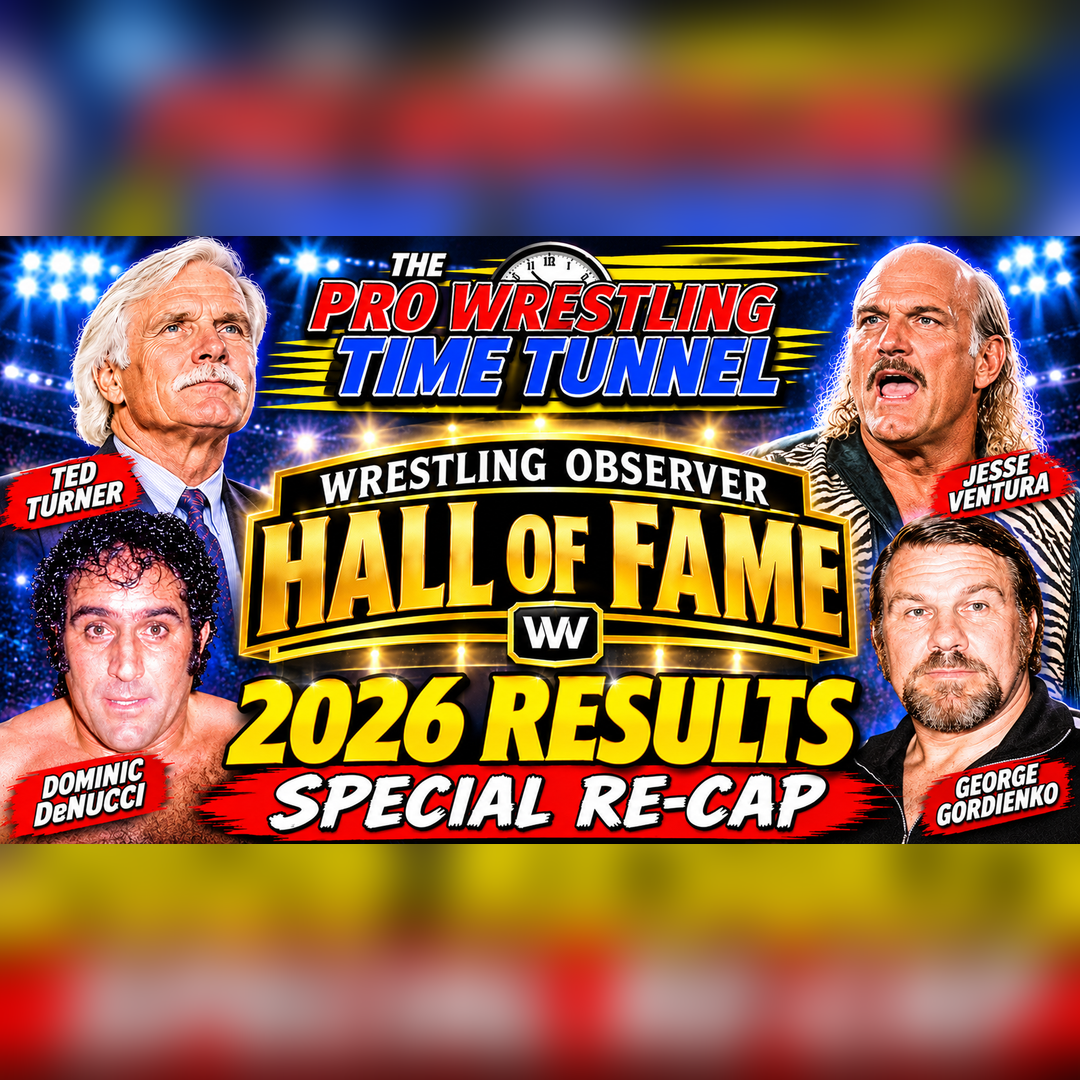
[00:00:08] And I had posted in a couple of my social media channels that I'd be doing a video to talk about my thoughts about the Wrestling observer hall of Fame results, which came out Friday morning, published in the Wrestling Observer Newsletter.
[00:00:26] And as you know, I've kind of made it part of the annual.
[00:00:33] When you do stuff like I do, I don't even know what to call it. But when you have something like the Pro Wrestling Time Tunnel, you think about, okay, let's take the entire year and let's think about what are all the things we want to do this year?
[00:00:53] And you know, this year we go back in these specific time frames. Because when I first started doing this, I thought, okay, what do I want to have when I'm done with this? So when I finish this run as a wrestling historian and as I finish up with the Pro Wrestling Time Tunnel, what do I want it to look like when it's over?
[00:01:17] And what I wanted and what I continue to want is I want a place that people can go and get an immense amount of history focused in on the Territory Era.
[00:01:34] From its early seeds being planted in the 20s, through its conceptualization in the 30s, and it's forming in the 40s, and it's strengthening in the 50s, and then it's absolutely on fire in the 60s, and in the 70s it's starting to lose a little bit of its momentum, and in the 80s it falls apart and by the 90s, it's totally gone.
[00:02:04] And so, thinking about that in very broad terms, I want people to be able to see this panoramic view of the history of the Territory Era of professional wrestling and have all this information that's been recorded and researched and put together so that future generations, when they go and look at the Pro Wrestling Time Tunnel, that is what they will get out of that. And even though I may or may not be actively contributing as much later on as I am now, there will still be a very well put together history of the Territory era.
[00:02:41] And so then as I think about that, doing that a step at a time and a year at a time, because I first thought about when I first started doing this, I thought, okay, let me take a 20 year period because over the course of my life I seem to have, as I look back on my life, I didn't pick up on this until I was in my 40s, but when I look back on my life and I look at it, it really did happen in 20 year segments. So my life from zero when I was born up until I was 20, and then my life from 20 to 40, and then my life from 40 to 60, and then my life from 60 to 80 is how I kind of have looked at it for the last over 20 years.
[00:03:30] Because when I got to be 40 and I had been CEO of a couple of different broadcasting companies, had been, you know, president of the sports networks in Missouri and in Kansas, and had done all these things and had been able to provide platforms for guys to win all kinds of awards and all of these state broadcasting associations and all, and I was 42, and I was thinking about, okay, what do I want to do for the next 20 years from 42 to 60, let's say. And that's when I got into being an executive coach and I left the broadcasting industry and I opened up my own practice, starting with zero clients, starting with nothing, and building that to where I was listed by Inc. Magazine as one of the top 1100 leadership advisors and coaches in the world.
[00:04:31] A couple of different year. I think the first year I made that list was 2015.
[00:04:37] And then as I began to get closer to my 60s and start thinking about retirement, although I will never retire fully because I have to be involved in something. I have to be doing something that's just part of who I am. I can't just sit on my ass here at the Richards ranch and do nothing. Like, I mean, if there are people that do that and more power to them, every individual has to decide and has to look at their life and the composite of who they are and act accordingly, right?
[00:05:11] So as I looked at it, I thought, you know, I love this pro wrestling stuff. I love this history stuff.
[00:05:19] And from the first time we're going to talk about the Wrestling Observer Newsletter today, because we're talking about the hall of Fame.
[00:05:25] But from the first time I picked up a Wrestling Observer Newsletter, I was fascinated with it.
[00:05:31] And I loved what Meltzer was doing.
[00:05:35] He was writing inside information and stuff that I had no clue about. I mean, I had learned about the insides of the wrestling business in the early 80s from some of the people in the PAFO organization with ICW and some other places, and I heard some terms and some things like that. But when I first got my first Wrestling observer newsletter in, like, 1985, and I'm looking at it and he's talking about all this inside stuff, and he's being so open about this closed business, it fascinated me and thrilled me and I couldn't wait. Every single week to get that wrestling observer newsletter from my mailbox and read about what was going on and what was happening and all of this kind of stuff.
[00:06:25] So there was always something inside me that felt some sort of attraction to that kind of thing, the kind of thing that Dave was doing, but I didn't know what it was and whatever. I tried promoting for a while when I was in here in Paducah, Kentucky, and I had a television station that I, you know, was running and I could work with. And I wanted to put together a wrestling promotion to. I mean, most people have learned, and we're going to talk about this quite a bit today, because the guy who got the most votes this year in the hall of Fame balloting was a television pioneer with professional wrestling.
[00:07:04] So I knew television went with pro wrestling. I mean, I knew that was a.
[00:07:10] That was a natural programming match.
[00:07:16] And so I got excited about it and became a promoter. And I promoted probably 25 or 30 shows.
[00:07:24] But that was at the time. The pro wrestling business was about to go into the doldrums and the territory era was ending. And so it was not a lucrative thing to continue doing because the television station run was coming to an end, and my run here at the broadcasting was coming to an end. But while I was doing it, I loved it. I loved talking to the guys, I loved booking it and talking and talking to the booker about it and the things we wanted to do and things like that. I loved everything about it.
[00:07:56] So moving on.
[00:07:59] You know what was. I was in my late 20s when I did that, because I had a promotional company on the side that. That did music stuff and concerts and fundraisers, and we held several music shows at. At the time was the Paducah Discount Mall, and we featured acts there on weekends. And it was. It was a lot of fun.
[00:08:26] And wrestling was one of the things that fit in that little promotion company that I had. I did a fundraiser here at the middle school, which was the high school building that I went to, and we raised money for the athletic department to get uniforms and things like that. Anyway, I loved it. And then when I got to my. Getting close to my 60s, I thought, when I get to my 60s and I start scaling out of the executive practice, coaching practice, I'm going to devote more time and energy to this wrestling history thing.
[00:09:00] And so anything I've ever done, I've just had a big focus on it. I've been committed to it. I've worked hard at it and made it successful.
[00:09:10] I did that when I was in broadcasting with my career. I did it with the coaching practice, and now I'm doing it here. So when you look at what do I want to accomplish over the next year in the pro wrestling time tunnel, and I think about programming it, putting together the things that are going to happen in the various components of it.
[00:09:33] Well, October is Wrestling observer hall of Fame Month, where there's a lot of discussion and talk about it. The ballots go out and then they're due back the first week of November, and then, you know, the whole thing.
[00:09:49] So I decided in the first year we had the podcast, we're going to have a show dedicated to the Wrestling observer hall of Fame. Now, to be fair, you know, my first and foremost dedication is to the Trago Stez hall of Fame in Waterloo, Iowa.
[00:10:05] And I'm very involved there and very involved in that. And there'll be more to come about that in the coming weeks about my involvement there.
[00:10:15] I'm in. I'm very supportive of the St. Louis Wrestling hall of Fame and Herb Simmons and what he does there. So I decided I'm going to have a show dedicated to the St. Louis hall of Fame. We're going to have Herb Simmons on it. We're going to talk about the guys going into the St. Louis hall of Fame that year, and I'm going to make it to the hall of Fame in May in St. Louis, and I'm going to do some things about the Trago Stairs hall of Fame, and I'm going to go to that in Waterloo every July.
[00:10:48] I'm going to do a show around the Cauliflower Alley and the wonderful things that they do with their benevolent fund for wrestlers who have experienced hardship.
[00:11:01] And I'm going to do something on the Wrestling observer hall of Fame because I'm in support of and highly excited about every professional wrestling hall of Fame, and I know there's one up in upstate New York and there are some in other places, and there are hall of Fames that have been set up, the Memphis Wrestling hall of Fame and others. I'm for all of them. And if there's anything I can ever do for any hall of Fame, I'm going to do it.
[00:11:33] Because the things that these people who are in this business went through to for our enjoyment and our entertainment, they deserve our respect, they deserve our adoration and every award and every honor we can put on them, I'm going to be part of it. I'm going to be positive about it.
[00:12:02] And I know people are sometimes negative about the observer hall of Fame.
[00:12:08] And you have the right to express yourself any way you want to. But in my view, when you do that, when you dog it, when you say negative things about it, you're also saying negative things about the people that are in it and the people that it was created for.
[00:12:24] And I'm not going to do that.
[00:12:28] And I'll, you know, you'll say whatever you want to say. And I'm like, well, thank you for your feedback or whatever. I had a guy on X and I told myself I wasn't going to mention this, but I'll just do it. As an example, a guy on X, the social media platform where I was posting the results from the hall of Fame. And on he's like, I wiped my butt with the observer hall of Fame.
[00:12:53] And I just thought, what a derogatory thing to say about really what you're saying it about. You're saying it about this institution that people are being elected to that recognize the accomplishments in their career.
[00:13:11] Now, I know you're really saying it because you have negative thoughts and negative feelings toward Dave, but put them in the right place, put them toward him if that's what you want to do, if that, you know. And I've always said feedback is not for the person.
[00:13:30] Like when people tell me that maybe I'm not the best podcast host or maybe I made a mistake here, made a mistake there, that is for the person giving it feedback. In most cases when people want to give you feedback or people want to give you their opinion, it makes them feel better. And so in a, essentially it's not for me, it's for them. And I just think to myself, when they say things like that or they post things like that, I'm like, I hope you feel better.
[00:14:01] Like, I hope that made you feel better because you obviously have negative feelings and you obviously feel the need to release those feelings. So I hope it makes you feel better that you did that.
[00:14:14] But you're saying derogatory things about something that's purpose is to honor these people. And this, this thing, this sport I call it, that we all love.
[00:14:29] And I, it's just me, but I'm just, I'm just not going to be that kind of person, you know, And I'm going to promote it, I'm going to support it, I'm going to be part of it.
[00:14:42] That doesn't mean I'm not in support of other things. That doesn't mean I'm. And I have said many times I can, I can function just fine in a world where I am friends with people who don't like each other. I can be friends with both of them because that's between them. It doesn't have anything to do with me. And I know it makes some people feel good to join in the fight and take sides and support your guy and all of that. And that's, that's fine if that's what you want to do. If that makes you personally feel better, do it. Do it to your heart's content.
[00:15:16] But you're not changing the mind of the person you're saying it about or that you're giving it to. And they're not taking it seriously, I hope, because it, it really isn't for you.
[00:15:33] I was speaking one time. I used to tell leaders all the time that I was working, coaching with because they would live and die when they would do a survey and their employees sometimes gave negative feedback on their management or on their way they did things or this, that and the other. And I would tell them, it's just data.
[00:15:51] It's not a judgment.
[00:15:53] There's something in most human beings. I don't know.
[00:15:58] I must have not been there that day when they handed this out for DNA construction. But there's something within some people. They could read 900 wonderful things that people would post about them, but that one negative thing will just totally ruin their day and totally take all the excitement out of it. And totally. And that's something that I am not going to succumb to.
[00:16:22] And I have worked with executives for years to try to not fall into that trap of listening to the negativity and taking it as reality for yourself and making that part of who you are.
[00:16:36] Because there's 900 other pieces of data here that say you're amazing and you're awesome.
[00:16:42] Let's focus on that and not focus on the one or two negative feedback comments or whatever.
[00:16:50] So let's talk about the Wrestling observer hall of Fame.
[00:16:57] I want to, first of all, talk about just. Let's just re. Educate ourselves on what it is. It's an annual hall of fame that is selected by private ballot.
[00:17:10] I am a person who votes and I get a ballot. I have no idea, other than the people that I have conversed with or that I have, they have disclosed to me. We have the option to make our ballots public.
[00:17:26] And I am always somebody who wants to make my ballot public. I have no problem saying who I voted for and why I voted for them and taking questions and all that about the voting.
[00:17:40] And of course I've. And so I've always participated in the there's a guy who keeps the spreadsheet of the public ballots and the results in this and the other, but the majority is private.
[00:17:53] And so it's wrestlers, managers, promoters and other industry figures that are still active in the business or that are retired from the business, writers and reporters, people who cover wrestling on an ongoing basis. And then historians, people that fit in the category like me that study the history of the business and publish work.
[00:18:17] Dave picks the voters and it's anonymous unless you make your ballot public like I said, and a candidate is judged on drawing power in ring performance, excellence in a specific field. So if we're talking about non wrestlers, you have to look at their contribution to the business like a Stanley Weston was not an in ring performer. He published the greatest set of magazines that had the biggest employee and they're not even known as his magazine, they're known as the apter mags. But Stanley Weston was the guy who was behind it and the publisher.
[00:19:01] And so looking at his contribution to the wrestling business, right. So it's the field that they were in being a promoter or being a photographer or any of that stuff. Referee, announcers.
[00:19:15] And then the other piece of criteria to think about is the positive historical significance that that that particular candidate put on the business.
[00:19:25] And it should be something meaningful in all of these areas that I just mentioned. Drawing power, excellence in their field or in ring and positive historic significance or be so outstanding in one or two of those things that it's just like people would say, a no brainer.
[00:19:45] Longevity is a very prime consideration which hurts some of people's favorite candidates. A short hot run is usually not enough unless that person was a major trendsetter or historically significant enough to really override the period of time they have to have reached their 35th birthday and completed at least 10 years since their full time debut in the business or been a full time wrestler for at least 15 years.
[00:20:23] As far as the way the votes go, ballots are divided by geography and our continental United States and Canada often referred to as modern and historical. Mexico, Japan, rest of the world and a non wrestler promoter manager category. Modern versus historical is really based on whether the person's peak as a headliner or a key figure was when in the last 30 years or so voters can cast just a limited number of votes per region per category that I just went over.
[00:21:00] Usually one vote for every three candidates or so.
[00:21:04] And voters are encouraged to skip candidates they are unfamiliar with due to geography or era. So for the last two years I have not voted in the modern category, because I've basically been checked out on the wrestling business just. And just as a casual person of watching the modern product.
[00:21:24] But I've committed to be a more. Because again, this is just me. This is who I am. I want to be a excellent voter.
[00:21:34] And to be an excellent voter, you have to study and you have to research and you fully have to understand why you're voting for someone or why you're not voting for someone.
[00:21:44] And I have a hard time voting for people who are still active in the business.
[00:21:49] But I really have decided I'm going to try to be the best voter I can be. So I'm going to study as much as I can due to a limited amount of time to the modern candidates from now till next year and at least be educated enough to vote in that category.
[00:22:08] But if you're not educated in that area or you're not familiar with that category, you shouldn't vote in it. Or if you're not familiar with that. I mean, just. Just knowing a person's name, oh, I've heard of that person before, so I'll vote for them. That is a bad reason to vote right now. To be elected, the candidate has to receive 60% of the votes from their specific region and category or era to be inducted. Candidates who receive between 10 and 60% remain on the ballot the next year.
[00:22:42] Candidates who receive less than 10% are dropped from next year's ballot. And after 15 years on the ballot and you don't get in, the candidate needs at least 60% to remain eligible or they get knocked off the ballot. Now that's going to come into play this year with a wrestler that I have highly supported. This was the last year they were eligible and they were going to drop off the ballot if they didn't go in. But they hit the 60% threshold, so they get to stay on another year.
[00:23:14] Okay, so these have been. I've studied this and looked at the history of it and all, and these rules have been pretty consistent, especially in the last 10 years or so.
[00:23:24] And they're on the ballots that we get that are sent out by Dave. And it's a published hall of fame. It's not a physical museum.
[00:23:35] So that's just a little review on the Wrestling observer hall of Fame. Let's talk about the guys who got in.
[00:23:45] And the first person who got in is somebody that I've supported. I wrote a case study for him last year. I didn't really campaign or push for him this year, although I always vote for him. But ted turner got 70.2% of the vote. And in last year's hall of fame he got 55.
[00:24:07] He got 318 votes overall, way more than any other candidate.
[00:24:14] And originally from Cincinnati, Ohio. I don't know how much you know about Ted Turner's life and career, but when I, when I did the Jim Barnett series on Briscoe and Bradshaw, I did a lot on Ted Turner because he was so influential in getting the wrestling on his television product. Because they were on WQXI in Atlanta, the NWA promotion, which was owned by Ray Gunkel and Buddy Fuller at the time in Atlanta, they were on wqxi, which is a legendary set of call letters in television and radio. For the Atlanta. For Atlanta. My friend Briggs Gordon.
[00:25:02] People in this particular area know him as Uncle Briggs because he had a radio show and he had a television show in the 70s and early 80s. He was my roommate for a little while.
[00:25:15] Briggs lived with me for some time. But anyway, he left the Paducah radio market and went to Atlanta to work at WQXI because they are legendary call letters, they're legendary stations. But the wrestling programming was on wqxi and they moved it over to wtcg, which was Ted Turner, and they moved the ring and everything. They picked it up. Bobby Simmons was part of the crew that moved the ring from QXI Studio over to Techwood Drive to WTCG17.
[00:25:52] And they did it on Christmas Eve and the very first show was on Christmas Day.
[00:25:58] And that set a long time relationship between Ted Turner and professional wrestling.
[00:26:06] He.
[00:26:07] He pioneered the first superstation in 1976, which we're going to be talking about on some of our podcast shows and stuff.
[00:26:19] Because it was about around this time 50 years ago that he went on satellite and allowed wrestling.
[00:26:29] Starting in 1977, wrestling was starting to be seen outside a particular geography.
[00:26:37] Now you got to understand that that is what built the territories, is the media coverage and particular boundaries of those television stations. Now, if you've watched my videos in the last. In the last year or so, you'll notice there's a big map behind me.
[00:26:55] That map is a Nielsen map From I think 2008 that I had in my office.
[00:27:05] I had one for television and I also have one for radio.
[00:27:09] And this one shows the television markets. I'll kind of lean to the side here so you can get a better look at it.
[00:27:17] But it shows the television markets in the continental United States and just a bit of Canada up there in Mexico.
[00:27:25] And if you look at that television map, you can see where the territories were because they were based on the television coverage that they were putting their show on.
[00:27:37] And people in that particular area that was the territory was where the television signal could cover and they could put on wrestling shows starting in 1955.
[00:27:50] And those television shows provided the advertising and laid the groundwork to promote the house shows.
[00:27:59] That's what made up a territory.
[00:28:02] Well, when Ted Turner went on satellite in 1976, 50 years ago, and he was able to have something that was able to be seen outside those geographical boundaries on that map behind me, that started to erase the lines of the geographies that kept the territories intact. And it started allowing people outside the Georgia territory to see a product that was not produced or seen in their particular limited geography.
[00:28:40] Now, it's just human nature, and I've talked about this many times before, it's just human nature that if you have a nice house and you have a nice lawn and you have a nice place and you're just really happy with it. I mean, you're really excited and happy with it. It's your place, you're invested in it, you own it.
[00:29:02] And people can see it and drive by and say, man, that sure is a nice looking place.
[00:29:09] It's beautiful. They keep the fences. They keep the weeds out of the fences. And they had a nice entrance there. And you can see the house and all. It's like, well, that's really. That's really pretty.
[00:29:20] But then somebody buys the property next door and they build a nicer, bigger house than you, and they have a nicer yard than you.
[00:29:32] Now people have something to compare.
[00:29:35] When before they were just driving by, looking at my house.
[00:29:39] Well, now they can see more than one house. Now they can see two houses. And then somebody builds something on the other side of that house.
[00:29:46] Now they can see three houses when before they could only see two. Now the one house they could see, which was mine, doesn't look as attractive or doesn't look as good as the one they can look at over here.
[00:30:00] That's what happened to the territories.
[00:30:03] When Ted Turner broke the boundaries of the territories and you were able to see another product which was a good product, the Georgia product was good and maybe more exciting and more, you know, more stars that you, you know, you had seen the same people.
[00:30:21] You had an anchor bunch of stars. In Amarillo, it was the Funks. In Memphis, it was Jackie Fargo and Jerry Lawler. In Florida, it was Eddie Graham. Then it was Jack Briscoe. Then was Dusty Rhodes. Those were the big anchors that people saw all the time.
[00:30:39] But now they're not only seeing Jack Briscoe and Dusty Rhodes, they're seeing Tommy Rich and Mr. Wrestling number two.
[00:30:47] When they didn't see them before in their home territory. And they had seen the guys in their territory for years. Now all of a sudden it's like, hey, we got something to compare this to. Well, that was the beginning of the end for the territories because that exclusivity played in their favor.
[00:31:07] And Ted Turner is one of the most revolutionary people in the pro wrestling business because of just that one thing.
[00:31:14] I mean, not. Not only did he save the Jim Crockett Promotions in 1988 by buying them to keep wrestling going. Now there's not anything.
[00:31:28] It wasn't like he wanted to keep wrestling on tbs. He wanted to keep wrestling going.
[00:31:35] And there wouldn't have been any product because when Crockett went out of business, there would have been no product on tbs.
[00:31:44] And so it just the fact that wrestling was part of what built wtcg, the little independent station back in those days on the UHF band.
[00:32:00] Every channel above 13 was UHF and you had to have a special antenna to pick it up. And a lot of times the signal was weak.
[00:32:09] But wrestling helped build those little stations all over the United States because as, as history went on, promoters lost sometimes those prime network television stations that they had, those powerhouses that were somewhere between Channel 2 and Channel 13.
[00:32:30] They lost them. So they had to go to those UHF stations in order to continue to be able to broadcast product.
[00:32:38] And those and pro wrestling, because people loved it so much, went out and bought the special antenna, went out and made sure they were able to get those other channels they couldn't get before on their television because they wanted to see pro wrestling. And that's the idea I had when I had the little station in Paducah, is that people will go out of their way to try to figure out where this station is and want to pick it up and want to watch it because they want to see this wrestling.
[00:33:03] And so Ted Turner was a part of all that.
[00:33:08] And the fact that he's elected into the hall of Fame I think is a no brainer. And he got a significant amount of votes.
[00:33:20] Next, Dominic Denucci.
[00:33:22] So Dominic Denucci got 159 votes. He got 69.7%.
[00:33:29] And last year he got 32.
[00:33:33] So a huge leap. And a huge jump.
[00:33:38] I'm kind of proud of that because when I did the Jim Barnett series on Briscoe and Bradshaw, I think we did it in five or six episodes. I mean, it was nothing compared to the Welch Legacy, which was 11 episodes, or the history of Texas wrestling. We just concluded 20 episodes. I mean, it was my first long series.
[00:34:02] And looking back on it now, I wish I had been more detailed and I had spent more time on explaining to people the Jim Barnett and Johnny Doyle booking office in the United States from 1956 to 1963 and how powerful it was.
[00:34:28] And it was just on the cusp of becoming the first national promotion since the Chicago broadcast.
[00:34:38] And they were booking talent for. They were not NWA members, they were an outlaw organization. But they had Cincinnati, they had Detroit, they had Indianapolis, they had Lexington, they had Louisville, they had all of these Midwestern towns that they were running. And they were also booking talent all over the United States for Crockett and for Los Angeles and for Texas and all these places.
[00:35:08] And Jim Barnett's nickname was the wizard because of what he was able to do in the professional wrestling business. And I wish I would have spent more time on that, and I wish I would have spent more time on Australia, because that's the key to Dominic Denucci's election in the hall of Fame.
[00:35:33] And.
[00:35:35] Well, let's just talk about Jim Barnett's impact for a minute.
[00:35:41] I mean, it's really foundational. And only in the last few years, Libnan Abnud, who I had on the podcast, who wrote the book about the history of the different AWA world championship belts, has done an amazing job of documenting Australian wrestling history.
[00:36:01] And Barnett and Doyle created in 1964. So they. They shut down, they sold Detroit to the Chic. They just basically abdicated Indianapolis to Dick the Bruiser. And they basically picked up, went out of business in the United States, went to Australia and picked up there and started using the same principles through the whole country.
[00:36:28] It defined the golden age of professional wrestling in Australia from 1964 to 1973.
[00:36:37] So they inspected Australia, sold their US interests, and launched World Championship Wrestling. The first card they had was October 23, 1964, at Sydney Stadium.
[00:36:53] They got a crucial television deal on the nine network, Channel nine, Saturday and Sunday.
[00:37:00] Prime exposure that drove strong attendance. I mean, they often drew 6 to 9,000 people in every major Australian town.
[00:37:11] The show later expanded to New Zealand parts of Southwest Asia, and they alternated time in Australia. After Johnny Doyle passed away in 1969, Barnett became the sole owner, joined the National Wrestling alliance and continued.
[00:37:36] He.
[00:37:37] I mean, he was never going to be a prominent public figure because Jim Barnett was openly homosexual.
[00:37:45] And in those days, that was not acceptable. Sam Mushnick was not going to have an elected officer of the National Wrestling alliance that was openly homosexual.
[00:37:56] But they did use his talent in the National Wrestling alliance and they started using him to take some of the administrative stuff off of Mushnick.
[00:38:07] And it really. Barnett's presence was a big contributor to Mushnik's retirement from the NWA in 75.
[00:38:15] Because finally there was somebody who could take on a lot of this admin stuff that Mushnik had been handling since 1948.
[00:38:24] So after 74, early 74, when he sold Australia to Tony Colony, he went back to the United States to buy into Georgia Championship Wrestling.
[00:38:37] And he is widely credited with importing top North America talent. Killer Kowalski, Ray Stevens, Mark Lewin, Spiros Arion was one of his top faces there. Mario Milano, Harley race, Dorie Funk Jr. Larry Hennig, King Curtis Iacaya. Lots of other people in the mid-1960s went to Australia and they were huge stars drawing huge amount of money. Barnett was flying people between cities, transporting them, paying for the transportation, paying for their meals, asked them to dress. It was almost like seeing a college basketball team in the 1950s or 60s get off of the plane or the bus, all wearing ties and jackets and all.
[00:39:31] That's what it was like seeing the Australian crew get to a town.
[00:39:37] And so he borrowed the IWA World Heavyweight title and also the IWA World tag team titles from California.
[00:39:49] He had a strong relationship with California and he recognized the NWA World title later on before he came back in as a member.
[00:39:59] And they were booking strong, ethnically resonant baby faces. He was told when he first started promoting Sydney, you've got to have a strong Italian baby face.
[00:40:14] And that strong Italian baby face was Dominic Denucci.
[00:40:19] And so the wrestlers who worked for Barnett, they described him as a promoter who. I mean, it was almost like they were talking about somebody like Paul Bosh or Sam Mushnick. He paid well, he allowed talent to be creative, ran a very professional operation, first class operation.
[00:40:45] And he treated the promotion as a full time television first business rather than the traveling carnival.
[00:40:54] That prior to 19, the mid-1950s is how the wrestling business worked and continued to work that way for some time with some promotions after that.
[00:41:06] So that sort of sets the stage for Denucci and why he belongs in the hall of Fame because most people are familiar with his WWW F Stuff where he was basically the guy under Bruno.
[00:41:25] But in Australia he was a reliable, highly valued draw.
[00:41:33] It was a high point of his career and it's why he's in the hall of Fame because Doyle and Barnett used him in 64, 65, 66, 68 and 70.
[00:41:47] And he had multiple reigns with the IWA world heavyweight title. He beat Killer Kowalski, who was in love with Australia. Jerry Briscoe told me they weren't sure that Kowalski was ever going to come back to the States.
[00:42:02] But he beat him November 7, 1964. He beat Ray Stevens. He beat King Curtis, IKEA, some of the biggest names.
[00:42:11] He beat IKEA in 70, which IACA was coming off. The big feud with Bruno in the WWWF and went to Australia was a huge star.
[00:42:22] His feud with Kowalski was the early foundation of the promotion's success and Drew Strong overall. 8,000 plus sellout in Melbourne.
[00:42:35] So we talk about the huge crowds he drew in Sydney, but he drew sellouts in Melbourne and the other major towns. Perth.
[00:42:45] And he had three reigns with the IWA World Tag Team Championship, one with Mark Lewin. They beat Larry Hennig and Harley race in 1966.
[00:42:57] Was there a better tag team in pro wrestling than Larry the Axe Henning and Handsome Harley race in 1966? I think not.
[00:43:08] They beat Antonio Pugliosi, which we know some as Tony Parisi and Mario Milano for a tag team championship.
[00:43:19] He headlined Sydney Stadium, Melbourne's Festival Hall.
[00:43:25] He often main evented ahead of Even if there was a world title match on the card.
[00:43:34] Denucci's match would be the main event even if he wasn't part of the world title match. Right. Promoters and observers.
[00:43:44] I just was amazed when I was researching for the Barnett series. I was just amazed at this entire Australian thing. And I wish I'd taken more time and done an entire episode or two.
[00:43:58] That Barnett series could have been eight episodes. Pretty easy because I could have spent more time on Barnett and Doyle in the states from 56 to 63 and then a couple episodes on Australia.
[00:44:12] But it wasn't just Australia. Denucci also made several trips to Japan. In 71, he worked for the JPA. In 72, he was one of the first All Japan wrestling stars billed as Dom Denucci.
[00:44:28] He lost to Baba, which everybody lost to Baba. He worked some tag matches in 1979-1981. He came back to All Japan.
[00:44:38] He faced or was teaming opposite Dick Buyer, Jumbo Saruta.
[00:44:44] So he was in the big picture in All Japan Pro wrestling.
[00:44:50] He spent large amount of time in his career in Canada.
[00:44:57] And the clear peak of his. The reason he's in the hall of Fame is because of Australia. That run there and he was never huge in the United States. He never got to Bruno status or anything like that in New York and the east coast in the WWF territory. But in Australia, he was Bruno or. Or bigger.
[00:45:20] So that's. That's a little Couple of thoughts on Denucci.
[00:45:27] The third entry into the hall of Fame is Jesse Ventura. I won't have to spend much time on Jesse. Most people who are watching this are familiar with Jesse's career, especially his career as a commentator.
[00:45:40] He got 272 votes. It was the second most votes overall. He got 63%, up from 57.4 last year.
[00:45:52] And so Jesse Ventura goes in the Pro Wrestling hall of Fame this year and obviously you know quite a bit about his career. Like I said, we don't spend a whole lot of time. He's from Minneapolis, Minnesota. You know, he was a Navy SEAL during the Vietnam era. Before he became a pro wrestler, he was Jesse the Body Ventura. And if you've heard my interviews with Jerry oates about the 1975 Kansas City Territory, and then when Jerry Oates went up to Portland in 77, late 76, early 77, 78, Ventura was huge.
[00:46:32] And then he went back to the AWA and worked there.
[00:46:38] And he was.
[00:46:42] He then, you know, he got in basically because of his color commentary for the WWF and then went over to the WCW in Atlanta as a color commentator.
[00:46:55] Of course, he had a political career after wrestling. He was the mayor of Brooklyn Park, Minnesota.
[00:47:01] He ran as the Reform Party candidate.
[00:47:05] He was elected governor of Minnesota in 1998.
[00:47:10] And Jesse Ventura is very deserving of the Wrestling observer hall of Fame. So congratulations to Jeff. All right, let's talk about a guy that a lot of people struggled with, George Gordienko.
[00:47:23] And it's kind of funny because Steve Varier, who does our Vancouver analysis and work on when we go back and talk about the Vancouver territory, Varier is a Pacific Northwest particular specialist, written two books or he's written one book on wrestling history of the Northwest. A fascinating book. I loved that book.
[00:47:49] Then he wrote a biography on Gene Kinisky, which we did a special show on the Pro Wrestling Time History show this year with Verrier and George shire on Kaniski's NWA title win January of 66, because Verrier wrote the book on Kinisky and he also wrote the book on George Gordienko. So Steve had sent me an email and he said, hey, I love what you're doing with Roy Welch and I love what you're doing advocating for him and June Byers and Cowboy Bob Ellis. Do you think we could do Something like that for George Gordienko next year when the voting is going on for the hall of Fame, I'm like, oh, I'd love to. Because I'm fascinated with Gordienko.
[00:48:36] When I heard that Lou Thes wanted to drop the title to Gordienko and knowing Fez's criteria of who could have an NWA title run and who couldn't, and George Gordienko checked all the boxes for Luthes. I was hooked. I thought I got to find out more about this guy.
[00:48:56] So I studied a little bit more about Gordienko. Then I read Steve's book about him.
[00:49:01] And then in preparation for having a campaign advocacy for him next year, I started studying him and also studying him for the voting. And I voted for him. I voted for him last year.
[00:49:17] But he's basically looked at as one of the top legitimate shooters and heavyweights of his era.
[00:49:27] And he was a successful painter, he was a sculptor. He was born in Manitoba.
[00:49:35] He had.
[00:49:38] He had a mixed heritage, Ukrainian, Canadian, Cossack, his parents. With all of those blendings together, he was a combination between physical power, wrestling skill and this huge career outside the United States.
[00:50:04] He was an amazing athlete. As a teenager he was proficient at lifting weights and at amateur wrestling. He turned pro in 1946. He was trained by Joe Pizza Deck and he was managed by Tony Stecker, who was the Minneapolis NWA promoter.
[00:50:29] He quickly impressed people as a powerful, skilled heavyweight wrestler. He had a promising start that included the United States. He spent time at the University of Minnesota.
[00:50:40] He was briefly associated. And here's the thing that got him knocked out of having a prominent US career is it was the McCarthy era, when the Red Scare was going on and McCarthy was hunting communists.
[00:50:55] And he, Gordienko basically was.
[00:51:00] I don't know if he was actually deported, but they threatened to deport him.
[00:51:06] So that effectively killed his work in the United States for years.
[00:51:12] He had a major career outside United States in Canada.
[00:51:20] He worked a lot of jobs, including working for a log company in British Columbia. He was brought back into the Ring around 1952.
[00:51:31] Stu Hart was the guy who brought him back. And of course, Stu Hart is one of the most legitimate shooting wrestlers in professional wrestling history. So obviously he took a liking to Gordienko in the 1950s.
[00:51:46] He was a top attraction in Western Canada.
[00:51:50] He also challenged luthes for the NWA World Heavyweight Championship in Edmonton in 1953. They went 90 minutes in a draw in 1955.
[00:52:06] And he impressed thes enough that he wanted him to be the guy who took the NWA title from him that eventually became Dick Hutton.
[00:52:19] That in that 1957 that Fez dropped the title to Hutton, but he preferred Gordienko.
[00:52:30] And Gordyenko won an amazing amount of regional titles, including versions of the Canadian heavyweight title in Calgary and the NWA Pacific coast title in Vancouver. He was a Canadian tag team title winner with Flash Gordon. He also was a big success in Stampede.
[00:52:55] But you got to understand that he was not able to compete in the United States. So he sent himself to the United Kingdom for the joint promotions over there. He was ranked the top heavyweight in Great Britain. In 1963, he won the Royal Albert hall tournament. In 1970, he captured the British Commonwealth heavyweight title. He was respected as a skilled performer and a legitimate grappler who needed no gimmicks.
[00:53:27] So let's just run down his drawing power. He went multiple tours of Greece.
[00:53:34] He had high profile series of matches and cage matches with Spiros Arion and others.
[00:53:44] He was one of the top foreign heels or attractions in Athens.
[00:53:50] He defended and won the British Commonwealth title, defended that in New Zealand.
[00:53:59] He drew enormous crowds. And this is something that we're just learning about and I'm so fascinated with the country of India, but he drew enormously large crowds, apparently up to 60,000 people.
[00:54:15] I mean we're talking about a huge amount of people in that era with matches against Dara Singh.
[00:54:27] They had a brutal 1975 match, just brutal.
[00:54:33] He went to Iraq. He headlined a massive show in the stadium there against Adnan Al Casey.
[00:54:44] We know him as General, General Adnan.
[00:54:49] He drew enormous crowds of up to 150,000 inside the political sponsored show. Right.
[00:55:03] He did work in Australia.
[00:55:07] He, he. He was just had a massive career outside the United States. And I've seen feedback on this from various people. Like I don't understand it. George Gordienko hall of Fame.
[00:55:21] Well, it's because you're not familiar with him because the majority of his work was outside the US and you really have to. And this is a little bit of the. And I'll talk about this when I talk about Roy Welch. I mean there's a little bit of work involved when you are talking about somebody like Gordienko. You have to read and study and search out the. It's not just going to be common knowledge. You're not going to open up Facebook where you see constant postings about Sammartino and Harley Race and Dorie Funk Jr. And Luthes. And there's all of this because they had a big US Career and there's all these postings about all of these accomplishments and things they did and all that. That's not going to be the case because Gordyenko's. I mean, unless you have a special Facebook page dedicated to the country of India or the country of the United Kingdom, which there is one, or Canada, you're not going to see that constant acknowledgment of all of his accomplishments like you will somebody whose career was in the United States.
[00:56:31] But he was a, he was a rare combination of elite legitimate wrestling and main event level drawing power.
[00:56:42] And then after his wrestling career was over, he was a successful working artist artist who, you know, his, his career in the US was taken away.
[00:56:55] It was almost like the tragedy of Muhammad Ali in his boxing career. The prime years that he could have had as a boxer were taken away because he wasn't allowed to compete because of his protest of not going to Vietnam. And the prime part of Gordyenko's career in the United States was taken away because as a young guy he liked the principles that were being spouted by the Communist Party and he had some heritage through his parents that had some communist related exposure and he supported it and got involved. He never was fully vested as a communist.
[00:57:40] But those years in the 1950s when he could have been one of the top drawing cards and even been an NWA world champion were taken away.
[00:57:51] But very hall of Fame worthy and congratulations to George Gordienko. So Ted Turner, Dominic Denucci, Jesse Ventura and George Gordienko go into the Wrestling observer hall of fame in 2026.
[00:58:07] Now you know that I highly advocated for three people this year, two of them, well, let's, let's do large, medium, small.
[00:58:21] So if you were to put it in levels, I had a small advocacy and small effort. I wrote a huge case study on Cowboy Bob Ellis and published it for, well, anybody, but especially published it for the voters to get educated on the career of Cowboy Bob Ellis.
[00:58:44] And he had had a major jump the year before. I thought he was probably got enough momentum to get very close to being elected.
[00:58:58] He got a little bit of a bump last year because you remember when we all thought he was still like the oldest living wrestler, but then we found out that he was not alive, that he had died a few years before and he got what's called the death bump. I think last year where because he passed away there was a lot of focus and attention on his career and so he got some momentum last year.
[00:59:25] That momentum seems to have subsided. I mean, I only have a minimum impact on this stuff, but at least I have some impact, right?
[00:59:35] I mean, I'm not arrogant enough to think that my particular contribution is going to really, you know, but I am committed to advocating for certain people. Now, the second person, the medium I would say was June Byers, the Texas Tornado. And so I spent a fair amount of time on her career on the History of Texas Wrestling series, on Briscoe and Bradshaw, because I knew that was leading up to the hall of Fame voting. So I used that opportunity to refamiliarize people with her career. She was the prominent feature female for 20 years.
[01:00:16] I mean, in between Mildred Burke and the great Moolah, who, you know, really rose up in the late 60s in that gap of time in there.
[01:00:27] It's June Byers.
[01:00:30] Such a phenomenal. And I was listening to Rich and Joe on the the Voices of Wrestling podcast. They were so kind to have me on this year to do my thoughts on the hall of Fame again this year. And they're such great guys.
[01:00:50] Neither one of them voted for June Byers, but I was listening to their hall of Fame show and listening to them talk about their votes and why they voted a certain way. And there are two people I very highly respect because they do their research and they educate themselves and they get familiar with who they want to vote for in this thing.
[01:01:10] And they both mentioned June Byers and they had read my case study of why June Byers was deserving of the hall of Fame, but neither one of them voted for June Byers, but they did vote for Mercedes Monet and they were talking about her accomplishments and how awesome she is and how she's the greatest woman wrestler in the world right now and all of that. And I was just thinking to myself, guys, if you were, if this were 1956 and you were talking about the most prominent female wrestler in professional wrestling and how awesome she is and how she's so much far and above higher talented than anybody else in the female wrestling segment, you'd be saying the name June Byers.
[01:01:57] So she got 57.2%.
[01:02:00] This was her 15 year thing. So if she didn't get 50%, she was going to get off the ballot. She was going to be dropped.
[01:02:11] So she got 57.2%.
[01:02:14] She did miss the hall of Fame by 13 votes.
[01:02:19] Thirteen.
[01:02:21] And she had already come up from 50% to the mid-50s last year. So I thought, man, we're going to get June buyers in the hall of Fame this year.
[01:02:32] So I was kind of disappointed because it was basically flat.
[01:02:39] But she cleared the 50% market. So she gets to stay on the ballot, we get another year.
[01:02:46] So I get from this year to next year, we gotta get June Byers in the hall of Fame. I mean, go read my piece, my case study on why June Byers should be in the hall of Fame. And I think you'll.
[01:02:59] You would vote for her now, of course, my large advocacy.
[01:03:06] I spent most of the month of October posting information and reasons and reaching out to people that I know who are.
[01:03:17] Who are voters.
[01:03:20] Roy welch went from 33.8% to 34.3%. So he had a small gain.
[01:03:28] So not that I was the reason, but I know I helped, right?
[01:03:34] And if you looked at the public ballots that my friends publish about the public ballot, I mean, he was trending high, almost to 60%. I'm like, man, could this be possible that he gets in this year? But the public ballots are such a small sample size of the overall amount of the electorate that it's difficult to look at the public ballots. They're just sort of an indicator of how things are trending.
[01:04:04] Not that there's anywhere near a perfect match.
[01:04:08] But, you know, I think I ran a nice, sustained public campaign on behalf of Roy Welch and posting the reasons why he should be in the hall of Fame every single day in the month of October.
[01:04:23] I did the entire Welch Legacy series on Briscoe and Bradshaw. We successfully got the family inducted in the Trago Stairs hall of Fame, which I am most proud of.
[01:04:35] And I got to see Ron Fuller and Roy Lee Welch there and watch them get hall of Fame rings and watch them get recognized for the contribution of that family.
[01:04:50] Without that family. Pro wrestling is not the same in the South.
[01:04:55] And it's personal to me because that's what I grew up on. I grew up on Gulas Welch wrestling.
[01:05:07] Not the tennis, not the Memphis territory.
[01:05:10] The Memphis territory was formed in 1977.
[01:05:16] What was left of the Tennessee territory after the split in 77 was NWA Mid America.
[01:05:25] NWA Mid America did not exist before 1977. So when you see people say, oh, he was the. He was the tag team champion in Nick Goulis and Roy Welch's NWA Mid America in 1972.
[01:05:38] False. Wrong.
[01:05:40] NWA Mid America did not exist until after the Jarrett goulash split in 77.
[01:05:49] And like I said, the Memphis territory was.
[01:05:53] Both of them were booked out of Nashville.
[01:05:57] None of them were booked out of Memphis. But Memphis was the largest city in Jerry Jarrett's circuit, so it was started to be called. And Jerry, bless his heart, I had so many names for his promotion and the television show was just championship wrestling.
[01:06:19] So am I disappointed that Roy didn't get in? No, not really, because I didn't have that expectation.
[01:06:28] I never expected him to get in this year. I got excited by looking at the public ballot trending, because in the public ballot trending, I feel like there were a lot of people in there that I did influence.
[01:06:41] Now let me just say too, we lost two votes in the public balloting for Roy. I don't know who changed their mind or why they changed their mind, but that was frustrating to actually lose votes when you feel like you're educating people to his impact from 1933 until 1977, I mean, we're talking about wrestling in southeast Missouri, in most of the state of Tennessee, in most of the state of Kentucky, in the entire state of Alabama, in a large portion of the state of Louisiana, in a large section of Mississippi, in Georgia, in Florida, where he basically gave up on Florida, because at the time in the 1940s, it was just too far.
[01:07:43] Travel was just too difficult. There was no road infrastructure in place to make it an easy trip.
[01:07:50] And being out of the general Tennessee territory to go to Florida to wrestle and to try to establish something was just too difficult. So he gave that up to Cowboy Latrell.
[01:08:05] But the impact that he had on professional wrestling in the southern part of the United States is just massive.
[01:08:16] And this is where you also have to understand that people look at a candidate and if they were in the area that you grew up in and they're an icon to you in your area, you think they should be in the hall of Fame. But everybody who lived outside that area doesn't necessarily see them the same way you do. And the case here is while we're on Tennessee and that all we'll talk about Dave Brown this next year will be Dave Brown's last year on the ballot. And the way he's trending and the votes he's getting, I don't think he's going to get in the hall of Fame. And I think he'll probably get dropped off next year's ballot. But if you talk to anybody in this area, oh my God. Dave Brown is a no brainer hall of Famer because they grew up with him. It's Lance Russell and Dave Brown. And how could Dave Brown not be in the hall of Fame?
[01:09:15] But there is an entire big world out there.
[01:09:20] I mean, if you talk to somebody in Britain or someone in India or someone in Greece, they're like, of course Dominic Denucci should be in the hall of Fame. Of course, George Gordienko should be in the hall of Fame, but people in the United States are going, why are they in the hall of Fame? Like, so this works for and against people.
[01:09:43] And I know that was working against me with Roy Welch, because there's just a lot of voters in a lot of other areas of the world who aren't familiar with him. Roy was a very introverted individual. He didn't even when he was a wrestler.
[01:10:01] They went on television in Nashville, Tennessee, 1955, the first studio wrestling show in the South.
[01:10:10] And WSIX and the Welch brothers would go on to do an interview against the Fargos or against the Corsican brothers or against the Gallagher brothers.
[01:10:22] Roy would not do any talking. It was all Herb and all Lester, very little Roy.
[01:10:31] When he was the booker of Memphis, he was not an on screen figure. He did not appear before the camera. He had the guy who was the president of the American Legion Post number one, who was the sponsor of wrestling in Memphis in the days when you had to have a nonprofit organization associated with your wrestling, he had that person go on television and talk about the matches and talk about the cards and this, that and the other.
[01:11:04] There's no interview out there with Roy Welch because in those days we didn't have all this wrestling history stuff. We didn't have all of this book writing and research and interviews and shoot interviews and all that. We just have Robert and Ron talking about Buddy and Roy and these people, their father and grandfather before them, they talk about them and Jimmy golden talk about them.
[01:11:36] So that's why I did the Roy Welch Legacy series was to get a lot of information out there about Roy's life and about his impact.
[01:11:45] He was not the front person for the promotion. Nick Goulis was.
[01:11:50] And some of it was licensing with the commission and having someone he couldn't wrestle and be also the owner. So he needed a licensed person with the commission and all that kind of stuff. But Nick, Nick was very much more extroverted. Nick hosted the television show at times, did the interviews, promoted the cards on TV and all of that. That was just not Roy. He was just a background kind of guy. So therefore you're not going to pull up YouTube and see him do any television stuff or anything like that, because he didn't do it.
[01:12:26] And there's, like I say, there's no in depth interview about him out there to go look at or whatever. I mean, I had to really dig. And one of the biggest compliments of my life is when his grandson Ron Fuller told me. He goes, wow, you talked about things about Roy and about my family I didn't even know. And I'm like, oh, my gosh, that is one of the proudest moments of my life that I was able to do that.
[01:12:52] But I really had to do some digging and I really had to talk to a lot of people and do a lot of documentation and dig out a lot of stuff and put two and two together on some things to do that series on the Welch legacy.
[01:13:09] But I was doing it to help educate voters, to get him in Tregostez, but then also to get him in the Wrestling observer hall of Fame and every hall of Fame out there that people would begin to recognize Roy Welch's contribution to professional wrestling, especially people who are not from around here.
[01:13:30] So we got a little bit of gain with Roy. He's got several years still on the ballot.
[01:13:35] We will continue to get some gains. I expect that next year Morris Siegel will go in, and I think Roy's trajectory will be very similar to Morris Siegel. I think it will be multi years with modest gains forward, more and more people getting educated about him and his contribution, and we will get him in. But it's not going to be next year. It's not going to be maybe even the year after that, because Morris Siegel is on the ballot for three or four or five years, and I think he might go in next year. He had a nice gain this year.
[01:14:11] So at this point, you know, it's not necessarily about a shoulda, woulda, coulda. Well, he should have been in.
[01:14:18] That doesn't matter. All that matters is how do we continue to contribute to and work the way the system is set up and with the electorate, amount of voters to continue to educate and inform. And that's the most fun thing about doing all this, to be honest with you, is the investigation, the research and the learning that takes place to about this wrestling history and learning about Gordyenko and learning about Denucci and learning about pro wrestling in other parts of the world besides the United States, and learning for other people who didn't grow up here in the southern part of the United States to learn about this phenomenon, this amazingly large territory and enormous booking office that started in little old Dyersburg, Tennessee, with the first wrestling cards in Little O Paducah, Kentucky, that eventually got to Nashville and then eventually got to Chattanooga and then got to Birmingham and then to Louisville and then boom, boom, boom, boom. Until the Tennessee territory was the most massive territory in the National Wrestling alliance and the biggest booking office in pro wrestling history.
[01:15:41] Educating people on that and showing them evidence and giving them this information, that's.
[01:15:48] I mean, that's the most fun about it.
[01:15:50] People are like, well, Roy should have been in, in the first group in 1996. Well, that might be true, but then I wouldn't be having as much fun as I'm having if Roy would have been put in in the first group.
[01:16:04] So much of what I've done over the last year wouldn't have been necessary, and I probably wouldn't have done it as much.
[01:16:12] So for me, the fact that Roy didn't get put in, in the initial group is a blessing because it gives me purpose as a historian, it gives me a goal, it gives me an objective, it gives me something to work for.
[01:16:26] And for years, I'll throw this in, too. For years I listened to wrestling podcasts, and it just seemed like the majority of them were bad guys in the north, and they were all very northern biased. And I'm like, man, outside of Cornet, who's the Southern advocate? Like, who's. Who's doing shows about wrestling in the South?
[01:16:53] And Bo James has done that and some of Conrad's.
[01:16:57] Some, you know, done that and this, that and the other.
[01:17:01] But I thought, man, when I launch my stuff, I'm going to be highly Southern focused because it has such a rich history now. You know, I cover all the territories as much as possible, and I look for people that I can talk to who are actual experts and analysts to do la. And. And you know how much I love Amarillo in West Texas.
[01:17:27] But I thought, I'm going to educate people on Southern wrestling. That's going to be a primary objective of the pro wrestling time tunnel. And so if Roy would have been put in the original class, I wouldn't have been able to get to do all of this. So for me, it's a blessing he wasn't put in. And like I said, it gives me an objective and a goal.
[01:17:48] So I will continue to advocate for Cowboy Bob Ellis and June Byers. Hopefully we get June in next year. Hopefully we get a gain on Roy Welch, we gain some other voters that we didn't get this year that maybe after the fact, I reached out to them and asked them why, you know, I didn't convince them that Roy Welch should be a vote for them.
[01:18:12] Hopefully some of those people will convert, and next year we'll have another nice gain for Roy. And then over the next couple of years, we'll get Roy Welch in the Wrestling observer hall of Fame.
[01:18:26] So I Think that's about all I wanted to say about this year.
[01:18:31] If you have other questions about the Wrestling observer hall of Fame. Oh, by the way, I was on Wrestling Observer Radio this weekend with Ethan Tyler and John Muse and Dave Meltzer talking about the results of the hall of Fame voting and interacted with them. And I was very, very honored to be asked to do that with guys like John Muse and, and Ethan Tyler, who I respect so highly. Of course I respect Dave. So it was very nice that Dave invited me to be on the first time on Wrestling Observer Radio. So I posted that in the Facebook group and it's on my X feed. It's a free show this weekend, so it doesn't. You don't have to be an observer subscriber or sign up for anything. You can just listen to the show.
[01:19:24] And so I hope you will do that. There's a lot of talk in there about the hall of Fame and so much rich material from Ethan and John that you should check out there. And I chime in a little bit here and there where I can, you know, being the new guy, I tried not to, you know, jump in too much, but Dave was gracious and put me over. He, you know, he said he reads my work every single morning, which is a high compliment and very nice thing to hear.
[01:19:57] But I think that's about all I wanted to say about the observer hall of Fame in this particular time that we had together. I hope, I hope you enjoyed this special look at the results to the Wrestling observer hall of Fame. Coming up this next week on the Pro Wrestling Time Tunnel History Show. It'll be episode 89.
[01:20:18] Going to be a really nice show. We're going to talk about Amarillo 1976. We're going to have Larry Lane on as my special guest. Of course.
[01:20:27] I got a. I got an email from somebody the other day that said it would add a lot to your show if you had wrestlers on.
[01:20:36] Like, it's great. You have these historians and authors on and this, that and the other. And I'm like, must be new to the show because, you know, we have people on. We have announcers, we have referees, we have wrestlers, we have these guys on.
[01:20:50] And so that will be the case with Larry Lane, who worked in 1976 in both Amarillo and in Stampede, but he spent the most of the year in Amarillo and had a great year there. And it's a great interview, especially if you're interested in Amarillo wrestling history.
[01:21:07] But.
[01:21:09] And he was very close to the Funks, the Funks, other people that got him into the business. And I interviewed him on the Dory Funk Jr tribute. So also on episode 89 of the show this coming week, we're going to have an Andre the Giant 1976 episode where we're going to go through the year of 1976 for Andre. You know, at the beginning of this year, talking about what I wanted to do in the year, I wanted to have a Dusty Rhodes 1970. Because when I look at the biggest, most influential draws of the year of 76, I think of five people. I think of Dusty Rhodes, I think of Andre the Giant, I think of Bruno Sammartino, I think of Terry Funk and Nick Bockwinkle. Those are the five guys who were the primary driving forces in professional wrestling. The three world champions, Dusty and Andre. And so I want to do special shows on those guys. In our Christmas super show, we always talk about the world champions. So we will be talking about Terry Funk's 1976, Nick Bockwinkle's 1976, and Bruno's 1976 on our big Christmas super show this year.
[01:22:19] And we did Dusty 1976 several weeks ago.
[01:22:24] And we're going to do Andre the Giant this week with Chris Owens, who is the most prominent Andre the Giant expert and collector that I know. The amount of memorabilia that he has that he's collected, either of things that were personally owned by Andre or were about Andre is fantastic. And he is going to go through the 76 schedule with me. And then we have an Andre the Giant mailbag where we've been collecting questions from you guys about Andre the Giant. And we're going to ask those questions and answer those questions. So Amarillo, Andre the Giant 76 and Andre Mailbag coming up this week on the Pro Wrestling time total history show. 89. Thanks for all the support on episode 88 that we just released on Dallas Territory. 76 and with Greg Klein and the Great West Maidment.
[01:23:18] I got a lot of compliments on my talk with Wes this past week. People are like, oh, my gosh, this. This interview you did with Wes Made men in Ontario, Canada. 76 was some of the best things you ever done. And at the time, it just seemed like another show to me. So thank you so much for that feedback and that input, and I'm glad you enjoyed it.
[01:23:41] So coming up in the next several weeks, we're moving in the holiday season and I'm going to have four special. Well, let's see. We got six special shows, so we're going to have Our special Thanksgiving spectacular show, which I'm still in the process of putting together.
[01:23:59] We're going to have our Christmas super show.
[01:24:03] And then we're going to have a show that counts down the top tag teams in 1976.
[01:24:09] We're going to have a show that counts down the top female competitors in 1976. And then for New Year's Eve and New Year's Day, the second annual Top 100 Wrestler Countdown for 1976. I got so much great feedback and so much great comments about 1975 last year. That, and that's just from me growing up and listening to the countdown shows on New Year's of the biggest songs of the year.
[01:24:39] And you'd follow along and you'd write down, oh, this is number 52. Oh, this is number. I wonder what the top 10 are going to be. And so I thought, why not do that same kind of thing for wrestlers?
[01:24:50] So I am in the process of doing that research right now. I mean, there's some guys I don't have to research because I've got a lot on them, but when you look at 100 different wrestlers, there's some guys I need to do some work on so I can pass that on to you when we count them down.
[01:25:06] And I'm still working on the list, but so we got all of that coming up on the. On the podcast. So I know you'll enjoy that. And of course, we always have a lot of great stuff for you right here. So thanks, everybody. Thanks for your support of me. Thanks for your support of the Pro Wrestling Time Tunnel. And keep it right here for the best Territory era wrestling history out there.
[01:25:31] This is the home for the history of the Territory era, the Pro Wrestling Time Tunnel. Thanks, everybody. Have a wonderful weekend.