Episode Transcript
[00:00:02] Speaker A: Time for the Pro Wrestling Time Tunnel Podcast. We've got lots and lots of things to talk about and to do today, covering the territories from the 1940s to the 1990s.
[00:00:13] Speaker B: It's the best thing going today.
[00:00:18] Speaker A: Interviewing wrestlers, referees, authors and other media personalities that have made the sport of professional wrestling great.
[00:00:27] Speaker B: The cream, yeah, the cream of the crop.
[00:00:30] Speaker A: And now, here's your host, Tony Richards.
[00:00:35] Speaker B: Well, hello again, everybody. Welcome to another edition of the Pro Wrestling Time Tunnel podcast. I'm your host, wrestling historian, author, storyteller, Tony Richards. And I'm coming to you from the Richards Ranch. And boy, do we have a fantastic show today.
My good friend, colleague and peer. I don't know if we're really peers or not. He's so much above me.
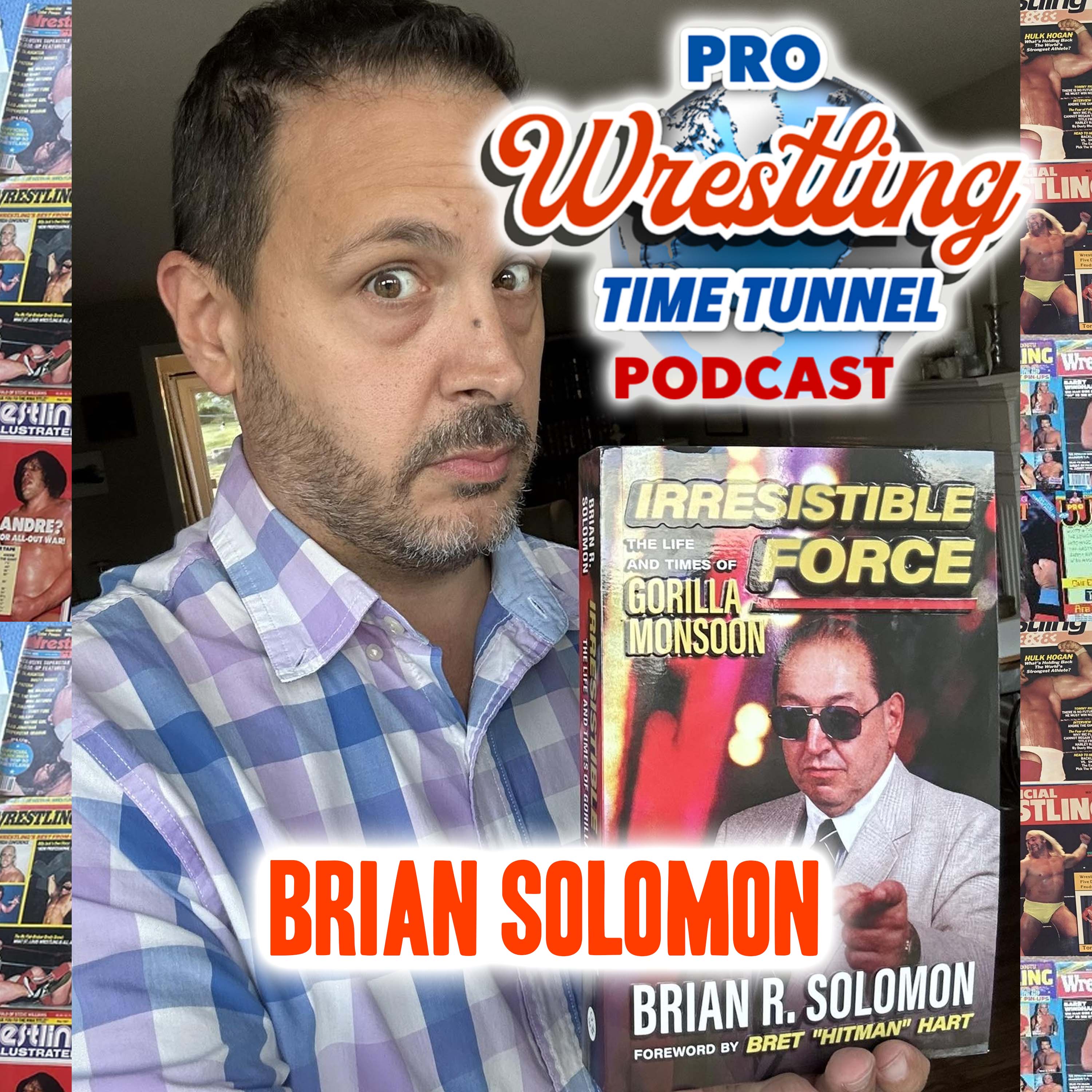
Brian R. Solomon is here. And I was so fortunate to get Brian to come on our show before his book comes out here. In just a few days here on September 30, he will release Irresistible Force, the Life and Times of Gorilla Monsoon. And at the time that we talked here just about a week ago, I didn't have mine, but I do now.
The Life and Times of Gorilla Monsoon. And for those of you watching on video, you can see I'm holding it up here, Brian R. Solomon. And during the interview coming up here, he even talks about how big the book turned out to be. And I'll show you the side view.
It is a monster book, but absolutely wonderful. I'm about halfway finished with it now and I can't put it down. I read a little bit every morning with coffee and a little bit every night before I go to bed at night.
And it's just a fantastic book. And the foreword is by Brett the Hitman Hart. Before we waste any more time, let's get to our show and my guest here at the Richards Ranch this week on the Pro Wrestling Time Tunnel Podcast, Brian R. Solomon, author of Irresistible the Life and Times of Gorilla Monsoon. Let's go to that conversation right now.
Well, hello again, everybody. Welcome to another edition of the Pro Wrestling Time Tunnel. I'm your host, Tony Richards, and tonight here at the Richards Ran have with me one of my very close and personal friends, Brian R. Solomon. You probably familiar with his work on his biography of the chic. And tonight we are here to talk about the new book that he has written on another pro wrestling legend, Gorilla Monsoon. Brian, welcome back, man.
[00:02:47] Speaker A: Thank you, Tony. I'm really, really, really thrilled to be here. I listen slash watch the show all the time. Thank you. And it's a must. And I Tell people to do the same thing. So I'm glad to.
[00:02:58] Speaker B: I appreciate the, I appreciate the, the plug and, and you're getting the word out. I appreciate that.
So this book on Gorilla Monsoon. So what, what was, what was your inspiration? Say, that's the next book I'm going to do.
[00:03:17] Speaker A: Well, there were a couple of things. First of all, I've got to, I've got to hold it up. So here it is.
[00:03:21] Speaker B: Irresistible force.
[00:03:22] Speaker A: That's it. It's giant. It can be. It doubles as a doorstopper or a paperweight. You know, you can hurt someone with it if you need to.
[00:03:30] Speaker B: I love it.
[00:03:32] Speaker A: But, you know, I have to say one thing about that, and I have to give him credit for planting the seed. I, when I did Blood and Fire and I was doing a lot of appearances, I was on the podcast of Dr. Mike Lano, who I know, we all know and you know, interesting guy, unusual guy, friend of mine though, and he, we were kind of spitballing live on the podcast, hey, what's your next book going to be? And you know, he's. One thing is, he's like an insight encyclopedia. He knew everybody, of course, and he's throwing names at me. And in my, my thing is I'm very, I'm not one of these authors who is just satisfied doing work in a vacuum.
And I don't care if anybody reads it or not. And that's fine for people to do. It's very important to me to find an audience. I really, really, when I'm thinking of topics, I want it to be things that will really appeal to an audience.
And it's tough because I love to write about old school wrestling and a lot of times that's very, very niche.
And Dr. Mike mentioned gorilla Monsoon and immediately a light bulb went on in my head because, number one, no one's done it and not even WWE has done much with him, which is bizarre. But number two, it's a way to be able to write about the territories and wrestling of the 60s, 70s, 80s, 90s, you know, this wide spectrum and ha. Not have to worry that it's going to be too obscure because the subject is somebody that everyone knows. I mean, you know, whether you knew him as a wrestler or more likely as a commentator, you know, and so all the, all the history stuff, it's like a Trojan horse. It's all, it's like built in and I get to do what I love to do and be confident that it's going to find an audience. So it was a great topic for that.
[00:05:23] Speaker B: That's fantastic. What a great. What a great story about how you. How you first thought about doing it. And I know one of the things that you do from listening to your show as well as reading your book on the Chic, is you really like to get in with the family. You like to talk to the family members. And I know Gino's what Gino is Gorilla.
His wife was very instrumental in helping you with the book as well.
[00:05:54] Speaker A: His wife and his daughter Valerie. In fact, Valerie made the introduction to Maureen, his wife, who was still with us when the process started. Unfortunately, she passed earlier this year. And, you know, I had been able to get the manuscript to her, so I know that she was starting to look at it, but I would have loved to have been able to give her the finished product, but she was a major part of. And. And Valerie of taking the book to the next level. Because you, you know, you mentioned Blood and Fire. I didn't have that with that book. I tried my best and it was frustrating and, you know, they had their reasons, and that's fine. But I think proud of the book.
[00:06:37] Speaker B: You made the attempt to, though.
[00:06:38] Speaker A: Oh, I did. Oh, I was.
[00:06:40] Speaker B: Yeah.
[00:06:40] Speaker A: What happened with that book was I was Communicating with Eddie, Jr. Captain Ed, George, and he was initially.
Didn't want any part of it. Not rude. We just. We had conversations. He just sort of declined. And then he wanted money, which was not realistic. And then the thing was, when he saw how serious I was and I was talking to a lot of other people, they were. He was starting to come around and. And him and his brother Tom, and. And then Tom died.
And then he, you know, understandably, he really didn't want to deal with anything at that point. And then a few months later, he died. It was very. It was all very tumultuous. And so it just never happened. But I always felt as proud as I am of that book. I think it could have been even better if they were on board, you know, and that's what I got with.
[00:07:28] Speaker B: This one, you know, and the reason I bring that up is because I've seen some of the pictures that you've posted on X of Gorilla and. And his wife. And, you know, it's just one of those things. I look at those old photographs of couples and I can just look and see and tell if they were really happy to. They were really in love. I mean, they were really happy together. It seemed like.
[00:07:55] Speaker A: Yes. And that's one of the themes of the book, because that is not something you see A lot in wrestling. And I'm not breaking any news there. I mean, the wrestling business is a destroyer of marriages. It just is for all the things we love about it. It's not good for family life. And you hear so many stories about, you know, it doing that and their relationship and their marriage is the absolute shining example of a marriage that was strong enough to survive everything there. And I'm telling you this, you know, everyone I spoke to, every rock I look looked under, everything I looked into, I can say with confidence that this was a rock solid marriage built on love and that there really weren't any of the usual problems that happened with wrestling.
[00:08:47] Speaker B: That's fantastic. And, and it's, it's the entertainment business. I mean, if you're, if in, if you're in a rock band or a country band or if you're in the movies or you're a star and you're on the road and traveling as they did back in those days in wrestling.
Every relationship is susceptible to damage from the entertainment business.
But it's heartwarming to see a relationship like that, which I think will make your book very enjoyable for people.
[00:09:19] Speaker A: And I'm glad I was actually able to talk to her about it because I got her side of it to confirm all that. And she knew how lucky she was and how special their situation was and they got to put roots down and raise their kids in one place and have financial security. I mean, they were all very lucky, very, very lucky to have that, that setup that they had in the business with him.
[00:09:42] Speaker B: I don't give away too much from the book, but how, how did, how did Gorilla get connected with the www?
[00:09:51] Speaker A: Connected in the sense of first coming to work there or connected.
[00:09:55] Speaker B: Did he work other places before that or did he start out there?
[00:10:00] Speaker A: He had a short period of kind of hitting the territories when he first started. He started wrestling in 1960 and he was kind of discovered. I wouldn't say discovered because he was already a known amateur champion. But he was brought into the business by Pedro Martinez in Buffalo and Row Rochester because that was his hometown. And Martinez's booker and trainer, who was Sandor Kovacs.
And they brought him in. Initially it was just supposed to be a one time angle. Very familiar. It's a modern style of angle where he would show up as the amateur champion, the local hero, saying this stuff is fake, I can beat all these guys, that kind of thing. They escort him out, security takes him out of the building, you build up interest. It was just supposed to be that. But when he started to realize how much money he could make doing it, he started to get more and more interested. And actually he was brought up to Toronto by Frank Tunney and he started wrestling sort of semi regular schedule a couple times a week. Going up there. Still had his day job, but then about a year later they sent him, they wanted to send him to Calgary. And this was going to be his first real full time commitment to the business. You can't go to Alberta and you know, you can't commute to Alberta. You have to commit to.
[00:11:19] Speaker B: Yes.
[00:11:19] Speaker A: And so he quit his day job. It actually ended his first marriage. He was married to a kind of a hometown girl and she just couldn't deal with the wrestling business, wanted no part of it. And he went out there and he really, he, he got a big break there. He was put in main events for the first time.
And then his next stop briefly was he went, he did the St. Louis, Kansas City thing a little bit.
Yeah, he did St. Joseph, which is where Goose Karras was the promoter there, who loved him.
And then he went to Japan. And Japan was where the WWWF connection happened. Because the guy he became friends with in Japan was Killer Kowalski.
And Kowalski, who had already been a major star by that point, this was like 63.
And Kowalski had been a main eventer for well over a decade. And he'd worked Japan and he'd worked the Northeast. So he knew everybody and he really, he really liked Gino. They were a tag team there. They became good friends. I have a picture in the book of them in Tokyo together shopping for Rolex watches.
And Kowalski made the introduction. Basically he helped get him plugged in in New York.
[00:12:37] Speaker B: That, you know, speaking of tag teams, you know, his tag team with Bill Watts when they were heels, that is not talked about very much as far as tag teams, but they were very instrumental in a very hot period there in 65. We're 60 years removed from it. But that was a, that was a first kind of big. When the WWF broke away from the NWA and they were doing the show out of Washington dc. I mean, Gorilla and Bill Watts, they were, they were a heated heel team, right?
[00:13:15] Speaker A: They were, they were. I have a picture of them in the book as a team and I don't think I've. I had ever seen a picture of them together before.
[00:13:22] Speaker B: I don't either. They're not talked about very much at all.
[00:13:26] Speaker A: Right. I got it from the family. And the thing people have to remember about that, it really was white hot because the reason it Was, was that Gorilla had already been the arch enemy of Bruno. His, his really his most kind of high profile opponent for those first couple of years. 63, 64.
And then Watts came in and was Bruno's ally. He was the friendly smiling cowboy. He was Bruno's.
Happened every week. It was special.
He, he teamed and allied with his worst enemy. That's the thing that made them actually really hated. They, they weren't together a really long time. But during the time they were together, yeah, I actually talked to some people who were fans back then who lit, you know, who remember seeing them on TV and going to the shows and they did some really hot stuff. In fact, they, they had the habit in those days in that territory of doing a lot of heel versus heel tag team matches for whatever reason.
So they would wrestle the Tolos brothers, they would wrestle Skull Murphy and Brute Bernard. And usually they would always be the most hated. Like whoever they were wrestling would get the cheers even if they were another heel team.
But they did. They held the tag team title there for a little bit. And then he, and he also teamed with Kowalski before that, but the Watts team was a more prominent team.
[00:14:59] Speaker B: And then Watts got a singles run, right, as a heel. And he did.
[00:15:04] Speaker A: That was all kind of happening at the same time because he'd be challenging Bruno while he also happened to be a tag team champion. And Gorilla had done the same thing. He was champion with Kowalski the year, year before and still challenging Bruno and main events at the same time.
[00:15:20] Speaker B: And so what was Gorilla's biggest run in the new. In the Northeast?
[00:15:28] Speaker A: His biggest run would have to be.
[00:15:30] Speaker B: Yeah, sorry, yeah, as a single. I meant.
[00:15:32] Speaker A: Yeah, it would have to be the early years when he first came in. Because the thing is about him, which is I think why he gets short shrift sometimes as a wrestler, is he peaked very early.
And part of that was that he was a very, very big guy and his body started to break down pretty early.
[00:15:50] Speaker B: Even I would think getting an early program with Bruno would do that to you. I mean, because you're already on top, you know.
[00:15:57] Speaker A: Right. And they, that schedule was grueling. I mean that, that WWF schedule, even though it was a terror one territory, they had these guys out there almost every night of the week. They were, you know, really grinding. And so he.
[00:16:13] Speaker B: And even though, to your point there, even though people think of them with the big towns, the Phillies, the New York's, the Boston's, they were running like a lot of towns, they were running small and mid sized towns too.
[00:16:26] Speaker A: Every little town In New England and all these, all these eastern Pennsylvania towns, every, every little town in New Jersey, they were hitting. It was a, a lot of stops on this circuit. So basically when he came in, he came in in the middle of 1963 and he was initially, he was plugged right in immediately because they took one look at him and that's what they needed. Because part of the reason was Buddy Rogers had been kind of a. Well, he. Combination of flaking out on them and also having his health issues and things and political issues with him.
They had wanted to do the whole return program with Bruno where, okay, now Buddy's gonna try to get the belt back. And that never really panned out. So Gorilla got plugged into that spot immediately. So immediately he's doing these main events with Bruno. People didn't even know who he was. The gimmick was brand new.
They put him over by having him win kind of a semi fictional tournament to get the initial title shot. The first match they had was at Roosevelt Stadium in New Jersey, which was a. Actually, I think it's still there. It was a minor league baseball stadium and it was outdoors. And that match sort of made him immediately into a star. And then they started putting him in at Madison Square garden. They had two main events in the fall of 63.
They came back in the spring of 64 and they had two more. And one of those was the 70 minute curfew draw that they had.
And so that run from late, from mid 63 up until the end of 1965 was probably his biggest run. He came back again in 67 and he had a few more matches with Bruno.
He had a pretty decent run of, of main event matches. But then by the time of 69, which is only, you know, a few years in, they turned him babyface and he got a piece of the company. That same actually moment it happened, they happened at the same exact time.
And then really that was the end of his peak as a wrestler. I mean, that's the thing. Like he, he became more of an attraction after that.
[00:18:48] Speaker B: Yeah, he was special referee or yeah, he would be underneath in the semi main. In a special match or something. I, when I did the Jim Barnett series for Briscoe and Bradshaw, I didn't realize he was a world champion. And I, I was doing the Jim Barnett stuff and I.
And he won the IWA world title in Australia, beating Mario Milano and then losing the title, Spirios Arion. And I thought, I never knew Gorilla was a world champion until now.
[00:19:19] Speaker A: I know I was. I Just made the same discovery. And there's a picture in the book that I found of him wearing the IWA world title belt to the ring.
And I found it among, you know, his family. They shared all these photos with me, and most of them, you know, they didn't really know what a lot of them were, who a lot of the people were and what. So I saw the picture of him wearing the belt, and I was trying to figure out what it was because it wasn't labeled. And I did some searches online and sure enough, it was that belt. And that was 1968. He went over there for Barnett, who was getting. Barnett had gotten. Bruno Barnett was getting a lot of big talent there in Australia.
[00:19:57] Speaker B: And it was hot. I mean, Australia was on fire.
[00:20:00] Speaker A: Yeah, hot. And literally hot to. Gino hated working there. Hated it because he was like almost 400 pounds.
And he, they, they brought in Spirit Sarian, who'd been there before. They brought in a few other people from the, from the northeast territory. And, and yeah, Gorilla got a run with that world title for a little bit before he came home, but he hated that trip. I actually talked to Maureen about it. It was the only time he ever went. And if I could tell a little brief story about that, of what happened there. So apparently Gorilla used to always wrestle with contact lenses because he was practically blind. I mean, his vision was terrible. And he used to wrestle with contact lenses as an amateur and then as a professional and when he went. And that's what enabled him to really be so acrobatic and, and crisp in his moves. When he went over there, there, apparently the rings and things were not the cleanest and the, the, the, you know, the, the setup was not the most kind of well cared for. It was kind of run down. Some of these places they wrestled in.
[00:21:06] Speaker B: Yeah.
[00:21:07] Speaker A: And were very dirty. And that was a major concern for wrestlers back in the day. There's dirt and filth and bacteria and stuff. So some of the dirt from the mat from one of the mats got under his contact lens.
[00:21:20] Speaker B: Oh, no.
[00:21:21] Speaker A: And he didn't realize what it was. And it. And it was festering in his eye. I'm sorry for the.
It's a gross story, but his, his eye became infected and it was very, very serious. They. Maureen said he almost lost the eye. They had to do some kind of surgery and he came home with his head all bandaged up from what they had done.
And he was so disgusted with what happened that from then on he never wore contact lenses in the ring again.
And what people don't realize is that is the reason there's such a drastic. One of the reasons he was also getting very big. That's one of the reasons why his work later on was not as impressive and not as athletic. And he started to rely more on the big man moves, the chops, the avalanches, the splashes didn't really leave his feet because the man could not see three feet in front of him.
[00:22:17] Speaker B: Yeah, he had the Stan Hansen.
[00:22:19] Speaker A: Yes.
[00:22:19] Speaker B: Vision. So, so when he got the, when he got the piece of the company, what, what prompted that?
Did it. Was there just an opportunity for somebody to buy in or was he specifically singled out for that to happen or was it that he had a relationship or something? How did that come about?
[00:22:38] Speaker A: Well, it happened in, in 69. And the reason, the motivator for it was that Toots Mont, who was the 50% owner with Vince Sr. Was going to be retiring. So Toots, his mother in law was sick. Toots himself was also pretty old by this point and his mother in law was sick and they were going to go home to St. Louis and take care of her. And he saw it as a good opportunity to just retire. So he wanted to sell this 50% off. Now, Vince Sr. Initially, the person they wanted to do it with, and this would be pretty customary in those days, it to be Bruno. It was going to be that situation where you give your top guy a piece of it so he never leaves, you know.
[00:23:16] Speaker B: Right.
[00:23:16] Speaker A: They were going to tie Bruno in. Bruno didn't want it there. He just, he didn't want to do business with them. He didn't fully trust them.
He wanted to have it all vetted, which they didn't like. He wanted to have lawyers and accountants and things.
And so they're looking for somebody else. Apparently Wild Red Barry's name came up because he was heavily plugged into the office at that time. But he also was getting older and wanted to retire. They wanted somebody vital, they wanted somebody who could actually really help.
And so Bruno apparently was the one who suggested not to, not to say they wouldn't have thought of it, but Bruno was the one who suggested Gino.
Now he was 32 years old at the time and he was, I mean he was young enough for people to understand this. He was young enough to be Vince Senior's son.
[00:24:05] Speaker B: Of course. Yeah.
[00:24:06] Speaker A: And but the thing is he had a great head on his shoulders. He was very well educated. Not common in those days in wrestling locker rooms. He was not a carny. He was not, he was not a shady Guy that was going to, you know, he was someone they felt they could trust and they knew he wasn't going to go anywhere. He had a house there he owned in New Jersey.
Everyone liked him.
So he became an obvious choice and they brought. But what they did is they didn't give him the full 50%. So excuse me, they took months, 50% and they split it up. They gave 25% to Gino and they gave the other 25% to Phil Zacko. And Phil Zacko had been their, you know, very loyal associate. He was a wrestling promoter. He started in, in Baltimore and he was very loyal to them. I mean he, he really helped them out so much in promoting. And in Pennsylvania and New Jersey he ran a lot of the TV tapings. He was very trusted. And as somebody once, actually I shouldn't say somebody. Vince himself, Vince Jr. Told me directly once also that Phil Zacko was the treasurer.
And so part of it was they wanted to keep him happy so they, they didn't want him putting his hand in the till. So they, they cut him in for a nice generous portion of the company and that. And that was the setup.
[00:25:29] Speaker B: And so what did, as a result of receiving the 25%, what did, what did Gorilla's accountabilities turn out to be? What was he responsible for?
[00:25:39] Speaker A: His main responsibility was going to be. It was, it was a pretty big one because as a lot of people know, the guerrilla position named after Gorilla Monsoon and some people have asked me about this, that, you know, there isn't one moment in time where that happens. It's just something that gradually happened over time. But he started manning that position and running those shows right off the bat.
He was, he was somebody that they could trust to do that. So Vince Sr. Did not really operate like Vince Jr. Did. He was not a micromanager, he was not a super hands on guy. He would do the broad strokes and then he would trust everyone else to do their job and he would go sit in his office and hold court. Basically. That was his style.
So he liked having somebody like Gino who could sit there and be on top of these guys and make sure everyone hit their mark and essentially produce the show. That's what we'd call it now.
[00:26:34] Speaker B: Yeah, he was like backstage coordinator.
[00:26:37] Speaker A: Yeah, right. He did that. You know, they sometimes would call it the Q man in some other territories before that, but he did a lot more than that. And on top of that, the other thing would be he was also involved in booking and he doesn't get a lot of Credit for that.
He, he, it was basically him and Vince Sr. Booking undercard stuff. And then the main event stuff would involve Bruno as well because he got to have a say in his own booking. It would be Vince and Bruno and Gino.
[00:27:06] Speaker B: Yeah, I never really knew that. I never knew he was involved in the creative in.
[00:27:10] Speaker A: He was.
[00:27:11] Speaker B: Wow.
[00:27:11] Speaker A: That's not when, not when the sun took over though. He was sort of. Yeah, of course.
[00:27:15] Speaker B: Well, you know, I, I, I study a lot of the 70s stuff and so I see a lot of really good stuff being done there and I often question myself going, did Vince Senior book that? I mean, because that's, you know, it wasn't, I mean it's pretty creative. And not to say that Vince Sr. Wasn't creative, it's just, you know, he's not associated with that kind of looking.
[00:27:39] Speaker A: You know, he's, he's not actually, you know, before he died, I interviewed Kevin Sullivan for the book because Kevin was there in the 70s as a kind of lower mid card guy.
[00:27:47] Speaker B: Yeah.
[00:27:48] Speaker A: And he told me things, you know, he saw things with his own eyes and he would say very often that Vince Senior specifically didn't get enough credit for booking that essentially it wasn't the kind of territory like most others were where you had a specific person who was hired to be the booker. It just wasn't like that. It was much more casual, I guess you could say, I don't know what the word would be, where Vince Sr. Would kind of, he'd have the big giant. People have seen pictures of him with the big notebook and the pencil and all that. He would lay these things out, you know, months and months in advance. But the thing that he had that Kevin told me and other people did with Gorilla was that Gorilla would have the input as somebody who actually had been in the ring and understood the in ring psychology and things probably more than Vince Senior did. And he would, he would kind of guide him and steer him. This guy's not going to make us any money. This guy will make us money. Let's do this, let's try that. He was sort of like the boots on the ground insight that Vince needed.
[00:28:52] Speaker B: I say that because we just did a show on the summer of 75 with Steve Giannarelli and I and we were looking at this card in Philadelphia in I believe August of 75. And they started the card off with a battle royal. And the winner of the battle royal was going to get the main event match with Bruno. And there's 24 guys in this battle Royal. So we're going to have 12 singles matches.
Well, it comes down to the last three guys in the ring are George the Animal Steel, Andre the Giant and Butcher Vashon.
And Butcher Vashon gets eliminated. So now we know Butcher Vashon is going to be in the semi main event, right? And now it's Andre and George Steele. And I'm thinking, man, the Philly crowd is going crazy. They're thinking they're going to get an Andre Bruno main event here, right? But George Steele eliminates Andre. So it's Andre and Butcher Vachon in the semi and then George Steele and Bruno in the main event. And I thought that's extremely creative. I mean, that's a very intricate creative booking scheme that I don't know that I've ever come across before. And I, and I would imagine that might be something that Gorilla would have been involved in. Sounds like.
[00:30:07] Speaker A: Well, I could tell you if it was Philadelphia. Absolutely. Because even more than most places, that really was his town.
There were certain, as, you know, the way they would do it then in that territory would be. And others too. Certain people would be given certain towns to run and you'd have. It was almost like the WWF territory was like a miniature NWA where you had your, you had your central booking office in New York and D.C. you know, and the talent would go out to all the satellite promoters and they'd run it based on the TV angles and things. And so Gorilla had. His towns were basically located in North.
No, I should know this, South Jersey, because that's where he lived. Right, South Jersey, some towns in eastern Pennsylvania. And he also had Delaware.
But.
So Philadelphia was probably the biggest town, the biggest market that fell under his domain. So I'm thinking if it's 75, that was already the Spectrum by that point.
[00:31:07] Speaker B: Yeah, it was Spectrum.
[00:31:10] Speaker A: That was his. I mean, he, he ran those Spectrum shows and, and the TVs in those days were done in Pennsylvania too. So, you know, he was heavily involved. He loved the whole setup with the Spectrum because he lived right, right over the bridge in New Jersey. It was an easy, easy drive for him to do that. So that would absolutely be heavy involvement.
[00:31:29] Speaker B: Yeah, he would, he would have done that. Well, that's, that's, that's amazing.
So how did they hit on this idea that he might be good on television to be on the air? How did that kind of happen?
[00:31:45] Speaker A: I almost wish I could have talked to Vince about that in the Times that I've gotten to interview him, because some of it you kind of had to have to piece together. I know that he had sort of dabbled in it here and there. So in the 70s, something they would do occasionally, they would never, it was really unusual. They would never acknowledge that he was part owner or anything like that. But there would be times where he would sit in on the commentary and just update the announcers on what was going on. He would talk like someone who was part owner, but they would never say it. He would update them on certain rulings that the Worldwide Wrestling Federation is making and what's going to happen next week. And you know, he handles himself very well on those things.
And there's one that they finally do in 78 8, right before superstar Graham lost the title to, to Backland, right before that, he had a steel cage title defense against Bruno in Philadelphia at the Spectrum. And this was a notorious night because supposedly he begged Bruno to, to beat him because he didn't want to lose to Backland, he'd rather lose to Bruno because he knew there'd be a lot. Well, or at least he thought there'd be a lot more money to be made that way. And Bruno obviously would not do that. So. But that match, if you watch it, they actually have Gorilla on guest commentary. And it's the first time he ever does that, really fully commentating on a match. And he does an outstanding job. I mean, his energy, his enthusiasm, his way with words, he's instantly comfortable. And I think it was as simple as that. They heard how, how comfortable and natural it was to him. But the other part of it was that in 82, when they sold the shares to Vince Jr. And Gino had to work this deal out in order to get him to go along with it. One of his conditions was, I want to be on television. That was a condition of his. I don't want to just fade away into the background. And so at that point, then that would be kind of the, the no brainer thing to do. I mean, if he was terrible on the mic and he said, I want to be on television, it would be really interesting to think what they would have done with him. I don't know if they would have maybe had him be the figurehead president. I don't know which he would do much later on. But that became, okay, here's the way we're going to keep you on tv. You're going to be the announcer. Not only will you be on TV, you'll be on TV more often than anyone other than Vince McMahon himself.
[00:34:11] Speaker B: How much difference was there between Gorilla Monsoon and Bob Marella?
[00:34:18] Speaker A: Well, certainly, certainly in the Manchurian Giant days, there was huge, huge difference.
But which is interesting because even during the years where he wasn't supposed to be able to talk and he was a monster and he was animalistic and everything, he actually gave newspaper interviews, which is really strange because we think about this ironclad code of kayfabe.
He had no problem talking to newspaper reporters. He was still being characteristic. He would talk about coming from Manchuria and wrestling in a traveling carnival and, you know, sacrificing chickens and things like crazy, things like that. But he would talk and he.
But in the 70s, really and truly, Gorilla Monsoon just became Bob Marella. I mean, there was no pretense anymore. In fact, I was joking about it with somebody else. They would just. They got to the point where they started just announcing him as being from Willingborough, New Jersey. You know, there really wasn't any division anymore, any kind pretense about it.
[00:35:19] Speaker B: So fans that saw him on prime time wrestling or whatever as Gorilla Monsoon, they were really seeing Bob Marella.
[00:35:26] Speaker A: I think so. I really do think so. And I talked to Valerie and she said to me specifically, he actually spoke that way in everyday life. Those, the cliches and expressions and all the. All his colorful way with words describing things and the illusions he'd make. It was just everyday language. So he just sat down there and was just himself.
[00:35:48] Speaker B: It's interesting, you know, when you dig into. I mean, I've been digging into the, you know, the Funk's life for the last two years and also into Jim Barnett's life for the last year and a half. And it's interesting, as, you know, when you dig into someone's life, the things that you uncover and the things that you find that are just, you know, they're sometimes not. Sometimes they're very different from just the average person's life, and then other times they're not really that much different than the average person's life. What was the thing that you discovered about Gorilla that really resonated with you when you were going through and learning about him?
[00:36:27] Speaker A: Well, resonated in what way?
[00:36:30] Speaker B: This guy is who I thought he was. This guy's different than I thought he was.
This guy is, or you obviously got to know him very, very well. Even though maybe you didn't talk to him, you still got to know him through, you know, going through and making this outline of his life and then filling in the. The words in the. In the book.
What was the thing that stuck out to you?
[00:36:55] Speaker A: One thing that this is something that Meant a lot to me because it spoke a lot of, about him as a human being.
[00:37:00] Speaker B: Yeah.
[00:37:00] Speaker A: One thing I did not realize and I discovered it through research. Ancestry.com I mean, an incredible resource for anyone. He lost his mother as a small child.
At 8 years old, his mother died.
It was a freak accident in the house.
You know, she, she injured herself on a rusty nail and never had it checked out and gangrene and all that other, you know, and she died. And she was very young woman, barely in her 30s, and he was 8 and his brother was about 10. And so this unthinkable tragedy, but the thing that happens is, you know, in those days, this is the 1940s, a single father working a full time job with two children. The, the instinct was, I need a new wife. I mean, that, that just, I mean, my grandfather did the same thing. That's what happened. I need someone to help me with these kids. And not, not saying that's all their marriage was, but he met another woman. Her name was Connie. And Connie really, truly became Gino's mother. I mean, he referred to her as his mother. He never said stepmother. She was his mother and he loved her dearly. And she treated him and his brother just like they were her own. Now, he grew up that way. Now later, fast forward, he met Maureen. Now, he had been married once before. They were, he was divorced, very brief. A college sweetheart. Just a mistake. It was a mistake. Now Maureen had also been married before and her husband had abandoned the family.
She had two small children, Sharon, who was 3, and her son Joey, who was an infant who was months old.
And I think he left when she was pregnant. So when Gino met her and they fell in love and she told me all of this directly, it was, she was very cautious in the beginning because she said, look, are you sure this is what you want? I have two young children and this is 1963.
Do you really want this? Can you handle this?
And not only was he, did he not mind, he welcomed this. And he loved these children like they were his own. He adopted them legally, so he's, he would not be considered a stepfather. He was their adopted father and he did the same thing for them that was done to him, for him by Connie, that he raised these children as his own and loved them with everything that he had. And that really, that said a lot to me about him as a person. He, you know, I always say when people have these horrible tragedies in their life, there's two roads you could take. Right. You could either allow it to destroy you and damage you as a person and then you repeat the cycle or you could use it as a source of strength and do the opposite and break the cycle and break the trend. And that's what he, that's what he did with his life.
[00:39:50] Speaker B: Yeah. That's amazing. What, what did his dad do? Did you learn that or.
[00:39:55] Speaker A: His father was a carpenter, kind of all purpose.
[00:39:59] Speaker B: He was a laborer.
[00:40:00] Speaker A: Yeah, he was a laborer. He did. He came here as a baby, as a very small child from Italy with his own parents and, you know, kind of. He worked for a cabinet making company for a long time.
Did that kind of work.
[00:40:14] Speaker B: Contractor, blue collar guy who needed support with the children. Right. I mean, I mean, it wasn't, wasn't. He wasn't a white collar office guy, you know that.
[00:40:25] Speaker A: No.
[00:40:25] Speaker B: That could have afforded daycare or, you know, babysitter or whatever, so. Right, I understand that. It makes sense.
[00:40:33] Speaker A: Yeah. It was, it was just in those days, that's just what you did. The idea of raising children alone was, was it's. If you, if you didn't have to, was really not an idea that people had. You know, obviously if you lose your spouse, you find another one, you know.
[00:40:48] Speaker B: That'S what they did. You. You have a family. Yeah, with all the players involved.
So gorilla, like a lot of large people suffered from diabetes.
When did that, when did the signs of that illness start showing up in his life?
[00:41:04] Speaker A: It was about when he was in his late 30s, I want to say. So he was born in 37.
Yeah. So in the mid-70s, he started to experience the symptoms, you know, thirsty all the time, just feeling sweating and the kind of symptoms that were really alarming and tremendous weight gain. He was, he got up to about 440, which famously he used to talk about it all the time on commentary, but he got as high as 440.
And he should not have been carrying around all that weight, even at 6 foot 6. That was, you know, his ideal weight as a young person when he was really at his healthiest was probably about 350 and 6. 6. I mean, still a brick wall. But of course you add another £90 to that. And so he had himself checked out and, and it was diabetes. And at first he was doing just oral medication for that for a long time.
If you think about this, he lived to be 62, so he was dealing with diabetes for 25 years.
And eventually it started to take a toll on his heart. And by the time he was in his 50s, he was just having all these Mini heart attacks and things.
[00:42:20] Speaker B: Oh, my gosh.
[00:42:21] Speaker A: Yeah, yeah, yeah.
[00:42:22] Speaker B: That's terrible. So, yeah, he. He eventually died of heart complications, right?
[00:42:27] Speaker A: Yeah, Brought on by the diabetes. But he had. He was only 62, and essentially he. He really could have lived a lot longer. Now, I know that people of his size, they generally don't live to extreme old age. So, you know, if he were alive Today, he'd be 88, which would be a tall order for somebody his size, honestly. But he most certainly could have lived well beyond 62. He just.
Look, this is a fact. He just gave up. He gave up. And part of that was when he lost his son. He just didn't want to take care of himself anymore. He ate whatever the heck he felt like. He was a heavy smoker. He just did what he felt like doing. He didn't.
He didn't give it a lot of thought, and that's just the way he wanted to live. And then once the thing happened with Joey in 94, he really stopped doing anything. He wasn't, you know, and finally they wanted to put him on dialysis, flat out. He said, no, I'm not doing that. They said, if you don't do that, you're going to die. And he just said, well, I'm gonna die then, huh?
[00:43:27] Speaker B: And how long was that period of time before he got into a situation where he just wasn't active at all?
[00:43:35] Speaker A: Well, not active at all. The interesting thing is he was active right up to the very end. Oh, he really was. He continued. You know, everybody saw him at WrestleMania 15 in 1999 when he was introduced at ringside, and he'd lost so much weight and he just looked.
People kind of assumed that, you know, obviously he's not doing anything anymore but.
Doing voiceover work. He was coming backstage still at all the local shows in the Northeast right up until the end. He did his last voiceover session at the Request Recording studio the week before he went into the hospital, and three weeks later he died. So, you know, he was diminished, but he was still doing stuff.
[00:44:28] Speaker B: Yeah, that introduction at WrestleMania, I. I don't like to watch that.
It's like seeing the later pictures of Dusty. I don't. I don't like to see those. You know, I want to remember Dusty the way I remember him, and I want to.
[00:44:42] Speaker A: Shocked.
[00:44:42] Speaker B: I want to remember Gorilla the way I remember him.
[00:44:45] Speaker A: Him.
[00:44:45] Speaker B: Right.
[00:44:45] Speaker A: Yeah. It shocked a lot of people. He'd lost easily £50 and he had trimmed down as an announcer. His weight as an announcer was probably already about 25 to 50 pounds less than had been as a wrestler.
And in fact, his daughter was telling me, Valerie told me recently that, you know, he was dressed. He was wearing a turtleneck sweater in that last appearance that he made, which is very unlike him. He usually had the suit and the tie and the jacket.
And she said he wore the turtleneck because he was so self conscious of how skinny he looked and he wanted to cover up as much of himself as he could.
[00:45:21] Speaker B: Wow.
Well, I.
Obviously the gorilla position, the backstage thing, will always be part of his legacy from now on in the wrestling business. Is there any other thing that he has as a legacy in the pro wrestling business that continues on or an impact that you think he made?
[00:45:45] Speaker A: He had a lot of influence on the way that professional wrestling is called and the psychology from an announcing point of view.
So little things. Some little things.
[00:45:57] Speaker B: Like, I mean, obviously the title of your book is one of his catchphrases, right?
[00:46:03] Speaker A: Yes. Well, yeah, he had all these catchphrases that he popularized or in some cases mimicked because I think he was a student of the game and he picked up on how a lot of wrestling announcers like to use cliches to colorful effect. So he wanted to do that. But a lot of his expressions, in a way, he was like Gordon solely that way. How a lot of announcers pick up on those phrases and like to use them, sometimes I think they don't even realize they're doing it or where it came from.
[00:46:29] Speaker B: Right.
[00:46:29] Speaker A: But also the idea, something that he. I'm not going to say he was the first one to do this, but he really popularized as standard practice, the idea of, as a television commentator, you need to be calling what you see on your monitor, not what you see in front of you in the ring. Let's say you're seated at ringside, you do not look in the ring, you look at the screen. It's counterintuitive because you're right there with the idea, of course, being you want to be describing what they are seeing on television. The live crowd doesn't hear you. So that became, you know, he imparted that other people have mentioned that JR talks about how he really kind of reinforced that. Kevin Kelly told me directly that sort of thing. And that's the standard thing and all of that.
He would talk to the referees about how to work and how to avoid the hard camera things that they were doing that they didn't think of in the old days and how to stand behind the wrestlers in kind of a. A horseshoe configuration. So you don't block them.
All these little details he put into calling wrestling and just. Even the way that today it's standard practice to always hook your opponent's leg when you're going for a pin, that was not always the case.
People who. That was not standard wrestling psychology that you must hook the leg. Right. That was him. That was him, you know, making wrestlers self conscious about it. He would criticize them when they didn't. But. So he had an understanding of psychology. And the thing about it was, even though some. Some critics would criticize him for it, he wasn't.
He would. He would criticize wrestlers like a sportscaster would criticize players in a game.
He would. He would criticize them on commentary if they were doing things wrong or if they weren't, you know, wrestling to their potential. He was not afraid of doing that. And I happen to think that that helped make people better.
It's not standard practice today. They generally don't let the announcers do that. But I think it made his work very strong.
[00:48:35] Speaker B: Well, I like.
Obviously, I like things that make the product more believable, things that are logical and make sense. It only makes sense that here's this guy who was a star, who was a former wrestler, and him saying, it makes sense to me because that's what he would have done if he would have been in the ring. And he probably won a lot of matches that way. So he's providing background. And it's almost like when you hear a former baseball player make comments on a baseball game, you're like, well, obviously he knows. And that makes sense to me because he can criticize them because he was one. You know what I mean?
[00:49:16] Speaker A: Yeah. And he wanted to build trust with the viewer. That was very important to him. And I think it was important to a lot of the older commentators of his generation and before, where you don't want to just come out there and everything is the greatest thing ever. Every move is great. Everything's the most exciting thing I ever saw. Every. No one ever does anything wrong.
Then it just becomes ballyhoo. And he wanted people to trust what he had to say. He was also thinking of his reputation as the. As the communicator, as the conduit.
[00:49:51] Speaker B: Yeah, yeah, we're just talking to Howard Baum. Just recently we did a Show on Florida, 1975, and we're talking about solely. And I told. And. And Howard made the observation. He said he was my generation's Jim McKay.
And that makes sense. Right, because you could take Gordon solely and Florida Championship Wrestling and put it in with Wide World of Sports. It would have fit right in. And I think Gorilla would have fit right in. He was in that style of commentator.
[00:50:21] Speaker A: He was. And especially sometimes he would be different than other times. So some of my favorite work that he does is actually on some of the house shows. Like if you hear him on the Spectrum shows and the Madison Square Garden monthly shows, he's a little bit more laid back, he's a little more conversational. He talks more about his own experiences and relates them to what's happening in the ring.
He has a sense of humor on some of the more high profile stuff. And you could imagine this is the Vince influence like everything else that was happening in the WWF over time.
He is bigger, he's more bombastic and more, more produced. Yes, more produced. A little more cartoonish in a way. And then of course, and then when he's with Bobby Heenan, they really are doing comedy routines and shtick. But if you want to hear a very different kind of Gorilla Monsoon, I'm telling you, go, go to the, they're on the network or wherever the heck they are. Now go, go to the, the Spectrum and Garden shows from the. From like 83, 84, 85, 86.
And you will, you will get a new respect for him. If you're one of these people that thinks he's just a ballyhoo artist, check those shows out. He's tremendous.
[00:51:40] Speaker B: Yeah, we had a, we had one of those big backyard dishes and in the 80s and we got the New England Sports Network, it was Nesn Nesn and the Philadelphia shows were on that. And the MSG Network had the Madison Square Garden shows. And you're right, I mean those shows, Gorilla sounds like what you would have heard in the summer with a major League baseball announcer. It sounds very similar to that where he's just sitting there calling the game. Just casual, you know, but very credible.
[00:52:12] Speaker A: In fact, obviously everyone loves his teams with Bobby Heenan and Jesse Ventura and they were both great. But I talk about in the book, he also had two other. Well, a few other teams that he's. That he's not. That are not as well remembered. He did a lot of calls with Pat Patterson. He did a lot of calls with Lord Alfred Hayes and he did a lot of calls with Dick Graham who was the, his co announcer at the Spectrum.
Now Dick Graham, you know, Dick Graham wasn't a wrestling guy and he was an employee of the network and, and maybe a little out of his depth. But if you listen to when he works with Patterson, who admittedly English not his first language.
When he works with Patterson and with Lord Alfred Hayes, I think they deserve a lot more credit than they get because they really do sound like old pros who are just kind of shooting the breeze and talking wrestling and having a good time. It's more laid back and conversational and it's really, they're fascinating to listen to.
[00:53:16] Speaker B: You know, I think back on the Lord Alfred Hayes before he again became more produced, but I think about the ones that you're talking about and I hear all these stories from these wrestlers, especially from the Amarillo territory and the Kansas City territory, where they talk about riding in the car with Lord Alfred Hayes and he would just constantly tell them little things that they could do to make themselves better or little things that they could do in the ring that would make a difference.
And that's kind of how he came across. And I agree with you. I think that that earlier version of Lord Alfred on color, I think he's fantastic.
[00:53:55] Speaker A: He is. And Lord Alfred, it's funny.
To be his original role. I think 83 is when they brought him in and when Vince kind of got a look at him and a feel for him and saw what he was, and also the fact that he could kind of play this, this British, kind of foppish character that he would do, he instantly said, we need to get you on tv, we need to get you behind a mic. You're being wasted as a road agent. And. But, but it just goes to show, though, that he was very much considered to be someone who could train these guys, not just a commentator.
[00:54:41] Speaker B: I, I'm excited. I'm waiting for my copy. Your publisher is graciously sending me a copy of your book. I told him I was going to have you on my show and I didn't get it before you came on, but it's on its way. I can't wait to get it. I mean, I follow you, of course, on X and your excitement has bled over into my excitement. Just you were so excited to get the book in your hands and you talk about all the great photographs that are in it and I just can't wait to see it.
[00:55:13] Speaker A: I've really become unbearable at this point because what I've. What I've chosen to do.
Well, here's what I mean. So we're in the last month now. The book comes out at the end of the month. And so all through the month of September, what I'm doing, what I'm going to keep doing is every Single day on Twitter, I'm dropping a different kind of interesting fact or interesting topic that's covered in the book. Sometimes with photos that are going to be in the book and sometimes even with photos that didn't make the cut of the book.
[00:55:41] Speaker B: Oh, nice.
[00:55:42] Speaker A: Because there were only so many. So I've been doing that every single day to just keep the momentum going.
[00:55:49] Speaker B: When I can catch them, I re x them or whatever we call it. I know.
[00:55:53] Speaker A: Thank you.
[00:55:53] Speaker B: Retweeting them anymore. I guess it's re exing them but. Or reposting them or whatever to pass them on. That's what I'm doing. So.
[00:56:01] Speaker A: Yes.
[00:56:01] Speaker B: Yeah, I'm really enjoying that and I think that's a great idea. I'm glad you're doing that. Those photographs are amazing. I can't, I can't wait to get my copy of the book. It's Irresistible Force. It's by Brian R. Solomon. It's on the life and times of Guerrilla Monsoon, a legend in our business. And I hope you've gotten a taste for what the book is going to be. We just scratched the surface in this little visit that we had today. It's how many pages, Brian?
[00:56:27] Speaker A: It's including all the back material. It's 500 pages.
[00:56:30] Speaker B: Yeah.
[00:56:31] Speaker A: And. Oh, you know what? And before we start, I have to mention I forgot I did this on Jim Cornette's show and I was kicking myself. The forward is by Brett the Hitman Hart.
[00:56:41] Speaker B: Oh, wow.
[00:56:42] Speaker A: Which, which gets into the whole connection of the Hart family in Calgary with Geno. Like as I said, he got his first full time break as a wrestler there. And Tom Burke, the historian. Tom Burke introduced me to Ross Hart. Ross Hart introduced me. Well, I had known Brett a little bit, but he made the connection to Brett and Brett really jumped. I'm thinking, oh, he's never gonna bother. He jumped at the chance to write this forward to the book because he loved Gorilla.
[00:57:11] Speaker B: That's fantastic. I can't wait. Glad, Glad. When it gets here, I'll. I don't know that I'll devour it all at one sitting with 500 pages, but I will give it a shot. I bet it doesn't take me a week.
So I'm looking forward to reading it. Brian R. Solomon, thank you so much, man for coming on. Always great to visit with you. Can't wait to be on your show. We're going to do another NWA world title.
We're going to do Dorie Funk Jr together and I can't wait for that.
[00:57:38] Speaker A: So we're getting there. We're getting there. Be patient. My next episode is Pat o'. Connor, so there's going to be a few.
[00:57:45] Speaker B: I'm ready when you are. I'm enjoying it.
I'm telling you, it's a great series, great idea. I love those shows.
[00:57:53] Speaker A: Thanks so much, Tony. I appreciate it.
[00:57:54] Speaker B: And we want to tell everybody it's Shut up and Wrestle. Right? That's the name of your show.
[00:57:59] Speaker A: So my podcast is Shut up and Wrestle. It's on the Arcadian Vanguard Network. And yeah, you can find it wherever you get your podcasts, essentially.
[00:58:08] Speaker B: Okay, man. Irresistible Force, the Life and Times of Gorilla Monsoon. Brian, thank you, man. And come on back real soon, okay?
[00:58:15] Speaker A: You got it. Anytime.
[00:58:17] Speaker B: All right, everybody, stand by. More from the Pro Wrestling Time Tunnel coming right up.
Well, I hope you enjoyed today's guest, Brian R. Solomon and the book Irresistible the Life and Times of Gorilla Monsoon. You really need to get this book and check it out. I mean, we love pro wrestling stories here at the Time Tunnel and this book is chock full of great history, great stories with one of the literally biggest stars, professional wrestling. We've got four places online that you can check out the Pro Wrestling Time Tunnel. You can come join our Facebook group, the Pro Wrestling Time Tunnel. All you have to do is fill out our membership questionnaire asked to be admitted to the group and I will approve you and let you in if you agree to our group rules. You can also follow me on x at Tony Richards 4, where I literally post 7, 8, 9, 10 times a day about professional wrestling. Got a great loyal community on X. And thank you all so much for following me and the great conversations and interactions that we have there. You can also check out our YouTube channel. Just search on YouTube for the pro Wrestling Time Tunnel. Or you can put in my name, Tony Richards, the number four.
And you should be able to find our YouTube channel that has all the episodes plus other clips and various things of the Pro Wrestling Time Tunnel podcast show.
And where almost all of my writing is done is on substack. And you can go search Tony Richards 4 Pro Wrestling Time Tunnel on substack. You should be able to find our daily newsletter, the Daily Chronicle. It's a pro wrestling history newsletter that I write every single day that runs down some birthdays, rip salute, significant events that happen on that day in pro wrestling history prior to the year of 1990. Plus I write some very interesting features on there about some Pro Wrestling Time Tunnel events in pro wrestling history and a whole lot more. Most of my publishers research is on the Pro Wrestling Time Tunnel on the Substack Channel. So come on by and check that out. You got a free subscription. You'll get the Daily Chronicle in your inbox of your email every single morning. And also if you sign up for a premium subscription, you'll have access to a lot of the research and things that I write on the on the Substack Channel. So come on by and either sign up for a free subscription or a premium subscription for just $5 a month or save $10 a year and $50 a year premium membership. Thanks so much for watching and listening to our show again today. Coming up, I've got some great guests ahead for you.
Howard Baum is going to be here next week and we're going to be going back to Florida, the Florida Territory in 1975.
Howard, of course, one of the all star performers on the 605 Super Podcast and also in various podcasts these days. But he's going to be my Florida analysis guy and he is going to be joining me for the Florida show and our first episode of that is coming your way next week right here on the Time Tunnel. Also, I've got author and historian Steve Verrier. And we're going to be going to Vancouver in 1975. Now, when's the last time you heard anybody do a podcast about the Vaughn, the Almost said the Von Erichs, but it's the Vancouver territory. And so we're going to be going to Vancouver coming up in a couple of weeks and another historian friend of mine, George Shire, is going to be here on the Time Tunnel and we're going to do a tribute show to the great performer Red Bastine. In addition to all that, we're going to be going back to the Gulf coast territory in 1975. We're going to be going back to Texas again here real soon and a whole lot more all coming up in the coming weeks here at the Pro Wrestling Time Tunnel. Thank you so much for listening and watching and thank you from the bottom of my heart for all the support and likes and subscribes and shares that you guys give us every single week. You're very important to us and you're special and I mean that from the bottom of my heart. Thank you so much. We'll meet you back here again next week at the Richard's Ranch when we'll once again venture back into pro wrestling's history on the Pro Wrestling Time Tunnel Podcast. See you then.
[01:03:04] Speaker A: Thanks for tuning in to the Pro Wrestling Time Tunnel podcast. Tune in for another great episode episode next week. Interviewing wrestlers, referees, and media personalities that have made the sport of professional wrestling. Great. We'll release a new episode soon. Don't you dare miss it.