Episode Transcript
[00:00:02] Time for the Pro Wrestling Time Tunnel podcast. We've got lots and lots of things to talk about and to do today. Covering the territories from the 1940s to the 1990s. It's the best thing going today.
[00:00:18] Interviewing wrestlers, referees, authors and other media personalities that have made the sport of professional wrestling great. The cream, yeah, the cream of the crop. And now here's your host, Tony Richards.
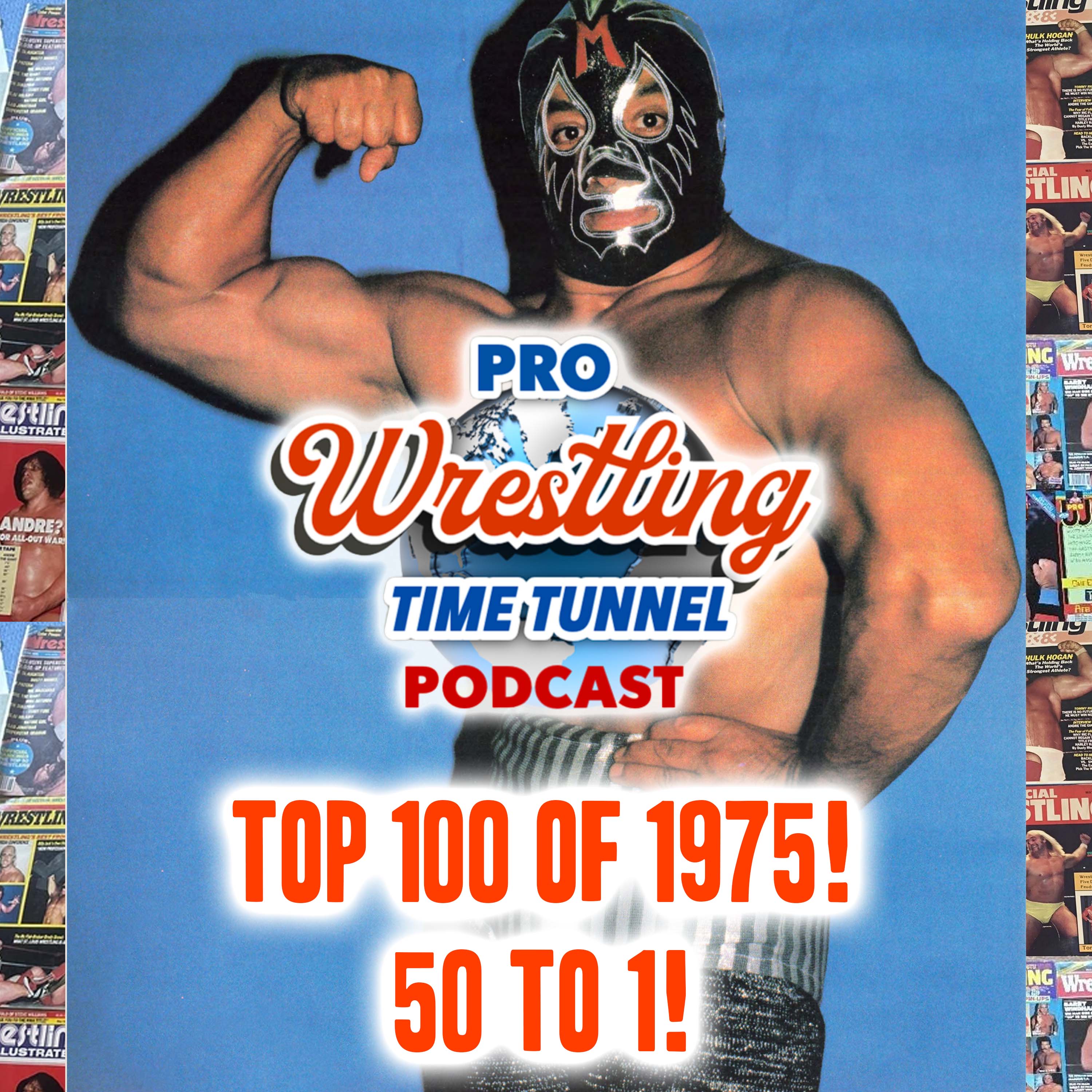
[00:00:35] Hello again everybody. Welcome to another edition of the Pro Wrestling Time Tunnel. For New Year's Day, the first day of 2026, and hopefully you listened to yesterday's show. Our New Year's Eve edition with the first 50 of my top 100 wrestlers of the year for 1975. And here we are, kicking off the new year, we're going to have my 50 of the top wrestlers of 1975. I hope you've enjoyed listening to the list so far. It's one of the things I used to really, really love to do growing up was to listen to the year end countdown shows and listen to all the great songs that were played over that year. And having a little contest with myself wondering what the top ten were going to be or what the top five were going to be or what the top number one song of the year was going to be. And so I decided really right just before the deadline of getting my podcast out for the week, it just sort of hit me like, why, why wouldn't we do something like that?
[00:01:43] And I was just telling Steve Giannarelli just a few minutes ago, he had sent me a message and talking about listening to the show yesterday and he was talking about he didn't really enjoy it. And I said, well, I'm glad I didn't have too much time to think about the list because I would have, I would have argued with myself a whole lot more about it. I probably would have, I probably would have wrestled with myself over the positions of the different wrestlers and this, that and the other. But I did it in a pretty fast manner. I, I had some changes that I made and moved but hopefully there are, as far as you are concerned as a fan, you don't think there are any glaring omissions from my list. And I should also say about the list that if a wrestler, if I thought about a wrestler's position as far as how good they were in the ring, that was one thing I thought of. And I took all these things into consideration really, really fast and it's one thing that I've always been blessed with is I have a very fast processor, my head processes things really, really fast. And I think I've just kind of always been that way, even when I was a kid with baseball lineups and baseball statistics and things of that nature and calculating things in my head really, really fast. And then when I got into executive management, I learned how important that skill really was to thoroughly think through situation or build a framework for a problem in your head and, and solve this situation, come up with different problem solving frameworks and models.
[00:03:26] And so when I was thinking about the list, I was thinking about, okay, how good of a wrestler is this person?
[00:03:36] Because you know, and take into account the style of wrestling in 1975, not the style of wrestling that maybe you've even seen on a lot of video tape. Because most of the videotape that we have are taken about 15% of the territory era.
[00:03:54] So we have video from say 79 through 90.
[00:04:00] And really 79 through. Like I really think the really the drop off really happened when Crockett sold Turner.
[00:04:08] But we. That's the. The only sliver we have of that. So the rest of it is just rare film. We have rare tape. We have a lot of anecdotal information from people who have been interviewed or done shoot interviews or they've. You read, you read articles about them and you got to separate the kayfabe from the actual when you do that.
[00:04:33] But when you start putting historical information about their drawing power and how long they were on top and where they were on top and the crowds they drew and those kinds of things, plus then you take into consider. I took into consideration the titles that they held.
[00:04:51] And yes, I know that it's all a work and all of that, but in 1975, titles had status and titles meant something.
[00:05:03] And so if a wrestler had a particular title, that increased their status in the business in their prestige. And it worked together to build a career for this wrestler. So I took that into consideration. I took into consideration also the status of the territory they were working and the territories they worked, not how many they worked, but the importance of the territory at the time in 1975, plus the position they held and how important they were to the territory, for example. And we're going to talk about another guy that this falls in this category. For example, ranking Hiro Matsuda, number 56. So he's right there in the dividing line between the upper 50 and the lower 50, because he had the title for just part of the year, the World NWA World Junior Heavyweight Title just part of the year.
[00:06:06] But back in 1975, the world junior Heavyweight Championship still had status and it really meant something. And there were certain territories that counted on that championship and that champion just as much as they counted on the world champion. Because they might not get the world champion in a certain territory, but once a year, if they could get the World Junior Heavyweight Champion a couple of times a year, that was very important to that booking office and that territory. So for example, take into consideration Stampede Wrestling in Canada, Stu Hartz territory.
[00:06:47] It was an important territory for the National Wrestling alliance, but it wasn't a premier.
[00:06:52] It wasn't a Jim Crockett or a Georgia or one of those kinds of territories that had some standing or a championship wrestling from Florida, Georgia, Florida, Crockett. Those territories had a lot of standing. You know, Vern's AWA had standing as a territory. It meant something if you work there. So did the WWW F. It meant something when you worked there. And then there are other territories at sort of mid level and lower level. And I'd put Stampede in the lower mid level part of the territory status at the time of 75. But my point is take the 4th of July card for 1975 in stampede, it was on top for the World Heavyweight Championship and the World Junior Heavyweight championship. Jack Briscoe versus Hero Matsuda. That was their main event card for July 4th for the whole Stampede Rodeo Festival and all of that. That was a primary drawing thing for them that year. A very, very, very important match.
[00:08:00] So these championships meant something. And they actually, they meant the wrestler meant more.
[00:08:07] So I put Hero in there sort of in the midline because he held that title for seven months or something like that. And he toured with it and was the traveling champion.
[00:08:24] I got a note from Michael Norris, who helps me do the Gulf coast part of our podcast here on the show. And he was thanking me for including Ken Lucas. And Ken Lucas had two different championship matches for world titles that year. He had a match with Jack Brissol and Gulf coast and he had a match with Hero, Matt Suda, maybe two. I can't remember. I don't have the email in front of me. But I mean that that meant something in 1975 and Ken Lucas. Gulf coast was a secondary type territory within the NWA in the middle part there of territories stacked as influence. But Ken Lucas was extremely important to that territory. He was an on top baby face that sold tickets and drew money.
[00:09:15] So he makes my list right, because he was very, very crucial and important.
[00:09:20] But we had so many more wrestlers working in the business back then that narrowing it down to 100 was harder than you might think. So let's get on with the countdown as we're going to go from number 50 to number 26 in this segment. And then we'll take a break and come back and I'll do my top 25 wrestlers for 1975.
[00:09:43] All right, here we go. Number 50. At number 50, I've got blackjack Lanza. And Blackjack Lanza started out the territory, territory of Dallas at the beginning of the year. That's why he's ranked up a little bit higher than Mulligan. And some. The other thing I'll mention about my list is if they. If a wrestler was in a tag team and they were in the tag team for the whole year, they probably weren't going to make my list because this is the top 100 wrestlers, single wrestlers, Right. But if they were in a tag team for part of the year and they were a single part of the year, they made my list. And depending on the matches they had the importance to the territory and the territory's importance, they might have moved up. And I got a great example of that coming up in just a minute. And what they did as a single in the year, and Blackjack Lanza, even though this is the year that they won the three WF tag team titles with Blackjack Mulligan as the Black Jacks managed by Captain Lou.
[00:10:48] And if you check out our WWW F podcast with Steve, generally we go through all of that. They beat Dominic Denucci and Pat Barrett in August in a two out of three falls match to win the titles. And I was always wondering, you know, gosh, they could have had a longer run.
[00:11:07] But then the plane crash happened in North Carolina and Mulligan was called back to North Carolina. But he also had some main events in New York with Bruno. So he's got to make my list because he started out the year with Wahoo in the Carolinas. Then he had a tag team there at the end of the summer and had a good chunk of that which was successful, but being successful in the tag team knocked him down some notches in my singles list. And Lanza, same thing, except that Lanza was on top with Fritz Von Eric in Dallas, and they had a heck of a run at the beginning of the year.
[00:11:47] He also was in a program with Ivan Putzky there and Doug Gilbert, the Doug Lindsay professional under a mask professional. Doug Gilbert had a little run with him also.
[00:12:03] And so they, they had a huge program there in a cage match, Battle of the Claw holds, and drew money in Dallas for Fritz and around the Dallas loop in Houston and Corpus and other places. So.
[00:12:18] And then Lanza stayed behind in the www F when Mulligan left to go to Crockett. But that, that couple of months period where. And Mulligan's run at Crockett at the beginning of the year, these are all things that are going through my head. Okay? Mulligan's run and Crockett at the beginning of the year was with Wahoo and they had some success. But Mulligan didn't do as well at the beginning of the year as Lanza did in the beginning of the year with Fritz on top in Dallas. So for that reason, you know, I put mulligan at like 61 and Lanza got nine spots ahead of him just because of that feud with Fritz Von Erich, who is coming up on our list here in just a little while, who also had another major accomplishment outside the ring in 1975. Okay, number 49 is the blue Demon. The Blue Demon, a luchador from Mexico, had a big year in the emll, which I think now is cmll. But again, I'm not real deep on my Mexican wrestling history and I'm sure not up to date on it currently, but he got his second NWA World Welterweight Championship by beating Mano Negra on June 29th in Mexico City.
[00:13:36] And when you have a big match in Mexico City, my gosh, the crowds that they drew there and the crowds they still draw there.
[00:13:44] He defended his title several times versus Karloff Lagarde, who a big legend from the 60s in Mexican wrestling. And they had that match on the 42nd anniversary show for EML there, which their anniversary show every year is always a huge, huge deal. He also had a lot of great. Of course, Lucha is full of tag team matches. He had a lot of tag teams. He tagged with El Santo when they had a third partner in that as well. Because they're typically mostly trios matches in Mexico.
[00:14:21] And they beat Pero Aguayo, Carlos Lagarde and Alfonso Dantes at another big event there. He had a hair versus hair trios match and win.
[00:14:33] I mean, you pretty much know if it's. You're on El Santos team and you're in a hair versus hair match, you're probably going to win. Because I don't think we're going to see El Santo, the cultural icon of Mexico, get unmasked and his head shaved. But because he's associated with all of that and all those great legends and all of that, I ranked blue demon number 49 on my list. Here in our top 100 wrestlers of 1975, here's a guy who, one of the guys I was mentioning who probably lost some spots because he was in a tag team for a whole lot of the year. But he also had some significant singles success and that's Ray the Crippler Stevens.
[00:15:16] Ray, at the end of 1974, Terry Funk sold his ownership interest in West Texas Territory Booking office. He sold that and his shares were divided up among Ray Stevens, Ricky Romero and I can never remember the other couple of people.
[00:15:36] One of the Kozaks maybe. But anyway, Ray lived in Amarillo and so he was most of the year the AWA World Tag Team Champion with Nick Bockwinkle. And he was flying back and forth between Amarillo, West Texas, El Paso, Lubbock and whatever town the AWA was running. And I give him a lot of credit for that. And he had, he worked like the second or third match from the top most of the time on the West Texas Cards because he wasn't in town as much to do television and promote the programs and things of that nature. So he worked down the card some. He was part of the booking team that those guys would Dory Funk Jr. And Ricky Romero and Jerry Kozak and Ray Stevens all get together from time to time and book out the cards and the wrestlers and this, that and the other.
[00:16:36] But I mean, their biggest deal that year in 75, Ray's biggest deal was in a tag team with Bachweagle against Dusty and superstar Billy Graham. And then there were some matches against Dusty and the Crusher.
[00:16:49] And there were most of a lot of their matches were against Vern Gagne and Jim Brunzell.
[00:16:56] And they had a lot of Dick the Bruiser and Crusher matches that year.
[00:17:01] So he did win the NWA Brass Knuckles Championship, which is probably why I've got him rated. The fact that he's such a fabulous worker in the ring and the fact he was an owner in the Amarillo territory and that he was flying back and forth trying to keep West Texas relevant and going.
[00:17:21] And he won the NWA Brass Knuckles Championship, which was like the third most important singles title in the West Texas territory. I would rank Ray in here at number 48, all right? Number 47, a guy who is really important to the Mid Atlantic territory in Jim Crockett Promotions. And if you've only seen him in the brown Nazi looking outfit with the little mustache from the 80s television, then you don't have as much respect for Paul Jones as you should have because he was an Exceptional wrestler, and he wrestled on top. And he was one of the main baby faces for Jim Crockett Promotions for a lot of the 1970s there. In George Scott's run, he was probably the number two or number three, Babyface Wahoo. Once Wahoo got there, you know, it was probably a close run between Paul Jones and Sonny King as to who was the second number two, Babyface. But, you know, George just had those great cards. You know, he had Paul Jones, he had Wahoo, and he had Sonny King that he could mix and match with Johnny Valentine and the Super Destroyer and the great heels that he had in there. So Paul Jones had a great. Had a great year. He was tag team partners with Wahoo McDaniel for some of the year, which is why he's down the list a little bit.
[00:18:54] They were the NWA World Tag Team Champions. They beat the Andersons and held the titles for a little while. He held the television championship for the second time. He beat Ric Flair for that in August. And his year probably peaked out, though. And why he's here at this place on my list, when they had the United States Heavyweight Championship tournament in November after the plane crash where Johnny Valentine had to vacate the title and he beat Terry Funk, or actually Terry Funk won the title in the tournament. But then later, earlier in November, Terry Funk won the title in the tournament. And then later in November, at the end of November, Paul Jones beat Terry Funk to win the NWA Championship and set up a great program for Terry Funk to come back to after he won the title in Miami. That whole shifting of titles there and shifting of positions in November. They had the NWA World Championship Committee meeting November 1st at the airport hotel in Dallas because Fritz Von Erich had become NWA president.
[00:20:05] And I think pretty much everybody thought when Briscoe was done, Harley was going to be the champion. But in the.
[00:20:12] In the committee meeting, the vote went to Terry. So there was a lot of moving and shifting around there after that November 1st meeting. And this is one of the things that got moved around.
[00:20:22] They gave the title that Terry had, which was the US Title, to Jones, and they start setting up these programs for Funk once he wins the title on December 10th. So there's a lot going on. He had the US title throughout the end of 1975. And so Paul got number 47 on my list. It's a close deal here, because the next fella on my list is a guy that you're used to hearing being the wrestler of the year. And I put him in here at number 46 in 1975. And that's the nature boy, Ric Flair, because in 1975. Now, listen closely to my thought process here. Ric Flair won his first singles title in 1975. Now, he is not long out of Vern Ganya's training camp.
[00:21:12] He was in there in Mid Atlantic in 74, he was tag team champions. They put him right away with the veteran Rip Hawk. And Hawk was given the job of teaching the young Nature Boy some things. And so by 1975, though, George Scott, the booker, is ready to start pushing Flair a little bit as a heel single.
[00:21:34] And so he has him beat Paul Jones for the television belt early in 1975, in February, and he held it for about six months. He lost it back to Paul Jones in August. And then he starts in with a program where I believe this is the place. And I'm just speculating, but I think it's right here in August where George Scott makes the decision to go with Rick. He's. He's shown him enough from February to August that he believes that Flair can do the singles thing.
[00:22:07] Giving him the television championship was a nice test run.
[00:22:11] And so I think Rick passed the test with flying colors. You also got to remember that Rick is a little heavier here than he would be in future years. And after the plane crash. But Scott gives him the television championship on February. He then has him lose it to Jones on Aug. 8, then puts him in a program with Wahoo.
[00:22:34] And they had a title versus they had a title match in September over the Mid Atlantic Heavyweight Championship, and he won the title. But then on October 4, he had the plane crash in Wilmington, North Carolina, that killed the pilot and paralyzed Johnny Valentine. One of the really heartbreaking things. And we've got more on that coming up here in just a second. But Flair's back was broken in three places. Doctors initially thought he would never wrestle again, but he started physical therapy. He came to the office one day and George Scott told him to throw the brace away, that if he kept wearing the back brace, he was never going to get over it. The back brace was going to hold his back in a place where he would be impaired for the rest of his life. And even though it didn't really make sense to do the opposite of what the doctors told him to do, he threw the brace away and he went on a diet and started working out in physical therapy to make his comeback. And he came back as more of the Nature Boy that we're used to seeing versus the much bigger, much heavier Nature Boy. But that year of transition There was good enough for him to be in the middle of my list, not good enough to be on up based on. He's just been a single here for six, eight months.
[00:23:58] And my list is based on singles competition. And he didn't come back for the rest of the year.
[00:24:05] But his prestige of his name holds a little bit of bias in my mind of what his career is going to be. So I've got a little bit of a futuristic put, you know, in stock trading we call it, you know, buying a, buying a call or a put. I put a little bit of a put here on Rick's career because I know how it's going to turn out. So I give him a 46. I put him at 46. All right, number 45, he gets to be the National Wrestling alliance president at the convention that year. So Fritz Von Erich, who in 1975 was working maybe a couple of times a month, but he held perennial, perennially he held that NWA American Heavyweight Championship, which was supposed to be equivalent to the U.S. championship in other places. And in other places it was the North American title, but it was the top regional title. And they put a lot of shine though on the Texas title. And we've got somebody coming up here just a second who ranked a little bit higher because of the Texas title and the singles thing. But Fritz needs to be on the list and he was, needs to be higher than 50.
[00:25:20] I wouldn't, didn't want to put him in the top 30, but I put him in here and 45 because he had that feud with Lanza that we talk about.
[00:25:31] He had a no referee cage match with Lanza that I talked about. He, he had a program with Mad Dog Bashon. He had a program with Han Schroeder. He had a program with a young up and coming rookie. Well, now it wasn't his rookie year, but he's very, it's his rookie year in singles. He had been a tag team with Frank Goodish. Stan Hansen comes into the territory. So he has, he, he has a, a program with Hansen, which, coming into a territory when you've been a tag team wrestler, now all of a sudden you're a single and right away you get put with Fritz Von Erich.
[00:26:07] I mean, I give Fritz some credit, you know, for that.
[00:26:12] He had a tour of Japan also in 75, where he beat Saruta. He lost though, and everybody lost a giant Baba in 75. But they had a Texas Death match in July that Fritz lost, which, you know, I mean, Baba goes over in all Japan, right? He's the head guy, he's the owner. But for Fritz to go in and do a gimmick match, based on where you're from and knowing how proud Texans are, I give Fritz a little bit of credit for letting Baba go over in a Texas Death match. So he, he and John Tolos tied in a pole battle Royal on July 1st. So again, he's putting the shine on this. The younger guy who's a single and Tolos is the Texas champion. So they didn't, they didn't make the American champion or Fritz bigger than Tolos or. And the Texas title, they co won the battle royal. So it was a. It was an awesome year. And as I said, he became NWA president. So I give Fritz Von Erich number 45. Okay. Number 44, Don Jardine.
[00:27:27] He had been one of the top heels in Jim Crockett Promotions. As I mentioned earlier, in 73, he was the major catalyst. If you listen to the Jim Crockett promotions podcast from 75 in our library, when Hitchcock was here, John Hitchcock was here. He talked about when he was watching television and the Super Destroyer showed up on tv.
[00:27:53] He knew things were changing as Crockett was making the transition from a tag team territory to a singles territory. And one of the major catalysts was Don Jardine as the Super Destroyer. He was the first piece of that wonderful mosaic puzzle that George Scott painted there in the mid. Early to mid-70s as the whole territory transformed and metamorphosized from a tag team area to a singles. And listen to the guys that Jardine wrestled as this masked Super Destroyer. Swede Hansen, Wahoo McDaniel, Jack Briscoe, Paul Jones, Johnny Valentine.
[00:28:34] You know, they did heel versus heel matches there. He won a. His big program, though, was against Reggie Parks under a mask as the Avenger. They had a series of mask versus matches. And in these days, no Internet, no communication between towns. Nobody reads the newspaper from the other town. They only read their local newspaper. They can't see the television in the other towns. They can only see their television. So they don't know that the avenger unmasked like 60 times that year because they ran that mask versus mask match in every one of their towns with Jardine going over and Reggie Parks unmasking. And it really was kind of the undoing and sort of the, you know, he went ahead and came back and wrestled a little bit as the Avenger, but it really killed the Avenger gimmick, as it would when the guy gets unmasked. But Jardine was. He was really, really Important to the territory. He went to Australia for a little while that year with Gary Hart, who typically was his manager. He wrestled as the spoiler over there.
[00:29:47] He did have a little bit of an issue over there that Gary Hart talked about in his shoot interview where Don Jardine got mad at the hotel clerk over, you know, an insult, you know, that he took wrong. And he had a temper, right? No charges filed, no big deal. But he came back and wrestled in Puerto Rico where he won the North American heavyweight title. He beat Carlos Colon for that title and Carlos didn't put guys over a whole lot. He won the Georgia title in November by beating Mr. Wrestling number two.
[00:30:24] So he had a pretty phenomenal year across some pretty significant territories. And I would put him here at number 44. All right, number 43 is a guy I had to research a little bit.
[00:30:39] Jose Luis Melacor Ortiz, better known as El Halkian. El Halkin. El Halkin, I guess is how you say that.
[00:30:50] A lot of hope, high profile matches in Mexican wrestling. He was a tag team with Dr. Wagner.
[00:30:57] They won a loser mask versus mask tournament, beating the Twin Devils, who were legendary tag team in Mexico City.
[00:31:08] In September he beat Raul Reyes to capture the Mexican national heavyweight championship at that big show we talked about earlier, the 42nd anniversary show at Arena Mexico. And he held it for three months and closed out the year. In the main event on December 5, a three way lucha hair versus hair mask hair versus mask versus hair match against Enrique Vera and Alfonso Dantes.
[00:31:38] So yes, there were three way matches going on in 1975 and he kept his mask and Vera forced Dante to lose his hair. So we will give El Hauken a spot in our top 100. For sure. We'll give him a nice spot. Number 43.
[00:31:59] All right, number 42, the world junior heavyweight champion for the National Wrestling alliance as the year opens, Ken Mantel.
[00:32:06] And he traveled with that title and he really worked hard. You know, Ken Mantel worked hard to preserve the legacy and the prestige and the honor of that championship. And I take my hat off to him.
[00:32:21] He was an interesting.
[00:32:23] And this has nothing to do with 1975, but I'll just as an aside, he had an interesting career as booker. He did a lot of stuff in world class that really drew a lot of money. And he didn't have as successful a run with Bill Watts, but here in 1975 he is recognized as a premier wrestler. During this particular time he made some great tours of Japan with that world heavyweight championship and he would travel with it to Florida to the Gulf coast territory.
[00:33:03] And so he had a great program at the end of 74 and going into 75. There was a great program between Ken Mantel, the wrestling pro, and Ronnie Garvin that spilled over into the McGurk, Oklahoma, Louisiana Territory. And I wish we had tape and film of all those angles and all those interviews and all the things that they did in that program. But it was very important to both territories.
[00:33:38] And in the Gulf coast they did the whole thing with the NWA naming the wore the promotion naming the wrestling pro as the World Junior Champion. And they, they built a whole thing around that was just really awesome. And I wish we had it. I don't think we do. But he lost the title mid year. So he held the title for the first half of the year. He lost it in St. Petersburg, Florida to Hero Matsuda, who we already put on our list.
[00:34:08] And then he teamed up with Ron Bass for a little while. It is an interesting tag team.
[00:34:14] It's not one that comes to mind right away when you think about tag teams, but they came into the Central States territory based in St. Joe and Kansas City, and won the World Tag Team title. And he ended the year in Japan with All Japan, always a favorite of Baba, always because of Baba's NWA membership. And he was in the open championship tournament at the end of the year in December. He had over 12 matches.
[00:34:42] He had mixed results there. He wrestled Kentaro Oki, who we already had on our list. He wrestled the, the.
[00:34:51] The judo guy, Anton Giesick, he wrestled him.
[00:34:57] As Jerry Briscoe told me, Anton Giesick was very stiff in the ring and he tagged up with Dick Murdoch a couple of times as well. There was also a wrestling movie, very little known wrestling movie out that year called the Wrestling Queen. And Mantel was in the movie.
[00:35:17] So I would give ken Mantel number 42 spot. All right, number 41 on our list is the Rock, the original Rock, Rocky Johnson.
[00:35:27] And Rocky Johnson is on his way to a career in territory wrestling that's going to be better. 75 is kind of the start of him building that career that we look back on now so fondly, where he worked on top in several places and all. And he did some working on top here in both Georgia. He was the Georgia heavyweight champion. He won it at the end of the year. Last year in 74, he was the first black wrestler to hold the Georgia title and he lost it in February of that year. He had a great tag team that year. And I didn't figure this in because it didn't. You know, when you're in a tag team, it starts deducting points from my singles list. It will add points to you on my tag team list, but it detects some points from my singles list. He was a Jerry Briscoe, and he held the Georgia tag team titles that year.
[00:36:22] And he. He had some world title matches at the end of the year. He wrestled Terry Funk for the world title there in Georgia right at the end of 1975. But at the. Almost like the last day of the year, or close to the last day right in there toward the end of December, he won the Florida heavyweight title. So he won the Georgia title. He had some world title matches.
[00:36:50] He won the Florida title. And he had some great, great feuds both there in Georgia and in Florida. Kind of one of those guys who. Bouncing back and forth, Eddie Graham and Jim Barnett and the Briscoes were all partners at that time. So they were all kind of certain guys were bouncing back and forth there. Rocky Johnson was one of them. And he. He's got a great 75 positioning him to have a great singles career going forward.
[00:37:15] All right, number 40 is the big Cowboy.
[00:37:20] And the Big Cowboy, as you might think, is Bill Watts.
[00:37:24] Watts had booked Florida. He booked Georgia in 73. He left Georgia for Barnett and went to work for Eddie Graham. And they were switching bookers back and forth. There was big musical chairs of bookers there for three or four years with the whole Barnett and Graham and all of that. But anyway, Watts had a very successful 74 as Booker. He also worked on top some as the Florida champion.
[00:37:54] Kept that after the Pac Song angle In Florida in 74, Bill Watts kept that thing going with Dusty. They had some crazy, wild brawls and bloody matches and on into 75.
[00:38:07] And right after the 75 plane crash at the end of February in 75, Watts resigned as the booker in Florida and went back home to Oklahoma, where he had always planned on going. But he always said he got his PhD in booking in Florida because he wanted to work under Eddie Graham. So he returned to Oklahoma feeling much more accomplished as he should have, and much more confident.
[00:38:34] And he was an owner with Leroy McGurk. And he increased his ownership stake up to 50% by buying out or getting rid of or whatever he did with Vern Gagne and Fritz Von Erich. And so he made a lot of improvements in that Oklahoma territory. He moved some buildings around and he got them into a nicer building in Tulsa, and he started bringing in some of his previous contacts to freshen up the roster.
[00:39:04] One of the things he did was he brought in Dick Murdoch, he brought in Killer Carl Cox.
[00:39:11] He did a lot of things there in 75. And he put himself out there in the ring on top against Dick Murdoch for a really good feud there through the middle part of the year, which is why, mainly why. And because of his.
[00:39:28] He was also in that little known movie, Wrestling Queen too, by the way, about the. It was about the Vachon family, I think. But anyway, Bill went out there and worked on top in main events, even though he was an owner and he was a booker. And he put his sweat and blood into that promotion there in the Midwest, in the middle of the Midwest and in the south of Louisiana to make it go. And I gave him a lot of credit for that because he was willing to show his roster that he was willing to do what he needed to do. So when he asked them to do things, he had already, you know, demonstrated it or whatever. But anyway, I put bill at number 40. I thought that was a pretty good slot for his influence and what he did, and a little bit of credit for his previous accomplishments, a little bit of credit for what he was trying to do there. And he was getting the houses up and they were starting to draw more, and he was getting the territory back on track, and he used himself to do it mainly was why I would put him at number 40. All right, at number 39. We're number 39, right? Number 39 is Waldo von Erich. And I have been extremely complimentary about Waldo's run in the WWF in our podcast about that federation in 1975.
[00:40:45] The matches that he had with Bruno, although the ones that we get on videotape, a lot of them are really, really pretty short.
[00:40:53] But the heat and the action and the bumping and the just sheer emotion that was evoked from Bruno and Waldo in matches and the crowd control that they had.
[00:41:10] And he also, of course, was working with chief Jay Strongbow, who was the guy right under Bruno. And, you know, he. He had a countout win against Bruno in 75 on the. In the May match, which caused the rematch. And they had some, I think, some German oriented type matches and some things like that. He beat Dominic Denucci. He was in a tag team with the other big heel for 75 there, Spiros Arian.
[00:41:42] And he also wrestled up in Canada, in Ontario a little bit that year and beat Dave McKigney with a DQ win after a lot of evil heel kicks to the ribs there. And he, you know, he was an aggressive Guy, he did the throat jab and he. All those little heelish moves would get so much reaction from the crowd if you watch the video of the matches that they had.
[00:42:18] And Watts respected him so much that when Watts needed a heel in Oklahoma, not too long after this, he's going to go to Waldo Von Erich as his lead heel and had a lot of success there. But for 1975 and being one of Bruno's top heel opponents, I put him at number 39.
[00:42:35] Number 38. Another Japanese wrestler, Strong Kobayashi. He was in New Japan Wrestling full time and he was a main event star. He had been to the WWF in previous years. He was known in the. On the east coast.
[00:42:51] He had a tag team with Seiji Sakaguchi and they were known as the Power Fighters that year they had a lot of high profile matches in New Japan.
[00:43:01] Wrestled a lot throughout the year in the various tours and series that were going on there with Inoki. Had really good tag team matches with tag team that I really liked in 1975, the Hollywood Blondes, Jerry Brown and Buddy Roberts. And so he was very important to New Japan, who that was an emerging promotion. They had a couple of years old now, and they were really the innovative, cool promotion in Japan at the time.
[00:43:39] And so Koba Kobayashi was probably the number three or four guy there. And so he was important to the business, he was important to New Japan and he had some really strong matches. So I give him number 38. All right, number 37. I've got the Golden Greek, John Tolos.
[00:44:01] This is another great example of a guy who was working in some territories and he's really important to the territory. He had been very, very important to Los Angeles, the NWA Hollywood office there. And he started out the year there. And he's really the guy that got Greg Valentine over in his first big singles run. Because Valentine came into LA and Tolos, who was pretty much a legend in Los Angeles by 1974, early 1975, very well respected. And he immediately put Valentine in a program with Tolos, which I do have Valentine coming up here in just a second. But Valentine won the NWA America's title, which was the number one singles title from Tolos. And they had some bloody, bloody loser leaves town matches. They had a cage match which Tolos lost.
[00:45:03] So I think he came back for a little while under a mask there in LA as Mr. California. But he eventually does leave town and he goes to Texas, to the Dallas office, where they put him at the top of the cards and he gets the Texas title and he pretty much carries, I mean, even though the American title is Fritz's title, and that's the number one title in the territory, the Texas title is what you would call the working man's title, you know, what they used to call the intercontinental belt in the WWF.
[00:45:37] The Texas title was that in 75, and Tolos won it three times that year.
[00:45:45] He had two title match, two title wins from Al Madrill, who was a young guy they were trying to get over. And then he beat Buddy Wolf for it in November.
[00:45:57] So he also had two, two victories of NWA tag team titles. The first one, he was partners with the booker in la, which was Louis Tolay. And then later on when he goes back to Los Angeles in December, they put him with Rock Riddle, which everybody knows Rock from various conferences and conventions. But they won the tag team titles in Los Angeles at the end of the year.
[00:46:25] And he, I mean, just, he had a really good 75. He was very, very important to the two territories. He was working and he was at the top of the card and he was working with the top guys and he was in high profile feuds and he was selling tickets. So John tolos gets number 37.
[00:46:45] Number 36 on my list is Ox Baker.
[00:46:50] Ox Baker by 1975 had been one of the premier heels in professional wrest.
[00:46:57] I mean, this is the guy that Kay Fabe people believed had killed two guys with his heart punch, you know, up in Nebraska and down in Georgia.
[00:47:08] Both of those deaths were whispered around, that they were because the guy had been in a match with Ox Baker and Ox had hit his heart punch and that was the end of those two guys. We know that wasn't the case.
[00:47:24] He was in the matches and he did give him the heart punch, but that's not why they passed away. But why does Ox Baker get a high position, which I think 36 is a pretty high position on my list out of 100. He gets it because he was the WWA World Heavyweight Champion for most of the year, or at least half of the year, late summer, he won the title there. And the WWA was Dick the Bruisers promotion in Indianapolis. This is another territory that, thank goodness for Dave Dynasty. He's keeping it alive out there. And if you had never listened to Dave Dynasty's podcast, you should, because Dave is the WWA champion. He is the guy keeping that territory out there and keeping the memories alive. We had him here on our show to talk about 1975. He did a great job. And if you want to listen to, you know, a Lot of the things about 75 in that Indianapolis territory. You listen to that podcast and we talk a lot about Ox Baker, who not only was he the WWA World Heavyweight Champion, he was defending that title and working that belt in Chicago against Vern Gagne, who was the AWA champion. So they were sharing in Chicago. So Ox was there in Chicago and on top. He was also on top in St. Louis for Sam Muchnick. He was on television on Wrestling at the Chase. He was feuding with Dick the Bruiser, who was the owner of the Indianapolis territory. And everybody knew they were enemies.
[00:48:58] So, I mean, Ox was still strong here in 75. He wrestled a little bit in Canada for Stu Hart. He wrestled a little bit for Carlos Cologne in Puerto Rico. And he was the consummate heel with that face, with that bald head with the big mustache and all of that that I just mentioned gets oxygen, the number 36 position on my list.
[00:49:23] Number 35 is another guy who didn't have any hair. And he was a big heel. He was a German, really, from Nebraska.
[00:49:34] Really? Jim Rasky from Nebraska, top amateur wrestler. But in wrestling, he's Baron von Raschke, the top German heel.
[00:49:45] And he was in the AWA for 200 and something matches, just in the AWA alone. Had a lot of great matches. And I'd kind of forgotten about it, or maybe I didn't even know. But when I talked with George Shire on our Christmas episode about the AWA world title, and we reviewed Vern's year that year until he dropped it to Bock Winkle at the end of the year, George reminded me that a lot of vern's matches in 75 were against the Baron, and they were on top in Denver and Chicago and in Minneapolis and in St. Paul.
[00:50:23] He also.
[00:50:25] Now here's another thing about Baron von Raschke. In 1975, he also had a match with Bruno in the WWWF in Madison Square Garden. And he teamed with Horst Hoffman a lot of the year, too. So that brought him down on my list a little bit. Von Raschke. And Horst Hoffman was another enemy of superstar Billy Graham and Dusty Rhodes. And they had a lot of great matches and they worked the main events in Chicago and Denver. And Dusty stayed in the AWA a lot that summer and they had a lot of matches with the Baron in tag teams with Horst Hoffman.
[00:51:05] To wrap up the year, though, Raschke went to Japan and he was in All Japan Wrestling for the Big Open Championship League. And he wrestled the giant Baba on December 6, and he didn't win.
[00:51:17] And he on December 9, he wrestled the former champion, Dory Funk Jr. He had a great year in 1975.
[00:51:24] And I was fortunate enough to meet the Baron at the Tragos thes hall of Fame in Waterloo last year. Just a.
[00:51:33] And the guy even did an angle.
[00:51:35] We had live wrestling on Saturday night at the Trago hall of Fame. And I'm sitting there with Tim Hornbaker, and we're sitting there talking and we're watching the matches and making comments about different things and this, that and the other. And then the main event. Who do I see get up out of his chair and participate at ringside in an angle is the Baron. And he puts the claw on a guy. And this crowd in 20, 25, 50 years later, this crowd in the summertime in Waterloo, Iowa, who probably never saw a Baron Ron von Reschke match, a lot of them went nutso for the Baron. Putting a claw on it was great.
[00:52:18] It was fantastic. All right, number 33. I was just talking about him. Greg Valentine.
[00:52:26] No, number 34. Sorry, number 34. Don't want to miss the big chief. Number 34, Wahoo McDaniel talked about Wahoo a lot already with Jim Crockett promotions that year. He had a big schedule. I mean, he wrestled almost 275 times in 1975 in Jim Crockett. And he also was a main drawing card still for Paul Bosch in Houston. Paul Bosch loved to bring back that Valentine and Wahoo thing in Houston all those years after their big, big program where they wrestled almost every week or every other week.
[00:53:05] But then they brought that Valentine Wahoo feud to mid Atlantic. And so Wahoo beats Johnny Valentine at the end of the summer for the mid Atlantic heavyweight championship. And as fans didn't know which was the top title in the territory on June 29, the fans didn't know there was going to be a brand new title that be introduced that would be above the mid Atlantic title, which was the United States heavyweight championship, which came into play in 75, which they gave to Johnny Valentine. But anyway, it was a great year for Wahoo. I mean, I am the biggest Wahoo fan.
[00:53:46] The reason he came down some notches on my list is because he was a world tag team champion that year for a few months with Paul Jones. And they were in a feud with the Anderson brothers.
[00:53:59] And it's just, you know, just amazing. The talent that George had to work with, George Scott had to work with there. And he's got, you know, Paul Jones and Wahoo McDaniel and they big singles baby faces. And the territory is just a year or so removed from being a tag team territory.
[00:54:19] And so you got these guys there, so why not put them together? You got this awesome team in Oli and Gene Anderson. And I just. He just couldn't resist having that program. And I don't blame him. It brought Wahoo down on my list. But anyway, I put Wahoo in at number 34 in 1975. Okay, now Greg Hammer Valentine.
[00:54:41] So Greg the Hammer Valentine comes in at number 33.
[00:54:45] He is building momentum for what is going to be. And maybe I ranked him a little bit higher because I know what his career is going to be. But this is such a pivotal year for him as he transitions out of being a Fargo brother and he transitions into championship wrestling from Florida. And Eddie Graham and his book are there. I think it was Watts who worked to put Valentine in the singles picture there in Florida a little bit. And then he leaves Florida. He comes to NWA Hollywood at the beginning of 1975. And again they put the.
[00:55:23] The America's title on him from John Tolos. They also give him the NWA Beat the Champ television championship, which I have always loved. That gimmick, the Beat the Champ television championship. We will go into that sometimes.
[00:55:39] I hope I can have a Los Angeles specialist on here. You know, at some point. I've been working to get one, but I'd love to talk about the history of that particular championship and the gimmick and how it worked and everything. But he had a world title match with Jack Briscoe at the Olympic on April 25, and he also made his debut at Madison Square Garden that same month with Angelo Mosca in a match he toured Japan. He worked for Antonio Inoki in New Japan, but he had a bad back injury during the year, which took him out for just a little bit. And of course, he also had to deal with the fact that his father was in the tragic plane crash in Mid Atlantic.
[00:56:25] But he was on his way and he was making the transition into being a singles competitor and one of the best heels of all time. And it's setting him up for the career that he's going to have. Was going to be amazing as we get into 76. So Greg Valentine's number 33, number 32, one of the best technical wrestlers of all time. A lot of horror stories about working out with him when you're breaking in and some things like that. But the guy from the Snake Pit and Wigan, Billy Robinson, he continued working internationally. He was an international traveling wrestler.
[00:57:05] He was just a phenomenal technical worker. George Shire said many times like Billy Robinson, Verne wouldn't give the title to because Vern is always talking about he wanted the guy to be a reliable and noted wrestler to win the NW or the AWA world title. But he never gave it to Robinson. And George said you give it to him, but how do you get it off of him?
[00:57:32] Because everybody knew he was so dominant and he was so good. But he wrestled in Florida a little bit in 75 and he. He was in New Japan and I posted it in the Facebook group not long ago that tremendous 60 minute draw that he had with Antonio Inoki at the end of 75.
[00:57:51] If you want to watch what a. What a wrestler pro wrestling match, in my mind, if you want a textbook pro wrestling match, one of the matches I would watch is that match from late 1975. Billy Robinson and Antonio Inoki from Japan in Florida. He and Tony Charles were a tag team, another great technical wrestler. The two of those guys together probably were great. Worked against the Masked Superstars tag team which by that point was Von Steiger and somebody else. Lawler and Don Green had been the Mass Superstars. But they left to go back to Memphis and the Mass Superstars turned out to be Von Steiger. And I can't remember the other guy right now off top of my head, but that match with Antonio Inoki is December 11th by the way, if you want to look for it. He won the Florida title. He beat Killer Kowalski who was the Mast Destroyer. He put the mask on down in Florida and lost the title to Billy Robinson. Overall it was a great 1975 for Billy Robinson. And so for that reason I gave him number 32. We've talked a lot about Johnny Valentine. I have him at number 31. I undoubtedly would have had him a lot higher if it wouldn't have been for the plane crash. Because he was a phenomenal heel. He was phenomenal in the ring. He sold a lot of tickets. People he had, he had.
[00:59:21] When you're trying to understand the psychology and what I tried, I want to do a whole podcast on wrestling psychology at some point.
[00:59:30] Give all my good ideas away here. But I want to have some people that really know what that means and I want to have them on the show and I want to talk about it.
[00:59:39] The thing about it is when people say the wrestling business has changed, they're talking about the way the wrestling business is presented has changed. But listen to this.
[00:59:51] Human beings psychology has not changed the psychology of what people get attracted to what people enjoy, what causes resonance and what causes dissonance with human beings is no different.
[01:00:10] The same things cause things to resonate with them. Which you want your baby face to be highly resonant with your human beings and you want your heel to be highly dissonant or disturbing to human beings. That has not changed, okay? Human beings have not mutated into some other species. They're still the same. And Johnny Valentine was a master at being dissonant with the audience. He controlled them. He controlled them like no one else in the wrestling business almost.
[01:00:43] He was so, he was so. His self esteem was at such a high level that he could be incredibly patient in the ring. And he didn't do things because of the crowd. He made the crowd do things because of him.
[01:01:00] And he was that phenomenal.
[01:01:03] And he won the US Heavyweight title. We talked about introducing a title bigger than the Mid Atlantic title, the US title which encompassed the whole United States. They wanted a, a bigger title. So July 3, he beat Harley Race in Greensboro and won that title.
[01:01:24] Supposedly Harley had come in from somewhere else already wearing it, winning it in some Rio de Janeiro maybe. But he had good, good programs with Ken Patera, he had great programs with Rufus R. Jones. He wrestled Dusty some.
[01:01:40] He. And the other thing he was doing right before the plane crash, probably about two or three weeks before the plane crash, George Scott and I, I keep lauding the praises of George Scott, but the guy needs to be in the hall of Fame.
[01:01:55] I mean, yes, his WCW stint for those few months in 89 were the crap, but so many things he did before that, those few don't let four or five months define a guy's career when he's got years and years and years of success.
[01:02:17] He missed a little in Oklahoma, he missed a little in Georgia. But in Mid Atlantic which would turn out to be one of the two most important territories in the whole world and the wwf, which would be the winner of the war. Overall, he had some of the best, most dominant runs as booker. So he had Johnny Valentine, who was his old master, the master of being a heel, tagging just like he had brought Ric Flair in and put him with Rip Hawk. Right before the plane crash he had him tagging with Johnny Valentine.
[01:02:56] And I am sure there were a lot of instructions being given before, during and after the matches that Flair was soaking up from. Johnny Valentine, he was a hard hitting villain and that whole thing that he did with the silver dollars and the fishbowl and all, it just, just amazing. So Johnny Valentine would have been much higher on my list. But because the plane crash knocked him out there for the last three months of the year and ended his career, we have to say goodbye to Johnny as a performer. So he's number 31.
[01:03:34] All right, number 30.
[01:03:36] Talked about him just a little bit. And he's another guy who falls into this.
[01:03:42] Is another guy that falls into this category of guys who were in a tag team a lot of the year. He was part of the AWA world title tag team with Ray Stevens. Nick Bockwinkel and Nick Bockwinkle had a match with Vern Gagne. I posted that video before, too, in Chicago in January, where people got shot. I mean, the heat that these two guys were generating and the crowd craziness that they were generating in Chicago ended up with some people wounded. And it was a terrible incident. But I'm just talking about the amount of emotion these guys were creating in the ring was amazing. And then he was tag team champions with Buck Winkle for most of the year. Had the program with Billy Graham and Dusty Rhodes. Had a program with Henning, hitting Henning, who was in there, Larry the Axe, he did Dusty Rhodes and Ivan Putzky in a tag team, but he.
[01:04:45] He won the title, so he won the world title at the end of the year.
[01:04:49] They lost the titles Aug. 16 to Bruiser and Crusher, so they lost the AWA titles. Stevens goes back to Amarillo. Bachwinkle kept going, and they move him into the singles feud the last 25% of the year and ends up winning the title in November. And we covered all that with George Shire on the Christmas show. But, you know, Gagne had had the title for over seven years, and that put Bock Winkle into. Into orbit, and the rest is history. So Nick, undoubtedly, if he'd wrestled as a single all year long, probably would have been higher on my list, but I'll put him at number 30.
[01:05:29] Okay. Number 29 is Pat Patterson.
[01:05:34] And for most of 1975, Pat's working for Roy Shire out in San Francisco, where he had made a name for himself with the aforementioned Stevens. He was a top star. And this is another situation where a guy is extremely important to a territory.
[01:05:51] Him holding that US Heavyweight championship was just something that people expected.
[01:05:57] And he beat one of the Cormier brothers, the Brute, in April for that United States heavyweight title. And he defended it most of the year.
[01:06:08] The Masked Invaders tag team were there, and they did some quirky, interesting things, and their roster wasn't very big at this point in 75. And so they're they're doing a lot of tag teams wrestling and singles matches and things like that. So they masked Invader number one, had a run in an angle and a run there with Patterson toward the end of the year. Angelo Mosca is in there in the last part of the year as well, who's just kind of getting going in the wrestling business.
[01:06:40] He had. Patterson had a tag team run this year too. He and Peter Maivia won the tag team titles. They called them the NWA World Tag Team titles as well.
[01:06:53] They won those titles twice in 75.
[01:06:58] So, I mean, he. He was. He had a very important spot in the territory. The territory was on the downswing, not the upswing as far as importance to the National Wrestling Alliance.
[01:07:09] He had.
[01:07:11] He had a very heated rivalry with Don Morocco toward the end of the year, and you could start to see some glimpses of what Morocco was going to be in future years. And they had a 2 out of 3 falls steel cage match that drew a lot of. Drew a lot of money at the Cal palace right at the end of the year. So you can see Morocco is going to be on the rise in the years ahead. But 75 really solidified Patterson's status. I mean, he was a versatile guy. You could use him in singles, you could use him in tag teams. He always had good ideas, as he would later demonstrate when he would go to the WWF and take over the booking there in the 80s.
[01:07:54] But, I mean, he was a crowd favorite too. I mean, people loved him in San Francisco. He had a good enough 75 on the singles side, though, that I ranked him number 29 in my top 100 wrestlers of the year.
[01:08:08] Okay, this brings us to number 28. Number 28 is the American Dream, Dusty Rhodes, who would have been in my top five probably the year before in 1974. Because in 1974 was the amazing Face turn, where he turned on Pac Song and Gary Hart and he became. He gave the big screech. He gave the big speech about being the American dream, the working class hero.
[01:08:41] And he aligned himself with the big baby face in the territory, which was Eddie Graham at the time, because Briscoe had gone to become the world title holder. And it put Dusty in the stratosphere, right?
[01:08:56] And Florida is a very important territory to the NWA and a very important territory to the wrestling business in North America and in the world.
[01:09:05] He won the Florida title at the beginning of the year after they figured out Killer Carl was not going to work out.
[01:09:13] So he beat Killer Carl Croup, who I still love for his appearance as a heel, not his work so much, but his look was fantastic.
[01:09:25] But Dusty was only in Florida for the first couple of months of the year. And then that main slice of 1975, he went to the AWA and worked in the Midwest with.
[01:09:37] With Verne.
[01:09:39] And of course he had felt like he owed Verne for a lot of things he did with him and Murdoch there in years past and stayed really close friends with him. And so he and Superstar Billy Graham. I wish there were more tape of them out there and available as a tag team. He was in a tag team with Superstar for quite a bit of 75 in all those programs we. We've already mentioned. He comes back to Florida in September, he gets in a program with Bob Roop and then he uses Dick Murdoch. He brings Dick Murdoch back and Harley racing Bob Roop and Dusty and Dick have a big tag team match in Florida and finishes off strong at the end of the year with some matches with.
[01:10:29] With Terry after Terry won the title. And.
[01:10:34] But it was not a huge singles year for Dusty as it would be in years coming.
[01:10:43] And it was probably the last sort of year. And it just comes at such an interesting time because 74 was such a big, big singles year for him. It was his big breakout year in Florida. And then 75, he was mostly a tag team wrestler for most of the year. But he will put him at number 23, which may be shocking to some. Or 28. Sorry, be able to read my own writing. Number 28, which may shock some people. Number 27 was another one of the heels for Bruno, which I mentioned several times. And I really put him over in a lot of podcasts with Steve Giannarelli. But the Iron Greek, the Golden Greek, whatever you want to call him as a nickname, Spiros Ariane. And I was so happy this year because I was advocating for Spiros Ariane to get into the observer hall of Fame. And it probably wasn't anything to do with my advocacy, but because it just made sense that this guy should be in a Hall of Fame because he had such a great career. He had a really great 1975. He starts out by beating Zabisco. He beat Bruno, but it was a DQ win in a title match in the. In Mass Square Garden. He had a no contest against Bruno in a title match which a lot of people would say was the match of the year in 75. On March 17, he lost the group death match, which is I think on YouTube.
[01:12:15] He lost it. He submitted in that match to Bruno in April Then he beats a lot of the underneath baby faces, Tony Guerrilla, Bill White, Dean Ho, Pat Barrett. Then he comes back in a tag team with waldo and a 2 out of 3 fall tag match that ended in a no contest. And then he's in matches with Baron McHale, Saloon Secluna and Dominic Denucci to end out the year. So he's tapering off and he's. His stock is trending down by the end of the year. He started out just in a. In a blaze and he sort of started trending down toward the end of the year. So Spyros Arian, who I really like as a professional wrestler, I Give him number 27 ranking in my list, which brings us to our last wrestler we'll rank before we take a break.
[01:13:04] Number 26, one of the greatest heels of all time in my estimation. And this was a great year for him because this was the year he ventured south.
[01:13:14] The big crazy madman from the Sudan, Abdullah the Butcher.
[01:13:20] Brutal hardcore foreign objects, forks galore, blood galore, bandages galore across North America, across Japan.
[01:13:34] He had a lot of bloody matches. Of course, in 75 he got. And here's the thing about Abdullah, because if you saw him later in his career, once videotape became easier to obtain, you didn't really see Abdullah with a title because by then he'd really, I almost said degenerated into. But he really relied on more outside the ring, brawling, more blading, more juice, more throwing chairs and. And being a cyclone through the crowd and those kinds of things. And I don't mean to downplay those things. He was amazing. I mean, even knowing what I know about the business, all these years later, I probably would still run from him. I got to meet him in St. Louis this past year. Larry was a generous, gracious, wonderful human being. I enjoyed sitting and talking with him and I was so glad because he's been in declining health of late. And I was so happy that I had a chance to talk to him and I had a chance to thank him for his career and thank him for everything he did and give him my appreciation as a wrestling fan. 1975 was about to say he had some titles. I mean, he was winning titles. He was up in the Detroit to start the year. He beat Bobo Brazil in February to win the US Heavyweight title, you know, the title that the Sheik never loses. Well, Bobo Brazil had it at the beginning of 75, and Abdullah won it. And he held it from February to April. He lost it back to Bobo.
[01:15:13] And then that's when, around February or March. Abdullah started coming south and Jim Barnett and Tom Rinesto. Bobby Simmons has told the story here. Go back to our Georgia podcast for 75 and Bobby Simmons will tell you his story about bringing Abdullah in and the various challenges of trying to keep up with Abdullah outside the ring in his private life and all of those kinds of things. You should check out that podcast if you want to know more about Abdullah the Butcher the person.
[01:15:46] But he won the Georgia heavyweight title.
[01:15:50] He beat Rocky Johnson for that.
[01:15:52] Early on he lost it to the Perennial Georgia Hero, Mr. Wrestling Number 2 on the 4th of July card. But he bounced back and forth a little bit between Georgia and Florida. He had a great Texas death match and I don't know if this is the one.
[01:16:12] I posted the video of it in the Facebook group. But Jerry Briscoe and Abdullah the Butcher in a Texas death match. You should check out that match. It is fantastic. And he went to All Japan in the fall. He won the United States Heavyweight championship over there from a guy who rarely lost his title, Dick Byer the Destroyer. He beat Dick on October 12th. And Abdullah defended that title over there and defended it against Jumbo Saruta very successfully in a really good match. And he lost it back to Dick Beyer the Destroyer on December 5th.
[01:16:50] And he also had other great matches. He had Dori Funk Jr. He had Kentaro Enoki or Kentaro Oki. He had Baba.
[01:16:59] And a lot of this is when he started. They started working in more of the hardcore stipulations. They had a no referee match cage match in Georgia that sounded good on paper, but in reality wasn't as good as they really thought. But it did sell tickets and it did draw money.
[01:17:18] And so Abdullah the Butcher for his 1975, he gets the number 26 spot on my list. Okay, those, that's half the list. That's number 50 to number 26. And we're only halfway done here on this New year's day of 2026. Thank you so much for joining me here at the Pro Wrestling Time Tunnel. We're going to take a short break and then I'm going to come back with my top 25 wrestlers in the year of 1975. Keep it right here, everybody. See you just sec. Welcome back, my friends, to the show that never ends. No, actually we do have an ending and we're headed toward it. We're headed toward number one in my top 100 wrestlers for the year of 1975. We've made it all the way from number 100 to number 26.
[01:18:08] In our new Year's Eve show and here on New year's day in 2026, we're on number 25.
[01:18:15] And these are the top 25 wrestlers in my estimation, for the entire pro wrestling business as far as singles competition, remind you, goes for the year of 1975. And as I have written extensively and talked extensively, 1975 is the first year of the final stages of the territory era.
[01:18:43] So the, the, the year that is in the middle of the decade.
[01:18:48] 25, 35, 45, 55, 65, 75, 85.
[01:18:54] And by 95, the whole shooting match is pretty much over, Right? But in the territory era, wrestling makes dramatic pivots and changes.
[01:19:04] In that middle year of the decade, in 1975 was no exception.
[01:19:11] You had Sam Mushnick retiring as the NWA president. That changed a lot of stuff because Mushnik had been the guy who had held the alliance together all those years, almost 30 years, was founded in 48. He retired in 75.
[01:19:31] So what is that, 27 years, something like that. He had held that alliance together and he wasn't going to be there to do that anymore. He had held the booking offices together. He had settled the territory demarcations and partitions, those disagreements over sections of the United States where promoters and booking offices would encringe on other people.
[01:20:00] Or if one guy said the town belonged to him and another guy said it belonged to him, Muchnik would help settle that. If another guy ran a town that was in someone else's territory, the one phone call to Sam Muchnick would pretty much end that dispute one way or another. And that whole captain of the NWA ship. Now, nothing against Fritz Von Erich, you know, nothing in. It's against Jack Adkisson, who in his own right proved he could promote a successful territory for 25 years in out of Dallas.
[01:20:42] But running the NWA as a political organization, which is what it was, was a whole different animal than running a wrestling territory. It was not even.
[01:20:54] You couldn't even compare the two.
[01:20:57] Running a booking office, running a region, running a territory, running a town, none of that stuff. Even though Sam Mushnick did a great job running St. Louis as a wrestling town, he really did a phenomenal job in another role of being the overseer or the president of this entire political organization that was worldwide at that time.
[01:21:21] I don't know that anybody could have stepped in there.
[01:21:25] Eddie Graham had the relationships to do it, but he didn't have the personal stamina to do it. He didn't have the. He didn't have. He Wasn't equipped to do it from a, from a health standpoint.
[01:21:38] He had recently again began to consume alcohol and that would eventually consume him.
[01:21:46] So he was not, you know, he tried to be president a time or two after that and he couldn't finish the terms because his demons got the best of him. Jim Barnett was never going to be able to do it because promoters didn't trust him. By and large they had a great relationship with him, but he was of a different lifestyle persuasion and at the time in 1975, that was not going to fly to be over at an organization like the nwa who had previously had a Sam Mushnick, squeaky clean All American.
[01:22:23] Barnett did a great job of running Georgia and running that territory and that booking office in Atlanta. He did a great job at that and he did a great job of building political relationships with the other NWA promoters. But settling disputes and pulling people together for consensus. Not sure Jim really had the skills for that or the time or the, or the energy for that. So there I know Jim Crockett Jr. Couldn't do it because we saw what happened when he was put in charge of a large, larger scale operation that that wasn't going to be an option. Even though at the time they thought it might be.
[01:23:05] As he was elected president a couple of times for the National Wrestling Alliance. Bob Geigel was a guy that people liked and he had relationships and as far as I know didn't really have heat with anybody.
[01:23:20] But he didn't really have the depth of management type expertise like a much Nick did, who could play the games that needed to be played and move the pieces around on the chessboard. Bob was a good guy and a lot of people that I've talked to really liked him and really held him in high esteem. But he was not strategic.
[01:23:45] The Central States territory suffered at times because of Bob's lack of depth in both booking expertise and also in the business part. And Bob was distracted a lot because he had personal investment in other businesses besides wrestling that were pulling his attention away at times. So he was not option. Dorie Funk Sr. Had passed away by this point.
[01:24:12] Stu Hart was not the guy.
[01:24:15] So the options of someone to oversee this fantastic cohesion and cooperative of promoters was very shallow.
[01:24:28] The amount of succession planning there was disastrous for Sam Muchnick and that started breaking things apart in the foundations of the territory era.
[01:24:41] Verne in 1960 had already broken away and started the American Wrestling Association. And even though he still stayed in relationship with the National Wrestling alliance and still maintained his membership, had already proven that the NWA did not have to stand on its own any longer, that you could be a successful individual independent entity away from the National Wrestling Alliance. So his success had already proven that you could be an island unto yourself.
[01:25:15] Vince McMahon proved it again. Senior proved it again in 63, I think when he pulled out of the alliance and basically became his own island to himself in the WWWF. Now, he eventually came back at the early 70s and came back into the national alliance and always had relationships and always attended the conventions.
[01:25:38] But that guy was not going to run the nwa.
[01:25:41] He had already again proved the test case that you didn't have to be hooked up with all these other cooperative promoters.
[01:25:52] So that those cracks started in 1975 and they would get wider in 76 and wider in 77 and wider in 78, that by 1983 they were not crevices, they were canyons that were between people. So 1975 is really the year where the reverberations and cracks were starting in the territory era. I mean, by 1980, just, just four years at the end of 75 to the beginning of 1980, you had several offices going out of business, you had Los Angeles, you had San Francisco, you had several that were not going to be able to maintain their regular wrestling operations.
[01:26:41] So we're only four years away from that at the end of 75. So that's why I believe 75 is such a pivotal and crucial year going into 76, because we have the benefit of hindsight. We can look from the front or from the back end of what happened.
[01:27:02] The last territory to shut down, I think, was Tennessee Memphis, which shut down in 97. 95 is. Everything's pretty much out except a little two year gasp of breaths that are happening there in Memphis.
[01:27:19] So that's 20 years from 75 to 95. And in 85, which we are recapping in the shows that are coming up in the next couple of weeks, you want to pay close attention to those shows too, because as we go through the remaining territories that are still around at the end of 1985, we're going to be pointing out some instances in places where things are happening and showing that will eventually cause each one of those territories to fall to the wayside as we progress forward. So this is all a very interesting study. If you like history and you like wrestling and you like wrestling history, you're my kind of person. You're a pro wrestling history enthusiast and you're my friend and I appreciate you and I appreciate your support. So let's get on with our countdown. Number 25. I have Bobo Brazil.
[01:28:15] Bobo Brazil at number 25. I mean, his is one of the.
[01:28:20] Until Ian Douglas's book came out this year. For the people who have read that, if you haven't read that, you should read that.
[01:28:28] He tracks the history of African Americans in the wrestling business. And if before you read that book, you would think, well, Bobo Brazil was a pioneer African American wrestler and he was very historically significant, don't get me wrong. And he was a prominent figure. That's why he's on my list. His heritage and his race has nothing to do with this spot on my list. I'm just making a point that previously people would have thought he was the groundbreaker. But Ian Douglas book shows there's a lot of guys before him that really, really paved the way and paid the price. But in 1975, Bobo Brazil was the United States heavyweight champion for the whole year.
[01:29:12] He lost it there to Abdullah for a little bit, but for the Main part of 1975, he's the champion there throughout the Detroit territory and also traveling up to Toronto. And he also traveled up to the WWW F. Not necessarily as the US Champion, but he was in tag team matches with Bruno and they had matches with the Valiant brothers.
[01:29:39] Steve Giannarelli and I covered that also. They, they faced off against the Black Jacks, but as a single wrestler.
[01:29:49] He lost the title to Abdullah on February 8, but he got it back in April and he beat Killer Carl Cox. In May, he teamed up with Andre the Giant against Kurt Von Brauner and Don Kent. In July, he had a title match with Jack Briscoe.
[01:30:08] Have you ever seen The Match on YouTube? Jack Briscoe and Bobo Brazil. I think that happened in Japan.
[01:30:15] You get a whole different view of Bobo Brazil watching that match because he basically wrestles as a heel, which in most times when you saw Bobo, he was a baby face.
[01:30:26] But in that match with Briscoe, he's a heel and he is a vicious heel. I will just say that. So Bobo Brazil is in here at number 25. Number 24 is Jerry Briscoe.
[01:30:42] Jerry Briscoe had an interesting year in 1975.
[01:30:47] He was buying into the Georgia territory as a partner. His brother Jack had already been made a partner and had increased his ownership stake when he got the NWA title in 73. When all of that stuff fell apart there in Atlanta.
[01:31:02] And Jerry is bouncing back and forth. He had a little bit of a fallen out with Fred Ward in Columbus because Fred Ward wanted him to get juice and Jerry didn't want to get juice. And Fred said, well, you can't wrestle here if you don't get juice. And Jerry said, okay, well I just won't wrestle here.
[01:31:20] So Columbus is on Wednesday night. And so Jerry went to Miami. So on Tuesday and Wednesday night he wrestled in Tampa and Miami. He wrestled Monday night in Augusta, he wrestled Thursday night in either Roman, Savannah, and he wrestled Friday night in Atlanta. So he hit all the major towns for the two big influential territories for all of 1975.
[01:31:46] And I also talked about him being in the tag team with Rocky Johnson. He had a feud with Abdullah in 75. He also held a very little known title at the time which was the NWA United States Junior Heavyweight Championship. And he had some fantastic matches with Bob Orton Jr. Who held the title for the first part of the year. And Jerry won the title for him for, from him for a couple of weeks there in Georgia. And although it really doesn't count toward my thought process, and his singles, he had some tag team matches with his brother Jack. When Jack would come into the territory and need a little breather from the NWA World title schedule, they book them in the tag team matches. And so Jerry and Jack had a few tag team matches together in 75. But for the most part in the year of 75, Jerry was a singles performer and performed very, very well. And so I've got him at number 24.
[01:32:47] All right, number 23 on my list, I have Dick the Bruiser.
[01:32:54] I mean, if you were to ask somebody on the street who never really done much reading or watched any pro wrestling name a pro wrestler, they'd probably say Dick the Bruiser. What a brand that guy has and had, especially back in these days.
[01:33:12] He was in tag team matches a lot in 75. That's why he's down my list quite a bit to number 23.
[01:33:22] But he, he had main events in St. Louis against Jack Briscoe and they had two out of three falls matches. He was in Japan, he had a high profile match there with Giant Baba for the PWF Heavyweight Championship.
[01:33:39] The last part of the year he, he was a tag team champion with the Crusher. They won their fifth AWA World Tag Team title in Chicago by beating Bockwinkle and Stevens to set up Bonkwinkel for his singles run and for Stevens to go back to Amarillo. And they won their fifth. So they won their fifth AWA World Tag title and they won their fifth WWA World Tag Team title in September.
[01:34:07] And he teamed with the Crusher for matches against Dusty and Dick Murdoch that year too. I mean, the guy is just incredible. Got an incredible brand. He's got an incredible name.
[01:34:20] Was over like Rover in Indianapolis and Chicago. And so I struggled with Dick a little bit about where to put him, but I ended up putting him at number 23.
[01:34:34] So next on my list, I have at number 22, I have.
[01:34:42] Let's see, bear with me here just sec.
[01:34:49] At number. So I got Dick the Bruiser at number 23.
[01:34:59] Lost my list here for a second. Hold on a second.
[01:35:10] Number 22, I have El Santo. How could I forget that? Well, the cultural icon in Mexico, El Santo comes in at number 22 on the list. He was used a lot in Mexico. Of course, he was in a lot of movies in 1975, as you know he would be throughout his career. He was probably one of the most.
[01:35:36] Well, maybe people would say the most for the entire history of the world. The most famous masked wrestler in Mexico. Of course, when they did his funeral, they buried him in the El Santo mask. And he was, he was mixed in with the Mexican culture. I mean, he was forever entwined.
[01:36:01] He had an amazing 1975. Of course, even though, check this out. 1975, El Santo was 58 and he was in two movies.
[01:36:13] He was in big high profile match and little program with Pero Aguayo. Toward the end of the year, he was in six man tags. We mentioned earlier when we talked about El Solitario and another guy that's coming up here on the list in just a second. Fans voted him tag team of the year even though they only wrestled a few times together. But that's, that's how popular and how over El Santo was in Mexico. I don't think I have to say a whole lot more about him, but just a fantastic talent and a guy who was really, really something else. I wish I would have seen more of him. Oh, by the way, he also came into Houston and I think Corpus a little bit. Greg Klein and I covered that part of Texas and our podcast and I, I'm pretty. I know he came into Houston. I think he might have come into Corpus a little bit that year as well.
[01:37:11] He always drew a crowd. And so tickets for Bosch in Houston. So el Santo, number 21.
[01:37:21] Number 21 is Tim woods, who sometimes wrestles as Mr. Wrestling.
[01:37:28] He was a prominent, prominent wrestler in Mid Atlantic.
[01:37:33] He was in a feud with Valentine.
[01:37:38] They had a feud going when the plane crash happened. They had a big match in August there where actually Tim woods won the title. But then the title got Stripped.
[01:37:53] He was on the plane with Valentine and Flair and David Crockett and Bob Ruggers. That went down, that killed the pilot.
[01:38:01] He.
[01:38:04] There was a very famous article, and I can't remember. I think. I can't remember who did it. And if Mike Mooneyham did it, I'm sorry, but I read something where he was the man who saved wrestling. And essentially he came back on television. He. In the newspaper. I posted the newspaper articles from that plane crash on my social media this past year on the 50th anniversary of the plane crash. And in the articles he was under his real name of George Wooden, and they called him a promoter. Promoter David Crockett, promoter George Wooden, and wrestlers Bob Bruggers, Johnny Valentine and Ric Flair, as well as the pilot in the newspaper articles. But he was only out three days and he came back for television tapings, I think that Wednesday.
[01:39:02] Then he came back in Charlotte under his mask and saved. Saved kayfabe. I don't know if he saved wrestling, but he certainly saved Kayfabe in the Carolinas to keep people from knowing that the heels and the baby faces were on the same airplane. Later in the year, he.
[01:39:24] He teamed up with Dino Bravo a little bit there in Mid Atlantic. He also was in Japan for that open championship league. That was just fantastic. At the end of the year, someone said to me recently, talking about him, somebody said, and I can't remember who it was, it might have been Bobby. But someone said, I would rather see Tim woods wrestle than Mr. Wrestling wrestle.
[01:39:48] So an interesting thing to think about is how much differently did Tim woods wrestle than he did when he was under a mask as Mr. Wrestling? Not sure, but I got him here at number 21.
[01:40:02] Number 20. Starting to get harder, by the way. The list is starting to get more difficult. And he. That again, he gets a lot of points now in my mind, and putting him Here at number 21, let me just say he gets a lot of points for his significance in a very significant territory.
[01:40:19] So that. That incident where the top heels and one of the top baby faces go down, Bob Ruggers was still kind of a prelim guy at that point.
[01:40:31] But Valentine and Flair were the top heels. Tim woods was a top baby face and he was. He had just come back and he had this program with Valentine. That's why they were on the plane together. They were going to wrestle that night in Wilmington, North Carolina.
[01:40:44] I gave Tim a lot of points for coming back from a plane crash just a couple days later and being that significant figure that wrestled in that Very significant territory at the time in 1975.
[01:41:01] So I don't know that he would have gotten that spot based on the very first part. But then again, I don't know how the Valentine woods feud would have gone from the middle of the year to the end of the year. It could have been spectacular. He could have been higher on my list if that feud had gone. If Johnny Valentine wouldn't have gone down in a plane, he would have been higher on my list. But because Tim woods came back from the plane crash three days later, got on television, appeared in the main hometown Charlotte, I gave him a lot of points for that. So he ends up 21. Number 20 is Harley race.
[01:41:43] It's a little bit unusual for Harley Race to be this far down a list. However, most of the year in 1975, he was in a tag team with Roger Kirby and he was the booker of the Florida territory when they had those musical chairs of bookers. That occurred at the end of 74. First part of 75, when Bill Watts went back to Oklahoma.
[01:42:09] Eddie Graham brought Harley Race down to Florida and Harley Race had been in Georgia booking for Jim Barnett.
[01:42:18] And that opened up the spot for Tom Rinesto to come back from the outlaw group, from the Ann Gunkels group to be the booker in Georgia and Watts to become the booker in Oklahoma. So he had four major booking positions there that were kind of rotating around and changing.
[01:42:36] And no doubt in my mind they really planned on Harley getting the NWA title at the end of 75. So Eddie brought him down to Florida to book Florida for that time and Jack's last year's champion so that they could do the title change in Florida and they could give the title back to Harley and then Harley would be out and they'd have to get another booker at the end of 75, which that happened anyway.
[01:43:00] But it didn't work out that way. Harley was the booker for most of the year in Florida and he was a tag team wrestler for most of the year. Now he did hold the Southern heavyweight championship from August to September.
[01:43:12] And he did hold a title there in Tennessee for a little bit.
[01:43:17] He won at the beginning of the year. Here's another thing that got him high on my list. He wouldn't have been as high as this if these things wouldn't have happened. He held the Southern title in Florida. He held the Mid America title in Tennessee for a little bit because he came in for a mid America title versus Southern title against Bob Armstrong in Tennessee in 75. He also won at the Beginning of the year, the Missouri Heavyweight championship from Dorie Funk Jr.
[01:43:51] So, I mean, that's another clue that they're thinking Harley's going to win the NWA title at the end of 75. Because usually they put the Missouri title on the guy who's going to be the next champion. And Funk, Terry Funk never got it because no one thought about him being champion until the committee meeting in November.
[01:44:12] So there's a lot of reasons here. I mean, Harley and Terry Funk had some great matches in Florida. They had a lights out match May 28th in Miami. That was great. He had a match with Dick Murdoch in April, that was great.
[01:44:26] And he came in and had a match against the Mongolian Stomper in Tennessee. It was just one of those one off things again in Tennessee that he did. But for all those reasons, Harley gets number 20 on my singles.
[01:44:39] Best wrestlers of 1975. Listen, here comes the top 20. Number 19, Dick Murdoch, Captain Redneck. In 1975, he wrestled over 300 matches. In 1975 he won originally the very first part of the year, Blackjack Mulligan was in West Texas and he had the international heavyweight title and he lost it to Dick Murdoch and Lubbock, Texas, and Murdoch kept the international title for a while and then he ended up losing it. And I believe he lost it to Terry Funk and then Terry Funk lost it to Cyclone Negro. But he had a Florida heavyweight championship match against Bill Watts in Florida in January. He wrestled Race in Florida in April.
[01:45:34] He was in All Japan wrestling. He had tag team matches with Dusty Rhodes over there in a tournament in a. Not a tournament, but a tour in Japan.
[01:45:44] And he was the North American heavyweight championship, which is where he got the majority of his points from me was because Bill Watts brought him in to be his key heel in Oklahoma until he could get Killer Carl Cox later in the year. And so a lot of the points to get Murdoch here to 19 is because he held that very important, the most important championship as Bill Watts is rebuilding the Oklahoma NWA Tri States area territory. And that territory became more important immediately as soon as Watts got there.
[01:46:22] So.
[01:46:24] And Watts started turning it around. And one of the key pieces he used to turn it around was Murdoch. And he used Murdoch with himself on top. He brought in Killer Carl Cox. He put Murdoch and Killer Carl Cox together as a tag team, then had him bust up and turned a Murdoch baby face. And then Killer Carl Cox was the heel and then they had a program. So for all those reasons, I've got Dick Murdoch here at number 19, number 18 on my list is Dick Buyer, the Destroyer, the famous white mask with the red stripe. Primarily, he wrestled in all Japan in 1975, but he was right under Baba along with Saruta.
[01:47:08] Destroyer is probably the number three guy in all Japan because he's got that end of or that United States Heavyweight championship that he had. He won the big battle royal at Korakuen hall in January.
[01:47:24] He had matches with. This is on Stan's first tour of Japan in October.
[01:47:33] And he won his United States Heavyweight championship back from Abdullah before the year was over in December.
[01:47:40] But I mean, he's a legend, especially on the west coast in the AWA and All Japan, which a lot of that doesn't count as far as my 1975 evaluation. But just by being the number three guy in a promotion as important as All Japan, he gets high marks on my list and comes in at number 18.
[01:48:02] Number 17 is a frequent guest here on my podcast.
[01:48:08] And fans may have forgotten What a great 1975 this fella had, because he's been on my show doing the Kansas City territory this year, and he had a wonderful 1975.
[01:48:24] I've often, in my conversations with him, I think I've said it on the podcast and I've told him Jerry Oates.
[01:48:32] Bob Geigel booked Jerry Oates and he put all his chips on Jerry at the beginning of the year. Jerry Oates and Mike George are the Central States World Tag Team Champions. And they are in this feud that carried over from 74 to 75.
[01:48:50] The fact he's in a tag team that takes away from him, right?
[01:48:55] So they work through that program. Mike George leaves the territory.
[01:49:01] Jerry wins the Central States Heavyweight Championship on February. So for a period of time there, he's got both the World Tag Team Championship and he's got the Central States Championship. So he's got two of the main titles on himself.
[01:49:21] And he's the biggest singles performer that year. Babyface Champion that year in the Kansas City territory in Central States. And they're drawing.
[01:49:31] Listen, we've gotten used to these days. We've gotten used to 10,000. Everything over 10,000. If you draw less than 10,000, you didn't have to draw a wrestling show. But that's not the way it was back in the day.
[01:49:46] Back in the day, especially in Southern wrestling, if you could average 4 to 5,000 people every single week in your building or in your buildings, you were doing good.
[01:49:59] If your main town could draw you 5,000, 6,000 people to that same building with those same people every single week, you Were cooking with gas. And Kansas city was drawing 2500, 3000, 4000.
[01:50:15] So they were drawing well in Wichita, they were drawn in Topeka, they were drawn. They had Tuesday night town with Sedalia.
[01:50:23] St. Joe was Friday night.
[01:50:26] And that territory still had legs in the 70s. And Jerry was the guy who was on top.
[01:50:33] And he wrestled, of course, Bob Brown. And he finally lost the title to Ed Wiskowski.
[01:50:41] And I talked about Ed earlier in our countdown, how he had the automobile accident and he was out of wrestling for a while and he came back.
[01:50:48] And you can hear all about that feud with Jerry on the podcast, but he lost the title to Ed later in the year.
[01:50:56] The other things, though, he was also in St. Louis wrestling, and he had a Missouri heavyweight championship match with Harley Race.
[01:51:07] He beat guys in St. Louis. And listen to these names. Now, a couple of these names weren't two of them weren't what they were, but they were still important. And one guy is not what he will be.
[01:51:21] Ox Baker, who was the world champion in Indianapolis. Now, Jerry didn't beat him when he was the world champion, but he beat him. And he beat Moose Cholak, which Jerry stories about Moose Cholak are absolutely hilarious. But he also beat Bobby Heenan.
[01:51:37] And you know, Bobby was in the formative years of what he would be, but he still was in St. Louis working as a wrestler. And Jerry got a win over him.
[01:51:47] So he had some pretty strong significance in a very, very significant and important market of St. Louis.
[01:51:55] And Terry Funk defended his very first title defense in 1975 was against Jerry Oates on December 11th in Kansas City. He also got a championship match with Funk that Saturday in Des Moines.
[01:52:11] So Jerry had a fabulous 1975. He was a great worker, as would be evidence in later years.
[01:52:21] But I just felt like, you know, I think Jerry's been overlooked a little bit by people in previous as time has gone on.
[01:52:29] But I put him as number 17 for this year in 1975.
[01:52:35] On my list, number 16. I've got the Mexican sensation Pero Aguayo.
[01:52:42] Pero Aguayo Damien. He had a big breakout year this year. A lot of title wins, a lot of feuds. He was extremely. And you know, of course, pero in Spanish means dog.
[01:52:55] I know that because I had a once when I lived in Columbia, Missouri. This has been 20 some years ago, but I had a nice, wonderful housekeeper. She was fantastic. She was Spanish and she didn't speak English.
[01:53:12] And in those days, my travel schedule was really crazy.
[01:53:19] And so I. And I had a dog Named Sophie. And I had a cat named Bon Jovi.
[01:53:27] And I came home one once from a trip, and she had been there and she had cleaned the house, and we didn't really communicate all that much. You know, I knew gracias and I knew C and a couple of things just so we could kind of talk. But I got home and she had left me a note.
[01:53:52] And the note was half Spanish and half English. And the note said, the pero and the gateau are in the closet or. No, the bathroom. The pero and the gateau are in the bathroom.
[01:54:06] I'm like, what does this mean?
[01:54:09] I mean, I'm from Kentucky, you know, I had a job opportunity in El Paso back in the late 80s to be the.
[01:54:22] To run a group down there, a broadcasting group, be a broadcasting manager down there. And I went to El Paso and I checked it out because I had negotiated a purchase of some broadcasting stations in Albuquerque and Santa Fe.
[01:54:40] Yeah. Around that same time, late 80s, and had met some other people down there in broadcasting from El Paso. And they had asked me. This is a different story, sorry, I'll get back to the top wrestlers. But they had asked me to come down and look around. They weren't wanted to hire me. But essentially, long story short, there was so much Spanish being spoken down there. When I went down there to look at El Paso. Is nice, fine people, great. I love Mexican food, love Mexican. Mexican people. I mean, they're. They're great. But I just didn't feel like I could function very well because I just was so limited in Spanish.
[01:55:18] Well, this note proved that, because she's like the pero in the gateau or in the bathroom. And I had to go.
[01:55:23] I think I had just gotten one of those translators things. And I went and put that in pero and gato. And I found out that was dog and cat. And then I found my dog and my cat were in the bathroom sequestered away while she cleaned the house. But anyway, Pero Aguayo is the dog is Pero. So.
[01:55:43] And of course, he wore those.
[01:55:44] He had the long hair and he had the, you know, the. The vest, the hairy vest and all that. And, you know, a lot of people didn't see him until the 80s and the 90s. But in 1975, he. He won the NWA World Middleweight Championship in a tournament. He beat Ringo Mendoza in the final match and probably one of the most iconic matches ever in Mexico. October 3rd, El Santo and Pero Aguayo in a hair versus mask match.
[01:56:20] And this is the famous match Where Aguayo ripped Santos mask and they had a heck of a fight. But ultimately Aguayo got beat and he lost his hair and Santo kept what was left of his mask.
[01:56:37] But because of his rising star in popularity and his significance to the Mexican promotion at the time in 75, I ranked him higher than El Santo. So I ranked him at number 16. And he's going to be tremendously important going forward and significant going forward.
[01:56:59] So I had him there at number 16.
[01:57:01] Number 15 is a guy that I first saw in Kentucky. He was working for the ICW promotion and the Pafos and I used to go to National Guard armories all around the state of Kentucky in 1980. Miles and miles and miles. Me and my two high school buddies and we just got together a couple of times lately and had lunch together and neither lunch passed without us talking about this guy.
[01:57:31] Because one of the primary feuds in 1980 when we were juniors in high school was Bob Roop and Bob Orton Jr. For the television title in the ICW promotion. And in 1975, Bob Roop was crafting his. He was perfecting his craft as a heel. He was probably the most prominent heel in Florida where he beat Bill Watts for the Florida title in May.
[01:57:59] And he defended the title. There were a lot of great matches. He had a lumberjack match with Rocky Johnson. He had a match with Dusty in September. He had that those angles where Larry Hennig was in the territory and Larry Hennig was aligned with Bob Roop. He also tagged with Harley Race a few times.
[01:58:20] They had Bob Roop and Harley Race had tag matches with Rhodes and Murdoch.
[01:58:25] He and Larry Hennig had tag matches against Rocky Johnson and Tiger Conway Jr.
[01:58:31] And he got the Florida title back in November before he would lose it again before the end of the year. But overall Bob Roop was the ticket selling heel in Florida in 1975. Significant place on the card, significant championship, significant matches and feuds. Significant territory. I got to put him at number 15.
[01:58:56] Same story with a different guy in a different territory.
[01:58:59] Number 14 is Ron Fuller, the Tennessee stud.
[01:59:04] A lot of people forget 1975, Jerry Lawler is out of Tennessee and he is working mainly in Georgia and Florida. And the guy who's selling tickets in the Tennessee territory as the Southern heavyweight champion is Ron Fuller.
[01:59:22] At the end of 74 he wins an eight man tournament for the NWA Southern. June, well, they changed the name of the title. They took the Junior out of it in 74. But the NWA Southern Heavyweight Championship, he wins the eight man tournament at the end of 74, he defends that title mostly in Memphis and Louisville.
[01:59:46] He had bought the Knoxville town in October of 74. And part of the deal of working in there for Jerry Jarrett, the booker was that he only worked Monday and Tuesday because he had to get back to Knoxville and run his territory and write his television and work with Les Thatcher on this television. And Knoxville was a Friday night and they probably ran a spot show or something that weekend.
[02:00:13] But they ended up using Ron more than just in Memphis and in Louisville. He worked a few. He wrestled in Chattanooga and a couple other places. He had some very, very significant. As a matter of fact, I did an article for Charles at Wrestling Playlist and he does a season of giving every year where he asks some of the people that he's affiliated with that subscribe to his service. I'm one of them because Charles has compiled one of the largest collections of video that's. That's out there professional wrestling all the way back to the.
[02:00:51] Where they were writing stuff down on tree bark. But Charles asks me, this was my second year to do a some kind of compilation list and write my thoughts about it. And I put one of the matches that Ron Fuller and Jack Briscoe had for the NWA title in Memphis. It's on YouTube. You can see it or you can go to find my compilation on Wrestling Playlist and you can see my thoughts about that match.
[02:01:22] The main thing is it was a screwjob finish.
[02:01:26] And people in Memphis thought that Ron Fuller had won the title. And the reaction of them partly influenced why I've got him here at number 14 because people believed he was a credible champion and believed he won the title. And Jerry Briscoe runs down to ringside, of course, and tells the referee what happened and the decision gets reversed, which didn't happen in those days, as when Sam Mushnick was the president. But sometimes people could get away with stuff and they got away with that a little called kabuki finish in the business, that little screw job finish in Memphis. But it really wasn't. I wasn't upset, offended or I didn't think it was bad.
[02:02:13] I thought it was good. And mainly because of the credibility Ron had and the way the crowd reacted and all. It's not like it is today where people have seen 40 million, you know, screw job finishes and title reversals and all of that.
[02:02:27] They didn't see that very often in Tennessee, believe it or not.
[02:02:31] But the other thing that happened was Ron and his brother Robert and his dad, Buddy Fuller pretty much carried the Main event, part of the territory in Memphis and in Louisville. And Robert Fuller also carried it going forward in Evansville and the other towns because Ron was going back to Knoxville after Tuesday.
[02:02:53] But he, you know, he was only 27 years old when he bought Knoxville in 1974. He became a promoter with Eddie Graham when he was in his early 20s when Eddie gave him West Palm beach to promote. So, I mean, this guy is a significant player in the wrestling business in his mid to late 20s and carrying the territory against the big heels of which were Bill Dundee, George Barnes and John Gray. Bill Dundee and George Barnes had come over from Australia as a tag team and revolution a lot revolutionized tag team wrestling in Tennessee and were doing things in high spots that people had not seen before. John Gray was from England, and the three of those guys were fantastic heels.
[02:03:39] And you had the hometown favorites because by this time people knew Buddy Fuller was Roy Welch's son and Robert and Ron were Roy Welch's grandsons. And that built in a legitimacy and a hometown feel for the fans and them against these three foreign dudes from England and Australia was hot. And on YouTube, you can see the Mississippi chain match that they had, and you can see the crowd and the reaction and all that stuff. And so the town never missed Lawlor in 75. And mainly it was because of Ron Fuller and because of that significance, I gave him a lot of points to bring him in at number 14 in my list here in 1975 of the top 100 wrestlers that year.
[02:04:25] All right, another guy who was significant in Tennessee, but he was also significant in Florida, and he will be significant at the end of the year in Texas. And he had a brief appearance.
[02:04:36] I don't know if he ever even wrestled a match, I can't remember. But Steve Giannarelli and I did a special Christmas bonus stocking stuffer episode last week as just a little extra gift for everybody. We put that out where he did go up there to what was known in the business at the time as the New York territory. He went up there for a while and didn't stay long.
[02:05:01] And that came from J.J. dillon's book. That's how Steve had remembered that from the book. As we were. I was saying he would be the perfect heel for Bruno. Why did he never go? Well, he did try to go, but.
[02:05:14] Well, you can listen to the episode and you can get our thoughts on that.
[02:05:17] But in 75, he eventually beat Ron Fuller for that Southern title we were just talking about in June in Memphis.
[02:05:27] And then Lawler comes back and has a no DQ match. Lawlor leaves again and Bob Armstrong comes in. Bob Armstrong eventually beats the Stomper. So the Stomper held the Southern title in Florida, which was a significant title in a very significant territory.
[02:05:47] It was the number two singles title in Florida. The Florida title was number one. He held the second most significant championship in Florida. He worked the significant towns. He worked B towns some because that was the B town built, but he also sold tickets in the main towns, Tampa, Miami, Jacksonville.
[02:06:06] And he held the Southern title in Tennessee, the other version of the Southern title. And he sold tickets and was over like crazy. Jerry Jarrett has sung the praises of the Mongolian Stomper for years as being a big ticket selling heel.
[02:06:23] And by the end of the year he's gone to Dallas and he's there working in the Dallas territory in Big Time Wrestling, where he's working Dallas and Fort Worth and Houston. And they put the Texas Brass Knuckles Championship on him before the year's over. And he just had amazing year.
[02:06:41] The Mongolian Stomper, Archie Gouldy. I mean, I got to put him in here at number 13.
[02:06:49] All right, number 12. I have the Japanese superstar, or he would be. He's starting to become, he's solidifying his status and his star is rising in All Japan Pro wrestling.
[02:07:02] He's the number two guy right under Giant Baba, and that's Jumbo Saruta.
[02:07:08] He had a match with Baba.
[02:07:10] The more I watched Japanese wrestling from the 70s, the more I really get into it.
[02:07:16] I really get into it because anybody's wrestling anybody at any time almost.
[02:07:23] And the booking that Baba was doing in All Japan was just, I mean, if you're, if you're a student of pro wrestling booking and I am like, I, I try to analyze and soak in the nuances of everything around psychology and booking. And I've just gained so much respect for Giant Baba's booking In the, you know, 72, 73, 74, 75.
[02:07:50] Saruta was wrestling Baba in their very first match in 1975. There were 10 special challenge matches against some of the top talent where Baba was wrestling Kamira Robinson and so was Saruta. And so it was amazing how Baba got through all of that with Saruta and kept him strong as the rising, challenging number two guy.
[02:08:18] He emerged from 75 as just firmly solidified in that he is going to replace Baba someday down the road. He had great matches with Dory Funk Jr. He had a big match with Bruno Sammartino.
[02:08:33] He earned the Champions Carnival Fighting Spirit award that year. And he, you know, you know, about Jumbo's career after that. I mean, he just went on to perform brilliantly. So I will.
[02:08:49] I will put Jumbo in here at number 12.
[02:08:54] Okay. Coming in at number 11 is someone, you know, I'm very, very familiar with. I love this guy to death. I love his work. I love his career. I love his family. I love everything about him. Dorie Funk Jr. At number 11, and he held the. You know, so Dory Funk Jr. Had an interesting year in 75 because he's got this transition of ownership going on in West Texas, and he wants to preserve. I've put myself in his shoes here many, many times thinking about this. He wants to preserve what his dad furthered.
[02:09:33] You know, the whole progression of Amarillo wrestling history is so interesting.
[02:09:39] And I won't say any more than that because I don't want to give away things that I want to do in the future, but because I did so much research for the Dorie Funk Senior book that I can't put it on the book. So I'm gonna have to do some of that information. And you will probably be the beneficiary of it. I'll just say that.
[02:09:56] But the progression of Amarillo legend And Dori Funk Jr. Terry has travel, is traveling. Some. He's wrestling some in Amarillo, but he's also wrestling in Florida. And he's traveling. He's.
[02:10:09] They're also booking Japan.
[02:10:11] So that. That gives him some points right there. The fact that he's. He's. He's the lead booker in Amarillo, he's the lead booker in all Japan. He's very significant in the wrestling business. He still has his Jack Briscoe feud going, and that. That kept the feud going. The amazing thing about Dorie Funk Jr. And Jack Briscoe is from 1969 to 1976, the amount of matches they had, and they were great every night.
[02:10:39] And the pickup truck accident made it possible for them to book it in a way where Jack never beat Dorie Funk Jr. And Dorie Funk Jr. Had never beaten Jack Briscoe for the title.
[02:10:54] He'd beaten him in matches and all, but he'd never beat him for the title.
[02:10:59] And Jack Briscoe Never beat Dorie Jr. For the title. He beat him in matches, but he never beat him for the title. And that just. Everybody wanted to see a title change between those two guys, and that sold tickets for years and years and years. I got to give him some points for that.
[02:11:16] He wrestled a lot of significant players in 75, and he. You Know, he just went. I mean, some weeks he was in, just for an example, and don't quote me as scripture and verse on this, but I mean, he would be in Tuesday night in Tampa, and he and Jack Briscoe would fly to Lubbock and they'd wrestle in Lubbock. The next night, they'd wrestle in Amal or Amarillo, and then they'd fly back to Florida and wrestle in Tallahassee.
[02:11:51] They might fly Saturday to St. Louis and then fly back. And they were flying back and forth between Amarillo and St. Louis a lot, I guess, is what I'm trying to say.
[02:12:01] And so he was putting a lot of miles on wrestling in a whole lot of high profile matches.
[02:12:07] And he was a player, you know, in the wrestling business. So I give him number 11, Dory Funk Jr. For the year 1975, which in previous years he would have been higher, but he has not, you know, slipped down my list a whole lot here by 75.
[02:12:23] Number 10 is the Sheikh Ed Farhat. Again, we get into how significant is the territory, how significant is the guy to the territory.
[02:12:35] I mean, you got the Sheikh, you got Abdullah, and you got Bobo Brazil. I mean, those were the guys who were significant.
[02:12:42] The Sheik is also booking the Ontario. He's booking Maple Leaf Gardens. He's in charge and control of the talent that's going there.
[02:12:51] He's under attack by a new independent wrestling promotion.
[02:12:57] Jack Kane, who had been in his office, left, formed a group of his own and is now trying to run against him. He wasn't successful, and he didn't really make a dent in the Sheik. But at the time when you're in the middle of it and you have something like that happen to you, you know, it puts you in a different space than when you're just running your territory and you don't have any competition.
[02:13:20] So it's put a little pressure on the Sheik and he responded great. He didn't take the title back right away and put it on himself. I got to give him credit for that. He came to Atlanta a couple times in some cage matches. This was the first year he came down to Tennessee. And I'll never forget as a kid watching Tennessee wrestling on television and they ran the highlights of the Memphis match with Jackie Fargo, and watching the Sheik throw fire at Jackie Fargo and all of that kind of stuff just. I will never forget that. It's firmly branded in my mind.
[02:14:01] And if you've read Brian Solomon's excellent book, Blood and Fire on the Sheik, you have a lot of idea about his career in 1975 he was definitely starting the downward part of his growth curve.
[02:14:16] He had already reached the apex in 74 and a lot of people point to the Andre the Giant match in Ontario in 74 as the place where he began to turn and go the other direction. So he's headed on the downslide here in 75, but they're still drawing in the Detroit territory throughout the towns that they're running. And he is still very much a ticket selling attraction.
[02:14:46] So I got to give him his kudos and I have to include him in the top 10. And I would light him in here at number 10.
[02:14:54] Significant player in a significant territory on top, drawing a lot of money and turns out to be a perennial legend. At number nine.
[02:15:02] I have Mill Mascaris at number nine.
[02:15:06] He was very significant in the newly formed UWA in Mexico.
[02:15:13] He was the first and maybe the only, I can't remember, might have lost it to somebody before the end of the year, but he was the iwa. Eddie Einhorn's group, he was the world heavyweight champion there and he defended that title in matches that drew money and sold tickets. He beat Lou thes in a two out of three falls match in 75 in July at Plaza Mexico. He, he was in a lot of tag team matches of course with the other people that we have previously mentioned here in this countdown. And he was voted, and he's voted a lot of times most popular wrestler of the year. And he, he is a, I mean you couldn't pick up a magazine and at the time there were three to six magazines that were out on the shelves in the drugstore, department store, store, wherever you bought your wrestling magazines on the wrestling magazine rack.
[02:16:11] I doubt that you would have been able to go to a wrestling magazine rack in 1975 and not see Mil Mask somewhere on one of the covers of the five or six magazines that were going to be there. Some of those magazines were short lived and some of them were had a lot of legs. But it didn't really matter if it was a wrestling magazine and it was on the shelf in 1975, you are probably going to see at some point or maybe every time Mil Mascaris, the Man of a Thousand Masks. And for all of that I got up and because he held a world title, I mean it was the iwa. Yes, but still people were, people were legitimately concerned about the iwa. I mean if you go through and I've done the research and I've gone through last Year I looked at all kinds of magazine and newspaper ads for wrestling cards. And when you go through and you see the advertisements and you see the recaps for the cards of the matches and the amount of people they drew, and of course you can't always believe the newspaper account, but it's going to be close, right? You get a sense none of the 10 that you read may be exactly right. But if you look at 10 that are fairly close, you still get a pretty good idea of what the drawing power was of the territory and of the person. They weren't that far off. Right. And so for all of those reasons, I got to put Mount Bill mask in here at number nine.
[02:17:44] Okay. At number eight, I got Mr. Wrestling number two, Johnny Walker.
[02:17:53] Again, significant territory, significant on top, significant titles run. He had some tag team matches, just a few with Tim woods, where the two Mr. Wrestlings wrestled together in 75. Not enough to count him down, not enough to hold him down in this list. I mean, it may have been a week or two in a row that. That happened a couple of times.
[02:18:18] And he did tag a couple other times, but mostly he was on top against Abdullah and against the other major heels that they would bring into Georgia. But Mr. Wrestling 2 would always come out on top. He wrestled in cage matches. It was always interesting to me when he would get juice and the blood would bleed through that black and white mask.
[02:18:42] And I mean, he would be significant to that territory for years and years to come. Which is why when Vince started his national expansion and he wanted to try to draw in the. In the south, he hired Mr. Wrestling Number Two to come in. And at that point in his career, two did jobs and he put people over to try to get them over to the audiences that used to come to see Mr. Wrestling Number Two. I hated that, to be honest with you. I hated seeing him in that position and doing that. But it's a business and he was getting paid.
[02:19:20] So, you know, try not to get too sentimental about this stuff, but sometimes I just can't help it. All right, number seven is, I think, let's see, Antonio Inoki.
[02:19:34] Antonio inoki at number seven. What is there to say? I mean, in 1976, he's going to have this big boxer, wrestler match with Muhammad Ali, and we'll talk about that as we get into next year and 1976. But he won the NWF World Heavyweight Championship from Tiger Jeep Singh and lost it and won it back. And then he beat Lou Thes for it again later on. He had that incredible match we talked about with Billy Robinson that two out of three fall title match that went to a 60 minute draw in Sumo hall on December 11th. He wrestled Ernie Ladd in June, he had some non title victories and he was in a tag team some of the year. I mean, Japan is known for a lot of tag team matches, so it's impossible to work there without working in tags. So he was, he and CG Sakaguchi, of course, was the on top main event tag team for New Japan at that particular particular time.
[02:20:43] They won the Tokyo Sports best tag team award for the year, as a matter of fact. And so earlier this past year we, we talked about, you know, Japanese wrestling and we talked a lot about Antonio Inoki and the position that he held and gave a history of how we got up to the New Japan and All Japan promotions. And so go back and check out those podcasts if you're not real familiar with Japanese wrestling. But Antonio Inoki comes in here at number seven. All right, number six is the wild man from Texas, Terry Funk.
[02:21:23] I got Terry Funk, number six on the list, just outside the top five.
[02:21:29] He held the NWA International Heavyweight Championship.
[02:21:34] He beat Cyclone Negro in June for that title.
[02:21:39] He had a Texas Death match with Harley Race in Florida. In May.
[02:21:44] He won the NWA United States Heavyweight Championship, beating Paul Jones in the final of that big 16 man tournament, which is still again harping on George Scott's great booking.
[02:21:59] He lost that talent that he did in the plane crash. He comes back for the tournament, for the United States title and puts on this fantastic 16 man tournament. So the biggest stars that are in wrestling at the time, Terry Funk comes out on top. He wins the NWA US Tournament, he holds the WWWF Tag Team Championship belt up in the air because Valentine still had the US title with him and they didn't have a new belt made in time and they forgot to get the belt back from Valentine.
[02:22:35] And Blackjack Mulligan was the WWWF World Tag Team Champion with Lanza and he had the world title belt with him.
[02:22:45] So he gave the belt to Terry or they gave the belt to the ringside guy. Whoever the Timekeeper or whoever was holding the title belt gave it to him.
[02:22:54] And when Funk won the tournament, they gave him the tag team title belt from the wwf, which is the title that he's holding up in the photo when he's back in the ropes and holding the title up.
[02:23:06] So all of that, I mean, gosh almighty, what a great year. Plus, you know, he had some match with the Briscoe that year. Briscoe as the NWA Champion. And then that, that whole sequence of events where he loses the US Title to Paul Jones in Mid Atlantic, he loses the NWA International title to the Super Destroyer in Amarillo, he wins the battle Royal in St. Louis to be the number one contender for the championship. And he goes to Florida in December the next week, and he wins the title from Jack Briscoe in that amazing two out of three fall match to become the NWA World Champion.
[02:23:52] And he defended that title for the last two or three weeks of the year.
[02:23:57] How could Terry Funk not be right up here in the top 10 at least, and edging, trying to edge his way into the top five?
[02:24:09] But when you hear the top five, you know, I put him at number six and he's going to have a chance. Now, if you're listening, this time next year, if I do this again, if I get good feedback about the podcast and I do this countdown again, Terry may be the number one wrestler next year. We will have to see because we will be doing 1976 stuff all during the year here on the podcast, mixing in a little 86, mixing in a little bit of territory, history, and some other stuff.
[02:24:45] I got some great things planned. You're going to want to be here. All right, are you ready to get into the top five wrestlers from 1975?
[02:24:55] Take a deep breath. We'll go through the last five.
[02:24:59] Number five on my list of the top 100 wrestlers in 1975 is Andre the Giant.
[02:25:07] I think it was 73.
[02:25:09] Andre signed the contract with Vince Sr. In the WWW F and he became a touring attraction.
[02:25:18] And what else can you say?
[02:25:21] I mean, he wrestled in most of the major NWA territories through 75. As I'm going through and I'm looking at the matches and the cards of the NWA territories and of WWWF and awa, every week I find Andre.
[02:25:40] So I go through and it's like, okay, in la, I see Tolos and I see Valentine and I see Louis Tillet and I see them moving people around. This guy leaves and that guy leaves. And I look at Texas and I see this and that and Amarillo and this and that. And I see Florida and this and that. But I always see one name every time I look at every card. Andre.
[02:26:00] Andre. Andre. Andre. Tennessee. Andre Florida. Andre. Atlanta. Andre Amarillo. Andre. Texas. Dallas. Andre Houston. Dallas.
[02:26:11] Andre St. Louis. Andre. AWA Andre WWF Andre.
[02:26:18] Louisiana. Andre.
[02:26:20] Ontario. Andre.
[02:26:23] So, yeah, no, I mean, come on, what else can I say? He's number five on my list and a tremendous worker In 1975, Andre was mobile, agile and actually we were talking today in a podcast I recorded for future listening and watching that you are not going to want to miss everything we've done that's going to come out in the next couple of weeks.
[02:26:50] If you think that's been good the last couple of weeks with the Texas Review, the Tennessee Review, the Christmas or the Florida review of Terry Funk, Win the Title, the Christmas show and now the Countdown.
[02:27:03] It's going to be better in the podcast as we go forward at the Pro Wrestling Time Tunnel. You're not going to want to miss anything as we go forward, but we talked about Andre really being able to do a whole lot more than Andre did because he worked like the Giant was supposed to work. But Andre could work and hang with guys at his size and with his agility and with his expertise and wrestling ability, he could had better wrestling matches with a lot of guys than he did, even though his matches were good. And he did a lot of two on one handicap matches to get him over for people to come see him at the arena. A lot of times on television, that was the match. Andre against two guys.
[02:27:46] He'd beat him and then they'd have Andre against the, you know, the big baby face of bringing Andre as his enforcer to help him vanquish the heels. Right.
[02:27:56] But he was significant in all the territories across wwf, across awa, across nwa. He was not a territory wrestler. He didn't, it was not restricted by any boundaries or anything like that. He's the, he's about the only guy you can come up with that almost that I would say hit every thing in 75. So he's number five, number four, giant Baba, another big guy who, yeah, he was herky jerky sometimes in his work and a little awkward with his bone structure and whatever. But in 75 he had great matches and he had good matches and he was the top star. He was the top star. He was the booker, he was the promoter, he was the head trainer, he was the president of the company.
[02:28:49] The way he booked the Champion Carnival Tournament was fantastic. It's not the same as the Champion Carnival Tournament you may be used to later in the 80s and the 90s, he booked them round robin wise, which the first time you see him and try to digest it's a little confusing, but very intricate. A lot of details, a lot of psychology.
[02:29:11] He was a lot better booker than he gets credit for.
[02:29:16] They won the NWA International tag team titles early in the year in February in that great match that we have on videotape they won it from Dory Funk Jr. And Terry Funk. A match took place in San Antonio the previous Christmas show in Amarillo. They did that same match with Dory Jr. And Terry retaining the International Tag Championship. And thank God for Japanese television or we wouldn't have that match on tape.
[02:29:42] Because that same match was used with American commentary on the Amarillo television show.
[02:29:49] Because of course, the Funk Brothers are on it as the champions. And they had headlined the Christmas show in Amarillo and Jumbo and Giant Baba had been there.
[02:29:59] And so that match aired with the title change with the Funks losing at Amarillo. But we don't have it because nothing exists from Amarillo television except for five or six little pieces of video. But we have it because the Japanese with Japanese commentary preserved it. So thank goodness for that.
[02:30:20] Giant Baba beat Fritz. We talked about that in the Texas Death Match.
[02:30:24] He had beaten jack for the NWA World Championship in 74 and he had a match with him in 75 that he did not win in August. It was about the only big match he didn't win. In 75.
[02:30:39] He successfully defended his PWF heavyweight title, which he had built a lot of credibility in. He beat Kentaro Oki, who was a rising star in the company.
[02:30:50] He won the Open Championship League tournament at the end of the year in December and beat Abdullah and Dori Funk Jr. And Horst Hoffman.
[02:30:59] And he was in a lot of tag matches and tours. But he was over and above the perennial Great Star in 1975 for all Japan and was becoming significant in the wrestling business. I got to put him at number four, which leaves the top three.
[02:31:18] Number three. I got to give it to Vern Gagne.
[02:31:23] I think he wrestled, he defended the title. I forget what. George Shire's gave us the number the other day, 12 or 15 times.
[02:31:33] And he had held that title since 1968.
[02:31:37] And so he. He had a lot of high profile matches in 1975. He defended it against Baron von Raschke. He defended against Ray Stevens. He gave Bobby Heenan a match and defended it against him. And of course he defended it against Bockwinkle a lot in 75.
[02:31:56] And that was the year. 75 was that famous year in Davenport, Iowa, with the Bockwinkle match where the world title built, got stolen and they found it the next year. But I'll get in another plug for a friend of mine. Libube Libe L I B A U O U B who wrote this book. It's all about the belt and it's the history of The AWA World Championship belt. And it has all the versions of the belt and the stories about all the belt. And the section in there about the stealing of the AWA World title belt is worth the price of the book alone. All the police reports are in there. All the people that were at the. At the event were there. And they held it at a ballpark, an outdoor baseball stadium in Davenport, Iowa.
[02:32:49] And Lib has pictures of the stadium. He's got pictures of the. The event that day from the air where you can see how everything was laid out in the ring and the crowd, everything.
[02:33:01] It's just an amazing book. It's all about the belt. Lib. Ayub.
[02:33:06] But he had a great reign as NW or as shoot. He had a great reign as AWA World Heavyweight Champion. Seven years with the belt, and it ended on November 8th when he dropped the title to Bockwinkle.
[02:33:20] He owned the territory along with Wally Carbo. He booked the territory along with Wally Carbo. He appeared on top.
[02:33:28] He was a political player in the wrestling business.
[02:33:34] He had come out with the movie the previous year, the Wrestler, and he was.
[02:33:42] There's hardly anybody as significant to a territory as Vern Gagne.
[02:33:48] So I had to put him here as number three in my top 100 wrestlers of 1975. Now, he's going to slip down that list quite a bit, I'm sure, in the years going forward. But for this year, I put him in 73 or I put him in number three.
[02:34:04] All right, that brings us down to the top two. And I'm sure if you have made notes or you've been keeping a mental note of the wrestlers that I've named so far are. And we're down to the last two. I think you probably know who my last two are, and you're probably wondering which one is going to get in which slot.
[02:34:29] And so let's just do it. Are you ready to do it? And I've done very extensive shows this year, very extensive podcasts on both of these guys that are in the top two slots.
[02:34:44] So I feel like I have a really good handle on both of the years that they had in 1975.
[02:34:53] So at number two for 1975, I've got Bruno Sammartino, a lot of wrestling historians, and a lot of wrestling people, hands down, put Bruno as the number one wrestler in 1975. And I. I wouldn't dare to disagree with them.
[02:35:14] I hardly ever disagree with anybody as far as what they think or what they believe or what their opinion is.
[02:35:23] What good does that do their perspective and their opinion and their thoughts are their thoughts.
[02:35:30] It's subjective.
[02:35:32] My opinions and my thoughts and my biases and my beliefs are mine.
[02:35:38] And I tend to look at things from.
[02:35:42] And honestly, and this might shock you, but I struggled with the top three because the way my mind works and the way my background has been, I take a lot of business things into consideration as far as these guys are very pivotal guys to the business of wrestling and to the business of the promoters and of the towns that they're appearing in and the economic power of wrestling in that town, which is driven by the drawing power of the wrestlers pretty much that are on top.
[02:36:26] So I mean, when I looked at the towns of the AWA and I looked at Minneapolis and St. Paul and Chicago, for goodness sake, and Omaha, Nebraska and Denver, Colorado, and later years they would bring San Francisco in. But that didn't enter into my 1975 valuation. Just the first ones that I named up to Denver, those are. And Winnipeg, I mean, those are some heavy hitting cities that were in the American Wrestling association. And Verne was defending his title there and he was booking the cards there and he was, you know, responsible for producing the show that was going to be in there that was going to draw the money. So I gave him a lot of consideration. I gave all three of these guys at the top a consideration for all of that. And I, you know, I struggled a lot till I finally wrote the names down. And then once I wrote the names down, I was like, okay, I'm done with this. This is what I think this is Tony's opinion, right?
[02:37:31] So I had Vern at 3, had Bruno at 2, and the business model I just talked about with AWA, the WWW have had sort of the same model where they ran towns once a month, but they were bigger towns.
[02:37:46] Verne had very significant towns. I mean, Chicago, I guess, was his biggest town.
[02:37:52] WWF had Boston, Philadelphia, Pittsburgh, New York, I mean, some Pittsburgh did I name that. Anyway, some very significant towns where they drew five digit crowds.
[02:38:08] And that's important. That's really, really important. And Bruno was the driving force of that.
[02:38:14] It's almost incomparable. The, the three, those three guys are almost incomparable.
[02:38:22] In other words, it's hard to compare them because the AWA had their business model, the WWF had their business model on a slightly larger scale.
[02:38:31] Draw a big crowd once a month in a really big town and draw, you know, 25, $30,000 for a show where the National Wrestling alliance was more. A lot of towns night after night after Night, week after week after week.
[02:38:51] So I put Bruno in here at number two with all the people that he had. We've talked about all of them. I think in this podcast.
[02:39:02] You know, we've talked about Waldo Von Erich, we've talked about George Steele, we've talked about Ivan Koloff, you know, all of the big guys that brought in for Bruno's big opponents, and Steve Giannarelli and I have talked about all his big matches this year. And I just cannot sing the praises of Bruno Sammartino enough. And I even said in the last podcast show we did how much more of appreciation I have for Bruno because growing up in the south, we didn't see the wwwf, which is one of the things I love about doing this show is I'm not just providing new information for you guys or maybe a different perspective. I'm learning too.
[02:39:42] And I learned a whole lot this year about the WWWF that I didn't know because I didn't grow up with it. And I haven't really extensively studied it because I poured myself so much into the Southern promotions because that was what I was used to and what I grew up with. But I've learned so much about how Bruno worked as a world champion and how he modified his style to work the match more like his opponent and make his opponent look good than making himself look look good. And when I watch a lot of video this year, every 1975 match that Bruno had in that year, I had, if it's available on video, I've watched it, some of them more than once because I enjoyed it so much. I could watch that Waldo Von Erich match, I could watch that George Steele match.
[02:40:35] I could watch a Spiros Arion stuff. I could watch all that stuff multiple times.
[02:40:42] I could watch it again tonight for New Year's Day and not have a problem with it. I mean, wouldn't be burned out on it. I mean, I enjoy that kind of wrestling, that style of wrestling, that crowd emotion and that intense heat that was created. And the crowd responses that Bruno gets when he starts to fight from underneath. Or in the Spiros Arian match, where he just beats him from pillar to post from the very get go.
[02:41:13] I love all that. And I, and I totally have nothing but the utmost respect for Bruno.
[02:41:21] But on Tony's list, on my list, he's going to be number two.
[02:41:27] Because my number one wrestler for 1975 is Jack Briscoe, NCAA champion, world champion, 73, 74 and 75.
[02:41:46] Eddie Graham's replacement in Florida as A baby face.
[02:41:50] And just. I went back this year because I was going to be talking about Jack a lot this year because he's defending the title and he's in every territory and every. And every month. So the tweets I do or the posts I make or the podcasts are all going to have some component of Jack Briscoe in there. So I went back at the beginning of the year in preparation for doing this year, and read his book again, the Making of a NCAA Collegiate Champion and World Wrestling Champion, with Murdoch that did the book and read it again.
[02:42:32] And just his. His presentation of himself and the way he carried himself and. And that is so.
[02:42:39] It's so close with Bruno. They both exhibited an aura that if it were easy to rank wrestlers, everybody would have it. But not everybody has it. I mean, there are some very good wrestlers out there. We've talked about some very good wrestlers, ones today and yesterday in the countdown.
[02:43:03] But when you get up into the top 10 or the top 15 or, you know, up in that area, it gets harder because those guys have something, even if they only have it for one year, and that's what we're talking about, a year of 1975. It's amazing, even if they only have that. And wrestlers, and people who talk about wrestling often call it. It's.
[02:43:27] If they have it, it's very difficult to rank them, very hard. And there's no doubt Vern had it. There's no doubt that Bruno had it. There's no doubt that Jack had it.
[02:43:38] But when I look at Jack's schedule, that's what puts me over to him being number one.
[02:43:44] When I look at the schedule he worked, the matches he had, the opponents he had. When I look at Johnny Valentine, Stan Stasiak, Abdullah the Butcher, Gene Kiniski, the Sheikh, Bobby, Shane Sparrows, Arion. In Australia, Terry funk, Dori Funk Jr. Dusty Rhodes, Jerry Lawler, Ron Fuller, every major territory champion that I have looked at, that I've put into this list, the top guy in every territory probably wrestled Jack in 75. He wrestled them all. And of course, as the champion, he walked out of there with a draw or a DQ win or a DQ loss. He left with. With the belt until December 10th.
[02:44:30] That's the whole year up until 20 days left in the year, from Japan to Australia to Canada to.
[02:44:43] I mean, it's pretty amazing to follow an NWA World Champion schedule in those days.
[02:44:50] It makes me tired thinking about the airports and the traveling and the.
[02:44:56] And the stuff you got to do.
[02:44:58] I mean, there was a Guy that filled out the schedule for you and told you where to go, but they didn't book your airline, they didn't book your hotel, they didn't book your car, they didn't drive you or fly you to and from.
[02:45:13] I mean, the fact that he was. The fact of his matches in St. Louis and the crowds he drew and Bruno didn't do that. I mean, he didn't draw in St. Louis as well as Jack did, which, again, we're talking about my bias. We're talking about Tony's bias.
[02:45:33] And drawing in St. Louis in 1975 carries with it in my bias. More prestige. Now you can say, yeah, well, Jack didn't draw in New York either. Well, you're right.
[02:45:43] You're right, he didn't. But New York, to me, because this is my list, is as important to me as St. Louis. Do I respect New York? Absolutely. Do I think Madison Square Garden is possibly the best venue of all time?
[02:46:01] That's debatable for wrestling because the Keel Auditorium is in my, you know, DNA.
[02:46:10] The Mid South Coliseum is in my DNA. The Sam Houston Coliseum is in my DNA. The Atlanta City Auditorium is in my DNA. The Miami Beach Convention center is in my DNA. So I get conflicted.
[02:46:23] I get conflicted when a lot of people would say, well, hands down, it's got to be msg. Well, it could be broadly overall, if you want to build a consensus. But if one guy is sitting down making out his personal list, then his biases are going to count and others aren't. So for that, I got to name Jack Briscoe, my number one wrestler for 1975. Here's what I can tell you. He won't be my number one wrestler for 1976 because he dropped. I mean, he took a lot of vacation after that and he tagged up with Jerry Moore and he didn't travel as much, thank God, and he threw his watch away after having to stay on a schedule for so long and for so many years.
[02:47:10] So I know he's not going to be number one next year, but for 1975, Jack Briscoe is my number one wrestler for the year. I hope you've enjoyed this countdown. I hope I haven't upset you, but, you know, this is what this being a fan and an enthusiast of this hobby and this art and the sport is all about is people's opinions and how the art that wrestlers create makes you feel and what you think of it and how it affects you.
[02:47:43] That's what's important.
[02:47:45] Your list of the top 100 wrestlers of any year, of any decade, of any particular time period, or of any town, or of any promotion. That's the most important list of all, is your list.
[02:47:59] This just happens to be my list. And I just happen to have a podcast that you have supported and helped and been a part of this entire year of 2025. And I hope you'll stick around and I hope you'll bring friends, and I hope more people will come and enjoy what we work very, very hard to do, not for the money, but for the passion and for the love.
[02:48:22] And we got a lot of great people on this podcast every single week, giving their thoughts, giving their opinions, sharing their biases, sharing their viewpoint. And I welcome all of them and I love it all.
[02:48:35] And just because we're disagreeing, we don't have to be disagreeable.
[02:48:42] And that's a wonderful thing in the world and the culture that we live in today, that we can all share our particular viewpoints and our particular points of view and our particular likes and dislikes. And it's okay.
[02:48:56] It's okay. They belong to you. They don't belong to anybody else.
[02:49:00] So we'll be back next week with another show and it's going to be fantastic. I don't know exactly which one it'll be yet. We got a lot of things recorded.
[02:49:08] We're going to for the next couple of weeks here in 2026, we're going to be looking back at 1985, because this podcast is all about the territory, era, history of pro wrestling. And it is getting interesting in 1985. So we're going to run through some of the territories that are still around in 85 and give you a synopsis of what went on that year.
[02:49:33] You're not going to want to miss the Florida episode because in 1985, the year starts out with Eddie Graham dying, which set the tone for the rest of the year in Florida. And they ended up kind of having a good year.
[02:49:47] But it's interesting, the WWF, they had a fantastic year in 1985. It was going to be the pivot and the catapult to lead them on to dominance. Jim Crockett Promotions. A Great year in 85. World class. I've got Lance Peterson, who's coming on to talk about world class in 1985.
[02:50:06] He's like the world's foremost expert on world class wrestling.
[02:50:11] It's amazing.
[02:50:13] We're going to have some other people, we're going to have Tim Deals back. We're going to talk about Tennessee in 85. And George Shire is going to talk about AWA still drawing lots of people in 1985. You don't want to miss that next couple of weeks. Recap in 1985. And then we'll slowly get back into our regular routine of going back to the 70s. And we will be covering 1976 in all the major territories. And I hope you'll join us. Won't spend a lot of time trying to promote anything. I just appreciate you so much. I hope you'll be a part of what we're doing here next year. I hope you'll bring friends, you'll recommend us to people. Thank you for subscribing to the substack. Thank you for subscribing to the YouTube channel. Thank you so much for your likes on our podcast and our videos and all the wonderful things you do to support us.
[02:51:04] And I will see you back here again next week with another great show at the Pro Wrestling Time Tunnel. This is your friend Tony Richards, the host of the show and just your friend, saying thank you. I love you. And if you want better neighbors, you'll be a better neighbor. So long everybody from the Richards Ranch in the Bluegrass State.
[02:51:29] Thanks for tuning in to the Pro Wrestling Time Tunnel podcast.
[02:51:33] Tune in for another great episode next week, interviewing wrestlers, referees and media personalities that have made the sport of professional wrestling great. We'll release a new episode soon. Don't you dare miss it.