Episode Transcript
[00:00:02] Speaker A: Time for the Pro Wrestling Time Tunnel podcast. We've got lots and lots of things.
[00:00:06] Speaker B: To talk about and to do today.
[00:00:08] Speaker A: Covering the territories from the 1940s to the 1990s.
[00:00:13] Speaker B: It's the best thing going today.
[00:00:18] Speaker A: Interviewing wrestlers, referees, authors and other media personalities that have made the sport of professional wrestling great. The cream, yeah, the cream of the crop. And now, here's your host, Tony Richards.
[00:00:34] Speaker B: Hello again, everybody. Welcome to another edition of the Pro Wrestling Time Tunnel History Show. I'm your host, Tony Richards, coming to you live from the Richards Ranch in Western Kentucky here in our podcast studio office where I do most of my historian work. And I want to welcome you on in here because I've got a special guest today, one of my really good close personal friends who has treated me magnificently, who has welcomed me into a space that he has occupied for a very long time. He has been involved in so many different wonderful things, like the creation of the Trago Stiz hall of Fame back in the day when he and Jim Melby collaborated to bring that into existence.
He's still a contributing member of that organization and he was one of the first people to reach out and give me a call to congratulate me on this year's Jim Melby Award at the Trago Estes hall of Fame and even has committed to me that he and his lovely wife will be coming to Waterloo to help me celebrate this particular wonderful honor that I'm going to be receiving this year. And of course, you probably have figured out I'm talking about my good friend George Shire from Minnesota.
And when I sit here and think about the frozen tundra that has been the Richards Ranch here the last week, I mean, since it'll be two weeks ago this Saturday that we got snow and ice and all kinds of winter weather.
I woke up Saturday night, which is not unusual.
I hardly ever sleep all the way through a night.
And sometimes I'll get up and go into a little room I have off the kitchen that has one of my easy chairs in there and some books stacked up that I'm perusing or reading. And I will sit in that chair and turn my reading light on and read for a little while until I get sleepy again and go back to bed. But anyway, I'm sitting there on that early Saturday morning or early Saturday night, Sunday morning, whenever that winter weather started, it was, I remember distinctly, it was around 2am which is usually about a time that is a regularly scheduled time that I usually wake up during the night, but it's about 2am and I looked outside, and I could see the snowflakes falling, and I could see that the.
The pasture and the land outside was getting covered. And then I heard it up against the window pane. Tink, tink, tink, tink. And I'm like, oh, man, that ain't good. That snow is frozen. That's either sleet or freezing rain or something like that. And when I lived up in Columbia, Missouri, I lived up there for. Well, from 1999 till 2025, till I moved back down here to Kentucky.
So in that 25 or 26 years, I think we only lost power, like, maybe five times. At my particular place where I was living, I lived in three different places in Colombia.
And most of during that time period, the power lines are all buried underground.
So we didn't have a lot of that to worry about. Where the power lines would get covered in ice or snow and fall down or get disconnected. We didn't lose power for those types of things very often at all. So now I'm back here, and all the power lines. I could see a power line cable in my back lawn through my window. And I kept looking at it as I'm sitting in my room with my wrestling book that I'm reading at this time. And I'm looking out there, and I'm waiting for the icicles to form on the power line, because I'm like, oh, my gosh, I can live with snow. I can live with all of this. Just don't let me lose electricity.
Which I'm thinking, after going through that night, of being a little bit worried about it. And we've had more snow and ice since then.
I think a lot of the city of Nashville, which is just south of us, about an hour and 15 or 20 minutes.
A lot of the city of Nashville still waiting for their power to be restored. I'm sitting there thinking, okay, Tony, you got to adjust your goals for 2026. And a power generator that automatically comes on when the power goes out needs to be on the list for the bunkhouse in 2026. And I already had some things I wanted to work on the driveway a little bit because it's a. It's an old gravel road that leads up here to the house, and it's got some gullies in it where it's washed out, and the previous owners hadn't done much with it in a while. And I'm like, that we need to pave that.
But that's going to be quite an investment to pave all the way up to the bunkhouse.
But I think that might be pushed back just a little bit for the power generator.
I'm sure it'll take another storm or two for me to get back in that emotional place I was in that weekend where that purchase was definitely going to happen as soon as possible.
But I wrote it down. So that looks like that might be an investment that we have to make this year.
But anyway, back to George. What I really think about is even though we've had the frozen tundra here for the last week and week and a half, I mean, George is from Minnesota.
I mean, we don't know winter weather like George is intimately familiar with up there in the Minneapolis and St. Paul and up in that part of Minnesota. I think when I talked to him the other day, he told me how cold it was up there and how much snow they had had. And I'm just like, man, it's kind of like that old deal, you know, when you sit down at a table and you hear everybody's problems, you just want to take your problems and leave them their problems to them. Right. And that's why I'll just take this weather that we've been experiencing. I'll leave that, that Minnesota winter weather. I'll leave that to George.
But we're continuing on with our special series that we're doing where we're going through all the existing territories that were still around in 1985. And 1985 is the first year of the last stage of growth or the last stage of the territory era. In my territory model, in that last 10 year period from 1985 to 1995, I labeled that time period disintegration, because that's what happens from 1985 to 1995. The last territory, I think was Memphis. And it went out of business in 97.
So just two years beyond that 95 mark.
So 1985 is kicking off that last 10 year period where the territory model that had been in place probably more formally, the territory lines started being formed in the 30s and in the 40s. And what really drew the geographical lines in even stronger was when the Dumont network went down and all the territories started producing their own television shows and started specifically using television to market and put out as a marketing vehicle the ability to draw people to their local shows. So they are producing their own local television program.
And those markets were based around the booking office, which was either in a top.
Well, they were all pretty much in top 100 media markets. But the television media market was pretty much what determined that particular area of the country that, you know, Goulas Welch was very fortunate. They had four or five towns that were in the top 100 media markets in their territory. Some were just their own territory. Kansas City had Kansas City, Des Moines, Topeka, Kansas, Wichita, Kansas, and a lot of other little towns around. But that's what really drew those territory lines. And those lines were slowly but surely fading and falling apart as Vince McMahon was going national across the territory borders, Jim Crockett Promotions was breaking out of the Carolinas and Virginia. They had bought the TBS time slot in 1985, and now they were broadcasting to as much as the cable penetration was at the time. And they were running shows nationally. Bill Watts was breaking out. World Class was breaking out.
So the territory model with those geographic lines on the map was really starting to break down into what I call the disintegration period from 1985-95. And this year of 1985 is the year that kicks that period off. And so it's interesting to go back to each territory, which many of them are still thriving and still drawing really good crowds and solid shows, especially to their big events. And some were still drawing fairly well consistently, week after week after week. In 1985, it was a great year for wrestling, one of my favorite years for wrestling. And so our series is examining each one of those territories. And who better to talk about the American Wrestling association than my friend, George Shire? So let's go to that right now as I welcome George in as my guest here at the Richards Ranch this week.
George Shire, 1985 AWA. Hey, everybody. Welcome to the Pro Wrestling Time Tunnel history podcast. This is Tony Richards at the Richards Ranch in Western Kentucky and welcoming back my dear good friend and nobody I'd rather talk old wrestling with than our friend George Shire. George, welcome back today, man.
[00:11:19] Speaker A: Wow. You're always so good. You're great, and I enjoy talking with you, too. I'm glad to be back. And we're going to have fun on this one.
[00:11:25] Speaker B: We're doing here in the month of January of 2026, we're doing a territory review, because the Pro Wrestling Time Tunnel is all about tracking the history of the territory era.
So here to kick off the new year, and in the first month of the year, we want to go back and recap 1985, because 1985 kicked off the period of the territory era that I call disintegration, because over the next 10 years, from 1985 to 1995, that's exactly what will happen, the territory system. It will be disintegrated, and there will only be two national companies left by the end of 95. And so this 85 is a really, really pivotal year. Most of the territories are still fairly healthy that are still around, including the awa, which was drawing really, really well in its home territory. And in this show today, George and I are going to look at how it ventured outside and expanded its borders a little bit, and some of the great angles and matches and performers and stories that were going on in the awa. So this should be a good show today. I'm excited about it.
[00:12:38] Speaker A: Me, too. Let's get her going.
[00:12:40] Speaker B: All right, so let's talk about just a little bit, if you can. George and George and I never really talk much before these shows. We just kind of do them, and I think that makes the best show.
But. But as we're kicking off here, just what was going on at the end of 84 in the WW or in the AWA? Sorry, get my letters mixed up.
[00:12:59] Speaker A: Well, you know, I think that's a good question. And what I would suggest is to answer that question, I think we need to back up just a little bit and look at what kind of went down in 84. Not in depth or anything, sure. But, you know, it was 1983 at the end of the year when Hogan did the departure to the adult to the WWF at the time.
And so verne, starting in 84, was really running a whole different type of program because he was already dealing with the onslaught from Vince McMahon Jr.
And the thing that I always find interesting, Tony, is despite McMahon taking the talent that he did during 1984 from Vern, the AWA, the AWA cards for 1985 or 1984 continued to be solid, well attended.
And I will tell you that the WWF was coming in in 1984, already putting cards on at our local Metropolitan Sports center here.
And each night they did. Verne had a card either day before, the day after it, they were kind of teasing each other, and Vern was still out drawing.
And what was interesting about it is that a lot of those WWF cards had AWA stars on it. Not a whole card of them, but definitely faces that AWA fans recognized. And what I found interesting, and this was my feeling back then, and I understood it because other fans said the same thing.
We never knew really about other alliances or federations in wrestling, unless you read a wrestling magazine from the newsstand. Most fans were basically following the local area. And that's what they're. They're. They're that's what they got, right? So when they started seeing WWF coming in, a lot of them were confused.
They like, okay, I see this guy on the card, and I see that guy on the card, and. And I recognize this guy because he's. He's an awa. And sometimes there were people that didn't actually know there were two different organizations. It was that. It was that simple. But now we flash forward to 1985, and Verne had successfully, I want to say, in 1984, he killed Vince McMahon.
Despite the fact that when Vince came in, he would bring in Hogan and guys like Don Morocco and Ivan Putsky and even Jesse Ventura. Eventually Bobby Heenan. Verne was crushing him in attendance for 1984 and well into 85. As I looked through this morning, I grabbed the 85 lineups and I looked through him and I said, holy crap, we had talent galore. Despite the fact that we didn't have Hulk Hogan and David Schultz and a couple of those guys that had departed for the East Coast.
[00:16:14] Speaker B: As I.
Yes, you're exactly right. And I can totally relate to what you're saying about the unawareness, because I was that fan, you know, and down here, I pretty much knew what was going on in the Tennessee territory. But everything else was just pictures and photos of other places that I never got to see or never knew about. And every now and then, one of those wrestlers that I'd seen in a magazine would come through the Tennessee territory. But to have an entire different company or organization come in was. Especially in the 70s, it was completely foreign. I mean, that wouldn't. That just wouldn't happen.
And then in the 80s, when it started happening, it was mostly. The awareness was raised for someone like me was when I got satellite or cable and could see other programs like Georgia and other places like that. But in doing these shows and reviewing the territories, every territory.
So we got wwf, Jim Crockett, we got Florida, we got Mid south, we've got World Class, we've got Portland, we've got the Alabama Southeastern territory and the awa. So we still got several surviving territories in this year. And they're all. They all have great talent. And, you know, there was even an outlaw group in Texas that had some talent there at San. Down in San Antonio, Texas All Star. And so there was a lot of wrestlers, probably more wrestlers working in wrestling at this point than any time in history, because they're.
[00:18:06] Speaker A: Well, the interesting thing, Tony, is when you talk about these other groups that were still around by 1985, obviously people had VCRs back in those days.
And I counted one time that I could sit down in 1985, 1986, and even into 87, I counted that I could actually watch about 20 or more hours a week of wrestling on TV, where 1. Back in the day, I could only get an hour and a half of. Of W of the awa. And we had.
We were getting wccw. The Von Erichs were in here on a Saturday night on tv.
We had the Joe Blanchard group out of Texas, San Antonio. Yeah, we had them. We had the Crockett promotion showing. We had TBS showing that Superstation, of course, and there were some others. And then we had news programs. You know, this was the time when.
[00:19:05] Speaker B: I remember pro wrestling this week.
[00:19:09] Speaker A: Yeah. Was it Blackstone? What was.
[00:19:11] Speaker B: Yeah, Bonnie Blackstone and Joe. Bonnie Blackstone and Gordon. Solely.
[00:19:16] Speaker A: Yeah. And I mean, these were things that the fans. Now, I think what was the biggest change for fans is they noticed the AWA was different once they noticed that Gene Okerland was gone because now they would see WWF and there's Gene as their. Their guy, prominent. And of course, we had. Yeah, we had Ken Resnick who come in and God bless Ken Resnick. He's a friend of mine and I love him to death. But, you know, when he. His first initial times, I just. I was like everyone else, like, this is going to replace Gene.
And he looked. He looked a little scared. But, man, I want. Now I'm going to compliment him. I think he worked hard and he got into that. He. He made. He made himself not be Gene Okerland, which you could never try to copy and you should never.
And I think he became basically our third greatest AWA announcer. And I. And by the time he was done, I said he was as good as any of them.
[00:20:23] Speaker B: Now, some fans may be wondering about my statement there that there were probably more wrestlers working in wrestling now than any other time. And they might say, well, Tony, the territories are shrinking. There's not as many territories as there was at one time. And that's true, but the cards and the matches were getting longer.
We were having more wrestlers working on cards because 1985 was really starting to become.
Crockett had had starrcade in 83 and 84, but 85 was really starting to be the year of the super show where the first WrestleMania happened. AWA had Star wars shows and they had. I forget what they call the metal lens show that they had with Crockett.
But. But there were a lot of super shows in 85, and Crockett had The first Great American Bash. I mean, there were a bunch of them.
[00:21:18] Speaker A: It seemed to be the time when, when the promoters were trying to give you. They thought more was better.
[00:21:23] Speaker B: Right.
[00:21:24] Speaker A: And so they would have not only just the usual five or six matches that they would have on their normal cards in the past that made a card great. Now we were getting 10, 12. I saw one card that we had had 17 matches on it.
[00:21:37] Speaker B: Yeah.
[00:21:38] Speaker A: And you talk, well, if you got 17 matches, you got to have 34 wrestlers.
[00:21:42] Speaker B: And I still. I mean, it's been 40 years, George.
[00:21:46] Speaker A: Yeah.
[00:21:47] Speaker B: And I will watch a wrestling pay per view or ple or whatever you call them now. I'll watch one every now and then, and I will actually get fatigued.
Oh, yeah. And I. And I would look at a card. Even back then, even as excited as I was to see live wrestling, I'd look at a card and go, goodness gracious. There's, there's, you know, 10 matches in the Mid South Coliseum. And I'm like, if I don't get there on time, I'm not going to worry about it.
[00:22:14] Speaker A: Well, and, you know, if you flash forward a year into 86 with the AWA, just for one card, they had their wrestle rock. 86.
[00:22:24] Speaker B: Yes.
[00:22:24] Speaker A: And on that card, Tony, we had like 20 matches. And I have always said, and I sat front row, ringside, center ringside. If anybody ever watches that, the Wrestle Wrestle Rock tapes, you'll see me in my plaid jacket right in the middle of the center there. But I sat there and I was bored.
And I'm a fan since I was 8 years old. They had so many matches and, and you know, really, literally about half of them, Tony, could have been removed from the card. Put a little more story and emphasis on the remaining 10, and that card would have been so much better.
[00:22:59] Speaker B: I agree.
[00:23:00] Speaker A: And even though all the matches had talent in it, you know, they had name wrestlers. Wrestlerock didn't have any, any slouches. Unless you call the aging Bulldog, Bob Brown and Giant Baba. You know, they were past their primes, but it was just too much.
[00:23:17] Speaker B: I love both guys, but I probably would have gotten a hot dog when that was.
[00:23:21] Speaker A: Oh, man. When I saw the lineup for that or them matched against each other, I, I yawned before I got finished reading it. Let's talk about 85.
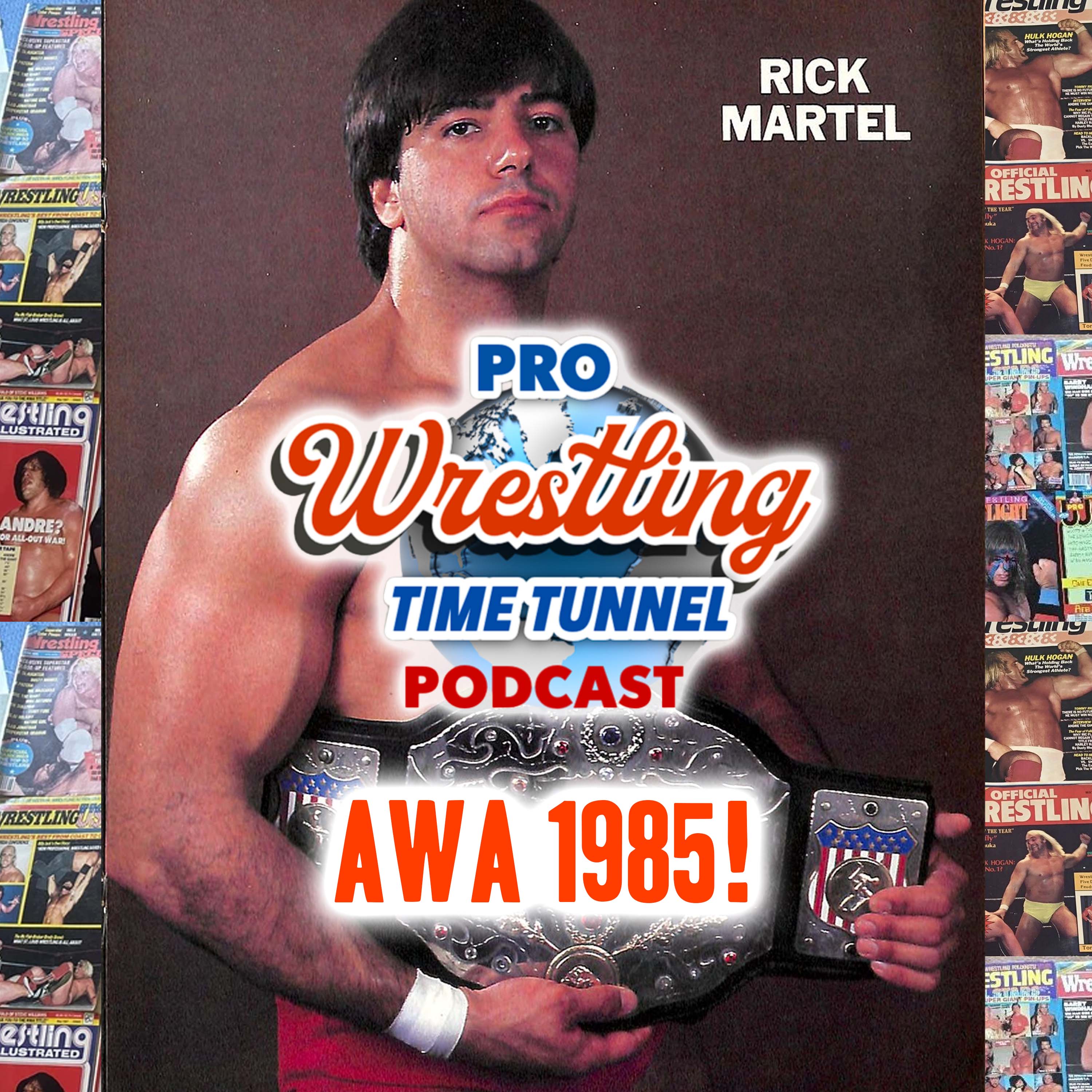
[00:23:29] Speaker B: Yeah. So we're kicking off 85. Rick Martell is the AWA world champion, and so a lot of the cards are built around him. And we still have the Road warriors as the tag champions. At the beginning of 89.
[00:23:45] Speaker A: Yep. Road warriors were still here.
Yeah. In fact, on the first January 13th card of 1985 in the St. Paul Civic Center. And I will point out to fans that the St. Paul Civic center for Pro Wrestling legitimately held 20,000 people as it was configured for wrestling.
According to the fire marshal, they probably got another, you know, one or two thousand in there at different times. But during the. The 80s, the very early 80s, up till this time, we were still drawing very close to that 20,000. That first card in St. Paul on January 13th, which would be coming up here on 40. 46 year. 41 years. Holy cow.
[00:24:35] Speaker B: Yeah.
[00:24:35] Speaker A: Martell defended the title to gorgeous Jimmy Garvin.
And we had Black Blackwell against King Kong Bundy, who was.
Or King Kong Brody. Sorry. Yeah, it was.
[00:24:50] Speaker B: Yeah.
[00:24:50] Speaker A: And then the Fabulous Ones went against the Road warriors because he was king.
[00:24:54] Speaker B: Kong in St. Louis and in the Awa. Right.
[00:24:57] Speaker A: Yeah. Well, they brought. Brody was in here and they called him Boom Boom Bundy, but King Kong. And you know, the story behind that, Verne did use him as Bruiser Brody, basically out of respect for Dick the Bruiser.
And that's a. That's a true story. Vernon Bruiser were friends for years. He wasn't going to bring another bruiser in.
That was simple.
[00:25:19] Speaker B: What do you think?
What.
What do you think about Jimmy Garvin as a single here?
Of course, he had been in that hot feud in World Class the year before with the Sunshine angle and all that stuff.
Yeah. And he wasn't tagging up. Was he tagging up with Regal yet, or was he just wrestling as a single at the beginning?
[00:25:41] Speaker A: He was wrestling as a single.
[00:25:42] Speaker B: Yeah. What do you think about him challenging Martell? I mean, that seems like those styles would go together.
[00:25:49] Speaker A: They went to. They went together really well. And the thing about Jimmy Garvin is that. Right mentioned World Class Championship wrestling before.
And I had seen Jimmy Garvin down there when he was with Sunshine. Originally, I liked him, and I had also seen him in Florida when I'd visited Tampa a few times. And he was still a baby face.
[00:26:09] Speaker B: Yeah.
[00:26:09] Speaker A: I saw him as a legitimate talent. Whether he was a baby, he was popular. But I think when he turned heel and got the gorgeous Jimmy gimmick going and the flapping of the hair, you know, and, you know, in the beard and everything and the strutting and the sequins that he wore, he was very colorful.
[00:26:29] Speaker B: Yes.
[00:26:30] Speaker A: And when he added precious to it, I thought he was. You know, we had put up with superstar Grahams and all kinds of characters over the years. And Jimmy Garvin, I thought he fit Jesse Ventura. I thought he was better than Jesse, actually.
[00:26:45] Speaker B: Of course, Jimmy broke in when he was just a teenager as a, as a Garvin brother with Terry.
[00:26:52] Speaker A: Yep, he did.
[00:26:53] Speaker B: And I mean way back, maybe early 70s or something.
[00:26:58] Speaker A: It was in the mid south area, I believe he was teamed up with Terry Garvin and Jimmy still had blonde.
[00:27:05] Speaker B: Hair and he was the kind of. He did the stick, he did the interviews for Ron and Terry. But I always kind of thought when he broke out in that heel character you were just talking about, he took a little bit of Terry and a little bit of Ronnie and kind of made Jimmy, you know what I mean? Because he wasn't, he wasn't really like that. He was a heel manager and he did the heel manager stuff at ringside, but he wasn't what he became as Jimmy Garvin. I always thought he took a combination of those three Garvin brothers and mixed them all together.
[00:27:39] Speaker A: Yeah.
And going against Rick Martel, that was a perfect match for the time period because Rick Martel was your basic real wrestler. Babyface Rick Martel, other than coming into the ring with a nice ring jacket on, he was. There was no more color to him. He was a wrestler and he was good and fans liked him for that. Which is the reason I, I know this is just a speculation, but I don't find it that it would be surprising. I think that's the reason Verne put the title on him. Because Vern, Verne liked him. He liked him to be like himself.
And Ricky was. That guy made a perfect opponent for the. You know, I'm not going to put the title and give the title up to this flamboyant clown Garvin, you know.
[00:28:21] Speaker B: Yeah. Well, in your opinion, where does Rick Martell rank as an AWA champion among all the AWA champions?
[00:28:31] Speaker A: Well, you know, that's a subjective.
[00:28:33] Speaker B: Yeah, I'm as asking George Shire.
[00:28:37] Speaker A: Definitely whether people liked it, you know, for whatever their reasoning for not wanting to admit it. Vern Gagne was, was the great.
I think Nick Bockwinkle is just equal to Vern. I think the two of them complemented the territory and the company so well for their respective reigns. And then I think just because of longevity, you throw Mad Dog in there for his three year run.
And then, you know, once you started getting into. I mean, if people say, well, Bill Miller was the greatest champion when he was Mr. M Mask. Mr. M.
No, you can't do that. He had the title for eight months.
And you know, Crusher had three runs, but they were all coffee breaks.
And so. Yeah.
[00:29:19] Speaker B: So he's in the top five then you think?
[00:29:21] Speaker A: Definitely after Nick.
I don't think you could ever count Jumbo Sharuda. Not because he wasn't a good worker and a good wrestler.
[00:29:29] Speaker B: He was.
[00:29:30] Speaker A: But because, because he had the title for two months or three months, whatever it was, without looking. Yeah. And you know, so all of the other AWA champions before Martell and after Martell. Martell would probably be after, in my book, Vern, Nick, Mad Dog and then Bock Winkle. Yeah. And Martell.
[00:29:52] Speaker B: Oh, wow. Well, I wanted to ask you that because I think he's extremely underrated.
[00:29:57] Speaker A: Absolutely. And you know, when you had Jerry Lawler in there for a while, the sad thing about Jerry Lawler is that he was a great worker. I loved his matches, I loved his Myth south stuff.
But to be honest with you, Tony, he didn't mesh with the Upper Midwest fan here. Yes, people did with try as they wanted to. They didn't, they didn't get him over.
[00:30:21] Speaker B: Yeah, I think that's a one way street, George. I think the, I think the guys who were up in the Upper Midwest worked well down south, but I don't think that street ran the other way if that.
[00:30:33] Speaker A: Right, right.
[00:30:35] Speaker B: I don't think, I don't think the Southern guys worked as well up that way.
[00:30:42] Speaker A: Yeah, definitely.
It just didn't work. He just didn't get over. And that's part of the reason too probably that him and Vern had the falling outs that they did.
[00:30:50] Speaker B: And, and quite honestly, I think that was probably a concern among the NWA championship committee when they considered him for the NWA title, that he was fantastic in the Tennessee territory, but was he going to be able to carry the ball outside of that? And you know, that that would be evidence there that maybe he couldn't have. And they knew that back back in.
[00:31:14] Speaker A: The day, you know, when you brought up who was the greatest AWA champions. You know, I think this would be a good time since we're talking 1985 and this is when Rick Martel had his year run or year and a half.
When I look at the, the possibilities for who Verne could have put the title on because he was, he was feeling the effects of Hulk Hogan leaving a year before and of course that the fans will never forgive him for it, that, you know, they should have put the title on him, etc. But I think if you looked at the roster, Rick Martel was the Best guy to be the AWA champion during that year or so run. It just, it was the perfect guy. Billy Robinson, if he'd have had an opportunity, was too old at that point.
All of the regular AWA guys were older. Crusher Hannig, Larry Hennig.
So, yeah, Rick Martel was the guy. And he didn't have the charisma that Ric Flair and Hulk Hogan had and the two opposing, bigger alliances.
But certainly I think Verne held true to wanting to have wrestling first.
He just believed that in the end it might have been his downfall. I don't know. But, yeah, well, Martell was the guy.
[00:32:44] Speaker B: It's worth noting, I thought, I thought at the time, with Vern wanting to compete beyond the scope of the, what we considered the AWA territory, I thought having Martell as the champion was the best option at the time because I just thought he was a young, good looking guy who could work and he could wrestle. And Verne was going further and further west and I thought he, Martell would work well out west as a champion out in the more glitzy California area, thought, oh, this guy's the champ, you know, we kind of like him, you know.
[00:33:24] Speaker A: Yeah, well, you know, and here's a compliment that you get, you know, our buddy Nick Blackwinkle, he would, he would always be square. When I would ask him about certain wrestlers, you know, what, how was this guy to work with? Or what did you think about this guy? And Nick would always say, if the guy was the pits to work for, Nick usually said, yeah, he, I couldn't, you know, if I had to wrestle him every night, I had to quit the business.
[00:33:49] Speaker B: Right?
[00:33:49] Speaker A: But then there were those guys that he'd get in the ring with and he'd say, you know what, Like Greg Gagne, he gets a lot. Greg takes so much heat. But he was such a good worker. It just was his size thing and the fact that he was daddy's kid, Vern's kid.
[00:34:06] Speaker B: Yes.
[00:34:06] Speaker A: And. But our Nick told me, he said, greg Gaga, I would wrestle the guy every night. It was a night off for me.
Now, that's a compliment that wrestling fans need to know that when a wrestler says that about another wrestler in a match, a night off, that's the highest compliment they can give. He said that about Rick Martel. He said, I enjoyed and I enjoyed being in the ring with Ricky, was his exact words.
[00:34:31] Speaker B: That's a wrestler's wrestler compliment.
[00:34:34] Speaker A: Yep. And you know, Nick was a wrestler Nick loved. I mean, he was never your true rule breaker. Like, you know, The Mad Dogs and the Sheiks and the rest of these guys.
Nick wrestled, but he was rough, and he'd do the stuff behind the referee's back, you know, I mean, he was.
[00:34:51] Speaker B: A wrestler, but so did Tez.
[00:34:54] Speaker A: Oh, yeah, but that was an NWA formula, too.
[00:34:57] Speaker B: Yeah, yeah, yeah. I mean, but as far as a world champion being a baby face or a heel, I mean, Lou worked both ends of that, too, and got away with it, and so did Nick. Let's talk about the Road Warriors. So what was the Road warriors status in 85, and what did you think about their programs and who they were working with?
[00:35:21] Speaker A: Well, again, this comes in personal opinion. First of all, I'm going to say that I think the Road warriors were, in hindsight, the biggest thing that happened for wrestling on a tag team division, as Hulk Hogan was to the singles division. That would be my In Hindsight synopsis. But at the time, I'm a tag team guy. I've always loved tag teams, and I did not like the Road warriors at all. I just didn't. I understood what they were doing. I understood their stick, I understood their gimmick to go flying into the ring to their theme music, entrance music, and just come in and throw bodies out of the ring and no introductions. And the fans loved it. They bought it. So when you're a promoter, Tony, you know, this is selling tickets. Okay, that's perfect.
[00:36:12] Speaker B: Yeah.
[00:36:12] Speaker A: And this is exactly what they did. But they weren't my, by any means, a favorite tag team. I didn't like the way they didn't sell for a lot of teams.
And Larry Hennig told the story one time. He said, you know, this was a time when Larry and Kurt, his son, got into the ring with the Road warriors.
And Kurt was still in his rookie years there, but he'd starting. He was starting to become what we could recognize to be later the Mr. Perfect character. But Larry got in there and he said, you know, I told him right up front, don't be taking any shots with my boy, you know, and I. And I'm not going to sell your power moves and all this stuff. You know, we're going to have a nice match here. Larry said that because Larry wanted to always give the fans their money's worth. And he understood. Going back and forth, you have your time, I have my time, and however the finish works, we'll go from there. But the Road warriors didn't want to work with Larry either.
And Larry said, I basically told Vern, tell him to go to hell. I don't Want to work with him.
They had some matches, but Larry wasn't happy about it.
So that's coming from. From another guy who had a perspective.
[00:37:24] Speaker B: At the beginning of the year, something that affected a lot of territory owners was Eddie Graham. Suicide. Did Vern.
[00:37:34] Speaker A: Oh, yeah.
[00:37:34] Speaker B: Did Vern have much of a relationship with Eddie at all?
[00:37:39] Speaker A: Oh, yeah.
Eddie Graham and Vern Gagne of the promoters around the country. Well, Vern had a. Seriously, let's be honest, Vern had a good relationship with basically all the promoters. You name the big territory, he was on good terms with him. But with Eddie, if you look at over the years, the number of wrestlers that Verne trained brought into the business many of those wrestlers.
Vern would contact Eddie Graham and he'd say, you know, I got this young kid up here. I mean, Vern would put out. In the 70s, he was putting out three, four, five rookies at a time from his camps. And ideally, those rookies were on our cards locally. But eventually Verne's got to do something with them, and you can't put them all into the main events right away.
So Eddie was one of the guys where Vern would say, I got this guy, I got this kid, and can you work with him? And the blessing to that is the blessing of the territorial system in and of itself, because when you work in different territories, you're working against different talent, you're picking up on different ideas to promote angles and seeing how wrestlers work.
So one guy in particular, and most fans will recognize this, Dick Blood, he came out of vern's camp in 1975, and Dick Blood was huge. He was. He was a great worker, but he didn't like being up here in the cold weather. That was part of it. And Dick Blood, for the fans that don't know, became Ricky Steamboat. And when he sent him down to. It was that exact conversation, he called up Eddie. So I got this kid.
Can you. Will you use him?
And Eddie took him down there and he basically gave him the name Ricky Steamboat because he felt at the time that he could have some lineage to Sam Steamboat.
[00:39:36] Speaker B: Yes. Of a previous era, had been Eddie's tag team partner.
[00:39:41] Speaker A: Yes. And I believe at one point they said they were cousins or it was his son. I don't know, I don't remember. But there was a lineage. But that's where Ricky Steamboat came from. From. And Ricky Steamboat, I don't think we have to ever say that he wasn't one of the best workers in the business.
His matches against Ric Flair were phenomenal.
[00:40:02] Speaker B: Yes.
What about. I mean, I think fans, when they think about that mid-80s and they think about talent, they think about all the talent that goes to the wwf.
But actually you had a major star leave the WWF and come to the AWA in Sergeant Slaughter.
What was the feeling about the Sarge coming to the awa?
[00:40:28] Speaker A: Well, he didn't really. Didn't really come to the AWA because he had been in the AWA previously and Vern, of course, trained him for the business. Back in 74, he was Bob Remus.
[00:40:40] Speaker B: Big that one of those big classes where all the stars came out.
[00:40:43] Speaker A: Yep. Bob Remus came out of the class and he wrestled for Verne for a short time as Remus. He went around the horn he used.
He was using the Slaughter name for a while. Bob Slaughter. He wrestled as Bruiser Bob Slaughter.
Then he became DI Slaughter drill instructor. That was the first thing. And then, yes, he was our Super Destroyer here.
[00:41:08] Speaker B: Mark 2.
[00:41:10] Speaker A: Mark 2. And that was an emergency situation when Vern and Don Jardine, who was our Super Destroyer, he.
He had up and left over a dispute on the mask thing when to unmask and Vern put a call in, he said, bob, I need you. Bob was in Kansas. Remus, he was in Kansas City at the time. And he said, I need you to get up here and you know, you're in the Mark 2. And he'd hooked him up with Lord Alfred Hayes, which was perfect because Hayes was hated and a great manager and a great wrestler in his own right.
So that's where Super Destroyer came in. Then he left after he was unmasked and had his run. And yes, he went to Vince.
He had some great matches out there with Pat Patterson, by the way.
But when, when he came back, the fans took to him right away because they. Now, this was already the time, Tony, when the fans now were cognizant of these wars going on and these wrestlers floating around. And like you said, television, we were access to so much.
So it was. It was like the returning hero or.
Although I will tell you, a lot of fans didn't know that he had been Super Destroyer Mark 2 at that point.
[00:42:26] Speaker B: Right.
[00:42:26] Speaker A: So you'd say that to somebody, they'll go, no, really? Oh my gosh. You know. But.
[00:42:32] Speaker B: But they came, they put it over huge. They put. They put him with Bisco. Right?
[00:42:38] Speaker A: Yeah, yeah, well. And they even created the America's title because of the Sergeant Slaughter thing. And. And that previously it had that contract with GI Joe.
So yeah, he. He. Vern actually created the Americas, I think they called it the America's title.
[00:42:56] Speaker B: That sounds.
That sounds right.
Yeah. So, I mean, so again, I just want to get across to fans. In 1985, all of these territories are pretty much still strong, and the AWA might have been one of the top strongest ones still here in. In 85. And so much so that Verne was going into some places. You and I talked a little bit before we went on the air here, but he. He's now running in Indianapolis. He's running some shows down there, and he's also.
He has already by this time expanded into San Francisco.
He's running in Salt Lake City, and he's also runs in 1985 in Los Angeles, a show or two. It seemed like in 85, the big dogs were fighting over LA. Crockett was in there, Vince was in there, Verne was in there. Everybody wanted the second biggest market in the country.
And so what was Vern's mentality during this time?
He was not, it seems like traditional strategy thinking would be, I'm going to. I'm going to fortify my home base and I'm. I'm going to just sit right here and. And I'm going to pick off anybody that tries to come in, which he did. I'm not going to expose myself by stretching out too far. But it seemed like he was going on the offense a little bit here.
[00:44:22] Speaker A: Part of the mindset, Tony, was that exactly what you say you think he would have said, I'm going to take care of Minneapolis and the cities that I've already got under my belt. But Verne's logic was, is that Vince is trying to go national with my guys would be his logic. And I am going to attempt to also be as open to these other cities as I can be, and I will continue to use the best talent that I can come up with.
I'm going to backtrack just one second, because we talked about that first main event for January 13th of 85. And I looked at the card, and I looked at the card a week later, two weeks later that McMahon came in with.
He had 16 guys on his card, and 11 of them were AWA wrestlers.
And this is a year former AWA wrestlers. He had Ken Patera, John Stud, Jack Mulligan, Andre, Tony Atlas, Tito Santana, Ivan Putsky, the spoiler, who was Don Jardine as Super Destroyer in Burns territory. He had Renee Goulet on the card and Don Morocco.
Holy cow.
[00:45:40] Speaker B: It's an AWA card in Indianapolis. You know, Bruiser was down to running his shows in A local nightclub. I mean, I mean, he was just a breath away from just being done.
So I think Vern maybe just thought, hey, Indianapolis fits in with exactly what we've always done. We've always run all around there. Why not just go in there and try to try to secure Indianapolis also?
[00:46:11] Speaker A: Well, and you know, the thing is at that point, like you said, Bruisers was on life support by then, big time. And it was a smaller Terry territory. You got to remember that Vernon Bruiser had been friends Ben partners in Chicago, co promoters in Chicago for a couple decades at that point.
And I'm sure Bruiser had no problems with Verne coming in as he did and putting on a card. I would point out that Vern actually had a connection with Indianapolis even as far back as before Bruiser and Snyder took it over in 64 with Vern. Actually had a connection in there with Barnett.
[00:46:48] Speaker B: Yes.
[00:46:48] Speaker A: And they even shared AWA World Tag Champs. What do you think when the Nielsen brothers were our champions, they were also Barnett's champions in Indianapolis.
[00:46:59] Speaker B: What do you think Verne's mentality would have been about Detroit?
[00:47:02] Speaker A: Who.
[00:47:03] Speaker B: Because Detroit was also kind of up for grabs because the chic was pretty much out of business at that point.
Maybe run a spot show here and there, but Crockett, wwf. And did Verne try to run Detroit as well? I didn't have a chance to look.
[00:47:20] Speaker A: No, not that I can recall. And I don't think it was ever a thought process with him. I know years years earlier, Verne had appeared on some of the rival promotion. It was Bruiser that was running against Sheik way back when in Detroit.
[00:47:37] Speaker B: Right.
[00:47:37] Speaker A: And Verne had appeared on those cards.
You know, the one thing about these old school promoters, whenever there was a somebody jumped over their fence to try and take over their talent or their territory, a lot of these old promoters would put out the phone call and get all their old buddies to come in and appear on the cards to help make it bigger and better than fans would normally see. And that that was another time where I don't think Vern ever thought about Detroit at that point.
[00:48:06] Speaker B: You know, I failed to mention this earlier when Brody came up, but he was involved in a feud with the Crusher, Jerry Blackwell, and was working all the big towns in January. And then he just left.
He just walked out and took off.
[00:48:26] Speaker A: You're talking about Brody. Yeah, Brody. You know that we don't even have to expound too much on that because that was Brody's mo.
The thing with Vern and Brody is Vern, like most promoters, they would be happy to have him on the card, because if they mentioned King Kong, Brody, Bruce, or Brody, whatever they were billing him as, he had a world reputation.
Fans wanted to see him. He definitely produced. When he was on a card, he was a draw. But the thing with Verne is Brody did it at least twice where before he went out to do his match on a card, he got to Vern and said, I want more money, and I don't care what business you're in.
You know, I spent years in the banking business, and I would dare to say I never went to my bosses and said, before I went to work, one day, before I go out there, I want. I want a raise. I want more money.
[00:49:27] Speaker B: Right.
[00:49:28] Speaker A: That's something you do behind closed doors. You negotiated. You don't hold them up. And that's where Vern and Brody had their problem.
[00:49:36] Speaker B: Yeah.
[00:49:37] Speaker A: And so Brody. Verne didn't care if he said, no, we. This is what we agreed on. You're going to go with it and we'll talk later. No, Brody bounces out. So.
[00:49:47] Speaker B: And Brody is a huge name and all, like we said. But we also said the roster is packed.
So I'm not sure it really mattered that much at that point that he took off, because Sergeant Slaughter came in, plus all the other great talent that was already on the card. But I want to jump ahead to springtime, because in 1985, it's the first WrestleMania for WWF, and Vern runs a show in Chicago on the night of WrestleMania. And of course, Vince wanting to get WrestleMania out there on closed circuit and make some money in all these other towns, but Verne runs a show in Chicago on The Night of WrestleMania and draws 9,600 to his live show.
And then a couple weeks later, on April 27th and 28th, the AWA and the WWF both had a day within each other in Chicago, and the AWA drew 15,000, while the WWF drew 2700.
Yeah, so, I mean, that's what Vern. That goes back to my point earlier. You know, Vern's cities that were his stronghold, he still had a strong grip on those at this point.
[00:51:01] Speaker A: Yeah, yeah.
[00:51:03] Speaker B: Beyond Minneapolis, I mean, you know, people I think would just take for granted. Well, of course, he had Minneapolis, but he also held Chicago. He also held Denver. He also held Salt Lake City. I mean, he still had strong grips on those towns.
[00:51:18] Speaker A: And he had Winnipeg. Yes, Winnipeg, which was a big city.
[00:51:22] Speaker B: He even did some television tapings in Winnipeg.
[00:51:25] Speaker A: Yeah. And sometimes that's something we should Note that I had said earlier that generally speaking, all of the angles and storylines were the same around the circuit.
There were some times in 85 and 86 when Winnipeg was actually doing it a little bit different with a couple of things. For example, how they turned Nick Bockwinkle Babyface. That was one of them. Winnipeg had a different version of how it happened than what we saw in the awa. We had Larry Zabisco enter the ring and attack Nick during a match that turned Nick baby. And they did it up in Winnipeg.
I think it was the Russian thing. The.
Was it Boris Zhukov and Chris Markoff or something? And they turned Nick baby somehow through that.
I won't deny to you that there were times by 1985 that I was starting to become just personally a little disgruntled with all of the wrestling.
Not that I quit being a fan, because I continued to watch faithfully until about 1993.
And then for the next six years I was in and out. And I loved the later 90s when they had the WCW, WWF Monday night clashes.
But Vern had a card. You mentioned the Chicago card.
[00:52:52] Speaker B: Yeah.
[00:52:52] Speaker A: Vern had a card in Chicago on September 28th of 1985 and he had 1, 2, 3, 4, 5, 6, 7, 8, 9, 10, 11, 12, 13 matches.
And as I looked through the lineup, there was not a.
There was not a ringer on the card.
Everybody was a solid star. Martell against Hansen, Flair against Magnum, Ta.
It was a combo thing. The Road warriors against the Freebirds.
That was teamed with Ellering because he was in there. Jerry Blackwell, Kamala was on the card. You talk about bringing in some other talent. Kerry Von Erich against Jimmy Garvin.
He had a ladies match on the card. Sherry Martell, Candy Divine had Jumbo Sharuda and Baba against.
Oh, here we go. Baba, Sharuda and Tenaru were against Harley Race on the Long Riders.
[00:53:56] Speaker B: Oh, my gosh, that would have been wow match.
[00:53:59] Speaker A: And then he had another six man match. Greg Gagne, Kurt Hennig and a mystery partner.
And that turned out to be big. Scott hall against Bockwinkle Stevens and Zabisco. And then they had Mil Masqueras against Buddy Roberts, Freebird.
[00:54:16] Speaker B: Mm.
[00:54:16] Speaker A: And Light Heavyweight Champion Steve Riegel against Brad Rangan.
What the heck is wrong with that lineup? Nothing. Nothing.
[00:54:27] Speaker B: That could have been. That could have been a pay per view, you know.
[00:54:30] Speaker A: Yes. And it was the White Sox Night of champions Super Clash 85. For those fans that want to look that up.
[00:54:38] Speaker B: That's amazing. Now, in the end, in the NWA at this time, Crockett is controlling the title. And before the champion could be booked out to all the territories and there were still some remaining members of the National Wrestling Alliance. But Crockett's deal was that he would send Flair out with half a card for 50% of the gate.
Is that the same deal he had with Verne, or do you know?
[00:55:08] Speaker A: I don't know, but I'm going to say this. I don't think Verne would have went for it.
[00:55:14] Speaker B: Vern, for that. For those cards. Let me ask you this. For those cards that they were working together, you just mentioned one.
For those cards that was mixed and one of those deals, what would the deal have been? Do you know?
[00:55:30] Speaker A: I'm going to guess that Verne would have wanted to.
He would have never went with Crockett's deal with Flair. Just wouldn't have been. He would have been throwing out that. I'm the reason Ric Flair is even in the business. And Byrne wasn't afraid to boast that. And, you know, Flair was probably saying, you know, you owe me a favor, and. And so on and so forth, and this will be the pay. I just don't think that Crockett would have gotten through with that.
[00:55:52] Speaker B: I always thought that Flair and Dusty, who was, you know, Crockett's number two guy at this point as far as running the company. I always thought Flair and Dusty both respected Vern quite a bit because of their previous relationship.
[00:56:06] Speaker A: Well, they did. I don't think Dusty and Verne ever had. When. When you look at 1984, go back a year to June, that was the night that the Jerry Blackwell Baby Face turn took place in June of 84, out of the Battle Royal, when the Sheik. Casey. And Not Casey, and King Kong Brody.
And who was. Who's the other guy? Oh, good Lord.
Abdullah the Butcher, They. They all attacked Jerry Blackwell in the Battle Royal because Jerry was part of their team and they attacked him. Jerry ended up winning the Royal. Verne had Dusty Rhodes in that night, and Dusty was the one that was at ringside getting the fans to cheer. Jerry. Jerry. Jerry.
So they had. They had a good relationship.
[00:56:57] Speaker B: Yeah. And. And these combo cards, like the one you just named, that was pretty. Prior to the Pro Wrestling USA deal, right. That didn't happen until later in 85, right?
[00:57:08] Speaker A: Yeah, that was later. 86 or 87. You know, one of the things that you had mentioned earlier to Tony, it's funny how we think backwards. You had mentioned Eddie Graham.
Verne had that good relationship with him, as I said, and Vern would. A lot of Vern's AWA guys would take a two week or a three week vacation from the AWA in the winter months and head down to Florida. Sometimes it could be a month. And they would wrestle on Eddie's cards. And if you look at Eddie's cards, during our winters, you see guys like Hennig and Bachwinkle and Stevens and Brunzell and Greg and Bob Orton Jr. I mean, all of these guys would go down there and work for Eddie, get a payday while they're on vacation.
[00:57:56] Speaker B: What, what was the television situation here in 1985 with the AWA? What, what were they doing TV wise?
[00:58:05] Speaker A: Actually, it was, if anything started to become the downfall of Verne, that was probably it.
The tv, we started having it preempted for different programs and then it got to the point where it wouldn't be shown for a week at all, you know, and the fans were lost as to where All Star Wrestling was.
[00:58:25] Speaker B: So did they just. Were they just running ESPN at this point or were they still running other stations?
[00:58:31] Speaker A: ESPN was later, I think 87. Ish.
[00:58:34] Speaker B: Okay, so they're.
[00:58:34] Speaker A: Yeah, yeah.
[00:58:35] Speaker B: Oh, yeah, they're still, they're still sending tapes out then.
[00:58:38] Speaker A: Yeah, this is still. This is still 87, 85, 86 is when. That was before ESPN.
[00:58:45] Speaker B: Okay, so they're still sending out the All Star Wrestling show or the championship wrestling. I can't remember exactly what it's called.
[00:58:52] Speaker A: But it was All Star Wrestling.
Vern would tape usually two, three, four weeks, usually three or four weeks worth, and send him out, which was the reason he got into trouble with the Hulk Hogan thing a year earlier, because they had like four weeks of tapes that went around the horn for their local television in whatever city it was going to be at. And they're advertising Hogan in a particular match or situation and. And then Hogan comes back and says, I'm not coming back.
Right or wrong, it changed the course.
[00:59:25] Speaker B: So on the television stations that they were running on their network of television stations, they were getting preempted on several of those stations then.
[00:59:35] Speaker A: Yeah, yeah. And then there was a time, and I don't know the exact date, Tony, it was, it was closer to the 87, around the ESPN time.
But that's basically when Vince McMahon had bought up all the TV time and paid stations to not put Verne's show on.
[00:59:56] Speaker B: I know it. You know, I know at one point that when they did get on espn, they got packaged in with roller derby. Do you remember that?
[01:00:05] Speaker A: Yeah, yeah.
I didn't like that.
And it probably didn't set well with Vern because people don't realize how much he tried to keep his wrestling wrestling and not, you know, he hated having clowns and characters on his card. He had some, obviously through the decades, but he just, he tried so hard to make it against two wrestlers.
If one wrestler had to be a little more colorful, you know, like the Jimmy Carvin type, that was okay with him. But he knew Jimmy Garvin could work.
[01:00:39] Speaker B: Yeah, I, I think that was toward the end of the year, now that I'm thinking about it, when I first noticed the roller derby deal and it being on espn. What, What?
What, What? Yeah, what that. I mean, yeah, because the AWA television had always been. And we don't have much of proof of that because a lot of the tape doesn't exist anymore, but it had always been highly respected as a high quality wrestling program.
Where did the, where did it start to go sideways? Like, was that a deal between Vern and, and Carbo where they just weren't paying attention or they have a booker in there? That, that. Where it went sideways. How did that happen?
[01:01:29] Speaker A: What you need to do when you're looking at the whole television setup is for Most of the 60s, 1960s All Star Wrestling, as it was called. And again, we'll do it locally because this is where the tapes came out of in the Twin Cities. It was taped a lot of times live, if there were live wrestling cards that night in one of the two cities.
But otherwise, if it was the week after that live card, you'd get some taped matches on the card and they'd have interviews that were inserted from a week earlier that were taped for an upcoming card. But the wrestling was always on TV religiously on Saturday night at 6pm and in the 60s, into the very early 70s, it was going until 7:36 to 7:30.
It was a perfect setup because, and I. I wish I had the TV Guide to prove this to you. There was one of these Nielsen rating things or whatever they do where they tell you, you know, which program had the most viewership. That was in the Pro. It was in the TV Guide. We had. What we called here was called, I think it was TV Weekly, local TV Guide. And they promoted that All Star Wrestling on Saturday night had the highest viewership of any other of the three major stations we had because we only had four TV stations back in those days and people were glued to their TV set. What happened into the 70s is they moved in the middle 70s to, of all things and this was the station that did this, the TV station. They moved it to a 2 o' clock in the afternoon on a Saturday.
Now that is where some of that started because now everybody that's turning on the TV at 6:00pm there's no wrestling.
And at 2:00 clock in the Saturday afternoon, you know, people aren't watching TV. I don't, they don't watch it today.
You know, you're out busy doing your, doing your work as a parent or whatever you're doing. And so it started to get lost for about a year there. And then they were putting it on at 3:30 and then it was on at 7:00 clock at night and then it would get preempted and in the middle 70s, holy cow. I never knew when it was on. One time it was on a couple of weeks at midnight. So it was.
[01:03:55] Speaker B: And in those days, that's death for a wrestling show.
[01:03:58] Speaker A: It's. It's death, it's death. There were times when literally we had me and I was in the know at the time, I had no idea what time the show was going to.
[01:04:07] Speaker B: Air and, and for modern fans it might be hard to understand because we, we live in a time where you, it's easy to tape everything and everything gets your fingertips and you can watch it anytime you want to on tape delay or on recording or. We didn't have any of that stuff. And back in the day that George and I came up as wrestling fans, you planned your week around the wrestling show. You're like, wrestling show is going to be on this day. And at this time, don't schedule me for anything, I'm not going to anything. I'm going to watch the wrestling show and we'll go from there as far as my schedule. But when, I mean, promoters knew that when that, I mean, they even hated it when they had to change stations.
If you were on Saturday at noon on Channel 3 and for whatever reason you had to move to channel 12 and you were still on at the same time, they still hated that because it's like, oh my gosh, our fans aren't going to want to know. They run newspaper ads. Hey, we're going to be moving stations and. Because that's how important it was back then.
[01:05:14] Speaker A: Well, one of the things that happened, you know, after that brief time in the later 70s when wrestling all Star Wrestling was all over the place and sometimes not at all. As we got to the end of the 70s, into the early 80s, Vernon picked up a deal with one of our local TV Stations where All Star Wrestling was going to be aired on Sunday mornings.
Now, you talk about people altering their plans, changing their plans. You know, wrestling's on. I guarantee you there were people that worked their church. If they were going to church, they worked it around All Star Wrestling, or they didn't go to church at all. They went to Saint Wrestling.
[01:05:52] Speaker B: You can't imagine how many people, when VCRs came in.
Yes, when people would get home from church or they would get home from their activity, and they had set their VCR to record the wrestling show, but when they push play, some other show was on there. Oh, my gosh, that was. Yeah, that was a mad, angry fit. I mean, because you could only set your VCR to one thing, right?
[01:06:17] Speaker A: Well, and so in the 80s, when wrestling locked into that 10, that 10 o' clock in the morning on Sunday's time slot and it was there for most of the next.
Pretty much close to most of the 80s until the ESPN thing and stuff like that started to come around, or 86.
But it was religion on Sunday morning and people watched it. And what happened was, is when Vince invaded the awa, fans could tune into AWA wrestling on Sunday morning. And if they turned on the TV on Saturday night on the very station they used to watch All Star Wrestling, six o', clock, it was WWF wrestling.
That's where the confusion came in. It's like, what is going on here?
[01:07:04] Speaker B: I'm going to run down just a couple of the TV taping locations in 85. There were several that were done in East Rutherford, N.J. and most time when you think about that, you think, oh, that was the combination deal. But this is just the AWA in 85. They're. They're taping just their show with their wrestlers in East Rutherford. There were several that took place in Winnipeg, several TV tapings there.
There were some that took place in.
Let's see, I had some more here.
Winnipeg.
[01:07:43] Speaker A: Really? Later you had Rochester, which was the death toll.
[01:07:46] Speaker B: Yeah, Waukegan. There was a taping in Waukegan. There was a taping in Hammond, Indiana.
There was a taping in Atlantic City.
[01:07:54] Speaker A: We.
[01:07:55] Speaker B: We brought that up earlier.
And that. That's pretty much it. So there's not as many as I thought. Most of them took place in East Rutherford and Winnipeg, I guess.
[01:08:04] Speaker A: You know where. I think Verne made his mistake starting in 90 in 1985 and going forward.
And again, this is some opinion, but I think if you look at it, you can kind of agree.
I think he made his mistake when he Started actually going into Vince McMahon's towns, trying to go opposition to him.
I think if he, Verne, would have been better off if he would have stayed in his main AWA cities, went to Indiana, if he wanted to try going out to California like he did. But I think when he started to try to go head to head with Vince in that east coast stronghold, that I think was where it got.
[01:08:45] Speaker B: That is where most of the remaining territories made their mistake.
Instead of drawing a line around, you know, don't I dare you to cross this line and just hunkering down and taking care of the fans that had been loyal to them for decades, they went out and did their TV tapings in other places and tried to go to other towns and left their hometown fans wondering, what the heck is this that I'm watching? You know what I mean?
[01:09:13] Speaker A: And here's something to keep in mind. In 1985, many the Twin Cities, they ran 13 wrestling cards.
So you have 12 months. They were pretty much on their monthly schedule like they'd always been for the last few years. Yeah, when, when they started going monthly. And then you looked at what Vince did coming in. Now, this is a year after taking Hogan. Vince was here six times.
So 13 cards for Vern, six for.
For Vince, and each of those cards, Vern was still holding his own. Attendance wise, Vince was using mostly former AWA wrestlers to come in with. I pointed that out on that one card and I looked at a few others that year, that the same year, and we had AWA former AWA guys.
So Vince was good at doing that, but his main process was is I'm going to take their big names and then, yeah, I might run a show there, but I'm not going to try to take over their city because they'll self destruct. That's it. That was his mindset, right?
[01:10:18] Speaker B: Well, and you look at, you look.
[01:10:20] Speaker A: At Verne when he had the Long Riders, when he had the Mongolian Stomper, when he had King Tonga, who later became Haku and Meng.
Vern had all these guys that kept coming through and he held his own until.
If you really want to say where it started to break down was right about 87 and going forward. And then it got sad. Got very sad. It was like attending a funeral.
[01:10:46] Speaker B: Couple things I want to hit before we head toward the house is the Free Birds are here. They're working in AWA and Tennessee, and they're working with the Road Warriors. What did you think about that program?
[01:11:00] Speaker A: I thought it was a very good program.
I enjoyed It. Because it technically was always three on three, so to speak. Because Ellering would get into it with the Road warriors because he was still a wrestler, even though he wasn't wrestling much.
[01:11:15] Speaker B: I talked about the Road warriors earlier about not selling. Did they sell for the Free Birds?
[01:11:21] Speaker A: Not that I can recall. But the rope. But the Freebirds. Gordy. Gordy did great.
[01:11:27] Speaker B: Gordy was the equalizer, right?
[01:11:29] Speaker A: Yeah. Gordy, I remember him picking up.
It was Animal picked him up and threw him across the ring. And that was good. You know, I pointed out in the past that one of the greatest genius moves was when Verne took the title, the tag team title, off of the Road warriors, which I've always believed, and I'll carry it to my grave, he should have never put it on the Road warriors because they would have made such great challengers because they're going to kick ass anyway.
[01:11:59] Speaker B: Yeah. And that's where I think Dusty did do a good job booking them because he never gave him a title for three years.
[01:12:06] Speaker A: Right?
[01:12:06] Speaker B: He didn't.
[01:12:09] Speaker A: Yep. And so when Verne gives them the title, yeah, they were popular. But the first question on my mind is, how is anybody beating them going to be believable?
[01:12:20] Speaker B: Correct.
[01:12:21] Speaker A: And that's what you need to do with a champion. You need to have them vulnerable. You need to have them look like they can be beat. And that's why some of these world Champions were good, because they could put that across.
[01:12:32] Speaker B: Right.
[01:12:33] Speaker A: So with the Free Birds, the night. And of course, they were all leaving anyway, it didn't matter. It had come to the point where they were all going to leave the awa. Well, took the title.
[01:12:43] Speaker B: Michael got that. Michael. I was. Sorry. I was just gonna say Michael got opportunity to book Florida after Eddie Graham passed away. So he was going to go down there and do that. And Terry was making good money in Japan, I think.
[01:12:57] Speaker A: But when they had the Free Birds interfere, all three of them, that night in St. Paul, they interfered in the match with the Road warriors against Jimmy Garvin and Regal, Steve Regal, and, you know, the most unlikely team in the world to ever say they could be world champions, Garvin and Regal. But they made it believable because you had it five against two.
And the Road warriors got beat by five guys that night.
[01:13:23] Speaker B: And flash forward 40 years, we would be remiss if we didn't mention the passing of Steve Regal this past year.
[01:13:30] Speaker A: That was sad. And it went under the radar for so long. That's kind of confusing to me.
[01:13:35] Speaker B: It did. And I always thought he was A fantastic performer.
[01:13:39] Speaker A: Absolutely. You know, that was one of those things that's kind of like same as Greg Gagne, Tony. I always loved Steve Riegel's work. I think he had a good, solid wrestling background and he was colorful, but he wasn't big. And that was the thing that fans, for some reason, they just always wanted big, big, big.
But with Regal or with Jimmy Garvin, he made a good partner. And then Jesse took him as a partner for a while at one point and you know, they, they made a good team too.
[01:14:10] Speaker B: We mentioned that massive September 28th Comiskey park superclass show, which was really, I mean, gosh, that's Vern flexing his muscles, man. And he's still, you know, still looking strong at this point. And you know, you know, Vince, he's on top of things. He's got a great team in the WWF around him. On the management side, they're looking at all these attendances and all these drawing from not only their own stuff, but they're also looking at what they consider to be competition. And you know, they looking at that Comiskey park show going, man. Vern is still got Chicago and they do get into Chicago and do better before the year's over because they run a show at the Rosemont Horizon.
[01:14:58] Speaker A: Correct.
But I was going to say that looking at St Paul on December 25th of 85, which we always had in those days, a Christmas type card around the Christmas time. This was on Christmas Day and here was your, here was your card here and you talk about great.
This was Martel defending to Stan Hansen.
The Road warriors against Garvin and Regal. Bockwinkle against Larry Zabisco. That's when Nick had turned baby and they had a special referee, Scott Ledoux the boxer there. They had a, a six man tag.
Scott Hall, Kurt Hennig and Jerry Blackwell oddball team against the Stomper. That's Archie Goldie the Barbarian and Boris Zhukov and they were managed by Sheikh AC at that point. We had a ladies match, Sherry Martell against Debbie Combs. He had a midget card on there. I think I explained to you once before that Vern liked to have the midgets on the card at the holiday and he'd actually have them at the house for Christmas for dinner or Thanksgiving dinner when he did that.
[01:16:13] Speaker B: I would watch a, I would watch either a Sherri Martell and Debbie Combs match any day of the week and I would watch a Sherry Martell and Candy Devine match any day of the week.
[01:16:24] Speaker A: We watched Them, and they were good. And she is another story for ladies wrestling, how she definitely was one of those new stars. We had Baron against Hogger, Hog Irwin, Scott Hog Irwin, Kevin Kelly, who later on became Nails, et cetera. He was on the card against Wild Bill.
And Marty Jannetti was against Kelly Kinisky, or wait, this was Nick Kinisky on this one.
[01:16:52] Speaker B: Another little anomaly or blip on the radar to kind of show vern and the AWA strength outside of the home territory. August 27th of 85, they ran a special benefit show in Boston for the Muscular Dystrophy association and raised $50,000.
And not only that, but they got a 10 rating and a 17 share on television with that. That show.
[01:17:20] Speaker A: And what was the date of that one? Did you.
[01:17:21] Speaker B: August, August 27, 1985, the fundraiser show in Boston, which was very, very successful outside the normal AWA boundaries. So go ahead.
[01:17:36] Speaker A: Contrary to what we said just a minute ago, that was in basically WWF territory.
[01:17:41] Speaker B: Yeah, right.
So we're headed into the end of the year and we got to talk about the title change. We talked about what a great champion we thought Rick Martel was.
So what do you. What was the reasoning and the mindset going to a heel, going to a cowboy, going to Stan Hansen as the champion at the end of 85 there?
[01:18:04] Speaker A: The basic mindset, Tony, was that Verne still at this point, he constantly had relatively a revolving door of guys. You know, when you say Mongolian Stomper and some of these guys that come through, and as soon as they'd come in, he'd lose them. Either Vince would take them or the guys would get an offer for somebody else. And it got to the point where he felt to compete with Hogan, to compete with Flair, that he needed to come up with a name wrestler.
And you got to realize that as far as name value, Hogan, Flair, other than Brody Hansen, name anybody that's a bigger name than those four at that particular time. And that's not discounting all the great things we said about Rick Martell earlier.
[01:18:52] Speaker B: Well, Hanson's in his 11th, he's in his 11th year in 85, and he's been on Georgia television a lot in the satellite.
And people know him from the magazines and things of that nature in the old days, it's not like this now, but in the old days you had to be in the business at least five or six years before you even kind of knew what you were doing.
Now hands at the 10 year mark is when you started kind of getting titles and those kinds of Things, you know, that are highly recognizable. You wouldn't think about putting a world championship on a guy in less than 10 years. Experience. Experience, you know, so Hansen's in his 11th year, so he's in about the right position of doing this. I always thought it was as far as the. What Vern liked in a champion. Doesn't seem to fit Stan Hansen in my head for some reason.
[01:19:44] Speaker A: Well, this is a true story. Behind the scenes.
Verne again, was kind of feeling the desperate part of it, where he needed to come up with somebody that he felt was going to be a big name.
Hogan and Flair were already taken. Neither were going to come back at this point.
[01:20:01] Speaker B: Yes.
[01:20:02] Speaker A: So it comes down to Brody and. And Hanson, and both of those guys were bad choices for all the reasons that we said earlier. We talked about Brody, how he basically.
I loved. I loved Bruiser Brody. I loved his matches, I loved his interviews, I loved his work, but I didn't like the guy. He was sometimes that I'd hear about behind the scenes, not just with Vern, but with all promoters.
He just marched to the beat of his own drum, nobody else's.
And so Brody was out. Vernon already had a recent fallout with Brody again and said, I'm not doing that.
He went with Hansen, and Hansen was a huge name. That's what he wanted at that point. He figured he needed that to continue to move on with his territory.
True story. Behind the scenes. Nick Bockwinkle and Jack Lansuck, they both told Verne, don't do it.
Don't put the title on Hanson. It's going to be a nightmare.
And Vern was, I want to say, one of the few times in his career, whether it be he was now old and getting. Just getting. Getting tired or. Or just feeling desperate. He did. He put the title on him, and that was going to be the same example. What's odd about that is he had had an experience with Duncan as well back in 1979 when Duncombe was brought in as Bobby Duncomb's partner. I'm sorry, Hanson was brought in as Bobby Duncomb's partner, and they were going to have a tag team run. And Vernon Hanson got into it behind the scenes, and he basically was written out. He was done. It was about eight months that Duncombe was here. Duncombe, Hanson was here, and Vernon, him had a falling out.
So it's odd that Verne didn't learn from that mistake or just felt the desperate at the time. I don't know.
[01:21:58] Speaker B: Was there a.
[01:21:59] Speaker A: But we all know that it Turned out that Hanson was not going to cooperate with Verne because Hansen felt he was the boss no matter who he was working for.
[01:22:09] Speaker B: I mean, Carbo and Ganya pretty much handled most of the booking for the AWA in the 70s and early 80s. But. But isn't this about the time they started using other guys to kind of help with the booking and all? Was that.
[01:22:22] Speaker A: Was it.
[01:22:24] Speaker B: Was there something somebody else involved in the decision?
[01:22:27] Speaker A: I don't think so, Tony.
[01:22:29] Speaker B: Okay.
[01:22:29] Speaker A: But Ray Stevens had done some booking. Wahoo McDaniel had done some booking.
Vern felt comfortable with both Nick. They didn't book it, as far as I know, but Nick and Jack Lanza.
Vern had a good relationship with them.
[01:22:46] Speaker B: And.
[01:22:49] Speaker A: Little did he know that Jack kind of did him in a couple years later. Yeah, but going to the wwe.
[01:22:56] Speaker B: But as far as guys who knew what they were doing and smart guys knew the wrestling business, I mean, two. Two really smart guys.
[01:23:02] Speaker A: Yeah. And so putting it on Hanson just was a desperate move.
It basically was a good draw.
It was. It was gonna. That's the basis behind wrestling in any business is, you know, you're gonna make money.
So we know the ending to that.
[01:23:16] Speaker B: But. But honestly, George, by this time, I think maybe what Vern didn't take into consideration was how strong his roster was. And at this time, people were not necessarily coming to see just the champion. They were coming to see the card. And that's why there were 9, 10, 11, 12 matches on the card, because people were making this adjustment. Typically, you know, you want to go see who was on top, that that made all the difference, and it definitely made all the difference for the WWF when Hogan went there. But I think in Verne's case, the. The fan that was Vern's fan was so educated and. And used to that territory being a wrestling territory, and you had so many great performers on the card.
I don't think the champion really affected it as much as it did before. Or am I missing a boat?
[01:24:08] Speaker A: No, I think you make good points. And I'm not saying that Hanson would have been the cure all to the thing.
I just think Verne did have that mindset that the other his opposition out there had strong champions. When I say strong, I'm talking from a box office standpoint.
[01:24:29] Speaker B: And I'll tell you why I was thinking that way, is because when we did our show on Christmas and we talked about vern's championship in 75, he didn't work on top on a bunch of those cards. He had the card was Carrying it. Verne only worked 10, 12 times that year, maybe once a time or twice a month.
So he had already kind of established that it wasn't just the world champion that was the draw.
So I just.
[01:24:58] Speaker A: But I think the only thing I would say to that. And I think that's a great point, but the only thing I'd say to that is that you go back 10 years to 75. Verne didn't have to worry about the rival promoter knocking at his door and coming into town next week to run a card.
[01:25:13] Speaker B: Okay, now we're getting.
Okay, now we're getting.
[01:25:16] Speaker A: See, that made the big difference right there.
[01:25:18] Speaker B: Yeah.
When you start comparing, that is the death of anybody. You know, when you start looking at your neighbor's house and looking at your house, your house doesn't look as nice as it did before. Right, right. And so now. So Vern, I think, got a little bit deceived by that, what Vince was doing, and got drawn into that trap of trying to do what Vince was doing instead of doing what he had always done, which was successful.
[01:25:45] Speaker A: Right. And you know, the thing is, you. You look at what is drawing money. You look at the crowds. Wrestling was huge. Oh, I mean, we. From 1982ish on, we had a whole new base of wrestling fans that were.
Wrestling was drawing bigger than it had been a decade earlier.
[01:26:06] Speaker B: Oh, no.
[01:26:07] Speaker A: All the local cards. I mean, in 1982. I think I mentioned this to you one time, that financially, that was the AWA's most lucrative year in history. In their AWA history.
They were selling out all or. And that was before Hogan left for two years.
[01:26:25] Speaker B: Well, that's. That's when most of your.
[01:26:28] Speaker A: All of them were.
[01:26:29] Speaker B: That is one of those situations where you're.
When everybody. When everybody wants to get into a stock, Right. You know, the stock is headed for the downward trend because your barber is giving you stock recommendations.
That's one of those deals where anybody could get a promoter's license and have a card down at the local park and draw a crowd. Because wrestling is so hot and it's in the culture and it's everywhere you look, and everybody wants to go to a wrestling card. It's a main. It became. It became more mainstream than ever.
[01:27:02] Speaker A: Exactly.
But when you look at 1982, for example, you look at all the territories. Mid south was on fire. Bill Watts territory.
[01:27:12] Speaker B: Yes.
[01:27:12] Speaker A: The wwf. It was WWF at that point. They were on fire. Florida was hot. Texas was hot.
[01:27:23] Speaker B: Pacific Northwest was Texas stadium. Where the flare.
[01:27:27] Speaker A: Exactly.
[01:27:27] Speaker B: Carry Von Erich Title change. It was sold out.
[01:27:30] Speaker A: But the key thing was, is that they didn't have to look over their shoulder at their neighbor going to promote a card in their same town.
[01:27:38] Speaker B: That's right.
[01:27:39] Speaker A: Tomorrow night. And I think you flash forward to the 85 and beyond. It had gotten to the point where no matter what Verne did, it was like a chess move and counter move.
It just. It got to be a bigger chess game.
[01:27:54] Speaker B: But my question to you is this. Do you think Verne could have done a better job of discipline in himself and shutting that out?
And he would have been better off. He would have. They would have made better decisions than have Vince kind of in their head.
[01:28:12] Speaker A: I think in hindsight, yeah, I would say that. But, you know, the old hindsight is 20 20.
I'm sure maybe Verne, and I'm sure if. If he were alive, he'd be able to tell us that, you know, I. I should have did it differently if I wouldn't have paid attention to that and paid more attention to this.
[01:28:33] Speaker B: Well, I know Jim Crockett Jr. Did before he passed away. You know, a couple of months before he passed away, he did an interview saying, hey, it was all my fault. Like, I. I should have done a better job of just taking care of what I knew was the right thing to do. And I and our listeners trust you implicitly. So your opinions mean a lot to them. So I'm just curious, what do you think Vern should have done differently?
[01:28:59] Speaker A: I would probably go along with what you had just alluded to.
Pay less attention to Vince McMahon coming into my town. And I'm going to continue to promote as I have promoted, Give the fans what I've always given them.
They've always had wrestling over showmanship overall, and I'm going to continue that.
And that would have been a good.
A good way to look at it. But I still think it goes down to Tony, that even if Verne were thinking along those lines, it got to the point where every time he ran a card, he had to worry about that old saying at the top of the card, of every lineup, page, program subject to change.
And now it was for real.
In the old days, you had programs subject for change because, you know, if a guy did get hurt or something, and it was rare that the program was changed.
[01:29:57] Speaker B: Missed a plane or something.
[01:29:59] Speaker A: Yeah, whatever. And now it was a frequent thing where he'd have guys agree to contracts and never show up. Well, and Vern, you know, he was new to the contract thing, bless his heart. He lived the old School where you know what, you come and work for me. Here's what we're going to do with you, here's your pay and we move on. We don't have to have it written in black and white that you're going to get X dollars on X day at this amount. And, and then, and then when you had situations like the Brodies and the Hansens who just want to live their own way.
[01:30:32] Speaker B: Yeah.
[01:30:34] Speaker A: The business, the business changed to ugly. If you had about a 10 year.
[01:30:39] Speaker B: Period there, if you were involved in the management and you had to look at one or two guys that you. Absolutely. If you were going to have to go to a company contract guarantee situation, who would you have made sure was secure in 1985? 1985, you look at the talent roster and say we're going to have to, you know, the business itself has changed to the point where we're going to have to start offering guaranteed contracts and we're going to have to secure some of these guys so we know they're on our team and they're not going to leave. Who would those people be?
[01:31:15] Speaker A: Wow. Now you got me looking at the cards here to see.
[01:31:17] Speaker B: Would you have gotten Rick Martel under contract?
[01:31:20] Speaker A: I would have.
I probably would have had the mass superstar under a contract and done a lot more with him because the AWA had always done well with masked men. Yep. And he was, he worked for Vern. He worked for Vern V. Flee.
I.
I think I would have tried to keep the Road Warriors.
[01:31:45] Speaker B: Would you have tried?
[01:31:45] Speaker A: Maybe.
[01:31:46] Speaker B: Would you have tried Brunzell?
[01:31:49] Speaker A: Well, there's a story there and Jim has told the story that Vern said he wasn't worth a contract. And I don't doubt what Jimmy's saying because he's a square guy, you know, but maybe that was Vern's problem. He was old.
This was, this was so foreign to him at 60 years old by this time. Well, he would have been, he'd have been 59 years old in 85.
[01:32:16] Speaker B: Do you think the Free Birds would have been worth a contract?
[01:32:20] Speaker A: I do. But you said at that point in time Hayes was heading to Florida.
[01:32:26] Speaker B: Yeah. Well, he wanted to get booking experience and that was the first place that it ever offered him that. And of course the guy's still, the guy still at it. So he, there must have been something there. You know, 40 years later, he's still in the creative department of wrestling company.
[01:32:42] Speaker A: So I think I would have given Sergeant Slaughter a huge contract and really promote the hell out of him as America's hero.
[01:32:51] Speaker B: Yep. Because he was going to have the GI Joe deal.
[01:32:55] Speaker A: Yeah. Yeah. And there's nothing better. I mean, Hulk Hogan could come out waving his flag and you know, I'm a real American. All he wanted to to his song. But I think if you put the. The real dude out there, the, the sergeant fighting for America, I think that would have been a good contract. I think he could have.
It was still too early for Kurt Hennig, but I think he should have thought forward a little bit and got Kurt wrapped up so he didn't have to worry about him.
[01:33:23] Speaker B: Yeah.
And by 85 it would. 85 it was too late.
But you know. And it was the most foreign thing in the world to give a contract to an announcer. But would you have given one to Okerland if you had a chance?
[01:33:40] Speaker A: Well, he'd had to have done that a year earlier.
[01:33:42] Speaker B: Right.
[01:33:42] Speaker A: Because Okerland left with Hogan.
[01:33:44] Speaker B: Yeah.
[01:33:45] Speaker A: In 84.
Beginning of 84.
Definitely.
Definitely. I would have.
[01:33:52] Speaker B: It been the regular announcer for the AWA for almost 10 years at that point. Point. Right.
[01:33:56] Speaker A: Yeah. And Okerland was way over.
He was very beloved.
You know, you look at some of the other guys on the cards though, Bockwinkel was, let's face it, he was nearing the end of his career. Crusher was certainly a shell of his former greatness. Rashke, I wouldn't have done anything with those guys.
[01:34:14] Speaker B: Right.
[01:34:15] Speaker A: Mr. Saito would have been somebody to consider.
[01:34:20] Speaker B: Von Rashke would leave and go to Crockett the next year and be, you know, a really solid mid carpet performer for them.
[01:34:26] Speaker A: Yeah.
[01:34:27] Speaker B: So you could have kept him in that mid card slot and he would have.
[01:34:32] Speaker A: Billy Robinson was. Was no good by that point.
I mean he.
Another guy. I don't know how they would have worked with him, but Chris Adams was in from world class. He could have been like the second coming of Billy Robinson if they wanted to play it that way.
[01:34:48] Speaker B: Could have been.
[01:34:50] Speaker A: Yeah.
[01:34:50] Speaker B: He certainly got over in Texas.
[01:34:52] Speaker A: Yes, he did.
I'm trying to think. Larry Hennig, of course he's beyond his time at that point. Jerry Blackwell is. Jerry's having health issues. Stevens and Bachwinkle are both older, so there's nobody there.
Mass superstar I mentioned, you know, he had.
He had the Ivan Koloff and the Cruise Crusher. Khrushchev, which was the. One of the demolition dudes. Darcel, he had Nikita Koloff. They were on his Chicago card.
[01:35:26] Speaker B: Yeah.
[01:35:27] Speaker A: They would have been guys to latch on to. Tony.
[01:35:30] Speaker B: Yeah.
[01:35:31] Speaker A: They were hot at the time. If Earn could have pulled them Away and.
And Magnum TA though, you know, he had a sad fate, but he might have been a guy. They could have went around.
[01:35:43] Speaker B: Yeah. You would have let the Road warriors go, though, because they were kind of the first ones to get a contract over at croc.
[01:35:54] Speaker A: Yeah.
Yeah. I don't know. That's hard to say. I.
I'm still believing that if I promoted. If I really did promote, I would want to. I'd go with the fact that if. If you put 20,000 people in my auditorium every month, you're worth it. Yeah. I don't care if you can wrestle or not.
[01:36:14] Speaker B: Right.
[01:36:15] Speaker A: And that's. That's.
But big Scott hall, there's. There's another one. Had he had his head on right and could have kept it on right.
He was. He was over here. Yeah, but Verne should have put it. That would have been a guy to say, hey, we're going to pay you X dollars and you're going to stay out of Vince's backyard.
[01:36:33] Speaker B: Yeah, well, he had.
[01:36:34] Speaker A: There's. There's.
[01:36:35] Speaker B: He had him win the big Chevy truck Battle Royal or whatever. So he must have.
[01:36:40] Speaker A: It's funny you mentioned that. I just pulled that program out. It was the 20 man, $100,000 battle royal.
[01:36:46] Speaker B: Yeah.
[01:36:47] Speaker A: And here's the guys in it. The Stomper.
Boy, we got some duds in here.
Now that I look at this. Oh, my God, the Stomper. Rick Renslow. Now, he's not a dud. He was a decent worker.
Jerry America. I have no idea who that was.
Zumhof. Oops. I mentioned that name.
[01:37:07] Speaker B: Yeah.
[01:37:07] Speaker A: Stevens, Leon White. That might have been another guy that Verne should have seen that. Seen that gosh writing on the wall with. Because he was big. No pun intended. We had Animal and Hawk. We had Kelly Kaniski.
Kevin Kelly was on the card.
Larry's Abisko.
[01:37:26] Speaker B: It's just amazing in wrestling how one guy can look at a guy and see one thing and somebody else can look at him and go, oh, my gosh. We got this gimmick we can put on this dude and make him a monster, you know?
[01:37:38] Speaker A: Well, but, you know, that's what wrestling was made of all through the decades, you know, go back, go back to 1970, and you got this journeyman wrestler who had had some main events in around the country.
You know, he has a decent name, but really went nowhere. Frank Shields.
And Verne looked at him and he saw an out of. Out of work truck driver when the. When the truck driver strike was taking place, and he put the Gimmick on him. Yeah, that's what he told Frank Shields. He says, we're going to make you an out of work bully truck driver.
And for. And. And Shields was in the up in the years. I mean, he'd spent the last four years and that was about it for him.
[01:38:17] Speaker B: Right.
[01:38:18] Speaker A: But what a gimmick. It went over.
[01:38:21] Speaker B: Who doesn't love, right? Moose Morowski.
No, Balinsky.
[01:38:28] Speaker A: I had the Bull Balinski. Bad boy Balinski.
[01:38:31] Speaker B: I had the Polish connotation. Right.
[01:38:35] Speaker A: You were close, but Frank Shields, who, you know, like I say, you'd been a journeyman, been in the business for what, 15, 20 years at that point?
[01:38:43] Speaker B: Yes.
[01:38:43] Speaker A: Never did anything major.
But Verne brings him in, and there really was the National Union for Over the road Truck drivers. They were on strike.
[01:38:55] Speaker B: Yeah.
[01:38:55] Speaker A: And Vern told him. He said, we're going to. We got a gimmick. You look like a truck driver. You know, Bull had that belly on him and the blue jeans. And he says, we're going to call you a bad boy. Balinsky. And Vern actually told him, I want you to go out and you're going to tell the fans that you're on strike and you got to feed your family. And you've been beating up bullies on the loading dock for years for nothing. So you're going to get paid by beating them in the ring.
[01:39:22] Speaker B: Yeah.
[01:39:23] Speaker A: How beautiful is that?
[01:39:25] Speaker B: He probably thought, oh, that is me.
Well, it fits me.
Yeah, sure did.
[01:39:31] Speaker A: For the next two years, Bolinsky was a main eventer with ver. He teamed with the Crusher. He had major programs with Lanza and Bockwinkle in tag bouts with the Vachon brothers.
Absolutely perfect gimmick.
[01:39:47] Speaker B: Well, before we wrap up today, and I've just. I've loved this walking down this 1985 road with you, George, and I can't wait till we.
In a few weeks, we'll be going back to 1976 AWA. But how would you characterize the overall year of 1985 for the AWA and its history?
[01:40:06] Speaker A: As I looked through it this morning and we've talked, I told you I had pulled out the lineup sheets.
It was a good review. Fresher for me, because as I look at it, Tony, I sincerely believe that Verne was as strong as he'd been probably since 82.
And he was. He was succeeding. He was drawing well. He was running all his cities. I told you, he ran 13 cards in the Twin Cities, and that means that he ran 13 cards in the other cities as well.
If you look at the results.
[01:40:42] Speaker B: So my theory has always been, and it's contrary to what's out there. You know, what's out there is that Vince put the territories out of business. But listening to you today and listening to 1985, if Verne would have made a few different decisions and done a few things different, I don't think Vince put him out of business as much as Vern made some mistakes.
[01:41:05] Speaker A: But I think when we look at it, you know, we have better vision when we're in the future and looking back at the past.
[01:41:12] Speaker B: Oh yeah.
[01:41:13] Speaker A: And I think if you look at all of the territories, it's true. Let's never take Vince out of the equation that he fired a lot of bullets at a lot of territories in 84, taking a lot of their top names.
Let's put it this way, he took each territory's Hulk Hogan.
They all had their version of that. Megastar Hogan being the biggest. And that was a blow to wrestling.
And with.
[01:41:43] Speaker B: With the exception of a couple like he didn't really do that with Crockett and he didn't really do that world class because the Von Erichs were the stars there and he didn't get them until it was pretty much over, you know, so there were some exceptions, but.
[01:41:58] Speaker A: Those were the mistakes that the Von Erichs made along the way.
[01:42:01] Speaker B: Yeah.
[01:42:02] Speaker A: I mean they self destructed. And that's a sad story.
[01:42:05] Speaker B: Yeah.
But I think there's a version of that story in every territory, you know, where the territory more. It more self destructed than Vince killed it.
In my.
[01:42:18] Speaker A: The only thing that I would say that Vince did that helped it along is that we got to the mid-80s and beyond. And it's true that Vince started paying TV stations to not run the local program, whatever they were.
[01:42:31] Speaker B: Yes.
[01:42:32] Speaker A: And that became that, you know, as we know that if you want to in those days, especially if you wanted to have a successful promotion, you had to have a TV program.
[01:42:40] Speaker B: Yes.
[01:42:41] Speaker A: That was their. That was their outlet.
[01:42:42] Speaker B: And Vince did a very smart thing. He had Jim Barnett on his team and Barnett knew all those executives in every market for.
[01:42:53] Speaker A: Well and he had been in enough promotions in his life working in Indianapolis and Detroit and he was in Australia. Yes, you name it.
[01:43:00] Speaker B: And by the time Barnett came around the second time with events, the guy that he knew son was probably running it. And so he, he knew the family is of all these people and was a great network.
As you know, in business, your relationships and your networking ability gets you a lot of business.
[01:43:19] Speaker A: Yes. So Yes, I agree that in hindsight, I think when you sit down and look at it, you say, yeah, if I did this or that differently, I might have been able to pull out another year or two or five or ten, who knows?
But hindsight is 20, 20.
[01:43:38] Speaker B: Oh, sure.
[01:43:38] Speaker A: Only thing I'll never concede to, and this is, again, it's my opinion, but I've, I've seen proof of it.
I will never buy the fact that if Hogan got the AWA title, that the wrestling business wouldn't have changed as it did. It just would have taken a little bit longer.
[01:43:52] Speaker B: I agree with that.
[01:43:53] Speaker A: Yeah, I think Hogan was the magic goose, but Vince was going to go national with or without Hogan.
[01:44:01] Speaker B: Yes.
[01:44:02] Speaker A: Hogan made it easier.
[01:44:04] Speaker B: Yes.
[01:44:04] Speaker A: Period.
Whoever that, whoever the guy would have been that would have been put in his place and, you know, you could throw all kinds of names out couple, but yeah, you, I mean, you could come up with five or six or seven names, but I don't think in the end it would have mattered.
[01:44:22] Speaker B: Well, George, thank you for investing an hour and a half here with me. I could do this all day with you. I appreciate you doing it and I think we've given our listeners and our viewers a lot more wrestling history to digest here as we look at what the happenings around the territories in 1985. And thank you so much for your perspective. I love it and I appreciate it. I appreciate you very much.
[01:44:49] Speaker A: You are, my friend, are very kind and I just want to say something before we close out.
I have been called a historian for almost 50 years and I've done it all and I applaud you for you this time. Tunnel thing is one of the greatest innovations and the hard work that you put into it and the people you've reached out to and the people you have on your show and the history that you're providing. And when you reach out to guys like me and others, you're the one and I pay back that accolade to you. You're awesome. So thank you, sir. God bless you and keep it going. And I hope I can have many more conversations with you because we're going to. Like I say, if we had a cup of coffee, we'd. We'd be in business.
[01:45:37] Speaker B: Well, thank you, George.
[01:45:39] Speaker A: Take care.
[01:45:43] Speaker B: Man. What a fantastic visit with George Shire. Nobody knows the American Wrestling association like George. I could sit and talk to him for all day long about the history of wrestling in general and especially about his home territory, the AWA, which had a pretty significant year in 1985.
And you know, the farther you get away from this time period and the more it becomes more historic, there's more space put between current day and what was going on back then. The more the lines sort of blur and the days and the years sort of blur and an overall narrative begins to form about what happened and how it happened with the territories dying. And so I think it's really good for us, especially this serious student.
And that's what this show is for. This show is for the serious wrestling history oriented fan who really enjoys wrestling history and enjoys taking deep dives into it and really getting specific about things that happened and about the history of the territory era.
And so I think it's good for us as serious minded history wrestling fans to go back and enjoy and relive these years in review and look at the things that happen and the sequence of events that happen, rather than just having the overall overarching Reader's Digest version of what happened. And as you can see from today's show, Vern Gagna still had a very viable business and was in a very strong position.
In 1985.
He was going head to head with Vince in the home areas of Minneapolis St. Paul. He was taking him head on in Omaha and Denver and some of his other markets and holding his own and really hunkering down and protecting his territory. And it wasn't like he was giving up ground. It was that the two strong business entities, the AWA and the wwf, they were both demand drivers in the market for wrestling ticket buyers.
So while no one wrestling company was probably going to draw 30,000 people to a show, two very strong companies like the AWA and the WWF at the time might draw two crowds of 12,000 and they might have 24,000 wrestling fans buying tickets to two different shows.
And so that can happen from time to time when you have two strong companies who are both providing a different kind of product. And the products were very different back then for the WWF and the awa.
And what that can do is that can drive more demand for wrestling in the marketplace. And believe me, I was alive back then. And I was a fan. I was 22 years, 22 years old in 1985 and I was a big Tennessee Memphis fan because I had grown up in the Tennessee territory. I was now able to see Jim Crockett Promotions that year because they got the TBS time slot. And I loved it because I was heartbroken when Black Saturday happened and I turned on to watch Georgia Championship Wrestling and it wasn't there.
Vince McMahon was on my television telling me that the WWF had taken it over and I had already seen them on usa.
I was getting them on usa, and I'm like, oh, man. Like, there's nothing against the wwf. You know, obviously they have a growing product and they are drawing fans to their shows, and they're definitely on the move and they're growing in cultural significance.
But I'm like, I got enough of that. I want more Southern wrestling, you know, and I want my Georgia Championship Wrestling back. And I did get it back to some degree with. With Cross Crockett. And the only Crockett I'd seen before that were the tapes I'd traded for which I had seen significant moments and angles and matches in the past at that time.
But I never got to see stuff start from the beginning and go through the arc and all. And now that's on my television.
And so at the time, if I would have had the disposable income, I would have bought a ticket for that. I would have bought a ticket for awa. I would have bought a ticket for wwf. I'd have bought a ticket for Mid South.
I would have bought a ticket for World Class Championship Wrestling in Dallas. I would have bought a ticket for all of it.
Because that's how much demand wrestling was driving in 1985, and everybody was still really strong.
But remember, this is year one of the disintegration period. And so it doesn't really go up from here.
As a matter of fact, the total pie starts shrinking from here. I just want to thank you so much for listening and watching our show every single week.
I really appreciate it. I hope you're subscribing to my substack newsletter. I write a daily newsletter about pro wrestling history called the Daily Chronicle.
It shows up in your inbox. All you have to do is subscribe. The subscription is free. If you want to invest in the work that I do, in the history research that I do, in the articles that I write, in the podcasts I produce, even going on other podcasts and other shows like Briscoe and Bradshaw. If you'd like to invest in that work in preserving wrestling history, I'd love for you to be an investor in what we're doing at the Pro Wrestling Time Tunnel. And you can do that for $5 a month, or you can save on an annual subscription for $50 a year.
And you can, you have that option there at the Substack Channel, the Pro Wrestling Time Tunnel Substack. It will ask you if you would like to become a premium investor in what we do. And if you do that, man, I, I just appreciate you being involved, okay. But I really, really appreciate those who support me through a financial investment.
That really does help.
It's not like I'm not going to put the podcast on. It's not like I'm not going to fund the.
All the stuff we do. But it sure does help when you have people who believe in what you're doing and they want to be a part of it, and they want to be a part of it with their dollars. So thank you so much. Come over and join our Facebook group. We're almost to 3,000 members. They're very active.
Gosh. We're posting a lot of stuff from 1966. We're following the year of 66, 76 and 86 with some other 36 and 46 and 56 all kind of sprinkled in. If there's some interesting and significant stuff, come on over and join us. We'd love to have you. And then our members post wonderful and fun things about this sport that we all love. And you can follow me on Twitter @Tony Richards 4 the number 4 at Tony Richards 4. Thank you so much for joining me. Come on back again. Next week. We're going to go down to Continental Wrestling and our good friend Ron Fuller is going to be here as we review the year of 1985 and continental championship wrestling. They changed their name from Southeastern. They are developing some of their own stars and they got some hot angles and some hot programs going down there in Pensacola and Birmingham and Dothan, Alabama, and all those great towns that used to be the Gulf coast championship wrestling territory. It's now in 1985 converting into Continental. And the man himself who is behind a lot of that with his partners is the Tennessee stud, Ron Fuller. And he'll be here next week on the Pro Wrestling Time Tunnel History show to do all that. Until then, I'm your friend and I'm your host, Tony Richards, reminding you that if you want better neighbors, be a better neighbor. Let's support each other where we can. What do you say? Thanks, everybody from the Richards ranch in Western Kentucky. So long from the Bluegrass State.
[01:54:23] Speaker A: Thanks for tuning in to the Pro Wrestling Time Tunnel podcast. Tune in for another great episode next week, interviewing wrestlers, referees and media personalities that have made the sport of professional wrestling great. We'll release a new episode soon. Don't you dare miss it.