Episode Transcript
[00:00:02] Speaker A: Time for the Pro Wrestling Time Tunnel podcast.
[00:00:05] Speaker B: We've got lots and lots of things to talk about and to do today,
[00:00:08] Speaker A: covering the territories from the 1940s to the 1990s. It's the best thing going today, interviewing
[00:00:19] Speaker C: wrestlers, referees, authors and other media personalities
[00:00:23] Speaker D: that have made the sport of professional wrestling great.
[00:00:27] Speaker B: The cream.
[00:00:27] Speaker D: Yeah, the cream of the crop.
[00:00:30] Speaker A: And now, here's your host, Tony Richards.
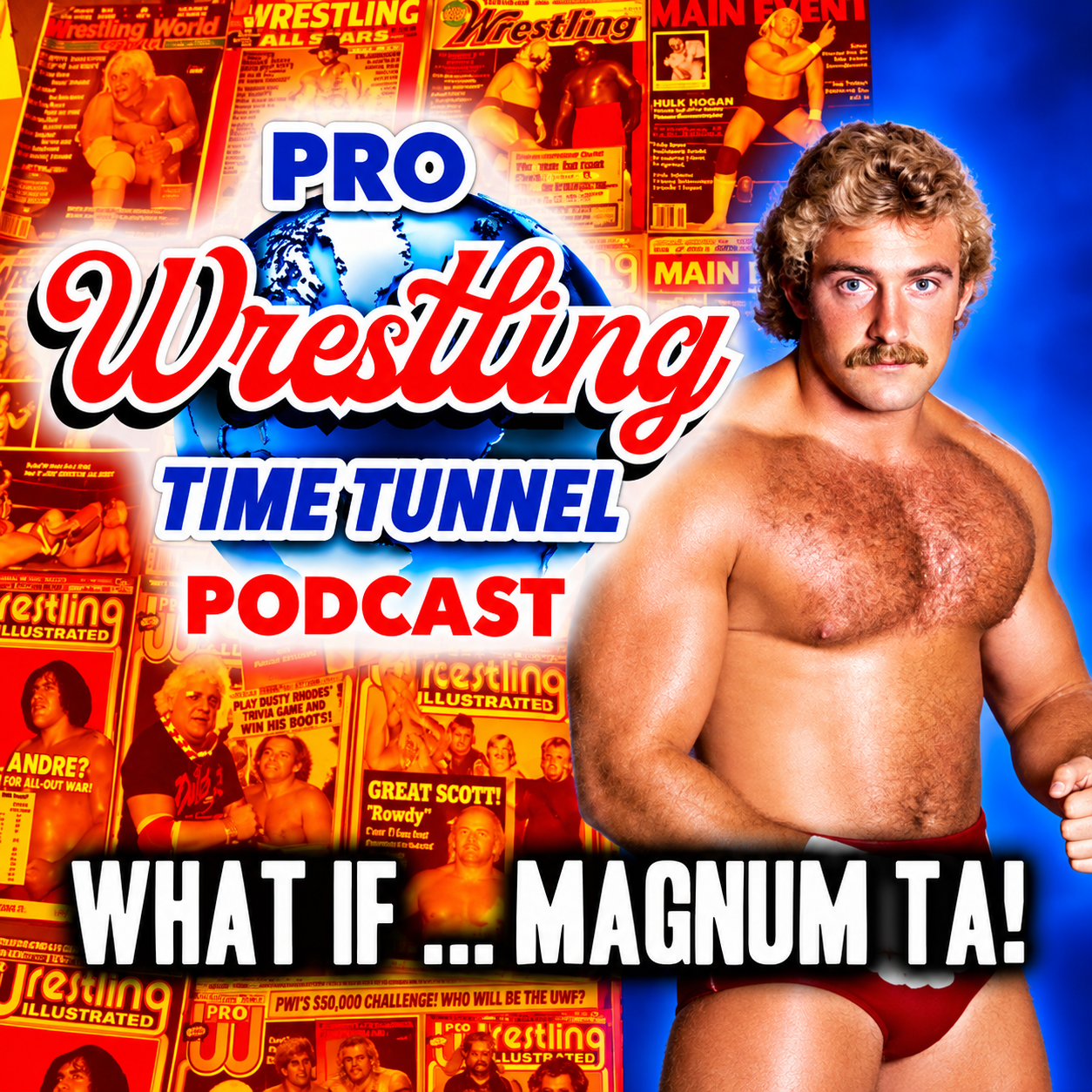
Hey, everybody. Welcome to another edition of the Pro Wrestling Time Tunnel History Show. I'm your host, Tony Richards, coming to you live from the Richards Ranch in Western Kentucky. It's been another great week here, working, living on the Richards Ranch, sending you greetings, welcoming you to another great Pro Wrestling Time Tunnel History Show. And today we're going to be doing our very first what if episode.
And today on the program, some fantastic guests. We have really had some good guests lately, and today is no exception. Jimmy Garvin will be here. Magnum TA will be here. We will be talking about Magnum. And Jimmy just started their program 40 years ago and they had a match in South Carolina, Greenville, South Carolina, I believe. It's a Monday night, was a Monday night, and Magnum had the car accident on his way home where he spun out in the road and hit the telephone pole and had all of those months of rehabilitation. And of course, it cost him his career. But what if that program would have been allowed to continue? What if he wouldn't have had the car accident and they would have been able to go forward with that program? We're going to talk to Jimmy and Magnum about that today.
Todd Goss is here.
Todd is our resident Jim Crockett Promotions expert and analyst. And we are going to be having a conversation about Magnum's car accident. And what if he would have been allowed to win the title in 1986 or 87? What would that have meant to Jim Crockett Promotions and how would that have changed things going forward? Todd will be here. We'll have that conversation. And then in our last segment today, Steve Giannarelli and Jamie Ward is going to be here. And we're going to be talking about what if Ric Flair would have been gone to the WWF in 1982?
What a great guest lineup for day. And we have some fantastic what if subjects as well. We're going to get to all that coming up.
Had some great mail this week.
Got an email from Louis Money. Hey, Louis, how you doing, brother?
Dear Mr. Richards, I wanted to let you know that I have enjoyed your podcast. I have also enjoyed listening to you on Briscoe and Bradshaw. Among Other shows.
However, I am contacting you today about the Grizzly Soap Company.
I recently purchased the Beer soap Beer Soap Flight, which had six bars of soap in it. I also bought a bar of the Patch Milk, Goat milk.
Okay.
I believe that's what he meant there. When it arrived in the mailbox, I could smell it outside the packaging. I am very pleased with my purchase. Living in Greensboro, North Carolina.
[00:03:37] Speaker E: Whoo.
[00:03:37] Speaker A: He gives a big Ric Flair woo in his email there.
Would have never heard of the Grizzly Up Soap Co. If it weren't for your great territory show. Your show was a great.
Your show was a great introduction to the local business there in Western Kentucky that I normally would have not been introduced to. Please keep up the good work. Thank you. Big listener of the show, Louis Money. Well, thank you, Louis. Appreciate the correspondence there. It's very nice of you. I appreciate you dropping that line.
I got this email from Joel Harvey and Joel. And the subject of the email is Dallas Sportatorium history.
Request for perspective. Hello, Tony, I'm Joel Harvey with Sportatorium Revival, an independent early steps concept of a new Dallas wrestling and live event venue inspired by the historic Sportatorium.
We're exploring roughly 1500 seats subject to feasibility.
Your Texas wrestling history series with Briscoe and Bradshaw makes your perspective valuable. Would you be open to a brief conversation about the original venue, the people who shaped it, and ways to tell that story responsibly in a new space?
We would seek permission for any research, images or artifacts used.
I can share the concept overview if helpful. Thank you. Joel Harvey, Sportatorium Revival. And he doesn't include an email. And when I tried to email him back, when I tried to email Joel back, the email bounced back to me.
And I don't. I tried it a couple of times and I tried it on a couple of different email email programs with different email addresses that I have, and none of them worked. And so, Joel, I'm sorry, buddy. I tried to get back to you, but it wouldn't.
It wouldn't go through. So if anybody knows Joel, or Joel, if you're listening, maybe send me another email and give me a phone number or. Or something like that where I can contact you. I'd love to talk to you about this new Sportatorium project in Dallas. That would be awesome.
Well, we got a what if episode rolling here Today on episode 84 of the Pro wrestling Time Tunnel history show. We got a lot coming up today, so let's get at it. And let's go now to our first segment and Our guests today are Jimmy Garvin and Magnum. TA. And we're talking about that night where Jimmy and Magnum had the match and the program they were having. And that terrible, terrible ride back to Charlotte, North Carolina from Greenville, South Carolina for Magnum. So let's go to that. Now. Here's my talk and my visit with Jimmy Garvin and Magnum, TA I'm sitting here with a couple of great guys that 40 years ago they were both competing in professional wrestling during the Great American Bash Series during the summer of 1986. It's been 40 years since then, but glad to have them both here tonight.
My friend Jimmy Garvin, who I just went into the hall of fame with this summer in Waterloo, Iowa. Trago Estez hall of Fame. Jimmy, how are you tonight, man?
[00:07:05] Speaker F: I'm doing fine, my brother. I'm doing fine. How many years ago did you say?
[00:07:10] Speaker A: 40 years ago?
[00:07:11] Speaker F: 40?
[00:07:12] Speaker A: Yeah. Because I just looked and I saw this new book that came out this year.
Magnum, TA and Nikita Koloff. The 40 year anniversary. Says right there. 40, 40 years ago, the United States best of seven series. This book just came out with Bill Murdoch, Nikita and Magnum. And you should.
Everybody should get.
[00:07:34] Speaker F: I think Precious picked that up the other day. She's been telling me, and I just haven't had a chance to sit down.
[00:07:39] Speaker A: It's an excellent book. Magnum, welcome. Tonight?
[00:07:42] Speaker D: No, I'm glad to be here. You know, Jimmy and I've launched into our, our feud shortly after that Best of Seven series. So we're, we're in the same time frame.
[00:07:53] Speaker A: You guys both had brutal feuds that summer. Magnum, you had Nikita in the best of seven. And Jimmy had strap matches with Wahoo McDaniel. So.
[00:08:04] Speaker F: Oh, my God, I'm gonna have nightmares tonight now because of that.
[00:08:11] Speaker A: So by the time the end of summer rolled around, I think your first match was on September 1st in Fayetteville, North Carolina.
And when you guys first heard that those programs were over now and that you guys were going to be working together, what was, what was your reaction?
[00:08:31] Speaker D: Well, for me, for me it was a. I'd gone from a 295 pound flipping monster who was killing me to somebody that could actually work.
And, and, and, you know, was, was, you know, way more seasoned than I was.
And I, I was just really, you know, looking forward to all, all that was gonna, all that was going to entail because, and I, and I say that tongue in cheek. It wasn't that Nikita couldn't work. He was just. He hadn't been in the business but, you know, two, three years, and, you know, he's throw us right into the main event deal. And he was very credible, very believable. I mean, a monster. And I'm very proud of the matches that he and I had. But it was a breath of fresh air to see Jimmy come strutting in with Patty and. And just a whole different game.
And what I loved about Jimmy, he had that beard, and I could throw. I could throw a punch with him and look like I made contact and just make contact with that beard, and it looks so good.
He was the easiest opponent I ever worked with to throw a punch off.
[00:09:42] Speaker A: Wow, that's cool. Jimmy, what were your thoughts when you found out you're going to be working with Magnum?
[00:09:47] Speaker F: Well, after my chin got better.
I'm just kidding. It was. It was a great pleasure knowing Magnum, you know, for a few years, and knowing the direction that he was heading, which was straight up to, you know, the world title. That isn't even a question.
And it showed then, and I was just excited to work with them, you know. I mean, it was like, you know, working with my best friend kind of thing.
[00:10:17] Speaker A: We talked about this the other day separately. I talked to both of you about it. But tell the story about how you guys first met. I mean, Magnum was going across the country, and Jimmy, you were in Louisiana, and how did that all happen?
[00:10:28] Speaker F: Well, Magnum, if you don't mind, I need to start first because it won't take me long to not remember anything hardly about that time frame that far back, so. And your memory's a lot better than mine. I remember a gold 98 Oldsmobile. Am I doing good so far, Terry?
[00:10:46] Speaker D: Yeah, you're doing good.
Yeah, you got the right four wheels.
[00:10:49] Speaker F: That's amazing right there. But Terry pulled into town, and he'd been up in Portland, I believe, and like I said, I might not have it. All right. But to make my story short, which it's going to be anyway, is Terry was just ready to go, and there was nothing stopping him. And he had that personality. Then I met with him, and right away we became friends, and I knew that it was going to be something. So Terry always had that air about himself, and it was sure nice to be that close to that air and to work with them and everything like that, you know, And Patty feels the same way, too.
It was just fantastic.
[00:11:35] Speaker D: So it went down like this. I had gone to. This is 1979, and I had gone down to pick Bret Sawyer up, Buzz's little brother from Tampa and take him to Mid south, because he was going to start working there. Buzz was up in Portland and he was supposed to call for me to go to Portland.
So this was like Thanksgiving of 70 of, of 79.
And I got there with Brett first and then Jimmy came and you know, I, I had never met Jimmy or, you know, half the boys.
And, and I wasn't even working yet. I mean, I'm just driving around just watching what's happening, what's going on. So I'm like the, the chauffeur. And when Jimmy came in, it was just, it was just like a brother that I had known my entire life. And we just had this instant camaraderie and I, I told him about my, my Buzz Sawyer story and Jimmy was the one that prompted me to say, you know, you need to get on up there and, and see him face to face and get this thing going.
So we spent about, I was in probably a month in, in Baton Rouge sleeping on a couch and, and him and Brett were, were sharing a two bedroom apartment and I got, I got quite an education just watching from, from the sidelines. And then of course went on and you know, that's a, that's a whole long story, but we don't need to get into here. But, but you know, fast forward, you know, 1986, I'd had a crash course in the business and Jimmy and I were around each other a little bit in Florida when I was working there for that year and a half. But Jimmy, Jimmy was, we weren't working any programs or anything and I was just working kind of in the middle of the card and still learning the ropes. So after I got left Florida, went a year and a half in Mid south and came back in and, and started the whole Jim Crockett Promotions NWA deal.
You know, Jimmy was just a perfect fit after the Fuse with Wahoo and Tully, then Nikita, here comes this brash smack talking, you know, guy with, with squeezy on his arm. And it was, it was just so much fun.
[00:14:09] Speaker F: It was as close to natural as you could get.
As far as you and I with our characters, it couldn't have been made up any other way.
[00:14:18] Speaker A: No, it was awesome. So you guys didn't run across each other except just that short time in Florida, because Magnum, you went out to Mid south for a while. Jimmy was in Texas, and then Jimmy went up north and you went to Crockett. So until y' all got back to Crockett, you didn't really run across each other again.
[00:14:35] Speaker D: Well, we had a big feud In Florida. That wasn't for the cameras. He healed me of the leader of the pack shirt down there one night, and which, Which I, I, I turned that around a little later down the road. But anyway. Yeah, we didn't, we didn't have. We didn't share any. I think I might have worked with him one time on TV Match or something like that, but never like a program.
[00:14:58] Speaker F: But the Briscoes and us, we rode together no matter what.
[00:15:02] Speaker D: Yeah. And, and Jack and Jerry and.
And Jimmy together was not for the faint of hearts.
[00:15:10] Speaker A: Hard to handle.
[00:15:11] Speaker E: Yeah.
[00:15:11] Speaker D: If you weren't a man you weren't gonna make. You'd make one of those trips and you'd be running home.
[00:15:17] Speaker A: I tell you, Jerry is a lot older, but I'm on the Briscoe and Bradshaw show with those guys every week, and it's almost like being in the car with all those guys all over again.
[00:15:27] Speaker F: Oh, man. Be sure to tell them hello, then when you're, when you talk to them.
[00:15:30] Speaker D: I'm.
[00:15:30] Speaker A: I'm gonna tell them this coming Tuesday. I will tell them I was with you two guys.
[00:15:35] Speaker F: Yeah, please do.
[00:15:36] Speaker A: The leader of the Pac came up, so.
[00:15:39] Speaker D: Oh, yeah, that, that was. I mean, there was people that came to the territory just want to be in the leader of the pack competition.
[00:15:47] Speaker F: Yeah, that was, that was. That was countrywide, wasn't it?
[00:15:50] Speaker D: Yeah, it was heralded. It was like, you know, like the Stanley cup or something, if you, you held that title then. And it was so brutal.
[00:16:00] Speaker F: What was the Spanish guy that could drink pretty good? El Apollo.
[00:16:05] Speaker D: El Grand Apollo.
[00:16:06] Speaker F: Grand Apollo.
[00:16:07] Speaker A: Grand Apollo.
[00:16:08] Speaker E: Yeah.
[00:16:09] Speaker D: Yeah.
[00:16:09] Speaker F: And.
[00:16:09] Speaker D: And, oh, my gosh, was just a different era, and it was like the closest thing to the wild, wild west you're going to get.
[00:16:20] Speaker E: Yeah.
[00:16:20] Speaker D: Because. Because it wasn't only you had to. You had to win it. But then the champion could challenge you for a takedown and you. Wherever. Wherever you were at. I think we were at the Days Inn or something, parking lot, and Jimmy and I are out there trying to plow the grass up. He's trying to take me, take me down. And I healed on him. I grabbed a handful of hair and plowed.
[00:16:43] Speaker F: We used to do that. We used to do that everywhere, didn't we?
[00:16:46] Speaker D: Yeah.
[00:16:47] Speaker F: I remember one time, behind the ABC Store, we had it.
[00:16:52] Speaker E: Yeah.
[00:16:53] Speaker D: It was just.
I tell you, I had it.
I had it when Jimmy. I wanted. I can't remember who I want it from.
Initially, it might have been.
It might have been Jack or Gerald initially. But then he came in and he was Fresh. And I'd had that thing for about six weeks and it killed me because they could. They challenged you every night, so you had to be good for 30 beers, right? You weren't good for at least 30 beers. You weren't gonna, you weren't gonna make it.
[00:17:22] Speaker A: Oh, man, what great memories.
[00:17:24] Speaker D: Those are
[00:17:27] Speaker F: just fantastic. And I don't, you know, and when you think about. I don't know what people thought when they were driving down the highway, but. And we didn't, and we didn't do. It was straight up amateur too. Like, we didn't do no healing or anything like that. It was a legit AAU take down and control.
[00:17:42] Speaker A: Well, of course you got Jack and Jerry Briscoe. I mean. Yeah, yeah, they weren't, There was no pro stuff. It was all, you know, straight up my amateur.
[00:17:53] Speaker D: Well, first time I got in the car with those guys, they had a case of Budweiser ice down on the way to the town. I never been. I, I was always. That was always the way it was coming home. But they were, they had, they, they were. They were so fouled up by the time we got to town. I remember, I remember Jack falling right off the bench, lacing up his boots. And Eddie was there.
Oh, man.
[00:18:18] Speaker F: Oh, yeah.
[00:18:19] Speaker D: Yeah.
Those guys were one of a kind. There were some wild Indians.
[00:18:25] Speaker F: Yeah.
[00:18:26] Speaker A: So when you guys first found out that you're going to be working together, I mean, how did that, how did you get told? Like, were you told, like, okay, Magnum, we're. You're done with Nikita now. We're gonna work here with, on the way to Starcade. And I think you kind of told me before that you knew you were probably going to win the title at Starrcade. But how, how did this get told to you or how did you find out that you guys are going to be working together?
[00:18:52] Speaker D: I just knew that. What a great hand Jimmy was. And with Patty and I knew that he'd had just this amazing run in Texas with the, with the Bon Erics.
So, you know, a heel that's not afraid to get heat and Jimmy wasn't afraid to get heat. It's just a pleasure all the way around.
And, you know, and the deal with the belt. So we'd already had that meeting and the NWA folks had blessed it. And they may not have done it at Starkey, they may have done it in a house show because back then they were really big on, you know, belts changing hands where people had to buy a ticket to see it. And not just, you know, making, oh, it's only going to happen on a big event.
It could have happened anywhere.
[00:19:39] Speaker A: Sure.
[00:19:39] Speaker D: But, but, but the, the, the longevity of what we could have accomplished after, after that fact would have been, would have been just unheralded because we just got started. I mean, we were just, we were just playing with different scenarios and, and Patty was so good. I don't know that she gets the credit. She's really do. But I mean, she get up in your face and jump on you and climb all over top of you like a dagger and orangutan, you know, I was watching some videos on YouTube and I just, I laughed. I said, man, we were just all completely crazy, you know, because he. She jumps on me and I throw her off and I spanked her one night and another deal, we do it.
And she was, she was very, very good.
[00:20:29] Speaker F: The spanking was huge though. Seriously.
[00:20:31] Speaker D: It was a shoot. Yeah, she wore dag on spandex pants on and there was no way around that.
[00:20:38] Speaker E: Yeah.
[00:20:40] Speaker D: Yes. She probably, she probably had a few handprints.
[00:20:44] Speaker F: That was great stuff though.
Yeah, good stuff. And we were just getting warmed up. You're right. We, we could, we were just kind of like filtering around, you know, just trying to figure the best way to go at it.
[00:20:57] Speaker D: Well, the crying shame of it is it forget just the person me or the character Magnum. But it really screwed up trajectory for, for a lot of people because Jimmy and I that would have had, you know, this serious single run, you know, flair with bad rematches. Nikita would have been chomping the bit. Tully would have still been a strong single, you know, competing for that. Arn could have done it, you know, and so all those guys that, you know, obviously, you know, did great business and everything afterwards, you know, Nikita would have never turned baby face obviously, had that not happen. And his longevity as a heel would have been much greater than, than what he became as a baby Face. Does he just.
He.
The heels didn't take care of him like I took care of him.
I made sure that he looked like a monster.
And I remember vividly watching him work with some different guys on television after he turned baby face three, four months down the road. And I'm thinking to myself, man, what, what happened to that guy? You know, that guy that just sent chills down, you know, he.
Nobody was like, mentoring him and guiding him about how, how he could still be strong, rough, rugged, be a baby face fan favorite, but not lose that, that killer, you know, side of him. And you know, I think he trimmed down and lost about 30 lbs. And looked different and worked different, and it was. It wasn't the same cat that I was in that best of seven series with now.
[00:22:44] Speaker A: The Russian Nightmare was the ultimate. I mean, and. And then when it got toned down and he became a face, it just wasn't, you know, it wasn't the same. We weren't quite ready to embrace the Russians as our friends. I don't think quite. Might have been five years too early, you know, for that to happen.
[00:23:01] Speaker D: Like, yeah, it was a quick fix for a dramatic, you know, obviously something nobody could have ever predicted, but.
[00:23:09] Speaker A: Right.
[00:23:10] Speaker D: You know, like I said, I just look back and, you know, in tag teams are, you know, certainly a huge part of wrestling history, but the. The singles feuds are, you know, the things people can really remember. And I can just imagine the memorable things that. The dastardly things that he could have thought of for us to have done and you know, gotten just, you know, major heat and, you know, and he got it instantly. I mean. Yeah, because they. They threw you and I right together, right out. Right out of the get go and. And the people were with it immediately.
[00:23:49] Speaker F: Yeah, that was made.
We were playing catch up. We're starting to catch up to what the people that was expecting that because the was on, they knew something was going to happen.
[00:23:59] Speaker E: Yeah.
[00:23:59] Speaker A: How did you think, Jimmy? How did. How did you think that Precious was gonna play into everything as far as the program was concerned? Did you see her as being a lot more involved?
[00:24:09] Speaker F: Oh, absolutely. Oh, yes, yes, yes. I mean, I. And not to recreate Texas, by no means, but, I mean, you still can't ignore the fact that if we had a match for Precious and Terry won her, you know, and she could, you know, be his housemaid for the day or something or whatever, there's so many different angles.
You could go on and on.
[00:24:32] Speaker A: You know, on that last television show that was taped before your accident, Magnum, you. You were still talking about Jimmy and getting the US Title back from Nikita. How much longer do you think the title with Nikita program was going to go?
[00:24:47] Speaker D: Well, I mean, he would have kept the US Title. That's the whole reason I dropped it to him and made him. I mean, the reason was that was to elevate him and to get him to another tier, knowing where I was going and. And it would just, I mean, you know, you know, Tully could carry himself without the strap, but it elevated Nikita and having the U. S. Title arm a Russian who, you know, with, you know, Ivan out there, you know, talking trash and everything, the way they were doing it, it was just, it was going to be a, a monster run. I mean, I could see him holding that title for a year, you know, and had had a real long solid run with it.
[00:25:28] Speaker A: I mean, you guys had. Jimmy, you'd had strap matches and lumberjack matches and Magnum, you'd had cage matches and I quit matches. And I mean now you guys are pretty much going to start this from fresh. But where did you see, I mean, what, what would you have done with Precious, do you think, Jimmy, as far as. Would that have been something that would have been done in the blow off or to heat it up or how would that.
[00:25:51] Speaker F: It would have been done as a whole storyline.
A whole. Even if it was a separate storyline or whatever, sooner or later, you know, it would, it would be advantageous to play it on out because there's so many different ways that you could go with it with her.
So many different ways. My goodness.
I mean she, she could, she could have fell in love with Terry, that kind of thing. Or it could have been, it could, you know, when you put, when you throw them, it could have, it could have went 100 different ways, but either way it would have went. It would have been huge.
[00:26:26] Speaker A: I mean, nothing against Rick or anything, but I can see it being a better program with Magnum than it turned out to be with Rick in 87, where you guys had your run together.
Is that how you think about it? Like it could have. That instead of Rick it would have been Magnum.
[00:26:45] Speaker F: Yeah. Because I think with, with Terry, I mean, and this is out there, but I mean nothing's really out of touch.
What if I, what if we had turned. What if Terry would have gotten a bind and Patty and I would have turned baby face. So then if Terry and I could be a tag team and Precious could be the valet for both of us,
[00:27:04] Speaker A: which is kind of what did happen with Ronnie in a sense.
[00:27:08] Speaker F: Yeah, yeah.
So there's so many, I mean, you know, just. You could just sit and think. There's so many things that you could do. It would, there's not just. It's a mind boggling because just a match. I mean Terry and I used to have great matches because we flowed and we wouldn't.
I wasn't getting dragged around the ring with a leather strap, you know, with the 300 pound Indian on the other end and Terry wouldn't get killed by the other guy. So we were really kind of, I think it was fresh air. Like Terry was saying that we could, you know, okay, now let's just do what we do. Best. And then psychology is what we do Pretty, pretty good.
[00:27:50] Speaker A: And Jimmy, I mean, you had the ability to keep your heat. So you guys could have done so many things that, you know, could have, could have lasted longer. I know you've had plenty of time to think about it, Terry. I mean, I mean, how do you think about Starcade? Do you think that would have been flair? Do you think that had been Jimmy?
[00:28:13] Speaker D: You know, it's, it's really hard.
It's really hard to tell.
And it was a, you know, it was a.
And it was still a bit of a game afoot between Dusty and Rick and I. Yeah, as a matter of fact, when we, we talked about it when they, you know, I mean, Jimmy and Dusty flew me up to New York and we, we went out, had a steak dinner and you know, made, they made a big to do about, you know, telling me, you know, what the plan was and what they were doing. But it was, but there were still a lot, there was a lot of mileage left between just the personalities of Dusty and Rick.
So if they could, if, if I, if I could have taken the title and Dusty and Rick could still stayed hot in something, you know, like the deals like where they broke his leg and did all this stuff, you know, I would have been loaded up with, you know, good people to work with.
And, and the thing of it was, until Jimmy came along, when I worked eight months with Tully and Tully was in just killer shape, could just flip and go and turn it on, turn it on, turn it on. And when I, when I work with anybody after that program, if I work with Rick or if I work with anybody, I had to turn it down a notch to, to not run over top of them or give them room to do what they did with. Then when I got with Jimmy, he was the same thing as Tully. He could go. There was no, never a problem about him having enough gas in the tank and he was hustling and bustling and, and, you know, laying the boots in and making this stuff, you know, look good and, and flying for me and doing, doing it all so, you know, again with him, you know, with him then chasing with the world title and doing all the things he could do to annoy me and, you know, and get me off my game and, you know, utilizing Patty, I mean, it really would have been, you know, limitless or it could have gone. I mean, I could see, I could see him, him screwing me out of the title and chasing him because, you know, the baby face, the, you know, even though I was Kind of the, the, the lone wolf, kind of the precursor of what Steve Austin became with the, the attitude error because I, you know, knocked Bob Geigel on his butt, you know, when he talked smack to me and he was the president of the NWA and all that stuff is still the, the big money is always the, you know, the chase in the chase.
And you know, Hogan was like the exception, you know, because they just kept feeding him, you know, monster, you know, they, they kept bringing the next monster, the next monster, the next monster. But that was because he was limited in what he could do in his storytelling in the, in the ring.
Jimmy and I could have gone out and gone 30, 30 plus minutes every night and told a flipping crazy story and, and, you know, had, had, you know, blood baths and done everything the old school, you know, dictated you did back in the day and, and had some real longevity with it. But I mean, I picture a world where, you know, it's bouncing back and forth between, you know, Jimmy and I and, and, and, you know, Nikita, you know, making a lot of noise about it, but more saber rattling and, and even Tully having, you know, a shot at the world title, right? And you change that thing up there in a matter of two years, you know, that title could have changed hands between, you know, three, four people, you know, multiple, multiple times. And just every time they thought they, you know, they, they seen it all. We pull the rope from under him again and we're back in another, you know, hey, room.
[00:32:19] Speaker E: Yeah.
[00:32:19] Speaker A: I would have loved to have seen Flair trying to get the title back desperately. Like he really had to have the title, like he was missing a part of himself. But then Tully going after it and creating a little stir between those two.
[00:32:33] Speaker D: Well, the thing, the thing I would say. Telly had abandoned Baby Doll, if you remember, right, she'd hooked up with Sam Houston and the whole dynamic was all screwed up and, and that was his, the best. To me, that was the best version of Tully ever. When, when he had Baby Doll, when she was at the Heat and had the deal, you know, it was, it was hot. And not that having a male manager out there like JJ is an impactful because JJ had great timing and he could, you could do all kinds of great things with him. He was kind of like a Bobby Heenan, but to have a pretty ballet who's, you know, family and so there's no competition heat going on between her and Jimmy, so they can do whatever's best for business, you know, they had the best potential, you know, thing that could have ever Happened.
[00:33:26] Speaker A: Yes.
[00:33:26] Speaker D: And they could have been out there going. They could have been undermining everybody that was chasing this, chasing me for the title.
[00:33:32] Speaker A: And it wasn't like it is now. There weren't that many females in the business. You know, you had just a few. And those few were really, really good.
So you're right. That would have been a great combination. Jimmy, when you had the series with Flair, you had turned Babyface. I mean, when Cornet burned Ronnie Garvin, you turned into Babyface for your Flair series. Would you have preferred to stay a heel or did you not mind turning?
[00:33:59] Speaker F: I would have preferred. I would have preferred to stay a heel. But then sometimes, you know, as it goes, you know, we gotta. You gotta ride what wave you. You got. You got coming at you, you know, so I'm more comfortable as a heel, I think as a natural.
I'm kind of a natural. I could be a heel pretty easy. Easy to think.
[00:34:20] Speaker A: And you're the nicest guy on the planet.
[00:34:22] Speaker F: Well, I know. Isn't that weird, huh? Thanks.
Thanks for the compliment.
[00:34:27] Speaker A: No, you are, man. I mean, we had a great time in Waterloo. I mean, we were just like. We were like. Magnum was saying, first time he met you, it felt like you were brothers, you know?
[00:34:35] Speaker F: I mean, we're gonna. When we're gonna do that again next year, right? We're gonna. I'm gonna go to. I'll be in Iowa, too. And Terry. Has Terry been out that way?
[00:34:44] Speaker A: I haven't seen him there.
[00:34:45] Speaker D: I've been twice.
[00:34:46] Speaker A: Oh, good. I wish.
[00:34:48] Speaker D: Yeah, I've got the.
The Lou says award around here somewhere.
[00:34:53] Speaker F: Well, I should have known that there was an award somewhere about wrestling, you know, I'm sure you got it.
You deserve it. You deserve it. Let me know who hadn't give you one yet.
[00:35:03] Speaker A: Come on. Come on back to Waterloo because Jerry Briscoe still goes to the bar.
[00:35:08] Speaker E: Well,
[00:35:11] Speaker D: the rib was when I.
[00:35:13] Speaker F: So.
[00:35:14] Speaker D: So I went one year and just kind of like met people and whatnot. And they inducted me the next year. And Jim Ross did this. He's the one that introduced me. And, you know, he knew me so well from all the. All the Mid south days and everything that, you know, he was a great guy to do the intro.
Well, I had eaten some. A big chunk of really rare roast beef and had the worst attack of reflux I have ever had my entire life.
[00:35:44] Speaker A: Oh, wow.
[00:35:44] Speaker D: I mean, I was like, literally like. Like vomiting acid. Had no. Had no tums. I had no nothing. And I was. I was back and forth throwing up In a trash can for before the whole thing, and then had to go out there and talk and then went right back to the trash can.
[00:36:05] Speaker F: Oh, that's. That's a terrible thing.
[00:36:07] Speaker D: They thought I was having a heart attack. I mean, it was so bad. I mean, it was.
I mean, I'd, like, turn white and. And it was just the worst.
I mean, this is before I knew about Proloc and stuff like that, but, yeah, I had the worst attack. Attack of reflux I've ever had in my life when they inducted me.
[00:36:26] Speaker A: Oh, my God.
[00:36:27] Speaker D: And managed to get through it and did my deal and came out,
[00:36:33] Speaker A: got it taken care of, got the award in the. And got it back in the room.
[00:36:37] Speaker D: Yeah, I got the picture and said, see y'.
[00:36:39] Speaker F: All.
[00:36:41] Speaker A: Well, as. As October started in 86, you guys were getting into a regular house show rhythm. You worked in Raleigh, Roanoke, Asheville, Spartanburg at the television taping.
Raleigh. You even worked in Greensboro one night, which is usually the sign that the program's really going to turn into something, you know, if they put you in Greensboro and then they had you in Atlanta at the. At the Omni, Jimmy. And then you and Magnum hooked up again that night, October 13, in Greenville, South Carolina, which was a lumberjack.
[00:37:12] Speaker D: Lumberjack.
[00:37:13] Speaker A: Lumberjack match. What do you guys remember about that night?
[00:37:19] Speaker F: You know, the Greenville Auditorium. It's.
[00:37:22] Speaker B: It's.
[00:37:22] Speaker F: It. You can see that. And I can see that in my head. And as far as remembering much more than, you know, just the. Terry and I having a great match and we, you know, it was just. It was just magic. It was magic, and I was feeling the magic. And that's.
[00:37:40] Speaker A: That's kind of what you were kind of thinking. This was going to be really good.
[00:37:43] Speaker F: Oh, this. I knew it was going to be good. I knew I would have bet everything on it.
[00:37:48] Speaker D: Yeah, me too. And. And the thing was, and, and.
And you come across people like this very, very, very rarely, but it was a. It was a complete joy for me.
Every time we were in the ring, it was so easy.
There was. There was no struggle. There was no, you know, you know, trying to make the chemistry.
I mean, it was just easy.
[00:38:16] Speaker A: That's what.
[00:38:17] Speaker D: Yeah, it was.
[00:38:19] Speaker F: That's very rare.
[00:38:21] Speaker D: And to be fair, I don't know that I ever had that chemistry like I had naturally with Jimmy, with anybody I ever worked with in the business.
[00:38:30] Speaker A: Well, you know, that's where. That's why The Dory Funk, Jr. Jack Briscoe matches were always so special. Those two guys just had it, you know. They had a special chemistry that when they got together in the ring, everything just clicked for 60 and 90 minutes at a time. And that sounds like what you guys are describing. Like you, you just, it was, you could read each other's minds. You knew what to do next, you knew what would work and what wouldn't work. And that's the key to really having a good match, right?
[00:38:57] Speaker F: It is, it is. And, and effortlessly to some degree of having a good match. We didn't have to, it wasn't like you know, snow plowing or anything and, and it's rare and, and Briscoe and Funk, they had it, they, and, and Magnum and I had it and it doesn't show up too often, but whoever's in there and if it's, if it's, if they're having that experience, it's something they remember pretty much the rest of your life because you're doing some pretty serious stuff pretty fast and everything's going on and it's just like, it's just as much effort as we're talking right now.
[00:39:29] Speaker A: Well, in a lot of ways Rick and Dusty had that, you know, when they worked together, you know.
[00:39:34] Speaker F: Yeah, they sure did.
[00:39:36] Speaker A: No, didn't know telling how many times they worked together, you know, and never, never said a word about what they were going to do that night. They just went and did it.
[00:39:44] Speaker F: Yeah. Terry, going back on the Iowa thing, we just go ahead and might as well make a plan right now that we just need to do that. We'll fly out there together.
[00:39:53] Speaker D: Yeah, that'd be, that would be fun. I, I would like, I mean it's a great, it's a great weekend and, and you know, I think I, I've told both of you, I mean Dan Gable was like my hero in high school and I, I, I just saw the book, I just saw the book somewhere here in my office the other day. The, my mom gave me that book when I was in the eighth grade in high school.
[00:40:18] Speaker A: Oh my God.
[00:40:19] Speaker D: And I read it and just was enamored with his story and the determination and the drive and it's what propelled me into amateur wrestling. And I wasn't a natural, natural wrestler. It took me two years and just beating myself to death to get good and, and get to the point where I became a state champion and, but I just, it was a life changing event for me and it taught me skills and discipline and focus that nothing else in my life compared to. So when I got to, had a chance to meet him and I know he's you know, been a coach for, you know, decades and done, you know, amazing things, but, you know, you took it. You look at a kid who, in the eighth grade, I couldn't do one push up in my phys Ed class, and that's. This is 1974.
And in 1985, I'm wrestling in Norfolk Scope, which is my hometown, and a sellout for the world's heavyweight championship, you know, with the, you know, with Ric Flair. And, you know, that journey all started because of that one thing that drove me to be able to do that. And I, you know, I just wanted to shake his hand and say, you don't, you don't know me from Adam. But he made a huge, huge impact, you know, on my life. And, you know, it's, you know, something I'll never forget. And he was a great guy, very humble. I was taken back how little he was. I forgot that he wrestled like 140 some pounds, but I wrestled 167, but I, you know, gained, you know, 70 pounds after, you know, after, after I got out of high school.
[00:42:10] Speaker A: Yeah.
So let me ask you this question.
Do you think it was a plus that you didn't know everything that was going to happen and that, like, so Dusty wouldn't tell you his plans for six months, eight months, nine months, a year down the road, and you were just kind of doing it as you went? Would you rather have done that to keep yourself kind of sharp, or would you have rather known exactly what plan was?
[00:42:36] Speaker E: I wasn't.
[00:42:37] Speaker D: Because it, because they did it the way they did it and, and had the conversation they did, and, and Jimmy Crockett, you know, had, had, you know, given me the vote of confidence that he had, you know, if it, if it had gone on too long, yeah, I would have, I, I would have probably got a little antsy or say, hey, you know, done something still politically correct. But to say, you know, I want to be ready for this, and if, you know, you don't give me a chance to have my eye on the ball, I want to be the best version of myself I can be, you know, when we do this, I mean,
[00:43:17] Speaker A: if you look at all the moves that Jim Crockett was making during that time, he was buying up syndication, television networks, he was buying up Bill Watts television, he was buying up Florida's television, he's buying up Kansas City's television. I mean, he's gearing up for a major fight, and you two are going to be a major part of that.
And in a lot of ways, that was part of, as Magnum said earlier, change the trajectory of everything.
I mean, did you consider that at the time, like, boy, we're going to be. He's really betting on us. Did you think about that that way or did you think, you know, about
[00:43:52] Speaker D: your program, what we did in the ring and in the. I mean, I knew my position in the company and I knew where they were, you know, that they were betting, betting on me heavily.
The. When you're out there with guys of this caliber, the Jimmy's and the flares and the Tullys and Wahoo McDaniels, these legendary people in the business that. And you know, and you're being told this now, not only is it your time, but you're going to lead the franchise basically. And where we want to go with
[00:44:27] Speaker A: the future, we're going to put it on.
[00:44:28] Speaker D: You know, it was, it was exciting, but it was. We were going so hard every day, seven days a week.
I didn't really get like, get to step back and look at it from the outside in to see even remotely what it looked like to other people. Because to me it was just what we do, what I do. You know what, you know, you, I get to the arena and it doesn't matter what else is going on in the world. You know, when the, when the lights come up and you know, I got Jimmy across the ring, you know, that is what I live for.
[00:45:02] Speaker F: And sometimes twice on Sunday, you're right.
[00:45:05] Speaker E: Oh yeah, yeah.
[00:45:06] Speaker D: We do a matinee in Asheville and maybe Atlanta that night or maybe Saturday.
[00:45:10] Speaker A: Maybe Saturday and Sunday you're doing that plus a television cbs.
[00:45:14] Speaker D: Oh, always twice on Saturday. Yeah, yeah, yeah. You could, you could set your watch by that.
But you know, it was just when you're living it and doing it and in the midst of it, it's.
You don't have the same perspective of, you know, the, the total. How enormous this thing could be. You know, I've been in, I've been in little shows in Florida where we, you know, we didn't have 100 people in the, in the, in a. You know, almost like we wrestle in a bar to, you know, to the stadiums and the Superdome and you know, and those type events and, and to be honest, the places like the old Charlotte Coliseum and Greensboro and Atlanta, the buildings that were like 10, 12,000 seat capacity for me, that was the biggest electricity that you could have because they could be so loud. It turned into like a white noise. It's so loud.
You would think it was almost surreal. Quiet. Like you could hear your own thoughts because they were so, so blasted loud. And they're making the sound. I mean, I throw a punch at Jimmy and it's like. It's like the Batman, you know, they're going boom, pow, right?
[00:46:27] Speaker E: People are.
[00:46:28] Speaker D: You know, the people are popping so big that it just made you. You felt like you were living a life of a. Of a superhero.
[00:46:36] Speaker A: So, Jimmy, you were talking about how that night, the lumberjack match and memorial at Greenville, that you knew this was going to be really special.
So then Magnum obviously has the car accident on the way home.
Then after that, the next night, you go to Columbia, South Carolina. You go to Richmond, you go to Philly, and you're with Hector Guerrero and Brad Armstrong and Dick Murdoch. So when did you sort of get the idea that Magnum wasn't coming back? And how'd that make you feel?
[00:47:08] Speaker F: Well, I just can't remember the. Can't remember exactly that moment.
[00:47:17] Speaker A: I mean, because for a long time it was kind of the thought was he was going to be able to beat it, Right. And come back. But there must have been a time where it sunk in like, he's not coming back and we're not going to be doing this. So, I mean, that was probably a terrible feeling. I was just kind of curious how you felt about it when you realized it.
[00:47:35] Speaker F: Yeah. I guess just as being such a.
A brother to. To, you know, we are like brothers and.
And we all know. And both of us know that we're for each other 24 7.
So that would. That anytime it would. I would feel the same way as you would feel about someone that you loved.
[00:47:56] Speaker A: Right.
[00:47:56] Speaker F: And, you know, I do love Terry, so anything that happens to him affects me deeply.
You know, I still have a job to do. I still got, you know, I still got things that have to get done, but that don't mean that I don't, you know, have the. Have the feelings in the heart for, you know, Terry, no matter what, you
[00:48:15] Speaker A: know, and that was probably universal throughout the dressing room, wasn't it?
[00:48:21] Speaker F: For Terry?
[00:48:21] Speaker A: Yeah, of course.
[00:48:22] Speaker F: Oh, yeah, yeah. Terry. Yeah. Absolutely, you know, Absolutely, you know, the best of the best.
Never. Nobody ever say nothing wrong, you know. You know, you could search the world over and nobody'd ever say a negative thing about Terry.
[00:48:38] Speaker A: Yeah.
[00:48:38] Speaker F: Now, I would prefer that you don't search. Search too far for me.
You're. And you're not going to have the same.
Hate to disappoint you, but you might get a different.
[00:48:48] Speaker A: Might get a different response, but it's not.
[00:48:51] Speaker D: It's not your fault.
[00:48:52] Speaker F: It is not my fault.
[00:48:54] Speaker A: It ain't his fault, man.
What's one match or angle from that program that never happened that you guys wish you could have done?
[00:49:03] Speaker F: We would have, I think we would have redone the valet for. The valet would put. The valet would have been on the line because that had been huge. I don't care if we did it again, if we did it in Texas or not. It had been huge again.
[00:49:14] Speaker A: Well, at that point in time, with technology limitations, nobody in Crocket land had ever seen that stuff in Texas.
[00:49:20] Speaker F: That's right. That's right. That's right. So, I mean, that's what I think, Terry. I don't know. There's so many things we could have done, but that would be an easy one there.
[00:49:28] Speaker D: Oh yeah, that, that would, that would have been easy. And you know, it's, it's just
[00:49:37] Speaker E: you,
[00:49:38] Speaker D: you had that whole package. The fact that you could talk just, just everything roll off your tongue and, and have Patty being able to just be this distraction moving all around and combined with the work in the ring, I mean, I just see all the things that could have been done where, you know, where she can, you know, involve herself to, you know, give you the opening to pounce and get the heat and just, just, you know, so many things that, like I said, he could embrace her being a part of that package. Whereas with, with Holly and Baby Doll, there were some, there was some struggles and some things that, you know, like who's making how much money for this and this, you know, other things besides, you know, just the in ring business of hand that really, you know, because, you know, it's a big political, you know, animal, the whole thing, and we kayfabe to, you know, to defend the business to the hill.
I mean, I remember Baby Dog coming and throwing a drink on me, a whole full drink on me as I walked in Rugs Gallery in Virginia beach one night. I mean, Telly wanted to work an angle and have him and I get into a brawl in the bar and get arrested and let it make, make it make national news and all that kind of stuff, right? So, I mean, so if, if Jimmy embracing, you know, everything that could be done with Patty, I mean, good gosh, it's just no telling. It could have really gotten out out there and, and really had legs. And that was a neat thing too. And that's why I say is we were just testing the waters, kind of like feeling out, you know, all the different fun things that we could do and we didn't even have, like, you know, the golden ticket hanging up here to. To be able to have a talking point, because I don't have a belt at this time. And, you know, I'm still talking about flair. So, you know, making innuendos about Nikita, but really trying to be, you know, as a baby face. You gotta. You gotta kind of walk a funny line, right? You can't, because you're leading the people.
[00:52:04] Speaker A: You can't promise anything, but you can threaten a lot, you know?
[00:52:07] Speaker D: Right.
[00:52:07] Speaker E: And you.
[00:52:08] Speaker D: And you want it to make sense, but you don't want to be all over the place. So they can't, you know, see that you got some direction about what you're doing. I mean, I was treating Jimmy like he was just annoying the shit out of me. Yeah, basically. And even because there was no title on the line, but.
[00:52:26] Speaker A: Well, that was the point of the story. That's what they were trying to do. Right? They were trying to annoy you. That was the whole call out from the back thing and all that stuff.
[00:52:34] Speaker D: Exactly. And so it was. Again, it was just really unlimited work that had gone. Because I have watched the, you know, the things that they did with Flair and Patty and JJ and all the things in the Miss Atlanta Lively deal.
They were entertaining. But the big money business that would have come would have been him and I dancing around that title and getting down to serious business.
[00:53:04] Speaker F: When Patty used to get up in your face like you were referencing earlier, there was nothing like it. You could. Those people in the building, if they could have got a hold to her, that have been it. But she used to get flat. Flat right up in your face.
[00:53:17] Speaker A: And, oh, you can still feel it today. If you watch those TV shows back and you watch when she comes down there to the ringside or whatever, you can hear. Hear and feel the whole elevation of the crowd. Go. Go up.
[00:53:30] Speaker D: Yeah.
[00:53:31] Speaker A: Now, I think I asked you this before, Jimmy, but, you know, I went to three great American bass shows that summer in 86, and I saw a lot of you and Wahoo and Patty, and I saw a lot of Magnum and Nikita. But the way Patty worked with Wahoo, I mean, it was just amazing. Did she do a lot of that stuff on her own or was some of that stuff called. Or how did that go? I mean, she just that natural of
[00:53:55] Speaker F: a talent or as far as getting up in his face.
[00:53:58] Speaker A: Yeah, yeah. And having.
Chasing her with the strap and all that stuff was that.
[00:54:04] Speaker F: Well, you know what? She. It was just a natural thing for her to. That she knew that her what she knew what her position was as far as what her attitude should be and she was a natural with it. And when she would get up in Wahoo's face, it's like, no, everybody in the world knows you don't get up into Wahoo's face. That would be a real bad thing to do.
[00:54:31] Speaker A: Well, and everybody, everybody had seen Dusty do stuff to Baby Doll for doing that. So they were primed for Wahoo to do something like that.
[00:54:40] Speaker F: Oh, for sure. They were on the edge of their seats ready to explode. And then with Terry as well, it was just as equal with Terry as well, but she just had that.
She was, she was good. You know, I got to tell just a quick story to get off of that for a second. In St. Louis when we go up there out of Texas and at the Kill Auditorium, Lord have mercy wrestling Chris Adams and that.
It was unbelievable atmosphere as you can imagine. So one night I'm wrestling Chris Adams and I'll make this quick, but with all the noise and everything I hear like noise, right.
[00:55:19] Speaker B: I think what, you know, so I
[00:55:20] Speaker F: look around and I. There's no. I can't see, I can't see Patty. I don't know where she's at. She's not on either side of the. So I look on the side over the ring.
Finally on two, two sides, I don't see her. Finally I look over the other side over there and she's on the floor with this big truck driving woman and buddy, they're going at it. Now I never seen a fight like that in my life, but honest to gosh, I said, oh my gosh, you know.
[00:55:44] Speaker A: But the truck driving woman was a fan that came out of.
[00:55:47] Speaker F: Yes, the fan jumped the rail and that noise, she knit the fan nailed Patty.
That was the noise I heard was when she hit her. And that pissed Patty off big time. They went to it.
[00:56:00] Speaker A: Well, we've talked about it on this show quite a bit. But a lot of fans don't realize, a lot of younger fans don't realize that going to wrestling show back then there was just a thin rail around the ring. There was no big time security like there is now. And fans could do that, you know. And it's a wonder that more fans didn't charge valets and managers and people like that.
[00:56:23] Speaker F: But when I was starting, they didn't have no trouble. I was stabbed in the back in Australia and I've been food poisoned twice. And in Mississippi was the first time I had a fan hit the ring. And back in the day they would hit that, they would hit the ring.
[00:56:38] Speaker A: Well, I was going to say, you both work mid south. I mean, wasn't that kind of the territory where it was kind of the craziest? You know that?
[00:56:46] Speaker D: No.
Especially down there with those Cajuns. I mean, the ranger. Yeah, yeah, Homa. Oh my goodness. Man, it. Those people get liquored up and they have no fear. I mean, none.
[00:57:04] Speaker A: For somebody like Patty who didn't really ever want to be in the business, there was never a person so natural to be in the business. You know, it's kind of funny. I mean, she just had a real talent for it. For somebody who didn't really care to be doing it to begin with.
[00:57:18] Speaker F: Yeah, yeah, she did.
[00:57:20] Speaker D: Well, it was like a bantam rooster because she was so little and petite, but she just, just so daggone feisty, you know. Baby Doll, by contrast is like, you know, six foot tall and, and flipping, you know, bigger than some of the guys and, and she looks like she can knock your head off. But Patty was like a flipping, you know, like a little pit bull and, and, and there was no backup.
[00:57:45] Speaker C: Yeah,
[00:57:47] Speaker D: I mean, it was easier to back a guy up than it was to be back Patty up off you when she got up.
[00:57:52] Speaker C: Yeah.
[00:57:53] Speaker A: I mean, when you looked at Baby Doll, you would think she was more of a shot put track and field athlete or something. And Patty just looked like a beauty queen, you know, a petite beauty queen.
[00:58:04] Speaker F: She's a firecracker now. I'm telling you, she scares me to this day.
[00:58:10] Speaker A: Well, that's probably not bad.
Well, all right.
[00:58:14] Speaker F: I'm just kidding though too.
[00:58:15] Speaker A: I know. Well, listen, you guys have been great with your time here to just share with the fans and everything. Forty years later, the program that never really got to get to its fruition. What, what are your final thoughts about the whole thing?
[00:58:29] Speaker F: Well, I'm glad that, you know, I had a, had a great career.
I couldn't complain about anything. And the fact that, you know, Terry and I got to do some of that magic a little bit, it sticks in, in my mind up at the top of the highlights in my whole career.
Terry's always there in my mind with that and it was just a, it was just a, it was a. It was a good time.
It was a good time and yeah, it was a good time
[00:59:05] Speaker D: and, and you know, I get asked all the time. I get called like the big one of the biggest what ifs, but the what if that applies to me, applies to my friends. Like I said, there's no telling what Trajectory, you know, his career would have. Would have, you know, had, you know, as a result of being on that. On that ride, on that lightning bolt and.
But you know what? It wouldn't have mattered whether we did it a thousand times or we did it as many times as we did the magic was the magic, and nothing will ever change that.
So the fact that we got to experience it and feel it and see it after we become friends in 1979, that I'd got on a.
Learned enough about the business that I could go out there and.
And, you know, sharing that magic with somebody with Jim's experience was.
Was a really good. It was a really good day and I got nothing but good memories.
[01:00:09] Speaker A: So much of the. Go ahead, Jimmy.
[01:00:11] Speaker F: I just want to tell you, Terry, I love you.
[01:00:13] Speaker D: I love you, Jim.
[01:00:15] Speaker A: So much of the business. So much of the great years of the business. Early 70s, let's say we don't have, but at least we do have some things from that that we can relive and watch over and over and over again. And I think that's a real blessing, what we, you know, what we still do have from those magic days in September and October of 1986. And thank you both for coming on tonight and talking with me about it.
[01:00:39] Speaker D: My pleasure.
[01:00:41] Speaker F: See you later, Terry.
[01:00:43] Speaker D: See you guys.
[01:00:44] Speaker A: Can't wait. Can't wait for water, Lou.
[01:00:46] Speaker B: All right.
[01:00:47] Speaker F: We're gonna have a good time. We're going to have a beer or two.
[01:00:50] Speaker A: What a great conversation with Jimmy garvin@magnum ta about that. That series that they were programmed in together 40 years ago in 1986, here in the middle of October, where Magnum TA's wonderful wrestling career came to an end.
Such a. Such a tragedy. I remember exactly where I was that Saturday that I heard about it the next weekend.
And it was going through the tape trading community that Magnum had had a car accident and no one knew how bad it was. And details were sketchy. We didn't have email or cell phones or the Internet or even. We just barely had the Wrestling observer at that time. And that news was a little bit behind. You know, when you got the Observer, Dave was gathering things. If it was October, you'd be hearing about things that happened in August and September.
So it's kind of hard if you weren't there to go back and describe to everybody what. What it was like back then.
Well, we lost another wrestler from our territory wrestling community on October 4th. His name was Mario Richard Krishia. I hope I said that right, Chriacia.
His obituary was up at the Burma or Boomer. I think it's Booma Booma Funeral Home for services for him last Friday, October 9th. The services were from 3:30 to 5:30 and Mario Chris Heresia I think is how I'm stumbling over that. Known to many as the spirited and well like professional wrestler Ricky Sexton passed away October 4, 2026 at UMass Medical center in Worcester after a life marked by energy, hard work and devotion to family, friends and community.
He was born August 26, 1936 in Brooklyn, New York and later made his home in Massachusetts where he built a life that reflected his friendly nature, his hands on abilities and his enduring love of people. He attended the Milford school system and while still a teenager discovered the path that would become one of the great passions of his life. At just 15 years old he stepped into a wrestling ring at an exhibition match in Milford Town hall and from that moment forward he never looked back. Mario went on to wrestle professionally for more than 40 years. He became widely known and admired to the wrestling world, performing for many years in the WWF and later continuing independently throughout New England and California.
He earned respect not only for his talent and determination, but also for the personality he brought to the ring. He was a familiar and memorable presence to fans and fellow wrestlers alike and he carried himself with the kind of confidence and spirit that made him unforgettable. In 2018 he was honored with induction into the New England Wrestling hall of Fame, a fitting recognition for a career that touched so many. Outside the ring, Mario worked as a carpet installer and in construction with Sabatelli Construction, where his practical skills and strong work ethic were appreciated by those who knew him. Later in life he also became an accomplished jewelry designer, showing once again he was a man of many talents and interests. Whether he is working with his hands, creating something new or sharing stories from his wrestling years, he brought dedication and pride to all that he did. Mario was devoted to his church, St. Denis Parish in Douglas, and his faith was an important part of his life. He also enjoyed simple pleasures that reflected his down to earth nature. He loved going to flea markets, thrifting and never passed up a bargain.
These interests suited him well and were part of the charm that made him such a beloved presence among those who knew him. He was a man who appreciated value, enjoyed the hunt and found joy in the everyday moments of life. He also served in the Massachusetts National Guard. He survived by his son, Robert C. Creasia, and his wife, Lonnie of Northbridge, and his son Richard M. Creacia, and his wife, Heather of Douglas, his daughter Donna M. Espada of Hopedale 13 grandchildren, seven great grandchildren and one great great grandchild and many nieces, nephews and cousins. His family was an important part of his life and he will be remembered with love by all who were fortunate enough to know him. He was predeceased by his first wife, Marie Goldie Berry Creacia, his second wife, Barbara Bruce Creosia his son Mario Sunny Creacia his parents, Michael and Rose Gaudori Galdorisi, I think Galderisi and by two brothers and one sister. Their memory remain part of the family story he carried his whole life. Mario will be remembered as a friendly, handy and spirited man whose life was filled with hard work, accomplishment and devotion. He leaves behind a legacy of strength, resilience and warmth that will continue to live on in the hearts of his family, friends and all who admired him. Visiting hours will be held Friday, October 9th. This was that last Friday last week from 3:30 to 5:30 in the Boma Sargent Funeral Home, 42 Congress St. Milford, followed by prayer service at 5:30 in the funeral home.
Memorial donations may be made to the Boys and Girls Club of Worcester 65 Boys and Girls Club Way Morester, MA 01610 Mario Ricky Sexton, 90 years old. He wrestled as Cyclone Sexton, Mario Rico, Nature Boy Rico and Ricky Sexton. He broke in in 1954. First recorded match March 31st at the City hall in Augusta, Maine. He lost a two out of three falls match to Stanley Wydra. Total matches just under 500 for his career. His busiest years were 1966 where he wrestled 102 matches, 1967, 86 matches and 1973. He wrestled 55 times. His most top five frequent opponents were Mario Savoldi, Johnny Rodz, Lou Albano, Tony Altomori and Smasher Sloan.
His top five most frequent tag partners were Arnold Scholin, Geno Brito, Miguel Perez, Tony Parisi and Pete Sanchez. He held the AWF America's title for three days in October 1991 and he is the father of professional wrestler Richie Rich. Rest in peace, Ricky Sexton, one of our heroes from the territory era.
Okay, let's talk a little bit more what if scenario and let's talk about Magnum TA if the wreck wouldn't have happened and Magnum would have won the NWA World championship, how would that have changed things in the Carolinas, in Jim Crockett Promotions and in the world of professional wrestling back in 1986 and 1987? To help me with that scenario, Todd Goss is here and we will talk about that. So let's go to my conversation now with the one and only Todd Goss.
We're rolling on with the Pro Wrestling Time Tunnel History show in this what if episode. And great conversation with Magnum, TA and Jimmy Garvin about the ride back from South Carolina and Magnum's car accident, which basically was a catalyst in changing the entire trajectory of Jim Crockett Promotions. And we've got our Mid Atlantic Championship Wrestling analyst on the line right now, Todd Goss. Hey, Todd, how you doing, man?
[01:08:58] Speaker F: Doing.
[01:08:59] Speaker B: Doing good, Tony.
[01:09:00] Speaker A: Yeah, good to see you and talk to you again.
[01:09:03] Speaker B: It's always good to talk to you and I'm happy to be back on here.
[01:09:07] Speaker A: We were Talking about Magnum TA's car wreck and it's been discussed and discussed many, many times in the last 40 years.
But I wanted to get your perspective, man. This time of year messes with my, my sinuses and my throat and everything. I wanted to get you.
I wanted to get your perspective on the car accident. You know, to me, there were two or three guys that could have interrupted Flair's title reign there in the 80s and none of them ever happened. I mean, there was David Von Erich, there was Barry Windham, and then there was Magnum ta.
And we didn't get any of those guys as challengers for different reasons. Of course. David Von Erich died, Barry Windham left and went to the wwf. And then Magnum had his car accident.
So what do you kind of think the thing would. Where do you think things would have gone if Magnum wouldn't have had his accident?
[01:10:05] Speaker B: Well, I remember the day it happened and it was a really, really sad day because, you know, Magnum was a huge star and he was beloved.
And nobody could have predicted that happening. You know, that's, you know, the case of accidents.
But I think he would have remained a top guy for, you know, at least the duration of Jim Crockett Promotions and getting the belt.
To be fair, I don't know if people were going to accept anybody but Flair in that role long term or if they would buy him as being the long term champion, that it's always been a heel champion territory.
[01:10:47] Speaker A: Yeah. According to Magnum, they had gone to New York City and had a dinner and Jimmy Crockett and Dusty had told him that the NWA had signed off on it and everything and that he was going to be getting the title. But I hear what you're saying. So do you think a heel turn would have been in the cards of trying to make that work or do you Think they would have just gone back to Rick or what do you think?
[01:11:14] Speaker B: I don't, you know, there's no way to predict because you never saw him as a heel and I don't.
So we don't know what he would have worked, worked like as a heel. I mean he was good, good worker. So I think he could have adjusted to it. But it's another case of no matter. Flair is a heel regardless of what anybody says. He was the most popular wrestler in the Carolinas that two people paid to see more than anybody else. And we've seen from, you know, few. When they replaced him with Sting and then when he left and Lex Luger got the belt, they really didn't get accepted as champion.
I don't know if it would have been. If Magnum was popular enough to.
For that to be the case or whether it would have lasted. I mean that's just a. A big what if.
Yeah, one thing I do think he would have been a major player for, for at least for the duration of Jim Crockett Promotions. You know, TBS era. It's a whole different story because one of the things that Turner wanted was flare as his top guy.
Yeah, but I think you would have got.
[01:12:24] Speaker A: I sort of feel the same way about it as I do Nikita. Like Nikita should have never been a baby face. And I'm not sure that Magnum should ever been a heel.
[01:12:33] Speaker B: You know, I think he probably could have pulled it off. I mean I've, you know, I've only ever met Magnum like briefly a couple of times. One time at a Cheap Trick concert and, and you know, one time at one of the fan fest. You know, it's basically. I've never really had a conversation with it and just, just introduce myself, shake, shake hands, you know, that's it. So I don't know him to know his personality outside of, you know, what I saw on television to, to say whether he could pull it off. I think he probably would have been a very effective heel though. I really, I really do.
I don't know.
Yeah, but yeah, this is. It's always been a heel champion territory and I mean I know they were trying to expand and.
[01:13:24] Speaker A: But that was the next thing I was going to ask you is what do you think about outside the territory? Like what do you think about St. Louis and Houston and Dallas and some of those towns?
Do you think Magnum as a baby face would have. Would have been over?
[01:13:41] Speaker B: Well, I mean they did okay in Houston, Kansas City. I think Magnum is a baby face. Would probably be over in Kansas City.
I mean, did Crockett ever have really good success running Dallas?
It seemed like. No. I mean, Watts did a couple of decent sized houses there, but, you know, it still wasn't doing what world class was doing at its peak.
[01:14:08] Speaker A: Just. Just taking from history what we know happened. We know Jim Crockett moved his office there, so he must have been thinking about running Dallas on a regular basis and being centered out of there for the media operation and things of that nature. So that's why I brought up Dallas.
[01:14:27] Speaker B: Yeah, I mean, I think Dallas at that point, because that's in the time that the Von Erich tragedies.
David's died, Mike has almost died.
Carrie has his motorcycle accident. And that time is never the same.
And Kevin had that incident where he.
Where he. The Oriental Tool punch that they had to cover him passing out in the ring and having to get cpr. But, you know, I. I think Dallas was going to be scorched as a town, regardless of who was running there.
[01:15:02] Speaker A: Yeah, I mean, I think you're right. And I think you would have had to work in cooperation with them in some way to get any crowds going. That's what Jarrett did when he came in.
[01:15:13] Speaker B: Well, I mean, Jarrett basically just bought the. Bought the territory in the end or bought the majority of it. But, you know, and, and, and that run with, with Jarrett's run, I actually enjoy that period. And they got the houses not anywhere near where it was, but they got them back up to a respectable level for a while.
[01:15:32] Speaker A: Yeah. And it was basically by focusing on Eric Embry, you know, somebody different than. Than the Von Eric.
[01:15:39] Speaker B: But yeah, I mean, that's about the opposite. And I think a lot of Eric Embry is. I think he worker and he's a great talker. He's about the total opposite of the Von Erics. You know, you've got a guy who's been sort of a pudgy heel all of a sudden as the beloved Baby Face. That's one of those things that it shouldn't work on paper, but it really did.
[01:15:59] Speaker A: Yeah, yeah. And I was just thinking about it. You know, Magnum could have. Let's say he got the belt at Starcade 86. Well, 87 and 88. That would have been the best time to capitalize on these other things. Houston and Dallas and these other, you know, places, because they were in transition. Paul Bosch was retiring and the WWF was trying to come in and the Von Erichs were going out. I mean, it would have been a good time to try.
[01:16:27] Speaker B: To try. Yeah. But I mean, Historically. And I mean, I think. I think it might have been you that's mentioned that recently that once a town goes down and the people leave for whatever reason, it's getting them back is next to impossible.
[01:16:40] Speaker A: And there's a relationship between them and the promoter that I'm not sure that people. I mean, right there in the Carolinas. I mean, WWF couldn't draw there. The people had a relationship with Jim Crockett, you know, and even TBS was different than Crockett. And.
[01:16:57] Speaker B: And, yeah, Atlanta. And I lived in Atlanta. I was working in the music industry. And half of my time I was in my. In our offices in. In Atlanta at the time. And it did not. Atlanta did not do what it was doing under the peak years.
Barnett and, you know, not that much earlier.
[01:17:16] Speaker A: Yeah, yeah.
[01:17:17] Speaker B: It just never got to what it technically should have been based on it being a wrestling crowd. They lost their wrestling and Crockett going in there. It's a different brand. It's not the same guys entirely. There's crossover, but, you know, that it never did. I mean, they had some good houses, but it never.
They weren't able to sell out the Omni consistently.
[01:17:40] Speaker A: Right.
[01:17:41] Speaker B: I don't really know about the other towns. I mean, you've talked to people that work that territory, you know, work Columbus and Macon, that would have a better idea. But what I saw in Atlanta is it was sometimes they'd have a good house and sometimes they wouldn't.
[01:17:56] Speaker A: Well, the thing is that Georgia Loop was dying before Crockett got it. I mean, it was.
[01:18:02] Speaker B: Pushing Barnett out was a. Was maybe the worst decision any promoter ever made.
[01:18:07] Speaker A: Yeah, yeah, yeah. That, you know, Jerry Briscoe has said, you know, that's why they went to Michigan and Ohio, is because the Georgia towns were starting to go down and Michigan.
Go ahead.
[01:18:20] Speaker B: I don't want to bag on Oli, but, I mean, it was about 1983 when a lot of the guys left and only, you know, and it's a problem always had in Crockett and Georgia and WCW see that he could replace top guys with just anyone. And you can't do that.
[01:18:39] Speaker A: Right. Yeah.
[01:18:40] Speaker B: They don't buy it.
I mean. And I think Tim Brooks and Larry's Abisko brother wrestlers I really like. But the people that are replacing the, you know, Terry Gordy and Bruiser Brody and Stan Hansen with them, it wasn't gonna fly.
[01:19:00] Speaker A: Right.
[01:19:01] Speaker F: What.
[01:19:01] Speaker A: What do you think.
What do you think about. How would you.
[01:19:06] Speaker C: Have.
[01:19:06] Speaker A: You said Magnum would been a top guy, so how. How would you have used that. How would you have used them? Looking at the. What Crockett had at the time, obviously, you know, Dusty was blowing off the feud with Flair at the bash 86 when he won the title. That was. That was essentially the end of the flare program.
Then he puts Magnum and Jimmy together and Flair then is sort of who is.
They wrapped up the program. Who did Flair work with at the end of 86 before they turned Nikita and the accident and everything?
[01:19:44] Speaker B: I mean, he's working Magnum on some shows.
I think he was still doing matches with Ronnie Garbin from time to time. Wahoo. And. And, yeah, and, you know, there's still some matches with Dusty.
[01:19:58] Speaker A: Yeah, he didn't really go to another opponent, I guess, is what my. My point.
[01:20:02] Speaker B: No, I mean, the next real program he had with a consistent opponent was Ronnie Garvin in 87.
[01:20:09] Speaker A: Yeah. And Jimmy.
[01:20:11] Speaker B: And yeah, the Ronnie thing was going off of Jimmy and. Yeah, I don't know if anybody really. I mean, I don't know if people bought Jimmy as a credible title contender if they saw him as the level of his kayfabe brother or not. I mean.
[01:20:27] Speaker A: Well, that's a good point. Let's talk about that. So if they don't turn Jimmy Babyface, which they probably wouldn't have done if Magnum wouldn't had the car wreck and Jimmy stayed a heel and he was one of Magnum's challengers, how do you think that would have gone?
[01:20:45] Speaker B: I mean, I don't see him as. I mean, I don't see him as a viable. And that's. I'm not knocking Jimmy at all. I think is a tremendous talent. Always. Always like Jimmy Garvin.
But I don't know if people see him as a world title, serious world title threat.
[01:21:00] Speaker A: So you think that was a mistake then when they.
[01:21:03] Speaker B: I don't think it was a mistake. Programming him with Jimmy, that's getting him somewhere, that's giving him somebody that's good to work with and, you know, give Jimmy a spot a little bit higher on the card.
But the biggest content, the biggest pro, the biggest problem I see with Magnum being champion is who is he going to wrestle?
Okay, you can have rematches with Flair. You can have.
I mean, the program with Tully has, you know, been blown off and he decides to back and decisively want it.
Nikita, that. They've already done that program and, you know, and Nikita is pretty limited as a wrestler.
[01:21:44] Speaker A: Is there anybody in the UWF when that gets done in 87 that would be good for magna
[01:21:51] Speaker B: dibiase?
But he went to WWF maybe doc.
Terry Taylor would be good matches, but I don't know if he was strong enough in that and perceived as a guy strong enough to do it. If you turn Magnum heel, he can have programs with Ronnie Garvin, Ricky Morton, you know, but you know, you're getting the same thing. I program with Dusty.
[01:22:20] Speaker A: Yeah.
[01:22:20] Speaker B: And that's the, that's the big elephant in the room is you don't know if Dusty is going to be. Want to be the number two baby face.
[01:22:26] Speaker A: Yeah, well, you'd have rematches with Flair too.
[01:22:30] Speaker B: Yeah, you'd have the rematches with Flair and that, you know, and that, that's where I see a problem is that people are going to expect Flair to win it back because he never dropped it for any amount of time.
And even being a heel, people love Ric Flair. And the Carolina line is, I mean I saw it. The one WWF show I saw after Flair jumped players a heel and it's in Charlotte, Randy Savage is getting booed out of the building. The point where they change roles in the way they work the match, it it.
People did not want to boo Flare. They did not want Flare to be a heel. And I think it was really a mistake that after he turned Face that they ever turned him back.
[01:23:10] Speaker A: Well, to be honest with you, Dusty shouldn't have even been number two baby Face. That really spot should been given to Barry.
[01:23:19] Speaker B: Yeah, I mean, I think, I think at the time Ricky Morton was gonna. Was a better opponent for Flair and, and Ronnie Garman, I mean, when Flair was still a tweener. I mean the best program and actually the best live match I ever saw was Flair versus Buddy Landell. But we know what Bud Row. Budrow shot himself in the foot.
[01:23:40] Speaker A: Yeah, yeah, but, but he's hard to keep. Keep straight. So.
[01:23:45] Speaker B: Yeah, I mean a phenomenal talent and that. It's just, it's a shame that he never, never could keep it together long enough.
[01:23:52] Speaker A: He always managed to show up in Memphis though.
Like when he did the Memphis stuff in the Memphis programs, he always seemed to show up when he was supposed to and all that. But when he got down there to Crockett and he got in sort of the, the bigger deal and the larger crowds and that kind of stuff, he always went off the rails, it seemed
[01:24:11] Speaker B: like, yeah, that happens. And I mean I, I knew Bud drove, I drove him to some shots and went to some with him, was around him on Indy cards, quite a bit.
Great guy. But yeah, he's Buddha. He's going to do Bud road things.
[01:24:26] Speaker A: Yeah, Yeah, I just thought, I just thought, you know, if Magnum would have got the title, that whole, you know, Dusty.
We're talking what ifs. I mean the, the good what if would have been Dusty after he blew off his program with flair and after the first part of 87, Dusty should have just become the booker and.
[01:24:50] Speaker B: Yeah, yeah, maybe or he could have turned him heel because you think that
[01:24:57] Speaker A: would, do you think, think, do you think the options between him getting off of television and being the book booker and retiring and all that would have been.
What do you think? You think it would have been better to turn him heel than that?
[01:25:10] Speaker B: Yeah. Or just use him as a special attraction.
I'm not a huge fan of a lot of Dusty's booking, to be honest.
I think there's a lot of things that were short sighted. You know, losing Ricky Steamboat really hurt the territory and keeping himself on top for so long and keeping himself the focus, I don't know if was the best decision. You know, I. It's not. It wasn't my company, it's not my money.
[01:25:37] Speaker A: Well, no, but we're, we're just podcast pundits. We're just like kick this stuff around, you know.
[01:25:43] Speaker B: Yeah, I, I think once, I mean, yeah, hot run there, but when the house started going down. Bookers have a finite timeline. You've run out of ideas. It's time to change.
[01:25:55] Speaker A: Yeah.
[01:25:56] Speaker B: And when it went down, even if it's just a short time, you bring him back later. I think somebody else should have been in charge. But who that person would be is, you know, another, another thing you, you give to jj, do you give it to Cornette, who's not had any experience that you bring somebody like Lynn Denton in or Bob Armstrong or Bill Dundee. Bill Dundee or you know, there's any number of people out there, you know, whether.
But I mean Crockett was, Crockett was married to Dusty. He had ultimate faith in him. And yeah, first part of his, first part of his tenure, things are going good, but when things start going south, it's time for a change. And I think that's one reason Jarrett was able to maintain when someone down, he changed the booker.
[01:26:41] Speaker A: Right. Or did it or did it himself. And that was something Jimmy couldn't do, you know.
[01:26:47] Speaker B: Yeah, yeah. When that, that time when Jimmy was temporarily the booker wcw, it was basically maintenance. It was. No, it was not. It was not a long term thing and it was basically not anything important was happening. It was just keeping the show going until they found a booker.
[01:27:03] Speaker A: I've always, I'VE often wondered about that about.
So Dusty got there late summer of 84, I guess, and yeah, and then he was there all of 85 and all of 86. I've often wondered that almost coincided when Dundee's run in Mid south played out because he and Landell showed up later on there. And I always wondered if they would have gone to a Dundee or something like that, how that would have gone for the company.
[01:27:33] Speaker E: Company.
[01:27:34] Speaker B: It would have been, it would have been interesting. I mean Dundee, you know, Dusty sent him to book Kansas City when they sort of swallowed that territory, you know, but I mean that territory was already really on its ass and they made. One of the mistakes of that is like they kind of made a developmental territory and they were pushing guys that were doing TV jobs on the national TV and they were syndicating that show as part of their package. And so, you know, you, you know, it was coming on and great. It was on the Greensboro market and you've got, you know, guys that are doing jobs on TBS and on worldwide Mid Atlantic being stars in Kansas City. And it's like part of the point of a developmental territory is to keep it where people can't, you know, where people are away from major tell away from a majority of the viewership while they're, while they're developing. You know, you can take somebody away and you know, get them ring time, give them a push, try out a new gimmick, but you know, you don't do that when they're still looking at the lights and TBS studio every Saturday.
You know, people aren't going to buy them stars. And you know, people in Kansas City, if they're seeing their guys getting pushed like you know, being job guys, you know, they're not going to buy them stars. And I mean Kansas City is one of those places that lost its audience it long before that and they just never came back.
[01:28:59] Speaker A: You know, one of the, one of the things that I think would have been good about Dundee if they would have used him would have been that he would have mentored and brought up and educated a cornet and some of the other guys that maybe could have been future bookers. I think Bill would have been a good guy to do that.
[01:29:19] Speaker B: I mean Bill, I always like Bill's booking in Memphis and in and in Mid South. I think that's my favorite period of Mid South.
I mean I wasn't a huge fan of Mid south before he was there. There was too many big lumbering ex football players and stuff. And when he brought in a Lot, you know, brought in the midnights, brought in the rock and roll. He brought in, you know, Pork Chop and himself and Terry Taylor and you had younger, younger guys that. A lot more action and it just. Yeah, it's a, it's, it was a much better territory. You still had your docks and your gordies and everything. But you.
[01:29:58] Speaker A: Well, that's why you had a lot
[01:30:00] Speaker B: of young, good looking guys bringing the girls to the girls to the show.
[01:30:03] Speaker A: So that's what I was going to say is that combination of Bill Watts and Bill Dundee was a good combination.
Yeah, Dundee had all the Tennessee ideas, you know, that he brought to the table, but Watts still, you know, refined them and put a, put a Mid south wrestling spin on a lot of it.
[01:30:24] Speaker B: Yeah, I mean, I don't know.
Yeah, with. I don't know how much Tennessee wrestling would translate. I mean, granted, Rock is trying to run national, but in the Carolinas, Tennessee Wrestling and Carolina Wrestling, it's got overlap and similar, but it's not booked the same way.
[01:30:41] Speaker A: Right, right. And, and it wasn't booked the same way in Mid south either. That's what I'm saying. They, they did a good job of taking some of those ideas and making them. I mean they even did some of it in Crockett. The birthday cake angle and the scaffold match and those kinds of things were all Tennessee ideas. I don't think the scaffold match was that great idea, but it was on their biggest event they ever had.
[01:31:05] Speaker B: Well, have you ever seen a good scaffold match?
[01:31:07] Speaker A: No, no, I didn't see them here weren't good.
[01:31:11] Speaker B: I haven't ever seen Coco one is actually pretty good because, well, Dundee was going to do all those spots where he's hanging off of it. Actually that Chicky Star vs Invader 3 scaffold match in Puerto Rico from 1986 is an amazing match. They're up there doing high spots on the thing.
[01:31:31] Speaker A: Yeah, I mean it's a blow off match. I mean you, you do it to blow off a feud and then you never see the thing again, you know. But you know, the problem is the guys, you know, they, they wanted to take it around the loop then, you know, and it's just like.
[01:31:47] Speaker B: I don't, I mean a lot of the problem, a lot of the problems I have with Dusty's booking with so many inconclusive finishes, you know, you don't send people home mad or feeling like they got ripped off.
[01:31:57] Speaker A: Like, well there, there you go.
[01:31:59] Speaker B: Once in a while you can't do it 100% of the time.
[01:32:02] Speaker A: There you go. Going back to my point, Dusty had Eddie Graham before.
You know, he had Eddie Graham looking over his shoulder like Bill had Bill Watts. And together they didn't get into those kinds of traps, you know, But Jimmy Crockett just wasn't the guy to oversee that, you know?
[01:32:21] Speaker B: Yeah. I mean, at one point, I know that Don Kernodle was an interim booker for a few months after Angelo Mosca didn't work out. And I thought right before Dusty came in, things were heading in the right direction. They made sense. And I mean, it was lobbying for him and Sarge to get the book, and they, you know, that's where the Nikita Koloff angle came from.
And, you know, I think some things needed tampering with, but some things, it may have been better. I don't know if they had the foresight to do these big shows and
[01:32:55] Speaker A: stuff, but I. I think Jimmy was. I think Jimmy had some good ideas. His idea for the four big events a year and the Dark Aid and all that was good, but I think the way he handled bookers overall, he just let them do, you know, I mean, I think he left George Scott alone until it was obvious he couldn't leave him alone, and then he left Oli alone until he couldn't leave him alone and he left Dusty alone. But he just never got to the point where it was time to not leave him alone, you know?
[01:33:27] Speaker B: Well, I mean, it's conjecture, and we're sitting here from a different position. I mean, it's not our money on the line, it's not our company.
[01:33:35] Speaker A: Sure.
[01:33:36] Speaker B: And, you know, we're basically fans that, you know, I mean, I've worked around indie wrestling and been around the fringes of it forever, but, yeah, I couldn't. I. I don't think I'd be capable. I may have ideas, but I couldn't book a.
A national company.
I don't. Don't have the confidence to do that. I can criticize somebody else who does it, but I don't think I can be successful at it.
[01:34:00] Speaker A: Most of my. Most of my criticism doesn't really come from. I mean, the booking stuff to me is kind of obvious of where things go take a left turn, you know, but my criticism mostly is on how it was run and how it was managed, which.
[01:34:14] Speaker B: Yeah, I mean, that's the other.
[01:34:16] Speaker A: That's. That's my background, you know.
[01:34:19] Speaker B: Yes, mine too. I've owned several businesses and.
[01:34:22] Speaker E: Yeah.
[01:34:22] Speaker B: And I see, you know, if I see something is going the wrong way, you, you take whatever, you take whatever steps you need to correct it.
[01:34:30] Speaker A: Yeah, that's right.
[01:34:31] Speaker B: And that's why I like, you don't understand yourself. You want to have the best people in, in a position to do. To do whatever you're doing.
[01:34:39] Speaker A: That's why I like talking to you about this stuff. Well, let me ask you this. Where did you first think things went
[01:34:45] Speaker E: wrong
[01:34:48] Speaker B: when they did the Dusty finish? It's Arcade.
Where, where it was Starcade 85, I believe where they, where they made it look like Dusty won the belt and then on TV they reversed the decision. That was the old Vern Ganya AWA Stanley Blackburn finish.
[01:35:08] Speaker A: Yeah.
[01:35:09] Speaker B: And I mean that was the last show my father ever attended because he was so mad because not only did we get.
They were watching the matches he thought the Stars were in on a big screen rather than having the world title match in Greensboro like we'd had for as long as I remember.
But none of all. But two of the matches had some sort of shenanigans or screw job finish in them.
[01:35:36] Speaker A: Y' all got the Magnum and Tully cage match, didn't you?
[01:35:39] Speaker C: Yeah.
[01:35:41] Speaker A: Was that. Yeah, that was the main event for Greensboro, was it?
[01:35:44] Speaker B: Yeah. And then we saw Flair and Dusty on the big screen. But you know, Jimmy Valiant's match was in Atlanta, I believe.
I think we got Rock and Roll and the Andersons and Magnum, Tully, but all the other main events and I don't, I, you know, I'm going back 40 years, so it's not like I can remember what all the card was.
[01:36:04] Speaker A: I think you got it. I think you got it.
[01:36:06] Speaker E: Yeah.
[01:36:06] Speaker B: I couldn't tell you all the undercard matches, but the matches my father wanted to see were in Atlanta and we're seeing them on a screen and just have an interference or you know, in every match except for two. And I think one of them was the opener. It just really made him mad and he stopped going.
[01:36:26] Speaker A: So they, they, they kind of screwed up the main event in Starcade 84 with Joe Frazier, but. But then they got the company going again in 85 and they got TBS in April of 85 and so that meant they got the Omni.
So you think it's your opinion they would have been better off if they'd have just had the regular event in Greensboro and left the Omni to build on its. Its on its own.
[01:36:53] Speaker B: Yeah, use as closed circuit location for that one and do a different show at the. Another big show some down the road at the Omni because it really, I mean the thing that and I just was speaking on one of the Facebook groups about, about this star K87 they put in Chicago. You know what our main event was the live matches in Greensboro, the historic Thanksgiving town. There's Ivan Koloff versus the mighty Wilbur and we had Mike Rotunda I think against Black Bart and the Warlord, against Ricky Santana and Kevin Sullivan versus Hiram Matsuda and seven woman battle royal with Misty Blues Troop. That's what we got for the big show of the year. And that really angered a lot of the long fans.
[01:37:44] Speaker A: You know, that makes sense because what they could have done is because they had the Bash in the Omni, didn't they in 87?
[01:37:52] Speaker B: Yeah, they had Bash in the army.
[01:37:53] Speaker A: Yeah. So they had war games there. So they should have just had Greensboro have Starcade and they could have come back in Atlanta with, with the bash and that would have been fine.
[01:38:05] Speaker B: Yeah, I mean there's a lot of things you're, you're looking back in hindsight that could have been done differently, but there were a lot of factors and it's not just both in the booking and financial management of the company that, that, that should have been done. Weren't. But you know.
[01:38:22] Speaker A: Oh my gosh. Yeah, they should have.
I'm going to do a whole segment series next year I think on things that Jimmy should have done.
[01:38:29] Speaker B: But I, well, I'm probably your person to talk about for that. Yeah, I'll get me or Bo James are John Edgecock.
[01:38:37] Speaker A: I'll get you, I'll get you involved in it. But I, you know, having someone in charge of the television syndication and the agency, television commercials and having somebody manage all that would have been crucial because that's really where their cash flow issue started was counting on the television advertising money that didn't, that didn't come in for. And you know, being an old advertising agency owner, I mean, of course I know we don't. You don't pay the bills for 90 to 120 days, but I guess Jimmy didn't know that. And then, you know, Bill Watts sold
[01:39:12] Speaker B: him a bill of goods he wanted. He sold him something he wanted to get rid of.
[01:39:15] Speaker A: Yeah, yeah.
[01:39:16] Speaker B: Well, that's basically what it was. And he fell for it. And wrestling was never a bit. You're not going to track Coca Cola or you know, any of the big advertisers with wrestling. They considered it a lower demographic. It wasn't the desired demographic. That's why that dog show that they got always preempted, you know, wrestling on USA once a year because it attract. It didn't draw nearly the ratings but it attracted, you know, bigger money advertisers.
[01:39:45] Speaker A: Sure.
[01:39:46] Speaker B: And yeah. You know, I mean and you're only going to get even. Even with McMahon. They weren't. He wasn't able to. He was able to attract more than, you know, any local regional promotion could get as far as advertisers. But it still took a long time for people to see it as worth it from an advertiser's perspective. Worthwhile investment because there's just that perception that wrestling fans are a bunch of hillbillies.
[01:40:12] Speaker C: Yeah.
[01:40:13] Speaker B: Well, money which is not the case, my golly.
[01:40:16] Speaker A: We're proud hillbillies, but I said we're proud hillbillies, by golly.
[01:40:22] Speaker B: Yeah, yeah. Yeah. I'm pretty much a. I'm as southern as you're going to get, but I'm a college educated. College educated one.
[01:40:30] Speaker A: Well, that makes us dangerous. There's.
[01:40:33] Speaker B: Yeah.
Could be. Yeah. Nothing.
[01:40:35] Speaker C: Nothing.
[01:40:36] Speaker F: Nothing.
[01:40:36] Speaker B: Nothing that scares people more than intelligent redneck. I guess.
[01:40:41] Speaker A: So let's, let's wrap this up and just talk about, you know.
[01:40:43] Speaker B: Well, I mean we, there's some things we haven't. Okay. You get Magnum there.
[01:40:47] Speaker E: Okay.
[01:40:48] Speaker B: What does it. Okay, he doesn't go. He doesn't. He doesn't. His career is not over.
[01:40:52] Speaker A: Yeah.
[01:40:53] Speaker B: Where does that leave Nikita Koloff's career?
Where does that leave. Staying Lex Luger and the next guys that come in.
[01:41:01] Speaker A: Yeah.
[01:41:02] Speaker B: Are they ever pushed?
[01:41:03] Speaker A: Well, Nikita gets the run with the US title which hating Russian communism was still hot enough that I think that could have been all right.
[01:41:13] Speaker B: Yeah. People also wanted to cheer him because.
[01:41:16] Speaker E: Yeah.
[01:41:16] Speaker B: He went in there and just destroyed people. It's like you can't make the. Like you couldn't make the Road warriors heels even though they tried because he just went in there and dominated people.
[01:41:25] Speaker A: Right.
[01:41:26] Speaker B: It's not going to work. People are eventually going to cheer him and yeah, there were. I knew some guys that went all shaved their heads to look like an Akita at one point that were going every week. So you know, I don't know when you know his career, when his wife gets sick, that goes off the rails.
[01:41:42] Speaker A: Yes.
[01:41:44] Speaker B: And do they have to elevate Sting and that. That was just. They have that one match is what made him.
But does he get that shot?
I think Magnum could have done fine as a short term champion, maybe as a long term champion.
I don't know. But if he gets over too much, does Vince McMahon come calling him put money in front of him.
And what would Vince McMahon be able to do with him?
[01:42:14] Speaker A: Or. Or does Flair, after he loses the title to Magnum, does he go, yeah, there's that.
[01:42:19] Speaker B: Or, you know, and you've got. There's. The NWA is essentially. You got Portland, where he's been, where he started in, I guess Hawaii is still sort of there and getting an NWA title match, and it's. You've got all Japan and I guess Puerto Rico's still part of the NWA at that point, but although they're getting a lot less.
They're getting a lot. They're getting a chance. And Continental.
Yeah, Continental, which they end up switching to using the AWA champ. Once Crockett locks the top, locks the
[01:42:55] Speaker A: champion up, which Ron Fuller was a vice.
[01:42:59] Speaker B: In most places.
[01:43:00] Speaker A: Ron Fuller was the vice president.
[01:43:02] Speaker B: Yeah.
I mean, that's another thing that, you know, what if one of the Fullers came in and booked kroc?
That would have been a possibility. But I don't know if Dusty would be willing to step aside, even though I know he had a good relationship with. With Ron and Robert, but I don't think he would want him to let go of. Let go of the book.
[01:43:26] Speaker A: Well, that's where Jimmy Crockett comes in. You know, I mean, I think people.
People sometimes act as if it was all Dusty's decision, but, I mean, Jimmy's supposed to be running the company.
So, you know, if Dusty doesn't want to step aside, that's a Jimmy conversation where Dusty has to step aside. It's not like to me, if you're the CEO at that point, it's not optional.
You know, it's not, hey, we would like you to. It's, hey, we're gonna have you do this instead of that.
[01:43:56] Speaker B: You know, I mean, I was working for a music company. I was running the whole distribution set. I was running the whole distribution center. I was. I was in charge of it.
[01:44:05] Speaker D: Yep.
[01:44:06] Speaker B: And the person that. The people that put in managing it was underperforming stuff, was not getting accomplished. It was slacking off. It wasn't organized, and he had to go. I put somebody else in that spot because, you know, it was. It was affecting business.
[01:44:22] Speaker A: Yeah.
[01:44:22] Speaker B: And that's what you have to do. I did not want to fire somebody, but in my position, I'm responsible for what they do.
[01:44:30] Speaker A: Well, and, Todd, here's the thing. You try to do everything you can do to get that person to perform.
You know, they have chances, but you can't meet expectations. You got to go.
[01:44:43] Speaker B: You got to go.
You know, you can reassign Them somewhere else in the company with a lesser position. But most people aren't going to take that.
[01:44:50] Speaker A: And before long, somebody. If you don't do that, before long, somebody.
[01:44:53] Speaker B: Somebody's gonna be replacing me.
[01:44:55] Speaker A: Somebody's gonna be telling you you got to go.
[01:44:58] Speaker B: Yeah, I've managed to never.
I think I've only been fired from one job in my whole life.
[01:45:05] Speaker A: But. But unfortunately there wasn't anybody. For Jimmy Crockett Jr. He was the final thing. So the company went instead of him. You know, instead of him being fired, the company went under. So I mean, that's where it's so important for him to make the right decisions.
[01:45:22] Speaker B: Now, if Crockets, if Francis, his husband, if John.
John Ringley, if John Ringley had been in charge of the company, if he hadn't messed around with the secretary, does that change things?
Probably so, yeah. There's so many questions. And you know, when you change something in history, you know, as much I've watched a lot of science fiction where scenarios like that happen. It's a domino effect. It changes.
[01:45:52] Speaker A: Is everything so Butterfly effect?
[01:45:55] Speaker B: Yeah. And just everything. Everything else is altered.
Which, you know, if they come up with time travel, it's like. Yeah. If you want to change this one terrible thing that happened in history, what does it do to everything else?
[01:46:07] Speaker A: Changes a lot of things.
[01:46:08] Speaker B: Then you may end up with something far worse.
I don't know. But yeah, I mean, I do think that Magnum was a big enough star.
[01:46:18] Speaker F: And
[01:46:20] Speaker B: I mean, I, you know, we didn't see a whole lot of long matches. I mean, he had good matches with Nikita, which is, which is, you know, you know, pretty impressive. Not many people could.
And good matches with Tully, He's a good worker, but is, I mean, and it's. I'm not trying to, To, To.
To diss on him, but is he. Ric Flair, Ricky Steamboat, Nick Bockling, level worker?
He wasn't around long enough.
And that we could see that.
[01:46:52] Speaker A: We know he was. But in the matches they were being called by Rick.
So, you know, we don't know what it would be like if he led the match.
[01:47:02] Speaker B: Yeah, and that's another thing. You have to have a ring General in there. Especially if you're working with somebody that is not the same level as you are. I mean, there's a lot of people are good workers. Workers that can't call, can't. That can't lead a match. They can do everything in it, but they couldn't call the match. You know, I mean, it was traditionally a heel calls the match Anyway, but if you're the champion, the champion is calling the match.
I mean, yeah, it's. Magnum, is good, but is he Dory Funk Jr. Is he Jack Briscoe? Is he Luther, is he Ric Flair? Nick Bachwinkle, Ted DiBiase, Stan Hansen? We don't know that.
[01:47:41] Speaker A: Right? That's true.
[01:47:42] Speaker B: I, I'd hope he, you know, I think it's possible, but you know, we're seeing mostly in matches where he beat somebody in 30 seconds on television.
[01:47:52] Speaker E: More, more.
[01:47:52] Speaker B: Unless you're going to the arenas.
[01:47:54] Speaker A: Well, you know, that's a good point because even Flair has said that he wasn't, I noticed his first title run that he, he wasn't even prepared for it.
[01:48:04] Speaker B: So I mean, Flair flare is also there. As many, many issues that Flare has had, I think for a long time he underestimated his talent because, you know, I think you had, you had the C Band Dish too, didn't you?
[01:48:22] Speaker A: Yes, I sure did.
[01:48:24] Speaker B: I was seeing his title defenses from Hawa, you know, in that first run because we, we got dish in 1970, 79.
I was seeing his matches in Puerto Rico, I was seeing his matches in Kansas City, I was seeing his matches in other territories and he was, he was having good matches every, you know, everywhere. So I think he's selling himself short. It might not be up to his expectation, but he wasn't always in there with the elite of the elite.
[01:48:51] Speaker A: Yeah, and, and obviously he was, you know, you always compare yourself to the guy before, so he's comparing himself to Harley.
So in that, in his own mind, I would say you're right, he sold himself a little short.
[01:49:05] Speaker B: I mean, when did you start getting Japan tapes?
[01:49:08] Speaker A: Not till like 85.
[01:49:11] Speaker B: Yeah, I started getting them in 81.
So I, I saw him go over there and wrestle Jumbo and all those, all those earlier matches. Yeah, I was pretty early in the tape trading thing since. Yeah, I had just about every territory at my, at my disposal with my dad's Dish and I had one at my place in Atlanta too.
So, you know, I had a lot to trade where, you know that you get a copy first generation. So I was pretty. Or I hooked up with somebody in Japan and was getting tapes like from the get go.
[01:49:48] Speaker A: I had a dish in 80, 81, whenever the free Birds came on because that, that was, I remember that was a major deal. But I didn't get a VCR till 83.
[01:50:01] Speaker B: And the man, we got our first one in 1978 actually. It's a big ass Betamax machine and thing weighs A ton. I. I still have it and it still works. Oh wow. Fast forward and the rewind don't work on it. So I got another one that won't play but it'll fast forward rewind if I ever want to pull out Beta tapes and the thing cost like two grand in 1978.
[01:50:22] Speaker A: You still have your tape library?
[01:50:25] Speaker B: I have most of it.
I had a thing where I put my tapes in storage when I, when I moved to the west coast for a while and at my parents house and my sisters recorded over a good chunk of it. Gosh, I never forgave them.
I never will.
[01:50:45] Speaker A: Wow.
[01:50:46] Speaker B: But I've got, I've got a whole room full of them.
But I don't have, I don't have the early stuff. I don't have the stuff. Most of the stuff from before like 86 is gone.
[01:50:57] Speaker A: Oh wow.
[01:50:58] Speaker B: Some of it I was able to replace some of it I never could.
[01:51:02] Speaker A: But what a tragedy.
[01:51:04] Speaker B: Yeah, well, most, not all of it, but most of it's out on, on YouTube or daily motion or somewhere now. So it's, I can access it. The funny thing is is some of those Mid Atlantic and worldwide tapes, they're on YouTube or my recordings. I can see the Channel 5 or the Channel 22 logo and the Raleigh Air area local promos on them and it's like, yeah, that's my recording.
[01:51:32] Speaker A: Oh man, that's cool.
[01:51:35] Speaker B: But yeah, I mean I, I don't know. I mean I know some people that still had all their tapes, but I think a lot of people over the years have said why am I moving all these boxes and boxes of things I'm never going to watch and just gave them away, tossed them, whatever. So a lot of stuff is probably lost. But I mean I don't know how much you check on YouTube but all kind of stuff is turning up. Like all this full shows of Brazilian wrestling from the, from the 80s are, are popping up now.
[01:52:07] Speaker A: Oh wow.
[01:52:07] Speaker B: I didn't know that and never. I, you know, I'd seen, you know, individual matches but you know, now some of the, some of the whole programs are turning up and, and it's like Armstrong Alley, Chris B. Lettuce, like he's putting the missing Puerto Rico stuff up on there from the 80s because some point when it wasn't on, wasn't broadcast in the, on the mainland anymore, you know.
You know you had to have a trading partner Puerto Rico or be able to find the Whopper Channel on your dish to, to get it. But yeah, a lot of that stuff it's amazing how much stuff is out there.
[01:52:45] Speaker A: Yeah, I know Chris. I, I have access to his drive and I, I like. He's a great guy.
[01:52:52] Speaker B: Yeah. One day, you know, one day I'm gonna sign up for the drive. I, you know, I've got more wrestling than I can ever watch in a lifetime. Lifetime right now.
[01:53:02] Speaker F: And.
[01:53:02] Speaker A: Well, a lot of times for me, it's just, I'm writing something that has to do with that and I want to go check the TV or I want to go check the match or something like that. So it's a, it's a nice reference thing for me. Him and Charles lynch both have great, great drives.
[01:53:21] Speaker B: Well, and you got, well, you got Alan putting up all the, all the world of sports stuff from England. Yep, that's pretty much.
[01:53:29] Speaker A: And he says he's coming up next week on the hall of Fame episode. He's going to do Rest of the world category for the observer hall of Fame for me. So.
[01:53:40] Speaker B: Yeah, that's a good choice. And I mean. Yeah, that's one. I know I'm all for Roy Welch getting in there, but Billy Joyce from England not being in there and it's his last year out eligibility is also one that. Yeah, well, we really, he really should have been in there from beginning. I mean.
[01:53:56] Speaker A: Yeah, yeah, we talk about Billy Joyce being in. And last year at Waterloo, I had a great conversation with Jody Malenko who just went over there at the Snake Pit.
And we need to get Billy Joyce in the observer hall of Fame for sure.
[01:54:16] Speaker B: Yeah. Ted Boy Marino is another from Brazil. I mean, somebody that was the biggest star on a continent.
[01:54:22] Speaker A: Yeah.
[01:54:22] Speaker B: You know, people don't know the history, but somebody that was that big, that was. Yeah. That had wrestling on television seven nights a week and spun off in the mainstream popularity.
Jeff, there's no way they're not a Hall of Famer. I mean, there's just, you know, you're talking about people that. There's lack of footage and there's not really historians that are specializing in that stuff. Voting or advocating.
[01:54:49] Speaker A: Hey, that's the thing. I, I figured out that people are not going to do the research for Roy Welch. I mean, they, there's no video, there's no nothing like that. And Roy was a fairly private person.
So somebody has to put the information out there for people to vote for him because they're, you know, they can't go to YouTube and watch a 20 minute tape of him, you know.
[01:55:13] Speaker B: Yeah. But, you know, guy basically invented Southern wrestling territories. I mean, it's a no brainer. His whole family, I mean, at one point they were some. Either him or somebody from his family by proxy were running about all the southeastern United States except for the Carolinas, they were. And you know, Arizona, Australia, the Caribbean. Yeah, it's, it's really, it's. I mean, to be honest, I think the whole Fuller Welch family, Fields golden family should be in as a unit because they are the really the most important wrestling family in North America. I mean you could say the Moreno's and in Mexico or the Alvarados.
[01:56:00] Speaker A: If I could do, if we could do it all over again, Todd, I would have gotten the whole family on the ballot.
But it's already just Roy and he's not been elected yet. And so I'm, I'm trying to do what I can with what we got,
[01:56:15] Speaker B: you know, but more Siegel's another one
[01:56:17] Speaker A: that, you know, but I'm with you. I think that's what we did in Waterloo. In Waterloo, we inducted the Golden's, the Fields, the Fuller's. Well, we inducted the whole family.
[01:56:29] Speaker B: Yeah.
Well, I mean, I think a lot of the reason that people were left out is that when Dave created the thing back in the 96, as this is, I think the 30th year of was him and John D. Williams and a couple of other people ever came up with it on a flight back from Japan. It's.
[01:56:47] Speaker D: Yeah, all.
[01:56:49] Speaker B: They're all California. They're all California guys.
And you know, that history, the, you know, the ones that are on there, I don't think there's anybody that doesn't, doesn't belong on the first list.
But you know, there just wasn't the, there wasn't as much known about the Fullers until you know, Ron started doing his podcast and Cornet started talking about Roy Welch and, and then you did the thing with, with Briscoe and Bradshaw.
If you don't know the history, it's not going to be, it's not gonna, it's not gonna be no college.
[01:57:25] Speaker A: And there wasn't as much of that around in 96, you know.
[01:57:28] Speaker B: No, no, it wasn't. You knew about, you knew about the people that were big, you know, of the 80s and you know, the night. I mean, it goes back. I think the, it goes. I mean you knew Strangler Lewis, you knew Jim Londos, but a whole bunch of stuff that was before. I mean, I guess Dave probably started watching in the maybe late 60s. Yeah, he's a little bit older than we are.
But you know, if the history was never Written down.
It was the case. That's the thing about Kayfabe is things weren't. Weren't documented.
[01:58:03] Speaker A: Right.
[01:58:04] Speaker B: When there was very few books on. There's the Fall Guys. And there was a book. There was a book in England that actually exposed the business that was. I'm forgetting who wrote it. Off top of my head, I should know that.
[01:58:16] Speaker A: But we're finding things, you know, we're finding things in newspapers that we didn't know. I mean, we're finding stuff every day, you know, that we didn't know before.
[01:58:27] Speaker B: I mean, until the last five years ago. I knew they were wrestling in France and I knew some of the names, but I didn't know the history of it. And I didn't. Had never. I'd seen. I'd seen the stuff from. That was aired on Eurosport in the late 80s, early 90s.
But all that stuff, all that video got out of the archive. And you're see. Yeah. I mean, and it goes back to the 50s up until when it ended on network television.
[01:58:54] Speaker D: And.
[01:58:55] Speaker A: And just the other day, someone sent me the name of someone who knows all about Greece and Greek history of wrestling. And I. I went to his YouTube channel. It's all in Greek, of course, and. But I mean, there's all. That's what I love about this. There's always people coming out, discovering new things.
[01:59:18] Speaker E: Yeah.
[01:59:18] Speaker B: I mean, we've got, you know, you got Steve Vogel V in New Zealand. And what's the. You've had the guy on the show from Australia before his dad was living in Abbey. Yeah, yeah, him and him in Australia. And you've got, You've got, You've got. Oh, I'm blanking on names that, you know, there's. There's pretty well regarded historians in Germany and England and, you know, generally in Europe, but we still haven't found at least an English language person. Person that speaks English that has given us a history of it in South America.
[01:59:57] Speaker A: Right.
[01:59:58] Speaker B: Or Africa.
There's a guy who did a documentary that I saw on YouTube fairly recently about black wrestlers in apartheid era South Africa.
[02:00:08] Speaker C: Wow.
[02:00:09] Speaker B: And where he's actually interviewing the people that are still around. And that was something I had no clue about.
[02:00:17] Speaker A: Fascinating.
[02:00:18] Speaker B: Yeah. There's a lot of good stuff, but. Yeah. But yeah, conclude with Magnum. Yeah, I think he could. I, you know, I think he could have worked as an NWA champion. I think he would have been successful for the length of Crockett.
After that, we don't, you know, it's just. We don't know. We don't know where it would have, what would have happened because you've changed so many things and you know, with the Turner sale and all that Sale, the Turner we don't know.
[02:00:51] Speaker A: Always interesting and always fun, man. Thanks for joining me today.
[02:00:55] Speaker B: Yeah, thanks for having me. I'll come back anytime you want.
[02:00:58] Speaker A: Come on back soon, brother. We'll, we'll talk some more. I appreciate you, Todd. Todd Goss from where are you living at now?
[02:01:05] Speaker B: I'm in Durham, North Carolina on sis. I'm from this general area. I've lived all over. But yeah, I'm back home.
[02:01:12] Speaker A: All right. Well, thank you, man. I appreciate you.
[02:01:15] Speaker D: All right.
[02:01:15] Speaker B: Appreciate it, Tony.
[02:01:17] Speaker A: Well, a wonderful conversation with Todd Goss. It's always great when Todd comes on the show. He's so knowledgeable about Jim Crockett and Jim Crockett promotions and always brings a lot of great stuff to our show here on the Pro Wrestling Time Tunnel History Show. Thank you, Todd.
Well, I wanted to mention another passing, Carrie Clary, I should say Clary Fleming. It was actually. His name was Clarence. Clarence Clary Fleming, commonly spelled Fleming. Fleming was a longtime television host and commentator for the Maritime wrestling promotion on the network ATV.
And he passed away in Halifax, Nova Scotia on September 30th at the age of 88 years old. He was a longtime maritime broadcaster. He began in radio at CFDR in Dartmouth in 1962 and he worked at CJCH Halifax and he became ATV, which is now the CTV Atlantic Network. He was their first sportscaster and from roughly 1971 to the mid to late 1970s, he hosted and did ringside commentary and pre and post match interviews for the ATV International Wrestling program, which was done by the Eastern Sports Association.
And he also did other Atlantic Grand Prix wrestling programming. His distinctive style and interviews with stars such as Leo Burke, the Cormier Brothers, Rudy and Bobby K. The Beast, who was also a Cormier brother, Andre the Giant Killer, Carl Krupp and others made him a household name across the Maritimes on Saturday night. Wrestling beyond wrestling. He was the voice of Sobeys commercials in the region for decades, including producing the classic Star of Christmas jingle. And he served as the track announcer at Sackville Downs. He was the voice of the Nova Scotia International Tattoo and he was remembered as a versatile storyteller and sports voice who connected generations of fans. They held a funeral mass for him on October 9th at Fall river and was followed by a celebration of life. And he survived by his son Craig and family.
Rest in peace, Clary Fleming. And it's just sad because These guys like this there were, you know, I'm writing a series over at the Pro Wrestling Time Tunnel.com the 31 Great Territory Commentators of the territory era. And gosh, there were just so many more than 31. I just sat down one day and made a list of about 65 commentators.
And because the particular month that I was doing this in had 31 days and I was doing one a day.
So that's why I ended up with the 31. But I really plan on continuing the series even after I get the 31st profile written. We just did one on Lance Russell. He was profile number 17.
But Clary Fleming from the Nova Scotia promotion, he is another guy who really needs to be recognized because most wrestling fans out there in the global scale of pro wrestling history have never heard of him. But to the fans of that Atlantic Grand Prix territory, he was the voice of professional wrestling.
And like that little blurb I was reading there, he connected generations of fans to that wrestling promotion. So rest in peace, Clary Fleming, and thank you for all you did for the wrestling business and all you did for us, the pro wrestling fans.
Well, there's a guy who hasn't yet passed away. He's still out there working.
Baron Von Raschke became the oldest wrestler to participate in a wrestling match last Saturday night on October 10th at the age of 86 years old.
He participated in, according to various reports, and won the Sydney back a Bella Gauntlet match.
And if anyone has photos from that event, I'd like to see him. But congratulations on the accomplishment. I see Baron at the event in Waterloo in Waterloo, Iowa. The Trago says hall of Fame. He's always there, always cheerful, always. Last year in the 2025 hall of Fame weekend, he. He actually got involved with a match that was going on.
So the Baron, he's still, still doing wrestling. And Jim Rashke, just a wonderful, wonderful human being.
Also want to thank Keith Barbero over on the Pro Wrestling Time Tunnel YouTube channel because Keith mentioned to me, left a comment on one of our videos over there where we were talking about Dusty. And he said that 1976 was the first year that Dusty was on television in New York City.
Championship wrestling from Florida came on channel 47 in 1976, which led up to Dusty having the Madison Square garden run in 1977 with superstar Billy Graham. But so many people in New York City knew Dusty by that point because he'd been on television in New York by a year at that point, which makes total sense. And Keith, Keith Barbero, thank you so much for mentioning that to me on our Pro Wrestling Time Tunnel YouTube channel. If you're not subscribed over there, you should. We post every one of our podcast videos over there every single week.
It drops at the same time that the audio comes out at 5am Central Time on Wednesday morning.
And we also post clips of our show. We post clips from the Texas Wrestling History series, from stories with Briscoe and Bradshaw, and we post a lot of things in our curated playlists over there of classic professional wrestling.
And we'd love for you to come over and be a subscriber and join us in our YouTube community for the Pro Wrestling Time Tunnel History Show. Well, we, we've had a lot of stuff.
We've had Magnum, TA and Jimmy Garvin. We've had a great conversation with Todd Goss. And now we're going to go to our last what if segment for today. It's Steve Giannarelli, it's me, and it's the great Jamie Ward who is joining us for this segment where we talk about what if Ric Flair would have gone to the wwf.
And let's go to that great conversation and that great what if scenario with two of my best buddies right now here on the Pro Wrestling Time Tunnel History. Hey everybody, welcome back to the Richards Ranch and the Pro Wrestling Time Tunnel History Show. I'm your host, Tony Richards, and we have a new segment that we're starting today, a conceptualized alternative universe future kind of segment that Jamie Ward suggested to us. And he's here to help us go through this idea session about the what if scenario. And also with me is our regular analyst guy who is awesome in the WWWF and WWF and every concept of every conceivable letter change that they've had. Steve Giannarelli is here today saying, hey, guys.
[02:09:20] Speaker C: Hey, Tony, thanks for having us back.
[02:09:22] Speaker A: Yeah, I'm excited about this.
I'm really excited.
I wasn't sure about it at first because I'm more of the hardline what did happen History guy, but I got my creative flow going on this one, so I'm excited about it. So, Jamie, why don't you start us off?
[02:09:40] Speaker E: Okay. Well, the premise of this show or the purpose is to entertain what if, as Tony said.
So for this particular episode, it is what if on July 4, 1982, when the WWF and NWA had a, quote, unification match. It all depends on how you want to interpret the audio video from the July 3rd show.
Whether it was Ric Flair first, Bob Backlin for both titles, or was it just me, the best man Win.
So our thing here this week will be what happens if Vince McMahon crawls into bed with Jim Barnett and ole Anderson and decide to go nationwide? And nature boy Ric Flair winds up walking out of the Omni with the NWA title and the WWF title.
[02:10:42] Speaker A: I'm trying to just not get that image in my head of Oli Anderson and.
And Vince McMahon crawl into bed with Jim Barnett. Goodness gracious.
[02:10:53] Speaker E: It would be a very interesting menage.
[02:10:55] Speaker A: Oh, my God. Oh, my gosh. Oh, no. Get out.
Get out of there.
[02:11:00] Speaker C: I heard about reinforcing the ring, but reinforcing the mattress.
Oh, gosh.
[02:11:05] Speaker E: We've heard about Vince lately. It's a good. Makes some sense.
[02:11:08] Speaker C: Anything goes.
[02:11:10] Speaker A: Okay, so Jamie, let me ask you a question. So, 1982, what, what was the. Remind me, where was the wholesale at that point between Senior and Junior?
[02:11:22] Speaker E: Junior had just bought the company officially on June 6th. Evidently they had been negotiating for well over a year and a half with, you know, Vince Sr. Wanting to get out. Not exactly wanting to sell to his son, but he ended up up, you know, Vince Jr. Did try to buy the AWA. He was unsuccessful in doing that. He decided, you know what, let me get some backing and I'll try to buy the company from Pops. And Pops eventually relented and sold the company to him, along with, you know, all the partnerships like Monsoon and Phil Zacko and a couple other guys. They all sold their interest over to Vince. And we know where what Vince did with the company from there on out. So this fourth of July show, I understand, was actually put together back as early as March.
[02:12:17] Speaker D: Oh, wow.
[02:12:18] Speaker A: That was going to be in my next question because I know Vince Sr. Had worked with Eddie Graham before down in Florida with some of these world title matches with Race and Backland and even with Superstar Graham back as far as that. So who would Senior have been the one to put this together with Barnett or do you know much about that?
[02:12:43] Speaker E: Yes, from what I've heard and what I've read, it was basically Barnett and Vince Senior kind of came up with this idea back around March because, you know, Senior's not blind. He knows what's going on everywhere. And he could see TBS is really taking off. They had a real big 1980, an even bigger 81, and now in 82, they're really, you know, expanding. They're moving up into the. Into Michigan, Ohio, West Virginia. So Barnett started his own expansion thing and at the same time, Vince Senior has been.
Goes into Ohio every once in a while, but gave all his blessings passing to go ahead and move into those towns. So yeah, it was Vince Seniors and Barnett's idea, which I believe Vince Jr. Had to play along with as part of the sale. He didn't want to mess anything up.
[02:13:39] Speaker A: I know that I've. I've got a show coming up to talk about Georgia 1976. And Bobby Simmons on that show was talking about, I think in December of 76 when TBS went up on the satellite. They worked out a deal because WWF had been working with HBO and they worked out a deal for a Georgia show to be on HBO in December that year. But then after that came about, nothing ever happened after that. And so there was speculation that maybe after Senior saw the Georgia show on HBO that he really want to work on that anymore. He didn't really want that Georgia to be exposed to his audience.
And that's just speculation. All we know is it never happened again.
[02:14:32] Speaker C: Well, part of that, part of that makes sense in that, you know, I think that the territories were so protective of their turf and you know, maybe Mr. McMahon felt that, you know, I'm showing my product is going out over hbo. People seem to like it, it's going over well.
But now sharing that with another promotion, like sharing it with Georgia and they did do that one show with Vincent Gordon solely, you know, had they done other shows, had they gotten other promotions involved, it, it only would have drawn attention away from the wwf. And, and you know, again, all these promoters are so paranoid and they're afraid of losing their income, they're losing their hold on things and. But that's why this kind of what if that Jamie is proposing is so interesting.
[02:15:22] Speaker A: Yeah. And I that it's going to provide some interesting conversation today about what the mindset was between these guys because you know, Barnett. So now it's six years later, Barnett could have done what Vince did. And in some ways Jim Barnett is somewhat like Vince McMahon.
He has driven a national type promotion in the United States before back in the late 50s into from 58 to 64, he and Johnny Doyle and then they went to Australia and built a nationwide program with World Championship Wrestling. So Barnett has done this before in the United States. He's always been a little reluctant because of the NWA relationship and all the television boundaries and territory lines. But by July 4, 1982, a lot of those were starting to get erased because of the technology. And Georgia Championship Wrestling has now been on national television for six years.
[02:16:28] Speaker E: Yeah, it's been a good run for Georgia up till now, as you mentioned, starting out with that HBO tie in Going up on the satellite. And each year cable television has been expanding, expanding and expanding. And you know, at the time it was a good idea for Vince McMahon Sr.
Probably not to get too tied into the hip because that was his deal with hbo.
Why let somebody else get, get in on it? And, and probably since Barnett and Vince go back to the Fred Kohler days together, you know, Barnett was able to talk his way into that HBO one off. And then Vince and probably guys like Monsoon and his other lieutenants said oh, let's step back, let's, let's analyze what's going on here. And as you mentioned, let's not get too tight, let's just do our own thing. But by 1982 there's no gray area left.
Georgia Championship Wrestling is nationwide.
Cable television has exploded.
Just about every major city, if not in the mate in the cities themselves. All their suburbs are getting cable television and TBS is usually part of that package and so is wor. You guys have any idea what WOR went up on sound like?
[02:17:57] Speaker A: Well, I was getting it in 1983, I know,
[02:18:05] Speaker E: I mean I was getting it in 70, at the end of 78 when I got cable television room September.
[02:18:12] Speaker A: I know when we had a satellite dish at my parents house, I didn't get one until 87 I think, but my parents got one in like 1980 and I can remember w o r being on there as early as 82 or 83.
So I somewhere around in there, I would say somewhere around this time that we're talking about, I would think.
[02:18:37] Speaker E: Yeah. So thus, you know, the Vince senior by this time has not only had the, the HBO shows, he has now moved stuff over to the Madison Square Garden shows being shown live on the MSG network.
Steve was there, wasn't there another channel they were involved with?
[02:18:59] Speaker C: Well, the USA Network starting in about 1980 and they were all, I think Gulf and Western owned, they owned Paramount Pictures, they owned the USA network, they owned Madison Square Garden, it was all under the same roof.
But the WWF started running as early as 1980 on the USA Network in addition to those MSG shows.
[02:19:25] Speaker E: Okay, I remember my first MSG show I saw was September of 80, the race backlin unification match, which they didn't air. Coincidentally they showed all the matches from the lower card matches from the Shea Stadium show the month before and never made mention of back on the race. But if you listen in the background to Vince McMahon talking about the other matches, you could hear the introduction of Harley Race and Bob Backlin and you could hear the crowd Cheering and stuff during every time they cut back to Vince.
So I know as of 1980 he was starting to explode with cable television.
In 1978, Vince Sr. Reached a deal with Prism, the Philadelphia Original Sports and in Home Movie Network in February 78 to begin showing the Spectrum shows. And they were all live, similar to the Madison Square Garden shows. It's not until years later when Vince Jr takes over that he shifts them from live to tape the next day.
[02:20:31] Speaker A: I just Wonder if Vince Jr. Wasn't the person who was in Vince Sr. S earth.
Hey Pop, we don't really need those guys being on hbo. You know, we're exposing ourselves or hey Pop, we don't need to be showing Harley Race on our MSG network or something like that. And even though he didn't own any part of the company, I could just, you know, since he was integrally involved in the television, I could see him saying, hey, we don't need to show them. There are, you know, but Vince Senior going, oh, no, these guys are my friends.
We've been going to meetings together for years. I've known these guys since the 50s.
And also I've been writing a lot lately because it happened in 1956. But it was in the middle part of the year of 56 when Vince McMahon Sr. Consolidated the new York market and sort of went in and told all the promoters who were in New Jersey and Long island and Queens and all these different places, hey, we're going to consolidate all of this at Madison Square Garden and you can all, you know, buy a piece of the small piece of this or whatever. And then he put Rudy Dusick out of business as the booking office in Manhattan. And so Senior did have some ruthlessness in him and some aggression as far as being assertive, especially when it came to New York because he essentially moved everything from Washington D.C. to New York in 1956 and consolidated all those different promoters. So he did have a history of doing some of this on a, on a. I don't know, I mean, New York is not, I almost said on a smaller scale, but New York City's not exactly small, right?
Not to a Southern boy like me.
[02:22:28] Speaker E: Well, Steve knows New York City much better than I do. I'm a Philly guy. So, you know, we're always considered the second rate New York City.
[02:22:37] Speaker C: And I don't, I don't want to get ahead of ourselves, but, but I would say that if, if, if something was to happen, say a backlin against a flair match and, and they decided to go with Flair as champion. To me, to me, that's a Vince Jr. Move because from what I understand, Vince Jr. Was not a backlink guy whatsoever. His father loved him and adored him, but not Vince Jr. So for the f. For the sake of fantasy booking here I can see Vince Jr. Pulling that move and saying, hey, we gotta put the belt on Flair. Let's see what happens.
[02:23:12] Speaker A: I could see that because Dr. Jerry Graham was the Vince McMahon's favorite wrestler of all time. And the Golden Grams were flashy and showboaty and he always liked Dusty in
[02:23:27] Speaker C: the Super Love Superstar.
[02:23:29] Speaker A: Yep. So I could see that. I could see him liking Flair and thinking Backlin was bland, I could see that. So, so our scenario is the match did happen on July 4, 1982, but what we're saying is there's this back office deal that's happened with Barnett and McMahon and they've decided to go now, which McMahon is a junior or senior?
[02:23:56] Speaker E: It's junior because junior is now.
I wouldn't be surprised if it's not like all of a sudden on June 6, Junior was buying the idea came up. I'm buying company from your dad. I'm sure they've been working hand in hand, you know, for the last year, year and a half of like some long range kind of stuff. And I'm sure Junior had his say, whether Senior listens to him or not, up to that point. But I'm sure Junior didn't go into this blind not knowing that this unification match was coming up.
[02:24:30] Speaker A: All right, so Barnett and McMahon have had this back office conversation, much like the 1965 conversation between McMahon and Mushnick where they were going to have Bruno go over thes for the NWA title. So here we're saying they've decided to work together and they're going to have Flair go over in the match and Flair is going to win the match. And then. So what title is going to be as a result of this match?
[02:24:59] Speaker E: My scenario has that the NWA title comes out on top here, okay? And the NWA title will now be defended in the World Wrestling Federation. But my version of this is that in the beginning, at least for the first year and almost a year to the date, matter of fact, at least for the first year, everybody plays nice and all the other promotions can still book Ric Flair as the NWA champion. It's just that as things go on, Vince, and this is going to be a familiar story as time goes on, Vince Sr. Or Vince Jr.
Starts booking Flair more and more and more. Kind of like the Buddy Rogers scenario. Nature boy again all over again.
Where the rest of the NWA promoters end up getting upset.
But for that first year, everybody's nice players making all his commitments.
Wasn't Barnett in charge of the booking of the the champion at the time? So it's really easy for Vince Jr. To get his hands on Ric Flair coming up north. And it will be, you know, the superstar Billy Graham title range, Steve, and, you know, you lived through it. It's a little before my time, but everything that I've ever saw about the superstar Billy Graham reign, it was pretty successful. The fans were buying in the Graham as a champion.
It was a change of pace to have a heel champion.
And the fans were behind their fan favorites going in against superstar Billy Graham. Right, Steve?
[02:26:47] Speaker C: Yeah, yeah. That was a very electric time in the Worldwide Wrestling Federation because, you know, it had been a baby face territory with a baby face champion Bruno for many, many years.
Now all of a sudden, superstar Billy Graham is on the scene and he's larger than life. You know, he looks like he came right off of a comic book. He's got the huge biceps, the huge body. I mean, not unlike Hulk Hogan, you know, very similar to Hulk Hogan. And he had that great jivi talk, kind of like a white Muhammad Ali, if you will.
And he really caught on with the fans. And whether he was defending against Bruno or defending against Dusty, those matches were just, you know, instant sellouts, huge sellouts. He did have a lot of kind of nondescript defenses against guys like Larry Zabisco and, you know, Haystacks Calhoun and kind of the standard guys, the Tony Guerreros, guys that were around the Federation there. But yeah, I mean, and Tony, Tony said it earlier in the show. Vince, Vince, like guys like Buddy Rogers, you know, thinking that he would like a Ric Flair, I can definitely go for that. I definitely could believe he would be behind Ric Flair as WWF Champion, or in your scenario, NWA Champion working for the wwf.
[02:28:07] Speaker E: Right. That's the way that I would see they're going to handle Ric Flair anyway, and then right out of the bat as far as the Northeast is concerned, you're going to get, you know, your Boston, Madison Square Garden, Pittsburgh, Philly, Baltimore, Washington. You're going to get your Bob Backlin, Ric Flair rematches, and you're going to build up Ric Flair as what he is, the, you know, the dirtiest player in the game to get him over.
And the people are still going to be behind Bob Backlin. At this point, the shot hadn't come off of Backlink. It was beginning to but he had only faced Snuka in Madison Square Garden really up to that point. And Madison Square Garden was the first crowd that really started getting behind Snuka in the feud with Backlin.
So now with Flair as a champion, you never get the Snuka, Bob Backlin in all the other cities. You're going to get back on in Ric Flair. You're going to let Snuka go and do everything that snooker was doing. You probably have them.
I have Snooka beating Pedro Morales for the intercontinental title.
And then you have the, the Snooka Pedro feud, which still evolves into the Buddy Rogers managing Snuka. Ray Stevens coming in with, with Lou Albano and Blassie. And I have that whole turn including.
And then eventually down the line now Snuk is red hot.
You got your Jimmy Snuka, Ric Flair feud going down the line.
[02:29:46] Speaker C: Now, Jamie, when this is happening, when Ric Flair comes in and the title change happens, well, he's NWA champion. But in your scenario, is he ever managed by any of the Unholy three, the three wise men in the wwf?
[02:30:03] Speaker E: Unfortunately, I think yes. I think they wind up putting him with the grand wizard just like they did the senior did with Greg Valentine.
[02:30:11] Speaker C: Okay.
[02:30:12] Speaker E: And Superstar Billy Graham. You put him with the Wizard. And since he is a complete unknown to the Northeast fans, it's not like some, not like Dusty Rhodes coming in with the NWA title where the, everybody, even the fans in 82 still remember Dusty from 78.
They're not that familiar with Ric Flair. They only know what they've seen on cable television. Not everybody has cable television in 82. Thus you're going to have to promote it really hard on your television shows. When you show the title change, it's going to have to be some kind of screw job. So back when has a legit ripe that he shouldn't have lost the title.
[02:30:57] Speaker C: Tony, I, I think I really like Jamie's scenario here. And I'm going to add a little something, a little tweak and we'll see if Jamie likes it or doesn't like it. I think with Ric Flair in the WWF more regularly, I, I've come up with an idea called the Before Horsemen. Not Four Horsemen, but the Before Horseman because he's going to see Sweet Hansen in there, who is an old Jim Crockett guy. I think he's going to bring Rip Hawk in to be teamed up with Sweet Hansen. And, and you know, we need Leo Burke in there somehow because Leo Burke is like, he's like a Chick Fil a sandwich. You can't go wrong with Leo Burke. So how do you like that idea of having the before, before horseman there in the wwf?
[02:31:44] Speaker E: I have no problem with it.
You know, with the WWF TV tapings being still every three weeks. I'm not talking about any major changes to anybody's TV schedule. Everything just stays the same in the world Professional wrestling. We're just changing alliances a little bit.
Yeah, I, I could see Blair and the grand wizard saying, you know, Hanson's or Hanson's been there. The shine's off him a little bit.
82.
[02:32:14] Speaker C: All right, how about Great Valentine?
[02:32:16] Speaker E: Oh, wait, wait a minute.
Who are you going with? You're saying Valentine, Swede or Valentine?
[02:32:22] Speaker C: Well, maybe, maybe Valentine would flare since they have a history together.
[02:32:27] Speaker E: That's a great idea. Bring Valentine in. And I'm fine with Leo Burke and Rip Hawk too, because you're going to have to go through those guys to get to him.
[02:32:37] Speaker B: Right.
[02:32:38] Speaker E: And that could be two lower level guys that not Valentine so much, but you know, Rip Hawk and Leo Burke that the grand wizard can manage. You've got to go through these guys and they go back when goes around the road with them or even after the back when things over when as I was mentioning Jimmy Snooka, you got to go through these guys to get, get the flare. I do like that scenario. That flare's got his little group that you got to go through to get to me.
[02:33:06] Speaker C: I like it.
[02:33:07] Speaker E: Now, of course, Valentine's the way we turn Ric Flair down the line, but you know, I'm fine with it there in the beginning with. With no problem to make them really extra chummy chummy since they, they have the history and you can build off, especially since everybody's going to be happy. Happy. You're going to have WWF guys appearing on Georgia Championship Wrestling. You're going to have some Georgia guys appearing not so much on WWF television because that's tough to do the one off for purpose reasons there. But you could have them appear at the, the arenas and the major arenas and they're. The fans are going to know just through name recognition who they are.
[02:33:56] Speaker C: Tony, Tony, what do you think of all this?
[02:33:59] Speaker A: I think I hear all the NWA promoters starting to squawk already.
I think they're already saying all the spotlight and everything has been shifted to New York and they've taken some of the better guys from the NWA and all the history guys of the Hanson and Hawk and Valentine and they've put the spotlight clearly on the Northeast and there's no attention being given to Portland. There's no attention being given to Dallas. There's no attention being given to Alabama or Florida. And the biggest squawker of them all, the biggest squawker of them all is Jim Crockett Jr. Who seemingly has been left out of all of this. And he just. And he just got out of office of president of the nwa and they've elected this dimwit, Bob Geigel, who's let all of this happen.
He's let all of this happen.
And he has taken everything that we had as an organization and handed it over to the crook in New York.
[02:35:11] Speaker E: Bingo.
I was going to go there eventually.
That's how the way I saw it was for the first year. As you just mentioned, Tony, everybody's playing nice, but as time goes on, you're going to have the other NWA promoters. Hey, Hey. I can't. It's deja vu. It's the 1960s all over again.
[02:35:33] Speaker A: Yep. I hear Jim Crockett and Fritz Von Erich burning up the phone lines all day long. And so is Ron Fuller, and so is Eddie Graham, and and so are, you know, so is the biggest cusser of them all, Don Owen is just. Every other word is a cuss word on the phone. And they're all pissed off because the NWA is as bastardized itself and has turned in everything great about the nwa. The only thing left is the name on the title. Everything else is wwf.
And we've. We've. We forfeited every bit of the heritage and history that we've ever built over the last 40 years.
[02:36:14] Speaker E: And there we all know that Jim Barnett, in the.
The view of many was a. If not only forced him out, that he was a turncoat on the nwa.
Depending on how you look at it, yeah, he was a turncoat. He turned his back on all the values. Sold out the Vince. He got the Briscoes to sell out the Vince and a couple of the other other minor partners to sell out.
So it's no. No surprise that this is how my scenario ends up.
That we get into 83 and everybody's now upset. They're getting less and less time with the NWA World Champion.
Crockett's not enjoying how Ric Flair is being used.
We're not in exclusive contracts yet. We're still where anybody can go anywhere.
[02:37:05] Speaker A: No, but not far away from it. Fritz Von Erich is yelling at Jimmy Crockett, saying, that's your guy.
Your guy has been used to do all of this to us. How could you Let this happen.
[02:37:19] Speaker E: So they call an emergency meeting of the NWA promoters and they determine that we want the belt back on Harley race.
Vince McMahon really has no problem with this.
It'll be another controversial. Andy Race takes that title, but Flair
[02:37:40] Speaker A: doesn't want to come back.
Flair has been in front of Boston, he's been in front of Philadelphia, he's been in front of Madison Square Garden, he's been in front of Baltimore. And now he doesn't want to go back to, you know, tour in Kansas City.
[02:37:55] Speaker E: That's right.
And remember, it was a unification match. So technically he's still the WWF Champion.
And you can play that up the whole time that he's the unified nwa, WWF World Heavyweight Champion. Thus, when you have Harley Race beat Ric Flair, I'll be a nice guy, we'll give, we'll let Fritz be happy and we'll have the title change.
Down in Texas.
But up in the Northeast has never acknowledged that Ric Flair loses the NWA title just very conveniently. You start, you just call him the World Heavyweight Champion. Slowly morphing into the WWF Champion. And on the Georgia Championship Wrestling side, you have moved on to wcw. You've renamed it just like they did. Was it August or September of 82? They still do that. And now it's just the World Heavyweight Champion. And the people in TBS have never been told about the Ric Flair title loss to Harley Race. Matter of fact, in real life, we barely found out on TBS that Ric Flair lost to Harley Race.
Gordon mentioned it in passing the week after the title change. And then on the Best of show the next day, Freddie Miller acknowledged that Harley Race had won the belt.
[02:39:22] Speaker A: Okay, so here's, here's, you only mentioned to October here, here's where I think we might run into a problem because just like Ric Flair, I'm not sure Jim Barnett wants to go back either.
I mean, so Jim Barnett has the TBS contract, right? Georgia Championship Wrestling owns the contract on tbs.
And I'm not sure he wants to go back with the NWA promoters. He may want to keep his television with Vince.
[02:39:48] Speaker E: Yes, I agree with that. And that deal stays golden because as
[02:39:53] Speaker A: we know, Barnett eventually does end up with Vince anyway, so.
[02:39:59] Speaker E: Right.
[02:39:59] Speaker C: So that and always only. So he's not going to pay the Briscoe. So that's all going to play out well.
[02:40:04] Speaker A: Oli's not going, you know, he's, he's an NWA guy, so he wants to stay. But he's got Barnett, who's a partner who wants to stay with Vince and keep the TBS contract. With the wwf.
[02:40:16] Speaker E: And instead of Barnett forcing Oli out, it's going to be the other way around in 1983, where Barnett forces.
Yeah, Barnett forces Oli out. Is that only some Barnett out?
And now they're keeping Ted Turner happy because they're still going to have that weekly television show on World Championship Wrestling. Barnett's still going to run his circuit, but with WWF help. As I said, throw Jimmy Snook it down on television for a week, especially after he becomes a face in the.
In the Northeast.
[02:40:52] Speaker C: And Jamie's booking. Jamie's booking is so creative. He's gonna turn.
What was his name?
Mighty Joe Thunder.
Jamie's going to turn Mighty Joe Thunder into box office. I believe in that.
[02:41:09] Speaker E: I forgot money. Joe Thunder falls under Junior's ring, doesn't he? Yeah, we might be able to do something there.
We'll have him tag with.
There's another one of his before Horsemen.
[02:41:21] Speaker D: There he goes.
[02:41:22] Speaker E: That you got to go through to get the Ric Flair. You got to go through Buddy Joe's Thunder.
[02:41:26] Speaker C: I love it.
[02:41:27] Speaker E: But then again, if Lou Albano couldn't get him over, who could?
[02:41:32] Speaker C: Right?
I can see. I can see Ric Flair enjoying being on the Joe Franklin show about, you know, 4am in the morning in New York.
[02:41:40] Speaker A: So my, My scenario goes in a different direction.
So what's that?
[02:41:47] Speaker C: Let's hear it.
[02:41:48] Speaker A: Yeah. So at the NWA meeting, where they decide that they want the title back and they don't want to be in bed with McMahon anymore, they also say, we're not going to go with Harley Race. He's, you know, we already got through his reign, and that's why we put the title on Flair. Like, we got into that trap before with thes, where we kept going back to the same guy all the time. So we, we don't want to go back to that. We need a younger guy, a guy that we think is going to be the future or whatever, so.
And so they don't want Crockett to be the one that sort of controls it because they're halfway blaming him for all of this anyway because Flair was his guy.
So Fritz comes out to be the leader in this situation, and they decide that they're going to put all their marbles into Channel 11 in Fort Worth, which is also a satellite station that's being carried by a lot of cable in the country. And they decide to have an NWA World Heavyweight Championship tournament in Dallas.
And 16 wrestlers in the tournament. Dusty Rhodes, Jerry Briscoe, Terry Funk, Tommy Rich, David Von Erich, Barry Windham, Ricky Steamboat Wahoo, Harley Race, Jay Youngblood, Dorie Funk Jr. Jack Briscoe, Ted DiBiase, Mr. Wrestling Number Two, Roddy Piper and Bob Armstrong. What do you guys think about that field?
[02:43:17] Speaker E: Oh, it's a. It's a great field.
I just see Vince sucking up at least four of them, and thus they never get the chance to be in that.
You mentioned Piper.
Did you say junkyard dog? Nope, in that.
But I could see Piper. Piper, Dusty Rhodes, definitely.
There's no way Vincent Barnett allow those two guys to walk away, because now you even have the possibilities of.
Of Dusty and Ric Flair up and down the Northeast where, you know, Dusty could have been the next Hulk Hogan if everything had played. But I love the idea of the tournament. And most likely you're right, Fritz does become the main voice of the NWA at that point. If Eddie Graham allows.
[02:44:11] Speaker A: Well, I think Fritz and Eddie Graham, they all say, you know, we've always been on this committee that's chosen the champion, but let's let the wrestlers choose the champion this time. You know, let's tell the fans this is going to play out in the ring, and the best wrestler that walks out of this tournament is going to be our champion.
[02:44:31] Speaker C: I think. I think Ted Dibiase would have to win that tournament. I mean, it's a great idea, Tony, but Ted Dibiase would finally get the goal that has eluded him this entire career.
[02:44:42] Speaker A: So there's some more wrinkles in this. I agree with you, Steve, by the way. There's some more wrinkles in this. So a couple of guys choose trainers for the tournament.
Dibiase chooses Luthes to be his trainer.
David Von Erich chooses his dad, Fritz Von Erich. And Roddy Piper chooses Gene Kinisky because they've got a Northwest connection from Portland. And Don Owen is happy because Piper has got the Portland connection for him. David Fritz is happy because his son is in the tournament, and Watts is happy because Dibiase is in the tournament.
And so the NWA champions that were former champions, they don't have trainers because they've already held the title. They already know what they're doing.
Dorie Funk Jr. Jack Briscoe, Harley Race have already carried the title. So they know exactly what it takes. But the younger guys, they don't. So they have these former champions as their trainers.
And so in Alabama, Bob Armstrong is the guy coming out of Ron Fuller's territory, and he's supposed to wrestle Roddy Piper in the tournament. But right before the tournament happens, an incident in Alabama, an angle in Alabama takes place Where Robert Fuller attacks Bob Armstrong and injures him and he can't compete in the tournament.
This is where Jerry Jarrett makes his move. So Jarrett approaches the NWA and proposes bringing Memphis back to the NWA from the awa.
You guys need my television network and you need my support and you need my markets. So they work out a deal with Jarrett. Jarrett agrees to bring Memphis territory back in the nwa. But he wants something in return.
He wants Jerry Lawler to be in the tournament. So the NWA agrees. So now the tournament has another layer. Lawler isn't just this additional star thrown in.
He's there because Armstrong was injured. And his participation becomes the opening chapter of Jerry Jared in Memphis. Coming back to the nwa. What do you think about that?
[02:46:57] Speaker E: I like it. I like it. I guess what you have to do at that point is you really have to get all the NWA promotions and Bill Watts to push this tournament heavy on their own television.
And I know nobody likes to give money away, but give each promoter a cut of the gate for this thing. Maybe even throw it into the Cotton bowl, if not Texas Stadium. But if you promote it right. Yeah, you're gonna get.
[02:47:31] Speaker A: Yeah, I see it being in the Cotton Bowl.
[02:47:34] Speaker C: I like the idea.
You could have superstar Bill Dundee be Lawler's second or trainer.
[02:47:43] Speaker A: Yeah, yeah, yeah. That would be a good idea too.
[02:47:48] Speaker E: Yeah. I like the idea of bringing other guys back to be the trainers. And for that. And then, you know, each week, you know, building up to it, you give it like a six week, six to eight week build.
And each NWA promotion agrees to show five minutes of the tournament. Some kind of highlight package. Yeah, different wrestlers.
[02:48:14] Speaker A: Right. And it's a Burgess Meredith, Sylvester Stallone kind of video angle where he's, you know, training him for the big, you know, tournament and getting them ready or whatever. I also think as a side deal, I think the NWA agrees to, to put the title on Lawlor at some point over the next year.
He doesn't win the tournament, but he is going to get a title run because that's the whole reason Jarrett left in the first place, is because Lawlor couldn't get the title. So I think they promise Lawler a run, three to six month run with the title after the new champions been established.
[02:48:51] Speaker E: And you, you have so much talent that's not even sucked up by Vincent Barnett that could be NWA World Heavyweight Champion and can work face or heel very easily, depending on where they go. Yeah, Lawler would be a great champion.
I really thought you were going. David Von Erich would wind up Walking away with it because he, by this time he's already played heel in Florida and that was a successful run.
[02:49:18] Speaker A: Yeah.
[02:49:19] Speaker E: So you could even put the belt on David and then have David be healed when he went to, to Portland or, or definitely when he went back to Florida.
[02:49:26] Speaker A: Well, I had, I had Terry Funk beating Tommy Rich. David Von Erich beats Barry Windham, who's also an important piece to this because some of the promoters want to put the title on Wyndham, but the majority thinks he's still too young.
Ricky Steamboat beats Wahoo Harley Race beats Jay Youngblood. Dorie Funk Jr. Beats Jack Briscoe.
Ted Dibe, because we got that classic 70s matchup in the tournament as well. DiBiase beats Mr. Wrestling to Lawler beats Piper. And then the quarterfinals, we've got Dusty beating Funk. We got a Dusty Funk match in there. David Von Erich beats Steamboat. Her race beats Funk Jr. And Ted DiBiase beats Jerry Lawler.
So we're going to end up, the final is going to be Dibiase and David Von Eric, which, you know, you, you said, you know, you, I, you thought I might go with David. Well, I've got him in the finals against Dibiase. That's, that's, that's the final match. And Dibiase goes over and becomes the new NWA World champion with Luther's beside him. And the NWA has got its new champion.
[02:50:37] Speaker E: And that's great because Dibiase. I'm sorry, Steve, because Dibiase had just turned heel in Mid south and was red hot right at that point.
[02:50:47] Speaker A: Right. And then that way when he goes to Memphis and he has the promised series with Lawlor, Lawlor can be the baby face and Dibiase can be the out of town heel and Lawlor can get his baby face wins at some point in Tennessee down the road.
[02:51:04] Speaker C: I just wanted to add that the pro wrestling time tunnel is the ultimate tribute to the territories.
And these scenarios that both of you have brought up, if they had done it like that, if they had done your two scenarios that you came up with, I think people would have respected wrestling more, people would have enjoyed it more because you're incorporating the history of wrestling into it. I mean, wrestling was such a cash driven industry, there was no thought about incorporating history or let's do things that will inform the fans about the great history of rich tradition of our sport. And everything's fallen by the wayside. But people like you, Tony, people like John McAdam, other people that have brought the history back, I mean, we're learning about it. Years and years too late. But I wish, I wish it had been out there on TV for the fans to, to learn. The average Joe Coffey fan who's out
[02:51:58] Speaker A: there enjoying wrestling now, I think the most important. Thank you, Steve. By the way. I think the most important thing is the first year of dbs he's run.
But the way we've booked the tournament, we've got all of his programs set up, which is the way the NWA used to be booked back in the 70s where they spent a lot of time figuring out how to get the program set up for the new champion. So in Florida we've got programs with Dusty and Barry Windham set up. In Texas we've got David Von Erich set up for Dibiase In Georgia and in Carolinas we got both Briscoes set up. Kansas City, we got Harley Race Portland, we've got Piper, we can take Piper back out there for matches with Dibiase. And we got Lawler in Memphis.
And down in Alabama we set up an angle for Bob Armstrong and Robert Fuller. So one of them is going to be set up for Dibiase when he comes, comes in and they'll, they'll do a program down in Alabama between the two of them to see who gets to face Dibiase when he comes to the market.
[02:53:09] Speaker E: Yeah, all the layers are laid out perfectly there.
[02:53:13] Speaker C: As a fan, I would say that that would probably be the one thing that we, at least for me, I mean the one thing that I would have really enjoyed seeing that never happened, which would have been a dbse, like a long Dibiase NWA title reign because to me he quality wise and he was the best wrestler of the, of the 80s that never had a chance to really wear the gold.
[02:53:37] Speaker A: Well, we never, except for that one angle In November of 85, we never got a Dibiase flare anything.
[02:53:44] Speaker E: Right, right.
Which is a shame.
[02:53:47] Speaker A: But that whole run in Georgia that Dibiase had on television where he was the heel with Tommy Rich and all of that, I mean he was magnificent.
And he was great in Mid south too. Turning on Junkyard Dog. So.
[02:54:01] Speaker C: And I know, I know I'm in the minority, but I actually prefer Ted DiBiase over Ric Flair as a performer. I really do.
[02:54:09] Speaker A: Why do you say that?
[02:54:10] Speaker E: It's 1A, 1B. I mean, it's there.
[02:54:13] Speaker C: I just, I just think, I mean, I don't, I didn't really care much for Ted DiBiase as the million Dollar man, but I think him in the NWA and the Mid south, he just, he Just checked all the boxes. I think his, his, his presentation, he seemed more, more legitimate, more scary.
I can never really take Ric Flair as like a threatening wrestler. I mean, he was a great showman, a great entertainer. He was never boring. But, but I, Dibiase, to me, was the consummate wrestler, in my opinion.
[02:54:48] Speaker A: I, I, I know I'm biased. I mean, I, I recognize my own biases, but I really think it was the influence of the Funks.
Oh yeah, I think it was the influence of the Funks on dibiase that, that, that caused that.
Right, we, we talked about it here on the show not long ago when I had Ted on when we were doing the Dory Funk Jr. Show and he said that Dory and Harley both told him, if I have anything to say about it, you're going to be the champion someday.
[02:55:21] Speaker C: I think anybody that came out of West Texas State has so much credibility, like Tito Santana, another guy, I mean, so, so much credibility, so much ability and he never, they never disappoint you in the ring, Brody. The same hands in the same.
[02:55:36] Speaker A: You know, one thing I did notice that probably takes, we all take for granted a lot is as I was kind of doing this last night, it was a lot of fun, you know, to do the fan, to do the, you know, book and all. But one thing I just realized that I probably have taken for granted is just how much talent there was to pull from that. I got a little bit conflicted on who to put in and who to leave out. Even if you take in of a couple consideration what Jamie was saying about the guys who might have gone, you know, who might have left, there still was so much young talent back then that there was just a lot of different options.
[02:56:20] Speaker E: Yeah, I'm sure by the time we get in 83, both Barnett and Vince are starting contracts to lock the guys in so they can't go elsewhere until they say they can go elsewhere.
[02:56:36] Speaker A: So where do you guys think this goes then?
Flair stays with Vince and he's the WWF champion. What do they do with him then?
[02:56:47] Speaker E: I see him being the WWF champion until Hulkamania arrives and then the rest of destiny ends up where, where it was, you know, another eventually leaving and going back to Crockett and, you know, being nice.
[02:57:02] Speaker A: I, I, I played around with an idea of Vern Gagne calling because he was still a member of the nwa, even though, you know, he had the awa, he still went to the conventions. So I had, I could see it in my head of Vern Ganya going, hey, I want in on this too, you know, because I'm. I've got the same problem of trying to keep these guys out of my backyard. So. So I want to be with you guys. Like, how do I get in on this? And I almost booked a Nick Bockwinkel AWA title match against Hulk Hogan for this tournament, but I thought it might take the spotlight off the nwa, So I didn't do it, but I did think about doing it.
[02:57:43] Speaker E: It's probably better that it wasn't. Yeah. Because you want to. The NWA is trying to put itself back together again, sort of.
And to show the united front, you just want the guys that you're going to work with all the time. Yeah. You know, Vern it. Sure. You know, if you want to send somebody down to be in the tournament, you know, that's one thing. But the feature in AWA title match in Dallas, you know, takes a shine off of the tournament just a little bit, because you're trying to crown a world champion. You don't want to cloud with another world champion.
[02:58:16] Speaker A: Yeah. And I. Jamie, to honest with you, I almost had the tournament in Houston for that reason, because they had already seen Buckwinkle there, but.
[02:58:26] Speaker E: Right.
[02:58:26] Speaker A: I decided to keep it in Dallas and not have that match. But that I could see. I can see where these guys, you know, we always talk about and criticize for overbooking and loading up shows too heavy and all. I can see where that temptation is there because you have all these great ideas you want to do and then all of a sudden you've looked, you've watered down your show.
[02:58:47] Speaker E: Yeah. You come up with.
[02:58:50] Speaker C: I'm sorry, Jamie.
[02:58:50] Speaker E: Go ahead, Tony. You've kind of come up with the formulation of pro Wrestling USA two years early.
And you know, my premise here is this is the Vince McMahon's move two years early.
[02:59:06] Speaker C: And I, I would go with what Jamie said, but I would put. I would put Ric Flair as Lou Albano's guy to.
When they found out that all Jimmy, all Jimmy Snuka's money was gone, Buddy Rogers would have found out that all Albano took that money and put it into Ric Flair's savings account. And Ric Flair showing up with these fancy suits and fancy cars and that's all Snuka's money. So they'd have Flair against Snuka and then bring in Hogan and you're off to the races.
[02:59:37] Speaker E: I love that scenario there, Steve. That's great.
[02:59:40] Speaker A: And I did think about that, Jamie. And you know, what I was thinking was. And I thought about this too long and got too deep into it. But I, I did think that, to your Pro Wrestling USA comment, I did think that when Jarrett said he wanted to come back and bring the his territory back to the nwa, I saw Eddie Graham and Fritz Von Erich saying, oh yeah, we want you back. So you booked the tournament.
They let Jerry Jarrett book the tournament because that was a big problem with Pro Wrestling USA is, you know, Dusty wanted to be in charge and you know, Jarrett didn't really get much out of it and this person didn't get much out of it and so it just sort of fell apart. But I think with Jarrett booking the tournament, he could have politically been savvy enough to hold all the people together.
[03:00:32] Speaker E: I agree with that.
[03:00:34] Speaker C: I know Jamie's got to get to his special concert events.
[03:00:38] Speaker A: Well, he told me he could stay a little longer so I could say a little longer before you got on.
So, so what else here, guys? I mean, we're on a roll. What, what else? Who, who are Flair's opponents?
[03:00:52] Speaker E: Go ahead, Steve. You haven't chimed in too much on your scenarios. Go ahead.
[03:00:57] Speaker C: You know, really, the WWF in 82, there really aren't any, aren't any really great baby faces per se.
I mean, I mean he could make anybody look good, but I mean, he's going to be in there with guys like Pedro Morales.
I mean, I know, I know Jamie's been waiting to see the long awaited Ric Flair against Ivan Pusky.
[03:01:21] Speaker E: Series matches, Polish power, come on. That would draw at least in one city at that time. Putzky could have sold out Master Square Guard against Flair one time.
[03:01:36] Speaker C: And I saw it recently on YouTube. I saw a great Pat O' Connor against Ric Flair match. I guess Joe Scarpa as Yay Strongbow would have to go against Flair in some matches from Allentown.
[03:01:49] Speaker A: I guess maybe I misheard it earlier, but did one of you say that somebody's going to turn in that, in that pre Four Horsemen group?
[03:02:00] Speaker E: It would be Valentine.
[03:02:02] Speaker A: Yeah, I was thinking, yeah, that's a good matchup down the road.
[03:02:06] Speaker C: That'd be a great matchup. Yeah.
[03:02:09] Speaker A: Flair and Valentine.
Who else?
[03:02:13] Speaker C: Well, I wanted to say something for the viewers of the pro wrestling time tunnel.
We have another idea that we've been percolating about. Like what if the, what if the Vince McMahon expansion of the WWF was more an altruistic expansion and incorporated other territories and, you know, wouldn't have been great if, say, I'm trying to think like a wrestler, like say Ken Lucas. Ken Lucas is wrestling in Southwest or in Continental and he's in this huge field with say, Bob Sweetand or maybe the Sheep Herders. And he brings in the World Wrestling Federation champion, Hulk Hogan to assist him in his feud. So that's something we're percolating for a future episode.
[03:03:00] Speaker A: Yeah, I had a harder time thinking about that one.
I had a harder time thinking about Vince Jr. Being altruistic.
[03:03:10] Speaker C: He's a great. He's a swell guy.
[03:03:12] Speaker A: Oh, I just like.
[03:03:14] Speaker E: It's just like this scenario. He's going to play nice for so long and then like I said, by 1984, him and Barnett might even have a fallen out and everything just ends up the way it ended up going. He's going to start invading other territories because he just can't help himself.
[03:03:32] Speaker C: Tony, can I put in a cheap plug here?
[03:03:34] Speaker A: Of course.
[03:03:37] Speaker C: Actually, Jamie and I are going to be on separate episodes of Blair Cody's show called wrestling with the 80s.
I'm doing a show on 84 WWF. He's doing a show on Jim Crockett. What, from 85 or 86?
[03:03:51] Speaker E: Six.
[03:03:52] Speaker C: So. So those are, Those will be out in the next few weeks or so. And I know on Stick to wrestling with John McAdam, I've got a special show coming up where I talk about being at the show in Binghamton where Ricky Steamboat has larynx crushed by Randy Savage. And so that's a really good episode. Episode. I just wanted to plug that because it's a little, Little more special than the average program.
[03:04:14] Speaker A: You know, I was trying to figure out a way to get Savage into this tournament, but I, I couldn't get. I could.
[03:04:20] Speaker C: He's still an outlaw.
[03:04:21] Speaker A: I couldn't reckon. I couldn't reconcile Angelo Poffo into this in any.
[03:04:25] Speaker D: Anyway.
[03:04:27] Speaker E: And a great outlaw he was. I've seen some of that ICW stuff. And you lived it, correct?
[03:04:32] Speaker A: I did, yeah. I, I went every week.
Yeah, I saw.
[03:04:35] Speaker C: He talked to Elizabeth and he talked to Randy Savage too.
[03:04:38] Speaker A: Yeah, I used to talk to Elizabeth every week in Paducah at the concession stand. She was selling popcorns and Coke.
[03:04:44] Speaker E: It's a shame he didn't. Instead of going to Memphis there in 83. 84. He didn't wind up staying after that 83 tag team tournament in Georgia. Staying there. Could you have seen a DiBiase Savage match at that point?
[03:05:00] Speaker A: Oh, yeah.
[03:05:01] Speaker E: Savage, Tommy Rich or anybody on that Georgia roster.
Savage going up against.
[03:05:08] Speaker C: Well, Tony. Tony saw great matches with Savage before crowds. About three or three or 400 people with Ronnie Garvin. Right.
[03:05:15] Speaker A: Tony oh, yeah, yeah.
[03:05:17] Speaker E: Three or four people.
[03:05:18] Speaker A: Well, on YouTube.
Yeah. Three. Yeah. And I was one of the three or four.
There's a great match on YouTube, I think, from Cape Girardeau with Savage and One Man Gang, which he was Crusher Broom for back then. And you can just watch that match and you can just see, man, Randy Savage can have a great match with anybody.
[03:05:38] Speaker C: Yeah.
[03:05:39] Speaker A: And Ripple Rogers always said that Randy acted as if his match was the biggest match he was ever going to have in his career every night and just put everything into it. And back then when he was that age and that agile and all of that, I mean, he was just phenomenal. He was throwing himself all over the arena.
[03:06:04] Speaker C: DBassi was the best pure wrestler. But maybe to me, Savage of his era of the 80s, I think savage was the best performer. That's just my opinion.
[03:06:14] Speaker A: Yeah. And I was trying to figure out how to get a Dibiase Savage program out of this, but I couldn't reconcile Angelo quite yet. But maybe by the end of. Maybe by the end of 83, you could have gotten Savage in there because he does go to Tennessee. So we could eventually have gotten a Dibiase Savage run in addition to the great Lawler Savage thing that we had.
[03:06:38] Speaker E: So many great ways to go with the NWA at that point.
[03:06:44] Speaker A: All right, guys. Well, this was fun.
[03:06:46] Speaker C: It was a lot of fun.
I just wanted to say, Tony, thanks for mentioning Lawlor, because he's another guy that gets short shrift as far as just how incredibly good, what a great storyteller he was. Could work baby face or heel, second
[03:07:01] Speaker A: to none, in my opinion, Jerry Lawler was. And I can tell you this because, again, I lived here. Jerry Lawler was a cool heel.
He probably was the first one that I ever saw for sure, because I only saw Tennessee, but, I mean, that's 10 years before the Four Horsemen. I mean, Jerry Lawler, Dennis Condrey and Phil Hickerson were cool heels, man. I mean, I just liked them, you know, Even though I knew they were bad, the bad guys, and I was not supposed to, I still liked them. I mean, Jerry Lawler was a heel that had a hamburger, you know, he had a Champ King burger, you know, and he was. They're not supposed to have stuff you buy, you know, but he did. He had records, you know, he had recordings and songs and all kinds of stuff.
[03:07:50] Speaker E: As a heel, it's a shame not more of that's out there on tape. I would. I would love to see more. Jerry Lawler heel.
[03:07:56] Speaker A: Oh, my gosh, his Interviews were amazing. He was so much better as a heel.
So much better.
[03:08:04] Speaker E: But you can't argue with the success he had as a face either.
[03:08:06] Speaker A: Oh, no, no, we can't.
[03:08:08] Speaker E: All right, breaking a leg. Do you mind if I throw a plug or two into, please?
[03:08:13] Speaker A: I was going to say anything else, guys?
[03:08:15] Speaker E: Okay, yeah, as Steve mentioned, I'll be on with Blair Cody very soon.
I'll probably be back with Bob Smith on the outdated wrestling hour. And then you catch me almost every week on the Other Ship podcast with Michael Herrick, Drew Samuels and William Merriweather.
Most of the time we talk pro wrestling topics, but other times we go off, we'll talk music, we'll talk movies, we'll talk the modern wrestling product. You never know. We're going to talk on the Other Ship. And then my real base home is with Ray Russell in the Russell Copia Podcast network.
I'm on once every five or six weeks doing the Georgia Championship Wrestling podcast with Ray. Currently were covering the year 1982, which is what helped me come up with this idea for a topic this week. Tony. Yeah, I, I, because I'm living it right now. You know, when the rest of when
[03:09:10] Speaker A: the wrestling podcast awards come out at the end of this year, I don't know who's going to be wrestling podcast biggest free agent, you or Steve.
And one of you though I won't go in.
[03:09:21] Speaker E: Hey, I'll go anywhere because I just love to talk wrestling. But I do have my allegiances with Ray. Ray's the first one that gave me a good shot at a record gig. I had been on with John McAdam since 2019.
Before Steve came on, I was like the, the normal WWF guy. And then, you know, I got involved with other stuff and Steve does an outstanding job. I don't miss one episode of Stick to Wrestling at all.
Especially Steve's on I got to make sure I get it get it that same day. But yeah, I'm on with Ray Russell, Georgia Championship Wrestling 1982. And then Ray and I also do watch alongs Mid South 1982 and Southwest Championship Wrestling 1983. And every now and then I'll also do one of his watch alongs on the big shows. We're working our way through 1989 WCW right now. We just did the AWA first Super Clash.
If you want to talk wrestling, call me up. I'll come on. I just like to talk wrestling and some people say I talk too much and yes, I do.
[03:10:29] Speaker A: Well, catch Jamie on all those fantastic shows and all of that great content. That's, that's awesome. Steve, where, where do people find you besides here?
[03:10:39] Speaker C: Well, also on Stick to wrestling with John McAdam and also on the Bob Smith Outdated Wrestling and Entertainment Hour. But we're grateful to be here with you, Tony. We love the Time Tunnel. It's where I met every Wednesday morning to listen to the show when it comes out. And we love being part of your network.
[03:10:57] Speaker A: Thank you. I appreciate both of you guys and thanks for this idea. And we'll have more what if scenarios coming up on the Pro Wrestling Time Tunnel down the road. Thank you, fellas.
[03:11:06] Speaker E: Thanks for having me on. Tony.
[03:11:08] Speaker A: Well, lots and lots and lots of fun. Wasn't that fun to talk about the what if scenarios and do a little armchair booking with the scenario what if Ric Flair would have gone to the wwf? And so I hope you enjoy that. I'm sure we'll get some comments on that and all the things on our show today, Magnum Ta and Jimmy Garvin, Todd Goss and our conversation and then the what if conversation with Steve Gennarelli and Jamie Ward all about what it would have then, the possible scenarios if Flair would have left.
And so I hope you enjoyed that and I'm really looking forward to hearing your ideas as well on that and what you thought of that particular segment, if you like that sort of thing.
We'll do those some more here on the Pro Wrestling Time Tunnel History Show. Well, you know what, it's fall and that means that the Cabin Escape Laundry soap might be the first thing you want to get for cool weather as it comes in for your laundry. Maybe you need a little beard oil for the dad's beard when you're headed out to the football games on Friday night, or maybe when he's going out for hunting season. Or maybe you need goat milk bars that don't, that don't drip down to Rawhide or maybe strip you down to Rawhide or drip you down to Rawhide or any of that kind of stuff.
If so, you can do that by going to the Grizzly Up Soap Company.
They're open 24. 7 online. Grizzly Up Soap Company.
Grizzly Up Soap Company and that's Grizzly Up Soap Company.
You can also visit them if you are around here in western Kentucky, Southern Illinois, southern Indiana, West Tennessee, Northwest Arkansas, Southeast Missouri. It's a very short drive over to Hopkinsville, Kentucky, to 200 East 9th street and do some holiday shopping. And I'll tell you what, you want to do that because Chastity was just telling me Chastity Alcock was just telling me that the big open house is going to be going on the 23rd through the 24th during the Christian County Holly Jolly Hop.
That's the Christian County Holly Jolly Hop at the store in Hopkinsville. They're going to be doing new product releases. They're going to have their first annual soap sale. They're going to have extended hours in the store and they're going to have come and go classes that are very convenient to make items like candles. You're going to learn how to make sugar scrubs and you're going to have to, you're going to learn how to do all kinds of stuff. Chastity teaches these classes and these, these things are so, so cool. Make your own candles and stuff like that just in time for Christmas gifting. They're at the Grizzly Soap Company. They are going to be in Murray, Kentucky this weekend, October 17th.
They're going to be at the downtown farmers market in Murray. Again, they're there quite often, but they're going to be there this weekend, October 17th. So you'll want to stop by and see Chastity and you want to stop by and see Travis. They're the cutest couple. They got the cutest little boy. You'll be able to spot them there because that little boy's got more energy than, than anything. But check them out. Grizzly Up Soap Company.
Go online and buy their products at Grizzly Up Soapco.com you heard the email we got from our listener earlier about how he enjoys the Grizzly Up Soap Company. I also got an email. I think I read it on the show here a couple of weeks ago. The guy who bought the soap for his granddaughters and they were going to have to fight over it or it might have been his daughters. I can't remember. I've slept since then.
But they got great products and you can find them online.
If you're one of our worldwide listeners, you can find them worldwide 24.7@GriZZLY upsoapco.com or you can visit them at 200 East 9th street in Hopkinsville, Kentucky. Thank you everybody. Appreciate you listening this week. If you want to have daily dives into this day in wrestling history, you'll want the Daily Chronicle, which is my daily territory pro wrestling history newsletter. And you can go to pro wrestlingtimetunnel.com and you can subscribe for free. You'll get the Daily Chronicle every single day.
Sundays we do a fourth quarter review of a wrestling territory in 1976. We go around the whole territory map, doing the business analysis of how business was, what the matches were, what the attendance was that we have records for and all that. On Monday we do seven stages of the Territory Era. On Tuesday we do seven stages of the Territory era. Wednesday is our Pro Wrestling Time Tunnel Community Update with the latest happenings here at the Pro Wrestling Time Tunnel Thursday. This month we've been doing case studies for people we are advocating for. This week we're going to talk about Cowboy Bob Ellis and the case for him being in the Wrestling observer hall of Fame and why you ought to vote for him to be in the hall of Fame. In the historical category on Friday we do a Territory Era star profile of their life and then on Saturday we usually profile a female performer in the business in the Territory Era, all in the Daily Chronicle. We also have our premium content that you can get for $5 a month or just $50 a year. And not only do you get premium content from me in my pro wrestling history research, but you also support the work that I do here with putting on the podcast show and doing the research that I do and the things that are going on.
You are supporting me financially by doing that $5 a month or $50 a year at the pro wrestlingtimetunnel.com thank you so much for joining me again this week. Next week we have our Wrestling Observer Newsletter hall of Fame show and I will be here with Steve Giannarelli and with Greg Klein and Brian Solomon and we're going to talk about our choices for who should be in the Wrestling observer hall of Fame from the ballot this year. Alan Blackstock is going to be here for his first appearance here on the show from Great Britain and he is going to do the rest of the World category. And I think I have a surprise analyst and historian who's also going to join us to talk about the Mexico category. It's all coming up here next week, the Wrestling Observer Newsletter hall of Fame show. We do one every year. It's always one of our most popular, most listened to shows and I can't wait for you to get it here next week at the Pro Wrestling Time Tunnel History Show. Thank you everybody. Appreciate you listening. Tony Richards reminding you if you want better neighbors, be a better neighbor. Live from Western Kentucky and the Richards Ranch, this is Tony Richards on the Pro Wrestling Time Tunnel History show saying bye bye everybody and so long from the Bluegrass State.
[03:18:42] Speaker C: Thanks for tuning in to the Pro
[03:18:43] Speaker E: Wrestling Time Tunnel Podcast.
[03:18:46] Speaker A: Tune in for another great episode next week interviewing wrestlers, referees and media personalities that have made the sport of professional wrestling great.
[03:18:56] Speaker F: Wilma.
[03:18:56] Speaker C: The release a new episode soon.
[03:18:58] Speaker F: Don't you dare miss it.