Episode Transcript
[00:00:02] Speaker A: Time for the Pro Wrestling Time Tunnel podcast. We've got lots and lots of things to talk about and to do today, covering the territories from the 1940s to the 1990s.
[00:00:13] Speaker B: It's the best thing going today.
Interviewing wrestlers, referees, authors and other media personalities that have made the sport of professional wrestling great.
[00:00:27] Speaker A: The cream, yeah, the cream of the crop. And now, here's your host, Tony Richards.
[00:00:34] Speaker B: Well, hello, everybody. Welcome to another edition of the Pro Wrestling Time Tunnel History Show. I am Tony Richards, your host, coming to you live from Western Kentucky and the Fabulous Richards Ranch, my family home.
And I'm so glad you decided to join us again this week for another show. We're in the middle of our 1985 Territory Review Series where we're going through the remaining territories that were still in existence in North America in 1985.
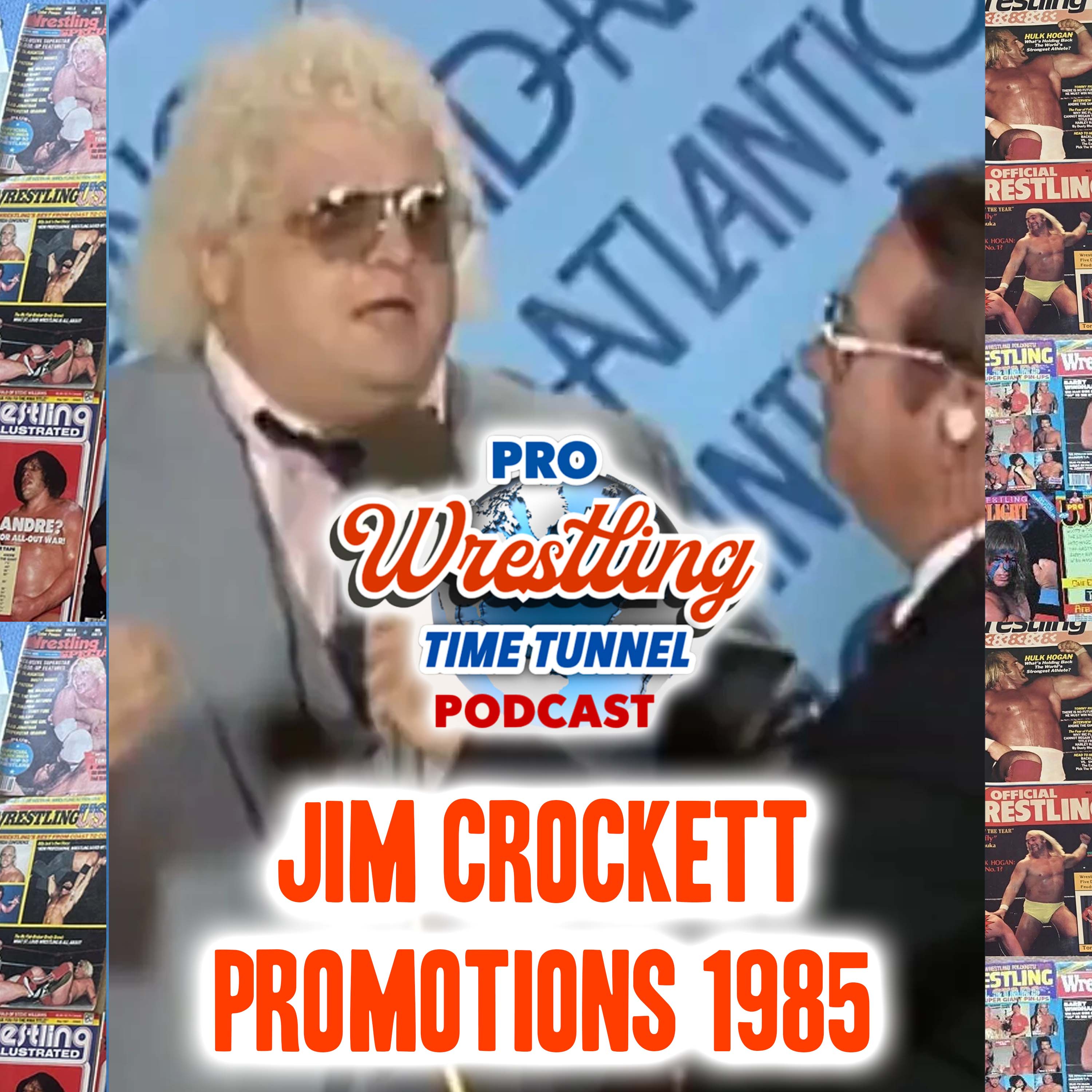
And today we're going to be talking about Jim Crockett Promotions. And I'll get to more of that in just a little bit.
I have been so busy lately doing podcasts. I was on Brian Ferguson's Bumps and Thumps show. I was on Talking Memphis Wrestling with Randy Hales and Pat Trammell and my friend Michael St. John.
I've been on the Twisted Turnbuckle show with Chris DeCarlo and Benny the Player Scala and Mike DiGiorgio and all of those great people over there, Melody Koloff, who has been special guest there promoting the Koloff Family Tour.
I am going to be appearing on the Bob Smith Outdated Wrestling Hour coming up really, really soon.
We should have a day. I may have a date on that.
Let's see here.
I think I did.
We are going to be. I am going to be on that show on Friday, February 27th. So a week from this Friday, I'll be on the Outdated Wrestling Hour, my very first appearance with Bob Smith, former editor and journalist for Pro Wrestling Illustrated. Bob's got a great show and I've been very jealous of not being able to be on there. And so many of my friends have been on there. I'm like, what's wrong with me? How come Bob doesn't want me on there? But just, you know, just timing and schedules and Bob's got a long list of people to be on his show. So we, we, we worked it out. I'm going to be on there a week from Friday and looking forward to you hearing the fabulous conversation that Bob Smith and I had on his show. And so, yeah, so it's just been really, really busy lately. Been on a lot of other shows besides the Home base here, the pro Wrestling Time Tunnel history show.
And I, I love it. I love all the great people that I interact with and all the great conversations we have about pro wrestling on all these different shows that are available for the fans for wrestling history and pro wrestling talk. So I'm glad about that. You know, for those of you who are brand new listeners, I want to recap my little story.
Last year I decided, well, actually in the end of 2024, my mom, my dad passed away three years ago. And so my mom's been living alone on our family ranch here in western Kentucky that I grew up on.
And at the end of 2024, I decided to move from Columbia, Missouri, back here. And I had an opportunity to buy a little piece of property right adjacent to the family ranch. And there was a lady who was here that was a good friend of my mom's who passed away. She was 90, I think.
And so I bought her home.
Her and her husband were neighbors and friends of my family for years. And I bought their home and I spent some money to remodel it and put in some pretty cool stuff here for the Pro Wrestling Time Tunnel offices and studios and moved in in late July of last year.
And here's my point about telling you, giving you that preamble. There is, there is so much to do when you move and they're moving across town is one thing. Moving across 325 miles and across state lines is another thing.
Getting your medical records all transferred, getting your. And I have, you know, had some medical issues in the past where I've had to have various specialists involved and doctors, and getting all that transferred and finding new doctors here and new places to go and get stuff done. And yesterday, or actually, let's see, earlier this week, we'll just say that then I don't have to pinpoint the day. Earlier this week, I thought it's time for getting close to a dental cleaning and I need to find a dentist down here. And so I went Monday and had all my dental records transferred to this new place and filled out all the new patient forms and got accepted and got it cleared through my insurance and all of that stuff. Got an appointment scheduled for March.
Just amazing. I had to send a FedEx.
I had to send some paperwork out for my other business, but I had to send some paperwork out and it needed to go FedEx. And people had sent it to me in a FedEx envelope and had already had the return address and everything and envelope inside. So I just had to sign the papers. And put it in there. But then I had to find a FedEx place to send it back. And it's just funny how I lived in Colombia for 26 years and I had lived in Cape Girardeau for seven years before that in Missouri, and then I'd lived in Paducah for years before that. And this, when you live in a place for a while, you learn where all the stuff is, you know, and this things as simple as finding a drive through car wash.
Now, I went to the same one all the time in Columbia for over 20 years, but here my truck's dirty and I need to go wash it.
After the winter time that we had with all the snow and the ice and the sludge and all that getting all over my truck, especially when it starts to melt, how messy it gets and going and finding a car wash, you just, you know, you just don't think about those things. You drive right past them and don't even notice them until you need one. And then you're thinking, okay, where is the car was.
Or maybe I'm just getting old and my awareness skills are failing me. Hey, if you haven't listened to some of our recent episodes and you're a new listener, let me tell you, you need to go back and listen to all of our 1985 Territory Series because we've done the WWF, we've done Florida, we've done world class, we've done the awa, we've done Memphis, Tennessee, we've done Continental down in Alabama with Ron Fuller. And coming up here on the show, we're going to be doing Mid south wrestling next week with Greg Klein. And then the week after that, we're going to finish up our series in Portland with Mike Rogers and Frank Culbertson. So check that out. We've also released one bonus episode and we got another one coming up. But we released a bonus episode this past Monday with Lizzie Flanagan, who has written the Gino Hernandez biography I am your champion.
And this is February of 2026 is the 40th anniversary of Gino Hernandez passing away. So we did a bonus episode all about the life and career of Gino Hernandez. And Lizzie has written the biography of Gino I am your champion, which is available from McFarland Books or wherever you buy books, Amazon, Barnes and Noble and others. And I encourage you to get that book from Lizzie.
If you listen to our podcast show, you're going to find out it's a very compelling conversation. Having Lizzie over to the ranch for a discussion about Gino's Life and his career and the rumors about him being Paul Bosch's son and about the circumstances around his death and about his family.
Married the same woman twice.
I don't know if I, I don't know if I admire people like that or if I think they're crazy. But anyway, Gino married the same woman twice and had a family. And we talk about all that in this special episode of the Time Tunnel podcast. Now we have another bonus episode coming up and we will release that this coming Monday.
This coming Monday I did. I sat down and invited Scott Teal over to the Richards ranch and we sat down and had a conversation around the great Frankie Kane.
And let me tell you something, Frankie Kane had an amazing career in professional wrestling. He was over 90 years old when he passed away just the other day. And he's the last living guy who actually saw Jim Landos wrestle.
And so kind of a long career through the evolution of wrestling. And as you go through Frankie's life, you learn so much about shoot fighting and the carnivals and boxing and the old fight clubs that they used to have and the, the territories and just so much wrapped up in the life of Frankie Kane. And it was a great discussion. Scott was very close to Frankie and so I wanted to give him an opportunity to talk about his close friend. And Scott's released two books on Crowbar Press, two volumes about the life of Frankie Cain. And I just wanted him to have an opportunity to come on here with me and let's talk about Frankie and give a tribute to Frankie and his life in professional wrestling. And that bonus episode is going to drop this Monday.
So you'll be able to get that where you get all your pro wrestling Time Tunnel podcasts either on YouTube or on Substack or the audio versions wherever you were on all the platforms. So if you download your podcast at a certain place, we will probably be available there too. If you search for pro wrestling Time Tunnel History show or you might put in my name, Tony Richards. Okay, I'll tell you all about the other stuff we got going on at the end of today's program. But right now let me welcome Jamie Ward. He's the, he's a first time coach host. We, we had a lot of first time guests on with this 1985 series and Jamie is the latest and the newest and he is on the podcast the Other Ship with a couple of other guys and they have a fabulous show. And I was so happy to welcome Jamie over to the ranch to talk about Jim Crockett Promotions in 1985, and it was a very pivotal year. It was the year that Jim Crockett Jr. Bought the contract for WTBS from Vince McMahon and the WWF. So it exposed Jim Crockett Promotions to a national audience with the cable penetration of WTBs.
And it sort of presented some logistical issues with the wrestling and also with the booking and with the syndicated programming in the old Crockett territory that was still running. We talk about Ric Flair being a baby face in the Carolinas and being a heel everywhere else.
They had that amazing program that they shot right out of the gate with Magnum, TA and Ric Flair on television on wtbs.
They had the Championship Challenge series. They had the first Great American Bash in July that year.
They brought in some talent from Bill Watts to even strengthen the roster even more. They had Starcade 85. They had a lot of great things going in 1985. And we're going to talk about it right here today as I welcome Jamie Ward here to the Pro Wrestling Time Tunnel history. Hey, everybody. Welcome back to the Pro Wrestling Time Tunnel Podcast and history Show. I'm Tony Richards coming to you live from the Bluegrass State at the Richards Ranch. And tonight we get to expand our family once again with another new member to the Time Tunnel crew. And Jamie Ward is going to be joining me tonight. I've been wanting to do a show with Jamie for quite some time. You've probably heard his work on the Other Ship and also on Regional Wrestling with Ray Russell. Those shows are on the Russell Copia Network, and you might have heard him on Bob Smith's podcast and maybe John McAdams. He gets around from time to time. Jamie, thank you so much for adding our show to the wide list of appearances that you make.
[00:13:54] Speaker A: Well, thank you for having me, Tony. I greatly appreciate it. Yeah, I just love talking wrestling, so if anybody ever wants me to talk wrestling, just ask. I'll come on and join them.
[00:14:02] Speaker B: Wonderful. Wonderful. Well, we're going to be going back in the Time tunnel tonight to 1985. We're going around the territories where the ones that are still remaining as everyone has national expansion on their mind, they're either thinking about expanding nationally or they're a little bit in fear about who's going to be expanding into their boundaries.
And one of the territories that has expansion on their mind is Jim Crockett Promotions.
And that's who we're going to be talking about tonight. So 1985 was a very pivotal year and probably the year where they actually started thinking about national expansion. I was doing the WWF 85 show with Steve Giannarelli. And he asked me, he said, when do you think Jim Crockett Jr. First started thinking about expanding? And I said, well, it couldn't really have been before 85 because the Briscoes offered to sell him the TBS time slot and he wasn't interested. So I don't. And that was in 84. So I, I don't think he was really thinking about it until 85. Is that kind of how you read the situation?
[00:15:15] Speaker A: For the most part, I think it was late 84 when he gets into that town, exchange agreement with Memphis and Ole Anderson down in Georgia.
And I think that's probably where the seeds were planted.
[00:15:30] Speaker B: Yeah. There for a while he was at.
[00:15:32] Speaker A: That point because by the time you get into January, he started to get into Philadelphia with the syndicated show. He's in Pittsburgh with a syndicated show. He's put shows in Baltimore and Washington syndicated. So I think when he joined up with Oli, he said, you know what, let's experiment a little bit and see what happens.
[00:15:57] Speaker B: George the Animal Steel claims that's when the war started is when Jim Crockett went into Baltimore.
He said that Jim, Jim Crockett fired the first shot.
[00:16:08] Speaker A: Well, I believe only fired the first shot by going into Johnstown and Altoona right back in was it August of 83.
[00:16:17] Speaker B: And I don't really buy that Vince wasn't thinking about expanding until Jim went into Baltimore. I think, I think Vince, when Vince Senior went to the 83 NWA convention and told people that he was selling to Vince Jr. And he wasn't going to do things the same way he had done them. I think that's what he was talking about.
[00:16:37] Speaker A: Oh, absolutely. And you could tell by his TV product, the way he upgraded, he put the big WWF flag in the background, which they never had before, you know, above the audience and just certain improvements in the whole television product that Vince had bigger things in mind.
[00:16:55] Speaker B: Sure. And, and he had bought the TBS slot originally after buying the Georgia company.
And he got the best, smartest long term television guy with Jim Barnett. So I'm pretty sure that's why he wanted Jim to be on the team.
And then he got a building guy who knew all the building owners in the south with Jerry Briscoe. I'm pretty sure that, you know, so I think Vince had a plan and that's, you know, I give him a lot of credit for putting a great team together that he did.
[00:17:30] Speaker A: Vince, he would be a multi.
Forget about the personal stuff right now, but he would be a multi, multi millionaire for being not having any business savvy at all. I mean, it was a roll of the dice that paid off for him. Everything he, he touched kind of might have been rough at times, but it all always worked out for him.
[00:17:50] Speaker B: Yeah, I, you mentioned the talent exchange. I know there was a period of time there where Jim Crockett was pretty much in charge of the NWA title because he had Flair.
And I think the deal he was offering was I will send you half of a card and Flair as the champion for 50% of the gate.
And so that was how you were getting the NWA champion in 85.
[00:18:18] Speaker A: Yes.
Example of that is, I forget what month it was, but he sent Ric Flair and a crew up to Portland, worked for Don Owen on his show and unfortunately all Owens guys were in the prelims and all Crockett's guys were the main events.
[00:18:37] Speaker B: And I was so excited when he partnered with Jarrett. I was excited when they came to Memphis. They brought the Bash, they call it the Bash on tour. And they came to Memphis and they came to Lexington, Kentucky, which I went to that show.
And I had been to Lexington earlier in the year to Randy Savage's Loser leaves Town match when he went to the wwf.
So that was a little heartbreaking to have Randy leave to go because as a Southern wrestling fan, I wanted to win the war. You know, I could, I could see what was going to happen.
And I thought if, if Jared and Crockett can work together, this, this could be really great. And they were already working with Florida and like you said with Portland. And so there were some people always point out the failure of the Pro Wrestling usa but there were some agreements that were working and they were drawing good houses and putting on great shows.
[00:19:38] Speaker A: Yeah, for a solid year that the Pro Wrestling usa when they ran those Meadowland shows, it was mostly awa, but you had two or three Crockett guys participating, including Flair on, on all those shows. And eventually Crockett actually stole a lot of those guys down the line.
[00:19:56] Speaker B: Right.
[00:19:57] Speaker A: But, but you see that they were co promoted there, you know, not only at the Meadowlands, but the Baltimore Washington shows. From everything I could tell, they were basically co promoted with the awa. So all was good in the world for like a year.
[00:20:12] Speaker B: Yeah.
[00:20:13] Speaker A: Before somebody, you know, didn't like whether it was Vern, whether it was Rocket, didn't like what the other side was doing and they all went their separate.
[00:20:21] Speaker B: Ways or, you know, I mean, and I, I, I like Dusty Rhodes, but I can see him exerting his, I want to run the whole thing, you know, deal. And I thought, you know, somebody like Jarrett's probably going to say, hey, I. I'm going to hang on to my territory here. I'm not going to turn.
Because they did that Pro Wrestling USA taping in Memphis and all the Memphis guys did jobs and. And I think that was kind of the beginnings of I'm not going to turn all this over to someone else.
[00:20:53] Speaker A: Well, that's why it ended up, ended up with just Bird and, and Crockett doing the Pro Wrestling usa. But even for the regular TV tapings totally turned into just Verne with Vernon using the JCP guys because they were on the local TV anyway, syndication, so he didn't need to have them at the TV tapings. But yeah, that whole premise of Pro Wrestling USA I was really excited for. It just never, never panned out. And unfortunately we had just lost Channel 11 in New York here in Philadelphia on the cable systems. So I wasn't able to watch it. I had to, you know, try to go and find somebody that I could trade tapes with back in those days, end up getting that show. And it would be, you know, like two or three months after it was already over.
[00:21:38] Speaker B: So let's frame this up at the end of 84.
Crockett is coming off a disappointing starrcade.
It was not as hot and as great as the original had been in 83. And the finish to the Dusty and Flair main event was not the greatest. And Frazier, whoever was supposed to do something, didn't do something. And it was supposed to lead to a Dusty and Frazier program or something, but it just never panned out. And Dusty has not been there for just a few months. So his is new booking and all hasn't really taken effect. So they're not ending 84 on the greatest of notes, right?
[00:22:20] Speaker A: No, exactly. I mean, doing some research for this, I went back and read Dave Meltzer's observers from back at that time. And he was kind of, you know, picking on JCP and Dusty at the time. Just whatever they were trying, just. It wasn't working. I mean, the biggest blow was saying they signed Barry Windham to this big monster contract and Barry walks out within a month and goes off the vents.
[00:22:45] Speaker B: Right. And then that, that, you know, that obviously leaves the hole for the future Baby Face. That would be Magnum. Ta. But you can see the way Magnum was booked and you can tell that was supposed to be Barry.
And this didn't, didn't pan out. And he left to go up to, up north to the WWF and work with Rotunda and make a better paycheck because I don't think they were drawing very well. And that's why Barry left was because he wasn't making any money because they were still getting, still getting paid based on houses.
[00:23:21] Speaker A: Right. Yeah. I had a chance to meet Barry Wyndham at one of Barry Rose's fan festival and I asked him something along those lines, you know, why did you jump? And he basically said the same thing you just did.
He wasn't getting the money that was promised to him.
[00:23:36] Speaker B: So how do we, how do we kick off 85 here, Jamie with Crockett?
[00:23:40] Speaker A: Well, we kick off kind of slow. I mean, the, the biggest probably thing they had going for him is Baby Doll. They brought Tolly Blanche Baby Doll in to be with Tully Blanchard and she just drew instant heat.
[00:23:55] Speaker B: Yeah. From the minute they did that video with her getting off the plane and Tully doing the. Well, I guess they started it by doing the, the I'm looking for the perfect 10, you know, so everybody expects something.
Then they get Nicola, who, you know, I mean, it was the perfect angle to have her do it. And, and she, she was over from the minute she walked off that plane in that video.
[00:24:22] Speaker A: Yeah. And she was a different kind of woman. She wasn't your Miss Elizabeth, who we hadn't seen yet anyway. But she wasn't the dainty little.
[00:24:31] Speaker B: She wasn't, she wasn't Sunshine, you know, she wasn't Sunshine.
[00:24:35] Speaker A: She was a big girl who could hold her own. And you actually kind of fear that, you know what, when she goes to hit somebody, that's going to hurt.
[00:24:45] Speaker B: So I guess, you know, the, the, the first big thing that starts to turn things, I guess is Magnum beaten Wahoo. Right. For the US Title.
[00:24:55] Speaker A: Right. I mean they, they played that perfectly. They, they fed Magnum 10 second squash matches for two or three months and then as soon as the calendar turn marked, he, he winds up beating Wahoo in a cage match. But yeah, Wahoo was a heel, was tremendous. I mean, the team of Tully and Wahoo going back through 84 was a great combination, but they kind of separated them in 85, which was a shame, but Wahoo didn't have much time left in the company anyway.
[00:25:27] Speaker B: I know Jim Crockett Jr. Has said that he tasked Dusty from the very beginning with creating four big events that they could have during the year.
And they already had Starcade as their Thanksgiving. And they create this thing at the beginning of 85 in March called Silver Star.
And it was Silver Star 85. And it was supposed to be like a celebration because this was the anniversary of Jim Crockett Promotions founding.
But Silver Star turned it out just to be. I mean, even though they drew almost, almost 10,000 people to the Greensboro Coliseum, Silver Star didn't stick. It was just a one time thing.
[00:26:12] Speaker A: Yeah. Which was a shame because, you know, we had just gotten the syndicated show Worldwide Wrestling in January in Philadelphia. And on that first show, they already had the first arena show hooked up for February, for February 5th.
And that, that was partially Georgia guys with JCP. And then they came back, you know, at the end of February. But when they started plugging that Silver Star show, I would have loved going down and seeing that.
[00:26:48] Speaker B: Yeah, yeah, I, I think, I think the concept was good, but it wouldn't be until July, and I don't want to skip ahead. It wouldn't be until July till they'd create their first big event after Starcade that would actually stick for a while. But that last part of March, right after Silver Star, is when they complete the $1 million deal for the TBS contract.
And I was so I remember exactly where I was and what I was doing when I tuned into Georgia Championship Wrestling and it wasn't Georgia Championship Wrestling, it was the wwf, which I already was getting on usa. So I was so disappointed because I, even though the Georgia wrestling was not what it had been before, I was still excited to watch it because it was more my style of wrestling that I liked. Then all of a sudden we have Black Saturday. Well, then almost a year later, I tune in one day just to check it out and there's Jim Crockett Promotions doing the studio show on TBS the first week of April. And I was so happy because I was at the time, as you mentioned, I was tape trading my Memphis tapes that I was getting. I was trading those for Worldwide Wrestling and Mid Atlantic Championship Wrestling, the two syndicated shows. I was getting those in tape trades. And I continued to do that because they had matches and stuff that the TBS show didn't have. But I was just excited to get more of Jim Crockett.
[00:28:25] Speaker A: Yeah, like I said, I loved it from the first moment that I got to see it in syndication. And then him taking over the WWF spot was just, you know, an early Christmas present at that point for as. I didn't mind Vince taking over because I knew from the sheets at that point Vince was probably going to take the show over, but I thought it was going to become just Georgia or World Championship Wrestling sanctioned by the wwf and they were going to keep that live show.
That's not what happened.
[00:28:57] Speaker B: Right.
[00:28:58] Speaker A: And then Ted forces them right before WrestleMania. Get off or put a live show on. So he kind of puts a studio show on, and then he ends up selling the Crockett. But actually, what I would like to know is, and I did some research and I couldn't find it, and is, how much did he pay for Oli's TV time?
[00:29:18] Speaker B: Yeah, I'm not sure.
[00:29:19] Speaker A: Is that just a handshake agreement? Because all of a sudden, you know, they had the 7am show and two weeks the week before. I'm sorry, not two weeks. The week before, he takes over a TBS spot.
I record it and I go to watch it. And here's Tony Schiavone saying he's filling in for Gordon solely who's on vacation. That's never a good thing when Gordon says he's going on vacation.
[00:29:42] Speaker B: Right.
[00:29:43] Speaker A: And then the next Saturday, there's Shivani again. And then Saturday night, there's Shivani. But now we're on to a new set, and we're in the World Championship Wrestling set. It was just great.
[00:29:53] Speaker B: So now that I think about it, Jamie, I don't think he paid anything for it because one of the conditions of buying it was that they would be exclusive.
So I think Watts lost his slot, and I think Oli lost his slot because Crockett had an exclusivity clause in the contract that they would be the only wrestling on tbs. So he might not paid anything for it. He might have just given Oli a job.
[00:30:18] Speaker A: Hey, if I'm only. I'm fine with that.
[00:30:20] Speaker B: Yeah. Yeah. For the next year. Next year, year and a half. I mean, Oli's got a nice slot there in the Horseman. And I mean, he didn't start out there, but he ended up there. And, you know, and he's got, you know, a pretty. Drawn. Pretty good money, I would imagine.
[00:30:36] Speaker A: Oli was already, from what I've heard Bob Roop say, was already a millionaire. So the wrestling business wasn't about him making money. It was more like pride for Oli.
[00:30:48] Speaker B: We were just talking about this when we were doing the Florida show the other day. It really worked to Dusty's advantage, too, because Crockett needed to get over in Atlanta. And people will always remember that 1980 turn Olean dusty, and it'll never be over.
And they just kind of kept that going a little bit in interviews, you know, when, especially after the Horsemen formed, almost every interview Oli would do, he'd, you know, call out Dusty and say, hey.
And, you know, they'd break his arm in the parking lot and that kind of stuff. And he'd say, I told you, Dusty, it ain't ever going to be over, you know.
[00:31:26] Speaker A: Yeah. They continued on, which was a great move. But what is kind of crazy is six, seven months before that, they were teaming in Georgia. Mm.
Again.
[00:31:35] Speaker B: Right.
[00:31:37] Speaker A: But you were at that point, you were supposed to forget about the 1980 turn. But poor Thunderbolt Patterson.
He was at the top of the Georgia promotion. And all of a sudden, within a month, two months go by Thunderbolt.
[00:31:51] Speaker B: Yeah. And I. I think. I think there were several guys in that position that just either. And as far as I know, Thunderbolt had a good relationship with the Crockets. He'd. He'd been in there for years and he had a successful tag team with Jerry Briscoe. But the people who didn't were Roop and Tommy Rich. And some people like that had never really had a run, you know, with them, although, you know, and Dusty's in a precarious position there because he's worked with all these guys and he pretty much liked, get along with everybody, but he can only carry so many people at that point.
[00:32:30] Speaker A: You know, he did something. I don't know if it was him or if it was Crockett, but right off the bat, they did something brilliant. They had their first card, I want to say April 14th. April 15th, under their banner at the Omni.
And instead of putting Dusty Flair together or some of other. They could even had Oahu Flair, they went Michael Hayes. They brought Michael Hayes in because everybody loved the Free Birds by that point.
They brought Michael Hayes in to be Ric Flair's opponent, and he even had some TV time to talk up the match.
[00:33:04] Speaker B: Yeah. And I remember being disappointed that all the Free Birds didn't come in, you know, that Michael was just there for that. That run.
And then he goes down to. Or he might have even been in Florida at the same time, because I.
[00:33:18] Speaker A: Know he was in Florida. Yeah, he might have been. Had just taken over for.
From Dutch.
[00:33:24] Speaker B: I think they were co bookers for a while. And then I think Dutch went home to Tennessee and.
[00:33:30] Speaker A: And then when Hayes goes back up.
[00:33:32] Speaker B: To awa, I believe.
[00:33:35] Speaker A: Yeah, they go to awa. That's when Wahoo takes the book.
[00:33:38] Speaker B: Right, right.
[00:33:39] Speaker A: The rest of Florida. But you covered with Howard anyway, so.
[00:33:42] Speaker B: Yeah, well, but they. But I. I always want to give Wahoo credit there because he continued to have fans coming.
You know, a lot of times what you Hear is like when Dusty left, the crowds dried up. But that it didn't die that quickly.
It was a. It was a progression over time.
Obviously Eddie taking his life was a big bump too, because that was the captain of the ship.
But they continue to stay. Hang in there. And they were drawing five, 6,000 people to Miami. They were drawing five, six. I mean, that first Battle of the Belt show was pretty good. And they drew.
[00:34:19] Speaker A: They were confident enough to hold that kind of card that they syndicated all over the country.
[00:34:24] Speaker B: You bet.
[00:34:25] Speaker A: If they weren't drawn well, they would have tried it.
[00:34:27] Speaker B: And the other thing Crockett did that I always thought was good too is they. They ran two crews. They. They kind of ran a Georgia crew for the Georgia Loop. And they ran the regular Crockett crew for the Crockett. And they'd mix them up some for the Omni.
But they would run Ohio and Michigan and Georgia with the Dick Slaters and the Sawyers and the people that the Georgia people knew.
And then they. They would mix them up. I know when Jim Cornett and the Midnight Express come in, they got on the Georgia Loop for the first. Because Dusty wanted to keep them in the Rock and Roll Express separated. So put the Midnight Express on that Georgia, Michigan, Ohio.
Feuding with the Sawyers.
And I thought that was a. I thought that was good because that didn't throw the audience in too much of a whiplash. Trying to learn all new people and all new angles and all new feuds.
[00:35:18] Speaker A: Yeah. Which was a. A very good move on Dusty or Crockett, whoever made that ultimate decision. They kind of separated into two booking offices. And it's not until we get into the 80.
April, May of 86. Do they kind of start doing away with the. The Georgia booking.
[00:35:34] Speaker B: That's right.
[00:35:35] Speaker A: Of it.
[00:35:35] Speaker B: That's right.
But as soon as they get on tbs, man, they don't waste any time at all. And running Flare and Magnum, I mean, they. They put them together right away. Every Saturday on tbs. They were at the desk at each other's throats and challenging each other to impromptu matches. And. And those. Those matches drew pretty well.
[00:35:59] Speaker A: Yeah, they did. But, you know, at that time, Crockett had quite the.
Easy for me to say.
Quite an issue going on. Because here in the mid Atlantic proper, Ric Flair is a good guy.
So they have Flair feuding with, you know, Buddy Landell.
A couple more shots of Wahoo before he leaves.
They even have, you know, that's what leads up to that.
[00:36:27] Speaker B: Yeah, you're right.
[00:36:28] Speaker A: Summertime match with Koloff but yet on the like I'm just going to talk from the Philadelphia experience.
[00:36:34] Speaker B: Sure.
[00:36:35] Speaker A: Blair was a heel in the localized interviews and. And at the. At the Philadelphia Civic center. There's no doubt that Ric Flair was the heel. He was the heel against Sergeant Slaughter, which was a great move.
[00:36:49] Speaker B: Yeah.
[00:36:49] Speaker A: To bring him in for the one show which they use him at Silvercade or Silver Star. They brought him in the team up with Kenodle. So they had to figure out how to get.
And we'll get to it, how to get Blair just hating across the board because pbs they were pushing Blair as a heel also.
[00:37:11] Speaker B: Yeah, you're right. In the summertime in the Mid Atlantic Loop in the Charlotte, Greensboro, Greenville, South Carolina, Philadelphia. Well not the Philadelphia maybe, but they were doing Flair and Nikita and Flair and Landell.
But then they were doing Magnum in the la's and the Ohio, Cleveland, Cincinnati.
At the Omni in Atlanta they were doing Flair and. And Magnum.
So they still were using him kind of as a face in the Crockett loop.
[00:37:42] Speaker A: Yeah, I was never a big fan of Magnum. Ta. I just. Because I didn't like the character. There's something rubbed me wrong. I just never cared for him. But hooking him up with Blair almost instantly on tbs, what was the right move? Because it just elevated Magnum up to that next level which Dusty was trying to do.
[00:38:03] Speaker B: Right. And, and I think putting him with Flair early on, I think Dusty was trying to give him.
I think it was trying to give him ring time with a veteran, you know, like Flair and New Flair could carry the match. Right.
And I've heard people say, well Magnum would have been champion in 86. I'm like, I don't think so. I mean I don't think. I think it would have been at least Starcade 87. Because I just don't think Magnum had the, you know, by the time he got to Starcade 85 and he was working with Tully, that's another matchup where he got a guy who could really work and carry, you know, a great match. He was starting to kind of figure it out.
[00:38:46] Speaker A: But I had.
[00:38:46] Speaker B: But Magnum hadn't. Magnum hadn't been in the business very long, you know, when.
[00:38:51] Speaker A: No, only about four or five years at that point, tops. But I met Magnum again at one of the fan fest in Florida and I said to him, any truth to the story that you were supposed to get a run with the NWA title? And he did, you know, told all the audience that he was supposed to get a run in 87.
But he was going to turn heel on Dusty Rhodes first.
[00:39:14] Speaker B: Yeah. Okay.
[00:39:15] Speaker A: And then get the title. And then Starcade87 was supposed to be him against Dusty instead of Ronnie Garvin.
[00:39:22] Speaker B: Yeah. And Rick.
Yeah.
When Ragnom had his car wrecked, that's when we got the impromptu Garvin feud in 87. And we got Jimmy in the summer and Ron in the fall. And I think it was supposed to be Ronnie Garvin and flair at 86. Stark 886. And they were going to put Magnum and Nikita in the cage for the U.S. title.
[00:39:44] Speaker A: Yes. That's a story. I've always heard it was going to be Ronnie. And then they.
They just moved it over to Nikita when. When Magnum got hurt. But that was his. His promise he would get it the next year.
[00:39:56] Speaker B: You can tell Dusty's booking was all scrambled, you know, because his original plan was kind of thrown out the window.
And. And he. And you know what I've always wondered. I know we're talking about 85, but I'll just throw this out to you. I've always wondered.
Barry and Dusty's relationship must have been damaged because I always wonder why he didn't go back to Barry in 87.
You know, because they. At the first part of the year, Barry and Flair have those great matches leading up to Crockett Cup. Why didn't they just go ahead and. And program Barry and Flair for the rest of the year through Starcade instead of doing the two Garvins? That.
[00:40:34] Speaker A: I mean, that is like you. It's like you said, there had to be still some heat there. Dusty had to swallow pride. He has Barry to come back.
[00:40:42] Speaker B: Yeah. I mean, because that would have. I mean, it was supposed to be Barry to begin with, you know, and then Barry left and it was Magnum. Well, when Magnum got knocked out of the picture, unfortunately, hated that for him, I would have just gone back to Barry, you know.
[00:41:00] Speaker A: Oh, Dusty.
It really had to be personal when he left, because you're right, because we didn't see him for over another year.
Even when he was free from wwf, there was no contact that I ever read about.
[00:41:16] Speaker B: Yeah.
[00:41:16] Speaker A: And they've kind of forced his hand.
I gotta swallow my pride and bring him in. Even though they always say in wrestling, you know, green talks.
[00:41:27] Speaker B: So we're at, you know, so we're in April. They get the TBS time slot. They. They pay, you know, some pretty good cash for it. But it gives them national exposure. The. The penetration that TBS had at the time on cable, plus the syndicated shows they have so I'll let you go from here. So we go from here to the build to the Bash.
[00:41:50] Speaker A: Yeah, I mean, was very interesting. You know, I got to see the build up, the animosity of Nikita Koloff and Ric Flair, you know, go. Going along.
And it was weird to see it in Philly because here again, Flair is a heel, but, yeah, he's going to go up against another bad guy in Nikita. So I personally was loving it. I mean, I always wanted Ric Flair to be a face and he. He just never quite got there.
[00:42:20] Speaker B: But most of that. Most of that build with Nikita was on the syndicated show, wasn't it?
[00:42:26] Speaker A: I mean, yes, I believe it was even on a syndicated show where David Crockett is interviewing Nikita. And then David says something kind of sharp and.
And then Crockett gets hit with the Russian sickle.
And then Flair comes out to defend him because Rocket and Flair were in that lane crash together and that they were good friends and everything. So there you had your. Your main event all set up.
[00:42:53] Speaker B: And then we also had.
Because the Road warriors were still working in the awa, and so we got a build with the Road warriors against the Russians, which I always thought that was. I went to the first Bash in Charlotte and I really wanted to go. One of the things I really wanted to see was that match. I wanted to see the Road warriors and the Russians go at it.
[00:43:17] Speaker A: That I was so happy when I finally got to see that at the Philadelphia Civic center, because that's the match I wanted to see. I mean, I, I know what wrestling was at that point, but I was still excited. You played Iron man over that, you know, sound system and just like the Rock did a couple years ago. I know you don't watch the current product, but he came out, he showed you the goosebumps on his arm. I had goosebumps on my arm when the Road warriors came out to face the Russians because it was the one team that just eyeballed it, that had a shot to beat the Road Warriors.
[00:43:50] Speaker B: Yeah, yeah, you bet.
So what else was going on in that build to the Bash, Jamie?
[00:43:57] Speaker A: Well, you still, you.
The feud that would never end. We thought Oli and Dusty would never end. But for 1985, the one that wouldn't end was Tully Blanchard and Dusty Rhodes.
They just kept going at it back and forth. They were swapping between the. The NWA TV title going back and forth, that later on they swapped the US title going on back and forth. So they set up for.
As weird as it sounds, it wasn't Nikita And Ric Flairs as the last match that night, it was Dusty Rhodes against Holly Blanchard, in which. Just let me double check my notes here. What was in a steel cage match that they finished up with, which of course Dusty went over. But Dusty did a hell of a job elevating Holly Blanchard that whole time.
[00:44:48] Speaker B: Yeah.
[00:44:48] Speaker A: To get to this point.
[00:44:50] Speaker B: And I think Dusty knew Tully was, I mean, selfishly, as a baby face and as one of the best drawing baby faces of all time. I think Dusty knew that Tully was going to make him look great.
You know, they were going to have a. Tully was going to make sure they had a great match because Tully Blanchard is one of the best bumping heels I've ever seen. Now, one thing I wanted to mention, Jamie, was. And then I'm going to throw it back to you. But we talked about Flair a little bit. We talked a little bit about the NWA prior to May, which was right after they bought the TBS time slot. You know, Flair had always been paid based on the house in all these different territories.
But now, as the NWA champion, I believe it was on May 1, 1985, Crockett signs a contract with Flair that he will make no less than 170 grand a year.
And so he's beautiful for Rick Flair.
Now he's on a guaranteed contract for the first time as the NWA World Champion. So why would he want to go to Portland, let's say, and, and draw 2,000 people and get paid 10% of that when he knows he's going to make guaranteed money? Just work in the Crockett loop.
[00:46:06] Speaker A: Right. And just as you also mentioned earlier on, and we, we touched on it, you know, that he, Crockett, would contact the other promoters, such as Don Owen. I'll send you a couple of matches. And the world champion. So that was. Yeah, it was a win. Win for, for Crockett.
[00:46:23] Speaker B: It's pure, pure speculation. But I know you've thought about this a lot, so I want to ask you your thoughts about it. But do you think that was kind of a way for Crockett to get into those towns? Like, do you think he was just thinking about that one show?
Or do you think by offering that deal, he was already thinking about, we're probably going to go back there and it's good to get my guys in that. In that town.
You know, it's almost like a Trojan horse booking deal.
[00:46:52] Speaker A: Exactly. You're a historian. We both know that there's no promoter that was 100% pure with pure intentions. There's always something in the back of the head for every single wrestling promoter ever.
And while it, like you just said, the Trojan horse, it's. It's a good gesture, but in the back of his head is, you know, Don Owens slips up, I can just start promoting their monthly.
[00:47:17] Speaker B: And I think, I think Jimmy was raised to be an NWA guy, and he had been president of the NWA a time or two, and I think he still did not want to invade.
I think he thought it would be better if he was invited in rather than, you know, barreling in. And so I just think that might have been a way for him to get his guys in those other geographical areas without upsetting the old relationships too much.
[00:47:49] Speaker A: Yeah, I mean, if, like when I was examining some of the Florida results from 85, there are some combined cards with JCP talent and Florida talent. So it wasn't just Don Owen that he was doing it with, as you mentioned, Memphis, he did the same thing, and with the awa, of course, Fritz wasn't working with him. No matter what Fritz was, you know, he was.
[00:48:16] Speaker B: He was doing his own thing by then. He. He was. That's why Rick. He brought Rick Rude back to be his first, I think, world champion after he had.
He had pulled out. I should mention, too, that that contract with Flair on 5-1-85 for 100, that he would make no less than 170 grand was for six years.
So through 1991, Flair pretty much has a guarantee of not making less than 170 grand a year.
So the notion that he wouldn't want to give up the title, it doesn't matter. He's still going to be. He's still going to have a job. He's still going to be making good money. So, you know, I think they were prime and Flair a little bit for, you know, getting off the flare train, although they never really got off of it. I think they were thinking they were going to, you know, at some point.
[00:49:03] Speaker A: Yeah, Flair didn't need the NWA title. He could have been over without it. I think they just kept going back out of necessity. Yeah, this guy's not doing well. We got to go back to player. At least we'll be on solid footing and, you know, make it 100 and some thousand a year. It's still, as you go down, I know we're talking 85, but going up, down the line further, sure.
No wonder he had that conversation with McMahon in 88 about possibly, you know, jumping up.
[00:49:31] Speaker B: And by the way, he signed Dusty to the exact same deal.
So he signed Dusty to the same contract on 5-1-85, no less than 100 and grant 170 grand a year for six years.
But I mean, they didn't know that what was going to be coming in 88, of course. But you know, I mean it contracts not good no matter what if the guy can't meet the obligation, so.
[00:49:56] Speaker A: Very true.
[00:49:58] Speaker B: So where do you want to go from here? So we're going. We're in the springtime. We're headed toward the bash. It's going to be, you know, it's going to draw over 20,000 people to the outdoor stadium in Charlotte. Things look great.
Vince is going into other areas. Crockett's going into other areas. And actually their first, their first entry into California when they ran LA for the first time in June of that year after they'd been on TBS for six weeks. They actually drew initially going into those Southern California markets. So I think that gave them a little bit of fool's gold thinking that they could continue to go in those areas and draw.
[00:50:42] Speaker A: Which he was standing toe to toe with Vince out there.
[00:50:45] Speaker B: Yeah.
[00:50:45] Speaker A: On the Southern California at that point when he first went out there. It was not until later that the tide turns.
[00:50:52] Speaker B: And going back when you reread your observers, did, did you get the feeling that Dave actually thought Crockett was going to actually pass the wwf?
[00:51:06] Speaker A: Not really.
I. I don't think Dave ever thought Rocket would become the number one, but I think Dave firmly believed that it could be one and one.
[00:51:17] Speaker B: A gotcha, gotcha.
[00:51:20] Speaker A: Almost on the same level.
As long as Vince had Hulk Hogan, there was nothing.
There was no way they were passing. You know, it's not till 89, 90 that the fans really have had enough of Hulk Hogan.
[00:51:32] Speaker B: What was that?
[00:51:33] Speaker A: Getting teased with Macho man and Dibiase.
[00:51:36] Speaker B: I mean, did the. Did the Philadelphia. Did the Philadelphia, coming from that market and being a fan there, did the Philadelphia market prefer Crockett?
[00:51:49] Speaker A: I would say the smart. The smarter fans did. I. I won't use the term smart fans, but the smarter fans did. They were selling out both arenas in. Later in 85, 86 and into 87.
They would have nights that they would run a Civic center in Center City by University of Pennsylvania. They would draw 10 to 10 and if the fire marshal wasn't there, they'd pack 12,000 to the civic center. And less than five miles away in South Philly at the Spectrum, WWF was packing in 19 to 20.
[00:52:23] Speaker B: I mean, obviously the reason. I mean, the reason. The reason I asked that is because the style I Mean, Crockett had blood, you know, and had, you know, a lot rougher, tougher, you know, bullying type of, you know, impact wrestling. And so it was, it was definitely a lot harder hitting than the WWF style. So I didn't know if that attracted the heel fan. Yeah.
[00:52:47] Speaker A: To the, to the Crockett shows. I mean it was the first time I was ever in a three quarter heel audience and I went to, you know, all the Crockett shows. I didn't go to many WWF shows anymore because they were all in prison the next day. On tape delay.
[00:53:03] Speaker B: Yeah. Gotcha.
So we get to the bash and Flair and Nikita on top.
They continued to run that, that, that match after the bash, of course, around the loop. Dusty one baby doll for 30 days and gets. Gets that.
All those vignettes still make me laugh of Baby Doll on the ranch and running off on the horse. One Nelson royals horse and all that. I just, I still laugh every time I watch those.
But, but that, I mean that had legs. I mean that, that whole feud until, I mean all the way up until, until they turn on or Dusty comes in the cage in Atlanta and in September and they break his ankle or whatever.
[00:53:49] Speaker A: I mean they're told him stay away.
And they happen. You want to come in the cage.
[00:53:56] Speaker B: And they, and they, you know, they, I mean they kept going back to Dusty and Tully, you know, for years.
So I mean that, that had impact.
[00:54:05] Speaker A: Yeah. But by the time we get up to that point, you know, fast forward a little bit now we're starting to get into the Magnum TA Tully feud. That is going to go all the way up through Starcade. And some of that stuff was really intense too. I thought some of the Dusty Tully stuff looked like it could have been semi real.
That Dusty or Holly Magnum stuff really looked like personal hatred on both sides there.
[00:54:35] Speaker B: What do you think about Crockett in 85 still promoting the NWA?
I mean, do you think it would have been better if he had broken off and created something different since he basically was the nwa or would it? What do you think they, they did the right thing with staying with the NWA brand?
[00:54:56] Speaker A: I think he did the right thing staying NWA. I mean, if you go a year later to 86 with the UWF, I don't think that helped Bill Watts as much as he thought it was going to help him by trying to pretend that he's like a new sanctioning body. He should have just stayed Mid south wrestling, in my opinion.
Because your local fan base kind of turns against you slightly. Because we're not Mid south anymore. We're UWF. We're keeping that NWA name.
[00:55:35] Speaker B: I 100% agree with you. I mean, I think.
I think that is a mistake that a lot of promoters made was that they abandoned their home. You know, they abandoned their home base, fan. They abandoned their home area.
You know, I'm going to have Ron Fuller on here soon, and we're going to talk about his promotion in 1985.
And instead of, you know, I mean, at some point, he rebranded and went, you know, to like, USA Championship Wrestling or something like that, instead of just continuing to draw a fence around his home area and making sure, like, it was almost like, if we don't expand, we won't be able to exist.
[00:56:20] Speaker A: And.
[00:56:20] Speaker B: And I'm not sure I agree with that.
I think you could. I mean, I think Jerry Jarrett lasted the longest by doing exactly what I'm talking about. He just stayed right there.
He had the opportunity to expand into Dallas, which he did, but basically he stayed right there with his territory and made sure his fans were taken care of. And yes, it's more difficult when people have something to compare you to.
[00:56:47] Speaker A: When.
[00:56:47] Speaker B: You can see something different. It does put a little bit of doubt into a fan's mind about which is really good and which isn't. But I still think you got to ride the dance with the one that rung you, I guess, is what I'm trying to say.
[00:57:00] Speaker A: I mean, he's on tbs.
TBS was always the nwa, except for that nine months that Vince took it over.
But that's what people like. They it he had to stay in the nwa so people thought it was a continuation of Georgia Championship Wrestling. It wasn't.
But a lot of the public, even to this day, considers it just like an extension of Georgia Championship Wrestling because it was many of the same talents, the same champions, the same championships.
So I believe that was the proper move for him, just to declare that he was, you know, the nwa. And everything is just going on all hunky dory.
[00:57:46] Speaker B: I mean, right up into that angle that we just sort of alluded to in September of 85. At the end of September, it's a Ric Flair, Nikita Koloff cage match.
So they're still doing that program from the bash. Now they're doing it in a cage. It's that match that Dusty came into the ring and got his ankle broken. And then they start trying to. They change and start going down the road toward another Dusty Flair Starcade.
[00:58:15] Speaker A: Right? And now we get the Ric Flair national heel turn right Even the people in Mid Atlantic from what I've been told, start to turn on Flair with this one. They didn't back flare over Dusty. They actually, you know, back Dusty at this point because the year before the Million Dollar Challenge, more people were behind Flair than they were Dusty because it was, it was a double baby face match but it was in Greensboro. So who else are they going to cheer for their local legend?
[00:58:45] Speaker B: So what's your thoughts about that? I mean do you think, do you think they should have gone back to Dusty and Flair again for Starr Kane?
[00:58:55] Speaker A: It doesn't bother me. Only because it was the first year of this company being on tbs.
He kind of got to disqualify anything that happened before what April 6, 1985.
[00:59:11] Speaker B: And the difficulty comes in Jamie, with trying to name another headline match for Starcade. I mean what are you going to do if you don't do that? Because that was their money match and they, you know, Magnum's not far enough along yet and they do a great job of putting him with Tully.
They got the Rock and roll and the Russians.
Or was it the Andersons? Rock and roll in the Andersons, I guess.
But, but it's hard to come up with a headline match besides Flair and dusty for the 85 starcade.
[00:59:44] Speaker A: Yeah, there wasn't really a better matchup and everybody that's watched TBS up to that point, Dusty had been on TBS for so long, they're behind him.
So as far as that particular star kid. Yes, I had no problem with with Dusty being the main event. I don't like the result of the main event. I think that was.
Did more damage than it did good at the time but I had no problem. I'm guessing Dusty must have actually had a knee issue that need to be done because they brought Dr. James James Andrews in show vignettes of him actually getting surgery. So I imagine he probably just had a knee cleaned up at that point. Or, or the ankle, I forget what they, they cleaned it was.
[01:00:32] Speaker B: But the, the angle on television was the ankle because that's, that's why he wore the white steel enforced boot which was also a part of Dusty doing something heal while still being a baby face.
[01:00:47] Speaker A: Yeah but so no, I had no problem with that main event. Like I said, I don't like the conclusion of it.
[01:00:52] Speaker B: But what finished.
[01:00:54] Speaker A: That was your.
[01:00:55] Speaker B: What finish would you have liked to have seen?
[01:00:57] Speaker A: Oh, I'm, I would have rather seen Dusty win the belt actually and he doesn't have to keep it for that long. He never wanted it that Long.
[01:01:05] Speaker B: Right.
[01:01:05] Speaker A: But he should have gone at least a couple weeks.
Coming out on TBS on Saturday two days later and saying, well, Ric Flair is no longer the world champ, but either is Dusty Rhodes or Ric Flair lost the belt. But Dusty Rhodes isn't champ either. And I think they totally clarified it even a week later. They kind of teased you on Saturday, but the people in the Omni left thinking they saw a world title change match and I'd have been pretty ticked.
[01:01:36] Speaker B: I don't think that particular angle has ever worked out well. Like, I, I think the fans always feel ripped off. Like when, when the AWA did it with Hogan.
I just did a story about one in 1966 where they did it with Tim woods and Mad Dog Vashon in Omaha, where the fans all left the Omaha Auditorium that night thinking Tim woods won the AWA world title. And seven days later they reversed it and said, no, he didn't really win it. The referee is going to put it back on the other guy. I just don't, I don't, I don't see any positives to that angle now.
[01:02:13] Speaker A: That and the.
As time went on, the Dusty finish.
[01:02:16] Speaker B: Right.
[01:02:17] Speaker A: There's just no, you're getting the fans excited for a cheap hop and then have it just take away from them.
[01:02:24] Speaker B: I'm okay with that finish once.
[01:02:26] Speaker A: Yes.
But I must have saw it four or five times in Philadelphia alone.
[01:02:33] Speaker B: Yeah.
[01:02:34] Speaker A: And it wasn't always Ric Flair. I mean, it was some other title matches also.
I was just never a fan of Dusty Finish.
[01:02:41] Speaker B: Who do you, who do you, who do you think are the top baby faces? I mean, who were. When you were watching in 1985, you said you weren't really that big of a Magnum fan.
Who else did you like on the babyface side that was on the roster at that, that time?
[01:02:56] Speaker A: Well, I was a Manny Fernandez guy.
[01:02:58] Speaker B: Oh, good.
[01:02:59] Speaker A: I liked Manny.
[01:03:00] Speaker B: And.
[01:03:02] Speaker A: You know the Boogie Woogie man. Yes. Everybody rips the Boogie Woogie man because he couldn't wrestle at, at that point, but he was entertaining as hell. You put him out on, on TV and he's captivated me for four or five. I have no idea what the hell he said.
[01:03:19] Speaker B: Right.
[01:03:20] Speaker A: He's captivated me. So they were two of the other big baby faces I liked when Wahoo returned, and I forget what show it was, Dusty needed a partner and he called out Wahoo and actually had Wahoo come on and say, listen, I know Dusty and I have had our differences, but I'm a man of my word. I don't like These guys. But I'll be there for Dusty Rhodes. And, and he was, and, and then he winds up being a face and Wahoo even winds up working star Kate, him and Billy Jack, I believe.
[01:03:49] Speaker B: Yeah, and I had, I had grown up in the Tennessee territory, so I had seen Jimmy Valiant going back to 1977.
So when I saw him on TBS, it was Jimmy. Like I already knew what to expect there.
And hey, he was over, you know, he was over.
[01:04:10] Speaker A: I wasn't the Jimmy Valiant I saw in the WWF in 1979. I was a little young for their first run. I, I missed that with 75.
But that 79 run, it was a totally different Jimmy Valiant. I, I had bought into it and I had already getting some Mid Atlantic tapes and Memphis stuff. So I was familiar with the good guy. Jimmy Valley.
[01:04:31] Speaker B: One of the things I've learned over time, maturing as a wrestling fan is that there are all kinds of ways to be a performer in the business.
And you know, it doesn't all have to be just great technical wrestling.
Jimmy is one of those guys that I would consider a fantastic performer because, yeah, he just goes out and has a 6, 7 minute match, but he's still over. I mean, he's, he is, he's something about him. People like.
And they kept that, you know, feud with Paul Jones going for years and they kept doing variations of the same thing, but Jimmy stayed over that whole time.
[01:05:11] Speaker A: Oh, and Paul Jones was still over. Everybody couldn't stand.
He had go away. He. But people just hated Paul Jones. They don't want to see him on TV anymore. But he, he was a survivor. I give Paul Jones a lot of credit.
[01:05:25] Speaker B: Who do you, who did you see without flair? Who do you see? Who did you think was the rising star on the heel side?
[01:05:34] Speaker A: Oh, without a doubt it was. Or another guy similar to Magnum. I just never, I, I had like a personal difference with Orin, but not, not me against him.
A mutual friend. But I just never cared for or even when Oie first brought him in teaming with Matt Bourne, I, I just didn't care for him. But I will admit the greatness of Orin Anderson. He did his job well.
And I could have seen him actually maybe somewhere down the line getting a short run with the NWA title. But that 1985, the rise of Oren Anderson is probably the most forgotten story of the year. You know, you know, bringing him in with Oli and going up against Thunderbolt and Manny and then, and then you have the Andersons together as the national tag team champions.
For the entire year before what we're going to talk about in a couple of minutes happens it.
Orn became a serious contender and a threat to everybody. In my eyes he was a threat to any baby face because he could win a match at any time.
[01:06:48] Speaker B: He. Because I didn't really know too much about Arn. I remember thinking at the time that he was actually related to Oli because, because he close enough. Did he close enough. And his interview was so good and he sounded like an Anderson in his interview to the point where I thought hey, that dude might actually be related to him. Like I, I didn't know. I didn't recognize him from Mid south doing jobs as Marty Lundy. I, I just, that wasn't in my mind. I was thinking he looked so convincing as an Anderson.
I thought this dude might actually be.
This might be a shoot, you know.
[01:07:29] Speaker A: Yeah, I mean it's weird. You know, Ray Russell and I do the Georgia Championship Wrestling podcast and we finished up December and January of 8. December 81, January 82.
They had a big guy named Jim Berto Rosso.
And I'm saying myself, man, I know this guy from somewhere. And then it finally clicked to both Ray and I that that was Arne Anderson. So what a body transformation that also because he was kind of big and thick like Tony Zane was. And then when he comes back in 85 or is cut.
[01:08:05] Speaker B: So what's next on your list for 85 for Crockett?
[01:08:10] Speaker A: Well, I guess we jump to the end of the year. The big, big angle where they take out ole Anderson.
The good guys all come together and they trap only in the ring. And Dusty comes off the top rope, I think it was. And they bust ole Anderson's ankle. So now, now the good guys are the vengeful guys.
[01:08:31] Speaker B: And we should mention that the Anderson had been the Andersons. Arn and Oli had been jumping guys all year. Yeah, they had jumped Magnum backstage. They had jumped Sam Houston. They had jumped all the baby faces.
[01:08:45] Speaker A: Rock and roll.
[01:08:45] Speaker B: And now. Yeah, and the rock and rock and roll. And now all the baby faces have gotten their retribution. So yeah, that, that was, that was good booking.
[01:08:55] Speaker A: Yeah. And you know what else we didn't even mention? Well, we, we touched on it. The rise of the Rock and Roll express. What a brilliant move by Dusty.
Whose ever idea it was Dusty or Jim Crockett to go bring these guys in and win the title on their very first night.
[01:09:12] Speaker B: Yeah.
[01:09:13] Speaker A: In the company. I mean what, what organization really ever did that at that time?
[01:09:19] Speaker B: And they beat, you know, and they were these young, fast baby faces that didn't look like they had a chance against the Russians.
[01:09:29] Speaker A: No, not at all.
[01:09:30] Speaker B: The big, you know, monster heels muscled up bad dudes and, and they, they actually won the title there on the first television taping. That was, that was pretty awesome. And I, I've mentioned this before. I don't know that I'll ever change anybody's minds, but Vince was not the only person rating talent. I mean, Dusty and Jimmy were bringing in the rock and roll. They were bringing in the Midnight Express. They were bringing in Buddy Landell. They had brought in Magnum, they brought in Terry Taylor. I mean, they, they, they, they hit Watts up pretty good there a couple of times.
[01:10:09] Speaker A: A lot of people forget Terry Taylor was in for the last six months of 85. And they put the national title on him, beating Black Bart at one point before he drops it to Buddy Landell at Starcade. But yeah, Terry Taylor had a nice little run, which is surprising because, you know, the backstage talk for all these years has been Terry Taylor and Dusty never really got along, but yet, hey, Dusty wasn't afraid to put him over.
[01:10:35] Speaker B: That's right. Well, don't, don't allow, don't allow me to get you off track and have us jump too quickly. I mean, what major things did you have that we may not have talked about? I want to make sure we get your stuff in, Jamie.
[01:10:50] Speaker A: Well, the arrival of the Midnight Express, somebody, I never fully heard what it was, but somebody spotted them before.
Oh, no, I remember what it was. Dusty saw him when he worked a card for Bill Watts.
[01:11:06] Speaker B: Yeah, New Orleans, I think.
[01:11:07] Speaker A: Right. And then he told him, well, Cornet told him, well, we're headed to Fritz next. And he said, go buy your time. Go do your thing with Fritz and I'll give you a call when I'm ready for you.
And what a masterful job he did. I, I know I'm highly praising everybody, but 85 was a magical year. Yeah, you know, Dusty hiding him down the Express and Cornet down in the Georgia part. They were on TBS every week working with the Boogie Woogie man and Rocky King, you know, getting, getting over.
And then finally you get up around the Stargate time, now you finally hook him up with the Midnight Express and Rock and Roll Express, which is now going to take the tag team division for the next two years.
[01:11:51] Speaker B: Yeah, at first they're, they're working with Ronnie Garvin in drag.
[01:11:56] Speaker A: Yes, Selena Lively.
[01:11:58] Speaker B: Yeah, and Jimmy.
[01:11:59] Speaker A: I almost forgot about that.
[01:12:00] Speaker B: Yeah, and Jimmy and their Dallas.
[01:12:04] Speaker A: Actually, Jimmy Valiant at that time. Yeah, I thought you meant Jimmy Garvin.
[01:12:08] Speaker B: Oh, Jimmy Valiant.
[01:12:09] Speaker A: Because that's another story with Ronnie Garvin and drag. It's a couple of years later. Yeah. The missile and Lively with Jimmy. Jimmy Valiant was very good.
[01:12:18] Speaker B: I.
Their run with Fritz in Dallas kind of reminds me of the fabulous ones going to the awa, it just seemed like they never found their groove. I mean, they. They had this wonderful run in Mid south and then they went to World Class and they did win the titles, but it just seemed like they never really got into a groove. And then they come to Crockett and then they've got to wait a few months before they're ready for the Rock and Roll Express deal.
But, yeah, I was excited to see Cornet and them come in because I had already seen them by tape trading the Mid south stuff.
[01:12:56] Speaker A: Yeah. And what people.
[01:12:59] Speaker B: I don't actually. I actually had seen Jimmy in Tennessee, but he really wasn't very prominent, you know.
[01:13:04] Speaker A: Yeah.
And when he was in World Class, they were the kings of the Fort Worth show on Saturday nights.
They got plenty of mike time on that show because. But, you know, they.
They were long shows and so they. They got their time on air. Not so much the regular world class syndicated show.
Great move. They're bringing them in.
[01:13:27] Speaker B: Yeah. They got national exposure by being on Channel 11. And so, I mean, that's where I was watching them, because I had a satellite dish back then.
[01:13:36] Speaker A: And of course, you know, for 85, we have to. We'd be remiss if we did at least mention everybody's favorite nature boy. Nature boy, Buddy Landell.
[01:13:46] Speaker B: Yeah. And I kept scratching my head going, where are they going with this?
Because they're doing the, you know, I'm the real nature boy, you know, and all. And. But they never really pushed it on tbs. It was mainly syndicated. Yeah. And I kept thinking, where are they. Where are they headed, you know, with this? Which I like that kind of booking because it's. It puts some mystery into it, like, where's this going, you know?
[01:14:12] Speaker A: Well, unfortunately, we all know where it went.
[01:14:14] Speaker B: Yeah. Yeah. Buddy's.
Buddy's habits did him in. Unfortunately.
I don't.
I don't know what was going to happen there. You know, I've heard all kinds of things. That they were going to give Flair a vacation and that they were going to put the title on Buddy. And Buddy missed the TV taping and then, you know, he got fired and all. But, boy, that. That six months or so that he was in there and they Put him with Terry Taylor. They had some fantastic. Their matches. Starrcade was great.
[01:14:42] Speaker A: Yeah, that was a nice little feud. And you know, just as Buddy gets the title, Buddy becomes Buddy. And my Buddy. But it just goes to show he's back. Six months later after the Buddy and Bill stuff in Memphis, I liked.
[01:14:57] Speaker B: I just. We'll talk about just things we liked. I like Black Bart.
[01:15:02] Speaker A: Very serviceable. I wasn't a big Black Bart guy because, excuse me, I knew he was Rick Harris.
I had a tough time transitioning over.
[01:15:14] Speaker B: But when they first went on TBS and he was the national champion, he had that little deal with Ronnie Garvin and he won the title.
[01:15:23] Speaker A: That was shocking. I didn't see it coming.
[01:15:25] Speaker B: Right, right. That's what I'm saying. I love that. And I just liked his whole.
I don't know, he just came across as being authentic. He came across as being an authentic tobacco chewing cowboy, you know, and I just liked that versus the John Wayne cowboy kind of that Dusty had going.
[01:15:44] Speaker A: Yeah. The only thing with him, like I said, I think a lot of people just pictured Mid Carter with him and he should have been over more than he was, as you mentioned, with that character, he really could have rode that a little bit further. I mean, he did get the world class world title there real quick, but he could have been bigger than he was.
And if you're going to mention Black Bart, you got to mention Ron Bass, who I was never a fan of until they had JJ and Buddy Landell and Bart turn on him. And I enjoyed that summer of Ron Bass against Buddy Landell and JJ Dillon's crew.
[01:16:22] Speaker B: Yeah.
[01:16:22] Speaker A: And JJ Dillon's crew. Yeah.
There was a match in Philadelphia where he was tagging with Ron Bass and like Bass would tag in and Buddy was making the hand signals, putting the hand fingers in the ears and, and laughing at Rom Bass and everything. And that was, you know, like right before the turn. So he kind of knew what was going on. But I enjoyed Ron Bass as a, as a face because I never really saw him in that position before.
[01:16:48] Speaker B: I.
What else should we mention that you've got highlighted there for 85, Jamie?
[01:16:55] Speaker A: Well, the Paul Jones Army.
[01:16:59] Speaker B: Yeah.
[01:17:00] Speaker A: With. With the barbarian.
Abdullah the Butcher is always around ready for a good bloodbath. Him and him and Manny, I think opened up Starcade 85.
[01:17:12] Speaker B: They had Abdullah with Tully there for a while.
[01:17:16] Speaker A: Abby was good to go after anybody.
[01:17:18] Speaker B: Tully had him on Rent, you know, there for a little bit when he, when he was in there and then.
And yeah, then he moved on over There to the, to the army. But I, I, I thought the mid card was good with the Paul Jones thing.
[01:17:35] Speaker A: Yeah, I enjoyed the Paul Jones army there in the beginning and hey, it lasted two more years. So Paul Jones could have been that horrible.
[01:17:43] Speaker B: Yeah, and I think Crockett was loyal to him. He had been such a long term employee and had, had done so much for them in the 70s that you know, he had earned his spot. He was a lot like George Harris and Klondike Bill and some of those guys who had, you know, put their blood, sweat and tears on the mat every night. And you know, that's one thing I did respect about Crockett is they, if you were long term guy with them, they, they were pretty loyal to you. Which I think is what killed the whole UWF merger is you know, Dusty's loyalty to the guys. He had had, his team that he had had not willing to be able to bring in. Mix that up some, I think was probably not good. That was where loyalty was misplaced.
[01:18:29] Speaker A: Oh, you, you mentioned loyalty.
Don Kernodle, the guy was hot at the end of 84, feuding with, you know, Ivan and Nikita. And then Dusty, you know, finally gets his crew in by, by January and Don Carnell just wanders away in the mid card, never really gets a push again. And as I said, when I'm doing my research, I'm back into the 84 observers. And Meltzer had him in the top 20 in the world in his opinion at that time.
So just like the wwe. Wwe, excuse me. WWF wasted Don Kernodle for that short run.
[01:19:11] Speaker B: Right?
[01:19:12] Speaker A: So did, so did Dusty. He just wasted him. I mean I, I understand he was still like in some of the main events in the smaller mid Atlantic towns, but you put him on TBS and they had him in there with a jobber losing the tag team matches.
[01:19:28] Speaker B: So we're going to have the, I mean the Great American Bash is a concept that's going to stick. They, they draw well over 20,000 people to the outdoor stadium. How do you rank the Great American Bash 85 and the future Bash as we would see.
[01:19:47] Speaker A: It's actually right up there with one of the best. As they always say, you, your first is the best.
And so I thought that was a solid car. I mean when they started getting into the Bash tours, you never knew what you were going to get in a city. You could either get a real hot bash or you could get a, you know, dead cold one. I saw a couple real bad ones at the Philadelphia Civic Center. I mean in 86. They did the stadium tour, which I don't think they should have ever.
[01:20:13] Speaker B: I went to Charlotte.
I went to three bashes in 86. I went to Charlotte, I went to Greensboro, and I went to Memphis.
[01:20:22] Speaker A: I would have liked to have been there for that one. I only went to the Veterans Stadium, and they should have gone to the big stadium.
[01:20:29] Speaker B: And I was one of 1300 people in the.
In the Liberty Bowl. Yeah, In Memphis. It just didn't.
[01:20:36] Speaker A: The only guy they used was Lawler. Right.
[01:20:39] Speaker B: And it was a fantastic show. And the guys worked their butts off. It was just like you'd gone to. There were 20,000 people there.
They didn't work any less or do any less. It was still. It was still great. But I just. They just could not penetrate that market without Jarrett support.
So that was in 86. By the time that relationship had fallen apart, I mean, they weren't working together anymore.
[01:21:06] Speaker A: And I definitely think the store ca 85.
You could put that right up there against, you know, any of the other Starcades right up through the close of the company.
[01:21:16] Speaker B: Yeah, I just. I agree with you about the finish of the main event. I mean, it was. It's like that. You got to the end. And then the next week on tbs, Tommy Young comes out and says, oh, by the way, I saw this happen. And so Dusty didn't really win the title. I'm like, oh, gosh, don't do that, guys.
Don't do that.
[01:21:36] Speaker A: I just misspoke there. I said, sorge, I meant to say the Great American Bash 85, but I'll agree with Starcade 85 as you go along. Summer hot, summer cold. But overall, I thought that was a very solid show.
[01:21:49] Speaker B: Oh, I remember I had it on.
[01:21:51] Speaker A: Videotape two days later. I had a buddy from Virginia who actually sent me the 83 and 84 versions overnight express mail on Friday morning. So I had it Saturday morning.
[01:22:02] Speaker B: I imagined that I felt on Thanksgiving night or Thanksgiving Day having dinner with my family. I still remember the day. And we all watched Starcade 85 as a family that night because we got it on satellite.
But I began to imagine this must have been what it was like to live in a city where they had annual Thanksgiving cards. Because I could not wait for wrestling that night. I was so excited for Starrcade85.
[01:22:30] Speaker A: Yeah. I was growing up. Read them into magazines all the time. I actually lucked out. I think it was 1982 and 1983. The WWF actually ran Philadelphia Spectrum.
And I begged my dad to go with me and we went both years.
[01:22:48] Speaker B: Jerry Oates and Bobby Simmons told me in Georgia that they'd have a card in Columbus that afternoon and Atlanta that night.
So, I mean, how would that. What that would have been like to. To go that afternoon after your Thanksgiving lunch and you go home and you have dinner and you go to the, you know, either the City Auditorium or you go to the Omni that night in Atlanta to watch the Thanksgiving card. I mean, that was just. That would have been awesome.
[01:23:15] Speaker A: And I imagine for the wrestlers, it was just part of the business, and you just accepted it. For as much as you probably wanted to be home with your family on Thanksgiving or Christmas, it's all part of the territory. If you want to be a wrestler, you got to work these times.
[01:23:30] Speaker B: And growing up in the Tennessee territory, it wasn't, you know, the Thursday nights were not a big night. That was Lexington once a month. And, you know, the big night was Monday night in Memphis and Tuesday night in Louisville, and we went to the Wednesday night Evansville card. So the Thursday nights weren't big. And Thanksgiving is always on Thursday. So Thanksgiving was never a big wrestling night, you know, but in Atlanta and in Charlotte and in Greensboro, I mean, that goes back to the 60s where, I mean, they had great, great wrestling on Thanksgiving. So I think Crockett did great on that. I mean, they. They delivered a great Thanksgiving night card for the fans who were in towns where Thanksgiving was a big deal, and.
[01:24:13] Speaker A: Which is why we could discuss this down the line. But he should have never gone outside of the Carolinas or the Omni for Starrcade 87. Big mistake going to Chicago.
[01:24:24] Speaker B: Oh, yeah. I don't. I don't get that.
Because it's almost like instead of rewarding your fans, going back to the loyalty thing, you're actually penalizing them because you're taking something away from them that had been theirs for going back to the late 60s.
I don't get that at all either. But there were a lot of decisions that were made as you get. Get further along. What else should we cover in 85 before I let you go?
[01:25:02] Speaker A: Sorry, my dog's going crazy upstairs.
[01:25:04] Speaker B: You're all right.
[01:25:05] Speaker A: I didn't know if you were picking it up or not.
[01:25:06] Speaker B: Yeah, yeah.
[01:25:11] Speaker A: No, I think we pretty much covered everything. I mean, as we got into later in the year, we. They started working with Florida a little bit more, and they had the Florida guys coming up and actually appearing on tbs. I don't know if that was because they couldn't get their regular talent was a little bit too Far spread out to get them back for the Atlanta TV taping or not. But I remember seeing Jack Hart on there and Rick Rude came up and through and.
[01:25:42] Speaker B: Well, one, one of the things, yeah, one of the things I think that caused that, Jamie, was they are in their first full season on TBS and so now they're getting ratings.
So Dusty creates the whole Championship Challenge series on tbs.
And so after, you know, six weeks, it's like, okay, we've, we've had all the titles we have. So let's bring in the Southern champions from Florida and let's bring in the United States tag team champions from Florida. And I thought it was great because it reminded me of the way TBS used to be when Georgia Championship Wrestling. You never knew who was going to be on there.
[01:26:25] Speaker A: Exactly.
[01:26:25] Speaker B: You could turn on one night and there might be Devon Erics might be on there or you know, Dusty might be on there or some, or Tony Atlas might be on there. And so to me it was a little bit of a throwback to the way TBS was before the WWE pwf. So I, I was digging it. I liked it. Right.
[01:26:42] Speaker A: I mean, even a couple days into the New Year of 86, Harley race shows up.
[01:26:46] Speaker B: Yeah. Yeah.
[01:26:47] Speaker A: So that is the way to keep things fresh. And, and a lot of people are continuing from the old show. So like you said, that's what they want to see with the new show so that the continuity stays together.
[01:27:00] Speaker B: And I love the fact that, I mean, they were saying, you know, well, you know, Harley Race is here, he's a seven time NWA champion. You know, he's not here to just wrestle anybody. He probably wants a title shot. And I'm like, oh man, a flare race deal, that could be cool. You know, I mean they, they kept you going that way where you just wasn't sure exactly where things were going to go. And they were mixed. Messi was mixing and matching people up pretty good back in those days.
[01:27:25] Speaker A: Yeah. About the only other guy I, I wanted to mention because I have highlighted here was superstar Billy Graham.
[01:27:32] Speaker B: Yeah.
[01:27:33] Speaker A: Coming off the kung fu thing with McMahon, which totally flopped.
I think he went to the AWA for a little bit and then down to Florida and continues to gimmick and I could never understand why, but Dusty did a good thing down there. He turned him face for a little bit.
[01:27:50] Speaker B: Yeah.
[01:27:51] Speaker A: And before bringing him back into the, the Mid Atlantic when Dusty gets the book there.
Yeah. He was stuck in that Paul Jones army, but I actually kind of got excited when he turned him face there in late 85 it's hard. Went back to the die tie or tie tie dye and obviously went back on some new cycles.
[01:28:14] Speaker B: It's hard for fans now to realize this, but for a guy like me who had seen superstar Billy Graham in magazines forever but had never actually seen him because we didn't get wwf. We didn't get.
We didn't even get awa. I mean, we got our Tennessee Wrestling, you know, that was pretty much it until we got a satellite and we could see tbs. But Graham wasn't on there. And just getting to see superstar Billy Graham was a big deal at first for me anyway, as a fan. Now, after I saw him for a while, it wasn't what I was hoping it would be, where he'd be, the superstar Billy Graham from the wwf. But I was still excited because I had never seen superstar Billy Graham before on my television.
[01:29:04] Speaker A: I think Dusty brought him in because they knew they were going to start a slight Northeast invasion. And Dusty or Dusty, Billy Graham was still a big name despite that 82 WWF run.
So if you're going to start running Pittsburgh and Philadelphia and Baltimore and Washington and the Meadowlands, you know, you might catch that casual fan. Oh, I grew up watching Billy Graham. Maybe I'll go there and I'll see what he has going on.
[01:29:34] Speaker B: So to sort of capsulize all this. So the whole series we're doing here is about the situation the territories are in.
And in 1985, Jim Crockett promotions with the WWF. I mean, the WWF had an amazing 1985. I mean, every month they were doing something new and different, innovative. Whether it was MTV or the wrestling album or the wrestling classic or the cartoon or something like that.
Where do you put JCP here in 1985, as far as the changing business landscape of race wrestling.
[01:30:16] Speaker A: As I was saying earlier, they're. They're now 1B.
You can see that they're.
How do I turn this?
They're better than the other territory promotions.
But they're not taking, they're not burying the other promotions. They're still, still working with them because they, they know they're going to need to get people, you know from somewhere. And if you just go and screw everybody over, nobody's going to want to, you know, loan you talent, I think.
[01:30:52] Speaker B: Yeah, I agree with you. Go ahead. Sorry.
[01:30:55] Speaker A: So he still had cracking.
If he had plans of a world takeover, it was a good business to screw everybody on your way up the ladder.
[01:31:06] Speaker B: I would, I would think they had to me anyway. Now you ask somebody else, they might say something Different. But to me, I think Crockett had. The one thing they had was the product.
I think their wrestling product was very, very good in 1985.
They didn't have anything else like they didn't have any merchandising. They didn't know how to market.
They didn't know how to do other things that, that Vince and his team were doing. They, they didn't know how to make a deal to get on network television. They didn't know how to even sell Rock and Roll Express T shirts, for God's sakes. I just.
[01:31:46] Speaker A: They were a glorified territory.
[01:31:49] Speaker B: Yeah.
[01:31:50] Speaker A: At that point is probably the best way to put it because as you just said, they hadn't put everything together yet and probably.
[01:31:58] Speaker B: I'm not, I'm not sure they ever did.
Yeah, I'm not sure they ever did. From a, just a business standpoint of how to take your wrestling company to the new paradigm.
I think they, they were, they just had a really great territory that had a big region.
Your thoughts?
[01:32:19] Speaker A: Yeah, yeah, No, I agree 100%.
It was the way to do it. They were the giant territory and they just didn't know how to put ABC and D together and they never did.
Which is unfortunate for fans like you. And I imagine if they had were able to put all this together and they actually were able to threaten Vince, how much fun that we would have had as fans with the talent and the matches that they, they were displaying every week.
[01:32:52] Speaker B: I had a chance to. Yeah, I'm sorry, go ahead.
[01:32:55] Speaker A: And it would have changed the common fans perspective. Instead of seeing the godlike people that Vince was creating, you got to see your everyday, everyday guy wrestling in a match. And really, really entertaining.
[01:33:12] Speaker B: You had a chance to talk with David Crockett at the Tragos Thea hall of Fame last year in Waterloo.
And we were visiting and according to David, Dusty and Jimmy didn't even tell him as head of production and television what any of the plans were.
I mean, he didn't know he was going to get sickled on television till that day.
[01:33:37] Speaker A: Oh really? Yeah, they were kind of flying by to see their pants there.
[01:33:41] Speaker B: Well, even if they're, even if they did have a plan, they didn't let very many people in on it. And here's David who owns part of the company, you know, so that as a business looking kind of guy, as an analyst of businesses, that tells me that they weren't really sure enough about the direction to get everybody going in the same direction.
Whereas on the other side we talked about when we first started tonight, we talked about Vince putting his team together. And his teams are all flying in the same direction. You know, the building booking guys know, the people that are working on the television show, know everybody. Linda, who's the data operational type person, knows we're all going in this. I mean, they're surveying their fans to see what they like and what they came to the arena arena to see. And I mean, they're getting sophisticated for a wrestling company. And I just don't see that same level in the Crockett.
[01:34:44] Speaker A: No, I agree with that 100%.
The crockets were. Or Crockett and Dusty were running the business as the business was always run, instead of trying to be progressive and look into the future.
[01:34:59] Speaker B: The other thing too is that Jimmy as the CEO has never really been in a fight before.
You know, he's. He's always. I mean, in the mid Atlantic territory that nobody came in there and took them on.
I mean, no, they had never had to fight anybody. I mean, they had the IWA in there for a short amount of time that just kind of fizzled out. But they've never. They've never been invaded on and they've never invaded anybody. So. So it's almost like you have a guy who's running the company who's never had to be in that kind of a fight before. So he doesn't really know how to fight.
[01:35:38] Speaker A: And in 85, I don't think Vince, I could be wrong. Somebody can look it up and then rip me for it. I don't think Vince really invaded the Carolinas right off the bat. I don't think it's until 86 until he starts trying to run there. And his first successes, then Richmond, which isn't that much further south than Washington.
[01:35:58] Speaker B: D.C. it's very much like Vince took a pin and traced around the United States and went that route. Like he, he went around Verne and he went around the Pacific Northwest and down to California and down through Texas and around. He didn't really go into Watts and he didn't really go into Crockett. Like he stayed out of the middle and the. And the Carolinas. He went to Florida, but he didn't really go into Crockett territory.
[01:36:24] Speaker A: Yeah, I mean, he even tried.
He learned quick that he wasn't going to win Texas and he wasn't going to win Louisiana and he wasn't even going to try going into Crockett. I mean, he held his own just fine in Atlanta there for the longest time before his crowd Just started dying off, you know, once Crockett got his firm hold. And so that was actually a little victory.
But that's. That's a great, great point about. He didn't know how to fight because he never had to before.
[01:36:54] Speaker B: No, no, the business was a juggernaut. I mean, he never really had to manage it, you know, before. And you know what, for what they were trying to do at the time, you were going to have to be fairly savvy.
And, John, I just don't think Jimmy was that savvy as a. As a business leader.
I mean, I'm not. I hate to speak ill of the dead. I'm really just giving an evaluation on how I see him as a. As a business leader. I just don't think he was equipped for that. That kind of thing.
[01:37:26] Speaker A: You know, I worked 40 years at the post office.
I tried my hand at supervision, but I just wasn't that guy.
And Jim Crock was probably, you know, very, very similar. He just wasn't that guy to put the hammer down.
He didn't know how to say no to people. And I heard that from a lot of former pro wrestlers. One of his biggest faults was he tried to make everybody happy.
[01:37:51] Speaker B: And he didn't really have that engaging of a personality. I mean, he was a very introverted, quiet kind of fellow, you know, even. I mean, you can see that when they bring him out to do interviews on. As the authority figure on tbs. He's just real dry, you know, just not really engaging.
And I guess Dusty was the guy that the wrestlers rallied around about going out and having great matches and having great cards. But as far as following a guy into battle, I don't think that was Jimmy.
[01:38:27] Speaker A: Right?
Kind of like Ken Barry and F Troop.
[01:38:32] Speaker B: Yes, very much. Very much so.
Jamie, I've had a ball, man.
[01:38:38] Speaker A: Yes, so have I. I do want to apologize everyone out there. I've been ill for a couple weeks. Tony and I had a heck of a time even trying to schedule this, and my voice still isn't back to 100. But I tried my best and hopefully my voice doesn't bother too many people when they get to listen.
[01:38:53] Speaker B: No, no, no, no, no. It doesn't bother anybody at all. And I. I had meant to not go this long to try to have some mercy on you so you didn't have to hang in.
[01:39:02] Speaker A: That's all right.
[01:39:04] Speaker B: But thank you for hanging in there and thank you so much for doing the work and. And coming on, and this won't be our last time working together.
[01:39:11] Speaker A: So Hey, I had a great time.
[01:39:13] Speaker B: Appreciate you being part of the family here at the Pro Wrestling Time Tunnel.
[01:39:16] Speaker A: My pleasure, Tony. Jamie Ward, you're having me on.
[01:39:19] Speaker B: Jamie Ward, everybody. So hang on. I'll be right back. Hey, hey, everybody. Give it up for Jamie Ward, his first appearance here on the Pro Wrestling Time Tunnel History Show. As we went through the year 1985 and did an overview of the things and events and wrestlers and angles and matches that happen in 1985. It's the latest in our 1985 Territory Review Series that we are doing here at the Time Tunnel. Hey, coming up in the springtime, late March, early April, something like that, we just keep adding programs and shows. But around the last part of March, first part of April, we're going to start our 1976 Territory Review Series.
And so we will go back 50 years to 1976, just like we did last season last year. We did 1975 in a whole lot of our shows and a lot of territories. We're going to be talking about Georgia, we're going to talk about Florida, we're going to talk about Tennessee, we're going to talk about Jim Crockett Promotions, we're going to talk about Texas, we're going to talk about Amarillo, we're going to talk about some of the California territories this year, Los Angeles, San Francisco.
Hopefully, we'll get Stampede Wrestling in there again. Of course, we'll talk about the Dub3WF, the WW, WWF and the AWA, of course, and all the territories. There were a whole bunch of them in 1976. And so we will start our 1976 Territory Review Series coming up late March, early April, somewhere around in there, as we get closer, I'll be able to give you a specific date that that series will get underway. I know for sure we're going to have a St. Louis show with Darla Staggs, who was a fan back then in St. Louis. And I specifically want to talk to her about the switch from Jack Briscoe, who was a superhero in St. Louis with the NWA world title, to the new NWA world champion, Terry Funk. And what were. What were the fans thinking and feeling with Terry coming in with the NWA title? I want to talk to her about that. She was there.
She went to the Wrestling at the Chase Television tapings and all of that, to the keel over to the Checkerdome arena and all those fantastic shows that Sam Mushnick promoted back there in the 1970s. Specifically, we're going to talk about 1976. So we've got all of that coming up for you in our 1976 Territory Review Series.
And let's see in the newsletter, the Daily Chronicle. We got some great stories in there this week. If you've if you're signed up for the Daily Chronicle Wrestling History Newsletter, it comes to your email every single morning at 5am Central Time.
And I review the birthdays of wrestlers that day.
The ones that are gone on we call that in memoriam. We also review current wrestlers birthdays that are still with us and then we also salute the wrestlers that passed away on that day.
Got some good stories this week. I wrote a feature on the life and career of Ann Gunkel which reviewed the her whole life and career as a hotel executive and as the wife of Ray Gunkel. And of course many people know the story that Ray passed away in 1972 and Ann was his wife so she took over his ownership percentage in the Georgia booking office in Atlanta. There was a big row and a falling out between all the partners and it led to Ann starting All South Wrestling association.
And she took most of the wrestlers with her across town to her new Gunkle Enterprises booking office, including the booker Tom Brinesto and the very popular announcer Ed Caprell. And that left the NWA office kind of scrambling because all the wrestlers left that were booked in that office but two, Darrell Cochran and Bob Armstrong, and they missed the meeting where everybody decided to walk out with Ann. But anyway, I do a little mini bio of Ann in the Time Tunnel Daily Chronicle this week and I hope you would read and enjoy that. I also got great pleasure in writing a mini bio on the life and career of Tojo Yamamoto.
Many of you know, if you're familiar with me at all, that I grew up in the Tennessee territory and when I started being a fan in 1972, Tojo Yamamoto was a heel and he was a very hated heel. And I had heard of Tojo as a kid even before I discovered wrestling because the people around me had talked about him for years, the people in town here and the people in my family.
But in 1972, right after I started watching Tojo turned baby face and started tag teaming with Jerry Jarrett.
So I mean he goes back to my very first first impressions of wrestling as a young kid. And so one of the old time Tennessee heels and then also a big time baby face, Tojo Yamamoto.
And there's a feature in the the Daily Chronicle that one of the issues this week I also had a chance to write a story about Kurt Von Steiger and I wasn't as familiar with the Von Steigers because we had the Von Brauners in the Tennessee territory. There were several, several Germans in wrestling that were portraying German Nazi heels. You had Kurt Von Poppenheim up in the Northeast. You had Von Hess, you had the Von Steigers, and you had the Von Brauners, and you had lots of Vons back then. And so I did a lot of research and was able to write a little feature on Kurt Von Steiger. And I hope you got a chance to check that out in the Chronicle and you enjoyed that as well. If you want to sign up for the Daily Chronicle, all you have to do is come over to the Substack Channel. It's the Tony Richards four is my thing over there at Substack. And the Pro Wrestling Time Tunnel is what you want to search for. You won't have any trouble finding it. We are very high in the search rankings in Substack, so if you put in the Pro Wrestling Time Tunnel, you'll be able to find it. And you can sign up there for the Time Tunnel. It's absolutely free. We do offer some special content. I do publish my research into some special, special pieces that are reserved for those who want to invest in and support the work that I do as a historian. You want to support the podcast, you want to support the Chronicle. You want to support the other work that I do, the series I do for Briscoe and Bradshaw, all that time and energy and research work, you're more than welcome to do that. It's just $5 a month or $50 a year. If you want to save $10 and take out an annual subscription, we'd love to have you. We'd love to have your support at the Pro Wrestling Time Tunnel. You can come over and join some of the other parts of our community as well. Our Facebook channel is on Facebook and you can come in and put in a request to join that we just ask you what your favorite promotion was and what your favorite years in wrestling and your favorite wrestlers and some things like that so we can kind of gauge what our membership is like in Facebook and then once you agree to the group rules, we will admit you. And we just passed 2,500 members here just the other day. So that Facebook group is growing. We also have a YouTube channel, the Pro Wrestling Time Tunnel on YouTube that gets updated almost every single day with videos of our podcast here and also very interesting clips from some of our shows that give you a little slice of what we do here at the Time Tunnel with all our co hosts and guests and subjects and things of that nature. You can also follow me on twitter @tony richards4. That's @tony richards4. I'm also on Instagram and Facebook and all those other social media places. I think if you just search for me, you won't have any trouble at all finding me and pulling me up. And I'd love to be connected to you any way you like.
Just send me something and I'll be glad to have you and I'd be glad to have your connection. Thank you everybody for joining us again this week for our journey into the past of pro wrestling and exploring the rich and deep history of the territory system in professional wrestling. And I hope you'll join us back here again next week when Greg Klein will be here and we will be talking about Mid south wrestling and Bill Watts in 1985. And that's going to be a fantastic show. So until next week, here on the Pro Wrestling Time Tunnel History Show, I'm your friend and your host, Tony Richards, reminding you that if you'd like to have better neighbors, you make the first move, you be a better neighbor. Let's support each other where we can, everybody. Thank you from the Richards Ranch in Western Kentucky. So long from the Bluegrass State.
Thanks for tuning in to the Pro.
[01:49:15] Speaker A: Wrestling Time Tunnel podcast. Tune in for another great episode next week, interviewing wrestlers, referees and media personalities.
[01:49:24] Speaker B: That have made the sport a professional wrestling great. We'll release a new episode soon.
[01:49:29] Speaker A: Don't you dare miss it.