Episode Transcript
[00:00:02] Speaker A: Time for the Pro Wrestling Time Tunnel podcast.
[00:00:05] Speaker B: We've got lots and lots of things to talk about and to do today,
[00:00:08] Speaker A: covering the territories from the 1940s to the 1990s. It's the best thing going today.
[00:00:18] Speaker B: Interviewing wrestlers, referees, authors and other media
[00:00:22] Speaker A: personalities that have made the sport of professional wrestling great. The cream, yeah, the cream of the crop.
[00:00:30] Speaker B: And now, here's your host, Tony Richards.
[00:00:35] Speaker C: Hello again, everybody. Welcome to another edition of the Pro Wrestling Time Tunnel History Show. I'm your host, Tony Richards, coming to you live from the Richards ranch in Western Kentucky. Boy, oh boy, what a weekend we had.
Man, oh man, I almost didn't want to get out of bed on Monday morning.
I woke up on Saturday morning to find out that Jerry Oates had passed away and then got up on Sunday morning to get a text from Randy Hales that Bill Dundee had passed away.
My goodness, I just shivered thinking about what would happen on Monday.
We are losing more and more of our territory wrestling stars as time passes and it's eventually going to happen to us all, I suppose. But boy, when you lose close friends and you lose people you've admired and that you've cared about and that you've been emotionally connected to, it can be kind of tough. And so we've lost several here lately. I mean, we just lost Dori Funk Jr. Not long ago.
So it's just, it's a, it's a difficult time as we lose these guys who were our heroes when we were growing up. And like I said, we became good friends with them, we became close to them and admired them and talked with them.
What a weekend. We've set up a couple of playlists on YouTube at the Pro Wrestling Time Tunnel YouTube channel. We've set up a curated playlist, RIP Jerry Oates, where we have a lot of clips and interviews and shoot interviews and matches from his career that are available. So much of his career was before the video era, but there are several, including a tag team match with Ted, his brother Ted. Ted and Jerry Oates against the Fabulous Freebirds on Georgia television back in the early days of the Free Birds. That is a very good match segment that we've got there in the playlist. You check that out. We also have an RIP Bill Dundee playlist with some of the best stuff that's out there, of course, from Memphis wrestling and from the Tennessee territory, the amazing tag team match with Bill Dundee and George Barnes against Ron and Robert Fuller. And then the Mississippi chain match with the three Fuller's buddy Robert and Ron Fuller and Bill Dundee, George Barnes and Johnny Gray that is out there as well. And so lots of great stuff that we could spend several days just watching and admiring the career of the superstar Bill Dundee.
We'll talk more about Jerry Oates passing and Bill Dundee's passing coming up here on the show. We also lost recently Paul leduc, who was a Canadian professional wrestler and of course best known, probably came along before a lot of fans who are even listening or watching this show today because he was huge with partner Joe Leduc in the 1960s, Paul Leduc was about 5 foot 10, weighed about 195 pounds, and even though he was a smaller type guy, he overcame all of that to become a mainstay of Canadian wrestling, particularly in the province of Quebec in the late 60s and early 1970s.
He was a Quebecer. He was born there in 19.
When was Paul Leduc born? He was born in 1936 and passed away on August 30, 2026. So just a couple of days ago he debuted when he was 18 years old. In 1957 decided to become a professional wrestler despite the advice from friends and family that he was way too small.
He trained up in Montreal at the gym where Pat Patterson got his debut and start and spent two years in Mexico honing his skills wrestling for CMLL and adding some weight and muscle to his frame. Early in his career he used names such as the Gladiator and in the mid-1960s he persuaded his good friend Joe Leduc to enter the professional wrestling business. Promoter Jack Britton helped shape their lumberjack gimmick, complete with denim shirts and beards and wool caps and a nod to the late Yukon Eric. To appeal to the working class fans of the Montreal promotion. They first teamed up there against Roy and Don McLarty and later they changed their surnames to Leduc. They were not related. The brother was a kayfabe storyline that was so convincing that later the revelation after the 1999 death of Joe Leduc generated discussion on Quebec talk shows that they were actually not related as brothers.
They paired up together in Stampede Wrestling in Calgary in 1958 and in January of 1969 they won the Stampede International Tag Team Championship by beating Yvonne Cormier and Bob Sweetand. They returned to Montreal and worked for the Rougeau family's All Star Wrestling before jumping to the rival Grand Prix wrestling promotion in 1972 for a large guarantee, $5000 up front plus $1000 or $1500 per week. They won the Grand Prix Tag Team championship twice in 1972 and 1973.
Their signature feud of their career was with the Canadian Vachon brothers, Maurice Mad Dog Vachon and Paul the Butcher. Vachon matches drew massive crowds, including a reported 17,000 people in Quebec City, still cited as the city's largest wrestling attendance. They also battled the Rougeau family and one of the most memorable nights of Leduc's career came in December 1971 when he and his wife Perriette were legally married in the ring at the Montreal Forum in front of nearly 15,000 fans. How would you like 15,000 people to come to your wedding and pay for the reception?
In late 1973, the LEDUC team traveled to championship wrestling from Florida as the Canadian lumberjacks and on November 23rd they defeated Dusty Rhodes and Dick Slater for the NWA Florida Tag Team Championship, holding it for around two months. A legitimate injury to Paul ended their partnership and Joe continued as a singles wrestler, particularly in the South.
He worked in Florida, he worked Georgia, he worked Tennessee, he worked Texas.
Joe leduc continued on with his career and Paul Leduc retired from regular in ring competition in 1978 after he suffered a heart attack.
He would also have two more of those by 1990.
He joined Quebecor as director general of media distribution and later create a weekly French language Wrestling column titled One2Three. He stayed connected to the business through Jacques Rougeau Jr. S promotion and in 2000 he founded the foundation de la Terre Quebeco in Montreal.
My French is terrible. The promotion ran regularly for several years and continued sporadically until 2022.
His son Carl later co owned it. Leduc and his wife had three children. Carl, born in 1974, who became a professional wrestler trained in the Heart Dungeon, briefly appeared in the WWF Yan, who was born in 1975 and Kim, who was born in 1976. His wife, period, died in 2011 at the age of 63. Paul Leduc faced additional health challenges, including strokes in 2001 and 2003, bladder cancer in 2006 and he also had cardiorenal syndrome in his final years and he died Aug. 30, 2026 in Quebec City at the age of 89.
His career spanned more than two decades in the ring and several more as a promoter, writer and mentor.
The lumberjack leduc brothers act remains a colorful chapter in Canadian wrestling history, blending territory, tag team success, regional promotional wars and memorable spectacular matches such as the Forum wedding and other things. Through his son Carl and his FLQ affiliation, he helped keep Quebec wrestling alive for an entirely new generation. He and Joe were inducted into the Slam Wrestling Canadian hall of Fame. And his story illustrates how determination, a strong gimmick and territory booking could turn a moderate, modestly sized wrestler into a household name in Canada and in the southern United States. And we shall definitely miss Paul Leduc, born 1936 and passed away August 30, 2026. A definite superstar of the territory era, especially in Canada and in the state of Florida. Paul Leduc.
Boy, Paul, rest in peace.
Okay, coming up on the show today, we have got. We will be talking about Jerry Oates in just a little bit and also Bill Dundee. So keep, keep it right here for that. We also are going to be going to Canada today on the show and we'll have Ross Hart here to do stampede wrestling 1976. That's coming up on the show today. And right now I'm excited because making his debut appearance. Well, Ross Hart's making his debut appearance too. So we have two brand new people on the show today to talk wrestling with. And the first one is Roy Lucher. And Roy is very famous on the social Internet. He's very big on X.
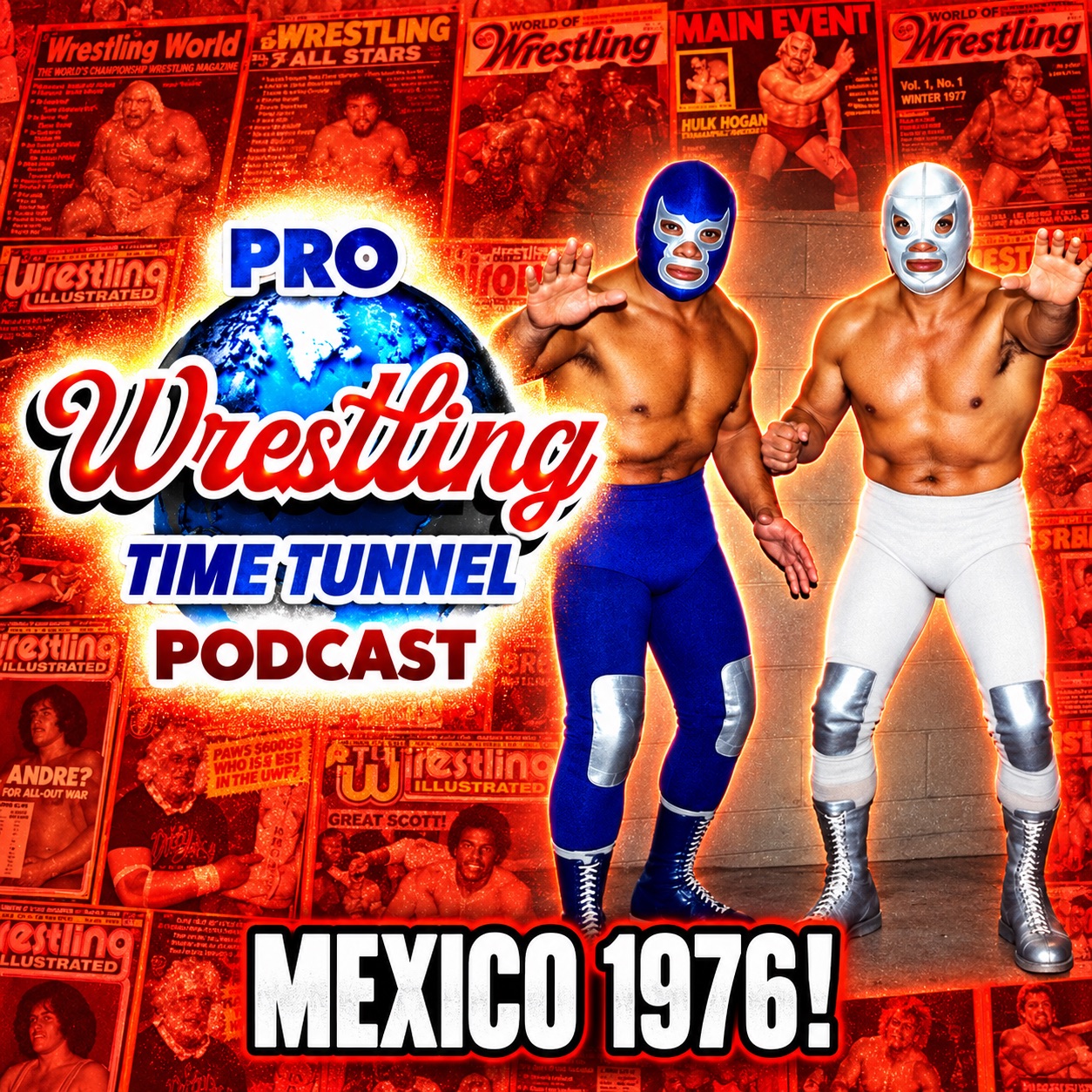
He posts his Lucha Libre collection, he posts his Japanese wrestling collection, things in history, all the wrestling tapes he's accumulating and a lot of the clips and his YouTube channel is huge. And everybody follows Roy Luescher as a pro wrestling historian. And I am so glad that he has joined us here as a part of the Pro Wrestling Time Tunnel family. And I'm excited to welcome him here to the Richards Ranch Today on episode 79 as we look at wrestling in Mexico. Lucha libre in 1976. Let's go now. Roy Lucher and his first appearance here on the Pro Wrestling Time Tunnel.
Hey everybody. We are taking a trip down south in this episode of the Pro Wrestling Time Tunnel History show.
And I am so excited, excited. I have limited knowledge of the history of Mexican wrestling just as much as I've learned through my research for Dorie Funk Senior and his connection to Gory Guerrero and those kinds of things. But the man who has way more expanded knowledge on Lucha libre and the history of Mexican wrestling is here with me today. And I couldn't think of anybody better to have on the show than Roy Lucher, who, man, listen, I am so thankful that you are on X and Twitter because I learned so much. I learned so much from your feed and I want to thank you for all the stuff that you put out there. When did you first get interested in lucha?
[00:13:17] Speaker A: Oh, God, late 80s. So I've been a wrestling fan since 81, so I was, you know, seven years old, I saw the Slaughter Patterson Cobra clutch challenge on TV.
Became a fan ever since late 80s. I started flipping around the channels because, you know, I'm from Anaheim. So I got the Los Angeles TV in my area and I remember turning on the channels and I would see like, Kamala, you know, I saw names of guys that I hadn't seen on TV in America in a while. But of course, along with that I saw, you know, Pirata, Morgan, Super Astro and you know, fast forward a couple years, Vampiro Canadiense and Love Machine and guys like that. So it really started to intrigue me when I got my car in 92, I, you know, drove to the local shows in the area. In Los Angeles, I had the LA Sports arena in my area, Compton, Carson Bell, had a whole bunch of live shows that I went to.
So I started getting known as like, you know, the white guy at the Lucha shows and stuff like that. And on top of that, my parents had a satellite dish. So I found out through Dave Meltzer and Steve Sims where all the.
The TV shows were down in Mexico City. So I would record all that. And by 96, I had 6,7000 VHS tapes of just Lucha. A lot of stuff the promotions themselves didn't even have. So, yeah, going through magazines, going through VHS tapes. I put it all up on Twitter. I don't have any type of patreons. I don't have any kind of paywall stuff. Everything I put up is free. As a thank you, the wrestling community and the wrestling fans for, you know, everything they've done for me as well.
[00:14:59] Speaker C: Yeah, I. I love it. Every now and then there will be a photo of you putting a dub in.
I got these tapes yesterday or whatever. I'm like, man, this guy's still getting VHS tapes, you know, that's cool.
[00:15:12] Speaker A: Like, yeah, last year, no, I think it was the year before I got two huge collections. I flew down to Ontario, Canada, not Canada, California, rented a car and brought back like eight boxes worth of VHS tapes. And each one had like hundreds in them and stuff. And then last year, old friend hit me up that he worked with Antonio Noki and he gave me like five boxes of VHS tapes. And I'm still going through those. And everything I do is in real time. I don't put the tape in and go to sleep. You know, I sit there, watch each one hit record, hit and all that stuff and make sure everything is recorded like the show.
And I upload it whenever possible if there's no copyright issues with the promotion, like, I Don't put anything new Japan up. And WWE knows what I'm up to. And as they said, as long as it's not on the Peacock Networks, anything like that, they said, go ahead and do it.
[00:16:08] Speaker C: Oh, cool. That's great.
[00:16:09] Speaker A: Yeah.
[00:16:10] Speaker C: Well, I, I certainly appreciate that, and I appreciate them cooperating with you. And for those of you who don't follow Roy, Roy, what is your X handle?
[00:16:19] Speaker A: My Twitter is at Roy Lucia, which is my full name, so it's R O, Y, L U, C, I, E, R. I think the current photo is me and L Dandy when I went down there, because he's my chiropractor, to be honest with you.
[00:16:32] Speaker C: So that's cool.
[00:16:33] Speaker A: Yeah.
[00:16:33] Speaker C: So if you go over there and you follow Roy, you're not just going to get Lucha stuff. You're going to get Japan and a lot of historical stuff. He's always taking pictures with people. I mean, him and Mr. 605 might be the two most photographed guys out there, but I love watching you move around and be with different guys. And you're so.
You're so much about honoring them and respecting them, which I respect. So thank you. Thank you for doing that and thank you for sharing it with all of us.
[00:17:05] Speaker A: There's enough pages and websites and things out there that are looking to, you know, bury, tear down people. I'm just here to, you know what? Every, every single one of these people, like, at some point, my life meant something to me. So I like to include a little story of, you know, their background or they meant to me personally and stuff like that. Like with Dory's passing on Tuesday. Yeah, I, I, I'm not gonna sit and say, oh, Dory's best friend, and stuff like that, but I was uploading a bunch of NWA title matches, I want to say, six, seven years ago, and later that week, I got a phone call, and the phone number on there said, Okala, Florida. So I was thinking, oh, it's Marty. And then Dory's phone voice came on. He's like, hey, Roy, I just wanted to thank you.
He said, because his dad was his second in the matches because it was him defending the NWA title against Anoki and Baba separately. And he said, I'll never forget this. Thanks to you, I've seen my dad more in the last week than I have in the last 10 years.
[00:18:04] Speaker C: Oh, man.
[00:18:04] Speaker A: It's just, you know, just things like that, like, really stand out. So I just shared that story when Dory passed away. I never shared it before, and, you know, just, I Always try to just something uplifting, something positive for the community. Just.
[00:18:20] Speaker C: Absolutely, yeah. And. And people know that's what I'm all about as well. That's why I've done the fundraiser for George Goulas, and I, you know, do the RIP salutes for the wrestlers who've passed. That may have been out of people's minds for a while. Speaking of.
[00:18:35] Speaker A: I remember. I remember you. You posted one one time. Dory Dixon, Rest in peace, Tory Dixon. I was like, wait, I was just at his house, like, last week.
[00:18:44] Speaker C: I'm like, this dude is 90 something. Like, he has to have passed away. And Roy goes, no, he's still alive.
I so appreciate that, man. Thank you.
[00:18:53] Speaker B: No problem.
[00:18:54] Speaker A: I think in March, I was at his house because he got the observer, like, the hall of Fame for Observer. So I hit up Meltzer, and I'm like, hey, I'm actually seeing Dixon in March. Can I bring him an award of plaque? You know, I'll pay for it, but just something, whatever. And Meltzer was like, yeah, go ahead. So, you know, I got a video, I put it up, of him giving, you know, giving him the award. And on behalf of the readers and the voters of the Observer river hall of Fame, just want to give this to you and stuff like that. And, yeah, I think he just turned 92. Yeah, you know, he's getting up there, you know, but he's very lucid, and he's got stories about the night Bruno beat Buddy.
[00:19:29] Speaker C: I bet.
[00:19:29] Speaker A: So, I mean, yeah, he's really good stuff, you know?
[00:19:32] Speaker C: Yeah. Speaking of Dory Senior, you know, I've got a book on him that's coming out soon that I've been working on for years. And in that book, speaking of what you were talking about what a heat magnet he was at ringside in Japan, and he didn't really do that much, you know, but, man, did he create. I mean, a lot of the pops are him, like, he's just gonna do something, but he doesn't really do anything, you know?
[00:19:55] Speaker A: Yeah.
[00:19:56] Speaker C: It's just powerful stuff, and I appreciate you. You doing that. All right, so, of course, Mexico, wrestling history. Can you give us a little bit of. I mean, we know Luda roth started in 1933. So now we're 33 years into the future. We got a lot of Mexican history that's taken place over that time period.
Lead us up to 76. Like, so what are some of the key events that happen in the years right up to 76?
[00:20:25] Speaker A: Biggest thing would be that Luderoth just got Too powerful in the 70s and stuff like that. Not enough work going around, promises not being kept and stuff like that.
So enough of the guys and. And we're talking top guys. We're talking Santo, Mil Maskeris, Renee Guajardo. We're talking the top guys had enough
[00:20:47] Speaker C: and
[00:20:50] Speaker A: got a bunch of the boys and started their own promotion with the help of Carlos Mines. And they did that. It was called the Universal Wrestling association, the uwa.
That's by far the biggest thing that happened at the time.
[00:21:09] Speaker C: And they're drawing, right?
[00:21:13] Speaker A: Yeah, Sundays. In fact, I, when I, I brought Dos Kairos to the gathering a couple weeks back in Charlotte, we. I mean, we're at dinner and he's telling me all about this stuff.
For nearly a decade, 20,000 people at El Toro de Cuatro Caminos every Sunday night.
They. He had a deal, the promoter had a deal with like Anoki to bring in like top New Japan stars. So you go down from top to bottom. A lot of those UWA cards, probably from. They're the start of the promotion all the way to the mid-80s. And you look at the opening match to the main event and I mean, there's at least one hall of Famer, so, you know, WWF observer, somewhere on there is someone that is a legitimate hall of Famer or someone that's on the cusp and stuff like that. So, like, those shows were loaded.
And this what sucks about the, the mentality at this point, you know, Watts, a lot of these guys had it, or if it gets put on TV for free, we won't draw anything. So there's New Japan. One time went there to record it to show on TV in Japan. But there's like no footage of this stuff, which is. It's sad and heartbreaking.
[00:22:36] Speaker C: So how, how did that affect Luderos crowds at that point?
[00:22:42] Speaker A: They were on different days. So in a sense it didn't. I mean, it did definitely hurt the attendance somewhat in the. Over the years as far as like the draws were gone, but, you know, they eventually built back up and you know, you obviously have to push who didn't come over. So you, you had Los Romanos, Dinamita, you know, seeing cars, Paraguayo, El Farion, you had a lot of names and stuff like that where that were the big names at the time. Fish, man.
But yeah, no, they eventually built back, but at the time, no, they was.
It was crazy how big the. The UWA was.
[00:23:22] Speaker C: And this is at a time when Luderoth is kind of pulling back from the business, right? Didn't he retire just right before 76?
[00:23:29] Speaker A: That I'm not sure of. Not gonna lie.
[00:23:31] Speaker C: I thought, I thought in some of your notes you sent to me that he retired in 74, but I could be wrong about that.
[00:23:39] Speaker B: The retail.
[00:23:39] Speaker A: Yes, yes, you're right. Okay, gotcha.
[00:23:41] Speaker C: Yeah, you've. You're a regular at Arena Coliseo, aren't you? On Friday night?
[00:23:47] Speaker A: Arena Mexico.
[00:23:48] Speaker C: Arena Mexico, yeah.
[00:23:50] Speaker A: So Arena Mexico's Friday, Sunday, and I believe currently Tuesday. Arena Coliseo is Saturday and then Monday is Arena Puebla. And then they also run Arena Coliseum de Guadalajara on Tuesday.
So the way CMLO runs even nowadays is like set in stone. They own the buildings, so it's not like they got to pay rent to the building, so you got to pay the people that work there and things like that, but that they don't do contracts. Basically you're paid a percentage of the gate.
[00:24:23] Speaker C: So they're, they're. They're probably up there with one of the most profitable wrestling promotions because.
[00:24:29] Speaker A: Absolutely.
[00:24:30] Speaker C: They own all their. They own all their biggest assets, right?
[00:24:33] Speaker A: Yes, Yes, I think that was the deal was, I want to say the late 2000 and tens, there was discussions with CMLL and WWWE to buy CMLL and I guess we're seeing. WWE didn't want. It was because at that point they would have the arenas and that's not something you were interested in doing.
[00:24:53] Speaker C: So what, what's the atmosphere at Arena Coliseo like?
[00:24:58] Speaker A: It's still pretty hot. I mean, it's a crazy crowd, but Arena Mexico is the place to be. It's. It's definitely like.
[00:25:07] Speaker C: And if, and if fans haven't watched Friday Night Card, I think on YouTube, you. You can do that. If you haven't done that. If you're a wrestling fan, you're missing out. I mean, it's a. It's some hot stuff.
[00:25:20] Speaker A: Oh, Jesus. Yeah. Let me just say, like, out of all the places in the world I've been, all the crowds that I've seen and stuff like that, Number one Lucha is like one of the hottest by far yet. But some of these smaller arenas, not Arena Mexico, but Coliseo, Puebla, Colosseo de Guadalajara, these fans, in a way, they still believe.
So there's still like the old school, like heat and stuff like that.
[00:25:43] Speaker C: And the boys still practice kayfabe, right?
[00:25:46] Speaker A: Yeah, some of the boys still practice kfa. Now, I couldn't go up to Mil maskers and ask him a question about was that really you and Memphis or something? Like, what was the deal? There's no one can get a direct answer about.
I guess Master Chris was brought in for a show in 79 or 80 in Memphis and he took the pinfall and he was teaming with Austin Idol and he was the bad guy. And we can never get a straight answer from Bill if you ask him directly or something like that.
[00:26:16] Speaker C: Yeah. If it was actually him or not.
[00:26:18] Speaker A: Yeah. He's just. He's not going to give you straight answer because of kayfabe or whatever.
[00:26:21] Speaker C: Right.
[00:26:23] Speaker A: So like the old school guys, LA Park Connect, they'll still kayfabe you somewhat if you ask them direct questions or whatever.
That's why there'll be probably never be any books about from that generation about Lucha, because you'll never get the straight answers and stuff like that.
[00:26:40] Speaker C: Oh, my gosh, I.
I'd love to hear a whole lot about the Atomic Pair.
[00:26:45] Speaker A: Oh, my God, yes.
[00:26:47] Speaker C: Gosh, I'd like to know a lot about that.
[00:26:50] Speaker A: One thing too is I was in a room with. It was me, Dos Karas and Rob Bahari from High Spots, and we were in a room in Charlotte and Dose was like, Rob would ask questions about how things were, arenas, behind the scenes, politics and stuff like that. Dose was giving everything up. It was like, like amazing. Remember, High Spots used to have the interviews that they would do. They stopped doing them a couple years ago.
[00:27:15] Speaker C: Right.
[00:27:15] Speaker A: And I was telling Rob, like, dude, what if we got that an interview? Like, if you still have the interviews of High Spots, he's all, there's no way Dose would say that stuff on camera privately.
You know, he's not, he's not like his brother, you know, he's still. He'll. He'll admit things. He'll. He'll say that the KFA behind the scenes and stuff like that, but he ain't gonna do that on camera.
[00:27:35] Speaker C: Oh, man, that's too bad. Yeah, that's too bad.
So what, at the beginning of the year, in the first couple of months of the year, what are some of the big events that are going on in Mexico?
I know Dr. Wagner got unmasked, I think.
[00:27:53] Speaker A: Oh, but that wasn't like the true unmasking. Like, he didn't lose his mask in a match. Like, it was just like he was in a match that the. His opponent, Adorable Rudy, unmasked him. But, like, you know, he still keeps his mask. Like, a true unmasking is when it's called in Mexico and a puesta, like a bet. Like, for example, if you, if you go play cards with the boys, you're doing an Aposta like you're betting.
So that's the biggest thing in Mexico. The biggest type of match you can have is an a puesta. Mask versus mask, mask versus hair, hair versus hair. So when someone truly loses their mask, it's from an apuesta, mask versus mask. And at that point, not only do you lose your mask, but you have to give up your identity and tell the public who you are.
The only good thing about that is the promotion pays you royally for losing your mask. Dr. Wagner Jr. When he lost his mask to Psycho Clown In, I think 2018 or 19, he got $333,000 for losing his mask.
[00:28:58] Speaker C: Good.
Well, I mean, is your career. Do you continue your career after your mask or.
[00:29:07] Speaker A: The majority of the unmaskings happen late in someone's career because then they built up their career, their name, their Persona, so that when they finally lose their mask, it actually means something.
So, I mean, there's go.
[00:29:25] Speaker C: Well, I was just gonna say, speaking of Dr. Wagner, give us a little information and history about him.
[00:29:31] Speaker A: The father of the son.
[00:29:32] Speaker C: The father, I think he was the one involved in this early 76 match with the Door.
[00:29:37] Speaker A: Oh, yeah, yeah, yeah. So the original Dr. Wagner. Oh, my God, the dude.
So Wagner, he was just a legendary name from the.
From the 60s and 70s and stuff.
He multiple different championships in the 60s and 70s.
He passed down his name. He had two sons, Silver King and Dr. Wagner Jr.
Just legendary name. And then his. He had an auto accident, I want to say, in like 85, I mean, later in his career. And he was actually riding to the arena with. With his opponent that night, El Solitario.
And the accident was so bad, I think a couple people passed away in the accident, and I don't think he ever wrestled again.
[00:30:29] Speaker C: Oh, wow. So you gave us the names of the arenas earlier. What are the towns associated with those?
[00:30:36] Speaker A: Mexico City on all of them, except Arena. Puebla Pueblo's about two hours east of Mexico City, I want to say. And then arena called Savage Guadalajara. I know a flight. I don't know the. I. I still. I've. I've flown from Guadalajara to Mexico City, and it's like an hour flight, bus, probably like three and a half hours or so, I want to say.
[00:30:59] Speaker C: And they also ran Monterrey. Right.
[00:31:02] Speaker A: Monterey is kind of its own entity. Monterey. The thing about them is there is legitimately a commission in Mexico City, the Boxy Lucia Commission. To wrestle. You have to be a member of this commission.
So the deal with the commission is that everyone medically can wrestle. They they, the commission is there to in a way protect the fans and to protect the boys from bad promoters.
So anytime there is a title match or a mask or or hair match, there has to be someone from the commission there because they want. That's why you notice nowadays whenever Santos Escobar dad, El Fantasma, he's in the ring holding the title before any title match, whether it be aaa, CMLL or any other promotion, because that's in place so that an actual title gets defended and that the fans don't get screwed. They don't, they don't do dusty finishes there. Like, like it's, you know, there has to be a winner or a loser. Same thing with mask or hair matches.
[00:32:06] Speaker C: Crowd. So the crowd's too hot, right?
[00:32:09] Speaker A: I mean, yeah, well, yeah, you don't want, you don't want to screw the fans and then the fans turn around and complain about it. So if there is a master hair match, someone has to get a master, someone has to get a haircut. They'll stay in the ring and make sure that like for an example, someone get loses their hair, that all of their hair is shaved and there's examples of that.
But however, the commission only runs in Mexico City. They do not run in Tijuana, they not run in Monterey. That's why you notice guys like Blue Demon Junior against our Blue Demon Senior against Rayo de Jalisco Senior and Wagner and Solitario later take place in Monterrey. Because I'm sure those guys couldn't have passed a physical.
So it's, that's why you see like it's better for them there to lose their mass. Number one, you got promoters that have the money and they want to be the ones that put on this huge inside of a bull ring or a stadium. Hey, we're going to have the legendary Blue Demon against ryo de Jalisco Jr. Someone's going to lose their, their mask here and you know, they're paying all this money for it and stuff like that. Yeah, the commission down in Mexico City never would allow that because of their health and their age.
[00:33:21] Speaker C: I see.
[00:33:22] Speaker A: Yeah.
[00:33:23] Speaker C: So they'd have to do that in another town where the commission isn't.
[00:33:27] Speaker A: Yes, yes.
[00:33:29] Speaker C: So February I've got here UWA ran a show in Monterey with 18,000 people. Vilano 3 defending the UWA welterweight title. Multi man mask. Stipulations involving Annabelle El Solitario.
I can't pronounce the.
Yeah. And Remington who lost his match and we just talking about this. Right. So he lost his match and mask and revealed his identity.
So, I mean, the psychology of losing your mask always fascinated me because in a lot of cases, unless it's a deliberate angle of a guy who came back under a mask, people kind of know who it is. But in Mexico, people have never seen these people before, right? So when a guy gets his mask taken off, how do they know? I mean, do they know the guy or whatever or they announced to the crowd that this is who this guy is and they don't really. They don't really know any more than they knew before. But it's the drama of it, right? It's the.
[00:34:31] Speaker A: Oh, geez. Yeah. No, it's a whole ceremony and stuff like that. Like Conrad Thompson was there with me at when Viano4 lost his mask at Triple Mania back in 2022. Conrad told me I normally leave shows after a match ends because I want to get out there, beat the traffic, get back, whatever he said. He was so fascinated with the whole ceremony after Penta beat Vianna 4 4's mask. Because then the whole family comes in the ring. Penta's on one side, all bloody. Viano's there.
A family member takes off Viano's mask and Viano has the mask in his hand. Hand is over to Penta at that point. The mask, the, the microphone is handed to Viano. He says something to the crowd, he announces what his real name is, his years in the business, where he's from, and then gives a little statement, whatever, at that point. But there's a whole ceremony that comes with losing your. Your mask.
That is, is amazing. Anytime there's a mask, it's always worth sticking around to see the whole ceremony that comes after it and stuff.
[00:35:38] Speaker C: Wow. Lots of title matches in February and March and April. This is kind of cool. It's the 20th anniversary of Arena Mexico on April 23rd.
Fishman and El Faron did you say?
[00:35:51] Speaker A: That's how you say I don't do
[00:35:54] Speaker C: good with the tongue roll thing.
[00:35:56] Speaker A: That's fine. Now the reason for the whole 20th anniversary goes back to why is there a new Arena Mexico, by the way? All right, so you go back to the 50s and El Santo and Black Shadow had the original Mass vs Mask match. It drew so many people to the arena and turned away so many people that the promoters were like, we need to build a new building to hold more fans. And that's why we have the current day Arena Mexico.
[00:36:27] Speaker C: It's that isn't that interesting that a one match is so pivotal and is such a catalyst for this amazing Expansion of the sport in an entire. You know, the thing I like about. And I. Even though I don't know a whole lot about it, and I'm very much a student of yours when it comes to this, but it's amazing to me how much culturally the sport is mixed in with the whole culture of Mexico. Like, it's a. It's a real cultural component of the nation, you know.
[00:36:58] Speaker A: So nowadays, if you were to put the sports on today, in any channel in America, be a little video package leading up to the sports, whatever, you're not going to see Hulk Hogan, Ric Flair, Lou Fez, you're not gonna see any of those people. But when you watch a sports program in Mexico, even nowadays, you're going to see images of Santo Mil Mascaris leading into it. So it's integrated into their sports programs down there. How big culturally. Culturally, Lucha libre is. Not to mention how many times I've lied in a bed Saturday afternoon in Tijuana or Mexico City, turn the TV on, and somewhere is going to be an old El Santo movie on tv. It's such a part of their culture there. Like, I can't even.
[00:37:45] Speaker C: Like, yeah, there are some territories in the United States where there were periods of that, but not consistently as long and as deep as in Mexico. I mean, there was a period in Florida where that was the case, where it was in the legitimate sports cast as part of the local sports scene in Florida and in Texas, of course, and also in Memphis was another place where it was in the newscast as a. As a sports reporting. Like, they'd come on Tuesday and tell you what happened Monday night at the Mid South Coliseum. But it wasn't ingrained as deeply and as long as it has been in Mexico. I just admire that. I admire that so much, the way they've handled the sport in their country.
[00:38:30] Speaker A: Yeah, it's still, to this day, integrated. Part of it. It gets talked about. Like, you open up a sports paper in Mexico and usually you'll find something. I mean, for the most part, lucha libre is their own newspaper.
Like, they'll have their own magazines and newspapers that are still weekly, by the way. Like, Boxy Lucha is still Jesus, 70, 80 years later, still a weekly magazine.
[00:38:56] Speaker C: They also. One of the things I'd like to hear from you on, and it comes up here. In April, Fishman defeated Blue Demon to win the NWA World welterweight title. So it's always interesting to me how they also kept the weight classes very strong, which I think is one of the biggest mistakes made in American pro Wrestling that we didn't keep the junior heavyweights and all of that. We didn't keep that separated because I think that adds to the legitimacy of the sport. What are your thoughts about that?
[00:39:30] Speaker A: Yeah, I mean some ways, for example, like in order for some bigger name like Rey Mysterio, obviously if he never won the heavyweight title, I just think he was always going to be pegged as a smaller guy. So it's a way for them to get them past a certain hurdle and get them to the next level so all fans can accept them instead of.
And as long as you have like matches that aren't disrespectful or somewhat gives a real nature to it, you know, and then doesn't make a joke out of it. Yeah, I'm fine with it.
[00:40:07] Speaker C: Yeah.
Let's see here. What else we got? We got May, we got Vilano, three mil mascaras, title defenses. Talk about mil maskers a little bit. What did he mean to the sport in Mexico? I mean just a huge name and probably one of the most cover photoed guys in the United States. He was on the COVID of so many magazines.
[00:40:33] Speaker A: I was just telling his brother about this the other day. I was like, in your opinion, where is Mill more popular?
Japan, Mexico or the United States and Japan by far, by far more. He means more to Japan than he does to Mexico.
And there's a good argument for him meaning just as much in America.
[00:40:56] Speaker C: Right.
[00:40:57] Speaker A: Because Bill Apter saw Mill and fell in love with him, him and put him on the COVID of everything he possibly could. You remember from the 70s to the 80s, it was Andre and Mill.
[00:41:10] Speaker C: I was up until the 1980, Tommy Rich got mixed in. But in the 70s, as a wrestling fan, that was the way I knew anything about what was going on outside of the Tennessee territory. And I'd go to this little prescription center place to do my shopping for wrestling magazines. And you know, everyone I picked up had Mill Masters on it or had Dusty bleeding or like or Andre, you know, but. Or the NWA champion, whoever it was. But Mill was certainly on so many of them. I don't have any idea what the number is, but it's. It's got to be a lot.
[00:41:49] Speaker A: Yeah.
Dose was telling me that Maskers has at his house in Mexico City, he has a wall that's covered one side, just Japanese magazines with him on the COVID And then on another wall just after magazines with him on the COVID Good gosh, man.
[00:42:08] Speaker C: And he never lost his mask, right?
[00:42:10] Speaker A: No, no, still he never will. Like it's, it's He's. His final match was 2019. It was him and his brother against Jesus no Sawa and somebody in Japan and stuff like that. And if you watch the finish, I mean, had to help Mill get to the top rope to do his. His dive and stuff like that. I think both of them at that point kind of realized like, we need to call it a day as far as wrestling and stuff.
[00:42:35] Speaker C: Yeah.
[00:42:36] Speaker A: Mil stakes. Mill will still make occasional appearances in Mexico.
Every appearance he's made in America in the last three years, he's canceled, like at last minute. He was supposed to be at the 80s Tommy Fo's 80s fest or something like that, and he canceled like the day before.
[00:42:53] Speaker C: But
[00:42:55] Speaker A: yeah, Mill.
I can't even put into words what Mill meant to Japan, because I even my own wedding. I came out to mask's entrance where he came out on the guy's shoulders and was brought to the ring because in Japan it was like considered like he was considered like a God. If you touched him, it was good luck.
[00:43:17] Speaker B: Yeah.
[00:43:18] Speaker C: Oh, my God.
[00:43:19] Speaker A: Japanese have this. Japanese have this thing where they're. A lot of Americans watch it and what they watch is them being all quiet and then something good happens in the ring and they'll react. It wasn't like that. The seventies with. With all Japan, with Giant Baba's promotion, the fans were crazy for the Funks. Crazy for she, crazy for Abdullah, especially crazy for Bill Maskers.
[00:43:41] Speaker C: A couple things I've always heard about him. One is, you know, he just wears his mask everywhere, even when he's got his suit on or whatever. But I've also heard from different guys that he's a very handsome fella, good looking.
[00:43:55] Speaker A: Gerald Briscoe told me once, because we're talking about Bill and he says, like, there was a show in Houston and like he went in the shower and Bill was in there with his mask on. And Briscoe's like, dude, come on, I don't care what you look like. And I guess he protected his identity that much.
[00:44:10] Speaker C: Yeah, Jerry's told me that story too. That's. That's kind of cool.
In July, we have a Mexican national welterweight tournament after Fishman's Vacancy.
[00:44:21] Speaker A: And by the way, you notice one thing. All the titles are not of the promotion. They're all NWA or wwf. They are not their own promotion.
[00:44:30] Speaker C: Yes. And I was curious about who controlled those titles after Luderoth kind of retired because he was the NWA representative for so long at the convention and, you know, his little committee, it was basically him that basically decided what was going to happen with those titles? I wonder who's, who's calling those shots here in 76?
[00:44:52] Speaker A: Probably, probably Paco Alonso.
[00:44:54] Speaker C: Paco Alonso. Okay.
[00:44:56] Speaker A: Yeah, so basically anything Mexican national welterweight, that's a commission based title. So if for example, a CMLL guy wins the Mexican national title and decides he doesn't want to be with CMLL anymore and goes to uwa, the title goes with them.
The NWA titles however, because the CMLL is an associate affiliate of the nwa, like the board of directors and all that stuff.
[00:45:28] Speaker C: Right.
[00:45:29] Speaker A: They have to stay with the promotion.
[00:45:30] Speaker C: I, I know Gory Guerrero claimed some title right up until he passed away. I, I can't remember which one. Well, I can't remember which one it was.
[00:45:38] Speaker A: But no, still claims, Milso claims that Einhorn IWA title.
[00:45:43] Speaker C: Yeah, yeah, a lot of pictures of that on the, on the covers of magazines.
Yeah, Big, big time show every year in September, which is the anniversary show. So in 76, it's the 43rd anniversary show, September 24th at Arena Mexico. El Halski, tell me how that say El Harcon.
I did. I've had him in my countdown of top wrestlers in 1975 and I probably butchered his name, you know.
[00:46:11] Speaker A: You know something historic about El Halcon was Harley defended the title in Mexico in 1979. El Halcon was his opponent.
[00:46:20] Speaker C: Wow, that's cool. Mexican national heavyweight championship beat Grand Marcus, who I'm very familiar with because of Texas wrestling.
[00:46:31] Speaker A: Grand Marcus, Grand Marcus was a heat magnet. Like I heard from people that have worked Texas that Marcus would get on the mic and he spoke English and he would like today I speak English. I don't care about you Mexicans, like get them going and stuff like that and cause riots because like I am from New Mexico, I'm not from Mexico.
[00:46:53] Speaker C: Yeah, yeah, yeah, great Goliath and those guys used to do that too.
[00:46:58] Speaker A: Oh my God.
[00:46:59] Speaker C: Grand Marcus was huge in Houston and San Antonio as a big time heel.
That program that he and Tony Rocco had, if Sony Rocco was his manager under a mask. They, they did huge business.
During 75.
El Farion defeated Pero Aguayo, who's a huge name in Mexico. And the mask versus Hair match, you know, I used to have a, I used to have one of those big C band satellite dishes in my backyard in like 1991 or 92. And I used to get some of the Mexican feeds or whatever and I was just so fascinated with the dog. Piro.
Is that Dog face? Is that what. Yeah, yeah.
[00:47:42] Speaker A: No, Guayo's just a name. But Pero is dog? Yes.
[00:47:45] Speaker C: Yeah, Pero's dog. I, I went on a trip one time and I had a Spanish housekeeper and I came home from the trip and there was a little note in my kitchen.
I had a dog and a cat as a pet at the time. And the note said the pero and the gateau are in the bathroom. And I say, what does this mean? You know, And I went to very early on in the Internet translation website days, I went and put the whole note in there and it was the dog and the cat or in the bathroom.
They're big. Yeah, that's, that's what it said. There, there is lots of tournaments that happened in Mexico. What, what's the, what's the significance around tournaments? Are they real fan favorites in Mexico?
[00:48:33] Speaker B: Yeah.
[00:48:33] Speaker A: Oh yeah. So basically to set up challengers, number one challengers for title defenses is, is usually the biggest reason for the tournaments
[00:48:44] Speaker C: around this time, I would imagine.
[00:48:47] Speaker A: If you notice the mask and the hair. Matches are kept basically to just anniversary shows or things like that. They don't just randomly happen. Like they're, they're kept for like, you know, the big shows.
[00:49:00] Speaker C: You know, it's changed over the years in the United States, how guys are booked as far as new guys or whatever. What was the typical progression for someone in Mexico? Like how long did it take? You know, it used to be in the territory days. A guy had to be in the business five years before he ever like worked his way up the card.
And then about the time he was in the business, about the 10 year period, then he was kind of in main events and title matches and things like that. How did that work in Mexico? What was the process for working guys in?
[00:49:32] Speaker A: So for example, if you go to 82 or something like that, you see a guy like Negro Casas or Forza Guerrero on there.
Basically it's how the, the, everyone reacts to what they're doing in the ring. So Negro causes immediately early on they knew he was something special.
So the, the fans were reacting, the newspapers would fawn all over him. But obviously, you know, he's from a wrestling family, so we have a little bit of a head start on that, stuff like that. But for somebody like, if they're just starting and they're booked in the, you know, first two matches, usually the women are usually in match two, but match one is like newcomers or guys are on the way up and stuff like that. Mostly it's by what the magazines, what the old timers, because they still had the mentality back then, like the Boys still watch the entire show.
So basically if someone's in the back watching and the, the promoter, you know, trusted their word good enough and somebody said, hey, you might want to keep an eye on this guy, you know, he'd get, and he's getting the correct, the right fan reaction, he'd start moving his way up the ladder and stuff like that. He put him in better positions.
[00:50:47] Speaker C: Yeah, I noticed particularly during that time I had that satellite dish around the early 90s, Art Bar came in and just was explosive. Like the Love Machine was like, hey, you, huge deal. Just like right off the bat, you know, it was just like, wow, that's.
[00:51:04] Speaker A: Oh no. They booked him strong. Yeah. From the beginning that, that feud he had with Blue Panther, that was crazy.
[00:51:12] Speaker C: Yeah, I always liked the Blue Panther. He was one of my favorites.
[00:51:16] Speaker A: He still wrestles.
[00:51:17] Speaker C: Yeah, I know, I know.
[00:51:19] Speaker A: Yeah.
[00:51:20] Speaker C: So anyway, some question about the Guerrero family while I got you here. So Gory was the promoter in El Paso, but also in Juarez.
So was that commission influence heavy in Juarez?
[00:51:33] Speaker A: None whatsoever. They had no commission. They could do whatever they want.
[00:51:36] Speaker C: Oh, wow. So it was just Mexico City and around the couple hundred miles.
[00:51:40] Speaker A: Just Mexico City. Yeah.
[00:51:42] Speaker C: So in October we got EML cards in Arena Mexico, title changes. And the word you used earlier is that a puestas, which is the mask match, right, or hair match.
[00:51:58] Speaker B: Like.
[00:51:59] Speaker A: Yeah, it's either mask or hair.
[00:52:00] Speaker C: One of the two, Pero Aguayo was beaten for the world middleweight championship. Ringo Mendoza and others took hair matches.
So. So this is. So tell me about Ringo Mendoza a little bit.
[00:52:14] Speaker A: Oh my God. So yeah, Ringo Mendoza.
It's funny, he's not even a true Mendoza. The Ry Mendoza, the father of the Vianos, is the original. But the thing is, Ringo looks so much like like Ry Mendoza that they actually gave him the name Ringo Mendoza. So that's how he got them.
[00:52:33] Speaker C: He's kind of an Arne Anderson kind of guy.
[00:52:35] Speaker A: Yeah, yeah, exactly. He looked like. Yeah, he looked like so much like Oli.
[00:52:38] Speaker C: Yeah.
[00:52:39] Speaker A: And then the funny thing is that Ringo had a younger brother. I don't know his shoot name, but they call him Cachoro Mendoza and he came into the business as well. And now those two were ultra hot. They were on the covers of. Ringo especially was on the COVID of a lot of magazines. He was known as like a no nonsense guy. And I don't, I. To my knowledge, I don't think he ever turned rudo. So I mean he was crowd loved his entire career.
[00:53:04] Speaker C: Well, that's another thing we should Mention. So rudo are heels and the faces are technicals, technicos. Right, Technicals back in the, back in the 70s, that's what baby faces were now. And they were scientific wrestlers.
[00:53:18] Speaker A: So they got, you know, and a lot of this doesn't get talked about, but there is actual rules to Lucha Libre as far as the trios match educators.
Yeah. So three on three match. If you ever hear a three on three match and everyone gets announced and at the end they say la capitan. So the captain of the team.
So basically the captain has to be the one to get pinned in order to, for the fall to end. So pretty much every match is two out of three falls. One guy on the team could get pinned.
I mean, usually the, the, the captain, it takes like the normal is everyone just gets pinned, especially the captain. Usually the three guys on the team usually get pinned at the same time or within seconds of each other, if you ever notice.
[00:54:12] Speaker C: Yeah, yeah.
[00:54:12] Speaker A: But the captain not getting pinned does get held back occasionally for like a big match or big show or a big angle. Like someone, one of the other two guys could get pinned and then something happens where the captain doesn't get pinned and then they come back or whatever. But 90 something percent of the time, all three will get pinned at the same time. But there is Captain's rules to Lucha. That's why recently there was a big thing about CMLL got rid of the Captain's Rules. And they're the oldest promotion.
And I guess someone at a press conference asked Tony Khan about it and he kind of danced around the issue. But some people feel like maybe the AEW influence got rid of the Captain's Rule.
[00:54:53] Speaker C: Well, I would have probably enjoyed some of the trio's matches if I had known that. I mean, I wish they would have done a better job of explaining those things to us. You know, there are rules. Of course, if you watch the Lucha matches in Mexico, fans know all that stuff. So they don't feel like they have to educate, educate people. But for an American who's not used to that, I mean, I was always like, wow, all three guys just got pinned. Like, what does that mean? Is that like a part of the rules or not part of the rules? I mean, you're just. When you're so Americanized, you don't really understand it.
[00:55:27] Speaker A: Yeah, it's Captain's rules. Yeah. And, and the, the lower promotions like IWRG and the ones you catch it on on a Saturday afternoon or something like that, it's something that isn't CML or triple A related Triple A got rid of. Got rid of two out of three falls in 2001. So, I mean, they're out of discussion anyway.
But, yeah, the little promotions and arenas, they still do two out of three falls. Captain's rules.
[00:55:52] Speaker C: Yeah. I don't really know who the television guys are here in 76. I just wrote an extensive article.
[00:55:58] Speaker A: No television.
[00:55:59] Speaker C: No television. I just wrote an extensive article about Dr. Alfonso Morales.
Let me just get some thoughts from you about Dr. Morales as a. As the television announcer.
[00:56:10] Speaker A: He was straight up. I mean, he. He loved pure Lucha libre.
He. I believe he left AAA at one point because he was just like, this is a joke. And like, he didn't like the becoming Americanized of what it was.
To each our own, by the way. I want to make that clear. That's his opinion, not mine.
[00:56:29] Speaker C: Sure,
[00:56:32] Speaker A: but.
[00:56:32] Speaker C: But he was very. I guess what you're saying is he was heavy. Traditional. Traditionalist, yeah.
[00:56:37] Speaker A: Traditionalist, yeah, yeah, yeah.
[00:56:39] Speaker C: And he was the Gordon solely of wrestling in Mexico, right?
[00:56:42] Speaker A: Yeah, yeah. I love the banter with him and Arturo Rivera. Like, it was almost like the. The Heenan Monsoon stuff, you know?
[00:56:50] Speaker C: Yes, yes. And there was a period of time there where I. In my research, I found there was a period of time there where people thought he was a wrestler.
Right. They thought he was under a mask.
[00:57:01] Speaker A: First time hearing.
I didn't know about that.
[00:57:03] Speaker C: Yeah, yeah. I can't remember the name of the wrestler. They. It wasn't him, obviously, but there was. He played it up a little bit.
But this is a very strong year for wrestling. I mean, very much ML ells drawn, you know, in the 18, 17, 18 thousands. The UWA is drawn in the 17 to 20,000 thousands. I mean, this is a hot period for wrestling in Mexico.
[00:57:28] Speaker A: Yeah, we haven't come up on 78 yet. When the promotion decides they need their own heavyweight champion. And Lou Thez comes in and him and Connect have the match to determine the first UWA Heavyweight championship. So that's still a couple years away. So they're. They're basically doing all this at this point with just their own talent. They're not doing this with Anoki's help, with Vince Senior's help, because down the road and Noki and Vince Senior would both send talent for UWA to.
To have on their shows.
[00:58:09] Speaker C: So when Fez would come in and work with Elkinek and this, that and the other, how did they work the match? Was it.
[00:58:15] Speaker A: I think.
[00:58:16] Speaker C: How did. How did. What did that look like?
[00:58:18] Speaker A: I would like. God, I would love to know that.
[00:58:22] Speaker C: I mean was it more of a thiz American match or was it. Did Thes change his style to work more Lucha style with a little bit faster pace or. I always wonder.
[00:58:31] Speaker A: That's the deal with Kinect was that feud was the one that put him over in the fans eyes. I mean that's what like. And also in the other boys eyes because at that point he started getting booked for Enoki in Japan.
So it's like, hey, here's this guy that worked with Fez and you know, he's the champion and stuff. I believe Fez originally won the the title and then in a rematch Connect won it.
So the fact that they dragged it out that long and stuff like that, I'm sure word got around about how great Kinect must have been to work with well at that time.
[00:59:06] Speaker C: You know, I also wonder about Fez's connection too because you know, in 76 in Tennessee, he named the outlaw promotion the UWA. So I just, I wonder if that was. You know.
[00:59:20] Speaker A: It's the same logo too, by the way.
[00:59:22] Speaker C: It is.
[00:59:23] Speaker A: It's the exact same logo. Yeah. So they have to be related.
[00:59:26] Speaker C: It has to be, right? It has to be. Even though it only lasted four or five months.
[00:59:30] Speaker A: I mean but yeah, someone said someone uploaded TV of it or whatever and that was the first thing I noticed when I watched it was it's the exact same logo.
[00:59:38] Speaker C: Wow. I wonder if somewhere down the road if Thes and Buddy Lee had planned on incorporating some Mexican talent once they got going. That had. Yeah, it had to. We never saw it because it didn't last but would have been interesting. So it was a solid year. The EML EML UWA split. The impact is positive, gives. Gives fans more shows, which I've always believed that. I always thought having, you know, more than one or two promotions is good for the business.
[01:00:14] Speaker A: You know, I remember in the 90s you basically within Japan you had Baba, you had a Noki, you had Oneida. But like where the hell are all these other guys going to work? And there's so little coverage or so little promotions at the time and stuff like that. And then you look at the names that are on top in both Arena Mexico and UWA here and it's like how could one promotion if they didn't split? How are all these guys going to work in one place?
[01:00:45] Speaker C: Right?
[01:00:45] Speaker A: Because I don't believe some of the outside arenas existed at the time. You know, like, like Arena Puebla, I don't know what year they started, but Arena Mexico and I Believe Arena Coliseo.
[01:01:00] Speaker C: Hey, buddy, which one is that? Roy, which one is Jasper? Jasper.
[01:01:07] Speaker A: Jasper. I don't believe Arena Coliseo was built yet. I'm gonna double check.
[01:01:15] Speaker C: Sure.
[01:01:15] Speaker A: As we're doing this in live, it started in, let's see, 1943. Okay. So no, it's been around a while.
I'm mostly reading about Arena Mexico stuff here. So that was still the center of all the. The big things that happened for, at the time, emll.
[01:01:37] Speaker C: So what do you know about the difference in styles?
The UWA and the emll, were they presenting different kinds of styles?
[01:01:47] Speaker A: No, it had to be because you still had the. The old school mentality here, where what they were presenting was authentic and true Lucha Libre. It's not like when, when Triple A split 92 under similar circumstances to UWA created 30 years before or 20 years before.
[01:02:06] Speaker C: And that was Antonio Pena. Right?
[01:02:09] Speaker A: That was Pena splitting. And Pena was influenced heavily by Vince McMahon. So he went in there and created like lavish characters. He ran angles which, like angles, you know, angles as we know them. Angle like things happen during matches, like partners accidentally hitting somebody or things like that. Just angles. Like everything had to be done in the ring. There weren't like angles. Pena started doing angles where someone bump into each other in the. In the airport, like the Jake Roberts Conan stuff. And that would start an angle that's like no promotion in 75, 76 would have done that. Like everything back then was like in the ring, as serious as real to the fans you could get. I'm 99.9 sure that both promotions were doing like the similar styles.
[01:02:57] Speaker C: You know, back to Pero Aguayo for just a minute. You know, one of the things that I always found fascinating about him was the fact that he had no mask. You know, to me, he stood out because here in 76, I mean, he's a rising star and he's a dominant rudo heel. And he had lost his hair to El santo in the 75 anniversary show. And he is just a dominant force, but he doesn't wear a mask. I always thought that was very interesting about him.
[01:03:26] Speaker A: Yeah, like, you notice some guys like Elsa, Tanico, Sangre, Chicane, we're used to them without their mask. And then you look like really early in their career, and they had the mask at some point, like it for a year or two, and then they lost him. LATIN LOVER Originally wore a mask and. But it was so, so short. It was better for him to lose it anyway and stuff like that. But no, Pero never Pero never wore
[01:03:48] Speaker C: a mask, but he did lose his hair. He did lose his hair many times. Yep.
[01:03:53] Speaker A: Many times. Yeah.
[01:03:55] Speaker C: Powerful, powerful influence in Mexican wrestling. Well, Roy, thank you so much for this today.
[01:04:01] Speaker A: One thing, too. 1976 was the Tijuana. Tijuana. Because there's really. No, we don't have. The magazines only talked about Mexico City at the time. And we don't have a magazine or a newspaper that really covered Tijuana or Monterey. I mean, we may trickle some stuff out of Monterey, but nothing out of Tijuana. But one thing we do know was that Miguel Angel Lopez, aka Rey Mysterio Senior, debuted in 1976.
[01:04:29] Speaker C: Wow.
[01:04:30] Speaker A: Which he. And like, I want to say what Bruno meant to the Garden is what Rey Mysterio means to Arena Foster Gutierrez in Tijuana.
[01:04:43] Speaker C: And you're talking about the senior.
[01:04:45] Speaker A: The senior. Yes. Yes.
[01:04:47] Speaker C: Yeah. Because Rey Mysterio, he carried the one that we know in America, he carries the Junior moniker for years.
[01:04:54] Speaker A: Yes. Until he went to WWE in 2001. Or was it two? I forget. It was the year after the purchase. So 2002, he was always Rey Mysterio Jr. At that point. And then he dropped the name. But the original Rey Mysterio, Rey Mysterio Senior, the one that.
Oh, my God. Like, seeing him live in that building was amazing. But on top of that, he was also the trainer for hundreds of names. Obviously his nephew, but Psychosis, Conan, the list goes on and on. For the names that he trained out of Tijuana or people that would come in and, you know, own up their craft and, you know, go under him for a week or two and get better and stuff like that. I was at his funeral a couple years ago, and the amount of love and people I cared about was just. It was amazing.
[01:05:41] Speaker C: He. That's an incredible comp. He was the Bruno Sammartino of Tijuana.
[01:05:46] Speaker A: Yeah. By far, 100. Like, even to this day, like, he's so loved and revered there in that city. Like, it just. That that building basically is like his Madison Square Garden.
[01:05:59] Speaker C: Wow. Amazing stuff. Roy. I've learned so much today. Thank you so much, man.
[01:06:04] Speaker A: I really appreciate you having me on. Thank you so much.
[01:06:06] Speaker C: Yeah, just keep on doing what you're doing. I love your feed. I've got an alert on you, and every day, every time you post, I get a little thing that tells me that Roy's done something, and I can't. I can't wait to see what it is. So thank you, man. I appreciate everything you've contributed to the business and I appreciate everything you're contributing to our show and the people who follow us. They got a really strong one hour education on Lucha Levi Debris today.
[01:06:33] Speaker A: Yeah, one thing too is my lucha is so extensive. Brian Blair B. Brian Blair puts me in charge of who gets the Lucha award every year at Cauliflower Alley.
[01:06:43] Speaker C: Oh good.
[01:06:43] Speaker A: In a little over two weeks we're going to be honoring psychosis in Las Vegas with, you know, Rey Mysterio Jr. Being the one that inducts him in.
For those that potentially may babe be there, we're going to be inducting him on Wednesday.
We're gonna have Ric Flair getting an award, Bret Hart getting an award. The Glamour Girls, Dan, Danny Spivey, Jimmy Corderas.
[01:07:07] Speaker C: I just interviewed Rip Rogers who's getting the trainers.
[01:07:09] Speaker A: Rip Rogers, Yeah.
[01:07:11] Speaker C: And also interviewed Dan Murphy who's getting the Melby.
[01:07:16] Speaker A: I love Dan, he's a Buffalo guy. So there's a lot of stuff with him and the Byer family.
[01:07:23] Speaker C: I had interviewed Dan before and I got the Melby at the Waterloo Conference and I wanted to have him on to talk to about his award and I, I love his work. It's just really, really fantastic.
[01:07:34] Speaker A: Yeah. Oh, Dan's great stuff for sure.
[01:07:36] Speaker C: Roy, where can people find more about you and what you do?
[01:07:40] Speaker A: Biggest three I do is Instagram which is Roy Lucher, Lucha fan so R O Y L U C I E R L U C H A F A N is my Instagram, my Facebook which is under my name, Roy Lucher.
I think the photo is like me and Doral Dixon and then my Twitter is @royloosher. R o y L U C I E R Also I have several YouTube channels. Now the reason for this being is let's say copyright people decide to come after a channel and get the entire channel nuked. Well, everything is under one channel. All the All Japan is on one channel. All the AAA is on one channel. All the CML is on one channel. All the UWA is on one channel.
[01:08:25] Speaker C: Channel.
[01:08:25] Speaker A: All the All Japan women is on one channel and so on and so forth. I think I have 12 different channels. Yeah, that's just so I don't get nuked like copyright wise.
[01:08:34] Speaker C: Sure. What's the earliest CMLL match you have out there?
[01:08:38] Speaker A: I think I have some 81 stuff with seeing Carson, Andre the Giant up there.
[01:08:41] Speaker C: Fantastic man.
[01:08:42] Speaker A: Yeah. That's when the TV was finally allowed because they were, as I mentioned earlier, they were afraid that if it was shown, people wouldn't attend live.
[01:08:50] Speaker C: Yeah, yeah. Well that can happen. For sure.
[01:08:53] Speaker A: Yeah.
[01:08:54] Speaker C: All right, Roy, thank you so much, man.
[01:08:56] Speaker A: Thank you. I really appreciate you having me on.
[01:08:59] Speaker C: Wowee. What a education and Lucha libre we got today. The great Roy Lucier. I am so glad to have him here at the Richards Ranch and here on the Pro Wrestling Time Tunnel History Show.
He adds so much, don't you think? I mean, the guy is just a walking encyclopedia of wrestling, wrestling knowledge, and especially on that subject of Mexico and lucha. And he's also very, very knowledgeable in Japanese wrestling as well. And so I'm looking forward to being able to tap in to Roy's knowledge and his experience and his passion. I mean, I know very few people that are as passionate about professional wrestling as Roy Lucher. And so very, very happy to have Roy here. And I know you enjoyed that segment on Mexican wrestling in the year of 1976.
Okay.
We talked about Paul Leduc earlier.
We also lost on Saturday morning.
And you know, Jerry Oates and I have become very close friends.
We would have a typical, probably two times a month, maybe every other week, Monday night phone call.
And that phone call might last 10 minutes or it might last two hours. I remember one time, I think we talked for three hours about the history of pro wrestling and about the psychology of pro wrestling and booking of pro wrestling and just a whole lot of different things. And he was just so willing to talk and to give of his knowledge. He went back to 1970 in the business, and just from the first time I ever reached out to him and talked to him about maybe coming on the show here, and the way it started was Jerry and Bobby Simmons and Michael Norris, who also just happened to be on our show.
They did a show back in the days of blog talk radio, and they did it for the Georgia History Wrestling website.
I think the show started around 2006 or 7, and it lasted right up until a few years ago. They really stopped doing the show around 2019 or 2020, and then they just do it every now and then.
Maybe somebody would pass that there was a longtime friend. I think when Olie Anderson passed away might have been the last show that they just jumped on and did about the passing of Olie.
And that was in 2022, I think, something like that. But anyway, I found out from somebody that that website was going to be, I don't know whatever happened to Rich, the guy who was the driving force behind the Georgia Wrestling history site. But somehow or another, all of that material was going to be coming off the Internet and it was going to be going down and that stuff was not going to be available. And I spent an entire Christmas holiday.
About two days before Christmas till about a day after Christmas. I think it took four or five days. And I downloaded every single one of the episodes of the show that Jerry and Bobby and Michael did.
And I don't think Michael was on the early shows. But he joined up a couple of years after they got started.
And they just had everybody under the sun on there. And especially guys who are no longer around or no longer with us. And just such valuable information and history that they shared with people.
And I somehow got a hold of Jerry's phone number from somebody. And I called him up and told him who I was and told him how I knew about him. And we just hit it off right from the very beginning.
And in the last year or so, I would say I knew Jerry had been struggling with some health stuff. And I knew that he had been sick. Because he told me me he had been to Atlanta a couple of times to have some procedures done on his face. And so he was a little bit conscious about coming on the show. And we didn't have him on the show for a long period of time. Because he was recovering from the facial surgery that he had had to take the cancer off. And, you know, he would kayfabe me on how sick he was.
You know, I would say, jerry, how you feeling? And he would say, oh, I'm feeling all right. I'm doing good. I'm glad to be back at work or whatever.
And then after, we'd talk for 20 or 30 minutes. And you could tell that, you know, we're talking like friends and opening up to each other about things. And I would sense that the time would be right. And I would say, jerry, how. Tell me truth now. How you really feeling? Oh, Tony, I'm pretty sick, you know. And so I knew that he wasn't feeling well. I also knew he's extremely private. So I never said anything about it to anybody. Even his other close friends who knew that he had been sick. We didn't talk about it because we kayfabed each other on it. Because that's what Jerry wanted. Because he, like I say, he's extremely private, individual. And if anything was to be said about Jerry Oates, I let Jerry Oates say it.
And he had a lot to say. And I think episode six, one of the very first 10 episodes, he was on number six, where we talked about Kansas City and the year of 1975 and some of 1974. That he was out there and he was also on, I think episode 18, where we talked about the central states. And then I had him on the Thanksgiving show last year, and we talked about Thanksgiving cards and we talked about the card in Kansas City that they had.
And his former tag team partner, Mike George joined the show. Jerry gave me his contact number and I called Mike, and Mike was more than willing to come on with us. So Bobby Simmons and Jerry and Mike George were on. And we did the Thanksgiving Spectacular show and talk about Thanksgiving shows in Atlanta and Thanksgiving shows in Florida and in Kansas City. And then I had Jerry on the Christmas show last year, the Christmas Super Show 2025.
And the reason was because I wanted to talk about the world champions that year. I wanted to talk about Jack Briscoe, and I wanted to talk about Bruno Sammartino, and I wanted to talk about Nick Bob.
So I had George Shire on to talk about Nick Bockwinkle, and I had Steve Giannarelli on to talk about Bruno.
And then when it came time to talk about Jack, I had Jerry on to talk about Jack Briscoe. But it was also in December of that year, which was right around Christmas, Jack had dropped the NWA title to Terry Funk in Miami.
And Jerry Oates was Terry Funk's first match.
After he won the world title from Jack Briscoe, he left Miami and flew to Kansas City, where he was going to be in Wichita that night to face his first opponent, which was Jerry Oates. And I love the story that Jerry tells about how he's sitting in the dressing room and they came to him and he said, well, is Harley about ready or no, not Harley, Jack. He said, is Jack ready? Because he thought he's facing the world champion. He thought it was Jack.
These were back in the days before newsletters, back in the days before the Internet, back in the days where no one told anybody that the title was going to change hands. It was a very closely held secret.
And he said, is Jack about ready for our match? And he said, jack's not here. And. And Jerry says, what? Jack's not here, but we've got a match. He goes, no, Terry Funk's here.
And he said, what's Terry Funk doing here? He goes, well, he beat Jack for the title the other night.
So your match is with Terry. He's the new champion.
And until they got into the ring and exchanged just a couple of words with each other as they were getting checked by the referee. Something else we don't do anymore.
Did they ever talk about it? And then they didn't talk about it that night they had the match, of course, Terry defended the title and walked out with the title. It was probably a DQ finish if I remember correctly.
But after they wrestled in Waterloo that later that week, Terry Funk and Jerry Oates. Jerry and Ted gave Terry Funk a ride back to Kansas City where I think Jerry wrestled him on Thursday night.
And then Terry flew out and it was on the car ride where they talked about the Terry getting the title and what it was like and about the match in Miami and all of that stuff. It was just. I loved Jerry telling that whole story. And if you're interested, you can go back to the 2025 Christmas Super show and the Jerry Oates part of the interview where he tells that entire story. And he also tells the story about the.
The position Harley Race was in where he got to take the title from Jack Briscoe to Terry. Terry Funk. No, Jack from Geez, Tony Dorie, Funk Jr. He won the title in Dory Funk Jr. And lost it to Jack Risko.
And they had talked to Jerry Oates about potentially being that person who carried the title for a few months and it didn't happen.
But there was potential there for Jerry to win the world title a couple of times, or at least he was in the conversation about it. Bob Geigel, of course, was a very big kingpin in the National Wrestling alliance who had the Central States territory. And everybody who Jerry worked for just really thought a lot of him.
Bill Watts loved Jerry Oates. He was the North American champion for Bill Watts in the NWA Tri State at the end of 1976 and into 1977.
He was the Central States champion for Bob Geigel in Kansas City. He was the world tag team champion for a Geigel in Kansas City with Mike George for a run and then with his brother Ted Oates for a run. He was a Georgia tag team champion with Ted. When they went back to Georgia, they were the All Asian tag team champions in Japan.
He was the.
[01:20:17] Speaker B: He.
[01:20:17] Speaker C: He won the Pacific Northwest Heavyweight championship up in Portland Wrestling. He won the Pacific Northwest Tag Team Championship when he was tag team partners with a guy who debuted in Kansas City by the name of Jesse the Body Ventura.
Like I mentioned, the All Asia Tag Team Championship with brother Ted. They won it in Tokyo in October of 76 for Baba and All Japan.
They were the national tag team champions. Once TBS went up on satellite.
Jerry Oates and Ronnie Garvin beat the Road warriors on the 4th of July on 1984 in Columbus, Georgia, which was a huge night.
Never talked to Jerry about that. We never got to that point. There's so many points in his career I was so looking forward to talking to him and discussing with him that we didn't get to.
But he beat the road warriors in his hometown of Columbus, Georgia, which had to be a really seminal moment for him. Going to the auditorium there in Columbus. From the time he was a kid until he broke into the business. His brother in law was Dickie Steinborn.
Dick Steinborn married Jerry and Ted's sister.
Jerry married a lady who her father, Mr. Newman, was the promoter in Savannah, Georgia.
He also told me so many stories about Milo Steinborn. That was one of those couple hour phone calls that we were on when he just kept telling me story after story about Milo Steinborn. Just so cool to hear stories that were passed on by Milo to Jerry and Jerry passed them on to me.
He trained a lot of guys. He trained a lot of wrestlers in his gym.
Probably the most one that you would know, name wise would be Marty Jannetti.
Jannetti was an amateur wrestler from Georgia. He debuted in 1983 under Jerry Oates, who was guiding him and training him.
He actually initially started working as an Oats cousin. His name was Marty Oates and he worked in Mid south wrestling with Jerry.
He trained a lot of local talents there, guys named J. Rod and A.J. steele.
He held a minority ownership in Georgia Championship Wrestling for a time. In 1984 he joined Jack and Jerry Briscoe there.
And he later promoted events later on, including Georgia Championship Wrestling, which was renamed Great Championship wrestling in the mid-2000s.
He, his wife, by the way, was named Kathy, Kathy Newman Oates.
And they were partners in the original Oats Gym that opened in 1979. And he did that because he had so many conversations with Milo Steinborn, who had a famous gym in Orlando, Florida.
And it was a cornerstone that Oats Gym.
And someone told me they are having the memorial Service this weekend, September 12th. And to my understanding, Les Thatcher is one of the hosts of the memorial service for Jerry. And they're encouraging people to wear Oats Gym paraphernalia, shirts, jackets, whatever. But Bobby and Michael Norris are going to the memorial service and they are also going to be coming on our show here maybe next week, I'm hoping, and they will give us some more details plus their own personal thoughts and remembrances of Jerry Oates.
His wife Kathy passed away and he had the most wonderful fiance named Helen, who most of the time when I would get on the Internet, I'd set up the interview with Jerry and Helen would be the one who would get it on his iPad and get the iPad straightened out for him and get the camera turned on and get it in the right place. And I would always say Helen was his producer and she's just a wonderful person. And it's just I'm so sad for them that they never were able to go ahead and get married.
Jerry passed away. I mean, he had a son named Bo and his daughter in law, Beau's wife's named Karen.
He had several grandchildren and a great, great grandson.
Of course, his brother, Ted Oates, who was in the tag team with him, is still with us, and his sister Janelle Studdard and Bo. I think his son Bo Oates has been involved in wrestling as well, in wrestling promotion.
But Jerry passed away this past weekend on September 4th.
And you know, Jerry wasn't a national television star in the WWE or anything like that. But let me tell you something, he was the consummate territory era wrestler. He was a great worker. Everyone who worked with him just thought it was a pleasure to be in the ring with him. It was like a night off. He traveled widely, he won titles in every territory he was in.
He helped train up the next generation and passed it on just like it had been passed on to him by Dick Steinborn and by Milo and those guys. And he debuted in 1970. He carried that tradition forward, training up the next generation and poured his energy into his hometown gym and into his hometown of Columbus, Georgia. And they just don't make a lot of gerios.
And I'll miss my friend.
We're going to be going to Calgary, Alberta, Canada now, and my new friend Ross Hart. And so we're going to be doing Stampede Wrestling 1976.
Let's go to that now here on the Pro Wrestling Time Tunnel History Show.
Well, everybody, I'm excited today because I have someone on my podcast that I've been wanting to have come by and visit the Richards Ranch for quite some time. We had opportunity to meet each other at Herb Simmons event in St. Louis a few weeks ago and we had a great conversation and I invited him to come on the podcast because I want to talk about Stampede Wrestling in the bicentennial year of 1976. And I'm excited, excited to welcome Ross Hart to the podcast today. Ross, how you doing, man?
[01:27:29] Speaker B: Great. Nice to be on your show, Tony.
[01:27:31] Speaker C: Yeah. Now, you debuted a few years after 76. Almost 10 years after 76, right?
[01:27:39] Speaker B: Yeah, I actually had my very first matches, believe it or not, in, in Hungary I was working for a promoter named Rpad Vapor who was running some shows. He was a Hungarian who had worked in Germany a little bit and I think he was maybe the first promoter to ever run shows. And that was part of the Iron Curtain back then, you know, Eastern Block. He brought in a bunch of wrestlers from Germany and France and I was, I was part of that tour, but that was late, actually late 1983. And then my brother Owen and I actually tagged, teamed for joint promotions in England and work for Max Crabtree. But wasn't too long after 76 that I got in the ring.
[01:28:25] Speaker C: Yeah, you, I mean, you wrestled everybody. You wrestled Jerry Morrow, you, you wrestled Wellington, you wrestled Benoit, you wrestled Goldie Rogers, Steve Blackman. Yeah, Steve Disavow, a lot of them.
[01:28:40] Speaker B: You know, I was around them. Right. You know, I wrestled the guy named Ted Arciti one time. Yeah, interesting.
[01:28:45] Speaker C: That was a big guy.
[01:28:47] Speaker B: Yeah, big fellow. You know, really strong.
Cuban commandos. Ron Richie.
Yeah, the angel of Death. He was a big tall fellow. He's about 6 foot 7.
Wrestled him.
Yeah, a lot, a lot of different
[01:29:01] Speaker C: guys remind, I mean, correct me if I'm wrong, but you did a lot of work in Great Britain. You, you were, you worked for World of Sports too, right?
[01:29:10] Speaker B: Yeah, that's right. On that tour in 83, Owen and I were there for about a month and we worked like every night, you know, sometimes in singles, sometimes tag team matches. And they billed us as Cowboy Ross and Owen Hart. So that was a great experience. And I worked against guys like Fed Finley and Skull Murphy and Marty Jones and some pretty good hands back then.
There are a few others, I think it was Pete Roberts and.
Oh, a few others that were pretty regular stars that worked in England for, through the 70s and 80s and in Japan a lot. But they had a really good stable of guys, you know, good workers. And uh, you know, wrestling in England was, was still on fire then. They were still drawing quite well as when Big Daddy was a big name there. And it was kind of during a promotional war they had with, I think it was All Star Wrestling with Brian Dixon and Org Williams. But at the time, Max still had TV coverage and so he had the advantage. He had the upper hand. And that's. If you, if you had television, you, you were bigger stars for sure.
[01:30:26] Speaker C: Well, and like a lot of people, and it's in your family DNA and in your family blood, you, you, you tried promoting for a while too.
[01:30:35] Speaker B: Yeah, Bruce and I, my brother Bruce and I tried to restart relaunch stampede wrestling in 99, 2000 and made a pretty good go of it for a couple years. But if you didn't have the right TV coverage, it was, it was really difficult. And then just competing with WWE and their stars, their production value, but enabled my nephews, Harry and TJ and Natty to break in. It gave him a chance to get experience and really learn the basics because we were running a training camp at the same time, you know, and opened the doors for some new wrestlers, which was great.
[01:31:15] Speaker C: You, of course, you grew up in the wrestling business. Your, your father is the well known, renowned Stu Hart.
Take me through just in your own words, a little bit about your family's history of building the promotion there in Calgary.
[01:31:33] Speaker B: Yeah, I don't want to digress too much, but I know my dad, he, he kind of had a dream of starting his own promotion. You know, he had worked for Vince McMahon Senior in Tootsmont in the east coast and then worked in some different territories over a year or two. Worked in Texas, he worked in Ohio, worked in Washington, worked in Minneapolis. I think he had some matches against Vern Garnier.
But he, he always had dreams of coming back to Alberta and starting his own promotion and that's what he did.
So he came and at the time there was no shows in Edmonton. There's no promotion going on in Edmonton, but there wasn't Calgary. So my dad launched the promotion in Edmonton, I think in 1948.
And then a few years later the, he made an offer to the Calgary promoter. I think my dad probably could have taken over Calgary. You know, he could have run opposition to Larry Tillman, the guy that was promoting. But my dad did the armor thing and bought him out instead of just competing against him and rating his stars. But you know, he, he was already running Edmonton and guys were working for him already. But he did the honorable thing and bought Larry Tillman out. And then he had established two major cities to run Calgary and Edmonton and then expanded it all over Alberta, Saskatchewan, parts of B.C.
and Montana. So and then he, you know, he based his promotion around those two cities, Calgary and Edmonton. And the highlights of the year usually were running the Stampede in July where you'd bring in the world champion, whoever it was at that time, years later, you know, bring in attractions like Andre the Giant, you know, to wrestle during the Stampede. And those were kind of our highlight shows at that time. My dad didn't run during the summer, he closed during July and August. But in 1970 he was convinced, I think by Abdullah the Butcher who was working for him to because we were doing such good business in May and June. In 1970, Abdullah said, why don't you just keep going and run all summer? Because it was hard for him to reopen in the fall and book guys that had to get relocated in other territories and kind of start programs and rivalries over.
So he continued running that summer and did great business. In 1970, I think he had Abdullah in a program with Sweet Daddy Siki and Dave Ruhl and Carlos Cologne was working for us at that time, and we had the Christie brothers, but a really good stable crew. And my dad never ever closed during the summer again. You know, he ran every year during July and August and, you know, and did quite well.
But that was kind of the history of the territory. We ran six days a week, sometimes seven, and long road trips, you know, a lot of travel.
But it was. It was great, you know, to get out to some of the smaller schools and run shows with the indigenous reservations or the junior hockey leagues or the Lions clubs and, you know, it's fundraisers for those groups. And we did phenomenal business sometimes in. In the rural communities where there's less sports competition than in Calgary or Edmonton where you had maybe hockey and football and other entertainment to compete with.
[01:35:04] Speaker C: I want to go through just what a typical week would be in Stampede. Typically Monday nights started in Lethbridge in Alberta at Exhibition Auditorium. Do you remember? What do you. I just want to get your impressions of these towns and these buildings.
[01:35:20] Speaker B: Yeah, we were running Lethbridge originally. I think Mondays, and I think Edmonton was actually running on Tuesdays. That changed many years later in the 70s, we kind of changed the schedule.
[01:35:37] Speaker C: Sure.
[01:35:38] Speaker B: Initially at that time, in the 50s and 60s, I think we were running Lethbridge Monday and maybe Red Deer, Medicine Hat, alternate Tuesdays. And I think we were running Saskatoon on Wednesdays and Regina on Thursdays.
[01:35:53] Speaker C: That's right.
[01:35:53] Speaker B: And Saturdays we just kind of run various spot shows. And Calgary. Calgary was always Friday night, Saturday, every Friday at the Pavilion. Yeah.
[01:36:01] Speaker C: And I think a lot of times you ran Edmonton on Saturday night, too.
[01:36:05] Speaker B: We did. We started running.
[01:36:06] Speaker A: We.
[01:36:06] Speaker B: We switched over from, I think Tuesdays after about, oh, early 70s, I think, maybe.
Yeah. Trying to think maybe late 60s, early 70s. We started running Edmonton on Saturdays.
We just thought it was a better night to draw on a weekend.
[01:36:29] Speaker C: And it was a good town for you, too.
[01:36:31] Speaker B: And it was a good town. You know, it usually ran on par with Calgary, you know, similar population, similar sizes. So we would, you know, draw very similar to what, you know, what we were drawing In Calgary and Edmonton.
[01:36:47] Speaker C: What do you remember about Lethbridge?
[01:36:50] Speaker B: Lethbridge. Kind of funny sometimes it's. It didn't draw very well except in the spring when the sugar beet pickers would come in.
They were working in the fields, I guess a lot, and then all these fans would come in. We all of a sudden see a pretty good increase in attendance in May and June, but during the winter months it really wasn't drawing that well.
And then during this time, you know, all the sugar beet crop pickers coming in, we'd be getting some pretty good crowds, but very rowdy. We didn't really have security. So these fans, once he got them going, you know, once there was heat, they'd be throwing things in the ring. They'd be, they'd be trying to fight with the wrestlers. The wrestlers had to kind of be their own security. And you know, we eventually had to hire security.
[01:37:40] Speaker C: I can only, I can only imagine what the crowd in Lethbridge was like when King Curtis and Mark Lewin were there.
[01:37:46] Speaker B: Yeah, yeah, you know, pretty, pretty restless. The, the, you know, the natives, I don't mean that term racially, but the fans were very, very restless, very much on edge. And when they saw the heels cheating and, and the refs kind of missing things or oblivious to it, they would try to take matters into their own hands. So. And they had to plead with my dad, you know, to hire some security which, you know, which was a few hundred extra dollars that we had to pay, you know, but we had to keep the wrestlers safe. But.
[01:38:20] Speaker C: Well, in a lot of towns, promoters ran, you know, to keep the boys working, you know, and.
[01:38:26] Speaker B: Yeah, yeah.
[01:38:27] Speaker C: And keep the rhythm. I mean, now, nowadays in the modern product, I mean, they don't, they're not working anywhere near the schedule you were working back in these days.
[01:38:37] Speaker B: No. And my dad was kind of a traditionalist. He ran those towns all the time even, even when they weren't wrong. And you know, sometimes it was, it was frustrating to run, say Calgary and Red Deer all the time or Saskatoon was, was. It seemed to be a really good city up to a certain point. And then I'm not sure what happened. It kind of dropped off in the 80s for us. It just wasn't drawing as well. Wasn't on par with through China, which was usually always drawing well. So.
So, you know, there was, there were cycles, you know, where.
And then when they, when they weren't drawing that well. But my dad usually ran a regular schedule, you know, and he always believed that business would come Back, you know, that there would be a revival of some kind. So, so we, we didn't really run a lot of spot shows, you know, until, you know, the 70s and 80s. And then we started reaching out more to high schools and reserves and you know, working with minor hockey and Lions clubs and different groups and you know, they, if they got behind it and promoted it as a fundraiser and we had the right TV coverage in those areas, we draw phenomenally.
[01:39:53] Speaker C: I'm sure as you came back toward Calgary, the crowds got better too.
[01:39:57] Speaker B: Yeah, yeah. And I think we were, I know at one time we were running Saskatoon, Regina, I think Wednesdays and Thursday, but it meant a long trip back to Calgary for the TV tapings on Friday. And the guys would be pretty tired from eight hour drive the night before, especially during winter road conditions sometimes. And my dad changed that years later and started running Regina on Tuesdays. That seemed to be a better day. And then he would try to run some spot shows Wednesday and Thursday that would bring us back or closer to Calgary so there'd be less travel for the end of the week shows. And then Edmonton.
Eventually it started running Saturdays consistently, you know, a day after Calgary on Fridays.
[01:40:45] Speaker C: Is the Victoria Pavilion still there?
[01:40:47] Speaker B: It still is. In fact, there was a show two nights ago. My nephew Dallas Brett's on. Ran a show, Dungeon Pro Wrestling and it was a really good show. Mike Santana from the TNA was there. He wrestled the main event against Chris Knight.
[01:41:01] Speaker A: And
[01:41:04] Speaker B: my nephew Harry was involved in the show.
And yeah, it was, it was, it was a good show. Usually mostly local talent, but a few good stars from make believe Wrestling from Ontario came and there was the second show they'd had since April. I guess they've been running about every three, four months. But the pavilion is still a great facility for wrestling. There's lots of atmosphere. It's, it's very circular with its seating and it's not a bad house anywhere. But hopefully they continue running shows there. But I have a feeling it might be replaced by a newer structure. You know, the, the Stampede, they're building a new hockey arena to replace the Saddle Dome for the Flames. And I think they're, they're replacing a lot of the older buildings like the traditional Saddle Dome and probably the Pavilion with, with hotels and entertainment structures. So it would be nice if the pavilion stays up because it's, it's the oldest structure in the Stampede, in one of the city's oldest landmarks. But in this day and age where new kind of replaces old, I have a feeling it'll be on the chopping block and probably gone in the next year or two. So. But for the time being it's great. We're running shows there still.
[01:42:28] Speaker C: Whatever they decide to do, whether they decide to preserve the building or build a new one, your dad's name ought to be on it.
[01:42:34] Speaker B: I think so. Yeah, absolutely.
[01:42:37] Speaker C: That, that should be, that that should happen. I mean he's such a, you know, and going back and studying his career even after he wasn't in the ring, which by this time in 76, you know, he was working some eight man tags and stuff in 75, but he was still doing a lot of charity work and a lot of fundraising and he wrestled a lot of local authorities, you know, in.
I mean he really was a guy who really back so much to Calgary and I just think, you know, that he should be honored with his name on the building. For sure.
[01:43:15] Speaker B: I, I hope so. They, they named a bridge after him in Calgary, the Twin Bridges, which was very close to a beach resort that he owned in the 60s and 70s called Clearwater Beach. And they named this bridge after him. So I think it's going to be called the Stuart Memorial Bridge. But it was a really nice ceremony they had, I think it was in September, October, honoring him and Dan Crawford, one of our big stars in the 60s and 70s. And my brother Brett spoke there, you know, and talked about their experiences with my dad and how he inspired both of them, you know, Brett on a family level. And Dan is a guy that was breaking into wrestling and looked up to my dad so much. So it was a really nice ceremony. So they've named that after him and I'm hoping they name more stampede sites, maybe, maybe it's sometime name a school after him because he did so much for the Calgary community.
I think he would be very deserving of additional honors.
[01:44:17] Speaker C: He would, he would tell me about your mom. She was, she was there, of course she had all you boys and had so many responsibilities in the house. But, but they were true partners, right?
[01:44:29] Speaker B: I mean they were. You know, my mom was a background figure. She, she didn't go to the shows, she didn't like to be in the spotlight, but she was very vital in keeping the engine running to the promotion. She did all the bookkeeping for my dad, kept all the financial records, filed the tax returns, answered the phones. You know, there'd be phone calls non stop from other wrestlers, other promoters, fans just calling up to find information about the shows and she answered all those calls.
So you know, she was kind of the receptionist, secretary the information provider to all the wrestlers. You know, they would call up, say where do we meet to go to Edmonton or Lethbridge and who, who am I writing with? And she had all that information and then she'd do the payroll at the end of the week, get and give the wrestlers their bookings. But, you know, in addition to that, she was running a household with my dad and they were, they were a real team, you know, they, they kind of split their duties, you know, raising 12 kids. My dad would get up early in the morning and make us all breakfast, usually porridge or something or oatmeal cereal, and get us ready for the bus. If the bus didn't come, then my dad would have to drive us old school. I remember many mornings my dad driving three loads of kids to schools. You know, he'd stop off the elementary school, then he would stop off at the junior high school and then the high school last, you know, and quite often we were running late, you know, with everything that was going on at the house and phone calls coming in, sometimes icy roads, you know. But my dad, you know, he was committed to getting us to school every morning. So he would always make us breakfast, usually made us our lunch, sometimes picked us up, brought us home and took us back. And then usually the boss would take us home at the end of the day. But he and my mom shared all those duties and my dad did most of the cooking. Oh, my mom was a pretty accomplished cook, but my dad made the dinners for everyone at night. And you know, this was a few years after he wasn't on the road as much, but he always did go to the, of course, the Calgary but Edmonton shows and quite often you go to Red Deer and Lethbridge just to keep a pulse on the territory and let the boys know he was in control. And you know, he, he was amazing. You know, how he did that? I, you know, I don't think he, he got enough sleep or rest, but, you know, he was very committed to keeping the business going while raising 12 kids, which was just amazing. And it was a great effort from him and my mom.
[01:47:06] Speaker C: What was your dad's overall mindset? I mean, obviously almost every one of you got into the business and even the grandchildren are in the business. What was his overall mindset about that?
[01:47:16] Speaker B: I mean, was, you know, he, he encouraged us to do whatever we wanted, but he always advocated we get our education and encouraged us to go to university and follow something, you know, get into law, get into engineering, go, go into teaching. And as it turned out at least three of us went into teaching. Bruce and Keith and myself. I taught full time for almost 40 years.
So, so, but you know, he, he encouraged that. And what did you teach, Ross? I taught mostly language arts, but I also taught history and I taught phys ed and I just retired last year, actually a year ago when I turned 65.
And you know, I'm, I'm glad I listened to my dad's advice because he knew wrestling was not a stable profession at times. There were cycles with it and said you always have to have something else to fall back on. And one of his standards was that whichever son, you know, I first got got a university degree or a post secondary degree would be the one that he would, you know, put in charge of the shows. He would sort of pass on the tradition. And so that was supposed to be my brother Smith, but he didn't quite make it that way. He kind of took a different route. But eventually my brother Keith was kind of given the position. Although Bruce actually got his degree before Keith. But you know, there was some, some factors there and I think Bruce had a shoulder separation. He was injured and sidelined for about six months and Keith kind of stepped into that role and then he was the booker for a long period. And Keith was booker from maybe the end of 1973 right up to about 1979, you know, on and off. But, you know, but he, he eventually went into teaching and then firefighting. That, that became his full time degree. So one, you know, one time Keith was firefighting, teaching and wrestling. You know, he had three incomes and still doing a lot of weekend shows in Edmonton and spot shows and you know, stayed very much involved in the business.
[01:49:30] Speaker C: That's a, that's a, interesting position to be in. I mean, anytime you're the promoter's family member, that comes with a lot of additional stuff, let's just say. And now you're in this authority position with some of these guys who've been in the business a long time and he's, he's, he's. Tell me about his approach. Like how did he approach those guys as the booker?
[01:49:57] Speaker B: Yeah, Keith I thought did a pretty credible job because he had to kind of work with my dad's wishes. You know, I think he, he knew what my dad basically wanted and you know, who, who would be, who was, who's going to be champions, you know, who would have the singles title and we had a tag team title as well. But, but he had to work with a lot of these top guys and have a harmonious Relationship with guys like the Stomper or Mark Lewin and King Curtis or Abdullah the Butcher. And some of them were a little high strung, a little headstrong, you think?
Yeah, yeah.
And I thought Keith did a pretty good job with that. You know, he was firm, but he also listened and reasoned well with them. And you'd report to my dad, you know, you'd have meetings with my dad usually every Saturday morning and kind of get his instructions for the whole week. And, you know, and my dad was still booking most of the talent, you know, so, you know, guys that were finishing up, were starting with. With territory would go through my dad for that and Keith would kind of facilitate that.
[01:51:07] Speaker C: But what a great way to learn.
[01:51:11] Speaker B: Yeah, yeah. And it was.
[01:51:12] Speaker C: I mean, you know your dad.
It's almost like taking your kid to the swimming pool. I'm sure your dad let him, you know, splash around and feel like he was doing it on his own, but he was right there to help out if he needed help, you know.
[01:51:26] Speaker B: Yeah, absolutely. So it was not easy for Keith. So sometimes he was criticized by his own family members. You know, I think he was pretty unselfish for the most part. He wasn't to trying of put himself over. You know, he. When he was starting out, he was. Wasn't that big. He might have been under £200. So, you know, he. But he went in and worked against different guys and was. Was. Was not concerned about whether he was going over or getting a big push. And I think my dad didn't want that precedent where his kids were getting pushed automatically because they were stu sons. So they had to, they had to work, work for their positions. And. And Keith was, I think, pretty mature about that, you know, and that. But as he worked longer, he got better and better. And he and Larry Lane were close friends and they, they had a really good run as a tag team that they did a major program in 1977 with the Royal Kangaroos. And we got pretty good mileage out of them. You know, they were. They weren't really working to our expectations, and my dad was paying them a lot, like these huge guarantees. And. And Keith and Larry started a program with them and said, okay, let's make this work. And they did. And, you know, it drew pretty well for about three months, you know, so. But.
[01:52:44] Speaker C: Which is good for a feud back in these days. Yeah, three months. I'm glad you told me that because I don't think Keith gets a lot of credit as being a booker. So I'm glad we mentioned that. And I, I'm for sure. I talked to Larry about, you know, every other month or so, and I. I'm for sure going to mention that to him the next time I talk to.
[01:53:05] Speaker B: Yeah, absolutely. It was. Keith drove with Larry. They would go to all these towns together, and Larry was kind of his sounding board for, for ideas and. But, you know, he.
[01:53:18] Speaker C: Larry was quite a wrestler. I mean, he. He was a great.
Had a lot of amateur in his work.
[01:53:25] Speaker B: Yeah, he was a really good amateur wrestler. And my dad's. Why, my dad loved Larry and he was almost like a son to him. And, you know, he broke in, I think, with the Funks in Texas and then came up for us in 73, I think, and I think had his best run, you know, in. In Stampede. You know, he won the North American title. He shared the tag title with some different partners, and then, you know, fought for the world title. He fought Jack Brisco, he fought Terry Funk up here. But Larry was, you know, a real believable wrestler. You know, he was very, uh, conscientious, you know, about protecting the image of wrestlers and making it look like a real fight out there. You know, he. He didn't rely on gimmicks or high spots. You know, he just. He liked real wrestling. And, you know, and that was true to his, his amateur background, but, you know, inside and outside the ring, you know, he lived a very pure lifestyle. You know, he. He didn't drink much alcohol, he didn't smoke. He didn't like rock music. He didn't like going to bars or nightclubs. You know, he's very conservative. And that's Larry. You know, he and Keith had a pretty good relationship. You know, sometimes a few ups and downs, you know, Larry would haul or raise hell if, you know, he felt he was not getting pushed or somebody else was making a little more money, you know, and, you know, and. And yeah, you had to.
[01:54:58] Speaker C: Well, that's, That's a wrestling business, right? I mean, that's just.
[01:55:01] Speaker B: Yeah.
[01:55:02] Speaker C: Well, I tell you, as we're getting into 1976 here, the, the North American heavyweight title is a hot commodity because it's. It's getting passed around a little bit here at the beginning of the year. Now, help me with the. The French guy's name.
[01:55:17] Speaker B: Is that Gil Fish Poisson?
[01:55:19] Speaker C: Yeah. Is that how you.
[01:55:20] Speaker B: Yeah, yeah. Who, who had worked a lot in Montreal and he actually worked in WWF under the name of Louis Ser.
But he'd worked a lot for Grand Prix Wrestling.
[01:55:33] Speaker C: But the Cormier brothers.
[01:55:35] Speaker B: Yeah, more for the Vashons, Maurice. But he, he'd been around a long time. He'd I.
Since the early 60s and he had used some different names. In fact, I think he wrestled his killer Conroy or something like that from my dad. Sometimes these guys would come back years later with a different look and the fans wouldn't even recognize them. You know, Ivan Koloff was another one who wrestled his red McNulty for my dad in 67, I think. And then like a year later he was launched as Ivan Kohl off. And I don't think fans could even see the difference because he had shaved his head and put on some weight. But, but Joel was, was going to wwf, I think, for his first run and he contacted my dad and you know, he had worked years earlier for us, so my dad brought him in and we had him win the title from Cowboy Frankie Lane in Calgary. And then I think a week or two later he, he dropped it back to Frankie. So it was a, a quick title exchange and you know, for Frankie, you know, he, he lost the title but had the sympathy of the fans. And then a week later he, he regained it, you know, and kind of regained his credibility. And then he had another run, you know, before I think he eventually dropped it to Carl Schatz, who's also John Anson, who had tag teamed with Kurt Von Hess a few years earlier. And they had a, a pretty good run as a team in Detroit and Toronto and I think in, you know, in Cleveland and Buffalo in that area. But they, they split up and, and Carl went as, just as a heel kind of without the German gimmick. It's just as Carl Schatz and he, he had a pretty good run for us as champion, you know, for a few months after he beat Frankie Lane. And then the idea then was for him to get Archie Goldie over. Archie was coming back in for Stampede and Archie always wanted to wrestle for us during Stampede. You know, he, he loved the big crowds. He'd be featured in a world title match. So that was the idea. And you know, he came in just, just before Stampede and it was enough time to put the belt on him. And then, you know, he had a pretty good run during, during the stampede of 76. Worked first with Terry for the world title and then Dory came up the week after to kind of avenge Archie's treatment of Terry and, and work to match with him. And then, you know, I think Archie even worked with Gene Kinisky in a match later that, that month. So we had some pretty high profile Names coming in and working for the title that year.
[01:58:16] Speaker C: Boy, another guy who is emerging here at the beginning of the year, somebody you even worked with when you got in the business several years later, is Gama Singh.
[01:58:26] Speaker B: Yeah, Gama Singh. Yeah, he was still kind of working as a, as a rookie at that point. You know, I think he started in 73 with my brother Keith almost at the same time and, you know, wrestled in a few other promotions. I think All Star Wrestling Bank Vancouver. And I think he went on a tour or two of New Japan with Tiger Jeetsing. But, but he was, he was staying pretty close to Calgary, you know, where he broke in with my dad and.
Yeah, so it took him a while to kind of get out of the, the preliminaries. You know, he was just sort of a good carpenter, baby face underneath and you know, it was always a very credible worker, but maybe just didn't have a lot of personality or charisma.
[01:59:18] Speaker C: It takes that first five years, yeah, for guys to find their footing and maybe find their character and. Yeah, find, find the kind of match they know they can deliver on consistently.
Yeah, it's not until, not until you get to that 8 or 9, 10 year point back in these days where you really were hitting your stride as a wrestler.
[01:59:38] Speaker B: No, and Gamma, you know, he, he, years later kind of went totally against his, his character just being a clean cut wrestler. You know, he was just billed as a Punjabi East Indian wrestler. And then, and then my brother Bruce did the dastardly thing and changed him into a heel, you know, paired him up with the Dynamite Kid.
And you know, it was kind of capitalizing on ethnic discrimination, I guess, at that time, you know, against a lot of East Indians and Pakistani refugees and immigrants, you know, coming to Canada and the U.S. and taking our jobs and overpopulating areas of the city and that, that seemed to be the consensus among a lot of Canadians and Americans at that time. So, so Bruce kind of seized that sentiment and he turned him into a heel and paired him up with Dynamite and he was managed by JR Foley and he had a much more successful run as a heel, you know, and then, and then Bruce changed him into a Muslim heel and build him from Karachi, Pakistan. And then later, you know, he and Mukan Singh formed the Karachi Vice and you know, they just had tremendous heat. So Gamma, as nice a guy as he was and, and a good worker, you know, fundamentally a sound technical wrestler, he had much more success as a heel.
[02:01:04] Speaker C: You know, years later, this, this Stampede week card is always that your biggest card of the year, typically is the Stampede Week.
[02:01:13] Speaker B: It is, yeah.
[02:01:15] Speaker C: And you usually had the NWA world champion. I remember in 75, when I was doing the 75 show with Larry Lane, we were talking about, I think that was a NWA World title against NWA World Junior title match. And I think it was Jack Briscoe and I, I can't remember if it was Ken Mantel or if it was Hero Matsuda, but it's a huge, huge date on your calendar. And I just.
[02:01:42] Speaker B: Yeah, we had.
[02:01:43] Speaker C: I want to go through, I want to go through the card with you and just.
[02:01:46] Speaker B: Yeah, so that's from 75.
[02:01:48] Speaker C: I think that was 75 with Briscoe and Matsuda. Yeah, 76. Danny Hodges had his terrible car accident.
[02:01:56] Speaker B: Yeah.
[02:01:57] Speaker C: And so the title was kind of up in the air.
[02:02:01] Speaker B: Yeah, we didn't.
[02:02:02] Speaker C: But, but Terry Funk has the title and I want to talk about that. But you also have here.
And your dad had strong connections of bringing Andre in and he's in a handicap match here.
[02:02:16] Speaker B: Yeah, I think he worked with Mr. Hito and Hamaguchi. Animal Hamaguchi in a handicap match. Yeah, which, which, which was great. You know, Andre really preferred working in those two on one matches. You know, it was hard for one smaller heel to work a match with Andre, you know, unless you're a really big guy, you know, unless you're a big heel like Ernie Ladd or Blackjack Mulligan or something.
It was pretty one sided for a smaller heel to work with Andre. So typically Andre worked best handicap matches against two guys. And he could do a lot of spots with that or in Battle Royals. Right. So I think we had Andre in one Battle royal with the McGuire twins. We got both of them into the ring and about 15 other wrestlers, you know. And of course Andre went over, but
[02:03:04] Speaker C: they were like, what's your favorite Andre the Giant story or memory?
[02:03:11] Speaker B: Well, I think, yeah, he, he could be belligerent at times. You know, he could be fairly cross, fairly grumpy.
[02:03:19] Speaker C: Did he come, did he come to the house?
[02:03:23] Speaker B: I think he was up once or twice maybe for, you know, we had some barbecues and some functions there. But yeah, I think, I think he was up once or twice. Yeah, but if he had women around him and, and beverages, beers, he was very happy then, you know, otherwise he didn't want to be bothered. And my dad, you know, would, would ask him, can you make some appearances, you know, at the Stampede, you know, be a part of the rodeo or the grandstand show and you know, we can introduce you to the crowd. And that's going to sell a lot more tickets. And can you come to the Stampede breakfast, which are unfortunately like about 6am in the morning. And Andre wanted no part of that. You know, he, he, he wanted to stay up late, party, you know, enjoy social circles and, and just sleep in the next day. So he was usually a no show for those events. Right, right. Dad was lucky to get him maybe to a few of the afternoon events, you know, that were later. But, but you know, he was, he was a great draw though. And he, he worked hard. Andre always worked hard in these matches and he was, he was, he was great in, in 76 because we had him pretty much for the whole Stampede.
[02:04:33] Speaker C: Yeah.
[02:04:34] Speaker B: And it was just so interesting to see him and the McGuire twins, you know, and about 15 other wrestlers. I don't know how the ring held all that weight, you know.
[02:04:42] Speaker C: Oh my gosh.
[02:04:42] Speaker B: The Maguires, we, they couldn't go over the top ropes as elimination, so we had to have a stipulation where they could be pinned, I guess, and that's what we had to do, you know. But Andre for sure had to go over. There was no way Maguires are going to be put over and Andre eliminated. I think that would have been an insult to him. So.
But you know, he was very self conscious about, you know, being considered a freak or, or someone that was an anomaly. He, he just wanted to be considered a great athlete, a great wrestler. But you know, he didn't like reminders of being oversized or anything like that or something that was unnatural, you know. And, and we had to be kind of careful how we featured him, you know, in interviews and promos. Right. That we, we didn't step over those boundaries or offend him. But, but yeah, it was, it was a huge stampede for us with, with Terry Funk coming in. Terry only could come in for two shows. Some reason the NWA only booked him for Calgary and Edmonton actually only booked him for two nights. So we, we didn't get to feature him in all our other cities. You know, we only had him for Calgary and Edmonton to work with, with Stomper. So my dad was disappointed because we usually had the champion for a whole week where they could work in Calgary and Edmonton the first week and then the following weekend, which would be the end of the Stampede. But we only had Terry for two nights, so we had to kind of improvise and did an angle, you know, where Archie roughed him up quite a bit and Terry got color and really put Archie over strong. But Archie was disqualified and we brought In Dory the week after, you know, to avenge what Archie had done to Terry. And that kind of kept our momentum. You know, we had, we had something to fall back on the week after because Dory was a well established world champion. My, my opinion, probably the best world champion of all time.
[02:06:47] Speaker C: I agree.
[02:06:49] Speaker B: You know, he had had previous feuds with the Stomper, you know, in the 70s and so. So, so it kind of worked out for us anyway, even though we only had Terry for two shows.
[02:07:00] Speaker C: What, what would this typically draw for you here for Stampede?
[02:07:06] Speaker B: Usually in the pavilion, we could hold about 2,000 fans. In Edmonton, we were running in the, I think it was called the Sales pavilion before it eventually got replaced by something called the Agricom. But it, it held about 2,000 fans as well. Yeah, so, so that was sort of our seating capacity. And you know, some nights we had standing room only. We just pack as many extra fans in there as we could, so.
[02:07:31] Speaker C: And did your dad, did your dad adjust the price for this?
[02:07:36] Speaker B: Yeah, sometimes during Stampede we raised our prices a little bit. You know, raised them by a dollar or something like that. We couldn't go much higher than that, but.
[02:07:44] Speaker C: Yeah, but it was typically a custom in most of the NWA territories that you had championship prices. You know, if the champion was in town, they usually race the tickets. Ticket price a little bit.
[02:07:56] Speaker B: Yeah, absolutely.
[02:07:56] Speaker C: And this is such a big event. I mean, this is a one time event per year. Yeah. For you guys.
[02:08:02] Speaker B: Yeah, there are a lot, a lot more added costs, you know, airfares, hotels, advertising, all that. So I, I think most fans were pretty understanding of that, you know, to pay the extra ticket price.
[02:08:13] Speaker C: Stars they didn't normally see as well. You have Gil Hayes and Keith Hart in a match and Gil goes over. Is this a babyface match?
[02:08:23] Speaker B: Yeah, I think at that point Gil had worked heel just a few months earlier against my dad, you know, had a major program. My dad came out of retirement to kind of settle a score with Gil.
And Gil was probably at his peak as a heel at that time, you know, but he, he switched back and forth, you know, from heel to baby face to heel to baby face so many times over the years, you know. And I mean, if I'm a wrestler
[02:08:53] Speaker C: and I'm in the Stampede territory, I've got to consider it a major milestone in my career that Stu Hart came out of retirement for a program with me. Yeah, that's a big deal, man.
[02:09:06] Speaker B: Yeah, and it, it was great because Gil was, was over pretty strong as a heel and he, you know, in the fan's eyes, he was, you know, trying to desecrate my dad's image as a promoter and as a kind of a has been wrestler coming back too many times and, you know, I'm, I'm younger, I'm stronger, I'm more vibrant and, you know, I'm, I'm not going to let a retired wrestler who's past his prime, you know, and should no longer be a legend defeat me, you know. And ultimately, Gil put my dad over in the end, you know. Yeah, sure.
[02:09:47] Speaker C: Yeah, that's the only finish there could be.
[02:09:50] Speaker B: Yeah. You know, my dad used a running form off the ropes and, you know, Gil was pretty good about, you know, putting him over and he was leaving. He was going to a new territory. But funny, you know, Gil was only, I think he was in the Maritimes. Lasted there about six weeks and he's right back with us.
And so, you know, so we had to kind of change him. Baby face, he said, yo, you know, you, you, you left. You know, it was almost kind of like a loser leaves town match. He lost with my dad, but. And then he was back, you know, like just during Stampede, you know, it's like a lot of these guys would all come back just before Stampede because, you know, there'd be bigger payoffs and they wanted to be on the shows, you know, and.
[02:10:29] Speaker C: Well, in the summertime, some match, right? You know, the summertime is the best time to work the territory too.
[02:10:33] Speaker B: Yeah, absolutely. So, so, so Gil was back, but now working as a baby face. And I think he was pretty much a baby face after that, you know, because, God, we changed him so many different times. And it got to the point where, you know, fans wanted to like Gil, you know, even when he was a heel and sometimes when he was a baby face, they still remembered all the horrible things he did as a heel. And he would get kind of mixed reactions. But Gil was a homesteader. You know, he worked. Worked in Calgary pretty much his whole career. And, you know, he was very comfortable here, you know, even though he, he, he had his moments and quit a few times or, you know, got fired, but he would always come back and, you know, my dad always had a place for him.
[02:11:17] Speaker C: You got Tony Marino defeating Carl Von Shots. Now, is this the same Marino that was a Batman?
[02:11:24] Speaker B: Yes. Same guy who wrestled as Batman and worked a lot in wwe?
[02:11:30] Speaker C: Yeah, with.
[02:11:31] Speaker B: With a lot of the other Italians. You know, he was pretty close to Bruno Sammartino and Tony Parisi and Dominic denucci and some of them. And then he Had a really good run in the. In Detroit and Buffalo in those areas. But he came and he. And Shots knew each other. They had worked a lot against each other in Detroit for the chic. So Tony came up and worked a program with Carl, who was getting away with all sorts of, you know, stuff as a heel. And it was kind of a throwback maybe to the mistreatment of a lot of Italians, you know, in the Second World War, you know, sort of the.
The idea that all Italians were. Were wops or, or that they were Mussolini or Hitler supporters and they weren't, you know, and I think Bruno kind of captured that sentiment very successfully, you know, in the Northeast. But Carl kind of used that ethnic trademark, you know, to. To establish himself as a. As a bigot and, and almost a racist against Italians. And anyway, so he worked a program with Tony. Carl had worked with a local Italian, a guy named Nick Pacciano, who had wrestled here. He did a lot of cement work for my dad. You know, he put in some of our.
Our driveways and, you know, did cement work for my dad, but worked on the side. And Carl had worked a program with him and bloodied him up pretty good. And Tony came in and, you know, rescued Nick and then worked pretty long program with Carl and I thought got over pretty well and worked here for four or five months. But Tony was a good talker. He had lots of fire, lots of charisma, and, you know, he worked well with shots.
[02:13:20] Speaker C: Tell me a little bit. Tell me a little bit about your memories of Ed Whalen as you were talking about Von Shots there and his character getting right on the edges.
That was something that Waylon did not like, right?
[02:13:36] Speaker B: No, Ed was, you know, he really wanted to preserve the show as something that was for families, and he didn't want anything that was too over the top, especially anything that was. That was racist or sexist, anything that was homophobic at all.
His, his wife had been involved in politics in, in Calgary, had been an alderman, an older woman, I guess, at that time. And Ed was very sensitive, you know, about anything that was anti Semitic or. Or racist. And when Mark Lewin and King Curtis had been here the year before, they had taken things over the top with a lot of very graphic promos. There was blood quite often every night, like blood fests and bloodbaths. And Ed walked away from the show in 76. You know, he, He. He was really upset with.
With the direction the show had gone, and I think it was early in 76, he just kind of walked away from it. Even though Lewin and Curtis, all those guys had, had, had gone months earlier, you know, they had kind of finished their run here.
And Ed, Ed felt his image was, was, was tarnished. You know, he was a local sportscaster and did a lot of media work and he felt his image was tarnished and he, he kind of walked away from the promotional. Oh, he, he came back and he.
Who, who did you co hosted the Stampede show. He came back and for the Stampede shows he came back there and then he left again. He stepped away from announcing and he didn't come back, you know, until the fall of 77, you know, and by that time, uh, things had kind of cleared up and you know, the, the, the angles weren't, weren't, you know, so, so graphic. There wasn't. So, you know, and he was very, uh, uncomfortable with blood. You know, guys getting right.
[02:15:41] Speaker C: I can't wait to go through 77 with you a little bit down the road because, yeah, I'm so interested in John Foley's run.
But who did you have when Ed wasn't doing the show?
[02:15:53] Speaker B: Do you remember a guy named Brian Dance?
He was from the global TV network.
He was another sportscaster. So he replaced Ed during that time period and you know, tough act to fall. And Brian just, he didn't, he didn't have a lot of personality, you know, was. But you know, he was, you know, he was, he was okay, just kind of playing, you know, just. But he didn't, didn't have a lot of color in his voice and well,
[02:16:20] Speaker C: just it's like he didn't have the
[02:16:22] Speaker B: report that Ed had.
[02:16:22] Speaker C: And yeah, it's a common misconception that people think, well, a sports guy can do wrestling. Not necessarily.
[02:16:29] Speaker B: No.
[02:16:29] Speaker C: I mean, it's a completely different animal.
And like a lot of when, when television started coming in the late 50s, especially local studio shows and local syndication, wrestling promoters did the really smart thing. They got the most well known guy in town on television to do their show. And that's what Ed was, right? He was on television every day.
[02:16:54] Speaker B: Yeah, every day. He was, he was a sportscaster on, on the evening news. And then years later when the Calgary Flames became a NHL sports hockey team, he, he started doing their commentating for home games, you know, for, for live telecast. So, you know, he, he had a lot of exposure, Ed, you know, and then as I said, his wife was in civic politics here. So, you know, Ed was very concerned, you know, about his image, you know, not being linked to something that, that was very graphic or inappropriate. For kids or that was maybe racist or, you know, you know, abusive of women or any minorities at that time. And sometimes, you know, we, we press things a little bit with, with angles and you know, and Ed would certainly let us know, you know, but he all. I think he always did feel that he was doing what was best for the show and keeping it as a family show, you know, even though he was protecting his own image.
[02:17:58] Speaker C: Where did your dad come down? Like where. What was his thoughts about that?
[02:18:03] Speaker B: I think he tried to cater to Ed as much as possible because, you know, it was a, it was a win, win relationship. We were drawing well and Ed was, you know, the voice of the show. That was great, you know, and my dad paid Ed quite well. You know, I think he paid him very lucratively. He, he made more for one night of commentating, you know, than some wrestlers did for the whole week. Like he was very well paid. But, but, and I'm not saying he wasn't deserving of that, of course. No, but.
So, but you know, Ed would, would certainly sound off to my dad if he, if he wasn't comfortable with some guys or angles.
[02:18:40] Speaker C: Just thinking about the position your father's in here. I mean, he's got this well known local institution fella who's on television every day and he's not comfortable with the direction things are going.
But then you also have your son who's booking the territory and he's coming up with some of these things and you want to support him and you want him to be able to do well and all. That's just a really interesting position for your father to be in.
[02:19:09] Speaker B: Yeah, it was a balancing act and he had to kind of, you know, I'm sure, you know, when you're the
[02:19:17] Speaker C: age of Keith at that time, I'm sure you're sitting there thinking, well, this. I respect Ed and I think a lot of him and I respect his reputation and all that, but he's been around for a while and I want to do things different and I kind of spice things up. I could just see a little rebellious streak, you know, with Keith.
[02:19:40] Speaker B: I think there was more, more of that sentiment when my brother Bruce took, took control in the 80s. And you know, Bruce definitely challenged more boundaries, you know, with, with some of his ideas, you know, and as much
[02:19:57] Speaker C: as we don't like it, things, I mean, as much as we don't like it, things do change and yeah, people's attitudes change and what they want to see changes too.
[02:20:06] Speaker B: Yeah, absolutely. So there, and there was sometimes some Some friction when my brother Bruce was in power and but I think there were just some wrestlers that kind of exceeded what they were supposed to do. And, and Ed, you had to be very respectful in the ring with like, you know, he wasn't like some announcers that you could insult or tell them to shut up while you're speaking. Like Ed, Ed didn't put up with that. You know, he wasn't gonna be a pushing, you know, you know, just push over for guys, you know, to, to insult or intimidate like, like some announcers and, and unfortunately didn't have that rapport with bad news Allen many years later and you know, Alan was fairly militant and you just sort of grab the mic from Ed and say this is what we're doing. And Ed never felt comfortable with that. And I think my brother Bruce, you know, it was blamed for a lot of that, yet that was kind of beyond his, his control. Once, once Allen and Ed were doing interviews together. That was, that was in the mid-80s, you know.
So I know you want to focus more on 1976, so I just wanted
[02:21:20] Speaker C: to mention the guy we've talked about a lot because he's gone down to West Texas for about a seven or eight month run, but he's back here. Larry Lane comes in. Yeah, Larry Lane goes over on the Stomper, wins the North American title in September of 76. And Larry's going to have a nice run here at the end of the year. And as you mentioned, your dad really, really thought a lot of Larry and he was almost like a member of the family.
[02:21:47] Speaker B: Yeah, it was great because he had, he had worked with Archie a few years earlier when he was kind of breaking in and had some really good matches with, with Archie.
So with Archie kind of giving his notice and leaving us on pretty short notice, in August he got an offer to work in Atlanta. Jim Barnett had contacted him and you know, and kind of left us high and dry without a new champion. And Archie was, he was pretty selective about who he was going to drop the title to. And his first condition was he wasn't going to do it on television in Calgary and he wasn't, wasn't going to do with many, any of the local guys here. You know, Carl Schatz had kind of moved on to another territory so he couldn't drop it back to him. And Archie was kind baby face heel kind of, but you know, he wasn't going to drop to say Tony Marino or Patty Ryan were baby faces. So, so my dad, you know, approached Larry, you Know, Larry had, had taken a, a hiatus.
He had, I think he had worked for us in the fall of 75, was gone almost a year.
Came back as a fresh new face and Archie put him over in Edmonton and you know, and, and that was great. You know, he was, he was seen at least as a credible champion and Archie didn't mind putting him over. And then Larry had a pretty good run here.
Worked with Terry Funk, which was kind of a dream match for him because he idolized Dorian Terry, you know, both, and gotten his start in Texas with them. And then Terry came back in. In fact was one of Terry's last title offenses before he dropped the title to Harley Race in February of 77.
[02:23:34] Speaker C: But it's an interesting story. I, yeah, I interviewed Larry for my Dory Funk senior book and Larry actually moved to Amarillo the week that Senior passed away.
[02:23:48] Speaker B: Yeah.
[02:23:49] Speaker C: And so he never got a chance to really work with him like he wanted to. But he did work with Terry and Dory and Dick Murdoch and the whole crew down there. I want to talk to you about a couple of tag teams here before we wrap up the show. But Ripper Collins and Larry Sharp.
[02:24:10] Speaker B: Yeah, kind of interesting. Ripper had had a few runs as tag team champions. I think he tag teamed with Frenchie Martin who wrestled here as Don Gagne. They had been champions. And then he managed Mr. Hiro and animal Hamaguchi as tag team champions because they couldn't talk. And Ripper, he had the gift of the gab. You know, he was a very good talker. Probably was moreover for his interviews than his work in the ring.
[02:24:40] Speaker C: And he started gaining weight too.
[02:24:43] Speaker B: Yeah, yeah.
So it's interesting because he and Larry didn't know each other. Larry I think came up here, maybe he had worked in Texas a little bit and came up here in the fall of 76. So we, we had them beat Eddie and Jerry Morrow for the tag team title sort of as uh, these uh, blonde bombers.
[02:25:02] Speaker C: And, and they've traded the titles back and forth. And I wanted to ask you about the Mara brothers too. What, what did you think of Eddie and Jerry?
[02:25:12] Speaker B: They were a really good tag team. You know, their baby faces. Eddie was the more experienced, the older brother, the, the more experienced when he must have been probably over 10 years older than Jerry, you know, so he, he was high, the, the senior of the team and, and most of the matches Jerry would, would sell and he was a tremendous seller. You know, he could get so much sympathy with the selling and you know, just incredible vocals and facials. And he would tag in Eddie and Eddie would do a really hot comeback. And that was kind of the, the relationship they had. You know, Jerry was the sacrifice and, you know, he did everything to give Eddie a hot comeback, you know, on the heels. But so they, so they dropped the title to Ripper and Larry and then they, it wasn't a long change, but, you know, Ripper unfortunately had gotten into some legal problems here over sexual assault with, with, with the fan in another city. And there was going to be a court case coming up about that, and my dad really wasn't sure how long Ripper was going to be in the territory. So Ripper and Larry, I think they worked a few matches with Bruce and Keith as a team and then they dropped the belts back to the Morrows, and then they had the belts for a while and then dropped it, I think, to the Cuban Assassins who came in for the first time. And, and they had a pretty good run as a team for a few months here. But, but, you know, Ripper did quite well in the year he was here. He was even a booker at one time for my dad. He had been, you know, he'd been around, he was experienced, had worked in a lot of territories. And I think when, when Archie Goldie was coming in, my dad knew he, he needed a really strong booker to kind of keep Archie happy and could link Archie to, to my dad, you know, just to discuss angles and promos. You know, Archie was very adamant, you know, that, that, you know, he, he, he kind of had final say on, on who, who he was working with and what the finishes were, kind of creative control over his matches. So my dad put Keith in charge. So, you know, he, he kind of replaced Ripper at that time with Keith as the booker. And, you know, Keith knew how to handle Archie and, you know, keep him pacified, but, but not give everything he away to him, you know, so, yeah, so, but Ripper had had a, you know, a decent run with us working in different tag teams and as a manager, as a mouthpiece for the Japanese team. But when he got into this legal trouble, unfortunately, you know, kind of the writing was on the wall for him. And, and he, and he, he left, I guess, before the, the trial ever took place with a warrant out for his arrest and his pretty serious sexual assault charges. And he never came back to Canada after that.
[02:28:18] Speaker C: You guys, you guys had some major, major names here and a lot of talent. You had your homegrown people and you had your Andres and your Funks and your Mongolian stompers. But I mean, 76. Never quiet jail, did it?
[02:28:37] Speaker B: No, you know, it was a year of recovery for us. You know, it was after Mark Lewin and King Curtis had had their run here, and it kind of reached a peak, but a level of too much graphic violence, very strong promos, blood almost every night, you know, guys getting color and, you know, and it was just too over the top. And when they, when they all left, you know, when, When Lewin left and Curtis left, the territory took quite a drop, you know, it was. And then, you know, with Ed's resignation a few months later as, As a protest sign over what was happening with Lewin and Curtis when they were in charge. You know, Keith was the booker at the time, but he kind of gave Lewin free rein. You know, Mark. Mark kind of ran his own program with all the top guys and, you know, and I, I think it was just. It just didn't work for, for Stampede. We were just.
[02:29:37] Speaker C: They, they. They had quite a reputation, Lewin and Curtis did for the Blade.
[02:29:42] Speaker B: Yeah, for that. And, you know, they, it was. It was just too much over the top, you know, and yet too much, too much color and, and it was really hard to bring things back to a normal level, you know, because people had seen, you know, chairs and, and forks and, you know, all these foreign objects, and they brought it to a much higher level than Stomper Abdul the Butcher ever had. And, you know, and that saying quite a bit because they were, they were brawlers and hardcore wrestlers. But so.
[02:30:15] Speaker C: And the problem with that is, what do you follow it with?
[02:30:18] Speaker B: What do you follow with. And they, they kind of left the promotion we had. Nobody really replaced them. So the tail end of 75 and most of 76 was a real down period for us. You know, we, we weren't drawing very well. We didn't have Ed Whale on his commentator. And it was a long recovery period, you know, and we started to come back a little bit in 77 with Keith and Larry Lane working with the Royal Kangaroos, and Killer Brooks was brought in as a heel and Leo Burke was kind of reestablished as a baby face. You know, he had always been a big drawing card for us and. Well, maybe, maybe, but it was a tough period for us. You know, it was really lean gates there for a long time. And, you know, when. I think when Ed Whalen returned in the fall of 77, you know, it couldn't have been at a better time, you know, And I was just thinking
[02:31:13] Speaker C: when we do the 77 show, if you will come back and do that with me.
[02:31:17] Speaker B: For sure.
[02:31:18] Speaker C: We'll get Larry Lane on here with us.
[02:31:20] Speaker B: Oh, that would be great.
[02:31:22] Speaker C: Yeah.
I talk about it.
[02:31:25] Speaker B: I can definitely talk about Larry's highlights and, and, you know, there are a few. A few periods where he just lost it, you know, and, you know, I credit Larry if he, if he felt he was mistreated or moved aside for somebody else, you know, he would certainly raise his voice. And yet he was like a son to my dad. You know, they had such a good relationship. But.
But, you know, sometimes not everything went his way. And that's what.
[02:31:54] Speaker C: That's with every performer. That's. Every performer goes through that. Right?
[02:31:57] Speaker A: Yeah.
[02:31:58] Speaker B: And, you know, and certain other wrestlers like Dan Crawford kind of knew how to push Larry's buttons, you know, and if he could wave his check or kind of let. Let Larry, you know, you know, in discreet way. This is what I made, you know, as a payoff last week. You know, he knew that would get Larry going.
[02:32:16] Speaker C: Larry had no problem at all telling me his opinions on Dan.
[02:32:20] Speaker B: Yeah, no, and I, I think some of that's deserved, you know, and I think when Lewin was kind of running things here, you know, Larry, Dan was more of a favorite to Lewin, you know, and I think he expected Larry to kind of make sacrifices, you know, to get Dan over and, you know, tag teams, things like that. And Larry wasn't very happy with that, you know.
[02:32:47] Speaker C: And Ross, before I, Before I let you go, I. How do you spend your time now?
[02:32:52] Speaker B: You know, I'm. I'm retired from full time teaching a year ago, so I'm. I'm doing some substitute teaching and there's been a few wrestlers that went that way, I think Stan Hansen and Larry, I think, was a substitute teacher as well, and he went into coaching.
So I'm doing that and doing podcasts like this and doing some traveling for the first time, which is great. You know, I had a chance to visit the Mardi Gras New Orleans a few months ago for the first time, and that was an incredible experience. Saw some Dallas Cowboys hockey games, I mean, football games. Actually went to some Dallas Stars games too. And then, I don't know, Atlanta and the Carolinas.
[02:33:33] Speaker C: I don't know how public we want to make this or whatever, but you and I are going to be taking a trip together later this year.
[02:33:39] Speaker B: Yes.
[02:33:39] Speaker C: I mean, I'm really excited about that. And I, I'm so excited that our mutual friend there in St. Louis, he just said. I said, boy, I'd really like to meet Ross Hart, he goes, well, come on, I'll, I'll bring you over and I'll introduce you. And we just sat there and had the great time.
[02:33:55] Speaker B: Yeah, we sure did.
[02:33:56] Speaker C: Watching James Beard referee.
[02:33:58] Speaker B: Yeah, absolutely. But there's, there's a lot of great stories to be told still. So, you know, I'm, I'm around. I'll still tell them.
[02:34:06] Speaker C: I need you to, I need you to stay around. I tell Ron Fuller all the time, you got so many great stories. I need you to stick around, tell them all to me, so.
[02:34:15] Speaker B: Absolutely.
[02:34:15] Speaker C: Ross, thank you for coming by.
[02:34:18] Speaker B: Thanks for having me on your show.
[02:34:20] Speaker C: Well, I hope you enjoyed that trip to Canada with Ross Hart and going through Stampede Wrestling 1976.
Pretty interesting stuff. We've got a little bit of an interesting international episode going here today as we have visited Mexico and we have visited Canada, or at least part of it. Anyway. Coming up in the next few episodes, we're also going to take a trip to Vancouver and we're also going to be going to Toronto and Wes Maidment will be joining us for Toronto and Steve Varier will be joining us for Vancouver and we'll be doing Those territories in 1976 coming up really soon. And speak of international, we've also got all Japan 1976 coming up and New Japan coming up. We've got the Georgia Territory in 1976 on the way and a whole lot of stuff here at the Pro Wrestling Time Tunnel History Show.
Well, also, we have another passing this past week to talk about. And again, this is gonna be a difficult and a hard one because it is Superstar Bill Dundee passed away. I got up Sunday morning, I was having my coffee and a text came across my phone from Randy Hales who's been here on this show. And you've probably seen me on his show talking Memphis wrestling and he said that the Superstar had passed away early Sunday morning, like around 3:30.
And I was fortunate enough to be able to go on Randy's Randy Hale show Sunday morning and give people an opportunity to say goodbye to the Superstar. And they had a huge tribute show Tuesday night on their regular flagship show Talking Memphis Wrestling, where they did a great job giving tribute to Bill Dundee. And we are going to do that with both Jerry Oates and Bill Dundee here on this show. We're going to have on some people and do a tribute to both of these guys. I just wanted to mention it because it happened this past weekend.
Bill Dundee, of course, he was born in the 40s. He was almost the same age as my mom. He was 78 years old when he passed away.
Oh, actually he was 82. Jerry Oates was 78 and Bill was 82 when he passed this last Sunday. He was born in 1943 and he was a Scottish descendant. He was born in Scotland even though he came over here in 1975 in that tag team with George Barnes from Australia.
And he's always been promoted as coming over to the States from Australia.
People just assumed he was from Australia, but he wasn't. He was from Scotland.
The family moved to Australia when he was really young. At 16 he joined the circus and he worked as a trapeze artist. And Jerry Jarrett always used to talk about how Bill Dundee never minded the scaffold matches because he had been a trapeze artist working in the circus and didn't mind heights and things of that nature. He also gained experience in the carnival side of the show, including working crowds and participating in staged fights.
And these experiences taught him how to entertain an audience and how to work skills. He later transferred directly into pro wrestling. He started wrestling in Australia in 1962. Some records and places list 1967.
In lower card roles. He was an opening match kind of guy.
Jim Barnett was a promoter in Australia with his World Championship Wrestling promotion.
And Bill's big break came when Bobby Shane went over to be the booker for Jim Barnett.
And Bobby Shane had been familiar with the Tennessee territory. And Bobby told Bill and George that they would really be able to get over in Tennessee if they went to the United States because Tennessee featured smaller guys and the whole Tennessee territory was built on junior heavyweights. And they came over here and it was just fortuitous for them that they came at the time in 1975. Their first match was February 11, 1975.
Jerry Lawler was out of the territory. He had been the big time heel in the Tennessee territory since he debuted in 1970. He had that huge run in 1974, the quest for the title.
And he and Jerry Jarrett had a disagreement about going to smaller towns. And so Jarrett said, if you're not going to work the smaller ones, you can't work the big ones.
And so Lawlor left and went to Georgia for a while and went to Florida for a while, which left a vacuum. And they needed some big heels. And so Jarrett brought George Barnes and Bill Dundee over here and they were instantly over.
Fans instantly did not like them because they had a foreign accent. And they were also in a three man heel configuration with Johnny Gray for a little while. Well after about six months or so, might even Been a little bit less than that. George Barnes got homesick and went back to Australia.
And Christine Jarrett was the first to recognize that Bill Dundee should be a baby face. She said that little one ought to be a good guy.
And so Jerry Jarrett turned to Bill Dundee, babyface.
And throughout 76, they teased the Dundee and Lawler rivalry quite a bit. They planted seeds of the future program that would last for decades.
And 1977 was the first time they really featured the feud over the NWA Southern heavyweight title. A series of high stakes matches that if you'll remember, had steel cage matches, Texas death matches, hair versus hair matches, and of course the famous match where Bill Dundee's wife Beverly put her hair on the line and Dundee lost his wife's hair. Beverly got shaved and Bill said those matches paid for his first house. That's how successful they were.
Dundee played both sides of the fence during most of his career. He either generated heat or he generated sympathy.
Ian Lawler later captured in tandem as a tag team the AWA World Tag Team Championship twice in 1987. Dundee also held the Southern Heavyweight Championship nine times and the AWA Southern Tag Team Titles 14 times with Jerry Lawler, Tommy Rich, Steve Kern, Robert Fuller, Dutch Mantell and others. He was equally effective as a singles headliner or a tag team wrestler.
And he had great partners like Jimmy Valiant, Buddy Landell, who they had what was called the last sellout in Memphis in March, April and May of 1986 when Lawlor came back after the loser leaves town, match with Dundee and Lawler, and Dutch Mantell had that big Texas death match with Dundee and Landell that sold out the Bidshouth Coliseum.
He had a sharp mind for the business.
He worked as a booker, both as Jerry Jarrett's assistant in Memphis. And he got his first opportunity to book a territory when he went to Mid south wrestling in late 1983. And under his booking with a lot of Tennessee wrestling ideas, Bill Watts had his most successful year of 1984.
Dundee brought in the Midnight Express, the Rock and Roll Express, Terry Taylor and some others from the Tennessee territory in the famous talent trade between Jarrett and Watts.
And Dundee stayed for much of 1985 before he went on to Jim Crockett Promotions and was there for a little while, including a team with Jimmy Garvin, a feud with Sam Houston over the NWA Central States Heavyweight Championship, and he booked the Kansas City territory while Crockett was the owner for a couple of months there. He also managed guys including the Barbarian, the Mod Squad, and he was also a player coach With Buddy Landell in Crockett and Buddy's second run in the early 1990s. He appeared in WCW as the character Sir William and he managed Lord Stephen Regal, later named William Regal, and that run ended in 1994amid a contract dispute. He kept working in the Memphis based USWA and other independent promotions including Randy Hales Power Pro Wrestling. He had buried Beverly and they had two children, son Jamie Dundee in 1971, who was born actually in Sydney, Australia.
He was also known as JC Ice of the tag team PG13 and he had a daughter named Donna who was married to wrestler Bobby Eaton in 1983.
Donna died in June of 2021 at the young age of 57. Bobby Eaton died just a couple of weeks after that. Dundee and Beverly divorced in 1988 after a long relationship strained by the demands of the road and pro wrestling and he legally changed his name to Bill Dundee. He was born William Cruikshanks, his grandson Dylan Dylan Eaton also has become a wrestler outside the ring. Dundee owned a bar in Tennessee, briefly operated a furniture store in Evansville, Indiana that failed and he worked in circus publicity as a PR guy in marketing. He wrote the 2011 autobiography called if you don't want the answer, don't ask the question, Bill Dundee's life story. He remained active on the independent scene into his 70s, winning the Wombat Television Championship at the age of 75 in July 2019.
His last match came in December 2019. He was inducted into the Memphis Wrestling hall of fame in 2017.
In 2023, his son Jamie publicly revealed that Dundee was suffering from late stage dementia and despite declining health, Dundee made public appearances as late as just last month in August of 2026, including a Tupelo benefit show with Jerry Lawler and Jimmy Hart and a tribute at the Memphis Wrestling Wrestle center just a couple of days before his death.
Memphis Wrestling aired a tribute the night before he passed and he died in the early morning hours of this past Sunday, September 6, 2026.
He wasn't a national mainstream star in the WWE or that much really in WCW. He played a character and was involved a little bit, but he was a cornerstone of one of wrestling's most vibrant territories. He was the booking mind of one of the most successful years for another territory and he overcame the size differential through work rate, selling, talking and an instinct for what made Memphis wrestling crowds care.
He helped develop talent, book several successful programs and he left behind a wrestling family lineage.
For fans of Southern wrestling, superstar Bill Dundee remains a legend whose career embodied the territory Era's grind, creativity and larger than life personalities. And that's Bill Dundee. He was a larger than life type personality.
Rest in peace for the superstar Bill Dundee.
So, well, I've gotten through this episode. That's, that's good. I pat myself on the back. I got a little wobbly there on Jerry Oates, his little tribute that I was doing. But I thought, man, I got to pull it together. I still got Bill to do so. We got through this together, didn't we? Hey, if you're going to step into the ring like an old school legend, like a Jerry Oates or a Paul Leduc or a Bill Dundee, you better smell like you belong there. This week's sponsor, of course is our sponsor, Grizzly Up Soap Co. Out of Hopkinsville, Kentucky. Family owned, small batch handcrafted goats milk soap made for real people who actually do real stuff. Whether you're channeling totally savage, going fierce with grit, cooling off with arctic breeze, or keeping it classic with tobacco and bay leaf or oatmeal milk and honey. These soap bars hit different, all natural ingredients, long lasting scent and tough enough for the grind, but gentle on your skin. Their motto says everything, if you're going to be a bear, be a grizzly and smell good while you do it. Shop the full lineup of all their products including beard oils and soaps and other fantastic body products. Grizzlyupsoapco.com that's grizzlyupsoapco.Com or swing by their storefront at 200 East 9th street in Hopkinsville, Kentucky, right here in the Bluegrass State.
Grizzly Up Soap Company. Get clean, stay savage and be a grizzly. Thank you so much. I talked to Chastity the other day and she said that you guys are buying soap from them like crazy. So thank you so much. I appreciate you supporting our sponsor. This fine young couple here in western Kentucky that's trying to grow a growing business and they got great products. The grizzly oats up soap is fantastic.
So get yourself some grizzly up soap today.
All right, so that's our show for this week.
We talked about Paul Leduc, we talked about Jerry Oates, we talked about Bill Dundee. We lost them all in the last week or so and all fantastic territory stars and gave us so much great entertainment in the territory era. Also want to remind you about the history of Texas wrestling.
That's the series that I'm doing right now on the stories with Briscoe and Bradshaw show. We just did episode 13 which is going to drop tomorrow on Thursday, September 10th.
And in episode 13. We go back to the Amarillo Territory from 1955 to 1950, 1965. We talk about the purchase of the territory by Doc Sarpolos. We talk about the Texas Tornado, June Byers. We talk about the great heel Frankie Murdoch, the father of Dickie Murdoch. We talk about Dory Funk Senior and leaving the territory and coming back to be its primary baby face and going on to win the world's junior heavyweight championship.
We talk about Iron Mike DiBiase.
We talk about Texas Bob Geigel. We just got all kinds of great stories in that episode. It's about two hours long and it's a great amount of Texas wrestling history. It's episode 13 of the History of Texas Wrestling with JBL, Jerry Briscoe and myself on the stories with Briscoe and Bradshaw show. Don't you dare miss it. It come on back here next week. I'm hoping that.
No promises. It depends on how we get everything scheduled and everybody's schedule lined out and everything. But I'm hoping we come back and we can do a tribute to Jerry Oates next week. I have an interview with Jerry that I haven't released yet and Jerry and I did it talking about his career in 1976.
And I've been torn about whether or not to put that out or just leave it in the vault, but I think I'm going to put it on the show and I'm going to try to get Bobby Simmons here and Michael Norris. They've both said they will do it. They both said they'd come on the show and we talk about Jerry and pay tribute to him. So we'll get Bobby and Michael on here. I don't know if it. I hope it'll be next week, but I'm not quite sure if we can get it recorded. So many things going on that Jerry's memorial is this weekend and so we'll try. We'll try see if we can get that going. And then I'll. I'll put that interview on with me and Jerry talking about his career in 1976. If not, we will do something else. And so come on back here and join us. You know, we'll have something for you. Good. About the territory era of professional wrestling. Because the Pro Wrestling Time Tunnel is your home for the history of territory wrestling. And this is our vehicle for putting it out to you in audio and video form. The Pro Wrestling Time Tunnel History Show. So we'll see you back here again next week. If you want better neighbors, start by being a better neighbor. Thanks everybody for joining us this week. I'll see you again here next week on the Pro Wrestling Time Tunnel History Show. And so long, everybody from the Bluegrass State.
[02:52:33] Speaker B: Thanks for tuning in to the Pro Wrestling Time Tunnel podcast.
Tune in for another great episode next
[02:52:39] Speaker A: week, interviewing wrestlers, referees and media personalities
[02:52:44] Speaker B: that have made the sport of professional wrestling great.
[02:52:47] Speaker A: We'll release a new episode soon. Don't you dare miss it.