Episode Transcript
[00:00:02] Speaker A: Time for the Pro Wrestling Time Tunnel Podcast.
[00:00:05] Speaker B: We've got lots and lots of things to talk about and to do today.
[00:00:08] Speaker A: Covering the territories from the 1940s to the 1990s.
[00:00:13] Speaker C: It's the best thing going today.
[00:00:18] Speaker A: Interviewing wrestlers, referees, authors and other media personalities that have made the sport of professional wrestling great.
[00:00:27] Speaker B: The cream, yeah, the cream of the crop.
[00:00:30] Speaker A: And now here's your host, Tony Richards.
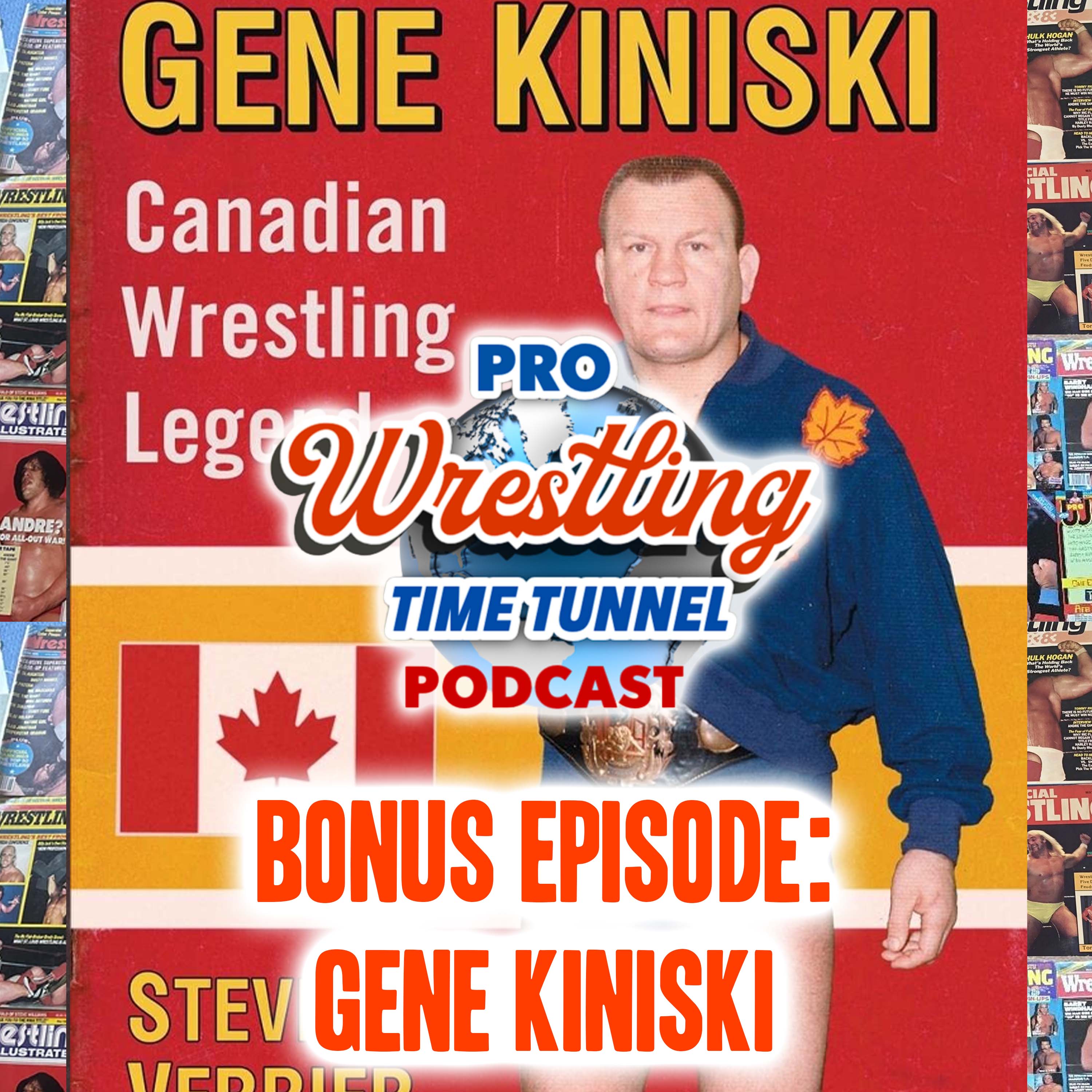
[00:00:34] Speaker C: Well, hello everybody. Welcome to another edition of the Pro Wrestling Time Tunnel History Podcast. I'm your host, Tony Richards, coming to you live from the Richards ranch in Western Kentucky. And today it's a special bonus episode. I love doing these from time to time. Just a little something extra on the side just for you. For the 60th anniversary of the NWA world title victory for superstar Gene Kiniski, billed as Canada's greatest athlete. And I couldn't do today's special episode without out inviting a couple of really good friends of mine who are regulars here on the podcast with me. George Shire, who does a lot of AWA history shows with me and we also do some special episodes on the wrestlers from time to time, is going to be here as well as the man who literally wrote the book on Gene Kinisky. He's the Canadian wrestling historian, Steve Varier.
And Steve has written a couple of great books. He's the co author of the latest book on Wilbur Snyder, the world's greatest scientific wrestler, with Richard Vychik. He's also written a great book that I just got that I can't wait to read on George Gordienko, who Lou Thes wanted to make NWA World champion at one point. And he's the author of the Gene Kiniske biography. And Steve has a very close connection to the Kiniske family, being close to Gene Sons who gave him great research for the book.
And so I wanted to have Steve here today along with George. Now the other reason I wanted George here is Gene is the only wrestler to hold both AWA world titles and NWA world titles.
Also he held the WWA world title for Dick the Bruisers organization out of Indianapolis, Indiana. And there's an interesting story that we get into in the show today about that.
And Kiniski also held the Montreal version of the World Heavyweight title, making him the only wrestler in history to hold all four of those world titles. The Montreal version, the WWA version, the AWA World title and the NWA World Heavyweight title.
And George even talks about in the show that Gene was close to holding another world Heavyweight championship that I won't spoil. I'll Let you watch and listen to our episode today.
It's going to be a great time here at the Richards Ranch as we talk about Gene Kaniski, Canada's greatest athlete on this special bonus show at the Pro Wrestling Time Tunnel. Let's go to that conversation right now. Hello again, everybody. Welcome to another edition of the Pro Wrestling Time Tunnel. I'm your host, Tony Richards, and we're here at the Richards Ranch in Western Kentucky with a couple of my really good friends to talk about a major, major superstar in professional wrestling, Gene Kinisky. And we just passed the 60th anniversary of Gene's NWA world title victory over Lou Thes. And I wanted to do a show about that and get as close as we could around the proximity of the date. And I couldn't think of two people I'd rather invite to talk about Gene kiniski than these two guys. I will introduce first, Mr. Steve Verrier, who wrote the book, the biography on Gene Kiniske. And Steve, welcome back to the show. You've been on with us before talking about the Vancouver territory and there it is with Canada's greatest athlete on the COVID And Canadian wrestling legend is the title of the book. Steve, welcome back, man.
[00:04:37] Speaker B: Well, thank you, Tony. It's a pleasure to be here with.
[00:04:39] Speaker C: You and George and also joining us for a really special reason, because Gene holds a very special distinction among pro wrestling champions and we'll get to that later on the show. But George Shire, who's a frequent guest and a close friend of mine, is back with us again today. George, welcome back, man.
[00:05:00] Speaker A: Always excited to be here, Tony, and so appreciative that you asked me to join you again. And Steve, it's good to be back on with you.
[00:05:07] Speaker C: All right, well, let's talk about. Let's talk about the man. So Gene Kinisky, Canada's greatest athlete. He, he was always billed from Edmonton, but he spent time other places before his family moved to Edmonton, didn't he, Steve?
[00:05:24] Speaker B: Yes. Gene was born in the town of Lamont, very small community about an hour's drive east of Edmonton.
And he lived with his family during his early years in another village, Chipman, which was just outside Lamont.
I had the pleasure of going to the old Kiniskey home a number of years ago. I don't believe the old house is still standing, but it's just a very small community. I talked to a number of people there and the those above a certain age remember Kinisky. They're proud of his presence in their village and he still Is acknowledged there. But, yeah, he is a product of Chipman, Alberta, first and foremost.
[00:06:16] Speaker C: His dad was a barber. What did his mom do?
[00:06:20] Speaker B: His mother was a very, very interesting person. I mean, she was an immigrant to Canada, you know, for many years. She was a homemaker. But she got it into her blood that she just, you know, had to run for political office. I mean, she was a champion of the working class.
She failed in many attempts at running for city council, but on her 13th attempt, she was elected.
There's a school named in her honor in Edmonton, and she is remembered as a proud Edmontonian to this day. I mean, Gene came from a pretty illustrious family, and you could say that his mother in many ways led the way there.
[00:07:11] Speaker C: Yeah, and it was during his world championship run where he's on television pretty much worldwide holding the title. He had many classic matches in Japan, and his mother is a city council member there with her son being the world champion. I'm sure that was a. That was interesting for her and for him.
[00:07:36] Speaker B: Well, yes, Gene and his mother were always very close. I mean, he spoke just reverentially about his mother, and I'm sure she had a great influence on him. And, you know, through the course of researching Kiniski's life, I mean, I.
I think in the book I made the comment that maybe his mother, you know, was the toughest kinisky of them all. That. Yeah, she and Gene shared a lot of characteristics, I think, and they were very close.
[00:08:07] Speaker C: Now, as a amateur athlete, starting in high school, he was.
I mean, he was an outstanding athlete. Right. He played football and. Did he play other sports, too?
[00:08:20] Speaker B: Well, he. Actually, he did some amateur wrestling. He did not have the background of certain others because he just did not have the environment for it. I mean, he was often the only heavyweight around, but he worked at it.
He was a serious athlete. He played.
Played junior football, of course, but it was mainly the football and the wrestling, and he became a professional in. In both of those fields. But, you know, there were limits in Edmonton. But he took advantage of every opportunity he had and did very well.
[00:08:59] Speaker C: He.
He was quite a football player, actually. And really what forced him to quit playing football was a terrible, terrible knee injury.
Isn't that the way it went?
[00:09:12] Speaker B: Yeah. He played three seasons of professional football. The middle season had him on the shelf with a very, very serious, serious injury. I mean, it's almost miraculous that he came back. I mean, in the book, I do illustrate to what degree he had to work to make that comeback. I mean, he was training full time Every day just doing whatever he could. He knew he would be coming back, but he knew it would take everything he had, so he gave it everything he had.
He was an excellent college football player in the United States. He was on a full scholarship at Arizona and had he not left college early, he likely would have played for the LA Rams. He was offered a contract, but he could not play for them since his class hadn't graduated yet, in effect.
But yeah, he was a great footballer.
He was starting to wrestle.
He played a season of pro football in Edmonton when he was still in his teens.
Then he went off to Arizona and he was wrestling professionally at that time. So for a time he was doing both sports.
When he came back to Alberta to play for the Edmonton Eskimos again, he did some wrestling. So, you know, he was interested in both. But I think largely it came down to money. I mean, wrestling was where the real opportunity was.
And also I think he felt he could manage his issues a little more.
He had more control as a wrestler than he would have had as a football player. So I'm sure that played in. But I think money was first and foremost.
[00:11:05] Speaker C: When I did the research for the Dory Funk Senior book came across so many people who wrestled out in the western part of the United States who became very influential in the National Wrestling Alliance. One of those was Rod Fenton.
And Rod had been a promoter out there in Arizona and had formed a relationship with Gene. And also I think Dorie Funk Senior had been somewhat influential in him getting into the sport.
George, do you remember the first time you saw Gene Kinisky?
[00:11:44] Speaker A: I was.
Would have been just shy of my 10th birthday when I first saw him. So you can imagine this would have been August of.
I would have been nine. August of 1960 was when I first saw him. My birthday's in September, so I would have been eight years old for about a month. But yeah, I saw Gene, a very impressionable little kid at the time. You know, he was big and bold and brash and he wasn't the typical heel of the day because he didn't really come out, at least in those years, didn't come out and, you know, scream and yell. He was more matter of fact, as I remember.
But he seemed so bigger than life to me.
And he was in the awa, which when I'm that young, that was my forte.
He was here for from August of 60 to September of 61, which back in those territorial days would have been right about the normal run for a lot of wrestlers to come into a territory and then move on to another territory. It was usually a year to two at most. And that's exactly what Gene did. I point out that when he was brought into the AWA in August of 60, it should be noted that of course, everybody knows that's the year or that's the month and year that Vern Gagne formed the awa. And what he did at that point was he called upon a lot of his fellow wrestling friends, wrestler friends, and he had guys like Tiny Mills and Stan Kowalski and Gene Kiniski and Hard Boiled Hegarty and Wilbur Snyder and Leo Nomellini, Lenny Montana, Joe Scarpello. If you looked at the roster at that time period when Verne branched out and started the awa, it was his friends that he called on to get the ball rolling and they came in for him.
And specifically because, you know, they had met through the years of the the 50s and stayed close.
So that was Gene's role. That was Gene's role to get the AWA off and running.
[00:13:58] Speaker C: That tells you what kind of in ring performer Gene was, if it impressed upon Vern, because Verne was a stickler for wrestling.
So if he, if he targeted Kinisky to come in and this was his debut of his new organization, that. That gives you an idea of how good Gene was in the ring.
[00:14:18] Speaker A: Yeah, and Vern told me one time, and this would have been in about 19, the early 80s, Vern told me one time because we talked about those early formation years. And he told me, he said, you know, I realized that I lost a lot of the NWA talent when Pauly Carbo and himself bought the office, Minneapolis office in 59. And he says, I had to come up with some solid wrestlers. And he said, I knew right away I had to call upon friends. And Joe Scarpello was one of his closest friends, along with Wilbur Snyder. And when we bring up Wilbur and I know Steve, you can relate to this.
You mentioned about the football.
That was originally where Gene and I think Wilbur met up when they played football together.
And I just want to say one thing about that football connection, because you mentioned Steve about the money.
It always amazed me when I was doing research through the years that in the late 40s, 50s and into the 60s, the huge number of professional football players that later moved on to pro wrestling, it seemed like football was like an open door to get into the pro wrestling business. And most of those guys back then, the ERNIE Lads and McDaniels and Kiniskis, everybody, they would tell you, I made more money in Wrestling than I could ever make in football in those days because football didn't have the background with the lucrative contracts and everything like they do today.
And so that was one of the reasons that Gene did as well as Wilbur Snyder and Joe Blanchard and so many moved to wrestling.
[00:15:58] Speaker C: I mean, you guys, I keep George's book handy here and I also keep the Gene Kinisky book of Steve's here handy for reference.
I've got all kinds of pages marked in it. But there is a great photo in your book, Steve, of Wilbur Snyder and Gene Kinisky and Darrell Royal who was the coach of that team. Right?
[00:16:21] Speaker B: Yes. And Kinisky was always proud of his football days and you know, he remained a fan of football long after he, he left the game.
And yeah, as, as George indicated, he and Wilbur Snyder met in Edmonton, became great friends and you know, football also played a part in the Kinisky sons lives.
Yeah, Gene loved the game and at that time, as George indicates, you know, a lot of excellent football players actually made the same decision Kinisky did to get into wrestling.
[00:17:02] Speaker C: And for I just want to point out, George, sorry to cut you off, but for those who may not know, in college football, Darrell Royal was a legendary coach for the Texas Longhorns and became a legend in college football. Go ahead, George.
[00:17:18] Speaker A: Well, I was going to say, you know, when you talk about the Wilbur Snyder, Gene Kinisky connection, if you look at main event wrestling around the country, how many times Gene and Wilbur wrestled against one another. They had just a solid program. They could always go out and deliver whatever territory they were in. They met a lot of times in St. Louis, they met here in the AWA for that year that the two of them were here together in the awa and that, that friendship outside the ring, and that's one of the things that has always enamored me too is that the guys outside the ring that admired their opponents, had friendships with their opponents, they always had the greatest matches. And Wilbur and Gene just had a chemistry. You could tell it just flowed. It was fluid in the ring.
They didn't make mistakes, they looked, they trusted each other. And I saw them wrestle one time in St. Louis and I was always a Wilbur Snyder fan as a young kid because you know, he was the world's most scientific wrestler.
[00:18:24] Speaker C: Yes.
[00:18:25] Speaker A: Before I discovered heels were better. But I love that fact and I think that friendship, that close camaraderie is what really makes good wrestling opponents.
So there's one example.
[00:18:41] Speaker C: Gene Kiniske debuts in 1952. In 1954, he was in a tag team with John Tolos, and they won perhaps the longest title name in history, the NWA Los Angeles International Television Tag Team Championship, by beating Wilbur Snyder and Bobo Brazil. And it was in that same year, in 54, that he had his first match with Lou Thes. Let me, let me throw this at you guys and just see if what this picture does for you. Gene Kinisky was a fabulous television interview.
So not only could he work in the ring, but his, his television interviews were amazing.
He, he kind of gives me the impression that he's a model of what Dick Hutton might have been if Dick Hutton could have talked, you know, if Dick Hutton could have done an interview.
They're similar in size, they both have great wrestling ability. But one of the things that I'm sure came into consideration because by 1966, when Gene gets the title, television is a huge deal, right?
[00:19:54] Speaker A: Very much so, yeah.
[00:19:57] Speaker B: Obviously, Kiniski's ability to talk played into the decision to make him champion. I mean, obviously in those days, what happened in the ring still mattered more than ability to interview, but you still had to get people to come to the matches. Yeah, I think one thing that set Kiniski apart from just about everybody is the preparation he put into his interviews.
You know, I talked a fair bit with Gene's sons and I still, you know, have contact with particularly Kelly.
And it's clear, you know, whenever Gene was touring, he would try to get early to his destination, try to get on the radio, and you know, he would speak to that local market. He studied, he knew the people he was talking to, and that paid off.
He was a great choice, I think, as champion. And that certainly played into it.
[00:21:03] Speaker C: I'm sure that another thing, and this is for both of you guys to comment on. I'm sure that another thing that led to his being considered was because Frank Tunney was still a large influence in the National Wrestling Alliance. He was, he might have been Sam Musnick's closest friend in the business.
And Kiniski had this amazing feud with a former champion, Whipper Billy Watson. They had an amazing ticket selling feud in Toronto and other places in London.
Talk about the Whipper Billy Watson and Gene Kinisky program over the years.
[00:21:48] Speaker B: Well, it was centered in Toronto, but it played out all over Canada. I mean, Watson was, you know, the national wrestling star in Canada.
[00:22:00] Speaker C: I mean, I saw an interview, not to cut you off, but I was just going to interject this. I saw an interview where a guy asked Kanisky about Watson. He said, you Mean, God.
[00:22:13] Speaker B: Well, I think that interview probably took place after Kinisky's career was over.
[00:22:20] Speaker C: Yeah, it did. Yeah.
[00:22:21] Speaker A: I mean, he.
[00:22:22] Speaker B: He stayed in character very well. He made you believe.
But behind the scenes and afterward, he was quite open in his respect for. For Watson and for other opponents he had over the years.
Yeah, Watson was the ultimate national hero to fans. I mean, he had a national audience through the CBC in early years.
He was known throughout Canada. And Kaniski was just this vile, proud Canadian.
You know, people, well, they. They respected Kinisky the athlete, Kinisky the performer, but they hated him for the most part as an opponent of Watson's. But the two of them just struck a chord across Canada. I mean, those matches sold out from coast to coast for a long time. And, you know, both guys played their roles very well. Obviously, Kiniski was a bigger star in more places outside Canada than Watson ever was, but certainly Frank Tunney, Sam Muchnick, I mean, they knew what they had in Kinisky, and they were very strong backers, obviously.
And I don't think Kiniski faced a lot of opposition in being named the NWA champion in 66.
[00:23:46] Speaker A: You know, one thing I'd like to interject is that when you talk about Gene Kinisky, the character in the interview, Gene came from that era where if you looked at Gene Kinisky, he didn't have any special gimmicks to his Persona other than that he was tough. He was big, he was tough. And he didn't have any, you know, elaborate costumes.
If he came to the ring, it was with just a ring jacket or sweater, and he just had that crew cut. And he was tough, and he prepared his interviews. And Steven and Tony, you know, in that era, these guys didn't have a script. They weren't handed six pages of script to memorize and do an interview. They. And like you said, Gene would prepare, but that was a lot of mental preparation. He knew who his opponent was. He knew where he was in a program with someone. He knew what he had to say to get it over, to get people to buy tickets. And when you look at that Whipper Watson connection and throw Lou Fez in there, goes back to what I said a little bit ago with that respect. Respect that you have outside the ring. Let's not forget that. Tony, you and I, we had a conversation talking about Buddy Rogers just a short time ago, and Lou says he was very particular.
And, you know, in the 50s, when Lou wanted to drop the title for a short time, one of his times off as he would take. It was Whipper Watson that got the nod. And though it was short lived, Whipper was the guy he chose. And then you look at Watson and Kiniski together, the battles that they had.
The only thing I would say when you mentioned the Dick Hutton connection, we know that that was Lou's personal choice to drop the title two in 57. But the bottom line was this. I think if Gene Kinisky at that moment in time maybe would have just had another year or two under his belt. I'd like to speculate that Gene would have, or that Lou would have certainly went to Gene as being the guy and think about how that would have altered history because he would have been NWA champion. He, we may never have seen him in the awa. I mean that's a whole fantasy in itself, but that's where it comes from, the respect. And Gene was the real deal. And he didn't have to lure fans in by any special costumes, gimmicks or anything else. He brought you in because he was Gene Kaniski, period.
[00:26:23] Speaker C: And in 1957, you brought up 57. He did win a world title in 1957. It was the Montreal World Heavyweight Championship where he beat another legendary wrestler, Edouard Carpentier, before he goes on to wrestle, still another huge name in the business. He beat Pat o' Connor for the British Empire Heavyweight championship. And George brought this up. He can read my mind sometimes. But when I'm looking at wrestlers careers in the, in the former days that we like to talk about, you had to be in the business somewhere between seven to 10 years before you were even thought you could even handle a championship. Gene's been in the business seven years at this point, so you can tell his skill set because they weren't just going to give it to you. I mean, you were going to have to earn it. So you could tell that his skill set was to the point where they felt he was capable of carrying a title. Because in those days titles really meant something. They didn't pass them around quite as freely as they do in the modern era. He also got the nickname, I mentioned it a time or two, Steve, but he also got the nickname Canada's Greatest Athlete. How did that, how did that happen?
[00:27:53] Speaker B: There was a Hamilton, Ontario sports writer, originally from the Prairies, I believe, named Dick Beddoes. He was, you know, I remember him from my very young days, I believe, on a TV station based in Hamilton. I mean, quite an interesting city in terms of wrestling history itself. But Beddoes and Kiniskey had some of that good on air interplay. Beddoes would help promote upcoming wrestling cards in the area. I mean, Hamilton is just a short drive from Toronto.
And it was Beddoes who came up with that moniker for Kinisky. I mean, Beddoes was a general sports reporter. He interviewed all kinds of athletes.
And he just made the point that, you know, if you can wrestle Kinisky and then afterward go on to play golf or tennis or hockey or whatever, well, good luck to you. And based just on that perception, on Kiniski's pure toughness, he called him Canada's greatest athlete.
Kiniske loved that nickname. He ran with it.
I think he had a bit of background with Beddoes going back to his days in Edmonton. I mean, Beddoes was a sports writing and broadcasting veteran, but he's the guy credited with coming up with Gene's nickname.
[00:29:27] Speaker C: As we get into the 60s there, there is a lot of. There's. There were always politics in the National Wrestling alliance, but there were a ton of politics in the late 50s going into the 60s. And as we mentioned previously, Verne separated himself from the NWA forming the American Wrestling Association. And it's only in existence for several months or maybe even a year. George, when he drops the title to Kunischy in Minneapolis in 61, did was that tell us the circumstances around that title change?
[00:30:06] Speaker A: Well, you got to remember the very early years of the formation, and you and I touched on this in our last podcast, Tony, that a lot of times the wrestlers, the promoters, they were looking to build a rematch or some storyline to keep the heat going for a program they were in.
When Gene came into the awa, he had had a match with Verne early on In January of 61, they had had a major main event in Minneapolis. But you go all the way to August of that same year and that's when Gene is going to get. Or July of that same year, that's when Gene is going to get the two week run as AWA champ. And it was just a matter of where they'd run the feud for several months, several programs, and let's get one more match out of it or a couple more matches out of it. That mindset that they had. And Vern Gene, you know, he says, I'm going to pass the title to you for two weeks. We're going to have this. You stole the title from me. You did this that. You know how they would do it. And then they have the big blow off match between them and Gene loses it back there's something that. I don't know if you're familiar with this, Tony. I thought before I went this morning, I pulled out my Gene Kaniski book. I have a book on all wrestlers, and I pulled it out and I had a note inside of it here.
So I. I figured I'm just going to run this by you because I had actually forgotten about this, and I wouldn't have known it unless I pulled out my book this morning or remembered it. And you're an Amarillo guy.
Well, according to this, Gene Kanisky was recognized as the world champion Amarillo in 1962 after Carl Sarpolis. Is that how he pronounces Sarpolis?
Sarpolis in public and Dory Funk privately. This would be. Dory Senior refused to book Buddy Rogers as world champion.
And this was even during the time that Sarpolis was elected NWA president.
[00:32:17] Speaker C: Right.
[00:32:17] Speaker A: But I thought that was interesting because you and I had talked on our last podcast about Killer Kowalski having a Texas NWA title run that never got recognized.
[00:32:28] Speaker C: That's right.
[00:32:29] Speaker A: So you were aware of that.
[00:32:30] Speaker C: Yes.
So there again, politics running wild at the National Wrestling Alliance. So Mushnik stepped back in the early 60s to make room for Fred Kohler. Kohler was.
Kohler was unhappy most times about almost everything.
He was sitting on top of the world. He was sitting on top of a gold mine, and he still wasn't happy.
And he was always concerned about all these little issues that were going on around the National Wrestling Alliance. Well, Doc Sarpolos was the primary shareholder and owner of the West Texas territory. And Dorie Funk Sr. Was his junior partner, which was unknown to the fans because he was their main event wrestler. They wanted Dorie Funk Sr. To get the world title, and they lobbied for for it and couldn't get it done. The rest of the alliance wanted Rogers. Mushnick wanted Rogers. Rogers had helped Muchnick in St. Louis defeat Tom Pax in their promotional war. So Muchnick always had a soft spot for Rodgers and Rogers got the title. Well, Sarpolis Kohler couldn't finish his term. I think he got mad and resigned again from the National Wrestling Alliance. And Sarpolos was the first vice president. He became president of the alliance. And so we had this weird situation where Sarpolos and Funk Sr. Were upset about not being able to get the title for Funk Senior and so they just wouldn't book Rogers. So they created their own world title in Amarillo. And Gene Kinisky. There were only two title holders.
Gene Kinisky. And then he passed it to Dorie Funk Jr.
Which would be the foreshadowing of what will happen in the alliance in a few years. Did I get kind of that sort of right, Steve?
[00:34:28] Speaker A: You did. You did. And I wrote it. That's the way I wrote it down. I found it this morning. I thought that was cool.
[00:34:33] Speaker C: Yeah. Yeah. It's interesting because Kinisky and Funk Sr. Had gone back for years. We noted that earlier when Kinski first got in the business and they made him their world champion. And Fez was even miffed at that, even though he hated Rogers. He thought it was a. He thought it was a miscarriage of justice that the president of the National Wrestling alliance would be naming someone else champion besides the actual champion, which was Rodgers at the time.
[00:35:03] Speaker A: Well, and the interesting thing about that, during that Sarpolis time period in 62, they also recognized the Inamorillo because the AWA, Vern Gagna's AWA, because Vern had wrestled down there and defended the AWA title. So the reality of it is they actually were recognizing three different champions as Vern was AWA Champarillo, even though he had no part of the city at all.
[00:35:31] Speaker C: Right. And which also linked him with Stanley Blackburn, who was Amarillo Citizen.
I have a complete set of the 1962 programs. And it's just so interesting to see that in the back of the programs they have the pictures and the.
[00:39:32] Speaker B: It did.
You know, I have described Kiniski's run with the WWA title as a dress rehearsal for what was going to transpire in January of 66.
Yeah, I mean, he was.
Gene Kinisky was on his way to the moon. And I think Bruiser and Snyder certainly played a big part in that as well.
[00:39:56] Speaker C: I have looked through. I'm sorry, George.
I have looked through.
I've scoured through the. Sam Mushnik communications. He was a stickler for letters. And I've looked through those, looking to find some communication between Munchkick and Bruiser or someone to ask them to relieve Gene of his duties so he could have the NWA title. But I haven't been able to find that yet. You going to say, George, well, here.
[00:40:27] Speaker A: Here's how it went when you said it was close proximity.
Kinisky had taken the title from Bruiser, the WWA title in August of 65.
And he held it until December.
Actually, on Christmas Day of 65, he dropped it back to Bruiser. And then you go, just a week so later, January 7th of 66.
So we're only talking a week.
[00:40:53] Speaker C: Right.
[00:40:54] Speaker A: And he got the NWA title. So there's no doubt in my mind that that was. There was some conversation or some, you know, we're going to relieve you of the WWA title because you're going to go to nwa. And Gene was gone. So that made perfect sense to do that.
[00:41:10] Speaker C: And also in 65, there was the meeting in Chicago between Mushnik and Thes and tootsmont and Vince McMahon Sr. And Bruno Samara, where they were trying to put together a title versus title match at Madison Square Garden, where Bruno would beat Thes for the title and hold it for a year and then drop it back to Thes. But because of Thes, he had a couple of grudges that he held his entire life against Buddy Rogers. And another one was against Toots Mott. I think the one with Toots Mott was more intense than. Than the Rodgers one, even.
And because of his hatred for Mont, Lou had demanded a lot of cash up front. And it was always Thes theory that the New York guys would have never given the title back to him. But he made it almost impossible for that deal to take place, which, according to Thes, really, really infuriated Munchnick. I mean, Sam really wanted to do the deal because it was going to make those guys a whole lot of money. And Sam trusted Senior and Vince Senior, that is. And it was right after that meeting that it was decided that it was time to move on from Luthes. And Lou made the suggestion, as I understand Lou said anyway, that he made the suggestion of Gene Kinisky. Do you guys know if there were anybody. If there was anybody else being considered at the time?
[00:42:47] Speaker A: I do not. I've never heard anything.
[00:42:49] Speaker B: Yeah, I do know there were names mentioned. I mean, obvious people like Johnny Valentine, for example, Fritz Von Erich. But, you know, I don't know to what degree anybody really pushed for them. I mean, Kinisky was the clear choice by the people who mattered.
[00:43:09] Speaker C: We mentioned his television interviews and we've mentioned his work.
He had traveled enough that people knew that he could keep up with the schedule, which was not quite as intense as the fest schedule had been because, you know, New York had formed their own thing and Minneapolis had pulled out and formed their own thing. The title was starting to go to Japan a little bit, where Gene, we should mention, too, Gene was highly, highly respected in Japan, right, Steve?
[00:43:43] Speaker B: Oh, absolutely. And he. I mean, I am in Japan part of the year. And Kinisky is still remembered, not only by the older people, but, you know, if you go to Korakwan hall, where the Hardcore wrestling fans go, many of them are quite familiar with Kaniski. He's one of those people remembered and revered by a lot of people.
And interestingly, even when Kiniskey was NWA champion, at least on some occasions, he would wrestle there, but his title would not be on the line. I mean, Kinisky played a huge role in elevating Giant Baba from, from, yeah, a main eventer to an icon.
Baba was wrestling for the Japan Wrestling association until he formed All Japan Pro Wrestling. Later on, Kiniski went in there as an NWA champion, but he challenged for Baba's NWA International Heavyweight Championship.
And the purpose clearly was to elevate Baba to a point where people in Japan said, okay, he's equal to everybody. His title is just as important as the NWA title. And Kaniski somehow, I wouldn't say dragged, but shall we say, encouraged Baba to a great 65 minute match. You don't associate Giant Baba with, you know, great 65 minute matches. But Kiniski and Baba went to a draw, by the end of which it looked as though Baba was probably going to win, but, you know, the match was over. Kiniski did his job, he did not defend his title, but he made a huge difference. And I think people remember him to a large degree for that single match in 1967 with, with Baba.
[00:45:50] Speaker C: And we talked about his television interviews. The Japanese fans were typically very reserved, but Kaniski could get them provoked with some of his arrogant promos that he would do. George, you were going to say something.
[00:46:06] Speaker A: Well, I'd like to point out, you know, we, as we've been talking here, and we kind of started with Kanisky's run in the AWA 1960. If you go through 60 to 69, when he dropped the title, the NWA title to Dory Jr.
You think about a lot of times people say, well, you know, Bruno San Martino was the cat's pajamas in the. Everywhere you went, the magazines out east, every now he's on the COVID and he's the, he's the this and that. But when you look at what we've just talked about, I think the main star throughout the 60s, from 60 to 69 for sure, with these title reigns, these Buddy Rogers situation, the Amarillo and Vancouver nwa, wwa, AWA titles, I think it would be hard to argue, guys that Gene Kiniski wasn't probably, and he doesn't get credit for it, the premier guy for the 60s, for the business of professional wrestling. I really do. I think this guy had it all.
[00:47:10] Speaker C: He really he really was a star for that time. And that's one of the reasons I love doing this podcast, because we can talk about things like this that have seemingly just sort of disappeared into the mists of time.
But we go back and make sure that we document these wonderful accomplishments by this man who were his biggest programs with Steve.
[00:47:34] Speaker B: Well, obviously thes, you might have to start there, but you know, thes helped boost the careers of many other wrestlers other than thes. I certainly would put Don Leo, Jonathan on the list and, and Whipper Watson, of course. I mean, Kiniski and Jonathan wrestled.
I think I counted recorded matches one time. I don't remember the number, but it is, it's astronomical.
[00:48:05] Speaker C: They were friends, weren't they?
[00:48:06] Speaker B: I mean, they were great friends. Yeah, I had the pleasure of spending some time with Don Leo when I was working on a couple of previous books and you know, he and Kinisky were very, very, very close.
[00:48:21] Speaker C: You know, they would go on to work together for a long time once Kinisky took the Vancouver territory.
[00:48:28] Speaker B: Yeah. And they, they kept in close touch when their careers were over. They had great respect for each other.
You certainly would have to, you know, at people. Well, I mean, there are so many, if I named one, I've probably come up with with a few dozen. But, but, but, but those names really stand out, you know, of course, Dory Funk Jr.
My goodness, who did Kinisky not wrestle?
You know, he, yeah, had a short run with the AWA title, but his matches with Wilbur Snyder over the U. S. Championship in the AWA were I, I think trailblazing matches also.
[00:49:13] Speaker A: Yeah.
[00:49:14] Speaker B: And again, interestingly, you know, I think Kinisky's greatest opponents were probably his best friends in the business or right at the top of the list.
[00:49:24] Speaker A: Let me point something out. We talked a bit ago about how Gene was the only wrestler to ever hold the AWA NWA and WWA world titles during his run that year. For that year and a month in the awa and you just brought it up, Steve.
Gene was recognized as the United States Champion in the AWA during that year's run.
And when he won the title from Vern, he actually was US Champ. He held the AWA title for two weeks and at the same time, and this is what's really funny, he co held the AWA tag team title with Hard Boiled Hagerty, and he's the only guy in AWA history that can say he held three titles at the same time, even though that AWA run was just the week or two, whatever the Time frame was there. I think that is remarkable.
And Gene was one of the last guys to actually hold the United States title as recognized throughout the 50s in the AWA.
So that's another accomplishment that we needed to touch on.
[00:50:38] Speaker C: I noticed in your background there you've got Vern and Gene and the headline there, I can see part of it. Haggerty Bard as Kinisky second.
So Gene was tag team champions with hard boiled Hagerty then. And I'm sure they were working that in the storyline that Hagerty was a little bit of his policeman. Right. Or the guy that was running interference for him.
[00:51:03] Speaker A: Yeah, Hagerty and Kiniski were tag team champs here when they became champs when Lenny Montana, who was Haggerty's original partner as champion tag champion. And the storyline was is that Montana suffered a broken leg, he was out of action. The AWA allowed Kinisky or Haggerty to choose a partner.
And Kinisky had been working with the two of them in six man matches a few times. So Kiniski was the choice.
But the irony of the whole thing is, is that while they were a team, one of the blow off matches between Verne and Gene Kinisky was in a cage at the old Metropolitan Baseball Stadium, which was the home of the Minnesota Twins and Minnesota Vikings at the time. Time they had a cage match out there.
Haggerty was outside the ring, obviously there for Haggerty and he had picked up some dirt from the infield of the stadium and he attempted to throw it allegedly at Verne. It hit Gene in the eyes. Verne was able to beat Gene and then Gene and Hagerty broke up and they were tag champs at that. The time they broke up, neither was going to defend the title together. They each wanted a match.
So the AWA chose the idea of they will meet in a singles match and the winner of the match will obtain a partner and continue to hold the title.
Well, this was at the end of Gene's run. That cage match was the blow off of the Vern Gagne Gene Kaniski feud. Gene was going to leave, so Haggerty beat him and Haggerty chose Texas Bob Geigel as his new partner. She was gone. But what's interesting about that is that was in September of 61 and if you flash forward to.
March of 62 in Vancouver, Gene and Haggerty are back as partners and they actually won the Pacific coast tag team title from Whipper Billy Watson, who we talked about, and a guy named Ernie Bemis of All people who some people would recall wrestled as Mr. Clean and some other names, but they. Haggerty and Kinisky were so I. I always laughed when I saw that after the fact, I said, well, they forgot they had feuded in the awa, but again, in territory, they could get away with stuff like that because nobody ever.
[00:53:41] Speaker C: Right. Well, a champion is a champion mainly because of the people they have to work with. And Gene had no shortage of people to work with. That's why I asked earlier about his.
About his opponents. Let me throw some names at you guys.
These are some guys that I. If I was a fan, I would want to go see these matches. So let me throw the first one out that I know you guys will have thoughts about. Big Bill Miller.
[00:54:11] Speaker B: Would be a great match anytime.
I mean, Miller was a great athlete, a big, strong guy. Yeah, you get your money's worth, for sure.
[00:54:23] Speaker A: And let me just say, regarding Miller and Kunisky, they both wrestled each other and they were tag partners. Now think about that as a tag team. I like that. Tag team.
[00:54:33] Speaker C: I like that. Let me throw this one. These are all big guys that could really work and go in the ring. That would be great. Matchups with Kinski, Fritz Von Erich, another tag team.
[00:54:45] Speaker B: Yeah, and another friend for life with Gene Kinisky.
They had a lot in common when.
[00:54:53] Speaker A: When Fritz took over in Dallas Fort Worth, if you look at the programs, he had Gene Kinisky on a lot of his programs. When Gene was champ, it was a good draw in Texas.
[00:55:06] Speaker C: This guy had a. Had a famous run with Bruno Sammartino, one of Bruno Sammartino's first opponents. Actually, that really got Sammartino pushed to the forefront as a champion. Bill Watts.
[00:55:22] Speaker A: Yeah.
[00:55:23] Speaker C: Tell me there wouldn't be some live rounds thrown in that match with Kinisky and Bill Watts.
[00:55:29] Speaker A: Well, I think we talk about that mutual respect, too. And again, there was some football background there from both of those guys because Watts had played football.
They were kind of in the WWF around the same time, too.
Gene had been teaming, I believe, with Waldo Von Erich, the wrestling brother of Fritz.
And he and Von Erich. Gene and Von Erich had some matches.
I know there was one against Watts and Gorilla Monsoon, which would have been a heel. Heel match.
Think about that.
[00:56:10] Speaker C: I mean, for. For modern fans, to give you some thought about this, if you could take a match like a Brock Lesnar against, let's say, Gunther, and you think, wow, what a match that'd be. Gunther and Brock Lesnar, we just named four or five guys that would be equivalent of that back in these days with Bill Miller, Fritz Von Erich, Bill Watts, Waldo Von Erich, Dick the Bruiser, these were all big tough guys who could really work in the ring and go.
And just like two big.
What would you, what animal would you put in there? Two big rhinoceroses, button heads, you know.
[00:56:54] Speaker A: You know, the thing that's interesting about that is that you think about if we were able to be a promoter back in that day and you wanted to be able to hand pick your, your group of guys. And I had mentioned about when Vern started the wa, he had went to a lot of his friends and the names I mentioned to you were all main events, stellard stars. They were well known nationally.
And, and you think about what you just said, Tony. You bring these guys in, Bill Miller and Waldo and Fritz and Gene and Bruiser and Bill Watts and holy cow, if I was a promoter and I had that selection to be my core guys to, to start a group, I don't have to worry about getting fans in the seats because they're coming.
They're coming.
[00:57:38] Speaker C: January 6, 1966. That's when Kinisky defeated Thes in St. Louis at the Keel Auditorium. They drew 11,612 fans. How did Gene feel about his title? I mean, talking to his sons. Steve, for your book, how did Gene feel about his title run? Was he satisfied with it? He, he defended it for three years, 1131 days, and that's 150200 times a year for those three years. How did Gene feel about his run?
[00:58:12] Speaker B: Well, I think at that point he was certainly all for it. I mean, yeah, the date I think was January 7th, Nick Kinisky's fifth birthday. And you know, I think I got to say that despite everything in his career, I mean, despite the glory, what really motivated Kiniski was the opportunity to provide for his family. And you know, I think he was eager to kick off that run. He had great respect for previous champions and I'm sure he felt ready to try his hand. I mean, obviously over time wanting to be with the family started to outweigh wanting to, to be out on the road defending the title. But, you know, in early 66, I think Kiniski saw it as a great opportunity to provide for his family and to at least, you know, get them to the point where they could settle down and live as a more normal family.
[00:59:14] Speaker C: And you should, you should read Steve's book because there is a lot of information in the book about his family, about Gene Kinisky's family. He was very much in love with his wife. Right.
[00:59:26] Speaker B: Yes.
Like a lot of wrestlers, you know, he had temptations and, you know, sometimes things did not go well when those temptations materialized. But, yeah, he, you know, above all, he loved his family, he loved his wife.
You know, things did not turn out well. I mean, in the book, I do talk about the eventual suicide of Gene Kiniski's wife, Marion.
But Gene loved her up until then and beyond then, he never remarried.
He had regrets for sure. But, yeah, I think is clear.
[01:00:14] Speaker C: Allow me to compliment you on your book, too, because my heart broke when I got to that part, when I read the book the first time.
[01:00:21] Speaker B: Yeah, I appreciate that. But, you know, I. I appreciate, you know, Kelly, particularly, you know, reliving all of that time, providing a lot of detail. To me.
Yeah. Just a tragic story.
But, you know, Gene did everything he could for his sons afterward.
And as I say, he never remarried. He made the comment publicly that there would be no point in remarrying because he had been married to the best.
Yeah. But unfortunately. Yeah, that is a sad turn of events in Gene's life.
[01:01:02] Speaker A: I'd like to point out that I had a chance to talk with Gene Kinisky. Had a Hall of Fame reunion when it was still in Newton, Iowa. So this is going back 20, some 25 years.
I had a chance to sit down and talk with Gene, and he never talked about the suicide part of it. I actually, I'll be honest, I didn't know that, Steve, until I had seen it in your book. But what I did have a chance to talk with Gene about is that I had known that his wife had passed away.
I didn't know the circumstances behind it. When I talked with him, and I remember him saying that it was important for him when his wife left him, that he had to take care of his boys and that he had to be the father and the mother to them. And he told me, and I still remember sitting. We were in a TV room, a radio room at the museum. And I still remember when he said, I realized that for me, that was job one for me as a man.
Now, that's heartwarming.
[01:02:09] Speaker C: Yes.
[01:02:09] Speaker A: And now when you talk about that suicide thing, and I'm like, Tony, anyone that has to endure that type of pain in your lifetime, whether it be a parent or a brother, sister, relative, close friend, takes their life, there is nothing that just has to gnaw at your heart. And I. I've lost two people through that measure. It's not good. It's not good at all.
And so Jean, Gene was a very strong and I got to believe a very good Christian man. But when he said that about my job, one was to take care of my boys, he was God there to me. And I mean that sincere. Yeah.
[01:02:54] Speaker C: Oh, I'm reading your book. I mean, you're going through. I'm going through the book, and I'm going back the first time I saw it, Steve, as I'm seeing the pictures of them on vacation and the things that they did together. And. And then I got to that part, it was.
I can't. As close as I could get to relating to what Gene must have been feeling at the time.
After he has, he drops the title to Dory Funk Jr. In 1969, but he continued to wrestle up into the 80s.
I got a chance and made it a point to watch some Gene Kiniski that's available out there in preparation for doing this with you guys today. And I saw a wrestling match in Houston in 1981 where he's wrestling Tank Patton, for goodness sake.
And that's 15, 16 years after his title was run.
Plus, he also. We alluded to it, and you and I talk about this when we do the Vancouver shows, Steve. But he. He was a partner in the Vancouver territory after that. When did he get. Was that during his title reign or after his title reign? When he got involved with Vancouver?
[01:04:05] Speaker B: He bought into Vancouver during his title reign. I mean, he had established a presence in British colonial Columbia previous to those days.
[01:04:16] Speaker C: I also saw an interview where he called Vancouver the most beautiful city in North America.
[01:04:22] Speaker B: So he loved it.
Yeah, he was active in the. I mean, you mentioned Rod Fenton, who actually wasn't Edmontonian, but who promoted in Arizona when Kiniski was breaking into the business. But Rod Fenton, after Arizona took over the promotion in British Columbia, he had a partner named Cliff Parker. But Kiniski was quite active there.
And Kiniski seemed to have a pretty significant hand in booking some of the matches as early as the early 60s in Vancouver. But he had the opportunity to buy into the promotion. Fenton made a decision, based on his wife's health, to leave for the United States.
Kiniski had an opportunity, and so in essence, he moved his family from St. Louis to the Vancouver area just, you know, about 2/3 of the way through his NWA title reign. And he played a role in ownership, you know, for. For well over a decade after that.
[01:05:41] Speaker C: Well, guys, I appreciate you coming on with me today and talking about Gene Kinisky. The 60th anniversary of him defeating Luthes for the NWA world title. Final thoughts on Gene Kinisky. We'll start with you, George.
[01:05:55] Speaker A: Well, I would just say that we've covered a guy who I believe, as I said earlier, is probably the predominant 1960s star for sure.
A guy who respected the business, a guy who represented it with class, a guy who didn't need a gimmick to get over other than to say I'm tough and go in the ring and prove it.
And I've got a lot more admiration from him just sitting here talking about it. And I feel honored that I saw him wrestle not only as NWA champion, but as a young kid.
I'd also point out just one little point of research. If anybody wants to go back and check into the mid-50s, there are some programs in Texas where Gene Kiniski wrestled briefly as Gene Kelly and he teamed up with Len Crosby, who later on was Lenny Montana.
And I think Godfather fans, that's Lenny Montana and the Godfather.
[01:06:50] Speaker C: Yes. I think he won the Texas title under that name.
[01:06:53] Speaker A: He did, yeah.
There's actually a tag team championship that Gene Kelly and Len Crosby won, which I always found interesting when I realized later they were teaming in the AWA under different names, but absolutely a genuine star and somebody that should never fall under any radar as being really one of the very best NWA champions and representing it for the three year time period that he did, which was usually about their formula to have their champion. And with that, I'm just going to say thank you for having me again, Tony and Steve, God bless you, sir. Thank you for the great book. Thank you for having me share the memories with you. And I had a blast.
[01:07:38] Speaker C: Three years is about as long as anybody could take the schedule for that title. Final thoughts on Gene Turn it over to you, Steve.
[01:07:48] Speaker B: Well, I grew up watching Kinisky. I lived in Ontario, Canada. All Star Wrestling from Vancouver was broadcast across Canada at that time. So I saw Kaniski well week to week or as frequently as he was on the show. And you know, as a very young fellow, I just found him extremely entertaining, whether in the ring or on the stick.
You know, I had no idea of the role he played behind the scenes at that time. I didn't know he'd been a big name in other places. Just watching him on TV on the channel from Kitchener, Ontario at 10 o' clock Saturday nights, I found him entertaining. That's what drew me in.
In later years I came to realize, well, you know, this is a guy who went all over, who stirred up fans wherever he went. I Mean, he didn't fail anywhere.
But what really attracts me to Kaniski now comes through research for the book and really the realization that this guy was not just a wrestler, not just a great athlete. I mean, he was a genuine fellow, an interesting guy.
And I really enjoyed talking to quite a few people who knew Kiniski as a neighbor in Blaine, Washington, particularly where he made his home for many years.
You know, I talked to a lot of people also over the course of supporting Genesis induction to the British Columbia Sports hall of Fame. And he is a member there and it took some doing, but.
And you know, I'm actually grateful that the book seemed to help in that regard. I mean, getting Kaniski recognized as somebody worthy of induction to a genuine sports hall of fame. But to me, it is largely all the stuff outside of wrestling that impresses me about Kaniski. I wouldn't have written the book had he just been a wrestler, at least not a whole book.
But, you know, I. I think as far as Kinisky's life is concerned, there's room for other people to take other approaches. I mean, Kinisky is that large a figure in life and in wrestling and, you know, I'm just very, very happy that I have become aware of what an impact he made. And. And again, I think in many ways the greatest impact is just on that community in which he lived. I mean, people had such respect for him.
And yeah, he's somebody we just have to remember.
[01:10:35] Speaker C: He was a member of the original class of the Wrestling observer hall of fame in 96. He was inducted in the Trago thes Hall of Fame in 2004, the Professor Professional Wrestling hall of Fame in 2008, the NWA hall of Fame in 2009, the St. Louis Wrestling hall of Fame in 2007, the British Columbia Sports hall of Fame in 2021. And the book is Gene Kinisky.
Hold that up there, Steve.
Get that book by Steve Verrier.
If we've influenced you some into the life of Gene Koniski, that's the book that you need to get. It's the definitive article written on his life. We lost gene in 2010. He died in Blaine, Washington at the age of 81. He had brain cancer that has spread and just a fabulous, fabulous, amazing career.
As you may know if you're a brand new listener or watcher, I will tell you. You can hear here George on the podcast with me as we cover the AWA and we'll be talking about 1976 in coming episodes and you can hear Steve and watch Steve with me as we cover the Vancouver territory in 1976, which is also, I should mention, the year that his wife passed away. Right, 76.
So I'm sure that will come up during the program. Thanks everybody for listening and watching. This is the Pro Wrestling Time Tunnel. Thank you fellas for joining me today.
[01:12:09] Speaker A: Thank you, thank you.
[01:12:11] Speaker C: What a great conversation today and what a great episode of the Pro Wrestling Time Tunnel, this special bonus episode on the life and career of former NWA World Heavyweight Champion Gene Kinisky. And I can't thank my friends George Shire and Steve Varier enough for taking time out to come by and visit with me about the this fantastic athlete. I hope you enjoyed it as much as we did. Let me tell you a little bit about my social network channels. You can follow me on x at Tony Richards 4 at Tony Richards 4 we have great conversations about pro wrestling there. I share several posts a day. We have a Pro Wrestling Time Tunnel Facebook group and also the hub of all things pro Pro Wrestling Time Tunnel is at the substack so you can follow me and subscribe to my publications and my podcasts and all the great things we do to document pro wrestling history at Tony Richards 4 on substack. And you'll find the Pro Wrestling Time Tunnel there. Now you can do a free subscription, but I want you to know that the whole reason all of this is possible is because of you and because of your support. And if you'd like to make a financial investment in what we do here, it's real easy to do. You can become a premium investor at the Pro Wrestling Time tunnel substack. Just $5 a month or $60 a year and that will get you an entire year's worth of great pro wrestling history. I just wrote a great article about the original British Bulldogs tag team.
These are all things that just go to our paid subscribers, so that article went to them. I just finished the Year in review of 1965 and we sent that out. The year of 1975 is coming up and also our next profile in the best territory television announcers and commentator series.
We are about to release profile number nine on that.
So come on by the substack and join in our great community. We've also got a YouTube channel. We just passed 500 subscribers on that where we post all our episodes and a lot of clips of the show and some other things that I'm working on like the stories with Briscoe and Bradshaw podcast and the great Roy Welch family legacy that we're just wrapping up this week with our special guest, Ron Fuller Welch, who has come by for two episodes, episode nine and 10, there to visit with us. Thank you for joining me today. I hope you enjoy the trip back in time that we take in the Time Tunnel every week. We do Territory Era wrestling history, which means we go back sometimes as far as 1925, and we cut it off around 1990, 1995, when the last territories are dying out due to the national expansion of the big companies. But at the Pro Wrestling Time Tunnel, you can always come back here and relive the Territory era. That's what we're all about here. Thank you for joining me today. I really appreciate you. Remember, if you want better neighbors, be a better neighbor. Thank you for joining me. From the Richards Ranch, this is Tony Richards saying I'll see you again this week. So long everybody from the Bluegrass State.
[01:15:50] Speaker A: Thanks for tuning in to the Pro Wrestling Time Tunnel podcast. Tune in for another great episode next week, interviewing wrestlers, referees and media personalities that have made the sport of professional wrestling great. We'll release a new episode soon. Don't you dare miss it.