Episode Transcript
[00:00:02] Speaker A: Time for the Pro Wrestling Time Tunnel podcast.
[00:00:05] Speaker B: We've got lots and lots of things
[00:00:06] Speaker A: to talk about and to do today, covering the territories from the 1940s to the 1990s.
[00:00:13] Speaker C: It's the best thing going today.
[00:00:18] Speaker A: Interviewing wrestlers, referees, authors and other media personalities that have made the sport of professional wrestling great.
[00:00:27] Speaker B: The cream, yeah, the cream of the crop.
[00:00:30] Speaker A: And now, here's your host, Tony Richards.
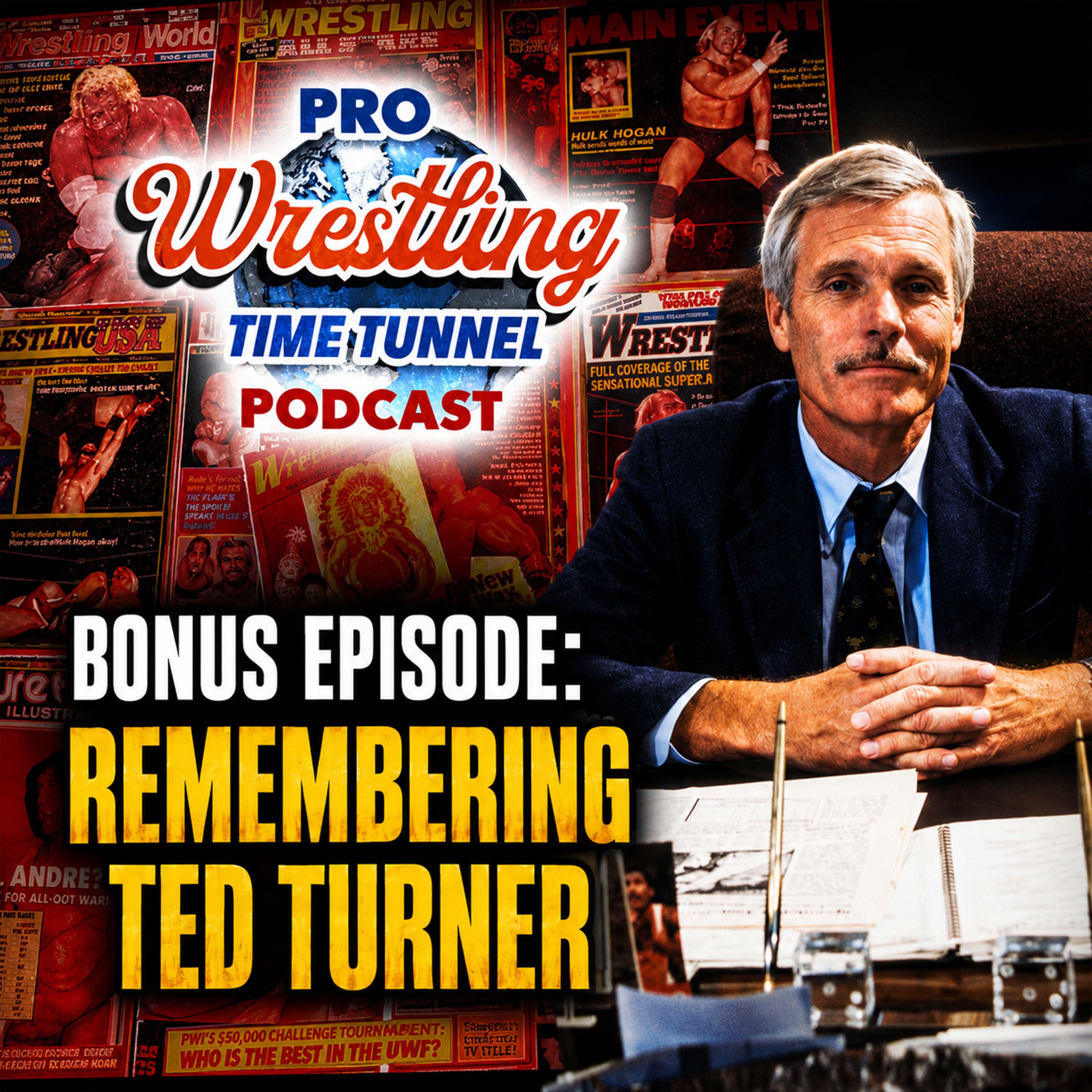
[00:00:34] Speaker C: Hey, everybody. Welcome back to the Pro Wrestling Time Tunnel. Live from the Richards ranch in Western Kentucky, I'm Tony Richards. And so happy to have two of my great friends along today to talk about somewhat of a sad event, the passing of a media mocul who I've been calling pro wrestling's best friend in television, Ted Turner. My friends Brian Solomon, author of the Life and Times of Guerrilla Monsoon, and my friend Bob Smith from the Outdated Wrestling Hour. And also previously of the magazines that published Pro Wrestling Illustrated and all that family of magazines. And I thought, and Brian worked in the media too, for the wwf, and so I thought they would be really great to have today as we visit, a pioneer in especially satellite and cable television and a lot of those things.
So, guys, what's your overall. Just when you think about Ted Turner and if we tie it to pro wrestling, what's your overall thought about him?
Anybody?
[00:01:41] Speaker B: Well, I, it's interesting because Ted Turner is, for example, his name always pops up on the Wrestling observer hall of Fame ballot. I know we've talked about that, but he's such an interesting figure, it's hard to categorize him. I know sometimes in justifying him on that list, he's referred to as a wrestling promoter. And I just think that's not really accurate. It's just he kind of defies description. And to be honest, what's so fascinating about him is that the wrestling stuff that we talk about and obsess over and is the center of our discourse was the tiniest little fraction of what he did and what his legacy was and his accomplishments to the point where every mainstream obituary you see of him now, and the New York Times did one that was epic, makes no mention of it. I mean, and that's more than just an anti wrestling bias. It's a demonstration of how huge he was as a media titan. But, you know, in terms of wrestling, you can't deny that he shaped the history of the business, not just television, but just the history of it from the 70s through the 80s through the 90s.
He was, I think Dave Melter said, probably the second or third most consequential person in all of professional wrestling with obviously Vince McMahon being number one of the last 50 years. And I don't think you can dispute that, especially when you sit and really look it over and think about it. I know for a lot of people they may think, well, I mean, he was just some sort of overlord of media and it just so happened that wrestling was on his channels. But it was so much more than that. I mean, he was, he did take an interest in these things. And I think also I don't want to go on too long because I want Bob to have a chance to. But I think that he's an example of the, the type of media mogul, whatever you want to call it, giant, that we just don't see anymore, which is, I think why he's being romanticized because he actually took an interest in the content rather than just seeing it as dollar signs.
[00:03:49] Speaker C: You know, he, he certainly did. And I'm releasing my in depth bio of him over the weekend at the Pro Wrestling Time tunnel to all my subs. And I, you know, of course I'm going to take the wrestling viewpoint and there are a couple of major events I want to talk about today that happened that he was involved in that really did affect the wrestling business for years to come. Bob, Bob, what's your overall thought?
[00:04:17] Speaker A: I have a really odd opinion of Ted Turner in that he, I think entertainment wise and the stuff he booked on his TV stations and stuff like that, he was booking, I think primarily for common people.
His productions were not glossy, high content, heady stuff. I mean, somebody said years ago, and I've always thought back to this quote, I wish I knew who said this. Ted Turner was the first person to realize that people would pay extra to watch Beverly Hillbillies and Green Acres reruns.
[00:04:55] Speaker C: Yes.
[00:04:56] Speaker A: You know, that's, that's really what got him going when he got placement on, you know, national cable companies and things like that. And it really started out when TBS was really small. In fact, pre tbs, you know, wasn't called TBS in the beginning.
[00:05:11] Speaker B: Right.
[00:05:11] Speaker A: It was just his superstation out of Atlanta.
And he always loved pro wrestling.
And I just watched last night, Bill Apter did a little tribute on his One Wrestling YouTube video channel. And he, he said something that was really. I didn't even know.
Bill took that famous picture of Ric Flair and Ted Turner together, which ended up on the COVID of Wrestling89 magazine that we used to publish with London. And that picture has been lifted a million times. I don't know how people feel they can Just reprint this thing all over the web. But it's all over the web right now.
[00:05:45] Speaker C: Yeah, I saw it yesterday.
[00:05:47] Speaker B: I used it in my tweet about Ted Turner, so.
[00:05:49] Speaker A: All right, you owe me five dollars. Anyway, anyway, at that meeting, it was kind of a press junket or something like that, and all the wrestlers were there. And Bill was really impressed with the fact that Ted walked over to wrestlers and was mingling with them, asking their opinions, treating him like well beloved employees. Really. He really liked pro wrestling.
[00:06:15] Speaker C: Yeah.
[00:06:16] Speaker A: And as far as what we're about to talk about, I think his actual enjoyment quotient for wrestling is what made him the perfect person to own a wrestling company eventually.
[00:06:25] Speaker C: Yeah.
[00:06:25] Speaker A: So there's the thing. I mean, it was his common man touched. Common. Well, I hate to say this, but people once considered wrestling to be for commoners, you know, for common folk, for, you know, families and people in rural areas. Everything else it was. Wrestling's always been the great equalizer. You know, millionaires didn't go, but your neighbors next door would go to see the wrestling cars. And I think he knew that and he perpetuated it. And I think that's his biggest contribution to pro wrestling. Really?
[00:06:54] Speaker C: Yeah, he.
He programmed the station AS and stations for Southern rural people.
[00:07:03] Speaker A: Yeah, that's what it felt like. Yeah.
[00:07:05] Speaker C: Yeah. Because he never really didn't have the total vision yet of what it would become. The original call letters were wtcg, which stood for Turner Communications Group, because he meant to, as a lot of people were doing in those days, he meant to buy a chain of stations and have a broadcasting group. His. He inherited his dad's billboard company when he was 24 years old when his dad suddenly passed away.
And he. Then he bought WTCG, which was a UHF station on channel 17 in 1970.
And a couple of interesting things about him and things that tie into wrestling is he went to Brown University, and I covered a lot of this on the Jim Barnett series with Briscoe and Bradshaw. He. He went to Brown University where also there was a female student there named Ann Campbell and Ted was expelled. I don't, I can't figure out whether he was expelled permanently, I don't think he was, or if he was expelled just for a little while for having a female in his dorm room.
And so he was known as quite the playboy back in those days.
And so in the 60s, when he inherited the billboard company, he formed this relationship with Buddy Fuller.
Buddy Fuller was Roy Welch's son and also the father of Ron and Robert and Buddy Bought into the Georgia Atlanta office in 1965 by buying out Don McIntyre's shares in the company and became partners with Ray Gunkel. Well, Ray Gunkel married Ann Campbell, and Ann Campbell's name was in, of course, Ann Gunkle.
And so there was an interesting professional and personal relationship between those four people. Buddy Fuller, Ray Gunkel, Ann Gunkle, and Ted Turner. And so Ted Turner starts telling Buddy Fuller about this concept that he has heard about, about that soon television stations are going to be able to broadcast on satellite, and they're going to be able to be seen in all parts of the world. And the geographical limitations of television would be gone.
And so Buddy Fuller starts trying to convince. Now, Georgia Championship Wrestling, which was called Live Atlanta Wrestling at that time, was on wqxi, which was the huge ABC affiliate in Atlanta. I mean, back when affiliated stations were the thing and UHF stations were not, you had to go buy a special antenna to be. To get your UHF station.
[00:09:53] Speaker B: What.
[00:09:53] Speaker C: What? UHF stations were the first ones you guys had, or did you have them?
[00:09:58] Speaker B: Well, Bob's older than me, so. Bob, why don't you.
[00:10:01] Speaker A: Yeah, we used to have to pick up PBS through UHF there was. On that frequency. And also I remember watching.
Oh, gosh. I think way in the early 70s, I believe, we got the Utica station on UHF that used to broadcast nwf, you know, Pedro Martinez's stuff.
So. Yeah, it was. That's exactly right. And we had. I had to pick it up. The uhf. We were the one thing my father invested in.
We weren't expensive, but somebody threw out a TV antenna and he picked it out of the garbage or something, or he took it from the guy. And it had an ability to rotate, like in the house, there was a dial and you could rotate the thing that was on the roof. And that's where I was able to see that. But, yeah, I had had experience because the first time I had ever seen PBS was on uhf.
[00:10:53] Speaker B: Yeah.
[00:10:53] Speaker A: But Bob was in New York, where I'm from.
[00:10:55] Speaker B: Okay. Because I was gonna say in the city, we had WNET. Channel 13 was PBS out of New Jersey, and that was a VHF channel for us. That was not.
[00:11:05] Speaker C: Uh, 13 is the highest VHF channel.
[00:11:09] Speaker B: Yeah. It was sort of like the mothership of public television. Still is.
[00:11:14] Speaker A: But, yeah, I believe PBS was on 17 in upstate New York.
[00:11:18] Speaker B: Okay. So we had. There was. In New York City, there was also channel 21, which was a UHF PBS. And I think. Right. I think that was. I don't know which one, though. And I also remember channel 50 being a PBS UHF channel.
I remember channel 31, which was an independent UHF channel that wound up turning into the Family Channel. Later on it got picked up as part of.
Which now is like Free form or something, but it's called Freeform. But it used to be channel 31 and we had the two Spanish ones, 41, 47 in New York, which, which had some wrestling. Florida was on there. WWF was on there for a while, LA was on there.
And there were a couple more. I remember 25, which I think still runs, which was WNYE, which might have been an independent one as well. And 68 was something, but I don't remember what that was. As you can tell, I spent a lot of time surfing on the UHF dial looking for something interesting. And the antenna was. I remember it being like a circular antenna.
[00:12:21] Speaker A: Yes.
[00:12:22] Speaker B: That you had to have on the back of the tv. And it. Honestly, I don't know about you guys, but for the most part it looked like garbage. I mean, like it was really fuzzy and bad. I remember there might have been one that was sort of somewhat clear, but it mostly did not really come in that great.
[00:12:37] Speaker C: So.
[00:12:37] Speaker A: Yeah, that's why it was limited viewing even where I was. I mean, we could watch, but it was through the snow, we'll put it that way.
[00:12:43] Speaker C: Yeah, we had channel 29, which was WDXR, which is where I first saw wrestling.
And my dad bought the little bow tie. It was a bow tie kind of antenna.
[00:12:55] Speaker B: Yeah, I remember that too.
[00:12:56] Speaker C: Yeah, that got put on underneath the big flat VHF tent antenna. So Ted Turner is, according Buddy Fuller, to move his wrestling program over, which live Atlanta Wrestling on WQXI was a ratings monster.
And he's, he's trying to convince him to move it over to this little rinky dinky new station in Atlanta that hardly anybody watches and you have to go purchase an additional piece of equipment to watch.
And wrestling fans are creatures of habit. They make back in these days, which I'm constantly trying to reinforce to people because we're getting away from it so long. People are going to forget because our generation is going to be gone. But wrestling was appointment television. I mean, you knew what time, what station, what day of the week your wrestling program came on.
And anytime a promoter was forced to either change their time slot or change stations, it was like, oh my God, our ticket sales are going to suffer for the next three months until people find out where we are.
And Ray Gunkel doesn't like Ted Turner at all somewhat because he went to school with Ann and there Was a rumor that they were relationship was more than platonic.
No one knows for sure, but except them. And they're all gone now.
But Buddy's just on this satellite, satellite, satellite. And Ray is like, look, we're on the biggest and the best. Why would we ever change? Well, eventually he gets. And Buddy Fuller and Ray Gunkle didn't get along as partners in the Georgia promotion.
They were Georgia tag team champions forever and look like the best of friends on screen and off screen. They wanted to kill each other.
But Ray finally relents in 71 to go over to WTCG.
And of course, Ray passes away in 72 unexpectedly in Savannah, Georgia. And then there's the breakup with Ann wanting to join in as an active partner and the. The guys that own the ABC booking office in Georgia didn't want her. And so she split off and created Gunkle Wrestling Enterprises.
And here's the interesting thing that I wanted to get to is Ted doesn't pick a side.
He allows the old ABC NWA affiliated office to stay on the station and he creates an additional hour of wrestling for Ann Gunkles. And that's why Saturday night was two hours on wtbs is because previously it was two different wrestling promotions whose wrestlers would pass each other in the hallway.
When one taping was over, the Gunkle wrestlers would come in. And according to Jerry Briscoe, there was only ever one altercation.
People like to think that people hated each other during those wrestling wars, but all these guys were still friends and they still got along and they still worked with each other.
The only incident was Ricky Hunter, who wrestled as a gladiator, took a poke at Jack and they had a little bit of a row out in the parking lot. But other than that, nothing ever happened.
[00:16:11] Speaker B: But I didn't know they were doing it in the same studio that I did not know. Wow.
[00:16:16] Speaker C: Yeah, they were. And one taping right after the other, back to back.
So when Ann Gunkle went out of business, then the ABC booking office, Georgia Championship Wrestling just kept the two hour Saturday night show.
And it wasn't live anymore, it was taped. But that reflects, I think a little bit that story reflects. I mean, Ted's sitting there going, wow, I can go to two hours of wrestling.
Like he. That shows to me his dedication to wrestling and how it was going to build his station and how people were going to find his station was because of pro wrestling. And he later credited Andy Griffith for some of that.
But he, you know, Bob mentioned the way Bob mentioned the way they programmed everything he had that was entertainment based, not necessarily the sports, because he would pick up the Atlanta Braves later on, but all those channels like Turner Classic Movies and all, they were a reflection of how he drew people to his first station by showing all those old films and buying up the classic libraries and all of that stuff. But he no doubtedly knew and credited pro wrestling was really being the building block that built his entire television empire.
[00:17:36] Speaker B: Yeah, I wrote an obituary for him for the wrestling news, which. Which was on yesterday's show. And it's probably the longest. I mean, I joke that I'm sort of like the angel of death in wrestling because I've written so many obituaries because of the wrestling news. And this, I think is the longest one we ever did. I'm pretty sure it was longer than the Hulk Hogan one, which had the record that. And, you know, by the time it was done and then I heard Mike Sempervivi read it the next morning and everything, it almost felt like I wasn't trying to do this, but it felt like the prologue to Citizen Kane when it's the newsreel of Charles Foster Kane dying. And I started thinking about, you know, not to compare. I'm not saying, obviously the portrayal of Charles Foster Kane, who's based on William Randolph Hearst, is pretty negative for the most part. And I'm not putting Ted Turner in that category in that way. But it felt like a giant of the media industry in the same way had left us and also in a way that we don't have today. Like I said before, it very much it was his personality, his.
He put his mark on everything he did. It wasn't just a faceless corporation that was just trying to, quote, unquote, enhance stockholder value and all that terminology they use today.
It was his, you know what I mean? And you knew it was his. It was. It was the things he wanted, the things he liked, the way he wanted media to be delivered. You know, he would personally champion these things. And that's something I don't think we see anymore. Like you mentioned the classic movies that he saved and preserved. I mean, without Turner Classic Movies today, those movies would just be artifacts, those old movies because broadcast cast and syndicated TV abandoned them in the 90s.
The, the animation that he championed because he wound up owning the Hanna Barbera studio and all the cartoons of Warner Brothers and everything else that he had put on his stations and there. And then you get the Cartoon Network and things like that. I mean, he was, he was very much present in everything he did.
Which is, which is unique and, and also civically involved. I mean, the causes he championed, environmentally, healthcare reform, things that he was, you know, deeply interested in. He was, he was, he felt like he was a man of the people, regardless of how big that he got. You know, I think Eric Bischoff said something like he was the, he was the. That generation's Elon Musk, which, which I disagree with very strongly because I feel like Elon. Elon Musk and those type of people we see today. Ted Turner was the antithesis of what those people were.
He was, he was something we just don't see today, is what I'm trying to say.
[00:20:27] Speaker A: Well, he, I don't like the Elon Musk comparison either. You would hear a quote from Turner occasionally. He didn't seek the spotlight as much as today's megalomaniacs do. You know, it's like it's a situation where.
[00:20:43] Speaker B: Well, he was a very much a larger than life figure.
[00:20:46] Speaker A: Oh, yeah. But he wasn't constantly in the news like today's billionaires are. You know, it's like they, these guys tend to seek out all the attention they can get. Whereas I believe he would speak when there was a reason to talk.
[00:21:00] Speaker B: And I guess. Yeah, and what I'm trying to say, I guess to connect to that. And I don't want to get. I don't want to romanticize too much and I don't want to talk like I'm thinking of, you know, like I, I love oligarchs and billionaires and I think we should, we shouldn't have a democracy. I'm not going that. I'm not, I'm not talking about him like he was a Roman emperor or something. But, but I will say that he characterized something that they used to call noblesse oblige, which was like, when you are at that level, you have an obligation, you have a civic obligation, you have certain moral obligations to the people to, to not just enrich yourself boldly and baldly that you actually have because of what you've been given and kind of like the status you have, you have an obligation to give back. And I think he personified that. I mean, the guy don't. What, what was it? A billion dollars he donated to the United Nations. And he said something like, at the end of the day, I'm still filthy rich and the United nations or whoever it is now has a billion dollars. And think of how many people's lives that is going to change. You know, that is something you don't hear anymore.
[00:22:13] Speaker C: The other, the other thing that happened in that, well, a couple things that happened in that whole split with the Georgia office, which started the Atlanta Wrestling War, was, well, and when they decided to move from WQXI to wtcg, they did it in the middle of the night and they never told WQXI they were leaving.
And so then they had to come up with a new name over on wtcg. And that's when the Georgia Championship Wrestling name came into play.
The other thing that happened was in 73, the Omni, brand new Omni opened. And you know, Ted, this is an anecdotal story. I don't know if it actually happened or what, but it's a good story that Ted suggested to Jim Barnett, hey, you finally got your Madison Square Garden of the south, and you should run wrestling over there.
And of course, that's what happened. I mean, today hardly anybody remembers the classic City Auditorium in Atlanta, which had an amazing, amazing list of classic feuds and matches. But most people, because of the video era, remember the Omni as, as being the, the big building there.
[00:23:29] Speaker B: Well, if you watch Georgia Championship Wrestling, I mean, and even later into the WCW years, flashing. Yeah. Let me tell you, as a kid, I think I've said this before. Growing up in New York, I was so incredibly jealous. I wanted, I'm thinking, why can't I go to the Omni? They're talking about these shows, and it's interesting that who would have done that? You know, you're talking about a regional venue, right? And yet here you are on a national broadcast hyping up this, these shows that unless you live in that area, you're really not going to be able to go to. But, but, boy, did it make it seem like the place to be. It really did.
[00:24:08] Speaker C: Well, even now, I mean, even now I send out special bulletins when the WWE Vault release Omni cards. I mean, and people, people flock to it. What are you gonna say, Bob?
[00:24:19] Speaker A: Yeah, I, I, me too. I mean, I'm a young adult and I'm watching TBS for the first time. I go, I want to go. The Omni.
[00:24:26] Speaker C: Yes.
[00:24:26] Speaker A: Because they had all the best stars, the best feuds. I mean, it was like, yeah, it sounded like the Madison Square Garden of the South. That's how they presented it. And I'll bet a lot of people feel the same way we do.
[00:24:39] Speaker C: December 17, 1976, is a huge date in the history of Ted Turner because that's the day they uplink the signal to the RCA Satcom 1 communications satellite, making WTCG the first satellite broadcasting station in the United States that was distributed nationally.
And what's interesting to me is that it took from 1976 until 1982 for Georgia championship Wrestling to ever run outside its regular television station boundaries, which we call territories.
It took that long for them to go take over. When the Sheik abandoned the Michigan, Ohio and West Virginia towns.
Jim Barnett just was so loyal to the NWA and he was so loyal to the other promoters. He just, he wanted. And that's, that's how the Georgia Championship Wrestling show got its variety, where, you know, it wasn't a regular lineup all the time. It was a little bit like Madison Square Garden. You never really knew who was going to show up on television.
You have different people from different promotions and different territories coming on the Georgia Saturday Night show, which was going out on. Eventually it would go out on cable.
[00:25:59] Speaker B: Well, like you said, it was like being at Madison Square Garden. You wanted to get that exposure. You wanted to be on national television. I mean, the funny thing is, they, they did. You know, Bob Backlin showed up because he was wrestling Ric Flair at the Omni. And think about that. Now you've got Bob Backlin, who's the, you know, the worldwide wrestler or the World Wrestling Federation heavyweight champion. And they're thinking, we've got to get this guy on tbs because that will get him seen by everyone way beyond our, our boundaries and really make him seem like a big deal. So here you're talking about the Madison Square Garden promotion, looking at the Georgia promotion and saying, we got to get our guy down there because that's going to really make him seem legitimate. I mean, that says it was a
[00:26:43] Speaker C: goal of every promoter in the United States to get their stars on TBS in that 76 to 82 range, you know, And Terry Funk famously said that when he was going to New Mexico once on the regular Sunday trip to wrestle in Albuquerque, they had this breakfast place that they stopped at in Tucum, Carey, New Mexico. And of course, fans were. All knew that wrestlers stopped there and ate. And there were always fans around wanting to talk to them and autographs.
And Tommy Rich was there in the Amarillo territory. And the girls ran right past Terry to Tommy Rich and Tom. And Terry goes, I knew that it was over at that point, that Tommy Rich is more over in my territory in New Mexico than I am. And this, this thing is going in a different direction than it's ever gone before.
[00:27:38] Speaker B: Didn't they bring Tommy Rich to the Garden, or am I just imagining this? Did, did they at some Point. Bring him.
[00:27:45] Speaker C: I think he did. I think he did. Yeah, I think he did. 76 was his first real singles year.
It was a Tommy Rich and Jerry Lawler feud at the beginning of 76 that really got Tommy kicked off. And I think he came up to the Garden. I think after that, he went to Atlanta, which. He went to Atlanta in 78. So it was sometime in there.
[00:28:07] Speaker B: Oh, okay. So it really wasn't related to the. To the TBS exposure then that they.
[00:28:12] Speaker C: Yeah, it was. He went to Atlanta in 78, which they.
They. They went up on satellite in 76. So he would have been there at least, or the satellite uplink would have been in place for two years before Tommy came to Atlanta.
[00:28:27] Speaker B: And you mentioned 82 also. Wasn't it Ted Turner that suggested that they renamed the show World Championship Wrestling around that time? I had heard that it was.
[00:28:37] Speaker C: I'm not sure that was Jim Barnett's name of his Australian company.
[00:28:41] Speaker B: Right. I knew that.
[00:28:43] Speaker C: I don't know if it was Ted's idea or Jim's idea to change it, but. But I know, you know, that was when they were starting to come to terms with the fact they. They should run outside. And the Briscoes, who were shareholders in the Georgia territory, really pushed Jim to do it because that's how they. That's how they came to the conclusion. Collusion to eventually sell it to Vince is because the Briscoes could see that national expansion was going to be the way to go, but Jim still was dragging his feet on it. And then when the sheik went out of business, they're like, well, there's no reason we get all these ratings in this area. We should be running shows there. And Jerry actually went up there and was the traveling promoter for a while in those towns, didn't they?
[00:29:31] Speaker B: Also, because I've been watching a lot of.
Of those old GCW shows, even before Ted Turner passed. I've just gone down the rabbit hole, and I'm. Yeah, I'm somewhere in 1981ish. And I'm seeing that they're running because they'll have Freddie Miller do the whole rundown. Here's where we're gonna be, you know, and he talks about Alabama a lot. Were they going in there, too? Because that's. That. Is that an open. I don't think that was open. Right.
No.
[00:29:57] Speaker C: Ron Fuller was running there with. With Continental, but Jim Barnett always had an eye for Alabama at the Houston Farm center in Dothan. That's only a couple of miles over the border. And at one time, Jim Barnett was going to buy the old Gulf coast territory and which was Pensacola, Florida, to Mobile, Alabama, that whole stretch down there.
And he wanted to buy it. And if he would have gotten it in 76, which was tied to the satellite uplink happening, if he would have got it, Jim Barnett would have owned a great amount of Florida. He would have owned Georgia, Atlanta's office. He would have owned pretty much the state of Alabama, with the exception of Birmingham.
But that deal fell through. But they always, always looked at Alabama as a place where they could run.
They did run Talladega, I think, in a couple other places.
[00:30:57] Speaker B: And, Bob, we've talked about the book Drawing Heat, and I know you agree with me that that's one of, if not the best wrestling books ever. And one thing I remember from that is.
So the author, Jim. I always forget his name. Jim Freeman.
[00:31:12] Speaker C: Freeman, right.
[00:31:13] Speaker B: So he traveled with the Chic. They were on the road together in Ontario. And this is a few years after. This is like mid to late 80s.
And he said how the Sheik would talk all the time. And you got to remember this guy's an outsider. He has no ax to grind. He's learning about these people for the first time. He talks about how the sheik would complain about Barnett all the time and how he felt that Barnett, you know, because Barnett had been instrumental in helping his career years and years before. When he got on the DUMONT network, Barnett was one of the. Had sort of. He had gotten on his radar. He was wrestling.
[00:31:49] Speaker C: Jim Barnett was the booker for the dumont network shows.
[00:31:51] Speaker B: Right. And he had gotten on his radar because I think if I remember from the book, he wrestled Buddy Rogers in his own territory. And he was. He was turning some heads. And Barnett noticed him, brought him to the attention of Fred Kohler, basically helped him get exposure. So he felt like Jim Barnett had made him and then Jim Barnett had destroyed him because he blamed him for. And the timeline doesn't totally match up to the show and a little paranoid.
[00:32:20] Speaker C: And then he bought the territory from Barnett.
[00:32:23] Speaker B: Right, Right. That's right. That was the other piece of it. Right. You're right. He bought the Detroit territory from Barnett and then he felt like when his territory was really weakening the Sheiks, that Barnett was basically now moving in and trying to take over and basically taking everything that he had given him and taking it back. He even blamed him for, he claimed, because of course, the Sheik, like everybody else, was trying to get the national Georgia stars in his territory. He claimed that Barnett was sabotaging him by granting him talent and then pulling them at the last minute so that he would advertise these people that would no show. And I don't know if that's true or not, but. But he certainly felt that Barnett was trying to sabotage him when Georgia Championship Wrestling was trying to expand into other places.
[00:33:10] Speaker C: And the only thing about that is, is everybody who went in there to try to run, Barnett did, and then Jerry Jarrett did, they always found a large amount of unpaid television bills that they had to clean up before they could run on television in the market.
[00:33:32] Speaker B: Yeah.
[00:33:33] Speaker C: So I don't know. There's probably some truth in every aspect of that story from all sides. There usually is. But I know that they. And I also know that in West Virginia, they went in there to run for the first time. Bobby Simmons told me this, and the sheik's girlfriend left with all the gate receipts, and she claimed, oh, well, she didn't know. And I'll send you a check for that. Which they never got.
[00:34:00] Speaker B: Yeah, somebody was telling me, too, when I was working on that book, because Oli Anderson in the beginning, and all of them, they sort of felt somewhat obligated, like they have to. They had to give the chic a piece of these towns. And then they eventually got to the point where they were sort of like, why are we doing this? Why? Why are we still doing this? And apparently, yes, he would send his girlfriend around to collect to these towns, which was adding to the frustration of them, sort of, why are we placating this guy? Why are we still doing this?
[00:34:31] Speaker C: When did you first see TBS wrestling, Bob?
[00:34:35] Speaker A: See, I feel cursed because I'm probably the last person, you know who got to see it. I'm originally from upstate New York.
[00:34:42] Speaker C: Right.
[00:34:42] Speaker A: I went from Albany county to Greene county to Ulster county to Westchester county. And it wasn't until I got to Westchester that I saw TBS for the first time.
Right when it became World Championship Wrestling.
So I didn't see Georgia Championship Wrestling originally when it was broadcast. I. I'm looking at him years later on YouTube and things like that, because it's like, I didn't have access to it for some reason. The cable systems in upstate were like, the last to grasp tbs. I don't understand why. Because they had everything else.
It's very odd. Maybe they just thought it was too Southern or something. I don't know. But I am probably the last person sitting here to actually see TBS for the first time. And it was like getting let out of jail, let me tell you.
[00:35:26] Speaker B: All later than you.
[00:35:27] Speaker A: And this is. This is.
You know, I wasn't working. I shoot. I haven't even started my first newspaper job at that point, you know. And wow. I mean, it was. It was amazing to me. Oh, my God, it's Ric Flair look. It's the Anderson's look. It's all these people I had read about but didn't have the opportunity to see. And it was like. Like I say, really opened my eyes and I became a regular shoot. I had. I had a. I had three VHS machines before I ever saw tbs. I was on my third or fourth video recorder at that point.
[00:35:59] Speaker C: There's a lot.
[00:36:00] Speaker A: So that's how long. Long it took to get that ball rolling for me.
[00:36:04] Speaker C: Here's a little bit of a. Just an insight into the way Ted kind of thought he was a little bit ahead of everybody. And I actually, he did.
He did an invitation thing where he did a seminar. And I went to it back in 1990, something. It was held on a university campus there around in Georgia. And he was telling the story about how he realized that he went from WTCG to WTBS in 1978 and he had to buy WTBS from, I think it was Oglethorpe College who had those call letters. And he said, I realized I was going to build a system.
So I went from Turner Communications Group to Turner Broadcasting Systems because I realized there were going to be more channels in my holding company than just the one or two. Then they got CNN and all of these different things, you know. And so in. In 78, they changed the call letters to WTBS. The other thing I wanted to get you guys perspective on, which is one of the greatest what ifs in wrestling, when you. And I generally don't like them. But this one does intrigue me, the relationship that Ted had with Bill Watts.
Bill was the booker for Jim Barnett in 73 and the beginning of 74. And he, like Bill, has said that he had conversations with Ted and they had a relationship. And Ted used to come to some of the tapings over there on Briar, and they're not. That's Crockett.
What's the avenue that the TBS studio was on? Techwood Drive. Techwood, yeah, he used to come over there. And so after Watts left, then I don't know what their relationship was from 74 till 84.
But when Vince got the contract by buying the Georgia Championship Wrestling Company from Barnett and the Briscoes, he went on tbs. And it's famously known to wrestling people as Black Saturday.
The day that Vince took over TBS.
And Vince is now on TBS and USA Network.
He's pretty much dominating wrestling there from 1984 to 1985.
And then Vince sells that contract to Jim Crockett Jr. For a million dollars.
Now, in the meantime, Ted hates this product of WWF on his show. And he wants a studio show. Because that is what he feels like. The whole environment that was driving the ratings through the programming on his station was the studio show. And by that time, Vince was doing tapings and arenas.
And he wanted to just show arenas with wraparounds from the studio, which Ted was not happy with. So he made a deal with Bill Watts to run on Sunday afternoon the Mid south wrestling shows. And that turns out to be the largest ratings getter on TBS is the Sunday afternoon Mid south show.
But then when Jim Crockett buys the contract in this very early spring of 1985, he has an exclusivity clause in there that says that Crockett Promotions will be the exclusive wrestling shows on any TBS stations. Which gets Bill knocked off. But Bill claims that he and Ted had talked about going into promotion together of Mid South Wrestling through WTBS and going national when all of this was going on. And then all of a sudden he finds out. And now Ted has nothing to do with the deal between Vince and J Jr.
But Bill feels like Ted went back on what he said. And that they were eventually going to work together. Isn't that a big what if. If Bill Watts and Ted Turner would have teamed up in 1984?
[00:39:54] Speaker B: That's a huge one. Yeah, it's almost like an alternate reality. Because it makes you think, you know, Mid south then would have been on the trajectory for what WCW became.
And the thing where they would have been sheltered from the wrestling war in the way that Crockett was, in a way. And if you know what happened with Crockett, it's like he was his own worst enemy. With the excessive spending and really questionable business practices and things. Because he was very well protected on that network. They weren't going to go anywhere. Because we know how much Ted Turner wanted to have wrestling on there. And I have to imagine, I mean, I can expect, you know, this is just a. A guess, but I don't think that Watts would have been as fiscally irresponsible as Crockett was. So it almost makes you think that wrestling. I don't know if they'd still be around today, but Bill Watts brand of wrestling probably would have survived for years and years through that it probably would have been his wrestling that was involved in the cable wars with Vince. And you know, maybe they would have even gone into the 21st century, who knows?
[00:40:58] Speaker C: Well, the other thing too is, Brian, you mentioned that the oil crisis in 85, 86 and 87, 1984 was the best revenue year ever for Bill Watts in Mid south wrestling. So they were on a cash high at that time.
And if he would have gotten on tbs, he would have had some insulation from the oil crisis in the Gulf coast area, because he could have run in other areas to sell tickets and run shows, which would have ensured he wasn't going to be selling out to Crockett in 87.
[00:41:34] Speaker B: But the flip side, negatively on that is I think if it was Bill Watts in there permanently, I don't think that they would have ever overtaken the wwf because from a creative view, Bill was a lot more kind of stuck in the past, I think. And I mean, I loved when he was running wcw. I felt like it was like an audience of one for me. But he was stuck in the past. And I think that you never would have seen the kind of things that happened with Bischoff and the NWO and all that kind of thing. It wouldn't have happened. I, I think that they would have been safe and protected, but I think they would have remained that very, almost like what Crockett was, that very kind of southern branded wrestling that, you know, I don't think that it ever would have broken through in the same way that WCW eventually wound up doing.
[00:42:25] Speaker A: You know, I'm gonna, I'm gonna take the opposite tack. I think he would have kicked ass. I think the Watts promotion would, if he had that wider. You know, very few people saw Mid south when it was Mid South. We see it now because it's been, you know, picked up, but it's in reruns all the time. But I think with wider exposure, they would have really done well. I really do.
[00:42:44] Speaker B: I can't help but I would like to think so. I would have loved that. I just don't know.
[00:42:48] Speaker A: I mean, if you, if you look at those Superdome shows and things like that, that translates.
You just do an aerial shot of all those people standing outside a major arena like that, and that there's your selling point. So I really feel that, yeah, that would have been a very interesting happenstance. We can only say what if, like Tony said.
[00:43:06] Speaker C: Yeah, I, I, I, I agree with both of you. I mean, I agree with Brian that I don't think Bill would have changed his philosophy at all?
[00:43:12] Speaker A: Oh, no. No way.
[00:43:13] Speaker C: I mean. I mean, even up until the day UWF became a Crockett property.
You didn't see Bill trying to copy anything Vince was doing.
But Dusty was over at Crockett with Laser Tron and all these different things.
Bill was never going to go down that road, I don't think.
I wonder if it wouldn't have fortified the country maybe in half.
And Bill or Vince would have gotten the west coast and the Middle west. Maybe from like, Nebraska North. And Bill would have gotten Nebraska south and over to Crockett. Crockett could have stayed in business.
If he would have stayed over there. I think he would have stayed in business a while, too. So Bill getting the TBS thing might have saved Jim Crockett.
[00:44:06] Speaker B: And I think what might have been funny about it, though, is we all know too, how Bill Watts. I think of all the promoters that were threatened by Vince McMahon. He was the least afraid to speak directly about it publicly. I mean, on his show, he would rip the WWF all the time. And I think that would have made it very interesting. Because you would have had a wrestling war where I think the two. Because, you know, Vince would have. Would not have taken that lying down. I think the two companies would have been much more directly attacking each other than what we saw. You know, even verbally on television addressing each other. Vince was always afraid to do that. Because you don't want to give your competitor publicity. But certainly if they were doing it, I think he was going to be doing. And I think that would have. It would have been a very different kind of wrestling war, you know, if it was Watts versus McMahon.
[00:44:57] Speaker C: The thing about the sale to. The thing about the Jim Crockett sale to Ted Turner was this was the first time you basically had corporate business people and wrestling people mingling together.
And I. I think it's a shame, but I've thought about this the whole time that. That Ted owned wrestling.
Not the times where he had wrestling as programming. But the times where he actually was the promoter and owned the company.
He just never got alignment between the business people and the wrestling people. They just never could.
Eric Bischoff was the closest that they ever came.
But still, Eric tells stories all the time about how he wanted to do this and that. But he couldn't get the TBS executives on the page to do it. And I think that's a real shame. Because when I look at Nick Khan and Triple H today.
I think it's the best example of how a corporate business person and a Wrestling person could work together if they had the right relationship. But I don't think they ever had the right relationship in tbs. What do you guys think?
[00:46:12] Speaker A: Oh, I work for two versions of WCW magazine. And what you just described filtered down even to what we were doing. I mean, you couldn't get one, one manager to agree with what the other manager wanted and we'd have stories killed and we couldn't do this. We couldn't show that we couldn't say this, we couldn't do this. Whereas someone else in the same company would say, yeah, go with it. Sounds great.
So it was a constant. Well, to be honest with you, cluster, it was a mess. There were too many chiefs and none of them were Ted Turner, mind you. But it was, it was just the fact that, you know, a good owner is a sophisticated pointing device. He has to have underlings that kind of have a grip for what's going on underneath it.
And if there was one flaw with Ted Turner's wrestling promotion is that the people he hired really didn't know wrestling. And they didn't know anything else either, apparently,
[00:47:05] Speaker C: which is okay. If they know, they don't know.
Yeah, if they acknowledge I don't know. And I'm going to let the wrestling people deal with the wrestling and I'm going to take after the business stuff. But it seemed like in every instance the business people wanted to put their finger in.
And gosh, we hear about that today.
[00:47:27] Speaker A: The world famous Pizza Hut executive, you know, let's make Ric Flair, Spartacus. Here come the ding dongs. Here's this, here's that. It's like, it's almost like you just let a complete stranger walk in and never saw a wrestling match and said, oh, it's all wild stuff. Here's my version of wild stuff. You know, we're gonna have a Hunchbacks tag team.
The insanity goes on and on. I don't know what to say.
[00:47:50] Speaker C: Yeah, when they actually put a business executive in charge directly of the product, that was a real disaster with Herd. But even if you're an executive with. There's a term we call it is executive overreach.
When you, when you overreach outside of your areas of competency and they just can't help it. It's like the creative is so much fun and they. It's almost like, well, anybody can do that. Here's my ideas. And that's not true. Not anybody can book or come up with a really good wrestling product. Not anybody can do.
Takes a really special skill set.
And when you're dealing with Ulta successful people who have won too much and haven't lost anything in a long time. They've just been promoted, been promoted, been promoted. They won, they won, they won, they won. And now they're at the top of their game.
Sometimes they tend to think they can get outside of their circle of competency.
And like I said, we hear about it today with Ari Emanuel. I don't know how much of that is true, but, you know, that tends to happen. And I just wish that Ted, during his time would have got the same kind of alignment that we're talking about in his company. But it was doomed because of that, I think.
[00:49:16] Speaker B: Yeah, and when I worked in the WWF, it was right at the tail end of WCW's existence. So when I came in there, it was right before the Russo era started. So, I mean, things were really circling oblivion at that point. But. But you still. And also Ted Turner himself was kind of getting pushed out around that time. It was right before the AOL merger and they. He had already sold to Time Warner.
And the conventional thinking, what everybody said was the reason the WWF is winning and the reason they overtook them and they were able to come back and sustain when WCW kind of had a hot period and then went down, was that they had the one clear vision, Vince McMahon. You know, the oversight. It was one person's vision.
And with wcw, it was like by committee. And Ted Turner kind of, not really, but. But, but the problem there is.
It was like the blessing and the curse. So Ted Turner kept it alive. He fought for it. If you see the WCW documentary, the, the Death of wcw, Ted Turner's in there. That might be his last public interview, I think, in there because he's already. He's not doing so great in there. But, you know, you get the sense with Jamie Kellner and other people that it was this weird thing going on where Ted Turner was the champion of pro wrestling. He loved it, he had a soft spot for it. And he had all these executives who were essentially, you just know, every time he left a room, they were going, what the hell are we going to do with this wrestling garbage? We have to make this guy happy. And that was very much, I think, what killed it, because you didn't have the vision. But the problem is Ted Turner could never be Vince McMahon, because like I said before, the wrestling was like this part of his empire. So in no way is he going to take the involved control that Vince McMahon had. That would have been very unwise for him to do because he had so much else going on.
[00:51:16] Speaker A: You know, I'm glad you brought that up, because it's. You know, by the time WCW sold to McMahon, Turner was still technically part of the company, but he had no say in anything anymore.
[00:51:27] Speaker B: Yeah, he was on the board of directors.
[00:51:29] Speaker A: Yeah, it was the AOL Time Warner merger at that point where his power kind of got squashed. He was still there, but it was almost like owner emeritus. You know, I don't have anything.
[00:51:40] Speaker B: He was furious about it. He lost billions over that AOL merger because it's kind of like Vince.
Vince. They were both majority stockholders. So when the. When WWE goes public, Vince becomes a billionaire because of all the stock he owns. When the AOL thing happens. And no one could have foreseen that AOL was just. That was really a stupid. What a stupid thing to do. They didn't see that coming.
Ted Turner lost billions of dollars on that deal, and he was not happy about it. And I think that's what led to the acrimonious split and him getting bought out and walking out the door because there were such hard feelings about it. And he was. He was furious at those people for. For even making that deal in the first place.
[00:52:24] Speaker C: He was sort of like a supportive but distant benefactor.
[00:52:28] Speaker B: Yes.
[00:52:28] Speaker A: Yeah.
[00:52:29] Speaker C: For wrestling. You know, it might as well have been a college or a museum or something that he was contributing to that had stuff in it that he liked. But he wasn't going to run. He wasn't going to be involved in the content of the museum or running of the museum. He was going to be a distant benefactor of it.
[00:52:49] Speaker B: Although I wanted to mention one thing about it, because we were talking before about the whole thing with Watts and Crockett and those decisions that were being made now. I had always heard, I don't know if this is an urban legend or whatever, that when Turner was considering buying Crockett, that Ric Flair was central to the deal. It was basically like. Because I think he saw Ric Flair as their Hulk Hogan. And it was like his view was, if Ric Flair isn't a part of this, I'm not going to buy it. I mean, at least that's my understanding. And so that I'm wondering if that also played a part in Turner going with Crockett over Watts because he knew that Flair was with Crockett. I mean, I wonder, you know, because apparently he had a great fondness for Ric Flair.
[00:53:36] Speaker C: I think.
[00:53:37] Speaker A: I think you're. I think you're right on the money.
[00:53:39] Speaker C: I mean, me, too.
[00:53:40] Speaker A: I talked about the picture with the. Bill Apter took of the Flair and Turner together, he was definitely the standard bearer for that whole style of wrestling at that point in time. And there's no question, I think you're right on the money on that.
[00:53:53] Speaker C: I think Turner was a fan of both Flair and Dusty until they did those internal employee interviews.
And, you know, it can't sell. A lot of it came back negative, especially Tully's.
And that put Dusty kind of in a questionable employee, eventually lost his job. But some of that was Dusty's fault. But I. But no, I think you're exactly right about Flair for sure, because, I mean, that was the first thing you saw after the purchase was Turner and Flair together.
[00:54:25] Speaker B: Yeah, because I guess, you know, obviously Flair had been the touring world champion and, you know, and. And he wasn't.
He was with the Crockets, but from. For years and years, he was all over Georgia Championship Wrestling as the world champion.
He was there all the time, getting the exposure and working the Omni constantly. So you had to imagine that that's where Turner really got to see him and appreciate him as being the standard bearer that he wanted him to be.
[00:54:58] Speaker C: Well, the. The championship committee for the nwa, they knew Flair was eventually going to get it. Like, they, you know, they were the ones who said, you got to get on TBS because, you know, one of these days you're going to have the title and we need you to be exposed. And I think Flair started going over there in 76 and doing some stuff.
And so, yeah, he was in the plans, you know, way back early on, both in TBS's satellite existence and then Flair's eventual world title run.
So Ted knew that.
What about the stuff that went on during the Monday night wars between Vince and Ted?
I was a very casual fan at that time. I mean, I was only watching occasionally. I remember coming to the office and my bosses say, have you heard of this NWO thing? And they're like, we know you like wrestling. I'm like, well, I haven't really watched it in a while, but I'll check it out. And I started watching because it was pretty compelling, you know, in the early days of the NWO and all. But what did you think about the stuff that went on with Vince and them doing their skits about Billionaire Ted?
[00:56:16] Speaker B: It was petty. I mean, I don't think there's any other way around it. It was very petty. And it's interesting. It was the most that Vince has ever acknowledged his competition, which to me shows me how desperate and scared he Was. And I always felt that Vince, honestly. And he had to know this.
I think Vince was trying to elevate himself by even insinuating that he was in direct competition with Ted Turner. I mean, Ted Turner was so much of a bigger deal than Vince. I mean, Vince McMahon was like a fly buzzing around Ted Turner's head. It's like, you know, in. In Marvel Comics terms, you know, Ted Turner was Galactus, and. And Vince was maybe Dr. Doom, you know, and it was by. For example, as we know, in all those years, he never acknowledged Eric Bischoff. I mean, Eric Bischoff was really his competitor, you know, and he would never acknowledge him because it was almost like he was lowering himself. If he did that, he wanted it to be Vince versus Ted. And of course, as we know, he never forgave Turner for so many of those. What he perceived as those slights in the 80s that he had, you know, made against him.
[00:57:28] Speaker C: So you're saying you think Vince wanted to be perceived as being on Ted's level?
[00:57:33] Speaker B: Oh, yes, very much. I think that was his goal, to be seen as the arch enemy of Ted Turner. I think, look, he wanted to be Ted Turner. Somebody said this, and it really resonated with me how Ted Turner was able to sort of go, Ted. I don't know if he would ever say this, but Ted Turner was able to say, you know, professional wrestling really helped me out in the early years. It put me on the map as a force in media. I'll always have a soft spot for it. And I went on to do these other great and brilliant things that people know me for much more than pro wrestling. That's what Vince wanted to be. Vince wanted to be able to say that, oh, the wrestling was my dad's company. I'll always have a soft spot for it. It's what got me started. And wrestling was so good to me. But now I make movies and television. I have sports franchises and. But I'll always love wrestling. That's what he wanted to be, and that's what he could not be because he failed at everything besides wrestling. And Ted Turner was the exact opposite of that.
[00:58:33] Speaker C: And that's interesting insight.
[00:58:34] Speaker A: Great point. Yeah. You know, I'll tell you a funny NWO anecdote. When I was with Colin Bowman's version of WCW magazine, I'm at home, I'm taking notes, I'm writing for Colin, and I quit on him.
And he goes, why are you quitting? And I went. I gave him some BS answer, like, oh, I'm burnout. You know, this is going on at home, but here's the fact of the matter. I'm watching Monday Nitro and it's Hulk Hogan and Beefcake, whatever his name was that week against Arn Anderson and somebody. And it was like a 45 RPM record on 33. Like you remember how it would be too slow. You had to change it to the right. No, this, this match was.
Was cold pudding. I mean, it was just. It was just. And the show was like.
[00:59:25] Speaker C: Heard that description before.
[00:59:27] Speaker A: Yeah. And it. And it was like.
It's like they're just retreading. It was such a retread. And I'm looking at it, I'm saying to myself, this company's going to hell. I really thought so I said, you know, nwa, whatever it was at that point, it's wcw, it's just. It's not going to work. So I had that in my mind's eye. So I quit the magazine. Literally. That was really the reason.
Three weeks later, Scott hall walks in the ring.
All right, Everything changes. On a dime, it did. And they start to take off. And I'm sitting at home and would you believe it, five weeks into it, I think Colin called me, said, would you come back? He actually invited me back to come back. Things are getting really good here.
I said, yeah, all right.
But I was the dummy who didn't have any foresight that, you know, Eric Bischoff and that crew could be that creative.
[01:00:21] Speaker C: Anybody else did either.
[01:00:23] Speaker B: Yeah, because, I mean, I was. I kind of sympathize with you, Bob. Because I remember at the time I had been a big WCW fan in their weakest period in the early 90s. I really enjoyed the product very much.
[01:00:36] Speaker A: Me too.
[01:00:37] Speaker B: And I felt like when Hogan came in for those two years, from when Hogan came in to when the NWO started, even though I think they were already, from a business point of view, I may be wrong on this and ratings and things. They were already starting to build momentum, which is why Vince was feeling so threatened by them. Just by having some of those names there. From a creative standpoint in those two years, I remember thinking, oh my God, this is terrible. And I didn't know anything about behind the scenes. All I remember going is, boy, this show has really gotten bad from what it was. I can't believe how bad this is. And you know, in that two year window. But isn't it interesting? And I don't know if what, if any connection there is to this, but just at the moment when they start to take off is when the company. When Ted Turner sells it to Time Warner. Really. I don't know what, if any, connection there is. It was 96, which is the beginning of him starting to lose power. Is also. Which is crazy to think about because just half a year, less than a year before, was when he had greenlit nitro with Eric Bischoff. I don't even know a year later if he would have even had the stroke to even do that.
[01:01:46] Speaker A: Yeah, that's a great point. Yeah, because things were. Things were hot, things were cold. It was like so fast, you know, snap your fingers. It was an amazing error that it.
[01:01:55] Speaker C: It was that, you know, and I've told this story many times before, but, you know, in 1990, they basically ran me and a bunch of Southern fans off.
[01:02:05] Speaker A: Yeah.
[01:02:06] Speaker C: I mean, when. When RoboCop showed up, that's when I tuned out.
I mean, I'm just like, the Four Horsemen are losing to robocop. I'm. I'm. I'm. I'm deeply offended. And I. Breaking up with this mistress I've had
[01:02:20] Speaker B: for not only losing, they were. I remember Arne Anderson in particular. God, I mean, talk about giving it the old college try. He was terrified of RoboCop. I remember on television, he acted like RoboCop was the worst threat that the Four Horsemen had ever faced. And he sold it, like, a million bucks.
[01:02:39] Speaker C: I mean, in 1992, I had been a wrestling fan for 20 years at that point, and. And here are the coolest dudes to come along in a faction in the Four horsemen in the mid-80s, and they're running and terrified from RoboCop.
I just couldn't.
I'm like, you and me, we're breaking up. You know, I. I can't do it. And then I remember, like, in 1994, one of my. I don't know if it was one of my employees or a friend or something, they're like, hey, did you hear? Hulk Hogan is in WCW now? And I'm like, why do I want to turn on the television and see unbeat, rip flair? Like, I know what's going to happen here. You know, they're gonna. They're gonna beat Rick with Hulk, and I don't want to see that. And so until the NWO came along, I was kind of out of it. You know, I just kind of broke up with my mistress. I didn't. But as all true loves happened, you know, went back to it, and she came back to me, but in a different. In a different form.
[01:03:43] Speaker A: Let me ask you guys something.
When Hulk Hogan went nwo, that moment where he attacked Savage and then the ring filled with garbage.
[01:03:51] Speaker C: Yeah.
[01:03:51] Speaker A: Is that in the top 10 greatest angles of all time?
[01:03:54] Speaker C: I really think it was probably so. I don't know. What do you think, Brian?
[01:03:58] Speaker B: Especially from a business point of view, I mean, to talk about somebody who had been the ultimate baby face of wrestling doing that, I mean, I don't know how you can, you know, creatively, I always say, I love the Larry Zabisco turn on Bruno San Martino. It's creatively my favorite heel turn ever. The way they did that, that's so carefully done. But as far as the biggest, hugest, most impactful heel turn ever, I don't see how it could be anything other than Hulk Hogan turning bad. I mean, that's the biggest you can get.
[01:04:31] Speaker C: You know, I have this framework that runs in 10 year time cycles from 1925 to 1935, 35 to 45 and such. So if I, I did apply that going forward, which 95 is the last year, I kind of say the Territory Era is over in 95.
But if you were to take 96 to 2005, like that created a whole new era of wrestling. I think when Hulk turned heel, I think the whole business changed. Because right after two years after that, that's when the Attitude Era kicked off. And to me, that's a completely distinct era from pro wrestling and moving more towards sports entertainment. So you can almost say that I think the Hulk turning heel almost kicked off sports entertainment to me as a fan.
[01:05:19] Speaker B: And they don't get enough credit for. Even though the Attitude Era is a term that WWE has made popular and it's so closely associated with them, to me, that's really the beginning of the Attitude Era. The true at the era of pro wrestling getting that attitude, I mean, really even earlier, it starts with ECW, but in 94, 95, but ECW was not being seen at that level. It was, it was, it was an underground thing. But WCW and Hogan is when it really became a mainstream thing.
[01:05:48] Speaker C: I mean, I consider ECW a territory.
[01:05:51] Speaker A: Yeah, yeah, absolutely.
[01:05:53] Speaker C: Yeah, like Smoky Mountain was a territory. And to me, in 95, that's when all the territories were dying and, and finally in 97, Memphis died. And so to me that, to me that still fits in the Territory Era. Go ahead, Bob.
[01:06:07] Speaker A: But you know, the NWO created a whole new paradigm in that.
You remember the ring filling with garbage when Hogan joins in.
[01:06:14] Speaker C: Absolutely.
[01:06:15] Speaker A: And yet within a month, they sold 2 million T shirts for the NWO. And I think the NWO T shirt. If it's not the greatest selling wrestling T shirt of all time, I don't know what was. So now you had fans rooting for the bad guys because they were cool, as nasty as they were and how many rules they broke. People thought that was cool for the first time in mass.
And I don't think wrestling had ever seen anything like that before. Maybe I'm wrong, guys. You're better historians than I am.
[01:06:43] Speaker C: Well, I think you're, you're right. And juxtapose that with probably the event that hurt my feelings equal to or greater than RoboCop was the last match with Flair and Sting with Flair working in a T shirt. I mean, right?
I mean, that just hurt me so bad to see that knowing that this was all coming to an end, even, even as much as WCW stretched my, my abilities and capacities as a wrestling fan, it was still, I still was very fond of it because it was wrestling on tbs, which was almost the, the blowtorch for Southern style wrestling. And so when Sting and Flair wrestled that last time, with Flair famously wrestling in the T shirt, that was a sad day for me because Ted was out of it, TBS was out of it. Vince wasn't going to be able to stay on tbs. And that was crazy. You guys remember that match?
[01:07:45] Speaker A: Sure.
Yeah.
My feelings at the time were that was, that was a huge flip around. Remember that wasn't the same night that they announced the sale.
[01:07:57] Speaker C: Yes.
[01:07:58] Speaker A: Or by misremembering.
Here I am with my remote going back and forth, back and forth, back and forth. I knew what was going to happen.
[01:08:07] Speaker B: Shane McMahon was there. I mean, it was simulcast on both networks.
[01:08:11] Speaker A: It was right at that point, it didn't matter where you were looking.
[01:08:14] Speaker B: Right, right.
[01:08:14] Speaker A: But, but holy shit.
[01:08:16] Speaker C: I just remember thinking Vince won.
[01:08:19] Speaker B: Oh, yeah.
[01:08:20] Speaker A: Oh, absolutely. Yeah.
[01:08:21] Speaker B: And I, I was working there and I'm telling you, I've told this story before, but it was the most. Matter of fact, we're all sitting at our desks, an all staff email goes out and it just says, this is to inform all employees that World World Wrestling Federation Entertainment Incorporated, which is what they were known corporately at the time, has purchased the, the assets of, you know, World Championship Wrestling Incorporated and every. And that was that. And then this just, just like, it was sort of just like, you know, the color printer is down and we'll let you know when it's back up and everybody's looking at each other like, is this real? Did I. Is it April 1st? We can't. It's almost April 1st. Like, is this really happening? And it was just boom, just like that. And then the nitro, the raw nitro thing happened where nitro starts. And the first person you See is Vince McMahon, which, by the way, is the ultimate callback to Black Saturday. It's like turning on, you know, World Championship Wrestling. And there you see once again, the first person you see is Vince McMahon. How strange. How strange that was.
[01:09:28] Speaker C: Well, May 6, 2026, Robert Edward Ted Turner III passed away at the age of 87. Give us some final thoughts on Ted from you guys.
[01:09:40] Speaker A: I might as well start because this is on my mind right now.
He loved wrestling and gave it to us. I mean, we, we could say that a lot fancier or look at historical moments where he backed it. But the fact was, going Back to the 1950s on television, wrestling was an important thing in the early days of the networks because it was cheap program that got good ratings even. Even way back then. Go back to the Marigold and all that stuff. Yeah, and you, you fast forward past all these technological advances and everything else. You go into the 90s and whatnot. In the 80s and the 2000s, it's the same thing. Wrestling is inexpensive programming to put together, you know, and the promoters make money because they sell tickets to watch a television show.
That doesn't happen when you would go to see David Letterman, right? You go in for free to David Letterman. But wrestling is the only TV show where you can sell tickets to see it other than a sporting event, you know, or something like that. So. So Turner knew this. He was bright enough to be a fan of it. And we all owed him a debt of thanks just for that, because how many great memories? I mean, just triple the business, who he was as a person. I'm just looking at it from a wrestling perspective. He gave us an alternative. He gave us a choice.
And even before that, he was the first person to see that it was worth having on a major cable network. I think even more so than USA or any of those other networks. I think TBS really had the inkling first.
So thank you, Ted Turner.
That's what I'm going to say.
[01:11:15] Speaker C: Do you have a favorite memory of wrestling on tbs, Bob? Even if you've seen it?
[01:11:19] Speaker A: Absolutely.
[01:11:20] Speaker C: Even if you've seen it on videotape.
[01:11:22] Speaker A: The first time I ever saw it, I went boying. The only other time I went Boeing in my life as an adult was when I saw Memphis for the first time when I started with pwi. Right, that.
Wow. You know, just that overall you know, it was, it was the Table Show. There's Tony Schiavone, here's whoever it was, here's Flair being interviewed and all those riveting unscripted interviews on, on tbs. And that was the beauty part.
Yeah, right. They didn't, they weren't fed those, those wrestlers were creative on their own and came up with these wonderful interviews they used to do when I was. Nothing else like it on television.
[01:11:56] Speaker C: When I was a senior in high school, there used to be a pizza place in Paducah across the bridge in Paducah called Mr. Gatti's. And Mr. Gatti's had a big screen television in 1981 in their pizza place. And a couple of my buddies would take our dates there to get pizza so we could watch Georgia Championship Wrestling on Television.
In 1981.
My probably favorite moments were when the Freebirds came on, they were just different and revolutionary. When the Free Birds came on WTBS in 1981, that was, that was something.
[01:12:34] Speaker B: And then they split up and started feuding with each other.
[01:12:36] Speaker C: Yeah, I didn't really understand that. But, but, but when Michael Hayes, they first came out with Freebird playing in the background. The music was playing in the background. And Gordon solely said, an innovation in professional wrestling. Now the Fabulous Freebirds and Michael Hayes comes out there, who's one of the best talkers of all time. I mean, my gosh, that was probably.
I just remember us trying to get our dates to eat pizza every Saturday night.
[01:13:04] Speaker B: Sure, they loved you for that.
[01:13:06] Speaker C: I'm sitting there thinking, I hope it's a really good movie after this because she's not really into the wrestling.
[01:13:12] Speaker B: I think for me, and this is definitely after the fact because I didn't get cable until 1992, so anything I had seen of was at a friend's house or reading in a wrestling magazine or getting a tape.
But my favorite moment of wrestling on TBS is Ole Anderson explaining why he turned on Dusty Rhodes. Yeah, I mean, that is. You want to talk about people that could creatively that didn't need a script or anything. Just having him explain that almost to the point where you go, yeah, I could sort of see why he did that. It was. That is the most. That's what I think of in my head immediately when you say Georgia Championship Wrestling, boom. It's that Ole Anderson promo.
[01:13:53] Speaker C: Oh, yeah, yeah, absolutely. What are your final thoughts about Ted? Brian?
[01:13:58] Speaker B: I think that you can't overstate the importance that he had to the history, the timeline of the entire professional wrestling industry. As I said from the 70s through the 80s, from creating the Superstation, putting Georgia Championship on there to the 80s with Crockett and saving them and creating and helping that wrestling war and then WCW and then the Monday Night War and Green Lighting Nitro. I mean, we. We can't even process how different the professional wrestling business would be both in the last 25 years of the 21st of the 20th century, or even right up till today without him and his involvement. Almost to the point where even Vince McMahon himself was reactive to things that Ted Turner was doing for a lot of the things that he did. And, boy, does it say. The last thing I'll say is, if you want to know how huge this person was for everything that we have said and described and what I'm saying right now, most beyond our circle of people that talk about these things, it's almost completely unknown to mainstream America that he even had anything to do with wrestling or anything at all. I mean, that shows you how massively huge he was. It's almost like thinking of the earth and then thinking of the solar system. Right? Just the vastness of it. I mean, that's how big of a deal he was.
[01:15:30] Speaker C: Well, I appreciate you guys spending some time with me today and talking about Ted Turner, who I still say he was wrestling's best television friend. He.
He did a lot for the sport. And back to what Bob was saying and imagining that Oli probably told Dusty, yeah, just go out there and talk about our Cage Nash next week.
And then we watch these promos, you know, and it's like, holy cow, you know, or Oli does the booker and he knows what he wants to get over, so he just goes out there and does that turn promo, you know, on.
[01:16:06] Speaker A: You know, there's a podcast subject in and of itself without a Script would be the name of the podcast.
And these gentlemen and women could get in front of a camera and just go, oh, yeah, talk about the feud. Snap your fingers. Shivani says, what do you. What do you think about your match coming up? And they'd riff for 10 minutes and none of. Not a word wasted. And you bought it.
[01:16:31] Speaker C: Dusty, go out there, talk about it. We're gonna in the Omni next week, me and you in the bull rope match. Go out there and sell me some tickets, you know.
[01:16:39] Speaker B: Yeah, yeah, they bought it because it felt like real people talking.
[01:16:44] Speaker A: It didn't exactly.
[01:16:45] Speaker B: And that's warts and all, because sometimes it could be clumsy. It wasn't as polished as what they did today. Sometimes it wasn't as you know, glossy and perfect, but that's what made you believe it. And they also were smart enough to only let the people do it for the most part, who could do it, not just throw everybody out.
[01:17:03] Speaker C: It's a big component into suspending your disbelief is the fact that there are, you know, mistakes in it and rough spots and guys who are nervous, who may not get their points over. Exactly. Right. You're like, boy, this guy's really mad, you know.
[01:17:20] Speaker B: Right.
[01:17:20] Speaker C: He can't even talk right. You know, and I.
[01:17:23] Speaker B: Right, right. And I always remember, and even Oli would do this where these guys would be so angry that they'd rush over to Gordon solely and they'd have their backs to the camera and they'd be blocking Gordon solely, and they'd be on a roll, talking, talking because they were so angry. Something they would never allow to happen today. And you understand why from a tv, you know, standpoint. But now you've got these guys and it's all blocked. There's. It's almost like you think they have little tape X's on the floor, like in a play. They're all standing in the right place. They're all not looking directly at each other. They're kind of diagonally looking at the camera. And. And it just makes it fake. And, you know, and we didn't really
[01:18:01] Speaker C: mention this at all, but I mean, taking Florida's TV guy and putting him on the Georgia show, when they went, you know, they were going satellite. I mean, how good was Gordon solely when. Even if he had somebody that was a good talker like Dusty Gordon was the man in extending the interview, if they needed more time, like he could say. And another aspect of this, Dusty is. And then I was in Dusty or Ollie or somebody on another two minute. You know, Bob, that's an art form.
[01:18:34] Speaker A: Art form. Lance Russell was good at that, too. Yeah, I mean, those. Those particular. That's a brilliant point you made. Let us not forget the announcers.
[01:18:42] Speaker B: And that's what made solely again, so the Voice of Wrestling, because he was on that Georgia broadcast. You know, that's why they brought him in for the first two Starcades. And that's why even Vince wanted them. You know, when he was taking everything over, he. He was the voice of professional wrestling for years.
[01:19:02] Speaker C: Well, thanks, fellas. I appreciate you coming by.
Brilliant and great analysis as always. And I always appreciate you coming by and visiting and us having these great conversations.
[01:19:13] Speaker A: Thanks a bunch, Tony. We. I'm sure I speak for Brian when I say we appreciate the invitation and can't have more fun than this unless, you know, you turn on an old version of Champ. You know, Georgia Championship Wrestling or something like that, right?
[01:19:31] Speaker C: Man, what an absolute blast this special episode has been. We just stepped through the Time Tunnel and took a deep dive into the life and career of Ted Turner, wrestling's best friend in television. His vision put wrestling on the superstation and changed the business forever. And a huge, huge thank you to my special guest analysts, Brian Solomon from Shut up and Wrestle and Bob Smith from the Outdated Wrestling Hour. Catch both of those podcasts. They both do a great job of covering professional wrestling and have great guests on their shows. Gentlemen, you brought the knowledge, the stories and the heat today. We couldn't have done this episode without you. Make sure you check out their shows and we'll put the links in the show notes. And thank you very much for you, our loyal listeners and viewers for joining our Special episode number 62 of the Pro Wrestling Time Tunnel History Show. Whether you're a die hard Territory fan or just love the history, we appreciate every single one of you coming on to the podcast every single week. And before we sign off, here's a couple of calls to action straight from our strategic plan. If you're enjoying the Pro Wrestling Time Tunnel History show, do us a huge favorite subscribe on your favorite podcast app. While you're there, hit the subscribe button, hit the like button, hit the favorite button, whatever button is positive, hit it. And leave us a five star rating and a review because it really helps the show reach more wrestling history fans just like you. And also make sure to visit tonyrichards4.substack.com to subscribe to our free newsletter for even more Territory Era history. It's called the Daily Chronicle with articles and behind the scenes stuff and your support keeps the Time Tunnel open and rolling. This episode of the Pro Wrestling Time Tunnel has been brought to you by our brand new sponsor and our very close friends at the Grizzly Up Soap Company right here in Western Kentucky. After a long night digging through the archives or throwing down in your living room watching classic matches, you need to get cleaned up and Grizzly Up. Soap Company crafts small batch all natural soaps right here in Hopkinsville, Kentucky using goat's milk and the finest ingredients and they've got some bold scents that'll wake you up or gentle formulas the whole family can enjoy. They got something for every wrestling fan who wants to stay fresh between body slams. I have been using the Kentucky Bourbon soap because you know, kind of go Bourbon kind of goes with me, right? Kentucky Bourbon Soap. And I also love Deadly Weapon and you can kind of see the multicolored and man, this stuff smells fantastic. So head on over to Grizzly Up Soap Company.
That's Grizzly Up Soap Co.com or stop by their shop in Hopkinsville, Kentucky. They're also at the weekend fairs that are going on in Murray, Kentucky. The arts and crafts fairs down there in Murray. You can see them out and about with all of their wares right there up and close there. So you stop in their shop in Hopkinsville or see them at the at the arts and crafts show in Murray. Grizzly Up Soap Co. Get clean, get tough and get grizzly up. Till next time, this is Tony Richards saying thanks for tunneling through the wrestling history with us. Keep it classic, keep supporting the territories and we'll see you back here in the time tunnel. Coming up in our regular scheduled episode on Wednesday when Todd Goss will be joining me and we will be going through Jim Crockett Promotions in 1976 and that episode will drop at 5am Central Time on Wednesday.
Take care everybody, and remember, if you want better neighbors, be a better neighbor. Live from the Richards Ranch in Western Kentucky. Thank you all for listening and so long from the Bluegrass State.
[01:23:36] Speaker A: Thanks for tuning in to the Pro Wrestling Time Tunnel podcast. Tune in for another great episode next week, interviewing wrestlers, referees and media personalities that have made the sport of professional wrestling great. We'll release a new episode soon. Don't you dare miss it.