Episode Transcript
[00:00:02] Speaker A: Time for the Pro Wrestling Time Tunnel podcast.
[00:00:05] Speaker B: We've got lots and lots of things to talk about and to do today,
[00:00:08] Speaker A: covering the territories from the 1940s to the 1990s.
[00:00:13] Speaker C: It's the best thing going today.
[00:00:18] Speaker A: Interviewing wrestlers, referees, authors and other media personalities that have made the sport of professional wrestling great.
[00:00:27] Speaker C: The cream, yeah, the cream of the crop.
[00:00:30] Speaker A: And now, here's your host, Tony Richards.
[00:00:35] Speaker B: Hello again, everybody. Welcome to another edition of the Pro Wrestling Time Tunnel Territory History Show. I am your host, Tony Richards, coming to you live from my humble ranch house. Actually, it's more like a bunkhouse here in the Richard's ranch in Western Kentucky. What a fabulous weekend it was with a magical 152nd running of the Kentucky Derby and my picks. As usual, I'm very consistent. I've only won about, I think maybe four times in the history, my history of the Derby. I've been to the derby 11 times, which pales in comparison, by the way, to my good friend Michael St. John when he told me how many times he had been to the Derby and he was going this year and I and it. And it compares to my mere 11.
I feel ashamed to be a Kentuckian, but an amazing, amazing race this weekend. I had picked Further Ado to win and Further Ado was in the 18th post position and got crowded into a group of horses and couldn't break out a do, made a run, looked like they were going to break through there, but got hemmed in there in the last last quarter and couldn't, couldn't break out.
But congratulations to this year's winner of the Kentucky Derby.
I want to remind you that if you like territory wrestling history as much as we do here at the Pro Wrestling Time Tunnel, go on over to our YouTube channel, the Pro Wrestling Time Tunnel YouTube channel. We just reorganized everything and put playlists together to organize the history show, our video clips. We even now have new curated playlists of my guest appearances on other podcasts. We're in the process of populating that. So my two recent appearances on the most excellent entertainment podcast with Keith Miller and then between the ropes, my guest appearance there with those two guys that those are there. And we're also starting to populate the playlist of my appearances and all my series that I've done on stories with Briscoe and Bradshaw.
And so I think we've got the first two or three episodes of the Welch legacy, but we're going to have all 10, 11, 11 of them on there will have all five of the Jim Barnett series and we'll have my show that I did that's almost three hours long on Dorie Funk Senior. We'll have all that in that curated list of Briscoe and Bradshaw appearances. And we're also curating a playlist of 1976 matches to go along with our 1976 Territory Review here on this show. Also, if you want daily dives into wrestling history in the territories, you come on over to my substack, tonyrichards4.substack.com and you could subscribe for free to the Daily Chronicle where I have birthdays, I have the RIP Salute, I have entries in the seven Stages of the Territory Era series. I have entries into the 1976. Right now we're doing April, May and June in the various territories and also we do a bio at least three times a week in the life and career of the men and women who were the stars of the Territory Era. Also, if you're listening on Apple or Spotify to the audio version of our podcast right now, please follow our show and drop a five star review. It helps more people discover our Territory deep dives here on the Pro Wrestling Time Tunnel History show. And I sure would appreciate you just making those two simple button pushes. And also if you're interested for more Territory discussions and questions that are in alignment with what we do here on the show and other areas, join our Time Tunnel family in our Pro Wrestling Time Tunnel Facebook group. We are there and you just do a search and fill out the little membership thing that we ask you to do because we want to know what territory you grew up with, what were your favorite wrestlers, maybe matches, and that helps us understand the people that are in our community there on Facebook a lot better. Okay, now today we're going to vary away from the 76 series for one week because the original title of this podcast was Personalities, Territories, Towns and Buildings.
Because I really wanted this podcast to delve into territory wrestling history in those four areas.
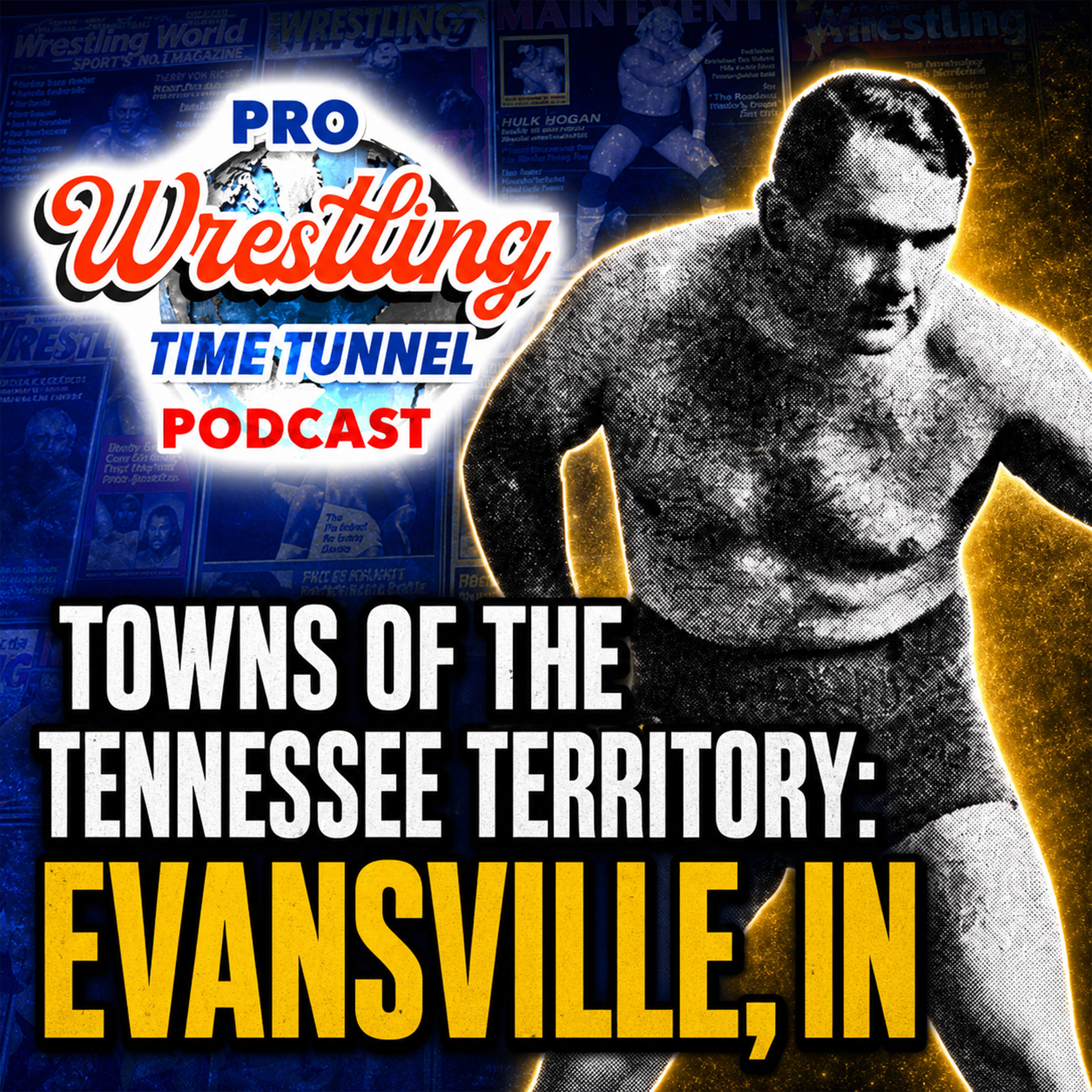
Well, last year I started having the idea to do series for those things. So last year we did the 1975 Territory Series. This year we're doing the 1985 and 1976 Territory Series. But today we're going to start another new series of podcasts on towns, specifically towns of the Tennessee Territory. And today we're going to go into the history of Evansville, Indiana. My friend Sean Delaney is here to be my special guest. He's an Illinois based author. He's also a very talented creative person. He's a graphic novelist, a comic book writer, a broadcaster and a pro wrestling historian who I highly respect. Best known for his detailed research into Evansville, Indiana and the surrounding Tri State area. His latest book, which is going to be into 72 and 73, which is brand new, also dives into some of the Kentucky history and some of the other stuff. He is a lifelong wrestling fan who grew up in New Haven, Illinois and he grew up watching the Memphis territory, specifically I think the goulish Welch territory, then the Memphis territory, Jerry Lawler, fabulous ones. And of course he also was a fan, much like your host of Angelo Poffo's International Championship Wrestling, otherwise known as icw. Based out of Lexington, Kentucky, he's an operations manager for local radio stations, I believe it's the Allen Media Group. He also hosts and produces a podcast called 400 Court street which launched in 2018 and focused on Evansville's rich wrestling history. His first book, the History of Professional wrestling in Evansville, Indiana, 1959, offers a month by month look at promoter Leon Balkan's first major run in the Evansville Coliseum featuring NWA World Champion Pat O', Connor, Lutheran Buddy Rogers, Rip Hawk and others and subsequent books cover 60, 61, 62, 63 and 69 and later decades, featuring a lot of research from the Evansville Courier and press. And these books have earned praise from many, many people. And I am so glad that he's making his first appearance here on the Pro Wrestling Time Tunnel History Show. It won't be his last. He is also putting together a 100 year history of Evansville wrestling for the local museum in Evansville, Indiana that's going to be debuting this August and we're going to talk to him about that in today's show.
So I am excited and thrilled to welcome to today's show Sean Delaney. Let's get to that conversation right now. I'm excited tonight here on the Pro Wrestling Time Tunnel Podcast to welcome in a longtime friend. But a first time guest is Sean Delaney, who has carved out a spot in the wrestling history space for the one of the towns that I used to go to when I was a young fan back in the 1970s.
Wednesday nights at Evansville, Indiana. And he's a graphic novelist, a comic book writer, he's a broadcaster, a pro wrestling historian. He's based in the southern part of the great state of Illinois. Sean, welcome to the show.
[00:09:10] Speaker C: Well, I appreciate it, Tony. It's. I know we've been talking about this for a while, but good that we finally were able to make it happen.
[00:09:18] Speaker B: Well, we got that opportunity. You're gonna be at Herb Simmons Fan Fest this weekend.
[00:09:23] Speaker C: Yes.
[00:09:24] Speaker B: And I didn't want to miss the opportunity to promote the fact that you're going to be there and you're also going to have. You're going to have your new book there, right too.
[00:09:32] Speaker C: I'm hoping, I'm hoping a lot depends on how quickly KDP can get the books to me. But hopefully I will have copies of the 7273 book and otherwise I will have the other volumes available.
So we're.
I'm looking forward to the show.
[00:09:57] Speaker B: Great.
[00:09:57] Speaker C: It's been been a while since I've done a fan fest.
[00:10:00] Speaker B: You. You grew up, did you grow up going to matches there in Evansville? I know you grew up watching the, watching the Memphis territory and also which was the regular Wednesday night town.
You grew up watching PAFO too, didn't you?
[00:10:17] Speaker C: Oh yes.
I mean it was 78, 79 was when I really started getting into it.
Although I had watched off and on the different promotions that came through.
It's one of those things where when the weekend comes around, you go to your grandparents.
And so a lot of times because of the way the Jarrett promotion bounced around the schedule.
Wasn't always home when that was on.
But yeah, around 78, 79 we didn't have to travel as much and I started catching it more often and I just enamored with it.
[00:11:14] Speaker B: Well, Angelo ran Southern Illinois quite a bit. I remember.
[00:11:18] Speaker C: Oh yes.
[00:11:19] Speaker B: Back in the ICW days, I used to drive up to Marion, Illinois, usually have a fairly good card up there. They would do really good cards in Paducah, Cape Girardeau, Marion, Illinois and then some of the other towns were just spot shows. But Marion, Illinois was usually a big card.
[00:11:39] Speaker C: Yeah, it was so funny that they rarely if ever ran Harrisburg, but they were on the Harrisburg Station.
But Marion, I believe Benton and West Frankfurt also would get fairly good cards.
And those were, those were huge high school gyms.
Benton and West Frankfurt especially.
So I think the size of the gym really played a part in how, how big a show they would put together for the Lions Club or whoever would be sponsoring their event.
[00:12:27] Speaker B: Those high schools that were built back in the 50s and 60s down in this area, Southern Illinois, Southeast Missouri, Western Kentucky. Basketball is just huge.
[00:12:37] Speaker C: Oh yeah.
[00:12:38] Speaker B: Down here it's. It's probably the primary high school sport. So they, they made those gyms so they could hold a lot of people and they doubled also as great pro wrestling venues as well.
[00:12:52] Speaker C: Yeah, my, I went to Norris City, Illinois and we didn't get to use the high school gym. When icw came in, they used the grade school gym, which was a fairly basic wood.
Wood bleachers on either side and stage at the end.
But, oh, yeah, it was.
It was always a good crowd turning out.
We had a neighbor.
We lived out in the country, and one of our neighbors was a woman by the name of mabel marlin, and she worked for the secretary of state, who was apparently overseeing the athletic commission at the time.
And whenever the paos ran in southern illinois, she would have to go and supervise that everyone had their license, make sure they had a doctor on hand, Supervise the blood pressure screening and everything.
And because the PAFOs would bring in or tended to bring in this really elderly doctor, My mom was a registered nurse, so she would call my mom and say, would you and sean like to go to wrestling in golconda tonight?
Or would you like to go to the galatia? Would you like to go wherever?
So, yeah, we went all over the shawnee national forest for icw cards.
[00:14:38] Speaker B: The ohio river is only about six miles from the ranch here. And just across directly across the ohio river is golconda.
[00:14:48] Speaker C: Yeah.
[00:14:48] Speaker B: So if.
If there was a bridge there or a ferry or something, it would cut my driving time to St. Louis down almost an hour, Having to loop down around paducah and back up.
[00:15:03] Speaker C: But, oh, yeah, the traffic on 24 anyway is always hell, so.
[00:15:08] Speaker B: Oh, yeah, yeah. And you don't want to speed, ladies and gentlemen, if you're ever going through I24, do not speed.
[00:15:16] Speaker C: Yeah, I'm getting ready for metropolis next month, so.
[00:15:21] Speaker B: And for the. And. And for those of who you just casually mentioned that. But there's the annual superman days. We do have a town named metropolis here just across the river from us and just down the road from sean. And they do their annual superman days there. And Sean usually has a booth there.
[00:15:40] Speaker C: Oh, yeah, yeah. I always enjoy going down and setting up in the artist alley and looking forward to it this year.
[00:15:49] Speaker B: And there is a large superman statue in metropolis that almost everyone who knows about it at least has to stop and get their picture made. Yeah, the superman statue. All right.
How'd you get interested in evansville then?
[00:16:05] Speaker C: Oh, God. Well, that was my TV market, really and truly. My.
My two grandmothers.
One was in mcleansboro, illinois, One was in harrisburg. So that's the harrisburg paducah, Cape girardeau market.
We wound up in carmine and norris city, illinois, which is the evansville market. So I got channel seven wrestling. I got when.
When Lou Fez was running UWA, we got the channel that had UWA, we had ICW through channel 25.
So Evansville, Evansville was the go to.
When you got the Sunday paper, you saw what was going to be coming up Wednesday night. If you didn't get to see the tv, sometimes you got to see it before the TV aired. So.
But yeah, that, that's how I got into Evansville as a fan and I got into the history of Evansville because I was working for a radio station group. One of our stations was a Fox Sports Radio affiliate and they were like, we need more local stuff. We need, we want to branch into podcasting.
We need, we need some shows. And just as a test, I went ahead and started doing a show looking back at Evansville wrestling.
And I mean, I thought it would be easy. Just, hey, let's review some of the old Memphis shows that are on YouTube because 90% of them were the Evansville tape.
[00:18:11] Speaker B: Mm.
[00:18:14] Speaker C: And as I started digging deeper, it's like, hey, let's go back, see how far this goes.
And that's when I discovered, oh, the first time the world championship was going to be decided between the two guys claiming was actually in Evansville.
Strangler Lewis and Joe Stacker in 1915 met in Evansville and the match ended so badly there was a riot and the mayor proceeded to institute a ban on professional wrestling in the city limits that lasted about 10 years.
[00:19:02] Speaker B: Wow. So,
[00:19:06] Speaker C: but part of the show was getting into the newspaper archives and seeing what I could find. And you've probably discovered this yourself as you get past the 1960s, it's like 60s, 70s, 80s, you're hit and miss on even getting basic results from a live event.
[00:19:36] Speaker B: Yes, almost, almost non existent in the 80s.
[00:19:41] Speaker C: Right.
But 40s, 50s, 30s, you're going, you can go into the newspaper and find complete write ups.
[00:19:52] Speaker B: Oh yeah, it was huge coverage back then.
[00:19:55] Speaker C: Oh, yeah, you, you'd get previews of the matches, you'd get the full results of the matches, you'd get side stories. It was, it was really kind of cool to do that. And as I was digging through the stuff, I thought the. It would be interesting to look at one of the last boom periods before the Jarrett's came in.
Turns out that was 1959.
And for the show, I wound up doing month by month breakdowns and it ran about six, seven shows.
We did the month by month breakdowns. The arrival of Rip Hawk, how the business turned around because Leon Balkan.
Leon Balkan was in huge trouble. He had had to sell parts of the town to the Indianapolis office and the St. Louis office.
[00:21:09] Speaker B: And let's, let's hit that real quick. The, the first book in your series is a book on 1959.
[00:21:16] Speaker C: That is the radio scripts.
[00:21:17] Speaker B: Yeah. And it's, it's Leon Balkin's last big run.
[00:21:23] Speaker C: He.
[00:21:23] Speaker B: He'd been there since 1941, right?
[00:21:26] Speaker C: Yes, yeah, he, he came in in 41. And I mean, he had his ups and downs. He would have good runs, he would have mediocre runs, but he had apparently a really bad run in the mid-50s.
And I know from one of the articles that was written by one of the columnists in Evansville, at least I think that's where I got the comment from.
But basically, Balkan at one point had Nick Gulas booking Evansville for him, and he accused Nick of trying to run him out of business.
[00:22:24] Speaker B: Oh, that couldn't be.
[00:22:26] Speaker C: No, Nick wouldn't do such a thing.
[00:22:30] Speaker B: The thing I really enjoyed about two things that I really enjoyed about that 1959 book. One is that you don't really have a lot out there documented about Pat oconnors time as NWA World champion. No, but, but you do in, in that book because there's Rip Hawk, a big match with Hawk and o'. Connor. And then of course, we're doing a lot on 1976 on a show here because it's 50 years ago in wrestling history and we're talking a lot about the Anoki ali deal in 76. But there was a boxer, wrestler match in Evansville, Indiana in 1959. Right.
[00:23:13] Speaker C: I know we had.
We got some of the.
God, it's been so long since I've done the 59 book.
[00:23:23] Speaker B: It was Joey Maxim, I think.
[00:23:25] Speaker C: Yes. Okay. Yeah, Joey Maxim came in.
We also got a little bit. I actually, I believe it was 1960. We got this a little bit of the Joe Lewis issue with the Shire brothers.
But yeah, we Rip Hawk did kind of run his mouth with a special referee and it.
You did wind up with some wrestler versus boxer action.
[00:24:05] Speaker B: 1960.
Balkan has some issues from his junior silent partners. Right. I mean, without giving. Giving away too much in the book, I would like people to get it because it's all. These books are fantastic. But what was the deal there with Balkan's partners?
[00:24:25] Speaker C: Well, the problem was Leon got into trouble with the irs and apparently he had to pay a substantial fine, which he didn't have.
So he wound up selling stakes of the Evansville office.
Evansville was independent at the time, although it had a connection to the St. Louis office.
So Sam Muchnick was a part owner of Evansville and a very familiar name going into the 80s was the person who owned out of Indianapolis.
[00:25:15] Speaker B: Well, Barnett.
[00:25:17] Speaker C: Barnett, James Barnett.
And he, he had to be a bit more of a silent partner because it was 1960 and I don't think he could butchered up that much to pull off being the full time promoter in Evansville, which is very much a Bible Belt town.
But yeah, Jim Barnett had been very uninvolved. We did not get through 1959, we did not get any Indianapolis talent coming in.
But apparently the money had picked up enough that Barnett wanted to put his mark on the town.
And during the summer of 1960, you lose a lot of the St. Louis talent and you get a lot of the Indianapolis people.
[00:26:26] Speaker B: You know, I, I think it's interesting that when people talk about Mushnik, you know, they, they have a recency bias about him because in his last 20 years or so he was just involved with St. Louis, but before that he had quite a few towns he was involved with. He was involved in Evansville, he was involved in Cape Girardeau, he was involved in Louisville somewhat.
He was involved in the Memphis with Sam Avey. He was involved in a lot more towns early on as far as his booking office was concerned. Concern.
[00:27:03] Speaker C: Yeah. And, and that's just it. It wasn't just the St. Louis promotion, it was actually a St. Louis booking office.
I mean, he basically took over what Tom Pax was doing.
[00:27:17] Speaker B: Yeah, he merged St. Louis Wrestling Club in the Mississippi Valley Sports Club, which was the old Packs and Luthes office, and merged.
[00:27:27] Speaker C: Which is. And that's where Lou Balk or where Lou Balkan. No, where Balkan came to Evansville was from Pax's office. He had been working there when they were desperate for someone to take over Evansville.
So at least that's what I am putting together.
[00:27:51] Speaker B: Because back back in those days, I mean from the mid-50s, Barnett came out of Kohler's office in Chicago when they were the, I mean they were the wrestling power because of the Dumont network.
And Barnett controlled just this huge swath of the Midwest.
And I read that in your book about him being one of the guys kind of in the background on Evansville, which makes sense because he pretty much controlled most of the state of Indiana.
[00:28:23] Speaker C: Oh yeah. I mean he had, he had Indianapolis, he had Fort Wayne, he had all the way up to Detroit and all
[00:28:34] Speaker B: the way over to Cincinnati and Louisville.
[00:28:36] Speaker C: Lexington and Evansville is just this little pocket that they didn't fully control.
And so they started trying to exert some control in 1960.
And unfortunately, exerting that control is what led to Leon Balkan losing Evansville.
Or at least that's the theory I have put together. Just reading between the lines of these
[00:29:13] Speaker B: different newspaper articles, your third book, which is 61 and 62, talks about the possible expansion south into Kentucky into Owensboro.
[00:29:27] Speaker C: Right.
[00:29:28] Speaker B: And that was all a rocky transition.
[00:29:32] Speaker C: Yeah, that was. That was after Barnett took over Leon Balkan.
I.
Let's say allegedly, because there. There's no exact proof, there's no paper trail, there's nothing.
But Leon Balkan was essentially pushed out of Evansville.
There were issues with no shows.
And at the time, the head of the Indiana Athletic Commission was from Evansville and longtime friends with Leon.
So he called all of the booking offices to Evansville for a meeting.
And this is 12, 15 years into the NWA, so they're getting called on the carpet by this guy for one little town.
And yeah, it.
The timing of Leon's retirement in air quotes and just the talk of him trying to find another spot to land to be a promoter, that it is just a situation where it looks like from the outside he was pushed out and he was blackballed.
[00:31:22] Speaker B: Now, it could be that it exists, in other words, people's writing that have researched. But I think this is the only time I remember ever seeing anything about the awa, which was. The American Wrestling alliance was involved in. In some of this too. And when people hear awa, of course, they think of Vern Ganya's organization. But there actually was an American Wrestling alliance, right?
[00:31:51] Speaker C: Yes, the Paul Bowser promotion.
There were times where they actually had the AWA champion turn up. And this is before.
Well, this is before. This is about the time that the Vern promotion was launching.
But, yeah, we still had the Bowser AWA active with a champion, and that was the world champion for a while that was turning up in Evansville.
[00:32:28] Speaker B: And that's. That's quite a ways westward into the country, for. They were based in Boston.
[00:32:35] Speaker C: Right.
[00:32:35] Speaker B: And that was. That was quite a. Quite a larger penetration into the country than they usually had all the way into Southern Indiana.
[00:32:44] Speaker C: Yeah. And I have to wonder, because of the proximity to St. Louis, if maybe that wasn't around the time I would have to go back and look, but possibly around the time of an NWA convention or just some meeting with Bowser and Muchnik, and it's like, well, you've got your champion with you.
Let's book you some dates.
So it could have been something as easy as that.
[00:33:24] Speaker B: Then the, the fourth book goes into the last three fourths of the 60s.
[00:33:31] Speaker C: Yeah, the, the, the off and on period.
[00:33:36] Speaker B: A lot of different changes going on in Evansville. I just found it really, really fascinating.
And I, of course, my interest really started peaking. I loved all your work, but I really started peaking when you got to the 70s.
[00:33:51] Speaker C: Oh, yeah.
[00:33:52] Speaker B: 70 and 71. This is the prologue before the Jarretts, who were working for Nick Goulis and Roy Welch, Christine Jarrett and Jerry Jarrett came in to start running the town, which is probably the focus of your new book. But. But in 1771.
Give us a little bit of that prologue of what was happening. That was a Dick the Bruiser time, right?
[00:34:21] Speaker C: Well, Dick the Bruiser came in in 68, 1968. He decided, well, I've got this area.
And this is before the promotional war with the Chic.
So Bruiser and Snyder decided to expand to the south since they already had everything from Indianapolis and Terre Haute north, probably. And before that, I guess as far south as they went would have been Vincennes, because they would get the Terre Haute TV.
But they got TV in Evansville and would for about four months in 1968, ran Roberts Stadium.
The reason they ran Roberts Stadium was the city of Evansville and County Vandenberg.
The local government were building a new city hall and that involved tearing down the youth center.
So they turned the old Coliseum into the youth center and it was no longer available for concerts or wrestling or what have you.
So Brucer and Snyder ran the other venue that was available, Robert Stadium, which at the time had about a 16,000 capacity for college basketball.
[00:36:17] Speaker B: By the way, I saw many, many concerts at Robert Stadium.
[00:36:21] Speaker C: Yes.
Before the 90s renovation.
I went to a few as well.
Love the rickety old bleachers.
But yeah, Robert Stadium would hold about 16,000 people, but the wrestling topped out probably at about 2,000.
You've heard the phrase you could shoot deer in the stands.
[00:36:52] Speaker B: Yes, you.
[00:36:53] Speaker C: You could for the wrestling.
But.
But I mean, there was a loyal audience that would turn out.
And
[00:37:06] Speaker B: my, My neighbor down the road here, just down the road from where I live now, he. He was my ride to Evansville. He went every Wednesday night, took his two daughters, and I would jump in the car with them on Wednesday night and go to wrestling every single week.
Yeah, they were ringsiders.
So I'd go to my parents and go, hey, I need, you know, six. I need eight bucks for the night. You know, I need a couple $3 and 50 cents or 4 bucks for my seat. And I need popcorn and soda.
[00:37:37] Speaker C: That's all I. Yeah, yeah, 350 for ringside and yeah, it was about five bucks, I think by the time I was going. But Jerry would book a lot.
[00:37:52] Speaker B: Jerry would book a lot of eight man tags in Evansville.
Yeah, there would be the. Louisville would get the next week's Memphis match. So they'd have the Monday night match in the Mid South Coliseum. And then the next week because of the television would be one week behind.
You'd get that main event in Louisville. And then oftentimes you'd either get a tag or a eight man tag or a six man tag. And then every now and then you'd get that Memphis main event. I remember in 76 I saw Tommy Rich and Jerry Lawler for the Southern title there. But it was on into the run. You know, it was almost four to six weeks after the Memphis match.
But you know, you know, he did a good job of recycling the matches in the town through there. I love going to wrestling at Evansville.
[00:38:41] Speaker C: Oh, the Coliseum.
And I talk about it in the new book. The Coliseum in the early 70s was in horrible shape.
The roof was leaking, the boiler was about shot.
The.
There were actual trenches in some of the meeting rooms from where they had to pull out pipes.
But 71, 72, like you were talking about the matches were.
I started including Louisville in the 7071 book mainly because I want to try to show when and where the two towns started syncing up.
And it really didn't start happening consistently until 77 when the split happens.
[00:39:55] Speaker B: Right.
[00:39:56] Speaker C: But the 71, once Evansville was up and running, Louisville had been going for over a year.
[00:40:07] Speaker B: And the reason for that was for. For fans who may not realize, the reason for that was from 72 until 77, Jerry was booking, but so was Nick in the Goulas Welch Company in the Tennessee territory. And a lot of times Nashville would be on Wednesday night and so Louisville was on Tuesday night. And Nick would use guys in Nashville. And so Jerry often got the leftovers for Evansville until the split where Jerry had his own guys and he could book it consistently.
[00:40:49] Speaker C: And 71 was really kind of a special period for Evansville because you had the infamous claim jumping by Bruiser and Snyder for Louisville and Evansville.
And Jarrett was like, okay, if you want to have a stake in these towns, you need to provide some talent.
A lot of the Evansville cards in 1971 were a mix of Tennessee and Indianapolis talent.
We had tag teams like Robert Fuller and Paul Christie against the Von Brauners.
It's like you. You would not see that anywhere else.
No.
[00:41:50] Speaker B: And you'd see some foreshadowing of icw.
[00:41:54] Speaker C: Yes.
[00:41:55] Speaker B: Paul Christie, for example.
Because a lot of those guys work for the Sheik and Bruiser and they would later work for Angelo later on in the late 70s, early 80s. And so you start, you'd see a little bit of that mixed in.
[00:42:11] Speaker C: Angelo was a frequent talent in Evansville.
[00:42:14] Speaker B: Yes.
[00:42:15] Speaker C: So, yeah, that was really interesting period to watch because you look at the lineups and you're like, okay, I know this guy, I know this guy.
Where did this guy come into the picture?
And fortunately, when I was doing the radio show, I got to talk with Jerry Jarrett a few times.
[00:42:46] Speaker B: And
[00:42:49] Speaker C: I asked him, it's like, how were you able to promote these matches? Because you've got cards that are 3/4 WWA guys, but your TV is all Tennessee.
And it's like sometimes we had them send tape and we would just have to edit it in.
[00:43:19] Speaker B: And. And also too, for people who may not know, oftentimes people could pick up various other ghoulish Welch shows which would be broadcast on television into the area. So a guy who would be appearing on Jerry's card in Evansville, maybe his main match or angle, was on another show that was maybe in Owensboro or Bowling Green or one of those other towns.
[00:43:49] Speaker C: Well, and that was one of the things. Owensboro was one of the early towns for pay TV going back to the late 60s and in those early days of cable, basically they ran coax from a building on a hilltop where they had a giant antenna.
Nick Gulas was running Owensboro for a while in the late 60s off of Bowling Green.
So when Jarrett got the TV in Evansville to start running the Coliseum, it was it. He was beat to the. Beaten to the punch on live events by Nick, who started running the Owensboro Sports center again off the Evansville TV.
[00:44:52] Speaker B: Right.
[00:44:53] Speaker C: Because they were still getting Channel 13 out of bowling Green and Owensboro.
So.
[00:45:02] Speaker B: And Bowling Green was also a Wednesday night town, right.
[00:45:06] Speaker C: And it was.
It was so funny as I'm going through 72, 73, that I'm looking at these Owensboro cards and I'm like, they're running off Evansville. They're promoting the Evansville TV show in the ads, but they are running completely opposite of what is going to happen on Wednesday night. It was like Owensboro was its own little bizarro world that Nick and Lynn Rossi maybe were booking while Jarrett was running or was booking Evansville to go with Louisville and Memphis.
[00:45:54] Speaker B: My uncle, my dad's older Brother moved to Owensboro in 71, I think it was.
And I used to go up there for the weekend and spend the night with my cousins at my uncle's house. And I used to love that because I could get.
Watch stuff on Owensboro that I didn't get to see otherwise. I mean, we. I could get WTVW Channel 7, which was the Evansville station. I could get it, but I had to go outside and take both hands and turn the antenna pole around to get it. But I could see the WTVW show. But of course, we didn't get Owensboro or Bowling Green. But yeah, going up to Owensboro, my uncle's house, I got to see all the stuff I didn't usually get to see.
[00:46:45] Speaker C: Yeah.
And another thing with the 70, 71, when Jarrett got the TV in Evansville, that was kind of a red flag, I think, for Phil golden.
Because the 7071 book. I also get into a little bit of what was going on with Paduka and how it went from being a gas Welch town to the Outlaws.
But the.
The Golden Group tried to run ahead of Jarrett's cards at the Robert Stadium.
[00:47:37] Speaker B: Which, by the way, I'll jump in here. Phil Golden's brother, Bill golden, was married to Roy Welch's daughter.
So Phil was like an extended member of the Welch family as well.
And so he opened up what was considered to be an outlaw group. But a lot of people, George Weingroft, told me that Roy knew all about it. He didn't care that.
[00:48:04] Speaker C: And I've suspected that for a long time. Because it was almost like a safe landing spot for guys.
[00:48:12] Speaker B: Well, a lot of longtime Welch guys went over there. I mean, Weingroth went over there. The Von Brauners went over there.
Mario Gallento went over there. After the television incident with Jarrett, there were just a lot of guys that went over to the Golden Group.
[00:48:29] Speaker C: When did the incident with Jarrett happen?
[00:48:33] Speaker B: 72, I believe.
[00:48:34] Speaker C: 72. Okay. I don't have it in the book because I'm not sure how much of a deal was made about it.
[00:48:42] Speaker B: It was 72 or 73. When I did the series on Briscoe and Bradshaw. I had the date on there. I can go back in my notes, but I'm pretty sure it was late 72 or early 73.
[00:48:54] Speaker C: Oh, my God.
I think you may have solved something for me.
We had a match that Jarrett no showed.
He was supposed to face Saul Wingroff in a hair versus hair match.
And he didn't.
He wasn't there.
And the story we were given was he had his appendix removed the night before, and he was gone for a few weeks after that.
So it would almost make sense that this is when that happened.
[00:49:47] Speaker B: If.
[00:49:48] Speaker C: Get me the date if you can, because I want to match that up.
[00:49:53] Speaker B: Well, I went. I did very meticulous work on it because I really wanted to nail it down. When it was because of this Mario then getting blackballed or whatever you want to call it. He left after the whole. After Jackie Fargo threw a fit over the Jarrett thing and all that, Mario went over to the Golden Group.
And a lot of that I think I got from Billy Wicks, who was the person Roy Welch originally approached about doing the Jarrett attack.
But then Billy Wicks turned it down and said, I don't want any part of it. And then he got Mario Gallento to do it.
Well, Morris and Roy Welch's dementia, you know, is taking sitting in and.
[00:50:40] Speaker C: Right.
[00:50:41] Speaker B: He's becoming paranoid about Jarrett's rise in the company and all. And I think a lot of guys like Mario and others were telling Roy that Jerry was trying to steal his part of the company, which they had already told Jarrett when he came back from Atlanta and booking for Barnett, that they were going to start transferring shares to him of the company that were. You know, I mean, all the shares are up to 100. So if they're going to take some shares from somebody, it's going to be Roy. So, you know, he was already getting some of Roy shares of the company by coming back to book from Tennessee full time.
But people were telling Roy, oh, that kid, he's. He's trying to steal the company. You better do something about it. You better teach him a lesson or something.
[00:51:25] Speaker C: Well, Mario and Al Ghalento were both part of the original batch of Golden all stars. Yes, in 71.
So that's why I was curious about. But that makes sense if he was working Outlaw, that when he turned up, it was a shock.
[00:51:51] Speaker B: And, yeah, they were not expecting him on Memphis television that day.
[00:51:57] Speaker C: But. But like you were saying, the.
I have said a few times in the books that when you look at the Nashville office, it is borderline Shakespearean when you look at just the power struggles, the politics, the family connections.
[00:52:26] Speaker B: George told me the reason Saul left and wanted to go over to the Golden Group is because he wanted Towns to promote and that Nick had promised him Huntsville forever.
And. And he kept asking, kept asking, and Nick ended up using his brother Gus Goulas to promote Huntsville. And that was the final straw. So Saul said Okay, well, I'll go in here and promote Paducah and some of these others with Phil golden, because I'm not getting any towns. And he's getting to the point. I mean, Saul had been in the business for 35 years by the time this took place in the early 70s.
[00:53:06] Speaker C: Oh, that.
That makes sense. I mean.
Well, you've read an advanced copy.
[00:53:13] Speaker B: Yes.
[00:53:14] Speaker C: Of the 72, 73 book. And that is one of the things that. That doesn't add up. The. The infamous story is.
And Jerry Jarrett told this story in multiple venues, that Saul was upset he wasn't getting booked in Jarrett's towns when they started making money.
[00:53:43] Speaker B: Particularly Lexington, I think.
[00:53:45] Speaker C: Yeah, Louisville, Lexington. But the thing is, when you get towards the end of the Von Brauners run with Saul in the Tennessee territory, Jarrett was using him. Using him a lot.
[00:54:01] Speaker B: Yes.
[00:54:03] Speaker C: So it doesn't make sense that if it was a falling out with Jarrett that he jumped ship because he was being used.
[00:54:15] Speaker B: Yes. I think it had to do with the Saul wanting to run towns and Nick not following through. Kept promising him over and over and then never, never doing it. Yeah, I mean, Saul goes back to Roy back when Roy was trying to open up Florida back in the 40s and Saul was promoting Daytona beach for him.
So there was a long, long relationship there.
[00:54:41] Speaker C: But.
But like I said, it is Shakespearean almost in how things moved around.
I've often wondered if George being brought into the business wasn't in part a reaction to Roy's grandsons suddenly being at the top of the card.
[00:55:07] Speaker B: Yes, I've wondered that as well. And recently had a chance to talk with George and never asked that question, thinking I would get another, you know, get another chance to talk with him. But I often wondered if Nick felt like there was a lot of Welch family involvement and not as much Gulas family involvement.
[00:55:26] Speaker C: Well, I mean, you've got the Welch family involvement. You've got.
I mean, I don't have Buddy showing up, but I have Jimmy golden turning up quite a bit in 71. Not as much in 72, 73.
Robert was being used quite a bit.
Ron turns up every now and again.
But.
So you've got Welch's coming in.
The Fields brothers are starting to turn up quite a bit in 73.
And you have Christine's son running towns.
[00:56:13] Speaker B: And Christine.
[00:56:14] Speaker C: And Christine.
So.
So you have to wonder if bringing George in wasn't to kind of shore up his. His base.
[00:56:27] Speaker B: Well, that makes sense to me. I've always kind of thought that. I mean, you're in a Family business and there's, you know, there's 50 family members on one side and you've got one son and maybe a brother or two. Of course you're going to try to involve them, I would think.
[00:56:45] Speaker C: And when you hear some of the stories of how Nick was treated going back to the 40s, it's kind of like, yeah, I can understand him trying to make sure he kept his foothold.
[00:56:59] Speaker B: Hey, man, like I said, I love your work. And I mean, Rip Hawk, Pat o', Connor Luthez, Buddy Rogers. You read through these books that you've written and they're just packed with legends coming through Evansville. What was your favorite character when you were writing these books?
What was your favorite or most colorful character that you felt that you covered?
[00:57:24] Speaker C: Leon Balkan is probably the main character in the first three books.
Just the fact that here's a guy who has probably been the most hard luck promoter in the history of the business.
He books a huge show, sells it out and they have a rainstorm.
He has another big show that he's putting together and it's the same night FDR wins the Democratic nomination.
He is sent into Shreveport to open up the town.
And because he's Jewish, the venue is burnt to the ground before the day before the show.
It's, it's just.
He was the ultimate hard luck promoter.
And in 1959, he finally gets that taste of success and he's having a great run when all of a sudden, Dick the Bruiser no shows and it all falls apart.
[00:58:48] Speaker B: Wow.
Another name. Another name that pops up from time to time, too. And there's an Amarillo connection with Bach Estes.
[00:58:58] Speaker C: Yeah.
[00:59:00] Speaker B: Who is. Shows up in your books too, as a, as a creative booker type guy.
[00:59:07] Speaker C: Yeah. He comes in around the time Barnett and Doyle fully take over Evansville because he was also running Louisville for them at the time.
So he, he turns up briefly.
I don't get into their story as much because I was kind of zipping through and there wasn't really a lot in the newspaper record to show, but the Farmer Marlin Gene Martin promotional combination, that is interesting. And Gene Martin sounds like he has a hell of a story because we've been trying to track down family members of his where we haven't really touched on this yet. I am involved with the Evansville Museum on. On.
[01:00:14] Speaker B: That was next on my list.
[01:00:16] Speaker C: Yes, I'm involved with the Evansville Museum doing a exhibit about 100 years of Evansville wrestling.
This year will mark the 100th anniversary of the lifting of Mayor Boss's ban on pro wrestling in the city limits and count Billy Varga.
The Varga family starts wrestling back up in 1926.
And it carried on to this day with a couple of different independent groups running Evansville.
[01:00:59] Speaker B: Now that exhibit, I'm doing this by memory, Sean. You have to correct me, of course, if I'm wrong, but August, is that right?
[01:01:06] Speaker C: Yes, it will start in August and it will run through, I want to say February.
[01:01:14] Speaker B: And you've had some amazing things donated to this initiative.
[01:01:18] Speaker C: Oh, it 1.
You talk about great characters.
I haven't been able to really write about him yet, but a gentleman by the name of Dr. Ralph Wilson.
Ralph Wilson was a Big Ten heavyweight champion for Indiana University back in 1929.
And he was a third generation physician.
His father had been killed in an explosion. His father was an anesthetist.
And back in the 19 teens, the gas was not stable.
He was in a room at the hospital with the tanks and a janitor came in smoking a cigarette and it blew up the hospital wing, killed both of them and a few others.
When Ralph was very young, he committed himself to becoming a doctor, but he was also, like I said, Big Ten championship wrestler.
So when he graduates from iu, he's going on to medical school. IU didn't have a medical school at the time.
He was going to the University of Pennsylvania.
He was the resident chief surgeon for the University of Pennsylvania's teaching hospital.
[01:03:03] Speaker B: Wow.
[01:03:04] Speaker C: During the day, at night, he was going up and down the northeast wrestling in main events. He faced Jim Londos. He faced, I mean, you name it, he was wrestling in Madison Square Garden.
[01:03:27] Speaker B: And, you know, some of his items
[01:03:29] Speaker C: for the museum, we, we have posters.
[01:03:33] Speaker B: Cool.
[01:03:33] Speaker C: We have programs, we have telegrams from Tootsmont because his wife kept everything, kept a scrapbook. And his grandson, I managed to track down, and the grandson had the scrapbook.
Gosh.
So we are going to have a section of the exhibit devoted to Dr. Ralph Wilson.
There were others in the area.
Jim Larocque, who was part of the 1959 boom. He was living in Fairfield, Illinois.
[01:04:22] Speaker B: Jim Laroque was the very first wrestler on wrestling at the Chase in St. Louis television show.
[01:04:29] Speaker C: Yeah, yeah, he was.
He was wrestling out of the St. Louis office, but he was, because of the area that he was being sent around, he made his home base in Fairfield.
Rip Hawk made his home base Evansville because he was also doing spots for Welch.
Let's see, trying to think who else. Of course, Tracy Smothers later had a wrestling school in Evansville.
And I'm just trying to think of all the different wrestlers who. Who wound up living for a time in Evansville.
[01:05:15] Speaker B: Sean, what's the date that it will open?
[01:05:19] Speaker C: I want to say it will be around August 12th. I'll give you a firm date a little closer to it, but I want to say August 12th because I think that's around the time the museum's comic convention will take place and will be set up there as well.
[01:05:40] Speaker B: I already have booked to meet some friends at Notre Dame for the Pfeffer collection and it's in August and I think it's going to just work out perfect for me to go by the museum on my way up or on my way back.
[01:05:55] Speaker C: Excellent.
[01:05:56] Speaker B: Yeah. I'm looking for if that could work out in that same trip that is be that make my year.
[01:06:01] Speaker C: Oh, well, what I'm hoping to do is during the show in St. Louis or Fairview Heights, I'm hoping to get some video from a lot of the guys who are going to be there who work the Coliseum.
[01:06:21] Speaker B: Yeah. Great.
[01:06:23] Speaker C: Ricky and Robert recently had their last appearance at the Coliseum when GCW did a pay per view from there.
That's a story in and of itself.
The Austin idol is going to be there. Tommy Rich.
One of the people we've been talking to is a lady by the name of Jan who did a lot of ring gear for guys and she did ring gear for Bill demott, Hugh Morris.
She did one of the first Wildfire jackets for Tommy Rich.
She did gear for the Rock and Roll Express for Eddie Gilbert and she did a few robes for Randy Savage.
[01:07:23] Speaker B: Nice.
[01:07:24] Speaker C: And she's got one of the last pieces she did for Randy Savage. Were hopefully going to have it on display.
[01:07:33] Speaker B: So that's very cool. Well, I'm going to. I'll keep in touch with you obviously, and we will keep talking about it here on this program as we get closer to the August debut and then continue to talk about it the whole time the exhibit is open. It's a. It's a thing that's near and dear to my heart. Evansville, just so important to my evolution and my roots as a wrestling fan.
Going back to being, you know, 10, 11, 12 years old and going to those matches in Evansville and just a special town. And I'm glad we got to do this show today. Now.
So what will you have at your booth this weekend at FanFest 4 in Heights?
[01:08:14] Speaker C: the booth, I will have for sure the five books, 1959, 1960, 60s Part 1, 60s, Part 2, and the 197071 book.
Fingers crossed. I will also have the 7273.
If not, I will have where people can pre order it on Amazon.
I will also have a book I did with James Pedigo called Worked.
It's a true crime and wrestling story.
James was a wrestler out of Nashville who wound up involved in an FBI investigation of a corrupt judge in Nashville.
And basically I tell James a story during the investigation.
[01:09:07] Speaker B: Very cool.
[01:09:08] Speaker C: And I'll probably also have some old dirt sheets and wrestling magazines. And will you have any of your
[01:09:19] Speaker B: comic book work or your graphic novel work?
[01:09:21] Speaker C: I will, I will bring some of the comics.
I never know how that's going to go at a wrestling show, but I'll have some of the stuff. I'll also. I've been doing sketch cards.
One of the things I was doing as we record this, it was free comic book day. I was doing sketch cards at a local comic shop.
So I've got a couple of Hogan's and a Flare and a Savage and a Danhausen.
I always wind up doing a bunch of Danhausen's.
[01:09:53] Speaker B: He's huge, man.
[01:09:55] Speaker C: Yeah, it keeps on giving.
[01:09:58] Speaker B: I don't know that I would have ever really gravitated into pro wrestling if it hadn't been for comic books.
[01:10:05] Speaker C: Oh yeah.
[01:10:05] Speaker B: I was a huge DC and Marvel Comics reader when I found wrestling and I thought, wow, this is a liveaction superhero deal right here on my television.
[01:10:18] Speaker C: You know, good versus evil. I mean that's, that's the basic story.
I mean you can have anti heroes all you want, but in the end it boils down to the good guy, the bad guy fighting for a particular prize.
That's.
[01:10:38] Speaker B: Well, I, I just, you know, I will tell you here, I've told you before privately, but I'll tell you here. Thank you so much for doing this work.
I, I am so excited over all the guys who are doing work on all of these towns in the Tennessee territory. We've got guys doing Chattanooga, we've got guys doing Nashville.
You have now done a lot of work on Evansville, plus a little bit of Paduka and some of the other stuff. And I really appreciate you doing it because it's really important to me in my history as a fan and I just enjoy reading your stuff so much. So.
[01:11:15] Speaker C: Well, I'm glad to do it because we. Especially when you're covering that pre video era.
[01:11:22] Speaker B: Yes.
[01:11:22] Speaker C: So many names have fallen through the cracks. So many guys you have no idea who they were.
And at least this gets the names Back out there.
[01:11:33] Speaker B: Yeah. And we don't have any of those film clips or any of that video. I don't even know if they ever even filmed much at the Coliseum back in the day. Do you know?
[01:11:44] Speaker C: Oh, this is my holy grail for the.
The museum exhibit. I am hoping against hope that somewhere between now and August, someone will find a film reel or a video reel and a chest.
Because in 1964 or 1963, somewhere in there, before it was shut down during the Martin and Marlon period, the Channel 7 Wrestling was a tape of what had happened on Wednesday night. Oh, the previous Wednesday night. They would do.
It's the old wrestling at the chase formula. They would tape everything except the main event.
And Channel seven was, like, a block away.
So I don't know if they had a direct video feed. I don't know if they had whatever.
If they were taking cameras and a
[01:12:54] Speaker B: truck over there or van or.
[01:12:56] Speaker C: Yeah, I'm not sure how they were doing it, but they were taping on Wednesday. They were playing it back on Saturday.
And I am hoping against hope that somewhere there is an old broadcast engineer that might have a videotape.
[01:13:17] Speaker B: Man, I hope so. That would be awesome to have some family member call you and say, hey, I heard you talking about that on that crazy Tony Richard show. And my great grandfather kept this real. And that would be awesome.
[01:13:33] Speaker C: Yeah, because it would be. It would be hilarious. Because that would be some of the earliest footage of Tojo Yamamoto.
[01:13:41] Speaker B: Yeah.
[01:13:42] Speaker C: Because Tojo was being brought in towards the end of that first run.
[01:13:46] Speaker B: Fantastic. Well, let's hope that we can find some of that for the museum exhibit and just to have for posterity.
[01:13:53] Speaker C: Oh, yeah.
[01:13:54] Speaker B: Sean, thank you so much. I appreciate you coming by tonight, and I am looking forward to seeing you next weekend. I'll be there.
I want you to set aside five books for me. I've got all of them electronically, but I want to put them in my library over here.
So set. Set aside five of those for me, and I will definitely get those from you when I see you in St. Louis at Fairview Heights, Illinois, at Fan Fest 4. Herb Simmons Big event coming up this weekend, man.
[01:14:23] Speaker C: Oh, and I will also have my replica posters, and I have one for you, a little match involving Buddy Hack and Jerry Lawler.
[01:14:34] Speaker B: That's right.
So that's going up back here on the blank wall.
Excellent. I got several things that are going to go up back here, and I'm saving a spot for that one. That's Jerry Lawler's. What? I mean, very early main event. Yeah. First main event at the sports arena in Paducah. Right?
[01:14:53] Speaker C: The IBEW Hall. Yes.
[01:14:55] Speaker B: That's it, man. That's it. All right, Sean, thank you man. Have a nice evening.
[01:14:59] Speaker C: You too. Have a good one.
[01:15:01] Speaker B: I hope you enjoyed my visit today with Sean Delaney and you learned a lot about the rich wrestling history of one of the towns of the Tennessee territory, Evansville, Indiana, which was a town that Jerry Jarrett and his mother Christine Jarrett opened up in 1972 as part of the Roy Welch Nick Gulas Tennessee Territory and booked out of Nashville, Tennessee and of course remained a town for the Jarrett's when they split off and formed their own Co. In 1977. I hope you'll check out Sean's books. You can get them on Amazon Digital and other places. And I hope you'll be able to come to FanFest 4 this weekend Herb Simmons event just outside St. Louis at Fairview Heights, Illinois, where Shawn will be there with his booth. I'll be there and I hope that we both get to meet you this weekend. If this episode took you back to the territories and you liked it, please like comment with your favorite 1976 memory or territory question and subscribe at our YouTube channel with your notifications turned on. Your comments help us shape future shows. Also, if you want full time tunnel experiences you need to subscribe to the Daily Chronicle and get my daily Pro Wrestling History of the Territories newsletter which will come to your email inbox every morning at 5am Seven days a week. If you want to invest in my work as a pro wrestling historian, I would greatly appreciate it. You can do that with a premium paid subscription where you can get exclusives like the New Family Tradition series which I started about a week ago with a with a big feature on Bob Orton Senior and also the Evolution of Wrestling series which just I just wrote a piece on the evolution of the foreign heel character. You get these things for just $5 a month and that supports the research and keeps the time tunnel fresh and moving forward. If you're on Apple Podcasts or Spotify, you're listening to the show on audio. Please leave a quick five star review and follow us. It really helps independent history shows like ours get in front of more pro wrestling fans.
Appreciate you listening today. I hope you enjoyed the history of pro Wrestling in Evansville, Indiana.
And we'll get back to the history of 1976 next week because Todd Goss will be my special guest and we will be reviewing Jim Crockett Promotions in South Carolina, North Carolina and Virginia for the entire year of 1976. You can follow me on X, formerly known as twitter @tony richards4 always great pro wrestling conversation going on there.
Thanks, everybody. Live from the Richards Ranch in Western Kentucky, this is Tony Richards reminding you if you want better neighbors, be a better neighbor. So long, everybody. See you next week here from the Bluegrass State.
[01:18:10] Speaker A: Thanks for tuning in to the Pro Wrestling Time Tunnel podcast. Tune in for another great episode next week, interviewing wrestlers, referees and media personalities that have made the sport of professional wrestling great. We'll release a new episode soon. Don't you dare miss it.