Episode Transcript
[00:00:02] Speaker A: Time for the Pro Wrestling Time Tunnel podcast.
[00:00:05] Speaker B: We've got lots and lots of things to talk about and to do today.
[00:00:08] Speaker A: Covering the territories from the 1940s to the 1990s.
[00:00:13] Speaker B: It's the best thing going today.
[00:00:18] Speaker C: Interviewing wrestlers, referees, authors and other media
[00:00:22] Speaker A: personalities that have made the sport of professional wrestling great.
[00:00:27] Speaker B: The cream, yeah, the cream of the crop.
[00:00:30] Speaker A: And now, here's your host, Tony Richards.
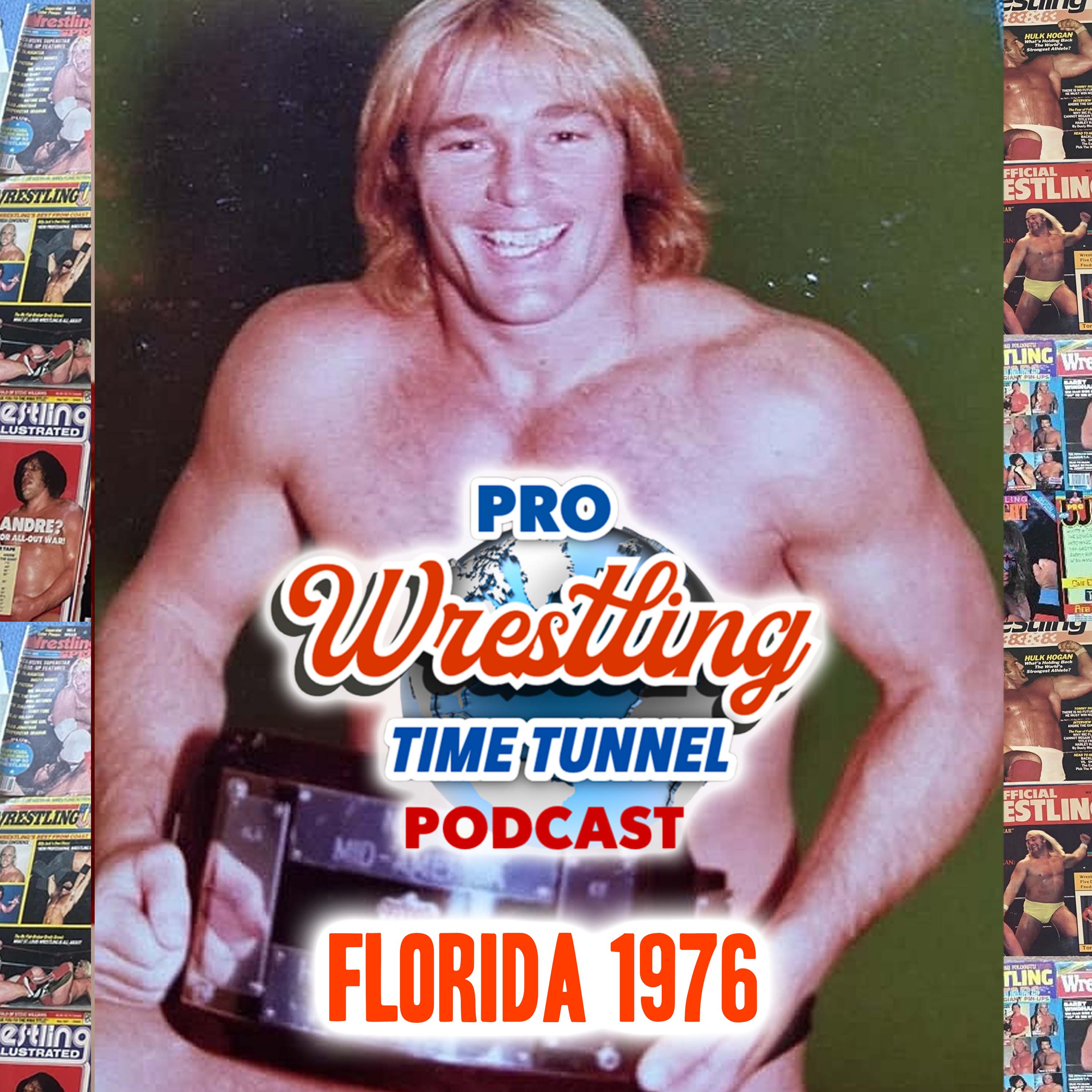
Hello, everybody. Welcome to another Pro Wrestling Time Tunnel history show. I'm Tony Richards at the Richards Ranch, coming to you with my good friend live from Florida, Mr. Howard Baum. And tonight we're talking about Florida, 1976. And I know you're really excited about our guest tonight, Howard.
[00:00:55] Speaker C: Well, as the shirt says, when you see this symbol, you see the symbol of excellence in professional wrestling. And that, my friends in the wrestling world, is what we're all about tonight because we have a childhood idol of mine. And I'm not just saying it because he's on the show. Steve Kern, he was always my guy. One of my favorite, top five guys in the ring of all time. Put him right up there with anybody.
One of my favorite. Not, not one of my favorite, my favorite tag team, the fabulous ones. We're going to get into all of it.
A real make a wish situation for me. And I thank you, Tony, I thank you, Steve Kern, and I thank you, wrestling world for letting this happen.
[00:01:41] Speaker A: Awesome, man. Well, we're getting into our 1976 Territory series and we're going to do a couple of Florida shows.
I want to remind everybody to come over and join us at the Facebook group, the Pro Wrestling Time Tunnel Facebook group. And you can follow me on x at Tony Richards 4. You can hook up with Howard on Facebook and Twitter as well. What's your ex follower, Howard? The Howard.
[00:02:05] Speaker C: But I think I'm the Howard Baum. I, I don't seem to get much traction on there for some reason ever since I stopped showing my feet.
But you can certainly seek me out there on the Howard Baum on the Twitter. But you can more easily find me on Facebook as Howard Baum. Or please check out my wrestling photography and art at Hardway Art on the Facebook. Okay, people, I would really appreciate it come by and say hi.
[00:02:35] Speaker A: Right on. We had a question or a comment or something in the Facebook group.
Just a day or two ago, someone was asking about Tallahassee and I know that that's on the other end of the state from where you were. You were going to the convention center in Miami beach on Wednesday nights.
Tallahassee was a Friday night show they had on Monday, Tuesday and Friday they had two shows a night.
Monday night was Orlando and West Palm Beach. Tuesday night was Fort Myers and Tampa, and Friday night was Tallahassee and Fort Lauderdale. Wednesday night had one show that was in Miami, and Thursday night had one show on the other end of the state in Jacksonville, but specifically about Tallahassee.
You know, that building in Tallahassee was built, I believe, by Buddy Fuller.
And Buddy was the founder of the Gulf coast wrestling territory, and he did that a lot. He also did that in Georgia.
The building in Griffin, Georgia, the sports arena where they had Saturday night shows in the Georgia territory, was built by him.
And he had a little horse ranch down there with it, too. So that was a common thing that he did. And I think he and Eddie partnered on that building. And I'm trying to think who the third person was that was involved in that. It'll maybe come to me in a minute. But the guy, he made a comment. He said it was almost like Tallahassee was an afterthought or an orphan.
Yeah, I mean, it wasn't in the big three or four towns, but it was part of the territory and they did own the building.
You and I were talking before we went on tonight about that film clip that's out there with all the crowds flooding in to see Dusty there.
[00:04:33] Speaker C: Yeah, yeah. It certainly looked like a horrendous venue. It looked like a big hot box. And much like the Eddie Graham sports complex, which I understand was another big corrugated metal steel building that was horrendous to work in, but that was under the same model of own the building, don't pay rent. And that's what Eddie Graham did with the sports complex up there in Orlando.
[00:04:58] Speaker A: Oh, I know. It just came to me who the third person was. It was John Regas.
John Rigas was the early 60s promoter with Buddy Fuller in Memphis.
And when John Rigas left Memphis, I think, in 67, and Bert Bates took over as the promoter in Memphis, they partnered with the nonprofit organization there to have shows. And in Memphis, the nonprofit was the American Legion post number one.
And John Rigas was the. Whatever the executive officer is in an American Legion organization, president or executive director, whatever that was. John Rigas and Bert Bates became that. And when Burt Bates took over in 67, John Regas came down, or he might have left when Buddy left Memphis, but he stayed connected to Buddy Fuller and his promotional stuff, and I believe he was involved in building that building in Tallahassee. So just a little deep, deep trivia. For our listeners and viewers.
[00:06:06] Speaker C: Yeah, that guy certainly sparked a rabbit hole. I wonder what year that building was built.
[00:06:12] Speaker A: Well, it probably would have been.
It probably would have been late 60s, probably, because Buddy came to Georgia in 1966, or 65, I think. 65.
And he partnered over there with Ray Gunkel. And of course, we know where that eventually went. Right. Because Ray had the heart attack. And then there was the big fight with Ray's widow, Ann Gunkel, that started the battle for Atlanta. And Buddy had swapped out his ownership interest with Lester Welch, his uncle, the youngest of the Welch brothers. And I believe. So Lester had an ownership percentage in Florida, and in 72, they swapped, and Buddy came to Florida and Lester went to Georgia. So I think Buddy was involved with Eddie, like, in the late 60s, and I think they built. Probably built the Tallahassee building then.
I wish there was a lot more information. It's almost like you got to piece it together with little fragments, you know, of. Of things that you find. But, yeah, I think that's when the. I think that's when the. And of course, that's where the first lady of wrestling went to shows.
Used to be married to Eddie Gilbert.
[00:07:34] Speaker C: Missy. Yeah, very good.
[00:07:36] Speaker A: You're from Tallahassee. And she did.
Used to go to wrestling shows there and used to drive over to Atlanta to see Georgia wrestling. And so she comes from Tallahassee. He was a Tallahassee fan.
[00:07:52] Speaker C: Well documented.
Yeah, well documented.
[00:07:55] Speaker B: By her. By her.
[00:07:56] Speaker A: In her book.
Yeah, it's. It's in her book.
[00:08:00] Speaker C: Yeah. Yeah, exactly.
[00:08:01] Speaker A: But she.
[00:08:03] Speaker C: In our day, folks, guys of a certain age will know that Missy was the deal back then before the stables and. And whoever. I mean, before every other girl was one hotter than another.
There was only one hot girl back then, and that was Missy, I must say.
[00:08:18] Speaker A: Yeah.
[00:08:21] Speaker C: I don't know if that says more for Missy or less for the other ladies that were out there, but it was not a hot girl centric, you know, thing at the time. And Missy was like the first one. She was the Rosa Parks of hot girls at ringside.
[00:08:37] Speaker A: You know, one more thing about your shirt. You know, Florida, a lot of territories, I mean, Tennessee was this way. I mean, they put NWA on everything. They put it on the turnbuckle pads. They put it heavily on the. All the television shows. They had had the NWA logo. And I know that on the Florida show, it was put very prominently on there. Eddie was a big deal in the nwa. He was a. What you would call a wheel in. In the nwa.
[00:09:12] Speaker C: Well, like they said at the beginning at the top of the hour. And it stuck with me for the past 50 years. When you see this symbol, you are seeing the symbol of excellence in professional wrestling. And everybody knows that I am NWA for life. Florida born and bred, Jersey born, but Florida bred wrestling wise, okay? And I appreciate you guys from the awa, wwf. That's what makes the world go around. But if you guys didn't see Florida wrestling, you know, a lot of people will say you missed professional wrestling.
[00:09:53] Speaker A: It's. It was very interesting, always was interesting to me that. And we've talked about this many times how. And we're going to talk about it with Steve in just a few minutes. But how sports based, reality based, legitimate Eddie wanted the product to be.
And it was always fascinating to me that he almost gave more credence to branding it NWA than Championship Wrestling from Florida.
I mean, they got equal billing. But like you say, the, the emphasis was put on when you see this, it's the symbol of excellence, which is basically saying our wrestling is the shit. Right?
[00:10:33] Speaker C: And they happen to be correct. You know, it's like when WCW came out and said we wrestle, that's like, yeah, that's what you're supposed to do. But with championship Wrestling from Florida, it was implied and the product delivered on its promise. When you. This is the symbol of excellence. And here's every great wrestler by the greatest booker. Did you think by the greatest announcer.
[00:10:55] Speaker A: But I mean, we're partial because we're both from that 70s ilk. But did you think we wrestle had as much oomph to it as what you just quoted about the symbol of excellence? I mean, it just didn't resonate with. I mean, it just didn't do anything.
[00:11:12] Speaker C: For me, it has much resonance as the ruse turnbuckles. It was another abomination because you're supposed to wrestle. I mean that's, that's, that's right there on the marquee. As Gordon Stola used to say, we're here for the wrestling. WrestleMania.
[00:11:29] Speaker A: And I always felt, I always felt like they were trying to say more about their competitor than they were about themselves.
[00:11:37] Speaker C: Exactly. Because everything back then, you know, my friend Brian Solomon said a great thing on somebody's show that he was actually more into the NWA or WCW and WWF in their early 90s struggling years than when everything started to heat up. 97, 98.
And I feel the same way because there was more wrestling actually happening in those, in those companies at that time.
As far as we wrestle. No, it's just, it shows you how Far, everything had fallen by then where they actually have to say, WWF is a clown show. We wrestle here. We're going to take away the mats and the moves and get back to basics. But it was too late.
The toothpaste was out of the tube by then. And you can't go back to that. You can't work a leg in 1993.
[00:12:32] Speaker A: I mean, the thing that bothered me was I. I already know there's two wrestling companies or three wrestling companies. As a fan, most fans, if you like wrestling, you're watching everything you possibly can. So, you know there's other stuff. But the thing that bothered me was it just always seemed like they were way more focused on them and what they were doing.
And they would throw that out there. Like we're really going to say something stinging about them because we're going to say we wrestle. And then they put on a product that was trying to be that.
Like there was so much about it that was carbon copied.
Like, if you're gonna say we wrestle, give that to me then. Don't give me big. Don't give me big Josh and Firebreaker Chip. You know what I mean?
[00:13:27] Speaker B: Yeah, yeah, yeah.
[00:13:31] Speaker C: This is a big bone of contention with me and a big talking point of mine, which is the wrestling world had an opportunity.
Had an opportunity to be true to itself and its roots.
Imagine a world in which Crockett won the wrestling war. And then the nationwide audience was exposed to Barry Windham and Ric Flair. Midnight Express against Rock and Roll Express. They would have been educated to professional wrestling in a gladiatorial, sportsmanlike setting, as opposed to a glorified cartoon, which they became used to, which became de rigueur.
Where the wrestling world blew it is they tried to compete with McMahon at his own game and they never could. And everybody from their major competition, WCW at the time, all the way down to the teeniest of independent shows made the same mistake. We don't have any money, but we're going to try and replicate a WWF production. So all of a sudden the heels and faces are not coming out of separate dressing rooms. We got to have a ramp now, because that's what they do on RAW, etc. Etc. And every Rinky Dink promotion all the way up had to replicate what they thought WWF thought wrestling should be.
And so instead of sticking to their guns, they said, okay, this is what the fans want. This is the WWF product and we're going to try and replicate it.
And it was a losing proposition because you're going up against people who they took an offshoot of the project, of the product. All you had to do was stay with your product. We still might have had professional wrestling.
[00:15:22] Speaker A: And that's what bothers me so much about because all of that gives us a, all of that gives us a narrative today about corporate people or corporate executives being involved in the wrestling business.
And the problem was that we, the wrestling company did not. I mean, what Vince was doing is he was taking people with a mixture of wrestling, people that had a background in wrestling and mixing them along with people who were very intelligent and highly skilled at the areas of the company that they needed to be skilled in.
He had a highly functioning, really smart, talented team.
Whereas it seemed like on the other side that had the stuff that we were hoping for.
We got idiots.
I mean, we got people that got in those roles of running the company that didn't understand the basics about business, about business strategy, about what to do when you're in a competitive situation, about how to carve out a piece of the pie for yourself and super serve that audience.
I mean, any person in the world can come in and make a cheap copy of something else, right? That's not hard at all.
But there's a saying in, in my, the corporate world that I come from, there's a saying you can't out Walmart. Walmart, right. So don't even, don't even try.
You're going to have to do something else that's very distinctive that the people that are your base, core, love.
But it seemed like what we got was we got a bunch of people that tried to run those people off as fast as possible.
I'm on a rant, you know, and
[00:17:16] Speaker C: it's hard enough, it's hard enough to translate old fashioned Southern wrestling, the comfort food of wrestling, if you will, into a national audience. But you know, the closest that we've seen to it is when UWF was syndicated, when JCP was syndicated.
[00:17:34] Speaker A: But here's my question about that, Howard. Why do you have to be a national audience?
Like, why can't you take three fourths of the country or 25% of the country?
And you already had it? Because Vince was not drawing in Texas to Florida and up to the Carolinas. He was not drawing there and it took a long time for him to draw in St. Louis. Why can you take that part of the country and cordon it off and partition it off and go, these are the people that we're going to serve. There are enough major markets in these states in this region that like this Product that we are going to take this and we're going to defend it with everything we got.
Why did they have to try to get the west coast and the upper Midwest where the product didn't translate?
Why did it have to be. And this is what. I run into this with people all the time. When you have an all or nothing mindset, we're either gonna have the whole country or we're gonna have nothing. And most of the time we ended up with nothing.
[00:18:42] Speaker C: Right.
[00:18:43] Speaker A: Instead of going, we're going to be true to ourselves and true to our base and true to our core and we're going to take care of them and we're not going to lose them. And then we'll see as things progress, we'll see what happens from there. If there's a possibility that we can expand from there, we'll take advantage of it. If we can't, we'll just be happy with this.
It's almost like the old proverb about the dog that has a nice bone in his mouth and he's walking along and there's a. There's a puddle of water and he looks in the water and he sees a dog with a bone and he wants to try to take the bone from that dog and he loses his bone. He has nothing.
[00:19:24] Speaker C: Yeah, but having said all that, look at the end game. It is.
Everything is so segmented now.
[00:19:35] Speaker A: It is, it is now, but not in 1990.
[00:19:39] Speaker C: But maybe he was thinking, I hate to give Vince this much credit, but maybe he was thinking so far ahead of the game.
[00:19:44] Speaker A: Oh, he was. Oh, he was. He was always so far ahead of everybody else in the wrestling business.
[00:19:51] Speaker C: Well, let me just say this.
I think that McMahon or no, the Internet would have destroyed professional wrestling. People say cable destroyed wrestling.
If cable didn't do.
[00:20:06] Speaker A: Was just. It was the next iteration of technology that did.
[00:20:10] Speaker C: Yeah, because I, I'll let Vince off the hook for this one. I mean, he might have bastardized what we consider professional wrestling as far as in ring product.
But.
[00:20:21] Speaker A: Well, what happened, in my opinion, what happened was cable television destroyed the territories.
[00:20:28] Speaker B: Correct.
[00:20:28] Speaker A: Destroyed the geographical regions because people were able to see across lines. Now Internet destroyed kayfabe.
[00:20:38] Speaker C: There you go. And I mean with the willing help of everyone involved in the wrestling business at the time, let's just be as. Let's just be as inside as we can.
Let's just do shoot angle after shoot angle. Bastardize the whole entire thing within a couple of years. Feast upon yourself as a business, be left with a mockery of what you Once were now, even the people involved in the business trickling all the way down to the fans. As Bob Smith said on his podcast, the fans don't even know what wrestling is supposed to be anymore, Right? So to make it. To make a clear connection between professional wrestling and sports entertainment is a fool's journey, because there's two different things. And you and I are on the same page about that, no doubt. And that's not even up for debate.
[00:21:33] Speaker A: I mean, you were around at the time, and I was around at the time. The newsletters didn't destroy kayfabe. They. They were just serving the fans like you and I that were just crazy about this stuff.
But the Internet, that's where everybody got access, you know, like, hey, you want
[00:21:51] Speaker C: to see how to make. You want to see how to make a blade? Or, look, you cut it here, you tape it here.
[00:21:55] Speaker A: I mean, unless. Unless you went to. Unless you went to a show or a convention or a conference where you connected with other fans, you wouldn't find out about the Torch or the Observer. I mean, there really wasn't any way for you to find out. But when the Internet. When the Internet hit and everybody had access to access information, man, it got on fire then.
[00:22:18] Speaker C: Well, I hate to be a name dropper here, but the great Gordon Sully said to me, I said, what do you make of all this? It's like, everything's out in the open now. It was in 98 at the NWA 50th in New Jersey. And I spent a lot of time with Gordon at that convention. And he said, I love it. He goes, you know why? You know why they're so into it now?
Because everyone's in on the secret.
And I'm like, and you're okay with that?
To Gordon Stoley, no less. You know, the. The guardian of kayfabe through my whole entire life. He's like, yeah, I think it's great.
So there you go. I mean, that's the wrestling business for you. If something's working. Even.
They even gave into their core beliefs at the very end of it, they're like, okay, we'll sell out the whole business if that's what they want. It's working, I think.
[00:23:09] Speaker A: I think. And we'll. We'll get on with our guest. But I. I think at the core, I think the people in the Territory era presented the product even though there were suspicions and people wondered about it and some people even thought they knew and all of that. They didn't allow that to hinder the performance of the Art.
You know, even if they thought that there was a crowd of people in a town and those people knew this wasn't trying to think of what word I want to use
[00:23:51] Speaker B: on the upper node.
[00:23:53] Speaker A: It wasn't the cooperative, you know, that people knew that there was cooperation going on.
[00:24:00] Speaker B: Yeah, yeah, yeah.
[00:24:02] Speaker A: But that. That didn't cause the performers to give any less to it.
You know, they still went out there and performed as if it was a sports based presentation. And I think that came across to the audience because that helped the audience to buy into it, just like you would if you went to go see a Tom Cruise movie. Like, you know, that it isn't real, that there's some other stuff going on here that's telling your brain that this is happening, but it's not really happening, but you're still into it and you're still experiencing it, even though you're. The logic of it tells you that what I'm seeing in this movie is not actually happening, you know?
[00:24:43] Speaker C: Yeah, this is. This speaks to the importance of why the guys maintained their character. 247 and Mil Mascaris, arrogant man that he is, wore his mask even in front of the boys.
All in the name of protecting the business and their livelihood. Because as a boy, what did I see of Ox Baker or Abdullah the Butcher? Big scary man, didn't know they were nice guys. Didn't know Ox Baker liked to paint his toes and sing opera.
Big scary guys who might kill you. That's all we knew. And for the majority of my adult life, that's all I knew.
And all this insider stuff has taken away that. That enjoyment of being a mark from the people. And they have no concept of what it is to have some mystery about somebody that they're interested in.
There's no mystery now. It's like Seth Rollins will come to his house, to your house, on his own time and explain to you how he's going to wrestle this match. You know, I mean, how much? What more do you want? The highlight of the shit, the whole thing that drew you in was, oh, my God, what's going to happen? We'll see you next week. And then you'd be there next week, like, oh, my God, what's going to happen?
[00:26:04] Speaker A: Or you would.
Or you would sit and you would wonder. I wonder what these guys are like away from the ring.
[00:26:10] Speaker C: Exactly.
[00:26:10] Speaker A: You don't have to wonder that now. They just, you know, you just show you which.
Which takes that magic you're talking about out of it.
[00:26:18] Speaker C: Oh, I'm a monster on tv. Here's my wife and kids, you know, here's my DVD collection. You want to play some video games?
Come on. I mean, it's just so basic. If I wanted to get over, I would not be seen complimenting my opponents or being a nice guy in public or a not nice guy in public, whatever the character may be. It is just basic. Basic wrestling 101.
And I see so many of the kids not realizing this basic fact because they would rather trade the momentary dopamine rush of a like, hey, I'm working a show, complimenting your opponent or whatever, instead of letting the people buy into your character.
[00:27:03] Speaker A: Right.
[00:27:03] Speaker C: Raven did not do a shoot interview for, like, five years. When he was on fire, when he was on top. He was one of the last holdouts in the era of shoot interviews. He's like, no, I'm not going to show you who I really am. I'm going to maintain the integrity of my character.
[00:27:19] Speaker A: And hence, because that's how I make my living.
[00:27:23] Speaker C: And he knew that. And that's so obvious, and it should be, and it's not.
[00:27:28] Speaker A: Right? Well, that's another thing. I mean, they aren't compensated.
I mean, they're compensated no matter what. I mean, it doesn't matter if they. You know, obviously there's levels and there's benefits to. To getting over, but it's not like it was where you were living and dying with your character, and your living and income was based on how well your character got over.
[00:27:54] Speaker C: And I mean, you know, you're taking your character everywhere. If you're Mascaris or Austin Idol and you're traveling the world, you're not beholden to any promotion. If you fall out of grace with Eddie Graham or Paul Bosch, okay, I'm still Austin Idol. So you have to maintain yourself. You have to be Buddy Rogers at all times.
You know, I'm Buddy Rogers. I'm protecting myself. I'm protecting the business. And everybody lived by that code. You better believe it.
And I mean, now it's like, hey, great match, Jaden Price.
See you next week at the rec center. Hope we have another one.
Come on. I mean, I don't even know what the word for it is.
[00:28:39] Speaker A: Man, I love having these discussions with you, but I guess we better get on with our guests. What are you most looking forward to tonight with Steve. Steve Kern.
[00:28:47] Speaker C: Oh, my God. You know, I can't emphasize it enough to me, when I was a kid, as it comes out in the episode, I. I told Steve I found a lot of the baby faces bland because I really favor the heels and everything, but Steve Kern was never bland. He was, as far as I'm concerned, he was the first cool baby face like Dusty was a force of nature. Of course he was cool, but he was out there. That was like Muhammad Ali in the flesh.
But Steve, he might have done the same arm drags and arm locks and leg locks and hitting the ropes as everybody else on paper, but he put a little extra something into it, a little more aggression into everything he did, and it just stood out. And if you want to see excellence in professional wrestling, you watch a Steve Kern squash from Florida, Georgia, Mid Atlantic. You watch the fabulous ones in, in Memphis.
And that's all I got to say. In the words of my friend Tyree Pride, Once I see Steve Kern, I don't gotta see nothing else. I already seen enough wrestling to last me the whole night.
And that's how we all feel about Steve Kern. He's, you know, he might not. He's just for us Florida guys, he's as good as it gets.
[00:30:05] Speaker A: We're excited to bring Steve in here tonight as our special guest. And we're going to talk about him breaking in. We're going to talk about him getting stretched by Hiro Matsuda. We're going to talk about.
We're going to talk about his finishing maneuver, which a lot of people may not remember what it was, but another wrestler who went on to become halfway famous took that finishing maneuver from Steve Kern. We're going to talk about that. We're going to talk about the big 1976 feud with Bob Roop and a whole lot more. It's just a great time and we're excited to share it with you guys. Any words before we go to Steve?
[00:30:40] Speaker C: I just think it's a beautiful thing, man, and everyone's going to love it.
[00:30:44] Speaker A: Great. Let's welcome in our special guest tonight, championship wrestling from Florida, 1976, Steve Kern.
Hey, everybody. Welcome to the Pro Wrestling Time Tunnel History Show. I'm your host, Tony Richards, coming to you live from the Richards Ranch in Western Kentucky. And tonight I have my regular co host for our Florida shows, Howard Bound here tonight along with our special guest as we're going back through his career, especially in 1976, Mr. Steve Kearns with us tonight. Steve, welcome aboard, man.
[00:31:16] Speaker B: Well, thank you guys for having me, man. I appreciate it.
[00:31:19] Speaker A: All right, Howard, how are you tonight, brother?
[00:31:22] Speaker C: Man, what an incredible thing. This is another one of those full circle moments because I don't know if Steve knows this about me, but I came down here in 75, started watching in 76.
And, you know, let me tell you a little story. Just kick things off here, and then we'll let you guys have at it.
We had a little technical difficulty.
Steve is not exactly the fabulous one
[00:31:48] Speaker B: at Internet dial up and whatnot, but I am retired.
[00:31:54] Speaker C: Hey, you're Steve Kern, man. That's worse than you down here. So we're gonna get on into this. I made some little notes so I don't make a fool of myself here.
Let me just tell a little story that you're gonna think is about me, but it's not. It's gonna segue right into Steve, and it's gonna go right from there. And then a minute and a half from now, you guys can have it. And I'm just gonna chime in like a little spice.
I was a photographer back in the olden days. And I happened to shoot in 1985, the Mid South Coliseum. My favorite wrestler in my favorite tag team, in my favorite match that I ever shot my entire life. And that would be Steven Stan the Fabs against Boyd and Morgan the Sheep Herders.
[00:32:38] Speaker B: Oh, man.
[00:32:39] Speaker C: And for my own personal world title, as a personal victory to myself, Ian Douglas says Steve Kern himself wants your photo for his book.
[00:32:52] Speaker B: Exactly.
[00:32:54] Speaker C: Mid South Coliseum, 1985. And I ain't lying, I ain't working.
My favorite match I ever got to shot ringside because I. I like when the action gets hot and heavy, unlike the Steve Kern of photographers.
And if it's a boring match, they might come out a little fuzzy. Whatever, whatever.
[00:33:14] Speaker B: When some.
[00:33:15] Speaker C: When the action's going and the blood is flying, I call it war zone photography. And that was the pinnacle of an example of that I had to get out of. I mean, those guys were killing each other. Fabs, sheep herders, Moondogs, all that stuff, that's my jam.
And I just want to say that as a Kid, Florida, South Florida, 70s kid, I got to promote this book. I gotta tell you, I think it's like my favorite book that has ever come out.
[00:33:45] Speaker B: Thank you.
[00:33:46] Speaker C: And I'll tell you why.
A lot of the big names don't name names. Steve brings you right into the dressing room, into the scenarios of what it was really like to work during my two favorite eras, 70s Florida and 80s Memphis. Everyone knows those are my two favorite promotions. Maybe not Steve's, but that's about all I have to say right now. And I'm going to leave it to you guys. But I want to just say one more thing.
1989, backstage, the PWF at the war Memorial Classic Championship from Florida building. I'm hanging out with Tyre Pride, who I was previously friends with. Steve Kern's walking around, and I go, steve Kern, man. And Tyree goes to me, man. Once I see Steve Curran, I don't need to see no more wrestling. I can go home.
And that's how we feel about you, man. Always my favorite, the consummate pro.
[00:34:44] Speaker B: I'm humbled, Howard, that I. I appreciate all those kind words. I mean, I was in my heyday, when you were talking, I had already gone through that development of being a green guy. I carried that on, though, in those days, you. We always went with the theory that for your first five years, you're green even though you're wrestling seven nights a week. And it, like in the Georgia Territory 10 times with three different TVs, but you're doing it so much and your opponents are changing and everything. And I just.
And when I hit about four years in there, I got that opportunity, I think, with Bob Group, and then I got into, like, main event stuff and violence. I mean, you know, one of the things Eddie Graham instilled in me with making it look real, it was like we were like magicians.
You knew it wasn't real. If you ask everybody in the audience is wrestling, we'll know rebellion then. If you go to.
Have you ever seen anything that looked like they were really pissed or whatever? Yeah, man, I remember this one time. Yeah, man, I remember. And that's what I was taught. It was a very kayfabe business at the time.
You know, heels and baby faces didn't ride. There's no rehearsals. You showed up at the town and you got it from a referee or finish, and he comes across with three finishes. I can remember getting in the ring and going, hey, Harley, did you just get the same finish I got? I'm not sure if this is the right one because I'm winning the world title. And he goes, no, that's not.
[00:36:25] Speaker A: That's not the way. It's not it.
You know, the Florida product, I always thought a great word for it was legitimate. Yeah, like, I just came across as legitimate. Howard and I have talked on our previous shows about how if you would have taken the wrestling in Florida and put it on Wide World of Sports Gordon solely, and the product would have fit right in, you know, because the Wide World of Sports had different things, different types of sports. It was an anthology type show. And if you would have had a wrestling match from Florida in there, it would have been seamless.
[00:36:59] Speaker B: Well, if you picked the right one. Yeah, that's true.
There was some holes in the matches,
[00:37:05] Speaker A: there was Little Gaga, not as much
[00:37:07] Speaker B: as in Tennessee, but yeah, I saw, I mean you know, the smarter I got by experience I was, my mentor was Jack Bristol, Harley, Terry Funk, those guys really took time with me and I, I really feel like it was because that my dad being a prisoner of war, they knew I'm, I'm a war child there with my dad still in Vietnam and things and then going through seven and a half years without him grow coming into the business I, I was adopted by all of them and every one of them told me the exact same thing. Man said Steve, when you're done with the first match, I know you're coming out to that new music, the national anthem. When you're done, don't take a shower, turn right back around and watch every match and watch what the main event does, especially how they emotionally move an audience that's on semi half belief and reality and watch them why they get paid the most. Study those guys. But watch every match because you might pick up something out of them match. And that's really was my education.
I mean, you know when I first started and I want to bore you guys and cut off, it's because my battery's dead from trying to find you.
When I first started to get into wrestling here in Florida, it wasn't the same as it, it came later or for other territories.
I was friends with Mike Graham, I was friends with Eddie and when he said you want to wrestle? I was going no. Because I'd been picking up Bill Watts and Terry Funk and Dory Funk and Harley and all these guys for a year or so. When I got my driver's license and I saw them all beat up and I'm pretty, I don't want to look like them. So whatever everybody else is saying, oh, it's all fake. I'm going, yeah, well I don't want to be a wrestler. And I told Eddie, nah, I don't want to do that. I don't want to do that. When I tried college flunked out, come home, I want to be a wrestler. But I was getting to this point.
He took me to sport a torrent and turned me loose with Hero Matsuda, Briscoe, Bob Roop and some others. And they just stretched my ass every day.
And it wasn't very long, like two hour workout or whatever. But it's 190 degrees in that Sportatorium and I'm thinking what am I doing And I had to do these squats, 500 squats or squats to a deck of cards. And I'm going, oh my God. Then push ups. And then I had to actually wrestle hero and hero. My, my sister could beat me at the point I was at. And it went on for six months. And my mom was the only one at home. When I come home, I'd have mat burns on my nose, my elbows. And my mom would say, honey, that wrestling, I thought it was all fake. And I looked at my mom and said, so did I said, I don't know what I'm learning. I said, but I'm too embarrassed to quit. I mean, you know, I thought, well, how am I going to quit? How am I going to go in there and say, listen, I don't, I've decided to go against this. This don't look like what I see.
And then all of a sudden, Eddie just out of, out of the clear blue come in and said, kid, time for you to go to work.
And I didn't learn but how to hit the ropes. Headlock Takeover. And I went to work and I wrestled. Guys old enough be my grandpa in spot shows all over Florida, like Arcadia or Leesburg or, you know, just all up and down.
And I'd do 10 or 15 minute broadways, which is a draw. And so we go through this and these old guys would be going, slow down, kid, do this, do that. And even the referee, like Stu Schwartz sitting right in front of me, he would tell me, fight back, fight back, you're dying, come alive. And so the education was totally different.
I went to work in front of an audience with just a handful of moves and then learned all of it really in the rain over.
Well, I drugged that five year green thing out because when I make a mistake, I said, man, I'm still green. For about 10 years into it, when I'm with Bob Orton Jr. Or somebody in the Omni, Kevin Sullivan, he's going, he used to go like this. When I'd hit him, he'd try to cringe and it was hard to not hit him in the ear because he didn't like the way I hit him. So anyway, I didn't want to run.
[00:41:46] Speaker A: Working those spot shows with those older guys. I'm sure your adrenaline was going nuts.
[00:41:51] Speaker B: Well, it was. And then plus there's a handful of people there. My first match was with Chris Markoff in Arcadia.
And you know, there was like maybe 30 people in there.
Later on in my career after I got so comfortable in the ring, it Was like my backyard. I'd go to a spot show sometimes in Tennessee, sometimes in Florida, whatever. And if there's no people, not a whole lot of people, I said, hey, would you all mind all sitting over here on this one side? I mean, you know, because that you guys being over there and you guys being over there and two of you up there. I said, come on all down together here. I mean, you know, like, like working at a high life. Fontaine Howard could understand that. Miami beach, we worked at a high time and it's like one sided audience, they're right straight out, like watching High live. But that's a hard, hard crowd to work.
[00:42:49] Speaker C: Even worse than that was the Sunrise Theater, right?
[00:42:52] Speaker B: Oh, yeah, same deal. It's like you're on a stage, you know what I mean? And so you've got a different aspect of an audience. The perfect scenario is like a squared circle. You're in a square and it's a circle all the way around you. And that's why it was called that. I think I'd ask Gordon fully, but I have to dig him up to ask him, so I'm pretty sure that's what he'd say.
[00:43:15] Speaker C: Well, it's conducive. You want the fans on all four sides. It's just conduit. It's not meant to be seen like a play on the stage. It took away from it so badly, you know. Yeah, and Tampa had that too, that people ran. Tampa highlight, I think.
[00:43:30] Speaker B: But we didn't, we didn't run or never ran highlight here. We do it in Ocala though. We'd run a highlight building there. The. The last exit going into Ocala on 75. There was a highlight front time. We've been there several times.
[00:43:47] Speaker A: Well, you spent 75 in Georgia and then up in North Carolina in a tag team with Tiger Conway Jr. And then we came back to Florida. There was another young guy there in, in Florida that would later be known as Bruiser Brody, but he was Frank Goodish back in those late 75, early 76. Did you work with Frank at all?
[00:44:11] Speaker B: Yeah, I worked with him when he was Frank Goodish. I mean, you know, me and Mike Graham were a tag team at that time, and I don't remember who they tagged him up. Is that phone call on my phone call get messing this up? No, no, no. Okay. So anyway, I think they put him with King Curtis. He was, he was Frank good. She wasn't Bruiser Brody yet.
And I didn't bully him, but, you know, I was stiff with me and Mike kept tagging out on his arm and we'd bend over, we'd boot him in the chest. I mean, you know, just working, but kind of stiff. And that was where before he got his education.
The next time I worked with him was in Minneapolis. And it was me and Stan had gone up there and he was brutal. I mean, he came around. We were walking around the ring one time, we had bow ties and suspenders on, you know, walking around ring, slapping hands. He come up out of nowhere, come into the ring and come right at me and from behind, booted me in the back. My suspenders flew off. I, I thought a mark had jumped in and hit me with a chair. I thought, what was that? I turned around and it was Bruiser Brody. And he had a whole different style now, man. He was. Been in Japan with Stan Hansen, who? Stan Hansen is my very first tag team partner.
So Stan Hansen and him had ruled in Japan, but stiff, I mean, really stiff.
[00:45:45] Speaker A: Well, they were setting you up, you and Mike up for a program with Rupin Orton Jr. For the tag championship, right? But you, but you had some matches with Orton Senior and Junior before that, right?
[00:46:00] Speaker B: Yeah.
[00:46:01] Speaker A: How was Senior, Orton Senior in the
[00:46:04] Speaker B: ring, he was great, but he was just, you know, he was too, like, loose. I mean, you know, he's like, he's, he was mature. That's the best way for me to put it. He wasn't like Bobby, Bobby was aggressive. Now Bobby gave me this brooking lip. He drove his lip through my teeth in Dade City one time when he put me on the ropes and hit the other ropes and he said, don't move. And all I heard was move. And when he come running the other way, I turned around and I ate his knee.
But one time with Bob Orton Sr. When they were together, I was gonna get color. And I carry my blade in my mouth. So I got my blade out of my mouth and I'm ready to get color. And Bobby Orton Jr. Runs me in the turnbuckle. When he did, my hand with the blade shot out of my hand and I'm going, oh, man, Eddie's on the rail. Eddie Graham sitting up on the rail here at the Fort Homer Hesterley Armory. And I look up and I see Eddie. And he remembers every bit of whatever he laid out for a finish. And I'm going, he's not going to see blood. What am I going to do? So I told Bobby, I said, bust me open the hard way. Well, he snap married me, twisting my hair and started punching me the forehead. He said, Your head's not coming open. And I go, I know, man, you're bruising. I'm getting knots all over my head, but they ain't bleeding.
So I said, run me into your dad's knee. And so his dad didn't wear knee pads, and so he told, dad, give me your knee. And he put his knee up. I run into Orton Sr's knee with my head so hard, trying to bust it open, that I knocked him off the apron and it almost killed him. He hit the steel rail, everything. And later on they're going, what was wrong with Yasa? And then when I came back up, Eddie looked at my forehead and it looked like a golf course. And he's going like, where's your blade, kid? And I go, I lost it in the excitement. Anyway, stories, war stories.
[00:48:10] Speaker A: Oh, man, how good. I mean, Bobby Jr. Went through that with coach John Heath, School of Wrestling. How good was he from the get go?
[00:48:19] Speaker B: Oh, man, he was awesome. Everybody that I worked with, I don't care what territory, they were all great workers.
And it's because we're doing it every night now. Some were better than others, and there were some that I really didn't want to work with, but at the same time, they were all good workers. I learned from everybody else.
Wrestling was like school. And you start in elementary school and you progress up well. You can go to college and just kind of hang out in the middle of the card, or you can go to med school and go to the highest you can get. And it was like a learning lesson. When I teach these people that I had working under me in FCW when I was running the developmental for Fence, I tell them, I said, you know, your, your. What you're going to get is. The idea is I say pick out five of your favorites from another era and pick out something about the way they work. Steal one thing from each guy and you're going to be a new creation, but out of old successful material. And I mean, they look at me like, you know, and this guy, what's wrong with this guy? He had too many chair shots.
But, you know, to me, my job was to teach young men and women at FCW how to get along.
Because it's not always about your talent.
Sometimes it's just about your personality. Being a well liked person in that dressroom was very important.
If you come in with an attitude, you got a target on your back because somebody's not going to like your attitude. You know what I mean? So be humble.
You know, always start when your conversation with your opponent for that night is what would you like to do? Is there anything you want to do? Are you hurt? Do you have anything wrong with you, like your back, your knee, your neck, your arm, anything? No. Okay. Is there anything you really want to do? Not try? I don't want to. I don't want you to try nothing tonight. But what would you like to do? Get you over.
[00:50:35] Speaker A: So anyway, you know, the thing I think is great about that advice is if they were. Would do that.
There's so much great stuff from the old days that isn't even done anymore. You would be an amazing revelation now if you did some of it. Some of it hasn't been seen in so long. It would be so new now if
[00:50:57] Speaker B: they did that abdominal stretch. I mean, you know, one of the things that I disagreed. I mean. And I worked for Vance for 14 years, and I was an agent then ran the developmental forum. And it's his business. It's not my business, but one of the things I disagreed with was taking the referees out of the action.
Pulling them out and making them really officials.
Referees were so vital during the 60s. Well, I don't know about the 60s. I was in high school during the 70s and 80s. I mean, you know, if I was working with a guy that couldn't work, I'd start working with a referee. If I was a heel, you know, I'd go to the referee and have, hey, catch me. I'm gonna hold the ropes. And then when he catches me, push me. I'll push you back. Then push me on my butt. I mean, you know, it was.
The guy I'm working with may not know what's going on, but, you know, you've got to keep going.
You're on the stage.
[00:51:55] Speaker A: Steve, did you ever. Did you ever work with Leo Garibaldi?
[00:51:59] Speaker B: No, I didn't.
[00:52:00] Speaker A: When he was. I mean, he. When he booked a territory, he also refereed the main event.
Yeah. And so that I. Picking up what you're talking about there, where the referee is such a vital component to it. I mean, I've talked to Bobby Simmons so many times about it.
[00:52:15] Speaker B: Well, they just. They just took the ma. The magic of that era. I shouldn't say that, because they're very successful.
[00:52:23] Speaker A: Oh, sure.
[00:52:24] Speaker B: Nobody can argue with the success of the businesses now. And I mean, you know, across the board. I don't know. I don't really keep up, you know, being a plumber and then wanting to go see your neighbor put a toilet in after you retire. You know what I mean?
[00:52:42] Speaker A: Well, Howard and I've talked about this many times. I mean, I just. It's just a different business now. I mean, I don't even think it's comparable.
It's not that it's good or bad or indifferent. It's just different.
Yeah, he just, Vince, he innovated and augmented and changed some things. And fans today don't know any different, but we do because we know what it was like then and what it's like now. But it's different business.
[00:53:12] Speaker B: The difference was 52 times a year I'd be in the same city, 52 times every week going to the same city.
And it was repetitive, one right after another. And then when I worked for Vance, it was. I go through the, you know, the towns maybe once a year and some of them not even coming back the next year. I mean, you know, and so it's like the talent that I helped with now, I don't ever take credit for all the people come out of FCW because it was a joint effort.
Not one person can train somebody.
You have to have a variety of input. You have to have knowledge from different things and then you have to get your feet wet. You got to be the one that critiques yourself.
But with all that being said, the guys now, they, they don't put the effort. I went to the matches here in Tampa a couple of times and talent that I had dealt with, I went in the back and I said, you know, no offense, but I saw this 8 man tag last time I was at a show you guys did. It was the exact same, same match, right down to the moon, soft in the finish. And they go, yeah, we do the same match over and over again. You know, we get one that really works and we do it. And so to me, that's not working.
That's kind of a different scenario. Working was just walking out there. We had separate dressing rooms, we went out there. Never even spoke to some of the guys that I worked with. And I didn't speak with them other than them telling me to slow down or loosen up.
You know what the most misused phrase in wrestling is?
I'm sorry.
It's better to apologize than ask permission, right? Yeah, I was famous for that. And go, oh my God, you heard me. Oh, I'm sorry. I mean, you know, go ahead.
[00:55:09] Speaker A: No, go ahead.
[00:55:10] Speaker B: Steve.
[00:55:10] Speaker C: One of the things I've always appreciated about you is that we had a lot of baby faces, white meat baby faces here in Florida, obviously, and I'm not going to name any names, but you always brought an extra intensity, a go forward aggressiveness that no other baby face had down here. Like, Dusty was off in the stratosphere. And there's two kinds of wrestling that attracted me in the beginning. You had your Dusty, King Curtis, superstar, Graham Ox Baker, Joe Luduc on top, all these like monsters, right? Like a Godzilla versus King Kong. But I also appreciated the wrestling, right? And when Jeff Quartz was down here and Gordon Nelson was down here in the. In the openers. And once in a while you'd work one of those guys if you were in between programs. And that was all I needed to see. That was tremendous. Steve Kern and Jeff Ports was better than anything that was going to come after that because there was so much technical wrestling in there. And while I'm saying this, I want to, you know, a lot of these baby faces, all you guys basically did the same stuff, right?
But Steve did it with so much more intensity.
And Steve was my guy because of that. Not really. Mike Graham, the Briscoes.
You know, it's blasphemy. But I was always really more into the heels because that's where the excitement was. But I also, I really appreciated really good wrestling. And Steve brought that man like nobody else.
[00:56:46] Speaker B: I mean, he laid it in.
[00:56:48] Speaker C: But I would always tell people, you
[00:56:50] Speaker B: know, you know, Howard, I invented that.
I love that you know that I invented that form. And you know that Eddie had given me the sleeper hole for a finisher in of front Florida. So it'd be like, you know, I had a secret weapon the whole time and that's what I'd use.
And I was watching TV and I see this guy, Dick Butkus, a football player, do a Preston antifreeze commercial. And what it was was somebody threw him a Preston antifreeze can. He catches it and he look and he looks and it's him throwing a form right in the center of a football thing where it catches the guy under the chin and the guy's face, feet come up in the air and I go, whoa. And he says, my job's plug and hole.
[00:57:40] Speaker A: I remember that.
[00:57:40] Speaker B: And so on tv, on tv, working with somebody, I tried it out, right? And. And you know, clothesline for me was not one of my moves, because if that was for like a big muscle, you know, like a road war.
So I hit him with that form coming off of my feet.
And Eddie, when I come back in the dressing room, Eddie goes, the sleeper is over.
You're going to use that forum for your finish from now on. I mean, Howard, you picked it. But, you know, there's like Terry Taylor told me, oh, I stole your forearm, Manny Fernandez, oh, I stole your forearm when I went to Carolina.
It's not really stealing it, it's using it. But it was. I know that I'm the inventor of that, and I don't claim anything else. I mean,
[00:58:34] Speaker C: but nobody did it like Steve Kern, people. And I always say this about a lot of guys. Steve, is that a lot of guys maybe more famous nationwide for a certain era of their life.
[00:58:47] Speaker B: Right.
[00:58:48] Speaker C: But people did not see you in 76, 77, 78, 79, 80. Florida.
[00:58:53] Speaker B: Tito dead.
Tito came to Florida.
[00:58:57] Speaker C: Hey,
[00:59:00] Speaker B: listen, I don't mean to interrupt you, but Tito came in and used Ricky Steamboat's real name.
[00:59:07] Speaker A: Yeah, that's right. Richard Blood.
[00:59:09] Speaker B: Richard Blood. And Eddie wouldn't let him use it because it's going thick. Blood. That sounds like a phony ass wrestling, right? Anyway, but Tito used it. And when Tito left, Tito had gotten that forearm from watching me. Nobody was allowed to do it at that time but me, because it was my finish. But when they left, they all used it. And I would have done the same thing. I mean, you know, so.
[00:59:34] Speaker C: Not like turn, though.
[00:59:35] Speaker B: But let me.
[00:59:36] Speaker C: Let me tell you the greatest use of the flying forearm. Smash. Okay, Here, here's Howard Baum educating Steve Kern, everybody.
[00:59:42] Speaker B: I'm ready.
[00:59:44] Speaker C: No, man. Okay, so the best is when Mike Graham has a guy.
By the way, do you endorse the term.
What do they call the jobbers?
Enhancement talent. Do you endorse the term enhancement talent? Because I'm old school and I call it jobbers. I'm not, you know, I'm not in the business or anything, but Don Serrano is a jobber in Florida.
[01:00:09] Speaker B: Well, you know, Barry Horowitz got that kind of handle and all of that.
And, you know, the thing about it is, is the.
I don't. I don't really call them that. You know, I call them enhancement guys because I think that's almost insulting them. I mean, you know, if you call me a jobber, I think you're trying to insult me. And. And I did as many jobs as anybody, especially when I first started. But that was part of your education and it was also part of your acceptance in that dressing room.
Because if they knew, when they come up to you and said, hey, kid, we need you to put this guy over, and you go, yes, sir, whatever they want. What do you want me to do when you answer like that instead of that old poo poo face? What, that guy.
[01:00:58] Speaker C: No, I don't mean I don't mean a guy. I mean, when you're a fan and you're educated to the fact that certain people are never going to win.
And I think if a fan knew the term at that time, they go, that guy's a chopper. In other words.
In other words, Don Serrano against Bruiser Brody on tv. You know, Don Serrano is a jobber in this. Okay, so I thought you meant, like.
[01:01:25] Speaker A: I thought you meant, like, in Tennessee, like Pat Hutchinson, so.
[01:01:30] Speaker C: Well, okay, so you guys are getting here.
But I really want to make this point because it's a great one to put Steve over. In deference to Steve Kern right now, I will retire the term jobber. I will. I will start using enhancement talent. But here's what brings us around to this. My favorite thing as a kid, Mike Graham has the guy in a figure four.
Then the guy who's in the figure four, his partner, the other enhancement talent, comes in, and I'm like, oh, here it comes. And here comes Steve from the third row across the ring. Bamboo. And I felt so sorry for the enhancement guy every time, because nobody laid it in like Steve Kern. And I knew that as a kid, and I knew that all the way.
[01:02:13] Speaker B: Thanks.
Well, let me tell you what that forearm led to.
That forearm led to a point in my career from using it so much that I couldn't straighten my right arm. It would only go three quarters of the way out. And really, when you noticed it the most.
Dennis Knight was a student of mine in the early 90s or 89. I started him, and he would always make fun of me by putting his hands up over there, and one's bent, one straight, and he goes, look, Steve Kern. And my elbow, where the joint is. What happened was I broke little small bone chips off over the years throwing it, and they lodged in the joint. So when it would go to open straight out, like, right straight out, the bones would stop it. Those that were wedged in there.
[01:03:06] Speaker A: Wow, you had spacers in your bone joints.
[01:03:09] Speaker B: I did not even notice it until I was in Tennessee and I was in the dressing room, and I was throwing a racquetball against a wall, bouncing it and trying to catch it. And I'm going, wait a minute, Mom. Don't straighten. And then I'm going, wait a minute. And I started freaking out. When I bench press, I noticed my arm. I'm having to adjust my shoulder.
I went to Vanderbilt. They operated, took the bone spurs out, but. But they put me in a cast, and it froze up again. And so I stayed with that till I came back to Florida and I had another operation again. And this guy that operated on me here in Tampa took the bone chips out. But he didn't put me in a cast. He put me in a perpetual motion machine. Machine that opened my arm all the way and closed my arm. And I'd have to be on that for so many hours a day. And it's better, but at the same time that form, it really it. And some guys, Rick Flair hated it. I mean, you know, he'd tell me, says, ah, not the forearm. And I'm going like, yeah, the forearm. I said, it's better than that bump over the top. And then you go into the corner, me slamming you off the corner. I said, heck no. Call your match blindfolded anyway. But he hated that for. Or hated it when I gave it to him anyway.
[01:04:34] Speaker A: Steve, you were practically a member of the Graham family. I mean you spent so much time with Mike and so much time over there and all. And you guys were a tag team. But then before you got the belts, they switched you over to Bob Backlin as a partner. Why'd they switch you guys?
[01:04:53] Speaker B: They were bringing Bobby in from Minnesota and Bobby was a tremendous athlete, a great amateur, everything.
But he was like, I guess I could explain it like way I like Lex Luger, muscly and robotic.
They're so tight from working out and muffling. And it's not like over muscular, it's just a tight.
And they weren't fluid motion. Your body has to be able to bend every way and be more like a rubber.
And so they, they decided they wanted to put him with me and groom him. And I, you know, there's a big story that goes with all of this and it's because that Vince Senior called me and I never even talked to the guy before and he says, I want to bring you up and he says, I'm going to send you a belt and I want you to take it to New Japan Pro Wrestling and drop it to Fujinami. After that, I'm going to bring you up here and I'm going to team you up with Andre the Giant. You're going to do the loops and everything and we're going to try to get you over as young baby face kid with your dad, war hero and all that.
So back then I didn't know anything about New York or whatever. All I knew it was big cities. I mean big cities. And I wasn't used to that. I'm comfortable. I was comfortable in the south, working Florida, Georgia Carolinas, Tennessee. People were nice to you. When you stop and say, hey, man, do you know how to get to the Coliseum? They go, sure. Hey, buddy, just go on down this road, that road. Hey, man, I'll tell you what.
[01:06:38] Speaker A: Just follow me over there.
[01:06:40] Speaker B: There. Follow me over there. When you go to New York, because Dusty and I went up there twice. Vince Senior brought us up there twice, or him more, but I went twice.
When I went there, people were just like, hey, you know how to get this? Madison Square Garden? Buy a map. I go, what do you mean by. You know, that's the kind of response you got? And I didn't really want to go. When I was in Japan, I really got into ribbon. Freddie Blassie, because I didn't get along with him. He was so arrogant on the bus that I started ribbon him. By the time we came back, Kevin Sullivan, before he died, he would tell this story because he heard Eddie Graham and Vince having a bet that they could get, that Vince could get Bob Backlin over.
And Eddie goes, you could take Kern. Right now, he's already primed. He's gone through some angles. Dad's a war hero. Legitimate, a shoot, you know, that you can run with him and he's gonna make it. And he goes, well, you know, I want a shooter, because I got some shooters like Iron Chic and some guys up here, and I want him to respect him. And I'm not a shooter.
[01:07:53] Speaker A: You know, I always, always heard he wanted a Briscoe kind of somebody like Jack.
[01:07:58] Speaker B: Yeah, well, he did. And they want. And that's why I wanted Bobby, and he took Bobby. And so, you know, the whole thing was, is everybody's always asked me, were you upset? I go, no, I was happy. Because you know what? Dusty and Eddie hung every belt they had on Florida on me. I was the half of a tag team champion. I was the Florida champion five times.
I had the Brass Knucks champ, and I even wrestled against the Missouri Mauler to get it, who was, like, really stiff. And so I was. I was happy where I was at. And Bobby went and he did a fantastic job, and he had a great run and all of that. But when I worked in New York, I didn't really like the style. And one thing about wrestling is where you go, you got to do their style right. I mean, you got to change like a chameleon. And when I went there, you know, the guys bitched about me being styled stiff, and the ropes were 20ft. Now it's at 18. And they were real Ropes with no re. Recoil. And I love to hit the ropes hard, but I'd go out into the audience there and so everything was against it there. And staying in my little domain was where I was comfortable, you know, so I'm so that.
[01:09:17] Speaker A: So moving. That moving you guys together was part of that whole preparation for process for Bob.
[01:09:24] Speaker B: Yeah, sure was. I mean, Bobby was a great guy. I mean, I just sent a picture to somebody that posted a picture of Bobby. I sent a picture of me and Bobby with a tag belt that said, great. I mean, a good man. Oh, and then Tito responded to that. No, great man. I'm going, okay, a great man. Whatever. I was trying to give him a compliment.
[01:09:44] Speaker A: Well, I think a lot of times bookers get credit for things that wrestlers come up with, and maybe even so vice versa sometimes. But this. This whole thing with Bob Roop, that. That was your idea, right?
[01:09:57] Speaker B: Yes, it was. Yes, it was. And I went to my dad before I even approached that idea because that was serious stuff. And once we got rolling, once that. Once that angle went, it was so real. Every. All of these buildings were filling up and people had their military uniforms.
I mean, they were coming fully dressed, and if they were not in the military for years, whatever they could put on that look military, they came. And Bobby had so many death threats. Bob Group got faced with a. Somebody in a parking lot with a gun, you know, and all different kinds of things. They cut his tires.
[01:10:36] Speaker A: And for those. For people, you need to get Steve's book and read it. And for those that don't know, this was a classic angle. In July of 1976, it was the bicentennial year. Everybody was stars and stripes and the United States. And Steve's dad had been a POW in Vietnam. They used newsreel of him returning home and all of that. And Steve went to his dad and told him his idea to get his permission. He's like, hey, after what I've been through, like, this is. You do it right?
[01:11:08] Speaker B: Yeah, yeah. He did anything help you up, kid? And it did. I mean, you know, it gave me my first real angle. And once you made money for a promoter back then there was the National Wrestling alliance. And all these men had go visit each other and they would talk about their Catalan. And when you can honestly talk about me and say kids putting asses in seats, man, I don't know if it's the angle. I don't know if it's the, you know, a reputation. I don't know if he's just got. Got it. Whatever it is. They're put. We're. We're doing business. And Dusty, to his dying day would defend me when somebody would say something about, oh, nobody could draw in Florida, but Dusty. Dusty said, oh, yeah, Steve, good man. He could draw.
Give him the ride. Give me the right angle. And he gonna put asses all over the place, baby.
[01:12:03] Speaker A: But in the middle of all this patriotic 1976 stuff, roops out there making fun of your. Your dad making fun of you and, and talking about how he was a veteran. Rupe was a veteran.
Yeah, so.
And he got death threats over.
[01:12:22] Speaker B: Oh, yeah, all kinds of them. I mean, he's right. But we're right by McDill Air Force Base. This is Central Command, this base. My dad was a fighter pilot. He was stationed right here. So we're right on top of the military here in Tampa. But that didn't matter where we went. I mean, you know, it was all American. And, and, and Bobby, what he did was he got on there bragging about being in the military. And then he also said about my dad. He said that as Steve S for Steve Kern's dad. I think he's a coward for being captured and not escaping after so many years or maybe a few other extra parts in there. But that's pre much close and I'm on the way. I'm coming from the dressing room.
[01:13:05] Speaker A: You exploded onto the set, man.
[01:13:07] Speaker B: I mean, you know what? I went. That's. You know what? That was the motivation for Hulkster to want to get in the wrestling business. He was going to high school with me, Terry Bolan. He's sitting right there in the sportatorium. When I come around that corner and I went over that desk after root. I hit the bone that's on the outside of my ankle on the top of Gordon's desk because it was a lot higher than I thought. Diving over it.
And then in the whole meanly. Bob always thought that I was crying because my ankle. But I got emotionally into my interview because my interview generally sucked. I mean, you know, there was such. Such boring interviews because that was. I'm following like Jack Briscoe and guys that, you know, they went out there and they spoke simple and they didn't knock anybody. That's not saying, like my old, old opponent or bald opponent or fat opponent or whatever, because it's your insulting people in the audience.
[01:14:07] Speaker A: Well, I talked to Bob. I talked to Bob last year in Waterloo in Waterloo, Iowa, at the Trago Says hall of Fame. I had a chance to sit with him because I wanted to tell him, man, when he And Bob Orton Jr. Came up to him, Kentucky to ICW, I mean, they were the guys that I was going to see.
Of course I was going to see the Jarrett shows, but then I was going to ICW and I was going because of those two guys. But he was telling me that when this was going on, he said a guy pulled a gun on him in Miami.
[01:14:36] Speaker B: Sure did.
[01:14:37] Speaker A: Over this.
[01:14:38] Speaker B: Yeah, sure did. I mean, you know, I don't know the whole story, but you know, I've seen him. I seen him in a couple of autograph signings and talked to him and he told me back then, you know, the heels and baby faces didn't ride together. We didn't have the same dressing rooms, so we didn't really know that much about each other. I mean, you know, sometimes when you're riding like between Tampa and let's say Lake Wales and then on the Yeehaw junction, there's like 100 miles, just open stretch and you'd stop and some guys would be peeing or drinking a beer or whatever, you know, and you get to talk a little bit then. But it wasn't personal relationship. So you really didn't know that much about them.
[01:15:21] Speaker A: I mean, the way I kind of look at programs and angles is, you know how far the heat goes. I mean, before the month was over, you guys had done Miami and you had done a steel cage match in Tampa, where you beat him in Tampa, which is usually the blow off for a feud.
But he keeps his heat for another two months after that.
[01:15:44] Speaker B: Yeah, they just, you know, once it got going, one of the secrets to them using that angle was dusty.
Because at Eddie, the owner of the territory would have never gone for that. But he had gone to Australia to work with Jim Barnett over there in Australia on something. And when he comes back, his territory is on fire. There I am and there's the angle. And it was so successful. Then Eddie got into it, you know, and he started adding matches like Texas Death Match, Lights out match, whatever. I mean, you know, like any kind of gimmick name you could come for.
[01:16:22] Speaker A: You guys had a light, you guys had a lights out lumberjack match.
[01:16:25] Speaker B: Yeah, we, I mean, you know, anything, anything to jazz it up. When I first started running FCW here in Florida, my talent was like Drew McIntyre, Seamus Roman Reign, Charlotte Flair, all of these people. But those names didn't mean anything. So what I did was I did old school and I booked the territory. But I wrote out the cards that they would put up and posters and stuff. And I put gimmick matches, I didn't put names because people will pull up to a card like on a telephone pole at a stop sign, read it, go. Wrestling's coming here to Leesburg. Okay, well who's on the card? Oh, no, no. But they got a steel cage match, they got a 20 man battle wall, they got a four man tag, they got mixed man and woman, they got a grow bikini contest and they don't nobody worried about the names. And they got educated watching these young talents. And you know, we had really good houses, but it was because they were drawn by the time they got to the point where the fans here in Florida got used to them or so boom, they got pulled up and I mean all of a sudden the people from the crowds are coming to me and going, hey, wow, that's pretty cool. Kofi Kingston, he's doing really good. And we just used to watch him here. Well, the thing was one of the
[01:17:51] Speaker A: first ones up, the thing about Florida always was the layers that were involved with everything. Like not only were you guys having this amazing singles program, but you also had that tag thing going with you and Bobby against a Rupin Orton and you had that going at the same time. And I always thought in the 80s in Dusty's booking in the Carolinas, it was like that was how he was taught to book because he had that
[01:18:18] Speaker B: same kind of multi layer all from Eddie.
[01:18:21] Speaker A: Yeah, those multi stories going on at the same time and then having him involved in your feud.
[01:18:26] Speaker B: Yeah, Eddie was highly respected between his peers, you know, and the talent and all of that. I mean, you know, Eddie was, Eddie was one of those guys that was just an old tough redneck and he, he had stole the territory from Cowboy Letro. Yeah, Cowboy Trail. Yeah. And I mean, you know, I didn't know all of that stuff when I started, but over the years I learned, I mean like you said earlier, that if you read my book, I mean both of them are just a history of what happened in wrestling. And I don't embellish stuff and try to make myself out to be something more than a soldier. I'm just a soldier.
[01:19:06] Speaker A: Right.
[01:19:06] Speaker B: I was one of those guys that didn't have any family connections, no political connection.
I just got opportunities because I could either take a lick and keep ticking or it was like, hey, let's try it. This guy's made some things happen. So.
And, and wrestling is kind of simple. You throw stuff against the wall and if it sticks you do it, but if it don't, the One thing I never wanted to be the main event when I'm in my first four or five years. And the reason was that I kept the common thing is coming to dress room and somebody go, who's on top? There's nobody out there.
I didn't want to be that guy.
[01:19:48] Speaker A: Well, you know, Bob. Bob said it was one of his career highlights. And he said the thing that made it was you. And because you were just a really unselfish, talented guy, you sold great and you knew how to read the crowd.
And so he was very complimentary of you. I'll just give one more thing here and ask you to comment on then. Howard, I'm sure has got a couple of things, but.
But Roop. Then after you guys finish your program or whatever, Rook sort of gets shifted over to the Briscoe brothers and you get shift over to Jody Hamilton.
[01:20:24] Speaker B: Yeah.
[01:20:25] Speaker A: And you won the Florida Southern heavyweight title from, from Jody. What was working with Jody like?
[01:20:32] Speaker B: Jody was cool. Jody was like a. A big man. I mean, just a big bear of a man. Solid. And he made movements and he was very light on his feet. And you know, he could come for, for an arm drag if he told me to arm drag him or something. I mean, you know, here these guys close 300 pounds, he goes sailing over me. But when you did something that he wasn't excited about, he would put you in your place pretty quick.
And when I was in Atlanta one time, and this is not. Not in reference to that, but I was in Atlanta and I first started.
Ricky Gibson had been my partner. Partner in another talented guys. Yeah. Lee Fields. That's a lot. I learned a lot from Ricky because once they teamed me up with him, I watched him and studied him. He was tremendous. But anyway, so now here I come real green to Atlanta, and Ricky takes me out the first night, right? Said, well, we got to get you initiated here territory. This is a bigger territory down there than Pensacola. And going, okay. So he takes me out. Now he. I'm not a much of a drinker, but everybody drank beer. So we're shooting some pool. So he puts these three shot glasses up on the pool table. And on the, on the third one, I mean the third one, he lit it. It was. He says, these are couple shots of tequila and 151 rum. Blow out the fire and drink it. So I'm going, oh, man, I don't know about this. So I go, I do the shots, right? I blow out the fire, drink it. I drink a beer. So we play pool for a Little while longer, he does it again.
So we go through it and I'm thinking, hey, don't you put salt on your mouth and bite a lemon or something with this tequila. And I do it again. And so I did it, I want to say three times, but now I, I can't stand up.
And I'm looking at Ricky, and there's nothing wrong with Ricky Gibson.
And he was working me the whole time. He was putting water in his shots, and I'm drinking tequila and he's drinking water. But the payback was is he had one of them big ass Thunderbirds.
And back then the seat, you pull it up and you climb in the back. He took me out to my, his car to pass out, and I threw up all over the backseat of his car.
So anyway, sorry.
[01:23:00] Speaker A: Oh, that's okay.
[01:23:01] Speaker B: Are we getting, are we getting close to the end?
[01:23:03] Speaker A: Getting, getting close. Howard and I are equally, equally envious of each other. He always says, oh, you got to go to matches in the Tennessee territory every night. And I said, you got to go to matches in the Florida territory every night. And you're, you're kind of like the perfect linchpin between the two. So we're excited to have you here, Howard. What do you got, man?
[01:23:22] Speaker C: Well, that's why Steve has been, like, at the core of my wrestling fandom because, you know, 70s Florida classic wrestling, 80s Memphis was just brawl city. And Steve is the king of both of those. So what I would like to do right now is segue into a quick lightning round, because I've seen Steve against all these people throw throughout the 70s, 76 through 79, with my own naked, steaming eyes. And I would just like to get Steve's quick opinion on a couple of guys. Oh, before I do that, though, what was one?
[01:23:52] Speaker B: Listen, I just got a warning. My battery is low. So.
Okay, it's a go ahead. All right, I hit that. Yeah, so you go. I'll give you a quick one. Then if I disappear, it's not me, I promise.
[01:24:05] Speaker C: If so, this has been tremendous, but what were Wednesdays like for you guys? Like, did you dread that day or was it.
[01:24:14] Speaker B: Of course you did. You, you got up and you went right straight to tv. You wrestled in a building. And if it was summer, it's 9, 000 degrees in there. Nowhere conditioning, no windows, no door. I mean, you know, it's just like worse than moratorium. Then you stood around sweating because you couldn't dry off from your shower, and it's so hot and you're sweating and you do interviews for six towns back to back. Then you get in your car, you drive to Miami 250 miles, right? And then you would get back in your car, drive home, and the next day you're in Jacksonville. So it was a, it was a, it was a rough day. Wednesdays, but nobody. Right.
[01:24:52] Speaker C: And you guys, I figured it had to be a horrible day. And you guys never mailed it in. Miami was one of the most action packed towns that you guys had.
How would you rank the towns as far as the way they stack the cards? Like, Tampa obviously was like the Bayfront and all that. You got names that never even came down to Miami.
From what I saw. I think Miami was like number two.
[01:25:16] Speaker B: Well, what it was is it was on a loop. Miami was two weeks, I mean, was a week behind.
We'd do a match in Tampa on Tuesday night and that next night, Wednesday on Miami, we're doing the same match kind of angle way from the Tuesday before.
[01:25:32] Speaker A: So it was like, it was like Tennessee. It was like Tennessee.
[01:25:36] Speaker B: Yeah, yeah.
They would have to court record it in Tampa, show it that was current. So Tuesday night you'd see from the Sportorium Saturday, but it's like Louisville and Evansville in Memphis, it was a week later. And the talent, it just ranged on, you know, who, who they brought in, how they did it. But they, they'd center a lot of stuff, of course, around the Bayfront center in St. Petersburg, Tampa and that. And if they got big stars, then they wouldn't have to travel. They'd fly them into Tampa and they'd maybe work, you know, Saturday night at the Bayfront center and drive over to Orlando and then come back, skip West Palm and go straight into Tampa Tuesday and go, bye, you're done. You know, quick lightning round.
[01:26:21] Speaker C: I don't want Steve to die on us and all of a sudden go, oh, crap. After all this. Okay, quick lightning round. Couple of your opponents that I've seen you work, live, in person, just a couple words, whatever. Morocco.
[01:26:34] Speaker B: Phenomenal. Phenomenal. He was so at home in the ring. It was like you knew is to me, it's like a playground in there. And when you can do it blindfolded and then you've got anybody that's magic. I can remember at one time, and this is real quick, there was a guy, there was. People were yelling, boring all around. And it was to incite the guys in the ring. It was trying to get the guys to do stuff, but it was sounding like the same guy falling, but they did it. One Time and me and Don were wrestling and he went over to the corner, put his feet up on the corner and laid back and he goes, you think that bored. Watch this. And he sat there. What a. What a response. It was phenomenal.
[01:27:19] Speaker C: You guys are my two all time favorites. I saw you in so many good matches circa 1980, man, including that one when Backlins and Ainoki came down. You were on that card against Morocco. Tremendous.
[01:27:31] Speaker B: Joe Leduc, Joe Ledoux, he was a funny guy. I taught him how to scuba dive, you know, just a big Canadian guy, kind of a big goof. And, and he was so naive. I mean, you know, I was notorious for, for catching animals. Like I caught an armadillo and put it in Haku's bag. I caught snakes.
I caught a snake one time and threw it on Humperding in the dressing room walking by. I mean, you know, but, but Joe, when I taught him to scuba dive, it was in Crystal river, just north of Tampa. And his had so many gig marks on his head that the mask wouldn't stop leaking. And I couldn't stop laughing when we got. He's going, what? What you laughing at? And I'm going, brother, that's not supposed to leak. And I don't know what to tell you. Put your hand up there. And he said, manatee underwater. And he's coming up to me, he's like, can you put them? Can you put them? I said, man, they'll eat you. And he goes, oh no. He wanted to kill me. But anyway, Joe, great guy, good one for you.
[01:28:35] Speaker C: Ali Pasha.
[01:28:39] Speaker B: Not as experienced, but I had a great gimmick. I mean, you know, when you're trying to do stuff and gimmicks. I always, as a talent myself, I always wanted to know why they had so much heat on Nazis and Germans. Except for in Miami. I got it because a lot of Jewish people. But that war had been over 30 years and they're still like the top guys in the heels. I mean, you know, I always thought that they should have a Vietnamese guy, a North Vietnamese guy or something, you know, for heat.
[01:29:13] Speaker A: Anyway, Tojo could only turn like 150 times, you know.
[01:29:17] Speaker C: Wait, you understand who I'm talking about, right? Ali Pasha, Ron Pope.
[01:29:22] Speaker B: Who?
[01:29:23] Speaker C: Ron, Ali Pasha, Ron Pope. Big, black, bald headed guy, great body, karate pants.
That's it for me. He lasted about a week.
And I saw you.
[01:29:41] Speaker B: Might be why I don't remember. You're talking 50 years ago.
[01:29:45] Speaker C: I saw you have a seven second match with him at the Miami Dade Community College. Andre and Funk were in the main event that night and you had a seven second match.
[01:29:54] Speaker B: Yeah, well, guess why. I mean, you know, I don't think I remember exactly. That's why I, I had a guy at an autograph thing up in New Jersey come up to me and he looks at me, goes, you remember me? No. He said, I was your first match here in Worcester, Massachusetts when you were Skinner. And he said, man, you gave me all kinds of things. You were so nice to me and everything. He sent me to match and I ate his lunch. I mean, you know, I, I never, he never saw daylight. My first match on WWF as Skinner, but he put me. Oh, yeah, great. And I'm sorry, I don't know, I. The name kind of sounds familiar, but I figured some gimmick guy. Yeah, seconds doesn't last long in my history.
[01:30:39] Speaker A: Two more quick ones. Harold Howard.
[01:30:42] Speaker C: Okay, tag opponents that you guys worked in the 80s.
Sato, Saito, spoilers. Cox and Duncan, any favorites or Saito and Sato?
[01:30:53] Speaker B: Yeah, Cox and Duncan. Duncan was good, but he's a big guy and you know, he's working down. Mike Graham and I were smaller or whoever, but there were. And it was like more of a, like, you know, bully kind of a match kind of guy. And Cox was older and kind of settled in his ways and he shortcutted. He was a great friend and a great guy, but he would shortcut. He would work the audience more than he would work with you. That's true, that's true. Saito and Sato not speaking much English was phenomenal when you could blend and make movement between us without hardly any communication whatsoever. And then when they brought Masala Toria and that was just, it just lit me up because this is great. Masala's a shooter, been to the Olympics, and he's nervous wreck and he's carrying a flag. And every time he turned when we get in there, and every time he turned looking away, I'd like dive him and I'd scream two points. And he'd be screaming and you know, it's like he was just so nervous. But I had a lot of respect and I was there the night Saito got arrested with Patera. Me and Stan were on that flight in AWA when that whole thing went down.
[01:32:12] Speaker C: Don't even tell it because it's in the book. And I think that would really entice people to purchase it because I think there is a version of that story that has never been told in public before.
Well, absolutely.
[01:32:24] Speaker B: There's two books, you know.
[01:32:25] Speaker A: Yeah.
[01:32:25] Speaker B: Make sure you Go.
[01:32:27] Speaker C: I am so getting. I am so getting that second book immediately. The second.
[01:32:31] Speaker A: The other one's over here, but I'll get. Yeah, I'll show. I'll show it on the wrap up.
[01:32:35] Speaker B: I had a ton of compliments in my book, but you know what?
I gotta give the credit to Ian Douglas, the guy that wrote my book.
[01:32:41] Speaker A: He was just here last week.
[01:32:43] Speaker B: Yeah, he is. He was phenomenal. And he was so patient with me. Every Wednesday night, he'd call me and we'd record for two hours. And you know how to. You know what happens when you're trying to record 44 years of history. I had 44 years. I covered four generations of wrestlers. Most guys cover one generation or they pick up where one's dropping off off and then they start one.
So, yeah, he did a tremendous job. And I've had more compliments on it. And I always say it was Ian.
[01:33:14] Speaker A: He's phenomenal.
[01:33:15] Speaker B: I tried to edit it, and my book wasn't written to get rich on. My book was to hand down to my grandchildren. I've got five grandchildren that never saw me really in action, or, of course, not in my heyday. But I wanted them to be able to read it and not, you know, have bad language and horrible things about people. I wanted them just to read a wrestling story.
[01:33:40] Speaker A: Yeah.
[01:33:41] Speaker B: And so I tried to do it like that.
[01:33:43] Speaker A: You did a great job.
[01:33:44] Speaker B: I asked Ian, I said, man, I know I dropped the F bomb, but I'm a Christian, I'm a believer in Jesus Christ. I'm not the perfect guy, but I'm trying my best. I'm in my sunset of my life, so I want to go to heaven and I want to do what's right in his eyes. And so when I do this, please help me. If I say a bad word in there, just talking to you, being cool or whatever, don't write it. And he wrote a few things in there. And I'm looking at it. I read it. I'm going, boy, good thing I read that. I mean, I proved it.
[01:34:21] Speaker A: Good thing I proved it.
[01:34:23] Speaker B: Yeah.
[01:34:24] Speaker A: Ian was here last week. He's a phenomenal guy. Really good friend. Friend. And does a great job.
[01:34:29] Speaker B: Yes, he does. He does a phenomenal job. You know what I asked him to do? I don't know if we're gonna do this or not, but my dad wrote a book, too. My dad wrote a book called Old Glory's the Most Beautiful of Them All. Oh, my God. A picture of him as a POW, 19 in World War II in Germany. And as a POW at 39 in Vietnam.
[01:34:51] Speaker A: Did it get published, Steve?
[01:34:52] Speaker B: Yeah, it got published. It was by Durance Publishing Company.
But my dad was so humble as a soldier, and he considered that his job. He didn't want no sympathy. He didn't have no drama. He just told the story. And it's a phenomenal story. But I'm asking Ian if he'd help me go back and not rewrite it, but maybe write it from my. My eyes, because from the time I was 13 to 21, he was there. He was a POW, and we. He was going to be executed one time in Hanoi. They had him march through the streets, handcuffed and shackled, and we're watching it on tv, and I only got to see him maybe three times on tv, and we got a few letters. But all of that, you know, is. It's. It's an unbelievable story, but my mom and dad met on a train going opposite ways during World War II, too. My dad was in the Army Air Corps, my mom in the Navy. He got off and got walked over the other train says, any of you girls don't have anybody to write to. I'm going to war. I need somebody. My mom raised her hand. They exchanged autographs. When he got shot down over there. She's working a teletype machine for the Navy in Chicago. She sees his name on there, contacts his parents. When they. When he. The war is over, he got out. They got together, dated two months, and were married over 50 years.
[01:36:20] Speaker C: Damn.
[01:36:20] Speaker A: That's a movie, man.
[01:36:21] Speaker B: My mom's born on the 4th of July. My dad was shot down. 9, 11, 1944. My dad died three days before memorial Day and was buried on Memorial Day. I mean, you know, there's so many things that I just feel like if the right person wrote, you know, when I worked for Fence, I gave a copy of the book to his producer company and movies, and they told me, says, well, it just doesn't have, you know, Razzleman, Taz or Drama, whatever, and I'm gone.
[01:36:53] Speaker A: Oh, my gosh. Well, I don't like using my friends, but I'm gonna use my relationship with Ian to get a copy of that once you guys get it done.
[01:37:00] Speaker B: Yeah, well, if you guys get in touch with me, I've got it on jpeg. Jody Malenko downloaded her on jpeg. You can't hardly find a copy. If you go on ebay, you could find it. Sometimes they're like 1500 hours.
[01:37:14] Speaker A: My, my. You mentioned Jody. My friend Jonathan Snowden's working on A book for their family.
[01:37:20] Speaker B: Yes, he is so.
[01:37:22] Speaker A: All right, Howard, you got anything else for Steve?
[01:37:25] Speaker C: I am good, man. I am well satiated now.
[01:37:28] Speaker B: Well, I enjoyed talking to you guys and I appreciate your patience there.
[01:37:33] Speaker A: You're fine, man.
[01:37:34] Speaker B: I tried to tell you, Tony, make it simple. Well, I've tried to kiss there and keep it simple. Stupid.
[01:37:42] Speaker A: Well, I hope that, I hope that won't prohibit you from coming back sometime.
[01:37:46] Speaker B: Well, I didn't, I didn't want you to think I was ditching you guys. I give it. When I started to sweat, I was thinking maybe I'm going to tell him I'm going to bed.
[01:37:54] Speaker A: No, I told Howard, I said I'm in communication with him. It, we're, we're going to make this happen.
[01:37:59] Speaker B: So yeah, we did. Well, God bless you both.
[01:38:02] Speaker A: You too.
[01:38:03] Speaker B: Good fortune and everything and thank you very much for having me on and promote my book.
[01:38:10] Speaker A: Well, thanks everybody for joining today. I had a fantastic time. Howard Baum and I have always had these interesting conversations and I thought today I just hit record and we'd throw one of them on. So I hope, I hope you enjoyed Howard and I tossing the football around a little bit about the changes in wrestling. And it's not good, it's not bad, it just is.
And so I try to stay out of the good and bad paradigm, try to stay out of the either or paradigm, try to stay into the both end paradigm.
It's wrestling changed and it's good for the people who watch it today. It's keeping it alive and it's their wrestling.
So they love their wrestling because today there's a 9 year old, 10 year old, 11 year old boy out there in 2026.
And when I was a 9, 10, 11 year old boy in 1972, 1973, 1974, pro wrestling was what it was and it was shaping the foundations of what I thought of as pro wrestling. And that is what I will always go back to when I watch the product.
And now there's a 9 year old, a 10 year old, 11 year old boy out there in 2026 watching today's product and that's becoming their wrestling. And that's been happening since 1925.
And wrestling was coming to people's towns and they were watching it and it was becoming, they were becoming familiar with the paradigm that was around pro wrestling.
1935-1945-1965-1975, you know, and every 10 year period or so people were making adjustments and wrestling was changing and evolving. Some people when wrestling changed from 1955 to 1965, some fans didn't make the jump. They didn't make the change. They didn't like what was happening. They didn't like the World Championship change from Lou Thes to Buddy Rogers.
You know, they didn't like those kinds of paradigm changes because Buddy was a lot different than Lou.
And that continues to happen today. Some people make the jump and they follow the product and they're invested in it and it will make them wrestling fans their whole lives. And they'll always go back to, to that initial experience of wrestling. Some people, like Howard said in our talk today, Some People, the 1992 version of WCW is the wrestling that they first saw and that they really enjoyed. And me as a wrestling fan Going from 1982 to 1992, I was becoming a lapsed fan because I didn't, couldn't make the jump with the product.
And I think that happens to a lot of people.
But the good news is it continues to evolve and it continues to survive and it continues to thrive.
I wouldn't have ever thought back in 1975 that there would ever be a wrestling show like WrestleMania broadcast globally and all of the things that have become. But anyway, let me take a Look at Florida 1976, before we get out of here today, we focused in on Steve because that was our guest, so we focused in on him. And the Roop feud primarily also going on, though. Let's, let's talk about what was going on in Florida in 1976. The key players were Bob Roop, Larry Hamilton, the Missouri Mauler, Thunderbolt Patterson, Eddie Graham and his son, Mike Graham, Jerry and Jack Briscoe, the Orton family, which, that's another thing.
Like all of these guys who commentate and comment on the product today. I was listening to one yesterday driving home and this guy goes, well, Orton, Orton was on the phone with somebody and he, he's saying, well, there's more than one royal family. And they're like, I don't understand that. I don't know where that's coming from. I don't know what that means. Well, he's talking about his family. He's talking about Bob Orton Sr. Bob Orton Jr. He's talking about his, his uncle Barry Orton, who are all in the wrestling business. He comes from a wrestling royal family. That's what he's talking about. And he's tired of Cody always talking about the Rhodes Royal wrestling family. That's not that hard to understand.
So anyway, I don't know where that's coming from. So Bob Orton senior, Bob Orton Jr, they're in here and they're Florida tag team champions. Very, very brief, really briefly. And Bob Roop is eventually going to take Bob Orton seniors place. And so Bob Orton Jr. And Bob Roop are going to be the tag team here. And they're planting seeds for this entire Rupe Orton alliance that is going to, this is an early part of the year that's going to dominate the whole year.
Also at the forefront though, Dusty Rhodes. And you've probably seen this on YouTube. It's out there where Dusty's doing the interview, where his eyes kind of frozen. He might have Bell's palsy. I'm not sure how they did that, that interview, but he's got facial paralysis and he sells it that it came from this attack by the Missouri Mauler because Terry Funk, who's the NWA world champion and he ran this angle in several territories. He ran it in Florida, he ran it in Kansas City and a couple others where Terry hires a bounty hunter in the local territory to take out the number one contender. Well, Dusty is the number one contender in Florida and Larry Hamilton, the Missouri Mauler won to collect the bounty.
And so of the amount of money, I can't remember how much it was. But so anyway, Dusty's on here doing this interview because he's been attacked by the Missouri Mauler. Terry comes out later on television, says I'm not going to, not going to give you the check because you really didn't do the job. He's really injured, but he's not out of wrestling.
So Jody Hamilton is into Florida as the booker.
And so there's been a change here from 74, where Bill Watts was the booker. 75, Harley Race was the booker. Now 76, Jody Hamilton's taking Harley Race's place because Harley's going back to be a regular in Kansas City and spend time at home. And so April 13, 1976, at the Fort Homer Hesterly Armory in Tampa, Florida, the assassin Jody Hamilton defeated Billy Robinson to win the NWA Southern Heavyweight Championship. And here's, here's where I think this was really, really smart.
I mean you might, people might say, well there you go again, the booker putting the title on himself and making himself the centerpiece. But the thing is he really wasn't.
Billy Robinson had been carrying that Southern title.
And Robinson has this reputation of being this technical upper mid card wrestler who was educated as a shoot wrestler in Wigan and was a trainer in Vern Ganya's barn.
And so he, he had quite a reputation. So the Assassin defeats him and the Assassins ruthless kind of heel style now juxtaposed against the technical wrestling of Robinson gives that Southern title a little vicious edge.
And he, he's going to be in the semi main event on some cards and he's going to be in the mid card in some cards. So I just thought that was really smart of him as the booker to put a little spice into the middle of the card to add some heat and keep the Assassin prominent as a singles wrestler and sometimes tag team wrestler.
Oftentimes he wrestled with his shoot brother, the Missouri Mahler. Even though they didn't recognize or acknowledge that on television, they did tag up some together.
But I think doing that where it wasn't the main event, but it was a spicy middle of the card catalyst that really enhanced the Florida cards during this time. Now also on April 21st at the TV taping at the Sportatorium, Bob Orton Jr. With Bob Roop at ringside face Steve Kern in a duration match.
And this duration match ended in a disqualification because Bob Roop interfered. And so this is just a little taste of the Kern Rupe Orton war that's going to take place most of the year.
There were several Florida heavyweight title changes that were just done right right away.
Pac Song, then Jack Briscoe, the Mahler won the TV title and the house show cards are all structure around Dusty Rhodes getting his revenge. Trying to get in a position to have a title match with Terry Funk and the Orton and Roop and Orton Senior. Orton junior and Roop tag title stuff with Steve Kern and Bob Backlink. And we explained in the show about the Vince Senior situation.
Wanting that person who's going to take the place of Superstar Graham to be in the Jack Briscoe mode. And Eddie Graham wanted Steve Kern for him, but he wanted Bob Backlin. And so the, the booking of the NWA around Bob Backlin is clearly with the Missouri title in St. Louis and this program in Florida. They're clearly getting him ready to go up to the east coast and become the WWF champion.
So Bob Orton Jr. And the way that Florida, see if you agree with me on this, the way they weaved guys in and out of tag and singles programs were, it was brilliant because they used tag team programs very very well. But then they'd also use people in singles program programs to really turn up the heat and augment it like they use Bob Orton Jr. To win the Florida title at the end of May.
And Roop then stepped in. So then you had Bob Orton Senior and Bob Roop holding the Florida tag team titles for about half a month and then they lost them and then they won them again and for a week or so and had them in a feud with Jack and Jerry Briscoe in a great feud.
So the Ortons and Bob Roop were the premier heel tag team. The veteran power mixed in with Bob Orton Jr. S youth and athleticism and Bob Roop's Olympic credibility.
It was a powerful three man catalyst for what they were trying to drive on the heelside in Florida and using various bounty hunters against Dusty with Terry Funk, who is a champion who's coming into the territory about every six weeks or so.
So the feud with Kern and Backland boiled over.
And then in June in Tampa, Kern and Bob Backlund beat Bob Orton Sr. And Bob Roop to win the Florida tag team titles. And they held those for a little over two months. And so this is a major baby face victory that launched Steve Kern because Bob Backlin is going to be moving up to New York. So now what they're doing is elevating Kern. Well, Vince Sr. Didn't pick Steve Kern, so we have a lot of belief in him. Eddie has a lot of belief in him as a baby face. Steve mentioned that during the show.
And so then they set up the personal singles program between Kern and Root. And it is just a master class in how to book a territory.
What else did I want to say about it?
I mean, you have this white hot by this time, Bob Roop who broke in, I think in 70 or 71 and now it's 76. So he's been around five or six years. He's been around a lot of the territories.
The Funks, all three Funks put him over in West Texas. They all did jobs for Bob Roop and Bob left before that. Could really. Those seeds could really take root and grow.
And I believe Bob when he says, well, I was a young kid, I didn't know what I was doing. I didn't know it was that big a deal that the three Funks all put me over. So I resigned, you know, and told him I gave my notice and I wanted to go back to Florida because he didn't like the West Texas weather and the travel and the miles and all that.
But anyway, he's this veteran that's pretty wily after seven, six, seven years in the business.
And you got this young white meat, all American Steve Kern, who has this story about his father, who's this military veteran that's just come home as a pow it is just tailor made. If everybody's in agreement on it and everybody's cool with it, it's tailor made for a great pro wrestling story.
So after that June 29th tag team match, that personal angle kicked into high gear. And on the July 7, television at the Sportatorium, Steve Kern, and he mentioned it during the show, he cut that emotional promo about Eddie Graham being his father figure. And while his real dad, Dick Kern, who was in the Air Force and was a POW in Vietnam but was away and was a prisoner of war. And Bob Roop comes out and interrupts him and he mocks him on television and he mocks the Colonel's POW history, calling him unskilled and a coward and all of that stuff, which in 1976, this is the 200th year birthday of America, man. I was around, I was 13 in 1976 and I can still remember how unified and patriotic the country was and how it was a total, total year long celebration for the bicentennial. And then they come out with this where this angle, which as Steve said it was his idea to do it, which his dad approved of it, and they generated nuclear heat, man. I mean, I asked Steve on, during the show, you probably heard where I asked him about Bob getting his life threatened in Miami.
And so they had an amazing series of matches that basically defined Florida in 1976.
We still may do, just for you, we still may do another Florida 76 show because I want to get to the Dusty Feud and talk about that a little bit more. I want to talk about Terry Funk's time in Florida a little bit more. And I want to talk about the Briscoes and what they were doing in Florida in 76. And a little bit about perspective about Jody Hamilton the assassin being the booker, because by all accounts, they had a really good year in Florida in 1976.
They were pretty red hot. So thanks everybody for listening today. Really appreciate you, really appreciate you downloading our show every single week. If you really like to help us, here's how you can do it. You can hit that follow button and subscribe to our podcast. It may be Follow. It may be. Subscribe, subscribe. Different apps have different buttons, but if you hit that right now, if you're on Apple Podcasts, you're on Spotify or whatever you're listening to the show on. It only takes a second, but it's a powerful vote for us and it helps the show grow. It helps more old school wrestling fans and wrestling history fans like you find us and find the show. It adds into the algorithms and the search engines out there that are tracking the popularity of podcasts. And the more reviews, the more subscribes, the more follows we get, the more we get into that mix of algorithms and more people can find us out here doing the Pro Wrestling Time Tunnel History Show. So thank you so much. Appreciate you very much.
Of course, you know you can come to my Substack channel and you can subscribe Tony Richards 4 the Substack Pro Wrestling Time Tunnel I do the Daily Chronicle Pro Wrestling History Newsletter every single day. We just passed our year anniversary. We just passed the 365th issue of the Daily Chronicle and now we're into year number two because of your support and the fact that we get subscribers every single day and we want you to be one of them. If you want to contribute to the work I do financially, you can do that. Becoming a paid subscriber. It's just free $5 a month. Or if you want to save a little bit, you can take out an annual subscription for $50 a year and you can save 10 bucks. You can follow me on X Tony Richards 4. You can come over to Facebook and join our Pro Wrestling Time Tunnel Facebook group. And that's pretty much it. It's a wrestling history enthusiast supported entity and I thank you so much for your support.
Appreciate you. We'll be back here next week with another episode of the 1976 series as we go back in time to the Territory era. Remember, everybody, if you want better neighbors, you take the first step and be a better neighbor. This is Tony Richards saying. So long everybody from the Bluegrass State.
Thanks for tuning in to the Pro
[01:56:14] Speaker B: Wrestling Time Tunnel podcast. Tune in for another great episode next
[01:56:19] Speaker A: week, interviewing wrestlers, referees and media personalities that have made the sport of professional wrestling great. We'll release a new episode soon.
[01:56:29] Speaker B: Don't you dare miss it.