Episode Transcript
[00:00:02] Speaker A: Time for the Pro Wrestling Time Tunnel Podcast.
[00:00:05] Speaker B: We've got lots and lots of things to talk about and to do today.
[00:00:08] Speaker A: Covering the territories from the 1940s to the 1990s.
[00:00:13] Speaker B: It's the best thing going today.
[00:00:18] Speaker A: Interviewing wrestlers, referees, authors and other media personalities that have made the sport of professional wrestling great.
[00:00:27] Speaker B: The cream, yeah, the cream of the crop.
[00:00:30] Speaker A: And now, here's your host, Tony Richards.
Hey everybody. Welcome to another edition of the Pro Wrestling Time Tunnel History show where we go back and we look at the history of the territory era. This podcast is focused on territory wrestling history and if you love history as much as I do, this is the show for you.
I had a great weekend at the Trago Stairs hall of Fame in Waterloo, Iowa. This past weekend. I won the James C. Melby Award for journalism and the preservation of wrestling History and was inducted into the hall of Fame. I got introduced by my good friend George Shire, who is a well respected, longtime historian in this business.
And I could not tell you what it meant to me when George Shire got up and started speaking and telling people about me. It was just fantastic. I was just on with stories with Briscoe and Bradshaw. We recorded a show just a few minutes ago and Jerry was talking about how much he felt like my speech was really good and he really liked what I had to say and so did John Layfield. So it was great. There was a fantastic group of people that went into the hall of Fame.
My friend James Beard went in. My friend Jimmy Garvin went in.
Of course, the Fuller family, Ron Fuller was there. Roy Lee Welch was there from the Welch family. And the Welch Fuller family went in with the Lou Thess Award and Ron Fuller had his son and his grandson there.
So if you count Ron as being fourth generation Welch family, if you say Big Ed Welch was generation one, Roy Welch was generation two, Buddy Fuller was generation three, Ron Fuller Welch will be generation four. And then his son, generation five was there. And then his grandson, his grandson was there who plays ball at Kentucky Christian was there. So, man, that's six generations. And we had three of them there at the Tregostez hall of Fame. And they came to my session where I was talking about the greatest wars in professional wrestling history. Greg Klein came to talk about the Texas wrestling wars of the 1950s and he had his new book there. And then Roy Lee Welch, who was Lester Welch's son, is Lester Welch's son. He was part of the working in the office in Georgia when Ann Gunkel broke away and started her company and started the Georgia Wrestling War. And so it was good to hear Roy Lee's perspective of what happened there and what took place.
And Ron Fuller and his son and grandson sat on the front row of my session and contributed. So it was good to have all those people there. And it was great weekend to be a part of the Tragos thes Professional Wrestling hall of Fame and Museum in Waterloo, Iowa, 2027.
Listen, our whole theme is bring a friend. This year I brought Greg Klein to the party and he enjoyed it. I think he's going to become a lifetime member of the hall of Fame, which is a fantastic thing to do to support the hall of Fame and support the great work that we get to experience when we go there on Thursday, Friday and Saturday and spend the weekend.
And the Trago Estez hall of Fame is an organization and an entity that is really, really respecting the history of our business and really focusing on the historians and the wrestling history nature of things. And I can tell you right now that in 2027, that's going to increase and be even better than it's been. And we're just going to keep going down this wrestling history road. And I've got more about that that I can tell you probably about a month from now. So keep, keep hanging in here. The Pro Wrestling Time Tunnel Territory History show. And we'll be talking more about the Trago says. And you know, one other thing that was cool was I was sitting at breakfast one morning and I got to know this couple that was there. He had been there before. This was her first time coming to the weekend in the hall of Fame, and she was just talking about how fun it was.
And it was a Saturday morning and I was getting ready to go to the softball game, but I was having a little breakfast there in the hotel eating area and they came and sat down next to me and we were talking and she said, how do I get your podcast? Like, what do I need to do to get your podcast? So I sat there and told her. She navigated the phone, she went to the app store, downloaded the podcast app, and then I told her search for the Pro Wrestling Time Tunnel History Show. And she did. And she, she hit the subscribe like. And I actually think on hers it was just a plus button. She hit a plus button and it added the podcast to her podcast app. And then she wanted to know how to get the Briscoe and Bradshaw show. So I helped her get stories with Briscoe and Bradshaw. And then her husband got out his phone and he downloaded the podcast app and we did the same thing for him. So we had two more people who are interested in wrestling history and are listening to the podcast show. And if you love wrestling history as much as we do, hey, on your podcast app where you listen to this show, hit the plus sign or the subscribe or the like or the follow button, whatever button it is, to make sure that you're subscribed and linked into us here. And every time we drop a new episode on Wednesday morning at 5am Central and 6am Eastern, you'll know because it'll come straight to your podcast app, straight to your phone, straight to whatever device you use to listen to podcasts and you'll be LinkedIn to the Pro Wrestling Time Tunnel History show because we got a lot of cool things that are coming up here in the days and the weeks ahead. We're sponsored by the Grizzly Up Soap Company.
And of course, if you're listening to this show, you're a fan of wrestling and maybe probably a fan of wrestling history. And if you're going to step into the ring like some of the old school legends you loved or that you talk about or that you look at pictures of or look at old programs, you better smell like you belong there. And this week's sponsor, Grizzly Up Soap Company in Hopkinsville, Kentucky is a family owned small batch handcrafted goat milk soap made for real people who actually do real things. Whether you're channeling totally savage, going fierce with grit, cooling off with arctic breeze, or maybe keeping it classic with tobacco and bay leaf or their oatmeal milk and honey, these bars hit different all natural ingredients, long lasting, wonderful scents and tough enough for the grind, but gentle on your skin. Their motto says it all, that if you're going to be a bear, be a grizzly and smell good while you do it. Shop the full lineup at their website, grizzlyupsoapco.com or swing by their storefront at 200 East 9th street in Hopkinsville, Kentucky. Right here in good old western Kentucky got these young, this married couple, young entrepreneurial folks who are putting out great product in Grizzly Up Soap. And they have other things there too. You can see it all at Grizzly Oak Soap Co. Or stop by their store in Hopkinsville. Get clean, stay savage, be a grizzly.
All right, so Grizzly Up Soap, we love them and they love the Pro Wrestling Time Tunnel History Show.
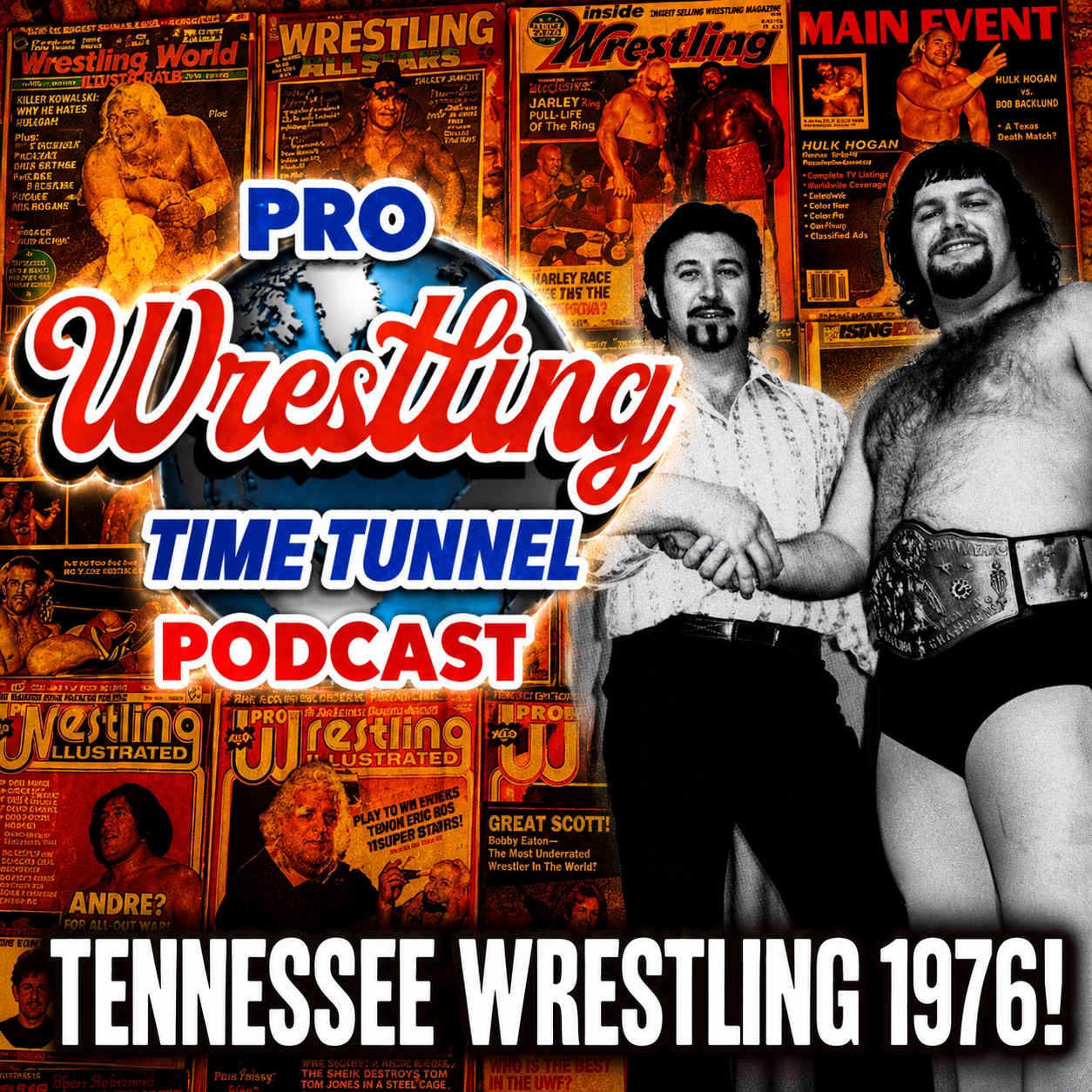
All right, today's focus and I'll be back at the end of the show to tell you a few more things. And I've Got some really cool things coming up on some future shows. But today, Tim Deals is here at the Richards Ranch in western Kentucky. And we're going to be talking about Tennessee Territory. This is what people call commonly referred to in the later years as the Memphis Territory. But in these days, it was the Tennessee Territory and it was intact. The Memphis territory was basically the western end of the Tennessee Territory. But when it was all one thing, 1976 was the last year that it would be whole and full in all its glory. And we're going to talk about things in the Tennessee territory and Chattanooga. We're going to talk about things in Birmingham, Alabama. We're going to talk about things in Nashville, Tennessee, in Memphis, Tennessee, in Louisville, Kentucky, Evansville, Indiana. We're going to talk about down in Alabama a lot. Huntsville, Alabama, Anniston, Alabama. We're going to talk about the whole territory today. And we're going to talk about two big programs. One of them in 1976 was Jerry Lawler and the young Babyface that had started the year before in 1975 in a babyface tag team with Tojo Yamamoto. But now they've decided to push him as this Baby Face singles wrestler at the beginning of 76 named Tommy Rich. And Rich had gone to high school with Jerry Jarrett's wife. We'll tell you all about that in today's show. The other big feud was Jackie Fargo, the Fabulous Fargo's Jackie and Roughhouse against the Bicentennial Kings, Phil Hickerson and Dennis Condrey. And that was playing out in the eastern end of the territory over in Birmingham and in Chattanooga and on, and sometimes in Nashville, and sometimes the western in feud of Lawler and Rich would be in Nashville. It was a huge territory. We'll tell you all about it today. I'm so happy that Tim Deals is here. Let's get right into it. I'll be back at the end of the show to tell you about a few things coming up that I think you're really going to be interested in and what we're going to do on shows going forward. But right now, let's get to it. Let's talk to Tim Deals about the Tennessee territory in 1976.
Hey, everybody. Welcome back to the Pro Wrestling Time Tunnel History Show. And of course, I am joined today by my good friend and Tennessee wrestling historian, Tim Deals. And today we're going back to the bicentennial year of 1976.
And this would be the last full year that the Tennessee Territory would stay intact. And so it's going to Be interesting as we go through the year, this year, to note all of those little clues that looking back, we can see that we couldn't see at the time. Right, Tim?
[00:11:20] Speaker B: Exactly. Exactly. You know, nothing happens suddenly, particularly in the. In the pro wrestling business. It's planned or it, you know, if something happens, sometimes it takes a little bit for the fissure to. To show up. And. And that's the case. And we'll point some of those things out. A year out.
[00:11:36] Speaker A: Yeah.
[00:11:37] Speaker B: Today probably.
[00:11:38] Speaker A: Yeah, we're going to go through as much of the year as we possibly can here. It'd probably take us a couple of shows to do the entire year, but we'll. We'll get started here. So when we finished up 1975, we talked about how much money this company was making.
[00:11:56] Speaker B: Yeah.
[00:11:56] Speaker A: And Roy Welch was almost all the way out at this point. I don't know how many ownership shares he still had, but he was living. In 1976, he was living in a house out on a farm that his son, Buddy Fuller, had purchased in Tennessee.
And Buddy Fuller and his wife were kind of looking after Roy as he was getting further and further into dementia and Alzheimer's.
So I don't know how much I know when Jerry Jarrett was coming back from Georgia, he was starting to accumulate Roy's part of the company, and Buddy Fuller and the Welch family was on board with that.
Roy's ownership portion was going to Jerry. I don't know how fast it was going or at what rate. So I don't know how much of the company Jerry actually thought he owned during 1976. But whatever it was, I mean, it could have been 20% and he would have been making a lot of cash, according to our calculations. But in 75, I mean, we talked about the commission reports, and it was up in the. With inflation. It was up in the 5 and 6 million dollars.
[00:13:13] Speaker B: Absolutely. And that's just Tennessee.
[00:13:16] Speaker A: Yeah, just Tennessee.
[00:13:17] Speaker B: That's not Kentucky and Arkansas and Mississippi and Alabama, where they had strongholds as well.
That's just part of the picture is. Is the Tennessee Commission.
[00:13:29] Speaker A: And there were. There was an article in the Tennessee and that I've used several times that said they were in television, was in 18 markets and their ratings in some of those markets outdid at the SEC basketball games in those towns, which is, you know, the wrestling has.
Well, as far as territories, the wrestling declined from here forward, but the SEC grew from here forward. But back in 1976, I mean, for kids like you and me, wrestling was on par with or better than watching our favorite. I guess for you it been the University of Tennessee.
[00:14:13] Speaker B: Georgia.
[00:14:14] Speaker A: Georgia. Okay.
You're. You're a red and black guy.
Yeah. Yeah. So you'd have been watching Georgia. I would have been watching Kentucky, but. But wrestling was a higher priority for me than.
[00:14:28] Speaker B: Yeah.
[00:14:28] Speaker A: You know, even that back then.
[00:14:30] Speaker B: Oh, yeah. I mean, if you had your choice. I wasn't, you know, I wasn't going to watch a football game or a basketball game. I was going to watch Channel 12 wrestling out of Chattanooga if I could.
[00:14:40] Speaker A: Yeah, well, Chattanooga is right there, close to the Georgia line. I could have picked one or the other and I picked wrong, but I won't do that again, so.
[00:14:48] Speaker B: Oh, that's fine. I actually grew up in. In North Georgia, so. Yeah, about 75 miles outside Chattanooga, but in the Chattanooga TV market.
[00:14:55] Speaker A: So.
So 1976.
Let's. Let's set the stage here.
I just posted a picture yesterday, I believe yesterday or the day before that, I got from somebody that was showing a booking meeting with Lynn Rossi and Mike Duncan and George Goulis and Nick. And they were probably booking the.
The eastern part of the territory. Jerry Jarrett, primarily, although I'm sure Mike Duncan helped him, too, since he was a family member of the. Jarrett's.
[00:15:28] Speaker B: Right.
[00:15:29] Speaker A: With the eastern or the western end.
So we've still got a whole lot going on here. And here in 1976, we kick off the year with the. The Southern title, which was the big singles title, particularly in the western end of the territory. The Southern title was held up at the beginning of the year and there was a.
There was a feud there, a little mini feud with Ricky Gibson.
[00:15:59] Speaker B: Yeah.
[00:16:00] Speaker A: Going on.
Brother of Robert Gibson.
[00:16:03] Speaker B: Yeah. I think Ricky might have been working Gulf coast mostly at this time frame, and he came in and he worked mostly Memphis.
I think I did see him in some shows maybe in Louisville, maybe Evansville.
[00:16:16] Speaker A: Yeah, I remember that He.
[00:16:19] Speaker B: He worked there. Ricky was a. Was a phenomenal talent. I, I thought I. He.
He was very fiery in the ring, very fiery on interviews, and was kind of innovative for his time, too. A lot of. Little more aerial maneuvers and a lot of guys, particularly in Tennessee, that you would see.
And he was, you know, for the ladies. He was a young goodlook guy and
[00:16:44] Speaker A: a heck of a worker. Yes, He. He could really work. I saw Robert this past weekend in St. Louis and we always say hi to each other and he always remembers me telling him how much I enjoyed watching them as a tag team.
[00:17:00] Speaker B: Yes.
[00:17:01] Speaker A: But. But the roster had veterans and younger talent. The Tennessee Territory Was always really good about that. They had their mainstays that had been around for quite some time, and they always mixed in the, the younger guys. There was a lot of emphasis, too, in Tennessee, always on tag team wrestling. It's not necessarily known as a tag team territory, but there was a lot of emphasis on tag teams. And of course, famous in Tennessee for stipulation matches, of course. And there were a lot of those. Hair versus hair, no dq, loser leaves town, blood feuds.
[00:17:35] Speaker B: We had an hospital elimination.
[00:17:37] Speaker A: Oh, stretcher matches. I mean, we, we had it all. And 76, I always kind of felt like.
And again, we have to talk about it in segments because different things happen on one end than the other. But in the western end that Jerry Jarrett was primarily in charge of, I just felt like 76 was the year that he made the decision. I'm going with Lawler.
[00:18:04] Speaker B: Yeah, for more. More so than he had before.
[00:18:07] Speaker A: I mean, yeah, 75 was a.75 was such a mixed bag. And Lawler was gone to Georgia and Florida and Ron Fuller was the Southern champion for a lot of the year. But in 70, the end of 75, it felt like Jarrett thought, okay, I'm, I'm. My instincts were right back in 73 and 74. I'm. Whatever. Lawler adjusted his attitude. I don't know what happened, but. But they sort of decided Jerry Lawler was going to be the horse they were going to ride.
[00:18:39] Speaker B: Right. And part of that going back into 75 is when they turn him heel. Lawler at that point, much more effective as a heel than he was a baby face. And so, you know, as you, you build him up through that, and you do see him here with the Southern title at the beginning of 75. But I, I think that's a very good observation about this is where it's. Lawler going to, going to carry the mantle forward. And, and, you know, when you look at the roster of some of these, some of these folks, some of these guys have been around a long time, including Jerry Jarrett and Eddie Marlin.
[00:19:19] Speaker A: And I think Jerry had loyalty to Don and Al Green.
[00:19:25] Speaker B: And yeah, I was, I was going to mention the greens because this is the final run of Don and Al in the territory together as a tag team. Because I think right after this, Al really does phase out. He does work some more in ring, but he becomes a manager for a while and, and, you know, goes in and out of the business for a couple of years. But the greens date back to the 50s.
And, you know, here you're a good 1618 years later, and they're still in the territory. You're seeing, I think, to some degree, guys like that who are beginning to age out.
[00:19:58] Speaker A: Yeah.
[00:19:59] Speaker B: You got to have a little bit of new blood coming in. And you do with Lawler, and I don't know if it's realized at this time, but you also do with Dundee.
I think it does. I don't know if that has actually clicked yet. With.
[00:20:15] Speaker A: At the end of 75, they were just playing with it.
[00:20:18] Speaker B: Yeah.
[00:20:18] Speaker A: Lawler and Dundee. And Dundee was the baby face.
[00:20:22] Speaker B: Yes.
[00:20:23] Speaker A: And fans will be more accustomed to Lawler in his baby face role because of all the videotape we have of the 80s.
[00:20:31] Speaker B: Yes.
[00:20:32] Speaker A: But, man, I'm telling you, he was one of the best heels of the 1970s.
[00:20:37] Speaker B: He was awesome. And he was a cool heel on. On top of that, I mean, he was. He would infuriate you, but you would also kind of go back and kind of within your own thinking, go.
It was pretty funny what he said. Or, well, pretty amazing what he did.
[00:20:52] Speaker A: Well, again, let's point out that back in these days, heels did not have merchandise, but Lawler did.
Lawler had a dang burger joint.
[00:21:03] Speaker B: Yes.
[00:21:03] Speaker A: Now, heels in professional wrestling in the 1970s didn't say, come out and eat one of my champion burgers.
You know, they didn't put out record albums.
[00:21:14] Speaker B: Right.
[00:21:15] Speaker A: They didn't have Merchant. They didn't have T shirts. They didn't have. But he did.
[00:21:20] Speaker B: People would buy the records to break them.
[00:21:23] Speaker A: Yeah, yeah.
[00:21:24] Speaker B: You know.
[00:21:25] Speaker A: Yeah, they have record burnings.
He was. And that's kind of lost in wrestling history. You made a good point there, Tim. He was one of the first cool heels.
[00:21:37] Speaker B: Yeah. I mean, for me, he was. I mean, you know, we lived in the territory.
[00:21:41] Speaker A: You know, we lived in it.
[00:21:42] Speaker B: We lived there. But, you know, it was. It was kind of like, I can't root for this guy because he's. He breaks the rules. You know, I mean, that's the mindset when you're 12, 11, 12 years old watching this stuff. But in the back of your mind, you're going, he's pretty funny. Or. Or he's fun to watch. Or you notice somehow the show changes when he comes out. The dynamic changes. It. It's more exciting. The crowd is really more involved in when. When Lawler's there.
Just a golden time for me, thinking about professional wrestling and really loving it. And part of that is from Lawler, and in those times, watching him come out, he also had a music video.
[00:22:27] Speaker A: Yeah, yeah, that's right.
[00:22:30] Speaker B: Which was rare too for. For a heel, which became a little more, you know, common in a few years. But there weren't any at this point
[00:22:38] Speaker A: talking about the, Talking about the guys who've been around for a while.
Eddie Marlin and Tommy Gilbert are still really involved. Actually they're involved in the tag team storyline.
The, the interns, which are kind of on their last run as a tag team, are the Southern tag team champions in January when the year starts and there's a no disqualification mask versus titles match with Eddie Marlin and Bearcat Brown.
This is also Bearcat Brown's kind of last hurrah, I think in 76 as well. So they lose the Southern titles to them and then it comes back with Tommy Gilbert and Bearcat Brown as a team with Tommy Gilbert's hair on the line and another no DQ bout.
And so is this the tag team program that was running over in your side of the territory?
[00:23:38] Speaker B: No, it wasn't as a matter of fact.
Mostly the, the. We talk really Lawler being the headliner, no matter who he's working against, Ricky Gibson or Tommy Rich. And then you have the interns in Tommy Gilbert, Eddie Marlin, Bearcat Brown, kind of the next level. On the eastern side.
It was mostly Jackie Fargo and a partner against Phil Hickerson and Dennis Condrey. That was the main, the main program that worked throughout various combinations. You know, Jackie and Phil would work singles matches against each other or they would be in a tag team with each other and, and Roughhouse would come in. Rough House came in some, I think in February.
And you also had Randy Fargo teaming with Jackie as well during this time.
[00:24:29] Speaker A: Right. I, I posted a picture of Randy Fargo and there were longtime fans on Twitter is like, I've never seen Andy Fargo, who is that?
[00:24:38] Speaker B: Well, he was prominent about 75 and 76 and that was probably about it.
[00:24:42] Speaker A: Another, Another Sad thing about 1976 and we're quite. It's. It happens in the middle of the year. But this is the last big run of Sam Bass.
[00:24:53] Speaker B: Yeah.
[00:24:54] Speaker A: Who I always wonder if.
Would there have ever been a Jimmy Hart if Sam Bass hadn't got killed?
[00:25:02] Speaker B: Yeah, that's.
Yeah.
I don't know. You know, Lawler.
The music part of Lawler's career is where heart comes in. But that is an interesting question. If Sam had had.
If the car accident had not happened or if he had survived and been able to come back in some way.
[00:25:25] Speaker A: Because that's another guy that most. That's another guy that a lot of fans just don't have any.
They don't know about Sam Bass or whatever, but he was the top heel manager for most of this. Well, from the early 70s through 76, and was, you know, Lawler's supporter and was always in his corner.
[00:25:49] Speaker B: Very Southern act, deep, a more East Tennessee dialect, a more Southern, you know, if you're Southern, you know the accents, you know, you know, the Deep south accent, you know, the mountain accent, you know, all these different accents. Well, Sam had more of an East Tennessee accent, real country accent from the mountains, very pronounced on air. But. And, you know, with Lawler, you didn't need to do a whole lot, but you had to have somebody to bail you out sometimes. And Sam Bass was the guy who would pull the cowboy boot off and knock somebody in the head so Lawler could get a. A win. And that is an interesting question. I don't know how to answer that. I don't know, you know, would you have pitted Sam and Lawler against each other at some point? I'm sure they would have. They kind of did that in 74 with. To me, kind of mixed.
You know, they.
I don't. I don't know. 74 blended into 75, and Lawler was gone a lot in 75. So it's hard to really measure that impact, I think.
[00:26:55] Speaker A: So.
[00:26:55] Speaker B: I don't know.
[00:27:01] Speaker A: Well, they. They tried a lot of different managers after Sam until they settled on Hart coming In there in 1980, I think it was. But.
But Sam was, you know, he deserves to be remembered because he was a strong, strong heel catalyst to the whole Lawler act.
[00:27:23] Speaker B: Right. And he also, at this point in. Also this time was managing Donna now Green, and had managed Al Green and Phil Hickerson before. So he wasn't just a one trick pony with. With Lawler. He.
He had other connections and other folks he had managed at at various times. And he, he also fit that mold that you had to be as a manager in this territory is you had to put the tights on and you had to work in an opening match almost every night as well. And Sam had that background where he, he had been in the ring early on in his career.
[00:27:58] Speaker A: And yeah, they still had that
[00:28:03] Speaker B: core
[00:28:03] Speaker A: philosophy going back to the 50s where, you know, six or seven guys in a car could do a card.
[00:28:11] Speaker B: Yeah.
[00:28:11] Speaker A: And, you know, there were no dedicated roles like manager. You also worked, you know, in the ring and Sam had his share of time in the ring for sure. Now, you mentioned Condrey and Hickerson, so Obviously this is 76, so I can only Assume that this is when the bicendie oh, kings bit was going to.
[00:28:31] Speaker B: Yeah. And I don't remember exactly the. The point in time when it happened, but it did.
[00:28:38] Speaker A: As a matter of fact, they even pulled out the United States tag titles. Right.
[00:28:43] Speaker B: For them, make it even more patriotic. Yeah.
[00:28:45] Speaker A: It went with the gimmick.
[00:28:46] Speaker B: Yeah. And they wore red, white and blue.
Red, white and blue outfit. Singlets usually.
And, and trunks. And at some point you.
I believe it's in February or March, Big Bad John comes in.
[00:29:02] Speaker A: Yeah.
[00:29:04] Speaker B: And so to kind of work a feud with them, he. He comes in and he pronounces himself as a bicentennial baby.
And so you've got a, you know, kind of a WWF late 80s feel to. We're going to argue over the name Bicentennial. Right.
[00:29:19] Speaker A: Which at that time was different.
I mean, it was very unique and very different.
And it's hard to explain.
You know, we talked about before experiencing things in context. And unless you were alive and living in 1976, you just don't understand the feeling of the bicentennial. I mean, it was all across the country.
There were parades, there were television shows, there were celebrations.
America was wrapped in the red, white and blue in the Stars in 1976. And that was just brilliant for them to say we're the top tag team in the country and we're the Bicentennial Kings. We're the kings of all the celebration that's going on. And you're going to celebrate us because we're so good. I mean, it's amazing. Heel gimmick, you know?
[00:30:13] Speaker B: Yeah. It's so simple. Right. I mean, you're taking something that everybody hears and everybody knows about and just blending it into professional wrestling. And that's. That's amazing. You know, you talk about some of those things going on that year.
One of the things I remember most is cbs. The CBS network would have the bicentennial minute every night, every night leading up to the 4th of July. I don't know, they might have done that for like a year prior. I'm, you know, a year leading into the fourth.
But they would take a minute every night and tell some piece of American history during their prime time. During the prime time hours of 8:11 Eastern, I guess.
[00:30:52] Speaker A: And you just got to think they already didn't like Condre and Hickerson. Right. I mean, they were already established heels in the territory in 75, so you already didn't like these guys. But now they're trying to steal our event. You know, they're trying they're trying to hijack. They're trying to hijack our nationwide feel good celebration by inserting themselves into this. And these guys are full of a bunch of hooey, you know, I mean, you just, you just thought that about him, you know.
[00:31:21] Speaker B: Yeah. And then you had big bad John who came in with, you know, with the red, white and blue too, and he, he had a top hat and
[00:31:29] Speaker A: he was already a big tall dude.
[00:31:31] Speaker B: Yeah, he was huge anyway, and he
[00:31:33] Speaker A: kind of looked like Lincoln a little bit. You know, he had the stovetop. He had the stovetop hat on.
[00:31:40] Speaker B: Yeah, yeah, yeah. So it was ready, ready made.
[00:31:44] Speaker A: Yeah. And again, going back to that philosophy we talked about, about how just a few guys, I mean, they, they would do a tag match in Chattanooga or Birmingham and then Fargo and one of the kings would have a singles gimmick match, you know, a lights out match or a no D. I know there were several no DQ matches. Reading the, reading the newspaper stuff from Chattanooga. I mean, some of them were pretty brutal with Condrey, Hickerson and Fargo, they
[00:32:14] Speaker B: spilled a lot of blood in that feud. Hickerson and Fargo both did a lot at that time.
[00:32:21] Speaker A: And I wish, I mean, Tim, I wish we had a couple of interviews with the Hickerson and Condrey and Harry Thornton because. Because that scenario we just laid out about the ridiculousness of hijacking the bicentennial, I mean, Harry Thornton had to be calling that out, you know.
[00:32:40] Speaker B: Oh, yeah. You know, Harry was a veteran.
Harry was, you know, in today's parlance, a conservative. I mean, you could, you could count on him to, in that regard to be that way. So. Yeah, he wouldn't, he wouldn't have been happy and Condrey and, and their flag, their flag waving.
[00:33:03] Speaker A: Yeah.
[00:33:04] Speaker B: I mean, even though they weren't flag
[00:33:06] Speaker A: waving, you gotta, gotta know. And for fans who don't know, let me tell you, Harry Thornton was the ultimate Chattanooga Babyface as the announcer, you know, and one things that's different about today's wrestling that you watch and watching it back then is babyface announcers like Lance or Gordon. So Gordon didn't do it as much.
Lance would do it and Harry Thornton would do it and other announcers would poo, poo the heels.
[00:33:33] Speaker B: Yeah.
[00:33:33] Speaker A: I mean, they'd be like, oh, come on, get out of here with that stuff. You know, same things you would be saying if you were watching.
[00:33:41] Speaker B: Right. Which makes, you know, makes you a fan of it because somebody's actually able to say something back to them when you can't and you know, one of the things that, you know, Harry was a pretty big guy, particularly if you stand Tojo Yamamoto next to him. And one of the things I've heard over the years was some people talking about how Harry would talk back to the heels and he shouldn't have done that.
Maybe, maybe not. But you've also got to remember Harry had a reputation in this town.
So he wasn't, he wasn't going to come.
He wasn't gonna make. Let himself come across as weak either.
[00:34:19] Speaker A: Right.
[00:34:20] Speaker B: Because, you know, he. He still had to live in this town. And so he's gonna. He's gonna step up and put it back in your face.
[00:34:28] Speaker A: And Harry was on television every day.
[00:34:30] Speaker B: Every day in chat Friday and then Saturday.
[00:34:34] Speaker A: And while I wasn't there and I never saw it, I can, I can assume Harry was one of the big bicentennial cheerleaders on his show every day.
[00:34:43] Speaker B: I'm sure he was.
[00:34:44] Speaker A: And so as he's on every single day, rah, rah in the bicentennial, then comes the weekend and here comes these fools trying to try to hone horn in on and take advantage of it. And he's probably calling it out, I'm thinking.
[00:34:59] Speaker B: Yeah, and not only that, the, this, the station that aired wrestling and the station that aired his Monday through Friday program was the CBS affiliate who was doing the bicentennial minute thing every night. So, yeah, he would have really been on board.
[00:35:14] Speaker A: I don't know how Sterling Brewer would have handled it or the more low key. Yeah, he. He wouldn't confront the heels as directly.
Yeah, he might do it in the context of while the match was going on, but not necessarily doing the interview segment. He was a little more cut in the mold of a Gordon.
I don't. I never heard the Huntsville announcer. He was also on television every day.
[00:35:41] Speaker B: Yeah, he was probably a little more like Harry. A little more maybe.
[00:35:44] Speaker A: Yeah. He was also the promoter for Huntsville, so he had a vested interest in the heels getting over. So he probably did a little bit more like Harry, I guess. I don't know. I never saw him.
[00:35:57] Speaker B: Yeah, I saw very little of him. But I do know, like Harry, he was very well respected and well liked in the community because of his.
He had a background in sports radio, if I remember correctly, to begin with, and transition over into tv.
And so he had been around for a long time too. Wasn't originally from Huntsville, but he, he became part of Huntsville over time. And he was, he was just that familiar face that when. When. And familiar voice that when you heard, you thought of Huntsville at the time.
[00:36:34] Speaker A: So you're the guy who's done all this research into the Tennessee Athletic Commission, and we've talked about the kind of business they were doing.
Memphis is spiking at this point, and some of that is the arrival. You know, Lawlor being a great heel is juxtaposed against. Somebody's got to be a strong baby face. And 1976 is the introduction of Tommy Rich as a singles babyface star. He had been a tag team champion with Tojo in 75, and that was brilliant. Put the young kid with the experienced guy like Toe Joe, exactly how Jerry Jarrett broke into business. Right.
But he breaks out here and starts using Tommy as a single.
I have no idea if Jerry had any idea how big Tommy would be as a baby face, not just in Tennessee, but in the entire South.
[00:37:30] Speaker B: Oh, yeah, yeah. Tommy.
You know, that's one of those things that Tommy come along at just the right time because, you know, particularly when you go. When you look at him in Georgia, those late 70s and early 80s where he was such a big hit, he
[00:37:45] Speaker A: was on the front page of almost every wrestling match. He was on as many covers as Andre and Bruno and Dusty.
[00:37:52] Speaker B: Yeah, yeah, yeah. Truly amazing. One of the things I looked at the last couple of days in prep for this was kind of his rise in Memphis during this time frame and how the attendance began to tick up from what. From what we know. I don't have any Tennessee Athletic Commission records from then, what we have to go on, on newspaper reports, but you can see when Lawler and Rich are in the main event. The attendance is up at this time in this time frame, more so than some of the other bigger programs that they're using at the time.
[00:38:33] Speaker A: Tommy's mother had.
Tommy had gone to high school with Deborah, Jerry Jarrett's wife. And Tommy's mother, Peggy was friends with the family as well, who would later be in an angle with Jimmy Valiant that we do have on tape. And she just. I can't imagine. I can't. I'm amazed at how. What a great job she did in that thing.
[00:38:55] Speaker B: Yes.
[00:38:56] Speaker A: But as a kid and a teenager, he pumped gas after school and on weekends, which usually put him in regular contact with the wrestlers because they stopped there to get gas. And he graduated from Hendersonville high school in 1974 at 18.
Had always been drawn to the wrestling business. Didn't really have any formal athletic background. He didn't play football or any other sports, but wrestling was his passion from early on. And Jerry Jarrett agreed to train him after he tested his dedication by having work on the farm. That was an old Roy and Welch family deal. You know, have you do some farm chores and see if you can, you know, be tough enough to do that. And he put him with Lawlor a little bit. Dick Steinborn was involved somewhat at Tojo Yamamoto. We mentioned his name is Tommy Richardson and He debuted in 1974 under Tommy Rich.
And that, of course, is more marketable than Tommy Richardson.
Go ahead.
[00:40:04] Speaker B: I was gonna say, if you know your country music history, one of the big stars in country music at that time was Charlie Rich. Charlie, who had the white silver fox, right?
[00:40:13] Speaker A: Yeah.
[00:40:14] Speaker B: Had the hair very similar to Tommy. I wondered then, are they related?
[00:40:19] Speaker A: Yeah, yeah. Because I mean, remember these territory, the Tennessee territory, even though it got the Memphis label later, it was all done out of Nashville.
[00:40:29] Speaker B: Yes.
[00:40:29] Speaker A: Which was also. Which is going to come into play here in our show a little bit. But, you know, all the country music stars were there. Tommy Rich grew up there in a suburb in Hendersonville. Jerry Jarrett was neighbors with a lot of country Bobby Bear, Johnny Cash after he moved out to the lake. So there was a lot of country music connection. So I can see where people might think that Tommy was in the Charlie Rich. I mean, most beautiful girl in the world.
Behind closed doors, rolling with the flow. I mean, I love Charlie Rich.
[00:41:04] Speaker B: Oh, yeah.
[00:41:05] Speaker A: So he started as a baby face, had a very. For the time, had a what. What would later become known as work rate. I don't use that phrase very often, but he was a guy who could move a little faster. Of course, he was younger.
And with Tojo probably calling the shots, you know, just doing, basically following the match what Tojo wanted to do. Probably got the hot tag a lot.
I can't remember specifics. I remember seeing them in Evansville as a tag team. And one of the things that Nick was very much known for was pulling out various variations of tag team titles from his closet, you know, when he needed. When he needed more champions. Like we mentioned, Hickerson and condre were the U.S. champions. I think Tojo and Tommy were the Southeastern champions. And then you had the Southern champions that were the main. Main champions.
But that might have been the US Tag Championship that he and Yamamoto had.
Yeah, that's who and Condre won it from, I think.
[00:42:11] Speaker B: Yeah, I think. I think that's right. Yeah.
[00:42:13] Speaker A: But it's hard.
[00:42:14] Speaker B: It's hard to keep them straight.
[00:42:16] Speaker A: Yeah, yeah, but. But he comes out here and we're talking about 1976, and so February 22nd, he beats Lawler because Lawler wins the match for the held up title with Ricky Gibson for the Southern title. And then on February 22nd, Rich beats him.
[00:42:34] Speaker B: Yeah.
[00:42:34] Speaker A: Was that match on television?
[00:42:38] Speaker B: I don't know. I'd have to look up the date.
[00:42:41] Speaker A: I think it was because I've looked for it everywhere and I've seen people post it, but they post it as an embedded post and I don't know where it came from because it's not on YouTube and it might have been part of some of the stuff that Scott Bowden was selling before he passed away, but.
And it might be out there, I don't know. I haven't looked for it for sale, but.
[00:43:05] Speaker B: And you know, that's one of the, one of the ways you, you shoot that crowd attendance up is a rematch. You know, if you run it, run the, run a title switch on TV and then run the rematch on Sunday night or Monday night, depending what not they're going to run the, the Coliseum.
You can get some folks out to, to see this depending on the, on how angry Lawler was after he lost it, if he lost it on tv.
[00:43:27] Speaker A: And Tommy was showing a, he was showing a competency for being able to talk here. And so the verbal battles between Lawler and Rich on television, they had a lot of those. And I think it was one of those, it was one of those coaxing you into a match deals, I think.
[00:43:46] Speaker B: Yeah.
[00:43:47] Speaker A: And I think Rich beat him on in the Memphis studio show for the title, which then caused the matches on Monday nights in Memphis. And then after the Memphis program kind of ran its course, we started getting that same match in Louisville and Evansville. Right.
[00:44:07] Speaker B: And I know, you know, you talk about YouTube and we talk about footage available footage that's out there and we all know about a lot of the stuff from before this time frame that's been shot in the arenas, in the, in the Coliseum and in other locations across the territory. But as far as tv, this TV studio stuff, the. About the earliest you find is from this time frame around maybe March.
You'll see there's. There's an incident where is it Lawler gets flat or they, they come out and dump flour on somebody's head in the middle of the ring? I can't remember. I can't remember who did what at this point. But that's from this, from this feud where they do that. And I think that's March.
And conversely, there's a tag tournament on the eastern side with Hickerson and Conre. Jackie And Randy Fargo and the Bounty Hunters, a three man tag team. And there's a, a pretty long video, eight or nine minute long video from this time frame too. I think that happened in March or February or March.
And when you. So if you really want to get a little bit of taste of this and have never seen it, go to YouTube and look up Memphis Wrestling 1976.
[00:45:35] Speaker A: Yeah.
And I will try to find that and post it in our YouTube channel.
I've been trying to gather footage that's out there that go with our podcast and I'll, I'll try to look for that and see if I can.
[00:45:49] Speaker B: Yeah, I watched, I watched most of the, the tag tournament thing today because I hadn't watched in a long time. And so if you really want to get a feel of, of Hickerson and Condrey on the mic and Jackie Fargo, Jackie Fargo's charisma it is. And a little bit of Jimmy Kent. You get to see some Jimmy Kent.
[00:46:07] Speaker A: Well, that's another manager that was really over on the heel side. Cash Box Jimmy Kent, who managed the Bounty Hunters. And Nick must have really liked Jerry and David Novak because they, they worked a lot.
They were prominent as a tag team.
[00:46:23] Speaker B: They were. And they were kind of like we talked earlier this time frame in, in the Western end, or the Jared end, if we want to look at it that way. Where the towns he appeared to be booking, you had Lawler Rich and then underneath you had the interns and Tommy Gilbert, Bear Cat Brown, Eddie Marlin. Well, on the, on the other end, the Bounty Hunters were like in that second slot and they ran a feud in February, maybe in March with Don Anderson and Luke Fields.
[00:46:53] Speaker A: Yeah, that's right. Bobby Fields.
[00:46:56] Speaker B: Yeah, Bobby. Also known in the Gulf coast as Bobby Fields, known here as Luke Fields,
[00:47:00] Speaker A: which is a Welch family member, for those of you who don't know, is Lee Field's son.
[00:47:06] Speaker B: Yeah, Don Anderson. Don Anderson was a guy named Dwayne Bailey who, or who worked some of the Gulf coast around this time too. And I think came up, you know, with Luke and I, I remember a little bit about that feud. I don't remember a lot about it, but I do remember seeing Luke Fields and I, I had never seen him before and was not familiar with him even though I could tell he was an older guy at this point.
[00:47:32] Speaker A: So for to, to Tim's point. So January in Memphis, we got crowds of 4800 to 6500. Now the Mid South Coliseum has around a 12,000 capacity, so they're drawing 4800 to 6500. In January, Tommy Rich gets introduced as a single. They do the angle on television. In February, Tommy Rich wins the title from Lawler and they go to 8,000 plus in Memphis. And then in March, I mean, they're doing 10,800.
[00:48:05] Speaker B: Yeah.
[00:48:06] Speaker A: So you can see how much whatever they're doing on television and whatever they're pushing as the main angle really directly affects the revenue, especially on this end of the territory. And I wish we had the attendance figures for Chattanooga and Birmingham because we could see how far go. And the Bicentennial Kings are affecting that. But I had to think that it kept running and those guys kept being pushed. So, you know, if something's working in wrestling, you keep doing it till it doesn't work anymore.
[00:48:38] Speaker B: Do it until you. Yeah, until you burn it out.
And, and you know, at this point we have to go newspaper reports generally or any. Anybody was there who could verify it. And usually what you see in a newspaper report on the eastern end is capacity crowd, you know, and in Chattanooga, capacity crowd would have been a little under 6,000. Probably about the same in Birmingham.
I see some, I see some attendance dates in Birmingham.
4000, 4400.
So, you know, two thirds full maybe.
[00:49:13] Speaker A: So.
So also here at the first part of 76. And I'm going to let you take the lead on this, but we find out from like the Tennessee Athletic Commission meeting notes that Lou Thes, the former NWA six time NWA World Heavyweight Champion, who has also worked the territory not long ago, has put in a bid to get a booker's license.
Is that right?
[00:49:46] Speaker B: Yeah, that's right. Now let's. We may have covered this before, but that's okay.
[00:49:51] Speaker A: We probably need to do it again because I even, I sometimes get confused about.
[00:49:55] Speaker B: So let's, let's talk about booker.
[00:49:58] Speaker A: Yeah.
[00:49:58] Speaker B: Because in our fandom and the time frame from when we began to watch professional wrestling until it evolved and we've learned about it and, and it's been exposed and whatever we think of booker as what today, today's wrestling fan would call rider.
And the, the Tennessee Athletic Commission did not define it that way.
[00:50:24] Speaker A: And to put it in even more modern terms in television, it's showrunner.
[00:50:29] Speaker B: Yeah, yeah.
[00:50:30] Speaker A: It's the person who's basically in charge of organizing all of the show.
[00:50:35] Speaker B: Yes, yes.
The, the creative end. The.
This character does that. This character does that. This is when this happens.
[00:50:44] Speaker A: And all the writers report to the showrunner, you know, and the showrunner basically lays out the season and all of that Stuff.
[00:50:53] Speaker B: And so booker in the terminology for the athletic commission is more like talent agent.
And so in. In these roles in professional wrestling overlapped. I mean, Nick Goulas, Roy Welch were talent agents, so to speak, who, if you came to work for them, they booked you somewhere.
And of course, this goes further back into the history of pro wrestling, where big promoters, big time promoters, controlled a lot of wrestlers.
[00:51:27] Speaker A: And we should also say that a promoter in the strictest sense was someone who was just in charge of a town.
[00:51:33] Speaker B: Right.
[00:51:34] Speaker A: The promoter was the guy, let's say in.
Well, Christine Jarrett, let's take her. She was in charge of Louisville.
So she basically promoted the town of Louisville. She didn't book it. She didn't arrange the creative. She didn't say who wrestlers go there or what the matches were going to be or what the finishes were. She just was in charge of making sure that the newspaper ads were in and the tickets were arranged and sold and the popcorn concession was taken care of. She was the promoter, not. Not the booker.
[00:52:09] Speaker B: Right. And the show went off.
She saw that the show, she was
[00:52:12] Speaker A: on location making sure that everything logistically was what it was supposed to be. Be.
[00:52:18] Speaker B: So Luth is. Is asking for a booker's license. So he's not asking to be the creative. Right. That has nothing to do with the.
[00:52:26] Speaker A: He's looking to be a talent agent in Nashville.
[00:52:28] Speaker B: Because one of the things that you. You will have to do to the athletic commission is you will have to prove, I have a pool of talent that we can run a show with that a promoter could run a show with. So that's. He's basically saying, yes, I've got this group of people that. That are going to work for me. And I will tell them, you go to Nashville, you go to. To Crossville or you go to Clarksville or whatever.
[00:52:55] Speaker A: I just.
[00:52:56] Speaker B: That's what they're asking for.
[00:52:57] Speaker A: I just thought of. And this is going to be relevant because of who else is involved in this whole thing.
But let's take country music, for example. We just talked about Charlie Rich. Charlie Rich had a booker. He worked for a booking agency.
That agency would book him in St. Joseph, Missouri, or they would book him in Tulsa, Oklahoma. And so that is where his tour bus would go to do a show.
Now, in St. Joseph or Tulsa, there was a promoter of that show who was there taking care of things on the ground.
So that's kind of the difference or the same thing in wrestling.
[00:53:34] Speaker B: Yes. And over time, these meanings have changed to us.
[00:53:38] Speaker A: Yeah, that's right.
[00:53:39] Speaker B: But at that time. And that's all rooted, like I said earlier, in. In. In guys like Tom Packs and. And all these guys through the years
[00:53:47] Speaker A: who were the Seagulls and Sam Av and Mushnick and all these guys.
[00:53:52] Speaker B: All these guys who. Who.
Who really controlled talent and. And sent them. Sent them to places. So Lou's asking for this in January for this booking license, and they table it, they say, we'll deal with it later.
[00:54:10] Speaker A: And who do we talk to about this? Roy is retired and incapacitated. We used to walk down the hall and ask him if we should do something or not.
[00:54:19] Speaker B: Yes, this is. This is key to this, because I think if Roy had been more active, had been able to maybe.
Because I. I mean, I have a personal belief that Roy Welch was extremely involved with the Tennessee Athletic Commission, maybe even had it appointed. Had it.
[00:54:42] Speaker A: He was the power behind it, Tim. I mean, he. Absolutely. He just was. And he used it for his ends.
[00:54:49] Speaker B: Yes. One of the great things about looking at all this stuff is when there was a. An available appointment on the athletic commission, and I would have to go back, it was sometime 63, 64, 65, somewhere like that. And there's some paperwork that I came across from the governor of Tennessee at that time, and who's meeting with him, Nick Gulas and Roy Welch. And they're suggesting to him who goes on the athletic commission.
Right. And so we Fast forward now 10 or so years, 75, 76. And I think in an earlier time, you would have never. This would have never come to light, no less be brought up here. Or it might have come to light and not made it to the minute, to the meeting minutes. Maybe, you know, there might have been somebody showing they're going, ah, get out of here. But the commission, I think at this point, a lot of those guys who'd been on there forever had retired or moved on. Maybe some had even passed away. And so you get a different crew of. Of commissioners in there at this point. They. And when I looked at them, most of them dealt with boxing, which brought practically nothing into the commission.
Wrestling, you know, was. Was what fueled the money they brought in. And they seemed more interested in boxing than wrestling. So I don't think they had an allegiance to Roy. Roy Welch or Nick Goulis. And I think it shows that Nick really didn't have a whole lot of power when it came to the athletic commission. Or maybe he could have shut this down.
[00:56:19] Speaker A: Well, I think another example of Roy's absence is that his grandson is being asked to come in to Explain some of his paperwork.
[00:56:30] Speaker B: Right. So Ron, of course, is Ron Fuller.
Ron Fuller running Knoxville.
[00:56:35] Speaker A: Who's Ron. Ron Welch and had been running it
[00:56:38] Speaker B: now for a year and a half. Yeah, he came in in October, November of 74.
And so they're saying, look, your paperwork doesn't match up. We don't understand some of your paperwork and we want you to come in. And, and, and, and Ron didn't for a few months. Yeah. You know, and I think he sent.
I think there was an attorney coming to him and are coming in his place and talking to them about it. But they, they wanted particular things, you know, a signature. You had to have a. A sponsor. You had to have certain paperwork lined up. And they were calling him out on that.
And, you know, I don't know if they ever really got pleased with what, what he sent. But it's interesting to note that the attorney who represented him also represented Nick Goulas in a February meeting.
And that man's name was Lyman Ingram.
And Lyman Ingram was a. An attorney.
And I. And he was a lot of other things. I think he had been a judge and maybe worked both sides of law as far as like district attorney. And, you know, he. And just a lawyer as well.
[00:57:46] Speaker A: Yeah.
[00:57:47] Speaker B: And. And he was one of the. He was. When the commission came back into play in 1955, he was the chairman.
And guess where he's from. It's. It's hard to imagine where he's from. Lyman Ingram was from Dyersburg, Tennessee.
[00:58:02] Speaker A: Golly.
[00:58:04] Speaker B: And, and so here, years later, when Lyman has left the athletic commission at some point in the 60s, he's an attorney and he's working for Nick Gulas. He's representing Nick Gulas in front of the commission. So
[00:58:19] Speaker A: let's have a Dyersburg moment. So here's my Tennessee. Look at that hall of Champions I got in Dyersburg, Tennessee, from Pro Wrestling Mid south, who runs in the Herb Welch Wrestleplex.
[00:58:32] Speaker B: Right.
[00:58:33] Speaker A: And I wish. I feel terrible. I can't remember his name, but the mayor of Dyersburg came by to meet me before the show started and we struck up a conversation and he wants me to come back to Dyersburg because he knows where the farms were and where the barns were. And you should. We should coordinate this.
He wants to have lunch and knew a lot of stuff about Dyersburg. I bet you he knows Lyman Ingram.
[00:59:04] Speaker B: Oh, I bet. So there is a facility out there and I guess it's still named, I think like a softball complex that was named the Lyman Athletic Alaman Ingram Athletic Complex or something. Very well known. He was also involved in a lot of youth sports activities.
And he. He lived to be nearly 100.
I mean, he. He only died maybe a decade ago.
[00:59:27] Speaker A: And he said. Because we had talked.
We talked earlier about making the trip to Dyersburg and he, he said, I'll clear my schedule. I said, well, I might bring a couple guys with me. He said, that's good. Bring whoever you want, you know, so.
So we need to go meet the mayor of Dyersburg and get in on this. You know, he. He would be telling us history he doesn't know. He's telling us probably.
[00:59:49] Speaker B: That's right. You know, the other. The other connection, and I think we've discussed this before with the athletic commission.
That was a gentleman named Malcolm forester.
[01:00:00] Speaker A: Yeah.
[01:00:00] Speaker B: Some of the. Some of the documents may list him as Mr. Forester. And he was a banker in Yorkville, which is really closer to where that
[01:00:10] Speaker A: was, where Roy's dairy farm was located.
[01:00:13] Speaker B: And so Malcolm forester for many years into the 70s, was called the executive secretary. And so he handled the paperwork.
So he handled the licensing. All right. He handled all. All the incoming money, the tax money that was dealt with. And so, interesting enough, a banker did that.
And Yorkville, Tennessee, which had probably three or 400 people, had a bank.
And I can only imagine three or 400 people. He had to know Roy.
[01:00:45] Speaker A: Well, there was an article about guys going out to Roy's dairy farm to look at his irrigation system.
[01:00:53] Speaker B: Yes.
[01:00:53] Speaker A: Like that was a big deal. And they were talking about how Yorkville had all these business. It had all these businesses and all of this great. Which back in those days, I mean, in this little bitty town that I live in now that I grew up in, there used to be so much agriculture going on and local commerce and grocery stores. And my one grandfather owned the feed store. My other grandfather owned the service station. And there was just so much that doesn't exist anymore. And I would. I don't know, I'd be interested to have him take us out to Yorkville just to see what it looks like now. So.
[01:01:30] Speaker B: Yeah. Yeah. And I remember years ago going to a. I believe a wedding, some. Something and driving near Yorkville. I remember seeing a sign and I'd never been there before, but I didn't know then the significance to professional wrestling that I do now. But forester.
[01:01:51] Speaker A: Go ahead. No, that's all right. Go ahead.
[01:01:54] Speaker B: I was going to say forester.
They forced him out. He ended up a certain age. And they said, you're gone. And so that might be another Reason why some of this, some of this licensing issues come back to haunt Nick at this point is because Forrester also wasn't there to. To kind of keep folks at bay.
[01:02:15] Speaker A: There was, I was just gonna say there was a older guy there, probably in his 80s, that sat with me during the wrestling show and he's telling me all about Herb Welch and he knew him and he, Herb tried to get him in the business, but it was, it was. I loved it. It was interesting. Now, now, do you think they knew Lou? Was, was Lou at the meeting or was it just his application? No, he was an attendant.
[01:02:41] Speaker B: I believe he was at the ME I know there was one meeting he was at because he got up and gave his credentials. I'm six time world NWA World champion.
[01:02:48] Speaker A: Yeah.
[01:02:49] Speaker B: And I've wrestled on here and there. And it was either January or February meeting where he was on hand. In the Feb. When the February meeting came around, they granted him a booker's license.
And in addition to that, Camelot Concerts was granted a bunch of promoters licenses as well at that time. And this, of course, is really where the UWA begins to be formed or more so begins to really come together now.
[01:03:18] Speaker A: Now, another, another couple of important things about the story is that one is Lou had a fallen out with Nick.
Somehow Lou had a belt or had a championship and didn't want to do the job to give it up or something. Or he had a. It was a. It always comes back to payoffs, right? It came back to his payoff wasn't good for Chattanooga or something.
And so he was, he was, he. He was wanting to get back at, at Gulas for all of this. And he found, he found a willing benefactor in Buddy Lee, who also was not happy with the wrestling business.
He had been married to the Fabulous Moolah. He had been married to Rita Cortez.
He had a female wrestling booking office in South Carolina at one point where he booked a lot of the Southern women, while Wolf booked a lot of people out of Ohio. Buddy Lee was cutting in on that business from South Carolina. And then there's another person who's involved here. Earlier, a booking license had been applied for by John Ringley.
[01:04:36] Speaker B: Right?
[01:04:36] Speaker A: Now, John Ringley may be a name that, you know, particularly if you listen to my show a lot or you listen to us talk about it, because John Ringley is basically the guy who reinvented Jim Crockett Promotions, right?
When Jim Crockett Sr. Basically turned over the reins of the company to him.
And in around 1973 or so, he Started the whole transformation of Jim Crockett Promotions into Mid Atlantic Championship Wrestling. Changed the brand.
Johnny Weaver and George Becker had been the bookers for a long time. It was very tag team focused. And I remember John Ringley telling a story about how after he had been to some of the shows for like six weeks in a row, that he turned to Mr. Crockett and he said, gosh, we've had a regular tag team match, we've had a six man tag team match. What's next week? A ten man tag team match. And so he was really wore out with it. And I guess he convinced Mr. Crockett they needed to make a change.
And boy, did they.
They brought George Scott in to be the booker and changed over to more singles oriented, put the title on Johnny Valentine as their main heel. And, you know, it converted the territory and really put Jim Crockett Promotions into its next level of success.
Now, unfortunately, John was married to Jim Crockett Sr. S daughter, Francis.
And evidently there was a relationship outside the marriage that went on that caused the demise of the marriage. And with that, it cost John his presidential role. With Jim Crockett.
He was also. John was also involved in other aspects of Jim Crockett promotions, particularly the booking of the Globetrotters and music acts.
And so when he left Crockett, he basically went into the music promotion business.
Started promoting like the Rolling Stones and different acts like that, and ended up in Florida working with Eddie Graham a little bit down there.
Eventually moved up to Oklahoma, worked with Leroy McGurk a little bit.
And so now he is thinking, I guess, about getting into the booking business for professional wrestling.
Yeah, and he's applied for a license.
What happened to that application, Tim?
[01:07:12] Speaker B: Okay, we talked about that in our last podcast about 1975, where he had come before the, the commission and asked this.
And so, and I think it had been maybe a two month period from when he had applied until we find out Lou Fez is applying for the same thing.
And so ringly, at some point in 1975. And I, I found a Billboard magazine article. And I know you got all sorts of Billboard magazines stashed away somewhere.
[01:07:47] Speaker A: I'm still putting them away. Tim.
[01:07:51] Speaker B: August 30, 1975, Billboard magazine talks about Danny Davis announcing the formation of Camelot Concerts.
[01:08:00] Speaker A: Now this is the Danny Davis from the music business. He's Danny Davis and the Nashville brass, Danny Davis.
[01:08:06] Speaker B: And so he's announcing Camelot Concerts. And, and it's. They describe it as gearing toward a full service promotion team.
And John Ringley was named the executive vice president at this time. And this is the end of August 1975. So their thrust initially seems to be not necessarily doing Buddy Lee's part of booking somebody somewhere.
But when somebody's booked, they're the. The advanced team. They're the team that comes in to promote the show that's coming up. So that was how I think this lined up. And somewhere along the way, when you bring John Ringling in this, I guess they get to talking about Buddy Lee and. And John Ringley probably gets talking about pro wrestling. And hey, you know, Nick's been around a long time. Maybe he can be supplanted.
You know.
Exactly. Though what happened between Ringley in November. October. November of 75, in January 76.
[01:09:09] Speaker A: Well, yeah, I. I think it goes back to. Buddy Lee had a grudge against Jim Crockett Senior. And I think again, it goes back to some payoff or something. And he left Jim Crockett promotion. This is back in the 1950s, folks. Yes, he left Jim Crockett Promotions upset. Buddy Lee was a good looking guy back in his wrestling days. I don't know if you've ever seen any photos of him. But he was, he was a good looking fella and was a nice looking baby face. And Moolah was considered to be an exotic female attractive talent.
And they formed a booking office in South Carolina and they ended up booking women.
But I think Buddy Lee always carried that grudge against Jim Crockett Senior. When Ringley finds out that they want to be successful here against Nick. And once they get Nick, you know, squashed or whatever, they're going to the Carolinas.
[01:10:07] Speaker B: Yeah.
[01:10:08] Speaker A: And I think that's where John Ringley said, no, I'm not. I can't go against.
I mean this. He had put so much into Mid Atlantic and he'd put so much into Crockett. And he still loved his family.
[01:10:20] Speaker B: Sure.
[01:10:20] Speaker A: Even though he's got children with, with Francis.
[01:10:24] Speaker B: Right.
[01:10:24] Speaker A: And they're still, you know, making a living. So you want to go in and destroy the company that your kids are going to directly benefit from. And I think Ringley said, no, I'm not interested in doing.
And so.
And another thing I was going to mention too is that. And book and Fez is very honest about it in his biography Hooker. That he made a lot of bad investments. And he wasn't necessarily a great businessman. I mean, fantastic wrestler, one of the greatest of all time.
[01:10:56] Speaker B: But business great.
[01:10:58] Speaker A: Carried himself. I mean, the NWA title had its prestige because of Luther's Absolutely. And guys had to rise to the prestige of that title because of him and the way he carried himself.
And so he was great in so many areas, but investing, maybe not so much. I mean, he. He lost a lot of money and a lot of different business ventures over the years. And now he's going to try to be a wrestling promoter. The very thing he has hated all these years, he now wants to be one.
And so he's hooking up with Buddy Lee now. Buddy Lee and Danny Davis had a nice career at this time.
His albums, which were pretty much instrumental brass horn performances were big. He was huge at Opryland in Nashville. I think he might even had his own TV show or he was on Ralph Emery's TV show, I think. Yeah, that Nashville Music, I think, was the name of the show. But Buddy Lee's Buddy Lee Attractions is one of the most successful, biggest country music star booking agencies in the whole United States.
[01:12:13] Speaker B: Yes.
[01:12:14] Speaker A: And so these guys who are successful in one area are going to try to be successful in the pro wrestling era area.
And it's interesting how the commission handles this. So they. They put it off in January, then what?
[01:12:32] Speaker B: Well, in February, they. They grant Lua a booking license and they grant promoter's license to Camelot Concerts. And, you know, I mean, I counted. I don't know if I put it in my notes or not at one meeting, and I think it was this one. Let me check something real quick. It might have been the next month. Well, I don't know. I've lost my pages.
At one point, there was like 35 or 40 licenses granted at one time by the athletic commission to Camelot Concerts.
So that I suppose their ability to promote music acts, they were going to also say, hey, we're also going to promote wrestling at some point. But you get them lining up getting licenses for Memphis, you know, a lot of smaller towns, too, but Memphis, Chattanooga, they, you know, obviously ran Nashville pretty quick.
And Clarksville, and I think Bristol and Kingsport were on the list, too.
They're covering pretty much the whole state of Tennessee.
[01:13:39] Speaker A: I know they ran in Owensboro. I mean, I know they ran in Western Kentucky a little bit.
[01:13:44] Speaker B: I believe the first card that I could find that had Universal wrestling on it was in Owensboro in February. Of where?
February 23rd.
And it actually had. It's a newspaper clip that had the Universal Wrestling name attached to it. And it had the Islanders, Pez Watley, Mr. Wrestling, the Interns and. And the. The Kentucky mainstay, Del man, the. As well.
[01:14:10] Speaker A: Owensboro in western Kentucky would probably.
It is considered to be in the Evansville television market.
And it's located, excuse me, it's located between Bowling Green which was a big gulas sea show town and Evansville which was one of the a towns.
So it's just kind of nestled right in there in between. And probably a good spot for them to try to get a foothold in western Kentucky. For sure.
[01:14:40] Speaker B: Work some of the kinks out of the show. Maybe, maybe.
[01:14:44] Speaker A: And Owensboro had a pro wrestling history to it, so probably a good choice on their part to try to work in there.
[01:14:52] Speaker B: Yeah. And you had, I mean, you know, Dale, man even at this point was probably booking some guys or could get. Or could get some guys to fill out a card with his connections in Kentucky.
[01:15:03] Speaker A: Now what's cool to me or cool. I don't know. It's interesting that the interns are working for Goulas and Ken Ramey is working for the uwa. Is that right?
[01:15:14] Speaker B: Yeah, yeah. It where we were talking earlier in January, they were semi final right in Memphis on a number of shows working tag matches over the southern tag titles and the Islanders. And we knew them later on as the Wild Samoans, Offa and Sika early in their career or in here as a baby face tag team for Nick in January and early February.
Pez Whatley was working the east side of the territory for Nick at the time too. And this brings up a point.
I'll go ahead and throw this out there. I don't have proof, but it's got to be. It's one of those things you just infer.
You think, oh, it's got to be that the, the March Athletic commission meeting they talk about.
Is that it?
They talk about seven wrestler Nick. Nick's attorney talks about seven wrestlers and their contract. I'm sorry, it's in the February meeting there's supposedly contracts that Nick has with seven wrestlers and they're going to take this to court. Okay.
And so my guess is these are the guys that left for Luthez.
So seven guys, let's count them. Intern one, Intern two, Islander one, Islander two. Ken Raimi Saw Wine Groff. Pez Wally, you know, gotta be, right? Yeah, we don't want you to go.
[01:16:49] Speaker A: Well, they're the guys that showed up and they're the guys that had worked for Nick just three months earlier.
[01:16:55] Speaker B: Yeah, yeah.
[01:16:56] Speaker A: Not even three months or the interns would been champions the month before.
[01:17:01] Speaker B: Yeah.
[01:17:01] Speaker A: But Pez, that worked I think in the fall or winter.
[01:17:04] Speaker B: Yeah, he had actually worked some in January.
[01:17:07] Speaker A: Oh, did he? Okay.
[01:17:08] Speaker B: Yeah, yeah. So they. He took them from both sides. We took them from both sides here.
[01:17:13] Speaker A: And that had to bother Nick a little bit, too, because PEZ was a Chattanooga, you know, kind of. I mean, went to University of Chattanooga and was a great amateur there, you know. So it was a good, good little thing for Chattanooga.
[01:17:28] Speaker B: Absolutely, absolutely. Paz got a lot of press here early on for his pro career around this time. When he came back, he enjoyed. He and George Wangaroff came back around the same time, and both had been at UT Chattanooga, amateur careers at various times. And you know, that they did have to. To be a hit to Nick.
[01:17:49] Speaker A: Now, when they do the television, I got to throw this in there, too. When they do the television show, the guy who hosts the television show is primarily Lou, but they also have a guy in the ring that does some of the ring announcing, who was one of the first television announcers I ever saw as a fan. Yeah, because he was the television announcer and play by play, guy for Phil Golden, All Star Wrestling. Buzz Benson. And Buzz Benson was a fantastic announcer. Yeah, Was a Nashville personality, I think, at the time. And so they used Buzz on their television. And I wish there was more of Buzz out there.
[01:18:29] Speaker B: He had been a major announcer in Nashville in the 60s. WMAK, WLAC, which you could listen to at night, you know, 1500 LAC, it was at 1510. Lack of W and Wsix.
He worked for all those stations in the 60s and was very well known, very popular.
[01:18:51] Speaker A: Yeah.
[01:18:52] Speaker B: And he.
He had worked in Chicago, St. Louis, Indianapolis before he came here. Had his own production company. They produced jingles, you know, so he. He was. He'd been around a long time, but he also had been a boxer at some point and maybe had even worked in roller derby at some point, too, maybe.
[01:19:14] Speaker A: He was good.
[01:19:15] Speaker B: Yeah. And if I remember right, at some point when he was working for Phil Godin, he actually got in the ring.
[01:19:21] Speaker A: I think so, yeah. They did the show.
[01:19:23] Speaker B: This is a referee.
[01:19:24] Speaker A: They did the show at channel 29, WDXR television. And I. I remember Buzz would drive up from Nashville to do the television, and they did the television out in the parking lot sometimes in the spring and the summer, because WDXR was located in this kind of rectangle building. It was a really unusual building at the corner of Broadway and, I think Broadway and Kentucky Avenue.
But I remember just going by there with my parents all the time going, that's where they do the wrestling show, you know.
But Buzz was. He was very good.
He was Very good. The other thing I think I should mention here that probably wouldn't have happened if Roy hadn't been out of the picture is Bill Warren.
Bill Warren was a promoter for Paducah, for Goulas Welch in the early 70s. He promoted primarily a lot of cards in 72 and 73. And he was also the promoter for Jackson, Tennessee.
And he had some kind of falling out with them. I don't know the specifics on it, but they give him a promoter's license.
[01:20:29] Speaker B: Yeah. And I. Looking back at this, I never really was able to. To get much information about Bill Warren after this time frame.
I wonder if maybe he was going to work for the uwa. I. I don't know.
[01:20:43] Speaker A: I don't know. I've tried to. I've tried to track down some things about him, and I'm always coming up on dead ends.
[01:20:50] Speaker B: It's tough because he has a very familiar last name, a name that's hard to really pinpoint exactly who you're looking for.
But, you know, there was. He could have also just been wanting to run with some guys in West Tennessee because there were a lot of guys out there that he could have run shows with. I mean, we've talked before about Stan Frazier running shows in Union City and some of those towns out there.
He could have very easily pulled a crew together from Western Kentucky and in West Tennessee and Arkansas and Northern Mississippi and ran his own group. Levon Stone was a guy that. Out of Jackson who. Who wrestled a lot for Nick and Roy at times. And, you know, he could have very well worked for him as well.
[01:21:37] Speaker A: One thing to kind of note about a person is for some people to find out who the promoter of the show was in a town, you'd almost have to have access to the paperwork.
Yeah, but not with Bill, because on his posters and newspaper ads, Bill Warren presents. I mean, he is very prominent on there.
[01:21:59] Speaker B: Yeah. And that's interesting to note because one of the guys that really helped Jerry. Jerry, early on, after Jerry had gone out on his own, was Buddy Wayne. Buddy Wayne ran a lot of those shows for Jerry, Jared and some of those West Tennessee towns.
You would have never known it, but, you know, Buddy worked behind the scenes for years like that.
[01:22:21] Speaker A: Well, yeah, and down in Alabama, too. He worked for Bill golden and promoted Selma, Alabama and Talladega and Muscle Shoals. And without having access to interviews where he said he did it, you wouldn't know it. Right.
So.
All right, so go ahead.
[01:22:42] Speaker B: I'll throw this out about the Tennessee Athletic Commission. Buddy Wayne did an interview with Scott Teal. Whatever happened to that magazine? And Buddy pretty much says Roy Welch was the one who put the Tennessee Athletic Commission in place. So.
[01:22:57] Speaker A: Right.
[01:22:57] Speaker B: And after I read that and have studied it some, I went. Buddy was right.
[01:23:03] Speaker A: So they, they're, they're running and they eventually get a license to run shows. And so they're getting these promoters licenses either with other guys or themselves to run shows. Right. They eventually get memph office.
[01:23:20] Speaker B: Yeah.
[01:23:21] Speaker A: And, and yeah.
So I don't, I'm not as up on the details as you are, but what I know you've listed in these things that you've sent me here. Yeah, I find these financials really, really interesting. So just kind of walk us through some of those.
[01:23:37] Speaker B: All right, let me grab my January sheet real quick. So for those of you who may be new to what we, we look at here, we're looking at Tennessee Athletic Commission records.
There is from about 1973 until around 1980, when the Commission was put to sleep.
There are ledger sheets that show how much deposit, how many deposits were made and how much was put into the bank by the Tennessee Athletic Commission.
So in other words, they're listing how much money they make from the shows. Now Tennessee Athletic Commission took in money on boxing for auto racing at some point too. At some sometimes. And professional wrestling. Wrestling was the one that made more money than anything. Boxing, you know, didn't really make much money racing only.
They only did licensing for like a promoter.
So they had to pay a fee, but they didn't licensed individual racers that I'm aware of.
And they always had trouble doing that.
So what, what I've done is as I've looked at the money that was deposited for a month and out of that we. I'm able to extract how much money they put that they have listed that came from a live show of live professional wrestling show. And out of that, that money is 4% of the gate that was taken at a wrestling show.
And so you make the money at a wrestling show, you have to pay a tax to the commission that's 4% of what you've made. And you also have to pay your sponsor.
Sponsor fee was generally pretty small. It was maybe 25, $50. And then you had to pay tax on, on this. So then you've got all this money left over. How much money is that? And so if we take out the 4% and do a little bit of math, we can come up with an approximate amount of how much money they deposited for a month. So in January January, they deposited 27, $792.75.
All right, pretty good amount of money. Not January 1976. Probably shows from December and January of December 75, January 76. If you run the inflation calculator through April, I believe of 2026, that comes out to $166,000 plus almost $166,500.
Pretty good amount of. Of change. February, they deposited $8,541. I'm sorry, I'm. In March, February, they deposited $10,189 and change.
They. The. The live show tax was $9,374. That shows you how much money professional wrestling was doing. I mean, if they deposited $10,189, but the live show tax was $9,300.
Everything's coming from professional wrestling.
So if you do the tax calculation, professional wrestling probably made around $234,000 that month.
[01:27:09] Speaker A: And if, if you. I don't know what Nick's percent was, but generally, if you paid talent 30%. Yeah. Let's say in January, they would have paid $8,337 to the talent, which if you got, you know, I don't know how many wrestlers that is, but I mean, that's a lot of money in 1976.
[01:27:29] Speaker B: Yeah, yeah. And again, one. This is one state.
[01:27:32] Speaker A: Right, Right, right.
[01:27:33] Speaker B: It's not, not, not, not.
[01:27:35] Speaker A: Not Alabama. It's not Mississippi, it's not Missouri, it's not Indiana or Kentucky or.
[01:27:40] Speaker B: Right.
And in March, they deposited 8, 500.
Little over 8, $500. The tax money was 5446. 5446.
And you run the calculation on that, you come up with 1, $151. That's $811,000 in today's money. Did I mention that in February, their inflation calculator tells us $1.398 million.
That's the. What it would be worth in today's money.
[01:28:11] Speaker A: And that's in three months.
[01:28:12] Speaker B: That's in three. Just three months.
[01:28:15] Speaker A: Yeah.
[01:28:16] Speaker B: It's amazing.
[01:28:17] Speaker A: Just for one state.
[01:28:19] Speaker B: Yeah, just for one state.
[01:28:21] Speaker A: Yeah.
[01:28:22] Speaker B: And you know, there are expenses as well. You got to pay your arenas. You got to, you know, you have other people other working for you. Christine Jarrett was working for him.
Nina Bond was working for him out of the office. So you had other expenses as well. And you probably had to pay maybe, you know, sometimes you may have had to pay some officials.
[01:28:42] Speaker A: So I don't want to get into my philosophy on exclusivity. And Monopoly and all of that. But I will just ask you, if your business made $1.3 million every three months, would you want that disturbed? Would you want somebody else coming in and cutting into that? I don't think so, no. Which is basically why Nick is going and saying, I don't think you ought to grant a license to these other guys.
[01:29:09] Speaker B: Right now. Granted, we've got Ron Fuller's promotion that. That pulls right.
[01:29:16] Speaker A: Tennessee is not really included in this.
[01:29:18] Speaker B: Right. And you've got, you know, and beginning in February, you have the UWA beginning to put some money in there because.
[01:29:26] Speaker A: Because Ron. Ron told me himself that he had the conversation with Roy about the booking fee because he didn't know what it was.
So when Ron got his financials, it said 10 or 15% to Goless Welch. And he's like, what is this for?
And somebody goes, oh, that's the booking fee. And he's like, what's that? And he goes, well, that's what you pay your grandfather and his partner to send guys over here. And so he goes over and has a meeting with Roy and goes, hey, Granddad, what's this booking fee all about?
And he's like, well, boy, if you can find wrestlers somewhere else, you know, go get them, but, you know, good luck to you, you know.
So he slowly but surely got away from that, but. And I think he was pretty much away from that by 76.
[01:30:15] Speaker B: Yeah, I think so, too. Yeah.
[01:30:18] Speaker A: So they, you know, they were pretty much just sending guys around three fourths of the state, I would say. Yeah, for that. For that amount, we said.
[01:30:29] Speaker B: Yeah, it's.
You want to talk about uwa, Memphis?
[01:30:35] Speaker A: Yeah, yeah, go ahead.
[01:30:38] Speaker B: So some of this actually bleeds over into April, I believe, but we'll go ahead. I'll go ahead and mention it because, you know, sometimes when we break all this up, we leave some stuff dangling and whatever.
[01:30:49] Speaker A: It's a big territory, folks.
[01:30:51] Speaker B: Yeah, it really is. And UWA was based in Nashville, Universal Wrestling Association. And they had an address, I think, on 8th Avenue or an office on 8th Avenue in Nashville. But, you know, they. They've got these ambitious plans. They're going to run different places, and in February, they run a newspaper article in, I believe, the Tennessee. And I don't know, it might have been the Banner, but I think it's the Tennessean where they're introducing the UWA and they're going to come in and work in.
They're going to run shows in Nashville.
[01:31:24] Speaker A: Yeah, I think around the same commercial
[01:31:26] Speaker B: appeal, I think yeah, well, in Memphis, yes.
[01:31:29] Speaker A: Yeah, yeah, but in Nashville it was the Tennessean, I think.
[01:31:32] Speaker B: Yeah, they, in the Memphis newspaper they run an article, similar article to what they ran in Nashville. And, and actually I believe time wise the one in Memphis appeared before the one in Nashville. But it's Luffy as saying, hey, I'm going to bring this new wrestling group to, to Memphis. I'm going to run a show in April at the Cook Convention center, not the, not the Mid South Coliseum. And my promoter is going to be a guy named Tommy Thompson.
And man, this has tripped me up until, until doing some study on this, they never came to Memphis.
But the guy's name is not Thompson. T H O M P S O N It's Thompson. T H O M S E N oh, and Tommy Thompson was an owner of the Western Steakhouse and Lounge in Memphis.
Probably had some connections with guys named like Eddie Bond. And if he knew Eddie Bond, he might have known Jackie Fargo at some point. But he was a, he was a nightclub owner and that nightclub brought in a lot of country music acts. So my guess is there's your connection through Buddy Lee and Danny Davis maybe of Tommy Thompson going to run these, these shows in Memphis. And it never takes place because now
[01:32:57] Speaker A: you just gotta imagine there's Buddy Lee booking all these country music acts to all these places all over the United States and he knows all of these local promotion guys, all these promoters in all these towns. He's gotta think, oh well look, they can promote wrestling just piece of cake.
I mean he thinks he's got. And it. To be honest with you, he really did have his own built in network to have a national promotion.
Yeah, I mean he knew the contacts,
[01:33:25] Speaker B: he had the network and in, in particularly in, in southern rural places, he had the audience. Yeah, if it's a country music audience, they're probably going to overlap at some point in some way with a wrestling audience. Of course.
[01:33:39] Speaker A: Yeah, well, Jim Crockett thought so. I mean.
[01:33:41] Speaker B: Yeah, yeah. So the UWA never really shows.
I do know this, that in.
I think it's in actually in March. It could have been in April. There is a small classified ad in the Memphis Commercial Appeal and it says that the Luthez is not responsible for, for debts, for all debts, commitments or obligations made directly with the uwa.
So he's, he's disavowing himself from something. And my guess is the deal with Tommy Thompson probably went sour and any money that might be owed lo saying go to uwa. We'll try to figure something out in Nashville and get the national addresses on there, but really it fell through. And, and my guess is there was some, some issue there with the promoter and, and maybe Lou or maybe Buddy Lee.
[01:34:41] Speaker A: And we'll go back and correct something I said earlier, by the way. I said Bobby Fields was Lee Field son. He was actually Virgil Hatfield's son, Speedy Hatfield.
[01:34:51] Speaker B: Lee, Lee and Don were the brothers.
[01:34:54] Speaker A: And Speedy was married to Bonnie, which was.
Was a Welch. And so that's how that connection to the family came in.
[01:35:02] Speaker B: It's. It's confusing.
[01:35:05] Speaker A: As much as I've talked about it, I still get confused.
[01:35:07] Speaker B: Yeah, I, I have to draw it out almost on a.
On a. On a tree or a map to, to get it done.
So the UWA is now, you know, becoming a factor. They run a show in, in at the end of February in Nashville. What I find interesting about the article in, in. In the national newspapers, how Lou says, we're not going to be at war with Nick Gulas.
Wink.
[01:35:37] Speaker A: There is no wrestling war.
[01:35:38] Speaker B: There's no wrestling war. But, you know, we're going to come. We're going to compete in the same market with the same product. And he also says it's going to be a different product.
Right.
So they run their first show at the National Auditorium. And what do they do? They run a big angle. Right. If it's going to be a different product, why are you running an angle? Right. You know, I don't, I don't know what you meant by different product, but when you have the interns in Ken Ramey attack Saul Weingroth and leave him on the floor, and Saul spends a week in the hospital from this attack, that sounds like a dick goose angle.
[01:36:15] Speaker A: Well, in the last few years, more UWA footage has been found and it's pretty pristine.
And the thing that has been the talk of all of it is Big Tessie.
[01:36:26] Speaker B: Oh, yeah.
[01:36:27] Speaker A: You know, just to say that, it's almost like he's inferring that they going back to the Tennessee bullshit again. Right. And then he's sort of inferring that, you know, we're going to. I'm Lou thes and I'm Mr. Wrestling. And this is going to be a different product, which everybody thinks is going to be wrestling mostly, but they do a Tennessee angle right off the bat and they put in things like Big Tussie, you know.
[01:36:52] Speaker B: Yeah. Yeah. And you know, at that point, you wonder.
There's a whole story to Big Tussie. She's got an interesting background dating back several years Prior to this and then her being in town in Nashville at the time. She wasn't living in Nashville at the time and came back for some reasons that we can discuss later.
[01:37:16] Speaker A: Yeah, yeah, we'll save that for another show.
[01:37:18] Speaker B: Yeah.
It's interesting and sad at the same time, but you do wonder.
She captured the attention of the city of Nashville at the time. And so somebody in that office, my guess is Saul Wine Groff, was going, man, we could make some money with her.
And that. That might have been easier said than done because you really look at the UWA talent line up and you see it really fall off.
[01:37:50] Speaker A: Yeah.
[01:37:50] Speaker B: As the summer goes on and when you're. When your champion, Pez Whatley leaves, when he's the champion and goes to Amarillo.
Nothing against Amarillo, but he just. He. He couldn't make a living there, I suppose, or got tired of it and moved on.
[01:38:08] Speaker A: So.
So in March, we'll just go through this a little bit and we'll wrap up for today. But in March, for. For Nick Goulas and Jerry Jarrett, that's the Bounty Hunters with Jim Kent, Donna Now Green, Bearcat Brown, Tommy Gilbert, Jerry Lawler, David Schultz, Tommy Rich, Bill Dundee, Tojo Yamamoto, Eddie Marlin.
Jerry himself is still on as a wrestler here. Giant Plowboy Frazier, who ends up in some of the Jerry Lawler program.
They end up being tag champions, I think, for a run there. Big Bad John, who has come back to the States from Australia, where he had been for a couple of years. Charlie Cook, Frankie Lane, Roger Kirby, Dick Steinborn, the Masked Dominoes. Now, a lot of people are not familiar with the Dominoes, but they are the tag team that was in the car accident that we will talk about probably on our next show.
They all passed away with Sam Bass in that terrible car crash. And they're managed by JC Dykes here, which makes them interesting that JC is primarily associated with the Infernos. Infernos.
And they get switched off to Sam Bass at some point. Also a rookie here is Don Kernodle, who's primarily associated with the Carolinas.
The Assassin. Now, who was the assassin here, Tim?
[01:39:45] Speaker B: This was Jody Hamilton.
[01:39:47] Speaker A: It was. Okay.
[01:39:48] Speaker B: Jody. Jody had finished up in Knoxville at the end of the year and he came over and this is one of the things I'm interested about. He worked the eastern side of the territory mostly.
[01:39:57] Speaker A: Yeah. Because I know he goes down to Florida as booker at some point in 76.
[01:40:02] Speaker B: And that's. That was my thinking. The east side, you and I were talking beforehand, and the east side, to me, seemed to fluctuate talent wise, some more than the western side. And I'm wondering who, who actually was booking the eastern side. And I, I wondered if maybe Jody had done some booking at this point here.
[01:40:20] Speaker A: I don't know. I think it was that committee that I mentioned earlier, you know.
[01:40:25] Speaker B: Yeah.
[01:40:25] Speaker A: You know, when I had George on the Briscoe and Bradshaw podcast, he talked about, you know, the booking meetings where the four, three or four of them would, would do it together.
[01:40:36] Speaker B: Lynn Rossi did a lot of booking, I know, on the eastern side over
[01:40:39] Speaker A: the years, and Lynn Rossi and Jerry Jarrett didn't get along that great.
[01:40:43] Speaker B: Right.
[01:40:44] Speaker A: So George is working here. George Goulis, Danny Miller.
Now the UWA roster has the Islanders, we mentioned them before, the Wild Samoans, the interns, and Saul.
Ken Ramey, who would eventually come back to the territory at some point. I mean, I think Ken Ramey is the ultimate Southern baby face.
Who. So they've got, they've. They got, you know, some, some guys here. Eric the Red Nelson, Royal Cowboy, Parker Hartford Love, who from the Love Brothers tag team who primarily associate us with Detroit and Canada and that sort of thing. Louis Martinez, Fred Curry, Bull Curry, Walter Johnson, Pistol Pez Whatley, Mike Boyette, the California hippie.
These guys. And you know what's funny to me, Tim, is you think about the Goules, Welch Co. And the entire six or seven state area, and they got all these wrestlers to send out to all these places that there's all these additional guys that can come in and be part of a whole different promotion. I mean, you know, at some point, I know like Joe Turner and Bill Bowman were working and some other guy. And Joe Turner's name has come up a lot since Dennis Condrey passed away. But a lot of these, there's so many wrestlers. Dale, Manny, there's so many of these guys that can work in this area. I mean, what is it about this area that causes us to have so many wrestlers?
[01:42:20] Speaker B: Yeah, good question. I. I don't know. And then you got some younger guys that we don't even talk about a lot who are coming along at this time who were even more local. Mike Jackson and Tony Ledoux or are two guys that I think of from this time frame.
[01:42:34] Speaker A: Troy Graham.
[01:42:36] Speaker B: Yeah, Troy Graham.
[01:42:38] Speaker A: First time we see Terry Mecca or Terry Gordy is on a UWA television show.
[01:42:44] Speaker B: Yeah. And you know, that's the thing about it, too.
[01:42:47] Speaker A: Who's from Chattanooga, by the way? Terry.
[01:42:49] Speaker B: Yeah. Well, I don't know if we've ever discussed this, but you're. We've been talking about various things that get posted and our friend Alan Moore, not long ago in some group maybe on Facebook, posted a clip of 1974, 1975 somewhere, or maybe even 76 in that time frame.
There was a TV station in. In Chattanooga named Wrip.
RIP is what a lot of folks called it. And they had. There was a group that ran wrestling out of Rossville, Georgia, Lakeview, Georgia. And this was the group that Terry's uncle, who worked as Captain Hook worked for. And so that, you know, there was Ted Tell out. Ted Allen worked for this group at some point and Terry was working that group at this time too.
And they were active in 73, 74, 75, maybe even into 76. So you got these little pockets that we don't ever know about. Right, right. These little communities that somebody comes from there, you know, to make a name for themselves later on in the year. There's some groups running in East Tennessee that, that we've been able to uncover.
I don't know if any of those guys in particular hit it big, but hey, you were running. They were running these small towns with local guys and who, you know, the roster might have been too big somewhere else, but. But it's. It's hard to think about that, that you've got. I mean, when I look at the list of the uw, UWA guys you're throwing at Eric the Red Bull Curry, Freddie Curry, and you're thinking they're coming here to work for the uwa, but they're not depleting a roster somewhere else.
[01:44:39] Speaker A: Right.
[01:44:40] Speaker B: You know, they're not defecting from a roster to work here.
Wherever they're leaving from is just going to go on as.
As normal.
[01:44:48] Speaker A: Yeah, it sounds like the chic.
I know, like those three you mentioned, plus Fred Curry and Bull Curry and I mean, those were regular Detroit. Detroit guys.
[01:45:00] Speaker B: Yeah. And I think some. Some were in Ohio maybe. It might have. Might have been a few. And it's just kind of associated with. With Detroit as well.
[01:45:08] Speaker A: And it's funny that the guys that come from there typically work for the Outlaw.
[01:45:14] Speaker B: Yeah.
[01:45:14] Speaker A: Like the PAFOs, you know, that typically they get on the side of the less established promoter.
[01:45:22] Speaker B: Yeah.
[01:45:23] Speaker A: It just kind of been their history. You know, there is another.
[01:45:27] Speaker B: Go ahead.
[01:45:27] Speaker A: No, I was just. Go ahead and I'll start to wrap up. But I wanted to go back to one of the things we talked about at the beginning. What were you going to say?
[01:45:34] Speaker B: Well, I was going to say one of the other guys that worked the uwi, his Name just caught my eye here looking at it was Rocky Johnson, but it's not soul man. Rocky Johnson as he was known then or is the Rock's father. This is a guy named, I think his name was Don Hudson and he worked, he worked places like Malden, Missouri
[01:45:56] Speaker A: and there's another little pocket. Henry Rogers ran one town, Malden, Missouri his whole life in a barn over there.
And so many of the Tennessee guys went there, especially if they couldn't get licensed in Tennessee because there wasn't a commission in Missouri so a 16 year old Eddie Gilbert could go work for Henry Rogers.
[01:46:20] Speaker B: Yeah, and here was a guy who, who you know, co opted the name of Rocky Johnson. I don't know how he got away with that. And Rocky had, had run, had been in, I think he'd been in for a few shows maybe in Memphis, the real Rocky, what we would call the real Rocky.
[01:46:36] Speaker A: There was that guy whose name doesn't come to me immediately that Lawler has kind of made famous. That was over in east Memphis running the outlaw group over there where Lawler kind of started his first matches, Abe Griffin, something like that. Yeah, but there's a whole bunch of those things like you mentioned like everywhere.
[01:46:58] Speaker B: Yeah, it's particularly at this time I, I can remember, I grew up in north Georgia and I, I remember we would drive, I don't know why we would, I don't know where we were going but I would get in car with my mom and dad and maybe my aunt and uncle and on a Sunday afternoon we would drive to a town called Jasper, Georgia, probably 45 minutes from where I lived. And it's, it's now really almost part of metro Atlanta.
It's the northern end of, of all that now but way out in the country, this little community called Hinton H I N T O N and I can remember seeing a big old placard on some building wrestling and you know the names on it. You were like who are these people? But you know, here we are probably around this time frame, mid-70s at some point and here it is in this small town, Georgia, some, some group running with probably a punch, a bunch of guys that went to high school together maybe and somebody had a ring and let's put on a show.
[01:48:03] Speaker A: We're taking our time here and I want to take our time because one of the things that comes to my mind is we're about a year away from the big split, right.
And it just makes me wonder, I mean Jerry Jarrett doesn't miss a trick. I mean he is a Smart, smart individual.
I wonder if this Thes and Buddy Lee stuff does anything to put the idea in his head that maybe there is another market that is out there besides the huge Tennessee territory.
[01:48:41] Speaker B: Right.
[01:48:41] Speaker A: And he doesn't really have a reason to act on it at this point.
[01:48:45] Speaker B: Right.
[01:48:46] Speaker A: I mean, he's making so much money because we just talked about how much they made in three months just for one state.
And some percentage of that is going to Jerry.
But I want to go slow here because we're coming up to just a major event in Tennessee wrestling history where the territory is going to be split in two in about a year.
And so these things that happen along the way here in 76, don't they usually just get glossed over? But I don't want to gloss over them. I want to really talk about them and look at them and, you know, ask these rhetorical questions we may never know the answer to.
[01:49:23] Speaker B: Yeah, yeah, yeah, that's. Yeah, absolutely. I. I think there are some things that we can find in the Tennessee Athletic Commission, stuff from the summer of. Particularly in the summer of 76, that point to maybe there being a move by Jerry to go.
One of the interesting things that really happens, I think, in February. We talked about Bill Warren earlier.
Bill had been the promoter for Jackson, Tennessee, as you said, for a number of years. He kind of helped revive the business in Jackson in the early 70s. And then there's this falling out and they go, Jackson goes about five months without wrestling. They come back in February of 76, and it's plastered everywhere. Your matchmaker is Jerry Jarrett.
And so, you know, maybe this is one of those moments where, of course, Jerry had. Had been, you know, behind the scenes doing all this. But this is one of the first times you really.
Jerry is. Is mentioned in any way as being really involved with the behind the scenes part of the business, not just as a wrestler.
[01:50:33] Speaker A: And Jackson is almost exactly halfway between Memphis and Nashville.
[01:50:39] Speaker B: Right.
[01:50:40] Speaker A: So it. So in a custody battle, it would be interesting who would get it because it doesn't really fall specifically within each geographical, you know.
[01:50:51] Speaker B: Yeah. And it is interesting when you look at that after the split, how. How Jackson.
It took a little bit for it to come to the west side.
[01:51:00] Speaker A: Yeah, right.
[01:51:02] Speaker B: Which is fascinating when you think about it, that, you know, it's geographically a little closer to Memphis in Nashville, but, you know, you know, who knows? A lot of. Like you said, a lot of these questions we ask and we'll never know, but man, the third to ask about.
[01:51:23] Speaker A: Interesting to ponder, but yeah.
[01:51:25] Speaker B: And there Are there's some other things that take place throughout the year that have caused me to go, I wonder was this part of it, you know, what was really going on here? And we can examine and it's, you know, there are all sorts of little weird things that make you go, you know, as the old TV show used, you know, you go, I wonder if this is, you know, something to do with it. And of course, throughout this whole thing, even though he's not involved in the day to day, Roy Welch's name is consistent through throughout all this because you're. It's a good Less Welch show and your promoters are Nick Goodwiss and Roy Welch. You see that in the newspaper ads and you hear it on the TV shows.
[01:52:06] Speaker A: World's greatest sport.
[01:52:08] Speaker B: That's right.
[01:52:09] Speaker A: And you know, of course it's of very much interest to us because this is our home territory we grew up in and we have a, you know, strong interest in its history. And I hope you've enjoyed, you know, our stepping our foot into the beginnings of 1976.
And Tim and I will be here throughout the year, going through the year just as in depth as we've gone through the beginning and follow this interesting story that's unfolding right, right before our very eyes. And I'm just excited to do this with you, Tim. Thank you for spending the time.
[01:52:44] Speaker B: Absolutely grateful to do it.
[01:52:45] Speaker A: Thank you. Thanks for all your work that you've done too.
And you and I are going to go to Dyersburg.
[01:52:52] Speaker B: You name it.
[01:52:53] Speaker A: All right, man. Thank you.
[01:52:54] Speaker B: Yes, sir.
[01:52:57] Speaker A: Well, we covered a lot of ground today, at least the first part of 1976 of the first half.
And Tim will be back before the year is over and we'll do the second half of the year in Tennessee.
Gosh, it took us to July to even get that show out there. There's just so many great things to cover in the year of 1976. There's so many territories. I've got a huge list of territories that I want to talk about and people that I want to talk about them with that are on my work dry erase board that you can't see.
But I'm so glad we got this on today. Tennessee territory. The seeds are being planted for the split that's going to come next year is going to be very interesting. In 1977 when the split happens in the Terry Tennessee territory is shattered and broken in two.
Next week Steve Giannarelli will be here and we will be doing the WWWF in 1976.
And we already put out one show where Stan Hansen broke Bruno's neck.
And this is Bruno's big comeback. So on the show next week with Steve Giannarelli, Bruno's big comeback from the hospital where the doctors say he may never wrestle again. It was on the front page of all the wrestling magazines. Bruno may never recover. He was, I remember it like yesterday. He's in the hospital bed, he's got the thing, the sling under his chin, holding his head in place. And the headline says doctors tell me I may never wrestle again. Oh my gosh, the people were going nuts. But there was a return match coming with Stan Hansen and the Lariat and the Bruno Sabatino. And we're going to talk about that with Steve G next week. Also we're going to talk about the big Ali Anoki match, the mixed boxing and martial arts match that took place promoted by Vince McMahon Jr. And also supported by a lot of the NWA promoter affiliates around the country. And they did closed circuit promotions and cards. We'll talk about all that next week in the show. I hope you'll join us here. Steve giannarelli and the WWF 1976. Don't forget stories with Briscoe and Bradshaw. This week we'll have a brand new episode. It'll be episode five in our current series, the History of Texas Wrestling. I will go through about a ten year period from 1932 to 1941 in Amarillo, Texas. And the great Dutch Mantel who is promoting Cal Farley has become an entrepreneur. He's in the tire business and the gasoline gas station business in Amarillo. He ends up with three locations in Amarillo. He gives away wrestling tickets if you buy $5 worth of gas.
And they have continually steady crowds growing in Amarillo and in Lubbock and in Abilene. They put a loop together a circuit for west Texas around 1935. We'll talk about all that stuff and we'll talk about the death of the great Dutch Mantel and how that wrestling went dark for five years after Dutch passed away. We'll have all that in episode five, History of Texas Wrestling.
New episode drops Thursday morning at 6:00am Eastern Time. And wherever you get your podcast, don't forget to check it out. And we have all the episodes of the History of Texas Wrestling curated in a playlist on our YouTube channel, the Pro Wrestling Time Tunnel YouTube channel. We have Tony's appearances on Briscoe and Bradshaw. And if you go there, you'll find the Jim Barnett series, you'll find the Roy Welch family series, you'll find the Dory Funk Jr. Show and you'll find the History of Texas Wrestling episodes up to and including this. After this Thursday, we'll have all five episodes there in that playlist. So you can listen to them in a row or watch them in a row, whatever you want to do on the Pro Wrestling Time Tunnel YouTube channel. Okay, coming up, we're going to start focusing a little bit. We're going to go back 60 years. So we've been going back 50 years to 1976.
Starting with next week's show, we're going to add in an additional feature where I'm going to go back 60 years for the year of 1966. It's a very interesting year in the life and career of Dorie Funk Sr.
And so I'm going to be talking about his year of 1966 on every show. We'll do a segment of the life of Dorie Funk Sr. In 1966, and I will go through it month by month through the year of 66.
Tremendous year. Lots of interesting things happening. The transition of Dory Sr. Coming out of main events and Dorie Funk Jr. Being worked up. Dorie Funk Jr. Debuted in 1961, I think, so he's in his fifth year as a pro, and Terry Funk had debuted earlier that year, or he might have debuted in 1965, but it was right in there. And so the Funk family is starting to be coordinated as a cohesive unit.
And it's obvious that Dorie Funk Sr. Is stepping back little by little, and Dori Funk Jr. Is stepping forward, and Terry Funk is beginning to be developed as well.
So every week here on the show, there will be a segment about Dorie Funk Sr. In the year 1960, and we're going to add that in here on the Pro Wrestling Time Tunnel Territory History show. So if you're a fan of West Texas wrestling and there's a bunch of them out there, man, I mean, they just can't wait to this Dory Funk Senior book comes out. So this is a little something to give you before Christmas time comes. And I have the Dori Funk Senior book out for you. We'll start including some of this to sort of whet your appetite.
All right. Sound good?
The Daily Chronicle is my daily pro wrestling territory era newsletter. Comes out every day and it comes to your email inbox 5am Central Time, 6am Eastern. And every day there is a story we're doing flashback reviews of territories in 1976. That's our Sunday feature. Our regular Monday feature is the Seven stages of the Territory era where I go through and I mark off 10 year periods in the territories and tell you what's going on month by month, year by year in each one of these stages every single week. And so we're in 1945, 46, 1956-1966-1976-1986. Every week on Monday, you get what's going on in the Territory era in those years and in those months. And I plan to continue that till I get all the years and all the months compiled ever how long that takes. So also on our website, tonyrichardsford.substack.com where we have all our pro wrestling times tunnel stuff, we have the seven stages of the Territory era archived there and curated for you in an easy list where you can go and click on those. If you're a subscriber and this is what it comes down to, you need to become a subscriber, and all you require is to put your email address in that little box and hit subscribe and you're in. It's absolutely free. Now, if you want to support me and you want to support the historical work that I'm doing and you want to do that financially, we've made it possible for you to do a $5 a month subscription and you'll get all the additional stuff.
Yesterday I just sent out a Tracking the World Champions Gene Kinisky in the month of July 1966 feature article which chronicles what was going on with the NWA world title when Gene Kiniski was champion in 1966. There was a big Buddy Fuller feud in Atlanta. There was a big Fritz Von Erich feud in Texas. We talk all about it in that Tracking the World Championship, and that is only available to our paid subscribers. We call them our premium subscribers because they do the $5 a month or they've done the $50 a year all at one time. That's the way I like to do things. If I've. If I've got the cash, I'd rather pay. One time and I'm in. I'm subscribed, I can enjoy the content. I don't have to worry about that every month, $5. But I understand and we've made that simple and easy for you. We even gave you a chance to save $10 by doing the $50 option. But if you want to do the $5 option, we would gladly have you here and really appreciate your support for the history work that I do. All this stuff costs money.
Hosting the podcast and having a place for it to be and all of this work and all these things have price tags attached to them. Even this software that I'm using to do this podcast today has a monthly fee attached to it. So anyway, appreciate the support, appreciate the free subscriptions. If you just want to come in and be a member of our community, we welcome you. If you want to be a paid premium subscriber, that would be great too. You'll get the additional content and have access to everything on the tonyriches4.substack.com website.
All right, let's see.
Come join our Facebook group, Pro Wrestling Time Tunnel Facebook.
We're up to almost 3,000 members now and we have a lot of fun in there. I post a lot of photos, a lot of different things about territory wrestling history. And we only do territory wrestling history, which means it only comes up to about 1995 or so starts in 1925 and earlier.
But we love, we got a great group of people. They're very knowledgeable, very serious about the history of professional wrestling and we'd like for you to be in that group as well. Follow me on Twitter. It's called X now, but used to be twitter @tony richards4 and there is a lot of wrestling talk going on on X and I am one of the people that is doing a lot of it and posting a lot of photos and making a lot of comments. I typically in the morning, first thing in the morning, I do a little rest in peace tribute for the wrestlers that passed on that day and some other things. So you can follow me at Tony Richards 4 on X and we'd love to have you there. And that is another piece and part of our Pro Wrestling Time Tunnel community. We'd love to have you, man. Thanks for coming today.
I appreciate you.
I had a great time at the Trago Says hall of Fame this last weekend, having a blast doing this show. We got a lot of great shows coming up in the future for you and I hope you enjoyed Today's show on Tennessee 1976 and you come on back here to the ranch next week for Steve generally and the WWWF 1976 show that we're gonna be doing. If you've got a question that you'd like me to ask and answer on the show, I'd love to do that for you. You can email me tonyrichards4mail.com Tony Richards, the number 4 Tony Richards 4 and you can send that email directly to me with your question you want answered on the show or we've got a Facebook group thread that you can post your question or you can post it in the thread on X.
And we do a mailbag at the end of every quarter. So we'll have another mailbag at the end of September.
But hey, if you got a question now and you'd like for it to be on the show and you'd like for me to talk about it or answer it, send me an email tonyrichards4gmail.com and we will get those going on the show. All right, thanks everybody. Man, it's really good we stopped by today and enjoy some good old trip back to some good old wrestling in Tennessee in 1976. I hope you'll come on back and join us again next week. We drop Wednesday mornings at 5am Central, 6am Eastern, where you get your podcast. Don't forget to hit that like follow, subscribe or plus sign so that you don't miss an episode. And if there's an option for a five star review, we'd really appreciate if you'd give us that. That helps other people. We show up more in searches and in public places and other people can find the show a lot easier the more five star ratings we get. And we would appreciate one from you.
All right, well listen, you know what I always say, if you want better neighbors, just be a better neighbor. It all gonna start with you, right? Live from the Richards Ranch in Western Kentucky, this is Tony Richards saying I will see you again next week, everybody. So long from the Bluegrass State.
[02:06:03] Speaker B: Thanks for tuning in to the Pro
[02:06:04] Speaker A: Wrestling Time Tunnel podcast. Tune in for another great episode next week, interviewing wrestlers, referees and media personalities that have made the sport of professional wrestling great. We'll release a new episode soon. Don't you dare miss it.