Episode Transcript
[00:00:02] Speaker A: Time for the Pro Wrestling Time Tunnel podcast. We've got lots and lots of things to talk about and to do today. Covering the territories from the 1940s to the 1990s. It's the best thing going today.
Interviewing wrestlers, referees, authors and other media personalities that have made the sport of professional wrestling great. The cream, yeah, the cream of the crop. And now, here's your host, Tony Richards.
[00:00:34] Speaker B: Hey everybody. Welcome to another edition of the Pro Wrestling Time Tunnel History Show. I'm your host, Tony Richards, coming to you live from the Richards ranch in Western Kentucky. I hope you're having a great day today.
We're going back in time once again to 1976 and this is the Pro Wrestling Time Tunnel, your home for the history of of the territory era of professional wrestling. Before I talk a little bit about today's show, I want to tell you about my trip to St. Louis to Fan Fest 4. And first of all, thanks so much to Herb Simmons, the SICW promoter who puts on that event or at least for the last four years he's put it on.
And there's always doubt that he'll do it again next year. But I've got confidence in Herb that he'll be back and we'll have another great time there in St. Louis next year. I had fun. Mainly my couple of my really good friends were there, James Beard from Texas who is also going to be going into the Tragos thes Hall of fame class of 2026 with me in Waterloo next month.
And from the stories with Briscoe and Bradshaw podcast, JBL was there and JBL teamed with the Powers of Pain in a six man tag and had a booth there and I hung out in JBL's booth. He was generous enough to allow me to hang out there and say hi to people and be a friend to the stories with Briscoe and Bradshaw show. As you know, I'm the official historian for Briscoe and Bradshaw and enjoyed meeting everybody and saying hi and my conversations with James and jbl, I wish you could listen in on them. Sometimes when the three of us are sitting around talking about the wrestling business, talking about what's going on today, talking about how today could be better if we did X, Y and Z from the old days.
But it's just, you know, it's just three friends sitting around talking about wrestling, which is one of my favorite things to do is sit around with people that I enjoy being around and that I enjoy being friends with and talking about wrestling. I also got to meet Chris Owens who has the large Andre the Giant display that he takes around at various conferences.
And Chris was there and got to meet him for the first time and say hello and spend some time looking at some of his amazing collection that he had on display of Andre the Giant.
My friend Maddie Mont Claim Montcom. I'm not sure, I hate to butcher your name, Maddie, especially when you gave me such a interesting and wonderful gift. If you're watching on video, you can see that I'm slowly but surely developing my office and podcast studio here at the Richards Ranch.
And in the background, that used to be the banner on my Twitter page with Sam Mushnick, Dorie Funk Jr. Harley Race and Jack Briscoe in a photo that was taken in Japan.
And Maddie had that for me as a gift. When I got to St. Louis, he presented it to me, we saw each other and he said, hang on, I got something for you. And he went back to his booth, came back with this framed photo for me and Maddie. Man, thank you. I thanked you profusely. There in St. Louis, Matty runs the Wrestling With Classics Facebook page. And if you go and you like that page and look at it, you'll see he has an amazing amount of memorabilia, so much great St. Louis stuff and other territories.
And if you ever get a chance to see Wrestling with Classics and Matty out, you should go to his booth because you're not going to be able to walk away without something. I was also there with Sean Delaney.
I hope you enjoyed our episode on the history of Evansville, Indiana. Well, Sean was there at FanFest 4 and he had some posters for me as a nice gift and I also bought all of his books. He five books and one more that's the brand new one that is still being printed.
But yeah, I wanted.
I've got them electronically and I've read them electronically, but I wanted hardcover hard copies for my library.
I don't know, it's just, you know, if you were, if you were were at my house and you see all the things I've got boxed up and I need to unbox and the room that I don't have for things, you'd think I'm nuts, adding to my collection of things like that. But I don't know. I'm addicted to wrestling books and I like to have them in my hand, so. And I like to have them on my shelf so that I can go to them and look things up and reference them. And I've got a reading stack by my chair at night when I like to get peaceful Before I go to bed at night and I'll read a little bit of wrestling history before I go to bed. I have a cup of coffee in the morning and read a little wrestling history when I get up. It's just part of my daily routine. And so I got Sean's stack of books there. I'm going to reread them and looking forward, I got a special advanced copy of the 71, 72, 73 book and it might just be 71 and 72. And I've read the pre release copy and I can't wait to get my, my regular in my hand copy. So go by and visit Sean.
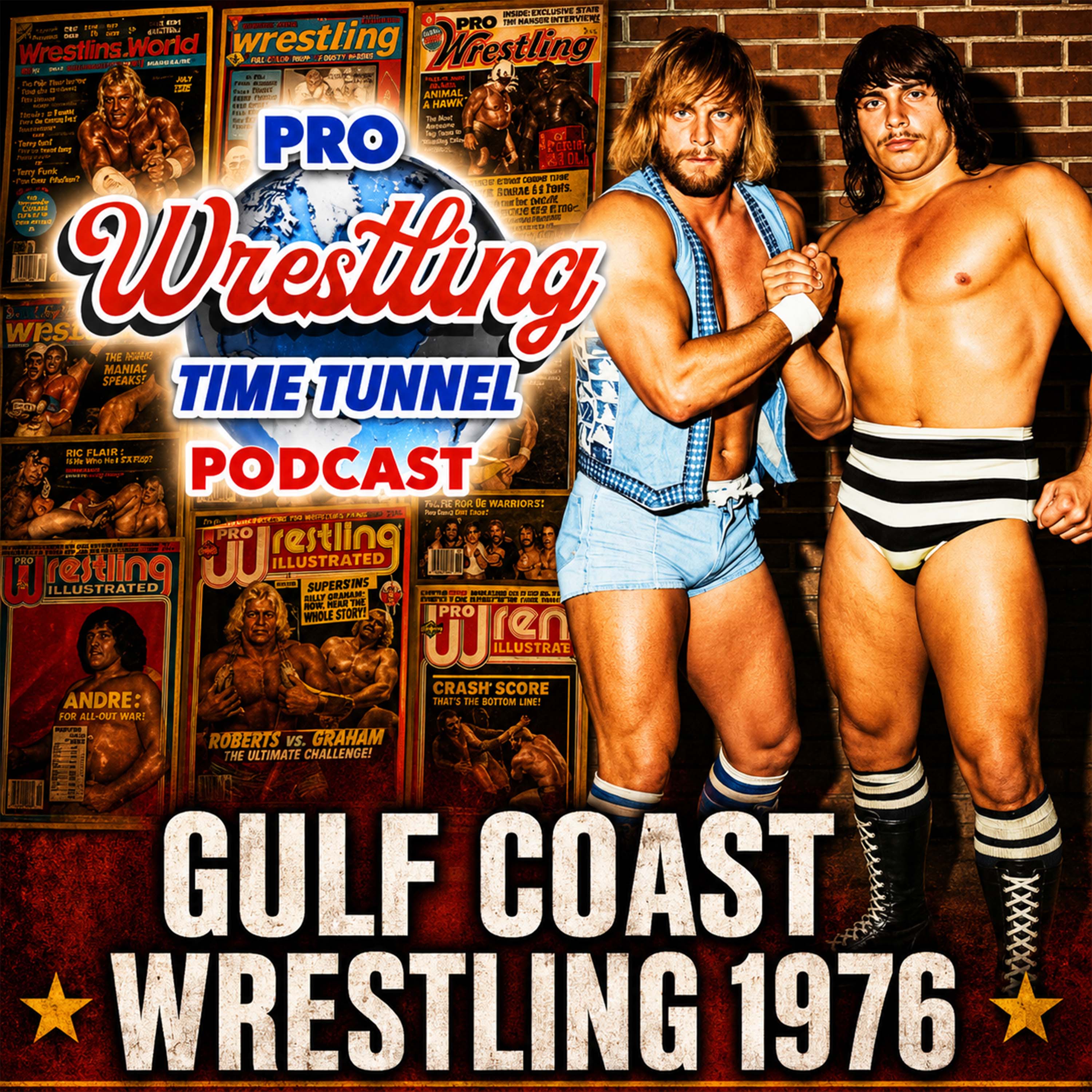
Of course we have all the details about Sean posted, where you can find him in his books and go to Amazon and you know, if you enjoyed our podcast on the history of Evansville, then you need to get some of Sean's deep in, deep in depth dives into Evansville, Indiana and the amazing six book series that he's got. This is episode 63 and we're firing up the time tunnel today to Zoom back to 1976 and we're going to Gulf Coast Championship Wrestling.
Now, Gulf coast is a territory that hasn't been talked about a lot in wrestling history.
It's a cousin to the Tennessee territory because Roy Welch owned the booking rights for Alabama. He bought those in 1953 and he sent his son down there in 1957 and he got the territory rolling. Buddy Fuller, who would later, he would do the same thing. He'd bring Buddy up to Memphis in 19 Thanksgiving, 1958 and 1959, 1960 and 1961. Memphis was the hottest town in wrestling and it had been mediocre in the 50s and it became a little bit mediocre after Buddy left in 61.
But we go into a little bit of detail on Buddy and the start of the Gulf coast territory today.
But it is related to the Welch family of territories and the Welch family of wrestling.
Eventually, Roy's nephew Lee Fields takes over and buys the territory from Buddy and Roy. And so 1976, the territory is dying, slowly but surely dying. And we go into that. We got an absolute legend in the studio with us today.
He's the man with the deepest knowledge of the Gulf coast territory anywhere on the planet. And that's Michael Norris. He's back for another deep dive and some of the most listened to episodes we've had. We've had Michael on to talk about the Gulf coast territory. If you love old school Southern wrestling, if you like blood feuds, if you like packed arenas on the Gulf coast and the stars that made Lee Fields promotion a must see promotion every single week. You're in the right place. And even though 76 is not one of their best years, we do go into and I know a lot of people have been waiting for this, we do go into Lanny and Randy Poffo first forming a tag team with a manager of their father, Angelo Poffo, because we have a lot of Kentucky and Indiana listeners who were big ICW fans. And so I know you're waiting to hear us talk about the the incident that happened between the Pafos and the British Bulldogs, John Foley and and Ted Heath and also Angelo and Eddie Sullivan. And we go into it and we talk about it today on the show. Now before we jump in the ring, I want to tell you that today's episode has just a couple of audio glitches in it. Michael and I tried to record one time before he was having a horrible thunderstorm where he lives and couldn't it affected the Internet and we couldn't get the show going because of the issues.
So we tried again the next day and we do have a couple of latency issues in the episode. There are a couple audio glitches. We were into it and Michael had already shared so much great stuff. I was sitting there thinking and doing the show with him and trying to think at the same time.
Do I call this show and start over on another recording session to try to get rid of the issues or do I just go on and ride it out and hope it gets better and it got better.
So when you hear those issues at the beginning of the show, hang with us because it does straighten out for the rest of the show. There are one or two little ones later on toward the end of the show but for the most part it straightens out and we have a have a great sounding show.
Just Michael is just so knowledgeable and was sharing so much great stuff. I didn't want to lose it and I wanted you to hear it. So I, I suffered through a couple of the issues and wrote it out and we rode through the storm.
So one more thing, if you haven't already, please hit the subscribe button and ring the bell so you never miss a trip through the wrestling history and all the territories drop a like right now if you're excited that we're covering 1976 Gulf coast and let us know in the comments.
What's your favorite Gulf Coast Gulf coast memory from the 70s might be. Or maybe you're getting introduced to this territory for the first time. I read every comment and I try to respond to every note and everything that anybody sends. So let's go now to the Richards ranch, where my special guest is Michael Norris. We're going back to 1976 and Gulf coast championship wrestling. Let's open the Time tunnel and get rolling. Welcome, everybody, back to the time tunnel. And I'm so excited about today's show because as you probably have guessed, I and know, I have a deep, deep interest in the wrestling Welch family and grew up in the western part of their huge Tennessee territory. And I've learned so much about the Welches from the guy that I'm talking to today who, who grew up down in Alabama with the southernmost part of the Welch influence in Mobile and Pensacola and Dothan, it was called the Gulf coast territory. And that's Michael Norris. Michael, welcome back. I'm so glad to see you again.
[00:12:29] Speaker A: Thank you. I'm glad to be back.
[00:12:32] Speaker B: I've learned so much. Yeah, so much from you.
[00:12:39] Speaker A: Well, I'm glad somebody's finally doing a deep dive and putting out knowledge on the Welch family because it has long, long, long overdue.
I mean, so many other families, you know, get, get credit for being the greatest family and wrestling history and this and this and this. But how many other families can name 27 members?
That was 20 years ago. I counted up 27 members. It's probably added. Been added to since then. They were actually actively involved in the wrestling business.
Yeah, emotion, wrestling, refereeing, everything. Ownership.
[00:13:25] Speaker B: I know Ron Fuller told me he, his son wrestled one match just so they could say, yeah, that was another, another generation that had wrestled, you know, so
[00:13:39] Speaker A: Jimmy golden son was working at one time. I don't know if he still is. I mean, I don't know where there is to work anymore other than, you know, parking lots and vents.
[00:13:50] Speaker B: Yeah, there's some, there's some promotions around now here, here and there. And I just went to Dyersburg, Tennessee the other night. They have wrestling there every Saturday night.
They run Ripley, Tennessee on Friday night. They run Dyersburg every Saturday night. And I really enjoyed it. I mean, you could tell there were some old school fans there. And so many people stopped me and said, oh, I knew Herb and I knew this person, that person. And the mayor of Dyersburg came by and met me. He couldn't stay.
He had something else he had to do that night. But he wanted me to come back to Dyersburg sometime because he knows where the farm was, he knows where the training barns were and all that. So I'm planning on going back to Dyersburg and spending the day and, and getting a tour.
[00:14:41] Speaker A: That'd be great if you could film that somehow and put it on your channel.
[00:14:44] Speaker B: Yeah, I'm going to try to do that.
I'm gonna try to do as much of that as possible. Of course, the guy down there who runs Dyersburg, his building is named the Herb Welch Wrestleplex.
And perfect. They named it in honor of Herb. And so, so many people down there.
When I did the Briscoe and Bradshaw series, I heard from so many guys who are promoting wrestling in southeast Missouri and western Tennessee and they're like, yeah, we have wrestling down here in Union City. Thank you for mentioning our town. And just so many of those old Tennessee territory towns, you know.
[00:15:22] Speaker A: Yeah, but sure, that.
[00:15:26] Speaker B: Go ahead.
Oh, I was just gonna say tonight we're gonna talk about golf.
[00:15:32] Speaker A: Yeah, yep, that we are.
[00:15:35] Speaker B: We're going to talk about the Gulf coast territory which Buddy Fuller had a big hand in.
I know there was wrestling there in years before, but Buddy was, I guess the guy who really made it go.
And you taught me so much.
[00:15:50] Speaker A: Pretty much, yeah.
[00:15:52] Speaker B: You taught me so much about Buddy's big matches at Ladd Stadium and all of that stuff.
[00:16:00] Speaker A: Yeah, he.
When. When Roy bought Alabama out or bought Joe gunther out in 1953 and bought the. The promotional rights to the whole state of Alabama, he.
It took him a little while, but he, he moved Buddy down there and pretty much turned. Turned everything over to Buddy. And of course he had all three of the Fields brothers there. He. Rocky McGuire, who was a associate of theirs from the Dyersburg days.
He was down there as a referee, promoter, you know, they, they use a lot of guys.
Les Wolf was down there for a while and then Buddy made a lot of contact.
Buddy was a very smart business. Never had the pleasure of meeting him, but from what I've heard from others about him, he must standing personality because like Dory Funk Senior and Eddie Graham in Florida, he made so many contacts outside of the actual wrestling business.
Like for an example, a gentleman by the name of Eddie Pericola was the promoter of record for Pensacola and Panama City. Well, Eddie Pericola was actually Frank Pericola who was the editor of the Panama City newspaper.
So you can imagine the kind of write ups wrestling got in Panama City.
[00:17:49] Speaker B: Yeah, yeah, so.
[00:17:50] Speaker A: And that's the type of contacts he made.
[00:17:53] Speaker B: I always heard too, something I heard about Defunk Senior and it's something I heard about Eddie Graham, but I also heard it about Buddy Fuller that he would get the wrestlers so excited about the finish that they didn't really care about winning or losing.
He just made it. The way he laid out the match got him going, you know, Got him excited,
[00:18:19] Speaker A: I'm sure. Yeah. Yeah. That his run there from 54 to 59 when he sold out to Lee Fields, was just spectacular. I mean, in the summertimes they only ran that stadium a handful of times, like six times in the hole from the mid to end of the 50s. But during the summertime, when the weather permitted, they ran Hartwell Field, which was a. A minor league baseball stadium, which sadly is. Is no longer there.
Was the home to the Mobile Bears, which was a minor league team associated with the New York Yankees at that time.
And one of the players that passed through and played for the Mobile Bears at one time was a gentleman by the name of Chuck Connors, if you've ever heard of him.
[00:19:14] Speaker B: I have.
[00:19:16] Speaker A: Yep, he played for the Mobile Bears. But yeah, that they.
They tore Hartwell Field down in the late 60s and it is now a big grass field where the police keep their horses. And they have garages on there where they do the repairs for these city vehicles.
[00:19:41] Speaker B: That whole late 1950s run was just a lot of stars coming to alignment at the same time. Because Buddy was.
Buddy was. He was the licensed promoter, and then he would come out and get into the ring to do a match every now and then.
But mainly he was. He was the promoter. But the Fargos had come to Nashville and they had their big run in the late 50s and they came down to the Gulf coast and did great business.
[00:20:12] Speaker A: They were down there a lot. Yeah, the Corsicas.
Corsica, Gene, Corsica, Joe and of course, Don and Bobby Fields. They were in Tennessee.
When they weren't in. In the Mobile area, they were. They spent a lot of time in Tennessee and those three teams seemed to trade the world.
Title at.
And then, of course, we got the Greens, the Grant brothers, and a whole lot of brother teams came down and came through there. They were all based in Coolest Welch, because Buddy built his own stars. But a lot of them, he would still trade talent with his dad. And, you know, a lot of guys that would work up there would work in Mobile. But, I mean, when Buddy took over, Mario Galento, Eduardo Perez, the original great, great Malenko, which was a guy out of Buffalo, New York named Frank Fozo.
Who else? We had Baby Blimp, George. George Harris. You know, all these guys really, they would work in Tennessee periodically, but they mainly. They kind of homesteaded in Mobile when Buddy was down there because he built his own crew. And of course, Lee Fields, Bobby Fields,
[00:21:44] Speaker B: Don Fields, who were all family members. The, the 50s were just spectacular. How were the, how were the 60s for the Gulf coast territory?
[00:22:01] Speaker A: The 60s, when Lee bought out Buddy in December 59, the 60s kind of carried on. They did very, very good business, use the same venues, same everything.
But it gravitated more towards being a tag team territory, kind of like the Carolinas were in the 60s.
Even though we had the singles title, it was, you know, it would go months and not even be recognized. You know, a guy would win it and next thing you know, he'd leave town with ever without ever dropping it. And next thing you know, they're going to have a tournament to crown the new champion. But that didn't happen with the tag team titles because everything gravitated towards the tag teams. We had some great tag teams besides Bobby and Don Fields, and that was up until 63 when Don was injured in a car accident and couldn't wrestle anymore.
Then Lee, he kind of did what Buddy Fuller did. He would use figurehead promoters and get back in the ring. So it was he and he and Bobby took over when Don was injured. We had the mysterious, the original mysterious medic. We had the Heinz brothers. We had, you know, Rocket and Flash Monroe. We had the Lucas brothers. I mean, it was just tremendous tag team territory.
[00:23:37] Speaker B: I've heard you talk about it.
[00:23:38] Speaker A: It went back and forth that way.
[00:23:42] Speaker B: Well, I was just gonna say I've heard you talk about it before, but I, I don't know if I remember the specifics, but was the 60s when Don Carson and Dick Dunn had their big program?
[00:23:59] Speaker A: It started that way. Carson didn't come in until 65 or 66 done, of course, Forever, But probably feud over on the Dofen end.
And then there'd be tag team partners in Mobile. And I know I've mentioned this before, but those that may be listening to this that may not remember the Gulf coast territory was basically three territories, isn't one.
It was split between the Dothan Panama City end, the Mobile Pensacola end. And then they had Mississippi. And for a While in the 60s, Mississippi was gone and they had Louisiana.
But in the 70s it was very, very distinct. Mississippi, Mobile, Pensacola, Doe from Panama City, Ozark, Quincy, Florida. They had their own televisions, their own titles, their own angles. They traded talent back and forth, of course, because Lee, Lee never carried a crew of more than 18, 20 guys, you know, so they would make the rounds and that, that kind of leads into the, the schedule what the schedule was like in 76, which is what we're talking about here tonight. So.
[00:25:32] Speaker B: Right.
[00:25:34] Speaker A: Yeah.
[00:25:34] Speaker B: What kind of year was 76? I know a Business was.
Business was declining.
[00:25:42] Speaker A: What was. Yeah, 76 was. Was the start of the slow death.
When Bob Kelly, who had been the booker for both Mississippi and the Mobile Pensacola ends of the territory, his mother got in bad health.
He was from Louisville, your neck of the woods.
His mother was in bad health. So he sent Louisville to take care of her. And he split his time working for Bruiser. And for at that point it was just Nick Gulas.
So that's. He would work for both promotions.
But so that started there. So Rip Tyler took over for the booker for Mobile and he kind of picked up. He was already helping Rocky McGuire on the Dothan Dothan in.
But he took over the book in Mobile, Pensacola. And Mississippi. And Mississippi just pretty much died on the vines.
I mean, it's just they were still running, but they had lost.
They had gone from four cities weak to three because one of the towns, Laurel, the building that they ran in Laurel Civic center, burned it by fire in 1975.
So they just dropped Laurel totally.
They still ran in Meridian and Gulfport and in Hattiesburg.
But I mean, most of the guys by that time in 76, most of the boys lived in Pensacola.
Meridian ran on Friday nights, which was also Dothan. Dothan was the second biggest city they had besides Mobile.
So most of the boys living in Pensacola are going to go to Dothan, which is closer and make more money than drive to Hattiesburg, Mrs. Army or the Meridian Mississippi, where they would have to get a hotel and spend the night or whatever, where they could go to Dothan and come home if they so chose. Same thing with Hattiesburg. Hattiesburg ran on Thursday nights.
Goport ran on Monday nights. Rocky would rotate during the year. He would run Panama City, sometimes on Monday nights for part of the year and sometimes on Thursday nights part of the year. Again, Panama City's a whole lot closer to Pensacola than Hattiesburg or Gulfport.
Plus they're going to make more money.
So most of the boys want to go there. So they got a guy, a lot of guys that, you know, we're either working part time or working, you know, in Louisiana or something that would come up there and fill up, fill in the Mississippi card. So with Kelly gone and not taking care of it, Mississippi was. Was a skeleton compared to what it was pick up in 76. Well, actually in the summer of 75 when Bill Golden Went out of business.
His Tri States promotion closed down. Lee picked up Selma and Montgomery. Montgomery during March and April, but they ran Selma from the beginning of the year through August. So that added two more towns. And I thought you had Pensacola.
[00:29:47] Speaker B: Well, I kind of thought. Well I kind of thought that you had told me in a. Another conversation, not one we recorded, but Lee was sort of finishing up with the wrestling business just as far as being interested. Right?
[00:30:03] Speaker A: Yeah, I mean he had, he bought the Mobile International Speedway.
Lee was always big into racing and I think Buddy Fuller started in that because Buddy was always big into racing.
But Lee bought the Mobile international speedway in 1972 and by that time he had Kelly pretty much ensconced as his booker. And Kelly was, you know, as far as Mobile, Pensacola and you know, Rocky was long time booker on the other end. So he had two guys that he could pretty much, you know, the business was on autopilot as long as he had those two guys.
[00:30:45] Speaker B: Yeah.
[00:30:46] Speaker A: And so he got interested more in the racetrack and he was dealing with the racetrack and spent all his focus was on that and building it. When Kelly left, you know, he had to focus a little bit more back on the wrestling business.
Bobby and his two brothers, Bobby and Don kind of took care of Mississippi because his dad, Speedy Hadfield had the promoter's license in Mississippi. Even though Kelly did the day to day work when he had it.
So.
[00:31:25] Speaker B: So when Lee, so when Lee picked up Selma and Montgomery after golden went out, was that more the other boys saying hey, we need these other two towns? Or was Lee really interested in trying to keep the business growing?
[00:31:40] Speaker A: I don't know what the deal was. I don't know if he did that
[00:31:45] Speaker B: because I know favor because I know that Montgomery, some of the guys, I know that Montgomery and Selma bounced back and forth between Goulets, Welch and Nashville and then the, the Fields office. I mean I know they traded that up from time to time.
So I wasn't sure if Lee was.
[00:32:04] Speaker A: Yeah, they. Well, when golden had it, he drew. Golden had Drew all of his talent either from the Nashville office or Mobile.
But there was a lot of guys that homesteaded there in Montgomery.
Jack Donovan was one of them. He. He lived there in Montgomery and I think he may have been bookie. I've never, I didn't, I never asked talk to Jack about it before he passed away. But he may have been booking Selma and Montgomery for Lee.
[00:32:33] Speaker B: And I don't know if. I don't know if he was promoting in Montgomery or not. But I know Buddy Wayne was running Selma with. He was the promoter kind of taking care of the town.
[00:32:42] Speaker A: Yeah, he did that. Dennis hall had it for a while.
[00:32:47] Speaker B: Yeah.
[00:32:50] Speaker A: After. After Lee went out of business.
Joe Turner ran shows in Selma and Montgomery for a while.
Montgomery was just that whole central Alabama was pretty much wide open until Fuller bought out the Gulas portion of Alabama in 1979.
[00:33:18] Speaker B: Well, we got some interesting things that happened in 1976.
I've got a couple things I'm really interested to hear your take on. So let's get into it. So first part of 1976, what's going on?
[00:33:33] Speaker A: Well, like I said, Kelly was gone, Rip Tyler was booking across.
But in the second week of January the first nail in the coffin got hammered in.
They lost television for the Mobile Pensacola area.
When I don't know what happened as far as why we are dropped them. Which was the. Was Channel 3 in Pensacola, which they had been where they filmed or taped did a tape show every Saturday morning at 10 o' clock from 1970 until the first week of January 1976.
Now, Kelly told me that at one point Rocky McGuire had gone to
[00:34:26] Speaker B: the
[00:34:27] Speaker A: management of the channel of Channel 3 in Pensacola. And I convince them to crew come in and tape there and instead air his tape from Dothan. Dothan taped live or ran a live show every Saturday afternoon. But they taped it to be shown in like in Panama City and Quincy and places like that. So he was trying to I guess get them to show his tapes as opposed to letting Kelly's crew come in there and take. Now I don't know if this was a part of War dropping this.
I don't even know if that's true because Kelly did not like Rocky Maguire.
He had a bad feeling about Rocky Maguire and it was mutual. They didn't care for one another
[00:35:27] Speaker B: how
[00:35:28] Speaker A: much of that was just Kelly whatever, because he was gone. So I don't know if this was what caused War to drop them or not. I don't know.
But for whatever reason they lost television there.
So for a couple months they did run all the. The only opportunity they had or the only option they had was to get another channel to run Dolphins the tapes of the dolphin show.
So they went back to WKRG and Mobile, which is where they started running.
They ran a live show there on Saturday nights at 10:30 from 1955 until.
67.
A prior relationship with WKRG. So I guess Lee approached them and they agreed to do it. But they didn't have a permanent time slot.
They were advertised as just after the late night movie and for those of us that grew up in the 60s and 70s and actually watch late night movies, it's kind of like watching a show on Tubi nowadays where a movie that may be an hour and 18 minutes long, it take you three hours to watch it. For all the commercials.
[00:37:02] Speaker B: Yeah.
[00:37:03] Speaker A: So there was never a set time for when wrestling would come on. So they lost their audience.
Plus they were showing a tape, you know, building up angles that had. Were already a week old by the time they saw it.
So that carried on until Lee convinced Kelly to come back.
So.
And then when Kelly came back, he moved back to Mobile, took over the book again in Mississippi, Mobile and Pensacola like he had before.
But he was, but there again the, the dynamics between him, Rocky. He was not going to show Rocky's tapes on his television program at wkrg.
So he came up with the bright idea. We'll, we'll have them film the house shows in Mobile because the WKRG studio was about 100 yards from the Expo Hall Mobile.
So sadly, the production was horrible.
And of course they never showed the main events. They would show the preliminary matches and the production was horrible because a live show is not conducive back in those days was not conducive to be a television show because the arenas were dark, you know, but.
And sadly most of what exists now, the most of the video that's available now for people to see of what Gulf coast was like is from those tapes that were taped at the Expo Hall Mobile. And the like, the quality is, is horrendous.
Even though they drew decent crowds, you can't tell because the building was so dark and there between the quality of the programming and not having a set time slot and you just, I mean as big a fan as I was, I quit watching wrestling on tv.
[00:39:19] Speaker B: Oh man.
[00:39:20] Speaker A: Because I couldn't find it.
So, you know, luckily by that time I could drive and I could, I could go, I could go to the matches live.
[00:39:31] Speaker B: But you know, we had other things
[00:39:33] Speaker A: that was, that was the first male.
[00:39:35] Speaker B: We had other things to occupy our time. Back in those days. We, you know, if, absolutely.
If wrestling wasn't on when it was supposed to be on, we found other things to do.
Which was why wrestling was so dependent on appointment television. I mean it needed to be same time, same channel every single week.
And promoters knew if they got moved to a different day or a different time that was going to be. Kill their crowds for a while. Till people found it again.
[00:40:08] Speaker A: Yeah, I mean it. And they may have been successful had they worked out something to have a set time slot, but just sticking it on, you know, after a movie. And sometimes it didn't come on at all, you know, because there were times that I would sit up and wait. I'd sit through, you know, some boring movie from the 1930s and wait for the wrestling to come on. And it never did. You know, they'd roll out of that into something else that I was not interested in. Well, I mean, there were some bright spots at the beginning of, of of 1976 too. We got the brand new NWA world champion. Terry Funk made his.
Made his first defense, first of four defenses that he made that year, which was.
Was highly unusual for the world champion to come through the Gulf coast territory Four times. Briscoe did, but Briscoe liked the territory and he liked the guys that he worked with. Briscoe had. Had worked for Lee one or two times in, in the late 60s when he was just, just getting started.
So he liked that territory and it was close, close to home because he lived in Tampa or he'd also actually had, I think by the time he was NWA champion, he had a home in an apartment in Atlanta too. So. Yeah, but Terry beating out in Texas, he had a place unusual for him to come through.
[00:41:41] Speaker B: He had a place on the lake out there in Atlanta.
Was it Lanier Lake? Is that was the name of it? Who did Lake Lanier? Jack Briscoe.
[00:41:51] Speaker A: Lake Lanier, yeah. Yeah.
Okay. I know he lived in Atlanta. I didn't know he lived in Lake Lanier.
[00:41:57] Speaker B: Yeah, because he no showed the 75 NWA convention, and they all thought he'd be there. And he kept telling them, I'm not coming.
And they kept thinking he would show up. But he spent the whole convention weekend out at Lake Lanier avoiding phone calls about where he was and why he wasn't at the convention. But. But he was just ready to be done with the title at that point.
I have been waiting. I've been waiting all this time, and I know a lot of, you know, of course, of where I grew up and live. I've got a lot of friends and a lot of contacts that grew up in the international championship wrestling days here in Kentucky. And they've all been waiting for us to get to the park because they want to hear your thoughts about Lanny and Randy Poffo tag team managed by Angelo Poffo, which came in here in 76 in Gulf CO.
[00:42:53] Speaker A: Right.
They came in first the, at the first of the year in January of 75 or 76.
And to be honest with you, I saw them but they, they were from the, on the tapes of, from Dothan.
I, I was aware of the Pafos, of course, Angelo Poffo, if you had anything to do with reading magazines like most fans did. I certainly did. Everybody knew who Randy or Angelo Pafo was because of 6033 and the sit ups and all that stuff.
[00:43:29] Speaker B: Well, he was a big, big star for.
Big star for Jim Barnett in the 50s.
[00:43:34] Speaker A: Yeah. And none of that but. And by the time I had gotten interested in wrestling in the early 70s, he was working for Bruiser and he and Kenny Dillinger had a tag team called the Graduates that were managed by Bobby Heenan if I'm not mistaken. And then they had a manager named Mark Manson.
[00:43:58] Speaker B: Yes.
[00:43:59] Speaker A: Who I guess they were trying to pass off as related to Charles Manson, but that's how I was aware of. And then, you know, they would talk about his past as being perennial US Heavyweight champion for Fred Kohler. And I guess by the time he was U.S. tV champion.
[00:44:18] Speaker B: Well, this is actually the first territory that Lanny and Randy tagged in because Randy work Randy. Randy worked as a preliminary wrestler in the first couple of matches, sometimes under a mask, sometimes he worked under a different name. They had been in Amarillo before they came to Gulf coast and Angelo and Lanny were the tag team for most of 75.
And this is the first time they teamed Lanny and Randy up.
[00:44:50] Speaker A: And the first time I saw them, you know, I was impressed seeing Angelo Palfo after I read about him and heard about him all these years. So I was impressed with him and he was still in great shape and Lanny was basically the Lanny that everybody. The genius gimmick that he later did for Vince was pretty much what he did. He was the very. Using big, you know, four syllable words and all this stuff in the interview.
And he never said a word on their interviews. As great an interview later turned out to be. When they talked it was Lanny did all the talking.
And I always assumed that he was the older brother as opposed to Randy being the old, because he led everything.
But he did a lot of the, you know, he would do somersaults and pirouettes and all this stuff. And I'm thinking this guy, you know, I mean I had heard of, I knew who Lanny Poffa was from teaming with Angie in Detroit, them being the Sheiks, world tag team champions, but I'd never seen him work and I just thought he was a Ricky Star knockoff Of course we had only we'd had Ricky Starr in the, in the territory three years earlier.
[00:46:09] Speaker B: Yeah.
[00:46:09] Speaker A: So but he was doing a lot of the same type stuff, you know and I just, I was not all that impressed with them, to be honest with you.
[00:46:18] Speaker B: Yeah, well it was very early on. It's very early on. And yeah, Lanny was the experienced one of the two, even though Randy was older. Randy just right. Actually in 75, I believe it was 75. Randy had been up to the WWWF and done jobs on television and he'd worked for the Chic under, under a hood and he'd worked for Phil golden in Paducah under a hood.
[00:46:49] Speaker A: He worked for a Goncal.
[00:46:51] Speaker B: Yeah.
[00:46:51] Speaker A: When The PAFOs, all three of the PAFOs worked for a Goncal and, and that was under Hood as a Spider.
[00:46:58] Speaker B: And that was.
They always seem to end up on that side of things. A lot of times they, they end up working for the outlaw guy.
[00:47:07] Speaker A: Well, I talked to Bobby Simmons today, which was today was his birthday. So I called him to wish him a happy birthday and we, I, I told him we were going to do this taping tonight and we were talking about the Pafos and were talking about what, what you and I are particular about are going to talk about their little scrum with the British Bulldogs
[00:47:33] Speaker B: when
[00:47:33] Speaker A: the Paos came in. The, the British Bulldogs, the original British Bulldogs, I should say Jonathan Foley and and Sir Edward Heath were the, the Gulf coast tag team champions and they dropped the belts to, to the PAFOs on January 20. The PAFOs had been in one week.
They dropped the bells to them.
So for whatever reason.
[00:48:17] Speaker B: There they are.
[00:48:18] Speaker A: Okay, there you are. There you are. Okay, for whatever reason.
They had a match in Mobile on yeah, that's them right there.
Foley is the one on the. If you're looking at the photo, Foley is the one on the right. His son in law Ted Heath is the one on the left and the stuffed dog in the middle was Sir Winston.
But British humor.
Yeah, I guess. On February 17, which was the same night Terry Funk made his first offense in the area against Eddie Sullivan the Pothos and the Bulldogs had a match for the Gulf coast title.
And for whatever reason Lanny and Randy decided to that they didn't like the way the Bulldogs worked, that they were too snug so they were going to teach them a lesson. And they, they each brought a blackjack in their trunks to the ring.
The match hadn't even gotten started good when they tried to pull him out and Speedy Hatfield, who was refereeing to stop the match.
They called her no contest. Got everybody out of the ring, whatever.
So this is based on what Rick Tyler said, who was booking at the time.
When they got back to the dressing room, he got in Randy's face and said, what are you guys doing?
Randy smarted off to him and Rip slapped him, knocked him to the floor. I know Randy and Lanny both swore to their dying days that this didn't happen.
But besides Rip telling this story to Scott Teale in one of his whatever happened to interview Interview things, Eddie Sullivan told me the story himself personally.
He was there. He was sitting in the dressing room.
I had a couple of other guys that were there on that card told me about it, so I believe Rip's version of it. But anyway, after he slapped Randy, Angelo reached in his bag to get a pistol when he felt cold metal up against his head.
And it was Eddie Sullivan standing there with a pistol up against his head.
[00:51:07] Speaker B: Oh, wow.
[00:51:07] Speaker A: Rip claimed he fired them that night, but they were booked.
Let's see. I've got it here.
To Russell, Rip and eddie on the 21st in Selma and in Panama City on the 19th and in Hattiesburg.
[00:51:37] Speaker B: Now, what was.
Why were they. Why were the Bulldogs carrying blackjacks? And why was the pothos care what instigated that? Was there heat between them?
[00:51:47] Speaker A: No, no.
Well, that's what. I don't know. And. And it's what Bobby and I were talking about. The pothos were the only ones with the black Jacks.
[00:51:55] Speaker B: Okay, well, the Bulldogs didn't need any black.
[00:51:58] Speaker A: Bulldogs didn't have. No. And that's what I. What my thing was, why in the world. You know, Speedy probably saved their lives at night because John Foley was no one to mess with.
He looked at John Foley.
[00:52:16] Speaker B: He had been trained in Wigan, in England and the Snake Pit. Right.
[00:52:21] Speaker A: Well, not only. Not only. Not only was he trained in Wigan, he was a trainer at Wigan.
[00:52:27] Speaker B: Oh, wow.
[00:52:28] Speaker A: You know who one of his students was?
Carl Gotch.
[00:52:32] Speaker B: Oh, my gosh.
[00:52:34] Speaker A: Yes.
So. But to look at Foley, they're again on the right in that picture.
You think he was a barfly.
In fact, something that kind of ties into this during. Now, again, all three of the PO And John Foley all worked for Gunkle during the split.
So I don't know if something happened there between Angie and. And Foley or what the deal was, but to give you an example of Foley, besides wrestling for Ann Gunk or Dick Steinborn, also promoted for her, one of his towns was America's Georgia.
And they had this fan that came every week, and he would stand up. Well, I can whoop every wrestler in this building. I can do that. I'm doing every week. It was the same thing over and over again.
So Steinborn finally got tired of him. And before the matches one night, he had all the boys come out of the dressing room, get in the ring, and told that guy, pick one.
I'm gonna let you wrestle one of these guys.
And if you beat him, fine. If you don't, I don't want to ever hear you again.
So Foley is purposefully trying to hide. He's ducking behind people and he's like, you know this. And Foley was not a big guy. He was, you know, maybe 5, 9, 5, 10, maybe 220, 225, maybe.
Pasty white skin, spindly legs, skinny arms. You know, like I said, he looked like a barfly.
So naturally, he was over exaggerating, trying to hide. So the guy says, I'll take him.
[00:54:14] Speaker B: Oh, no.
[00:54:16] Speaker A: Everybody else left the ring. Foley standing there, the guy standing there. They ring the bell, within 30 seconds, the guy's in tears.
I don't know if he ever came back to the matches, but that's how.
How dangerous he was. And Bobby told me one time he asked Foley about training Gotch, and he said, yeah, I trained him in Wigan. And for those of you that aren't familiar with Wigan, Wigan was a school in England where people like Jeff Ports, Billy Robinson, Carl Gotch, Johnny Eagles, John Foley, Ted Heath, all these guys came out of this school.
And it's the nickname of the school was the Snake Pit. It was dangerous, everybody.
[00:55:05] Speaker B: It was started by Billy Riley, maybe
[00:55:08] Speaker A: Billy Riley, who was, if I'm not mistaken, Billy Robinson's uncle.
[00:55:12] Speaker B: Yes, well, Johnny Eagles, you mentioned him. I've always heard he was a bad dude to mess with, too.
[00:55:20] Speaker A: Yes, yes, he, he. Yes, he was. I'll tell you a story about him and the Iron Sheik.
The. Jerry Oates told me, okay, but.
But anyway, Bobby asked John about training Carl and Carl. He said, yeah, I trained Carl. And Bobby said, not to insult you or anything, but if it came down to a shoot in the gym, which one of you would win?
And Foley said, a good teacher never teaches his students everything.
Yeah, Bobby said he left it at that. And so. But that's how dangerous he was. So Speedy probably saved their lives that night. But Bobby and I were talking about it, and I said, you know, I don't understand knowing that these guys knew Foley, knew his reputation, and Ted Heath was no, you know, he was John's son in law and he was trained out of Wigan too, so he was no slouch.
And Bobby said Angelo probably instigated all of it because he was nuts.
He was just absolutely nuts.
So. But anyway, I don't know. I, I can't tell whether or not they ever showed up at these, these other bookings or whether they just gave the belts back to the Bulldogs because they were scheduled to face them in Hattiesburg.
And they may have just said, the Pavos aren't here, we're giving the belts back. But whatever the reason was, they were gone. They were only in the territory maybe six weeks.
[00:57:00] Speaker B: Yeah, I don't know why they always seem to have a chip on their shoulder, but they seem to. I mean, you know, they filed suit against everybody and their brother in the early 80s claiming antitrust and everything else. And you know, Randy finally got very really humble and you know, when they couldn't make it anymore, asked Jerry Jarrett for a job, which he, Jerry was a businessman before anything else and welcomed him in. And they had that great series with Lawler which led to Randy going to the wwf. But I mean, outside of working for themselves and the chic, they didn't leave a lot of good feelings when they left places.
[00:57:45] Speaker A: No, not at all.
[00:57:49] Speaker B: I'm interested just because there's not a lot out there on Foley and Heath. I've always been really interested in them. As a matter of fact, I wrote a story about them and I got all this feedback on the Internet. I didn't know there was a British Bulldogs before the WWF guys. And I'm like, yeah, these two dudes were, they were bad guys.
[00:58:10] Speaker A: Yeah, well, Foley towards the end of his career of course was working for Stu in Calgary as a manager and Davey and Dynamite were both out there. So I would imagine he probably suggested the name.
[00:58:30] Speaker B: Yeah, he started, he started managing Dynamite first. He was his manager as a single and I'm sure that's where the, I mean, obviously he had to be where the name came from.
[00:58:42] Speaker A: Yeah, interesting. They were, they were quite a duo. Quite a duo.
[00:58:48] Speaker B: Now somebody else. Somebody else that a lot of wrestling fans, unless you're kind of interested in wrestling history that you maybe haven't heard a lot about Eddie Sullivan and you talk a lot about him.
What's, what's tell us about Eddie Sullivan a little bit.
[00:59:04] Speaker A: Eddie was from Arizona, he's from Phoenix. He grew up in Phoenix and he was trained by one of the many Mrs. Billy Wolfs, Tony Tomas. You Ever heard of that name?
[00:59:26] Speaker B: Yeah.
[00:59:27] Speaker A: Princess Tony Toma, who was a.
A true native American woman from Minnesota who settled in Arizona towards the end of her career and lived there the rest of her life as far as I know. But she actually trained Eddie Sullivan.
[00:59:51] Speaker B: I've got it.
[00:59:51] Speaker A: Whose real name was Reuben.
[00:59:53] Speaker B: His r. I got a Japanese photo here of Rip Tyler and Eddie Sutherman. Here, let me throw this up. There we go.
Go ahead, Michael.
[01:00:08] Speaker A: I'm not seeing it. So I'm not sure what the photo is.
[01:00:11] Speaker B: Oh, it's a. It's a Japanese. It's from a Japanese magazine. I don't know why you're not seeing it.
[01:00:16] Speaker A: Are they holding belts in there in the air?
[01:00:19] Speaker B: No, they're not. They're just kind of standing offset of each other.
[01:00:23] Speaker A: Okay. Okay. Yeah, there you go. Yeah, that's the tour in 70.
Would that been 76.
Towards the end of 76 they went over for the IWE over there and won their. The IWA World World Championship. They won that tournament.
Rip and Eddie. I've always. People always ask me who. Who do you consider the most underrated wrestler of all time? And my stock answer is Ken Lucas.
Most underrated, most overlooked, not talked about the tag team division of that question.
These two right here, Eddie Sullivan and Rip Tyler, they first teamed in 1970, 71 in mobile.
And they were together off and on all across the country for 15 years.
But Eddie again was. Was his real name was Benny Hazar or Reuben Hazar, but he went by Benny.
Broke in In Arizona in 63, 364.
Was best friends with Ken Lucas.
The two of them knew each other from out in Arizona. Ken was also from Mesa, which is a subdivision of Phoenix.
They even went in in all the heated bloody battles the two of them had in the Gulf coast territory. What most people didn't know is they. They. They own property together on Pensacola beach and shared a trailer.
It's kind of like a timeshare thing. Ken would have it stay in it for a while and sometimes Eddie would stay in it for a while.
But Eddie first came to the mobile territory in 1968.
And there was a lot of Latin guys already working the territory at the time.
So Rocky Maguire said, we got too damn many Mexicans here already.
I'm gonna change your name.
He gave him the name Eddie Sullivan.
[01:02:47] Speaker B: Oh, man.
[01:02:49] Speaker A: But that had a precedent. In 1959.
A guy came, came through the territory. Spanish guy who would later work. Became fairly well known under the name Tito Montez.
But there again, Rocky McGuire said we're gonna call you Eddie Sullivan.
So he worked as Eddie Sullivan.
And the funny thing was when Deed Silverstone was having his get togethers in Seattle in the early 2000s, Benny Hazar and I can't remember what Tito's real name was, it was something like his name was Eduardo Monte Moyer or something like that.
But the two of them were. Had their picture made, said Eddie Sullivan, meet Eddie Sullivan.
[01:03:49] Speaker B: Oh, wow.
[01:03:50] Speaker A: But and they both, both of them spent a lot of time in Seattle and we're big stars out there.
But so as Eddie Sullivan, he started in Mobile as a baby face.
He turned heel in 1970 and he had the neatest gimmick, which is. Was when I first got into watching wrestling, he had the neatest gimmick. He would come to the ring carrying a mask and then put the mask on because he said he was too pretty to let all the people watch him wrestle bare faced.
[01:04:24] Speaker B: Wow.
[01:04:25] Speaker A: Well, what most people don't, which I didn't find out until years later in 1968.
He and. And Frank Morell were the Mighty Yankees for Gulas.
[01:04:35] Speaker B: And didn't. Didn't edit. Didn't. Eddie Sullivan. Wasn't he one of the Blue Yankees or one of the Yankees at one point?
[01:04:44] Speaker A: No, no, he was. He was never a Yankee. He was one of the Mighty Yankees.
[01:04:49] Speaker B: Okay, there we go. Yeah.
Did he team and then he, he worked Curtis Smith?
[01:04:55] Speaker A: No, he didn't team with Curtis. No, it was he and he and Frank Morrell were the only two. All right, the Mighty Yankees. But then he worked solo as the Mighty Yankee in Louisiana after Lee sold out and McGurk bought it.
Bought Louisiana. He worked for part of 1969 down there before he came to Mobile. But he started doing the. The Eddie the Mask man Sullivan gimmick. He did that for about a year.
He dropped it when he and Rip started teaming, but they were, they were a great tag team. But Eddie had been gone when he came back in 76.
He had been gone since 1973. When Dean Silverstone opened up his territory in Seattle.
He kind of rated the Gulf coast territory and took a lot of the talent with him. You know, he had a lot of guys finished up in Mobile and went to work for him in Seattle.
He had Ripping, Rip and Eddie both went out there. Armand Hussein went out there.
Bob Griffin went out there, but he didn't stay very long. A young kid by the name of Dwayne Bailey who was from Portland, he went out there.
You may know Dwayne Bailey from. He worked for Gulas as Donnie Anderson.
[01:06:26] Speaker B: Oh, yeah.
[01:06:27] Speaker A: If you've heard that name.
[01:06:28] Speaker B: Yeah, yeah, yeah. He spelled it with two ends.
Don Anderson. Yeah, I think.
[01:06:35] Speaker A: And then a guy by the name of Eric Verbal, which most people remember as Dynamite Jack Evans.
He was doing a. An Arab gimmick in Mobile. Call as the Great Gamma. Well, he went with Dean and Rip was going to be Dean's booker. He didn't stay out there, but maybe a few months and he came back to Mobile.
Eddie stayed out there for almost three years.
[01:07:06] Speaker B: Wow.
Do you think it was hard. Was it hard for guys to go from Mobile to other territories because it was such a perfect territory. Like you were making short trips and it was. Weather was perfect and I mean, it was just hard to not miss it. Right?
[01:07:26] Speaker A: Yeah. Which is something else that we'll get. We'll get into when we talk about when Ken Lucas left.
But Eddie. Eddie was just, you know, I luck. I was lucky enough to get to work with Eddie later on when in my career and get to know him a little bit. What a sweetheart of a guy. And he and Rip were so opposite. Rip was very.
He had a very forceful personality. Good, nice guy and everything, but he was. He just, you know, he was all business and he was so quiet and unassuming until he got in front of a tv.
When he got on tv, I wish there were more of his promos where people could see him. There's one snippet of a promo from Dothan TV in 70 at the end of 76 is the only thing out there. But he had such.
He was such a great promo, which is totally opposite of what his real personality was like because he was so just nice, humble guy. Kind of reminds you of Jimmy Valiant, sweetheart.
[01:08:34] Speaker B: Kind of reminds you of a Jimmy Valiant, you know?
[01:08:37] Speaker A: Yeah, exactly.
[01:08:38] Speaker B: Just gets exactly energized when he's on camera.
So. So the Pafos.
[01:08:45] Speaker A: But Eddie had just come back to the area.
Go ahead, Go ahead.
[01:08:49] Speaker B: I was just gonna say. So the Pafos and he had just
[01:08:52] Speaker A: come back to the area.
[01:08:54] Speaker B: The Pafos win the titles from the Bulldogs and then the titles end up on Rip and Eddie right at the first of the. I mean, so after the.
[01:09:03] Speaker A: Well, they ended up on the. Back on the Bulldogs. Yeah, after they ended up on the. On the Bulldogs. I guess I'm assuming they just handed them to them because Aphos were gone.
Even though they still were booked for cards and were advertised, they just didn't show up.
So. And then the Bulldogs dropped them to Rip and Eddie, which they Were working Baby Face at that time.
They had always been heels until Rip turned Baby Face at the end of 75 when he started feuding with bruiser Bob Sweetan, who was the Gulf coast champion at.
When 1976 began.
And then Eddie was a baby face when he came back from Seattle and he beat Sweet Tan for the Gulf coast title. So he was a Gulf coast champion. Ripping. He and Rip ended up with the Gulf coast tag team champions.
Our championship, Duke Miller, was still around, who'd been the top heel in the area since he first came in 19.
At the end of 1973, Duke was the Mississippi champion and the Alabama champion.
So.
[01:10:17] Speaker B: So did. Did Terry Funk.
[01:10:19] Speaker A: That's how the.
[01:10:20] Speaker B: Did Terry Funk do the angle where he had a bounty hunter in the territory. He was doing that in some of the other territories. I didn't know Gulf coast or not.
[01:10:29] Speaker A: Where. No, he did. He was.
No, he never. He. He came in and like I said, he worked.
He did four title matches there in the Gulf coast area. He wrestled Eddie in Mobile in February, on February 17, and then he. February 20, he was in Dothan and faced Jack Briscoe.
[01:10:55] Speaker B: Yeah, so, you know, when Dory Jr. Had the title, Terry was kind of the policeman. You had to go through Terry to get Dory.
Well, when Terry won the title, he did this deal where they used a Missouri Mahler in Florida, and I can't remember who he used in Dallas, and he used somebody in Oklahoma where he hired a bounty hunter to keep the top contender from getting a title shot. And I didn't know if they ever did that in Gulf coast or not.
[01:11:23] Speaker A: They did that angle, but they did it with Ken Mantel and ken Lucas in 1974 when Mantel was the junior champion.
Yeah, that. That was a. A neat thing how that worked, but no, they didn't do that. But.
But Eddie was the only one of the locals that Terry faced, even though he made four defenses in the area. He faced Briscoe in a rematch for the title in. In Dothan.
And then his next two defenses were also in Dothan on October 28th.
And I take it back. And. And on October 28th in Dothan, he wrestled Dusty Rhodes.
So something was going on there with. With Rocky McGuire.
Rocky always had a. A close relationship with Fred Ward. And so we would get a lot of Georgia guys but only work in Dothan.
They wouldn't work Mobile or, you know, Kelly's Ends. It would only work for Rocky.
And something was going on in 76 because Dusty came in three times and worked For Rocky and Dusty was. Dusty Rhodes was a. Was the hottest thing in wrestling at that time.
[01:12:42] Speaker B: Yeah. And he was doing a lot of Georgia. He was doing a lot of Georgia in 76 too because he won the Georgia title for the first time in 76, beating the spoiler.
It was a really short run but they were starting to. Starting to use Dusty more and more in Georgia than they had before.
[01:13:03] Speaker A: But he before his match with Terry I guess just to get people familiar with him besides the back, you know, being known in magazines.
[01:13:13] Speaker B: Yeah, that was the program.
That was the program that was going on in Florida at that time too was Dusty and Terry for the title. So I don't know if they were right and.
[01:13:25] Speaker A: But they brought him in. He face came in and wrestled the intern in Dothan which the intern was was Jim Starr with Ken Ramey.
He came back and worked a six man tag team match with working team with with Rip and Eddie to wrestle the intern and the challengers which was Mike McManus and Curtis Smith.
And that was all prior to him getting the. The match with Terry and Dothan.
And then Terry came back at the end of the year to face Ken Lucas.
So that was his runs.
[01:14:03] Speaker B: I bet that, I bet that Terry Funk and Ken Lucas match was awesome.
[01:14:11] Speaker A: Oh yes.
Ken could work with anybody.
In March we had Andre came through.
He only worked three towns though. He worked Mobile, Montgomery and Dothan and he did battle rolls in all three towns. And then in Dofen he worked against the Bass brothers and he teamed with Ken Lucas to work with the Bat against the Bass brothers and Duke Miller.
And this particular set of Bass brothers was Ron Bass who had been in the territory twice before with Don Bass and was a former Gulf coast heavyweight champion.
And he had a new brother along with him by the name of Dutch Bass. And I'll let you guess who that was.
[01:15:02] Speaker B: I was going to ask you. I don't know.
[01:15:06] Speaker A: Was Wayne Cowan Dutchman tell.
[01:15:08] Speaker B: Oh, Dutch, yeah.
[01:15:11] Speaker A: They had been together in working for Geigel in Kansas City.
In fact they held their that version of the world tag Team championship out there just before coming to Mobile.
[01:15:23] Speaker B: Yeah, they they worked a whole almost all year of 75 with Ted and Jerry Oats.
[01:15:29] Speaker A: Yeah, exactly.
And then they came came into Mobile and rather than I don't know how by this time Kelly's back and so he's booking.
He talked Dutch into being Dutch Bass and Dust. Dutch refuses to admit that that was him. That wasn't me. I never worked, I never used that name.
And they had with them before when they had been in, Ron Bass always had mob ass.
Mae Weston is his mother. Well, this time around they had a, a dandy Jack Crawford knockoff and they called him Paul Bass.
Nobody can remember who this guy was. He was a tall, thin, skinny guy, bald headed.
Bob Kelly always told me he was either one of one, either Ron's real father or Dutch's real father.
And I don't, I don't buy that.
I'm beginning to convince myself that he was actually a guy by the name of Marvin Cheatham who had been in the territory in the late 60s, 69 and in 1970 as Colonel Beauregard Van Buren is a manager. He managed the Blue Yankees.
He also worked for McGurk under that name. But even prior to that he is. He wrestled under the name of Slim Marlin and was one of the scuffling Hillbillies, one of the many teams of scuffling Hillbillies. He mainly teamed with Willie Garrett and had cousin Alfred with them.
But I, I can't confirm that either.
So I don't know if that's who it was or not.
But Ron and Dutch weren't around long. They won the Gulf coast title, tag team titles from Rip and Eddie and then dropped them two months later to Gorgeous Georgia and Ken Lucas and then were gone.
Then they went to Florida or. No, they went to Georgia and Dutch converted back to the name he was known in Georgia, Wayne Cowan, because he was. That was the name he was known as in Georgia.
[01:18:07] Speaker B: He worked in Tennessee for a while before he became under Tennessee, he worked there.
Chris Gallagher. Yeah. One of the Gallagher brothers.
[01:18:17] Speaker A: Yeah.
And then.
[01:18:22] Speaker B: Oh, well, he worked.
We were mentioning John Foley earlier. Dutch and John Foley were tag team partners for Ron Fuller in Knoxville for a while.
[01:18:32] Speaker A: Yeah, they were.
I don't know. I know Buddy's the one that name, gave him the name Dutch.
I don't know when he started using that full time though.
[01:18:43] Speaker B: It would have been after Georgia because in 77 he went up, he went up to work for Nick Gulas in 77 and he had a feud with Randy Savage. So he must, must have been right after Georgia maybe.
[01:18:59] Speaker A: Well, he was using. He was Dutch Mantell in Kansas City.
[01:19:04] Speaker B: Yeah, he was. They were Braun Bass and Dutch Mantel.
[01:19:07] Speaker A: Well, that was, that was 75. Yeah. So I don't know when he, when, when he got the name and when he started using it full time.
Well, but he was, he was Dutch Mantel in Florida.
[01:19:18] Speaker B: I think the first time he used it was for Ron Fuller when he and he and Foley were partners. I think that was the first time he used the Dutch Mantel.
[01:19:29] Speaker A: That was probably what, 74.
[01:19:31] Speaker B: 74, yeah. They had a program with less Thatcher and some Nelson, Roya Les Thatcher, Nelson Royal against. Okay, Foley and Mantel. Yeah.
[01:19:43] Speaker A: And I would love to see Nelson rolling it and John Foley hook up would be.
A lot of people don't realize it, but Nelly was, Nelly was a shooter.
He was, he, he had an amateur background. He was, he could go. Even in his old age when he was still working as the junior heavyweight champion, he could go, oh, I saw
[01:20:05] Speaker B: Nelson royal there in 1986 and he, he was still laying them in.
[01:20:14] Speaker A: But we also had a short program.
Steinborn came in, Dick came in and he came in billed as the Mid Atlantic heavyweight champion. Of course, his Mid Atlantic or not Mid Atlantic Mid America heavyweight champion, his Mid America title had nothing to do with the Gulas. Mid America title. In fact, the belt he was using was the old Georgia junior heavyweight belt that they used for, for and Gunkle.
But he came in and, and had a three match program with Lucas where Lucas took the belt off of him. And they never really resolved that they.
The third match that they had not to get. The second match they had where Lucas won the belt.
No, Lucas won it in the third match. The second match they had. Steinborn was supposed to bring in his own referee. He didn't like the local referees, so he was supposed to bring in his own referee.
And he didn't bring anyone in. So Eddie Sullivan, who remember was still a baby face at this point, volunteered to referee.
So they said, okay, you can referee. But before the match started, he jumped Lucas, beat Lucas up, finally got a regular referee out of there, got Eddie out of the ring. Eddie stayed at ringside to kind of second Steinborn. Lucas got Steinborn in the sleeper hold while Steinborn was in the ropes.
And they stopped the match, called it, no contest. Eddie jumped back in the ring, jump back on Lucas. And that started a long program with them. By that time, Eddie had already won the Gulf coast title. So they were swapping the Gulf coast title back in forth.
But Lucas and Steinborn had a third match where Lucas won the belt.
Steinborn came back in, they had another no decision and it was never mentioned again.
Belt went away, Steinborn went away.
So that's, that's just kind of typical of how Rip's booking was. Rip. Rip was scattershot with his booking.
And then so that, that just kind of petered out. And Lucas, but it rolled right into Lucas And Eddie Sullivan. And they had some tor admission for them two to be the best, best of friends. They had the bloodiest matches.
[01:23:02] Speaker B: Yeah, they had some death matches, right?
[01:23:08] Speaker A: Oh, yeah, yeah. Oh, every kind of giving match you could have. Texas death matches, boxing matches, you know, brass knuckles matches.
And all that happened in March and April between Steinborn Lucas and the Eddie Sullivan deal.
And then in, also in April, we lost a guy I mentioned earlier, Duke Miller, who'd been Duke Miller when he first came in in November 1973. He immediately made an imprint on the territory. He was the straw that stirred the drink.
From there through the end of 75, I think he held the Gulf coast title like five times back and forth at one time. He held it for over a year solid.
And in 74, he and Gorgeous George Jr, Billy Spears and the wrestling pro, Leon Baxter.
Formed what would now be recognized as a Ford Horseman type faction.
They called themselves Murder Incorporated. And the whole deal was for that group to protect Duke Miller from losing the title.
So I don't know. I've sat and racked my mind as to who would have been seen that run of Murder Incorporated. Who would have been in involved with Crockett. That would have passed off the Four Horsemen idea.
Only one I could think of was Michael Hayes. Because he was a fan. He grew up in Pensacola. Yeah, but he wasn't there. He wasn't around. That was before his time. So I don't know, May it's probably just a coincidence, but that whole thing, when that whole Four Horsemen thing started up, I'm thinking that's just a replay of the. Of Murder Incorporated for Duke Miller.
[01:25:15] Speaker B: Yeah.
[01:25:15] Speaker A: But anyway, Duke had been, you know, like I said, the top heel since he came in in 73.
And he began the 76 holding both the Alabama and Mississippi titles, he and Ricky. He had a program with Ricky Gibson where they were swapping the Gulf coast and Alabama titles back and forth. One would have one, one would have the other. And then at one point, Ricky Gibson had both.
But that was before Lucas and. And Sullivan started.
Because Sullivan won it again for the second time of the year. He beat Ricky Gibson for it. And then he went into the program with Lucas.
But Miller was one of those guys that when I first saw him again, I was familiar with him because somewhere as a kid I read a magazine in the Wrestler or Wrestling Review or something about it had to been the wrestler because it was such a phony story. It had to be one of those made up ones that the western magazines always did where he. He Was in. No, in Omaha at the time that he had magic boots and nobody could beat him because he had magic boots.
And they were what they. They were red, white and blue flag. Flag boots.
And he had. He wore those when he came to Mobile, But. So I was familiar with him, but he was a baby face out there.
But he was such a good heel and was such a great talker. I kept one as I got older and started researching the territory again. As I got older, I wondered why he never got over anywhere else. I know he got a bit of a push in the late 60s in Louisiana Teaming with Jim Osborne, but, I mean, he was a heat magnet.
[01:27:19] Speaker B: Wow.
[01:27:20] Speaker A: And why he never got over anywhere else.
But, you know, he got over there. But he left in April after being there for, you know, almost three years.
And he went to work for Godless for a few months, and then he wound up in Tampa in November.
He started in. In Tampa in November and was there three weeks and got killed in a car accident.
[01:27:46] Speaker B: Everybody who.
Everybody that I've ever talked to that actually saw him just rave about him, but I just don't think that many.
[01:27:54] Speaker A: Oh, yeah.
[01:27:54] Speaker B: That many people didn't see him. You know,
[01:27:59] Speaker A: that's. That's the price we pay for nobody thinking. Thinking ahead to, you know, of course, every. Everybody. Every territory recycled their television tapes.
[01:28:10] Speaker B: Yeah.
[01:28:11] Speaker A: So nobody. There's not very much footage of, you know, a lot of guys like this. I would give anything for there to be video of Rip and Eddie as a tag team because they were our version. They were the Gulf coast version of the Anderson brothers. They were technical wrestling heels that, you know, got heat just for being so good and which. That.
[01:28:39] Speaker B: That's my favorite. The only thing that's my favorite tag team of heels are the ones that can wrestle.
But. But they're rough.
[01:28:48] Speaker A: Yes.
[01:28:49] Speaker B: You know, they're rough.
[01:28:50] Speaker A: And Eddie could both. Both group.
And Eddie, you know, if the crowd had kind of lulled down on him, he do the. The Baron secluded gimmick and reaching his tights like he had something in his tights. He never had anything. His tights, but it set the crowd on fire. Yeah.
Yeah. So, you know, and I know you posted a thing. I read one of your things that you did a thing on Jerry Miller and you posted a blurb that was in the news, the newspaper, about him getting killed. But I looked all through Florida newspapers. I couldn't find that.
[01:29:31] Speaker B: Yeah, it was in St. Augustine's paper.
I. It was the only one I could find of any details of his death at All I couldn't find an obit or anything. But there was that little piece there that I cut out of the paper and put in that article.
And I remember it was from this.
[01:29:48] Speaker A: I have to look. I have to look again.
[01:29:50] Speaker B: It was from the St. Augustine, Florida paper.
[01:29:53] Speaker A: Because if I'm not mistaken, if I'm not mistaken, his last.
He was booked in Tampa, but he was killed before he was booked there for that Tuesday night show. But I think, if I'm not mistaken, his last show was in St. Augustine. So I guess he was headed home.
But it was unusual for him. I guess he was in a single. Only one in the car.
Which was unusual because when he was in Mobile, his entire time in Mobile, he had. He owned a Winnebago and he lived in a trailer park.
So, you know, he. You know, one of the boys would come pick him up and drop him off and all that. So he.
But yeah, he lived. Lived in a Winnebago and he had.
He had two. Lived with two.
What's the white dog?
Not Malmutes.
[01:30:51] Speaker B: That. That is one Malibu.
[01:30:56] Speaker A: Okay, then, yeah, it was two Alaska Malmutes. He had. That's what he had. And everybody that I. I've ever talked to about Jerry Miller talked about what a nice guy he was. Just an absolute gentleman.
Couldn't tell the fans that Mobile.
[01:31:15] Speaker B: He was good at his job.
[01:31:18] Speaker A: They hated him.
[01:31:19] Speaker B: He was good.
[01:31:20] Speaker A: Yes, he was. He was. Absolutely. In fact, he would, of course, how most. Most hills would get cheap. He went by the name Duke Miller. So the fans would quack at him, call him Duck Duck Miller. And he said, myers, I'm a Duke, not a Duck. And fans would quack at him and everything, but that was crazy.
But I mentioned Kelly came back from.
From Louisville, moved back. He came back in April and took over his territories again.
And naturally, if he took over Mississippi, he had to win the Mississippi title. So he won it for the 22nd, 23rd and 24th times of his career before he retired.
But he had worked an angle, I guess he'd run across. When he was working for Bruiser, he'd run across Bob Ellis.
So he had called Bob Ellis and wanted to bring Bob Ellis in to work an angle where they could be tag team partners. He would say, you know, he. Before he got in wrestling, that Bob Ellis was his hero. And, you know, he'd seen him wrestling in Louisville and all this stuff, but he wanted to bring him in. So he called Ellis, ask Ellis to come in. We're explaining the whole program to him. And Ellis said, no, I'm not gonna do it. He said, if I come in, I'm gonna be a heel. He said, I've shaved my head.
I'm bald now, and I'm working as a heel.
So that blew that whole thing off. But Kelly went ahead and booked him for a week in May.
His first booking was in Mobile. He was supposed to wrestle Ken Lucas for the Gulf coast title. Then he was booked in hattiesburg on the 27th. And Dothan on the 28th.
And then Pensacola the 30th. And Gulfport on 31st.
Well, I don't have any results, so I don't know if he ever showed up.
So I can't say whether or not he actually came in or not. I know the advertising, but I can't say for sure that he was there. I do know that the Gulfport paper reported that he no showed that show.
And Sweet Daddy Banks took his place. Which is not another guy we'll talk about if we have time.
But out there from 78, I guess, or so from McGurk after the. The Watts split.
Where he still had Oklahoma, where. Where Ellis is in there with his bald head. Which is so funny, because Bob always had. Bob Ellis always had a bald spot that he was trying to hide all the time anyway. And he used to take shoe polish and make his hair black.
And. And, you know, he'd be in the dressroom putting that shoe polish. Pretending like he was putting it on his boots. He'd wave it. Hey, how you doing?
So that he finally gave in and shaved his head was amazing. But I. I don't know if he ever came in or not. I'm assuming he made at least one of those shots, but I don't know.
But.
But like I said, Sweet Daddy Banks took his place. And for those who are not familiar with the name Sweet Daddy Banks, most people know Sweet Daddy Seeky. Of course, some people have heard of Sweet Daddy Watts. Because of the Georgia War connotation about. Suppose. Supposedly him being called Gorilla Watts after making fun of Bill Watts. But that's not true. He was using the. He was using the name Watts in Arizona. And a couple years ahead of that, he was a straight. Well, you're familiar with him because he worked for Phil golden and Paducah, right?
Heavyweight champion there.
[01:35:21] Speaker B: I saw him when I was just a kid, man. Yeah, he was.
[01:35:25] Speaker A: I have never been able to find out much information about him. He.
[01:35:29] Speaker B: He was a big, big man. He was a big human being.
[01:35:35] Speaker A: He was from.
I want to say he was from Paducah or somewhere in Kentucky. His name was T.J. henderson. What the T.J. stood for, I don't know. I always heard his name was T.J. henderson.
[01:35:48] Speaker B: I always heard he was from Paducah. But I've never been able to find anybody who knew him.
[01:35:53] Speaker A: But he first came to Mobile in 74 and worked a program with Mike Boyette.
The Gulf coast title back and forth.
[01:36:05] Speaker B: Which is about the time Phil closed down.
[01:36:10] Speaker A: Yeah, he. They used him.
They had Algalinto as his manager because I don't. Did Phil ever let Banks. I'm not Banks watch talk on television?
[01:36:24] Speaker B: No,
[01:36:28] Speaker A: he stuttered so bad it would take a two second promo. It take him 15 minutes because he stuttered so bad. So they get. They put out Galanto as his manager
[01:36:40] Speaker B: a lot of times. They worked this program a lot of times. Angelo Poffo did his interviews.
[01:36:47] Speaker A: Really?
That's probably. It's probably why. So he wouldn't. Because he stuttered so bad.
But he, he worked that program with Boyet in 73 and then he was gone. Then came back as a baby face and was in 74 and was around for a while that he got into angle with the. With the Murder Incorporated and Duke Miller.
And that whole blow off was a. An 8 man California street Rumble where there's like basically a street fight, Southern street fight or whatever they call them in different territories where everybody was dressed in street clothes. It was Bob Kelly, Tony Gonzalez, the medic without the mask, Mike Boyette and Sweet Daddy Watts against Murder Incorporated.
And then he left again.
And then oddly he showed up in 75 as the butcher.
Shaved head, white, cut off jeans.
They were trying to pass him off as Abdullah the Butcher.
That lasted about four weeks and then he was gone again. So. But anyway, back to Levi Banks. Levi is one of one of my dearest friends in the world, I'm proud to say.
But Levi never really worked anywhere a regular NWA town. He worked a lot of independence in the Carolinas and in Georgia. He'd been down to do a couple of matches in Pensacola in 74, but he was just Levi Banks, dark hair, dark beard.
But when he came back with. With the Sweet Daddy gimmick, he took. He took Duke Miller's place as a heat machine. White hair, white beard, sequin gloves long before Michael Jackson ever thought about it. White capes.
And luckily, even though the quality is not good, there is videotape out there of, of Levi from those house shows in Mobile.
And luckily a couple of interviews with him.
Levi could talk.
But that white hair all the fans used to call him Uncle Remus. He come to after the ring and everybody start, Uncle Remus, Uncle Remus.
But he got in. He was a heat magnet.
But Kelly gave him a push right away.
I mean, he held the Gulf coast title and Mississippi title for six, eight weeks, you know, during that time.
[01:39:43] Speaker B: And what name did he work under, Michael?
What?
[01:39:48] Speaker A: Sweet Daddy Banks.
[01:39:49] Speaker B: Yeah. Okay, that's what I thought.
I was just looking for the video real quick.
[01:39:53] Speaker A: His name was Lee. His name is Levi Banks. That's his real name. He just. He was just Sweet Daddy Banks. And he claimed he was from many from Minneapolis, Minnesota, so. But Levi was also the cause of Selma being closed down and wrestling being banned from there for quite a spell.
And what happened was he was working with Burhead Jones in Selma.
And
[01:40:33] Speaker B: yeah, here's some video of Sweet Daddy Banks.
Here's some video. Sweet Daddy Banks and Dick Dunn as a tag team.
[01:40:43] Speaker A: Yeah, that's Dothan. That was after. That was after Levi turned baby face. And notice if you watch that match, notice who does the job.
Dick Dunn was one of Rocky McGuire's closest friends.
And Rocky hated Levi for whatever reason.
I don't know why. Levi is the sweetest, as he used to say his sweet daddy. I'm sweeter than 25 pounds of Dixie crystal sugar. And he is a wonderful human being. But Rocky did not like him. Rocky, whatever push Kelly was using, doing with him, Rocky killed when he came to Dothan. That's why he does the job on tv.
They're working Ravens Raiders in that match, right?
[01:41:30] Speaker B: Yes. And Sweet Daddy is. Sweet Daddy's wearing like a single strap singlet.
Like a blue.
Yeah, yeah.
[01:41:40] Speaker A: Wore the tars and singlet.
[01:41:41] Speaker B: Yeah, yeah. I'm gonna watch this when we get finished.
[01:41:47] Speaker A: Find the one he did.
He did that one. The. The best thing they did with him, they had him be like five or six guys in Mobile one night.
And four of those matches are on video. You can watch them on YouTube. But they. They work. They're working a gimmick to start kick off the thing with him and Lucas.
He beat his regular opponent.
Then he wanted a match with somebody else.
They brought out somebody else. He beat them.
Then he wanted a match with Ken Lucas because Lucas was the champion at that time. He said, I want Ken Lucas brought Lucas out there. He jumped Lucas from behind, suplexed him pending. They carried Lucas out of the ring as back in the days when a finishing hold was a finishing hole, suplex was a finishing hole, and guys get
[01:42:41] Speaker B: up from it and Guys, I will put these Sweet Daddy Banks videos in our 1976 playlist on the Pro Wrestling Time Tunnel YouTube channel. So you guys can.
[01:42:53] Speaker A: Oh yeah, please do. That would be great.
[01:42:54] Speaker B: You guys can find them really easy.
[01:42:57] Speaker A: But.
But then, anyway, so they hauled Lucas out of the ring. Then Lucas's match is supposed to start, his regular scheduled match.
His opponent's in the ring, Lucas can't come back out. So Levi says, I'll beat him. I'll go go wrestling. So he jumps in there and he beats this guy. So that put him over big time.
[01:43:20] Speaker B: I love those kind of, I love those kind of. I love those kind of angles where the guy comes in.
[01:43:27] Speaker A: See if you can find the, find those matches. Because there's. In between each match, Levi's. They're interviewing Levi. Okay. And he could talk.
He could talk. Man, those fans hate him so bad. But anyway, back to what I was, I was telling you about Selma. Yeah, he's working Burhead Jones. And Burhead had a bad habit of getting heat on his opponent in the wrong kind of way.
You'd lock up with Burhead, especially if, if it was a majority black crowd, which Selma always was.
Burhead would lock up with you and then he'd push you away and hold his hands up and say, what'd you call me?
[01:44:12] Speaker B: Oh, no.
[01:44:13] Speaker A: And that would set the crowd up. Well, he couldn't do it with Levi because Levi was also black.
[01:44:19] Speaker B: Right.
[01:44:21] Speaker A: But anyway, they were working around, work around, and Levi got heat and it's got somebody at ringside threw a chair in the ring.
Well, Levi picked the chair up and he said, biggest mistake of my life, he said. I threw it back out on the floor. But he said, I purposefully aimed at the guy's feet. Not to hit him, just to get near his feet.
He said when he did that, it started raining chairs.
He said everybody at ringside started throwing their chairs. They had to get him in the ring or get him out of the ring, get him in the, into the dressing room.
He and Selma, the long time chief of police, there was a guy by the name of, I can't remember his name, a captain something or other. He was like a hundred years old, typical old Southern, you know, chief of police, sheriff, whatever, you know.
But they were going to try to arrest Levi for starting this riot.
Kelly smuggled him out of the bathroom window of the old National Guard army there in Selma and got him out of there.
And there's a coda to this story. But anyway, they shut, they, they, they Told Lee he couldn't run. They were not going to allow Selma to run anymore.
I don't think they, they ran wrestling and allowed wrestling in Selma again until a year or two later when Joe Turner ran some shows there.
But the coded to this story is in 1981, a young gentleman by the name of Michael Love, who was me, shows up in Selma, Alabama to work for Ron Fuller.
I'm working with Mike Jackson, Captain Green, that was this guy's name.
So I'm in the heels dressing room and, and Captain Green comes in and all our security that night was Captain Green, who by that time was 120 years old and he had had a deputy with him who was younger guy, 98 I think is how old he was.
But they come in there and Captain Green tells all of us in the heel dress room there'll be no fighting on, on the floor outside my, outside this wrestling ring in my building tonight because it all stems from this stuff. Levi.
So I'm working Mike Jackson and we got a spot in our match where I throw him out of the ring and then go out and bail him across the floor.
So I told Larry Brock, who was the referee that night, I go over there and tell Jackson, go to the baby face dress room and tell Jackson we're not working that spot tonight because I'm not going to get arrested in Selma, Alabama tonight.
So Larry came, went over there and told him, came back and because Mike was calling the shots in our match, because I was still fairly new to the business and Larry said no, Mike said, we're gonna do that. You're gonna do that spot so good.
So Mike and I worked the opening match. We were doing crisscross. I sidestepped him, threw him out of the ring, climbed out of the ring, build him across the floor, got back in the ring, he got back in the ring, gave me a Russian suplex, pinned me one, two, three matches over. I roll out of the ring, I'm headed back to the dressing room. Next thing I know I'm in handcuffs.
You're going to jail.
Told you no fighting on outside the floor.
So I'm sitting back in the dressing room in handcuffs. They won't even let me take a shower and change clothes.
So I'm thinking, great, I'm going to jail in Selma, Alabama, wearing a red butcher tights and candy apple red boots. Oh man, I'm gonna be real popular.
So luckily Ron Fuller was there that night and he talked him out of it. They came, let me loose, said we don't Want no more trouble out of you tonight.
Well, the main event that night was a battle roll. All of us on the card working the battle Royal.
But the semi main event was a match between Jimmy golden and Ron Fuller.
Guess who was supposed to run out and interfere in the match to help Jimmy Golden?
Me.
I said, I'm not doing it.
Ron Bass said, man, come on, you got to do it. You got to do it. Because that's how we kick off the battle Royal. I said, I'm not doing it.
They talked me into it. I went out there and did it.
[01:49:33] Speaker B: Oh, man.
[01:49:33] Speaker A: We rolled in the battle roll. Luckily I got out of there. I got out of there and got out of Selma and swore I'd never go back. Levi would not go back to Selma. Levi to this day will not go back to Selma because they had a warrant out for his arrest for ever.
And actually we did. He did go back to Selma. We, we used to do a little get together, Bobby's church up here.
And sometimes we go to different people's places to, to do it. We did it a couple of them at Bill Dromo's house before he passed away.
A friend of ours, gentleman by the name of Bill Sellyer, who lives in Selma, he want us to all come to his house.
So we all did that.
We talked Levi into going.
He didn't want to go to Selma. Come on, Levi, you. I said, it was 35 years ago. Levi, come on. Yeah, so Bill's next door neighbor happened to be an Alabama state trooper.
We were going to work to where have him in uniform come to the door, knock on the Bill's door and say, is there a Levi Banks in here?
[01:50:46] Speaker B: Oh my gosh. You guys didn't do it, did you?
[01:50:48] Speaker A: The guy didn't do it.
[01:50:49] Speaker B: So yeah, you guys.
[01:50:50] Speaker A: Levi got off.
No, we, we weren't able to do it. So.
[01:50:55] Speaker B: But anyway, or Levi.
[01:51:01] Speaker A: And then another thing that kind of spelled the beginning of the end for that territory happened in mid July.
Ken Lucas left.
Ken Lucas left for the. Ken had been in. And he would go, you know, he'd go work Tennessee for, you know, a few weeks. He'd go down Louisiana work for a couple weeks. But. But he.
From 19, he first came in in 1964 until 1976. He was pretty much a mainstay in, in the Mobile territory. Now he would go back and work in Arizona and work in Amarillo and in the Southwest periodically. The longest time he spent out of the territory, he spent all of 1968 and two or three months of 1969 up working for Goulas.
That's when he and Dennis hall had the big feud with Big Dunn and Don Carson up there. Dick Dunn was the Red Shadow, but he left in July and went to Tampa and was gone the rest of the year basically except for a very brief period in November.
And I watched your. Your program with Howard Bomb and I know you guys are going to do another one on 76. I'm anxious to see what he says about Ken. Yeah, and how Ken got over down there. He got a pretty decent push. They put the tag belts on him like Graham and But he's. He worked a lot of tag team matches team with Ray Candy a lot working like the Missouri Mauler and Ray Stevens did that a lot. Worked a lot of matches with. With Mahler.
So I'm just anxious to see how well he got over.
But he was.
He came back in November and started back in November on He was back for the first time November 23rd to face Terry Funk for the NWA title.
Well on the undercard of that the semifinal match was. Was supposed to be Don Carson who by that time was the Gulf coast champion. And Don had been out of the territory for several years at that point. But Don and Don was always was. Had been a baby face for Most of the 70s or his time in the 70s in Mobile because he made his home in p. Had a home in Pensacola.
But he was came back as a heel one beat Levi for the for the Gulf coast title and was scheduled to defend it against Mike Boyette who was also coming back after being gone for a while.
Well, Boyette didn't show up.
So Ken worked the match against Carson, won the Gulf coast title, went to the dress room, came back out, worked 45 minutes with Terry Funk.
[01:54:18] Speaker B: What a game.
[01:54:18] Speaker A: And then was gone.
Then he, he wrestled in hattiesburg on the 24th, in Panama City on the 25th and then Dothan on the 26th and New Brockland on the 27th and then move then went to Nashville. He was still the Golf coast champion when he left, but he came back and worked on December 3rd in Ozark and dropped the belt to the wrestling pro.
And that Ozark card falls into another thing that, that was the final big thing that happened in 76.
By this time Kelly's. Even though Kelly's come back, Kelly has decided I'm, I'm done, I'm quitting, I'm retiring.
He quit and went into the real real estate business.
So Lee, I don't know when he started talking to Jim Barnett.
But he had worked out a tentative deal with, with Jim Barnett to buy the Gulf coast territory.
So the deal was, Lee told Barnett, I will shut everything down the end of November, go dark for two weeks, then you can come and run.
Arnett only wanted to run Dothan for the two shows that he ran.
And he.
Because he was drawing talent out of Florida, which he owned a part of in Georgia, which he owned the most of. So he was drawing from both places.
So he wanted to see, you know, before he bought the territory, how well he thought his product would get over. And another reason he chose Dofen was Dothan could get Albany, Georgia's tv.
So they were familiar with a lot of the Georgia guys.
And I told you Rocky had had a working relationship with Fred Ward, so he would bring in a lot of Georgia guys. But Here are the two cards he ran on Friday night, December 18th.
The opening match was El Gaucho versus Dean Ho.
Ted Oates versus Bill Howard.
Bob Root versus Steve Kern, which they were in a major program in Florida at the time. This was around the whole time that Roop had done the thing about Steve's dad being a prisoner of war thing. And that was a hot program.
So they brought it up. That was. That was the third match on the card.
Then Ole and Gene Anderson worked. Mike Graham and Bob Backlin.
The main event was Mr. Wrestling Number 2 and Dick Slater. They had been trading the Georgia title back and forth.
So that was the card for the 18th.
Then on Christmas night, the 25th, they came back with the second card.
Opening match was Ricky Steamboat against Randy Halls.
Ray Rougeau against Bill Howard.
Tony Parisi against Scott Irwin, both out of Florida, out of Tampa.
Abdullah the Butcher versus Ted Oates.
A Southern championship match. Steve Kern versus Bob Roop.
That was a semifinal. And then the main event was a no disqualification match between Wrestling 2 and Dick Slater.
Now, why I mentioned that Ozark card, Lee did not know Rocky ran this card.
So that Rocky running that card in Ozark, which is only 22 miles from Dothan, got Barnett thinking. Well, they lied to me. They didn't go dark. They broke our agreement. He backed out of the deal.
So that whole thing fell apart.
[01:58:54] Speaker B: Yeah, I'm thoroughly. I'm thoroughly convinced that this was all.
I'm thoroughly convinced this was all in conjunction with TCG going up on the satellite and Barnett knowing he was going to have wider distribution out of Atlanta and he was going to basically.
[01:59:14] Speaker A: I'm sure it is.
[01:59:16] Speaker B: And he was basically going to have controlling interest with most of the Wrestling from Louisiana to Florida if he would have got this Alabama deal.
[01:59:27] Speaker A: Yeah, because like I said, he already had points in Graham's office. But Eddie, Eddie, Eddie was notorious. He'd sell 175% of shares.
[01:59:38] Speaker B: Well, yeah, some. Somebody just told me not long ago that Barnett actually had more points than Eddie did. After Eddie, it kept selling them, you know, probably, but I don't know, who knows?
[01:59:55] Speaker A: But, but that ended that whole thing. So, and I, and I asked. I never talked to Rocky about it. After I got to know Rocky later on, I never talked to him about it because I didn't know all the back behind the scenes stuff.
But Kelly told me after this whole thing fell through, he said, and by the whole deal that I mentioned about the television, even, even Lee's brother Bobby said, ashley, why are you keeping Rocky around?
Because that's one the reason. Kelly told me why he decided to go ahead and, and quit and retire.
He said Lee offered him part ownership of the territory. He already had points in the office, being the booker and everything.
But Lee offered him a bigger share and Kelly said, okay, I'll do it if you get rid of Rocky and I, I book everywhere. Lee wouldn't do it. Now, this is after, you know, this whole deal with the television that supposedly happened with Rocky. And again, I don't know, this is all coming from Kelly. This all may be sour grapes from Kelly. I don't know if it's true or not.
I always liked Rocky. I thought Rocky was a great guy.
All the boys that I got to know over the years that work that territory, they all like Rocky better than they did Kelly. So I don't know.
[02:01:30] Speaker B: How did, how did Ron Fuller.
[02:01:32] Speaker A: I don't know.
[02:01:32] Speaker B: But how did Ron Fuller feel about Rocky? Did they keep having a relationship after Ron came in?
[02:01:39] Speaker A: Yes, Rocky was a Charlie Platt. And I talked about this when Ron bought in. Of course, he'd known Rocky his whole life because Rocky was from. That he was a branch. Well, from Dyersburg, actually. Rocky, Rocky grew up in Cleveland, Tennessee. He was a boyhood friend of Don Carson. Yeah, they'd known each other since they. Yeah, since they'd known each other since they were kids.
But, but Rocky had a lot of contacts, especially since they decided to base their television out of Dothan instead of, you know, even all the boys lived in Pensacola. They wanted to do TV out of Dothan.
And because the last. 1977, by the end of 76, also the deal with WKRG died. I mean, Kelly was gone. Nobody to produce that show.
It died. They took him off the air and 77, they just ran Dolphin. They ran Dolphin's tapes of Dothan's live TV show.
So that last year, you know, they were, they were doing television strictly from Dothan. So when Ron came in, they did TV from Dothan. All right, so Rocky had all those contacts.
I got the woods family and all that stuff.
[02:03:04] Speaker B: So I got a question for you and it's pure speculation, but what do you think would have happened to the territory if. If Lee would have gone along and done what Bob wanted to do?
Like if he would have gotten rid of Rocky and if he would have gave it over to Bob, you think it still would have died?
[02:03:23] Speaker A: It would have died because all of the talent there were all getting older.
I mean, they were still. If you look at those 76 tapes, You know, Levi was good.
Jim Starr, when he was in with Raimi as the intern, he was good.
Still good work. Ken Lucas was still on the far end of his prime, but he was still. Could go. Ken could go until the day he had to quit. Yeah, Ken was just a tremendous worker.
But Rip Tyler, Eddie Sullivan, they were both getting older. Dick Dunn was still around. Greg Peters, they was still putting titles on Greg Peterson. And he'd been around since 1957. Dick Dunn started in 1949, you know, and he was still the Alabama champion most of the time. That in 1976.
And I just don't know because of the dynamics, Lee did not let a lot of outside publicity.
That's why you never saw the Gulf coast territory in any magazines. They never got talked about, even though they had a great photographer who was a fan there by the name of Bill Moody, who would do write ups and send pictures to the magazines and they would run them.
[02:04:47] Speaker B: That all goes back to those of
[02:04:49] Speaker A: you that don't know Bill.
[02:04:50] Speaker B: That all goes back to the Welch philosophy overall. I mean, they, they didn't want that. They didn't.
[02:04:56] Speaker A: Because Roy was the same way. Yeah, they didn't.
You know, Lee Levi, I mean, Lee quoted Roy is saying, nobody in New York's going to buy tickets to matches in Mobile. Somebody in California is going to buy tickets to matches in Mobile or, or Memphis or Nashville.
[02:05:15] Speaker B: Especially their philosophy, especially after they got.
[02:05:18] Speaker A: Kelly told me that.
[02:05:20] Speaker B: Especially after they got television because Roy would say, we got television and we got our own programs in the arena. That's all we need.
[02:05:30] Speaker A: And Kelly said that Lee said later on, years, years and years later that it's one of his biggest regrets that he didn't let.
Let the magazines do do more about his territory. Yeah, but the reason I say it would have died because of the. The talent was getting older.
The territory was not, did not have a great reputation for well paying.
Even though the trips were short, the weather was great, you go to the beach every day.
The talent was just not there.
And the growing of Atlanta tv. You compare Atlanta's television show to, you know, the TV show in Dothan, you know, there's no comparison.
Charlie Platt, as much as I love Charlie Platt, John Gauss, Al Roberts, they were not Gordon solely.
And guys in the business say, well, you know, I can go work in Georgia and be seen all over the place. I can go to Tampa and still have fairly short trips, wonderful weather.
I can go to Nashville. And the trips are God awful and he doesn't pay, but I can go to Nashville. Why would I go to Mobile?
Because Mobile was not a well known territory.
You know, I still think it would have died. It matter. It might have lingered one or two more years, but by that time, you know, it would have been died. I just, you know, Kelly talked about had he stayed on, he would have tried and got people like Buzz Sawyer and all that. I said, Bob, you thought Mike Boyette smoking dope between the trips between Pensacola, Mobile was a problem. You couldn't handle Buzz Sawyer. I saw Buzz Sawyer up close.
[02:07:30] Speaker B: Yeah.
[02:07:30] Speaker A: He was so Scott out of his mind on cocaine, you'd have never been able to control him. Plus he no showed half the time. The business was just changing.
[02:07:39] Speaker B: It was.
[02:07:39] Speaker A: And that whole philosophy of, of that carried through the Welch family and carried through to bookers like Kelly and Rocky and stuff like that.
You know, Ron, when he bought territory, he was able to navigate it well. He was very successful for almost another decade. But Ron was.
Had a lot of business acumen that the rest of the family didn't. Even Buddy, I think, I think Ron was probably a better promoter than Buddy.
[02:08:14] Speaker B: Well, it helped, it helped Ron. We helped Ron when he got Northern Alabama as well.
[02:08:21] Speaker A: Yeah, yeah.
Well, he had learned a lot. I mean, you think when he bought Knoxville from The Kazanas in 74, Ron was what, 26, 27 years old?
[02:08:36] Speaker B: Yes.
[02:08:37] Speaker A: He'd already been running West Palm beach for, for Eddie Graham and his dad, you know, he started doing that when he was 24. Ron just, Ron just had a knack for it.
I, I don't know. He just, he just had. And he was a smart, very smart businessman. He got that from his dad because everything his dad touched ever always went to turn to gold.
[02:09:00] Speaker B: I Was going to say he had it in his DNA.
[02:09:04] Speaker A: Yep.
[02:09:05] Speaker B: All right, man. Well, listen, anything else on 76 we need to mention? But man, what a trip through the Gulf coast territory.
[02:09:15] Speaker A: I just encourage everybody to keep in mind when they watch those videotapes. The one you're going to put up is from Dofen tv. So they'll get us a good idea what. What the dolphin TV was like.
But if you can find the ones from mobile.
One particular match to fight. I mentioned Dick Dunn and Greg Peterson being on up in. Up in Age by that time, but both of them were so smooth. Such good work on YouTube.
[02:09:45] Speaker B: I've actually seen that match.
[02:09:47] Speaker A: The quality is. The quality is not good at all, but it's a good match. That's a good match.
And just keep in mind when you watch those mobile tapes that the quality is not good. That's not indicative of what the territory was like in its heyday. It was the dying days, but there's still glimmers even on there, you know.
Well, Michael north of how good a territory that was.
[02:10:12] Speaker B: Michael north, thank you so much again for sharing all your knowledge with us.
[02:10:16] Speaker A: Welcome.
[02:10:17] Speaker B: I. I could sit here and talk to you all night, man, for doing this. You bet. We'll. We'll do. We'll do some more.
[02:10:23] Speaker A: You mean we. We did.
[02:10:25] Speaker B: We'll do some more.
[02:10:27] Speaker A: All right, let me know.
All right.
Thanks, Tony.
[02:10:33] Speaker B: I hope you enjoyed today's episode. Man. I always enjoy visiting with Michael Norris. He has so much deep knowledge of the Gulf coast territory that I'm going to have to try to figure out because the Gulf coast territory sells to Ron Fuller coming up in the next year. And I'm going to have to figure out a way to keep Michael on the show and keep going back further in history to talk about the amazing Gulf coast territory. Because Michael goes back from the very beginning, all the way up to what we've been covering the last two years at 75 and 76. So I'm going to keep Michael around. Don't worry.
We got a lot of great stuff still to cover. This episode of the Pro Wrestling Time Tunnel is brought to you by our great friends at the Grizzly UPS soap company right here in Western Kentucky. After a long night digging through old tapes, maybe watching some great Gulf coast brawls on YouTube or living that rugged wrestling fan life, you need to hit the shower and come out smelling like a champion. Grizzly up crafts small batch. All natural soaps with goat's milk and the finest ingredients. No junk, just bold, clean scents that actually lasts. Whether you want something that wakes you up, like a chair shot or a gentle bar the whole family can use, they've got you covered. I'm still riding with my Kentucky Bourbon bar every single morning in the shower. It's smooth, strong. It smells like me and it smells like home and it smells like Kentucky. And I also have a bar on my bathroom vanity that I use called Deadly Weapon.
Man.
My mom was over here the other night in the early evening. Sometimes she'll drop by for a visit maybe once a week or something. And she lives down at the ranch house, which is down the ranch a little bit. And she drives her golf cart across the ranch and visits me down here at the bunkhouse. And she was over and we were sitting out on the porch the other night and she was asking me about Travis and Chastity Alcock and, and about their story and about the company. And I said, well, they make soap. And she goes, soap? And I said, yeah, they make soap. And I went in the house, grabbed a bar of the soap, came back out, gave it to my mom. She held it to her nose and
[02:12:52] Speaker A: she said, oh, my.
[02:12:54] Speaker B: So I think my mom's going to be a customer as well. So head on over to their online store. If you live away from here, you can go over to their online store, grizzly up soapco.com right now and grab your order. We got orders coming in since they've been a sponsor on the podcast here. Or if you live around here, you can stop by their shop in Hopkinsville, Kentucky. They're also at weekend arts and crafts fairs all over the area. There's a big one in Murray, Kentucky, this weekend. They're there all the month of May. They also sell homemade bread. Oh, my God. You're gonna smell them before you see them when you walk up to their their booth and it's going to be a heavenly smell you're not going to forget. Get clean, get tough, get grizzly up.
And so, man, what a ride through 1976 and Gulf Coast Championship wrestling today. Michael Norris, thank you so much for coming by and visiting and bringing all that incredible history and all those rare details to the table today, folks. If you want more Gulf coast gold, go back and check out some of our 1975 episode episodes with Michael. They're an absolute must listen or must watch. You can find them on our substack channel or in our YouTube channel. And if you've enjoyed if you've enjoyed today's episode, do all the things I ask you to do. Smash the like button. Hit the subscribe give us the notification. That'll ring your nose.
Come on Tony, that'll ring your notification bell so you'll never miss another episode and drop your thoughts in the comments and I try to respond to all of them and give us a five star review button. Hit that button on our audio podcast that helps other people find our podcast. And if you want even more Territory History Bonus Episodes Early Access Daily Chronicle Newsletters Head on over to tonyrichards4.substack.com and get the Time Tunnel family of publications that I put out for from the Pro Wrestling Time Tunnel. We'll be back again next week with another 1976 Territory action packed episode. George Shire will be here as we go through 1976 AWA.
Until then, this is Tony Richards saying, thank you so much for tunneling through wrestling history with me. Keep it classic, keep supporting the Territory era.
And don't forget, if you want better neighbors, be a better neighbor.
I'm Tony Saying so long from the Bluegrass State.
[02:15:31] Speaker A: Thanks for tuning in to the Pro Wrestling Time Tunnel podcast. Tune in for another great episode next week, interviewing wrestlers, referees and media personalities that have made the sport of professional wrestling great. We'll release a new episode soon.
Don't you dare miss it.