Episode Transcript
[00:00:02] Speaker A: Time for the Pro Wrestling Time Tunnel podcast. We've got lots and lots of things to talk about and to do today, covering the territories from the 1940s to the 1990s.
[00:00:13] Speaker B: It's the best thing going today.
[00:00:18] Speaker A: Interviewing wrestlers, referees, authors and other media personalities that have made the sport of professional wrestling great.
[00:00:27] Speaker C: The cream, yeah, the cream of the crop.
[00:00:30] Speaker A: And now here's your host, Tony Richards.
[00:00:35] Speaker B: Well, hello everybody. Welcome to another edition of the Pro Wrestling Time Tunnel Podcast and History show. This is your home for the history of territory wrestling. And my goodness, do we have a lot of history lined up for you today. I'm your host, Tony Richards. Welcome to my home here, the bunkhouse at the Richards Ranch in Western Kentucky where we do our show every single week.
Drops on Wednesday morning at 5am Central and 6am Eastern. And we always have wonderful guests, great topics, lots of history and fantastic conversations. And so I'm so glad that you've chosen to join us today.
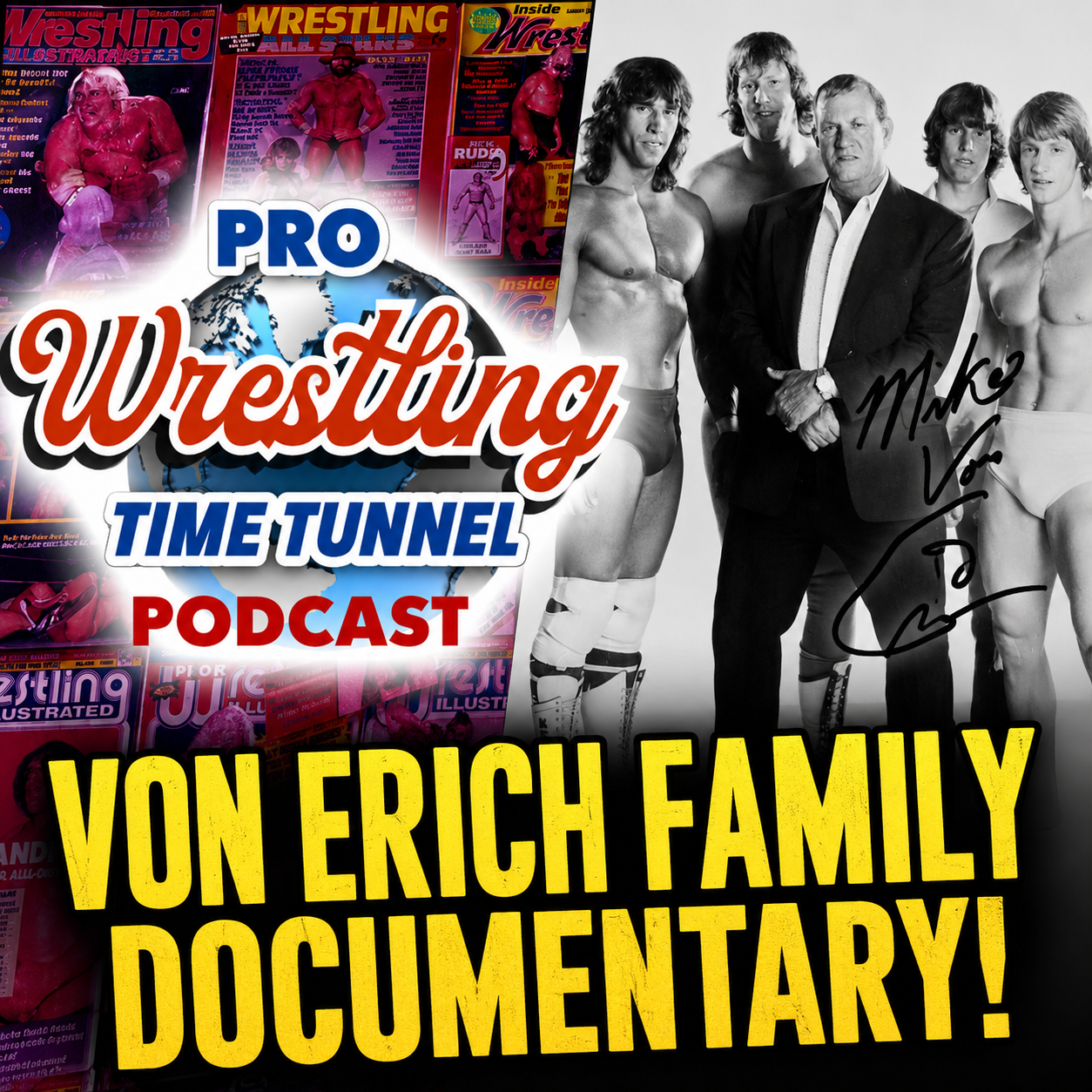
I've got Lance Peterson here who knows more about the world class championship wrestling territory those years with the Von Erich boys than anybody I know. And the recent documentary that came out, the Curse of the Von Erichs, is going to be our topic today. So I'm going to welcome in Lance Peterson here to the Richards Ranch in just a second. And then I'll be back for segment two of our show in which I will be going into 1966 and talking about the career of Dorie Funk Senior.
And today we're going to talk about the Albuquerque, New Mexico market. We're going to talk about the buildings there, the circumstances, the matches, and a whole lot more today on the Pro Wrestling Time Tunnel History Show. And then finally, Steve Giannarelli will be here for our segment three and he's got a whole bunch of questions that you have sent into the show that we're going to answer in our latest mailbag segment. And so we got a lot to do today. Let's get rolling and welcome in Lance Peterson. And let's talk about the documentary the Curse of the Von Erichs here on the Pro Wrestling Time Tunnel History Show.
Well, we're back at the Richards Ranch again and we have our resident world class championship wrestling analyst and friend of the show coming back, Lance Peterson. Hey, Lance, how are you, man?
[00:02:44] Speaker A: It's a pleasure to be on, Tony. You know, I always consider it an honor the work you do here. Just fantastic. All your work, you know, from Twitter X to your, your interviews.
It's always a privilege to come on and I try to do my part in preparation and I'm ready to roll today.
[00:03:03] Speaker B: Well, we. We're going to be talking about the recent A E documentary, the Curse of the Von Erichs, which aired on A and E in two parts. It was part of the WWE Legends series and it aired. The first part aired on April 26th of this year, 2026. And part two aired on May 3rd, 2026. And each episode's about 85 minutes long. Of course, it's a WWE produced biographical documentary and it's centered on the Von Erich family and on Fritz Von Erich and his sons with a lot of emphasis on their dominance and world class, which is. Is true. And Lance, you grew up right in the middle of the really hot period.
You were in. You were in high school right when the hot period happened.
[00:03:53] Speaker A: Yeah, really. 83. I was 13. So it was my teenage years were those years and as some people grew out of their teen beat years, if you will, and moved on to having jobs and boyfriends, girlfriends. And I was still watching, you know, still faithful through the end basically, and into. Into uswa. And I always think that I have a unique perspective on it, you know, and I'm not always just rah rah Von Erich or world class, you know, I'm. I'm there to, you know, criticize when I see it's necessary.
I thought it was such a complete, complete show. I mean, three hours. And I.
What I want to say today is I, I like the other video, other things that they've done. You know, heroes of world class. I was around Brian Harrison a couple of times and you know, is a fantastic. For the time. But this was complete. Each brother they gave time to. They didn't skip over Jackie, they didn't skip over Chris.
It's a answer to the Iron Claw without a doubt by the Von Erichs. They. You could see the. They wanted to do this. They wanted to answer the movie that they've stayed classy on.
They. They say it's a good movie, but it's not our story. And it wasn't. You know, it was fun, but it was not their story. And this is a complete answer to it. And they gave us a. A few new nuggets. Somebody like me is watching. Of course. I've got all the newspaper clippings of the deaths and I don't dwell on it on. On Twitter where I'm at a lot. But you know, that's kind of. I know all the details to each of the deaths, but it's the. In between. It's the. The ladies I was. It was. We'll get into it, but I just love all the ladies being able to speak. It was. That was the biggest thrill for me.
[00:05:41] Speaker B: Yeah, I've got James Beard coming up on the show here in a couple of weeks and we've talked many, many times in just our private conversations about the movie. And of course, he was involved with some of it and he said, you know, it's really supposed to be a movie about a fictionalized story based upon a real life situation, whereas a documentary is supposed to be more factually accurate. So that's why I was so interested in having you come on today to talk about it, because I know you know all the facts and so you'll be able to tell us how close things are and where things might have got off track or maybe anything that was missed.
They've got so much archival footage that's available to them that we got to see some things we wouldn't normally see. But it kicked off talking about Fritz. And of course, how did you think they did as far as framing up Fritz Von Erich at the. In the early parts of the documentary?
[00:06:39] Speaker A: Very nice. And they went right for that, the molestation situation, which was kind of the big, you know, scandal thing that came out of it. But they, they moved.
[00:06:50] Speaker B: We never, we never heard that before. Right?
[00:06:52] Speaker A: Not never, never. And let me explain about Kristen, Kevin's daughter.
[00:06:58] Speaker B: She.
[00:06:59] Speaker A: She can remember being in the Sportatorium. It was probably 88 when she was around Kamala and he scared her. She was.
She had the same birthday as Carrie, so they had a very close bond. And what I'm getting at is she's very well spoken.
In Hawaii, her and her husband took in babies from, from drug addicts to foster. So the kind of things saints are made out of. She already had a huge, beautiful family and she does that. So what she says is going to be very believable, credible.
And so think. She said that Kevin said he had never heard it before. But if Kristen said it, I have to, I kind of have to go with it. She really is, you know, a good, good person.
Yeah, that's. That, you know, that's really the way I saw it throughout this. If Kristen's saying it, I mean, that is, is fantastic. I also do. We'll throw in here that Brian Adias always comes off very level headed, really classy. If Scander Akbar was alive, he would, he would discuss negatives, but be very classy about it.
That's very nice. And David Manning on here. David, you know, I, I'm it's funny, I. I tease about David Manning and Chris Adams in a kayfabe way, you know, that I. But David knows his fact.
He will miss a detail and it, you know, it sticks me. It gets me sometimes when he misses a small detail that is kind of obvious out there. But I know he's going for the honest answer. In fact, I believe everything Kevin says. He believes. Exactly. I, I have no doubt that there's any intense journal, you know, falsehoods that were put out there during this.
[00:08:39] Speaker B: You know, it's the documentary talked about the death of Jackie Jr. Who was electrocuted in 1959. And then, of course, the births of the boys that we know closely. Kevin, David, Carrie, Mike, Chris.
And so what did you think about the way they talked about Fritz and Doris's life prior to most of what we know?
[00:09:05] Speaker A: Yeah, that was. That was really nice how they put it. They didn't really discuss any. How they ended up in Dallas, coming that he was going to go to Corpus Christi and have a bait stand and instead stopped and he stopped off in Dallas and then it went from there. Joining up with McLemore and I think buying out Houston and then Macklemore passing away and Fritz became the sole, sole man in Dallas. And, you know, they didn't. They actually, you know, they lived in one spot. Then they bought the property that's a little farther from Dallas that we're all familiar with, and they got out there. I think they lived in a mobile home while they were building the home. But so. And I believe that would be 7071. And that anything you see out there of the boys, you know, water skiing on that property is. Is after that 72, 73 is. David and Kevin were getting a little older. Carrie was born in 60, so he's about 12.
And that's the, you know, the relationship that, you know, Kevin, Carrie and Brian Adidas were in the same class and Kathy and. And Mike were in the same class and, you know. Oh, and pan. I'm sorry. Pam and Carrie were in the same class with Mike and Kathy that were in the, you know, same school. Such a small little area they. In small high school that they went to. So it was, you know, they kind of knew each other. Unlike the Iron Claw, where she just walks up in the parking lot of the sportatorium. Maybe the. One of the most outlandish things in there. But that's okay. They. They did capture the spirit of Pam.
[00:10:33] Speaker B: Do you know why he was going to Corpus Christi? What was. What. What was it about Corpus that he wanted to live there.
[00:10:40] Speaker A: I do think possibly in laws down there. Now, Doris was from here. She had gone to a big high school here that has a huge alumni base for many years. Woodrow Wilson High School was high school, had two Heisman Trophy winners. Not anymore, but at the time. So I believe the in laws might have been down there in. In Corpus.
[00:11:02] Speaker B: Well, this is just an aside, but I really wish somebody would do a lengthy documentary just on him, just on Fritz. I think that would be a really, really, really interesting thing.
[00:11:15] Speaker A: I do want to note that near the end, you know, after 84, so Fritz is not there at the. The ranch in Denton that we grew up, we see on, well, let's say 87 or so, because you'll see it through the years on episodes of World Class, Gary Hart's in the front yard, supposedly doing an interview from Illinois. Or the swimming pool in the back where they took eight by tens. Or the Freebirds did an interview, things like that. But then he moved an opposite direction from Dallas, and that's where Carrie and Chris passing away happened. And that's. And they note in there that Kevin had moved to that property. Chris had to move back into the house.
So that really explained a lot to me. I knew Kevin was around, and I believe there was an argument the night before. I believe that's been talked about over something nonsensical about a vcr. But now I understand they were staying where Chris had been and Chris had moved back in the house. It all makes a lot of sense.
I've seen a Kristen and her and Marshall and Ross on a podcast, talk a little more in depth on Chris. As far as just kind of an angry, bitter. They didn't use those words. They used the words loner in this. I thought it was, you know, very classy the way it was done.
[00:12:32] Speaker B: How accurate do you think the documentary was as far as the way they portrayed Fritz's strict control and pressure that he put on and those kinds of things?
[00:12:44] Speaker A: The more they said it, the more Kevin is trying to rehab that image. And so he doesn't want his dad seen at that. Amazing. The shade they threw on Ms. Von Erich. I'll just say it. I was, wow, you know, we've never heard that. She, you know, she started, you know, she wanted to protect the image that was thrown in there. Now, that could have been edited the way they. They wanted it. But they, you know, Kevin said, don't. You know, dad was strong. Don't blame him. And mom was weak. He said that on there. And I was kind of amazed at that.
But that is the way it was edited together.
[00:13:20] Speaker B: I thought it was. I've always thought it was kind of interesting, Fritz being in the business for, you know, a good 10 years. Well, actually 15 or 16 years before the first Kevin breaks in the business.
And he had had all these experiences. He had traveled all over the world being a wrestler. He had worked the wrestling business.
And then the sons start getting into business. It seems like just wrestling families either goes one way or another. It is. The kids get in or they don't. You know, they're affected by the dad being in the business, and they don't want any part of it. So I just think it's interesting that every son. Well, until you get to the last couple who just sort of. There was pressure there. And maybe.
[00:14:10] Speaker A: I hate to say, how could you get home runs on everybody?
[00:14:14] Speaker C: Yeah.
[00:14:14] Speaker A: If you had that many sons. I hate to put it that way, of course. And maybe Mike, you know, Mike. I felt that I've defended Mike's career. I say, progressed all the way through the years. And maybe he hadn't gotten sick. He would have gone farther. Of course, he was under the microscope from day one while the boys were on a late. On Saturday nights when you got to see them and people. And it was a dingy arena, you know, a dingy Will Rogers Coliseum before, you know, production standards went up. But I do think you're right. A Fritz documentary of those years of what was going on. And then all of a sudden, you strike such gold at the beginning of 83. Well, the show in 82 got. Got the kids like me at 12, 13. We were talking at school, and it got, you know, I had a babysitter, actually, that got me into it, who I would see about. See the show about once every two years because she was babysitting me on the weekends or something. And then, you know, fell in love with it. And I, you know, my parents immediately said, you know, it's a show. And I had no problem with that.
Watched for the next million years, and then we got the Internet and learned a lot of secrets. And I wouldn't trade it for the world.
[00:15:21] Speaker B: I just wonder how Doris felt about it, because she was married to a wrestler and saw the wrestler going through all these things and traveling and not being home and all the ups and downs and the business challenges that go with pro wrestling. And then to see your sons start going down that road, too. I always wondered what her feelings about it really.
[00:15:41] Speaker A: Makes sense. Makes sense.
[00:15:42] Speaker B: I always wondered, you know, he was
[00:15:44] Speaker A: king of the world here as far as real estate. And, you know, a domineering, a big Texas redneck man that, you know, wanted his kids in the, in the successful family business. Well, it's not that uncommon.
[00:15:56] Speaker B: I've often posted, you know, in 1976, you know, you own the Dallas wrestling territory, which includes Houston, and you've got a booking office in Dallas. It's doing really well. You draw in, you know, a record breaking crowd in 76 at the super bowl of wrestling. And you're the president of the NWA and you've got these kids that are starting to graduate high school. What could go wrong?
[00:16:21] Speaker A: Exactly. And why not try to keep it going? When there's breakdowns of David passing away, you got to keep the train going. Why? Why not? It's a successful business.
And, you know, some of those guys had to be that way. Fritz isn't the only one that had to be domineering, I'm sure. Bill Watts, of course, and, you know, Eddie Graham had to run it his way.
Those guys had to be the way they were. And I think the younger people today don't understand how it had to be.
[00:16:49] Speaker B: Now you bring up Eddie Graham and you bring up Bill Watts. Now those, those guys, there's no qualms about it. They were very hard on their kids in the, in the wrestling business. I mean, they, they put a lot of pressure on them.
Joel, as far as television production and Eddie on Mike, they were very domineering and, and they had to be a certain way.
So it's just interesting that there's never a definitive answer as far as Fritz. You know, it, it goes from yes, he was to no, he really wasn't.
You know, there's a, there's, yeah, there's a spectrum about, about Fritz.
[00:17:28] Speaker A: Bill Irwin will say, oh, he did this for me on the side. It was so great. And then others will say, oh, Fritz didn't. You know, everybody met Fritz was, you know, didn't like him and, you know, just a domineering redneck had a fallen
[00:17:43] Speaker B: out with Jack Briscoe over a plane ticket. He wouldn't pay the NWA champions plane ticket.
[00:17:49] Speaker A: That, that is exactly the story I've heard. I went back and I've seen more and more of Jack coming in in 75 and, you know, but I absolutely have heard that it was the disagreement over travel.
[00:18:02] Speaker B: Mm. Yeah.
[00:18:03] Speaker A: Yeah.
[00:18:04] Speaker B: And, you know, so Fritz didn't become that king of the Texas like you talked about by, by being frivolous. I mean, he, he, he watched his dollars so.
[00:18:18] Speaker A: Right, right.
And you know they, they pushed that. He didn't push them into wrestling but once they said they were going to go it was going to be 100% and that was the same way he did with Carrie and the discus. I do one of the things in there. I'll throw it out saying that Kerry picked UT football over Houston throwing the discus. I've never heard that UT football and the discus he went and did. I don't you know they brought up the Olympics that they, they touched on just for a second. I you know I think people have gone back and seen Carries throws weren't he, he probably wasn't going to the Olympic trials but it just works out in storyline so beautifully for the Olympics to get canceled. I think Tory Tori Yatsu in 83 I think that was in Dallas had the same problem that when boycotted but he had been in other Olympics.
[00:19:07] Speaker B: Well I know you got a whole desk full of notes there about it but what were some of the other things that you thought for each one of the I mean how did they do on David Did David very good
[00:19:20] Speaker A: you know discussing the death. You know saying that you know he married the first wife Candy because they had gotten pregnant and he thought it was the right thing to do. So that was kind of the most detailed. They've, they've been on it and it you know he, he saw that you know Kevin making the money and so he wanted a part of it.
He is, he. Kevin started but Kevin went right back to college and didn't get full time. David starts and then a few months later they're both rest, they're tag teaming. So a lot of times people think, you know and me too I look at it really careful years ago because people will make the mistake that David started first but, but really more David was more regular first at wrestling. They didn't discuss much about David traveling to Florida which I think is pretty important. I was wondering if maybe in ways he was running away from Dallas in a, in a way of the memory of the baby passing away.
And, and again they, they showed the grave out there of Natasha the baby. So I, I thought it was perfect.
He, they, they came to the conclusion he was just too manly to go to the doctor and get it taken care of. He just pushed himself with in this infection got worse and worse and they pushed that, you know, alcohol on top of it. They, you know they really tried to steer clear that if he was on anything recreational it wasn't the reason he died, it was this infection and Just not getting it taken care of. So I, you know, I thought it was pretty fair because I, you know, at that point, it's hard to make any.
It was a long time ago. It was 1984. And we don't have all the exact things we know Fritz could work magic with, with police and press at the time.
[00:21:05] Speaker B: It's funny, we always.
I think everybody kind of looks at it as David, Kevin and Carrie, but it really is Kevin, David and Kerry. Right. I mean, as far as the.
The birth order and the order of them breaking into the business, it was Kevin first, then David, then Carrie. But for whatever reason, and it might be because David passed away first, I don't know. Or maybe he was the one that most people thought was the going to be the next NWA champion. But for whatever reason, we always put them as David, Kevin and Carrie.
[00:21:38] Speaker A: Yeah, you do hear that a lot.
[00:21:40] Speaker B: What else you got?
[00:21:43] Speaker A: You know, we didn't get.
So we didn't. We got Kristen. Her sister was. Jill was on there. I've never heard Jill really do much, so that was nice. She was, you know, close with Chris, and so she was able to, you know, discuss his life and his, you know, private area on the property where he went off to. But they. They kept it kind of. They didn't go too deep into saying how, you know, a bitter person he was. I knew early on about the asthma. I knew a teacher that had him. A buddy of mine's grandmother had him as a student in East Texas. And I believe he was. They were flying him to Colorado for treatment. So, you know, and. And you would see him on things. Knew he wasn't this lanky. I mean, he made Carrie look lanky. He, you know, was not that way. He's short and, you know, and then he should change his look for wrestling. But he was just so small for the time. They put him against Matt Bourne here and there, but mainly he fought Percy Pringle. He had a few other opponents during his time and. But it was it, you know, I. I saw all the boys wrestle. I saw Fritz wrestle Lacey Bross and Marshall. And one time I saw Jill do a kind of a charity box.
But I've been told not to mention that by Marshall. He said my dad hated that, and he did at the time. But they. It was something with a local radio station, brought Kristen in to do a kind of a boxing thing that was kind of a. A farce. They did a fight night.
[00:23:08] Speaker B: Those dadgum radio stations always got a promotion.
[00:23:11] Speaker A: They got it. That's exact. And I went out there, I was like, oh, that's. I've got to drive out to the horse races and see that. And our horse races was still new in Dallas at the time. Our.
Where our track. So that was pretty wild.
[00:23:24] Speaker B: They can. One things. I.
I don't know. It's just they. They went with the curse thing. You know, they. They framed it overall about the. The family curse. And Kevin seemed like he was always overturning that, you know.
[00:23:40] Speaker A: Yeah.
[00:23:41] Speaker B: When he was talking, he was kind of going against the narrative that was being.
[00:23:45] Speaker A: Exactly. He just doesn't want that, you know, curse. You know, it's hard to say. I mean, they were so in the spotlight that every little, you know, pimple shows in a person's life. And if we had big families with six sons. I don't know how many children you have. I have two boys. But, you know, none of this drama that they had. But, you know, they. They were set in it. That enablers.
[00:24:09] Speaker B: I've known big families before that have had a lot of tragedy and different things happen to them. You know, I mean, it's just the fact that these guys were on television and they were part of the wrestling business and they were part of a very.
Well, they were just huge stars, you know, I mean, they were. They were big entertainment figures. They weren't just wrestlers in Texas. They were large entertainment personalities.
[00:24:35] Speaker A: Tony. I could reach out and touch them. That's the thing. They're here. They're living my life. I know the freeway. They went up and down. I know where, you know, things were filmed. You know, I can drive towards Denton and I know. Oh, that's how they came in from the sports hormone. I didn't know for years exactly where the house was. I never went after the houses or where they lived. I think at 87, I went over to where Gino lived because guys were still living there and saw Tatum and Victory in the parking lot. That's about the only thing ever.
I didn't know where the house actually was.
But they were. We could reach out and touch these guys. They wanted us at the shows. Right. They told us every week to be at the shows. And people that watch the syndicated show don't know that. To channel 11 show had twice, three times as many interviews with everybody every week, building up the shows.
And so, you know, we got. That's why there's such passion. That's why there's the Von Eric Facebook pages with these people that are very serious about their passion for the boys.
[00:25:32] Speaker B: And Channel 11 was the Saturday Night show, right?
[00:25:35] Speaker A: Yeah, the Saturday night show, where if you weren't out, you were cuddled up on the couch watching this, and it was life. You know, you're upset if you fell asleep and you didn't have the VCR going. I. I'm telling you, Ex. How I felt.
[00:25:47] Speaker B: I used to watch it on the satellite dish because KTVT was a satellite superstation and used to watch it on Saturday nights. Right. Right after the TBS show went off.
[00:26:00] Speaker A: You know, I. I felt like one of the things they. They did get right in this, of course, was the brotherly love and the mention of, you know, like Carrie early on saying, maybe I should just go be with David. They. They did have that.
That theme, you know, in a belief in real life. You know, we're going to be together. So taking this way out, and I'll jump ahead to where near the end. Kathy was there with the girls. Kathy was with Holly and Lacey. Lacy was born right after Carrie hurt his leg.
And they both came off very, very well. I've just got to meet Holly about a year ago for two seconds. And I'd taken a picture with Lacy years ago.
[00:26:42] Speaker C: They.
[00:26:43] Speaker A: Then they're on a. On a property in East Texas, Holly's house. And they were looking at that photo album. And, you know, I bring a tear to my eye, you know, I mean, I was, you know, a Carrie guy, and I'm not, you know, I don't hide that. That was my superhero. People got Batman, Superman, and, you know, this was my guy growing up, you know, and I know how sad I was when he. When he passed away. I was a little young for David. And just more and more, you know, I. You would imagine what's going to happen if one of these guys, if Carrie died? I remember thinking that or something, you know, how would this be?
[00:27:14] Speaker B: You know, one of the things I was going to ask you is after the. After the big year in 82 and world class kind of blows up, Fritz doesn't have the large territory anymore. I mean, he doesn't have San Antonio, he doesn't have Corpus, and he doesn't have Houston.
So they're pretty much running the Dallas Fort Worth metroplex. And so when they did spot shows, which are things that we don't see a lot about, there's not a lot out there, documentation wise of. Of shows outside the big Friday night sportatorium or the Monday night Fort Worth. Did the Von Erich boys work? A lot of those you talk about? I could reach out and touch them.
Were they out at a Lot of like the ancillary towns around when they would run spot shows and stuff.
[00:28:04] Speaker A: There wasn't a spot show without a Von Erich unless they started doing it. This was so here. Here really quick was a normal week was San Antonio on Sunday, maybe every three to four weeks. Okay. So once a month, Monday night, Monday night, Fort Worth. So the week began on Sunday when Flair would come in town. Gene Hernandez comes in town. They start on a Sunday at the San Antonio show.
[00:28:27] Speaker C: Okay.
[00:28:28] Speaker A: Then there's the. The Fort Worth show on Monday nights. Tuesday, Wednesday, Thursday are all these spot shows. My high school, which is in Dallas proper. They were there three years in a.
[00:28:39] Speaker C: And.
[00:28:39] Speaker A: And everybody else is here. Nothing special. I mean we, I mean Rick Rude, these Domini Express, they're all in my high school. All these famous wrestlers. Amazing.
So yes, they were there. And then Lance propped that up when. When it was down to just Kevin Lance, Lance Von Eric could, you know, I went to see spot show with Lance headlining against. Against Rick Roode and without a doubt, you know, and there he is. We know he's not a real Von Erich. Never a question about that part of the show.
And he was there and he did his best. He was more of a bodybuilder than an athlete. So injuries kind of stacked up on him. They cheered him from day one to the last day he was there.
[00:29:19] Speaker B: I can see where that worked in their favor too. I mean, back when they, you know, had to do the Monday through Friday from Fort Worth all the way to Houston on Friday, that, that was a. That was a lot of miles there and all that. So. So by the time that they. They came along in the world class years, it was a great territory to work because you were home every night.
[00:29:40] Speaker A: You Absolutely.
[00:29:41] Speaker B: It was easy mileage as far as going to those spot shows.
[00:29:45] Speaker A: Yes. And let me on the other. The other big house show besides San Antonio was Lawton, Oklahoma. And I believe David and David Manning split that early on. They promote that they'll tell store. David Manning tells the story of the box office getting robbed and they. Not in this. Not in this. Now the reason I'm able to say a little extra is because over the last few years Kevin Von Erich did an evening with Kevin Von Erich where it was Kevin a. A local famous sports anchor here in Dallas and David Manning on stage. And they did one in downtown Dallas and a year late and they did a. Had a few scheduled. I don't think they did as many as they planned on. And then they had one at Will Rogers Auditorium which was Cool. First time I had actually been in Will Rogers Auditorium where they wrestled sporadically through those years. They would wrestle in the Coliseum or the Auditor.
So a few extra stories were told at these things.
And David Manning, of course, I forgot where I was going with that, but that's why I know a few extra things like the Sid's death, David's daughter passing. I mean, I'm sorry, Kevin's daughter. He ran over her. That, that story I'd heard just about two years ago for the first time. So I did know that ahead of time.
So those are a couple extra things that, you know, why. Know how David Manning talk things and you know, level headed.
[00:31:07] Speaker B: Wow. At Lawton, Oklahoma.
[00:31:09] Speaker A: Oh, Lawton, Oklahoma. Right. That's where I was going.
[00:31:11] Speaker B: That was an old Leroy McGurk town that after Watts didn't really care about it or whatever. I'm sure that.
And they partnered on a lot of things too. Watson and Fritz.
[00:31:21] Speaker A: Oh Yeah, yeah. Especially 85 a lot.
And Lawton got their own program.
People know I have a lot of programs, but Lawton got their own programs. San Antonio got their own program. I, I have a few of the. A couple written.
[00:31:36] Speaker B: Arena program, you mean?
[00:31:37] Speaker A: Yeah, yeah. Sold at the arena for that show.
[00:31:39] Speaker B: Yeah.
[00:31:40] Speaker A: For San Antonio and for Lawton. That's how big they were.
[00:31:43] Speaker B: Neat. That's cool.
[00:31:45] Speaker A: Yeah. Yeah.
[00:31:46] Speaker B: Did they, did they get the syndicated television or.
[00:31:49] Speaker A: Oh, I, I have to think they did. Syndication blew up so big by the time, I want to say right after June, July, August, some people can remember that Buddy Roberts, Hair Creek, you know, Los Hair or the Free Birds coming in with the Confederate flags that sport a Tory match or maybe you started right around the, the November country whipping match. People will remember kind of. Okay, did you watch? And then some people get mixed up because they're like, well, maybe I saw it on repeat later, but that kind of. And Bill Mercer actually would really do a good job of announcing when the new syndication deals. Oh, you're watching us now in Boston and, and I think the Wahlbergs in Boston got to watch the Von Eric. Pretty neat. And I know down in and where Matthew McConaughey was. He certainly knows Mid south and world class and skandarakbar.
[00:32:38] Speaker B: I just saw him on, on a podcast here two weeks ago and he was talking about going to wrestling shows and how big of a wrestling fan he. He was. You know, I, I had, I had relationship with his brother Rooster.
Rooster McConaughey. And when he, he got his own show on CNBC, an investing show and he Sent me a CNBC branding iron.
[00:33:08] Speaker A: Very cool.
[00:33:10] Speaker B: The whole McConaughey family are all wrestling fans.
[00:33:13] Speaker A: Let's talk about Carrie real quick.
They covered that really well. I think he's just so lovable.
Everybody liked him. It's too bad that that got a hold of him, that, that, that life. But, you know, Carrie lost that foot. Let's say June, he had that wreck. Lacey was born right after that.
They rushed him back. You know, the foot just was never going to get well. They, you know, Bill Colville, they're older guy that brought him to the ring.
[00:33:45] Speaker B: He's also going to be on my show this year.
[00:33:47] Speaker A: Yeah, I wonder that. I knew that would be a good one for you to have. I've. I've never met him. I've been around him a few times, but I've never met him. He says that maybe, you know, he didn't think the blood flow circ speculation was right and that's why that Carrie didn't do the rehab. But I think the foot was just withered from the start and it was just a Hail Mary pass that they. That it would make it and he kept it.
Christmas night of 86, he comes to the ring with David and. And Kevin. He shakes the ropes at the end, causing Brian Adidas to fall. And it helps the boys win the match. He gets into the ring and he goes through the ropes. And he did have crutches with him that night, but he did.
He didn't have. It was kind of half and half on the crutches and he got into the ring without the crutches. And you see him step and he limps and you cringe and you can go back on the net on that episode of Christmas 1986 and see that he winces when he hits steps on that foot. And a month later is that first comeback match with Brian Adidas. No way. He's ready for it. They numb it up. Brian Diaz on other shows has talked about the fact they got through that, but he knew that the footage was a problem and there the foot is taken at that point. So I love the fact that they showed him in the ring practicing, you know, that he was running the ropes and, you know, he really learned to pivot on that foot really well. It's really interesting to watch him, and especially when he's with Terry Gordy at the beginning doing some brawls, you can see Terry Gordy helping him.
You know, they're near the ropes and how they're doing is. Is. Is really, really interesting. And I think he tried different, different boots at different times. That hurt. The mobility, obviously, the mobility was already gone. There's the match with Sid Vicious in December of 88 is not good to watch that. Both of them look really, really bad in it and I'm a big Sid fan, but that match is not very good. I think Carrie improved, improved. Got to the WWF and it looked good for a while. As Kathy said, in this, for a while he was, you know, she, you know, as clean as. You know, she didn't say the word clean, but, you know, several months he was okay. And I think he was very good. When he came right back as far as clean, you know, I thought after everything, he came back really, really well.
[00:36:01] Speaker B: And yeah, I remember, I remember when he went to the WWF and I remember thinking, okay, we'll. We'll see how this goes. I was very tentative because of the travel schedule and the pressure and all that how. But man, he did a good job.
[00:36:17] Speaker A: He did. Did find the magazines were way behind it. Amazingly. Bill Apter, you know, certainly put him all over the magazines, is coming back in this big push and he got the title. It was pretty wild. It was, you know, it was all of a sudden to us at Sports Forum, he did do a goodbye in the, in the ring and Jarrett let him do that. And, you know, we're going off. I'm gonna do it wherever I go. Was, you know, I'm gonna do it for Texas and I take y' all with me and things like that. And had a. Had a brawl with, with Rod Price and. And use the tornado punch. You know, he'd always discus punch, but I saw him go towards the ropes and do this spin.
That's going to be the move. That's going to be the move. At the time, and I wasn't Mr. Smart by any means. I'm telling you, once in a while I did sit next to one of the doctors. Not sucker who was in this, but another doctor that would tell me a few little things, but not much. I was still in the dark about the secrets, even though I'm right there and, and you can see on my Twitter there's pictures. You know, I'm sitting front row and Carries at my feet, and I would hear him hit that sportatorium wooden floor and I could tell there was some kind of brace in there, but I didn't know what it was. The story of De Beers match did make it to the Sportorium and he kind of blew it off. You didn't. Yeah, I don't know. You Know, we didn't have any proof of that at the time.
So it, you know, Carrie, it was amazing how fast and what he was able to do.
You know, the mic death was handled pretty well.
You know, they didn't read in detail the note he gave, he left, but you know, just kind of that he thought of himself as a screw up. Just horrible.
I love the pizza in bloopers or yeah, people, because that commercial ran forever here. And seeing the bloopers, seeing Mike relaxed. I love that for everybody to see Mike relax because his interviews were always hard to do. But in the ring, he was fined by Texas Stadium 84, where he'd been wrestling seven months. He had really come along. He'd been married to Buddy Roberts in the ring. Then he was married to Gino after that. I mean, at the Jake the Snake, I can see him helping Mike.
I always like, you know, like seeing that. I see him At Texas Stadium 85, Kevin's kind of in the corner sitting, and he kind of fakes giving him a nutshot with the, with his fist. I just love seeing Mike relaxed. That's because that's what they say, you know, about him. You know, they say he liked music. But, you know, I can see the dad wanting him to go into wrestling. They say Mike wanted to go into wrestling. I mean, music, a lot of people like music. You're never going to make a dime, but you got, your dad's got a successful company, why aren't you, you know, it doesn't make sense for you not to get into it.
[00:39:01] Speaker B: Right, right.
No, I, I, I, those, those later, you know, with Chris and, and Mike and all. I, I was glad they gave them, you know, a good amount of time. They didn't just focus on the three,
[00:39:17] Speaker A: you know, and they, you know, I, they didn't go into the death of Doris over in, in Hawaii, but I don't think there was much. I think she just kind of faded away and they, they brought her back to be buried here at Grove Hill. That's where David Manning said Oak Grove and you know, Cliff, which I just can't believe, you know, other people I can understand, but David Manning right there, you know, it's Grove Hill Cemetery. And you know, it's in, in East Dallas. Everybody knows where this is. My parents are there. I'm there all the time. I don't, I don't, I've never gone over to the Von Eric's grave. I gotta tell you, that just wasn't that. I'm not, that's not me going And I really wouldn't know much about the grandkids if they hadn't gone to Hawaii and posted everything online while they were in Hawaii. Otherwise I didn't know where what Kevin was doing from 93 to wherever. I know one time people at the gym said, oh, Kevin was down at Starbucks down the street with his mom. And I was kind of strange that she's down the street. Well, she was renting a house down the street and she gone to the high school that was right down there. And it all, you know, fits together as you get a little more details through the years. So we didn't get.
[00:40:24] Speaker B: I think I've only seen maybe two photos of her ever.
[00:40:29] Speaker A: Oh, you know, they were. They're really good about showing her. Maybe on the Texas stadium shows the boys would bring out flowers. They didn't show those parts. But at Texas Stadium she came, came out. They were usually on Mother's Day so we got to see her. But now Fritz kept her kind of in the background.
No Pam. You know, I would have loved Pam to speak.
You know, she press persevered through all of this. Kevin's wife and I don't know why they didn't put her on there. Ross and Marshall as adults, I can see with Triple H being the executive producer and their relationship with the other company that they probably, you know, didn't put them on there except a few scenes of Kevin. Kevin playing football with them on the field at Texas Stadium. And that was during a time when Kevin and David Manning were going to did a few VCR tapes of. Of wrestling of world class and were selling it. David Kevin still owned the tapes and for years on ebay those were. So they were priced just crazy prices until.
Until you could get the episodes now, you know, you don't need to buy anything. You can see anything you want.
[00:41:33] Speaker B: To me that's a little bit of over focus though. I mean why not show them and show the fact that they're wrestling and I mean, I don't know.
[00:41:43] Speaker A: I guess they can't tell the stories like the girls. The girls really were there. You know, in fact one of the press conferences, if it was on TV and I have the clippings from it. Carrie.
Carrie and Kristen are sitting together because they share this. Such a birthday and such a, you know, a bond. Not instead of him her sitting down by her dad. And it was. And she knows that they stopped letting her Carrie drive her. And they mentioned this, the girls, the two Holly and Lacey mentioned him not being sober, driven. But she mentioned on this show with her cousins Ross and Marshall that, you know, it was that, you know, he got so bad off and, you know, that's hard. I hate to hear that. I see the pictures sometimes, you know, on Facebook people post pictures and it's just weeks before he died and I can see a broken man and you know, and he didn't, didn't have a pot to piss in. He had just, you know, life, money, life, life problems.
And you know, nobody blames Kathy at all, you know, except maybe Fritz. Now notice during the show she calls Kathy Carrie's ex wife, calls him Mr. Atkinson throughout. She was never liked by Fritz. She knows that. She was never liked. She was too, you know, very young. She might have been 19 when they got married, maybe 20. And so, you know, and Carrie was 23 and 83. They got married, married June 17, the day after that. International Star Wars People remember Carrie and Brody winning the titles and the same night that Buddy Roberts lost his hair.
[00:43:13] Speaker B: So you want to shift to the free Birds.
Michael, Michael, speaking of the wwe, I mean, Michael Hayes is still a big, big time deal in the WWE behind that.
[00:43:25] Speaker A: Amazing.
[00:43:25] Speaker B: Oh my gosh, I'm so happy for him.
It's amazing that he has been able to stay in the business and be so influential.
He's really a noted figure in the creative part of the business and in the matches that we see on the ples and all that. He's got a major hand in all of that. Why do you think that? I mean, you were right there.
What made that so special? The Freebirds and the Von Erichs. I mean, that was something that was just dynamite.
[00:43:58] Speaker A: Here it is.
They started that show, started filming at the very end of 81. So it start hits at the beginning of 82, all of 82. The Von Erichs have Frank Dusick, Bill Irwin and then Kabuki's on a another level. The really the top heels that 81, 82 kabuki run. So they have these guys, but they're dominating on TV and then we're going duck hunting and we're going, we're doing these things with the Von Erichs and life is good, life is peaceful, no problem.
And then boom, these friends come in and they turn on us and it's, you know, very end up. You will how they later on NWO did the same thing. You know, they come in and they've turned our world upside down. They've cracked Carrie in the head with the cage door and we're off to the races in these brawling feuds they'd still wrestle. And it's, it's. Man, watching Kevin and Terry Gordy watch any of their matches is amazing. But they would have these such frenzies, such electricity that they captured on this when they were all in there. Six man, six man's perfect. You know, any more eight man, 10 mans, you know, it's just too much. And you, you know, it's a mess. And they did that at Texas stadium. A Big 12, man, that was horrible. But it was, it was perfect. And you didn't feel like Mike was the weak link when he came in. He's fitting in right there. They always escalated that feud, dude, from just two out of three to, to the, at Texas Stadium, they did the, the bad street. But wait, Carrie wasn't in that. That was Fritz. So then they do the bad street where it's Carrie and that all six and that ends in some mess with killer con. So they move it to a bad street in a cage. And that's how they actually blew off the very first 19th month run of the Free Birds. Von Erichs. But they are always able to raise the stakes.
And Terry Gordy and Buddy Roberts, so selfless in the ring, so giving. I mean, amazingly amazing how much they gave. You know, one of the notes in this was that, you know, Michael Hayes talking about Carrie, and Carrie, you know, talking about the pain of walking around.
But Michael a said, it's easy to make excuses when you're getting high or to get high. And I thought that was pretty, pretty, pretty pivotal. You know, I thought it was very, very true, you know, for people that, you know, are caught up in something like that. But it's amazing that Michael Hayes is still out there. I had the pleasure of walking up to Terry Gordy at a show. He was standing by the concession stands in, you know, late, probably early 90s. And it just shook, said, hey, man, shook my hand, shook his hand, said, man, thanks for all the great years. That meant a lot to me that I was able to say that to him because I. That's the way I thought. His daughter's, you know, out there doing her thing to wonderful Miranda, met her times. She's just wonderful. And the mom, I took a nice picture with the mom one time at the hall of fame that we had in Wichita Falls.
[00:46:55] Speaker B: How did they, how did they handle the kayfabe situation? Because obviously there were always the, the pre. The primary spots to go in the Dallas area. They're going to end up at the same bar or something at some point.
[00:47:09] Speaker A: Beautiful question did that beautiful question, did
[00:47:11] Speaker B: that kind of thing happen?
[00:47:13] Speaker A: They would do both Von Erich's and Free Birds would be on the rock and roll stations and other Sunday night talk show, and they would do long form. I mean, this would go hours, especially the Free Birds. They keep it going all night. It was. It was so. It was so heaven. I mean, it was. It was great. And they would talk about being on the planes and we're not paid to fight on planes. That is the. That was what the Free Birds had that ready to roll. We don't. You know, we're not paid to fight on the planes because they're taking Southwest Airlines. Most of them are living about a mile, mile and a half from Love Field in Dallas. Okay. And they're. They're also right next to a toll road, a major freeway to get in and out of Dallas.
So easy. Southwest Airlines, they could go do that San Antonio show. And as you said, they're back. They can lay around all day and then drive to Fort Worth, 50 miles the next morning, 40 miles, whatever. So it was easy. And where they all live, not the Von Erichs, but the birds, Tatum, Gino, passing away, baby doll, they all lived in these specific apartments there on Lovers Lane in Dallas. That's where. That's the name.
Gino's gym was down the street where they filmed the Badge of the Bone video. And they filmed by. Out by the pool there saying that we were at his penthouse. So it was so easy for them to travel and. And that's what they did and sleep as long as they want. I think Tatum would always say Jack Victory. Had to get him up and drag him to the house. Shows, things like that.
Oh, sorry, sorry. I'm hitting the mic. I thought I had a couple of things I wanted to touch on.
One of the one thing that they didn't touch on, and it is surprising because it should have fit in perfectly, was May 11, 1987. This is a month after Mike has died.
Kevin has to wrestle, you know, three weeks later at Texas Stadium in a throwaway match with Nord the Barbarian, who I don't believe was doing. Didn't want to do business with the office, really.
And it's a. It's a throwaway nothing match.
But then a week later, Kevin collapses in the ring in a big eight man. At Fort Worth, one of the fantastics has to do cpr. And they don't touch on that at all. But I can understand. I mean, he was under so much pressure after Kerry passes away, and Mike is still not Mike I mean I started wrestling back again a month after the carries wrecked, but he wasn't regular. The whole place was being propped up by Kevin and Bruiser Brody. That is your two biggies, without a doubt. Nobody close to him. And then Brody's only got Abdul the Butcher.
When everybody left right, right around Kerry's wreck for Mid south, they left before the wreck, but they went to uwf.
One of the guys they brought in was Blackjack Mulligan. And Mulligan was supposed to be in feud with Brody for a few months and instead he leaves town down and Abdul has already started. And so they have to push go right into this Brody Abby feud and it goes forever. It goes so long. And then you have Brody on TV doing the same enhancement guy. This a guy who's been around Dallas for years. I think he has four singles matches with Brody. We don't have anybody for him to, to wrestle here besides Abby and Kevin's kids got Brian Adidas. Brian Diaz gave it everything he could, but he had already been pigeon told by the fans in Dallas and everywhere that he, you know, he wasn't on that level. Funny because he's such a great athlete and a true hall of Famer in the Southland Conference for, for shot put, you know, he really had some skins on the wall. They don't really ever mention it till he does turn heel and 86. And somewhere in there they, they mentioned a little bit, but not, not anything. They, they never wanted to put him a. Of an athlete like they did the brothers
[00:51:12] Speaker B: Gary Hart.
Was there much about Gary Hart?
[00:51:17] Speaker A: I don't, I didn't hear Gary Hart's name throughout.
[00:51:20] Speaker B: I started to say, I don't remember anything about.
[00:51:24] Speaker A: And I know and I don't take anything away from Gary Hart. I think sometimes he gets credit for stuff he didn't do because, you know, he was gone. And I'm like, okay, you think Gary Hart's great, That's fine. Tell me what's, tell me what part of it. And that's fine too, too. I mean he did, he did do a ton of stuff. It's just, you know, sometimes I get him, he's miscredited for different things where he was. And I think his opinions depend on what day of the what side of the bed he woke up on. His book is his book. You know, that's, that's his. You know, it's funny to put down Southern wrestling and you're, you're Southern wrestling and you're, you're loved and respected. I know he was very nice. People would say to meet him at a gas station.
Wonderful, just wonderful. I met a lady a year ago up here at CVS who, who dated Gino Hernandez when she was an airline hostess. And she. I don't know what, how it came. Oh, I was probably printing out pictures I was gonna have autographed at a wrestlecon type of deal. You know, I'll get a blow up of some picture I took. You know. So I, and I think she saw it and she was, you know, right away she was like, you know, I dated Gino until he cheated on me with another airline of.
But that David store. I mean that Kevin collapsing story was not included when I was surprised because so many other things were put in there.
[00:52:41] Speaker B: How did you think they handled the decline of the promotion and when things started going. I mean, obviously there's tragedy all through the whole thing, but then, you know, as the promotion starts to get weaker and weaker and weaker. How'd you think they handled the portrayal of the death of the world class?
[00:53:00] Speaker A: They were good about throwing in there about WrestleManias bigger and bigger and so that they did a better job than the Iron Claw that all of a sudden, boom, they sold. You know, it was the curse of the Von Eric's, not the curse of world class.
So they, you know, the biggest thing besides a Von Eric passing away or Mike's death, Mike's being sick was the death of Gino Hernandez. That really hurt this place.
Gin dying of drugs and that being out there gave everybody an easy spot to jump off wrestling. I mean if you were 13 in 1983, you're 16 by the time Gino dies, you've got other things going on in your life and you know, an easy spot. But you know, Gino was loved by the fans, you know, love to hate and loved by the office.
I, you know, it's, it's so, so bad that he passed away. He did need to freshen up and I wish that both. I wish Chris Adams would have gone after the hair match, gone somewhere with, with Gary Hart. He had split with Gary Hart time, but I wish they gone somewhere but there really wasn't anywhere for him to go, I guess.
[00:54:09] Speaker B: Right, right.
[00:54:09] Speaker A: Because I thought it was, you know, they had a little bit of lightning with that and Gino and Chris together were fantastic. The, the hair match that kind of. It was that they had a couple more months before they did their, their, their feud started. That feud that didn't get to go anywhere, but that looks so good on tv. The, the cotton ball Hair match next to Texas Stadium 84 is, you know, a masterpiece and it's huge because you could get into the state fair with your wrestling ticket. So the crowd looks fantastic. Everybody's in a good mood at our state fair. People are super passionate in this area about the Texas State Fair. And there we are. And that was such a one match show, such a one match show and it came off. We got what we wanted. We got some many things they gave back to the fans. The, the carry winning that doesn't happen in every territory.
Such a successful hair match that was, you know, went to perfection. They put a table in the ring, put him up high, put both of them up high and shave their heads. And we got to see it all right there that you know, there's no baloney. And then little things, you know, the Buddy Roberts getting a hair cream that was tremendous of spectacle. You know, they gave us so much and just not every territory got got their hero winning the title. I mean I'm thinking of Dusty got to win it race got to win it in their home areas. You know, it's just so rare and we got to do it.
[00:55:33] Speaker B: Do you think fans at the time, which you were one but did fans around you and all that followed to promote, did they think that when Kerry won the title that was going to be a lot longer thing?
I mean did they think Kerry was going to have the title for quite some time or.
[00:55:49] Speaker A: And you know, I didn't have enough friends of following wrestling to get an opinion and we were young.
I went into it going how are they going to get out of this? You know, how are they really going to give it to him? How could they. I knew that. How could they do this? But you're seeing, you know, Meadowlands is coming up. We knew that and you know Crockett's going to have flair and Steamboat and I don't know if that marketing had already come out but you know it all made sense at the time that you know, it was so, so quick and but it was so neat. He got to win the title on Sunday. The defendant in on Monday was here during the week taking doing spot shows. He fought missing link in a non title fought flair somewhere in there a couple of times. And then Friday night did a match with Flair non title. And Tony, I'm going to tell you something I thought of the other day when on Monday night after he won the title at Texas Stadium, the match which aired on the Channel 11 show, he comes to the ring, he poses with the belt. Everybody can See him, it's, it's what you know, in the robe, in the belt, showing off for the fans. The Friday night he's with going against Flair at the Sportatorium, comes to the ring, takes the belt off on the apron really fast, no showboating. And I wondered if that was kind of a respect for Flair and the title. He, he wasn't showing him up. He was going to pin flare that night and it was non title. But he takes the belt off so fast compared to the Fort Worth show. And I do have a picture of him with the belt right before he's. He's trying to unhitch it from the back. It's one of my favorite pieces of memorabilia. Lady took it and had him autograph it a few years later.
And you know, it's. It's one of my favorites. In fact, she had it signed the night that. There's interviews throughout this that were from a talk show that was filmed on a Friday night night after the matches. February of 86, the same week that they left announced they left the NWA and it was in the ring with Kevin, Carrie and Mike and Fritz. I shook. Reached up, shook Fritz's hand that night and they. And it. And then it aired that Sunday night. And a lot of the speeches or clips were from that night in the ring on that local thing. They really. This was easy. They seem like they were able to gather information from everywhere on this documentary. I mean, everything they had at their fingertips. And going into it, I did not know how much involvement WWF had. I did not know until I saw the credits and saw the situation. And I, you know, I was trying to not hear anybody else's reviews. I was. Jim Cornette mentioned my Twitter account on a. On a. The other day and somebody told me. So I had to go in and see what he had said.
And it was, it was on something about Texas stadium and wrestling. And so I heard a tiny bit of his review he was talking about a little bit. But I really try to avoid it so I can come up with, with, you know, fresh ideas when I do a show like this.
[00:58:42] Speaker B: So you, you thought when Carrie won the title, you thought, okay, how they're going to get out of this or how they gonna get the title back off of it? Would you have felt the same way if David would have won it?
[00:58:52] Speaker A: That it's, it's. Yeah, I would. I would have thought they got out of it. I mean, we saw so many arena shows and stadium shows that with the, the champ escaping, you know, the super bowl of wrestling and Flair, whatever, the ones in Florida, things like that. I just thought there's no way they're giving him the belt.
[00:59:09] Speaker B: So you, you wouldn't.
David would have kept it for a while either, right?
[00:59:13] Speaker A: Like, you know, and it made sense once. Well, I don't know that we knew he was going to Japan.
You know, we didn't have that. I never knew when they were in Japan. In fact, I thought, Bill Mercer, are you telling the truth or not? Did they really just go to Japan through the years like he would say they did. And then I was able to see, you know, when he, when they did, they really did go to Japan each time or Terry Gordy came back from Japan with the spike. Well, he really hated had. That was his first tour of Japan there, July of 83. So you know, they were, they were telling the truth. I was always kind of what, you know, trying to decipher what was really happening.
[00:59:49] Speaker B: Well, I felt the same way when Dusty won the title in 86. I thought, well he's not going to keep it. That's not going to last very long. The Horsemen are going to beat him up in all. And that that's what happened. And then when Ronnie Garvin won it, I thought, okay, this isn't going to last long. Too long, you know.
[01:00:04] Speaker A: No, it was for the best. You know, Flair have it. I saw Dusty this, the first title defense was in Dallas 7-27-86.
And they had a. That was the first time all those guys had come into Dallas. The Road warriors are there teaming with Bill Watts against the Birds.
A special night. I love those pictures. I'll be putting those on my Twitter account in a, in a few weeks when the anniversary comes up. I.
Yeah, you know.
[01:00:29] Speaker B: So were there any lesser known stories or behind the scenes things or angles from those days that they dismissed and could have, could have expanded on? But.
[01:00:41] Speaker A: Well, I, you know, I know Chris Adams has said it was Tony who Carrie was messing around with and because she was so distraught at Carrie's. Carrie's funeral that, you know, he found it. Oh she's been with him and that was, that was pretty wild.
You know, know there's some, there's a couple of stories. There's a. Carrie comes to the something happened about a month before that motorcycle crash. Carrie does an interview with his face like a big scar, you know, like he something happened and that. I, you know, I don't know the answer to that. Where it was at the Lance thing, you know, that had been planned before Texas Stadium 84 and it wasn't for a year and a half before, before Lance came in at the Cotton Bowl. 80, 85.
But you know, we know now through, through that book that Vinnie wrote I, which was very good with the timeline. There's a few things I question on there, but I think, you know, you have to forgive things for being a million years ago. You know. Yeah, everybody, we all have to forgive these guys. And you know, we do know we still kind of live in the moment with our hobby. But everybody else, just like Kevin Von Erich has gone on with his life life and is peaceful. He's not dwelling on the deaths, which I hate to do. I'm not big on the Dark side episodes because I've, you know, I did watch theirs, watch the Geno. You know, I'm a world class guy, but I don't watch a lot of the other negatives. We've lived it already and I'm just feel like an old man at 56 that I'm just, you know, I've seen all these, all these deaths and you know, wasn't quite anxious to watch this because I've been through it all the time. The, the, the photo albums, mine and then in the newspaper clippings, mine are in a box. And then I have two other, my close friends. These girls, they put theirs in albums perfectly and the, the photo albums are in there where they, you know, they got, I got Gina, I got Chris Adams hair in there, you know, where they got these like the close. These books mean so much to me and, and the fans, the passionate Von Eric fans.
[01:02:36] Speaker B: That's a good point because I, this is the first time in my community and on my show that I have ever done something like this, that I've ever reviewed a documentary and we've never done a Dark side episode. And I'm not really that interested in doing one as far as talking about it in ancillary terms. But after I watched it and I spoke with you, I really felt like, you know, this is something that people should watch.
Like I wanted to do it because I wanted to be able to give a recommendation that if you really want us get as close to the story as possible, either you're going to have to follow you Lance, or you're going to watch this documentary. And I, I mean, I think we can give it a recommendation. Right?
[01:03:25] Speaker A: I mean, without a doubt. It's, you know, they, they covered it all complete, as I said, not jumping over anything. I mean they go. And it has chapters, the chronological, you know, order. I, that's One of my biggest things is, you know, I like things in order. And on my Twitter, I kind of back up the pictures. I say, okay, this happened at this point. So yes, really, really covers it. All the others can just, you know, they're, they're secondary now. There's, there's no reason. This is what you need to see.
And just, just wonderful the way they do it all to see Kevin so at peace. Life is fulfilling.
I believe him. I believe it. All those things happened a long time ago. They're horrible. But I mean, the beautiful life he had in Hawaii, the beautiful life he has now down in Bernie, Texas. He's in Bernie. That's where Ms. Brody was when she got word about something that happened in Puerto Rico. Rico, to, to. To Brazer Brody and I. It's funny, I'm.
[01:04:29] Speaker C: I.
[01:04:30] Speaker A: My wife had family from Bernie and before, right before we got married, went down there for a wedding and I'm like. And this is before Internet as much as stuff. And I'm like, wait, is bro. You know, is Ms. Brody here in Bernie, Texas? You know, I didn't even know the little town I was going to. That's an amazing place now, though.
[01:04:47] Speaker B: I just, I just saw her in St. Louis A of. Couple. Couple of weeks ago. She looks fantastic.
[01:04:51] Speaker A: I've never had the pleasure yet.
[01:04:53] Speaker B: She, she was Cactus.
Mick Foley did a. Did a little deal there where he did his stage show, you know, where his one.
Sure, sure. And she did some of it with him and he had her up in the ring with him and sitting and talking and she did. Barbara did such a great job and she is always so cheerful and such a supporter of the business. Business, and she just looks great.
[01:05:20] Speaker A: That's wonderful.
[01:05:20] Speaker B: I'm going to have her on here. We talked about it while we were in St. Louis, so I hope we can do that sometime soon. You know, and the other thing I was thinking too, Lance, is one of the things that occurred to me and one of the reasons I wanted to have you on and do this show is for everybody who complained about the Iron Claw for what it wasn't or maybe for what it should have been or that it was wrong or didn't have this detail. Now you can watch the Iron Claw just watch it as a movie because you have this. That is historically accurate and has all the details. And now you have, you have both things. You have a fictionalized movie and you have a very accurate documentary. So wrestling fans are blessed to have both of those things.
[01:06:02] Speaker A: That movie. It makes you wonder, makes you question Anything you've ever watched, because we know the story so well and. Yeah, yeah.
[01:06:11] Speaker B: Oh, yeah.
[01:06:12] Speaker A: And it. Unfortunately, this is only going to be seen by a fraction of the people that saw that movie. You know, the girls at work, they're not going to watch that, but they watch, they watch the Iron Claw. You know, they're not going to watch this, but that's okay. That's okay. I, I almost a love letter to the passionate fans. I haven't said anything on the Facebook groups to them, but I really felt that way. Kevin got to say what he wanted. He was very relaxed. I mean, there he is talking about growing marijuana and, and we never heard him go that far saying things like that. So it's, you know, it was him in such a good place. And let me tell you what, when I've made him and see him at these places, they've been. The boys and Kevin have done shows around Dallas since 2014, flown in from Hawaii and, and done shows. The boys, Ross and Marshall, Kevin, they are that calm spirit. It's wonderful. The boys, Boys are truly what. What people thought of Kevin, David and carrie in the 80s. Even though they're kind of wild. You thought that they were these nice, you know, clean cut, perfect boys. Let me tell you what, Ross and Marshall are pretty damn good boys. They truly are.
And, and they the three, Kevin, David and Kevin, Ross and Marshall, they still take the time with the fans like me.
A lot of the passionate ladies that are in town, we're all, we know each other when we go to shows, all the Von Eric fans, we really happy to see each other.
We kind of hold court. We were they. Kevin did that night in, in Dallas where he did that talk. And beforehand we're all in the lobby and we're in the way of everybody else talking to each other. And Holly comes up and I got to take that picture with Holly that night. And you know, it's a, it's a close bond we have. And even though there's arguments inside the Von Erich army sometimes that are funny, I, I try to straighten people up when they, they say things, but people really love the, the older ladies really just love the pictures. They don't want to be corrected on something that they're saying is wrong. And so, you know, we shouldn't, as my dad always said, don't argue with people about wrestling. So I never corrected the old lady at the Sportatorium when she told me that Jimmy Hart had been the lead singer of Genesis.
That is the truth right there. I just said it what about a buddy on the other side of me going, what are you talking? I was like, we're not arguing.
[01:08:31] Speaker B: No, we're not. Not so.
I mean, you're so deep in the knowledge of all of this stuff. But as we sort of wrap up here, I'm curious about one or two things about the Von Erich family that you wish more people understood or appreciated.
[01:08:50] Speaker A: You know, they were. They were surrounded by enablers. They own the town. And, you know, it's hard to say no when, you know, people are handing you whatever, whatever. And, you know, especially with Mike, that he was under the. Under the microscope compared to the others who got to start in a. In a different world than. Than Mike.
You know, a regular family with ups and downs. But they. They were. They had these opportunities for these downs. That is so sad.
I can't. I can't just go into that whole sad thing. I have to stay positive on them. I do it on Twitter. Twitter, because I. I want to celebrate these guys. I want to do it like somebody who's celebrating the statistics of the New York Yankees, a baseball fan or something like that. That's how I put my hobby into perspective.
I, you know, I was upset when, you know, Carrie passed away. It was, you know, it was touching for all of us.
[01:09:48] Speaker B: I was. I didn't. I wasn't living in Texas or anything like that, but I was upset when he passed away. I was upset when David passed away. Away.
[01:09:57] Speaker A: Yeah, I was young for David, yeah,
[01:10:00] Speaker B: that wasn't my core territory, but he was a star in the wrestling business and was on an incredible arc.
[01:10:08] Speaker A: His secret. His secret was getting so well liked by those.
Those legends, Briscoe, and they did show a clip of Briscoe and David from Florida. It'll look like Texas Stadium. If anybody here was watching, they're like. But it's not. It's. It's from Florida, but there was a Pepsi sign in the background that's also at Texas Stadium. And so that's why it looked like that Fonzie was refereeing. And that was David's secret. That's why, you know, when he could do that hour, not that carrying Kevin, Carrie could do an hour and had to do a few with. With flair. But David knew how to work that style.
If you watch his matches with Jim Garvin, they're kind of like that. You know, they could go long compared to when Jim Garv Garvin goes into a feud with Chris Adams right after David, and it's a different, different match. But David could have Gone. David could have done it all. It was just too late in the territorial era for him to get that title.
[01:11:04] Speaker B: So just the fact that they.
They were families.
A family who was in the entertainment business.
And when you are in that kind of business, I don't care what it is. It could be radio, television, it could be wrestling, it could be movies. Movies. It could be any music.
You could be a star on the music. When you're that person, you're gonna have people who, for whatever reason, just wanting to be connected to you and they think that they're doing something for you or they think that that's cool or whatever. You are gonna have just a whole lot of stuff that you have to be disciplined and.
[01:11:46] Speaker A: And nobody's gonna say no. Elvis Presley, people around him, enabling.
Britney Spears is probably lucky to be alive. Michael Jackson didn't make it out. You know, you've got people around you always saying yes.
Oh, let's jump into this real quick. I was really shocked at how they talked about the hard times of. Of Kevin being basically broke. The girls were on the angel tree at church and people had to give them presents. Wow, that was. That was amazing.
You know, selling that property, selling the library really helped him. But he had done some real estate. Fritz had real. That's how Fritz, besides the wrestling, had the real estate. I figured the way Fritz had it going in the 70s, you know, businesses this and this and it's, you know, kind of steady. And he's doing real estate. And then boom, the lightning of. Of the 80s hit it.
[01:12:38] Speaker B: I was going to ask you what happened there. So as Fritz got older and he got sick, he had some kind of brain issue, right?
[01:12:48] Speaker A: Yeah, lung cancer. They went to the brain. Yeah.
[01:12:50] Speaker B: How did he handle what happened to all the real estate he had? How did that.
[01:12:54] Speaker A: No, I think that had just been sold off through the years as. As things dropped down and, you know, sometimes people put the death of world class, you know, a definitive death, really.
Carrie came back the very end of 87. And if you see the episodes, the beginning of 88, holy cow, we're back. Michael Hayes just done a whole month of house shows with Ric Flair. He comes back. They. I guess they thought the whole gang's back and we're gonna do this. And for a couple of months, it's a fire, you know, it's no problem.
Nobody looked bad about that. That whole Fritz heart attack angle was not looked down upon. We knew it was part of the show was just made. Made bigger by the wrestling historian of the time. Who made it? Who. Who said, oh, this is not good. But it was just part of the show. But those early 88s are rolling. I was very happy. But you can see by Texas Stadium of 88 that it was. And it wasn't the same.
Me personally, I got excited because then the Lawler feud started and I was way into that. I secured the front row at the Sportatorium by then permanently.
So I was there for the entire Lawler feud, the whole Eric and Cambrief run, all of Cactus Jack on the front row, his whole run here in Dallas. I had, you know, very fortunate to get in tight with the ticket ladies through other friends who knew guys on the front row. And there's one picture of me on the front row from maybe 85, early 86, and I say, okay, I'm there on the front row in this picture, but it would be a couple more years before I can make it permanent. But, but I did and I was proud of that. I had a lot of fun.
[01:14:30] Speaker B: Well, we're going to have you back here when we do world class 1986. We'll be doing that. And we'll have you back to do.
[01:14:39] Speaker A: Oh, fantastic.
[01:14:41] Speaker B: With the. And we've got 1985 in the archive if anybody wants. Lance did a great job on World Class 1985 earlier this year, and we're going to do 1986. So what are your closing thoughts on this whole.
[01:14:54] Speaker A: This documentary about the Von Erics again, complete, wonderful. No reason to watch anything else. It is long. I had to watch it in two parts. I take a lot of notes, so I know I wanted to digest each thing. But the, the, the clips were clips that, you know, 30% we hadn't seen. A lot of us Von Erich fans had seen them through the different things and, and through that Von Erich scrapbook pictures. But they really scraped everything together and put it in there. Threw it all together. The Von Erics, everybody comes off very credible.
You know, I don't think any malicious. I was surprised with the shade they kind of threw towards Doris. I knew Kevin, you know, was in the last few years Def was trying to make sure his father wasn't seen mean and evil. And I'm not going to change anybody's opinion on Fritz. I have my blaming day Fritz and I have my not blaming Dave Fritz's honestly.
So it's, it's wonderful. I'd rather you watch it than the Iron Claw, but I understand the shininess of the Iron Claw. But this, this looked pretty shiny. I just, you know, can't say enough about it.
[01:15:58] Speaker B: Yeah, well, like I say for those people who were disappointed because of the things that that weren't part of the Iron Claw, now you have this. So we should be happy. We've got this and we've got the. We've got. If you want to just be purely entertained by a very interesting story about a family in Texas that happens to be wrestling business, you can watch the Iron Claw. But if you want the true story about the details and really as close to historically accurate as possible, you can watch this documentary that WWE has put together. Lance, thank you so much for spending time with us and talking about this today.
[01:16:34] Speaker A: Thank you, Tony. I'm anxious for the to cover 1986. That Texas Stadium has some good backstories that I'm looking forward to it anytime. It was a pleasure as always.
[01:16:45] Speaker B: All right, my man, thank you so much.
[01:16:46] Speaker A: Thanks.
[01:16:47] Speaker B: Well, I hope you take some notes there and enjoy that segment of the Curse of the Von Erichs with our special friend and world class championship wrestling expert Lance Peterson. All right, the pro wrestling Time Tunnel history show rolls on. We're going to stay in Texas, but we're going to go back about 10 years before and actually we're going to go back 20 years before because a lot of those events we were talking about with the Von Erichs happened in the 80s. We're going back to the 60s and we're talking about the career of Dorie Funk Senior and we're talking about the Amarillo territory.
As we left our segment last time, we were at the end of 1965 and we were setting the scene for what was going on and we're getting ready to roll into 19, 1966 and that's where we are today.
So as we go into the year of 1966, Western State sports still owned by the majority owner and also promoter in Amarillo and booker Doc Sarpolis.
Dorie Funk Senior has bought into the territory. He's a minority behind the scenes partner.
Most people don't know anything about the ownership stake of the of Dory Funk in the wrestling operation, but because in these days in kayfabe you just didn't do that. So Doc Sarpolos was definitely the front man and they had a guy in Albuquerque, New Mexico. We're going to talk about Albuquerque today.
We're going to talk about these towns that they would run in the loop of West Texas here. As we go through January, we're going to do a little deep dive on each town town and give you a little bit of an idea of what the territory was like. But Albuquerque was run by a fellow named Mike London.
And Mike London was originally from South Dakota. He was about 5 foot 6. He weighed about 180 pounds. He debuted as a wrestler in 1933, worked as a very rough and tough roughhouse competitor in the southwest in the junior heavyweight division division. He worked in the 30s, the 40s, and into the early 50s.
He opened a booking office in Denver, Colorado. He worked with Jim Barnett and Johnny Doyle there.
He also was in Albuquerque, which we're talking about today. There was a dispute with Dorie Denton, who had come in and opened up the Amarillo booking office office.
And Denton claimed that he had sold Albuquerque to him for a certain amount of money. And London denied it and said he didn't really sell it to him. And Denton had to produce the canceled check to the National Wrestling alliance as they were the ones who were settling the dispute.
We'll, we'll get into that story sometime. And it's that whole Albuquerque, El Paso, Colorado, Colorado situation was really, really interesting there in the 1950s, but here we are, we're in the 60s.
And Mike London, he was not a major national star or anything like that, but he was a star out here in the western part of the United States.
He ran shows at the ice arena until it burned down in 1953. A lot of wrestling buildings burning down there in the early 1990s, 1950s. Then he moved over to the Armory, which he started running in 1954. Eventually he moved to the Civic Auditorium.
And we'll talk a little bit about the Civic Auditorium. The television was run on channel 7, K Oat television there in Albuquerque. I believe they were a CBS official affiliate.
The show ran on Sunday afternoon at 3pm and later on, as it got into the 1970s, the television show would move to Sunday morning, but they were running on Saturday afternoon at 3:00'.
[01:20:59] Speaker A: Clock.
[01:21:00] Speaker B: That station, KOAT in Albuquerque, launched on the air October 2nd, 1953.
And they would. The wrestlers would take a tape of the show that they had taped in Amarillo on Saturday. Saturday wrestlers would work Hereford, Texas on Saturday night, or they'd work Littlefield, Texas on Saturday night. And then they drive to Albuquerque with that reel of tape with the show on it.
The engineer, if you follow me, on social media, you would have seen I posted a picture of a engineer in a television control room threading up a tape for to run a movie or a television show or something like that. That's what they did in the those days.
And then they had left Room space in the show in Albuquerque for breaks. And so during the breaks on koat, Mike London, the promoter, would take the microphone and he'd be the interviewer and he'd interview the wrestlers about the card in Albuquerque for either that Sunday night or that Monday night or that Friday night.
And so they would work off of the angles and the stuff that happened in the show. And then the local interview views would localize it and customize it for Albuquerque.
The television station was on University Boulevard.
And they ran, as I mentioned, they ran different nights on different buildings. The Sunday night show here at the beginning of the year is at Civic Auditorium. That's where they ran their typical big shows. It was a domed type building. They built the building building by pouring concrete over a sand hill. And then they removed the sand out. They held about 6,000 people at the Civic Auditorium. It opened up on April 27, 1957 with the Albuquerque Symphony. Civic Symphony.
And that was the city building was built to help celebrate the 250th birthday birthday in 1956 of the city of Albuquerque. And they tore the building down and demolished it in 1987. So the building lasts about 30 years.
And the Civic, the Civic Auditorium was downtown on Grand Avenue.
Later that street was renamed to Martin Luther King Jr. Avenue between St. Joseph Hospital and Interstate 25.
And that's where they had their big, big shows. If they wanted, you know, they're going to draw a couple thousand people that, like I said, the capacity was 6,000.
The first card of the new year was Sunday, January 2, 1966.
And on that card, Dutch Savage, one of the heels in the territory, pinned rene goulet in 8 minutes and 24 seconds seconds. Ricky Romero penned Jake Smith, that's Grizzly smith, who was 1/2 of the Kentuckians tag team that had been in there in the end of 1965.
I'm not sure I don't see the Kentuckians on the cards in January. So perhaps Luke Brown moved on to another territory or something and Grizzly stayed behind.
They were advertised in the newspaper as the Three Funks because as you'll remember from last year, time Terry Funk made his debut in December of 1966. He's 21 years old at this particular point. He'll be 22 on June 30, 1966. So in the newspaper they just referred to them as the Three Funks. So they did some six man tags.
That's not going to last long because Dory Jr. Is going to be going to Dallas and coming up on an episode here, we're going to tell you all about that situation where Dory is going to be leaving the territory and going to Dallas and they have to get the tag titles off of Dori Funk Jr. And Ricky Romero so he can leave the territory. And then in the main event, Iron Mike DiBiase won the match against Sailor Art Thomas. Now Sailor Art Thomas was a brand new baby face coming into the territory. Dibiase was long to heel in the Texas territory.
Let's talk about Iron Mike Dibiase for just a minute.
He was born in 1923. He famously passed away, had a heart attack in Lubbock, Texas during a wrestling match on July 2, 1969.
It was just a couple of weeks into Harley Race's first booking job.
And as you probably have guessed, he's the stepfather of the Million dollar man, Ted DiBiase. And he's the grandfather of Mike DiBiased DiBiase Jr. And Brett DiBiase.
And sources vary on his birthplace, but he grew up in Omaha, Nebraska. He was about 6 foot tall, weighed about 230 pounds. That was the average size of a wrestler in those days, sick anywhere from five ten to six foot two or six foot three and somewhere around 240. He was six feet tall and weighed 230.
Sometimes he was billed from Italy and his finisher was a top rope knee drop. And you may not know this, but in these days coming off the top rope was usually 11 legal. But that's what made it so devastating for him to use as a finisher. And he, he was quite a competitor. He was in the U.S. navy during World War II.
He won the 1946amateur championship, national championship in the unlimited heavyweight division. He attended the University of Nebraska where he's a multi year letterman in wrestling and also competed in the NCAA tournament in 1947 and 1940 48. He earned the Iron Mike nickname in college after he battled back from a potentially career ending knee injury.
Some accounts also note Oklahoma AAU titles while he was stationed in Norman, Oklahoma.
He debuted as a professional April 4, 1950 in Nebraska.
And he worked extensively across territory territories for nearly 20 years, including the AWA, the central states Territory, Florida Pacific Northwest, Rocky Mountain Southwest Sports, the WWA in Los Angeles and especially in the West Texas Amarillo territory.
He was a very stiff, I'm sorry, I've had this sinus congestion stuff so I have to use a throat lozenge. And I just want you to know I know it's not very professional to do the show with something in my mouth. But if I don't have something in my mouth, I won't be able to do the show. So I apologize for this.
But he was, he was very well known as a stiff worker, very, no nonsense. He believed in the hard hitting style, he believed in hard ways.
He was a very effective heel.
He drew a lot of heat from the crowds.
He had a notable non wrestling appearance, 1963 March in Phoenix, Arizona. He was the final opponent of light heavyweight boxing legend Archie Moore. And he lost by TKO in the third round of a mixed bout that didn't draw very well.
It seems like the wrestling promoters were always trying that gimmick of wrestler and boxer and it hardly ever, ever drew crowds or didn't go over well with people when they had it.
He was very prominent, as I mentioned, in the western states territory here in Amarillo.
And he won the North American heavyweight championship three or four times.
He, it was in a, it was in tag teams. He was, he was the North American tag team champion. He was the NWA World tag team champion.
With Art Nelson and also with Bulldog Danny Pletches, they formed the first trio heel team in West Texas. Dibiase Pledges and Nelson.
Nelson would leave the group at some point and Rip Rogers, who was Eddie Graham, would join in that heel trio team. He had a long running feud with Dorie Funk Senior and they had that famous Texas Death match just about six months before this time period that we're talking about, 7-29-1965 in Amarillo.
And then NWA North American heavyweight title was at stake. And it was a brutal, brutal, bloody match. Lasted about 3 hours and 10 minutes. Minutes.
And.
With, with the little breaks in between, it was probably four, four and a half hours actually.
And I think it went 12 falls.
And when the match was stopped because of curfew, it was even six falls apiece.
And Sam Mushnick, president of the NWA ordered a return match the next week and put a 60 minute time limit on it.
And I believe Iron Mike Dibiase won the rematch because Funk Senior was always very good about putting over whatever was going to be the best for business.
He, Iron Mike died as I mentioned, in Lubbock, Texas July 2, 1969.
I interviewed a couple of people for my Dorie Funk Senior book that were there when he passed away that night in Lubbock.
And just a shame that his career was cut short like that. And he was 45 years old when he passed away.
His main competitor for these matches in January in Albuquerque. Now in these days days, Sarpolis booked towns. So rather than booking the same match around the territory which would be more commonplace in the 80s where they were doing longer tours and, and thinking about national expansion. So they'd book the same match in Atlanta and Charlotte and Greensboro one month and then come back next month with something else in the territory days. When they did weekly towns, often they booked towns. They booked specific programs with specific guys for specific towns. And so in Albuquerque they set up this match between Dibiase and the brand new baby face coming in territory.
Sailor Art Thomas.
He was also known as Seaman Art Thomas. Born in 1924, passed away 20033 and born in Gadsden, Alabama.
And after his mother passed away he was raised in a Wisconsin orphanage and various other foster homes. He served 27 months in the US Merchant Marine, hence the nickname Sailor Art Thomas. This was in World War II and he worked in a construction battalion helping build airstrikes strips. I built a, an airstrip on Guam. Very famous in and out place for jet military planes and jets.
And this service in the, in this in the military is what inspired his long time seaman gimmick or sailor gimmick. After the war he worked for Greyhound Bus Lines and became a professional bodybuilder builder. And people say that he was one of the most amazing physical specimens that they had ever seen at any time in his career. They never saw him where he, he won the best chest and best back categories often in bodybuilding contests. His natural strength and muscular build usually built around.
Excuse me.
He was about 6 foot 5 and weighed 300 pounds. So he was, he was a big dude. So in the match with DIBiase, he's about 5 inches taller and about 60 pounds heavier and he had a 52 inch chest.
He was a wrestler for almost 40 years. He retired in 1961 or 1981. Sorry. He retired in 1981 and he briefly later appeared appeared in just some spotty wrestling matches around. He was a powerhouse dude and he won the Texas Heavyweight Championship two times. He won the WWA World Heavyweight Championship in Indianapolis one time for Dick the Bruiser. NWA World Tag Team Championship in Detroit one time with tag team partner Bobo Brazil. He won the NWA International Tag Team Championship three times.
That was the Tag Team Championship in Toronto.
His partner was John Paul Henning.
He won the WWA International Television Tag Team Championship once and believe it or not, his partner was Luther as he was inducted in the WWE hall of Fame Legacy Wing in the class of 2016.
He, he had quite a, quite a career in Texas as well. Wrestled there quite often and he had seven kids.
Sailor Art Thomas. He was known for his gentle demeanor outside the ring, despite his imposing size and amazing strength.
He emphasized respect and physical conditioning in interviews that he did. He was very active in fitness and participated in the local Madison, Wisconsin events, including a lot of benefit shows. He died of cancer in 2003 in Wisconsin at the age of 79 and only about a month after he was diagnosed. So it didn't take long for that disease to to claim his life.
So we got some cards in Albuquerque with first cards on Sunday, January 2nd.
We also have a card at the Golden West Sports arena on Friday, January 7th.
Another card at the Golden West Sports arena on Friday, January 14th, and then again at the end of the month January 24th at the Civic Auditorium. So they ran two cards at the big building at the Civic Auditorium and two cards at the Golden West Sports arena which was a much smaller building that held several hundred people. Less, much less than a thousand. I think it, I looked it up if I remember right, it's about 600 people.
And they ran those shows on Friday night there in Albuquerque, a lot smaller place. Then they build up an angle or something and move to Albert to the Civic Auditorium, the 6,000 capacity. But in these days they were drawn anywhere from 1500 to 2000 people at the Civic Auditorium.
On this first card on January 2, 1966, Dutch Savage pitch pinned relay goulet in 8 minutes and 24 seconds. Ricky Romero pinned Jake Smith.
That's Grizzly Smith.
And the Kentuckians had been in as a tag team at the end of 1965. I don't see them on cards in January of 66. So I don't know where big boy Luke Brown is. Must have gone on to another job in another territory. But Grizzly is still here and Ricky Romero pins him. And then the Three Funks. That's how they were advertised in these days.
Terry had debuted in December of 65.
And so this is a new novelty act. The three funks and Dory Jr. Dory Senior and Terry Funk defeated Doug Gilbert.
That's Doug Lindsay also worked under a mask as the professional long time Japanese heel in West Texas Tokyo Tom. And I'll talk about Tokyo Tom in future episodes.
And also another long time West Texas heel Alex Perez.
And the Funks went over in two straight falls. And then in the main event we have the feature match. Mike Dibiase defeating Art Thomas 2 falls to 1. DiBiase won the first fall with a body press and then Thomas won the second fall in a little over eight minutes.
And then in the third fall, Sailor Art Thomas was disqualified for kicking the referee.
And they drew about, like I say, 1700 people for this card. The referee in the match was Ed Sharp.
And there's another guy we'll talk about more in future episodes is Ed Sharp. Very, very interesting, Interesting, interesting character.
I wanted to give you some of the newspaper accounts, If I can pull them up, May not be able to.
Here we go.
A double main event.
So this is for the card on January 7. The double main event is billed at the Golden West Sports arena this Friday night. Former New York jets Pro Gritter Wahoo McDaniel will. Will tangle with Doug Gilbert.
Excuse me. Wahoo McDaniel will tangle with Doug Gilbert. In one feature, Dandy Jack Donovan wrestles Doe Gilbert. That should be Doug Gilbert, not Doe Gilbert. They put an H on the end of his name in the companion match. And young Terry Funk wrestles Salt Lakes Dutch Sack Savage in the opening match. All right, let's check the results of that card at the Golden West Arena.
This is the smaller venue that held a couple hundred people.
Terry Funk defeated Dutch Savage via disqualification in the first match.
Wahoo McDaniel defeated Doug Gilbert and two straight falls. And Ricky. Ricky Romero defeated Dandy Jack Donovan via disqualification in three falls at the Golden West Arena.
All right, then we go to the next card.
Well, let's, let's review here. We got Wahoo McDaniel was the clear cut winner during this past weekend's pro wrestling show at the Golden west arena, and he defeated Doug Gilbert in two straight falls. McDaniel, who plays profood football with the New York jets, joins the pro wrestling circuit during the off season. And we're going to be talking about this more during this month of January because Wahoo McDaniel is negotiating with the New York jets to stay on the football team. So there's going to be some headlines during this month about Wahoo and whether or not his football career is going to continue. Wahoo debuted in wrestling in 1961, so he's about five years into his wrestling career here.
Wahoo McDaniel plays football with the New York jets, and he joins pro wrestling in the circuit during the off season. Of course, Wahoo is from one of the towns in the circuit, Midland, Texas, because Odessa was the regular Tuesday night town in the territory and Wahoo was from Midland.
Ricky Romero won the deciding of three falls in the finale from Dandy Jack Donovan by disqualification. And Terry Funk won the single fall opener from Dutch Savage via the Same route.
Okay, that was at the Golden west arena on January the seventh.
All right, then we got January the 14th, January 14th, 14th.
At the Golden West Arena. This is a Friday night card. Terry Funk fought Tretch Phillips to a draw in 30 minutes. So Terry goes out there, he'd been in the wrestling business now about a month, and he goes out and is put into the opening match. And oftentimes in these days, especially in this decade of 65 to 70, there were a lot of opening matches that were pure wrestling. You were educating your wrestling crowd.
I mean all the theatrical big craziness and wild stuff and all that, that typically happened either in the semi main event or the main event. You had a lot of wrestling going on up until that point. You built your card and you started out with straight ahead wrestling and Terry Funk and Tretch Phillips. Tretch Phillips was from 10 Tennessee. He was a longtime heel, worked a lot in the Oklahoma territory, worked a lot in Georgia and Tennessee. And he's here. And they do 30 minutes in the opening match. And they used Sputnik Monroe in Terry's debut match in Amarillo. And now they're using another long time working heel who knows what he's doing and can help him get through the match here.
Tretch Phillips, Wahoo McDonald Daniel beat Dutch Savage. And then in the main event, Ricky Romero defeated Dandy Jack Donovan at the Golden west arena in Albuquerque.
Then we have the big card.
Well, let's, let's, let's read the recap there. From the Golden West Arena. Wahoo McDaniel and Ricky Romero registered main event pro wrestling Tron at the Golden West Sports arena this past weekend. The next card is this Monday night at the Civic Auditorium. So they would have done matches at the Golden west arena on the 14th. They would have come back and done a television show that next Sunday and promoted the big card coming up at the Civic auditorium on the 24th. They would have done a television show on the 23rd. Is that right? Let's see, the 24th was a Monday night, I believe.
Yes, Monday the 24th. Now the territory also ran Abilene, Texas on Monday night. So they've got to run split crews for this particular night.
Some of the boys went to Abilene and some of the boys went to Albuquerque for the big show. And this car drew about 17, I believe so.
Excuse me.
McDaniels is a star linebacker for the American Football League New York jets during the grid season. And he scored his second straight Duke City mat win. Duke City was a nickname for Amarillo he won his second straight Duke City mat win against Salt Lake's Dutch Savage. Ricky Romero, west coast club favorite, defeated Jack Dandy Donovan in the co featured bout while Terry Funk and Tretch Phillips wrestled to a 30 minute draw.
All right, so on the 24th we've got in the main event coming back with Seaman Art Thomas. Thomas.
And we want to mention too that on the 24th at the civic Auditorium in Albuquerque.
Manager in a cage. Seaman and DiBiase will wrestle on Monday and Jack Kane was Iron Mike DiBiase's manager. The wrestling match that local Matt fans have been clamoring for between seaman Art Thomas, 20 and Iron Mike Dibiase headlines Monday night's pro wrestling show at the Civic auditorium. Jack Kane, DiBiase's ruthless manager, will be locked in a cage suspended 10ft in the air above the ring for the duration of the main event.
Kane has been interfering in bouts involving Dibiase in the past here at the Civic Auditorium. So promoter Mike Lee London has now insisted that the troublesome manager be prevented from causing any more disturbances whenever the Rocky Mountain heavyweight champion from Omaha wrestles here.
So the Rocky Mountain title is on dibiase at this point. Jack Kane will wrestle newcomer Vern Holstetter in the opening bout. The semifinal match pairs McDaniel against Doug Donovan and Dutch Savage in a tag team battle.
A special bout between Terry Funk and Jack Miller will complete the card. So that's what we got for the Civic auditorium on the 24th. Terry Funk pinned Jack Miller, Jack Kane in a match pinned Vern Statler. We mentioned that, he's a rookie here. Ricky romero and Wahoo McDaniel in a tag team match fought Jack Donovan and Dutch Savage to a draw in three falls.
And then Seaman Art Thomas earned a title match against Rocky Mountain heavyweight champion Iron Mike Dibiase by defeating the omaha native in two out of three falls. In a non title feature match before nearly 1700 fans in the Civic Auditorium last night, Thomas used a headbutt and a body press for the deciding pin. Wahoo McDaniel and Dutch Savage traded pins before time ran ran out to end the tag team Ricky Romero McDaniel vs Jack Donovan Savage match which ended in a draw. Terry Funk pinned Jack Miller and Jack Kane pinned Vern Statler in the preliminary match. So I can just imagine how hot that television show was.
The card was on a Monday night, so all the boys would have driven to Albuquerque on Sunday.
They would have been on television on Sunday afternoon at 3 o' clock doing the interview inserts. So London is there telling Jack Kane probably the Sunday before, because this was in the newspaper on the 23rd.
So the day before the television show on a Saturday would have been out in the paper that Jack Kane was going to be in a cage. So London, I'm sure would have brought that up on the television interview with Jack Kane and Mike Dibiase that Kane was going to be put in the shark cage 10 foot above the ring. So they were doing the cage above the ring Gimmick here in January 1966 in Albuquerque. And that would have been a hot show. And then I'm sure he would have interviewed Art Thomas as well.
He would have probably the two main baby faces in the territory, Ricky romero and Wahoo McDonald. Daniel probably would have been interviewed and then also.
Dandy Jack Donovan and Dutch Savage, who were two of the main heels in the territory. And then they would have done. They sold three interview segments. I would imagine they would have done Donovan and Savage, they would have done Ricky Romero and Wahoo McDaniel, they would have done Seaman, Art Thomas and they would have done Iron Mike, Duncan Dibiase. And that main event would have revolved around Jack Kane being in a cage. And of course, with Jack Kane in a cage above the ring and the title not on the line, Art Thomas won the match, which then sets up a return in February in Albuquerque for the Rocky Mountain heavyweight title. So that's, that's basically what happened in Albuquerque in 1966. In January, when we come back, we will look at the Monday night cards which were in Abilene, Texas at the beautiful Fair Park Arena. And so we will look and see how they have booked Abilene and review the four Monday night cards that they had. January 10, January 17, January 24 and January 31 in 1966. The next time we go back in time and back in pro wrestling history and look at Amarillo West Texas territory. Territory. Dorie Funk senior's career in 1966. By the way, I mentioned that Dorie Funk would have been 46 here in January of 66. Dorie Funk Jr. Would be 24. He would turn 25 in February and Terry was 21 and he would turn 22 in June. Dorie Funk Senior would turn 47 years old on May 4th. So definitely thinking about getting out of the ring. And he was wrestle occasionally up through 1973 until he passed away. It was would have been quite amazing wrestling up into his early 50s on occasion. So that's our segment on Dory Funk senior in the Amarillo Territory. 1966. Let's move now to Steve Giannarelli, who's going to come in here and we're going to do the mailbag segment and questions from our listeners on the Pro Wrestling Time Tunnel History Show.
The Pro Wrestling Time Tunnel History show rolls on and we're going to do another mailbag segment and I've welcomed in our special mailbag correspondent, the guy who compiles the questions that we get from our various sources. Most of these came from the Pro Wrestling Time Tunnel Facebook group. Steve Job, how you doing today, man?
[01:53:17] Speaker C: I am great, Tony. Thank you for having me back. And I'm surprised the questions keep rolling in, but this is great. I love doing the questions for you in the mailbag.
[01:53:26] Speaker B: Well, people don't, you know, they don't want us to do it quarterly. They want us to do it more frequently. So we'll just, we'll just see how frequently we do ask questions come in because if we don't, then we'll have like a five hour mailbag show. So we, Right, so we'll just see how the questions come in and we'll, we'll take it from there. What's going on with you lately?
[01:53:50] Speaker C: No, things are good. Things are good. I'm still doing the podcast with John McAdam, the stick to wrestling with John McCadam that comes out on Friday. I've got some shows with Bob Smith, the Outdated Wrestling Hour. They come out on Friday as well. But I, I actually, I'm getting lots of great feedback on the show that you and I did last week, debut Feud.
It was a show where you and I talked about 1976 WWWF and George Shire did a great job on the same episode about the AWA as well. So thank you for having me on that show. I'm getting lots of good feedback about it.
[01:54:23] Speaker B: Yeah, that show or that question came in on the YouTube channel. So I thought I'd just have George come in and instead of having him just do his favorite, let's like, well, let's do your top five and make a little, make a little history lesson out of it. And also we are, I am tracking the career of Dorie Funk Sr. In 1966. And so that is a special segment we're gonna do from time to time.
[01:54:49] Speaker C: So that was very good.
[01:54:52] Speaker B: History show has a lot of different variety in it. So I enjoy doing it and enjoy the back and forth and the conversing with all the people who watch the, the show. And you're a big part of our family here, so.
[01:55:07] Speaker C: Well, thank you thank you for having me back.
[01:55:09] Speaker B: All right, what do we got for questions?
[01:55:11] Speaker C: All right, our first one is from Mark Matsuo, who's a great contributor to the show with all of his magazine photos and covers.
Mark Matsuo asks who are some territory commentators who should not be lost to time that unfortunately have been.
[01:55:30] Speaker B: Well, thank you, Mark, for the question. And I went to get my hand one of one of my handy dandy booking books where I outlined the 31 Great Commentators series that I'm writing on the Pro Wrestling Time Tunnel substack page. So I got a whole list of commentators that a lot of people don't talk about.
We won't mention the obvious Big Three.
Well, let's mention them. I mean, everybody knows the big Three, right? Lance Gordon and Bob. Lance Russell Gordon solely, and Bob Cottle. So they. I don't think they're going to be forgotten to history, those guys, do you? Right.
All right, so let's talk about some. Let's talk about Larry Matazek in St. Louis.
I think he was a really great commentator on wrestling at the Chase.
Larry's passed on now, but I mean, I think he was pretty, pretty good. Sam Menaker with the wwa. If we had Dave Dynasty here, he'd probably tell us a lot about Sam Minaker.
Ray Morgan, who did the WWWF television show. Lord Layton I really enjoyed, who did the Detroit show and the Maple Leaf Gardens. At times I thought Lord Leighton, who also was a fabulous show wrestler who then became a commentator, was really, really good.
My next 31 great announcer series subject is Hank Renner, who was the announcer in the San Francisco territory. I thought he was very good. Now, I usually get a lot of comments from fans whenever I bring up Hank's name.
I would say one that we don't have any. Well, we've got a little bit of San Antonio on Steve Stack, but Steve Stack was the Amarillo television commentator. We got maybe four pieces of video, one with him interviewing Dory Funk senior while Terry and Dory are working out in the ring, and a couple other things. But I wish we had more on Steve Stack and I wish we had more on Amarillo. But those are two. Just a few.
[01:57:47] Speaker C: Very good.
Now this I'm going to mention a name from the past. I'm sure you would remember him.
Not so much more of like a color commentator, but a guy that was around for kind of a brief time. But I thought he was really good and he was working for World Class.
Do you remember the other Terry Garvin?
[01:58:11] Speaker B: No, I can't Say that I do.
[01:58:13] Speaker C: Well, this was probably around 1989, 1990 in world class or Global, God knows what they were calling it then. But this was flamboyant Terry Garvin and he was very, he was, he was a wrestler, a good wrestler, a heel wrestler. But he had kind of would wear pink, pink and kind of a flamboyant, slightly effeminate character. But he's, he sounds not unlike a Jimmy Hart type, you know, a very energetic, very fast talking and I thought he was very, very good.
[01:58:51] Speaker B: Awesome. Well, we want to make sure that we mention him. I, I, Toward the end of 89, going into 90, I was starting to get a little away from the wrestling business. So I, that's a little bit of a fuzzy time period for me right
[01:59:10] Speaker C: in there, and it probably should be because it definitely wasn't one of the strong marks for the promotion for sure.
But I do have another question for you. Rick Whitmore, who we talked about recently, a terrific guy. He has a question.
He says, I've been a fan since the mid-70s and love seeing other territories and was in heaven with cable when cable came to my town in 19811 and I could see wrestling from all over USA network with Southwest Georgia on TBS, the WWF on W.
Plus my local town of St. Louis had wrestling at the chase. Then when it went away, we got TV from the AWA and world class.
Was the pay in the WWF always the best or did Vince Vincent K. McMahon up everyone's pay to get the top talent in the 84 EXP expansion?
[02:00:08] Speaker B: Well, I don't, I'm not privy to exactly what Vince's pay strategy was at the time.
I, I don't know, I don't know if guys made more or less. You know, I mean, there were some guys who, there were promoters who had stronger reputations for pay than others.
Paul Bosch always had a strong reputation for pay.
Vern Gagne always had a strong reputation for pay.
And then there were others who you probably don't think of when you think of promoters who didn't pay well. Eddie Graham did not pay that well in Florida. I've heard a lot of guys say,
[02:00:53] Speaker C: I've heard that too.
[02:00:55] Speaker B: Roy Shire did not pay that great in San Francisco.
So I don't know if the two can be compared because we're talking about two different business models.
So, gosh, I don't, I don't know if the WWF was always the best. You know, I know Jim Cornett has done a lot of segments on his show where he's proven that the guys made more money in the territory era than the they did in the national era. So, you know, I would, you know, you could go and hear some of those things on his YouTube channel, but I, I'm not sure how to answer that.
[02:01:38] Speaker C: I would just add that, I mean, from what I've read on and different books and different newsletters, different things.
I would say in the early 80s, before the national expansion really exploded, I would say the two biggest money territories was the WWF first and then the AWA second.
I think, you know, from what I heard that WWF preliminary pay wasn't that good. But, you know, you're working in the Northeast, you're working in these big, big buildings, and if you're like say, a top heel coming in and you're going to work with Bruno or Backlin, you're really going to make these big paydays. I think the AWA paid well too. Verne was good on the payouts, and again, their travel schedule wasn't that bad and they would give you more time off than the other territories would. So. But yeah, as we get into the expansion era, everything did change.
[02:02:34] Speaker B: I mean, I think, I mean, I've heard guys say that Vince really never talked specifics on pay. He just said, this is an opportunity and I'm going to give you an opportunity to come in. And then based on how the guy performed or how the, how everything went, then, you know, they might have done a little bit better. You know, the higher floor of level and the television reach was a major lure for guys who were leaving the territories.
It wasn't all ego, you know, it shifted the market.
I think, you know, St. Louis was a great town for. I mean, you know, they always talked about Sam Mushnick paid right down to the penny on the pursuit percentage to the wrestlers. So it's, it's, it's a hard one to, to compare. I mean, you've got a business paradigm that's shifting and you're going from the territory paradigm to the national paradigm, and it's hard to compare those, I think.
I know, I know people try to do it all the time, but I just think it's apples and oranges.
[02:03:46] Speaker C: Yeah, I've seen some of those, those pay sheets from the St. Louis promotion, and they were very, to me, they were very generous in their pay there. I mean, and again, everything was right down to the penny. So it was very professionally done.
I do have Jason Monday with a question.
In your opinion, Tony, which promoter of the Territory era had the best business Sense and could have possibly survived in the modern system with cable, Internet, etc. With their Pro wrestling business model. Your answer can't be Vince Jr. But thank you and keep up the good work.
[02:04:28] Speaker B: You know, I don't do good on what if questions.
I was on a show, I was on Ryan's show this weekend talking about SummerSlam and the Oba Femi and Brock Lesnar match coming up at. I was doing some analysis on it, talking about the possible finishes and all. And I told Ryan, I said I'm 100% accurate on finishes from the territory era. Like I know all of my things are 100% on the future.
Yeah, on the future ones though in the modern product, I don't know that I'm really that good.
So on things that have already happened and things that are historically accurate and factual, I'm pretty sure good at that. The what ifs, what could have been, I'm not as good at. It's hard for my brain to think about it because I've thought about what has happened so much and why it happened so much. It's difficult for me to open up my mind to anything different than that because I know so much about these promoters and none of these promoters were equipped to handle the national paradigm.
They were all good at the territory paradigm where their territories were sealed off from the world. I was just thinking about the guy who was asking the question who said, you know, I started seeing this wrestling from here and I started seeing this wrestling from here. Well, there's a sign right there that you're entering a new business paradigm. When you can sit in your home and you can see all of this wrestling from other places. Places. The paradigm is changing because before that you, that wasn't possible.
You could only see the wrestling that was broadcast to you in your area.
So none of those guys were good at it. You know, no promoter was good at making the shift into the paradigm.
So it's hard for me to think about any of them being successful if they would have had the national opportunity because they kind of all did have it, you know, I guess Watts would be the guy who, if, if he had.
See here's again, when I think about Bill Watts, he didn't have his head in the game, you know, he was thinking about he wanted out of the wrestling business. At the time, he wasn't interested in being in the business, he was interested in doing other things. He wanted to do multi level level marketing, he wanted to be in the jet fuel business, he wanted to do some other things. Jerry Jarrett, his focus waned in the later years. He wanted to be in the construction business. He wanted to be in real estate. So he wasn't really paying all that much attention to the wrestling business. Eddie Graham was in a terrible real estate problem in Florida, and so some say contributed to his untimely suicide.
And Jim Crockett kind of showed what he could do with the national paradigm. It didn't last very long, so it's really hard for me to do that.
I mean. What are your thoughts, Steve?
[02:07:51] Speaker C: Well, two names come to mind.
Sam Mushnick, I mean, is the guy that kept all those promoters in check and kept the NWA working together as a successful cooperative.
His, his brain and his mentality, I think, was. Was definitely far superior to the average wrestling promoter. And I think he really could have been the Vince McMahon Jr. Type guy with lots of irons in the fire, and I think he could have managed everything. Everything. I think. I think Dory Funk Senior deserves some credit too, because, you know, the Amarillo promotion was a success.
And, and as Dory and Terry were developing as wrestlers, they had the wherewithal to kind of hook up with all. All Japan and to become the booking agent for All Japan and getting a network going with that. So. So at least there's the beginnings of, you know, you, you can see the mentality of these promoters, their ingenuity, their. Their intelligence.
I think that those promoters could have been looked at to have been much bigger than they were in a different era,
[02:09:12] Speaker B: possibly. I mean, I. When you bring up Sam, I think he's an excellent comp.
He's 100 and something years old, though, I mean, you know.
[02:09:22] Speaker C: Right.
[02:09:23] Speaker B: And ready to retire.
You know, he held on being the promoter in St. Louis for seven years past the time he retired as president of the National Wrestling Alliance. And I think by the time he did retire in 1982. Well, actually it was New Year's Day, 1982. He was kind of done, you know, with the wrestling business business. But if you could have found somebody that was, you know, kind of like that, and that was also why the NWA met its demise, because they had nobody to replace Sam that could do all the things that, that, that you mentioned.
So I hate to be a party pooper on a question like this. It's just I can't think of anybody who would have because I saw how they handled the opportunities that they did have have, and they didn't handle them well. They were not equipped, because the wrestling promoters were equipped to run a small business.
They were not equipped to run a corporation.
So they were not equipped like a Vince McMahon Jr. Who knew his own weaknesses and limitations and filled those ends with other people who had talent.
Whereas the small business, small operation wrestling promoters that we all know and love, your Watts, your Jarrett's, your Crockett's, your Grahams, they were very good at running their small, tightly held, closely held operation, but not something as big as a national operation. It's just two different leadership and business roles. And I don't know that any of them could have filled in.
I mean, I just give Vince all the credit in the world. He handled it just brilliantly.
[02:11:09] Speaker C: Yeah, and I think, I think Vince McMahon really was set up to succeed because, I mean, you know, at a fairly early age, I think in his early 20s, he becomes the voice of the promotion, the announcer.
And his father's promotion was arguably the most successful promotion in the United States or North America at that time.
So he's got the ringside seat, meet to see how this successful operation is going.
And of course he's involved on the television side. He's meeting and talking with TV executives and people and, and as you well know, eventually he gets Jim Barnett on board, who is the ultimate authority on that subject, and he has wrestling people like, say, George Scott to come on board and manage some of the wrestling aspect of it. So what he doesn't know himself, he's surrounding himself with the best people to avail himself to be a success.
So, and also, I think Vince, the elder Vince McMahon could have, could have probably sold the Worldwide Wrestling Federation or WWF to a third party for a much larger sum than what he ended up selling it to young Vince for, in my opinion.
[02:12:26] Speaker B: I mean, I, I to, to your point earlier, I'm gonna make a couple other little observations.
I mean, the Funks saw it, they saw the paradigm changing. That's why they sold.
Terry and Dory Jr were getting more and more popular around the country as wrestlers. They had the deal with all Japan and they were going to Japan and they were very over in Japan, and they also had this little small, closely held family business in Amarillo.
And they had to make a choice like the business was changing. They didn't see themselves doing what we're discussing, so they sold.
The Briscoes saw it, they saw it changing, they saw an opportunity.
Whether they could or couldn't have taken advantage of the opportunity, we don't know, because they sold, because they saw what was happening, they saw the change and they bet they had an opportunity to sell Georgia Championship Wrestling and bet on Vince at the same time.
So the other thing I would say is, just from my background as an executive coach, I will tell you, like in categories, in categorization of presidents and CEOs, for example, there are different kinds of those.
There's a turnaround seat who that guy is really, really good at coming in when a business is on its butt and clawing, scratching, and fighting to turn it around.
There are mature company CEOs who are very good at coming in when something's already humming along and already running, and all they have to do is maintain it. There are growth CEOs where the previous CEO took it to a certain level, but then the business got stuck and couldn't grow, and you bring in this other guy whose growth is his forte. So there's even different kinds of people who lead and operate in companies. And so this particular role that Vince took on was more of a growth role where the company was in good shape, it had its regular footprint in the Northeast, and it was going to expand to other territory. And he just was uniquely gifted for that role.
Now, when the WWF reached maturity in the early 90s, he was not the right guy because they got stuck, and he almost went to prison for the steroid stuff. But while he was involved in all that, he brought in other people who got a foothold and changed up the WWF and got it rolled, rolling again.
So I'm just throwing all that out for people to think about. When we think about these kinds of questions where it isn't just the guy with the product that you watch, it's other talents that are behind the scenes. It's financial savvy, it's vision, it's business sense, it's strategy sense. All of those things would have to be present in a person for them to make the same kind of leap into a different paradigm like Vince did. Does any of that make sense?
[02:15:45] Speaker C: It makes a lot of sense.
[02:15:48] Speaker B: So it's hard for me to answer that because I don't see anybody. You know, Eddie Graham was extremely strategic within the state of Florida.
Not sure outside the state of Florida how he was, because he had other limitations that prevented that.
And you could just go down the list and I could tell you why it wouldn't be a good idea. And I can't really give you the name of somebody that I think it would be a good idea. So right
[02:16:14] Speaker C: now, fellow podcaster Joey Harris has a question. Oh, Joey, who is your favorite commentary team?
[02:16:24] Speaker B: Well, I don't really have one. Most of my favorite commentators were solo Acts, which is a foreign thought these days, but used to. There weren't teams. I mean, the only team that I can think of that existed in the 60s and 70s was Lance and Dave in Memphis.
Most everybody else were singular commentators that did the show alone, or they might have had somebody from time to time come in. But as far as a paradigm shifting team, I'd have to say Gordon and Roddy Piper.
[02:16:59] Speaker C: Right, right.
That's a good.
[02:17:02] Speaker B: They probably changed.
They probably changed the paradigm to the point where the bookers or the people in charge of the product thought they needed more than one commentator.
I think they really caused that sea change.
Piper was a baby face in the beginning. Well, no, let's take that back. He was a heel who turned baby face while being a commentator.
Rescued Gordon from Morocco, wasn't it?
[02:17:33] Speaker C: That's right.
[02:17:33] Speaker B: Yeah. So, I mean, that Georgia satellite delivered WTBs, I think caused most people to look at and go, hey, that's working pretty good. We need two people.
But for the most part, Excuse me, I'm getting over some kind of respiratory thing. But before that, it was all singles except for Lance and Dave in Memphis. You know, I've said before, my favorite commentator of all time is Sterling Brewer in Birmingham, Alabama, who was a Gulas Welch commentator who I saw from time to time when they would show film from Birmingham on the show here on the Nashville show that I watched. But, yeah, I don't know. I'd have to say for. For the reason that they changed the game, I would say go Jordan and Roddy.
[02:18:25] Speaker C: Two of my favorites from the mid-80s were from the UWF, the team of young Jim Ross and young Michael Hayes. That was a very good team.
[02:18:36] Speaker B: Yeah. Yes.
[02:18:38] Speaker C: And I. I always liked the team, especially on the big events of Gorilla Monsoon and Jesse Ventura. Like for your WrestleMania 3 or WrestleMania 1, that sort of thing.
[02:18:47] Speaker B: Yeah, I like those. Those guys, too. I like them better now than I did then. Even right when I go back and watch them now, it's like, well, they're pretty good.
[02:18:59] Speaker C: Absolutely.
I have another question for you. This is from Clarence Grigsby.
Did Kevin Sullivan ever mention the great Mephisto as an influence? They were in Georgia at the same time, and Mephisto made occult references in his interviews. Heck, Mephisto even mentioned Abu Dhabi a few times.
[02:19:18] Speaker B: He did, Yep.
Jimmy Alt, who's Frankie Kane's real name, I think Jimmy Alt was in Georgia at the same time as Kevin. I don't remember ever hearing Kevin mentioned, but Kevin has done so many interviews and has so much material out there. I also can't tell you the seen it all.
His, his whole Prince of Darkness army of Darkness thing in Florida could possibly be attributed. I mean so many guys in the wrestling business take little things from other guys when they put in their gimmick together.
Right. And it's possible that Kevin saw that while they were both in Georgia. I don't remember ever hearing Kevin saw say it outright, but it possible he could have.
[02:20:15] Speaker C: Russ Stiles has a couple of questions.
[02:20:18] Speaker B: Can I also say I recently heard the outdated Wrestling hour with you and Bob Smith talking about Frankie and about the great Mephisto being highly underrated and I couldn't agree more.
[02:20:31] Speaker C: Yeah, yeah, it was so bizarre. We taped that episode. This is going back a few months and the following day we get the news that he had passed away and that just tore me up. And, and when Bob said he had actually won, like I believe the 1974 most hated wrestler in the after magazines, that blew me away because he was never really given a huge role on the major stage or the major promotions. But apparently he was important enough to get that award, which is really saint something.
[02:21:04] Speaker B: Yeah, yeah. And I've mentioned it many times. But his two autobiography books from the time he was a kid on the streets of Columbus, Ohio, up through working in the smokers and being a boxer and revealing the whole boxing is a work just like wrestling. I mean, I learned so much about the business reading those two books and I, I cannot thank Scott Teal enough for being persistent and sitting down and recording all those interviews with Frankie Cain and putting out those two books because they are fabulous resources for every wrestling fan. And Frankie Kane lived quite an amazing life and contributed so much to the business. I, I'm glad we're keeping his name out there.
[02:21:54] Speaker C: For those that don't know, crowbarpress.com is where you can get any of the Scott Teal books. And that's where most of the best wrestling books are available from. So check that out.
[02:22:05] Speaker B: I've got about seven books stacked up now to read that have come out in the last few weeks, many by my friends. I'm going to talk about one of them here in a few minutes. But I keep the two Frankie Kane books by my little reading stand where I go. I don't like going to bed after watching TV or looking at a screen or something like that. I like to look at regular pages or something at least 30 or 45 minutes before I go to bed. And invariably one or two nights a week I'll pick up one of those Frankie Kane books and just start reading anywhere, it doesn't matter where, and just.
They are just really, really good.
My books look like I've taken the Frankie Kane college course or something with all the bookmarks in them.
[02:22:53] Speaker C: I. I definitely have to go back to Crowbar Press and find those.
But I have a couple of questions for you from Russ.
Russ Styles. The first one says Stites.
Styles, I'm sorry, Stites, I think states, I'm sorry, I'm reading it right.
He says, what was your favorite venue? Sing for a Russian Wrestling.
[02:23:18] Speaker B: Well, growing up here in Western Kentucky, you know, we always went to the National Guard Armory. That's where we saw, well, years years ago it was the sports arena in downtown on Kentucky Boulevard.
I just barely have the faintest memory of going there in the 70s and seeing wrestling.
We would go to the National Guard Armory and Paducah for the ICW shows.
So I got super fond memories of that. We went to the Coliseum in Evansville, Indiana to see the Tennessee.
Before it was Goulas Welch, then it became Jarrett. So many great, great cards there.
Now I will tell you, the greatest card I ever saw in the best venue was a card that took place 40 years ago today, July 26, 1986, at the Greensboro Coliseum. And it was the night Dusty beat Flair for the World Heavyweight Championship.
[02:24:21] Speaker C: Part of the Great American Bash.
[02:24:23] Speaker B: It was. And I. And I. Greensboro was like a holy thing to me as a wrestling fan. Not living there, but hearing about it and reading about it and all of that. And so I went to three cards in July of 1986. I went to the Memphis Bash in the Liberty Bowl. I was One of the 1300 people that were there.
And I went to Charlotte for the stadium show and I went to Greensboro because I had a sneaking suspicion that the title would probably change hands there because it was about the blow off. I mean, people talk about the length of the Dusty and Fl Flair feud, and a lot of it has to do with the fact that they wrestled several times from the time Flair got that. Well, Flair beat Dusty in 81. That's kind of where it started.
And they had some matches from 81 to 85, when they were both in Jim Crockett. That's when they really turned it on. But. But from like September of 1985 to July of 1986 is about how long that feud was lasted. Lasted about 10 months, which a lot of people say, oh, it went on and it went on and went on. It went on about 10 months. And the Greensboro Match where Flair small package or Rhodes small package. Flair for the title was the blow off, you know, that was the blow off of the Bash tour. It was the blow off of the Rhodes and Flair feud. And I was so happy as a fan to see a different world change champion than Flair. I knew Dusty wasn't going to hold it long, but I figured, okay, it, so if, when Dusty gets it back, we're going to have shift gears and go into something, you know, really, really different.
But let me just talk about that card, Steve for a second.
We're taping this on July 26th. It's not, it's going to come out like on July 29th on that show this week, but today is the 40th anniversary. So in the main event in a cage, it's Dusty and Flair for the world heavyweight title match goes over 20 minutes.
I mean Dusty is older and he's definitely bigger at this point in his career.
Heavier, I mean, but the guy still could move. I mean I wasn't bored with the match at all. I mean they kept it hard hitting and of course there were some blood and this, that and the other. The semi main event, which I'd seen some variations earlier in the month of the Jim Cornette Midnight Express against the Road warriors and Baby Doll in a cage was the semi main event and then the match before that. So two matches down from the top was the best of seven. Semi was Nikita Koloff had a three to nothing lead over Magnum TA when they went into this match in Greensboro.
I can't tell you how electric the building was that night when that match got in the ring and people were stunned that Nikita had a three to nothing lead in the best of seven. And that's the book I was going to mention by the way. There's a new book on the best of seven series. Nikita Koloff and Magnum TA for the US title. I had them on the show here a few weeks ago and this is written and told to my friend Bill Murdoch who sent me a nice little note on the inside up here and he actually sent the book to me through a friend at Waterloo, Iowa. So thank you Bill. I will get this read. But I was there 40 years ago today, July 26, and I would say that was probably the most exciting wrestling card and the most exciting environment fan wise that I ever attended Greensboro Coliseum.
[02:28:25] Speaker C: So from what you just said, I can tell that you were already a smart fan at that time.
Definitely a discerning fan.
[02:28:33] Speaker B: I was getting the Observer.
[02:28:35] Speaker C: Oh, you were? Okay, yep.
But but was part of you hoping is a fan fan? We hoping that Dusty would have a long run with the title?
[02:28:49] Speaker B: No, I don't think, I don't think I was expecting it because everything was lined up for Magnum, right? And I knew Magnum was going to get it at some point. I mean, could just tell by the push that he had gotten since he got there and it would only make sense.
And it was one of those things that looking back, I remember thinking it at the time, but looking back, it's so clear that there were so many false starts on Flair giving up the title. First it was going to be David Von Erich, then it was going to be Barry Windham who quit and went to the wwf. Well, the guy who's in the role that would have been Windham's is Magnum.
So the young heroic baby face just under Dusty, that was going to be Barry Windham's role.
And I knew Dusty was the booker. I mean I knew that at the time by reading the observer or whatever.
And you could just see his future plans lined out. And now looking back on it, the way 87 ended up and the way 88 ended ended up when Magnum had his car accident in October of 86, it just screwed the plan.
And so from October 86 on, it's dusty trying to keep the same plan together with different people.
And it just, it didn't.
I mean, 86, 87 carried over somewhat, but then by, you know, the fall of 87, it was dis. Discombobulated, right?
But some two other matches, I mean, I told Jimmy Garvin when he was on the show that I was at three of the Wahoo McDaniel, Jimmy Garvin. And this night was one of Indian strap matches.
And I don't, man, listen, I was what you call a smart fan, but when I got in my seat at ringside for this card, I was a wrestling fan.
And do you ever, do you ever remember watching all in the Family of Gross? All the time, Archie Bunker there was, and this describes me as a fan, I think, and it describes most of like what pro wrestling is all about. Archie Bunker's watching wrestling on television and I can't remember who came in and, and said to him, he goes, you watching that wrestling? And Archie goes, yeah, I like it. And the guy goes, well, you know, those two guys know who's going to win. And Archie goes, yeah, but I don't.
I mean that's pro wrestling.
It doesn't matter that it's predetermined. It doesn't matter if the two guys in the ring know who's going to win, it's the excitement of a fan not knowing it, everything, not being able to figure out exactly what the finish is or exactly who's going to win. That's what makes it wrestling.
And so when I'm in, I'm in there watching Wahoo McDaniel beat the tar out of Jimmy Garvin with the Indian strap. I'm not sitting there going, they're working. I mean, that's not in my head at the time when I'm sitting in my seat and there's, you know, 10, 11,000 people, maybe more. More like 15 or 16,000 people in that coliseum going nuts. And they're only. And we're only three matches in the card.
And McDaniel is chasing precious around the ring and he's barely missing her. And that strap is wrapping around the ring post and you can hear it crack and all. And then he goes back and takes a crack over Jimmy Garvin in the corner. And you can see the whelps rising up on Jimmy Garvin's back. Are you kidding me?
I mean, I'm not sitting there going, oh, this guys are working pretty good. I'm on, how many stars would I give this, man? I'm not thinking that.
I'm not thinking that. Steve, does that make sense?
[02:32:53] Speaker C: It makes. No, it makes perfect sense. And I'm just like you. I. If I'm there watching the matches and I get caught up in it, I'm. I'm believing it, definitely.
[02:33:03] Speaker B: I mean, you got. You got Manny Fernandez and Baron Von Raschke in a loaded glove on a pole match.
That's pretty good. But then you got Wahoo and Jimmy Garvin in an Indian strap match. You got Tully Blanchard and Ron Garvin in a taped fist match. You got Oli and Arne Anderson versus the Rock and Roll Express.
You got a hair versus hair match, Paul Jones and Jimmy Valiant. And Jimmy got his hair shaved that night.
You got Magnum Ta and Nikita Koloff and the US Title match and the best of seven and Nikita. Nikita's up three to nothing.
And you got the Road warriors and Baby Doll against the Midnight Express and Cornet in a cage. And then Flair and Dusty in a cage. What a card, man.
[02:33:46] Speaker C: Yeah, that's a. That's a full meal. All right.
[02:33:49] Speaker B: I was never so excited driving back to Kentucky the next day to be a wrestling fan. I wish I could stay and go to the next card.
I remember thinking, I wish I lived here like I wish I could go to the next. Wherever they went after that.
And I really wanted to go to. Wanted to go to Fulton County Stadium in Atlanta the first part of August, but I didn't. I didn't make it.
[02:34:12] Speaker C: You wanted to see some wrestling and some Braves games at the same time.
[02:34:15] Speaker B: Yeah.
[02:34:17] Speaker C: Now, now, Russ had another question. He says, did you ever go to the studios where they taped wrestling, like Memphis, icw, Southeast, Eastern, Mid Atlantic Florida and others?
[02:34:28] Speaker B: I know I can't say I ever went to any of those.
We had a studio wrestling show for a little while in the little promotion that I was doing with the television station I was running here in Kentucky. But I don't think I ever went to any television studio tapings.
I remember going to.
I went to some ICW cards that they were taping with cameras.
I remember going to the arena building in Cape and they had a camera there. I remember going to Marion, Illinois where they ran sometimes and they had a camera there. Owensboro, Kentucky one time they had a camera there. So I just thought they're probably going to do a title switch or something. But it turns out they were actually taping those for television at the time. But I guess the short answer is no, I never went to the WMC show or anything like that.
[02:35:26] Speaker C: Now we have another podcaster from Canada, Blair Cody.
[02:35:29] Speaker B: All right.
[02:35:30] Speaker C: From the wrestling with the 80s podcast. A great guy who I've been on a couple of his shows. He is asking who is the greatest tag team of all time and why.
[02:35:40] Speaker B: Okay, Blair, like I hate to be that guy again, but I don't do the all time thing because I don't think think it's fair. Now what I will do if you want me to is I'll go through and tell you what some of the top tag teams I think were by decade because I think that's a little more fair. Because it's hard to say that the Duc Riot Squad, who were one of the top teams in the 40s, is somehow comparable to the Midnight Express in the 80s. I just don't think you know what I mean? And I think recency bias and videotape availability clouds people's things on this stuff because they never saw the Du sick. Riot Squad may never even heard of them.
But the Dirty Dusicks were fantastic in the 1940s. So I could go through the decades real quick and tell you who I think were the tops if you want.
Steve.
[02:36:40] Speaker C: Sounds good.
[02:36:41] Speaker B: All right. I mentioned the DU6 in the 40s. I'd have to say the number One for me though, around here would be Roy and Herb Welch. You know, the Welch brothers, my grandfather, both of my grandfather's favorite wrestling tag teams, Roy and Herb Welch. You also had the Garibaldi's, Leo and Gino Garibaldi. They were very big out in the west coast and in Los Angeles. So the Garibaldi's, the DU6 and the Welches in the 50s, I would have to say Ben and Mike Sharp, they were very dominant as tag teams, especially in San Francisco. They were also humongous in Japan. As wrestling was coming into Japan in the 50s. The Sharp brothers were the big American heels in there on the television boom in Japan. Japan, you got to mention Antonino Rocca and Miguel Perez sellouts in Madison Square Garden. In New York, you got to mention the Fabulous Kangaroos, Al Costello and Roy Heffernan. You got to mention the fabulous Golden Graham brothers, Jerry and Eddie Graham. You got to mention the Fargo brothers, who I was very happy to hear. Also on the outdated wrestling, I heard Don Fargo's name and a mention of the sellouts In Nash, the 18 straight sellouts in Nashville.
You got to mention the Kalmakoff brothers, Ivan and Carol Kalmakoff. You got to mention the Tolos brothers, Chris and John Tolos, various combinations of the Torres brothers. There was an amazing feud in Georgia between the Torres brothers and the Vachon brothers, who you also have to mention as far as far as tag teams.
Gosh.
The tag team, as I was coming into fandom in the 1960s would have been the Von Brauners.
Kurt and Carl Von Brauner I used as a kid, I used to see them on television and they were the road warriors of their day. I just remember thinking so vividly in my mind, who in the world could ever beat these dudes? I mean, they were just, just huge. And they looked very much identical. And they were doing the switch behind the referee's back. And as a kid, I was jumping up and down in the floor and yelling at the television.
You know, it's the 60s. You have the Andersons coming in, the Minnesota Wrecking Crew, Gene and Lars, and then Gene, Oli and Lars.
You got the Assassins, the Masked Assassins, who were a very hot team in the 60s. You've got the Shire brothers, Roy and Ray. Ray was of course, Ray Stevens, but they were the Shire brothers. You've got the Gallagher brothers, who were very hot tag team here in the Tennessee territory.
Gosh, you got Mark Lewin and Don Curtis, who were notable champions up in the North American Northeast.
Gosh, that's several 60s teams.
I would also throw the Mast Infernos in there, the Mast Interns. Gosh, there was just so many good tag teams racing.
[02:40:03] Speaker C: Hennig.
[02:40:05] Speaker B: Yeah, Harley Racing. Oh, good, good call, Steve. Yeah, Harley Race and Larry Enig, they were huge in the AWA for sure.
And then various people tagged with vern in the 60s. He wasn't always the champion there were, you know, he. And he and Harley Race had quite a thing going and they usually played it out in tag teams. Verne and somebody against Race and Hennig in the 70s. You got the Briscoe brothers, Jack and Jerry. You got the Funk Brothers, Terry and Dory Junior. Can't mention the Briscoes. I mentioned of funks and vice versa. You got Crusher and Bruiser, you got the Valiant Brothers, Jimmy and Johnny. You got the Black Jacks, all these guys we've talked about on our podcast. You know, you got Baba and Saruta in Japan. You got the Wild Samoans, you got the Texas Outlaws, Dusty and Dick. You got Anoki and Sakaguchi and New Japan, a tag team that was brought up to me in Waterloo by a friend of Jerry Brown's.
Jerry Brown and Buddy Roberts, the Hollywood Blondes. They were fantastic.
[02:41:23] Speaker C: Mr. Oliver Humperdink.
[02:41:25] Speaker B: Yeah, yeah, they were amazing.
Then in the 80s you got, of course, you got the most decorated tag team of the 1980s, the Road Warriors.
You got the Midnight Express. You got all the expresses, you know, the Midnight Express, the Rock and Roll Express.
You got the Fabulous Free Birds.
You got the British Bulldogs, you got the Hart foundation, you got Demolition, you got the Rockers, you got the Fantastics, you got Arne Anderson and Tully Blanchard, you got all of those in the 1980s. Now how are you going to name all best tag team of all time, just with who I've named name so far?
[02:42:04] Speaker C: Yeah, we didn't even mention the Free Birds yet.
[02:42:06] Speaker B: Yeah, I said fabulous Free Birds just now.
[02:42:08] Speaker C: Oh, sorry.
[02:42:09] Speaker B: Yeah, yeah, yeah, fabulous free birds.
90s, I'd have to say my favorite in the 90s were the steiners.
[02:42:19] Speaker C: I like, I like Williams and Gordy from the Bill Watts era.
[02:42:22] Speaker B: Perfect. I like Williams and Gordy too. I go along with that.
You got Harlem Heat, you got, got Road Dog and Billy Gunn, you got Hardy Boys, Dudley Boys, all the Boys.
All. And Ash hall, the Outsiders. Yeah, all in Nash, you bet.
Now how are we going to do all time now?
I just don't think it's possible.
Like, I think it's good, I think you could do. I mean, we did a show with Bob, we Keep talking about Bob Smith here on this show. Plug Bob. Give Bob a ratings boost.
We did a show, the Best wrestlers of the 60s. Remember that show we did? Yeah, yeah. And so I'm a big believer in narrowing it down like that and do a Mount Rushmore of the 40s and Mount Rushmore of the 50s and the Mount Rushmore of the 60s. I just think videotape availability is clouds bias and so does recency bias. Whoever you've watched recently becomes like what you think.
So I would just say some of those in each one of those decades could be the top in that particular decade at that particular era of wrestling.
[02:43:35] Speaker C: Tony, that was a great answer, by the way.
[02:43:37] Speaker B: Who do you think out of those that I named? Who are your favorites?
[02:43:43] Speaker C: You know, from listening to Jim Cornett twice a week, every week. Jim Cornette, the Midnight Express would be high on my list this. But I would give credit to a team like the Kangaroos because they really lasted a long, long time. They, they really lasted about three decades or parts of three decades in different incarnations, like some teams do. But they were really over, like you said, in the late 50s and the early 60s. They were majorly over. So I'm glad that we give them a shout out.
[02:44:13] Speaker B: Shout out to Corey Santos who brought me. I had posted on Facebook that I was looking for this fold out poster of the Kangaroos, okay. And they were demonstrating wrestling holes. There's like 65 wrestling holes that they're demonstrating on this fold out thing from the 1950s.
Corey Santos brought one to me at Waterloo and gave it to me. I don't have it here. I've got it in a, I've got it in a plastic thing because it's, it's old.
But it's going to be framed and probably you'll see it back here in the background. I got so many things back here, I might have to have a bigger wall. But thank you, Corey for bringing that to me. And I love that kangaroos fold out. That's wonderful.
[02:45:00] Speaker C: Very nice.
[02:45:01] Speaker B: I like your, I like the kangaroo suggestion.
[02:45:04] Speaker C: Now we have another Canadian here, a very well known Canadian historian. Wes Maidment is asking, Tony, who are your favorite wrestlers that you never saw last live?
[02:45:22] Speaker B: Wes, by the way, is coming up. We're going to do All Canada show on the Nice History show and we're going to be talking about.
Ross Hart is going to be with me to talk about stampede wrestling in 76.
Steve Varier is going to talk about Vancouver 76. And then west is covering Ontario 76. So we got that coming up soon, so I'll give Wes a shout out and some credit. Gosh, I'm thinking this question has to be a little.
Well, I would.
One guy I never saw live, but always wanted to. Cyclone Negro.
Awesome.
I just admire his work so much, and there's not a lot of videotape of him.
And he was an amazing, amazing wrestler.
I mean, some of the NWA champions, like Buddy Rogers, I never saw live.
Gene Kaniski, I never saw live.
Don Leo, John Jonathan, I don't think I ever saw Fritz Von Erich live.
But a lot of those wrestlers in that 65 to 75 timeframe. Dory Funk. Dory Funk, senior Eddie Graham.
There's a whole bunch of those guys in there that. There's just the. Right on the edge of the video. And you can see some of them on video, but I never saw them live. So some of those guys.
[02:47:05] Speaker C: Sure.
[02:47:06] Speaker B: A lot of those tag teams that we just went through, we could put them in there. I never saw a lot of them live. I wish I could have.
I did see some fabulous wrestling live, but those are some people I never saw that I wish I would have been able to.
[02:47:21] Speaker C: Delbert Prince is asking us, what Was your favorite WrestleMania?
[02:47:26] Speaker B: Good old Delbert. He's a big fan of our show, Joe. He. He likes what we do here. What was it? What do you say again? What was his question?
[02:47:33] Speaker C: What Was your favorite WrestleMania?
[02:47:40] Speaker B: Now, let me say also, I don't think I've seen them all, and even if I have, I don't remember them.
I guess the first one.
[02:47:53] Speaker C: Okay, okay.
[02:47:54] Speaker B: I guess because of a nostalgic purpose, you know, it's nostalgic.
And when I watch it, I. When I watch the first WrestleMania, I see the business changing just amazingly right before our very eyes.
[02:48:09] Speaker C: Right, right. Yeah. If you were to ask me that question, I probably said the third one just because of the magnitude of Pontiac silver dome seeing 93,000 wrestling fans all together.
It's kind of like a Woodstock of wrestling for wrestling fans. And everyone was in peace and harmony enjoying three hours of wrestling.
[02:48:29] Speaker B: So now. Now that you say that, actually, the first five probably WrestleManias.
[02:48:36] Speaker C: Yeah.
[02:48:37] Speaker B: When you watched each of them, the first one, the second one third, one fourth, fifth, you see change in the business.
[02:48:42] Speaker C: Yes.
[02:48:43] Speaker B: I mean, the business is changing a little bit faster and more. Excellent. Accelerated with every WrestleMania. You know, you could see it between one and two and between two and three, and then really big sea change between three and four and up through the fifth one, I think.
[02:49:02] Speaker C: Yes.
[02:49:02] Speaker B: And then it kind of was what it was. The business was kind of was what it was. It had made its major changes by the time you got to six, I think.
And then again then, then you had another major change around 2000 or 2001, but when Vince was the only wrestling.
[02:49:21] Speaker C: That's right.
[02:49:21] Speaker B: But the first five I think are
[02:49:24] Speaker C: really special right now.
The next, the next question comes from Evan Ginsberg, a very well known wrestling historian and he is asking are any of the following WWF undercard guys still alive?
And because I'm kind of more of a WWF expert than Tony is.
[02:49:44] Speaker B: Absolutely, absolutely.
[02:49:45] Speaker C: I tried to research this for, for Evan and for you Tony.
He asked about Moose Monroe, Pinky Larson, Joe Turco, Lee Wong. I did try to spend like almost an hour online this morning trying to get answered this question.
I don't really have any definitive dates of their passing or if there any of them are alive. If you were to ask me me to put my money on one of them being alive. Moose Monroe I would say might be alive just because he seems to be the youngest one on the list. But all the others I believe have passed away. I don't have any factual information to confirm it, but it's been a long time for these gentlemen and I don't think other than Moose Monroe, I would say they're right. They have all passed away.
[02:50:35] Speaker B: I think Moose has passed away.
Okay, I got a date of September 2016 for him.
[02:50:43] Speaker C: Okay, very good.
[02:50:45] Speaker B: He was 81 and it's on his Wikipedia page.
[02:50:49] Speaker C: Oh, nice.
[02:50:50] Speaker B: Pinky Larson.
I couldn't find anything on him.
He kind of worked as a corner man with Superstar Billy, didn't he?
[02:51:01] Speaker C: Pinky Larson, that's what, that's what's been reported since same. Basically he was a guy that was kind of like part of the ring crew and I guess he knew enough to wrestle and be like a fill in when they needed one. And actually Danny Davis, the infamous heel referee Danny Davis from the mid-80s, he kind of started that way as part of the ring crew and then he became the manager of the ring crew. But he later became a referee and then eventually a wrestler. But yeah, Pinky Larson was more or less just a ring crew guy who was a once in a while fill in.
[02:51:34] Speaker B: So he wasn't like Bundini, he wasn't over there giving Superstar all the rhymes and stuff.
[02:51:39] Speaker A: Not really.
[02:51:41] Speaker B: Okay, well Joe Turco is possibly alive. I couldn't find anything on him.
Lee Wong, I couldn't find anything on either, so. So I mean Lee Wong's pretty obscure.
I don't know, Evan. We'll give another little plug here. There's a show out there on YouTube. They made that show available with you and Evan having your debate, didn't they?
[02:52:10] Speaker C: Yes. Yeah, that's one of Blair's. Blair Cody's podcasts. Wrestling with the 80s. So Evan and I had a debate basically talking about did Vince McMahon ruin wrestling or not? Not. I kind of defended Vince. Evan kind of went in the other direction. But it was just a nice congenial talk between two longtime fans. And it was. I thought it came out okay.
[02:52:33] Speaker B: It did. It was excellent. But I'll be honest with you. I got my dinner already and I got it sitting out there on the table and I sat down to tune in to watch, you know, Ali and Frazier. And it just didn't quite play out like that. You guys were nice to each other, so.
[02:52:49] Speaker C: Yeah. Yeah. Well, he's a very nice guy. And I'm not.
I'm not a guy that wants to fight anybody. So I'm sorry if I let you down from that aspect of it, but
[02:52:58] Speaker B: I'm just kidding, Evan, really. I mean I. I like Evan a lot.
[02:53:01] Speaker C: He's a nice fellow, very knowledgeable fellow.
[02:53:06] Speaker B: All right, what else we got? Anything else?
[02:53:08] Speaker C: We have a few left. We have Jen's. Genki is asking or Gerky. I'm asking. Sorry.
Here's a what if question. I know you don't really like these, Tony. What if?
[02:53:19] Speaker B: I just don't think I'm very good at answering them.
[02:53:22] Speaker C: You're selling yourself short. What if, Tony. What if Bill Watts had bought jcp, the national TV and probably working Ted Turner into financial. The UWM could probably work on a head to head fight. So I guess basically he's saying if the head. If Bill Watts had bought the Jim Crockett Promotions, could the UWF have put on a better fight than Jim Crockett did with the WWF in the mid to late 80s?
[02:53:55] Speaker B: Possibly. But again, Watts wasn't in the game like he was before.
He had had a religious conversion about a year and a half, half before he sold the company.
He was much more interested in that than wrestling.
As a matter of fact, he thought wrestling had contributed to a lot of the low points in his life and he just kind of wanted to get out of it. And he was, like I said, he was in multi level marketing and doing other things.
If, if you're asking me about the Bill Watts of 1975 or 76 going into the the 80s, that Bill Watts. Yes, but the Bill Watts in 1987, he was done with it. I mean, even if you watch some of the.
I get into conversation with somebody and I can't remember what the conversation, who was in the conversation, but they were talking about some of the booking in UWF in late 86, and I'm like, yeah, I mean, Bill was overseeing it, but he was not even in the game. I mean, what wasn't. He let things go by that the old Bill Watts would never have allowed on television with some of that stuff that just didn't make any sense.
But, you know, I mean, there's. There's no doubt. I mean, Bill Watts could have been a great wrestling executive perhaps, as long as he's heads in the game and he's enjoying what he's doing.
But I mean, just a what if scenario where all things are equal. Yeah. I mean that if Bill Watts would have bought Crockett instead of the other way around, I think that would have been.
I think that would have been interesting. But here's. I always think about a guy's downside. Watts downside was that he always.
He always went back to big guys when he was left to his own devices without an extra external. Without an additional booker.
Right, right. And so that's what Vince was doing. So I don't think if Bill would have been the competitor and Bill would have gone back to his old habits, then we would have just seen big guys on both promotions. And I think it. I think what would have worked better would have been action and smaller guys.
And the. That's not usually where Bill goes.
[02:56:20] Speaker C: Right.
[02:56:23] Speaker B: So even from a product standpoint, I'm not sure that it would have played out as well if Bill would have been in charge.
[02:56:30] Speaker C: Zimbo White is asking Tony, are wrestlers for WWE and AW eligible to join the Screen Actors Guild?
[02:56:38] Speaker B: I think anybody is, aren't they?
I mean, I think if you're a performer of any kind, can't you apply to join?
[02:56:48] Speaker C: I. I mean, I would probably say no, just from the sense that when all the wrestlers already be with the SAG and have insurance and stuff, if it was that easy, I think they. Well, I would have done it by now, but I guess it probably isn't that simple.
[02:57:03] Speaker B: Well, I mean, the Rock's a member, isn't he? I mean, all the movies that he does. I mean, to. To work in the movies, don't you kind of have to be a SAG AFTRA person?
[02:57:11] Speaker C: Right. And I mean, guys like, even like Jesse Ventura, who did a. You know, the Predator, and he did Some small roles in other movies.
I mean, he did it, but, you know, Jimbo is asking, is any wrestler eligible? And I, I, I don't think it's that simple. I don't think a wrestler could just go to the Screen Actors Guild and say, hey, I wrestle on, on this show that airs on Tuesday night on this channel. Can I join the Screen Actors Guild? I don't, I don't think they would let you in.
[02:57:40] Speaker B: Well, here's, here's why I say that. Here's why I say that. Terry Funk, Funk said, Terry Funk said the reason he joined SAG AFTRA was for health insurance.
He wanted health insurance for his family. That's why he did it, and that's why he went and did some Hollywood stuff.
So I just, was, by that, I just thought, okay, well, if you wanted to do that and you wanted to say, yes, I'm interested in having a career in movies and television, I could get in.
So wouldn't any human being who said they were interested in doing that and also be a wrestler, wouldn't they be able to get into saga? I just don't know enough about it. I guess this is very naive.
[02:58:23] Speaker C: Well, I just think that the wrestlers who did it, like a Terry Funk, for example, I think he was a wrestler first through Stallone, he did Paradise Alley. And then after Paradise Alley, I think is when he joined or during the filming of that movie. Movie. And then, and again, he remained an actor, did more wrestling, too. But I think it was that particular movie that got him in the Screen Actors Guild. But I don't think, I don't think you could just say, like, hey, I'm wrestling on a show on Tuesday night and I want to join the Screen Actors Guild because my show's on the air.
But, but you know, if you did, say a commercial or if you did a movie or TV show I could see, then maybe they would let you in for the, that type of thing.
[02:59:07] Speaker B: I don't know.
I, I really, I'm, I'm, Everything I say is speculation because I've never checked into joining it.
I always just kind of thought I could.
I, I don't, I don't know. Good question. Good question.
[02:59:23] Speaker C: I'm not 100. I'm not 100 sure either. But now Dennis Mitchell is asking, Tony, growing up at the wrestling matches, did you see fans trying to beat up wrestlers?
Let's see. Yes, yes, yes, yes.
[02:59:42] Speaker B: And I saw fan. And I saw fans get beat up, too.
[02:59:46] Speaker C: And he's got a second question here. Do you, do you Plan the UK wrestling territories.
I don't know if he's trying to say, but more wrestling in Kentucky than West Virginia. I'm not sure his second part of
[02:59:59] Speaker B: the question, but I think he's asking if I'm ever going to do a show on UK wrestling.
[03:00:04] Speaker C: Okay.
[03:00:05] Speaker B: British wrestling, in other words.
[03:00:06] Speaker C: Okay.
[03:00:07] Speaker B: I think is what he's trying to say.
But, yeah, I mean, territory crowds in the south, that there was real heat there, man. And there wasn't anything between the fans in the ring. I mean.
[03:00:21] Speaker C: Right.
[03:00:22] Speaker B: You know, I sat ringing side for a lot of shows and I usually sat in the third row. I don't know why. Mostly because there were people that would come into the wrestling shows longer than me. And one of the things I was just telling somebody the other day, when you went to wrestling shows on a regular basis, you made friends with other people because they went all the time, too.
So you're doing something that you're both interested in. It's both. It's like being in a club almost. And I think that's why they were even called clubs years ago, because fans went there to see professional wrestling. And I saw all kinds of stuff happen between wrestlers and fans. I didn't really want.
I did not want to get in Ronnie Garvin's face like.
Or Savage, which I saw Randy Savage go nuts many, many times on people who are at ringside. And I'm sitting there thinking to myself, this can't be a work.
And I've seen these people sitting in these seats for weeks and weeks and weeks and years and years. So I know they're just fans, but gosh almighty, were they tore up and emotional and excited and wanting to get their hands on the heels and all of that. Now, I've heard stories about fans.
Well, Bobby Simmons told me a story one time about a fan sitting in the City Auditorium in Atlanta that were blowing straight pins through a straw and he was blowing, hitting wrestlers with straight pins like a. A dart, you know, blow dart.
[03:02:05] Speaker A: Wow.
[03:02:06] Speaker B: And back in the 60s, 60s,
[03:02:09] Speaker A: I
[03:02:10] Speaker B: remember Freddie Blassie talking about in Atlanta that there was a guy there who was putting mustard oil in a water gun and when the heels would come near them at ringside, he'd shoot them with mustard. And they'd get these big red blotches on their body and everything from this terrible skin problem because it got shot with mustard seed oil by the. By the fan.
So, gosh, there were a lot of. There was a lot of things that happened back then. And when I think about it, I think about.
There is just no way you could run a wrestling show today. The insurance would be catastrophically high because of liability and all that, which back in that day, I don't know if they had to pay for insurance for those shows, I don't know what they did. But the fans were right there. I mean, and wrestlers walked right through fans, I mean, you know, to and from the locker room there. You know, that. That Greensboro show that I went to, I touched Dusty Rhodes when he came by going into the main event. I patted him on the back as he came down the aisle. I was just so, so into it, you know.
So, yeah, I saw a lot of crazy stuff.
[03:03:32] Speaker C: Yeah. I mean, for fans that don't know, back in those days, the security was almost nil at the wrestling matches. And the kind of stuff you'd see, like, at a car wash, like little pennants that look like they're made out of rubber or paper, like multicolored pennants would, you know, would kind of give you. The wrestlers a way to. To get to the ring and back, and maybe a cop would. Would take them to the ring. And I remember one show I went to, I think it was George Steele was teamed up with Captain Lou, and they were both heels at the time. And this one lady who was a really.
She looked. She looked like a kind of like a female moondog. She went up to Lou Albano and hit him. Hit him with her purse.
And it almost started a riot.
And they kind of ran back to the. The dressing room at that time. But it was a violent time. It was a very kind of dangerous, scary time to be a wrestler.
[03:04:32] Speaker B: I would say Ron Fuller told me a story, and I've heard him talk about it before, but we were just sitting and talking the other day at the Waterloo thing, and he was telling me the story about Harlan, Kentucky. It was either Harlan or Hazard, Kentucky. One of the two. I can't remember which one it was, but one of those where the guy shot. He had his gun, rifle, and he shot at. Had a guy in. In the wrestling matches.
And the sheriff is in there as security, as you're talking about, and they went over and they said, hey, this guy just shot. They goes, oh, that was just Frank. He's a good shot. If he didn't want to hit you, he would have.
So I just. I don't know. Different time, man. Different time.
[03:05:12] Speaker C: Different time.
Well, Tony, that's all we had for
[03:05:15] Speaker B: this week, and that's something that Wes made. Mint and I were talking about this. This is Going to come up in the Canada show where it's interesting doing history based shows like ours because we're just trying to open up a window to the world that was, you know, and you know, Wes got all nervous because he referred to little people, you know, with the M word. And I'm like, hey, listen, back then that's what they were called. That's what everybody called them. That's the way they were advertised. And, and when we're trying to open up a window to a world like that in history, we're not using it as a derogatory or pejorative term. We're using it as a term that was common then.
[03:06:01] Speaker C: Right.
[03:06:02] Speaker B: So, you know, when we talk about these things, we're trying to open up a window to this world. And I'm just telling you, man, it was a lot of fun. But you. And part of the fun was the unpredictable, predictable nature of never knowing exactly what was going to happen.
[03:06:19] Speaker C: Very true.
[03:06:19] Speaker B: Because you were right there on top of them.
Is that, that what you got, Steve?
[03:06:27] Speaker C: That was my last one.
[03:06:28] Speaker B: All right, well, any final thoughts before we call it a wrap?
[03:06:33] Speaker C: No, I really enjoyed this. I enjoyed doing it with you.
You know, it's just so nice to have this interactive part of the show. Show. As I know so many people are just finding your show now and getting addicted to it and they want to have a place to be able to come to and ask questions. And you're, you've answered all the questions, so that's great.
[03:06:53] Speaker B: I don't know if I answer them the way they want me to answer them, but at least I try. I mean, and honestly, if I don't know, I just say I don't know.
[03:07:02] Speaker C: Sure.
[03:07:03] Speaker B: But thanks for coming by and thanks for wiping out and the slate clean. And when it fills up with some more questions, we'll come back and do another set of Mailbag.
[03:07:12] Speaker C: I look forward to it. That'll be fun.
[03:07:14] Speaker B: By the way, if you want to submit a question for the show, you can do it in our Facebook group. There is always a post with the Mailbag logo there. For questions for Mailbag, you can email me directly Tony richards4gmail.com you can ask them on our YouTube channel Pro Wrestling Time Tunnel or in our substack channel, tonyrichards4.substack.com or you can do it on my ex, Tony Richards4.
A lot of Tony Richards fours out there.
So thanks Steve. And we'll be back with another segment coming soon.
[03:07:48] Speaker C: Thanks, Tony. Thanks for having me.
[03:07:50] Speaker B: Well, lots of great mailbag questions from all of you. Thank you so much for sending your questions in, posting them in our Facebook Facebook group sending them in to me. Tony richards4mail.com and I really do appreciate all the wonderful questions and all the support from all our great viewers and listeners out there. The Pro Wrestling Time Tunnel History show and you know what I really appreciate? I really appreciate smelling fresh and clean because I use our sponsor, the Grizzly Up Soap Company.
Whether you're sitting there soaking up all these old school wrestling stories, don't forget to actually smell like you belong in the territory. Grizzly Oak Soap Company the real deal family outfit from Hopkinsville, Kentucky right here in Western Kentucky, cranking out small batch goat milk soaps that hit harder than a forearm smash. Whether you need oatmeal, milk and honey to smooth things out. Kentucky Bourbon, my personal favorite for that no that strong, no nonsense scent or a smooth Southern comfort to wind down after today's show. They got you covered.
They've also got beard oils for those of you who have facial hair. I need to get some beard oil and they got body butters if you want that full grizzly upgrade. They have a rule that's simple. If you're going to be a bear, be a grizzly and smell good while you do it. Shop online at Grizzly Up Soap Company or swing by the shop at 200 East 9th street in Hopkinsville, Kentucky or as we call it around here, Hoptown Grizzly Up Soap Company.
Clean up like a legend all right.
And thanks so much to our friends at Grizzly Up Soap Company for sponsoring our show every single week. Don't forget to subscribe to the Pro Wrestling Time Tunnel at our substack that is tonyrichards4.substack.com and you can go over there. And it doesn't cost anything to subscribe. It's absolutely free. You'll get my daily territory history newsletter. It's called the Daily Chronicle. And you'll get birthdays for those wrestlers who have passed on. And for those that are still with us, we do a rest in peace update for all the wrestlers who have passed on that date in pro wrestling history. We like to give them a little tribute and recognize their service for entertaining all of us for all of these decades. And usually there's a feature article that I write on Sunday. I review a territory for three months, whatever. Three months we're in. So right now we're in in third quarter of 2026. So I review third quarter, July, August and September in 1976 and we just did the Dallas territory, we did the Florida territory. And we do a territory every single week. On Sunday that morning you'll get your Chronicle and it'll have that update. And on Monday I write about the seven stages of the territory era. And we are going back to 1956 this particular Monday. And so we'll go back and cover the month of August of 1946, 56, 66, 76 and 86. And it gives you an idea of how the territories were progressing through the decades, what was going on, what was happening to the business and what was happening until finally you get to the disintegration stage where the territories go away.
And so thank you so much for all your subscriptions. If you want to support the show financially or if you want to support me and the history work I'm doing, it's simple. You can take out a paid subscription to the Daily Chronicle. It's $5 a month. Or if you want to save $10, you get an annual subscription. We just got several annual subscriptions that has come in in the last couple of days and I'm really, really appreciative. Appreciate it. That's $50 and you'll get 52 issues of the Daily Chronicle. You'll get my special extra content since you're a paid subscriber. You'll get the Family Tradition series. Right now we're doing the Von Erich Family.
And you'll get my Evolution of Pro Wrestling series.
And you'll get the 31 great announcers on television in the territory era and tracking the world champions. So we will do a month of the World Champion schedule throughout the years.
We'll do all that for our Premium paid subscribers. $5 a month or $50 a year. And believe me, it really helps in covering all our costs. And also it's an investment in preserving wrestling history. And I just want to thank you so much for those of you who who do that. Okay? So thank you so much for watching and listening this week. We'll be back again next week with another great episode of the Pro Wrestling Time Tunnel History Show. Don't forget, we drop on Wednesday morning at 5am Central Time at 6am Eastern Time and love to have you back here every single week at the Pro Wrestling Time Tunnel History show. Coming to you from the Richards Ranch in Western California, Kentucky, I'm your host, Tony Richards, reminding you if you want better neighbors, be a better neighbor. So long everybody from the Bluegrass State.
[03:13:31] Speaker A: Thanks for tuning in to the Pro Wrestling Time Tunnel podcast. Tune in for another great episode next week interviewing wrestlers, referees and media personalities that have made the sport a professional wrestling. Great.
[03:13:45] Speaker B: We'll remember.
[03:13:46] Speaker A: Release a new episode soon. Don't you dare miss it.