Episode Transcript
[00:00:02] Speaker A: Time for the Pro Wrestling Time Tunnel podcast.
[00:00:05] Speaker B: We've got lots and lots of things
[00:00:06] Speaker C: to talk about and to do today
[00:00:08] Speaker A: covering the territories from the 1940s to the 1990s.
[00:00:13] Speaker B: It's the best thing going today.
[00:00:18] Speaker C: Interviewing wrestlers, referees, authors and other media
[00:00:22] Speaker A: personalities that have made the sport of professional wrestling great.
[00:00:27] Speaker B: The cream, yeah, the cream of the crop.
[00:00:30] Speaker A: And now here's your host, Tony Richards.
Hey there, everybody. Welcome back to another Pro Wrestling Time Tunnel history show. I'm your host, Tony Richards, coming to you live from the Richards ranch in Western Kentucky from the bunkhouse here. And I'm so glad you decided to make the decision to join us again this week. We have got a fantastic show and I got kind of stuck in a conundrum over the weekend because we had the passing of Dory Jr last Tuesday and then. So now that's been a week and I wanted to get a article out tribute to him which I'm working on. I may have already released it by now, but chances are it probably won't come out till tomorrow.
[00:01:17] Speaker B: Thursday.
[00:01:18] Speaker A: That would be Thursday, August 12th or 13th. Actually August 13th.
I mean, the man just had such an amazing long in depth career.
And quite honestly, well, I won't say that, but you know, there have been other people that have been talking about him and talking about his career and I resisted the urge to want to get it out when everybody else had theirs out. I resisted it because this is really important to me and I've got so much in depth research from the Funk Senior book that I have to be selective about what to include in in the tribute article.
And that's why I'm also doing a supplementary podcast, which I wanted to get that out too.
But to get people that I wanted to be involved in the show, I had to work with their schedules and things like that.
And I thought it was worth pushing back a week and having the Dori Funk Jr tribute come out next week on the podcast because I really wanted these particular people to be able to share their thoughts and their memories about Dorie Funk Jr. So next week here at the Pro Wrestling Time Total History show. That show will be dedicated to the memory of our fallen NWA World Heavyweight Champion and the passing of Dorie Funk Jr. And so I hope you will be here again next week for that.
I was supposed to go to Notre Dame this week with some other historians to make the trip for the Jack Pfeffer collection and I really, really wanted to go to that. But to get these logistics arranged and to get this article written and to get this show put together.
I thought it was more important that I stay here and do that rather than go on the Pfeffer trip. But Chris McMahon has done such a great job. He sent me all kinds of great material from there. And I'm hoping we can schedule a segment with the guys who did go on the trip, and we'll have them here on the podcast show.
The other thing we had going on was that George Goulis was in a bit of a pickle, and he was facing eviction from his apartment because he had redirected funds to his hip surgery and getting his hip fixed so that he could go back and. And be a college basketball and high school basketball referee.
His situation only gets worse if he can't work right.
So he needed the surgery. They directed the funds there. They didn't have any health insurance, so the bills went unpaid for three, four, five months.
And landlords typically want that money.
They tend to notice when you don't pay your rent even for one month. As being a former.
Well, I'm still kind of a real estate investor. I still hold some property, but I've had more. But anyway, I'm just trying to say that being in that position myself, you want that money to come in because you've got expenses to pay and so on and so forth. And there's nothing worse than letting somebody get upside down a long time in their rent. It takes so long to get it back.
So they were going to evict George?
Well, a week ago Monday.
And I got on the line and Michael St. John got on the line and a few other people. We got a GoFundMe set up for George. And all of you were gracious and generous in your giving.
And with some money that George received on the side, we raised over $10,000 for him in about a week's time.
And all of you graciously put in $7,000 on the GoFundMe. And again, he got some private donations directly to him from his church and some other places.
I don't know if people would want me to mention their names. I know who they are, and they're great people, and they're very generous and they care about George because of mainly their connection to his dad, Nick Goulis, who promoted wrestling in the south for, you know, almost 50 years.
So the good news is we raised the money for George. He was able to pay. He wasn't getting evicted. They're working a deal out for him to get into a smaller apartment that's more manageable based on the funds he has because he still has rehab to pay for. He's still going to rehab on his hip, and he still has some expenses connected to that. So he needed less monthly expense. So they're downsizing them to a more manageable apartment. So everybody, including the landlord and the people who are giving and the people who went and put it on the social media and put it on their podcast shows, everyone's just been so wonderful. And I just want you to know, I know some of that, and I'm not trying to take credit for it, but I know some of that's due to me because I. You trust me and you believe in me, and my community knows that I wouldn't just go on and do this for just anybody, for any old thing.
I've investigated the details. I've looked into the situation, talked to relevant people that were connected to it, and verified it all before I went on and asked for the money to be given to George. So I want you to know how much I appreciate your faith and belief in me and your willingness and heart to give to George Goulis to help him be able to stay in living conditions and not have to move to temporary places. And, you know, I'm a dog person. George has got a few dogs, couple of dogs.
One of them's on the GoFundMe page with him looking at the camera. And so relocating your pets and them getting used to a different place and trying to get everything organized on the really short amount of time frame is hard.
So y' all made it easier on George and Julie and the pets. And thank you so much for doing that. Really do appreciate you reaching out. No matter what it was that you contributed, every little bit counted and every little bit is appreciated. Thank you so much.
So let's see, what have I covered? Dori Funk Jr episode next week and the George Goulis. Thank you. Thank you so much to everybody.
I want to tell you about our YouTube channel. It's the Pro Wrestling Time Tunnel YouTube channel, and we operate that as part of our Pro Wrestling Time Tunnel community. And of course, it's the video outlet where we store all our shows, all the video clips of our shows, and we have carefully curated playlists there of material we think would be relevant. There's a 1976 playlist. There is a playlist of me and my guest appearance appearances on other shows. So whenever I'm on somebody else's show, we put it in the playlist for the YouTube channel. So you can just go there and easily click to that and hopefully what happens is when you do that and you see me on other people's shows, whether it's talking Memphis wrestling or the flagship or if it's with Ryan Gray or some of my other friends, I mean, when you see me on those shows, hopefully you become a fan of those shows as well. And so when you go out there and go out to that show, be sure and subscribe and like the original place where that show was created, as well as coming back to our YouTube channel. There's also a playlist for the various series that I'm doing with stories with Briscoe and Bradshaw. So you can find the Welch series, all of the episodes, you can find the Jim Barnett series, all the episodes, you can find the new show series. We're doing the history of Texas Wrestling, which this week will be episode number nine. And we're just getting into the decade of the 1950s, so we've got another 40 years to go. So this, this will definitely be our longest and most episode series we've ever done. This might be 15 episodes by the time we get finished. This week we're doing episode number nine and my friend Greg Klein's coming on because as we get in the 1950s, the Texas wrestling war over talent and television is underway and Dallas and Houston are going at it.
And you'll want to hear this story. And Greg will be promoting his new book as well, that's on Stories with Briscoe and Bradshaw and the curated playlist right there at the Pro Wrestling Time Tunnel History Show.
So thank you so much for subscribing to that and thank you so much for being a part of our community today. We got a fantastic show. We're going back to Tennessee.
We did the first half of Tennessee 1976 A couple of weeks ago and it's become our most watched and most listened to episode.
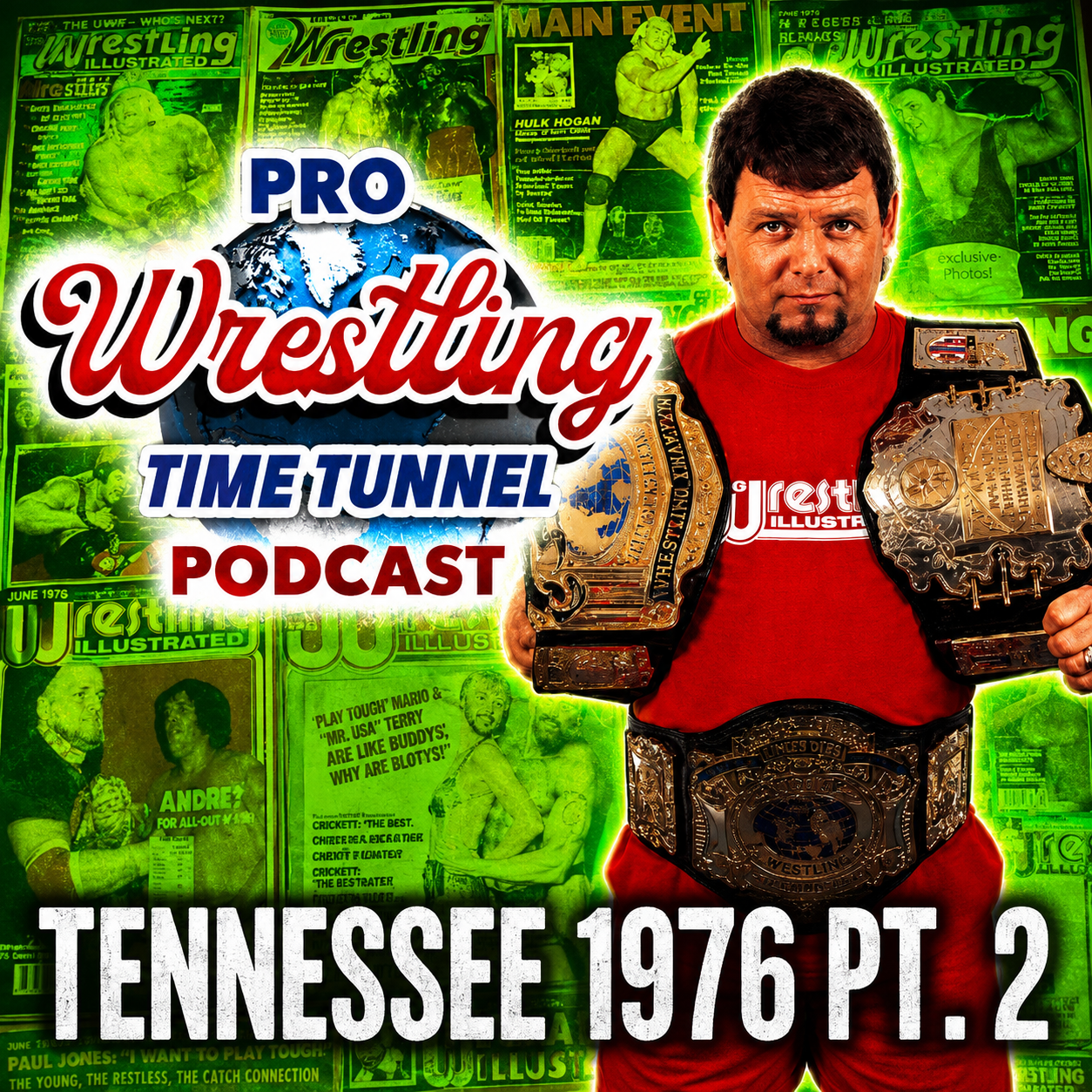
And now we're going to follow up with part two. We're going to do the second half of 76 with Tennessee Wrestling historian Tim Deals. We're going to tell you a lot of Tennessee Athletic Commission stuff, a lot of behind the scenes things, a lot of things that happened before you get to 1977 and the breakup of the Tennessee territory between Jerry Jarrett and Nick Goulas.
There were seeds being planted back in 1976 and there were some interesting things that were being applied for. The contract on the Mid South Coliseum was very interesting.
Jerry Jarrett applying for some Tennessee Athletic commission licenses in 76 was very interesting. So I think sometimes, and Tim and I hit on this I think sometimes when the story is told about the breakup, it was, well, Jerry Jarrett and Nick Goulis and Jerry found out he wasn't a partner and yada yada, yada, boom, they split.
But there was a whole lot more to it. And it also gets blamed on George.
So yeah, Nick was pushing George and Jerry didn't like it and they split, yadda yadda yadda and boom, there were two territories. Well, there's a lot in the yadda yadda yadda's that people don't really talk about. And as we get here toward the end of 76 and next year when we go into 77, we're going to go in depth on everything that happened, created and caused the split. And actually everything from 77 to 1980 is going to be really interesting between the two parts that used to be one big territory in Tennessee. So we're going to have that also. I'm going to welcome Randy Hales to the show for the very first time and we're going to tell some of the Randy Hales story here on a very Tennessee centered episode. But in the middle of it, I'm going to go back and do another installment of Dorie funk's career in 1966 in West Texas. And we're in January of 66. Last time we focused on Albuquerque, New Mexico. Today we're going to focus on the town of Abilene, Texas. And there's a lot of interesting things. Don Slatten has bought the town from Benny Wilson the year before in 1965. We're going to cover that. We're going to talk about the two buildings that wrestling was held in Abilene. The Key City Sportatorium and the Fair Park Arena. We're going to talk about the cards. There were four cards in January in Abilene. We'll cover all that. We'll get to it in our second segment today. So Tim deals to start the show. Tennessee, 1976. Me in the middle of the sandwich with 1966 West Texas. And then welcome Randy Hales to the Richards Ranch and we'll talk about the Randy Hales story all on today's big episode. What do you say we get started and let's go to Tim Deals here at the Richards Ranch and Tennessee part two, 1976.
All right, we're in 1976 and first of all I want to thank everybody because you made that Tennessee episode our most watched and most listened to episode of the pro wrestling Time Tunnel. It's, it's now the number one Listened to and watched show that we've ever done before.
So I didn't want too much time to go by before we continue the story.
And the story is 1976, and Tim deals, who is a Tennessee wrestling historian, is here. Written a couple of books about Tennessee wrestling history, and always knowledgeable and helps guide us through a lot of these things. And I pitch in where I can, based on my memories of the territory, especially on the western end.
Tim grew up on the eastern end of the territory. So both of us together, we at. This territory is so huge, it takes two of us to kind of COVID it. So. How you doing, Tim?
[00:14:32] Speaker C: I'm good. How are you, Tony?
[00:14:33] Speaker A: I'm good, man. I'm so glad to be back with you again and get back to this story. So, 1975, as we're wrapping that up, Jerry Lawler has come back. He's now again the King in Tennessee.
He got into a little program with Ricky Gibson at the beginning of 76 over the southern title. He got into a program with Tommy Wildfire Rich, who that was his very first big singles push. He won the Southern title from the King. And they had a little program going through the spring of the year over in the eastern end of the territory. In the Chattanooga, Birmingham end, Jackie Fargo and the Fargos are battling with the Bicentennial Kings.
So, I mean, we got main events out the wazoo across this huge territory.
Just. I mean, they always have so much great talent and so many great options to things going on.
[00:15:33] Speaker C: Yeah, absolutely. And as we move into, you know, the spring and the summer with. With the group, you, You. You know, things evolve, things grow.
We've talked a little bit before about things you can watch from 1976 on YouTube. And there's some stuff out there from the spring in Memphis, where you can see Lawlor, but it's also where Lawler, in the spring and into the summer is partnered with Plowboy Frazier.
And Frazier plays kind of the dumb lackey of sorts for Lawler, and they eventually turn Frazier, with the help of Jerry Jarrett, into a hero.
In that summer, you have Plowboy Frazier as one of the good guys.
[00:16:25] Speaker A: We also got, at the end of 75, we got Bill Dundee turned into a baby face also.
And the seeds were planted for Dundee and Lawlor back then.
They're saved. Jerry Jarrett has got that in his back pocket, though. He's saving that.
And, gosh, we had Roosevelt Jones come into the territory, who would later become S.D. jones.
[00:16:51] Speaker C: Yes.
And if he had come along, maybe in the Attitude era, they would have probably called him STD Jones, you know.
[00:16:58] Speaker A: Oh, yeah, that's right.
[00:17:00] Speaker C: Bad joke there. But yeah, Rosie Jones.
[00:17:03] Speaker A: We had Randy Fargo make his debut as a Fargo brother.
We just had a whole lot going into 76, and we had Big Bad John come in, who would become the Bicentennial baby, and he and Bill Dundee would form a tag team.
We had a lot of things. Now as we go in, we also talked a little bit about the formation and the foundations of the uwa, which is coming in with Luthes and Buddy.
[00:17:37] Speaker C: Buddy Lee.
[00:17:38] Speaker A: Buddy Lee, who's the Nashville talent booker for country music.
Those guys teamed up along with Danny Davis of the Nashville Brass. Not Danny Davis. Not either one of the. Danny Davis of the wrestling.
Not the wrestler or the referee, but a third Danny Davis, who was the leader of the Nashville Brass and he financed part of the uwa. So we're going to talk more about the UWA this time.
We're going to talk about.
We're going to talk about a couple of terrible tragedies that happened, and the seeds of the split are going to continue to happen that we would eventually see in 1977. So where do we want to pick up and start off, Tim, from where we left last time?
[00:18:27] Speaker C: Wow. Let's.
Let's see, let's.
Let's talk about maybe a little bit about Big Bad John.
[00:18:36] Speaker A: Okay.
[00:18:38] Speaker C: For those who were around and saw him in his prime, he was. He was not a great worker or great in ring, but he had a gigantic personality, contagious personality. And to have him come in in the red, white and blue and like you said, on the western end, he and Bill Dundee were a tag team and, and held the titles for a while. He eventually comes over to the east side and there he gets involved with Jackie Fargo against the Bicentennial Kings, Hickerson and Condri.
And so you have.
[00:19:18] Speaker A: Well, I was just going to say for those of you who are not familiar, maybe this is your first time listening and you're not familiar with the Tennessee territory. The wet. When we say the west end, we're talking about Memphis, Louisville, Evansville, Lexington, Kentucky, Jonesboro, Arkansas. That's kind of the west loop. And then on the east end, we're talking about Birmingham, Alabama, Chattanooga, Tennessee, Nashville, Tennessee, and Huntsville, Alabama. So. So those are the two ends of the territory.
[00:19:50] Speaker C: And that becomes more defined after the split than before.
[00:19:53] Speaker A: Right.
[00:19:54] Speaker C: You know, I mean, we're kind of talking getting a little ahead of the game when we say east and west, maybe, but. But it was kind of loosely Defined that way. Anyway. What you saw in Nashville, you probably saw in Chattanooga. What you saw in Memphis, you probably saw in Louisville. And some of that goes back to kind of maybe getting ahead of ourselves here. Some of that goes back to the fact that it was Jerry Jarrett who Louisville and help open Louisville up. And he went to Lexington and opened Lexington up, went into Evansville and revived wrestling in Evansville. And he did that over the course of a number of years, beginning in the late 60s and into the 70s. And when. When the split came, and just to
[00:20:35] Speaker A: throw in, I think it goes back further, those were Roy's towns in the West End. Roy Welch got really involved in Memphis, and he. He was really involved in the western side. And he was the mentor for Jerry Jarrett. So when Jerry took over kind of for Roy, he kind of took over that west side. And Roy and Nick always kind of split up. And one did one end and one did the other.
[00:21:02] Speaker C: Yeah. Even though their names were always together almost. And it was, you know, it was a company that they. That they both owned and both were involved in.
And so, yeah, you can't get very far away from Goodwiss Welch. Even though at this time Roy is.
Health is declining and he's not as active, maybe even at all in the business at this time.
[00:21:28] Speaker A: I don't think he was. And I think I might have mentioned it last time, but just for continuity's sake, in case I didn't, Buddy Fuller moved back from Florida to Tennessee and started developing farms and started doing land development. And he'd buy these farms and clear them up and clean them up and sell them. And part of the reason he did that was because he wanted to take care of his dad, who had become very incapacitated with.
As Alzheimer's was steadily increasing.
And I think I talked about last time, maybe we discussed how sad it was when I went back in the research of, say, from 1968 up through 1977, all the newspaper ads of the things that they were selling that they own personally there. There were several implement sales and they were selling the dairy farm. And Bob Welch was in charge of that, which was Roy's wife. Right.
Yes. And I. And I'd learned, I think, from Jimmy golden was the one that told me that Buddy had a house on one of the. Whatever farm Buddy lived on.
Buddy and his wife had a separate house that Roy lived in. And they took care of him there and they took him out. One of his favorite things to do was to go out for pie and they'd take him out for coffee and pie. And then I think toward the end of 76, it became kind of unmanageable to take care of him. It was more than he could handle. I think anybody who's ever been around someone who's been afflicted by that terrible disease understands and knows that there are days they don't know who they are. They get very violent, they get very disoriented. And they really needed to be in a facility where they were better equipped. And so they moved him over to that facility in Trenton, Tennessee, where he would pass away in 77.
[00:23:35] Speaker C: Yeah, yeah. Very sad. I do know in looking through this, one of the things I found was Buddy Fuller having a wrestling school in Bolivar, Tennessee around this time. I think it was August or September, there was an ad in. In maybe the Jackson newspaper or Memphis or Memphis newspaper, one or the other where Buddy was saying, hey, you know, if you think you're tough enough, come on out to the farm.
[00:24:03] Speaker A: And Buddy would. Buddy would do that to supplement his income for the rest of his life. I mean.
[00:24:08] Speaker C: Oh, yeah.
[00:24:09] Speaker A: Down in Alabama. I remember seeing on a video clip of him and Gordon solely talking about his wrestling school.
[00:24:15] Speaker C: Yeah.
[00:24:17] Speaker A: I think they even. That's how Plyboy Frazier got in the business, was he went down to Loxley, Alabama, to the ranch down there.
And we've told that story before where Buddy told him, you know, if you could beat my referee, then we might train you. And the referee was Charlie Carr.
And Plowboy Frazier said he would never forget the, the, the butt whooping he got that day. But I think Buddy did that a lot. He opened up wrestling schools to help supplement. And I mean he was just. Buddy Fuller was a money making man. I mean he. Everything he did made money almost.
[00:24:56] Speaker C: Yeah. And following. Following in the footsteps of his father, no doubt having learned a lot from. From his father and from other experience as well, obviously.
[00:25:05] Speaker A: And you know, Tim, another thing. And we could do a much deeper episode sometime on Roy and his death and all, but I always think about how we didn't know anything about CTE back then.
[00:25:18] Speaker C: Yeah.
[00:25:18] Speaker A: And understanding how Southern wrestling works is that. And I've got so many. Well, don't have a lot of them, but I got a few photos of Roy just really having the tar beat out of him because that's how baby faces got over, was they took hardway beatings to get over and get the heels over so they could make a comeback later on and have a blow off to the feud. And Roy took a lot of hard, hard beatings and so did that contribute to his mental condition? I don't know, but you have to think it must have played some part.
[00:25:55] Speaker C: Yeah. When you. When you learn how his latter years were, you do think that. And that's something that I've thought about, as, you know, did.
Did all those years in the ring just finally catch up with him. Yeah. And.
[00:26:11] Speaker A: And Buddy, you know, Buddy took some of those. In some of those matches with Mario Galinto, he didn't take as many as Roy, but he came back only a few times. But when he came back, he drew huge crowds and made a lot of money. You know, Roy was taking them, you know, weekly at the Hippodrome in Nashville, so.
But that's what baby faces did back in those days.
[00:26:35] Speaker C: That's right. But we got a hot.
A hot heel, though, in the territory. That's Jerry Lawler.
[00:26:40] Speaker A: Yes.
[00:26:40] Speaker C: And one of the things that happened a few years earlier was the ascension of Jerry Lawler that Jerry Jarrett promoted, where it ended with Lawler going through a series of contenders to eventually get a world title match. And they do something similar in the summer of 76 in Memphis because you see Jerry facing guys like Harley Race.
Jack Briscoe comes to town. Dori Funk Jr. Comes to town. Actually, Jack Briscoe comes to town and wins the Southern title one week and then drops it back the following week. And it culminates in late August with Jerry Lawler getting a title shot against Terry Funk, who is the NWA Champion at this time. And then they run a return match in October that has some, you know, Lawler claiming the world title.
[00:27:33] Speaker A: Yeah, he comes out on television. He comes out on television. It's on YouTube. He comes out on television with Lance Russell and claims that he.
He's won the title. He doesn't have the belt, but he has the title.
[00:27:45] Speaker C: Yeah, the claimant.
Title claimant.
[00:27:48] Speaker A: That's right.
[00:27:49] Speaker C: Yeah. And, you know, for. For those of you who. Who may have seen Lawler as somewhat of a heel in the 90s and beyond with the WWE or whatever, you really need to go back and look at that 76 stuff, because he is gold as a. As a territory hill in this. I mean, just the arrogance and the condensation and the. The interviewability, man, I just wonder.
[00:28:14] Speaker A: I just wonder if that little exile that he took in 75 didn't motivate him to really put himself into. I mean, he.
He just probably was just so glad to be back home, and he was probably much more agreeable to with Mr. Jared at that point.
[00:28:36] Speaker C: Yeah.
[00:28:38] Speaker A: Another Thing I was going to mention too, I don't think we said it last time, but Roger Kirby comes in.
[00:28:44] Speaker C: Yeah.
[00:28:45] Speaker A: On the east end in Nashville and wins the Mid America heavyweight title. So he's going to be defending that title over on the east side for the summertime.
[00:28:54] Speaker C: Yeah. And we get the Mid America title kind of brought back to the forefront of the eastern side. You know, the southern title has always been the, the major championship. We get the Mid America title. And it didn't just come out of nowhere. This Mid America title had roots going, going back to the 1950s when Buddy Rogers held it in the territory. But they, you know, for whatever reason, it, it would remain quite. Mostly, I think, because tag teams were in vogue a lot of the 60s and they didn't necessarily push a single star until Lawler came around. And then. So on the eastern end, you need a champion. And, and Roger Kirby is that guy. And Roger Kirby, I thought was. Was a great heel. I've got a. I'll tell you an interesting Roger Kirby story that probably Roger Kirby, God. God rest his soul, never heard, but I. I would hope he would get a kick out of it.
When Roger Kirby was in, in this territory,
[00:29:55] Speaker B: little.
[00:29:56] Speaker C: How old would I have been? 12 years old, maybe.
Probably 11 or 12 years old at the time.
I have a nephew who is five years younger than me, and he was visiting on a Saturday afternoon. And we had channel 12 wrestling on Chattanooga, out of Chattanooga on the, on the tv.
And one of the things that I had at the time was a BB gun, pistol, had the CO2 cartridge in it, you know.
And so we're watching this Channel 12 wrestling. And I believe Roger Kirby and Gorgeous George Jr were a tag team maybe at the time.
And they're, they're just nefarious on, you know, in the ring doing all these shenanigans.
And my nephew, who would have been, I don't know, 6, 7 years old at the time, he took that BB gun, thought the safety was on, pointed it right at the TV from across the room, centered it with a BB.
Now you got to remember these TVs back then were just. They were boat anchors, you know.
[00:31:02] Speaker A: Oh yeah.
[00:31:03] Speaker C: And. And it just left a little hole in the tv. Didn't blow the TV up or anything.
I'm sure his dad just worries hideout for that. But I've often thought, man, I wish I had met Roger Kirby to tell him that story that he got shot on. On Chattanooga TV by my nephew with a BB gun in 1976. And of course, we were so Redneck at the time. We kept the TV for years.
[00:31:28] Speaker A: Oh, sure, yeah.
But we'll just watch around it.
[00:31:33] Speaker C: That's right. That's what we did. But Roger Kirby was a great heel. I enjoyed him here. And he had worked on the eastern end prior to this, I think with David Schultz as a tag partner. But he comes in and this the whole summer on the eastern end, anchored by Roger Kirby as the Mid America champion, I think was probably booked by Robert Fuller because you come in and you see Robert in here in a lot of these matches in July and August.
But the. The talent they use and the way they use it is like Robert Fuller would have booked small core group and you just mixed one or two pieces up week after week and you can run it. You know, it ran. They ran these shows with these guys, same crew of guys from June, July into October probably.
And so you had Roger Kirby, Gorgeous George Jr. The Superstars, Dick Dunn and Tarzan Baxter came down from Knoxville as mass tag team and they eventually were managed by Big Bad John who was injured. And you know, somebody that exciting on the microphone, you got to use him. He can still bring a crowd in, so you make him a manager. Robert Fuller, Bob Armstrong come in. Just a good group of talent. Norvell Austin, Butch Malone, another very underrated competitor at the time, Bill Ash and David Schultz, just some great talent that came through in the summer on the eastern end.
[00:33:06] Speaker A: By the way, I heard from Ron Fuller while we were in Waterloo, this just one of those random things we were talking about. But Tarzan Baxter was trained by Buddy Fuller and he was trained when Buddy was in Memphis in the early 60s. He trained him out there. And one of his training barns or whatever it was that he had, long,
[00:33:32] Speaker C: long time Gulf coast mainstay. You know, a lot of those guys are forgotten. They didn't have to go anywhere. They made money there and they homesteaded there and they, you know, just were so good. The booking was so good and so consistent. It never really grew stale there. They were always able to keep things moving along.
[00:33:55] Speaker A: I always thought of Tarzan Baxter in that same Dick Dunn mold, you know, that he worked under a mask sometimes and he was a wrestling pro. And yeah, he worked as himself and this, that and the other. A couple other. Just little things I wanted to mention is. And you wouldn't have really noticed it at the time because when a guy is out there in a preliminary role or in a carpenter role or a job role or whatever, you just don't think too much about it. But this is about the same Time, if you were watching television on the east end, you would have seen Bobby Eaton, who started working the territory about this time, just working, putting guys over and just, you know, had been on the ring crew and would set up the ring in Huntsville and do things around there. And while, while they were waiting for the show to start, he'd get in the ring and bump around and do some things. And finally somebody said, hey, we would just use this kid, you know.
[00:34:52] Speaker C: Yeah.
[00:34:52] Speaker A: And so he started appearing just on spot shows and things like that.
The other thing was Mr. Nashville, which was Phil Hickerson under a mask and as a good guy, as a, as a baby face. And he gets unmasked by Dr. D. David Schultz.
[00:35:17] Speaker C: Yeah. So I think they ran an angle where Schultz and Ash, who were a really good tag team, they weren't really weren't together for very long, but you know, even then Schultz had the big hair and, and Bill Ash was always one of those underrated guys, even later in his career who, who just knew how to work in the ring. And they were a little brash and cocky and somewhat in the mold of Hickerson and Condrey and how they presented themselves, obviously different physically, but I believe they gave a beat down to Jerry Jarrett, maybe in Nashville. And of all people who'd come running in to save Jerry, Jared, it was Phil Hickerson. And I, I imagine it was one of those deals, everybody's gone and nobody would, you know, you got to talk Phil Hickerson into coming in and clearing
[00:36:06] Speaker A: house and, and but Phil, everybody else has already left the building to go to the show tonight.
[00:36:12] Speaker B: Right.
[00:36:12] Speaker C: And Phil had lost a loser leave town match, I believe, on that card. And so he couldn't come back as Phil Hickerson. Right. But he came back as Mr. Nashville the next week or two before he's unmasked. But yeah, that's interesting that they would turn Phil Hickerson into a hero right in the middle of this bicentennial King Heel run.
[00:36:34] Speaker A: And yes, and. And here's another thing that just occurred to me to bring up, just to provide a little window into this time period.
A guy could lose a loser leave town match in Nashville and still work the other towns of the territory because he lost it. The town was Nashville.
It wasn't a loser leaves the territory match, it was a loser leaves town match. So he just didn't get booked in Nashville again while he worked some of the other towns. And because you didn't know what went on in the other towns. Nobody new.
[00:37:10] Speaker C: Right. You didn't have you.
[00:37:11] Speaker A: You.
[00:37:12] Speaker C: We weren't privy to a newsletter telling us this.
It might, maybe might get reported in a newsstand magazine. But how, you know that's going to be four or five months before you even read that. And not everybody would read that.
[00:37:27] Speaker A: Right. It reminds me of.
And this is. This perfectly describes wrestling, but I know you are going to get this because you're of the same time period as me. But the show all in the Family.
[00:37:40] Speaker C: Yeah.
[00:37:41] Speaker A: Archie Bunker is watching wrestling in an episode and one of his neighbors or friends or somebody comes by and says, you watch that pro wrestling.
And Archie Bunker goes, yeah, I like it. He goes, well, don't you know those two guys know who's going to win? And Archie goes, yeah, but I don't exactly. That's pro wrestling.
[00:38:04] Speaker C: That's it. That's it. Right.
It's the, it's those of us who love stories, right. The storytelling aspect of things. You don't know what's going to happen, where is it going to turn.
And this is one of those moments, right? Who would have thought Phil Hickerson, right. And when Phil Hickerson came out in Under a mask is Mr. Nashville with that body. You had to have known it was Phil Hickerson, right?
[00:38:31] Speaker A: Yeah, it was like don Green as Mr. Wrestling.
I mean, there's no way you don't know who that is, particularly when he talks. Yeah, absolutely.
[00:38:43] Speaker C: He had that deep Southern Southern gentleman accent. And I can remember my uncle being at my uncle's house one time and wrestling was on and they interviewed Mr. Wrestling, who was Don Green. And my uncle just watched it intently and then he looked at me and goes, I think that's Don Green.
[00:39:02] Speaker A: They kind of move Hickerson going into the July in the summertime, they move Hickerson and Condrey over to the West End. Yeah, Memphis is still. I mean, Memphis is having a great year in 76. They're drawn between nine and 10,000.
Yeah. And Hickerson and Condrey won the Southern tag titles on July 19.
And you mentioned the Lawler's run there. He defeated Harley Race and he also defeated Bobo Brazil special matches and held the Southern title.
Rocky Johnson started the boxing versus wrestling matches with Lawler.
And it's a little confusing sometimes because I know Jarrett did those things too after the split, but they started them here back in July of 76, which kind of fell in with all the Ali and Anoki stuff, you know.
[00:39:56] Speaker C: Yeah, it was. It was a complete lift from that. And what's interesting, you and I Before we went on air, were talking about some of the stuff I've looked into with the Tennessee Athletic Commission and they were not happy about a boxer versus wrestler match because you one of them has to have a boxing license. You know, I mean it was just, you know, the commission was so out of touch with what was going on.
And so they I believe stopped one of the matches originally from happening until it was decided to go forward with it. But that was a big push in the business of Pro Wrestling in 1976 and I'm sure you've talked about it on some of your other podcasts. Ali Anoki was.
Was very prominent in the Northeast and you, I mean you had a lot of big names involved in the, in that promotion for a closed circuit event.
Nashville was going to run the Ali Anoki show. There's some stuff that indicated Nick Goulis was going to run that program at the auditorium, but I think he pulled out at the last minute. I don't know that it would have had a large appeal in Nashville.
I think Memphis did run it, Atlanta ran it. But that whole idea of boxer versus wrestler is where Jerry Jarrett got this idea for Jerry Lawler, Rocky Johnson.
And it's Rocky had appeared a few times in the territory. But this is really Rocky's grand entrance into becoming one of those guys who was a big name in the territory.
And it's with his program with Jerry Lawler.
[00:41:41] Speaker A: Before we talk about the big tragedy at the end of July, let's back up talk about one that happened just a couple of months. And what's interesting is they were both managers.
In April the Sir Clements passed away. Yeah, he was, he was a very big time draw and met heel manager in Tennessee and in Georgia. I don't remember him being big in a lot of other territories. No, but he was, he was a major piece of of the Tennessee territory in early 70. Managed the greens, right?
[00:42:16] Speaker C: Yeah, yeah, managed the Greens while they feuded with Jackie Fargo. The infamous Al Green Jackie Fargo hair feud. Yeah, Sir Clements was involved in it. And Clements for man for three or four years was just a constant in, in the Tennessee territory.
And you know, he was a smaller guy. He was a junior heavyweight.
[00:42:43] Speaker A: He is British, right?
[00:42:45] Speaker C: British. His father was Ted Beresford. His real name was Stephen Bearsford. I may be saying that that last name wrong. But his father Ted promoted work in ring and then later promoted with Norman Morrell in England. So Sir Clements came by this honestly. I mean this is something that was in his blood when he came to the States he was a junior heavyweight, so he could. He was one of those other guys. We've talked about this before as a manager. You got to step in the ring, got to put the tights on. And he was willing to do that because he had done it before.
Manage the Greens. And that was his real big. The Greens and the Kangaroos. He managed Don Ken and Al Costello when they had a run in here after George Cannon left. He managed Al Costello and Don Kent.
73. Maybe he was.
[00:43:37] Speaker A: He was Steve Clements in Tennessee, and it was Dudley Clements in Georgia.
[00:43:42] Speaker C: And in Georgia, he was there at the same time Gary Hart was. And he was Gary Hart's assistant manager. I don't know if folks remember that.
[00:43:52] Speaker A: The cornet down there.
[00:43:54] Speaker C: Yeah. If. If Gary Hart wasn't on the show, Sir Clements or Dudley Clements was on the show and. And that. That was where he was before he left and worked in the Michigan territory, in the Detroit territory. And unfortunately he passed away April of 1976 in Ohio from. From a car accident. He was managing Brute Bernard at the time, and Brute survived the accident, but Sir Clements unfortunately did not. And, you know, he's one of those guys that when we, you know, we do speculation on this show a good deal, and he's one of those guys you've got to think would have been back in the territory at some. At some point because of his history there.
That would have been interesting. One of the things that I. When I got to thinking about this, I thought about a time in the early 80s when Alfred Hayes was in the Carolinas and Billy Robinson was there, too.
And they paired up Al Hayes. Lord Al Hayes is the manager to Billy Robinson. So, yeah, that double British thing going on. And I thought what a great tag team or great trio it would have been to have Sir Clements manage Les Thornton and Tony Charles as a heel team.
You know, they could have worked Texas. They could have worked the Central States, Gulf coast, maybe. Florida, maybe.
[00:45:20] Speaker A: Well, they sort of followed up on Clements being in Tennessee with Barnes and Dundee and John Gray, who were British and Australian.
Well billed. And he's Scottish, but he came from Australia and always was Billed from Australia.
But. But Clements really kind of started that.
That British heel, this guy's not from around here kind of thing.
[00:45:49] Speaker B: Yeah.
[00:45:50] Speaker C: Carried an umbrella. Used an umbrella for a weapon.
[00:45:53] Speaker A: Sure did.
[00:45:53] Speaker C: It was.
[00:45:54] Speaker A: They wore a bowler hat too, didn't he?
[00:45:57] Speaker C: Yes, he did. And he also wasn't afraid to dress up like a woman and attack an opponent, which we. Which we've seen other managers in the territory. I'M looking at you. Jim Cornette, I think. I think Jim Cornette did that at some point in his career, too. Yeah.
[00:46:10] Speaker A: And that's what I was referring to because they, you know, around 82 and 83, they use cornet as like a little protege to Jimmy Hart.
[00:46:18] Speaker C: Yes.
[00:46:19] Speaker A: And Clements was kind of that to Gary Hart in Georgia.
[00:46:22] Speaker C: Yeah.
[00:46:24] Speaker A: The second tragedy, which happened in July. Clements died in April and at the end of July, and I think it was right after the Harley race match in Memphis.
July 27th. Well, 26th was the night and the 27th was the early morning when they had the car crash. And Frank Hester and Pepe Lopez were in the car with Sam Bass when they crashed into the 18 wheeler around Dixon, Tennessee, which is close to around Jackson, isn't it?
[00:47:00] Speaker C: Yeah, it's about 50 miles west of Nashville. So it's probably about halfway between Nashville and Jackson.
[00:47:10] Speaker A: They had dropped somebody off in Jackson, hadn't they?
[00:47:13] Speaker C: Bill Hickerson.
[00:47:14] Speaker A: Yeah.
[00:47:15] Speaker C: One of the. One of the things that I was able to do 20 years ago or so was interview Jerry Jarrett and. And I was able to just sit down and sort of mostly chronologically go through his career. And we obviously came to this point in time and he talked about later, Phil Hickerson saying he got out of the car in Jackson and kissed the ground because Sam Bass was driving like a maniac.
And so Phil rode with him to Jackson. Phil lived in Jackson. Most all the wrestlers lived in Nashville. So they. Everybody was headed back to Nashville, which was home.
And so Phil was fortunate that he lived in Jackson that night. And because of what happened, you know, probably an hour later,
[00:48:07] Speaker A: I did a big article on this earlier a week or so ago, and I was talking to Scott Teal about it. And one of the things I learned that I didn't know is that most of the photos out there of the Mass dominoes are not Pepe Lopez.
Yeah, most of them are. Bulldog Ellis, isn't it?
[00:48:29] Speaker C: Cliff Lily.
[00:48:30] Speaker A: Cliff Lily, that's right.
Bulldog. Cliff Lily.
[00:48:34] Speaker C: Yes, yes, yes.
[00:48:35] Speaker A: Bulldog. Cliff Lily.
And he left the territory. And that's where Pepe Lopez took his place under a mask as a Mass Dominoes.
[00:48:43] Speaker C: You'll see some shows in, I think, May, maybe early June, where it's maybe just one of the dominoes working a card. And. And so that must have been that transition period until they found someone to plug in that spot in that spot for. For Cliff Lilly, who. Who, you know, I don't know what happened. If it was an injury, if he was just fed up, decided to leave or whatever.
They, at the time, the dominoes were moving from the eastern side of the territory to the western side of the territory they had been in. I don't know, maybe March is when they came in.
[00:49:22] Speaker A: And yeah, I think in a brief time there, Lily worked on the east or west side and. And Lopez worked east.
[00:49:32] Speaker C: That could have been. Yeah, yeah, that's.
[00:49:33] Speaker A: I think for a week or so. Yeah, because one of them, one, I think Lily worked in Memphis and maybe Lopez worked Nashville there for about a week and then Lily left.
[00:49:46] Speaker C: Yeah, yeah, there, you know, there's some indications of, of a route, you know, when that happened. It's interesting though, because they were moving to Memphis and.
Or the western end, some of those other cities, they had moved them over the dominoes. Their gimmick, if you will, where you had a tag team where one man was white, one man was black.
They had these stark looking outfits that were black and white. You know, the upper left might be black, but the.
Your right leg and would be. Would be black and the other side be white. You know, it was a very unique looking outfit for the time. And their manager was JC Dykes.
[00:50:36] Speaker A: Frank Hester was the black fella. And yeah, yeah, Dykes was their manager. And the impact on the territory with losing Sam Bass was humongous.
Yeah, I mean, it was a big, big removal of a heat drawing component. What I know you mentioned to me you were. Want to talk about the impact on Lawler. How would you describe that, Tim?
[00:51:04] Speaker C: Well, you know, at this point, Lawler
[00:51:08] Speaker B: was,
[00:51:11] Speaker C: was the, the top dog. And they were in the middle of this program in Memphis where he was being pushed to the top or being pushed for a world title match.
[00:51:22] Speaker A: Well, the last picture of Lawler and Bass was the night of the Harley race match.
Yes, they're standing in the ring together.
[00:51:29] Speaker C: And so that was one of those matchups where Lawler had to prove himself, where he had to win in order to still be in contention for this world title match. So they brought in a former NWA champion Harley race, who worked the territory from time to time, but usually in a special role like this.
So you, you. That program, you know, continued even without Sam. But you have to wonder, Jerry lived in Nashville at the time too, even though he's so associated with Memphis, but because of the territory and traveling, he still lived in Nashville. And so he could have been in that car that night with Sam.
In his book, Jerry talks about having. We talked about this last time an association with a fast food restaurant called Slam Burgers, which was On Summer Road, I believe in. In Memphis. And they use his artwork and they use his image to. To sell fast food. And Jerry, you know, probably had a little bit of a piece of the action there, but that night he had a meeting with.
With those business partners in that.
In that restaurant, and that's why he wasn't in. In the car.
Now, you could play what if here. If he had been in the car, had he. Would he have been able to tell Sam, slow down or let me drive?
You know, you could play that speculation. But if. If he had been in that car and had been in that crash.
Wow. I mean, you look at the impact of Jerry Lawler from this point forward after the accident, what do you have? I mean, where would you go? You would maybe look at Tommy Rich to carry the mantle or, Or Bill Dundee or.
[00:53:18] Speaker A: Or you.
[00:53:19] Speaker C: You hope Jackie Fargo's got a little bit more magic until you can find someone to fit that role.
Wow.
[00:53:27] Speaker A: I definitely think Tommy Rich doesn't go to Georgia.
[00:53:30] Speaker C: Yeah, I. I think he's the. I think he's the guy you turn to at that point.
[00:53:36] Speaker A: We mentioned the dominoes and JC Dykes. I mean, it had a big impact on Dykes, too, because he quit the business, right?
[00:53:42] Speaker C: Yeah. And, you know, let me. Before I get there, because out of all this bad stuff, and it is. Right. I mean, we lost Sam Bass and we lost Pepe Lopez and we lost Frank Hester.
There is a redemption out of it, and that's. That's the life of J.C. dykes after this.
But you also have to speculate someone. Frank Hester and Pepe Lopez, I think we. We kind of lose them in this.
They were both in their late 30s. They're probably the better part of the careers might have been over, which might have been why they were working under the mask. Although Pepe worked under the mask a million times.
[00:54:24] Speaker B: Right.
[00:54:25] Speaker C: And. But I could see both of these guys in the landscape that's ahead the next four or five, six years of, of maybe working Mid Atlantic, you know, where so many of those guys who'd been in the business for so long work the low, low card matches. Guys like Abe Jacobs, even Brute Bernard and some of those guys that had been main eventers. Sweet Hansen even did some of this where they were.
[00:54:53] Speaker A: Cowboy Parker and guys like, yeah, they were first.
[00:54:57] Speaker C: Steve Kovacs worked over there some too. They. They were guys who had talent, had been in the business a long time and were willing to. To take that role, to put others over, maybe on television, but to get a Win at the, at the house card every now and then. They could have both easily have fit in there and done that in Mid Atlantic or Georgia or Florida for the next four or five years. And I think maybe even Pepe after the split, you could have put him under a mask and, you know, he could have come in and challenge Fargo or, or a Bobby Eaton later on or Ken Lucas.
He could have been in, in those top roles as well, no doubt about it.
JC Dykes.
JC had been a referee in the territory early on.
He became friends with two guys who were super talented, named Rocky Smith and Frankie Kane.
And they went on the road under mask as the Infernos. And their mouthpiece was JC Dykes.
And from all accounts, JC Dykes was a heat magnet.
And you can see some of the clippings and, and things from, from Georgia, I think, maybe. Did they work the Carolinas in Florida, maybe? I know they worked. I know they worked Amarillo.
[00:56:23] Speaker A: They did.
[00:56:24] Speaker C: I know they were huge in Amarillo.
[00:56:26] Speaker A: They worked Los Angeles.
[00:56:27] Speaker C: I mean, Los Angeles. Yeah, they worked.
[00:56:30] Speaker A: They worked all those, I mean, most major territories you can think of in the southern part of the country.
Yeah, I mean, if you drew a line from across the country with, from St. Louis down, they worked everything pretty
[00:56:43] Speaker C: much for years, and we're talking 63, four or five somewhere in there. When they got together for, for seven or eight years, they worked together, and JC had come back at this point to manage the dominoes.
J.C. lived in Cleveland, Tennessee, which is from Chattanooga, about 20 to 30 minutes east of here.
And after this happened, J.C. just, he couldn't, he couldn't work in the business anymore, apparently. He struggled with alcoholism for a time, and his wife convinced him to go to church. And he turned his life over to God. And in the process, J.C. dykes turned his life around and he ended up owning a business called Dykes Sandblasting in Cleveland.
And so he became a, a, a businessman in the area. But beyond that, through his church work, he worked with a jail ministry in Cleveland in the Bradley county area for many years and did that until his death in the 90s. And so out of all the bad stuff, you do get the redemption of JC Dykes out of all this.
[00:58:01] Speaker A: Yeah, great, fantastic story out of a terrible tragedy.
[00:58:05] Speaker C: And let me, let me throw this one in there, too.
[00:58:08] Speaker A: Sure.
[00:58:09] Speaker C: 76 was really a bad year for these things. Sir Clements, Frank Esther, Pepe Lopez, Sam Bass, JC Dykes being impacted by this and the territory in Jerry Lawler, even though it didn't take his life, we Lost Danny hodge that in 76, too, because he was in a serious car accident in Louisiana, I believe, in the spring. And so, man, Danny Hodge, just a stalwart in the McGirk territory.
[00:58:43] Speaker A: Well, he was the NWA world junior champion, and he only had. He'd only had the belt for. Well, he had had it several times, but on this time, he'd only had it for a week or two.
And in March, he. He hit his car, ran into that Louisiana bayou, and he suffered a broken neck. And I did a whole piece on the physical therapy and the things that they told him, and they just thought he announced his career was over, and he did eventually make a comeback, but. But no one thought that he ever would.
[00:59:15] Speaker C: Yeah, well, you know, and Danny Hodge was one of those guys you never. You. You shouldn't have never given up on. Right, right. I mean, he was just.
[00:59:25] Speaker A: Well, you never would have thought he would have been injured to that level. It just seemed like Invincible Superman. Yeah, that's right.
[00:59:32] Speaker B: Yeah.
[00:59:33] Speaker C: Yeah. And he had been in the territory a couple of years earlier with us here.
[00:59:38] Speaker A: So to round out to July, Bob Armstrong beat Roger Kirby for the Mid America heavyweight title in August.
[00:59:48] Speaker C: Yeah,
[00:59:50] Speaker A: August 14th. And then his reign was pretty prominent. He was in Chattanooga, Nashville, Birmingham. So that Mid America title, as Tim referenced at the beginning of the show, was really coming to the forefront. And now you got two guys feuding over it. Very credible, very. Both very good workers, Bob Armstrong and Roger Kirby. Audiences were really treated to some fantastic matches there.
[01:00:15] Speaker C: Yeah, for me, the highlight, being on the Eastern end, the highlight of the whole year was this time frame. I was a big Bob Armstrong fan and was a big Robert Fuller fan, too. And so to see them in the area was. Was special. But to see them with guys like Roger, you know, some of these guys I'd never seen before, you know, that were new to the territory. Roger Kirby, Gorgeous George Jr. Came in. Gorgeous George Jr. Had a feud with George Goulis. For a time. They were a tag team. And then they.
George Jr.
[01:00:44] Speaker B: Turned on.
[01:00:44] Speaker C: On George and they feuded with one another for a time.
You had the spectacle of gorgeous George Jr. And the, you know, the golden bobby pins that he would throw to the crowd. And he either had a female valet named Suzette with him or he had a male valet with him called Sir Bradley during this time. And so, yeah, some of those guys were kind of unique to the area for us, anyway. And to see them in here, as I said earlier, pretty consistently for three or four months was a highlight of the Year for me.
[01:01:23] Speaker A: We mentioned earlier, but on the western end, Jack Briscoe beat Jerry Lawler for the Southern title on August 9th. They drew over 10,000 for that particular card. Lawler regained it just a few days later in a bank account versus title match.
Lawler put up his bank account against the title.
[01:01:48] Speaker B: Oh, wow.
[01:01:52] Speaker C: That could be good or bad depending on how much you had in that bank account.
[01:01:54] Speaker A: Right. I would think of the promoting Lawler with all these merchandising things and the Champ Burgers and all that. I think they were promoting him as having a pretty substantial bank account.
[01:02:06] Speaker C: Oh, but you know, but you know, Nick Goo has never paid those guys.
[01:02:09] Speaker A: Right, right.
Well, the other thing too is Lawler gets lost in all of this. You know, when you hear about videos, usually they start the history with the fabulous ones and all of those videos that were being done in 83 and 84. But Lawler was doing videos back in these days.
[01:02:29] Speaker C: Yeah, yeah. Bad news. You know, it came out. I remember, I remember seeing that one of the first times and thinking how unique it was, you know, because I'd never, you've never seen anything like that on a, on a wrestling show. All you saw were the interviews and the matches. You didn't see anything outside the studio or outside the arena.
So very unique for the time. And, and I think a lot of this is the, the foresight of Jerry Jarrett at the time. I, I, I, I really do believe for whatever you want to say about Nick Goodlis's ability to promote, he knew a way to promote. But at some point guys like Jerry Jarrett and Ron Fuller came along who had, who under better understood the value of television and video.
And so they were looking for new and different ways to promote the product they had. And one of those ways was through maybe a music video. Ron Fuller's show in Knoxville, Southeastern Wrestling.
And probably a lot of this is, should be credited to Les Thatcher.
They did this segment every week called Personality Profile. And it was more of a one on one interview that didn't just deal with, okay now, Friday night you got this match coming up. It was, you know, what are your hobbies? And you know, a little bit more of a personal, personalized interview that kind of made you realize that this guy is not just a brute.
Yeah, there's a little bit more to him. And, and so you see some of the softening maybe of some of these guys through these type of things. And I think it's just a new, newer generation of promoter coming along that sees the value in things like you Know, Nick, Nick always had newspaper ads and probably had radio ads at some point too. And they were reaching beyond that.
[01:04:29] Speaker A: August 22, the National Wrestling alliance world champion Terry Funk, who is had the title all year, comes to Memphis and goes to a one hour time limit draw with Jerry Lawler. And we mentioned earlier on television, Lawler comes out and claims that he won the match and that he actually is the new champion.
And it's just funny the way Lance. Oh, come on, Jerry. Come on, Jerry.
[01:05:00] Speaker C: You know, in October when they met, supposedly Lawler ran, grabbed the belt and ran back to the back and had a picture made.
[01:05:08] Speaker A: Yes.
[01:05:09] Speaker C: And there is a Memphis magazine cover with Lawler and the world title on there.
That's pretty rare to find, I believe. I think our friend Mark James has a copy of it.
But yeah, I mean that, making that claim to the world title.
[01:05:29] Speaker A: We always on a podcast here talking Memphis wrestling here about a week ago and we were talking about the Jerry Lawler Harley race match in 77 and somebody made the comment that they didn't think Harley was too fond of Memphis.
And I, I said, I, I don't think it was Memphis. I think it was Mike Shields he might not have been too fond of because of the creative video editing that they were doing.
Yeah, but I think they did that to a lot of guys.
[01:05:58] Speaker C: Oh, yeah, I mean, yeah, Jerry would
[01:06:01] Speaker A: look up, but Jerry would book a two out of three falls match and then the second fall the champion would get pinned and that wouldn't be the match, but that would be the finish they'd show on television.
[01:06:12] Speaker C: And that's the lasting image you had of it.
[01:06:14] Speaker A: Right, right.
[01:06:15] Speaker C: Yeah. You know, there you, there we go again, talking about this being being able to use the medium for what you need it for.
[01:06:25] Speaker A: Yeah, they're the, they're, they're continuing to draw over 10,000 to the mid South Coliseum even with the loss of Sam Bass as Lawler's primary manager. Which is really a testament to Jerry, I think.
[01:06:42] Speaker C: Yeah, it is.
And maybe to the program that he was involved with at the time where he was chasing the world championship.
But yeah, it is, it's a testament. And that's why I say go back for those who've never seeing Lawler in that time frame, go back and look at some of that stuff where you're talking about he comes out and claims the world title. You know, it's, it's a different Jerry Lawler than the Hill Jerry Lawler you would see in the 1990s or, or other time. And he, it's more localized, you know, it's more centered toward Memphis and the residents and citizens there. But it's still so good, you know, nobody can call me a redneck like Jerry Lawler. Right. And it make me angry about it.
He's just amazing in this time frame.
[01:07:38] Speaker A: I think the, the streak of fabulous workers holding the Mid America title ended on September 8 as Big Bad John took the title off Bob Armstrong.
[01:07:51] Speaker C: Yeah, yeah. I don't know why, I don't know why that happened. But John, as I said earlier, had been injured earlier in the year.
He wasn't a great worker anyway, but man, I loved him. I love to hear him talk.
[01:08:04] Speaker A: Well, his relationship with Bill Dundee goes back to Australia.
[01:08:08] Speaker C: Yes.
[01:08:08] Speaker A: I think where they originally met. Well, anyway, Bob Armstrong gets the title back two weeks later in Chattanooga. So it didn't last long. And then Roger Kirby won it back on October 3rd.
Birmingham and Nashville shows kept these title matches going. And that was just a. I wish we had all of that on videotape. For sure.
[01:08:31] Speaker C: John was a manager, I think I mentioned earlier, the Superstars, but he also managed Roger Kirby.
[01:08:37] Speaker A: Yeah.
[01:08:37] Speaker C: As well. And that's, that's kind of the involvement of Big Bad John into that. Roger Kirby, Bob Armstrong for you.
[01:08:43] Speaker A: September on the West End. Tommy Rich comes back into picture because he defeats Lawlor for the Southern title. Once Lawler gets through all of his world title matches and all this world title former champions Briscoe race, then he goes the hour with funk in September. Tommy Rich. Now what does this say about Tommy Rich after Lawler gets through all these legends, then Rich comes back and beats Lawler for the Southern title on September 14th.
[01:09:10] Speaker C: Yeah, go ahead, go ahead.
[01:09:13] Speaker A: No, I was, go ahead with your Tommy Rich thought.
[01:09:17] Speaker C: Well, I was gonna say Tommy had, had worked a lot of the eastern side, I think at this point with Tojo Yamamoto's tag partner.
But yeah, I mean you, you go back to what works and what worked earlier in the year. It was Jerry Lawler and Tommy Rich that kind of kicked off the big year really in Memphis.
[01:09:36] Speaker A: And speaking of that, Tojo gets a different partner, Bill Dundee, and they win the Southern tag title the Same Night on September 14th. Same Night, Rich won the Southern title from Lawler. So they had a big storyline change there in one night.
And Jerry Jarrett was very fond of doing these six and eight man tag team matches.
There were several of those multi man elimination matches and we get another little Jackie Fargo and Jerry Lawler run as well. But they continue to draw somewhere between 8,000 and 10,000 to the mid South Coliseum.
[01:10:16] Speaker C: Yeah, this is really the end of the Fargo. You know, they did work against each other after this, but this is the last kind of mini feud they had that stretched back what, three or four years at this, this point.
And it's another one of those things. Sometimes you go back to what works and see if it works again. And if it works again you write it until it doesn't work. Right. And.
And this is also Fargo's last time. The western cities, as we would. As we've been referring to them, we'll see Fargo for a time because. Because of the split in the next year.
[01:10:52] Speaker A: And for those of, those of you who are not familiar with the territory, most of the time whatever happens in Memphis goes through the rest of the western end on the next week.
So if, if Monday night you have a Lawler Fargo match the next week in Louisville, Evansville and Lexington, they would get that match because the television would be the repeat of the television in Memphis the previous week. So.
[01:11:19] Speaker C: Yeah, you know, you and I've talked too before how so many towns had their own show and, and it's kind of, I think maybe beginning in this time frame where they begin to figure out. Yeah, consolidate. Yeah. And begin to. To run one show. They still ran a show in Chattanooga. The eastern end still I think had shows in all their towns. But the Memphis show began to be run in these other towns. A little more economical for them to do that.
[01:11:46] Speaker A: We're also getting into the period too from here on where Harry Thornton health will start failing a little.
[01:11:53] Speaker C: Yeah.
[01:11:53] Speaker A: And he's intermittent and we get different fill in people and things start to break down in the territory from when it was the strongest.
[01:12:04] Speaker C: Yeah.
[01:12:05] Speaker A: Hickerson and Condre come back when the southern tag team titles in the western side and Jackie Fargo was involved in that in a reverse decision situation. They had some Texas death matches. Dorie Funk Jr. Was in the territory and they had some of those matches. Lawler and Dory Funk Jr. And lose or leave town stipulation match as well.
This is where business is cooling off a little bit in October. They're down to the 6,000 to 8,000 range in Memphis.
[01:12:41] Speaker C: Yeah, it probably did around the territory too.
You know, that's, that's one of those things.
Professional wrestling in the territories was cyclical. You know, you would have a hot period and you try to keep it at that level, but at some point it topped off and you kind of had to rebuild things. And I think that's where we are here maybe across the whole Territory.
And they do some things, you know, sometimes you think, why did they do that? And sometimes you, I think anyway, well, they did that maybe to try to drum business up. You had Tommy Gilbert go heal. You had Dennis hall go heel for a time too.
You know, those guys had never been.
They'd always been the good guys. They'd always wore the white hat. And you wonder sometimes if maybe that was to maybe shake business up.
[01:13:36] Speaker A: Rocky Johnson beat Lawler for the Southern title. No new November 1 we have the American Native American tag team of Danny Little Bear and Chief Thunder Cloud. They win the Southern tag titles during the month of November.
The more I get away from this time period, the more I can't buy into Chief Thundercloud. But yeah, Gordon, he was, he was very small. It's almost like the Indian headdress was longer than he was.
[01:14:09] Speaker B: Yes.
[01:14:09] Speaker A: Gorgeous George Jr, Dutch Mantell, Ricky Gibson, they were all working here during this time houses now down to under 5,000. I'd say somewhere between under 5,000 to 7,000.
Lawler began working more multi man tag matches and special stipulation matches without Sam Bass being around. So I think the impact of the Sam Bash car crash has something to do with this too.
[01:14:38] Speaker C: Yeah, yeah, maybe so. And you know, one of the things too that when I looked at some of this stuff, I, for my benefit, I kind of looked at it like, here's the guy, here are the guys that worked on the western side and here are the guys that worked on the eastern side. And then I had a middle row of these guys who work both and just, you know, just for my benefit. And you see a lot more of that crossover the last few months of the year. And you're wondering, or at least for me, I wonder, are they, you know, are they bringing Lawler to Nashville because business in Nashville is bottoming out and they need a shot in the arm there. Does Fargo go back to Memphis because of the same thing?
I think.
[01:15:24] Speaker A: And we're putting Nashville in the eastern side.
Really? Nashville would be that center column. Yeah, you know, it's really the town where everybody worked.
[01:15:34] Speaker C: Yeah, they all live there mostly. They mostly all live there too. And that was the easiest shot to make for most of them
[01:15:42] Speaker A: as we get into December.
I mean, the tag titles swapped around quite a bit between Hickerson and Kandry Yamamoto and Tommy Rich and some other people.
In December, Rocky Johnson defended the Southern title against the Mongolian Stomper and Little Bear and Thundercloud held the Southern tags for almost all through the end of the year. Almost on the eastern side, Nashville, Birmingham, Chattanooga, and Huntsville usually featured the Mid America title defenses
[01:16:20] Speaker C: overall.
[01:16:20] Speaker A: And we'll go back and pick up some of these other things that we wanted to talk about, like the UWA and Tim's mysterious timeline. But 76 was a very, pretty much a successful year. I mean, the first half was really hot, and the second half kind of cooled off. I mean, they were between 8 and 11,000 for most of the beginning of the year with the Tommy Rich push in Memphis. And I don't know, after the Sam Bass car crash, that's when it really started dropping off to the 4800-7000 range.
Yeah, yeah.
[01:16:57] Speaker C: You want to talk numbers right here?
[01:16:59] Speaker A: Yeah, yeah, go ahead.
[01:17:00] Speaker C: Financial numbers.
You know, these are numbers that were reported to the Tennessee Athletic Commission in the year 1976. And, you know, your. Your take on this is. Is pretty well spot on as far as deposits. Now, you and I both. We know. We know how that goes. You might get a check and you might hold it for three weeks before you deposit it or. Or be told, can you wait till two weeks to cash that thing?
[01:17:28] Speaker A: Yeah.
[01:17:28] Speaker C: So, you know, the reality of. Of when the money went in the bank and when it was made, you know, we. We can't determine that.
But In July of 76, the Tennessee Athletic Commission, and this is based off the. The 4% collection of taxes for wrestling matches.
They were taxed $14,308 and some change. That's what they collected.
So you run a little calculation on that, and you find out that the money that. That's taxed from would be $357,000 plus 1976 money.
If you looked at that in.
[01:18:14] Speaker A: And that's probably just. I mean, that's just Tennessee towns.
[01:18:18] Speaker C: That's Tennessee towns. You got to do. You do have to remember Ron Fuller is. Is part of the equation here, too, up in the East Tennessee corner.
[01:18:25] Speaker A: And his problem, his biggest town is Knoxville.
[01:18:28] Speaker C: Knoxville. He's probably drawing 25003000 a week in Knoxville. He's running some shows in Kentucky, too.
[01:18:36] Speaker A: You're pretty much got four main towns, though, that make this up. Right. You got Memphis, Nashville, Chattanooga, and Knoxville.
[01:18:43] Speaker C: That's right. And Jackson is. Is in the mix at times as well.
[01:18:47] Speaker A: Jackson.
[01:18:48] Speaker C: Right. If you inflated the July numbers, the 357,000 in more modern terms, that would come out to almost $2.1 million in. In money, where we're talking in 2026,
[01:19:03] Speaker A: and they ran like six states. And this is one state.
[01:19:06] Speaker C: Yeah, it's one state. Yeah, probably the, probably the most profitable.
[01:19:10] Speaker A: No doubt.
[01:19:11] Speaker C: But still, Kentucky's probably pretty close.
[01:19:15] Speaker A: Tennessee and Kentucky are probably the two states. They had the whole state.
[01:19:20] Speaker C: Yes, yes.
[01:19:21] Speaker A: The rest of the states were like the Pete or pieces of the state.
[01:19:25] Speaker C: Yes.
[01:19:26] Speaker A: Northern Alabama, northern Mississippi, southeast Missouri, northwest Arkansas. But Kentucky and Tennessee, they pretty much owned all the towns except for Ron Fuller's.
[01:19:37] Speaker C: Right, right, exactly.
August, the deposits were down 7,956 bucks.
That's almost $200,000.
You, you take in the inflation and that's $1.1 million in today's money.
That was August. Of course, that would have been an impact with Sam Bass, maybe September, $11,100 of tax money, that means about $275,000.
[01:20:13] Speaker A: No wonder they, what was it in 74, they moved out of the Sam Bass Hotel and built a big, big brand new office building. No wonder. Look at the. They had to spend that money on something. They had to reinvest it on something.
[01:20:25] Speaker C: That's right. And, and so if you inflated the, the $11,000 tax total and the 4%, it comes out to 1.6 million in today's money.
That was September, October, $8,100 of tax money, $204,000 of gate money.
And after the sponsorship money, which was negligible, that comes out to almost 2 million, or I'm sorry, 1.1 million, almost 1.2 million.
November 3696 in tax money, $92,000 dollars in gate money, $542,000 in modern day money.
And in December, 11 $68 tax money, $29,000 in gate money, and $171,000 modern day money. So you do see the drop off there. But again, we don't know, you know, when the deposits were made. We don't know from what dates they were. They were in there. Sometimes you would see in a commission report, so and so's not reported money from a month ago. You know, they've not received the money from a month ago. So we can't really tell other than just by deposits of when the money was made. But I think, I think we can draw some conclusion from it that the summer was really hot and it did dip off in the fall.
And for the year 1-1-76, 12-31-76, they collected $79,000 in tax money.
[01:22:01] Speaker A: Oh, man.
[01:22:03] Speaker C: And if you, if you look at the 4%, the gate that they, the gate money was 1.973 million.
And if you ran that through inflation, today's money, that would be $11.5 million.
[01:22:22] Speaker A: Well, I was calculating in my head real quick, quick there, and I thought, man, that's close to $2 million they made.
[01:22:28] Speaker C: Yeah, yeah.
And in 1976, money and, you know, 76, there was some inflation going on, and it was tough times. Maybe to some degree, gas was.
[01:22:39] Speaker A: Ever been before.
[01:22:41] Speaker C: Yeah, gas was big.
But, you know, they. They still drew a consistent number and they. They paid their tax money and. And had plenty left over.
[01:22:51] Speaker A: Yeah.
Wow.
All right, well, so when does the UWA kind of disintegrate here? It doesn't last the entire year of 76, does it?
[01:23:04] Speaker C: No. By August, they are out of business.
It's. You know, when you go back and look at it, we see that they went back into 1975, as we've talked about before, when everything was being formed and being pushed together to come together.
And they ran their first show at the very. They ran some chosen, we believe, in Kentucky in February and then in Nashville at the end of February.
Interesting that they run this big show in February, the end of February in Nashville, and they don't run another natural show for, like, three weeks.
Not sure why that happened. The one thing I'll say about this, as for Nick's involvement in this, Nick took this seriously.
I believe, you see on some of those cards in March and April in particular, he's bringing in guys like Ernie Ladd.
I think Andre came in for a show.
Bobo Brazil came in. He had moolah scheduled, and I think Mula wasn't able to make it due to an injury.
[01:24:19] Speaker A: This might be one of the few times that, I mean, Nick was extremely proud of his NWA membership. I mean, it's. It's on everything. You know, on the television show, on the rings, on everything.
But I don't remember him ever leveraging the power of being an NWA member like he does right here.
[01:24:39] Speaker C: Yeah. You know, and even within his own territory, he brings Lawler over, he brings Tommy Rich over. Tojo, who'd worked a lot of the Western side, comes over some, too. And he highlights, of course, Fargo and Hickerson and Condrey.
[01:24:54] Speaker A: We're in a fight over here. Boy, we got to have these guys over here.
[01:24:58] Speaker C: Yeah, he took it seriously, I think. And, you know, one of the things that we. You and I talked about on the last show was how in a newspaper article, it was said, I believe, by Luthez or someone with his organization. This is, you know, we're not going to be competition, you know, basically saying, there's room for both of us in Town and, and this, that and the other. Well, I think it's in that same newspaper article or in one that followed. Nick goes, if it's not a war, if you're not coming after me, why are you papering the cars in my parking lot at the show?
Right. Or your upcoming show. And so Nick, you know, Nick saw this for what it was. I mean it was an assault on his territory.
[01:25:39] Speaker A: Yeah.
[01:25:39] Speaker C: And he wasn't going to stand for it. And so from the get go he promotes some loaded shows.
Whether or not that's what slowed the UWA down, I don't know. I mean you, for a startup it's got to be so hard anyway. And I think for a startup, even in this time frame, you have to have a real long range vision and goal and you have to stick to it. And I don't know that they had it.
[01:26:04] Speaker A: Well, you know what? I think the major problem they encountered or the major thing that was the catalyst where they were going to be doomed from the start is when John Ringley quit being involved.
[01:26:16] Speaker C: Yes.
[01:26:16] Speaker A: Because he was, he was the real management of wrestling guy who would have made a difference. Buddy Lee was, he'd already moved on. It was just sort of a revenge type tactic for him. And if it didn't work, he was going to continue to book country music stars. And Lou didn't, wasn't really. He was a great wrestler, but he just didn't really have a lot of business sense.
[01:26:39] Speaker C: Yes.
[01:26:40] Speaker A: But John Ringley was a genius. And when John Ringley said, oh once, if this is successful, you're going to the Carolinas, well, I'm out then I think when that happened, I think they were going to have a difficulty, difficult time from then on.
[01:26:54] Speaker C: And Ringley having worked not just in wrestling promotion but in overall promotion, entertainment promotion, he could have leveraged what Buddy Lee had access to.
[01:27:07] Speaker A: Oh yeah.
[01:27:08] Speaker C: Been big.
[01:27:09] Speaker A: That's what I'm saying. He was the real hammer in all of this. And when they lost him, that's when they lost all hope, I think.
[01:27:16] Speaker C: And you know, all credit and all respect to Luther's.
I definitely don't want to disparage you, but Luther has had an aura about him. Right.
And, and definitely earned it.
[01:27:30] Speaker A: Yeah, for sure. Yeah.
[01:27:31] Speaker C: But, but what, what are you going to do with a Luthes?
[01:27:35] Speaker A: You know, when I watched the UWA television show, just a simple thing like if Ringley would have been in charge of the UWA buzz Benson would have been calling the matches and Lou would have been doing the interviews instead of the other Way around.
[01:27:49] Speaker C: Yes, yes. Or some kind of cut or commentary to fill in.
Which, which wasn't in vogue at that time. The two man teams aren't in vogue at that time other than Lance and Dave. Right, right in Memphis.
[01:28:01] Speaker A: But they had Buzz Benson as the ring announcer and he was a fabulous announcer. You know, he would have been a great commentator.
[01:28:10] Speaker C: And Buzz eventually leaves and they have this guy named Bob Hines come in who was a local Nashville TV host who actually lived part of the time in Michigan.
And he comes down and, and does some of this stuff too. But you know, for Lou at this part of his career, what does he do? I mean, this is for him. You have to, you have to reach for that, that brass ring here and try this maybe.
But because what no one, I would think at this point in a territory is going to take a chance of bringing Luther as in to work.
And, and that's no disrespect to him, but he's Lou Fez, right? He's six time former world champion. He's not going to come in and work a program with the Mass Marvel where he has to do, you know, three weeks of pinfall losses before he gets his win back. This is Luthez and, and you know, so this is, this is where he is working to promote these shows. And you know, Lou, late in his life did have an online presence and he was on a couple of messages, at least one message board that I was able to find years ago. And someone asked him about the uwa.
He put the blame at the feet of Buddy Lee. He said Buddy Lee invested money in Ali Anoki and didn't have money for the uwa.
[01:29:43] Speaker A: Possible, I suppose.
[01:29:46] Speaker C: Ken Ramey, who was also involved with the uwa, said in an interview with our friend Scott Teal that we've mentioned before, Scott's newsletter. Whatever happened to one of those early episodes?
I think Ken kind of hits more the head of it that we, that we as fans could see.
And that is they were promised a product different than what they were seeing. And that never materialized because it was, you know, the same type of wrestling that you see Nick Goo has put on. Who's putting it on better? Nick's putting it on better. And the second thing he said, which is probably more true or to some degree more truth is the promotion never had a good guy, a baby face that they could, that fans could rally around.
[01:30:39] Speaker A: Right.
[01:30:40] Speaker C: And you got to have either that or a heel, you know, like, you know, the Memphis Inn had Lawler as your heel.
[01:30:47] Speaker A: Well, when they, when they say that they were going to provide an alternative product to go less, but the brain trust is Luthes and Saul Weingroth and Ken Ramey, who's going to be coming up with those revolutionary ideas.
[01:31:00] Speaker C: Yeah, you know that's right. Yeah. And what. What is the alternative? I mean, they said it, but what is it?
[01:31:05] Speaker A: And I love all those guys. Don't misunderstand me. I do, because that's my kind of wrestling. It was kind of wrestling I was raised on. But that's not an alternative path. That's the same path.
[01:31:16] Speaker C: And, you know, when you look at it, to their. Their main feud to get off the ground was Ken Ramy and Saul Weingroth, two managers.
[01:31:25] Speaker B: Right.
[01:31:26] Speaker A: And even though it's all in the hospital.
[01:31:29] Speaker C: Yeah. And even though the interns and the Islanders were involved in that, the feud was really between Raimi and Weingart and these two guys. And of course, Saul had been in the ring for years, and.
And Ken Ramey had been a referee and a manager for years, and. And. And had worked some when needed.
And if you're the right juice to get it going off the ground.
[01:31:51] Speaker A: Well, if you're the booking guy or the booking team, you start with yourself.
Right. Because you're count on yourself. Right. You know, okay, we got to work on something until we can get this thing going, until we. And then we can get some more talent in here. So let's just do something between ourselves. You know, I mean, it makes sense to me, but it's not.
It's not different than what Nick was doing.
[01:32:13] Speaker C: Right. And. And Nick, you know, Nick had the advantage at this point of being there for 35 years, 36 years.
And if anybody knew what Nashville wanted and some of these other cities they ran to because they ran shows in Jackson and they ran shows in Chattanooga, Clarksville, it was all those were Nick Gooastowns. And so what worked there was what Nick had educated the fan base to for 35 years at this point.
[01:32:46] Speaker A: I had the great honor of when I won the award in Waterloo this year. At my table sitting next to me was Charlie Thes.
[01:32:55] Speaker C: Oh, yeah.
[01:32:56] Speaker A: And just a wonderful, charming lady.
But what happens to Lou? I know Charlie's a part of this. What happens to Lou after this?
[01:33:07] Speaker C: Well, he. He ends up working some indie shows in Georgia and Florida during the rest of the year.
But you've also got to remember that the Tennessee Athletic Commission issued a ton of licenses, and Lou's got his name on some of those. And Lou and Charlie run some shows in East Tennessee. And these shows, you. You would rarely recognize a name on them. I mean, they were very small shows or shows with very young talent or local talent that never made it beyond their hometown, really.
And so you see some of that going on with these licenses, at least for the rest of the year. And of course, Lou comes back to the territory in 78 and works for Nick, of all people.
[01:33:58] Speaker A: I think, I think that might be when they had the belt dispute and all that.
[01:34:02] Speaker C: Right, it is. And I also wanted to throw in at some point in the next year or two, we. I love hearing the sound of Malden, Missouri. Never been there, but Lou worked from. In Malden, Missouri for Henry Rogers too, at some point in the late 70s.
[01:34:18] Speaker A: I've been to several Henry Rogers shows in his barn in Malden, but never did I see Luther as there.
[01:34:26] Speaker C: Well, he.
[01:34:27] Speaker A: I would have loved to have gone.
[01:34:29] Speaker C: That would have been great with it. Of all places to see Lutherans.
[01:34:31] Speaker A: Yeah, I saw many wrestlers there, but none that any of our audience would have heard of, probably.
What, what about your interesting timeline here?
[01:34:42] Speaker C: Some things to kind of look at and consider.
[01:34:45] Speaker A: Yep.
[01:34:45] Speaker C: Yeah, let me get my. Let me get my paperwork here so I can make sure that I've got it in order here.
It's kind of like when we talk about the uwa.
We see their first show in February, but we know from athletic commission paperwork that just didn't happen overnight. It's something that happened. You and I both know that and understand that, that something like this just doesn't happen at some point.
The interesting thing, the first interesting thing that I want to point out.
Yeah, here it is, is on June 30, 1976, the contract for weekly wrestling at the Mid South Coliseum expires.
Okay, so they have run shows at the Coliseum since 71, 72 maybe.
[01:35:40] Speaker A: And so, Tim, is that. Is that contract with Goulas Welch or is that contract with American Legion? Who's that contract with?
[01:35:49] Speaker C: As far as I know, it was with Goodless Welch.
[01:35:52] Speaker A: Okay.
[01:35:52] Speaker C: And the reason I say that is the newspaper report this is pulled from a Coliseum board member named Joe Pipkin. And for those long time Memphis wrestling fans in the 90s, there was a place near the fairgrounds called the Pipkin Building named after Joe Pipkin. But Joe Pipkin says a new contract has stalled due to problems within the wrestling organization.
So there's something going on there that has stalled this contract from being renewed. Now they're gonna, they're gonna continue to let wrestling take place at the Coliseum without a contract. Because it's probably the top money make consistent moneymaker for the Coliseum. They didn't. You know, when the Coliseum was built, it was seven, eight, nine years before a wrestling show ran there. And there was some initial reaction from some of the folks with the Coliseum that they didn't want wrestling there.
[01:36:53] Speaker A: Right, right.
[01:36:54] Speaker C: And. But when it came.
[01:36:57] Speaker A: Well, there was. There was some reaction from the fans didn't want it there too.
[01:37:01] Speaker C: Yeah.
[01:37:02] Speaker A: But they complained that they're. They couldn't see as well as they could Nellis.
[01:37:07] Speaker C: Yeah. But Ellis was having to have. Was being renovated and they had to go somewhere.
Right. And so they go to the Coliseum and they never look back in a sense. And it, you know, something else that plays into this at this time is Memphis is trying to be.
Is trying to attract professional sports.
And so they do have an ABA American Basketball association team.
And consistently wrestling out draws the basketball shows.
You know that. That come there and you know that would only be part of the year with basketball.
But wrestling on a consistent basis is. Is out drawing it. So you have a consistent customer that you want to. At this point, they become a consistent customer and you want to keep them happy. You know, you. You want them to continue to.
To run their shows there.
[01:38:04] Speaker A: I know, I know. I know that we'll get into it more when we actually get into the actual split, but the reason I asked that a little bit ago is because when Jerry Jarrett and Nick Goulis do start fighting over the Coliseum contract in 77, the American Legion is involved in all of that. And it's very publicized because they still at that time had to have the nonprofit organization involved. And the guy at the American Legion was a very powerful Memphis politician at the time.
Burt Bates. Yeah, yeah.
[01:38:40] Speaker B: Who.
[01:38:41] Speaker C: Who went back with that organization and some involvement in wrestling, I think into the 30s. If you go back and look, he
[01:38:48] Speaker A: was very involved with the politics all the way back.
He took over for John Rigas, who was the front man through, I think around 67. And I think Bert Bates took over for him. Yes, but. But that's interesting. I never knew that they started having issues with the contract in the June of 76.
[01:39:11] Speaker C: It says in June of 76. And that would have been a fiscal year issue probably for.
Because Memphis, the Coliseum was city owned.
[01:39:20] Speaker A: City owned. Yeah.
[01:39:21] Speaker C: And you run your fiscal year July 1, June 30. So that's when the contract would exp.
[01:39:27] Speaker B: Fired.
[01:39:28] Speaker C: So in July. Here's something else that makes you go.
Jerry Jarrett is the. Listed as the matchmaker for wrestling in Jackson. And I think on our previous show we talked about wrestling, had Bill Warren had been the promoter there. There had been some conflict there.
Wrestling disappeared for a few months in Jackson. When they bring it back, Jerry Jared is called the matchmaker maker for the. For the Jackson shows. And so that takes place through July 15th on the July 22nd show.
[01:40:06] Speaker A: Which means we've covered some of these licenses in the last show. But that would have been a booker's license, right?
They call it a matchmaker license or a booker license. Which one?
Probably it's the same thing.
[01:40:22] Speaker C: Yeah, yeah, yeah. Well. Well, a booker is more like a booking agent. Matchmaker.
More like a promoter maybe.
[01:40:29] Speaker A: Okay, so. Yeah, so did you have those. So did you have those licenses for individual towns then?
[01:40:37] Speaker C: Yes. Promoters licenses. You did?
[01:40:39] Speaker A: Okay, so matchmakers licenses, though.
[01:40:42] Speaker C: Yeah, well you didn't have. They didn't call it a matchmaker. The matchmaker term is.
Is a company term.
[01:40:49] Speaker A: Right, right, so that's what I was thinking. So the booker's license is more statewide.
[01:40:55] Speaker C: Yes.
[01:40:55] Speaker A: And the. In the mat. And the promoters are.
Those are statewide do, aren't they?
[01:41:01] Speaker C: They can be, yes.
[01:41:02] Speaker A: Okay.
[01:41:02] Speaker B: All right.
[01:41:03] Speaker C: Or. Or to a particular location.
[01:41:05] Speaker A: Okay.
[01:41:06] Speaker C: And so this town is called Match is. Jerry Jarrett's list is matchmaker. But on July 22, Nick Goulas is listed as matchmaker.
So Jerry Jarrett, Nick Goodless. All right, so maybe something's going on.
[01:41:20] Speaker A: Right, right.
[01:41:21] Speaker C: And so the end of July or near the end of July, the Tennessee Athletic Commission has a meeting in Gatlinburg over in the Smoky Mountains.
And on that meeting, Jerry Jared applies for and receives booking and promoter's licenses for Memphis.
Okay. It's not February, March 1977. This is July of 76, where Jerry's appears to be dipping his toe into getting a booking license, which would mean he would have a crew of wrestlers that he could send to a. To a town. But he's also got the promoter's license to run a show in Memphis.
What does it mean?
[01:42:05] Speaker A: You ever. Did you ever ask him about this?
[01:42:07] Speaker C: No, I didn't know about it at the time and I. I couldn't. Couldn't ask him. I think he had passed when I discovered this information. But, you know, does. Does this mean anything or is it related to the. The Mid South Coliseum issue?
You know, because Jerry was really the one running those shows, booking those shows from a creative standpoint.
[01:42:33] Speaker A: Well, just because of the way I would.
My experience of knowing Jerry and your experience of knowing Jerry, we know he was a pretty smart dude. So that is what makes us think. It's an interesting thing, I think.
[01:42:48] Speaker C: Yeah, yeah.
[01:42:48] Speaker A: That. That Jerry is already.
And I can't remember if we talked about it on the show or if you and I talked about it privately, but it's almost as if this whole UWA thing may have put a thought in Jerry's head.
[01:43:03] Speaker C: Could be.
[01:43:04] Speaker A: Could be that this is possible, you know, that. That it's possible for another wrestling organization to exist outside of Gas Welch since Roy's not involved anymore and it's just Nick.
[01:43:17] Speaker C: Right.
[01:43:18] Speaker A: And Jerry at this point thinks he owns half or close to half.
[01:43:22] Speaker B: Yes.
[01:43:23] Speaker A: Of the Gulas Welch organization.
[01:43:26] Speaker C: And that's what we don't know in a timeline. When he learned that.
Right. When did he learn it? Did he.
[01:43:32] Speaker A: Well, the way the story is always told, it all happens like in a day, you know.
[01:43:36] Speaker C: Yeah. It happened. Yeah. And. Come on now, you. You can't. I just. I have trouble believing that that could happen.
[01:43:43] Speaker A: Right.
[01:43:43] Speaker C: I think it's a culmination of things. And these are some of those things that we found when you go, well, is this part of it? Is this part of that?
[01:43:52] Speaker A: Now, the other thing I heard somebody say not too long ago that I hadn't considered, but they were saying that Christine didn't leave right away.
Maybe not like when Jerry broke off and started doing his own thing. Christine didn't leave the Gulas office until a little bit later. And I would like to somehow figure out what that timeline was, too.
[01:44:16] Speaker C: Well, and it's interesting even because after she left, there were people working in that office for Nick Goulas who were related to Jerry Jarrett.
[01:44:24] Speaker A: Yeah, right. Yeah.
[01:44:25] Speaker C: You know, Mike Duncan, Donna Bauer was also related.
[01:44:33] Speaker A: And I think what this person said was. And I can't remember who it was, but this person said she wasn't exactly confident Jerry was going to be able to do it.
[01:44:42] Speaker C: Yeah, could be.
Could be.
[01:44:45] Speaker A: I mean. Which just tells you how strong the Goulas Welch organization was.
Well, I mean, we tend to think because of recency bias. I take. I think we tend to think of Nick as being weak.
[01:44:57] Speaker C: Yeah.
[01:44:58] Speaker A: You know, because of the way his company went down after.
[01:45:01] Speaker C: Yeah.
[01:45:02] Speaker A: But. But in 1976, they're anything but. Did you hear those numbers you just quoted?
[01:45:07] Speaker C: Right, right. And.
Yeah. Well. And. And another thing for Christine to. Considering all this, you know, watching your child go out on his own in a.
A risky business venture is bad enough, but it's going against somebody that you've been loyal to for 25 years at this point.
[01:45:35] Speaker A: And most everything that Jerry ever wanted to do. Christine was a little reluctant on.
[01:45:40] Speaker C: Yeah, yeah. And that's, you know, that's being apparent, right? I mean, I believe so in this
[01:45:46] Speaker A: case, if, especially in this era.
[01:45:49] Speaker C: Yeah. Yeah, I think so. Let me point out. So you mentioned Roy. Let me, let me mention Roy here because in August 25th in the Nashville newspaper, you've got an ad for the Nashville wrestling show.
Guess who's not listed.
Roy.
[01:46:08] Speaker A: Wow.
[01:46:09] Speaker C: So why is Roy Welch's name disappearing at this point? You know, that's, that's a, a good question. So.
[01:46:16] Speaker A: Well, I'm sure Jerry thinks it's disappearing because he is gaining.
Could be those points.
[01:46:22] Speaker C: Yeah, but.
[01:46:24] Speaker A: But you're never going to see Jarrett Goulas wrestling. No, I don't think we do, do we?
Not that I can recall.
[01:46:33] Speaker C: Never did, no. That I've seen, no.
[01:46:36] Speaker A: But that, that brings up something I've often wondered about and I'm glad you said that. I often wonder, wondered, when did Roy. Well, when did Welch stop being on the Gulas company?
Yeah, well, that's whenever I hear, I guess.
[01:46:49] Speaker C: Yeah. And. And you've also got to think about some of these ads.
You know, they lagged sometimes you could tell somebody in the ad department, make sure you take that name off and it still would appear for three weeks, whatever.
[01:47:02] Speaker A: Oh yeah.
[01:47:03] Speaker C: But it's, it gives us a general time frame. Here's something very interesting and I don't know what think about this, but in September, Jerry Jarrett places his name in contention to be elected a delegate to a state constitutional convention.
I don't know what that means. Was he getting out of the business, you know, or was this just him being civically minded and wanting to participate in this?
He already had the license in Memphis. He had the, in the, and the booking license.
One of the other things to consider,
[01:47:42] Speaker A: just off the top of my head, I'm just thinking, I wonder if his wife would know.
[01:47:46] Speaker C: Yeah, maybe. Yeah, maybe I hadn't thought of that.
You know, this was 9-76. It's been a few years ago, but
[01:47:55] Speaker A: I mean, but you know, you would think something like that would be something he would have discussed with his wife.
[01:48:00] Speaker C: Yeah. And talked with. Yeah. And the other thing too is, and I failed to mention this when we talked about the licenses in, that he, he looked for in Gatlinburg or asked for in Gatlinburg. What they did do with his wrestler's license was suspended. So basically saying you can't wrestle.
Okay. But apparently that was the trade off for getting the, the licenses.
[01:48:25] Speaker A: And he didn't wrestle at the end of 76 at all.
[01:48:27] Speaker C: No, no, you don't see it. You might see him maybe in Huntsville, maybe for a show, but in Tennessee, he, he wasn't supposed to wrestle at that point.
Here's you something else to consider. We go to October and we now we're going to talk about your friend Herb Welch.
[01:48:45] Speaker A: You bet.
[01:48:46] Speaker C: Or not in Dyersburg, but in Blytheville. He is the promoter in Blytheville at this time and he reports good old Uncle Herb.
You know, Blytheville ran weekly, mostly weekly, off and on forever. It seemed like one of those towns that date back. Probably one of the original Roy Welch towns.
[01:49:06] Speaker A: It was.
[01:49:06] Speaker C: Herb has run it for years.
[01:49:08] Speaker A: It was typically Monday night town.
[01:49:10] Speaker C: Yeah.
[01:49:10] Speaker A: And so it ran the same night as Memphis.
[01:49:13] Speaker C: Memphis, Birmingham. And they still had big shows and big guys come through there. The big names still came through there at times. And he says, Herb reports to the newspaper. We've had trouble with the booking office in Nashville.
And so the talent he had on the show, there's a, a clip of it. I didn't recognize a name.
So he probably just pulled together some local guys. And then after this, you don't see wrestling in Blytheville until 1977. Some point in 1977, Nick comes back and says he's going to run a show, but it ends up being Jared that, that runs the show because this is happens after the split. But here you've got a Welch family member, Herb, being impacted by something going on with the wrestling office at this point.
[01:50:01] Speaker A: And he's quoted in the newspaper.
[01:50:04] Speaker C: Yeah, Blytheville newspaper had a lot of good stuff in it. If you go ever look at it through the years, they really, you know, Blytheville was one of those towns. Wrestling was a big thing when it came.
[01:50:15] Speaker A: Absolutely.
And we've had trouble with the booking office in Nashville.
[01:50:20] Speaker C: Yes.
Yeah. So I'll. If I find the clip, I'll send it to you, Tony, let you look at it.
[01:50:25] Speaker A: Okay.
[01:50:26] Speaker C: So there's some, a few other things to consider.
October 18, 1976 is Tojo's Yamamoto's last match in Memphis prior to the split. So that's October.
A week later for the Monday, October 25 card in Memphis, the newspaper ad promoter listed is Nick Gulas. And for the first time ever, we don't see for years. Not ever, but the first time in years we do not see the names of Roy Welch and Burt Bates attached to a Memphis wrestling newspaper ad.
So something's going on at this Point.
[01:51:06] Speaker A: And Bert would have still been involved, but Roy would not have.
[01:51:10] Speaker B: Probably.
[01:51:10] Speaker C: And if Bert hadn't been his son, guy would have been, yes.
As we find out, some in 1977 guy was involved, some as well. Late October, 76, Jerry Jarrett says, take my name off the constitutional delegate election. I don't want to be part of it. So that was. That didn't last long. But does that mean Jerry's thinking I might need to put a company together? Yeah, you know, that's something to consider.
[01:51:39] Speaker A: Or maybe he found out that he wasn't gonna be able to use that for whatever he was thinking. Yeah, he could.
[01:51:44] Speaker C: Yeah.
[01:51:45] Speaker A: Yeah.
[01:51:45] Speaker C: It just. That's one of those interesting things, maybe totally unrelated to everything.
[01:51:50] Speaker A: Tim, Tim, there's. There's maneuvering going on here.
[01:51:52] Speaker C: There's something happening, something shifting.
November 3, 1976, Jerry Lawler's last match in Nashville before the split. Now, Lawler didn't work Nashville a lot at this point, but he had worked some in the fall. And this is his last match before the 77 split in March.
And let's see, let me throw a couple more at you from December.
[01:52:20] Speaker A: Okay.
[01:52:21] Speaker C: December 2nd in Bowling Green, Roy Welch no longer listed as a promoter.
[01:52:29] Speaker A: That makes me sad.
Now he's losing his name in the Kentucky shows.
[01:52:33] Speaker C: Yeah, I was gonna say it's close to home, right?
[01:52:35] Speaker A: Golly, man.
[01:52:37] Speaker C: Yeah. In the. In 12-27-76, Jackie Fargo's last match in Memphis prior to the split.
[01:52:45] Speaker A: So now that's a sad one, too. So, yeah, he didn't work in Memphis again until he came back to Jarrett's company then.
[01:52:52] Speaker C: Right. And at this point, too, Fargo mostly worked the eastern end, but as we saw in the fall, he did come back and work and. And drew.
[01:53:01] Speaker A: Well, isn't it crazy how all these years later, though, he's so closely associated with Memphis and not Nashville.
[01:53:09] Speaker C: Yeah. Yeah, it is. And he lived in both places, too, at various times.
[01:53:14] Speaker A: But he made his name in Nashville. I mean, the Fargo brothers came in there and had those eight that they had 18 sellouts in a row at the Hippodrome in Nashville. And the Fargo's were in, I think 12 of them.
[01:53:27] Speaker C: Yeah.
[01:53:29] Speaker A: And just tore things up when Memphis wasn't drawing hardly at all, you know, until Buddy Fuller came in. Right. But. But. And then here, Fargo doesn't work Memphis again for maybe four years.
[01:53:44] Speaker C: Yeah, it's a few years before he comes 70. He might have come back in 79, maybe for a shot or two.
[01:53:50] Speaker A: Yeah, three years maybe. But. But yet when you hear Jackie Fargo, the first thing you think of is Memphis and. And some of that is because of all the video that's available after all of this takes place and his association with Steve and Stan and all that.
[01:54:05] Speaker C: Yeah, he was a huge drawn. Chattanooga too.
[01:54:08] Speaker A: Oh, yeah. Oh, yeah.
And Birmingham too. I mean, he.
[01:54:12] Speaker C: Absolutely.
[01:54:12] Speaker A: Jackie Fargo was a big deal everywhere.
[01:54:14] Speaker C: He was.
[01:54:15] Speaker B: Yeah.
[01:54:16] Speaker A: Okay, well, you have anything else in the interesting clue game here that's going on?
[01:54:23] Speaker C: Well, there's more that happens in 77, right. Well, we'll follow that, but we'll in.
We'll end the 1976 speculation and about what's going on behind the scenes with.
[01:54:36] Speaker A: With those items and for all our listeners and fans and all, we probably going to do more frequent shows in 77. So when we get in 2027 and we're going to do 1977, but things are going to really get.
First half of the year is going to be crazy with everything that goes on. So we'll probably do a few more shows than we usually do because there's just going to be so many things to cover and so many things to talk about and think about. And this stuff that we talk about today, I had never heard about it or thought about it.
[01:55:11] Speaker C: Well, you know, you dig around and you find stuff. Yeah, at times. And you, you know, you hear the story so many times and you do go looking for angles on it and what's going on and.
[01:55:26] Speaker A: And for a lot of people, that whole time period from 76 to 78 is all kind of fuzzy. And it all boils down to Jerry Jarrett coming into the office and Jerry finding out he doesn't have half the company, and then he goes and starts a company and they split.
That's kind of the story. Well, but there's a lot more to it back here, you know.
[01:55:48] Speaker C: Right. And Jerry Jarrett's a storyteller at heart. Right. But I mean, he's the booker. And so the detail stuff may. May not make it, but there is stuff in there, there. And.
And unfortunately, a lot of it's probably lost and we would never know.
But, you know, you find some stuff like this by digging through newspapers and, you know, you do find some stuff
[01:56:13] Speaker A: now and then, because if Jerry was still alive, I'd pick up the phone like, right after we get off this show and go, hey, what about this delegate thing that you. You know, but. But we can't do that now. God rest his soul.
[01:56:28] Speaker C: Yeah, I wish I had learned that before.
And he was always so willing to talk.
[01:56:33] Speaker A: Oh, yeah, yeah.
[01:56:34] Speaker C: I.
You Know, sometimes I wanted to go deeper, but you could tell that's as far as I'm gonna get with you. But, yeah.
[01:56:42] Speaker A: And then sometimes he honestly couldn't remember something.
[01:56:45] Speaker C: Yes. Yes. That happened to him.
[01:56:47] Speaker A: All right, man. Wow. Another great show. Thank you so much, Tim, for all the great research and all the great detail you always bring to every show. And I know our listeners and viewers are going to love it and can't wait for you to come back. And I want you to come back before the end of the year, because I still want to do a show about the. The town of Chattanooga.
[01:57:05] Speaker C: Okay. Yeah.
[01:57:05] Speaker A: And you. You've done a lot of research on Chattanooga and some of that.
[01:57:10] Speaker C: And, you know, there. There are other folks out there like Alan Moore and Ed Harrison who are.
Who. Who helped live it, and, yeah, I
[01:57:17] Speaker A: definitely want to make Alan part of it. I've already spoken to him. It's been several weeks ago, but he was all gung ho for it at that time, so.
[01:57:24] Speaker C: Yeah. Yeah, good, guys.
[01:57:26] Speaker A: We'll get him in here with us, too, so.
[01:57:28] Speaker C: All right.
[01:57:29] Speaker A: Thank you, Tim. I appreciate you, man.
[01:57:30] Speaker C: Yes, sir. Always a pleasure.
[01:57:32] Speaker A: I hope you enjoyed that trip back to Tennessee in 1976. Some pretty interesting stuff, huh? I mean, you got the Lawler Rich feud getting underway. You got the seeds of the Lawler Dundee stuff going on. You got Jerry Jarrett doing some interesting things.
You have the uwa. You know, the only thing I regret, and I want. I want to tell you this because I'm going to have Tim come back because we had it in our notes, and it was totally my fault.
[01:57:59] Speaker C: Fault.
[01:58:00] Speaker A: We didn't tell the story of Big Tussie.
And Big Tussie has been the subject of a few comments over the last year or so, because the. The master tapes or the, you know, pretty pristine, clean tapes of UWA have surfaced. And one of the interesting things that people have locked onto is the interview with Big Tussie and her involvement, and we were going to tell her story on the show, and I.
I totally flubbed it.
You know, I was so into the things we were talking about, and I thought we had covered the massive list of details and topics that we had to cover in 76. And I completely missed the chance to ask Tim, and obviously I didn't prompt him. And so it just sort of, as I say, floated on down the river, and we didn't. We didn't do it. But here's. Here's what I'll tell you. I make the commitment to you. I will have Tim back on as a segment of a future show. And we will clean that up and talk about Big Tussie because it is an interesting story and I do want you to have it. And I do want it to be here in the historical archives of the Time Tunnel where we talked about that. Okay, 1966, West Texas.
It's the last full year of the partnership between Dorie Funk Senior and Doc Sarpolos.
Sarpolis bought the territory in 1955. He brought Dorie Funk Senior in as a junior partner with his other investors that he had.
He coached and mentored and shaped Dorie Funk Sr. To be the baby face hero of the territory.
He was the hero that slayed the heel dragons that came in week after week after week after in West Texas.
And so, and I'm going to talk about this on the Dorie Funk Jr. Show or maybe in the Dorie Funk Jr. Tribute.
No one talks about Doc.
They just talk about Senior.
And Dorie Funk Senior mentored his son. And yada yada, yada, he became the world champion. Well, there's some more in the yadda, yadda, yadda. And one of the most important things in there is that Doc Sarpolos was one of the most powerful booking office owners in the National Wrestling Alliance.
Sam Mushnick would not even think about having a championship committee without Doc Sarpolos being a part of it. Even when he really wasn't an official member.
He was the most powerful figure in Texas Wrestling from 1935 until 1954 or so when he quit the business for about a year and got a furniture store and he laid out. And then he bought the West Texas territory from Dean Denton. And then he ran west Texas from 1955 until he died in 1967.
It doesn't really become a full funk story until 1967 because when Sarpolos passed away, his widow held his shares And Dorie Funk Jr. Actually bought the shares from Sarpolos widow. And then so Senior and Junior were the partners until Senior passed away. And then Terry got some of the ownership shares. And the interesting thing about that is Terry only held those shares about a year.
And then at the end of 1974, he sold those shares to some other wrestlers in the territory. Now, we're not talking about that. That's not our subject today. But I just want to give you the scene of what we're talking about here in 66.
Dori Funk Jr. Has been a pro now for three years. He debuted January 30, 1963.
Were in January of 1966. So it's been three years and Doc Sarpolos has been his mentor, his booker, his psychology man.
Dorie Funk Senior was excellent at teaching Junior the things as far as West Texas was concerned. Doc Sarpolos was the guy who told Dory Funk Jr. About, and senior to, for that matter, about the political capital to build and maintain throughout the National Wrestling Alliance.
He was the one that passed on that knowledge of how to network, how to build a power base, how to maintain powerful connections with the other booking offices and the other territories, and Most especially with St. Louis and the headquarters of the National Wrestling Alliance. There's no doubt in my mind in 1968 when Dorie Funk Sr. Went into the championship committee meeting.
Whose place did Dory Funk Sr. Take on the championship committee?
Doc Sarpolos.
So when he walked into that championship committee meeting in 1968, Sarpolos had passed away the previous year. He went in there sitting in a chair that had already been a lot of power invested into it. We often talk about Jim Barnett and the amount of power that he would later accumulate in the alliance.
But here from the formation of the alliance in 1948 until 1967, one of the most powerful men, because what title was held before the NWA world title prior to 1970, we know after 1970 it was the Missouri title.
But here in 1968, one of the most powerful titles that people held before they went to the world title was the Texas title. Who was the Texas title created by Carl Doc Sarpolos.
So you have all this great political capital. I'm kind of off on the Dory Jr tribute episode here rather than the Funk 66 segment. But it all ties together in the timing of what's happened here.
So I'm just setting the stage for you here. Back in 1966, in the January beginning months here, as we're going to roll through this year, Sarpolos is in charge. He owns the company Dorie Funk Seniors, a Junior investor and partner. He is accumulating shares, as that was done in those days where wrestlers used a part of their income and part of their.
Their payoff went back into the company and accumulated ownership points.
So Senior is still doing that. He's got a fairly large position now by 66, because I think he started doing that in the late 50s when he committed to stay in West Texas to Sarpolis. And they started their campaign to get Senior the world heavyweight title, which eventually failed because Buddy Rogers got it instead of Dory Funk Senior. So anyway, today we're going to focus on the town of Abilene. So last time we focused on the Sunday night town, which it was Sunday night and Friday night in Albuquerque, New Mexico. And we went through a little bit of the history of Albuquerque and we talked about that a little bit.
Today we're going to focus in on Abilene. And there's something interesting going on in abilene.
Here in 1966, it's Don Slatton, who now is about six or seven months into being the promoter of Abilene.
The syndicated bicycle tape that was recorded in Amarillo would run on KRBC TV, channel three. And channel three in 1966 was in color. So that was a little bit ahead of its time.
So most televisions converted to color in 66 and 67.
Well, this television station in Abilene was in color. So the wrestling show came in, it was shown in color. It also ran as a simulcast on KACB TV3 in San Angelo.
And eventually Don Sladden would also promote San Angelo as well. The show ran on Saturday afternoons at 5 o'.
[02:06:28] Speaker B: Clock.
[02:06:28] Speaker A: And a little bit about K A, KRBC.
Back in this time it was channel three. And today if you try to watch KRBC and Abilene, you'd find it on Channel 9.
It's an NBC affiliate. It's owned by a company called Mission Broadcasting. It's operated by nexstar Media Group under a joint sales agreement. Okay. Back in the business, you know, I spent 20 some odd years in the broadcasting business.
You would do a LMA sometimes, which would be a lease management agreement where you would lease the station out for your.
The ownership asset would remain with the owner, but they're basically turning the management over to you and you're running and maintaining the station. From a management standpoint, this is a JSA and under a JSA agreement, that's a joint sales agreement. So you're only involved in controlling the sales. You're not controlling the management, but you're controlling, controlling the sales and marketing of the station. And you have a shared services agreement, an SSA agreement alongside that.
So that makes it a sister station to the Fox affiliate KXVA channel 15 and CBS Telemundo affiliate KTAB, channel 32.
So KRBC television and KLST TV share a studios South 14th Street West Abilene. KRBC'S television transmitter is located on State Highway 36 in Callahan County.
And so the FCC first received a construction permit from the Citizens Broadcasting Company who owned stations KWKC, KRBC.
They owned a few other stations July 14, 1952, and the FCC granted them a license on April 15, 1953.
KRBC television first began broadcasting August 30, 1953 as the first television station in Abilene.
So now in 1966 they've got their wrestling program on this legacy station that was the very first station in Abilene. It's only about 13 years old in its broadcasting life. I would imagine I'd need to research it, but at some point, I'm not sure when, but I'll find out. I've made a note on this. I didn't do it before the show because we were under a deadline. But I'm going to find out when. The first wrestling show was run on KRBC. So if it signed on in 53, I would think it was be closer to 58 or 59.
That's when most local syndicated programs and studio wrestling started becoming popular was in the mid to late 50s.
So wrestling fans have been accustomed to this station being in their community as a leader. It was the first station in town. And wrestling has been on this station for quite some time as well. Probably around six or seven years.
Have they been tuning in to KRBC to see their pro wrestling show that came from Amarillo, Texas. Okay, so they've got a really strong television station here in 1966.
Let's talk about the travel. So which, by the way, we're going to be getting to Lubbock by the time we get to Wednesday. So we've done Sunday. Now we're on Monday in January 66 when we get to Wednesday. The Wednesday night town was Lubbock. And by the way, the television program ran. The wrestling show ran in Lubbock on channel 13K LB K. And it ran at 3:30 afternoon on Saturday. So Saturday afternoon was a good time because a lot of times the studio wrestling show was recorded on Saturday morning.
Wrestlers would then depart after the show was over for their Saturday night town.
And usually most offices had a fairly close by Saturday night town that they ran that was run by the office, not a separate town promoter. And then the boys would hit the road for Sunday. Or in a lot of places in the south, they didn't wrestle on Sunday. They'd be off. That was not the case in West Texas.
They'd be off on Sunday and then they'd hit the road either Sunday night or Monday for the week. Loop so Albuquerque was about 289 miles from Amarillo.
The main east west Corridor along Highway 66 would have been the route they would taken back in 1966. I40 would later be constructed which would be about the same amount of distance, 289 miles.
So the distance and mileage was about the same no matter if it was Highway 66 on a two lane road or if it was a four lane road of I40 when they got finished in Albuquerque on Sunday night. Now in 1966, in January, there were two occasions where they ran two Monday night towns. They ran Albuquerque and they ran Abilene. But Albuquerque was primarily a Sunday night town. But when they left Albuquerque, they had 490 miles to go to come back through Abilene and then go to Amarillo. Now what happened a lot of times is they would and this would change after 1967. El Paso would become the Monday night town and Abilene would move to Friday night.
So that is going to change things in about a year.
But here in 1966 it was Albuquerque to Abilene to Odessa to Lubbock to Amarillo and start all over again on Friday.
So Albuquerque to Aberleans, 488 miles.
Well, do you want to drive back to Amarillo 289 miles and then drive to Abilene or would you rather just go on to Abilene and split the trip up? I think most people probably went on to Abilene.
The promoter of the town from the 1930s to 1965 was a guy named Benny Wilson.
I've told this story before, I'll tell it again. That Dorie Funk Jr. Used to tell this story about Benny Wilson would go out and all the West Texas Amarillo office guys would be in the back in the dressing room and they'd hear Benny Wilson out there promoting the matches on the microphone and the PA system in Abilene. And he'd say, thank you all for coming out and supporting us. And if y' all keep coming and keep buying tickets and keep supporting us, we'll get you some real good wrestlers in here.
Tory Jr. Said half the time they laughed and half the time they were demoralized because it sounded like Benny Wilson was saying they didn't have good wrestlers in West Texas. And if everybody just give him a little bit more ticket money, he'd get some good wrestlers here.
The 1960 census for Abilene showed 90,638 people. So just under 130.
The current population today, if you want to know how much Abilene's grown is it's almost grown 40,000 people since 1966. Today in the city limits, it's 132,823.
If you look at the metro of Abilene, which is the surrounding counties mainly where the television signals can reach, it's 185,400 population. So it's a nice little town for your weekly territory to run.
Now, the Key City Sportatorium and the Fair park arena were the two arenas that wrestling was running for years.
The Key City Sportatorium for this, about 10 years before this, the Key City Sportatorium was the town arena for wrestling. And it was a much smaller arena. Okay. It was a. It was a classic example of the smaller, specialized wrestling hall that sustained the territory system in these days.
I think the buildings in the territory era are a very interesting study. It's why I try to include some of that data and information when we talk about it.
Almost every wrestling territory in the south had an arena that held somewhere between three and 6,000 people.
And that was about the. The perfect size audience for a weekly wrestling show. Because remember, in the Northeast and in the AWA so Vince McMahon Sr. And Vern Gagne and his partners in the. In the American Wrestling association, they ran monthly.
So their business model was based on running towns monthly.
AWA would run Minneapolis, they would run St. Paul, they'd run Moline, Illinois, they'd run Winnipeg, Canada, they'd run Denver, Colorado. And they'd run all those towns monthly. In the Northeast with WWW F and Vince McMahon Sr. They would run Philadelphia, they'd run Boston, they'd run the towns up in Maine, they'd run, you know, those, those towns would be monthly run Madison Square Garden once a month.
In the south, the business model was different.
It was smaller crowds, more often.
So while they're drawing 18 to 20,000 in Madison Square Garden once a month in the south, they were drawing 4 to 6,000 people every single week to the same arena in the same town. And those arenas that held somewhere between three and six thousand people were perfect because that was about the amount of people that you could sustain on a weekly basis with consistent booking and storylines and talent without hotshotting and trying to blow the territory up or burn it out, as they used to say.
Now that changed in Tennessee in the early 70s when they got the Mid South Coliseum because then they were trying to sell 11,000 tickets every single week to the Mid South Coliseum. And they did do it at times, but other times they drew 4,000. When the territory was down, the Mid South Coliseum would draw 4,000 people or 3,000 people.
When it was probably on average and it was doing its average. It was probably somewhere between 6 and 8,000 people every single week.
And then when they'd run something hot or they'd get a good storyline going or a hot angle or something like that, then they'd do the 10 or 11,000.
But I mean, I've heard people talk about the Mid South Coliseum like they were selling it out every week. And that just wasn't the case. I mean there were hot periods and hot stretches where they were drawing big, bigger crowds, but they didn't do that consistently day in and day out for years.
They did somewhere between 3 and 5.
Most of the time. The average was somewhere between 6 and 8. And then when they had something strong and hot, which is the things that most people remember, they would do the 10, 11 and a half, those kinds of crowds. So the Key City Sportatorium was perfect because it was this smaller arena that they could run every single week.
The larger arena was Fair Park Auditorium, also called the Fair Park Arena. And Slatten, when he bought Abilene from Benny Wilson, he was in the process of moving and going back and forth.
And I'm going to read an article to you about Slattin being in the city council meetings because both of those Key City Sportatorium and the Fair park arena were both city buildings.
So he had to go to the city council every year and negotiate terms and conditions for a contract to be able to present wrestling there on a regular basis.
So Abilene is a long standing professional wrestling town.
I mean, going back to stage two of the territory era, going back to the foundations of the territory back in the 1930s, I mean, early cards there took place in a series of halls. They often called it a sportatorium or sportatorium with an A in the middle.
In different locations around town, including South 7th and Oak streets, also South 3rd Street. And these buildings, they were typical of the era, modest functional spaces.
Promoters could lease them or adapt them for weekly shows.
Noise complaints from nearby residents occasionally surface from the hot crowds they would have there. And that would sort of reflect the intimate neighborhood character of these early buildings they were using.
But by the 1950s, the venue known as the Key City Sportatorium had become the primary home for Western States cards in Abilene. Now they had and you know, you can go to cage match or you can go to wrestling data and they will document the NWA Western States events there as early as October 1960 and continuing through at least 1965. And you'll see Dorie Funk Sr. And Jr. And Ricky Romero and Nelson Royal, Danny Miller, Carl Cox and others.
Detailed architecture like I've always wondered what these places look like. And I found a picture of the remodeled Key City Sportatorium that I will put in the Facebook group maybe later on after this episode airs.
But let's talk about the transition to Fair Park arena.
So by late 1965 and moving into 1966, which is what we're focusing on, Western states, cards in Abilene shifted over to the bigger Fair Park Arena.
The end of Slattin's lease or the decision not to renew it seems to have been a primary factor in this change. Or maybe he just thought he could draw more money and bigger crowds in the Fair Park Arena. But the Municipal Auditorium had greater capacity, had more formal facilities. And you know what the biggest feature was because it's all over newspaper ads when Slattin's running newspaper ads for cards in 66 air conditioning.
The key cities for the Torium had no air conditioning, but the Fair park arena did.
So the Sportatorium never really achieved the legendary status of the arena it's named after, of course is the Dallas Sportatorium, which was the first kind of sportatorium building that was built back in the mid-30s, but it represents an essential layer of Texas wrestling history. I mean it was one of the countless mid sized wrestling arenas that kept the Western States territory alive week after week and it provided a stage for both traveling stars and hometown heroes like Don Slatin and Dorie Funk Sr.
In the broader narrative of Abilene, it just seems like that entertainment landscape. The Sportatorium was a productive contrast to the more formal Fair Park Auditorium, now the Fair park arena, where they moved the bigger building. It was one of the most important multi purpose civic venues throughout the mid 20th century in Abilene. It was located on the east side of what was then Fair Park. Today it's called Oscar Rose park around South 7th street and Barrow.
And that large multi story auditorium described in local newspaper accounts that I've read is the three or four stories tall and it was the central gathering place for sports, entertainment, theater, community events long after the West Texas Fair itself relocated in the mid-1950s.
The first municipally owned park opened in 1914, originally called West End park because of its location to the western edge of the city's trolley system, and it became known as Fair park after the Central West Texas Fair association secured the building site. The Fair had earlier attempted a more distant location near Lytle Lake park, but found it impractical. The 19131914 swap for the South 7th Barrow property allowed the fair to resume success fully on October 8, 1914.
And over the next several decades, Fair park developed into a true community hub. It had a racetrack, it had automobile and motorcycle racing, it had polo, it had horse stables, had livestock buildings. Anybody who's been around a civic located fairgrounds anywhere in the southern United States knows exactly what this property was like, right? Had a playground on it, a football field known as Curly Hails Curly Hayes Field or Fair Park Stadium. Abilene High School played its football games there for many years before Shotwell Stadium opened. The Fair Park Auditorium sat on the east side of the grounds. It was a little area occupied later by Safety City and functioned as the park's primary indoor performance and assembly space.
Just an amazing, amazing look back in history at what America was like in these little municipal fairgrounds properties.
So for territory era wrestling fans, the people who are listening to this show, I'll just skip right to the heart of the matter. The Fair park arena holds significance in the mid-1960s.
Earlier in the 60s, NWA Western states, which was the Amarillo booking office, booked cards and Abilene, frequently used at the Key City Sportatorium. But then Don the Lawman Slatten, who both competed and was also the town promoter by late 65 and throughout 66 it shows he moved his shows over to the Fair park arena and the shift coincided with the apparent end of Slattin's reported two year lease on this Key City Sportatorium.
So I want to look at a newspaper article that was written about this and this is from the May 14, 1965 Abilene reporter and the headline is Legal Obstacles Floor wrestler Don Slatten, former Abilene policeman turned professional wrestler, was left somewhat up in the air Thursday by legal technicalities and timing. In his request to sublease the old Municipal auditorium in Fair park to promote weekly wrestling matches, Slatten, at a morning session of the City council told of arranging with Bart LaRue, formerly of Abilene, but now in California for subleasing the auditorium. And then discovering that such a sublease would have to be approved by the city Council.
To compound Slatten's problem, in addition to the fact that he already has contracted with one of the top high priced wrestlers for opening his show here May 24, is the fact that a city ordinance adopted in 1957 specifically prohibits wrestling or boxing exhibitions in the Fair Park Auditorium building.
This is why they didn't have shows there before. Obviously, it's why they were at the Key City Sportatorium.
Outcome of about an hour's discussion in the morning and another 30 minutes or so in an afternoon session was that the council voted to notify LaRue that his lease was to be cancelled due to the default because of failure to maintain the building. And Slattin was advised to work something out to get LaRue to release his lease, all the while indicating that they were sympathetic with his problem and apparently trying to work out a way to help Slattin. The council was up against a dilemma.
La Rue, who received the dollar a year contract with the city for the auditorium in November 1962 for five years that would have been through 1967, has a clause in his lease calling for 10 day notice by the city which he may remedy whatever default exists.
LaRue leased the auditorium to put on summer stock theater productions, but quit after one season and went to California.
Slatin's first plan wrestling exhibition is only 11 days away.
If the city approved a sublease at this time, Mayor Lee Byrd, who's an attorney, felt that it might be considered an acknowledgement that there had been no default in the lease. And Assistant City Attorney Les Cochran agreed.
Slatten already has repaired plumbing and electrical wiring in the building and installed his ring, so he's already done a lot of work here in the Fair Park Auditorium.
Would he be able to come out of it without loss on a temporary basis? The council wanted to know.
I'd be better off than I am now, grinned the tall broad shoulder. Ex policeman.
What about the city ordinance against wrestling?
The council voted on a motion by Dr. George Graham to suspend the ordinance for six weeks.
But what about the lease that LaRue still holds? If Slatten can get LaRue to relinquish the lease back to the city, he's in business.
Slattin told the council he feared that LaRue may be hard to deal with now because he thinks he's going to make some money out of it.
So Don Slatten, back here in 1965 is trying to transition from the Key City Sportatorium over to the Fair Park Arena.
He's made a sublease contract with the guy who's got it from the city for a dollar, what was it, a dollar a year.
And Slatten's already invested in all these repairs as a sub lessor so he can have wrestling there. I mean, that used to be the case if you didn't own the building and you were getting the building from the city or you were getting it from a private investor who wanted to maintain ownership of the building. You had to pay for the things in order to get the building ready.
Or I guess you could negotiate with the person who owned it to try to split it with you. Because obviously it depends on what the owner of the building is getting from it. If the owner of the building is getting some kind of percentage from the ticket sales or that's going to be a device by which he's going to get his rent or his payment on the lease, there might be a way to get him to invest also. Obviously that's not the case here.
LaRue hadn't invested anything and Slattin has been the one paying for everything. To get this ready for wrestling, he's already got a ring set up there.
Now this is from May 28, 1965. Wrestling makes Key City return After an absence of six weeks, wrestling is returning to the Key City.
Key City was the nickname not just for the sportatorium but for Abilene Don Slatten. So Benny Wilson was the promoter before.
He hadn't had wrestling matches there in a month and a half.
And now after Slattin has purchased the town from Benny, which that was another thing. Slattin had to buy rights from Benny Wilson, which I always wondered, how do you secure those rights and what, how do you get that to be legally binding?
So he doesn't have a place to run.
He's not buying a building from the guy, he's getting the building from another guy who's getting it from the city.
So what exactly is he buying from Benny Wilson when he buys the town?
Not sure. Let's read this. Don Slatten, perhaps better known by the matt name of the lawman, has bought the mat franchise from Benny Wilson and will start from promoting wrestling Monday.
He had planned on opening a little sooner but ran into a little red tape problem with the city on the rent of the Fair Park Auditorium.
The difficulty is now settled and Slatten is going to go ahead with plan for Monday's action with Fritz Von Erich headlining a six man card. The ex policeman, who plans to continue wrestling three or four times a week throughout the territory, is planning on getting some big names here in the future.
And that right, the town promoter is always getting the big names.
June 25, 1965. So this is about a month later.
A two year contract. This is from the city council notes by the way of the city council meeting in Abilene. A two year contract to Don Slatten on the Fair Park Auditorium for wrestling matches has been voted on. Slatten had asked for at least four years with a four year option to help amortize the cost of air conditioning and heating equipment. He said he will have to install. The contract calls for payment of $25 a week to the city or 5% of the gross of the wrestling matches, whichever is greater.
So Slattin essentially has to pay him $25 every week to have wrestling there.
If 5% of his gross receipts are greater than $25, he will pay that instead of the 25 bucks. So it's $25 plus whatever is over 5%, essentially.
And that was all that was in there about that.
So he got the deal worked out to go to the Fair Park Auditorium. He got it for $25 a week or 5% of the gross, whichever is the greater.
Slatten, let's talk about him a little bit. He was a West Texas wrestler up through the 70s. As a matter of fact, toward the end of the 1970s when he was promoting Abilene, he had a little bit of a falling out with the Funks, Terry and Dory and some other of the boys that owned the office there. And Murdoch and Mulligan. He really fell out with about the booking and about.
Anyway, I mean it was a. It was a big old mess. Maybe we'll talk about that sometime. Slatten, 6 foot 5, weighs 240 pounds. He's a big dude.
He carved out a 20 year run as a reliable baby face brawler. Particularly believed in the big country region centered on Abilene, Texas.
His lawman Persona was based on the fact that he was a former police officer.
He would his gimmick complete, complete with cowboy hat, boots and image of justice seeking toughness that resonated with regional audiences.
He was born in 1935 at the family home two miles south of Cisco, Texas in Eastland County.
To marry.
Well, actually to William Murphy Slattin and Eula Lee Stewart Slatten. He grew up in Eastland county attending Scranton schools and graduated from Olden High School. He studied at Cisco Junior College before serving in the United States army and then attended the Ranger Junior College. After his discharge May 10, 1958, he married Sylvia Latham in Eastland, Texas and the couple remained together for 55 years and had one daughter, Donna Jean Slatten. After his education and military service, Slatton served four years with the Abilene Police Department.
That background became the foundation of his wrestling identity and his nickname, the Lawman. Reflecting his real experience in law enforcement and helped him connect with fans as a heroic, no nonsense baby face figure who always played the good guy. Slattin entered professional wrestling in early 1960 with documented matches beginning around 1962 in the Amarillo territory with the Funk family and Doc Sarpolos. He completed his rough 20 years primarily as a singles and tag team wrestler. And here in 1965 he's becoming a promoter.
He retired from the ring around 1981. 1982. His style was straightforward, brawling, hard hitting, bloody and physical with the bulldog headlock as his signature move. That's what a lot of cowboy type wrestlers used back in this era. He excelled in rough stipulation matches, particularly chain and brass knuckles contests.
He became known as the King of the chain matches. His home base was Abilene and surrounding big country towns where he became a consistent fan favorite. He also worked throughout Texas, including Lubbock, San Angelo, Odessa, Dallas, Fort Worth.
So he worked for the Dallas office somewhat and so that meant he worked in Dallas, Fort Worth and San Antonio. He also worked Colorado, New Mexico, the Central States territory out of Kansas City and made appearances in the Northeast and a brief run in championship wrestling from Florida in 1981. Toward the end of his career, notable opponents and partners included members of the Funk family, Harley Race, Bruiser Brody, Dick Murdoch, Ray Stevens, Ken Lucas, Thunderbolt Patterson, Killer Evans and Eric Rommel, Abdullah the Butcher and many others. Slattin was not a national headliner, but he was a dependable mid to upper card performer who could draw locally and deliver physical matches that fit the territory style. Championships included multiple reigns with the NWA Texas Brass Knuckles Championship, Including a, let's see, 1967, 1969, 1970 and a 21 day in August to September 1975.
He also held the NWA Central States United States Heavyweight Championship for 21 days. Golly, what a convoluted title name. Anyway, October, August through September 1975, the NWA North American Tag Team Championship with Moose Evans, 1964-1965 and the NWA Western States Tag Team Championship. The brass knuckles title particularly suited his brawling approach and a series of matches against Ray Stevens in 1975 generated strong interest in the territory.
One of the most enduring stories was the 1978 Russian chain match that he had with Harley Race. That's when he tried to steal the title.
You've probably heard that story a million times where he got a victory over Race in the chain match. The title wasn't on the line, but Slatten grabbed the belt and ran to the back with it.
Which why would you ever do that to Harley Race?
Don't you know you're back there realizing what you had just done and you're waiting for Race to come through the door.
After Establishment. That was in 1978. After establishing himself as a wrestler, Slatten and his wife began promoting shows.
They ran weekly cards in Abilene and monthly events in San Angelo and other small Texas towns. He took occasional film roles.
Credits include the wrestler part in Sylvester Stallone's Paradise Alley. I'm sure Terry Funk got him that since that was Funk's first film, man in the Moon Suit, credited to Don Slatten. And he was also in the movie Silkwood with Meryl Streep in 1983.
That's kind of cool. He was customer. He was customer number one.
That that movie 1983's Independence Day.
Contemporary accounts also linked him to projects involving Cher, Kurt Russell and Jackie Chan. He appeared as himself in a 1981 world class championship wrestling Star wars television episode.
Slatten retired from active wrestling around 1982. With Sylvia and Bill Olson, he founded SOS Bail Bonds in Abilene, where he managed until retiring in 2007. He earned a reputation as a gentleman bail bondsman and he was respected by law enforcement and judges.
He reportedly provided Bibles to those he helped post bond for, hoping they would find a better path. And he was known for quietly assisting the homeless with jobs and low rent housing. A longtime member of Trinity Baptist Church, he was remembered as a gentle giant who enjoyed fishing and hunting.
And he would often go with colorful embellishments about the size of his catches on his fishing excursions and have trophies to back up his stories. Even after retirement and fans recognized him and sought autographs from him. He died August 23rd. Night Shoot Tony August 23rd, 2013 at the Abilene Hospital. At the age of 78, funeral services were held at Trinity Baptist Church. Pallbearers included Terry Funk, judge John Weeks and others. He was survived by his wife Sylvia, daughter Donna and his sister Gloria, brother Dale and his wife and extended family. He was.
He was preceded in death by his parents, siblings and other relatives. Don the Lawman Slatten never became a national star, yet he represents something essential about territory areas. Wrestling the local hero who worked hard, drew in his own towns and promoted when needed and stayed connected with the community. Don Slatten, just a tremendous part of the Western states, Amarillo territory and so glad to feature Don today. As we talk about Abilene in 1966, let's talk about these cards. There were four cards in 1966 on the Monday nights on January 10th, January 17th.
We also have a card on January 24th and January 31st.
So let's look here at Monday night, January 10th at the fair Park Coliseum.
And I think I have.
I think I have.
Let's get rid of the other one. And.
So he's, he's doing wrestling at the Fairport Coliseum.
Here we go. And the big promotion, because the guy who's going to be appearing in the main event January 10, 1966 in Abilene is going to be Wahoo McDaniel, who of course is from nearby Odessa Midland, Texas, just up the road. So Wahoo is a big figure here, and we're going to talk about him more in these segments because January 1966 is the month that he has to make the decision on whether or not he's going to sign a new football contract with the jets or, and continue to play football or if he's going to become full time in wrestling. Right now, he's doing both. He's playing football during the NFL season and he's wrestling in the off season.
And this is in January of 66, and he's wrestling. Wahoo McDaniel, star linebacker for the New York jets, an outstanding wrestler during the off season, returns here Monday night for a main event match with the rugged Iron Mike Dibiase in the top match in the show at the Fair Park Auditorium. Wahoo, who whipped Iron Mike just two weeks ago, is giving him a return match in their first mount. Mike lost on disqualification. Big Dutch Savage, a newcomer in Abilene wrestling service circles. Dutch is sort of the lead heel here in the territory at the moment will meet Ricky romero in the second main event. Big Dutch stand 6 foot 5, weighs over 265 pounds. Rookie Terry Funk and Tretch Phillips clash in the third match while Dandy Jack Donovan faces the always tough Doug Gilbert in the opening match. And let's look at the results.
Let's look at the results of January 10, 1966.
Tretch Phillips defeated Bobby Hart in the opener. Ricky Romero defeated Dutch Savage via disqualification. Dutch Savage and Tretch Phillips defeated Wahoo McDaniel and Ricky Romero. Oh, no. I'm sorry. I'm on the wrong day.
It's 1-10- Sorry. Here we go. Let's start over. 1-10-66, Fair Park Coliseum. Tretch Phillips defeated Lenny Phillips with a pile driver in 11 minutes. Doug Gilbert defeated Dandy Jack Donovan via disqualification in 16 minutes. Dutch Savage defeated Ricky Romero in three falls and Wahoo McDaniel fought Iron Mike DiBiase to a count out in three falls in a two out of three fall match. So he had a count out finish for Wahoo and Dibiase, who is the lead heel. I said Savage earlier, but Dibiase is definitely the lead heel here in 66.
And the under heels are Dandy Jack and Dutch Savage. So you got, you got all of them on the cart. You got Tretch Phillips, who's a heel. You got Lenny Phillips, who's an opening match trainee or a very inexperienced local guy. Doug Gilbert, who is also known later as the professional, is wrestling Dandy Jack Donovan. They get out of it in 16 minutes with a DQ. Dutch Savage beat Ricky Romero in three falls. So you can tell they're trying to get Dutch over as a heel because Romero is way over as a baby face here in 66. Wahoo and Iron Mike go do a count out.
All right. January 17th at the fair Park Coliseum, Tretch Phillips defeated Bobby Hart. And Bobby Hart would go on to become a member of several masked teams in the south. And he would get way more recognition as a masked wrestler than under his own name. Ricky Romero defeated Dutch Savage via disqualification.
Dutch Savage and Tretch Phillips defeated Wahoo McDaniels and Ricky Romero in the first fall. Savage used a stomp and a body press on Wahoo to win the fall. So Wahoo did the job in the first fall.
McDaniel used a throat chop and a body press on Tretch Phillips to win the fall in the second fall. And Savage used a body press on Ricky Romero to win the third fall.
Let's look at the recap here from The Abilene newspaper. January 18th. The next day, 1966. Popular Wahoo McDaniel and Ricky Romero fell to Dutch Savage and Tretch Phillips in three falls at Fair Park Auditorium Monday night in a match that ended in a brawl in the winner's dressing room.
See, that's what I love about the newspaper accounts and the programs because they give you details that you just don't normally get.
So they ended up brawling all the way back to the heel dressing room and in the heel dressing room.
Savage won over McDaniel in the first fall with a stomp and a body press. But McDaniel roared back to win the second fall over Phillips with a throat chop and body press. And Savage caught Romero in the final fall with a body press for the winning verdict. In the night's opening match, Phillips defeated Bobby Hart, while Romero won over Savage in the North American Championship match, but failed to receive the crown after winning by disqualification qualification. So the match between Dutch Savage and Ricky Romero was for the North American title.
And I should have read this to you. When they were promoting the day of the card, they had a piece in the newspaper.
A return match with the North American Championship will be at stake in the first of two main events in the weekly wrestling card at the Fair Park Auditorium tonight, starting at 8:15.
Dutch Savage last week won the title and will defend it against Ricky Romero, the same foe he beat in a wild match at Fair park last week.
And that might be something I didn't tell you when we went over the January 10th card just a second ago, that when Dutch Savage beat Ricky Romero in three falls, he also won the North Carolina American title.
There you go.
The second main event will feature popular Wahoo McDaniel and his tomahawk chop against Tokyo Tom and his karate chop. The first match in the card will send Tretch Phillips against Bobby Hart. So obviously there was a problem with Tokyo Tom because he didn't show up.
They had to put a tag match on.
So they had four guys there.
Tretch Phillips, Bobby Hart, Ricky Marrero and Dutch Savage. And then they had Wahoo, who would have been the fifth guy. And they were supposed to have Tokyo Tom, who would have been the sixth guy. Well, Tokyo Tom wasn't at the card, so they had to turn it into a tag main event with Dutch Savage and Tretch Phillips against Wahoo and Ricky Romero.
Pretty awesome.
We will. I've got a profile on Dutch Savage that I want to do here pretty soon because he ended up being such a big star out on the west coast in Portland, in the Portland territory. But he's just starting out, developing and getting his heel chops down here. And of course, Dutch Savage was famous for inventing the coal miners glove match.
So going to talk about that coming up on a future episode of the Pro Wrestling Time Tunnel History Show.
All right. Do we have any other. Yes, we do. Hold on.
All right, let's go to January 24th.
So we're going to be highlighting Dori Funk Senior in the main event on the January 24th card. He's going to headline Abilene. So you'll notice the only show, there's only one show out of the four, that Dory Funk Senior, because he's scaling back a little bit and he's making room for Dory Senior. He's making room for Terry. He's starting to wind his cross career down. He's in his mid-40s here in 1966. So Tokyo Tom faces Funk in the feature.
Tokyo Tom will face Dory Funk senior in the main event at Fair Park Coliseum in a match that could develop into the wildest scene here in many years.
Tokyo Tom is expected to rely on his deadly karate chop against the popular Funk.
Tretch Phillips will clash with Doug Gilbert, the rugged barefoot wrestler.
Doug. Doug Gilbert's wrestling barefoot here. He didn't always do that in his career. Bobby Hart faces Eddie Heard, the city marshal from Crossplanes, in the opening event. So Eddie Heard is going to be in the first match here in Abilene, and he's the town marshal in Cross Plains, Texas.
So you had guys back in this era that they weren't regular wrestlers you'd see on the television show, or they wouldn't be regular wrestlers that went around the territory in a full time basis. But they were local guys who maybe only wrestled in their, their town or in the nearby biggest town to do enhancement work or opening card matches because a lot of people knew them.
And it was another way to get somebody on the card who didn't have to travel.
All right. January 24, 1966. Dori Funk Senior used a pair of spinning toe holes to defeat Tokyo Tom in the feature match on the weekly wrestling card at the Fair Park Auditorium Monday night. Funk won the first and third falls, while Tom took the second fall with a karate chop in the semi windup. Tretch Phillips decisioned Doug Gilbert by taking the last two falls after Gilbert had won the first on a backflip and a pin.
You may not remember this, but Doug Gilbert was in a tag team with.
Oh, shoot. I had it right on the tip of my tongue. It's not in my notes. I'm trying to do it from recall. So sometimes my brain kind of locks up when I do that. Dickie Steinborn. I knew if I talked for a little bit, it'd come to me. So Doug Gilbert and Dickie Steinborn were in a tag team in the mid-60s, late-60s, called Mr. High and Mr. Low.
And so Gilbert was a little bit of an acrobatic wrestler here in 1966. He did a backflip and pin flips. Phillips got my mind on flips. Phillips took the second fall on a pile driver. So they're getting over Tretch Phillips's pile driver here. Tretch Phillips is from Tennessee.
And any wrestling fan who grew up in the Tennessee territory knows that if there's any hold that's banned and is super dangerous and will mean that the Match is instantly over or concluded. Not over as in the fans like it, but over as in it's over is the pile driver. So they're trying to get Tretch over with the pile driver here. And he's using it because obviously it's a well known maneuver back in Tennessee and he's getting it over here in West Texas.
He followed up in the third fall with a body slam and a pin. He pinned a guy on a body slam in the opening match. In the card, Bobby Hart decisioned Eddie Heard, the city marshal of Cross Plains with a cradle.
So Funk Senior beat Tokyo Tom and this is a long term feud in West Texas.
Funk and Tokyo Tom have been wrestling each other for 10 years or more.
Tokyo Tom is a well known heel in the West Texas territory.
All right, do I have any other newspaper accounts I want to share with you?
I've got.
Yes, I do, as a matter of fact.
So for the January 31st card, this is the fourth and final card for the month of January, 1966, Fair Park Coliseum in Abilene, Texas. We got Ricky Romero and Dutch Savage. We got Don Jardine, who is brand new. This is his his debut in Abilene that he would later wrestle under a mask as the spoiler in the 70s. It's Don Jardine and Wahoo McDaniel and it's Terry Funk and Ricky Romero against Iron Mike Dibiase and Dutch Savage in the main event.
A tag team match pitting the duo of Dory Funk Senior and Ricky Romero will top the main event in the Fair Park Auditorium wrestling card this Monday night. So they're promoting it to be Dorie Senior and Ricky Romero.
Whatever reason, Dory isn't there.
He was there on the 24th. He was supposed to come back, be in the tag match on the 31st. He's not there. So Terry Funk takes his place.
So this is rare for Terry to be in a main event this early on in his career. He just debuted in December and now here we are in January and he's a replacement for his dad and his dad's longtime partner, Ricky Romero.
Iron Mike Dibiase, managed by Jack Kane and Dory Senior have established themselves as old rivals, setting the stage for a real knockdown battle. Popular Wahoo McDaniel, the New York Jet Grid star will receive one of the sternest tests of his young professional wrestling career when he tackles Don Jardine in the second match.
Although a newcomer to the game, Jardine stands 6 foot 5, weighs 275 pounds, probably the largest wrestler to appear in Abilene.
Ricky Romero and Dutch Savage will renew their rivalry in the night's opener at 8:15.
They only have three matches, but all the matches are quality matches and could be main events. Right, because you only got six guys here. We got eight, eight guys on the card.
Let's look here. 1, 2, 3, 4.
I got about six guys here. Six guys.
Yeah, Eddie Heard is back. The town marshal.
All right, so what do we got here? So we got the results.
Yeah, I don't have a news, I don't have a newspaper result here for it. So I'll read it to January 31, which. The newspaper result. Let me, let me just bear with me here for a second. Let me look and see something.
Let me look at something.
The segment's already kind of long, so you, you don't mind. I mean, this is, this is kind of cool stuff here. I think.
Gonna take me a minute.
And I think I need to go back to having two monitors. I had two monitors for the longest time and then I only went back when I moved. I went back to one monitor, which makes it so hard to see everything I need to see with just one monitor and not being able to pull things up on the other one. But I, I found what I'm looking for for. So give me just a second here.
Because the results of this card may be in February. And I didn't look in February, I only looked in January.
Let's look.
[03:01:18] Speaker B: At.
[03:01:35] Speaker A: We got a lot of stuff in Abilene in February to talk about. I can tell you that I'm seeing it all.
Let's look here and see.
And then I'll, I'll move on. I won't take any more time here.
Okay. I don't, I don't think there's any, I don't think there's any results. I'll just read the results to you.
So in the final card there on the 31st, we've got. Ricky Romero fought Dutch Savage to a draw. It was a 10 minute match. So Ricky Romero and Dutch Savage, they've been fighting over the North American title. The first, first card of the month, Savage won the title from Romero. They came back with the title on the line again. Savage retained.
Now here in the third match of the month, they went to a draw in 10 minutes. So they're stretching that feud out.
Don Jardine is coming in as a heel. So what do you think the heel is going to do in his first appearance? He beats Wahoo. He beats Wahoo McDaniel in three and two out of three falls to win the match.
And Terry Funk and Ricky Romero defeated Iron Mike Dibiase and Dutch Savage, the two biggest heels in the territory.
Reverse decision in three falls. DiBiase and Savage had originally won the main event, but the decision was reversed by promoter Don Slatten.
So Slattin gets himself over by giving the match to the baby faces.
So he reverses the decision.
I've never seen where a promoter can do that. I thought the referee or a commission official were the only ones who could determine the outcome of a match.
But Slattin takes it on himself to be the ruling authority here. And he reverses the decision and gives it to Funk and Romero so they win the tag team match. So that's January in Abilene, Texas, January 1966. I hope you've enjoyed this trip back in the Time Tunnel. In this segment where we're looking at West Texas and we're looking at it for 60 years ago in 1966. And now I'm excited because we're going to go to my final guest on the show today, Randy Hales, who has quite a story when it comes to Tennessee wrestling and Memphis Wrestling and Jerry Jarrett and Eddie Marlin and even his own promotion, Power Pro Wrestling. Let's go to that. Now I'm going to welcome in here to the Richards Ranch my good friend Randy Hales rolling on here with the Pro Wrestling Time Tunnel History show live from the Richards Ranch in Western Kentucky. And so glad to welcome in one of my friends who has been graciously inviting me on to his show talking Memphis Wrestling. And now we're going to have him here on the Pro Wrestling Time Tunnel, my good friend Randy Hales. Hey, Randy, how you doing, man?
[03:04:59] Speaker B: Hey, Tony. It is good to be here. Hey, you've been on my show multiple times. It was about to hurt my feelings, but you told me a couple of weeks ago I want you on here. And so I am fired up to be here.
[03:05:16] Speaker A: Great, great, great. I'm glad, glad that you're here with us at the ranch tonight. And we got several things.
[03:05:21] Speaker B: Another thing, let me say another thing. All right, Cruise. How dedicated I am. First of all, I am proud you see my background behind me. I am proud of the fact that the talking Memphis wrestling and my great set. So I was also been envious that I never. I love the state of Kentucky. I love that part of the country. And I heard had my feelings badly hurt that I'd never been invited there. But you gave me about a week notice and so what I did earlier in the day. I did this just for you and because the fact I'm on hype Randy Hills and talking Memphis wrestling.
[03:06:02] Speaker A: Yep.
[03:06:03] Speaker B: I long way from this set to my car.
And by the way, I'll tell you once I got to the Richards or ranch and then so I took the monitor and I went out and put my big monitor in the car.
My, my gimmick, my keyboard in the car, my microphone that I was given to by Randy west. That is the microphone that Lance Russell did commentary on at the Mid South Coliseum. All my stuff I put in the car. Then the rev on me. I drive the 4 hours, 5 hours, however long I drove too fast anyway. I drove all the way there, knocked on your door, you gave me perfect instructions, you did not answer them.
And then I went back to the car and I grabbed the computer, I grabbed the dollar drive, I grabbed the monitor and everything else and soon as I was blowed up and sweating, it's hot in Kentucky, all that sort of thing during if you didn't open the door after I'd already got everything up on the front porch. So people, that's how Tony Richards is now that he is now a member of the Dragon's this hall of fame. He won't help his buddy take his stuff into Richard's glance. So I'm just going, I'm smarting them up with that. Tony.
[03:07:38] Speaker A: We got to get some young enterprising guys like us and we were young wrestling fans to do that stuff for us. You know, we got a lot of
[03:07:45] Speaker B: stuff like that and I'm sure we'll talk about some of that a little later. Hey, I spent. I had a. I my retirement gig, as you well know. And anybody that listens to my show knows I drive for Uber cuz I like to drive. I like people and I like making money. But today I had a trip to Memphis. Well actually two trips to Memphis on the way home.
What do you think? I listen to you. I listen to the pro wrestling time tunnel is 1976 and you're talking about and I remember were reading about it in the Inside Wrestling and the wrestler and Pro Wrestling Illustrated, the Bruno Stan Hansen deal, the Muhammad Ali Anoki match, all that.
So not only did I have two hours worth of Tony Richards, now we're probably gonna do hour and a half or more, whatever this conversation leads us. So wow. I'm a Tony Richards listener and watcher and viewer and I love your show, man.
[03:08:55] Speaker A: I appreciate that. I appreciate you, I appreciate our friendship and I appreciate you saying so many nice Things about me and about the show and can you see my shirt? I can. Yellow again, everybody. Lance Russell.
[03:09:10] Speaker B: I love that shirt.
[03:09:12] Speaker A: That's awesome.
[03:09:13] Speaker B: Love that shirt.
[03:09:14] Speaker A: You grew up in Jonesboro, Arkansas and you were going to the matches there. You started doing. I read your book, by the way.
Thank you.
You started selling programs and all kinds of stuff for. Eddie Marlin was the promoter in Jonesboro.
[03:09:30] Speaker B: Right, Right. He was a Jonesboro promoter. And my original history is exactly the same, but probably a year before, because I think you're a year younger than me. I was born December 10, 1961. So same background. We discovered channel or. You discovered Memphis wrestling. You didn't see it on channel 13?
No, the ABC affiliate. But my first entry into being a wrestling fan was I just happened to be. I had. We didn't have a whole lot of money, but enough money to have me a little TV in my bedroom and I searching cartoons and all of a sudden I'm going to sing. I got to have this microphone in my. My hand because. Do you remember, you're a radio guy. You remember when jingles was a popular thing? Right, of course.
[03:10:23] Speaker A: Yeah, I used to have my own jingle.
[03:10:25] Speaker B: Oh, really?
[03:10:26] Speaker A: Yep.
[03:10:28] Speaker B: Maybe you can play that for me sometime if you still have it. Anyway, I heard at 11 o' clock on a Saturday morning in around 1972, probably August of 1972, was the first time that I watched wrestling.
It came on, I thought, this isn't cartoon. And I heard a jingle. It's America's favorite sport on WHBQ television. Then all of a sudden, hello again, everybody. Lance Russell, Dave Brown live from the studios of WHBQ Channel 13, 487 South Highland and Memphis, Tennessee. Big show today. What do we got, Davey? That's the first time that I ever saw wrestling on television. Then it just so happened.
I say this in my book, but the Randy Hill story in wrestling absolutely wouldn't start with this next thing. Now, I had been to a couple of live matches at the American Legion arena in Jonesboro, Arkansas, my hometown. Seven, eight minutes. The problem though was my mother and dad.
I was too young to go by myself, they thought 10 years old or 11 years old or what, whatever. And so I had gone two or three times and they would quit doing what they. They used to go out to eat once a week. We would go out to eat on a Saturday and we go to the mall. My mom would shop, my dad would sit on the bench and do. Smoke a cigarette and do old men's stuff. And I'D run around trying to find friends and all, all that sort of thing. So I just didn't get to go to see the matches.
It just so happened one weekday after noon I wanted to go to the park which was two and a half blocks from my house. At that point they wouldn't let me go by myself.
And so my dad said I'll walk down there with you. So he did. So there was another young man, another Randy, his name's Randy Wade. And he was there and he was few years younger than then maybe we started playing. So my dad went to the smoke a cigarette while Randy's dad, Charlie Wade was smoking a cigar and they were talking. And one of the. The thing that my dad say is, what does your son Randy like to do? Oh, he's obsessed with wrestling. Obsessed with wrestling. He loves it on channel 13 goes every Saturday night. My dad said, hey, my son Randy, he's crazy. He. He's not so much into baseball or football or basketball, whatever, but that's all he thinks about. He loves wrestling. And we can't really go every Saturday night.
And then this guy's name was Charlie Wade and say, well, Randy and Randy are getting along, they're having fun, they're wrestling, they're on the swing, they're on this and they're all on that. And he said I am the chairman of the wrestling committee of the American Legion.
[03:13:45] Speaker A: Oh, wow.
[03:13:46] Speaker B: Where do you ask my dad, where do you live? On Warner, just right around the corner. And he said well, I'll tell you what. Would Randy like to go to the matches every Saturday night? Said said we will when we head to the matches. So we. I have to be there early.
But he said his wife couldn't go to about six. And he said, said Lucy and Randy or stop by and pick up your Randy and single matches. And, and I get as many guests as I want. And so, so he gets in free. So all of a sudden I get that opportunity think to the waves for every Saturday night or they would come by and get me and I could see the matches for free.
Now where that led in to selling pictures. Eddie Marlin was the promoter and it was. He was also one of the top baby faces. So you really didn't know that too much. The general public didn't. But then Randy was selling somebody else's pictures and Eddie asked me to sell his pictures. That's the 8 by 10 black and white. So for 50 cents and you would get 5 cents a picture for salad.
Eddie would change pictures about every 78 months. And wrestling was a habit.
A lot of new people. So I, I sold the same picture to the same people every week for years. Well, Eddie liked the fact that, that I hustled. He liked me personally.
And so at the end of the day, he became a mentor. And, and, and it just got me going.
[03:15:38] Speaker A: The die was cast.
[03:15:40] Speaker B: Yeah. And then later on, let's jump a few years.
I think think it was the bicentennial year. I always say 77. I, I think though it was the bicentennial year, though I think it was 76, because I remember Big Bad John was there, that sort of thing. Well, do you know how the American legions have fundraisers around different hollow days and sell what little flowers that caught that was called poppies.
[03:16:14] Speaker A: Yep.
[03:16:15] Speaker B: Do you remember that?
[03:16:16] Speaker A: I do.
[03:16:17] Speaker B: And so the guy that was the ring announcer every week and had been a former commander of that picket post, number 21 of the American legend.
And he was in charge of that. Well, he was also the ring announcer. And by the way, to this day, he's the worst ring announcer I'd ever seen in my life. But one Saturday night, the day after the poppy weekend type of thing, all of a sudden he didn't show. He didn't show up. Well, it ended up this son of a gun Tony. Good for me, something bad ends up with something life changing for me because he didn't show up. He didn't take the poppy money to the bank.
He left town.
[03:17:10] Speaker A: Oh.
[03:17:10] Speaker B: And never to be seen again.
[03:17:14] Speaker A: Oh, my gosh.
[03:17:14] Speaker B: So Charlie Wade went to Eddie. We don't have announcer. Well, Eddie knew I was all, all the time and had my pencil or my pen or something.
And because my original thing I wanted to do was be a disc jockey at a radio station.
[03:17:33] Speaker A: There you go.
[03:17:34] Speaker B: So I used to always, always read the weather.
I like country music.
AM 970 was a country music station there. I'd listen to WMC 79. Best country WMC 79 in Memphis. So as a matter of fact, later on, I've got a degree in radio television at Arkansas State University. We're jumping ahead, but Eddie and he said, let's get Randy to do it. He does everything else. And so Charlie said he'll more likely do it if you ask.
So obviously I didn't have dressing room credentials at that point because the dressing room got together, that sort of thing. It was years before I had that. But believe it or not, I got that opportunity.
[03:18:27] Speaker A: There you go, man.
[03:18:28] Speaker B: Eventually, but still. So Eddie asked me. I was a nervous wreck. Jerry Calhoun was Refereeing that first match. And he still tells the story anytime I have him on my show or anytime we're out of town together or whatever. And I'll put this microphone because he, he uses a pen or something to demonstrate. He said, said, oh, Randy, Randy was saying hello, you know, just shaking a leaf. I think he's exaggerating, but it's a funny story. And I remember how Charlie Jewel, even though I don't know how I understand it, I can still remember that opening today. Good evening ladies and gentlemen. The American Legion picket Post number 21 welcomes you to another night of professional wrestling sponsored by picket Post number 21 of the American Legion, conducted under the rules and regulations of the state of Arkansas athletic commission. Now ladies and gentlemen, if you would please stand, face the flag for the playing of our national anthem. And before you comment to that is that this was an old tin building.
One hundred and some years it was old man.
[03:19:44] Speaker A: I was gonna say they, they later built a new building. But how many people did that old building and hold?
[03:19:51] Speaker B: 8 or 900 people packed. Pack. Pack, yeah, but it's old timing. They had a microphone up in the ceiling of the building and the rope would go into the concession stand. So I'd have to wait, wave and get the attention of the concession stand worker and point to the ceiling and they would, they would lower the ring, the microwave microphone down to the ring and I'd grab it and Good evening ladies.
[03:20:21] Speaker A: It was a good old days man.
[03:20:23] Speaker B: Good old days.
[03:20:24] Speaker A: That's good old days.
[03:20:25] Speaker B: Good times at the American Legion arena. No doubt about it. And you know the first time, here's another funny story.
I know you have a lot of questions and I'll let you get to it but trying you brought up the background and I'm telling you the background.
[03:20:42] Speaker A: Sure.
[03:20:43] Speaker B: The first wrestling match I finally talked my parents and my mother went with us and my, my sister 18 years older than me. So I had three nieces at that time maybe. No, all three would have been born Tracy, Cindy and Amy. And we can to the matches. And they just happened. We, we said ringside tickets and they said, said well for 25 cent more we have cancellations. We have for first row tickets. So we sat on the front row. However, the main event was Ron and Terry Garvin with Jim Garvin against Eddie Marlin and Tommy Marlin, his brother Thomas Marlin. Later on the referee they did something. They did a small, as I would later learn, a wild and woolly Donny Brook type of thing. Four way juice all the thing fighting out on the floor, typical Memphis wrestling stuff. But it's my first live wrestling and they were on top of us, the girls and me and, and fighting all, all over us. And it scared us to death. So in the middle of the main event, me and the girls beg my mother, get us out of here. So I left my first live event.
That's the story.
[03:22:09] Speaker C: Then he.
[03:22:11] Speaker A: I believe I really. I believe I remember correctly. I mean, that tells me a whole lot about why you wanted to get into broadcasting. You graduated from high school in 1980 and then you went to Arkansas State. You were there till 84, right? And you got your degree in radio and television.
And then you approach. Were you still just working for the promotion during that whole time or.
[03:22:34] Speaker B: Although starting in 1981, that point.
No, I'd gone to the Coliseum a little bit to start in 81. I was already in college. I started going every Monday night and I was. I would set.
By that time I'd got dressing room credentials and I would go in the back room at the Mid South Coliseum. They did their localized promos every. Every week. So Randy west would run the camera work and, and Eddie, Marlon or the booker would lay out the interviews and. And Eddie had had his hand full. But before that he went. Ran the, the.
The stopwatch. It was two minute interviews and. And then you give them the one minute mark. I'm obviously, you know this, but for the people, the 1 minute mark, the, the 32nd mark, the 15 second mark, and then 5, 4, 3, 2, 1. So I started doing that then when matches started, then I would go out and, and say, Lance will do the first match always because the national anthem and all that. Then he'd have me do the second match, then he do the third and we. We'd alternate. Except that he would do every.
He would try to do the main event every time, which was obviously the people wanted to hear him do that. And so that was my opportunity to do that. Then they started training me on, on the promos. I would do Lance's part for the secondary show. The B show we had that was showed. I think I heard you talk about it in one of your shows. It showed in Tupelo, Mississippi and it showed in Jackson, Tennessee. Also showed eventually in Nashville when we had a. The A show was on one station and on another station and they changed the Nashville a lot, but the B show was on there. So I started doing that. And Lance, even to today you can look at matches. And Lance would always. I'm right there. Beside him and he'll ask me a question or hand the microphone to me. And I thought one of the. I think my favorite calls I ever did it was in 1984 and maybe college wasn't quite off. You remember this match because man, man, man, man, this started something wrestling. I announced because I don't think Lance was there. I ring announced and I did the commentary of the match that Randy Macho Man Savage Lanny Poffo against the Rock and roll match Rock and Roll Express. And I think you saw that because that to my, that to my knowledge is. Is the first time ever a table had been broken.
They had sent people into the table, but this wasn't a called spot Tony at all. It was just the aftermath. The kind of cheap DQ DQ Randy then was DQ'd and referee calling for the bell. Randy attacked Rick, threw him up on, on the announced test, set him up for a pile driver pile drive, drove him. Not anybody knew that was going to happen to about two seconds before Randy decided to do it. And that big oak table broke. And I said, it's funny being a greenhorn and announcing.
I said, because my emotion coming out of that thing, the table broke right in front of me. I mean, right. I had stood up to get out of the way, but right in front of me. And I said, oh my God.
And then I thought to myself, you can't say God on tv. Then I said, and I hate myself every time.
I said, I'm using this prop Mac phone again. So I said, oh my God. Then I panicked. You look like I was gonna pass that. You know what I said next?
[03:27:01] Speaker A: I. I should know because I've seen that match a million times.
[03:27:05] Speaker B: I said, oh my gosh.
I went from oh my God. Which, that's before Joey Stiles was even born.
That could have been my call sign right there. That could have been me, baby.
Oh my God. And then I wimped out and I changed it. And now I hate myself big time for that.
[03:27:28] Speaker A: My, my high school buddies and I used to go see the ICW shows in Paducah on Friday night. We'd go to Wednesday night in Evansville. Well, when Randy and Lanny came into Memphis wrestling, we were just over the moon. We just like, can you believe that the Pafos are in working with Memphis Wrestling? So we saw all those matches and came to some of them.
[03:27:52] Speaker B: That's great. I mean, just, just a good run and you know, never say never in the wrestling business. How many wrestling people have you heard say that?
[03:28:03] Speaker A: Yeah, I always Admired Jerry for, like, doing what he thought business should be done instead of still holding a grudge against all that stuff that the ICW guys were doing.
[03:28:15] Speaker B: And to tell you the truth, it was always Savage taking shots at us.
[03:28:21] Speaker A: Yeah.
[03:28:22] Speaker B: And Jarrett's philosophy was, we got the major tv, we're the major promotion. We are affiliated with the NWA or the awa, whichever the case may be, and said, let's don't give credibility.
And all they did, Savage was give credibility to us. Say, well, that's the big time. That's the big time. But Randy Savage was just Atlanta, too. A super, super nice guy and a talent. And. And his debut and run here in Memphis was. Was great. Again, Angelo was a nice guy, too. I don't know how much you ever saw Angelo wrestle, but.
[03:29:02] Speaker A: Yeah.
[03:29:03] Speaker B: Yeah.
[03:29:03] Speaker A: I just talked to Rip Rogers here just a few days ago. He just got named the trainer of the year for Cauliflower Alley. And I asked him. I'm like, these guys were. No matter if they were in the Gulf Coast, Alabama or wherever they were, they were always getting into it with people, like, what was wrong with them? And he said, well, he said, I knew Randy better than anybody, and I can just tell you he was crazy.
I'm like, oh, well, that explains it.
[03:29:29] Speaker B: I'll tell you one story. I was not there. It was a Sunday show.
Referee was Eddie Marlin's brother. I mentioned before Thomas Marlin, some sort of reason over a girl.
Former best friends, Randy Savage and Rip. Oh, Rogers got in a fist fight.
And downstairs in the Louisville Gardens, and Thomas Marlin broke it up.
[03:30:01] Speaker A: Rip ended up marrying her.
[03:30:04] Speaker B: Is. Is that right?
[03:30:05] Speaker A: Yeah.
[03:30:06] Speaker B: A former girlfriend of Randy Savage, right?
[03:30:09] Speaker A: Yep. Brenda Britton. Yeah.
[03:30:10] Speaker B: Yeah.
Believe her or not. But at the same time, we were doing that short working relationship where Gordon Sully would come in to Memphis, and because this Oli had. Had lost his partnership. And so they had the Saturday morning early thing. So we were working together, and then only had heard about that. And so the next time Savage we were. Jared was sending Savage Law or Heart, everybody there. And so Rip Rogers was also one of these guys, and only, like, so.
So Oli really read the riot act to Randy Savage.
[03:30:58] Speaker A: So what came first? After you got into the broadcasting side of things, you started doing the interviews. Then you did some show. You were an authority figure on television.
When what came first? Did you start booking first, or did you start promoting? Promoting first pro.
[03:31:17] Speaker B: Heck, I was still in.
In high school when I was kind of promoting. I would. I would put. Put out wonder cards In Jonesboro, Eddie would, would, would call me and, and give me the, the next Saturday night card and I would type it up and take it to the Jonesboro sun newspaper because they wasn't fax machines. I just ride my bike back down to the Jonesboro son handed to him all that sort of thing. Then it evolved when I got my driver's license that he want me come to Blytheville and, and all kinds of different towns. And, and so it was still announcing. Plus I would help set up spot shows. In 1985 Eddie told me, he said find some towns and, and run a town. I'll split it for you. So I went to, to a little town called Tuckerman, Arkansas and we had Aliba House. And the main event was, was Jerry Lawler against Randy Savage. This was in 1985 and it did very good. So doing a little thing. Well after college I started going to every town. I go to Louisville and ringing Alps and, and, and Evansville and ring announce the Nashville and ring announce and and then so after Monday I'd leave my car usually at Jerry Lawler's house on Monday nights. Then I would ride back with either Eddie Marlin or, or Randy west at a production van that was seats and, and so a lot of times it was Eddie, Randy, Jerry Jarrett, me, then later on Jeff sometimes Tojo.
So on Monday, on Monday nights I would stay at Eddie's house. On Tuesday nights I would stay usually at Jerry Jarrett's house and big house on Cumberland Hills Drive. On Wednesday I would normally get a ride with whoever. Like in some years it was time to learn astos. Some years I'd just ride back with. Because after Evansville Lawler when he didn't fly would drive back just whoever. Ken Wayne lived in Memphis. Some of the Memphis Coco lives in Memphis. Steve Kern sometimes if there was a Thursday night spot showing the Memphis Inn, I'd ride with him.
So I started that Tuesday and Wednesdays I I would go go to the office in Jerry Jarrett's house. And so I'd be a part of the book and be there for the booking meetings and, and that sort of thing. And Jerry said make a copy of this format or do this or that. And usually I'd go to Louisville with Tojo Tojo driving. Jerry Jarrett didn't like the back seat. He, he would sat in the front and usually work on TV or whatever. And I'm in, in, in the back.
And so one particular all the time Jerry said I need to book tv. Then he said ready? And then he Grabbed his booking book. He said look at Monday night. That's, that's the card and you can switch a page and see what next week show is. Then he said I showed you formats before. He said here's the last three formats. He said so. So you won't repeat any anything that we just did. He said why I'm taking a nap or lay out the tv. Back then we didn't say write the tv, book the TV or lay out the tv. And he said when I wake up from my nap, go over it with me. And so about two hours when he woke up then he said you got my tv? I said yes sir. And he said let me see it. And he said, said I'll see how well you you know it.
He says I'm looking at it. You do it back to me by heart.
And so I did more than that. I said so VTR open 25 second SOT which is obviously you know sound on tape regular open live set. Lance and Dave opened two minutes preview show pitch to break break one.
And you know he went and went and so he would give constructive all critters says I'm some maybe simple like you probably wouldn't want to want to go with with two tag team matches in a row. Kind of split that up, blah blah blah. And then he said very good. You, you pass. Very good, very good. Then the next the following Saturday at the TV and I wasn't going to TV yet. I watched the TV show and he changed one, one little thing or added one little thing but was pretty my TV that followed money. I I was a nervous wreck. I'm thinking this has got a draw or I'll never be able to do this again. And and it did draw. So thank, thank God. Then skipping a head real quick once college happened. I go to many as many, many TVs. As many. Not many TVs but many shows as I can and making as much money as I can. But in 86, around April Jerry Lawler started booking and he, he had a little office, a little converted storage building he turned into office. And so he's going to run the office out of that. And so that became me as the assistant booker.
[03:37:25] Speaker A: So he had that building at his house.
[03:37:28] Speaker B: Yes, yeah, you know, a little portable storage room and the thing. So it was in the backyard of his, his house. And and so just quickly later on he'd say hey, I got to go to the WWE WWF this week. I won't be in Louisville or Evansville. And he said, he said, said I need you to go to, to live on Evansville and take care of the finishes. And so the assistant booker started there. And then when Jared took over the year before, he had me move move to Hendersonville, started going to the office there and the assistant booker and if he went on vacation or what, whatever the. Basically Jeff had started coming to the office every all week too. And so if Jerry went to Florida on vacation, sometimes he's gone month and he didn't want to mess with the wrestling or business. So it was up to me and Jeff and, and so Jeff, I did the grunt work, the format and writing the cards out. And Jeff helped as much as I did with the ideas. And so. So the first official event time that I I started booking on my own with 100% full authority was after the March 7, 1994 Monday night memories. Took the house from 800 people to 9,000 people with that concept, the Legend Night. And I laid out that television and. And so after that, Lawler stayed Booker for three or four weeks in name. But from March 7th on I started laying out the television. And then eventually nothing official and announced to the group, just everybody knew it, just all of a sudden that was a booker.
[03:39:29] Speaker A: Yeah.
And then in 1997, after all the Larry Burton and all that went down and everything, in 1997 you launched your own promotion, right?
[03:39:40] Speaker B: Actually, no, that went away in 97.
Power Pro started in April of 98.
[03:39:47] Speaker A: Okay.
[03:39:48] Speaker B: Yeah.
[03:39:49] Speaker A: The following year.
[03:39:51] Speaker B: Yeah, yeah.
So didn't do it. There was bad feelings going, going on with the Larry Burden and the Mark silker and, and TV5 canceling the. The show and a reason, you know, in the same week, basically Dave Brown, Lance was already gone. Dave Brown, Corey Macklin and myself quit.
Dave, of course the lead announcer, me, the booker. I just knew something bad was going on. And I swear, people don't believe this when I tell you, but I knew what was going to happen. This was going south quick.
And Channel five, the value of Channel five and the value of wrestling in the market. And I knew people that did. I'm thinking I gotta get out of here before it gets bad.
Because right now the directors, the producers, the station management, the whatever, the production manager, they all never had a problem with me. And like me, but I didn't want to because I knew it was going to fixing the stink quick, right. And I wanted to get out of there. I wanted my name off of that.
[03:41:09] Speaker A: Yeah.
[03:41:10] Speaker B: So I quit and Dave quit, Corey quit. And then it wasn't too much longer that that they had the big, I think maybe there was a gun pulled in the dressing room and that first thing, they changed the show to them. They changed it from Saturday mornings to midnight, but still taping on Saturday mornings, it was just gone, gone downhill. And we took a hit in the Monday night wars anyway, you know, but we could get by with Memphis being.
Even though that used to be the main town, but we had the Monday night wars competing with that. People's gonna stay home if they can see a world title match flaring Stingbo or Hogan, somebody in a world title match on the other station. And so Memphis was tough. But the reason I didn't have a nervous breakdown, Tony, was then I'd go the next night to Louisville and we'd have a hell of a house. Best in six or seven years. Evansville was always a struggle, but it was still up. Nashville did great. Everything did great except for Memphis.
Then Lawler and I tried to switch it to Saturday and Wednesday.
Memphis was just always a muddy town.
[03:42:31] Speaker A: Right habits for 40 years that just,
[03:42:37] Speaker B: you know, what kept me from going insane was the rest of terrorists territory stayed up. I never had the pressure at all from Jared, who didn't come around much, but Law see him all the time. Every Saturday pretty much for sure, and every other Monday, you know. No, they knew what I, what I was up against. They knew how hard I was working and, and they knew I was, it was just the time. It was just the time. So, so it was tough after it went away.
[03:43:13] Speaker A: When you went back to do Power Pro, was the television station receptive?
[03:43:19] Speaker B: Yes, absolutely. 100.
[03:43:21] Speaker A: So it was a good move you got out of there because you got to come back and have a clean reputation with them.
[03:43:26] Speaker B: Then I got a meeting with, with Mason Granger and I'd already had talked to, to Lawler and, and talked to Jim Cornett who was in the office for the wwf. So I knew I could get what would be the developmental system. You know, I, I, I, I was setting things up, but, you know, I thought they're going to give me Tony the Saturday night show at midnight. But then he said, well, I have to go to my board and blah, blah, blah, blah, blah. So about two weeks later I'd almost give, gave it up. And he called me back and he said, will you meet me at so and so restaurant downtown?
And he said when can you, can you drive from Jonesboro to get here? Well, I can be, be there in about an hour and 15 minutes. He said, how about tomorrow at 12:30? I said that'll be Great. And so when he told me the start date, which was April 16, 1998, and told me 11 o' clock Saturday morning for an hour, we didn't get the 90 minutes, but we got an hour, I was tickled to death with, with that. And, and so certainly then at that point I made decisions how I wanted to be because we, we had lost Louisville to Danny Davis. We had lost Nashville to Burt Prentice. They weren't paying building rents and they weren't paying TV stations and, and all kinds of stuff. Of course, they didn't owe TV5 any money because TV5 would pay their money, but any. Anyway, so we hadn't done a lot of harm in Memphis as far as owing people money.
Channel 5 was upset with that group, but wasn't upset with Lawler and certainly not upset with me. And I decided, I said, here's the thing with being. I got a good license fee to do the show and I knew I could get a good fee from the wwf. And I'm thinking this will not strictly be a live event show. This will be TV or TV Durban. We could sell sponsorships and TB5 could hear like ring skirts or whatever the case. And we would split that sponsorship. Whether I sold it or they sold it, get 50, I'd get 50%, they get 50% of sponsorship. So it was more of a TV company there and then with the developmental company. So there was the ways around it. And so, so I did run some live events, but by being a TV show and concentrating on ratings and that sort of thing, I could put matches on television you never see on tv. You know, I, I booked one match maybe in August of the first year we were there was Billy Travis and Randy Hales against Jerry Lawler and Stacy the Cat Carter.
If we won, I would shave Stacy's hair. If they won, my hair would be shaved right on television.
In the history of three year history of the show, that was the highest rated show we ever did.
And about my hair, about a year.
[03:46:57] Speaker A: About a year into it.
So you started in March 1988 or 1998?
[03:47:02] Speaker B: April.
[03:47:03] Speaker A: April.
[03:47:04] Speaker B: April 16, 1998.
[03:47:06] Speaker A: About a year into it, you got the debut of your biggest star that would make his debut in Power Pro. And a lot of people may not know this, but you had the debut of Kurt Angle.
[03:47:17] Speaker B: Can I backtrack a little bit?
[03:47:19] Speaker A: Yeah, sure.
[03:47:20] Speaker B: In 1996, I had on a Randy Hills book television, I had the debut of Flex Cavana. Tell everybody if they don't know.
[03:47:35] Speaker A: Wow.
[03:47:36] Speaker B: Tell everybody who Flex is.
[03:47:37] Speaker A: Well, I don't know that. I know. You tell us.
[03:47:41] Speaker B: Are you working me?
[03:47:42] Speaker A: No, no.
[03:47:45] Speaker B: He had his dad. His dad was a famous. That's your assignment. When you get off of here. Write it down, the name Flex Cabana.
[03:47:53] Speaker A: Okay, I got it.
[03:47:55] Speaker B: Here's the story.
It's Dwayne Johnson.
[03:47:58] Speaker A: Oh, okay.
[03:48:00] Speaker B: So here's the.
[03:48:01] Speaker A: Is the Rock okay?
[03:48:03] Speaker B: Yes. Flex Cavanaugh.
So Jim Ross, we had started developmental. Jim Ross called me and said Randy, because he knew that Dewey used to go to the matches all the time when was a kid, a 10 year old with his dad. We called him Dewey.
So most of us did too. So Junior called me and he said, hey, Randy was starting Dewey. Oh. He said, said we needed to get him some experience. Do you have a spot for him? I said, hell yeah, Jim. Heck yeah. Give me a date. I said, man, what if we can draw some money eventually with him? We'll have a couple of hills jump him and bring in his dad and, and father and son. We'll take him, have great business there. Then he dropped the bomb on me. He says, randy, that is a great idea, but you can't do it. I said, what?
He said, the old man is. That's what he called Vince. He said, the old man doesn't want to acknowledge the fact that he's a Johnson.
Acknowledge the fact that. That he is Rocky's son and Peter Mavia's grandson. He can't. He's come up with idea. And he says, and I can't believe you hadn't heard this story as knowledgeable you.
So you got, you got to everything. Flex Cavana, you gotta. Oh, watch that.
[03:49:32] Speaker A: I'm going.
[03:49:34] Speaker B: So he said, so? So he said, oh. I said, yeah, whatever you want.
So we started it on him on Friday night in I believe 1996, and started him on that Friday night. Most of the time I wouldn't go to Friday's fight shows. I'd be working on the last minutes of TV and all that kind of stuff. So I got a call and I won't say the names of who it was. Two, it was a tag team and it was somebody I pushed a lot and it was in 95 or 96 if that's not a hint of PG13. I think that's probably a hand of PG13. They called me in the middle of the night and they said, randy, do you have Dewey on television in the morning?
And I said, of course I do. Take him off.
I said, what?
They said, he's green as grass.
He's horrible. He'll expose the business. He's horrible. He cannot be on tv. Taking off tv. And I said, who did he work with? Oh, they had to change that. He was some, some guy with no experience either. They put him on there.
I said, okay. He said, are you gonna change the tv?
[03:50:53] Speaker A: I said, nope, he's gonna put him with somebody better.
[03:50:58] Speaker B: He. He said, you're crazy. I knew what I had written down. I. I know. I knew that he was, was, was green.
My fault for not making sure of that debut match that I didn't.
I think somebody didn't show up and it was Buddy Wayne Town. And Buddy changed it and type of thing, which happened all the time any way. But I knew he would be just fine because, because, because I knew that first week on, on tv, I had him with Tony Falk.
So I knew he would be fine. Right? And everybody, Raven and all, all that and type of thing. And they came to me and said, how did you know?
I said, I knew that with Tony, there's no way it could have been bad. No way.
Impossible. Tony could put himself in this holds if he had to. Yeah, Tony's just a professional man.
Just a professional. But. So you're right, coming back. And I believe the official starred. I believe you tested my memory a little bit, but I believe Kurt Angle debuted in March of 99. Yeah, March 20, March 20, 1999. And, and you know, he started the day before. And I said, how many matches have you had, Kurt? He said, professional? I said, yeah, professional.
And I said.
He said. He said, so this will be my first.
I said, is that right? He said, but I've been training with Tom Pritchard. I said, well, that's good, that's good.
I said, what's your favorite match you've ever seen of all time? He said, to tell you the truth. So I've never seen a professional wrestling match in my life.
Not one.
And I had. I didn't really believe that. How can you not?
But still, the fact he was a natural. Had to work with him a little bit on his promos. But he got the physical part from, from day one. And I think the, I think the, the I'm throwing. You're supposed to ask me questions. I keep asking you questions. It's just the host in me. I can't help myself. Do you know who J R Smooth is?
[03:53:28] Speaker A: I believe so.
[03:53:29] Speaker B: Junior Smooth ended up being Rikishi in the Wood WV wwf. Anyway, he was my power Pro Heavyweight champion as J R Smooth, which is a WWF gimmick that I just took from. From then and because they. They ended up changing it when he went back there and rest is history on that, but I can't exactly tell you the date, but it's on YouTube. Another assignment, Kurt Angle against J R Smooth, where Kurt won. There's several. We did about three matches. The one where he won the title, the Power Pro heavyweight title. I think it's the best Power Pro TV match we ever did.
So I'm pretty sure that would have been 99.
[03:54:22] Speaker C: Yeah.
[03:54:23] Speaker A: Fantastic.
[03:54:25] Speaker B: Now, do you want to continue to be the host?
[03:54:30] Speaker A: I just work with you. I'm all right with you calling the match, man.
[03:54:33] Speaker B: Okay. I say I'm used to that.
[03:54:35] Speaker A: Yeah. Yeah. Well, let's talk about that. So how did talking Memphis wrestling come around?
[03:54:42] Speaker B: You know, it happened at a.
Maybe not the name. The concept was I. I started doing Twitter live back when it was just audio only.
[03:54:59] Speaker C: And.
[03:54:59] Speaker B: And then I started doing Facebook live video wise, but it was just strictly a Facebook thing. And then when my friend Adam Dunn started catching the show and he found. Oh, I don't. I don't. You do zoom. I do a live stream called Reese Stream. And we did a haps before that. Different things. And it evolved just Pat Trammel, who I knew had met before because he. He did some business dealings with Jerry Jarrett and Pat would. Would do audio on talking Memphis wrestling. And then Michael St. John heard the show and. And he. This was audio only. And so it evolved to that. It involved the Pat and then Michael and Bo James has not ever been a regular guy, but then Chris Ellis, who a couple years younger than me from Jonesboro and Dr. William Robinson and.
[03:56:04] Speaker A: Yeah.
[03:56:04] Speaker B: And so. And we, we have it live on the Randy Hill Facebook, the Power Pro Facebook, the Memphis Russell hall of Fame Facebook @RB Hills, on Twitter X on Ready Health channel, on Twitch classic Memphis Wrestling, YouTube and also the Randy Hills channel on YouTube. And. And so it's evolved and. And do you like the format of it? How we. We talk, but we throw videos in and we continue.
Can you tell there's a wrestling booker that lays out that show? Can you tell?
[03:56:38] Speaker A: Yeah, I can tell because I showed up about five minutes till one day and I got in trouble. I was supposed to. To be there before that. So I'm like, oh my gosh, I didn't know you're supposed to be in the locker room 20 minutes beforehand.
[03:56:51] Speaker B: Back in the day, it was our.
[03:56:52] Speaker A: Yeah, right.
[03:56:53] Speaker B: Back in the day, it was our.
[03:56:57] Speaker A: No, it shows. It's a great show, Randy. It really is. And you know, I, I catch the show just as a viewer, whether you're
[03:57:05] Speaker B: on it or not.
[03:57:06] Speaker A: Yeah, yeah, absolutely. Because I, I just enjoy the conversation between y'. All. You got a great camaraderie between all the guys and you all enjoy and love the, the, the, the wrestling and you enjoy talking about it. And it just, there's just good chemistry there with you guys.
[03:57:27] Speaker B: It's fun to do. It really is. Sometimes you heard those saying, if it's not bro, don't fix it.
[03:57:36] Speaker A: Right.
[03:57:36] Speaker B: Well, I steered away a few weeks ago, as you very well know, because you join me on both and I'm not blaming you for this at all. It was 100% my idea. 100% my idea.
I, I decided to not do talk of Memphis wrestling at all. I would, I would do.
I would watch the three episodes of Dark side of the Ring with Jeff. And my plan was to, to do the whole season and then move talking Memphis Wrestling to Wednesday and review the shows. Well, I did that two weeks in a row. And, and, and on the Wednesday shows, just. People have it. Wrestling fans are having. That's right, people. I think we had two great shows both weeks. I mean, very good shows. But the numbers sucked.
[03:58:27] Speaker A: Tuesday talking Memphis wrestling is a Tuesday night town, man.
[03:58:32] Speaker B: Yeah, it really is. And so we came back with one of our better shows this past from where we're recording today, not where we're airing, but this past Tuesday show was part two at the time of the series on Memphis wrestling's greatest nights. And we showed Al Green and Jackie Fargo and we showed Jack Briscoe and Lawler and the two local station said Brawl and, And good stuff. And, and we'll continue that, that series. You know, it's just the fun and, and you know, we'll do a first take. We can talk about anything because we have Michael S. John and at times have you or Tony. We, we talk about broadcasting because I'm very interested in broadcasting as well. And the banner we might talk about. I might ask you how your mother's doing at the ranch. Or, or we. We spent a lot of time promoting Bo James New Adventure, the power half hour in Huntsville. We, we plugged you and Jeff Jarrett because that's much respect for everybody that went in. But the two people that went in that I care something about was Jeff Jarrett and Tony Richards.
[03:59:47] Speaker C: Yeah.
[03:59:48] Speaker B: You know, type of thing. And so we promoted.
Or that. I just think it's a exciting show. Is it always a hundred percent professional?
No, it's not. It's. No, it's not Sometime I'm. I need my nicotine and I have a dip in sometime. Pat turns his light off in the middle of the thing. Sometimes somebody might eat a sandwich and something like that. If it was on TV5 or whatever, you wouldn't have that. So it's not the most professional video you've ever seen in your life, but it's for. See if you would agree with this, Tony. It's formatted like a television show, 100%.
[04:00:30] Speaker A: It's very comfortable. I mean, you feel at home there. And I think, I think my lucky stars every day that somebody doesn't own that library because that means y' all can show as much footage as you want to and don't have to worry about it. And you can talk about it and discuss it and you can't do that with a whole lot of wrestling footage in history because it's all owned by somebody. So I'm glad that.
[04:00:58] Speaker B: Here's the thing, I think because you do the pro wrestling time tunnel. You do your shows, I do my shows. Jeff Jarrett does the show. Dutch Mantel does the show. Who doesn't do a show, right. Jim Cornette does the show. Jim Ross does the show. Tony Schiavone, Eric Bisra. So many different shows. And what you have to do is something different you have to do. No matter what you do, it has to be good. Not saying that we hadn't had crappy shows because we all have had shows that don't click and I've had that book in wrestling. Sometimes that happened, but more often than not, I'm real proud of our product. But it's different.
Your show, I love, I'm addicted to it. And I'm not just saying that because you can ask me, ask me questions about the. The different shows. As a matter of fact, fact, I kind of tried to correct you about Memphis 1985, and apparently I'm. You had. Remember I thought y' all left out Tom Ernesto booking or in 85. And you said no, we mentioned that. So I went back and listened to it again. And you did mention it. I wasn't gonna thank you. Your word. I'm a.
You think that's what I hear. But anyway, the show's different. I think the fact that we have chemistry.
Several reasons good. Michael St. John is the ultimate broadcaster.
Pat can talk about business. He's a successful finance guy.
Chris Ellis is. Is an educator, a former athletic director. Just everybody has their little Dr. Robinson is good because everybody thinks the wrestling fan is a no tooth redneck Hillbilly and he was the head of the. The women cancer wing of Tulane University.
And he grew up as a wrestling thing. Tony, obviously everybody knows Tony and Michael has smartened me up. You're a great broadcasting thing and that's the.
[04:03:07] Speaker A: That that photo y' all had of Russwood park was phenomenal.
[04:03:12] Speaker B: That's another thing that makes that show good. Adam producing it because it's not real easy producing which I've three weeks before or whatever I had to. I can. If I have to click the buttons and all that I can. But it's so better on my performance as hosting this show is better when I don't have to also direct the show, you know.
[04:03:35] Speaker A: Right. Sure.
[04:03:36] Speaker B: Type of thing. I'm just proud of the. The show and there. And another thing I think it's different.
I'll think the difference the stuff you do and I think both very important you and your most of your guests with some exceptions. But from the historian perspective and the fan perspective.
My perspective is also the fan perspective leaning heavily on Memphis wrestling also or one of the few people that's actually booked a Memphis wrestling card or a little hard or a Memphis wrestling television.
There's not a lot of people that can say that there's really.
And certainly I. I think if some people would call this B.S. but I can.
I can tell you I. I think that in most range for amount of time like in years, not total years through the years but Jerry Lawler and.
And Jerry Jarrett, they say six months. It was usually a year. It wasn't a tried and true six months.
But Jared Lawler might do it seven, eight months and Jared a year, sometimes two depending on. On hot hide. I I did it three years straight. So I'm up there on. On on length of a single single book and run.
[04:05:22] Speaker A: And I was just thinking when you were telling the story earlier about Jerry being taking a nap in a car and asking to fill out the format, I was thinking are you doing the same thing with you that Roy Welch did with him?
[04:05:36] Speaker B: Yeah, yeah, absolutely. I don't know if it's exactly the same.
[04:05:41] Speaker A: Well, they rode in a car together and Roy was asking him questions and asking what he'd do and I don't
[04:05:47] Speaker B: as far I'm sure as it got evolved the TV format was a lot more evolved. There's a lot more to it.
[04:05:55] Speaker A: Oh sure.
[04:05:56] Speaker B: Certainly that's how Jared learned and just being in those booking meetings and I wouldn't say a word now maybe somebody might ask me a question and I would answer and in that room. A lot of times it was.
It was depending on when I first started going. Say when I went to 86, it was just Jerry, Jeff and me. Randy west, our cameraman and production guy, lived next door and he would be in some of them. Eddie Marlin would. Would come in. Who, when time Ernesto was booking, he would be there.
Dundee, when he was booking, would be there. Just different people through the.
The years.
Once I was the.
The booker, whether I was living in Nashville in an apartment or back in Jonesboro, what, whatever.
Sometimes I might do some booking in the car or, or it's normal to get a.
It's. It's. It's good to talk ideas in the car to guys, but to actually figure out times and segments, it's probably not a good idea to do it. Why. Why are you driving, drinking beer or doing worse, which we were doing, by the way.
[04:07:22] Speaker A: Of course you were.
Tuesday nights, it's talking Memphis wrestling. You can see it on YouTube, you can see it on Facebook, you can see it on Twitter. X.
And Randy is the host and he mentioned his cohorts that do the show with him and it's a fantastic show and I want everybody to check that out. So, Randy, thanks for tonight. This won't be your last appearance here, so we don't have to cover every single thing. So be glad to have you back as soon as we can get it worked out. I really enjoy hearing your perspective about 80s Memphis, 90s Memphis and Power Pro.
[04:07:59] Speaker B: We even went back to 70s. We went back.
[04:08:02] Speaker A: We did.
We went back there to my familiar territory.
[04:08:06] Speaker B: We went back to the playground. We went back to the original thing. We went back to the roots of the person that would. And here we go again. Let me get performing mode.
Who would have thought that little kid that watched Lance Russell. Welcome, people, to TV5 or TV13. Channel 13 Wrestling. Back in the early 70s, who would ever know that man would become the owner, the founder, the president of Power Pro Wrestling? Love you, Tony. This has been.
It is almost time to go to bed. Gotta rock and roll tomorrow and make some money. Good luck to you and congratulations again for that great award. And I don't see it hanging in the background.
[04:08:59] Speaker A: We're gonna get that up there. We. We got to get that up there. So I, I will get that up there soon. By the next time you come back,
[04:09:06] Speaker B: are you gonna help me take this crap out to my car?
[04:09:11] Speaker A: Yeah, I am. And you're going to come on back to the ranch sometime soon.
[04:09:16] Speaker B: All right, That'll be great. That'll be great. You need to have my own, my own set there. You like my set, by the way?
[04:09:24] Speaker A: I do, I love it.
I do. I got, I got spend time looking back there going what card is that? But I see Jackie Fargo
[04:09:34] Speaker B: this one.
Gorgeous George Jr. Battles Jerry Lawler for title Tommy Gilbert and cowboy Frankie Lane.
[04:09:43] Speaker A: And yeah, Fargo's on that one.
[04:09:46] Speaker B: Right here is Red Shadows Max at state main event semifinal features judge tag team matches Jackie Fargo and toy Joey Yamamoto. This is Rough house and Jackie Fargo team up to be Blue Infernos and main event tonight. So God bless Curtis Smith, a bunch of old programs. Do you know Mark James? Yeah, I do.
[04:10:12] Speaker A: Yep.
[04:10:12] Speaker B: Yeah, I bought. He's has some great, great merchandise and I've spent a ton of money on him.
[04:10:18] Speaker A: I have too. I have too.
[04:10:22] Speaker B: Thank you, Tony. This has been a bit fun. Let's do it again, buddy, and I'll have you back on.
[04:10:27] Speaker A: Thank you, Randy Hales, everybody.
[04:10:32] Speaker C: Thanks for tuning in to the pro
[04:10:34] Speaker A: wrestling Time Tunnel podcast.
[04:10:36] Speaker C: Tune in for another great episode next week, interviewing wrestlers, referees and media personalities
[04:10:43] Speaker A: that have made the sport of professional wrestling.
[04:10:45] Speaker B: Great.
[04:10:46] Speaker A: We'll release a new episode soon.
[04:10:48] Speaker C: Don't you dare miss it.