Episode Transcript
[00:00:02] Speaker A: Time for the Pro Wrestling Time Tunnel podcast.
[00:00:05] Speaker B: We've got lots and lots of things to talk about and to do today,
[00:00:08] Speaker A: covering the territories from the 1940s to the 1990s.
[00:00:13] Speaker C: It's the best thing going today.
[00:00:18] Speaker A: Interviewing wrestlers, referees, authors and other media personalities that have made the sport of professional wrestling great.
[00:00:27] Speaker D: The cream, yeah, the cream of the crop.
[00:00:30] Speaker A: And now, here's your host, Tony Richards.
[00:00:34] Speaker C: Hello, everybody. Welcome to another edition of the Pro Wrestling Time Tunnel History Show. I'm your host, Tony Richards, coming to you live from Western Kentucky in the beautiful, beautiful Bluegrass state here at the Richards Ranch. And I'm so glad that you made the decision to join us again today for a trip back into territory wrestling history. Our show covers the history of pro wrestling in the Territory era, which by our standards takes in somewhere between 1925 or so to 1995.
And if you're not familiar with it, you might go to my substack, tonyrichardsford.substack.com and there you will see an entire section of the website dedicated to the seven stages of the Territory era.
And you'll see my framework that I created with seven stages, seven 10 year periods from 1925 to 1995, that pretty much encapsulates the Territory era. By 1925, we started seeing the Goldust Trio and we started seeing some of the ways that they were incorporating booking and finishes and creative things into the performance art of wrestling.
And that began to shift and change throughout 1935, 1945, then after World War II, Territory Wrestling really, really took off. 1948 and 49, we had the invention television come in and that really put rocket fuel on everything.
Then through the 1950s, we had an amazing boom in the wrestling business.
We got 1965, which I consider to be the bright, brightest and most wonderful period in territory wrestling history. From 1965 to 1975, and all the amazing wrestlers that came in after that, around that 1965, 1966 period.
And then we had the fragmentation of the territory era from 1975 to 1985, where we began to see offices closing down and shutting off and getting closed. That's when the technology was really changing on the television delivery of cable and satellite television that by 1985 we were getting into the last stage of the territory era, from 1985 to 1995, which I call the disintegration era, where the territories were slowly but surely breaking apart, becoming disintegrated, until by around 1995 or maybe a couple of years around that time period, One way or the other. Everything about the Territory era was pretty much destroyed and gone and disintegrated.
It's a shame because that's what I grew up with and a lot of people who listen to this show grew up with. We have to treasure those memories and learn and discover as much about it and enjoy it as much as we can.
Because I don't think we're going to see it in that form ever, ever again. You know, the wrestling business is shaped a lot by the technology that accompanies it. And in that 1985-1995 period, there were so many changes and so much that was going on that we were all in this paradigm shift going from regional wrestling and regional territories to national expansion.
A couple of the companies, the WWF and Jim Crockett Promotions and UWF and World Class, they were all trying to go into a national scale.
That change fundamentally changed the business.
And so we have worked our way through that for 40 years, from 1995 or so until 2025.
And now we're in a completely different paradigm which is freaking everybody out all over again. Where we're going through global expansion and pro wrestling is becoming.
Where promotions are becoming global in scope and in size and in scale. And that's requiring a lot of different changes. And again, it's really driven by the technology and the delivery system of the times, which today happens to be the Internet and streaming, which is also the platform we use to get you this show. So some of the things that we look at with disdain and we wish weren't happening are the same things that bring us good things and blessings. So just kind of depends on your perspective and how you look at it. I want to thank you for making our last episode the episode 75, the Tennessee part 2 episode where Tim Deals and I were going through the second half of the Tennessee Territory in 1976.
And also I went through West Texas 1966 and we talked about the town of Abilene, Texas. And then we had Randy Hales on from Memphis Wrestling. We told the Randy Hales origin story and went through that with him. That episode is climbing, climbing and climbing our engagement surveys. And I want to thank you for listening and commenting and sharing and liking all of that supports our show. It gets it out to other people who find us. And we're one of the fastest growing shows out there for pro wrestling and specifically for pro wrestling history because that's all we talk about. And even inside the history category we even. I've even niched this thing even further because even inside the pro wrestling history category, we only talk about the territory era.
So that's even a further differentiation about our show. And some of you like it a lot and thank you so much for that support. Be sure to hit like, be sure to hit if it has a review and you can give us a five star review that would help us way more than you even realize. So give us a five star review. Hit like hit, subscribe, hit share, hit the plus button. Whatever it takes for you to be informed about when our episodes come out on your podcast app. That would be great. Subscribe to our YouTube channel, Pro Wrestling Time Tunnel. YouTube.
And we have all the video versions of our shows there for you to watch as well. And we reached, I think on Saturday. So the show had been on about three or four days and we went over the thousand views.
That's pretty fast to go over that. So thank you for The Tennessee Part 2 episode that you've been so graciously engaged in. We're bringing you a brand new show today.
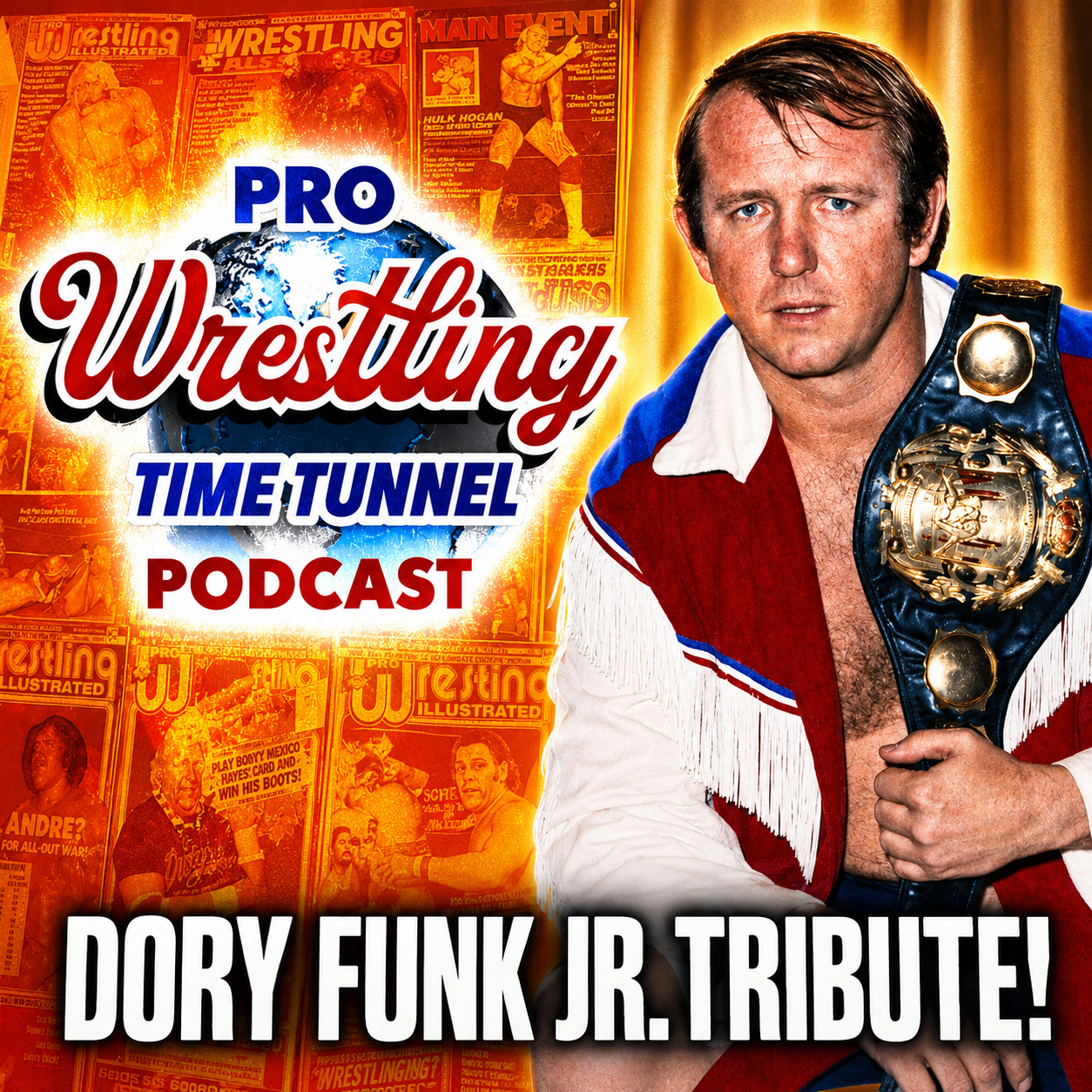
And today is an important show because we're going to be honoring the legacy and paying tribute to what I consider to be the greatest NWA champion of all time, Dorie Funk Jr. Now, I've made that statement before on other podcasts. I know it gets the ire up of different people and it goes against the grain of the narrative about Lou Thes being the greatest champion of all time. And so I'm going to address that today and tell you why I make that statement. Because most of the time I'm not just throwing things out. I mean, I've spent quite a bit of time researching it and trying to figure out a way to determine or whatever. So I'm going to talk about that today with our first guest, George Shire, who's coming on. George is well known throughout people who watch this show and through other shows or whatever. George has been around for quite some time. He's a very noted historian and he's going to be coming up first here on the Dorie Funk Jr. Tribute show. We also are going to have Larry Lane, the Red Dog. Larry's been on with us before. Last year he was on our Stampede Canada show. This year he's going to be coming up, he's going to be on our Amarillo show because that's the next territory he went to after Stampede. But Larry was very, very close friends with Dorie Funk Jr. He was very close friend with Terry Funk. He's going to tell the story today about how he came to Amarillo and about his conversation with Dorie Funk Senior and the interesting incidents that took place after he met them and after he met Sr. To decide to get into the wrestling business and to come to Amarillo.
And he's going to tell some personal stories of he and Dory Jr. And some things like that. It's great. I think you're going to like it. And also, my third guest is Ted DiBiase.
Ted DiBiase. And if you're a regular listener of this show and you listened last week to the West Texas segment, you know that Ted's stepfather, Iron Mike DiBiase, was one of the biggest heels in the territory and the arch enemy of Dorie Funk Senior.
So Ted has a very unique connection to Amarillo and West Texas and to the Funk family.
And Dorie and Terry were actually his trainers.
And so it's an interesting conversation I'm so glad to have. It's the first time Ted has been on our show, and I'm glad to have him here. And he's going to share some things that I know are very personal to him and very emotional to him.
So I think you'll want to listen with a lot of interest into what Ted has to say today, particularly about the town of Lubbock, Texas, which was in the Amarillo West Texas loop. It was the regular Wednesday night town for years, and it's a town we're going to cover here on the show coming up in a few weeks. But that was the town that his dad, Iron Mike DiBiase, died in in 1969. We're going to cover all that in the conversation. I think you'll want to listen and catch that. And then what show would be complete in talking about the Funks if we didn't have a Briscoe? And so the last guy who's with us from that famous Funk and Briscoe feud, Jerry Briscoe, will be here to be our cap on today's episode to talk about his relationship with Dorie Funk Jr. And what Dorie Funk Jr. Meant to him and to his family. And it's a really interesting conversation that I think you'll want to be a part of. Okay, so my framework. So I sketched out a framework by which I was going to score and rate the NWA World Heavyweight Champions of the Sam Muchnick era and not Sam's total presidency. But I took the years of 1958 and 59 somewhere around in there and then to 1975, because that's the last year that Sam was the president of the NWA And a member of the championship committee. And that was the last year he had a personally endorsed by him. NWA World Champion.
So that takes in just about five or six names who were personally selected by him and endorsed by him and had any kind of run at all.
And so we're going to talk about the score sheet that I put together, the 10 categories that I selected, and my criteria for ranking the champions. And George and I are going to go through that, plus a lot of personal recollections and memories by George about Dorie Funk Jr. And I think it's going to be something you'll want to listen to and hear. So let's get the show kicked off today. And let's go to our first guest in our Dorie Funk Jr. Tribute show. And welcome into the Richards Ranch here, my good friend, historian George Shire.
Well, we're rolling on with our little tribute show here to Dorie Funk Jr. Who passed away on August 4, 2026.
And I just thought, the first person I thought of to just spend some time talking about the champ.
I've got a couple other people on the program today, but I really wanted to get George Shire on because, George, you were, you were along a little bit in your fandom when Dory became the champion. So, you know, you've got anecdotal experience with being there at the time.
You know, I became a fan in the last year. He was a champion from 72 to 73. I became a fan in 72, but the only time I saw him was on magazines.
And I remember after I saw the Jackie Fargo and Al Green interviews on Memphis television.
And I just got so intrigued with wrestling. So the next time I went to the drugstore on Saturday with my mom, that was my comic book day and baseball card day.
But I added in wrestling magazines after that. And the first magazine I saw had Dorie Funk Jr. The world champion. I thought, oh, my gosh, there's a world champion to all of this stuff. And he was the world champion. So what was your first. What was your first experience with Dory?
[00:13:38] Speaker A: Well, the interesting thing about that, Tony, is that, yes, I have probably about 10 or 15 years on you, but I was pretty young.
I started getting interested, you know, back around in the middle 60s when it was really coming to me. And I was looking at results and trying to find programs and territories and everything. And so obviously this guy, Dorie Funk Jr. And I'd heard, I'd seen his dad wrestle in Minneapolis, and Dory was coming around. And it really intrigued me because I don't know how many people would remember this, but in 1963, when Vern Gagne briefly dropped the AWA title to Fritz Von Erich, and it was one of those coffee break things, but it was building Fritz up for the Texas territory. And they went down to Amarillo, Fritz and Vern, and Vern won it back in Amarillo. But it was intriguing to me at the time because Verne was wrestling this young Kid, Dorie Funk Jr.
And I actually made a note. He.
He wrestled Dory on May 30 of 63 in Amarillo. And they went to a draw. Verne took young Dory to a draw.
[00:14:57] Speaker C: 60 minute draw.
[00:14:59] Speaker A: Yeah, yeah.
[00:15:01] Speaker C: And I should point out that Dorie had only debuted on January 10th.
[00:15:07] Speaker A: That's right.
[00:15:08] Speaker C: So in 63, that was his rookie year. So by May 30th, he's wrestling Vern Gagne.
[00:15:14] Speaker A: Well, and the thing was, you have to remember that Verne is down there and Vern is already, you know, he's kind of in his prime right there when he was 8, NWA champ. And he's down there and he's. Then he loses it or wins it back from Fritz. But they also wrestled in Lubbock on August 28, and Verne actually did win over Dory.
And then on August 29, the next night in Amarillo, another Broadway.
And then there was one more in October on the 2nd in Lubbock, where Verne went to another draw with him.
So the good thing about that is, I think aside from the training that Daddy Funk Senior was giving Dory, he was also getting a little. A little bit from Vern, who was noted for training the wrestlers. And that's when he first came to the light for me.
And I want to touch on something you said.
[00:16:09] Speaker C: Sure.
[00:16:09] Speaker A: When you go to the drugstore and you got into your comic books, Tony, that's exactly what I did. It worked in the exact same order. I'd go get the comic books. And there was that cover of Wrestling Review, which I'd been collecting.
And, oh, my gosh, Dorie Funk Jr. Is recognized as the new world champion. I sent you the COVID the other day. I think you probably already had it, but if you didn't.
And that was the first time I really started paying attention to him, that this was real. And the thing was, is that in those days when you said, there's a real world champion, we always have to tell fans that beside the fact that the WWWF in those days and the awa, the nwa, really was considered by most as the World title.
[00:16:59] Speaker C: Well, you know, growing up here, I just, I just saw Tennessee Wrestling, you know, and I became a fan because, you know, and Al Green and Jackie Fargo, they were fighting over the Southern title. Yeah, it was just basically our title for our territory.
[00:17:16] Speaker A: Exactly.
[00:17:17] Speaker C: But then I, when I went to the drugstore, I found out there was an actual world champion. I thought, oh my gosh, there's a champion of the whole world. You know, it's just fun to think back about the way I was when I first became a fan. Just, just learning all these cool things for the first time, you know.
[00:17:35] Speaker A: Well, we were all in the same boat. We didn't have any other way to find stuff out other than through the magazines, which were always, you know. When Dorie won the title in 2-11-69, we didn't see it in Wrestling Review until the June issue, which, you know, that's a four month hiatus, but that's the only way we had stuff in those days.
[00:17:58] Speaker C: I'll just throw in here a little background before we get to 63 that George and I were talking about. And then I want to run down some of the wrestlers. Other wrestlers he wrestled in his rookie year.
He was born in 1941 and he's actually Indiana native. The family was from Hammond, Indiana, where Dory Senior's father, Adam Funk, was the police chief and Dorothy and Funk and Dorie. Funk Senior had two sons, one, Dory Doran, Ernest Funk, and of course, Terence Funk.
And Dory went to Texas in 1947, I believe, if I've got that right, 1947.
And the reason he went to Texas was because that in most of the southern territories, the junior heavyweight titles were being pushed and he was trying to break into the business in Chicago and he was hanging with the big boys, but they, everybody told him, well, you're never going to get a chance here. You're never going to get pushed, you're too small.
And so he decided he'd go to the Southwest and try his hand out there. And he got out to Texas and Arizona. It's funny thing, and I'm not going to be able to remember them right now off top of my head, but he wrestled under a different name in Texas, New Mexico, Arizona and California. He wrestled under four different names. One of them was Dorie Dean, and I can't remember the other two or three. And I don't know why he did that, but he did that as he was wrestling up and down. He went as far north as the Pacific Northwest at one point, and then he Got a job for Cal Farley working at the Texas Boys Ranch. And at that point, he.
He brought his whole family down. Dorothy and the two boys moved down to Amarillo, where they made that their home base. And Dory started out at seven years old in the amateur wrestling program that his dad set up at the Boys Ranch.
And so I've talked to enough people who knew Dorie Funk Sr. And enough of the high school friends of Terry who were buddies with him about the way Dorie Sr. Was as a dad.
And what I've always heard was he was an excellent dad, but he was very, very strict, and he demanded perfection and he demanded excellence. He and even Terry said at one time, he never really said much about anything good. It was always, here's what you're doing wrong.
And that's the kind of environment that Dorie and I think all of us kind of grew up with dads from that generation, you know. And Dory ended up going to the high school there in Canyon, Texas, which is a little town outside of Amarillo, where they settled down. And they eventually settled in Umbarger. That's where the Flying Mare Ranch was. But Dory had a good high school career. Then he went to West Texas University, which is now West Texas A and M.
And he played both offense and defensive tackle by the football coach there named Joe Kerbal. And Joe Kerbal was a lot like Dorie Senior. As a matter of fact, they were really close friends.
And he ran that football team like a Marine boot camp.
But he produced some of the most amazing professional wrestlers in the business. Bobby Duncomb, Bruiser Brody, Ted DiBiase, Stan Hansen, Tully Blanchard, Tito Santana, and the two Funk brothers. I mean, a lot of names came out of that West Texas program.
They won the bowl game that they went to. And then Dorie turned professional. Now, senior told Dorie Jr that you are not turning professional until you finish college. He demanded that the boys get their college education before. And of course, they're just dying and chomping at the bit to get into business.
But he told them, you're not going to get in until you do your college tour, you know. So Dory gets out of school, and he debuts in January of 63 against Jack Dalton.
Now, Jack Dalton is better known as Don Fargo.
And so he has his first match against Don Fargo, which is interesting because Terry's first match was against Sputnik Monroe, which would take place in 1965, in December.
But January 30, 1963, Dorie wrestles Don Fargo and then just let me run down just some of the names. He wrestles Nelson Royal and he goes over in most of these matches too, as you can imagine. He wrestled Nelson Royal. He wrestled an old time Southern heel named Don Duffy.
He was in a tag team with Wahoo McDaniel, who had only turned professional two years before in 61. And he was only wrestling when football season, pro football season wasn't going on at this point. In 63 he wrestled February 1st. In 63 he wrestled Cowboy Bob Ellis.
He wrestled Iron Mike Dibiase.
He wrestled Carl Von Brauner, he wrestled Killer Carl Cox.
He wrestled Moose Cholak. That probably didn't help him too much in his career. He. And on my birthday, the, the day I was born in 1963, March 28, he wrestled and defeated in 34 minutes and 10 minutes or 10 seconds, the one and only Gene Kinisky.
He wrestled.
He wrestled in the tag team with Roy McClarity, who was. The McLarety brothers were big baby faces in Amarillo against Carl Cox and Steve Stanley.
He wrestled Sonny Myers.
Who else did he wrestle? He wrestled Dano Oshocker, he wrestled George Romanoff, who ended up becoming a major promoter in Mississippi.
He wrestled in a no contest with one of the big baby faces, Ricky Romero. Amarillo was very, very in its booking.
It wrestled babyface matches and heels against heels a lot of the time.
June 4, he wrestled another Tennessee guy, Dick Dunn.
He wrestled in a tag team with Jose Lothario against Dick Dunn and Tokyo Tom. Tokyo Tom was a long time Japanese heel in Amarillo.
He was in a tag team with Bob Geigel against Tokyo Tom and Tough Tony Bourne. He wrestled with his dad in a tag team against Fritz Von Erich and Sputnik Monroe. I would have liked to have seen that match. And it was a 60 minute draw.
He beat Pat O' Connor on June 27th. Now this is his rookie year, right? I mean they're putting him over in July. He wrestled Tretch Phillips, he wrestled Fritz Von Erich, Leon Karolenko, Angelo Poffo in Indianapolis, Indiana. So he went up there for. Would have been Barnett at the time, in 63, and he wrestled Angelo Pompo and defeated him. Which. Angelo Pompa was a big name in Indianapolis at that time. Yeah, you mentioned the three or four Verngagne matches he had. He wrestled a wrestler named Rasputin on a program for three or four weeks. He wrestled Mr. X.
He wrestled on October 3rd, which was the day after the Lubbock match with Vern gagne. That went 60 minutes.
The next day in Amarillo, he had a loss to the original Sheik.
So he did have a loss there. That's a very unusual loss for him that year in 63, toward October on Halloween night.
This is probably Harley Race's first appearance maybe as a single because he had been through Amarillo two years before with Happy Humphrey and that's how Harley Race met the Funks.
But he wrestled on Halloween night of 63. He beat Harley Race and that, that's about all the rest of the year he wrestled. Well, in December he wrestled two guys I haven't mentioned yet, Pedro Godoy and Bob Orton. He wrestled in Tampa, Florida at the Tampa tv.
Other than that, I mean he wrestled a whole lot of matches with all those guys I mentioned. But what a rookie year to wrestle those names.
[00:27:14] Speaker A: Well, and the point is well taken. When you look at a rookie year and you listed all these guys, we should point out it was Bob Orton Sr.
[00:27:22] Speaker C: Yes.
[00:27:23] Speaker A: And all of these guys. And I listened to your list and I go, yeah, he was getting a mega push.
And I want to say that because I remember in 1969 when he did win the title, I remember having a discussion with somebody who said, well, you know, he only got the title because his dad put up the money and they're, they're pushing them this way. And that was that same story. And I had to have the discussion, have you followed his career for five years or six years here? Dory has not been a pushover. Dory has earned it. He has worked. And you can list that name of that list of wrestlers and you go, wow.
I mean, you're not going to get in this business, Tony. And a lot of people just don't realize this. You're not going to get to the top only because your daddy owns a company or your daddy owns, you know, it's, you got to work for it. You got to prove you can draw people and be.
And of course Dory did. I don't think, I think you and I would agree. I don't think Dory had the, the greatest looking wrestling body in the world. But that wasn't what mattered. It was what you could do with what you had. And Dory, Dory looked great as a champion.
[00:28:37] Speaker C: Well, and no matter who you were, if you were going to be NWA champion some, you were going to put up money. Somebody's going to put up money because you had to put up the bond.
Yeah, that's what we're talking about to hold the title. So it didn't really matter about who put up the money or whatever. Somebody was going to put up some money.
Smushnik was not going to have a champion without that surety bond guaranteeing that. That when the time comes, they would lose the title. So.
[00:29:04] Speaker A: Right.
[00:29:05] Speaker C: And.
[00:29:05] Speaker A: And the thing about Dory, when you saw him wrestle, he really could wrestle. He could get rough with him if he had to, but he really could wrestle. And that was a formula for the nwa, that the champion had to really look the part and work the part. And Dory did it.
[00:29:24] Speaker D: He.
[00:29:26] Speaker C: He went.
He went to Australia early on for Barnett, too, by the way. He. I think Barnett brought him over there in 65, which was about the time that he was going to win the Amarillo version of the world title, ironically from Gene Kinisky, who.
Who held it. And amazingly, no one knew at the time that was going to repeat itself with the NWA title in just a few years.
But he. He started out going, I'm doing a segment here on the show about Amarillo west Texas in 1966.
And in early January of 66, he's only there for about a week, and then he goes to the Dallas territory. And he was going out to other territories within the first three or four years of his career.
There's no doubt in my mind that Dorry Sr. Knew what he wanted to do.
It was his dream that his son.
And later, when Terry would get in and he saw he could wrestle as well, you know, he wanted it for both of his kids. But it was very obvious to me that early on he wanted the boys to get the world title.
[00:30:44] Speaker A: This is unrelated to Dory at this point, but you just mentioned Terry.
And Terry also came through the AWA in 1964, 65, and he was working for Vern. He wasn't winning, but he was working with the Hennigs and the Races and the other wrestlers of the territory at the time. And that was another chance for Terry to get his roots.
[00:31:10] Speaker C: Yeah, yeah, absolutely.
And
[00:31:15] Speaker B: so
[00:31:17] Speaker C: I'm trying to think of where I want to go with this, George, but, you know that the NWA title was in this interesting transition in the 60s, going from, you know, we had a little break with Rogers there for a little bit, and then we gave it back to Thes and Thiz had it for a little bit before transitioning to Kinisky.
Kininski changed the title somewhat in his own way, but it was a real.
It was a real gamble a little bit for Mushnik and the NWA board to go with somebody so young, with Dory Jr.
[00:31:58] Speaker A: I think when you talk about the transition, you know, and you started with Buddy Rogers, you and I have talked, I think, in our previous show. About how the Rodgers championship was and how it kind of evolved. And I guess the voice of reason or the voice of logic was coming through where they wanted to get the title off a buddy. And they went to Luthes, which was sort of the pattern over the years when they needed something done.
Lou had it for three years. And when you get to Kinisky, I think that the thing about Gene is I personally then. That was again, right in the 60s when I was really getting into it. I always looked at Gene Kiniskey. And because I had seen him 10 years earlier. And I had seen him, you know, as a younger wrestler. And I looked at Gene as being not a scientific wrestler, but I knew he was a wrestler. And he always carried himself well in the vein that the NWA wanted their champion to do. You know, heaven forbid, they wanted to have their guys come out and wear a suit and a tie when they're in town and look the part of a champion and not come out in blue jeans and, you know, whatever.
Not that there's anything wrong with that. But they. Sam Muchnick wanted them to look like a champ, and Fez was reason for that.
Buddy Rogers still did it. He was more of a big blazer and dress shirt type guy. But Gene did it. And Gene, I looked at. When I think of the champions that I remember, I was very impressed with Gene because he had the rough side to him, but he could still put a guy over.
And he could still come out looking like he could get beat.
And when I saw Dory get it, I. I will admit to you, I thought, holy cow, Dory is so young.
But I didn't have a problem with it at the time because I had seen Dory a few times, and I liked what I saw. I thought he was the real deal. And I knew that Verne endorsed him. Believe it or not, Vern did. I mean, people would say, why would he endorse Dory Jr. But he did.
He wrestled him a few years earlier, and he got the endorsement of Vern. Got. You can't get higher than that.
[00:34:17] Speaker C: Well, when you think about the guys who were being considered at the 68 convention.
[00:34:23] Speaker D: Yep.
[00:34:24] Speaker C: So you had out in San Francisco, you had the United States champion, who was Bill Watts. He was being considered.
You had the American champion in Dallas, Fritz Von Erich. He was being considered. Now, the only thing about Fritz was, you know, Muchnik didn't really like the name. And he always wanted the champion to be his real name.
[00:34:47] Speaker A: Exactly.
[00:34:48] Speaker C: So they had had conversations about Fritz being Jack Adkinson, and if there was a chance that he would be champion, they'd bring him into St. Louis as Jack Adkisson rather than Fritz Von Erich.
That never happened. They didn't go that way, but it was an option. Another person who was under consideration was Dick the Bruiser from Indianapolis, who Sam liked a lot, featured him in St. Louis on top a great deal. He had the, you know, Sam liked the collegiate athletes, and everybody we've talked about had a collegiate background. Watts had one, Fritz had one, Dick the Bruiser had one. They played college football, and in some cases they played a little pro football, and he liked that.
And then you got the kid who is Dorie Funk Jr.
And so out of those four options, you know, they. They decided to go the Dory Jr. Route, which all the guys in that group, they're all fairly young, but not as young as Dory, you know, at that time. So it's interesting to me that Sam bet on Dory, and it was a. It was a very good bet. As a matter of fact, he held the title until 73.
[00:35:59] Speaker A: Thing with. When you mentioned Bill Watts being in the picture, I think that would have been the long shot of the group, even over the fact that Fritz wouldn't be Jack Atkinson.
I love Bill Watts. He's on my all time favorite wrestler list. But I do know that Bill was. Bill was kind of a.
I think at the time, kind of an outsider. He was very opinionated. He had some personal issues that he had been dealing with.
He was even out of the country for a little bit due to some issues.
And so I think that even though Bill, I always thought would have been a good NWA champion, if you'd have seen, and I had the honor to do this, if you'd have seen Bill Watts and his four matches with Vern Gagne for the AWA title, there was no doubt in my mind that being the younger that he was at the time over Verne, that Watts would have been a great AWA champion.
But Bill had issues.
Let's just leave it at that. And I don't think that would have been good with Sam.
I wouldn't see that Jack Atkinson thing happening. And Bruiser, I don't know, Tony, that.
That was a gimmick wrestler to Sam, I think. And we all know Sam didn't like gimmicks. And which probably the reason for the Fritz thing with the German Persona.
He would have had to been for sure. Dick the bruiser athlete on a constant basis. If I think if they would have considered it.
[00:37:34] Speaker C: And I think they did. And I think they did talk about that. And the fact that he had used Affilis before was one of the reasons why he was in the conversation, I think.
[00:37:43] Speaker A: Correct. Yeah.
But Bruiser still had that gimmickary to him a little bit. Even though we know Sam loved him and used him quite a bit over the years.
I just think he would have been that long shot too. And I think since you mentioned Adkisson, then we narrow the three down and you say all of a sudden we got this young kid who look what he's done and look what he's been doing.
He's. I think he's our guy, let's go with it. And you roll the dice. And it turned out to be a good decision.
[00:38:17] Speaker C: And I hate the fact that so many people are influenced on dory by the 1980s and his career by the time the 1980s rolls around. And the kind of work he was doing. Because he was more focused on the booking and behind the scenes kind of stuff in Florida and in Crockett and these different places. And he wasn't trying to be the champion at that particular point. And my gosh, the amount of ring wear he had had in the 60s and 70s. I mean, he wasn't gonna, you know, he wasn't going to be a bumping machine in the 1980s, but he really was in this. I mean, I wish people could see more. There are some. I mean, you go and watch his hour long draw against Antonio Inoki in Japan or any of those matches. I mean, it's not the same guy. I mean, he's.
I think too, I think Bill Watts and Dick the Bruiser and maybe to some degree Fritz. Although I think Fritz's style was a little bit different.
But I think Watts and Dick the Bruiser in particular would have been a little bit more of the same Kaninsky type.
[00:39:27] Speaker A: Yeah, that's a very good point.
And the other thing I'd like to point out about Watts and possibly Bruiser.
I think the travel schedule that was required.
I'm not sure that Bill Watts in 1969 was.
Would have been up or 1968. You know, he. He left the AWA in 69 and went to the Mid south to work with McGurk and. And he stayed there for the rest of his career. Got into the promotion side and ownership, et cetera. But I don't think he would have been up for the travel that was the demanding factor. And I don't think Bruiser definitely was. By 1968, Bruiser had settled into an Indianapolis and he had a place to stay. He didn't need to go around the world anymore.
[00:40:15] Speaker C: And by the way, he didn't.
[00:40:17] Speaker A: But I don't think they would have been up to it.
[00:40:19] Speaker C: And the way Sam worked was he would let the committee have their deliberations, but it was going to be the guy he wanted. I mean, he was going to be the primary driving force about who got chosen. So the fact they were discussing all these guys, I think Sam is letting them talk about them, which was probably healthy.
[00:40:42] Speaker A: Well, and that was one of the things about the annual conventions that the NWA had back in the day.
There were many promoters, even some of them not NWA promoters, that were members of that group, and they would attend the annual meetings and they would all put in their two cents. And I think what was this is another reason I thought Sam was so perfect as president Tony, is that he always listened. He always let everybody have their two cents. And ultimately he probably was going to have the final say, but he was open enough to. Let's. Let's get all the stuff on the table, look at all the cards, and then let's see which one comes up the best.
[00:41:25] Speaker C: I kind of want to talk about some of the champions leading up to Dory's title run, too. We talked about a couple of them, but let's talk about some of them because I want to get your.
I mean, when we talk about Lou Thes, I mean, he was the pure technician. He was the hooker. He was. I mean, it's the title of his life story book.
He was trained by George Tragos in St. Louis and had those legitimate submission skills. And like you say, when the NWA wanted something done, they would always bring in the hammer, which was, you know, Thesis.
But I mean, he popularized the body press for a finisher, the stf. He probably was doing a early version of the powerbomb and the Belly to belly or Belly to Back German Suplex.
He was a chain wrestler. A lot of holds, a lot of realisms, but he really was the technician, right?
[00:42:27] Speaker A: He absolutely was.
And I think what happens when we start looking at these older champions or further champions is pretty much what you and I talked about briefly is we never had a chance to see. I mean, I'm 74 years old, Tony, and I never got to see. Luther's in his prime. I never got to see him as a champion. I remember once as a kid seeing him In Minneapolis when he was NWA champion before it was AWA territory.
But it's so vague and I don't remember.
And it's hard for.
I always think it's hard for us to take a guy and automatically just say, well, because everyone else said he was the greatest and he did this and did that, that he's the master.
I think we can't do that unless we physically, personally saw them at their prime.
And we had mentioned Vern Gagne. Anybody that came along in 1981 and saw Vern Gagne, you didn't see Vern Gagne.
I'm telling you, you saw a shell of a. Of a man who was once great and he shouldn't have been in the ring, probably, but with Lou and Vern and guys like that, I mentioned to you. I think if. I don't know if we did it before we started or not, but Pat o'. Connor, and we'll probably talk about him. I saw Pat in his. In his career in the beginning.
I saw him early in the awa.
What a whirlwind. Oh, my gosh, this guy was. He was drop kick flying around and just so. So smooth and fluid. And then I saw him in 1983 against Nick Bockwinkle. And I saddened me because I saw Nick carrying him, making him look better than he was.
And I told you, I said to my wife, please, I hope he retires after this, because it wasn't fair.
And then you look and say this guy was NWA champion. Well, that's not a fair assessment.
[00:44:28] Speaker C: Yeah, he was. And he was. But he was. When he was champion, he was from 59 to 61. He was. He was the clean, athletic baby face who. You mentioned the word. I was thinking the same word. Fluid.
He was the bridge between.
And we talked about this when we talked about the Comiskey park show. He was the bridge between the shooters and the showman.
He was the white meat baby face. He was a great box office draw and a really dependable representative of the National Wrestling Alliance. He really was a really good champion and he was reliable. And that was another thing. You know, Sam wanted to. Because you had to carry a lot of. And the schedule wasn't what it would be later on, but it was still a tough schedule. I mean, you were working 20, 25 dates a month.
[00:45:26] Speaker D: Not.
[00:45:26] Speaker C: Not the. Not the 28 to 30 dates a month. That dory schedule would be. But, you know, Fez was working about 20 dates a month. Pat O' Connor was working four or five more than that. And Dori was working almost. Almost every day.
So Pat was a. Pat was a great bridge.
[00:45:46] Speaker A: The thing I want to point out when you bring up that schedule thing, because we had touched on that before, too.
The schedule, though, yes, it wasn't as grueling as it would become, but when you're working 25 nights a week and you're in a different city every night, there's a certain amount of both road travel and air travel involved. And I think what you've got to realize with the NWA champion is that that reliability, the word you used, was so important.
And it's. You've got to have a guy that's going to be in that role that you can rely on to be there and to be the best they are that night, the best they can be.
[00:46:26] Speaker C: Well, that was Fez's problem with the membership.
[00:46:29] Speaker A: Right.
[00:46:30] Speaker C: His problem with them was he only wanted to work those 20 dates and he wanted that last week of the month off. And it wasn't that he wanted it, he was going to take it.
[00:46:38] Speaker A: Right.
[00:46:38] Speaker C: He was just not going to work those towns. Well, that left some of the members out of having the champion. And Lou didn't like working the tank towns. He didn't like working the small towns. He only wanted to work the big towns. Well, that. That caused consternation with.
With the membership and really was the reason why he, Whipper Billy Watson took it for a while. And then there's another reason Dick Hutton took it for a while is that they had gotten to the point where, you know, until they finally had to have him in 61 or what. What was it, 61 or 63? 63.
[00:47:16] Speaker A: 63.
[00:47:16] Speaker C: Yeah.
[00:47:17] Speaker A: When they took it from. He took it from Buddy.
[00:47:19] Speaker C: Yeah. When they had to have him back, you know, then, you know, they. They went to him, hat in hand, going, okay, work whatever schedule you want, you know.
[00:47:28] Speaker A: Right.
[00:47:28] Speaker D: But.
[00:47:28] Speaker C: But in the 50s, when wrestling was so hot and television was coming on strong and the wrestling was in demand everywhere and in every town, and then Lou was refusing to work a lot of the smaller ones, that. That made a lot of the smaller town booking offices upset.
[00:47:49] Speaker A: Well, and see, the thing is, when we talk about the reliability and we talk about the schedule and we talk about the things you mentioned about Lou, the NWA wanted to have a champion that didn't have their own agenda at all the time. I think that's really what it comes down to, Lou. Another thing that a lot of people may not have known, he wouldn't go to the smaller towns. He had these Personal issues. But he also wouldn't work a card that had a ladies match on it. He didn't want to work on a card that had a midget match on it.
And me, as a fan back then, I wasn't a fan of ladies wrestling and midget wrestling, but I still would never have understood why you would not want to be the world champion on the card and go to the town and showcase your talents and.
And.
But yeah, guys like Dory, Gene, Kaniski, o' Connor, and then Jack Briscoe later, they didn't have their own agenda. They weren't always in the office saying, I'm not going to do this or I won't do that.
And that's why they made them champion, and that's why they were good champions.
[00:49:00] Speaker C: Kaniski, you know, and of course, we talked about the contrast of Rodgers when we talked about the Comiskey park show. I mean, Buddy Rogers was just a different animal. I mean, he was just more of a total performer as the NWA champion.
Now, what I do want to mention here, though, is Kaninsky, because Kaninsky really worked a majority of the time as a heel with the title, and he worked as an athletic heel. He didn't work as a showman heel, not like Rogers. He worked as a. As a.
You know, he drew heat and he traveled and he handled the pretty brutal schedule. And he. He was the first one to go to Japan on a regular basis. And by the time the 68 convention came around, he had his troubles with the NWA membership, but mainly it was because he was exhausted.
But the one thing that Kaniski did show, I thought, was he was showing them that a tougher, more aggressive style could work as the champion.
[00:50:10] Speaker A: Well, and the thing with that type of a style, and like you said, he was a. He was a heel, but he wasn't the kind of a guy that had any showmanship to him. And that's probably, if you back up, when we talked about a guy like Dick the Bruiser. Had Bruiser been NWA champion, I think there would have been a problem there because the bruiser was always more of a little showman in his own way.
And Gene was just a tough. So be. That's the way the fans could look at him. And they always knew that they had the strong baby face that, you know, Gene could work with, put over and make the guy look great and didn't have to pound him and hit him with three tables to do it. He was just. Just a rougher wrestler.
[00:50:51] Speaker C: Yeah. And that brings us to the Subject of what we're talking about today, which is Dory Funk Jr. And I'm hoping our listeners and our fans and some of our researchers or whatever can appreciate the contrast and differences in this progression.
That I don't think that they planned it this way, but it just kind of happened this way. That along comes this young, exciting kid who's got this collegiate football background, who's got a very strong representative in his father lobbying for him at the convention.
And he is a technical baby faced, leaning wrestler who's got the Texas edge to him. But he looks like we're coming out of the Vietnam War in this hippie stage America was in. Where in 1969, we're just a little bit past Woodstock. And where was that? The year of Woodstock, maybe 69. Was that Woodstock or was it.
[00:51:55] Speaker A: I think it was 69. I was 18 and 69. So Dory. I could relate to Dory being 21 or whatever he was at the time.
[00:52:03] Speaker C: Yeah, he was a youthful, but a clean cut image. Yeah. Who I said the other day, and maybe it was a little too much of an overreach, but I almost felt about Dory Jr. Now that looking back on it, that I can see similarities in what Cassius Clay did for boxing, you know, where you had all these lumbering giants in the ring as boxers, these heavyweights who just stood and hit guys. And it was just a battering contest between two giant lumberjacks hitting each other. And Cassius comes along, forget the interview style. He came along with a grooving, moving style. He came along with footwork, he came along with the. The jab and the hook a dope, the rope a dope.
[00:52:55] Speaker E: He came.
[00:52:56] Speaker C: It came along with all of this stuff that really revolutionized and changed wrestling. And Dory Funk Jr. To me, did that same thing.
[00:53:05] Speaker A: Yeah, absolutely. And the thing too, you know, when you talk about the hippie era, that. That definitely was the height of it. The Vietnam War, nobody wanted to go there. And those that did, some of them didn't come back. And I was caught up in that. But Dory was that he was kind of that refreshment, if you will, of the. Not to copy Dusty Rhodes there, if you will, but Dory, yeah, he had a youthful look. He wasn't the hippie look. He didn't have the long hair at the time that was really popularized.
And, and you know, the other thing you talk about is he wasn't. He was the David to some of the Goliaths out there, you know, and there's. There's a story with David and Goliath that you don't always have to be 7 foot tall and be built like the proverbial brick, you know what to be the guy and get it done with wrestling and in the ring. And that's what Dory was doing.
[00:54:08] Speaker C: You know, Jerry Briscoe and I were talking about this the other day and he said something reminded me of something I'd forgotten. He said that his brother Jack Briscoe said that he always asked people what was the greatest night in my career.
And they're all thinking about it and they can't think about it. And he says, okay, well, I'll just tell you. The greatest night in my career was the night Dorie Funk Jr. Won the world title.
Because that opened the door for more athletic collegiate based wrestlers, of which Jack was the ultimate. He was the 65 NCAA champion, for goodness sakes.
[00:54:44] Speaker D: Yeah.
[00:54:46] Speaker C: And that was also the night that sort of ignited what would become the. One of the more famous feuds in all of wrestling, the Funk and Briscoe feud.
And boy, did those two guys as a combination, that was the Cadillac match of the 1970s.
[00:55:06] Speaker A: Yeah. And you know, Tony, the thing too, when you talk about the. When we're talking about the look of Dory Jr. And the Briscoe thing, this was also an era in the six late 60s into the 70s when we were able to tell the difference between good and bad.
You, you knew the good guy and you knew the bad guy. And Dory, there was never a doubt that he was the good guy, that he could really do it. He wasn't out there like some of the heels and you know, they looked to heel because of the things they did or the way they looked. But Dory was that difference and that youthful look and that style was what captured fans.
We were in an era. I remember being in that era and saying, you know, I want to believe that clean cut and good and honest is still out there.
And I think we could all agree that in our world today, not for any political reason that I want to get into, but we no longer can see that good guy, bad guy definition.
All of the wrestlers look alike and we have to figure out who's doing what this week. And that wasn't the truth. That wasn't the case with the Dory Jack Briscoe era. It was, was defined.
[00:56:28] Speaker C: And it was interesting too, because when Dorie was the champion, the only place I can really think of much, well, two places maybe were Florida and in the Carolinas and not even all the Time in the Carolinas was he considered the heel.
In Florida he was considered the heel because Jack was such a strong baby face and they pushed the feud, you know. Yeah, but if they had that same match in Amarillo, Jack was the heel.
[00:57:00] Speaker A: Exactly. But see, even in those days, Tony, even though that they would could reverse the roles of who's technically the heel in the match. They weren't heels that were bringing brass knuckles in the ring. They weren't heels that were bringing the table in the ring or, you know, having a manager interfere. They weren't that type of a heel. They were just, they were just not
[00:57:23] Speaker C: the favorite the heel. The heat was coming from Senior because, you know, for a few years there he was the second in the corner for sure, Dory Senior. And he was running around at ringside, not really doing anything, but just the fans thought he was going to do something which created, which created heat. Now there was a, there was a match in Florida where they were going to a 60 minute draw. It was supposed to be a 60 minute draw.
And Jack had Dorie Jr. In the figure four. And the countdown was on to end the match. And about five seconds before the bell rang, Dory Senior ran over and rung the bell and it caused the match to end about five seconds early and there was a big controversy. And then they came back the next week with a 90 minute match.
[00:58:16] Speaker A: Oh, sure, sure.
[00:58:18] Speaker C: So that guy, he, you know, but it wasn't the, it was just the old man got excited kind of heat. It wasn't the, like you say the brass knuckles or the, the foreign object or anything like that.
[00:58:30] Speaker A: Well, and I always think when I use that word, definition of bad guy, good guy, because it was so clear cut.
There were times when even our best baby faces in the business, Tony could at the time could be a subtle hero or a subtle heel. I mean, and again, I will refer to the four matches that I seen with Watts versus Verne.
Verne, as popular as he was, Tony, in each of those matches, the fans were for Bill Watts.
That's how over Bill was in the awa And Vern would. He never broke the rules with tactics, but it was a little slap on the face or a little shovel, you know, that the fans would say, ah, come on, come on, you know. But Vern was never a heel. It was just that given the fans the choice to vote or to root for the other guy and they knew how to. And that's what Jack and Dory knew how to do.
[00:59:29] Speaker C: George, just in the last few minutes that we have Here on this particular segment, talking about Dory Jr. You know, I've often gone on podcasts. I was on Brian Solomon's podcast a couple of times, and he asked me to rank the champions, you know, and of course, I was doing the Dory Funk Jr. Show when we were talking about it, but I said I gave my ranking and Fez was 2 and Dory Funk Jr. Was 1, and he kind of stopped and was a little. Wow, really? And we got to talking about. And so there's a narrative about Luth as being the greatest NWA champion of all time. And I'm certainly not here to say that he wasn't. But in my own analysis, it's very close.
And I give the edge a little bit to Junior, mainly because of the schedule that he worked so many more dates and so much. He worked in New Zealand and he worked in Australia, and he worked in Japan regularly, which Lou never did. And so that is where I gave him the edge. And then there's a couple other things, and I sent you. And I've never shared my scorecard with anybody, but I did develop a little scorecard by which I formed my opinion.
And yes, it's all subjective. It's me ranking them in the way that I see them, but at least I've got some kind of formula for backing up what I think, right? And so there's. There's 10 categories, and I just want to share with the audience the 10 categories that I chose in order to rank these guys. Now, here's another thing. I only rank the Munchkin Champions, the Sam Muchnick Champions. So only from 1958 or so until 1975.
So Terry Funk isn't in my list. Harley Race is in my list, but only for the three months in 1973. His 77 to 81 run is not in my list because it's not a Sam Mushnik.
Sam had already retired at that point. Flair is not in there because he was not a Mushnik champion. And not taking anything away from those guys. I mean, I don't take anything away from Tommy Rich, for God's sakes. He won the title. You know, he had the title. If it was just for a week, he still had the title, and nobody can ever take that away from him. But there was something different and unique about the Sam Mushnick champions, I think. And so I'm just ranking them now. I'm not ranking all the NWA Champions. I'm just ranking the Sam Muchnick ones in those really hot years from 58 to 75. My 10 categories are technical ability, ability to make challengers look strong, ability to leave territories healthy drawing power and box office impact, star power and presence, having the look of a champion, charisma and promo ability, match quality, consistency of strong matches, reliability and durability as a traveling champion, legitimacy and credibility and how they carried themselves as a champion. Those are my 10 categories.
Now I'm going to give my ranking for each one of these and I'm just going to let George give a few comments. How's that sound, George?
[01:02:58] Speaker A: Fine, go ahead.
[01:02:59] Speaker C: So technical ability, first category. I give that to Luthez. He was an amazing technical wrestler and an amazing shooter. I give the second spot to Jack Briscoe. The third spot to Dorie Funk Jr. The fourth spot to Pat O'. Connor. The fifth spot even though he only had the title for three months during this period I give to Harley Race.
The sixth I give to Gene Kaninsky. And the seventh I give to Buddy Rogers. So what do you think about my ranking there?
[01:03:30] Speaker A: Well, I do like the ranking. I, I personally, I love the word you use, subjective. Because anytime we do anything like this we always have to remind folks that the discussion with 100 people we're going to get some spirited conversation.
[01:03:47] Speaker F: Sure.
[01:03:47] Speaker A: And probably some, some good answers.
[01:03:49] Speaker C: It's just my list.
[01:03:50] Speaker A: It's. And it's just your list. And if I make a similar list, it's just mine.
[01:03:55] Speaker D: Okay.
[01:03:56] Speaker A: So with Lou says, I love everything you said but I, if I was to look at this, I would say I want to.
I, other than seeing Luthors wrestle in 1967 and he was not the Lutherans that obviously everybody can claim he was and is I have to put Dory above him because I saw Dory.
[01:04:21] Speaker D: Okay.
[01:04:22] Speaker A: And I just have to move Fez down the list only because I can't, I can't qualify what everybody says.
So when I usually.
[01:04:34] Speaker C: And I have to say I mainly put him in there because of me seeing him on the Chicago show.
[01:04:41] Speaker A: Sure.
[01:04:42] Speaker C: And the amazing Vern Gagne match and some of the surviving matches that we have on tape. That that's how I got my thoughts about it. It wasn't that I, I mean I wasn't around, you know, he won the title for the sixth time when I was born. So, so I never saw him. I only saw him in Tennessee in the late 70s when he came to work for Nick and he was well, well past his.
[01:05:08] Speaker A: Well, you know, he came through Minneapolis often in the 50s.
I want to say every few months. If I look at my old Minneapolis St. Paul programs from there.
Lou was a regular in the Minneapolis territory. It was part of the nwa and he was. But I was. I was four or five, six, seven years old. I never went to these matches. I don't even recall seeing them on tv. So. All right, I just use that as being subjective. I would put Dory above him just for that.
[01:05:36] Speaker C: Okay.
[01:05:37] Speaker A: And then, strangely enough, I would stick with Jack Briscoe being next.
[01:05:43] Speaker F: Okay.
[01:05:44] Speaker E: Then.
[01:05:45] Speaker A: Then I get a little bit tougher because.
And again, being when you're doing something like this, you have to take your personal feelings out of it. So I have to say I always liked Kaniski better than o' Connor as a wrestler.
But if I'm being fair, I have to put o' Connor next.
Okay, so that's where I changed the ranking.
[01:06:07] Speaker C: All right, so category two, ability to make challengers look strong. Here, I gave this to Dory.
And then number two, I gave it to Jack Briscoe. Number three, Lou Thes. Number four, Pat o'. Connor. Five, Harley Race. Six, Kinisky, and seven, Buddy Rogers.
[01:06:26] Speaker A: I know it's going to seem like a broken record, but again, I would move Fez down only because I can't judge from what I saw. And so I would put Dorian Briscoe almost in a tie.
[01:06:38] Speaker C: And I only go by, like, what Lou said in his own book, and I've heard other people say is that if he didn't respect somebody, he didn't care what it did to the territory or the box office or whatever, he was going to embarrass the guy.
[01:06:53] Speaker B: Right.
[01:06:53] Speaker A: Well, and we know that's the case when he. When he got to the Buddy Rogers thing in. In 63, it was, you know, Buddy.
Lou didn't like Buddy, right? Not probably not. Not really. Not like him, but didn't like what he brought to wrestling.
[01:07:11] Speaker C: Well, he certainly.
He didn't like him for his Strangler Lewis comments.
[01:07:15] Speaker A: Yeah, well, that too. You and I talked about that. But basically he said to Buddy, you know, we're not going to play games. I'm gonna. We're gonna win the title and I'm gonna do it, and if it. I'm going to hurt you. That's in so much language.
[01:07:27] Speaker C: Well, so I think he told Mr. Mushnick and Mr. McMahon that too, when they wanted him to do Bruno, you know.
[01:07:35] Speaker A: Yeah.
[01:07:35] Speaker C: He's like, well, I'll go up there and, you know, you can order me to lose, but that doesn't mean I will. And if I want to win, I will.
[01:07:43] Speaker A: Which Goes back to what we were talking about a bit ago when we talked about a champion who has their own agenda sometimes and they're difficult to work with. And that's why some of the other guys around Luthes were probably better champions because they were there to do what was best for the business and to represent it in a positive way.
[01:08:04] Speaker C: And folks, this is not a bash Luther's show. No, you know, but. But we're just trying to lay the facts out there.
[01:08:12] Speaker A: Let me point something out about Lou says, even though I said I didn't have the opportunity to see him, I served on the CAC board in the early 2000s when Lou was president of CAC.
And I got to not only sit with him on the board, I had a couple of nice couch visits during our two years that I was there and Lou was there. And I totally enjoyed talking to the man and he was totally fair and nice to me, and I didn't get kayfabed. He was upfront about a lot of things. I have nothing but respect for him, so I would never bash him.
[01:08:50] Speaker C: Category three is the ability to leave the territory healthy because the champion was supposed to come through, wrestle the top guy, leave the top guy, and just as strong if they're not stronger, and even make it look like the guy could win and leave it the. You know, it's supposed to be not to come in and have a peak, but come in and enhance the territory. I gave Dory Funk Jr. This only because I heard so many stories from different people that Dorie always did what was best for business. I heard that over and over and over and over from people all over the United States and all over the world.
Number two, I put Jack Briscoe. Number three, Pat o'. Connor. Four. Because I heard the same thing about Pat, actually.
Number four, Lou. Number five, Gene Kaniski. Number six, Harley. And number seven, Buddy Rogers.
[01:09:39] Speaker A: In the case of this one, I totally agree with everything I would put. I personally would put Kinisky above thes again only because I always thought that aside from the fact that Lou didn't want to wrestle in some towns or he didn't like this promoter or whatever the deal, I don't ever recall hearing anything like that from Gene. He went where he was asked and he did what he was asked to do.
So I put him above.
[01:10:05] Speaker C: Okay, Category four drawing power box office. I have to give this to Buddy.
You know, I mean, I'm so biased by the Comiskey park. And from all indications, the Northeast did great when he was NWA Champion because he was working those towns up there probably more than he was working any of the other parts of the nwa. They were monopolizing him. So he's drawing those crowds up there.
So much so that Vince McMahon wanted him as his champion when he became the WWWF.
So I got to give that to Buddy and then I give it to Dory just because he's working more dates, drawing more towns and going for more parts of the world. And then three, Lou, four, Jack, five, Pat o', Connor, six, Gene and seven, Harley. Mainly because of his just three month reign.
[01:10:59] Speaker A: Yeah, and you know, on that one I am not going to. I can't even debate it. I think I agree with you 100%.
Buddy Rogers Time as champion was evident to.
Not at the time for a lot of fans, but it was evident to the change that was starting to take place in wrestling where showmanship was drawing over technical wrestling sometimes.
And so I agree with you on Buddy Rogers and that category. I would leave it as you have it, Tony.
[01:11:29] Speaker C: Category five, Star power and presence.
I give this to Lou.
Just so many guys who would become influential in the business talked about how much he influenced them. When he walked in the front door, he didn't come in the back door. He came in the front door of the arena and he came in with his briefcase and his overcoat and his nice suit.
I got to give him number one here. And Buddy number two. I put Dory as number three because he always wore a suit and a cowboy hat.
It was a dress cowboy hat. It wasn't a straw cowboy hat. It was felt. And he always carried the title with him. He always went out to dinner with the belt on the table.
Jack. I would put it number four, Pat, five, six, Harley and seven, Gene.
[01:12:19] Speaker A: Yeah, and I can't argue with that at all. In the star power thing, I guess that's where I have to listen to all of the plaudits of Lou Thez over the decades because he was magic at the box office. Luthes was Luthez on the marquee, you know, and that meant people are paying. The only one I'd change on that one is I'd flip Harley and Gene. And I am a huge Harley race fan for from the time I saw him in 64. I love the man, but I would change Harley and Gene again only because Harley only had the.
Actually it was about two and a half months, three months reign that you mentioned. And I don't think he can fit into that category. I'd give it to Gene on that One.
[01:13:01] Speaker C: And you know, the reason I discounted Gene in this category was because he always wore that Canada sweater thing that.
Well, that Canada pullover instead of a suit or whatever. He always, you know. But that. That was the only reason I had him that way.
[01:13:16] Speaker A: Yeah, well, you know, that. That was part of. Even though he wasn't a gimmick wrestler, that was a gimmick for him.
[01:13:24] Speaker C: Canada's greatest athlete.
[01:13:26] Speaker A: Yeah.
[01:13:27] Speaker C: Category six is charisma and promo ability. Again, Buddy Rogers.
I ranked Gene up here. I love his promos.
Harley at three, Dory is not the strongest promo. I put him at 4 and Jack at 5.
That would, to me were Dorian, Jack's weak, more weaker parts that their promos weren't very exciting. But their matches were like knockouts.
Pat at number six and Lou, bless his heart. I just can't believe that. When they formed that UWA promotion in Nashville in 76, we were just talking about it here with Tim Deals. But they made Lou the commentator and oh, my goodness, they had Buzz Benson as the ring announcer. And Buzz Benson was one of the most fabulous commentators I've ever heard. And why they would have Buzz introducing the wrestlers in the ring and have Lou on the commentary, I don't know. But he just. To me, Lou was not a very charismatic type guy.
[01:14:33] Speaker A: When you talk about the charisma and the promo ability, I think the way you have them rated is probably, I would say, picture perfect for what I do.
The problem with the baby faces, and this isn't a slam to Dory or Jack or Pat or Lou, but the problem with them is that because they were playing this, I'm going to use my term, mom's apple pie, good guy image.
Their interviews were about as exciting as watching your lawn growing.
You know, they come out and say, well, you know, Jerry, we're going to be. I'm going to be in the ring with him and I'm going to let wrestling do my talking. And they were so bland. And.
And when you had the champion come in and had a promo ability like a Rodgers or a Gene or a Harley, they.
They not only told you what they were going to do, but they did it with force. They did it with impact, and they did it with that. You know, I want to go see, see this guy.
That was the difference. So as good as Briscoe, o', Connor, Dory and Fez were, their promo ability.
That was awful.
[01:15:44] Speaker C: I mean, folks.
[01:15:44] Speaker A: And I say that in honesty.
[01:15:47] Speaker C: Folks out there on YouTube, there's Gene Kaniski. He's the Guest on a Canadian talk show. You ought to go Google that or go into YouTube and find that he, as a guest. He, he's tremendous. I mean, he's just really got an amazing amount of charisma.
Category 7 match quality consistency of strong matches. I gave this one to Dory and I gave number two to Jack and I'll tell you why.
Dory was champion for three and a half years and Jack was champion for two and a half. So Dory had a whole year's worth of matches. Now probably most of those, a lot of those matches might have been with Jack. With Jack, yes. But I gave the edge to Dory here. I put Lou at three, Pat at four, Harley at five, Gene at six and Buddy at seven.
[01:16:39] Speaker A: I look, when you look at the schedule, I have Pat o' Connors and I actually put this together many years ago, but I, I know there's some blanks in it, but I have Pat o' Connors title history from the time he won the title to the end.
And I don't know if you've ever seen this, Tony. This man traveled.
Oh my God. He was wrestling everybody and anybody.
[01:17:04] Speaker C: And so he was a fantastic draw in West Texas. Yeah, I mean so much, so much so they were bringing him back in 76 when Terry had the title.
[01:17:13] Speaker A: Sure.
[01:17:14] Speaker C: It was Terry Funk and Pat o' Connor in West Texas.
[01:17:17] Speaker A: The only thing I do on the, on the match quality, obviously I am, I think both Gene and Harley had good match quality, but I'd move Harley down the list because again, we're only looking at that three month window. Certainly we could talk differently later on Buddy Rogers. There was no match quality. It was built. It was Buddy strutting, which fans applauded and paid to see. You can't knock it, but there was, there was no match there. It was the, the baby face tolerating him and putting him over and that's the way it was. So I like your list. I would just, I'd maybe put Pat o' Connor above says only because again, I saw him a lot and man,
[01:17:58] Speaker C: if you were only taking the Comiskey park match, these guys would both be higher. I mean, that was an amazing match by both guys, but, you know, Pat's, you know, leading that match.
[01:18:08] Speaker D: Right.
[01:18:08] Speaker A: And a lot of fans will never realize how you and I think we talked about this on our Buddy Rogers Comiskey park thing.
O' Connor and, and Buddy in that match. That was really a transition for wrestling.
It really was. It was kind of the.
Buddy led the way for Future bombastic, arrogant, sarcastic wrestlers to get a push and that can never be taken away from him.
[01:18:41] Speaker C: Category number eight, reliability and durability, which I just noticed. I've got Jack on here twice. But number four should be Gene.
Number one is Dory. Number two is Jack. Number three is Lou. Number four is Gene Kaninsky. Number five, Pat, six Harley and seven, Buddy. On the reliability and durability as a
[01:19:01] Speaker A: traveler, I wouldn't argue with it at all. Other than that I might.
No, I can't argue with that. I think that's pretty much perfect.
[01:19:12] Speaker C: Number nine. Number nine or. Sorry, George.
[01:19:14] Speaker A: No, I was just going to say Harley again. I don't think he can be.
I wouldn't put him above Rogers in that point, only again because of the three month thing. But if you're talking Harley later on, I think we definitely had durability and traveler that would outclass Buddy tenfold.
[01:19:31] Speaker C: Oh my gosh. This if we were looking at his 77, 81, this would be a totally different list.
Number nine category is legitimacy and credibility. I give this to Lou, Jack, 2, Dory Funk Jr. At 3, 4, Gene Kaniski, 5 Pat, 6 Harley and 7, Buddy Rogers.
[01:19:53] Speaker A: I would rate it exactly as you did it.
I don't have a problem with that at all.
I feel bad for Harley. That is even on the list on most of these because like you just mentioned, if, if we were talking the Harley of 77 and then the next four or five years, this man was. He was incredible.
[01:20:13] Speaker C: It would make it a lot tougher. Rank. I mean it was absolutely. Would take me another two or three years to do it.
[01:20:21] Speaker A: Well, not only do I. Do I have record of all the travels that he did, but I have talked with his son Justin, Harley's son Justin a number of times. And just listening to Justin and the travel schedule and how little he saw of his dad and how much he appreciated when he did.
But Harley was a workhorse and Harley took it serious. I think. You know what, I'm going to tell you this. I think Harley in those latter years, I think he took it as serious as Lou says did on the other end that blue was on.
[01:20:56] Speaker C: Well, well, honestly, if we were doing it by all the champions in reliability and durability and traveling flair probably would be way up there.
[01:21:07] Speaker A: I mean definitely could.
[01:21:09] Speaker C: Oh my gosh. From 81 to 85 especially.
[01:21:13] Speaker A: Yeah. There again it just changes the whole scope. But that wasn't the much Nick years that we're talking about.
[01:21:19] Speaker C: Right. All right. Category 10, how they carried themselves as the Champion. I give this to Lou, I give this number, 2 to Dory, 3 to Jack, 4 to Pat, 5 to Harley, 6 to Gene, and 7 to Buddy.
[01:21:32] Speaker A: And, you know, again, I'm going to agree with you almost all the way down, simply because of what we talked about earlier, that this was an era when the champions looked like a champion. They walked into the arenas with a suit and tie on. They carried the title with them.
They represented what they were as being the best in a positive, supportive way. And they always made the fans want to respect them as champion. Not they could not like them as champion, but they always respected them and they held it. And that was a much Nick model. Well, I want you to look like the champ.
[01:22:12] Speaker C: A lot of your. A lot of you may not know this, and it was just really on the tail end of my growing up even.
But college, all Americans were celebrated.
Bob Hope used to do that show every year where the all American football players would be trotted out on the stage and it'd be, you know, here's Joe Namath from the University of Alabama, and he'd come running down the stage or whatever. And I think Sam was trying to tap into that where America respected a college graduate and a college athlete. And so they would be on the Bob Hope special program in their suit and their tie, and they'd be saying, Joe Namath, University of Alabama quarterback. You know, and I think he. And he was trying. You remember that, George, when we had television? Yeah, yeah. I think Sam was trying to tap into that because that was something that America as a nation respected. And I think the NWA Champions were former college athletes.
They had been there, they had played ball, and they wore the suit and tie. And I think that's what Sam wanted to. Wanted to project.
[01:23:28] Speaker A: Yeah. And like we talked about earlier, Tony, you know, it was that definition of good guy, bad guy.
They looked the part of being a good guy.
[01:23:38] Speaker B: Even.
[01:23:39] Speaker A: Even Gene Kinisky, who was, you know, a bona fide heel, he still looked like a champion.
[01:23:45] Speaker C: So in my rankings, if we use your rankings, Dory is.
Gets. Gets the nod in my rankings. Lou gets number one four times. Dory gets number one four times. Jack Briscoe gets number two six times.
So I put them in the upper level, top tier, in the higher level, medium kind of tier. Pat o', Connor, who's number three or four six different times, and Kaniski is ranked high three times.
Buddy is more of a polarizing influence and transitional influence. And so is Harley. I mean, he's the mailman from Dory to Jack.
[01:24:26] Speaker A: I love it when you use that term.
[01:24:28] Speaker C: Yeah, he carries the title from one guy to the other, but, you know, that was just his role at the time.
And I want to give him the nod because he was a hand selected guy by Mushnik, but he just didn't have the title very long.
[01:24:45] Speaker A: Well, and you know, the thing about the Harley thing, and we only talk about the three month period, you got to believe that during that three months, it wasn't that Harley didn't draw well.
He was intended to be the transitional or the mailman, as you call him.
It was just going to happen and go to Jack. But what happened was, is because Harley was the professional that he was and dedicated to the business that he was, that he earned his oats with that three month reign where four years later, when it was time. Well, it was after. After Jack lost it to Terry.
Correct. Yeah.
[01:25:27] Speaker C: Yeah. And then it was February.
[01:25:31] Speaker A: Yep. And so they realized that they've got an apple in the basket that they can grab if they need it. And Harley was that guy and he never let him down. Talent. Harley was right there, willing and hardy. Harley was also, I think, one of the few guys.
I don't know this for fact, but I've just always thought about it. He was one of the few NWA champions that even though you think he should have, he never complained about the schedule.
[01:26:00] Speaker D: Right.
[01:26:01] Speaker A: It just seemed to not get to him. Whereas the rest of them, they were out of a suitcase for two, three years and they were finally like, I don't know where I live. I need to. I need to have the title go away.
[01:26:11] Speaker C: And he's always keeping me honest. He's always looking over my shoulder.
[01:26:15] Speaker E: Right back.
[01:26:15] Speaker C: Here you go.
[01:26:16] Speaker A: He's right on top.
[01:26:17] Speaker B: He's right.
[01:26:18] Speaker A: I love that picture, by the way.
[01:26:19] Speaker C: Yeah. Dory Funk Jr. Harley and Jack and Sam Mushnick. I, you know, and if nothing else, why are you guys doing this? Somebody who might be. Didn't hear the whole show or something. It's because I'm trying to show you how great of a champion Dori Funk Jr. Was.
And we just lost him.
And he was, as you can tell, in these. And I made up the categories. They're my categories and they're my rankings. But I just trying to integrate and incorporate all the things that the NWA was taken into consideration when they selected somebody to be the champion.
And in that sort of analysis, I think he is. I think he's right up there, George.
[01:27:04] Speaker A: Yeah. And Tony, I totally agree with you. And the thing is that some fans who say, well, why do you do this? Or why do you think about this?
When you've been around the business as long as we have, following our hobby, bottom line, it's our hobby. But when you follow it as long as we have, these guys are more important to you and me and other historians, Tony, that they're, they're more our family than our family sometimes. And when they pass, you know, let's be honest, not every single wrestler who ever laced up a pair of boots, though I respect them to the moon. Not every one of them are hall of fame or all time greatest wrestlers. Some of them just put in their time, God bless them for it. But the Dory Juniors and all these champions that we spoke of and so many others, when they become our friends, and I know Dori was your friend and I've suffered through that. I told you that I've had many friends, my wrestlers that I literally, I shed tears when they passed. I lost something. It's a part of me.
And so why do we do this?
Because we love the sport. We love the business. We want it to be, we want them to be acknowledged. We want them to get the respect and the honor that they deserve.
And Dorie Funk Jr.
I don't care if there's somebody out there that wants to put him under the bus. I'm telling you, you didn't see the Dory that we did. You didn't see the man that we did and you didn't see the contributions to the business that we did that he gave and gave of himself and his whole family.
And for that reason, yeah, he deserves this tribute and any others that he can get. And I just want to say personally to Marty Funk and to the rest of the family and God bless you for sharing them with us. Yeah, we, we are better because of it. For our hobby.
[01:29:11] Speaker C: Yeah, you bet. And, and I just wanted to open up the kimono, for lack of a better term and show I don't just make random statements. I actually put some thought into it, you know.
[01:29:23] Speaker A: Absolutely.
[01:29:23] Speaker C: And did some work and some research. And I think that's a lot of what we do is we put the time, the effort and the research in to formulate these thoughts and formulate these opinions. And if you want me to rank all of the NWA champions, I'll work on that.
[01:29:38] Speaker A: You know, I can do that too.
[01:29:40] Speaker C: But I, I just thought the, like I said before, there was just something special and I'm not putting down anybody, but I just something special about the munchkin Selected guys. I mean, they were an amazing collective group of individuals, and I just think Dory ranks up there very, very high among that collection.
[01:30:02] Speaker A: Absolutely. I couldn't argue against you, Tony. And you know, when we used the word subjective earlier, about 10 years ago, I worked for a couple of years alongside James Beard, our mutual friend.
And we were. We were put in charge of coming up with names for hall of fame recognition.
And one of the very first things that we talked about was the fact that we can't just look at our personal favorite wrestler. And I teased James Beard at the time. I said, well, you know, when I was 12 years old, that would be Moose Evans.
And the next question or the next comment, I said, but who's Moose Evans? You know, it has to be people that made an impact, and we have to take our own personal feeling out of it.
And that's what we tried to do here with Dory, and I do it with so many of the others. I know you do.
It's out of respect for what they gave us.
[01:31:01] Speaker C: That's right.
[01:31:01] Speaker A: And Dory was a good. A good representative. As good as you're going to get.
[01:31:06] Speaker C: And as you guys could tell, as you could tell, George, when you looked at it, it wasn't easy.
No, I mean, it wasn't easy ranking. I mean, you're talking about the best of the best of the best. Yeah.
[01:31:16] Speaker D: Yeah.
[01:31:17] Speaker C: So anyway, and there was only a
[01:31:19] Speaker A: couple of them that the fans listening, they'll know that you and I, we were pretty close.
A couple of them where I switched a couple guys. I would. I think I was a little bit less Luthes than you were, but not because I would ever take anything away from him being the God of the business.
[01:31:37] Speaker C: Yeah.
[01:31:38] Speaker A: I just.
[01:31:38] Speaker C: I don't think we're gonna. I don't think we're gonna change the narrative. You know, I think. I think most people are still gonna say Lou was the greatest.
[01:31:46] Speaker D: Right.
[01:31:46] Speaker A: And that isn't our objective to change it either.
[01:31:49] Speaker C: No, no, no. And that's okay with me. If that's their opinion, that's fine.
But anyway, George, thank you so much for spending this time with me. I mean, it means a whole lot to me. You know, when you lose somebody you care about, and it's good to have people around you that you still, you know, that support and care. And I appreciate you doing this with me today.
[01:32:09] Speaker A: I was so honored again that you asked me, Tony, and you know that I have a passion like you do for this, and we've got to keep this alive by keeping These guys and their memories alive. And thank you for letting me share that with you. Appreciate it.
[01:32:23] Speaker C: Thank you, man.
Well, a wonderful, great conversation with George Shire. Regular watchers and viewers of this show know that I have George on quite often and such a wonderful, wonderful human being and so knowledgeable and so deep into pro wrestling history. So thanks so much for George Shire coming by and visiting today on this sad but celebratory kind of day to celebrate the life and career of Dorie Funk Jr. And speaking of that, it wouldn't be complete without having one of Dorie's close friends on to talk about him and talk about their years together. They held a couple of tag team championships together and Dorie didn't have that many partners that he was tag team champions with. He was the tag team champions with Ricky Romero for a while in the West Texas territory and he was also champions with our next guest, Larry Lane. They held the title, the Western states tag team titles in the West Texas area. And also they held the international tag team titles up in Stampede Wrestling for Stu Hart and wrestled together up there. We'll tell the whole story and let you know a little bit about how all that came about, how they met and how they connected and how they got started and together as friends and how they were friends for over 10 years.
They were close and tight and traveled together and worked different territories together. So I'm excited to bring him on. My next guest here at the Richard's ranch, the Red Dog, Larry Lane. Let's go to that right now.
[01:34:02] Speaker F: This call is being recorded.
We're doing a tribute today to what I consider to be, you know, a top tier NWA World champion.
I think it's neck and neck there as far as who is the greatest NWA champion during that period of the Sam Muchnick years.
And I've got a guy on the
[01:34:24] Speaker C: phone with me right now who knew
[01:34:27] Speaker F: the former champion very, very well. Of course, we're talking about Dory Funk Jr. And my guest on the line right now is the Red Dog, Larry Lane. Hey, Larry, how you doing, man?
[01:34:38] Speaker B: Well, I'm doing. Doing fine, you know, considering.
[01:34:41] Speaker F: Yeah, yeah, it's been a sad week for sure.
So you, you consider Dory like one of your closest friends for, for a decade or more, right?
[01:34:52] Speaker B: Yeah, exactly. Exactly. Ten years. He was, he's the one that got me started. He and Terry, they were both very good friends of mine and they kept me going and they got me started and I stayed with them and actually moved to Canyon, Texas, where the territory was of course in Amarillo But I,
[01:35:13] Speaker F: I posted a photo. I posted a photo that I got from Gwen, your wife. I think those are the, the Stampede International titles that you guys are holding there. I, I said they were the Western states ones, but I think they were the Canadian international titles that you guys are there. And then all these guys, Jerry Briscoe and several other people are like that Red Dog Larry Lane. He was a tough customer, man.
[01:35:40] Speaker B: Well, that's a good compliment, I guess.
[01:35:42] Speaker F: He was hard to handle, they said. So I can't remember who all posted on there, but several names of guys, you know, from the business that Larry Lane was a tough son of a gun boy. So tell, tell me a little bit about how, how did you guys meet? How did you meet the Funks?
[01:36:00] Speaker B: Well, you know what?
I was kind of. I wrestled amateur for about 12 years and, and I was getting ready to. I was on the all army wrestling team, all ready to get going and all of a sudden I got an early out.
And I still wanted another year of amateur wrestling, but they told me either sign up for four years or not, you know. And so I decided that I had a very good time, so I better get out of it. So I got out of it and taught school in Farmington, New Mexico for one year.
And I kept thinking about professional wrestling. Now I never really even watched it on tv. I knew nothing, hardly anything about it. The only thing I knew about it was the wrestling part.
And anyway, I decided to go down and see the function in March and told him I was very interested.
[01:37:03] Speaker F: What year was that? What year was that, Larry?
[01:37:05] Speaker B: That was 1973.
[01:37:07] Speaker F: Gotcha.
[01:37:08] Speaker B: And I talked to Dorie Funk Senior and he was very nice. He said, well, when are you ready to go? And I swell. I want to finish my school year and how about the 1st of June?
He said, that'll be great.
[01:37:22] Speaker F: They loved guys with the amateur background. I mean, they, they, they. That was. The mouth was probably salivating. Dory seniors was, you know, with all, you know, amateur.
[01:37:34] Speaker B: Yeah, he certainly did. And, and what was ironic or sad or whatever, I was driving from Amarillo to Canyon and he lived in Ambargarh, but I could have even passed him. And as I'm going to Canyon, he's going to the hospital when he had his fatal heart attack.
And the first thing I heard the next morning when I was getting ready to go see him was that he had passed away. And that really hit hard.
[01:38:06] Speaker F: Did you meet, did you meet Dory Jr. At the same time you met Senior? Was just you and Senior had that Conversation.
[01:38:13] Speaker B: Okay. Well, in March when I went down saw him, Senior said, we thought I talked to him. He said that's about. Oh, just a minute. I want you to meet my sons in case if anything happens to me or I'm not here, the, the deal goes through with them just like it does with me.
And so he brought Dory and Terry over and I met them.
[01:38:36] Speaker F: What a, what a thing to say in case I'm not here.
[01:38:41] Speaker B: Yeah, it was, it was amazing. And anyway, I'm going, I come in and I'm gut shot and sad and everything else that I thought, well, there's my chance to get into pro wrestling. And so I hung around and went to the funeral and Dorian Terry both came up and said, Larry, the deal you had with my dad goes through with me with us too. So. But could you give us a couple months so we can get everything organized and going again?
So I went down to Pearsall, Texas and, and, and trained, you know, for two months.
[01:39:17] Speaker F: And was there a big crowd, was there a big crowd at Dory Senior's funeral?
[01:39:23] Speaker B: Yeah, and tons of of the professional wrestlers think a lot of me was very popular with, with the, within the
[01:39:32] Speaker F: business and oh my gosh, the, the pallbearers were some of the giants of the wrestling business at the time. I mean some of the real power brokers, you know.
[01:39:43] Speaker B: I know Harley Race was one of them.
[01:39:45] Speaker F: Yeah.
[01:39:46] Speaker C: Eddie Graham.
[01:39:48] Speaker B: Yeah.
[01:39:49] Speaker F: Jack Kane was one of them. I don't have the list in front of me, but I remember the list was, was huge. I think Nick Roberts might have been one of them, but there were several.
[01:40:02] Speaker B: Yeah, Nick Roberts was very good friend of mine and promoter out of Lubbock.
[01:40:08] Speaker F: You and Don Slatton had some great matches as well. He was a Abilene promoter.
[01:40:14] Speaker B: Yeah, he was Abilene. Yeah, I knew him well.
[01:40:17] Speaker F: So, so then, so then you came back when to start?
[01:40:23] Speaker B: Okay, so I went down to Paris Hall, Texas. I had a good friend that lived there and he was the PE teacher and stuff and he will come on down to Pierce all and, and train.
And so I went down there and it's kind of amazing. He had a big, he was a football coach and he had a big old player there that he said, I want you to kind of handle him. He's kind of cocky and end up being Dave Studdard who played for the Broncos for about 10 years.
And I worked out with him and wrestled with him and so on about, oh, probably August 8th, I went, went back and called Terry and said, you know, Terry, I'm. I'm back. It's been two months.
And he said, well, hold it. Just. Man, I'll get with Junior and I'll call you right back. He came up and he said, listen, here's a deal. On Wednesday, we're going to meet at the arena.
On Thursday, you'll be. We'll introduce you in the ring and Amarillo.
Friday, go to TV for interviews. Saturday we go to TV for matches. And Sunday you'll have your first match with Dory Funk Senior and Clovis to Mexico.
[01:41:46] Speaker F: So you guys did your interviews on Fridays, huh, for all the towns, right?
[01:41:52] Speaker B: Yeah, if I happen to say senior, I mean junior.
[01:41:55] Speaker F: Yeah, yeah, I know.
So you. You would do interviews on Friday for all the towns, right?
[01:42:01] Speaker B: Yeah, for all. Yeah. Friday was interview and Saturday was matches.
And it was always kind of amazing. Roy's head had those. And we. We wrestled in Colorado Springs or Pueblo or Hereford.
Yeah, Hereford. Yeah, you're right. That's very good.
But anyway, a lot of times I have to rush, rush through our interviews or matches and had to speed to get to the towns, you know. Oh, sure, it was quite a ways away, but it was all fun.
[01:42:34] Speaker F: What's your.
What's your best memory of Dory Jr? I mean, you guys had hundreds and hundreds of conversations, but what's one thing you remember specifically about him that's very personal and close to your heart?
[01:42:48] Speaker B: Well, you know what? He was good enough friend that I took him to Idaho, where my brother lived, to hunt elk.
And we went up there and had a good time, met different people and everything, and we went out and camped out and we had this tent that one of the other wrestlers gave us, and we couldn't figure out how to put it together so it would sleep one. So he went into the camper with my brother, and it was always so funny. He was in there sleeping. I guess he had to go to the bathroom or something, and he opened the door of the camper and my brother's mule stuck his head in.
And I mean, about scared Dory to death, you know, but it was fun. Well, I had a great. A lot of memories. And one of the memories, we used to always ride together to go to Lubbock to wrestle on on Wednesday night, I think. And.
And after the matches would always go and get a bucket of Kentucky Fried Chicken or Church's Chicken, I guess, and they had jalapeno peppers there, and we always had to get one.
And I'm not kidding, those were the hottest peppers we've ever had and, but we always made the deal. We had to eat the pepper completely before we could eat the chicken.
And I mean our mouths are burning and everything.
And we always swore we'd never do that again, but every week we did it.
Yeah, we had a lot, a lot of great times, Dory and I, we just, he was good, a very good friend and it was fun. He was. And different things.
[01:44:35] Speaker F: So, you know, 73, 74. He was just coming off his world title run.
Did he share many memories with you of his title years?
[01:44:47] Speaker B: Well, you know, not, not a whole lot. I mean like I said, when my first match with him, it was the, the world professional champion versus the world amateur champion.
And yeah, actually didn't, but we were tag partners quite a bit and different things. And then we wrestled each other several times and I always had great matches with him. He was, he was just a good person. He was.
And it's funny, he had a farm and, and called me one time and he says, Larry, we're having, we're having a big picnic out here at the Hill place and you're invited, come on out. And I said, well, that's great, Dori, what are you doing for entertainment? He said, well, we do have a few bales to throw.
So I'd go out there and we'd throw bales and it was always kind of funny. We always had to turn the bales up away from us because a lot of times there was a rattlesnake under them. But we would, we'd throw bales and, but you know, he, he tried to pay me and I said, don't worry, after all you did for me in pro wrestling, you're not going to pay me. You can't afford me. I'm way, way too expensive for you. Either I throw them for nothing or I don't throw them.
But you know, I used to get paychecks. My paycheck would always have a bonus on it, you know, up to a hundred dollar bonus, you know, for God, was my matches that good? And what's the deal here? And then I, I finally figured out he was, he was going to pay me for throwing bales one way or the other.
[01:46:31] Speaker F: Yeah, yeah.
You know, you had two tag team championships with him as your partner and he, he tagged with Ricky Romero for so many years. And of course that was his dad's tag team partner to Ricky romero.
But in 19, 1978, you guys held the Western States tag titles and you beat two guys who, to me, very big, scary, bulky dudes, Brute Bernard, And Frank Morrell, do you remember much about those matches?
[01:47:07] Speaker B: Well, you know, it's kind of funny. Yes and no. You know, you wrestle so many times and different things, it's. It's hard to really remember a lot of this 50 years ago.
And
[01:47:22] Speaker F: Frank Morel, you know, I'm very familiar with, from the Tennessee territory here
[01:47:26] Speaker D: where I grew up.
[01:47:27] Speaker F: But Brute Bernard was a big wild man.
Yeah, of course, I'm asking you things that were, you know, 50 years ago too.
[01:47:39] Speaker B: So I know it's kind of amazing,
[01:47:42] Speaker F: you know, what do you remember? What do you remember about tagging up with Dory as a tag team?
[01:47:47] Speaker B: You know what, it was great. I mean, we, we worked together. Well, I mean he was, he was a great tag partner.
You know, of course he was a world champion, which he wrestled a lot of individual matches, but he was, he was an excellent wrestler. You know, he knew when to tag and whatever. We, we had some great matches.
[01:48:08] Speaker F: What sorts of things would you. What sorts of things did you guys like to do in your singles matches against each other?
[01:48:16] Speaker B: Well, actually just.
[01:48:18] Speaker F: Were you the heel?
[01:48:21] Speaker B: Well, both were.
[01:48:23] Speaker F: They just.
[01:48:26] Speaker B: I will say that one time we wrestled in Olathe and that's very close. Well, that's where I used to, when I was in high school. That's where we always had our district championships. And Olathe was very, very good town and it was kind of funny that we would sell out that little high school, you know, and we would, we went our matches and it was just good. I mean, just we did a myriad of things and it always worked out
[01:48:56] Speaker F: good, you know, and for a spot show like that, you probably only had six guys there, right? Something like that.
[01:49:02] Speaker B: Yeah. And actually that was kind of true. The last time I was there, it was kinda. I know Mulligan and Murdoch were there and they were in a tag match before us and I swear they only went about 10 minutes.
Then they took off and, and Dori and I had an hour match and it went great.
Always, always sold good. I had a great story on that. One time Dory was going to have a big home crowd in Amarillo, you know, for a fundraiser at west, for West Texas.
And well, he made the joke about they really pushed it and, and advertised it and he said that they.
The crowd was so small. He said that when he went in the ring, you know, like the whole crowd on the west side stood up and started cheering. And finally Doris said, he said, mom, can you please sit down?
It didn't draw good and he kind of found horrible because it was a big thing for West Texas. And then we went to Lathe at my hometown. He said, well, Larry, wait until you go to your hometown and, and nobody comes to watch you.
And of course, we sold out, actually turned people away.
I said, dory, you know, this, this doesn't feel too bad.
[01:50:32] Speaker F: Yeah.
Did you ever meet Dorothy Funk?
[01:50:37] Speaker B: Oh, yeah.
His mother.
[01:50:40] Speaker F: Yes.
[01:50:41] Speaker B: Yeah, she. She was very good. Yeah, I met her a lot. I mean, not.
[01:50:46] Speaker F: I always heard that Terry was a lot like Dorothy, personality wise.
[01:50:52] Speaker B: Yeah, I, I liked her a lot. And, and I liked.
And actually her husband, you know, that she. They got. After she.
Yeah, I guess divorced. Dory senior.
[01:51:05] Speaker F: Yes.
[01:51:06] Speaker B: And. And she married and I got along good. The fact is, I.
He was in a tree service and I worked for him a little bit. He was.
[01:51:15] Speaker C: Yeah, he.
[01:51:15] Speaker F: They had a tree. Tree farm together.
Sold a lot of Christmas trees in Amarillo, I think.
[01:51:23] Speaker B: Oh, yeah.
[01:51:23] Speaker F: How did y' all end up going up for Stu Hart together?
[01:51:28] Speaker B: Well, actually, I was going to go to Tampa, Florida, and Stuart's, two of his boys came down to the Amarillo territory and they watched me and they dangled around and, and they decided instead of me going to Tampa, well, they, they sent me to Calgary.
[01:51:50] Speaker F: And, and how did Dory get there?
[01:51:53] Speaker B: Well, actually, Dory, he was just, you know, he was just a spot person, you know, just came in different times.
[01:51:59] Speaker F: Yeah, he wasn't.
[01:52:02] Speaker B: He wasn't a regular. I mean, he was. Of course, he was world champion a lot of the time and he had a lot of commitments, but he came up there several times.
[01:52:12] Speaker F: Yeah, well, you guys, you guys beat Keith Hart and Leo Burke. I mean, that's. There's two fantastic names I know.
[01:52:23] Speaker B: I. And Leo Burke.
He just passed away not long ago. It was bad. He was a good friend of mine. He,
[01:52:33] Speaker F: I, I saw, I saw Gwen posted on Facebook. You and Keith are connected.
[01:52:39] Speaker B: You know what? It was, it was. It was fun.
[01:52:42] Speaker F: I gave you his phone. I gave his phone number. So did you guys have a good conversation?
[01:52:47] Speaker B: You know what? I'm glad you did that.
And, and we're sitting in the. Gwen had to go to the doctor, and we're sitting in the parking lot. We're there early. And then they give old Keith Hart a call.
[01:52:58] Speaker D: Yeah.
[01:52:59] Speaker B: And.
And he answered. Keith, what in the world you doing?
Who is this?
Well, you don't know.
Is that you?
Yeah. He was a good guy. He was very, very good kid. He was one of my better friends. And, and wrestling.
[01:53:17] Speaker F: I, I was in. I was in St. Louis and I Met Ross and we were talking and. And Ross said, aren't you the guy that had Larry Lane on your show not long ago? And I said, well, yeah.
And he said, you know, he was good friends with my brother Keith, and he would really like to talk to him. So I'm glad y' all connected, you
[01:53:37] Speaker B: know, I'm glad you. So you brought that about. That was good.
And like I said, Keith and I, but we own about 3,000 miles apart now.
[01:53:47] Speaker F: But can you remember the la. I don't think you're going up there anytime soon.
Can you remember the last time you saw Dory Jr.
[01:53:59] Speaker B: Yeah, actually, you know what? His. His son Dink, he actually is a doctor, and which is kind of amazing is that he came to Natarita, which is right in our area, and he was a doctor here for quite a while, and he used to come out to our place here in Redvale, and we would shoot skeet and different things and got to be very good friends with Dink. I like Dink a lot. He was very good. Good doctor and different things. And one time, Dory came to Grand Junction, and actually Dink went to the junction. 4th of July, 1991. 4th of July, 1991. My.
My informant just told me, yeah, I
[01:54:41] Speaker F: heard your producer back there talking to you.
[01:54:44] Speaker B: And yeah, we got.
He came up and we. We had a long visit and a lot of fun and.
And actually met his new wife and different things and.
Yeah.
[01:54:59] Speaker F: Did you ever. Do you ever. Do you ever meet his daughter Penny?
[01:55:02] Speaker B: Oh, yeah, I knew Penny very well and then.
[01:55:07] Speaker F: Very pretty little girl.
[01:55:09] Speaker B: Oh, yeah, A good girl. Nice.
Dank was the one I really, really got to know good of his. His three kids, from what I understand,
[01:55:18] Speaker F: Jimmy, his first wife and Penny, and they all live out there in Colorado now.
[01:55:24] Speaker B: No, really? I didn't know that.
[01:55:27] Speaker F: I think so. I think so. I. You know, I'm friends with Stacy, Terry's daughter, and I believe she told me that, so don't be surprised.
[01:55:36] Speaker C: I. I don't know.
[01:55:37] Speaker F: Maybe I'll find out and give you a call back sometime.
[01:55:40] Speaker B: You know, I'd appreciate that. That's amazing. I. I like Jamie a lot. Yeah, you know, it was kind of sad when. When they broke up. I. You know.
[01:55:49] Speaker F: Yeah, sure, I'll find out. I'll find out and let you know.
[01:55:55] Speaker B: It'd be amazing if they live 20 miles away from us.
[01:55:58] Speaker F: Wouldn't that be something?
Yeah, I just. I just moved. I just moved back here to Kentucky. It'd be a year ago last week, and I'VE just started reconnecting with my two best friends that I grew up with here. We have lunch about once a month and it's just amazing that no matter how long it's been, if you're really good friends, when you see each other, you pick right up where you left off.
[01:56:22] Speaker B: Well, and that is kind of sad too, you know, like. Well, just like with Dorian, myself got there with. We're good friends. We. We did a lot of things together, went on a lot of picnics, had a lot of fun, different things. And then he moved to Florida and I moved back to Colorado and it kind of disconnect and everything and all you got left is memories and. Sure, yeah, it's. That's kind of sad. I mean, you, you lose your best friend. Well, it was kind of like that in the army, you know, you did all these things together and got some great friends and then you all get discharged and go your different ways.
[01:57:01] Speaker F: That. That bond is always still there though.
[01:57:03] Speaker C: You know it.
[01:57:04] Speaker B: Oh yeah. You still have great memories and stuff. It'd be nice to be able to, to see everybody.
[01:57:10] Speaker F: But I'm sure the other day when you and Keith talked, you probably picked up and started talking just like you'd never missed it any time at all.
[01:57:19] Speaker B: Well, yeah, then we're always talking about guys, we gotta.
We gotta get together and see each other. Well, that's 3,000 miles and different things. It's. It's kind of rugged. Yeah, but you do pick up.
[01:57:33] Speaker F: Was that Canada deal? Was that the last time you and Dory worked in the territories together?
[01:57:41] Speaker B: No, actually, man. See, like I would go to Canada. Actually, I spent about three years in Canada, but then always Amarillo was my home base. And mainly the things we did, I did with Dory was Amarillo based. And then we would go different places together.
[01:57:59] Speaker F: You worked in Amarillo after they sold it?
[01:58:03] Speaker B: Yes, I did.
[01:58:07] Speaker A: Yeah.
[01:58:07] Speaker F: Eminem.
[01:58:09] Speaker B: Yeah.
[01:58:13] Speaker F: Yeah, yeah, that's right.
[01:58:15] Speaker B: Yeah. I, yeah. Wrestled with it for them a lot. And it wasn't nearly like it was when with the Phonics, when they had it. They were, they were great.
[01:58:24] Speaker F: Yeah. It was probably not the same, was it?
[01:58:28] Speaker B: No. Well, it's amazing.
First two people I met in pro wrestling were two of the very best.
[01:58:37] Speaker F: What's your. What's your favorite memory of Dory in a match? Maybe not one you wrestled with him, but one you were on the card with him with.
[01:58:46] Speaker B: Well, you know, when you've wrestled a lot of times.
Well, you know, be real honest with you.
The, the best, the best time And I even consider this the best match I've ever had was when Dori and I wrestled in Olathe.
When we wrestle against each other and win an hour match, it was just, it was great.
You know, I had a sellout crowd and a lot of, lot of great fans there and everything. And it went great.
And that, that's the epitome of my match with Dorie. I mean, it was, it was, it was good.
[01:59:24] Speaker F: What, how did the other guys who were working in the territory, how did they.
How did. I mean, was Dory somebody that just was special or did they treat him just like another guy? Or how did the guys in the territory when you were there, how did
[01:59:40] Speaker B: they treat Dory Jr.
You know what? He was just one of them, just one of the crowd. Him and Terry both, they were, they were very good, very good people.
They didn't try to run.
[01:59:53] Speaker F: You hear about guys selling out the curtain, you know, watching matches and whatever from the back. I mean, did anything like that happen
[02:00:01] Speaker B: with Dory Jr.
No, not at all.
They were just one of the boys.
[02:00:08] Speaker F: Well, that's good in a way.
[02:00:10] Speaker B: Well, it was great. I mean, you never felt any pressure about them or whatever, and they let you do your thing and they did theirs and they were great to work with and great people and they cared about the wrestlers.
[02:00:25] Speaker F: Did they ever send you to Japan?
[02:00:28] Speaker B: Oh, yeah, I went to Japan twice and they sent me.
[02:00:32] Speaker F: They go or just send you there?
[02:00:35] Speaker B: They just sent me and then they sent me to Puerto Rico and different things. Yeah, they, they took good care of me.
[02:00:43] Speaker F: It's amazing how much of a worldwide impact Amarillo had.
I mean, they, Dorie senior got that deal with Baba and all Japan and then they got the connection with Puerto Rico and all these different places. I mean, you know, I've talked to guys in Japan.
The guy who comes on here, Fumi Saito comes on here and we talk about Japan wrestling and he's like, you know, Madison Square Garden was on the same level as Amarillo as far as Japanese fans were concerned. Because of the funks.
[02:01:17] Speaker B: Absolutely. And well, and it worked out great. They, you know, and that was a big thing. And Japan paid very well. I mean, it was, it was good, good place to go.
[02:01:31] Speaker F: Well, yeah, go ahead, Larry.
[02:01:34] Speaker B: Yeah, I went to Japan one time for, for six weeks, which was a long tour, and then, then went to Korea for three weeks.
[02:01:43] Speaker D: Oh my,
[02:01:46] Speaker B: you know what I did and, oh, how they advertise and stuff. It was.
They had big blown up pictures of you everywhere and different things. It Was.
It was good. That made you feel pretty special.
[02:01:59] Speaker F: Well, I want to get back with you here pretty soon because I want you to be on my show. We talk about 1976 in Amarillo, because I know you were there, and Jerry Briscoe was even there for a little while in 76.
And so I want to get back with you on that. But I just thought this.
This occasion of Dory Jr. Passing away, you were one of the first people I thought of, and I wanted to get in touch with you and just get your thoughts on it. And, you know, I know it's a sad thing for me and for you and for all of us who have ever been connected with the Funk family.
[02:02:34] Speaker B: Well, you know, and they have to realize he was. He was 85, and he was a good person. Very good for the business, very good friend, very good to work for.
And like I said, when I threw bales, I wouldn't take any money, but I always had bonuses on my check.
[02:02:53] Speaker F: Yeah, I was talking to.
I was talking to Stacy, I think maybe the day after or something, Terry's daughter, and.
And she said, well, Dory and Terry are together again. And I said, yeah, And Dory Senior and Dorothy, and all of them, the whole family, they're reunited now. So.
[02:03:14] Speaker B: Yeah. Oh, yeah. And that's good. You know, talking about good memories when we went to Idaho, while we're out doing something, and it was Saturday night or Sunday night, but we're coming back to my brother's place, and Dory was answering everything, and he said, gosh, the.
The Dallas Cowboys are on it. We. We gotta. I gotta watch that game. I gotta go.
And somehow we stopped or something. He hopped out of the car and ran into the house and.
And they had the TV on and. Oh, the Dallas Cowboys on. He goes up and changes channel, sets down, and he's watching the game and starts looking around, and he was in the neighbor's house.
[02:04:01] Speaker F: Oh, that's hilarious.
I'm sure that was. I'm sure that, you know, knowing him being a big Cowboys fan and all,
[02:04:11] Speaker C: I'm sure that was a thrill for
[02:04:12] Speaker F: him because he and Fritz Von Erich drew that huge crowd in 1972 in Texas Stadium.
I'm sure Dory was just, you know, on cloud nine, wrestling at the same place the Cowboys played.
[02:04:26] Speaker B: Oh, I know he was.
He is now. Like I said, I'll miss him. I wished.
Wish I'd had more to do with him, but. Time passes and everything, but always have great memories of Dory, you know?
[02:04:42] Speaker F: Yeah.
[02:04:42] Speaker B: Yeah, him and him And Terry, both are my all time favorite. Two people I met were, were the best.
[02:04:50] Speaker F: Well, Larry, I appreciate you taking a little bit of time to spend with me here to pay a little tribute to, to Dory Funk Jr. And sharing your memories with me.
[02:04:59] Speaker B: Well, and you know, one thing that I think he was in pretty bad shape there at the end, which is
[02:05:05] Speaker F: bad, but he was. I, I spent some time with him one year ago in St. Louis and you know, it took a while for him to get from the, from his table where he was meeting fans and all of that and getting him to the elevator and getting him up to his room. You know, his steps were really short and you could tell, you know, that he, he'd, you know, run his course pretty much. And it, it was sad, but I was glad I got to sit with him and talk to him a little bit, you know.
[02:05:37] Speaker B: But when you, when you see the condition that he's gotten into sometimes, you know, it was kind of like that with my parents, you know, man, I loved him to death, but when they didn't go easy and you know, you can realize that you're going to miss them a lot and everything, but, but they're not suffering anymore.
[02:05:57] Speaker F: He had a, he had a replica of the old NWA World title there for me and he signed it for me. And I'll always treasure that and keep that here to remind me of his friendship and greatness. And I'm so glad I got to see him that last time.
[02:06:18] Speaker B: I know that was good and you know, have, well, and I'll always have great memories of him. You know, I can't think of pro wrestling without thinking, thinking of Dorian, Terry, both, they were both very good friends and, and they took care of things, you know, they took care of me and always appreciated it and we were friends to the end.
[02:06:40] Speaker F: Well, give Gwen a big hug for me and tell her, you know, thanks for always. When I want to get in touch with you, I always get in touch with your, your booker there first, so.
[02:06:51] Speaker B: Well, I would give her a hug, but she'd think she was hugging a stranger.
[02:06:58] Speaker F: I appreciate you, Larry.
[02:07:00] Speaker B: Yeah, I do too. I always love to talk to you. That's, that's great. It brings back great memories and always feel free. I'm always ready to talk to you.
[02:07:10] Speaker C: Hey everybody, I hope you're enjoying our show. We're off and running with today's pro wrestling Time Tunnel history show and a great segment with George Shire there. A lot of great history in there for you. And just how I came to my thought about Dory Funk Jr. And the NWA world title. And isn't it interesting, George actually ranked Dory Funk Jr. Higher than I did.
So I felt good about that. I mean, George not only substantiated the way I was looking at things, and of course, they're my categories, and I put the categories together and they're my rankings, and they're with my biases and my opinion. But it's my show. And so I'm here to give you my thoughts and here and give you my share with you. Share with you my thoughts, my perspective, my research, the things that I'm doing and working on. And, you know, you can take those categories down and score it the way you would score it or maybe change some things or do some things with your. With your own. That's just what I did with mine.
And, you know, I tried to be. And no human being can be unbiased. We're all biased. And you can't suspend your biases. The best you can hope for is to be aware of your biases and know where you tend to gravitate or whatever. And so there were certain areas in those 10 categories that I did gravitate toward junior for one reason or another. And I tried to be very.
I tried to have some facts and some thoughts about why I gravitated in those areas and did the best I could. I loved the.
I love the piece that Dave Meltzer wrote. He wrote two pieces on Dory, and one of them was about his drawing power and his ticket sales and the big shows that he was on. It's just some really good stuff in the Wrestling observer newsletter about Dorie Funk Jr. And by the way, if you got a chance to read my piece, Rip the Life and Career of Dorie Funk Jr. That I published last Friday from the Pro Wrestling Time Tunnel. Thank you so much for taking the time to read that.
It was a labor of love for one of my heroes, and it was not written without a couple of tears being shed.
Just being close to Dorie and his family and getting to meet him and talk with him and the amount of admiration and respect that I had for him.
And then to write the.
Write the feature piece about his life and about his background and about his family and all that, that was a real honor for me to be able to work on that. And if you read that and shared that with people or gave, you know, a reaction to it and maybe even gave me some feedback, thank you so much for doing that. If you haven't read it, it's available at the substack channel.
Tony richards4.substack.com Got that? Tonyrichards4.substack.com that's where all my Pro Wrestling Time Tunnel research is that I publish and the articles and the bios that I write and all those things are there.
And the reason we're able to do that is because we've got a great sponsor of our show, the Grizzly Up Soap Company.
And so there are different ways to support me, my research and my show. One way is by becoming a sponsor or a business here that helps bring the show to all these all of you out there and wrestling fans, if you're going to step into the ring like the old school legends we talk about here at the Pro Wrestling Time Tunnel History show, you better smell like you belong there. This week's sponsor, as it is every week, is the Grizzly Up Soap Company out of Hopkinsville, Kentucky.
They're a family owned shop that creates small batch handcrafted goat milk soaps made for real people who actually do real life and do real things. So whether you're channeling the totally savage or the fierce with grit, or cooling off with arctic breeze, or keeping it classic with tobacco and bay leaf, or oatmeal milk and honey, these soap bars hit different. And you know, if you've listened to any shows and heard me talk about the Grizzly Up Soap Company, you know my favorites, right?
My favorites are loaded weapon and Kentucky Bourbon. My bathroom smells like Kentucky Bourbon soap and it also smells like loaded weapon. Actually, I got a little loaded weapon in the kitchen and I've got the Kentucky Bourbon in the bathroom. So it's a little bit different scent throughout the house, but boy does it smell good. They use all natural ingredients. They use all of that to create long lasting scents. And it's also tough enough for the grind, but gentle on your skin. Their motto says it best, if you're going to be a bear, be a grizzly and smell good while you do it, shop the full LineUp@GriZZLY UP SOAPCO.
That's GrizzlyUpSOAPCO.com GrizzlyUpSOAPCO.COM or swing by their storefront at 200 East 9th street in Good Hopkinsville, Kentucky. Grizzly Up Soap Company. Get clean, stay savage and be a grizzly. We're rolling on with the Pro Wrestling Time Total History Show. My next guest is Ted DiBiase, the million dollar man who went to play football at West Texas University.
He was in contact with the Funks and he's going to tell the story. But he had to decide about what university he was going to go to. And he picked. He was gonna. He had a choice between going to Arizona or going to West Texas State. And the entire reason he picked West Texas State was because of the Funks and because of pro wrestling.
And his dad, of course, was Iron Mike DiBiase, who was in the three and a half hour Texas death match that everybody's heard about in 1965 that Iron Mike and Dory Sr. Had that I think went 12 or 13, 12 falls, I think six apiece. And so it was tied up when they finally declared the curfew and ended the match.
And we'll tell all that and we'll tell the tragic story of Iron Mike and him passing away in the ring in Lubbock, Texas. Harley Race had been the booker for just a few weeks.
And it's an emotional story and Ted gets emotional when he's talking about it today. And I just, my heart went out for him when he was talking about. But he tells something today on our show that I don't think I've ever heard him say before.
And I have scoured over interviews with Ted for information for my Dori Funk Senior book. And I don't remember ever hearing this thing that he's going to say today. So I'm just, I feel fortunate that he shared it, even if he has shared it before or he has said it before we just met. And the fact that he would be so transparent about his feelings and about what he was going through and all of that, I just appreciate it so much. And I appreciate the fact that you get to listen in on my conversation one on one with Ted DiBiase, the Million Dollar man about Dorie Funk Jr. And his recent passing. So let's go to that now. Ted Dibiase on the Pro Wrestling Time Tunnel History Show. Welcome back to the Pro Wrestling Time Tunnel History Show. I'm Tony Richards and we're rolling on with our special tribute show to the.
What I consider to be possibly the greatest NWA world champion of all time, Dory Funk Jr.
And on. On the line with me today is someone who has been very connected with the Funk family, not only in his generation, but in the generation before.
And it's the Million Dollar Man, Ted Dibiase. Ted, how are you today, man?
[02:15:24] Speaker D: I'm doing pretty good, buddy. How are you?
[02:15:26] Speaker C: I'm doing okay. I'm doing okay. This, you know, I know you and I are supposed to have an interview to talk about the book that I'm writing. On Dory Funk Senior. So you can imagine in the last three to five years, all the research I've done, I feel like I have a personal connection to the whole family. You know, I've had a lot of conversations with Terry's daughter Stacy, and a lot of different conversations with people who knew them. And I wanted to get around to you, but I noticed on your Twitter feed you posted Dory Funk Jr. Part of the last of a dying breed, and you talked about how close your families were. Can you kind of take me through the moment you found out that he had passed?
[02:16:17] Speaker D: Well, I mean, I knew that, you know. You know, after, I mean, Terry. Terry died, Vicki died.
You know, it's kind of like, you know, like, you know, my dad has gone. To me, it's like basically Dory Jr. Was the only one left, right? And, you know, and. And again, you know, he was one of many people who held the NWA World Heavyweight championship. And I need the people to understand that back then, the end.
And NWA World Heavyweight championship was the closest thing to a national championship because it was. You know, it wasn't just.
This is back in the days of the territories and the Funk family, they. Well, I don't know if you say you could own it, but they promoted what was considered the Amarillo territory, and that was Dory Funk Senior.
And, you know, and my dad, you know, and it's like. I don't know if you know that, but my dad and Funk senior had probably one of the longest Texas death matches in history.
[02:17:33] Speaker C: We just. We just passed the sick. We just passed the 60th anniversary of that last year, and it was in 65.
And what's amazing. What's amazing is they were the worst of enemies in storyline, but in reality, they were the closest of friends.
[02:17:51] Speaker D: Exactly. Exactly.
And it's kind of like in our home, you know, the DiBiase home, the DBs are from Nebraska.
And, you know, but when we would go down to visit my mother's mother and father, they were down in a little town called Wilcox because my. Because my grandmother owned a truck stop there.
Ran a truck stop anyway.
And, you know, we didn't have to go that way, but we would always go. We would go from Omaha to Amarillo, that's 600 miles. And then from Amarillo to Wilcox was another 600 miles. But we all. We would always go that route.
So my dad, you know, and our family could visit with the punk family.
And, you know, they. You know, they had a ranch, you know, out in the. I mean, you know, this little town called Umbarter. I mean, it was like the Flying Mayor.
[02:18:55] Speaker C: The Flying Mayor?
[02:18:56] Speaker D: Yeah.
Yep, that's it.
So it was just, just, you know, and so I can't remember the date, but they, they wrestled what they call a Texas Death match. There's no, the only, the rules are okay. There's basically not really many rules. I mean, balls don't count. I mean, in other words, you know, you can, you can win 10 falls and then still lose.
I mean, you know, and it was like once a fall was done, whoever won the ball, there was like a 32nd rest period and then the match continues.
And it's like you go anywhere that you could go out on the floor, you can go into the concession stand, you can go out onto the street and carry this match on that. And that's exactly what they did. You know, I mean, you know, think, just think what it would take to hold the attention of that many people for three and a half hours.
[02:20:05] Speaker C: Ted, One of the most prized possessions I have is, I have a program from that night for, for that event.
It's, it's the only, man, it's the only match advertised on the card because they didn't know how long it was going to go. I mean, they did, but the people didn't. They had two standby matches and the notes are from a fan who was there that night, who wrote down the finish of every fall.
[02:20:33] Speaker D: Oh, wow.
[02:20:34] Speaker C: Yeah. Yeah. And so you can imagine how much that means to me and also the amount of detail it helps as far as writing about things that took place that long ago.
But so then Sam, much. They got the NWA involved, by the way, and then Sam Mushnick ordered a rematch with a one hour time limit for a return, and your dad won the return match. Now, the return match wasn't a Texas death match, but it was just a return match. And it was just kind of a testament to Dorie Senior, always keeping your dad strong and doing what he felt was right for business.
[02:21:14] Speaker D: Right.
[02:21:15] Speaker C: And your dad was there for, for a long time. I mean, he was there in the 50s up through when he passed away.
Passed away in 69.
[02:21:25] Speaker D: Yeah, July 2, 1969.
He was in Lubbock, Texas the night he died.
[02:21:35] Speaker C: Harley Race had just come in there as the booker for, for a few weeks before.
And I talked to his wife at the time about it, and she said that Harley cried for like six months after that.
[02:21:52] Speaker D: Oh. I mean, and, and Harley, you know, it's kind of like, you know, he, he was watching the match and My dad was wrestling a guy they called Mountain Man, Mountain Mike.
Great big, you know, I mean, real big guy. And so.
And of course, my dad was the heel, he was calling it, so he had to throw him out on one side of the ring. And he came, he climbed back in, and he says, okay, throw me out the other side.
And he threw him out the other side. And he got up and he started to pull himself back up to the apron and just let go of the rope.
And again, Harley was there and Ben.
And then back then, it was like, I think it was like almost a 20 count on the floor to get back in the ring. Anyway, they counted him out and, and then Harley raced down there and he said, I, I, he said, he told me, he says, your dad was face down. He said, I rolled him over. And I could tell it's like, you know, like you have a heart attack. And like, it said his jaw.
And, and so he was trying to give me, you know, artificial resuscitation.
And, And Harley was really pissed. You know, it took an ambulance, like, what, 15 minutes maybe or so to get there. And, and he says the problem with them was they just thought it was part of the show.
You know, they didn't take it seriously until they got there and they saw that. They saw the shape my dad was in.
[02:23:41] Speaker C: It's kind of interesting that Dorie Sr. Would pass away in very similar fashion, except he was at home.
And they took him. They took him to the local doctor in Canyon, and it took that ambulance about an hour to come and get him, to take him to Lubbock. And it's just the similarity is interesting.
What did.
[02:24:04] Speaker D: Was there then? I was there then. I mean, that was, I was, you know, I was playing football at West Texas State.
[02:24:12] Speaker C: Yeah.
[02:24:13] Speaker D: And so when that happened, you know, I was there.
I wasn't at the ranch when it took place.
[02:24:20] Speaker C: But you were in town.
[02:24:22] Speaker D: I was there. I was in town, yeah.
[02:24:25] Speaker C: So your mother, who I've talked about extensively on this show and also on stories with Briscoe and Bradshaw Shaw, Helen healed you.
What, what kind of, what kind of support did. I mean, they were so close. What did, Did Dory Senior help you guys at all?
[02:24:44] Speaker D: Oh, I mean, he, you know, we actually had a service in Amarillo, and I mean, and then he, he, he paid for everything.
I mean, you know, I mean, and, and my dad's body then had to be shipped, you know. You know, because my.
Now, my mother and, and my dad were both from Omaha, Nebraska, but they didn't live there Anymore. I mean, you know, because of the nature. I mean, we. I know it's a long story how we. We ended up back in Wilcox, Arizona.
But.
[02:25:25] Speaker C: Well, it was another. It was another territory. Your dad worked quite often out of the Tucson office.
[02:25:33] Speaker D: Yeah, well, yeah, and he. He didn't, you know, and it wasn't really what he tried to do was establish a territory there, and he says he just. He couldn't get it done.
[02:25:45] Speaker C: Wow.
[02:25:47] Speaker D: Anyway, the.
[02:25:48] Speaker C: I know, I know. Doc. Doc Sarpolis bought that office in the late 50s and they tried to run it, but it was just so far from the Amarillo office, you know, I mean, if you thought the Albuquerque and El Paso run was long one, put. Put Phoenix and Tucson in there, you know.
[02:26:05] Speaker D: Oh. Oh, yeah, I know. And they. They tried to do that and it just wouldn't, you know, it wasn't going to work.
I mean, the town. The towns that were part of the Amarillo territory.
Let me see.
[02:26:21] Speaker C: I can listen.
[02:26:24] Speaker D: Albuquerque, Odessa.
Odessa, San Angelo, Abilene, Lubbock. Abilene. Yeah. Oh, my gosh.
[02:26:34] Speaker C: You can't for. Can't forget good old Hereford.
The bull barn.
[02:26:41] Speaker D: Oh, yeah, The. The Hereford was the short run, 30 miles or those other trips, or you got crazy.
[02:26:51] Speaker C: You got the other run to Pueblo, Colorado on Saturday.
[02:26:56] Speaker D: Yeah, yeah. Pueblo and Colorado Springs, both of those were.
And so one week they'd run Pueblo, another week they'd run Colorado Springs. But then from. From Pueblo or Colorado Springs, you had to drive Albuquerque because Albuquerque, you know, they always did that on a Saturday night after a tv, and then. Then go to Albuquerque. And then for whatever reason, Mike London wanted his interviews to be live.
And I think it was because. So he could show all the people that all those wrestlers were really in town.
[02:27:34] Speaker C: Mike Lund. Mike London. What a character there, huh?
[02:27:38] Speaker D: Oh, boy, you know it, man.
Crazy.
[02:27:42] Speaker C: You talk about a throwback to the old days, boy.
He was.
[02:27:46] Speaker D: Yes, sir.
[02:27:47] Speaker C: So. So.
So you had a period of time there from the time your dad passed away. 69.
Until you got in the business. You were in Arizona in school. And the way I understand it, you saw the television show or something or other. Anyway, you got in contact with them when they were in Arizona on a wrestling show.
[02:28:05] Speaker D: Right.
Well, you know, when. You know, once my. You know, after my dad's death and everything, of course, you know, we weren't. We're going to stay there.
So my mother.
My mother takes me and my younger brother John, and we go back to Wilcox, Arizona, this little bitty town with three traffic lights and in the south southeast corner of the state of Arizona, you know, and I think Wilcox was 80 miles from Tucson.
And then I don't know what it was from there. But anyway, little town.
And of course that's where my grandmother, my mother's mother had a truck stop and that's why we went back there. And what's really crazy is that my grandmother called my biological father whose name was Ted Wills.
And you know, Ted. And my mother had divorced and I don't know how long before she met Mike.
But she told me one time, she said, she said, she called me to everybody called me Teddy. She said, your, your real dad was not a bad guy. He was a real nice guy. He says. She said, but he had no, he had all this talent and, and just no ambition. He thought if he went out, out to Hollywood that, you know, it was just gonna drop in his lap and he's. And she said, no, when you go out there, you gotta, you gotta chase it. And he just didn't chase it.
[02:29:55] Speaker C: So, so yeah, when he, when Mike
[02:29:57] Speaker D: died, then he came back because my grandmother called him, he came back and me and my mother struck it up again and my mother remarried my biological father.
You know, and I'll just say this, you know, I don't, I don't think she loved him or married him out of love. It was more out of need, more of, I don't want to spend the rest of my life in Wilcox, Arizona. I, you know, I hate to say that, but I believe that was the truth. And she went out to LA with him for a while and then they ended up moving to Phoenix.
She just couldn't take la.
And anyway, well, your mom kind of felt sorry.
[02:30:49] Speaker C: Your mom was quite a handsome woman, you know.
[02:30:53] Speaker D: Yeah.
[02:30:53] Speaker C: Seen many, many pictures of her when she was a wrestler in the 50s. She was a very, very pretty lady.
[02:31:01] Speaker D: Yeah.
So, yeah, you know, that was, you know, July 2, 1969, state. I'll never forget because that was the day that my, that Mike died.
[02:31:14] Speaker C: That changed everything, right?
[02:31:17] Speaker D: It changed everything.
I go to, I go to Wilcox, Arizona and you know, and I had just, you know, my dad was trying to get out of the wrestling business and he went, he went into partnership with one of his childhood friends from Omaha and tried to run a nightclub. It just didn't work.
And so I went my freshman year of high school.
I went to an all boy Catholic high school, it was called Omaha Creighton Prep and played football. And my dad saw that I had some football talent. Well, you know, he. And if anybody Knew, you know, he wrestled and played football from Nebraska.
And so his idea was, I'll go back to. I'll go back to Amarillo because I have such a great relationship with the Funks.
Plus, Texas is famous or it's high school football programs. I mean, it's just kind of like crazy.
And so put you in a good Texas high school and. And see what happens. Because I had, you know, I played on the freshman team there at Creighton Prep, and then they moved me up to the JV because the JV had a couple of games left. And anyway, he saw that I had some downs. He said, well, let's go to Texas and I'll. I'll finish my wrestling career there and see what we can get you, what kind of college we can get you into.
And, of course, that summer he died.
And.
[02:33:07] Speaker C: Ted, can I ask you just.
You mentioned that you guys used to go to the Flying Mare Ranch and Umbarger.
Tell me a good story that you remember of a young Dory Jr. And a young Terry and a young Teddy.
[02:33:22] Speaker D: Well, I mean, obviously Dory Jr. And Terry are both, you know, quite a bit older than me, but anyway, and it's. It's. And what's. The other thing is, you know, I got a. I got a scholarship. I had a scholarship on from the University of Arizona to go there and play. Play football.
And. And so I'm. I thought that's what it. That's. That's what it's going to be. And so I turned the TV on one day, and it's wrestling. I hadn't seen any wrestling since my dad died.
[02:34:16] Speaker C: You there, sir?
[02:34:20] Speaker D: Working. And obviously they decided it wasn't going to work, but I went to Tucson just to see. Just to see the Funks.
And.
And so, you know, Dory Jr. Was there. The first person said, we're going to be back in a couple of weeks, you know, you know, come on back and, you know, Terry will be here. And anyway, and Terry was the next time they came back and, you know, I told him that I had signed a scholarship to play football at Arizona.
That was a conference signing. You know, you can. You can sign a letter of intent with every conference in college football, but once you sign the national letter of intent, you're committed to.
[02:35:05] Speaker B: Right.
[02:35:05] Speaker D: And I hadn't signed that yet.
And so Terry told me, said, teddy, I can get you.
I can get you a, you know, a trip to West Texas State. He says, hey, if you want to go to Arizona, go to Arizona, but take the. Take the Trip and come back and see everybody.
That's all it took. I mean. I mean, wrestling was the love of my life. I always wanted to be my dad.
And so, you know, people wondered, why would you choose West Texas State over the University of Arizona? And I said, I didn't go there to play football, really. I went there, and I knew that would lead into my. My wrestling career, and it did.
[02:35:48] Speaker C: Remind me, did you play for Coach Kerbal?
Joe Kerbal?
No, he was gone by then.
[02:36:00] Speaker D: Oh, yeah, he was gone. And all the stories I heard, I was glad he was gone.
[02:36:07] Speaker C: That's. That's what I was asking.
[02:36:10] Speaker D: Oh, gosh. I heard some stories. I mean, they would. They would have a game, and if Kerbal didn't think that they played good enough, I mean, right after the game, they'd go back to the, you know, the practice fields, and all the guys would, you know, pull their cars up, turn their lights on, and they would run wind sprints after a game.
[02:36:34] Speaker C: Oh, I've heard Hanson tell those stories. You bet.
[02:36:38] Speaker D: Oh, yeah, yeah, yeah. I think. I think Brody played there, too.
[02:36:43] Speaker C: Yeah, he did. Yeah, yeah, yeah. Bobby Duncan and several other guys.
[02:36:50] Speaker D: Oh, yeah.
Oh, yeah. That's what I tell everybody. I said, West Texas State graduated more pro wrestlers than football players.
[02:36:58] Speaker C: Of course, you were there with telling, right?
[02:37:01] Speaker D: I was there with Tully. Yeah.
And, you know, I don't know, Tully's.
I think Tully's changed quite a bit now, but when he first got there, it was like, you know, a lot of my buddies were coming up going, who's this guy? You know, does he think his doesn't stink or something?
[02:37:25] Speaker C: He's the consummate heel, man.
[02:37:28] Speaker D: Oh, yeah.
But any. Anyway, so I.
[02:37:33] Speaker C: So you. Probably you. When you went there to play football, you spent a lot of time at Sports arena then?
[02:37:39] Speaker D: Oh, yeah. Oh, yeah.
I.
And then the summer between my sophomore and junior year, I refereed.
You know, I refereed professional matches. I didn't wrestle.
[02:37:56] Speaker C: Right.
[02:37:57] Speaker D: But I refereed.
And I can't remember, but somewhere along the way, the NCAA changed the ruling. Basically, they said if you compete professionally in a sport, then you lose your amateur status completely. Well, then they changed it, you know, like, for whatever.
For whatever sport you compete professionally.
You know, you can't go back and do that sport as an amateur anymore once you've been paid for it. So, anyway, but I spent the summer between my sophomore and junior year referee, and that was a pretty good. Pretty, Pretty good gig, because when you're the third man in that ring, every Night.
And with the talent that the Funks would bring in. And I was exposed. I didn't realize just how much exposure I had to just great wrestling talent.
[02:38:55] Speaker C: Was that 73 or 74, Ted?
[02:38:59] Speaker D: That was probably 74.
[02:39:01] Speaker C: Got it said.
[02:39:03] Speaker D: Then the next summer, you know, Dick Murdoch, who's another guy that came out there, you know, he, he told me, said, he said, teddy says, you know, I can get you booked with Cowboy Bill Watts over in Oklahoma.
It was called Mid south then.
And if you, if, you know, if you want to get your feet wet, let's, let's find out.
[02:39:29] Speaker C: Hey, can we take, can we, can we take a left turn here? Because I want to ask you about something, because in our show, we're going back 50 years to 1976 on all of our shows. And this was the 1976 was the first Superdome show that had Terry Funk and Bill Watts on top. And you were on that show, weren't you?
[02:39:52] Speaker D: What was that, Val?
[02:39:53] Speaker C: The first Superdome show was in July of 76, and Bill Watts took on Terry Funk, who was the NWA Champion. Weren't you on that Superdome show, that first one?
I think you might have been on.
I think you might have been in a tag team match.
[02:40:15] Speaker D: You know, I think you're right. And I'm trying to remember who my partner was.
[02:40:19] Speaker C: Well, while you're telling your story, I'll look it up and we'll come back to it.
[02:40:26] Speaker D: Wow. Man, that's. I had forgotten.
Wow, wow, wow, wow, wow.
[02:40:36] Speaker C: So what. So that second year, 75, that summer of 75, then, did you were in the ring by that time?
[02:40:45] Speaker D: Well, yeah, the summer of 75, you know, I, I went, I went to Mid south and, and, and, and. Okay, let's back up the summer. 74 in the Amarillo territory. I spent that summer refereeing, you know, now that the NCAA changed the ruling, where, you know, you know, you can compete, you know, once you compete professionally in a sport, you can't, you know, you, you lose your amateur status.
[02:41:22] Speaker C: Right?
[02:41:23] Speaker D: But when I went to, when I went to Mid South, I, I didn't go there intending, you know, to.
Again. NCAA changed the ruling. It's kind of like you, you know, it's like, what now, instead of you use your. You lose your amateur status for all sports, you only lose your amateur status for that sport.
And that sport was wrestling. So I could go to Mid south and wrestle and still go back and play football at West Texas State.
[02:42:02] Speaker C: Wow.
[02:42:03] Speaker D: Well, everything, everything went so well the summer of 75, and. Oh, boy, I tell you what.
Gary's wife was Vicki.
[02:42:15] Speaker B: And
[02:42:17] Speaker D: Vicki got so mad at me.
She said, teddy, you only have one year of college left.
Go back and finish. I mean, this is going to be here for you. It's going to be there, you know, but it was just. That's what I always wanted. Wanted to do. Things were going good. People were telling me that I was gonna, you know, go places.
And that's, you know, if there's a regret I had, it was. I should have listened to Vicki.
But obviously it worked out.
[02:42:48] Speaker C: July 17th at the Louisiana Superdome in New Orleans. Louisiana drew 17,000 people. It was the first Superdome show. And your partner was Jay Clayton, and you guys defeated Randy Tyler and Bobby Jaggers.
[02:43:04] Speaker D: Okay. Wow.
Jake, like, you know, and, you know, Jay was a good guy.
It was just. It's just weird. He was.
[02:43:16] Speaker C: Jay had.
[02:43:17] Speaker D: He never became.
[02:43:18] Speaker C: Yeah, Jay had been.
When. When Bill first came back in 75 from Florida, he didn't have a lot to work with. And Jay Clayton was one of his top baby faces, you know, and he, I think. I think he was always loyal to Bill and Bill was loyal to him.
[02:43:35] Speaker D: Yeah.
Yeah.
And so.
Yeah. And then my first dealings with Mid south was.
I don't know, Bill must have been booking by then. Yeah, he was, but I mean, it was the. The territory was owned by Leroy McGurk.
[02:43:59] Speaker C: Yeah.
[02:44:00] Speaker D: At that time.
And it was just Oklahoma, I think, you know, and Bill was. Bill is the guy that was responsible for.
Oh, my gosh. Mid south became all of Oklahoma, Arkansas, Louisiana and Mississippi, part of Missouri and.
And yeah. And then. And then eventually Houston was added.
[02:44:25] Speaker C: Yeah, yeah, yeah, yeah, it sure was. Yeah. Yeah.
Paul had.
[02:44:30] Speaker D: If I'd been paid by.
If I'd have been paid by the Mile, I'd be the multi million dollar.
[02:44:37] Speaker C: Yeah. Paul had a falling out with.
Well, he had a falling out with Fritz first, and then he had a falling out with Joe Blanchard, and then he took on Bill and then. Yeah, I think he pretty much stayed with Bill till he sold. Bill sold to Crockett.
[02:44:55] Speaker D: Yeah.
[02:44:55] Speaker C: Which you, which you left. You left right before that. So.
[02:44:59] Speaker D: Yeah, well, that's when I was.
That's. I had started going to Japan.
[02:45:05] Speaker C: Yeah.
As another funk. As another funk thing, right?
[02:45:10] Speaker D: Oh, yeah. I mean, yeah, they booked off. They, they. They booked the Funks, booked all the talent. The, the American talent for All Japan Pro Wrestling.
Yeah. And, you know, that was something. You know, I thought. I thought about it. I said, if, if, if I'd have been smart, I should have just Gone to Japan and. And just forget about it. Because when you go over there, I mean, everything's paid for except your food.
[02:45:42] Speaker C: Well, that's whatever you are. That's why Stan pretty much did that, right?
[02:45:47] Speaker D: Yeah, that's right. I. I should have stayed with Stan, but I don't know. Hindsight's 2020 ads, as it worked out, you know, when I did go back and work for bits, everything went pretty good, I would say.
[02:46:07] Speaker C: It went really well. It went really well. You know, one of the things I've always kind of been curious about and never had a chance to talk to you about this before, but, you know, the Funks had such political capital in the nwa and first with Senior and then, of course, Dorian Terry, both holding the title and your name got bandied around about the title several times.
Did. Did they ever talk to you about that?
About you having the title?
[02:46:36] Speaker D: Yeah, well, they. And they did. And.
And, you know, one of the guys that also held that title was Harley Race. And I can remember Harley having a conversation with me saying, teddy, if I have anything to do with it, one day this belt's gonna be around your waist.
And.
And I think that would have happened, but then, you know, I went to work for Vince.
[02:47:06] Speaker C: Right.
Oh, and Harley.
Harley, you know, his first kind of job was to drive Happy Humphrey around.
And when he took Happy Humphrey through Amarillo, he made a connection with the Funks, and he went back there. That was his first booking job when your dad passed away. And, you know, he was the guy they used to get the title from Dory Jr. To Jack Briscoe. And there was just a lot of connection there. So I'm sure Harley meant every. I'm sure Harley meant every word he said because he knew your connection. He knew your connection with the Funks,
[02:47:45] Speaker D: and he had a connection, you know, And I think. I think you know, too, Was.
I don't know. I mean, I know. I know that's what Carly was looking for then.
And I guess something about my dad had wanted to. You know, I just. I just need a day off. Well, my dad didn't realize. I mean, he was 45 years old, had been an outstanding amateur athlete as well, and.
And then July 2, 1969, he has a heart attack in the ring. That was it.
Died. He died on the way to the hospital. And I think. I don't know, He. Harley never said it, but I think Harley may have felt a little bit guilty.
[02:48:34] Speaker C: Oh, I think he.
[02:48:35] Speaker D: Because my dad was. He was asking, you know, he says, I. I need A day off. I need a day off.
And of course, that was not like my dad. Of course, he didn't realize what was going on inside his body when they autopsied him.
You know, I guess you have two main arteries to your heart. One's, you know, once for N and once for out.
Well, he had so much cholesterol in his arteries, they said the passageway for the blood to get to you is about the size of a pinhole.
So he wasn't getting any blood.
[02:49:12] Speaker C: Oh, man.
[02:49:12] Speaker D: Anyway.
The rest of history, anyway.
[02:49:15] Speaker C: Well, you know.
[02:49:17] Speaker D: Well, I was just gonna, you know, go ahead.
[02:49:20] Speaker C: No, you go ahead to finish your thought.
[02:49:23] Speaker D: Yes, it was just Harley, you know, and when. When Harley was the NWA World champion, you know, and he said. He told me one day, said, teddy says.
He says, if I ever. If I haven't had anything to do with it, one day this belt will be around your waist.
And he meant it.
[02:49:41] Speaker C: So, you know. So speaking about the title, I mean, Dorie was champion for three and a half years. And, you know, he was very technical. He always made his opponents look great. But I'm just curious, from your viewpoint, somebody who worked with him and you worked in, you know, adjacent to his era as champion, what made Dory Jr. Such an effective and respected champion?
[02:50:10] Speaker D: Well. Well, just that. I mean, he was, you know, he could work with anybody.
And. Well, of course, when you're the champion, that's a must. And I always tell everybody, I said, you know, Junior was the technical. I mean, he's probably one of the greatest technical wrestlers, you know, whether he was a heel or a baby face.
Now, his brother, when Terry was champion, Terry was also a great champion. But Terry, you know, you never knew which Terry you were gonna get. Yeah.
You know, because Terry could be the
[02:50:49] Speaker B: most
[02:50:52] Speaker D: scientific wrestler you have to put in the ring. At the same time, he could be the wireless, you know, orangutan in the ring.
[02:51:01] Speaker C: Well, I mentioned that. I meant. I mentioned that title match at the Superdome with Bill and Terry. And you would think that's a little bit of a Styles clash, you know, but Terry made it work.
[02:51:12] Speaker D: Yes, Terry made.
[02:51:15] Speaker C: What do you think? I mean, as somebody that got trained by Dory Jr. I mean, he opened his own training school in later years, the Funking Conservatory down in Ocala.
What do you think some of the. What. What are some of the greatest things that Dory Jr. Passed on to you?
[02:51:34] Speaker D: Well, you know, I never went to the. I never went to the school.
[02:51:38] Speaker F: Sure.
[02:51:39] Speaker D: You know, but I mean.
But. But I mean, just.
Well, because, because back then it was, you know, you know, always protect the business, you know, and it's kind of like when you go to.
When you go and you watch a magician, you know, and he, he pulls a rabbit out of their hat or he makes something disappear. Well, he really didn't do that, but it's, it's slight of hand. And he said, you know, but, but wrestling, I mean, you know, most people who ever watch wrestling long enough figure it out, but they don't stop coming because there it's, it's like a soap opera for guys pro wrestling.
You know, there's always a good guy and a bad guy and the bad guy gets away with it. Gets away with it and gets away with it, and finally the good guy makes the big comeback and then the rest is history in its simplest form. And so that's what I always tried to do is, you know, I said, you know, my, my, my whole concept was this. I said people could say whatever they want, but I am going to work in such a way that when I walk out of that ring that the people are going to go, well, maybe these other matches were phony, but those two guys were going for it. Yes, because you watched the Funks wrestle.
That's how they were, you know.
You know, you couldn't tell it was fake.
[02:53:21] Speaker C: Well, anyway, well, just a couple more thoughts or questions for you.
What, what, what was unique about that? We talked about West Texas and we talked about graduating more wrestlers and football players.
Dori Sr. And Doc Sarpolis created an incredible environment in Amarillo. What was unique about it from your standpoint?
[02:53:46] Speaker D: Oh, gosh, I mean, Yeah, it's hard to, it's hard to, to pinpoint any, any, any one thing. I mean, I guess, you know, when you, when you look at now, okay, Dory Funk Senior. Dory Funk Senior and my dad wrestled a 3 hour and 15 minute Texas death match in 1969.
I don't know if it was ever recorded, but it was a three. It was three hours and 15 minutes.
And the only thing. And, and it's a three hour and 15 minute draw, right, because the police came in and stopped the match because there was a curfew on the building.
In other words, they couldn't keep the building open to the public any later than whatever.
And, and that's, you know, so, I mean, just, you know, I just remember I wasn't there. I didn't see that match.
But you know, I mean, a lot, a lot of people obviously did and, and you know, would bring it up to me later.
And I. I said, but you're talking about, you know, two guys who not not only were great wrestlers, but they were also great friends.
[02:55:07] Speaker C: Right.
[02:55:07] Speaker D: You know, my dad wasn't afraid that Dory was going to try to get himself over at this. It is. You know what I'm saying?
[02:55:15] Speaker C: Yeah, you bet.
[02:55:17] Speaker D: There was mutual respect there. And.
And that was passed on. And like I said, that's the summer of 69 again. Like I said, my dad had a heart attack in the ring. Died. Love it.
And, you know, I went back to Arizona, finished high school, thought I was going to the University of Arizona. Watch TV one day, and it's a wrestling show. And I knew it was out of Amarillo and folks are coming to Tucson.
And that's what ultimately led me to. It's like, you're. You're choosing.
You're choosing West Texas State over the University of Arizona.
[02:55:52] Speaker C: That's quite a choice.
[02:55:55] Speaker D: Well, yeah, And I think a lot of the people who supported me in this little town of Wilcox had gone to Arizona, and I think that was a big part of that.
And I disappointed a lot of them. But, I mean, what they didn't understand was, you know, where my heart was. Like, I'm going to go back.
And this.
And this is what I did when I went back to West Texas State. When I went there that first summer.
I remember.
I remember I would just. I would go to all the matches. So one day, Terry calls me and he says, teddy, you do anything? I said. I said, no. He says. He says, you know, great, I'm going to pick you up in 10 minutes. I need a referee tonight.
[02:56:44] Speaker C: Oh, wow.
[02:56:47] Speaker D: And so.
And he knew that I need. And, you know, but here. Here's the thing. Where was he going? He was going to Lubbock.
And. And. And didn't think about this until I stepped into the ring.
I am stepping into the same ring that my father died in.
[02:57:15] Speaker C: Yes.
[02:57:17] Speaker D: And I said, okay, dad, I'm tagging in. Wow.
And I took over where he left off. I never looked at it that way. I mean, didn't even hit me until I got there.
[02:57:31] Speaker C: Right.
[02:57:31] Speaker D: I said, oh, my gosh. This is where it all went down. This is where my dad died. And I'm gonna. I'm.
[02:57:38] Speaker C: You know, I said, and you're starting and where you're starting.
[02:57:42] Speaker D: Yeah, that's. Yeah.
[02:57:44] Speaker C: So that's amazing, Ted.
That's really awesome.
[02:57:47] Speaker D: It is. It really is. And, you know, and I don't think Carrie even thought about that. I mean, no, I told Him, I said, you realize.
No. And of course, that he just needed referee that night and he knew I could do it.
[02:57:59] Speaker C: Yeah, that's right.
Well, hey, before I let you go, I'm just curious. You know, we don't, you know, one of the things about our show here in our podcast is we go back before there was a lot of videotape around, and I think that's unfortunate. I think that's unfortunate for Dory's NWA reign that we don't have more of him, which in these later years when there's so much of an abundance of. Of tape from Harley's reign on.
[02:58:31] Speaker D: Yeah.
[02:58:31] Speaker C: What's most underappreciated about Dory Funk Jr.
[02:58:39] Speaker D: You know.
Okay, I'll just compare him to his brother Terry. Terry, they, they were both great.
Harry was the guy who.
He didn't just have one style. I mean, of course you didn't. You never knew which Terry was going to show up because he could. He could show up and he could be the most scientific wrestler or he could be the wildest orangutan in the ring.
But Junior wasn't. Junior had, Junior was, was, I guess, just steady, steady as it goes.
Very, very good at what he did and, and very much loved and appreciated.
I, I think the difference between the two is just, you know, it's just, I don't know, Terry's ability to do, you know, do whatever it took. I mean, it's like Junior was great, but he had one style.
That was it.
[02:59:44] Speaker C: But at the time, it was, at the time, it was the best style back then.
[02:59:50] Speaker D: Yeah, it was.
[02:59:52] Speaker C: I mean, he always. Here's just my thoughts, and you tell me if you agree, but to me, he. He did what the NWA champion was supposed to do. He went to the territory, and the territory was better when he left.
And, and the chat and the challenger looked good and it looked. Dory looked beatable.
It looked like the challenger was going to win the title no matter what. No matter if that guy could really wrestle or if he couldn't wrestle, Dory still had. Still had a good match with the guy.
[03:00:23] Speaker D: Well, that's the, that's the thing. And that's why, you know, that's why, that's why Junior had the belt, because you put the belt on somebody who, you know, you're going to. They're going to send him into a territory and, and, and he is going to wrestle that territory's top guy and in the process make him look like King Kong. And it's kind of like, you know, and of course. That's why the. That's why the NBA world champion was always the heel.
At least.
Unless, like, the only. The only place that barrier Junior Were baby faces as champion was in Amarillo. In the Amarillo territory. Everywhere else they were. They were heels.
[03:01:12] Speaker C: The thing about Dory, too, I always thought that the stuff that I have seen, like his hour match with the Japanese match and some of that stuff, he was a subtle heel, you know, he wasn't a. He wasn't a chicken heel or he wasn't a very overt hurt heel. He just. And it might be. And it might be 45 or 50 minutes before he ever did anything heelish, but. But, yeah, kind of subtle about it, you know?
[03:01:41] Speaker D: Oh, yeah. And. But it. But. But his timing was perfect.
[03:01:46] Speaker C: Perfect. Yep.
[03:01:47] Speaker D: It was always perfect. I mean, you know, I.
One of the greatest matches I ever watched was Dory Funk Jr. And.
And Jack Briscoe.
You know, Jack Briscoe is another guy who held the title, who was really good.
And those two guys. I mean, you know, here I am. I was raised in the business.
I know it's at work, and I'm watching this match and I'm jumping up out of my seat.
[03:02:17] Speaker C: Oh, yeah.
[03:02:18] Speaker D: I mean, they had me, you know. You know, anyway, I. Oh, yeah.
[03:02:24] Speaker C: I mean, just like going to a movie. I mean, you go to a movie, you know, James Bond isn't really falling off the mountain, but your palms are sweaty because you're like, oh, my God, he's gonna fall. You know?
I mean, isn't that the great thing about wrestling, though? I mean, the fact that we can. We can go to that place where it's. It takes us out of our. I mean, it's. It's a great combination between sports and entertainment, I just think.
[03:02:56] Speaker D: Yeah, yeah, yeah.
[03:02:58] Speaker C: So you were. So you were. You were living in Amarillo when the pickup truck accident happened?
[03:03:07] Speaker D: Yeah, I think it was.
[03:03:09] Speaker C: I mean, you brought up Jack Briscoe. So I always. You know, I always think of the pickup truck accident because.
[03:03:15] Speaker D: Yeah,
[03:03:18] Speaker C: and Jerry Briscoe. Jerry Briscoe. And I've laughed and talked about that for a couple of years now, but, you know. You know, and I don't know if you know this or not, but in 1966, I believe it was 66. It might have been 65, but Dory Jr. And Dory Sr. Were supposed to go to St. Louis and wrestle a handicap match against Dick the Bruiser.
And Dory Senior didn't make it to the match because he had a pickup truck accident on his ranch.
And just so. Just so happens that in 1973, Dori, a junior, can't make it to Houston because he had a pickup truck on the. On the branch. He had a accident on ranch. I just think. I just think it's funny. I just think it's funny.
[03:04:13] Speaker D: Oh, yeah.
[03:04:14] Speaker C: And those. And those guys. And those guys never broke Kay fabe on that their entire lives.
[03:04:21] Speaker D: Yeah, yeah, yeah.
[03:04:24] Speaker C: And, you know, Jerry would ask Terry about it. Jerry Briscoe, he goes, oh, come on, Terry. Come on. You know, it's a long time later. We. We're out of the business now. Like, come on, you can tell me. Right? And Terry's like, well, Junior was always a terrible driver.
[03:04:43] Speaker D: Yeah.
[03:04:44] Speaker C: Oh, man. Thank you so much for spending some time with me today, because I know Dory Jr. Was really important to you.
[03:04:51] Speaker D: Yeah, he. He was. I. I just, you know, I wasn't able to go to his funeral, but my heart was there.
[03:05:02] Speaker C: Yeah, I'm sure it was there.
[03:05:04] Speaker D: I mean, it was like, you know, you know, the last of a dying breed.
You know, those guys.
[03:05:13] Speaker C: I mean, well, and you're. You're one of the last connections to the generation of Amarillo wrestling. I mean, it's just.
It's a shame that there's no, you know, not. Not from that original line, you know, is a. Is a town that became worldwide famous because of that family. I mean, it was, you know, in Japan. Wrestling historians in Japan will tell you that Amarillo is right up there with Madison Square Garden to Japanese fans because of the. The family connection and all the guys who came out there.
[03:05:50] Speaker D: Yeah. Oh, boy. And I tell everybody said West Texas State graduated more pro wrestlers than football players.
I mean, both of the Funks, me, Holly Blanchard, Tito Santana, Bruiser Brody, you know, I mean, Bobby Duncan.
There you go. Bobby Duncan. There's a bunch of them.
[03:06:17] Speaker C: A whole bunch. Yeah.
I used to be able to tell you the list, but I can't anymore. I'd have to go back and look at it. But we got most of them, I think.
[03:06:27] Speaker D: Okay.
[03:06:28] Speaker C: Hey, man, listen, thanks so much.
[03:06:32] Speaker D: You're welcome. I appreciate you wanting to interview me.
And I have no trouble, you know, going back and reliving a lot of these things. So thank you.
[03:06:47] Speaker C: Well, a great conversation. I appreciate so much Ted DiBiase taking the opportunity and taking the time to spend some time talking to me about someone that, obviously, after listening to that, you know, how much Dory Funk Jr. And the entire Funk family meant to Ted.
And the. The story about Dorie Funk Sr. And. And Them paying for the expenses for Iron Mike's funeral and supporting Ted and his mother. Helen.
Just a great story and tells you a little bit about the human being behind the wrestling as far as Dorie Funk Sr. And the Funk family. They all have big hearts and really, really, really, really cared about people.
So, no, as I said at the top of the show, no show would be complete to talk about the Funks without talking about the Briscoes. And of course, my good friend Jerry Briscoe is about to come on here at the Richards ranch and we are going to discuss things from his perspective about the famous Funk Briscoe feud and about the program and its origins and some things that we've talked about before and a couple of things that we haven't talked about before. Of course, we've talked about the pickup truck accident before and some things like that. But it's felt like we should go back and talk about it because that's what you do when a close friend and someone that you really care about passes away. You take a little time to reflect and think back and talk about the special moments and what they meant to you and what they meant to your life where Jerry is concerned, you know, what they meant to your career and what it was like being a participant in such a big program.
For those who were not fans in the 1970s, I will just tell you that there was no program hotter than the Funks and the Briscoes. And no match was better than the 50 or 60 Dory Funk Jr. And Jack Briscoe, when Dorie Funk was the champion and Jack Briscoe was the champion And Dorie Funk Jr. Was the challenger and even the tag team matches. And we talk about that some, about how the various promoters around the country picked up on how hot the feud was and how it would sell tickets and draw money and how many different territories the Funk Briscoe feud actually ran in. And gave us so many great historical moments and historical facts in the story of pro wrestling history through Stage five and into Stage six.
And then it kind of interesting, you know, watching the Briscoes turn heel in North Carolina, which didn't have anything to do with the Funk feud. But it was just interesting to watch the Briscoes, who had been heroes for most of their career, turn heel before Starrcade 83.
And, you know, I didn't get to talk to Jerry about that. I wish I would have thought about it, but, you know, Dorie Funk Jr. Was the booker at that point. And I need to remember to ask Jerry a little bit about that. And we talk about Dorie Funk Jr. Being the booker, and we talk about him being in North Carolina and all of that leading up to Starrcade, but I didn't talk to him about the Briscoe heel situation.
I need to remember to ask him about that. So, anyway, thanks so much for joining us today. We're going to go into our last conversation now and our last little segment about our tribute. We're doing the Dory Funk Jr. Tribute show, and it wouldn't be complete without this guy who was so involved with the Briscoe and Funk feud and knew the Funk felt, gosh, almost all you guys lives want to welcome Jerry Briscoe on board. And Jerry, how you doing today?
[03:10:51] Speaker E: Well, I'm doing great. I wish the subject was going to be more cheery, you know, but Dory had such a great life. So let's focus on that, you know, you know, as I talked to Junior here recently, you know, we were talking, he said, you know, it's impossible to mention a name Funk or Briscoe without including the other name.
And, you know, he said, you know, great. A career as all four of us had, we're all intertwined forever. And I got no issue with that. I'm proud of it. Matter of fact, I mean, to be associated with. With Dorie Funk in any way because he was such a class act throughout his entire career and carrying that world championship belt for so long because I saw the effect that, that, that two and a half years had on my brother Jack and Junior for almost double that two four and a half years that he had it, what a grind he had to go through and to keep his sanity, what little sanity we all can keep, you know, in this business.
Junior was able to maintain that composure throughout his entire career.
[03:11:59] Speaker C: And I sort of noted it in the, the piece that I wrote on him. But the, the belt, you know, started being defended in Japan and Australia during his time too. So that, that added on which your brother Jack had to do that schedule as well.
[03:12:16] Speaker E: Once, you know, that's where. Tony, I'm sorry to interrupt, but, you know, now, always interrupt there, but all right, you know, you know, you read some of these. You know, NWA was a regional truck champion. Where the hell are these marks? And I hate to use that term, but I'm going to use it when, when I read that, that where, where are they getting their history from? I mean, regional champ, if anybody's a regional champ, as people up in the Northeast and the Midwest with Vernon there I mean, they never, they never went out of that country. That Bell wasn't recogn. Those two belts weren't recognized anywhere in the world like, like the NWA belt or.
[03:12:49] Speaker C: That's true. Yeah. I, I don't know where they, they, you know, they just go back to the video times, you know, which Crockett pretty much did have it during those times. And it, yeah.
[03:13:00] Speaker E: When it became a rental. Champ, that's what I call that, that error after that, you know. But Dory Jr. I mean, Dory. Dory was the one.
He was the first one in my, in my.
How do you call it? Wasn't, you know, in my, my. My 10 years when I started wrestling that I knew that became a world champion, you know. And after that, of course, you know, with Jack, Harley and Terry, you know, they were all out of my. When I was starting out and I was lucky. When I was still in college, you know, I was putting up the ring for Leroy, just beginning working. He called me one week and they said, hey kid, you want to make some extra money? Go to Amarillo, do tv?
I had no clue what I was getting into. And I said, sure. So, you know, I volunteered for that. Got my old Ford Fairlane 500, headed West Tamriel, about a 3 1/2, 4 hour drive from where I was at in Stillwater. Went out and that's when I fished. Was 1969. That's where I went off late 68 or 69. That's where I first met the Flocks and hit it off right away. Right away. And that night, you know, you stayed over, did a house show.
That was my first night going out to Elna Road. On the road with, with the Rattler from another place. And it happened to be Dickie Murdoch. So I got the full treatment in Amarillo. My first time chilling college. Funny thing of it was we had a softball game, fraternity softball game.
And I took a. Took a mount to it at shortstop right in the nose and broke my nose and gave me a black eye. So I showed up with a, with a big black eye shiner. Of course they're all accusing me getting in a fight and all that stuff, which is part of the business back in those days when they ribbed their rookies. And I don't think you're allowed to rib them anymore. But you know, the ribbing was immersively, especially from Murdoch.
I had a ball out there, man, I wanted to go back and.
But you know, I talked to my brother. You don't want to go out there and work territory. Because then he described what happened to him out there and I kind of changed my mind about going out there right away.
[03:15:17] Speaker D: So.
[03:15:18] Speaker C: Yeah, you mentioned 1969. You know that that night at the Gasparilla festival in February where Dory Funk Jr. Beat Gene Kaniski. Jack had won the Florida title that same night and decided to go on home and missed the main event and woke up the next morning and heard on the radio that the title had changed.
[03:15:41] Speaker D: Yeah.
[03:15:41] Speaker E: And you know, even after that though, when I asked, you know, what was his best night, what was his greatest, greatest night in the business, I don't forget exactly how the question was posed to him. But he said Tonight, Dory Funk Jr. Won that, won the world championship. It opened it up the door for guys like me.
[03:15:58] Speaker C: It's hard.
[03:15:59] Speaker E: That's how much respect a Jack had for Junior.
[03:16:02] Speaker C: Yeah. And I think it's why it's important for us as historians to keep documenting this stuff because it's hard for the regular fan who's interested in history. It's hard for them to understand that what the title was before Dorie Jr. And what it was after him, and it was all. And it's also difficult for them to understand the difference between an NWA champion and a much nick NWA champion.
[03:16:27] Speaker E: Exactly.
[03:16:28] Speaker C: What a huge difference, you know, Big difference.
[03:16:32] Speaker E: Yeah, more accountability, more, more responsibility. And just more was on your plate with Sam than it was with, with, with Crockett or any of those other guys that was renting that belt out for a while.
[03:16:43] Speaker C: He had difficult criteria that raised the standards of the title that you had to write, you know, you had to up your game for the title back in those days, you know, and you
[03:16:54] Speaker E: had to call Sam every night. You had a call Sam every night before and after the match and report in and report in what happened, how to happen and what took place. And if you're coming back and all that stuff. And even a 60 year, even a 60 minute hour draw with a champion had to be approved from Sam.
If he didn't want to approve it, you, you, you had to. If you were the local guy, you had to put the champion over, you know, so, so even. But he got to where he trusted Jack's and Dory's, you know, knowledge on, on their opponents and would let them get by with a lot of stuff because both of them kind of pushed the limit, especially my brother kind of pushed the envelope with Sam a lot. And you know, because they had such a great relationship, but there was a lot of responsibility with them and you
[03:17:48] Speaker C: always wanted to try to do something different, you know.
You know, you felt kind of limited, you know, you wanted to get away
[03:17:55] Speaker E: from that 60 minute draw.
[03:17:56] Speaker C: Yeah, yeah, do. Do something else, you know, DQ me in 25 minutes or something.
[03:18:02] Speaker E: Yeah, me one time I would, you know, George Scott had that philosophy, 60 minutes with a champion. I was Mid Atlantic champion at the time, or whatever they call it at the time. Eastern champion, whatever. Every day I was working on Spoiler and Jardine every night. Every other night I'd work with one or the other, and every night I would. Finally, I went up to George Scott. George, I have heat with you. He didn't know why. I said, man, I'm going 60 Minutes every night. He said, well, I won't beat those guys, and you can't beat you because you're champion. I said, hell, I'll give the title them. I get out of that system.
[03:18:34] Speaker C: Please beat me.
[03:18:35] Speaker F: Please.
[03:18:37] Speaker C: Well, you and I get to talk pretty often, and we were keeping each other up to date. I know you'd call Dorian Marty every now and then and. Yeah, and I would hear, you know, and I was keeping you up to date and what I was hearing and all. But when you finally heard that he did pass away, what was your first thoughts and what personal memories come to mind?
[03:18:57] Speaker E: Well, actually, it was from you. As we were finishing up a podcast on. On Don Layfield's favorite subject, Texas wrestling. We're finishing up one of our episodes of that, and you had just gotten a report that Junior had passed away. I found it hard, hard to believe, you know, because Junior was immortal to me. And so I called Marty and sure enough, she confirmed the fact that Junior had passed away that morning.
[03:19:27] Speaker B: Morning.
[03:19:27] Speaker E: And, you know, I was. I was just. I was. I was just, you know, crushed by the. By the news there, because he's one of those guys you look at, you know, a friend, you just think, you know, he's immortal. He ain't gonna go away. Sort of like my brother, you know, but, yeah, you know, it happens.
[03:19:43] Speaker C: All of us, they were heroes.
You mentioned. Jack said, don't, don't go out there. After his first few experiences, he's 1965 NCAA championship champion, and he goes out there and they pump him up big time on television and all as the NCAA champion. But they did that so Junior could beat him pretty quickly, which kind of soured Jack on the whole experience. He. He didn't have a great.
[03:20:11] Speaker E: That was one time Jack wanted to pack his bags and go back home and finish up one little schooling he had left and start teaching and coaching and you know, Leroy and Danny talked him out of making that decision.
[03:20:25] Speaker C: After he'd been to Tennessee and Texas, he was ready to, ready to hang it up.
Well, you know, you mentioned that you can't say one name without the other. And it is one of the greatest of the territory era.
What made it work so well for so long?
[03:20:42] Speaker E: You know, Terry and I used to talk about that all the time. And Terry said, you know what I think it is, Briscoe. He said we had four guys out there there who were superb athletes and that none of the four of us had any ego than the match. And we all knew that we would get our shit in sooner or later and there was never any rush or anything like that. So we were able to take our time and get each other over no matter what combination was in the ring and work at match would for the match instead of for our own egos. We all felt confident in each other that hey, when it comes time to for function to get their heat, they could get their heat undestructed. When it came time for a baby face, Jack or I had to get our comeback or vice versa, depending on which territory we were in that we knew that we would get our stuff in there. So there were never a competition trying to rush a batch or trying to get our individual self over. Everything we did was for the betterment of the match and that foursome and I might as well add fivesome because when I come along, Dorie Senior was still in the ring. So Dorie worked a lot of those bastards with us. So it was a combination. A lot of times it was the three of us, the three of them, the Senior, Junior and Terry against Jack and I and Eddie Graham or somebody like that, you know.
[03:22:12] Speaker C: So I was just getting ready to ask you if Eddie ever was in a six man with you guys.
[03:22:17] Speaker E: Yeah, Eddie was in several six mans with us, with the old man with Senior. So it was, it's just, it was fun. It was fun working with those guys. You know, Terry and Senior were so much alike. You know, you just had to change your momentum and change your, change your pace when one of those two guys we get in there. Because Junior being a methodical champion that he was, I mean you knew exactly what he was doing. But with Senior and Terry, you never knew what either one of those guys were doing because they were wild asses in the ring. I mean, whatever they felt like doing, they would do it, you know. But you always knew you were going to get your Comeback with those guys.
[03:22:54] Speaker C: Well, I, I was always curious about who kind of got it going. I mean, was it more.
Was it Senior that got the Briscoe funk thing going, or was it Eddie or combination of both or who.
[03:23:06] Speaker E: It was a comb them both. But you gotta. Got push the button in Eddie's favor there on that because we had more, more down. More, More swing down here. And Eddie. Eddie liked a combination. You got to give a lot of credit to the Jim Crockett Senior for kind of expanding the, the. The. The picture of it too, because, you know, we were. We're trading back Amarillo and Florida, and Crockett Senior wanted some of that. And Jack and I, when we got in the business, got serious about it.
We decided then, you know, you go to one territory and I'll go to another territory. We can take advantage of that system. And that's, that's. That's the system. We. We found out what. What the system was in the territories, and we used that to our advantage, where we knew the Carolinas would tag team territory and Eddie would occasionally work into a tag team. So we knew if Jack was down here, we'd have that run, and if I was in the Carolina, we'd have that run. So that opened up a whole new territory for us. But we had that in our mind when we started in the business. You know, if you want to make money, you're a single wrestler. So we kind of broke off into a single wrestler. And it wasn't really. I mean, we won all these accolades that tagged him, but it really, if you look at the big picture, wasn't till Jack was through with his title run that, that. That we actually started doing a lot of tag teams across the country.
[03:24:26] Speaker C: Oh, yeah, you guys kept that thing. It never really ended, did it?
[03:24:30] Speaker E: Never really. That's right.
[03:24:33] Speaker C: I don't think it ever ended. You know, Crockett, I'm glad you brought him up, because from 1970 to 1976, he had big Thanksgiving shows before Starcade. And there was a funk or a Briscoe in every Thanksgiving show for seven years.
[03:24:49] Speaker E: Yeah, for that. Now, what, what a record that is. That goes unnoticed by a lot of history historians out there. But I remember my, my first hour draw. I remember getting a. A telephone call. And in late September, I think it's right after my birthday, which is late September 19th, I got a phone call from Jim Crockett Senior asked me to come to the office. He wanted to talk to me about something. I'm thinking, you know, down there, what'd I do wrong. You know what? Because I was always in trouble. Crockett senior. Because like I said, I was a young kid out of college, had long hair and dressed like a hippie and all that stuff. Got a lot of heat for that from some. From the older guys in territory. I sat down, he said, son, what kind of shape are you? Well, I consider myself in pretty good shape. Then I think, well, it's about my party. I'm going out and staying late. And he found out about it because he knew everything in your life was going on.
I said, why are you asking, Mr. Crockett? He said, well, we got Thanksgiving coming up, and I was brand new in territory. And he said, I don't know if you know, but that's our premiere show. And he said, I'm thinking about putting you with. With the world champion Dory Funk and starting a little program with the Funks and the Briscoes. But you, we. We need you to be in shape to go in our. Our match. I'm terrified. I'd never gone longer than 25, 30 minutes of my life at that point, you know, so I'm terrified. I said, yeah, I could handle, you know, being an Eric, a cocky young guy was.
So as soon as I got home, I called brother Jack. Jack, I'm terrified. He wants me to go an hour for Thanksgiving, a big show at Greensboro. And he said, you got that spot? And I said, yeah. And boy, he was happy. He was happier than I was that I got that spot, that main event spot in Greensboro.
He said, that's fantastic. I mean, Mr. Crockett really has a lot of confidence.
As far as the match. He said, number one, you listen to everything that Dorie said because he knows he's a master at these masters. He'll lead you through it. He said, the way I do it. He said, I'll break it down in four 15 minute matches. And I worked at 15 minutes and I worked on that. He said, that way it's not so intimidating when you're looking at the big picture. 15 minute matches near you. You can go through those with a breeze.
But I had so much advice from Dori. And when Dorie got to town, I ran to Doris. Doris, my friend. First hour Broadway man. How are we gonna do it? He said the same thing. He said, just don't let. Just listen to me. Do everything I tell you to do. Don't go into business for yourself and listen to me. And I said, yes, sir. Jack. My brother Jack's already told me that. And he said, good. He said, we've had great matches and I expect the same thing from you.
[03:27:28] Speaker D: Wow.
[03:27:28] Speaker E: Putting the pressure on me right away.
I show up at night, I'm scared to death. The night before, of course, I. We're working seven days a week, so I go to bed as soon as I got home. I stayed off the alcohol for a week, you know, and got myself out doing jogging, running and gym work on the extra.
Trying to get my cardio back in shape there. But, you know, justin the junior and walking through that match, 60 minutes, it was a breeze. It was like, man, it was like a 15 minute match or wave. Got told me to break it down,
[03:28:02] Speaker C: that that was their biggest show of the year.
[03:28:05] Speaker E: That was. That was it. Yeah. If you were main event, that you were kind of, you're kind of stamped, you know, for success. If you're. If you're main event, that Greensboro show, you bet.
[03:28:15] Speaker C: Now, obviously, you know, there were different styles with Dory and Terry. What, what did you notice different about working with Dory?
[03:28:23] Speaker E: Oh, Dory, like I said, Dory was much like my brother and I were. It was a lot of hold in a lot, a lot of, A lot of, A lot of psychology going on and a lot of just more storytelling. And I'm not taking any away from Terry or Cena, but it was more of a storytelling. With Junior, you told that story, you know, about a challenger trying to be the champion and the ups and downs of that story, you know, and take you to the next chapter, take you to the next 50, 15 minutes or take it to the next 20 minutes. Dory was a master of storytelling in that ring. And that, that's one thing that, that got lost in the shuffle as the years went on was these great performers that could tell that story in there. And Harley, Harley was probably the last great storyteller in our business.
[03:29:14] Speaker C: And not only that, but, you know, people are so influenced by what we have on video with Dory and those later years where he was also booking the territory and doing different things and, and after you're the NWA champion in those days, you had to be careful about how you booked yourself and all because you'd already won the biggest prize in, in wrestling and now you're working in the semi main or maybe you've got a regional title or something like that. I think he worked a lot slower and more methodical after his title run.
[03:29:46] Speaker E: I do too. And you mentioned something that Dory don't get a lot of credit for. And I'd like to really bring this up and talk about it a little bit. It's dory booking ability, Starcade 83. You know, the big dream gets the credit for it because he gave it to name and they did give it the name. But that show would book months and months and months before dream was ever a thought Crockett mind about bringing him up there. Junior put that car together.
Junior booked that first star code and he ran the Starcade that night.
Dusty was not. I don't, I don't know if Dusty was there or not. I can't remember.
[03:30:23] Speaker C: But no, he, he'd not gone there yet.
[03:30:25] Speaker E: Yeah, he, he wasn't even there. So Junior ran the show and made it the success that he was when all the credit for that Starcade 83, the first really big super show was all dory funk, you know, booking and, and, and, and running the show show. And it just shows you what kind of booker he was. Was. He don't get a lot of credit for that, you know. And I'd like to kind of bring that up. Junior was a fantastic booker. Think like I said, he was fantastic storyteller. So when you're a good storyteller, that works right into being a great booker.
[03:30:56] Speaker C: Well, not. Yeah. And he, and he booked so much out in West Texas after his father passed away and he lost the title, he went back to West Texas to run the, run the promotion. You know, he and Terry had to, had to keep that promotion up for another three or four years after Senior past until they, they sold it.
But, but everybody, you know, that was anybody were using you guys. I mean Barnett brought you into Georgia, of course Eddie used you in Florida and Crockett used in Texas and
[03:31:30] Speaker E: Guy will use us in Kansas City. I mean Watchers in Louisiana. I mean that tag team was everywhere.
[03:31:37] Speaker C: Okay, so let's talk about you and I have talked about this several times and I can't do this without talking about the pickup truck accident.
So the pickup truck accident happens and it's connected to what we're just talking about. But I always thought it was good because Eddie was really, really mad about the pickup truck accident.
I mean he was hot about it. But what I think is wonderful is it didn't really affect the relationship long term. I mean he continued to use Dory brought him in as booker and their relationship got healed after that.
But I, you know, in my piece that I wrote, I, I mentioned the fact that Dorie Sr. Had used that excuse before that he had to pick up.
[03:32:23] Speaker E: That's what's amazing. Go ahead.
[03:32:24] Speaker C: There yeah, well, he had a match in St. Louis where they were supposed to wrestle a handicap match against Dick the Bruiser, and the Bruiser was going to go over. And Senior, his parents were visiting and they had a pickup truck accident, so he couldn't make it the same. Which, which I always thought that's why Sam was so mad about it, because it wasn't the first time he'd heard that story, you know.
[03:32:46] Speaker D: Yeah.
[03:32:47] Speaker E: And, you know, well, there's pictures of Dory in the hospital.
Yeah. Have you looked at that picture? I'm sure you've studied that picture. How many times you go to hospital, you got blood on your face. They leave that blood on you and hook up all those hoses to you and still leave the blood on.
[03:33:02] Speaker C: Oh, they clean you up before.
[03:33:04] Speaker E: They clean you up like a, like a, like, like, like a, like a, like a Spick and Span, a commercial there. And here's Junior laying in a hospital bed with, with IVs running through, through him and everything. And he's got blood all over the side of his face. Come on.
[03:33:19] Speaker C: Well, you know, and I've always, It's always been my. After studying their family for so long, I feel like I know them really, really well. And I always thought that Senior had such a dominance over Dorie, Jr. And Terry that I'm sure at some point he told them, I don't care how long you live, never own up to the pickup truck accident. Always kayfabe. The pickup truck, truck accident. So
[03:33:48] Speaker E: go ahead.
[03:33:49] Speaker C: I just think Terry, when asked about it, you know, he always, he, you know, he look at you like we both know what it was, but he never would really admit it, you know, and neither one.
[03:33:59] Speaker E: I would ever admit it, but they both would. The way they look at you, kind of knew something was in there. But, you know, through all that, what was there?
[03:34:08] Speaker B: Heat.
[03:34:08] Speaker E: Yeah, there was tremendous amount of heat because the sacrifices that Jack and even me in my career made, you know, because the champion before you get that championship belt, the old NWA tradition, as you travel the country and you're putting over every top star in the country and you're setting up program with them for as soon as you get that belt, you're coming in. They got video of them beating the champion in a non title match. They're playing that constantly before you come in there. So the damage that it did. And I was asked to go and help set up a lot of these opponents. You know, I go in, well, you know, you got to beat his brother before you can beat him. Get to him, you know, and of course, they end up beating me. So both of us had traveled the country, we made money, but it wasn't. Wasn't the right money. It was still dirty money to us. But we went. We went around the country, especially Jack went around, around the country, putting over all the top stars and getting his name sold. And the fan view, well, he'd been bd. What's he so great about to come in and then. Then put. To have it delayed where you're missing that, that. That turnaround, that fresh turn around, you know, it just. Just wasn't good for our careers at that time. So there was a tremendous amount of heat. Eddie was just furious. I mean, Eddie, I've never seen Eddie so upset in my life.
And, you know, but Junior and Terry were such great guys and such professionals that we liked them. I mean, they were friends. We'd spend a lot of hours, a lot of blood, sweat and tears, you know, traveling up and down the road, you know, fighting each other and working with each other, where, you know, we.
We kind of forgave them as the year went by. But it was always in the back of mind, you know, these guys put a big screw job on. I said, still this day, I mean, Junior passed away.
You know, I think he believes there was an accident.
[03:36:03] Speaker C: Yeah, well, Eddie spent so much time out there in his career, and he
[03:36:08] Speaker E: had seen their career started out there where he got his first big punch out there.
[03:36:11] Speaker C: Yeah. And he had seen all the tricks, you know, and used some of them himself, you know, even as, you know, whatever. But one of the things I always wondered about is Eddie was this was in the era where kayfabe was so strong. Eddie was a firm believer in kayfabe. I mean, you. You were not to be caught with, you know, your opponents out public or anything like that. How did you all keep your relationship or how did you develop your relationship with kayfabe being so strong?
[03:36:41] Speaker E: Just in the ring, basically, and, you know, in the office and, and, you know, I mean, kayfabe was strong, but, you know, there were times too where, you know, you. You could. You could sneak a. Sneak a trip in with. With them and, and you know, you had something big. You could. You drop me off outside of town, you know, pick me up at mile marker 10, you know.
Yeah, you all back in there. The fans wouldn't follow you from town to town, you know, and you guys
[03:37:13] Speaker C: met up at the sportatorium and things like that, you know.
[03:37:17] Speaker E: Exactly. I mean, there were ways, I mean, go down to Puerto Rico, I mean you could visit with each other, you could, you know, you're staying at the same hotel, you could talk to each other. Going into other territories where you weren't quite as well known, you kind of get together and kind of talk or talk, talk things out or sneak in each other room and stuff like that. But they even had you staying at different hotels. That's how serious they were at the time there. But we just would like I said Terry would say had four good athletes out there that would, got along, respected each other and there's always that, that, that, that respect tab that you could always, hey man, you know, we know what's going on.
[03:37:59] Speaker C: So what was it like to work with Senior in the ring?
[03:38:03] Speaker E: Senior was, was a whirlwind. I mean you talk about Terry, I mean you had to tone Senior down from Terry a little bit because Terry Senior was up in age. When we're were working with him, I think we were some of the last guys that got his matches out of him. And we go, we go into Carolina work, they work a sick man or an odd, odd man were if one of them were champions, you know, whether they throw Senior in like that. But he was, why like working with Terry. That's where if you, if you look at Terry Funk and visualize Terry 20, I mean Terry at the end of his career, that was Junior, that was Senior.
[03:38:43] Speaker C: Senior, yeah, at the end of Terry's
[03:38:45] Speaker E: career, that's the best way I think to put it because Terry had slowed down, had all the injuries that he had from those crazy matches that he was doing. So he kind of slowed down his work and what he was doing in the ring. And that's where kind of where Senior was at when we were getting to work with him.
[03:39:01] Speaker C: I always think about Senior. He was always telling Terry, hey, you doing those crazy bumps in the ring, you're going to pay for that. You know. And Terry certainly did at the end of his life.
[03:39:11] Speaker E: Yeah, unfortunately he did, but so did, so did Senior.
[03:39:14] Speaker B: Yeah.
[03:39:14] Speaker E: And I mean what a unique family they were. I mean just, you know, I just, oh, so much for my career to all three of those guys. I mean, did we get treated bad by them occasionally? You know, when we go out to and payoffs weren't worth exactly like you thought it was or you know, the match quality or the match match finish design wasn't always in your favor. But you know, when they had such great personality, great charm and Junior, Junior with his laid back personality, it was hard not to like Dory Fox.
[03:39:54] Speaker C: Yeah, I I think, you know, at one point I sent you a letter or something. Something that I had found in Sam Mushnick's files about Jack going and doing a title match in El Paso and getting paid like $9 or something like that. I mean, crowds got thin, you know, later on, you know, in the 70s, after Senior passed away.
[03:40:14] Speaker E: Yeah, that's why Jack wouldn't go back out there after that.
That same thing happened to him with Fritz. I mean, Fritz wanted to deduct his transportation from his pay and not pay it. Not pay. His outgoing transportation promoter at that time had to pay the champions incoming transportation. Next promoter was, was responsible for the outgoing.
[03:40:34] Speaker C: Yeah.
[03:40:35] Speaker E: And so Fritz was. Even though you have to buy round trip tickets, you know, when you're buying your tickets, you know, Fritz said, no, I'm not doing it. And so Jack that wouldn't. Didn't want to work for Fritz anymore either.
[03:40:46] Speaker C: So, you know, after Dory passed away, of course the Internet and social media is full of videos of you guys working together. And I mean, when you see all those matches and all you guys had some fantastic spots. I mean, I, I love that corner spot that Terry did where he reversed it and then in Jack came in and, and foiled it. You know, it's just, just awesome, awesome stuff. What do you think about when you see all those old videos?
[03:41:17] Speaker E: Well, I think just, wow, I'm like a fan. I really am. And I kind of, kind of removed myself from, from that thing and. But you know, the matches, the lockups in the matches, the.
[03:41:31] Speaker D: Were.
[03:41:32] Speaker E: Shoot lockups were the arm drag.
[03:41:36] Speaker D: What?
[03:41:36] Speaker E: It wasn't anybody better that taken an arm drag than Dory Funk Jr. I mean, and Jack was a perfect one to give to him. My arm drags were never that, that good. And I'm the first to admit it. Everybody tells me, well, you'll never be as good as Jack Briscoe. I said, how many guys were as good as Jack Briscoe?
[03:41:56] Speaker C: Well, yeah, that's, that's saying something for everybody. Yeah, I was watching their Japan, one of their Japan matches when Jack was the champion this weekend. And my God, Jack would do the arm drag and Dory would fly. I mean, I'm not sure that I ever saw him, you know, move like that before. I mean, they just had. There was just something about their chemistry together that was just fabulous.
[03:42:20] Speaker E: But both were. Wanted to be better than the other. Yeah, to me, Tony, that was the bottom line. When you go in and get somebody like that, you want to raise your level. You don't Raise your level to at least equal theirs and if you can, above there. So when you got both people in the, in the ring trying to do the same thing, raise their level above each other, you're going to get those type of situations. And you had four guys out there that was highly competitive, highly, highly motivated, high, but most of all highly competitive with each other and didn't want to be the walk out of the ring and be the second best. So you're going to raise that level as high as you can possibly raise it. And no matter where you're at or what the situation is, you know you're going to raise that level.
[03:43:06] Speaker C: Well, you, you know, you have the, you have the wonderful thing about having, having been a part of all that. And you can think back now to all those great times where you guys were the, you know, four best wrestlers in a, in a wrestling ring and doing all that stuff together. I mean, very unique, something that not a lot of people ever get to experience.
[03:43:27] Speaker E: Yeah, I'm just grateful for it. I'm grateful for the font and I'm grateful. Most of all, I'm grateful. My friendship, my long lasting friendship with both of them. I mean, it was funny, you know, when Terry was in an assisted living home, you know, you know, we're, we're both goofy, you know, and you get Terry and I together, that's what Jack and Dory used to hate because we would go goofy sometime.
Calm down, guys, come back to reality. But Terry and that assisted living deal, I call him Terry. Let's do One Flew over the Cuckoo's Nest. I'm the Indian, I'll come, I'll get in a van and you get all you guys together, we'll make a run to Mexico. He said, do you know the way? I said, no. Do you know? I said, well, hell, all you got to do to go south.
[03:44:10] Speaker C: Yeah, I'm surprised he didn't know the way.
[03:44:12] Speaker F: Actually
[03:44:14] Speaker E: didn't know the way anywhere.
[03:44:16] Speaker C: You, you told me.
That's true. You, you told me one time, one of the best times you ever had was with Terry when y' all were on a Japan tour and you got the water jet and all of that stuff.
[03:44:28] Speaker E: Yeah, we never got thrown in jail. I mean, if had been for good old Joe Iguchi, we probably would have been thrown in jail because we're on a fishing island the story's been told about. And we'll tell that again rare for you, but yeah, please, we're getting off a ship. We have to take a ship to the slow fishing on we get there and that's like two blocks from the hotel. Everybody's taking taxi today. Hey Briscoe, let's just walk over there. So we, we start walking on the way. You know, the docks aren't the greatest part of town. There's a salvage yard over there. In the middle of that salvage yard right by the gate, a big stack old motorcycle.
And he Terry said let's go in there and see what they got in there. A motorcycle we can ride around. We're here for. We were there for two and a half, almost three days for the ship sailed out of the port there.
So we walk in, we asked a guy broke in England. Hey, they well, no run, no run. I said, terry, I know a little bit about mechanic. I got a body shop. I bet you we could put two of these things together. So we start rummaging through the deal. We ended up putting two.
I don't know how many it took us, but we put two motor scooters. I won't say motorcycles. They're motor scooters together one day, neither one of them had mufflers on. We couldn't find a muffler for them that took ramble muffler. I mean loud as could be there. So we got them running, gave guys like 50 bucks a piece for them and took off, man and man. Joe Gucci saw us on. On DJ I know you guys are going to get in trouble. It's a fisher village. You know, after matches everybody goes to bed and you know, they got to get up early the next morning, go to work, go fishing, all that stuff. So we're out all night. It's a little island, so it's like probably three or four miles around. That's a circle. You're not going to get lost as long as you on the road. So we're out there, we're revving up those. They were coming into town, waking everybody up.
So after the second night, here come the police. As soon as we get to the hotel. They're probably. Every policeman in town is there at the hotel. Joe Gusti standing out waiting on us. We don't know what happened. Somebody get robbed or something? No, it's you guys.
You guys are being shot. What do you mean? I said, he said. Joe said give me the keys down motorcycle. You can't ride them anymore at night time.
[03:46:45] Speaker F: Yeah.
[03:46:45] Speaker E: Oh no. Come on, Joe. Well, no, there you go. Throw you in jail if you got on another one. The curfew here at 9:30 for. For motor vehicle too. So of course we were breaking every curfew, never lost. So, you know, we ended over the keys. So the next morning we get the keys back because it's morning time. We ride our motor shooter. We get the keys back. We sneak away from Joe that night we're riding. All of a sudden, here comes the cop lights.
[03:47:11] Speaker D: Boom, boom, boom.
[03:47:13] Speaker E: And so we pull us over, you know, read whatever they're saying. They're not happy in Japanese, whatever it is. So they called Joe and here comes Joe. I told you guys, told you guys. Now you're in trouble now. I don't know why I'm going to cost us money. Blah, blah, blah.
Joe gets us out of it. We don't get arrested.
So we're leaving the island the next day. So we get to get a motorcycle the next morning. Riding through the doctor there's a ship and get on. Terry said, what are you gonna do with your br. I'm doing baby F. Well, I'm gonna find a little kid and probably just give it to the kid. What are you gonna do? I'm gonna ride mine off the end of the damn dock and jump right before it gets there.
Terry, you're crazy. You might fall, roll in. No, I want. I'll stop in time. And so sure enough, I gave mine to a baby face. And I'm watching Terry, he takes off towards the ship. Man, we get about 25ft, 25 yards from the. From the ship. Terry takes a little dive off there and tumbles that. That damn motorcycle. Right now they're. Now they're wanting to find Terry for polluting the damn bay. And that bay is so damn filthy anyway. Yeah, if Terry would have rolled in there, he probably got scurvy and that really kind of. He said it wasn't on the humanity at that time, but that. That's just a weekend with Terry Falk.
Puerto Rico, great story toward Puerto Rico. We're working with funk down there.
We're in that Roberto com baseball park there. 15, 16,000 people screaming, man. We got. He.
We're in the ring first, and all of a sudden, here comes a funk. And Jack said, you better watch Terry. And you know, right by the battery box, there's a lot of that gravel, that center, you know that you clean your cleats off of them. Obviously. We see Terry reach down. He grabbed a couple of handfuls that Jackson, watch him. He's going to throw that. So he goes back and throws it. We of course duck when it throws. It hits everybody at ringside so they. They think it's us. So they're showing the ring before the match even start. We got a damn riot going on because of Terry and Dory.
[03:49:17] Speaker C: That's crazy now.
[03:49:18] Speaker E: Insanity. Every time he went somewhere.
[03:49:22] Speaker C: Now we know how Terry could wreck three or four cars in a day.
[03:49:25] Speaker E: Yeah, exactly. That's another story. Him, Jack, I mean, wrecked three cars in one day and one trip going to Lubbock, Texas, 180 miles or whatever it is.
[03:49:35] Speaker C: Well, you know, we just have so many great memories of Junior, and we. We rest in peace. Dory Funk Jr. What do you hope people remember about him, Jerry?
[03:49:46] Speaker E: Just a quality champion and a quality, quality person. I mean, June, Junior, great a worker. He was. He was the same as being a human being. He was just a really good person. I mean, likable, charitable.
Him and my son. When Wes started working, Junior took him under his wing and would mentor him. And that's probably Western favorite when I call West Western.
Probably more upset about it than I was. I mean, he shed a tear or two over it and. Yeah, but just, just that, that, that compassion that Junior showed toward my son Wes and would encourage West. No matter what the roadblock west would run into, Junior would always call him and say, wes, get your head up. You know, you're, you're, you're going, you're, you're. You got some, you got some talent there. But yeah, Junior gave, Gave, Gave west so much encouragement that that's what I appreciate passing it on to a second generation. After Jack and I been out of his life for a while, he kept. Kept that Briscoe name in the back of his mind and just Junior just being a great person. I mean, enough with the, the work and the, the book. And, and like I said, that that's where I want to really make sure, sure this shined on him, his booking ability.
I mean, we've been covering Texas history. Some of the stuff that was done in Texas was all related to the funks. And Funk took that on and made it, Modernized it, modernized it. And when he was booking Florida, Georgia and Amarillo and the Carolinas, he modernized a lot of those old gimmick matches they would have and brought them into the 80s at the time.
So the guy was just.
He was made for this business there. So rest in peace, Dory Funk junior.
[03:51:48] Speaker C: Well, always good to visit with my friend Jerry Briscoe. And I try not to take it for granted that I actually get to see and talk to him almost every single week over on his show stories with Briscoe and Bradshaw. And if you haven't checked out our latest series that we're doing, the history of Texas Wrestling, which Jerry will say is John Bradshaw Layfield's favorite subject.
And so check us out over there on stories with Briscoe and Bradshaw. We do these historical series that people seem to like. I'm on those and I try to be a contributor to those. And we enjoy doing those on the stories of Briscoe and Bradshaw show. So a good conversation today would Jerry, I could tell, I just know him so well. I've talked to him so much over the years. I could tell the hint of sadness in his voice over the fact of losing Dorie. And like he said, it's hard to really think about because he just seemed so bigger than life and a hero to so many people.
And thanks to Jerry for stopping by and sharing his memories. Hey, if you want to support our show, there's a way to do it, a couple different ways to do it. And one way is become a subscriber to my newsletter, the Daily Chronicle. And so the Pro Wrestling Time Tunnel puts out a Territory Era history newsletter every single day of the week, every single week. And it's called the Daily Chronicle. I go back in pro wrestling history of the Territory era and explore different aspects. It's where we write about the seven stages of the territory era. It's where we go back and we look at territories in 1976, 50 years ago, and we talk about their quarter, the three month stretch for them. Right now, of course, we're doing July through September because that's the quarter we're in. 1976, we just did Gulf Coast Championship Wrestling. We did Florida Championship Wrestling.
We've done the wwwf, but we go through and we do a nice slice of a lot of territories for the 12 or 13 weeks of that quarter. It's a different territory every week. And we also do the seven stages, the Territory Era, where we review a month in pro wrestling history that we're in. So we're in August right now. So we've done August 1946, 1956, 1976. We're doing 1986.
So every week we advance the story forward of the Territory era and the stage that it was in at the time and what was going on and what contributed to its rise and to its fall.
And so, you know, we do that and we also write little biographical sketches of stars of the territory era.
If you want to support our show beyond that, with the financial support, you can get something in return. And so become a premium subscriber. If you become A premium subscriber to the Daily Chronicle. It's $5 a month or $50 a year.
And then you'll get some premium issues like tracking the world champions and our series about the families in pro wrestling family tradition. Or you'll get our series about the overall changes over the years in the pro wrestling business, the evolution of pro wrestling. All of these series come out in our premium subscribers mailboxes at the $5 a month rate or $50 a year. So you get all of that plus some other cool things that I'm working on at the end of 2025. Going in 2026 and 2027. We got some great, great things that we've got coming for you that I hope you'll be able to get, be a part of and all of that by becoming a premium subscriber. And it helps us cover the cost of some of the things that we do here to be able to bring this great show to you. I hope you've enjoyed our show today. It's, like I say, it's been a little bittersweet and a little bit sad to mark the passing of what I consider to be the greatest NWA champion of all time, the Dory Funk Jr. Years of 1969 to 1973.
And of course, we talked a little bit about why I rank him as the greatest. In our segment with George Shire, we had a great conversation. We also had a wonderful trip down memory lane with One of Dorie Jr. S best friends, Larry Lane, the Red Dog, who was an Amarillo product.
He didn't go to West Texas State, but he did get birthed into the pro wrestling industry in Amarillo and in West Texas. And we're going to have Larry back for our Amarillo show coming up here in a couple of weeks when we do amarillo Territory Review 1976. And we got to hear a great, somewhat emotional conversation with the Million dollar man, Ted DiBiase and his connection to the Funks through his father, Iron Mike Dibiase, and his years of playing football at West Texas State. And we wrapped up with a great conversation and time of reflection with Jerry Briscoe, who was so much apart. I love that story about having never gone 60 minutes before and Dorie, the young champion and the young Jerry Briscoe talking about how they were going to do the 60 minute match in Greensboro that night.
It was good. And today he's been good. And even though we've lost a very good friend, friend and a mentor and a hero and a great champion, we can take the opportunity to mark his passing and again share some reflections. That's what you do when someone does, when this happens, when someone leaves this earth. And it helps you get adjusted to life without them by having these conversations and leaning on friends. Thank you for being our friend. Thank you for being a listener and a viewer. And if you're a subscriber, subscriber to the Pro Wrestling Time Tunnel. Thank you so much for that and all the great support that you give me and the historical work that I do. I appreciate you and I thank you for the great comments that you make and the feedback we get in all our places, the YouTube channel, the Facebook group, the substack channel, or if you follow me on x @tony richards4, or on Instagram or Facebook or any of those social media channels, you know I'm out there. You'll find me, right? Thank you so much for everything. And so we are going to go and then we'll be back again next week. Every Wednesday morning, 5:00am Central, 6:00am Eastern Time, we drop a new episode of the Pro Wrestling Time Tunnel History Show. We will continue our walk down memory lane for 1976 and another great territory coming up here next week. So please join us. We got some great analysts, some great commentators, some great guests and a lot of fun. So come on back and join us and I will see you here next time. And don't forget, if you want better neighbors, be a better neighbor. Thanks, everybody. Live from the Richards Ranch in Western Kentucky, this is Tony Richards on the Pro Wrestling Time Tunnel History show saying so long from the Bluegrass State.
[03:59:06] Speaker A: Thanks for tuning in to the Pro Wrestling Time Tunnel podcast. Tune in for another great episode next week, interviewing wrestlers, referees and media personalities that have made the sport of professional wrestling great. We'll release a new episode soon. Don't you dare miss it.