[00:00:02] Speaker A: Time for the Pro Wrestling Time Tunnel podcast.
[00:00:05] Speaker B: We've got lots and lots of things to talk about and to do today,
[00:00:08] Speaker A: covering the territories from the 1940s to the 1990s.
[00:00:13] Speaker C: It's the best thing going today.
[00:00:18] Speaker A: Interviewing wrestlers, referees, authors and other media personalities that have made the sport of professional wrestling great.
[00:00:27] Speaker C: The cream, yeah, the cream of the crop.
[00:00:30] Speaker A: And now, here's your host, Tony Richards.
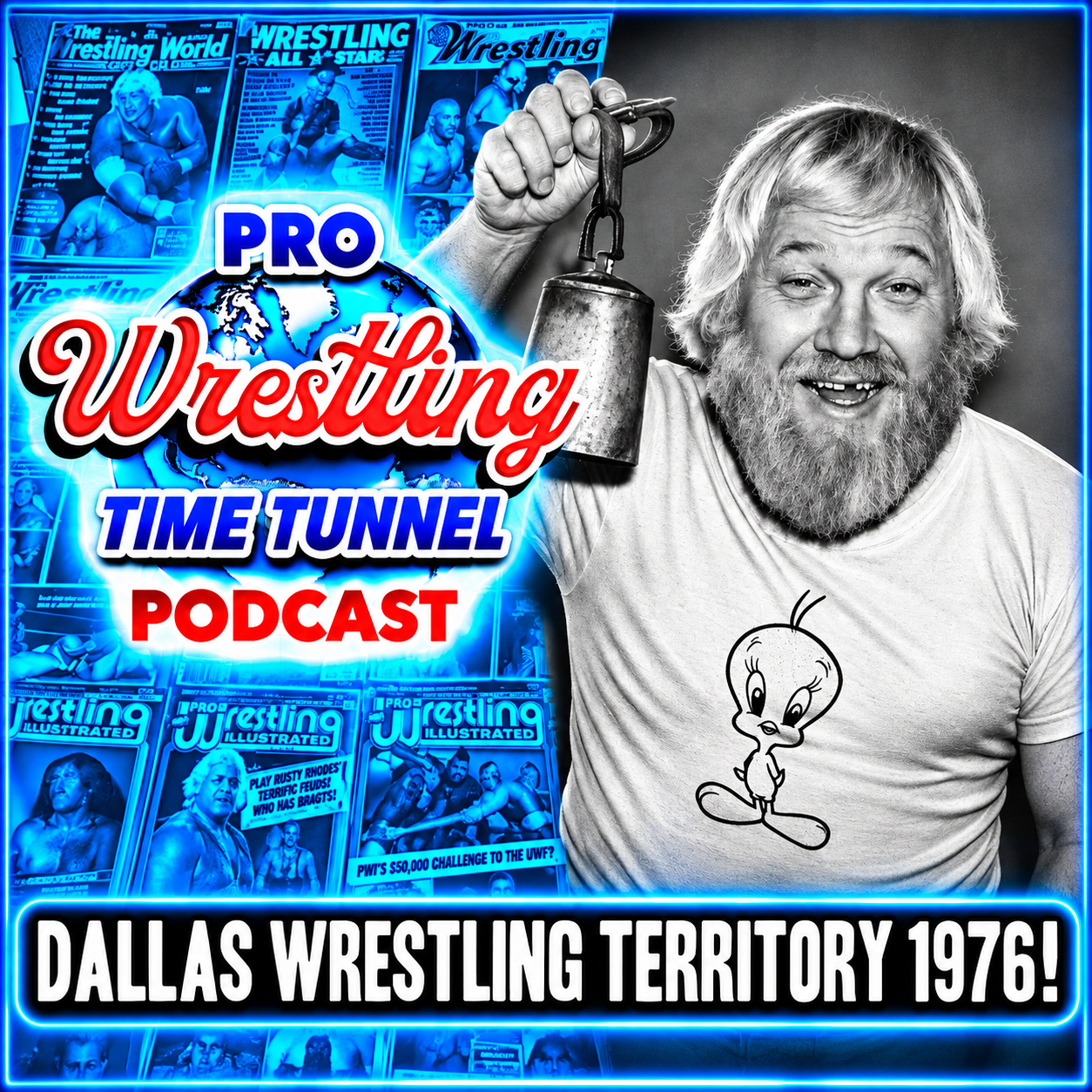
[00:00:34] Speaker D: Hello again, everybody. Welcome to another edition of the Pro Wrestling Time Tunnel History show, coming to you live from the Richards ranch in Western Kentucky. Howdy, everybody. Thank you so much for joining me for another great episode today as we go back to 1976 in two great territories. We're going to kick off in the Lone Star State of Texas and we're going to go to the Dallas territory.
The Dallas territory encompassed the cities of Dallas, Fort Worth, San Antonio, Corpus Christi, Houston, Austin, Texas.
That entire region of Texas was booked out of the Dallas talent office.
And we're going to talk about that here as we come down to the end of 1976. This is the second part of the Texas show. Go back earlier in one of our earlier episodes and pick up the first part of 76 if you need to do that.
So we'll start in July with Greg Klein, who's going to be here, Greg Klein's Old school wrestling and check out his new substack over there and his new book on the Texas wrestling wars of the 1950s and a whole lot more.
Greg has really, really gotten in depth with his Texas research this year and it shows. He's going to have some great information for us today in the Dallas territory. And then we're going to Canada, to Ontario, Canada, and look at some various promotions. Of course, we'll have to look at Toronto and the Great Maple Leaf Gardens.
The chic is coming down to the end of his run as the booker there and we'll talk about the attendance woes and some of the burnout and some of the other stuff going on with the chican. To help me do that, my good friend Wes Maidment is here and Wes runs the National Wrestling Clipping Service with all the great clippings.
He's got three or four Facebook groups that you can track west down on and of course, Toronto, Ontario is one of them.
But Wes is going to be here. It should be a wonderful show. Appreciate you all joining us again this week for episode 88 of the Pro Wrestling Time Tunnel History Show. Let's get started by going deep in the heart of Texas with Greg Klein. It's taken us A little while to get back here, but we are back to do the second half of the Dallas, Texas Territory in 1976. Terry Funk is the NWA champion.
J.J. dillon and Moondog Lonnie Main are the main heels. And my analyst for this is back once again, the wonderful and talented Greg Klein. Greg, how are you doing, man?
[00:03:27] Speaker C: Great, Tony, really great. How are you?
[00:03:30] Speaker D: Good. How's the book coming? A lot of people buying the Texas wrestling wars of the 1950s,
[00:03:35] Speaker C: Tony. I don't know what happened, but book sales hit the accelerator in the last month or so and things have just been amazing. Yeah, really, really amazing. I launched my own sub stack for wrestling, you know, the beginning of September. Greg Klein's old school wrestling talk. And yeah, things have been great.
[00:03:56] Speaker D: Good. Well, that's what we want.
That's what we want. We want the Greg Klein wrestling brand to grow. And that's usually evidenced by the amount of people who want to buy and see more. So good for you, man. Good for good. I'm glad. And for those who I don't know that I have it handy. I usually keep it handy here for the Briscoe and Bradshaw show, but we will try to show it later on when we put this in post production. But it's the wrestling wars, the Texas wrestling wars of the 1950s, Greg Klein. And you can get it at Amazon. Is there any other place you can get the book?
[00:04:35] Speaker C: Yeah, you can also check out my website, Greg Klein presents.com K L E I N and in addition to the books that you can buy, you can get the signed copies there, but you can also see what's going on in my film career as well.
[00:04:49] Speaker D: Okay, good. Well, let's go back and talk a little bit about.
We left off, I think at the super bowl of wrestling, Terry Funk defended the NWA World title against Fritz Von Erich. He drew. They drew about 17, 18,000 people in Texas Stadium and really seemed like they're on a roll here.
Well, let's go back and give, give us a little recap of where we were so far in 76 and then we'll proceed for the second half.
[00:05:18] Speaker C: Well, I think a couple of big things to note as we switch from first to second half of 76. Tony one, we're saying goodbye to the Mongolian Stomper as our lead heel. So you said Moondog Maine comes in and almost literally Moondog Maine replaces Mongolian Stomper. Not only is the lead heel, but with JJ Dillon as his manager and the last month of Mongolian Stomper in the territory, he does put over Some guys. But he also ends up feuding with JJ Dillon his last go round the territory. And then you can, you know, kind of see where Moondog comes into that picture. Fritz Von Erich is the American heavyweight champion. Rocky Johnson is the Texas heavyweight champion.
And I forget who the tag team champs are exactly, but I know Rocky and Jose win them at some point. Sigmund Stanky is another one of the big heels at this point in time. Killer Brooks is a big heel.
[00:06:17] Speaker D: You know, Siegfried Stanky started his career here in Paducah, Kentucky.
He debuted here in the early 70s and ended up after his wrestling days, ended up as quite a prominent and successful football coach. The other thing I was going to say is that Mongolian stomper, somehow or another, I don't know what the magical powers are, but there are magical powers on the other side of the Canadian border. Because when he goes across the Canada border, he gets his voice back. He can talk again somehow. He can do talk interviews in Canada, but he can't do them in the United States. He has to have someone talk for him down here.
[00:06:59] Speaker C: Well, I wonder if his last go round in Texas, he suddenly got his voice back and told everybody what he was going to do to J.J. dillon in the grudge match.
That sort of sent him out of town. The other thing, you know, we talked about a little bit on my show and we're talking about a little bit in my Houston recaps in 1970. I'm at the Dory Funk Wahoo McDaniel last showdown in 1970. But you know, what do you do after the big show, Tony? And you know, we'll talk about Terry Funk in Texas in a little bit. What do you do after Terry Funk, you know, beats your big baby face. Because at some point the champion does go over and you know, the second half of 1976 seems to be a lot of you immediately feed them, you know, big heels, either Stocky or Brooks or, you know, whoever else is at Moondog. You know, there's a lot of Moondog being the foil after somebody loses a big match.
And you know, Fritz, we can talk about a little bit.
He is just, I don't know if they have the 30 day rule for the American heavyweight title, but he is just defending it enough to qualify for that rule. He's on about a two to four match per month, you know, kind of guideline at this point. And the interesting thing is he doesn't get any more NWA title shots in my part of Texas, you know, where he gets them in the second half. Of 76. Tony in your half of Texas, he gets a couple, I think in Abilene or something like that, which is a little strange, but I would imagine based on the success of the Texas Stadium show, wouldn't you?
[00:08:44] Speaker D: Yeah, I didn't know I had a half, but yeah, he gets.
[00:08:48] Speaker C: Well,
[00:08:48] Speaker D: I
[00:08:49] Speaker C: wouldn't call it a half. I think I got three quarters and you got a quarter, but.
[00:08:53] Speaker D: Oh, really? Well, I shouldn't be doing that Texas series on Briscoe and Bradshaw then.
[00:08:58] Speaker C: I know you're stealing my gimmick, but what are you going to do?
[00:09:02] Speaker D: Yeah, I don't
[00:09:03] Speaker C: know. But seriously, Fritz Von Erich does get a title shot July 3 in Abilene against Terry Funk. And I don't, you know, again, I don't quite know what to make of that, except you would think that that's coming on the heels of the June match in Texas Stadium, right?
[00:09:19] Speaker D: Yeah, I think Fritz is, you know, I think he's showing the early signs of starting to check out. I mean, he's the NWA president here.
He has been NWA president for half the year. He's coming up on September. He will go out of office and Eddie Graham will take over. But, you know, I think, I think Fritz starts going into the early stages of really just being half in the business and half in his ranch and half in his personal life. And like a lot of guys who have been very successful over a a decade, Bill Watts went through this as well in UWF where it's just like I'm just not as interested in it as I used to be.
So I think Fritz is starting to get there.
[00:10:08] Speaker C: But when he does come back to Dallas, he's fighting Moondog. And when he comes back to Fort Worth, he and Lord Alfred Hayes are fighting Moondog and Killer Brooks. So it's interesting, Lord Alfred Hayes seems to go be a little bit of a tweener in this era. You see him both against like Moondog, but then you see him against some of the baby faces.
And as we'll see when J.J. dillon leaves, he kind of Moondog does has the same fate as Mongolian Stomper. You want to talk about Terry Funk a little bit in Texas?
[00:10:42] Speaker D: Sure.
[00:10:43] Speaker C: All right, so Terry is not around as much in the second half of the year as we've seen him. And he is in West Texas exclusively at least once where he doesn't make the loop.
But he is in San Antonio July 31st and he goes to a 60 minute draw with Rocky Johnson actually. Interesting. Tony in, you know, again dividing up the State in, in north South East Texas, it's really Terry against two guys for the rest of the year, either Rocky or Joseph, as both of those feuds come to a climax. Whereas in West Texas he's fighting the Super Destroyer, he's fighting Fritz Von Erich. I think there's even like a Swede Hansen match that I have a card for.
He really has a wide variety of opponents in West Texas. And as you can imagine, sometimes Terry's actually the baby face as the NWA Champion when he's in West Texas.
[00:11:44] Speaker D: Yeah, he's always the Baby Funks are always the baby face in West Texas. They. He still has the, the remnants of the Super Destroyer feud that is hanging around with Art Nelson.
And I don't know the exact date that it starts happening, but somewhere here in 2H76, he starts talking and gets back with Vicki and they start visiting and talking. And so his schedule allows him to be in West Texas more. And they start trying to.
I don't know if they're rebuilding their relationship quite yet, but the, but the starting steps of that are starting to take place.
[00:12:27] Speaker C: Makes sense. Makes sense. So August 22nd, he's in Memphis against Jerry Lawler, but then the 24th he's in Dallas and beats Rocky. The 25th he's in San Antonio, beats Jose. The 26th, he goes to a draw with Jose, double count out of ring in the third fall, the 27th there in Houston and he loses to Jose, but he's disqualified in the third fall. And interesting. I don't have an exact location, but I know that the 1st of September, somewhere in Louisiana he defends against Bill Watts, which I thought was an interesting match. And then he goes to Nova Scotia for a couple of weeks in the middle of September. So that, that's kind of an interesting trip, and scrambles all the people that you would think that Terry Funk would be defending the NWA title against.
But he does come back to wrestle Jose again September 24th in Houston.
This time they go to a 60 minute draw with each man having one fall apiece.
He has a rematch with Jerry Lawler in Memphis on October 18th and then makes the Texas loop again. So on the 19th he goes to. He beats Rocky in Dallas. On the 20th he's in a tag team match with Siegfried against Jose and Rocky and that's in San Antonio. The 21st he's down in the River Valley, he's in Harlingen and he wrestles Jose. I don't have a result on that, although it's the only time so you'd imagine they just go to a draw or something like that. So Jose can save face down there. And then on the 22nd, they're back in Houston again, this time in a no DQ match. And it is a double count out the first fall, Funk wins the second fall, Jose wins the third fall, and then Funk wins the fourth and deciding fall.
And interestingly enough, Tony in November in Fort Worth, he wrestles Les Thornton.
And I don't. I. I have two different results. I have one place that says it was a draw and one place that says that Funk got the win.
Another interesting match the next day in Mobile, I have him wrestling Ken Lucas, which I just like to mention Ken Lucas getting an NWA title shot because he was that big a draw in Mobile in. In that era. So that's Terry Funk in Texas, at least in, again, the north, south, east parts of Texas. I left out a little bit of the Super Destroyer stuff. You know, Super Destroyer, Tony is like one of those trivia questions that you wouldn't get, like, who did Terry Funk defend the title against the most? It's sort of like the Assassin being the answer for Dusty Rhodes.
[00:15:13] Speaker D: Or how many different guys played the Super Destroyer.
[00:15:17] Speaker C: Well, there's that
[00:15:19] Speaker D: Jardine, you got Scott Hogg, Irwin, you got several different guys who under the mask.
[00:15:26] Speaker C: And this year it's Art Nelson, right?
[00:15:27] Speaker D: Yeah, it's Art Nelson. Yeah. Art had been a star in West Texas 20 years before. In the 1950s, he was a tag team partner with Iron Mike Dibiase and Bulldog Danny Pletches. And, you know, this is the last go round for his career. He's winding down here, but, man, go, he goes all the way back to 1940.
Art Nelson had a long, long, successful career.
[00:15:54] Speaker C: So should we talk about Red Bastine?
[00:15:56] Speaker D: Sure.
[00:15:57] Speaker C: Yeah. So you and I have talked a lot about Red Bastine and Texas wrestling because we were talking about 1975 for months and months and months, right? And obviously everything that we talked about last time in 76, all the planning for the big show, we talked a lot about. When Red comes in, he comes in hot, he wins the Texas title. And after about three months, then he starts to put people over. And we talked about guys that Red brings in, Rick Martel, Roddy Piper, Stan Hansen, guys that really got a good first early career push in Texas. And you and I both think with the blessing, with the help, with the guidance of Red Bastine.
So Red Bastine leaves not long after the big show in June. And in fact, if you look at his matches In July, it's 100% putting people over. And it's exactly who you would think. It's Killer Brooks, it's Moondog Maine, it's Lord Alfred Hayes, it's, you know, it's all the guys we're talking about. And at that point, Tony, I don't know who's really the booker.
I would think that J.J. dillon is helping out quite a bit, although it's, you know, it's earlier in his career, but he's just transitioning to being a manager. He's probably getting more power, you know, more say so in terms of finishes and things like that.
Obviously the logical ideas that Gary Hart comes in and he does, but he doesn't start showing up in matches until November of 76, which makes you think that, you know, even with a little bit of lead in, he's not here till about October.
So I'm not 100 sure who is booking some of these things at the end of 76, but obviously. And then the other half of it is we don't see Gary Hart's quote unquote guys until 77.
[00:17:51] Speaker D: Yeah, I, I don't know that Dallas is one of those places where the booker hasn't always.
I mean, of course, during Red Bastine's tenure, he was very much in charge. Laid out the matches, laid out the finishes, directed all the guys. So did Gino Garibaldi. But there were times in the Dallas office where the boys just kind of did their own thing. I know in 1983 when the territory was really hot, a lot of the guys were just laying out their own programs. I mean, Jimmy Garvin has told me that, you know, he and he and Michael Hayes were laying out a lot of this stuff and neither one of them were the booker. They were just get together and talk about what, what would draw money.
[00:18:37] Speaker C: Well, and as we've discussed, whether it's the Houston booking office or the Dallas booking office, there are individual promoters and individual towns and different people, you know, are headlining in this era in different towns. You know, whereas Fritz is more often in the Metroplex and in San Antonio or Corpus Christi, it's more often Jose or Rocky or something like that. So, yeah, I think you're right. And I think that probably there are a lot of cooks that, you know, have their hand in it for a couple of months and then at some point we do get much, much more into the Gary Hart influence. But, you know, that's something that we'll end up talking about in 77. But
[00:19:19] Speaker D: I think, I think it's obvious JJ and Lonnie Maine are doing their program. You know, they're laying out what they're doing.
[00:19:27] Speaker C: Absolutely. And as I said, you know, JJ does leave as well. JJ and Rocky end up both going to Memphis or Nashville, whichever. You'd probably call it Nashville in this era. Right. But.
And then, as we said, Red Bastine ends up going to Mid Atlantic.
And so, you know, at some point, Moondog Main actually turns into a baby face, which I find so interesting. But that's, you know, that's not atypical. In Texas, you get the. The big bully. You get a season of who can take down the big bully. And a lot of the times, the guy that comes in as a surprise to try to take down the new big bully is the old big bully. Right,
[00:20:09] Speaker D: right, right. And we also have an injection of some really young talent here in the. In the second half of the year.
Gino Hernandez is in as a baby face and Kevin Von Erich makes his debut in August. So
[00:20:24] Speaker C: I was going to say Kevin Von Erich starts to appear on the cards. And oftentimes when you actually see Fritz Von Erich on a card is because you see Kevin earlier on one of those cards, there's an interesting result. I don't have right in front of me where it was or the date. But Gino gets a win over Joe Blanchard at one point, I think on a card in Dallas. I found that kind of fascinating.
Still getting a little Tully. We get a lot of Tully as a baby face, which is always so fascinating. I was reading some clippings that talk about, you know, Joe Blanchard, the fine scientific wrestler, and how his son Tully takes after him and is such a shining star in Texas at this point in time.
So I thought that was interesting as well.
[00:21:12] Speaker D: I think, you know, that's another added thing thing with Fritz Von Erich, too, because you're going to have a son debut every consecutive year after this. Right. And. And the same thing happened with Dory Funk, senior in Amarillo. He started moving him, removing himself from the cards. He started moving himself down to the semi main and down to the middle of the card while he pushed the boys. And I think, you know, Fritz has this already in mind here in 76.
[00:21:44] Speaker C: Yeah, I would think so. I would think so. Now, as I mentioned, we are going to lose Rocky Johnson at some point. He's basically been one of the two lead baby faces for the entire year. And at some point in about September, he starts to take dates against Jerry Lawler in Memphis as well. And at that point, I think the Seed is planted and they offer him a deal and he leaves. You know, kind of October ish. He starts to put people over on his way out of town. He drops the Texas title for the final time to the big German, who in turn ends up dropping it to Moondog Maine. At about the time that Moondog turns Baby Face for good, I think, or I won't say for good. There's a lot of interesting Moondog main results that make you question. I think he's just a tweener in a lot of cases, or city by city, depending on how he's getting over. But he does win the title at the beginning of the year. The other thing that I don't think we mentioned is that at the end of Mongolian Stompers run, Jose wins the brass knuckles title from him. And there's a flurry of Jose matches where he's having brass knuckles matches against Killer Brooks and, you know, again, all the usual suspects. Moondog. They even bring in superstar Graham again for a couple of of, you know, reprises against Jose.
And then the brass knuckles title seems to go quiet again. Jose ends up keeping it for about a year, it seems like, but it really doesn't feel like it's front and center. It feels like he wins it. There's about a month or two of him defending it, and then whenever he loses it a year later, it feels like they reintroduced it specifically to give it to somebody else, you know, which we won't jump ahead that far in, you know, into 1977. But so interesting with the titles and what they've been doing with the titles at this point in time.
[00:23:45] Speaker D: I think Siegfried Stanke is an interesting character here into the second half of the year because he's not a. You know, a lot of the Nazi German gimmicks of the 60s, 50s and 60s and 70s were just power guys. They were kind of like early versions of Road Warriors. They. They were, you know, the. The Von Raschkes and the guys like that, they were just. They had the Iron Claw or they were even Fritz, you know, in the. His early career was based on just power. Siegfried Stanky, though, is more of a scientific German Nazi. Like, he can really wrestle. You know, he has a lot of technical moves in his repertoire and whatever. And I think he's an interesting challenger after he beats Rocky Johnson for the Texas title in Houston, I think. I think he's an interesting challenger for Fritz because even though Fritz was a big, powerful guy, he could still work.
And so I think I would have liked to have seen These matches.
[00:24:54] Speaker C: Well, they did have a couple of series of matches, including a claw versus claw match in Dallas, so that does make sense. A couple other interesting matches. Tony.
June 23rd. So just kind of right before we were talking about this, to set up the NWA title match, there is in San Antonio a Terry Funk vs. Jose Lothario match, non title, which gives Jose the chance to beat Terry Funk in San Antonio. So I thought that was interesting. And then of course, they follow up, they go to a draw and then they go to a dq and they really keep that going all year in San Antonio with Jose and Terry.
[00:25:34] Speaker D: That's
[00:25:34] Speaker C: kind of imagine. Now, I talked about J.J. dillon leaving. Here's J.J. dillon's like last couple of months in Texas. So in San Antonio, he loses a taped fist match on August 4th to Tully Blanchard. How about that?
[00:25:51] Speaker D: That's got to be
[00:25:52] Speaker C: JJ Dillon in a taped fist match.
[00:25:54] Speaker D: Yeah, that's got to be. I saw several of those in 86.
The. The Terry Funk bull rope title match. That has got to be Terry's idea.
I mean, that's got to be him saying that it's not like it was not normal for the NWA World champion to work a gimmick match. That was not part. You
[00:26:15] Speaker C: beat me in my specialty bull rip match and then we'll come back. Yeah,
[00:26:18] Speaker D: yeah. That's something that is normally done by an NWA champion to work a match like that. It's typically a straight main event match. And this is also the difference in a Fritz Von Erich president versus a Sam Mushnik presidency, which would. I don't think that would have ever flown with us.
[00:26:38] Speaker C: Right?
Yeah, for sure. So August 9th in Fort Worth, in a light out. I quit matching. Rocky Johnson beats JJ Dillon now in Houston, September 3rd. JJ has a very special opponent.
His name is Victor.
Can you guess his last name?
[00:27:00] Speaker D: Don't know.
[00:27:01] Speaker C: The Bear.
So on his way out of town, they make JJ wrestle the bear.
[00:27:07] Speaker D: Oh, that's right. Yeah, I remember that.
[00:27:09] Speaker C: Houston and then in Dallas on September 9, Rocky beats JJ and like I said, they're both actually heading to Memphis. Rocky is wrestling part time in Memphis by this point, and when we next see jj, he is in Mid America as well.
[00:27:25] Speaker D: Yeah, yeah, I, I remember that. Now. They. They did everything to JJ on his way out of town or.
[00:27:32] Speaker C: Yeah, for sure, for sure.
All right. You want to talk to Madre the Giant?
[00:27:39] Speaker D: Yes.
[00:27:40] Speaker C: So we have not seen Andre much in the second half of the year, but boy, does he make up for it in November. And it's funny, I was I was finding bits and pieces and bits and pieces, and there's still a few dates that are missing, but you can almost name the towns and figure out where they must have been. So Andre comes into town Nov. 8 in Fort Worth and wrestles the Moondog.
Then on the 9th in Dallas, he wrestles. And this is a big deal.
The Sheik, the original Sheik who has started in the territory, he actually comes in in October and he wrest. He wins in 58 seconds against an El Brasserio.
And then the next night, he wrestles Rocky Johnson.
And he's, you know, he's keeping the chic schedule. But I would say over the next half year, the Sheik becomes the next big bully monster guy in the state of Texas, and he really ends up making the rounds. We'll get to that in 1977. But as we said, Tony, what happens when you bring in that. That big bully monster guy? Well, one of the guys you throw against him is the previous guy. So we start as the Sheik comes into town with, like, Chic versus Fritz, Sheik versus Andre, and then Sheik versus Moondog, all around that time. But back to Andre.
[00:29:06] Speaker D: Yeah, One quick thing.
[00:29:08] Speaker C: Yeah,
[00:29:09] Speaker D: yeah. Talking to Brian Solomon about the Detroit territory on the show here, and he was saying that the Detroit territory was starting to. It had reached its apex in 1973, and it was starting to fragment and go down. And so the Chicago, possibly because he needed the cash, started touring again.
Instead of homesteading Detroit, he started going out again. And so he had a big feud with Dick the Bruiser in the Indianapolis Territory in 77, and he's here in Texas at the end of 76 and 77 because he needs the money. So I remember he came to Tennessee also.
So he's back on the road again in the latter stages of his career for sure. And it's kind of a sad thing, really. I mean, when I think about Ed Farhad and I think about the hot period that he had from the 60s to the early 70s, to be forced to go back out and.
And pedal yourself again.
I mean, you got to do what you got to do. But I feel bad for him at this point.
[00:30:15] Speaker C: Yeah, I get it. You know, I mean, he was. He had such a great run in Houston that on some level, I'm glad that he had that run. But obviously, the. The sadness of losing your financial status and having to do it is a different story altogether.
[00:30:34] Speaker D: Certainly things that are decisions and things that by his own hand, that created the situation.
But I still feel bad for the guy.
[00:30:41] Speaker C: Sure, sure. So, speaking of which, in San Antonio on November 10th, Andre versus the Chic. And again on the 11th, Andre and the Chic in Corpus Christi, we also get Rocky Johnson on his way out of town losing to the Great Goliath.
And that's the other thing that's going to happen at the end of this year that, you know, I said earlier, what happens when you get, you know, after you lose a big match like the NWA title match. Well, at the end of the Jose vs. Terry funk series, they bring in Gordman and Goliath.
And so you immediately get Jose into a new feud that the fans can get behind that makes them forget that he didn't quite get there against Terry Funk during this series of matches. Now, for Rocky, they don't have that same problem because Rocky's leaving, Rocky is going to Mid American.
So, you know, they can beat Rocky on his way out of town. And, you know, Rocky was good about doing business, obviously.
So that happens November 12th in Houston. Andre and Jose wrestle Gordman and Goliath. And then Tony. There is an interesting week. I can't figure out where he is that Saturday and that Sunday, but that Monday he's in.
Let's see, Monday he's in Odessa, I believe.
No, wait, I have that backwards. Monday he's in San Angelo. Tuesday he's in Odessa, Wednesday he's in Abilene. Then there's a couple more days where I don't know where Andre is, and by the weekend he's in Lubbock. So literally, Andre the giant spends two whole weeks in Texas in November of 1976. And as you know, he'll be back for the first week of January as he goes to Houston for the Battle Royal and. And makes, you know, makes the circuit.
[00:32:31] Speaker D: Yeah, yeah, yeah. San Angelo would have been a monthly town. The others would have been a weekly town. So, I mean, it's just.
Just a regular week for the West Texas office there with the special attraction.
[00:32:45] Speaker C: Yeah, well, you know, I thought this was interesting. I think you were the first one I heard talk about Pez Whatley in West Texas getting a big break. But he's in a six, man with Ricky Romero and Andre the Giant in the main event against Gordman, Goliath and Dennis Stamp, November 16th in Odessa. And it's like, wow, that's early in Pez Watley's career to be getting that. I mean, main event with Andre and Ricky Romero, that's.
[00:33:11] Speaker D: Yeah. I don't know exactly what the sequence of the shows are. Going to be. But coming up, I've got Amarillo 1976 with Larry Lane coming up.
[00:33:19] Speaker C: Oh, nice.
[00:33:20] Speaker D: And Larry Lane did a series of collegiate matches because just so happened they had Dennis Stamp in the territory. Larry was a former collegiate champion. Pez Whatley was University of Tennessee at Chattanooga. And Pez Whatley got in on some of those collegiate matches in West Texas. So he did. He really got. They really got behind him and gave him quite an opportunity in the Amarillo office
[00:33:46] Speaker C: in San Angelo. He teams with Ted DiBiase to wrestle Rip Hawk and Sweet Hansen, which I thought was interesting. There's also. There's a Rocky Johnson and Pez Whatley against Rip Hawk and Sweet Hansen match.
[00:33:58] Speaker D: Yeah.
[00:33:59] Speaker C: And I. I wonder, you know, Sweet Hansen was famous for saying the wrong things to Tony Atlas. I wonder if he would have tried that with Rocky Johnson or Pez Watley, because that would have been a fight.
[00:34:10] Speaker D: Yeah, I doubt it. I doubt it. I mean that, you know, some of those things are things that are just captured in moments in time, not necessarily the way a guy was all the time. So I don't know. Wasn't there. Wasn't there? Don't know.
[00:34:26] Speaker C: Nobody knows.
Nobody knows.
[00:34:29] Speaker D: All right. I tend to. I tend to lean toward the give a guy a break for saying the wrong thing at the wrong time. It could have just been a mistake type of thing versus condemn someone for something like that. Because without being around them and without being there, you don't know if that's consistent behavior or if that was just a bad day, you know, you just don't know.
[00:34:53] Speaker C: Well, and I mean, famously at that point in Tony Atlas career, he speaks of being tested by all of the veterans because they're putting him into the main event.
[00:35:03] Speaker D: And.
Yeah, and that was the standard operating procedure for the old veterans at the time.
Guys like Sweet Hansen and Rip Hawk were in the very last runs of their career.
They're a throwback to the old days where. Okay, kid, you know, we're going to show you how this works.
[00:35:24] Speaker C: Yeah, for sure. So, Tony, you mentioned how interesting you thought the Fritz Von Erich Siegfried stocking match was going to be. So listen to this. They have a whole series in October in Dallas. They have the steel cage match in which Fritz wins. Then they come back in November and actually the American title is held up.
Stonko wins the match, appears to win the title. They hold it up. This is November 16th. And then they come back again November 23rd for a return match. Fritz wins the title back.
And then on the undercard I thought there was an interesting match.
Les Thornton and Tony Charles come in as the tag team and they wrestle Lord Alfred Hayes and the Moondog.
[00:36:13] Speaker D: I was just gonna, yeah, I was just gonna mention in. In Dallas on October 5th, they have a Rocky Johnson and Chic match and Tony Charles is a special referee. Like it. That seems like a waste of Tony Charles. You would think he would be on more of the Fritz von Erich vs Stanky match as a special referee or something.
[00:36:34] Speaker C: Yeah, interesting, interesting. The I, I talked about the claw versus claw match, that was September 21st. So they, you know, if you look at it that way, they're Fritz and Snake have about a two month series in Dallas, you know, so that's exactly what you were looking for. And then as we said, the, the talent starts to change a little bit. In November, December, we get the Chic, we get Gordman and Goliath.
You know, we get Gary Hart. The first times I see Gary Hart are in November and December and December 28, there's a steel cage match. The main event, Fritz and the Moondog against Lord Alfred Hayes and Gary Hart.
[00:37:15] Speaker D: Here's another anomaly.
San Antonio, October 20th. Jose Lothario and Rocky Johnson are the Texas tag team champions and they beat Siegfried Stanky and Terry Funk to retain the titles. What is the NWA World Heavyweight Champion doing in a tag team match for the titles? That doesn't make any sense to me.
[00:37:37] Speaker C: Well, probably because he's coming back the next month to defend against Jose, right? Well, yeah, but just
[00:37:44] Speaker D: put him in a regular tag team match. I mean, fans know Terry Funk is not going to win the tag team titles and have to stay there and defend them. I mean, you know, you don't, don't make it a title match, just make it a regular tag team match.
[00:37:59] Speaker C: Yeah, for sure.
[00:38:00] Speaker D: I mean,
[00:38:00] Speaker C: to
[00:38:01] Speaker D: me it sort of devalues the titles, you know, and devalues the world title, which would eventually keep happening.
[00:38:10] Speaker C: Yeah, I mean, well, as you said, it's a different era and Sam is gone and things are happening that never would have happened during his era.
And you know, this is the long downfall of the NWA title or the NWA as
[00:38:27] Speaker D: a
[00:38:27] Speaker C: functioning cartel.
[00:38:29] Speaker D: It is definitely a decrease in the value of the NWA title. There's no doubt about it. And that's just one example. The bull rope match is another example.
You know, anything having to do with a gimmick match should be far, far away from the NWA world title.
[00:38:52] Speaker C: So Tony, some other people that are in the territory in this era, obviously we get a little thunderbolt Patterson towards the end of the year, we get some big O.
You know, the original Bob Orton, he is kind of mid card to make, you know, he pokes into the main event every once in a while, gets into a feud with Rocky Johnson, gets into a feud with Jose in San Antonio, that kind of stuff.
Killer Brooks is around, as we talked about. Gino Hernandez is around. Tully Blanchard's around. Paul Pershman is still around.
He loses to Gino and a couple of curtain jerkers, especially in the middle of the summer.
[00:39:36] Speaker D: He's working back and forth in West Texas too.
Paul Perchman, I don't know. They're swapping out a little talent here. Toward the end of 76, Hirschman, I know, wrestled Larry Lane because we talk about it on the show.
So they were sending some guys over there.
[00:39:57] Speaker C: Yeah, yeah, a lot of. A little bit of talent training and as a matter of fact, we do get a little Pez Watley in Houston, I think. And we get, we start to get Scott Casey at the end of the year as well. Coming over from West Texas, you know how much I like Scott Casey. So that, that's always fun to see.
[00:40:17] Speaker D: Yeah. So let's see. Where are we, sir?
[00:40:20] Speaker C: Well, you know, Tony, if we have a little bit of time, I wanted to read something to you.
[00:40:25] Speaker D: Okay, yeah, let's talk about that article from Corpus.
[00:40:28] Speaker C: Okay, so this is what kind of the equivalent of a parade magazine article?
October 15, 1976. The section is called Tempo Update Beat, and the woman that wrote this is named Hillary Hilton, but it's H, Y, L, T O N. And if you know anything about Texas political writing, you probably know her name. Just a Google search of her came up a bunch of stuff about all the usual suspects in Texas. So we won't go into it except to say that this is not a wrestling writer, this is not a sports writer. This is someone who goes on to a career sort of writing, you know, upbrow pieces about politics. I think there was a bunch of Time magazine things.
Anyway, though, the headline is the Saga of Good versus Evil. And you'll tell that she's actually talking about something in about June of 1976 in Corpus. It was the end of a beautiful relationship. There were no tears, no whispered goodbyes, no anxious last glances.
Their relationship had been a volatile one. Their parting was no less.
It was over. The Mongolian Stomper wrestler and James J. Dillon, wrestling manager extraordinaire, had parted company. The Stomper had listened for the last time to his cigar puffing, banty rooster of A manager.
No more would he be urged on into a wild Mongolian frenzy by Dylan's red faced yelling of that famous Mongolian battle cry and Yul Brenner movie title Taurus Bulba. Taurus Bulba. It had ended with blows, a few muttered Mongolian expletives and rousing cheers from a hungry crowd.
It was a night to be remembered. Another chapter in the weekly saga of Thursday night wrestling at Corpus Christi's Memorial Coliseum had been written. The pages would turn.
Soon Dylan, the eternal object of the crowd's derision, would reappear with another moondog, Maine, a wild eyed man given to chewing on beer cans.
Watching a man chew on beer cans and call another man's mother names is a spectacle which might have pleased Nero or been an ideal apperatif for Attila the Hun.
It is also the weekly diet of several thousand area wrestling fans. Professional wrestling is an enigma. It is entertainment, it is brutal, it is comedy. And yet it's sad. It is a blood spurt sport where few are seriously hurt. It is a lucrative business for the wrestlers, among them lawyers, college graduates, businessmen and policemen whose capers on the canvas add tens of thousands of dollars to their yearly income. And yet it is a weekly ritual which attracts the working man and woman.
Every Thursday night, this ritual unwinds with the same rhythm. This is a drama with a cast of thousands, where each actor knows his role well and the curtain always comes down on time. No matter how fierce the battle. Center stage are the wrestlers. They're either hero or villain, their character pure or poisoned. But this is no antagonistic drama between two mere mortals. To borrow a phrase from the ring announcer's jargon. This is a battle royal, a battle between the forces of good and evil. A drama written with a Greek pen, where the crowd is a chorus echoing ritual phrases. Rip the turkey's head off. Hit him again. Kill the yellow belly.
And on this warm summer night, a night etched in the memories of the faithful, there was to be a fateful meeting. Jose Lothario, man of the people, symbol of good, would fight the Mongolian stomper, stranger, man of evil. In the brass knuckles Texas Death Match.
It is apparent only to the faithful fan who is evil and who is good.
Orientals are usually evil black and Mexican American wrestlers. Good men who affect feminine ways, like the famous Gorgeous George, are evil. Men with clear, clean looks and baby blue trunks are good. Germans, especially those sporting Nazi regalia, like the infamous Hans Schroeder, are definitely evil.
But again, there are contradictions. Prince Peter Maivia, whose legs and lower torso are tattooed, marking him as a prince of Samoa is good.
And yet the Samoans, two stocky wild men who roamed the Southern wrestling arenas, were evil. And Andre the Giant, whose name, size and constant maniacal smile might lead the uninitiated to think he is evil, is surrounded by children as he strides forth to combat, much like his jolly green namesake surrounded by elves.
Terry Funk and Dory Funk, the products of a West Texas wrestling dynasty, are about as evil as wrestlers can get.
Another graduate of the Funk Ranch, Killer Brooks, recently ripped open a turnbuckle with his teeth and spat stuffing all over Joe Blanchard, a grand old man of wrestling who has passed his goodness onto his son, Tully Buddy Wolf, who in June battled Muhammad Ali in Chicago, wrecked havoc in South Texas earlier this year. Wolf was a Yankee and evil, but backstage, Wolf was a soft spoken, articulate man who said he had found wrestling more lucrative than professional football.
Wolf, his blonde orifice, Orphan Annie locks framing a handsome face, said he flew home to Minnesota every week to visit his girl.
Later in the ring, he would shake those same locks and snarl at the crowd. Wolf's once backstage concession to the moors of professional wrestling was to sneer softly that he didn't like the Mexicans. Wolf, like most of the evil wrestlers who appear on the Texas circuit, frequently battled Jose Lothario. Lothario is something of a legend in Texas. He and his wife are both longtime wrestlers whose appearances prompt loud cries of support in Spanish and English. There is no place for racial or ethnic discrimination here. This is us against them. The evil ones from unknown lands, Suspicious and unknown people.
This actually has two.
Not just one, but two pages. Let me pull up the second one real quick.
[00:46:51] Speaker D: Do you know who the local promoter in Corpus was at this time?
[00:46:56] Speaker C: Well, you know, at one point I know that Joe Blanchard and. And, you know, Living Good Brown take over in the city, which is part of what makes it so interesting. You know,
[00:47:07] Speaker D: they promote that in addition to San Antonio. So it.
[00:47:10] Speaker C: Yeah,
[00:47:12] Speaker D: so was Joe Blanchard. It sounds like Joe Blanchard was like the authority figure on the television maybe, and he was participating in some angles, the way that sounds. Or
[00:47:23] Speaker C: I think so,
[00:47:24] Speaker D: or was that a match that they had or something?
Do you know?
[00:47:28] Speaker C: I think that she's talking about him as the authority figure, But I'm not 100% sure. But here
[00:47:33] Speaker D: I would think he was kind of out of the ring at this point.
[00:47:36] Speaker C: Yeah, well, you know, when you see him at this time, he's in like the curtain match. He's wrestling a Broadway or he's wrestling a scientific match against Gina Hernandez, something like that. He's not, you know, he's. He's not in a main event at this stage. He taking his bows a little earlier than Fritz does, for sure.
[00:47:53] Speaker D: I mean, I'm just off the subject just a little bit, but I, I gotta think they starting to think about doing their own television at this point.
[00:48:02] Speaker C: Yeah, well, and he, you know, in a sense they have their own circuit because they have other towns and they're running the South Texas towns, they're running the spot shows, they're running Austin, they're running Seguin. So yeah, I think the seeds are being planted for sure.
[00:48:19] Speaker D: So those spot shows they're running that you just mentioned, are they using the Dallas office talent then for that or.
[00:48:25] Speaker C: Well, you know, again, you know, this is where the different promoters in different towns could do different things. So they're not using Fritz, obviously. They
[00:48:32] Speaker D: probably, I mean, the guys are that are on the five main towns probably aren't going to
[00:48:37] Speaker C: both.
[00:48:38] Speaker D: They probably aren't going to Seguin, you know, but.
[00:48:41] Speaker C: Right, right. But on the other hand, if you did bring a Jose or a MIL mask into Seguin or into Austin or into Harlo, you know, you could do really well with that.
And you didn't need to have necessarily all the talent that you had in Houston on a Friday night.
[00:48:56] Speaker D: Right, right. So you
[00:48:58] Speaker C: could have local guys, you know, under mask, you know, as they do in the 80s,
[00:49:02] Speaker D: or on
[00:49:02] Speaker C: the Jose shows that run opposition.
[00:49:05] Speaker D: Or maybe you're using guys that aren't really on the main programs right now, like Grand Marcus or something like that. Who
[00:49:12] Speaker C: exactly
[00:49:13] Speaker D: comes in for the spot show. But he isn't in a main program in the five big team towns or something.
[00:49:18] Speaker C: Yeah, or again, I mean, in the early 1980s, what Jose does is he puts some of the guys of the job guys under masks and gives them different names, you know.
[00:49:25] Speaker D: Yeah. Oh God. Nick Gula's trick.
[00:49:27] Speaker C: Yeah, yeah, exactly. All right, so here, here's the rest of the article.
Behind the curtain at the Coliseum, good and evil share the same dressing rooms. But once the light goes up, good enters the arena from the right of the stage while evil walks down the left aisle.
That faithful night, the hero, Jose Lothario strode through cheers and crowds of well wishers towards the ring in cerise colored tights and silver boots.
But the Stomper and the infamous Dylan walked through a wall of booze. From his boots to his frown, the Stomper looked evil. While most wrestlers wear wrestling boots The Stomper preferred brown leather boots, vaguely reminiscent of the Gobi Desert or the Sears and Roebuck catalog, depending on your particular background. He also wore his Mongolian frown, which stretched the full width of his forehead.
For a few brief minutes, as the two men locked their bodies together, there were fleeting glimpses of wrestling as it might have been thousands of years ago. Their sweating torsos captured the light and the two men became a single flesh statue caught in the midst of a rising cigarette smoke. But then the scrap began in earnest. The two bounced off the ropes and lunged at each other. The stomper ripped his fingers down Lothario's face and the hero sank to his knees. We were watching the ritual destruction of a champion of the people. Lothario's hands reached out blindly toward the crowd as if he sought some support. There again, the stomper crashed into him. Lothario was down and rolled in agony. For the unbeliever, there was always the eternal question. Does it really hurt?
Like vegetable virgins, professional wrestlers are guardians of a sacred trust that they may talk about their motives, their opponents or their income. But they never answer that question.
But pain is a transitory thing in a wrestling ring. And there are miracles. Every Thursday in the Coliseum after that first agonizing round, Lothario, recharged by the screams of the crowd, came out for the second round, smashing his fists against his forehead, ripping at his hair and pacing the ring like a stud bull. There is a universal moment in every wrestling saga where evil shows his true character. A moment where every bad guy sinks to his knees, begging for mercy. That night in the second round, as the crowd banged metal chairs together in a barrage of noises guaranteed to overcome evil, the Stomper, his eyes round and his arms stretched heavenward. Be. Screeched Lothario. Despair him. Sweat sprayed off the two men and suddenly it all seemed so barbaric. Surely these same screams were heard in the Roman circus and in a mud filled bear baiting rings 400 years ago. Lothario, in a fit of rage, grabbed the stomper's leg and ripped off his brown boot. Suddenly, the barbarity of the moment ended. The stomper was wearing white sweat socks bordered in blue. Mongolian sweat socks. Perhaps the Mongolian stopper, man of the steps and spirit, still descendant of the cons, hopped around the ring in one Mongolian boot and one Mongolian sweatsock.
[00:52:41] Speaker D: Dylan,
[00:52:41] Speaker C: his cigar clenched in his teeth, blustered his way into the ring, grabbed the boot out of the grinning Lothario's hand and tried to hit him with it, Lothario ducked, and Dylan hit the Stomper, knocking out his own man. Lothario turned on Dylan and knocked him down. Dylan and the Stomper were spread eagle on the canvas, unable to come out for the next round. Lothario stood in triumph, his hands held high. This was a Thursday night tree, member and savior and saver. The hero was carried triumphantly to his dressing room, while the Stomper and Dylan stumbled out of the ring, arguing.
The Stomper struck a moody pose, his shoulders round, his frown deep, while Dylan, ever cocky, strutted back with the confidence of a con man.
That night, the Stomper strode out of the Coliseum, never to be seen again in these parts. Perhaps he is back on the windswept steps, or maybe Cleveland for a little while. Moondog, Maine took his place. But heaven knows it's hard to keep a man happy who likes to chew on beer cans. And so Moondog and Dylan broke up. But Dylan remains. Perhaps he knows that out there in wrestling land, there are dozens of strange, evil ones chomping on beer cans and grunting in front of television cameras, ready to meet the Thursday night challenge.
[00:54:01] Speaker D: Wow.
[00:54:02] Speaker C: And then there's a picture of the crowd, and it says, crowd reacts to evil.
[00:54:08] Speaker D: How
[00:54:08] Speaker C: about that?
[00:54:09] Speaker D: That's amazing writing, actually.
[00:54:12] Speaker C: Well, that's what I was saying. She was obviously a pretty good writer who was writing with a little bit of tongue in cheek and yet summed up.
[00:54:19] Speaker D: Sounds like.
Sounds like she's writing the promo, though, I mean.
[00:54:23] Speaker C: Yeah.
[00:54:24] Speaker D: Yeah, that's pretty cool. Thanks for sharing that.
[00:54:26] Speaker C: Yeah. You know. Well, thanks for making me look for it.
[00:54:29] Speaker D: I enjoy the heck out of it.
And that was in the Corpus paper.
[00:54:34] Speaker C: That was October in the Corpus Caller Times, I believe. Yeah.
[00:54:39] Speaker D: Wow. Cool.
All
[00:54:40] Speaker C: right. So, you know, that's kind of. That was the Mongolian Stomper era, but, you know, you can see that replaying again with the Moondog and then again as we leave Texas in 76 with the sheik.
[00:54:55] Speaker D: Yeah. So this is going to enter into a little bit of a down period for the Dallas territory, and we're going to see the early stages of fragmentation start in 1977. So I'd be interested. I mean, 76 looks like a fairly successful year for the territory. I mean, it's still intact. The five main towns are still working and cooperating with each other.
We do have a change in bookers. I don't think.
Gary Hart, for all his great attributes, and there are many, probably not the diplomat that Red Bastine is.
So as far as being Able to smooth things over.
I could be wrong about that. What do you think?
[00:55:44] Speaker C: No, I think you're spot on. And, you know, as you mentioned, when is the split with San Antonio? Well, Frank Brown dies in 77, and that's when Dorothy sells to Joe Blanchard. And Joe Blanchard starts to, you know, slowly but surely move away.
He has his own people he wants to push. He wants to push his son not as interested in the boys, you know. So by like 1980, we're in full fledged, you know, Joe Blanchard and, you know, versus Fritz for control of South Texas. Something that plays out over five years.
[00:56:21] Speaker D: It's kind of interesting because 10 years before, this had played out in the other direction. And Joe and Frank were the first to kind of pull out.
I saw a newspaper article where they pulled out in September of 66, before Macklemore and Fritz start running the Bronco Bowl. So, I mean, this is not, this is not new behavior for Joe and Frank. I mean, I think. I think they're just thinking, well, it's time for us to, you know, move the chess pieces around again.
[00:56:54] Speaker C: Yeah, well, you know, as. As my book talks about, this goes all the way back to the late 1950s, when Morris Siegel and Frank Brown have a falling out over booking San Antonio. And, you know, Morris accuses Frank of starting his own circuit, then denies him talent, gets in business with Pinky George briefly, which encourages Frank to start his own circuit. So that's where they really start to look for other towns. And then again, as we keep talking about again and again and again, you didn't have to run the five main towns as a wrestler or as a promoter. If you had San Antonio and Austin and, you know, Corpus Christi, you could run just south of San Antonio and do very well. And so they start to realize that in 1959, 1960, and that is, I think that informs everything that Joe Blanchard does.
You know, you thinking, okay, I don't need these other guys. I could just run my own loop. And maybe, you know, for a while. Paul Bosch thinks he'll get in business with Joe Blanchard rather than Fritz.
[00:58:02] Speaker D: You probably
[00:58:02] Speaker C: know that starts, by the way, the beginning of 1981. Very clearly in 1980, those cards are still Gary Hart and his associates.
And the first January show of 1981 is Wahoo McDaniel and Tully Blanchard and Joe Blanchard. So, you know, what we're seeing at the end of the 70s starts, as you said, in 76, 77.
And by the time we get to the era that we know in the 80s, Fritz's Texas loop is all blown up. Because
[00:58:33] Speaker D: you probably.
You've. I know you have. You've looked into this deeper than I have. But it just seems like, to me, it's interesting because Fritz Von Erich is much more of an imposing figure than Morris Siegel. Morris Siegel is the little business accountant type guy, you know, but it seems like there was more fear of pulling away from Morris Siegel than there was of pulling away from Fritz. Am I right about that?
[00:59:02] Speaker C: I think so. You know, you're talking about two different things, though, like who you want to fight in an alley versus
[00:59:10] Speaker D: Well, I mean, just like, I don't know, man, if we want to pull away from Fritz or not, you know?
[00:59:15] Speaker C: Right, right. Well, but here's the thing.
[00:59:18] Speaker D: But Morris
[00:59:18] Speaker C: was just kind
[00:59:19] Speaker D: of like the business guy, you know,
[00:59:21] Speaker C: Monopoly for decades, to the point where he was rumored to have the Texas legislature and. And the commissioner of labor in his pocket. I don't think Fritz Von Erich ever had that for a while.
[00:59:34] Speaker D: No, he wasn't as politically connected as Morris, for sure.
[00:59:38] Speaker C: For a while. He was the president of the nwa, which, you know, that helps. Right. But that's not the same thing as having the ear of the governor of Texas or the governor of Texas's lackeys.
[00:59:50] Speaker D: He's kind of like.
You know, who it reminds me of is the frail, small mobsters in the Mafia. You know, like, Morris Siegel was sickly. You know, he was in bad health for most of his life or whatever, but he just had so much gravitas around him that it seemed like. To me, it was like he.
I don't know, he carried a lot more.
A lot more respect than Fritz did. I could be wrong, something like that. You know, I'm not.
I'm struggling to come up with the exact description, but it just seemed like the promoters were a little bit more in awe of Morris than they were for it.
[01:00:35] Speaker C: Well, you know, Tony, you didn't get in this position and maintain this position for decades. If you were pushover.
[01:00:41] Speaker D: Yeah.
[01:00:41] Speaker C: If the boys could push you around, if other promoters could push you around.
You know, whether it was Morris that set the suspicious fires, whether it was Dizzy Davis or.
Or Ed McLemore in the 1950s, there were suspicious fires. Right. There was rumors of the legislature being in Morris Siegel's pocket. There was sharp elbows. There was Pinky George. There was. You know, there was a lot of stuff.
[01:01:08] Speaker D: Yeah, it's interesting stuff, for sure. And an amazing, amazing year in Texas in 1976 in this. And the thing I like doing about these shows is because People don't think about this stuff. They don't think about this era where Dallas was the booking office and you had all these great feuds and matches and all that. Pre boys, you know, pre Von Erich boys. And so thank you for helping us go back in time in the time tunnel and recreate all this stuff.
[01:01:40] Speaker C: Yeah, well, thank you. 1976 is not a year that I have a lot of programs from. So it was great to dig in and do the research and learn about a bunch of guys that I hadn't taken on yet.
[01:01:52] Speaker D: Sounds good. Greg Klein, everybody. Get the book Texas Wrestling wars of the 1950s. Check out his sub stack. And what is that address, Greg?
[01:02:03] Speaker C: Hold on. I will give you the real address as opposed to just making it up on the fly. It is Greg Klein's no apostrophe old school. Wrasslin.substack.com and then my website is Greg Klein presents.com and it's K-L E I N. We do not obey the I before E except after C rule.
[01:02:24] Speaker D: And. And tell us a little bit about your rhythm in your.
In your substack. So,
[01:02:30] Speaker C: yeah,
[01:02:31] Speaker D: what do you cover? You cover Houston on Friday nights because it was a Friday night town and
[01:02:36] Speaker C: then. Well, sure, in. In honor of my new good friend Jeff Winningham and his book, Friday Night in the Coliseum.
[01:02:46] Speaker D: Hold it up just a little bit more. There we go.
[01:02:48] Speaker C: Yeah, so this is a new copy. He has the old copy, which is, he told me on my show, did not sell for years and years and years and now it costs you a couple hundred dollars to get one. But this is a new copy with about 50 more pages of pictures and writing. Anyway, so on Friday,
[01:03:08] Speaker D: I've never unwrapped mine. I've kept it wrapped.
[01:03:10] Speaker C: Oh, it's beautiful. Yeah, no, it's a great, great piece of art.
So on Fridays we do Friday nights at the Coliseum where I talk about Houston wrestling history. We've been doing 1970 because it lines up the same Friday nights. So that's where we are right now. And then on Mondays we do some sort of historical essay. Right now I'm exclusively doing the hall of Fame case for Junkyard Dog. And tomorrow we're going to be in year three, which is a great year. It's where he takes over Calgary and becomes really, truly becomes a headliner.
So that is going on.
And then on Wednesdays, Tony, we do artifacts. So, you know, stuff from the vault, so to speak, whether that's my own programs or stuff that I saw from the Jack Pfeffer collection at Notre Dame or stuff that I've found on genealogy.com just, just various things. So that's what I do times a week. And you just. That made me think, Tony, one more thing about 1976 I wanted to mention. November 7, 1976, as far as we know, first match for the Junkyard dog.
[01:04:19] Speaker D: Wow, awesome.
[01:04:21] Speaker C: That's what
[01:04:21] Speaker D: made me think of it. When you said you didn't have many programs from 76, I thought, well, we need to mention the fact that you show those some, a lot of those on your sub stack, so.
[01:04:30] Speaker C: Well, on my sub stack we definitely were talking about 1976 because November 7, 1976 in Batesboro, South Carolina is what we still think of as Sylvester Ritter's first match so far.
And if you want to go back, you can read year one and year two for the Junkyard dog on my substack, Greg Klein's old school wrassling substack.com.
[01:04:54] Speaker D: okay, so check that out everybody. It's. Is it free right now?
[01:04:59] Speaker C: It is free. I'm having a little trouble with my phone. But as soon as I can get my phone to get texts, we will turn on the live paid version of the substack.
[01:05:09] Speaker D: Okay, awesome. Greg Klein, everybody.
[01:05:11] Speaker C: I sound like an old man with my technology here, Tony, but that's where we are.
[01:05:15] Speaker D: Well, I am an old man with technology, so just welcome to the club.
Thanks everybody for Texas Dallas Territory, 1976. And thank you, Greg.
[01:05:27] Speaker C: Yeah, I'll see you soon, Tony. Take care.
[01:05:29] Speaker D: Many thanks to Greg Klein from Greg Klein's Old School Wrestling talk and Greg Klein's old school wrestling. Be sure to check out his substack where he's writing some great things about Houston wrestling, about San Antonio wrestling and some various things over there. And boy, Dallas 1976 might be the biggest, the last, biggest year they had until they go through the world class transformation. I'm looking forward to reviewing 77 and 78 in the next two years because you don't hear a whole lot about those years and you don't hear a lot about any of that. So I'm looking forward to, to checking that out.
Red Bastine is leaving as the booker. Gary Hart is coming in as the new booker.
So should be, should be very exciting.
Grizzly Up Soap Company is here because fall has shown up in a big way in western Kentucky. And the good smelling part of fall can be found at the Grizzly Up Soap Company in downtown Hopkinsville. They've got their limited edition fall collection at the Grizzly Up Soap Co. Brand new in holiday gift baskets.
So what's cool is if you have some of your favorites, you can get those in a gift basket and maybe some other scents and flavors and things that you haven't tried yet. So you get a nice variety pack in the holiday gift baskets. They got soaps and lotions and beard oils and all kinds of great stuff. And they brand new have now a nativity soap.
So it's a bar of soap with the nativity scene stamped right into the soap. What better way to remind yourself what the Christmas holiday is all about with Joseph, Mary and baby Jesus stamped right there into your soap. Every morning, every if you wash up at lunchtime or as you're washing up for dinner in the evening or before you go to bed, check out the nativity soap there at Grizzly Up Soap Co. They also wanted me to remind you that their four year old son Dane, who again, we've got to get on and tell his story sometime here. It's an amazing story. But he's decided he wants to start up his own company because he wants to be able to afford a GoPro camera. Now I think this is what's cool about the guys at Grizzly up is they're trying, Travis and Chastity are trying to teach him of some of the fundamentals of business. And if you want to buy something, you've got to make money first. You either got to have a job or you've got to sell a product or you got to do something to have money coming in so you can have money going out. So in order to get this GoPro camera, Dane has formed a brand new company called Kid Crew Creations.
They never give me anything easy to pronounce. Kid Crew Creations. That's a lot of hard consonants there.
And so Kid Crew Creations has a brand new product out.
It's called Ocean Ooze.
And while I don't know a whole lot about slime, everybody tells me slime is all the rage with the kids today. And so this slime ocean ooze comes in blue just like the ocean and smells just like wonderful chocolate.
Every jar comes with its own bag of accessories of cute little things like seashells, pom pom balls, glitter and resin sea creatures.
So stop in to grizzlyupsoapco.com GrizzlyUpSoapco.com and check out Kid Crew Creations. Check out the Ocean Ooze slime product as well as the holiday gift baskets and much more at Grizzly Up Soap Company and you want to check them out at The Grand Rivers Holiday Artisan Market. This weekend, Saturday, November 14th, they're going to be there. And this time of year in Grand Rivers should be great weather for those of you who might not be in the area. And a lot of you are listening worldwide here on the Richard's Ranch network.
But Grand Rivers sits on a little small strip of land between Kentucky Lake and Barkley Lake, two of the largest man made lakes in the world.
And they have done quite the job building up Grand Rivers here in Livingston county to be a great recreational town.
So I would imagine that on a Saturday in November and they're having a holiday artisan market and craft show, there is going to be a humongous amount of people there.
So if you're making your plans now, if you live in the area and you're going to Grand Rivers, you want to check them out at the holiday Artisan market. Grand Rivers, Kentucky. Saturday, November 14 so Grizzly Up Soap Co. 200 East 9th street in Hopkinsville, Kentucky. Or you can shop them 247 at grizzly up soapco.com thank you for helping out my friends and my little friend Dane, especially at the Grizzly Up Soap Company and appreciate Grizzly up for sponsoring the Pro Wrestling Time Tunnel History show so we can bring you more great history like we're, we're getting ready to do right now because we're going to the Great White north and we're going to the province of Ontario to spin around the province and talk about the Wild man. We're going to talk about the Maple Leaf Gardens, we're going to talk about the Sheik and the boredom with the Sheik's booking. And they're just about ready to tell the sheik, thanks. We're going to take it over from here, but we'll check that out now with West Maidment and Toronto, Ontario, Canada.
Well, our Canadian show rolls on here at the Pro Wrestling Time Tunnel and welcoming in now one of my great friends and our history buff from Ontario, Wes Maidment is here along with his million Facebook pages that he runs. Hey Wes, how you doing man?
[01:12:10] Speaker E: I'm good, Tony. How are you?
[01:12:12] Speaker D: I'm great.
[01:12:13] Speaker E: Good to be with you again. And congratulations again on the the NICE award for the Tragos Fez hall of Fame. That's super duper and well deserved, sir.
[01:12:26] Speaker D: Well, thank you man. You and so many others contribute to what we do here and I couldn't have done it without you. And I hope you can get to Waterloo at some point in the future. I'd love to have you there and see. See you. Greg Klein came for the first year, this year for this first time. And it was just fun just watching him and watching his face going, oh my gosh, there's Jimmy Garvin. Oh my gosh, there's Charlie Thes and oh my gosh, there's the Cuban Assassin.
And so it's, it's a lot of fun to watch somebody's first experience. So I hope you can get there.
[01:13:06] Speaker E: I went to CIC for the first time two summers ago and that was beyond incredible.
It was, it was big. There was lots of people, lots of beer. But on the same note, it was what, it, what a time to get together. And, and yeah, we Canadians, we all stuck together to a certain degree. Ron Hutchinson and Bobby Bass especially,
[01:13:32] Speaker D: and
[01:13:32] Speaker E: Kevin from out in British Columbia. But it was just such a great thing. And I know everyone says that it's more intimate at Waterloo and I, I just. There's so many people that were there this year that I, I've met before in person, like Greg Grog and Lord Zoltan and some of the people.
Stuart Kemp, who I really, really like. So these people, you know, it'd be nice to just shake their hand again and give them a hug.
[01:13:58] Speaker D: Oh, yeah, I hope, I hope we can make that happen. Greg Grog and Steve Johnson did a great steel belt panel on Pittsburgh and Ohio and that was just a fantastic session and I think you'd really, really enjoy it and I'd love to have you there to enjoy it with, so
[01:14:16] Speaker E: it'd be awesome. Yeah.
[01:14:17] Speaker D: We're going back to 1976 today and we're talking about the province of Ontario, which includes the city of Toronto and the famed Maple Leaf Gardens. And Wes, where do you want to start?
[01:14:31] Speaker E: Well, I think one of the things that we should talk about really quickly right off the bat was that 76 was the last full year in Toronto for the Chicago.
It was waning. It was really, really waning. But he still held court, so he was still going strong with his bi monthly shows basically at the 17, 000 seat trauma leaf gardens. Now that was for sellout. You know, she didn't draw that all the time, but Frank tunney put on 24 cards that year. Maple Leaf Gardens and still holding the customers at ransom, if you wanted to call it that was the noble exalted chic, as they used to be termed here in Toronto on tv.
[01:15:17] Speaker D: Well, I was going to ask about that. What's the relationship between the chic and tunny like at this point?
[01:15:23] Speaker E: You Know they, I've seen pictures and I'm going to briefly talk about this a little later on, but I've seen pictures of the Chic and Tunny sitting in Tunny's cottage backyard with their shirts off, just enjoying sun tanning.
And it's, it's kind of strange because you don't think that someone like Frank Tunney who was never a wrestler or you know, anything like that, but he obviously very famous promoter like for 50, 50 plus years in Toronto.
[01:15:56] Speaker D: Right.
[01:15:56] Speaker E: And then the braggadocious chic who was way over the top and everything that we saw, but obviously they still had a working relationship in 76, so.
Which of course was America's bicentennial.
[01:16:12] Speaker D: Yeah, that's right. And, and we have new NWA champion, which is Terry Funk, who is right off the bat in Toronto right at the beginning of the year. He makes two appearances, right?
[01:16:24] Speaker E: Yeah. And he, he made, I kept, I don't have it here. It's, it's down a little further in my notes. But yeah, he
[01:16:30] Speaker D: made
[01:16:31] Speaker E: quite a few appearances here and it was pretty regular for the NWA champion to come to Toronto. I'd probably say at least six times a year, at least. Although when Flair and Race were trading the belt back and forth and Toronto was more mid Atlantic territory, they, the NWA champions just did come a lot more. They were sometimes they were eight to 10 times a year, which was obviously fantastic for us fans to see. Right.
And that's probably part of the problem with the chic.
Like I said, 76 was his last full year in Toronto. He had some, he was turning 50 and, and you know, he was, it was so close to being out of vogue. Yes. He was still packing 8 to 10,000 people in this, in the Maple Leaf Gardens every second week. But I think that people were getting sick and tired of an aged man who looked it and winning all the time. Not winning. He didn't win all the time, just didn't lose, let's put it that way.
[01:17:38] Speaker D: Right, right.
[01:17:40] Speaker E: It's like I've heard people talk about Johnny Walker for example, because of the bald.
So it, it makes a difference when you see a, a buff guy as opposed to someone who looks like a grandpa.
[01:18:07] Speaker D: Right.
[01:18:08] Speaker E: She had.
He was still successful, semi successful in Detroit with his big time wrestling operation. But the clock was really winding down as his former ultra success was, was, it was going, it was, it was fleeting and it was getting closer and closer to the end. He was bringing a lot of his guys that were working full time for him in, in Detroit and Ohio and Michigan. He's bringing a lot of those guys to Toronto as the rest of the crew kind of thing, like Hawk and Hanson. Repack and Sweet Hansen were up in his territory and they worked for Tundee at the time.
A bunch of other guys were coming up after a long absence and, or they were winding down their career like Hawk and Hansen were, you know.
[01:19:00] Speaker D: Well, yeah, and you had a lot of WWWF guys who had just coming off hot runs.
I know Spiro Sarion was in, Stan Stasiak was in, was in.
I'm sure we'll get to it. But Bruno defended his title a couple of times.
[01:19:17] Speaker E: The chic had, was running on all cylinders for what he did. Now it's easy to look back, right, Tony? It's easy to look back and say, oh God, those matches were terrible.
And I, I, I've seen some video when you watch it now and you go, oh my God, that's awful. But that, that's not the point of watching it on TV now, 40 years later or 50 years later, but being live in the arena and seeing something you don't get to replay in your mind, if you're at the arena, you're excited beyond compare,
[01:19:49] Speaker D: right?
[01:19:49] Speaker E: So
[01:19:50] Speaker D: it's just, it's just another card, you know, I mean, you're going to the matches, you're enjoying it, and it's just another, another wrestling card. And in your mind you're thinking, well, you know, this is just going to keep going.
I mean, you don't think about it winding down or stopping with a tradition like Maple Sympathy Leaf Gardens. I mean, you're just enjoying going and yeah, you wish things might be a little bit different, but you don't think about it getting close to the end.
[01:20:17] Speaker E: Well, no one would have thought that at the time at zero, zilch. And she was still ruling the roost.
Now when the NWA in Mid Atlantic came to Ontario and Toronto, all the fans thought that it was never going to end because we could see all these young new stars coming up and, and being part of the new kind of breed of, of wrestlers like Flair and Steamboat and Snuka. It was, it was, we thought it would never end. And unfortunately Vince did what he did and that's, that's, I'm not, we're not going to get into that today.
[01:20:54] Speaker D: Yeah, sure, well, we got a little ways before we get into all that. But,
[01:20:57] Speaker E: but the only thing that happened, the biggest thing that happened in, on two big things happened in Toronto this year was that Sheik went down with Gallbladder surgery and he, he was out for a few months. And it was so funny because they made a big huge deal about, well of course the magazine said that he had been injured, you know, in Japan or whatever, but Tunny and the TV show here had made a big deal about bringing Bruno back into the Toronto fold.
And T's relationship with Vince McMahon Senior obviously was that good, that it was, it was a no brainer and they just, they just fit Bruno in just like it was nothing.
Bruno had been in Ontario when he got blackballed from the WWWF in the early 60s and he made a living here and he I think learned part of the craft that he didn't learn down there. And then when Bruno was ready to come back to the WWF to take the strap, he left Ontario and Frank Tinney and Bruno worked all the tank towns in Ontario too. Back in the 60s he worked like all the little places, tag matches, six man matches. And in Toronto in 76, Bruno just didn't cut it for some reason. I don't know why.
[01:22:20] Speaker D: Yeah, that, that happened often, especially if it was a well established NWA town, even though it was in the North.
I, I, when I look at the 76 cards, I think man, Toronto is behaving a little bit like St. Louis here. It you like, you don't really know who's going to be showing up because you've got two world, two different world champions that are coming in and you've got some of this WWF talent, you got some NWA talent, you got some regulars from the Detroit territory. I mean when you look at the people that were involved, it looks really cool.
[01:22:59] Speaker E: It's amazing and it shows the power and the strength of the promotion that Tony had. Of course, who wouldn't want to come to wrestle a couple dates around Ontario and then get a big payoff in Maple Leaf Gardens? Yeah, that's, that's what the boys did, right?
[01:23:15] Speaker D: You bet.
[01:23:17] Speaker E: You gotta take a couple of, let's just say for example, you gotta take a couple of 50 payouts to get a 250 payout because of a 10,000 or 15,000 crowd payoff in, in Maple Leaf Gardens that Bruno had.
Kowalski, Stasiak, excuse me, Waldo Von Eric, Ox, Baker and quite a few. And Brute Bernard too. And these were guys? Yes, some of them were brought in by Tiny because they wanted. Obviously Kowalski and Bruno would probably work a fantastic match, whereas Brute, Bernard not so much, but right was what it was. Right.
[01:23:55] Speaker D: Do you think that was part of the reason it didn't draw as well? Because they didn't have the right booking or the right matchups for Bruno.
Did they think they were just bringing in Bruno and he would just draw because it was Bruno?
[01:24:10] Speaker E: I, I think so.
But on the same note, in. At the time there was no major heel to go against because the heel was. The sheep was the main heel. So there was no secondary heel.
[01:24:23] Speaker D: Right.
[01:24:24] Speaker E: Okay. There was a. We had a secondary heel tag team but we didn't have a second secondary heel. Like it was a couple lower heelish kind of guy but no one big. So we, when Tiny brought in Bruno, thinking that Bruno was going to bring thousands of people.
Bruno and Brute Bernard wasn't going to cut the mustard. Kowalski for sure. Waldo Von Eric was still really a, a good heel in Ontario still because he's very, very famous because he was from Ontario. But
[01:24:56] Speaker D: yeah, I've got a, I got a little critical comment to make when we get there about how the Sheik booked something, but I'll wait until we get there. So, so the, the year opens up with Funk coming in and he's, he's. They. He's matched in the first appearance against Eduard Carpentier.
How did, how did that card do to kick off the year? January 4th, I think
[01:25:23] Speaker E: it was. It was a great card. Another 10 to $12,000 seat purchases. But Carpentier, not that carpenter was over the hill. He was close to being over there, although he still, he lasted another like 8 to 10 years.
Funk could wrestle against anybody so. And make them look at hey that the, the talents of the National Wrestling alliance world heavyweight champion was that if you went in and you had to face a heel, you were a great baby face and vice versa, especially somewhere far away from Texas.
[01:26:00] Speaker D: Carpentier is over 20 years in his career at this point in 76, but still looks really good. I mean if you look at pictures of him from 76, he's still in great shape.
I don't know how he was doing in the ring at that point.
I haven't seen a lot of tape of him wrestling in 76, but as far as the photos he still looked good.
[01:26:23] Speaker E: He was very ridiculously popular in Ontario still, even for.
I don't mean this other than there was a bit of a battle between French Canada and Ontario Canada. So Montreal Canadiens, Toronto Maple Leafs, the football teams were adversaries.
But when the French heels came to Toronto, which they did a lot and especially in the winter, Quebec, French Hills, they were all regarded as good heels. But Carpentier was, was without a doubt still one of the most Popular guys in, in Ontario and he wrestled for the Wild Man. He wrestled for all of the promotions in the province, whether it was making the payday or helping someone out. But Terry Funk, I never got to see him block. Yes, I did. I did see Terry Funk live, but a lot later in the career it would have been interesting to see him in Toronto as a more of a heel as opposed to when I saw him, he was a bit of a tweener.
[01:27:31] Speaker D: Yeah. And, and for most of his, his title run, he, he, he was a tweener, depending on who the number one challenger in the territory was at the time. Now he did, he did play the, the heel quite a bit with.
Well, he would have been a heel here, right? Against Carpentier.
[01:27:52] Speaker E: Yeah, definitely.
[01:27:53] Speaker D: Yeah, he was in Los Angeles, you know, he was a heel against Chavo Guerrero and he was a heel, he was a very, definitely a heel against Bill Watts and Fritz Von Erich and all these icons and all these territories around the horn in 76.
But Arian Spiros Arion beats the sheik by DQ here. So Spiros hadn't been in Toronto. Is this his first appearance?
[01:28:21] Speaker E: No, he was, he was regular in the 60s.
[01:28:24] Speaker D: Well, I mean in the 70s, I mean he,
[01:28:26] Speaker E: he
[01:28:26] Speaker D: went to do, he went to do his Bruno run in New York.
[01:28:30] Speaker E: Yeah, he came and went. And a lot of this is when we'll get to Carlos Rosha also. But a lot of this was, was bringing in the, the nationalities, the Greek, the Greek, the Portuguese, the what, what have you. Right. And Toronto was such an ethnic town.
So ethnic that it didn't take much for Spiros area to go on and even say 10 words in Greek Greece, Greek to the TV audience to get them all fired up.
[01:29:06] Speaker D: You still, you got, still got the Crusaders tag team here. Tell everybody who they were.
[01:29:13] Speaker E: Well, it was veteran Billy Red Lions and Dewey the Missing Link Robertson. So Dewey was a little, well, both, both guys were local guys from the Hamilton area and Dewey was the. Going to be the godsend after Whipper Billy Watson.
And I like Dewey. I met him, he's a great guy and I thought he was a fantastic wrestler, but lots of people would say that he didn't have the flair.
[01:29:44] Speaker D: Yeah,
[01:29:45] Speaker E: he just didn't have that, that little bit extra. And I see
[01:29:49] Speaker D: he's one of those guys that, the gimmick of the Missing Link really, that's, that really helped his career because he, he didn't have the charisma, just being himself.
[01:29:59] Speaker E: No, he, and he was, he was a good wrestler. He Could. He's a good technical wrestler. I mean, he, he had lined in St. Louis. So I mean, you know, you have to have something to be there.
[01:30:10] Speaker D: Well, I think it's interesting is he was a really good technical wrestler who had to play a gimmick. The, the guy who didn't wrestle.
[01:30:18] Speaker E: Yeah. Which is kind of sad, but true.
[01:30:21] Speaker D: Yeah,
[01:30:23] Speaker E: of course, Lions was mass massive veteran.
You know, he. Lions held titles everywhere he went and Texas a lot in Texas actually in the 60s and in AWA with Red Bastine.
But they, they were Lions. Had been away for quite some time and then he came back as a mystery partner and they put the white masks on with the white tights and they were a great tag team and they held the straps all year. And this international straps that they held were just basically Ontario based.
They, they fought the Kelly Twins. They fought different Hartford or Reginald Love. Actually they fought the Love brothers once in the beginning of the year and then I think Hartford left to go down to the iwa, which I don't know if that was a mistake or not. But
[01:31:23] Speaker D: I was going to make a comment here about Lord Layton too. He's wrestling in some tag matches and you would think with all this talent they wouldn't really need him. Was he still doing commentary
[01:31:36] Speaker E: in 76? I think he was still doing commentary. If not, he was really close to the end.
Leighton was obviously a huge draw
[01:31:45] Speaker D: and
[01:31:45] Speaker E: he wrestled, wrestled for the Wild man, which we'll talk about a little later. But he was definitely winding down his career. I think he was probably mid-50s by then, so he wasn't doing too much in the ring other than being a big tall guy with lots of awesome judo chops.
[01:32:05] Speaker D: Yeah, I mean, you look at the first part of the year here, you got all these guys that are in the later stages of their career.
You got Chris Tolos, who's been around for 20 years or more. And you are, you mentioned Brute, Bernard, Ox Baker.
There's just a lot of those kinds of guys who have been in wrestling for quite some time.
[01:32:32] Speaker E: And it was, it was maybe that was also part of the demise of the Sheik that there was new like so many territories. Right. If you don't bring in or find the new hot product, you slip and then they, you know, you, you can hot shot all you want a territory, but that's going to burn out too because they, they're not the people that are staying around and doing the spot shows and doing at the shows. So. So Leighton was basically gone at the end of the year.
TLUs obviously TLUs lasted another five or six years after this easily because he was in great shape.
Yeah. Funk was huge in Toronto. I think there's a lot of people made the. Without knowing him, then maybe they weren't magazine people like what you or I would have been.
They made the connection between Dory and Ter as the same.
The same mold. Yeah. Where we know that they weren't. But I think I have it here. He had several defenses. Yeah. Denucci, Stasia Kabon, and even Carlos Rocha was given a shot. Which is. Which is strange because Rosha was 49 at the time. Look, I looked that up and I was like, oh my God. He looked like he was about a thousand.
[01:33:56] Speaker D: And then we compare that with Bruno who wrestled Waldo von Eric and who else did Bruno have? You
[01:34:04] Speaker E: had Ki, which Kowalski was obviously older than Bruno.
[01:34:07] Speaker D: Killer. Was Killer Kowalski in the mask?
[01:34:11] Speaker E: Yes, yes. In 75, he wrestled without the mask. And then when he came back to fight Bruno and then a couple of tag matches in Toronto. In 76, he had the mask.
I was lucky enough to see him wrestle on a Wild man show in the early 80s and I saw him walk in the building and I was astounded because he was slow and huge and he looked. He looked arthritic, let's put it that way.
[01:34:41] Speaker D: Right. Moving slow.
[01:34:43] Speaker E: But when he got. Put the mask on and got in the ring, he. It was awesome. It was action galore. And it was. Was pretty interesting to see some of your heroes that you never thought you'd ever see. Life. I know, Tony, maybe I told. We talked about this before, but I was a closet fan, so I never went to live shows when I was a kid.
[01:35:01] Speaker D: Right.
[01:35:02] Speaker E: So when I started going to shows, I had to grab every show I could to see my favorites or someone who I thought I needed to see before they were gone. So my thought was going to a Toronto show once to see male mascaras.
His. In his only appearance in Toronto. That was.
That was.
Yeah. Let's get back to 76.
[01:35:25] Speaker D: Okay. We got me good. Sweet daddy Siki. I'm just looking at all the different people. The the Mongols take a loss against Lord Layton and Duncan McTavish. Now tell everybody a little about Duncan McTavish.
[01:35:41] Speaker E: Duncan McTavish was Scottish guy who immigrated to Canada and wrestled firstly as Matt Gilmore, which is his real name.
Wrestled for Casaboski, wrestled for the Quebec promotions. Rougeaus, wrestled out in Vancouver where he was very popular and billed as a man of a thousand holds.
Duncan was an awesome guy. I got to See him wrestle a few times and talk with him.
Short guy, great Scottish gimmick with the kilts on and the whole bit.
But this time he was.
And Duncan was another guy. He could work, but he looked older than he was because he was sort of had my sort of hairstyle and.
But he was, he could draw the fans and he was a good worker and he wrestled.
I saw him against the Sheik in a Wild man card and that was, that was a bloodbath. But that's interesting. I like Duncan and he was a good guy and he was very famous for horse breeding, which was, you know, something some of these guys never do. They never get into anything else to finish off their life.
But
[01:37:00] Speaker D: the, the Mongols are in there too at the first, first of the year and they're wrestling the. Well known. I'm sorry, the Crusaders are wrestling the Kelly Twins. But what I wanted to ask was who are the heels in that match?
[01:37:15] Speaker E: The, the Kelly Twins could go both ways very easily. And unfortunately, if you look through the whole year, you see them going against baby faces, you see them going against heels, you see them going against baby faces. So they, they.
Not that they couldn't do it. They were, they weren't seasoned professionals. By this time they'd been. Maybe been in the business for 10 years. But I thought they were a great tag team and a great gimmick and unfortunately, I don't think they got their just.
They're just rewarded in the whole picture of things.
I don't know if they hit the wrong territories or I don't know what happened. I know they wrestled down south quite a. Quite a bit, but
[01:37:57] Speaker D: they did, but they often split up.
You know, they often. One would go to one and one would go to the other. I mean, they didn't wrestle as much as a tag team, I don't think.
I know in the Gulf coast they won a pat. I think wrestled down there sort of like.
I don't know, they never, I don't know if they just never.
I mean, in Tennessee I think they. One of them wrestled and they didn't really wrestle as a team, so I don't know if they just didn't appear as much as they could have.
I don't know why that happened.
[01:38:38] Speaker E: Yeah, nor do I. And I haven't delved that much into their career. But I've also noticed in clippings and what have you that, oh, they were in Memphis or they were here or they were there and then six months later they're just not. No, I don't I don't know why they. I thought they were great, but, but the Crusaders were the, the baby face team.
And to oppose the the negativity or the healedom of the chic, they needed a undercard. That was where the baby faces were going to win because the Sheik was never going to lose. Maybe. Maybe the Sheik was never going to lose. Maybe.
Yeah. The Kelly twins, Hawk and Hansen wrestled against Crusaders. Reggie Love
[01:39:25] Speaker D: was
[01:39:26] Speaker E: hard for once and then with a bunch of other partners, August Baker.
Reggie was a massive veteran by this time and he was ready to give it up. It wasn't a year or two later he had retired from wrestling and gone into acting. So
[01:39:41] Speaker D: yeah, that was a combination. I was going to ask about Reggie Love and the one Wild Man.
[01:39:47] Speaker E: Yeah, they,
[01:39:48] Speaker D: they seems like an interesting combination. I wouldn't have thought about
[01:39:52] Speaker E: the. These guys. They would. They and the Love brothers would have wrestled for years on the Wild Man's promotion, aside from Frank Tunney's shows.
And these guys were so interconnected because of Ontario being a big province and over the 70s having lots of promotions, lots of places to wrestle.
I think in 1957, I did a little bit of research with a friend and we counted up over 250 cards across the summer in Ontario and, and wrestling was banned on Sundays in Ontario unless you were flying under the radar. So there was more than enough talent, more than enough promoters, more than enough cities.
And it's a big, it's a big province.
I think we talked about this before, other than California, I think in Texas, Ontario is the next biggest state if it was in the states.
But, but I don't want to go in there. But
[01:40:59] Speaker D: here, here's another interesting thing I was going to ask you about. So in February, the main event is the chic defending the US title against Mark Lewin. Of course, that's a Detroit match they brought over, but it's a Texas death match in Canada.
[01:41:19] Speaker E: Yeah.
And. And seeing some of these stipulations that we've, we've seen on the clippings or in cards that we've researched so many, it's like, doesn't make it look. Why not call it a Spokane death match?
[01:41:32] Speaker D: Right, right. Or a Canadian lumberjack match or something that's more suited for the, the demo. Right.
[01:41:40] Speaker E: But also you have to look back. This is 1976. This isn't 19. It's not 1986 or 96.
And, and quote, people still believed.
[01:41:54] Speaker D: Yeah, right.
[01:41:56] Speaker E: And a Texas death match in. On in Toronto meant. It meant something.
It really it was, it was the be all, end all of matches. It really meant something. And Lewin and the Chic were great opponents.
Now personally me, I thought Lewin and the Chic put on better matches than Bobo and the Chic.
[01:42:16] Speaker D: Oh yeah, probably so. Yeah.
[01:42:19] Speaker E: But obviously for the record for the most matches against each other was probably Bobo and the Chic.
[01:42:25] Speaker D: I mean Lewin, Lewin would have, I mean he was a better worker than Bobo.
And that Texas Death match went almost 18 minutes, which is a long match for the Chic,
[01:42:37] Speaker E: definitely. Considering. Considering sometimes it was. The introduction was longer than the match and the extro was longer than the match. So.
[01:42:45] Speaker D: And then they come, they come back within in July you got Gene Kinisky, also Canada's greatest athlete, coming, coming in and the Chic wrestles him in the main event and they go almost 16 minutes, which I would have loved to have seen that match.
[01:43:04] Speaker E: I've seen some pictures of one of the Kinisky Sheik matches and there's a.
I bought some pictures like so long ago, I don't even know who took them.
And I was. There were someone else's pictures that was selling in. Fantastic picture of Kanisky with a tiny little cut on his forehead and he's got the. A table, a gigantic table over his head and he's going to whack it down the Sheik's head. They, they were, they were good, good wrestling foes.
Kaniski.
I saw Kaniski live too, luckily enough, thank goodness once and it was a treat and he was definitely older and it was in Maple Leaf Gardens. But I can't imagine the Chic and Gene Kiniski at their advance ages doing 16 minutes. But on the same note, ducking in and out and interference from the manager Abdullah Farouk.
Kaniski probably could do just about anything up until about 1983, 84.
[01:44:08] Speaker D: So. Right. Well, for those who may not be familiar, Maple Leaf Gardens was very similar to St. Louis. They ran twice a month. They ran a early card in the month and then a later in the month card and Gene Kaniski and the. She came back in July and the second card of that month and that match was half of that time. So they came back and did eight minute match.
So you know, they did the long match to kind of set up the second match with the. They came back and did the Sheiks regular kind of time. I think at.
[01:44:42] Speaker E: They did a massive public publicized match in June in a tag. A tag match in a cage which they never had in. In in Toronto. And that was Kisky and Len against Ox Baker and the Sheik.
And, and it was so publicized in the, in the newspapers, it was crazy. I have architects articles like all sorts of articles on, on that, on that card that was upcoming. It was an anniversary card for, for Tony. Tony would have some opposition and he, he'd throw an anniversary card. Oh my God. 45th and a half anniversary of wrestling and Maple Leaf Gardens or any kind of special stipulation to try to quell any competition in, in the city. And, and for the most part, Tony ruled. He had, he had decades of experience behind him. So it wasn't like someone was going to rent the Maple Leaf Gardens. No one was going to rent the Maple Leaf Gardens.
[01:45:45] Speaker D: Also that, well, that match went five, a little over five and a half minutes in the cage.
Andre is also there. He made a couple of appearances in 76 and in that June 76 card, Andre beats the Kelly Twins in a handicap match.
Does that, does that kill off the Kelly Twins?
[01:46:09] Speaker E: What can you say?
I, I again, not deep enough pockets for our deep enough talent.
[01:46:16] Speaker D: Yeah,
[01:46:17] Speaker E: you know, Andre coming in and beating the Wild Men and Reggie Love say, for example, it's, it's, it's ridiculous. It's, it's a TV match and I know that people wanted to see Andre and he was a big deal, but it's, it's, to me it was ridiculous.
[01:46:38] Speaker D: Here's an end, here's an interesting match. Bobo Brazil and Randy Poffo defeated Don Kent and Lou Klein in eight and a half minutes.
[01:46:49] Speaker E: And Randy, Randy was.
Angelo and Lanny were wrestling a lot in Detroit
[01:46:57] Speaker D: and
[01:46:57] Speaker E: they, they brought up the kid brother.
I actually posted a picture of a negative I found of Randy Savage upside in the ropes. Upside down in the ropes from. I think, I think it's 1975 or 1976 and you can't see his face perfectly in the picture, but you know it's him. You can just tell by the body style and everything.
[01:47:24] Speaker D: Well, 76 was the year he started working without a mask. You know, he'd been masked enhancement talent in most of 75.
Lou Klein was formerly Lou Bastine and he was working, I think primarily as the Sheik's trainer or he had his own training thing over in the Detroit territory. He was training guys and sending them out. I know Jim Lancaster and my good friend Jim Rein were both trained there by Lou Klein.
[01:48:03] Speaker E: Lou was the, at this time, Lou was the transportation.
I think in the winter, Mike Lauren was appearing on a lot of the Toronto cards because he was the Sheik's bodyguard driver. But Lou was, Luke was probably at this time of the year, the guy who drove the four guys in the back and the Chic in the passenger seat.
[01:48:25] Speaker D: Also I'm showing that Tunney ran a couple of cards in Oshawa.
[01:48:34] Speaker E: He, he worked with the Oshawa promoter who was Pat Milosh and Pat had the Oshawa Civic Center, I think it was called Civic Auditorium, Civic center, whatever. He had the arena there and he promoted for probably 30 years, 35 years until the Wild man pushed him out.
[01:48:57] Speaker D: Who would have been sending, who would have been sending the talent over there, there. But that had been coming from the Chic also.
[01:49:02] Speaker E: Yeah, they would have, they would have just went either the Saturday before the Sunday show or the Monday.
[01:49:09] Speaker D: I see now July 27th at the Civic Auditorium in Oshawa. The main event is a cage match between the Sheik and Dominic Denucci. So there you go.
[01:49:20] Speaker E: And that. And that was really close to the time when the Wild man started taking over Oshawa.
For those who don't know, the wild man, David McKigney was outlaw promoter in Ontario and we'll talk about him a little bit later, but just for reference sake,
[01:49:37] Speaker D: also called the Bear man, right?
[01:49:39] Speaker E: The Bear man, yes. More commonly known as the Bear Man. He, he was promoted, started promoting in 1965, approximately right until his death in 88.
So over 20 years without TV, without radio, without anything other than posters. And for the longest time he drew sell out crowds in every place he went.
A lot of tunnies
[01:50:02] Speaker D: from all accounts I've read guys loved working there for him.
[01:50:05] Speaker E: Yeah, and he, he, he promised, he paid well and he paid what he promised. And whether he lost or not, he took over so many of Ty's towns that were regular places in the, in the 40s and the 50s and the early 60s.
Dave would try a show and have a great crowd and the next thing you know he'd be promoting once a month or in the bigger cities once a month or to a certain degree all year long.
[01:50:34] Speaker D: I'm showing the last Tunny card in oshawa was on August 10th, which a main event was a 10 man battle royal that had Andre in it.
So I'm sure that's who went over.
[01:50:50] Speaker E: Yes, well he, he didn't, just didn't lose them. It was. Although you know, I think in earlier in his career he did lose Battle Royales, but it was to put someone over.
[01:50:59] Speaker D: Yeah,
[01:51:00] Speaker E: that was gonna be going to be the next big heel or what, whatever. Yeah, Andre, I think wrestled in Ontario in Toronto, Maple Leaf Gardens I think five times that year or four times. And surprisingly, and it still boggles my mind, he wrestled over 25 times for the Wild man that, that, that year.
And to think about Frank T M Leaf Gardens and the pull and the strength of that promotion of Andre only going four or five times and then wrestling 25 times. For a man who was promoting shows in, in a thousand population cities and towns, it must have been phenomenal to have seen a poster somewhere in Nowhere Ontario advertising the Andre the Giant coming in and some of the towns that Dave ran, Dave McKigney, the wild man.
He actually had the chic and Andre wrestle against each other, which was, it must have been huge with a thousand people in the arena. Jam packed or even less sometimes.
[01:52:12] Speaker D: What's amazing to me is so by the way, we've been covering on our www F76 shows with Steve Giannarelli, we've been covering the Stan Hansen and Bruno broken neck angle and Bruno gets his neck broken. The May show that's supposed to have Bruno on it, the whole show gets canceled, which is amazing to me. The Sheik is booking this and because Bruno got hurt, they canceled the show.
[01:52:42] Speaker E: And, and I don't know if what the ramifications are on that one. I, I imagine that,
[01:52:53] Speaker D: I mean I understand canceling the show because of Bruno, but with all of this amazing wealth of talent, I wouldn't have thought that they would have canceled the show because Bruno couldn't be there. I would have thought they'd have just put together another main event and had to show.
[01:53:08] Speaker E: And maybe it was, had something to do with the Sheik coming back.
So I'm assuming that the Sheik was calling shots and said frank, well no, I can't come or I'm not making it so tough. Titty is too bad for you.
Suck it up. And someone had to make a hard decision.
It seems bizarre that they, they canceled shows in Toronto when there was airline strike and the guys couldn't get there.
[01:53:36] Speaker D: Yeah.
[01:53:37] Speaker E: Oh, and
[01:53:37] Speaker D: they never can. That makes sense to me.
[01:53:40] Speaker E: They never canceled for snowstorms. It was one, there was a snowstorm during the mid Atlantic era, a snowstorm somewhere in the mid Atlantic area. The guys couldn't fly out. So there was a handful of canceled shows over, you know, 30 years. It just didn't happen because Toronto was so big.
[01:53:58] Speaker D: Well, I think that's what amazes me about it. And, and all these guys that we've been naming so far that appeared there on a Regular basis.
I would have thought it'd be like, hey, Bruno's got a broken neck, so he's not going to be here. But we got the Sheik and Gene Kaninsky or we got the Chic and who. Whoever, you know?
[01:54:21] Speaker E: Yeah, whoever. Like, when she came back, they. They threw him in against Chris Markoff. And there was no reason whatsoever other than Markov was also working the Sheik's territory at the time. And just a gruesome match with the Sheik going over like in five minutes and butchering Chris Markov.
You could see the big scar on his belly. And I think that it was. The people started realizing that, okay, he kicked Andre's butt.
No reason why that should have taken place
[01:55:05] Speaker D: at the. In 74, right?
[01:55:08] Speaker E: Yeah, yeah. And, and, but it was.
When you start throwing guys like, no offense against Brute, Bernard or guys that aren't Mark Lewin, say, for example, against the Chic.
Why. Why would you come and buy a ticket? It just doesn't make any sense.
[01:55:24] Speaker D: I've already been conditioned to what the match is going to be.
[01:55:28] Speaker E: Yeah, you want. You want a star in there. A star, A real star.
So the.
Some of the matches were.
Were terrible, and some of the matches were disappointing, obviously, to a fan back in 76 like myself, like, I would have been still sort of believing. Sort of not believing you. I think there was. You could just see. I remember reading the newspaper, getting the newspaper every Monday morning, and there was always. The headline was always an excuse.
And when you read enough excuses about anything, you. You have to get either turned off or you don't look anymore. You don't care. And the booking was. Was just incredibly lame after so, so long.
And, you know, at the end of the year when we have. We have the strangest thing.
We have the strangest thing. And there's a picture of a chap. I see you've got Thunderbolt Patterson on that poster behind your shoulder,
[01:56:39] Speaker D: right.
[01:56:40] Speaker E: Wearing the United States Heavyweight championship belt for three weeks, he beat the Chic in early December and lost it at the last show of the. Of the year.
So there was hope there. I guess maybe they had to do that to bring in 1977. And, you know, she can be beat. You know, there is a chance and it never happened. And 77 was just absolutely brutal for the Chic.
[01:57:08] Speaker D: Yeah, I just wanted to mention August the eighth card.
Well, no, that's not the one. The August 15th card. Andre the Giant defeated the Sheikh by DQ in the main event.
And Carlos Rocha defeated one of the most curious Wrestlers to me that I'd really like to research a whole lot more, but I just don't have the time. John Quinn, who I know was very over wrestler in Canada.
[01:57:38] Speaker E: Yeah, Quinn was.
Quinn was huge because of his exposure with the British Columbia wrestling the Pacific Northwest.
It worked a
[01:57:48] Speaker D: lot in Calgary also.
[01:57:51] Speaker E: Yes, Calgary in his early days and then huge in British Columbia. And he worked both sides of the ring also. So that was good.
And he was other Hamilton boy.
So that was.
Everyone knew him as the Hamilton boy. But also Quinn was so huge in Europe and he didn't need to stay anywhere because he had England and Germany. So he had absolutely no problem working a territory for a short period of time or just as a hot commodity to bring in. I like John Quinn. I thought he was great. He was big. He was a big guy.
Looked like a kind of guy that would lay them in. Like his, his forearms look like they'd break you and I in half easily.
[01:58:39] Speaker D: Yeah, yeah.
[01:58:41] Speaker E: And I never saw him as the Kentucky Butcher in the wwwf. That was just a tiny bit before my time. But
[01:58:49] Speaker D: yeah, he was in a heel, a little bit heel faction with.
Well, he was Prince IKEA in the W before he became King Curtis in the 60s.
[01:59:00] Speaker E: They, they. Yeah, we're talking about King Curtis. They did do that People's army slash war in Calgary as a blood fest for six months with ikea, Kurt Curtis and Lewin and Larry Lane.
Yeah,
[01:59:18] Speaker D: I've had Larry on the show talking about that.
[01:59:22] Speaker E: And, and, and you know, the truth of the matter is is that that's a, A hot shot thing and it burns out the territory because I, that's why Curtis and Le moved along so much because they heat it up and then go somewhere else.
[01:59:39] Speaker D: So there's a. You mentioned it earlier, but I just want to make note of it here.
There is October or. Yeah.
September 12th. September 12th, September 26th, October 17th.
Yeah, those three cards in a row had Carlos Rocha on top against the Sheik for the US title.
And I'm not that familiar with Carlos Rocha.
[02:00:12] Speaker E: I've done a tiny bit of research into Carlos Rocha and he's a huge star in Europe, Italy, Spain, France, Germany and England and in the 60s.
And between you and I, I'm not gonna knock the guy. He was.
He. He did something I never did. So he was a professional in the ring and he had a long career. I'm not gonna knock him a bit, but. Oh my God, he was, he was terrible. He was terrible. He
[02:00:42] Speaker D: looks like his Rookie year was 1950,
[02:00:46] Speaker E: I wouldn't doubt it.
[02:00:48] Speaker D: Well, we don't have a lot of documentation about his matches from 1950 to 1961.
Wrestled somewhat in the 60s, but it looks like his, he really started picking up his career, at least of what we have documentation of in the 70s. Looks like his best, his best year was his last year in 77.
He wrestled like.
Well, we got about a hundred, 100 in 10 documented matches in 1977. So
[02:01:20] Speaker E: he, he main evented in the WWWF and it's like other than drawing in Portuguese fans, he, he was, although I think he was suited perfectly for this sheet because of his wrestling style of, of not really wrestling, just hammer and tong kind of smashing each other in the head and carrying on with a brawl, more or less. Although I think I remember seeing Carlos Rocha in the early 70s from Quebec where he was the star. Also, I think he used a rolling arm, what's it called? Rolling arm leg scissors or rolling leg arm scissors or something that's a finisher.
[02:02:05] Speaker D: Yeah, I don't know what it's called, but I can see it in my mind.
[02:02:08] Speaker E: Yeah, you, you hook and then you roll a person around the ring.
But yeah, he, he in, in Quebec for Johnny Rougeau's promotion, he unmasked the dreaded Mr. X, who turned out to be Hans Morche.
And that was a big deal. That Mr. X in Quebec had ruled the roost as a top heel for over a year. So it was, it was, he was, he was, he had something, let's put it that way, he had something.
[02:02:38] Speaker D: You, you mentioned it earlier, Bill, just go ahead and say on December 5, he gets Carlos Rocha gets a NWA world heavyweight title match against Terry Funk on top. That goes about 10 minutes.
[02:02:52] Speaker E: I, I, I can't even imagine. I, I can't. I'm sure he could hold his own when he had to, but he's, he was 49. How old was Franken? 76.
[02:03:02] Speaker D: He would have been in his late 30s.
[02:03:04] Speaker E: Yeah. Okay. Still 20 years or
[02:03:07] Speaker D: maybe
[02:03:08] Speaker E: 10 years. 10 years difference. Well, in your age or more.
Yeah,
[02:03:12] Speaker D: yeah, he would have been early 30s, maybe.
[02:03:15] Speaker E: Oh, okay. So, but there you go again, showing the non depth of the talent and why the territory was going down.
[02:03:28] Speaker D: Yeah. And then you got the Thunderbolt Patterson and Chic matches in December, which Thunderbolt eventually wins the title, as you mentioned. And here's the thing too. They got the Crusaders defending the international tag team titles in December against the Kelly Twins, who I don't think will have a chance against the Crusaders because they got Beat by Andre in a handicap match.
So I don't know, some of. Some like, some of this, like you said, looking back, you're just looking at it going, oh, my gosh.
[02:03:59] Speaker E: And the, the.
If I remember, the joke at the time was, there's nobody else.
There's no other formidable foes that were regular guys in Ontario that could even match up with them. So they were. It was. It was the perfect baby phase team. They weren't going to lose.
They just weren't going to lose. They, like, maybe that was the juxtaposition between the sheep being the evil heel who never lost, and the tag team champions, who were great guys that. That never lost.
[02:04:29] Speaker D: They did have. They did have. I'm sorry, Wes. They did have. At the end of the year, they did have the fabulous Kangaroos, the Costello Don Kent combination coming in. So that was a little bit of a refresher in the tag team division, I would think.
[02:04:48] Speaker E: They. They didn't build them as the kangaroos, so that was the most bizarre thing. Even though everyone knew them as the. And the kangaroos. I watched the kangaroos on TV like every Saturday and for my whole life, practically my young life. And
[02:05:00] Speaker D: what they call them, Wes, what they say they were
[02:05:03] Speaker E: Don Kent and Kangaroo Costello,
[02:05:05] Speaker D: so they just call them Kangaroo Costello and Don Kent. Huh.
[02:05:08] Speaker E: I think. I think Kent was. Was branching out and wanted to get away from tag team. And Kent was a.
Not one of my favorite wrestlers, but he was a good heel and he was a good single guy. He. He worked. He worked down south. Your territory.
[02:05:24] Speaker D: Yeah,
[02:05:24] Speaker E: Memphis and. And
[02:05:26] Speaker D: different
[02:05:27] Speaker E: places.
[02:05:27] Speaker D: Yeah. He was the Mid America champion for most of 75. He. He was.
I enjoyed Don Kentucky enjoyed his work.
[02:05:39] Speaker E: He. He was.
It's funny, I. I saw a post from one of his kids once saying how they, they. They would be so excited when they, quote, didn't know.
And then when they saw their dad smiling in the ring, it was. It was inside joke between the kids and their dad.
[02:06:00] Speaker D: Wow.
[02:06:01] Speaker E: It was into the TV cameras. He was smiling because he was beating up someone. But the kids would go.
Way to be dad. Thank you for acknowledging us. Right.
[02:06:10] Speaker D: Yep. Well, that's a pretty good look at what was going on at Maple Leaf Gardens. What else in Ontario should we talk about?
[02:06:16] Speaker E: Well, we had in the eastern part of Ontario in the Ottawa Valley, which was Larry Kasabowski's Northland promotion for. From the forties right until the seventies. He was winding it down. Obviously. You can't. You can't go that long and still keep getting in the ring. So he was not in the ring anymore. And he was.
I don't. He said tobacco farmer, or he was a farmer. And I think he wanted to just start slowing down the promotion. So he, he was still doing shows, but he was booking mostly guys, guys from Quebec with the Rouge those promotion. And then the Grand Prix promotion, like Carpancier, and a lot of the underneath guys, he had lots of masked guys and, and, you know, with those, with those mask guys that you didn't see on TV every week. And now we're looking. You and I are looking at clippings and saying. It just says the Green Hornet. And, you know, we. We have no idea. So there's a lot of guys that worked his territory in the past that ended up being famous. Like Nikolai Volkov worked there. Reggie Love worked there.
Terry Yorkston was one of the mainstays in Ontario as a referee over the years. They worked there. Vic Ronny, some of the local guys worked for Kabowski. He always had the midgets. And maybe that was.
I said the word. Sorry. I, I, I.
That.
That's what they call them then,
[02:07:57] Speaker D: that. That's our generation, you know.
[02:08:00] Speaker E: Yes. So I, I, that's what I, what I still say, although some people have a problem with that.
[02:08:07] Speaker D: We lost. We lost your video. Did you. Can you turn it back on?
[02:08:12] Speaker E: Sorry.
Hmm.
There we go.
[02:08:20] Speaker D: Yeah. Yeah. I mean, that's just what they were called back then. And when.
I think my community is pretty understanding of using those things. I mean, we have to use the Negro word from time to time, because that's what it was in the context.
And we're only trying to describe to you what the word world was like then.
Yes. We're not using it in a derogatory way or to marginalize anybody. We're just saying in the world of that world or our window of looking into that world, this is what was going on, and these are the things that were said.
[02:08:58] Speaker E: And, and it was 50 years ago.
[02:09:01] Speaker D: Yeah.
[02:09:01] Speaker E: So when you, when you pull up a clipping and like, I've seen clippings that said with Negro superstar Bobo Brazil, and I was like,
[02:09:14] Speaker D: yeah, well, well, the, the Negro. There were Negro titles that were still being defended in the 60s and early 70s.
So when we're looking into. When we're looking into that world, we're just telling you this is the way it was.
[02:09:28] Speaker E: Yeah.
So Kazabowski was one really. He really was winding it down. And that's another territory that. The Wild man or the Bear Man. That's another territory that he came in.
[02:09:41] Speaker D: I mean, a lot of. One more thought on that. A lot of wrestling posters in the south and especially in Tennessee. My gosh, there were so many clippings and new and ads that would say girls, girls, girls with the exclamation marks. And you would think you were looking at a gentleman's club instead of a wrestling match. You know, that's just, that's just the way it was.
[02:10:04] Speaker E: We've seen that so many times. Oh my gosh, it's a plethora of. Of and that's right from the. The 50s on clippings that I've seen where it was such a big deal right from like Mildred Burke going back to the 40s or whatever, right up until. And the Wild man would, Would do the same thing on his.
[02:10:25] Speaker D: And all their publicity photos. And you see them as we post photos of those stars of that time. They're all like laying on their side or, you know, it's just like what you would see in a men's magazine in their publicity photo, you know, and that's what they were using to draw people and sell tickets.
[02:10:43] Speaker E: I, I don't have a problem with someone who looks good to show off, especially if you're in the public limelight. There's absolutely nothing wrong with it. Is it a little bit chauvinistic now? Yes,
[02:10:58] Speaker D: of course, if you're looking at it through the lens of today,
[02:11:01] Speaker E: that's what the girls did and that's what they sold. That's how they sold tickets. And when the girls came to anywhere in Ontario, they, they did a good job of marketing them and they always did well,
[02:11:14] Speaker D: you know, and Wes, I think at least the people that I talk to now, there might be other people that.
Well, there's always people that are just looking for something to be upset about or protest about. But I think most of the people in my community here, they want accuracy.
Like, they want to know.
They want accurate facts, you know, about the time and the place and the way things were presented. So I mean, that's what we're trying to do. We're to. Trying. Just trying to show you what the world was like in 1976 or whatever year we're talking about 1956.
[02:11:49] Speaker E: And, and that's, and that's. I've had to explain that sometimes on some of the people who retort to my posts and come on, I don't know how old you are typer on the Internet, but this, and I have to say more than once, this is 50 years ago. This was 60 years ago. And you want to say, like, don't you get it? It was. I, I know you're 24 and, and you, you have no idea. Right.
So it is.
We're keeping history alive. We're also telling a tale of the way times were to a certain extent. Yes,
[02:12:24] Speaker D: exactly. That's exactly right. And maybe we don't even know. Maybe that's outside of even our generation parameters. I mean, when I'm studying the 1930s and 1940s. 40s I wasn't around then.
But I'm just trying to keep an open mind about the way it was. Right. And I heard from my grandparents stories about the 30s and 40s. I know a little bit about how difficult it was, especially pre war, but I'm learning too, and I'm just communicating what I'm learning.
[02:12:54] Speaker E: Yeah. And that's why some of the wrestling history that I tried to keep alive is so fascinating because it is a story of life back then. And
[02:13:06] Speaker D: it's,
[02:13:08] Speaker E: it's just so, it's so great to reiterate that. And, and, and I, I have no problem saying. Well, I think, I, I don't know for sure, but. Well, I think because of what my dad told me about Montreal in the 40s and 50s or, or what have you. Right. That he used to go to wrestling at the Montreal Forum when he was young. And
[02:13:32] Speaker D: that's what I appreciate about guys like George Shire and guys like Bobby Simmons and guys like that who were around to see the early 60s.
When I was 2 years old, I didn't watch wrestling then, you know, and they, they were in their teens or whatever or, you know, old enough to remember. And I just so appreciate their perspective because they were actually there.
[02:13:57] Speaker E: Yes. And, and yes, okay, maybe they were looking at it through nine year old eyes or 14 year old eyes, but that the point is, is they still were there.
[02:14:07] Speaker D: Those are the best ties.
[02:14:09] Speaker E: Yeah,
[02:14:09] Speaker D: I mean, those are the, those are the eyes that form your wrestling opinion from then on. You know, I think
[02:14:14] Speaker E: that's why we're still talking about it
[02:14:17] Speaker D: and that, and that's why the people that get a little nitpicky about it started watching wrestling in the 2000s.
You know, so their, their perspective is based in a totally different era and a totally different foundation. And, you know, if, if they're watching our show or they're watching some show similar to ours, you know, the, the, the burden of stretching yourself is on the person who's watching.
[02:14:48] Speaker E: Yes.
[02:14:49] Speaker D: I mean, we're just communicating.
We can't, we Can't.
I can't in good conscious change the way I communicate things back then to fit today. Because that wouldn't be accurate.
[02:15:04] Speaker E: Exactly. You can say that I can't believe how similar pick someone from nowadays wrestling is to so and so.
[02:15:13] Speaker D: Yeah,
[02:15:15] Speaker E: but, but that's about it because what I've seen of the. Well, I'm not going to get into modern day.
[02:15:21] Speaker D: What about. I mean anything else on Kasabowski?
[02:15:25] Speaker E: He's winding down.
I've. I've been lucky enough to find some programs from his promotion and share them with his family, his kids and his grandkids, which is awesome.
Dave the Wild man basically took his. Did some spot shows out hitting his area in the early 70s and then by the 76 he was running the territory.
We also had the Rouge. Some of the Montreal guys were wrestling on the eastern part of the province also which was 300 miles from.250 miles from Toronto. So it, it no consequences whatsoever to Frank Tunney or his enterprises.
George Cannon and Superstars Wrestling, which was shown right across the country, which is still unbelievable because it was, it was wrestling and it was professional wrestling. But it was a couple notches below in my opinion than what we were used to seeing some of the other promotions that we had seen in the past on tv.
But Canon was. He stayed the course. He. He.
[02:16:36] Speaker D: And where was his show based from
[02:16:39] Speaker E: the. For a while it was based in Windsor, which is across the river from Detroit. And then it was based. They were taping in Montreal
[02:16:46] Speaker D: and
[02:16:47] Speaker E: they had Sailor White and Hartford Love wrestle there for a while. They, they didn't have any really big stars, but they had TV every week. So
[02:16:59] Speaker D: I, I don't have a Montreal expert that's on the show on a regular basis. But isn't Montreal making a little comeback here in 76?
[02:17:08] Speaker E: They're, they're, they're floundering still.
[02:17:11] Speaker D: Okay.
[02:17:12] Speaker E: After, after the Grand Prix the Vashons and the Rouge was. Fought it out for three or four years and burned the whole territory to the ground.
International.
[02:17:22] Speaker D: I want to find. I want to do a series on that at some point. I mean because that was a crazy war.
[02:17:29] Speaker E: It's fascinating. I, I love watching and, and reading. Doing research on the Montreal battle in the seven early 70s between the two. It's just so fascinating to me. And we were lucky in Toronto that we got the, the Grand Prix TV show.
So we were subject to John Feng or anything. And
[02:17:52] Speaker D: you got to see one side of the war then.
[02:17:56] Speaker E: Yes, only one side. Unfortunately.
Rouge's promotion was French based.
So in Toronto we had a French speaking TV station, but it wasn't going to carry Quebec Wrestling.
[02:18:10] Speaker D: Gotcha.
[02:18:11] Speaker E: Actually, I never saw even one episode of Rouge Shows Wrestling. I used to go to Montreal quite often, but just never was able to see the wrestling tv.
[02:18:23] Speaker D: We'll have to dive into that sometime. I'd like to, I'd like to know more about that
[02:18:30] Speaker E: when you consider the people that they had when Grand Prix first started. And I know, I know we're going way over here, but
[02:18:36] Speaker D: that's okay.
[02:18:37] Speaker E: When Grand Prix started they were connected with the AWA because the Vashons had just left being the World Tag Team Champions to start the promotion.
[02:18:46] Speaker D: Yeah,
[02:18:46] Speaker E: and they had George Gordienko who was a gigantic star in Europe. And from where I live now in Winnipeg, Manitoba, we're pushing to see if we can get him in the sports hall of Fame here because his gigantic career and one tough looking dude.
Andre, John, Leo, Daniel, Jonathan, the Vashon brothers, Carpentier, Tarzan, Tyler, Killer Kowalski, all in that area at that one time.
[02:19:22] Speaker D: One thing, I mean a couple things that interest me about that whole Grand Prix promotion was that we were talking about the pothos earlier. That's where they were right before they opened the office in Lexington for, for icw. They were up there in the Grand Prix. And then Jerry Oates has told me about, he and his brother Ted in Kansas city territory in 75 wrestled the Cormier brothers who called themselves a different name in the United States. But what great matches they were and what great workers they were.
[02:19:57] Speaker E: The Atlantic Grand Prix was different from the Montreal Grand Prix.
[02:20:01] Speaker D: Right.
[02:20:01] Speaker E: So the, the Montreal Grand Prix lasted to about 74, whereas the Atlantic Grand Prix was the Cormiers in the Atlantic provinces of Canada, Nova Scotia, New Brunswick, British
[02:20:13] Speaker D: Columbia. That that's where the Pafos were. And they, and they always talked about the world Heavyweight title in the ICW which is in Lexington, Kentucky was one in Halifax, Nova Scotia. They, they always, you know, Randy beat Lanny and Halifax, Nova Scotia, which I think they actually did have that match that wasn't just a Rio de Janeiro thing.
[02:20:37] Speaker E: It was not a Rio de Janeiro thing.
We have, I have connection with the Atlantic Grand Prix Facebook group.
So when I find something new, I share it with them and they try to share some stuff with me. But it's just it the different promotions that lasted, not just the Fly by Nighters or the guys that were just summer promoters, the guys to give Atlantic Grand Prix a fantastic area to wrestle in because the trips were short. Guys like to fish, guys like to relax. And it was just.
[02:21:12] Speaker D: And it was. And it was seasonal. Right? They only ran part of the year.
[02:21:16] Speaker E: Yep.
[02:21:17] Speaker D: I remember J.J. dillon telling me because I, I interviewed him for my funk book and I remember him telling me he went up there on a semi regular basis to wrestle from time to time.
[02:21:29] Speaker E: You, you. When you look at the.
Because I'm a clippings guy. So when you look at the clippings. See homie smokes now. They did in later years. They did use a lot of names that weren't who they were. But it just. It back in the 70s that was a hot territory. Definitely. I mean Carpentier wrestled there. John, Leo, Jonathan went there just to fish and wrestle and enjoy the easy drives and the scenic. It was beautiful, beautiful area of the. Of the country.
[02:22:02] Speaker D: Was there anything else on McKigney that you wanted to mention before we wrap?
[02:22:06] Speaker E: The.
Dave was stepping on Frank's toes and they had a love hate relationship. So in 76 they were in love.
[02:22:22] Speaker D: That seems so, so weird to say this independent guy who's hauling rings all over the place and doing these shows is stepping on the tunnies who are the legendary.
They are the wrestling names from that part of the world. And this smaller independent guy who's running and flying by the seat of his pants is stepping on their toes. I just think that's fascinating.
[02:22:51] Speaker E: It's. It's.
At the time, I have to admit it, it was.
I didn't see any Dave Wildman shows from back then because I was a closet fan. But I could have because where I lived and where I went in the summer on my holidays and stuff, they had shows everywhere. He probably promoted over a hundred shows that year.
London was one of his big towns. And I have a poster here right on this side of one of the shows in London. That was 12 to 14 times a year in London at sellout every time. That's such a hot town.
[02:23:30] Speaker D: How big was London, Wes,
[02:23:32] Speaker E: back then? It would have been.
It would have been 80, 000 people.
[02:23:38] Speaker D: That's a nice sized town.
[02:23:40] Speaker E: 60. 60 maybe.
[02:23:42] Speaker D: Yeah.
[02:23:42] Speaker E: I have one of my prized possessions. I have a poster here from 1976 and that's in London. Look
[02:23:49] Speaker D: at that.
More, more, more unpopular than ever.
[02:23:53] Speaker E: Yeah.
[02:23:54] Speaker D: Oh, that's a car. And that the. They're doing the Carlos Rocha match.
[02:23:57] Speaker E: Yep.
And that probably was obviously another blood bat. The Sheik. When the Sheik worked with Dave, it was so bizarre because yes, history tells us that the Sheik had his three minute matches in Toronto's made believe Gardens. Now we, I think we talked about this before. Yes, there was 10 minutes before and sometimes 10 minutes after. So it was, it was just the timed match was whatever.
[02:24:23] Speaker D: Yeah.
[02:24:23] Speaker E: When the Chic wrestled on Dave's card, they'd sometimes go 15, 20, 25 minutes and it was a Donny Brook.
I, I don't know why there was such a big difference. Maybe because it was accepted that that's what was going to happen in Toronto. Whereas the Wild man expected more and paid more, probably to the Sheik.
[02:24:45] Speaker D: Probably you had, I mean, gosh, in Toronto you had maybe 12 or 13 matches on the card, but on the Wild man show, maybe you had five or six. Probably. So
[02:24:58] Speaker E: London, which was, which I consider one of his A towns, I'll use that term, they usually have six matches, but in
[02:25:05] Speaker D: the B
[02:25:06] Speaker E: towns,
[02:25:06] Speaker D: so to fill out, fill out a two or three hour show, they had to go longer, you know, they had to go longer and give, give the fans more. For the main event, I would think
[02:25:15] Speaker E: we got the Wolf Man, Billy Red Lions and Dewey Robertson, Chris Tolus and the Midgets on this card. So yeah, he, he would, the bigger talents, he would put an extra match on and he didn't always bring the bear because like the Midgets, the Bear would be. Get stale.
[02:25:34] Speaker D: Yeah,
[02:25:35] Speaker E: he could only do, he could only do wrestling Bear maybe once or twice a season.
[02:25:40] Speaker D: Yeah, I would, I would imagine when they're talking about it, they're thinking, okay, we got five matches. You know, fans are paying X amount for ringside. We got to give them at least 20 minutes, you know.
[02:25:52] Speaker E: Yeah. And I don't know if he stopped putting the prices on his posters, but I know in 76, I imagine it was, I'm gonna say $5 for ringside.
I did, I did send you the picture of. I, I didn't keep all this stuff out because I thought you'd be able to reference it.
[02:26:16] Speaker D: Yeah.
[02:26:16] Speaker E: The picture of the, the last card in December in London, Ontario, which was an afternoon show with Thunderbolt Patterson versus the Chic and Andre on the card also. And then they just traveled to Toronto that evening for, for the evening show where the Chic won the belt back from, from, from Thunderbolt Patterson. I, I asked Patterson at CAC when I saw him, I said, do you remember wrestling for Tunny? Nope. I said, you remember wrestling Ontario? Nope. I said, you remember wrestling for the Wild Man? Nope. I said, do you remember wrestling for the Chic?
So I, I just left it at that.
[02:27:02] Speaker D: Yeah, I'm looking at all the London cards.
Kind of cool.
[02:27:08] Speaker E: The, I think the London area, the arena sat around 1500 for standing room only and it was packed
[02:27:25] Speaker D: perfect. Perfect for town that size for wrestling. Perfect.
[02:27:28] Speaker E: Yeah. My, my information that I got from my good late friend Terry Dart was that he'd meet Dave in, in the afternoon, pulling into the arena with the trailer with the ring and everything. And Kay would always say, are we going to sell out today? Are we going to sell out tonight? And they, he would have known by the advance the people were buying the tickets like the next day after the last show in London to, to make sure they got a ringside seat. Even though sometimes I didn't even know what the main event was going to be. Although I've heard Jim Cornett talk about how promotions promoted without tv. And whatever the main event was, say, was Carlos Rocha versus the Chic. And the Chic ends the match by taking off and just getting counted out. Well, right then and there they're going to say we got a cage match coming up next card and
[02:28:21] Speaker D: start selling tickets for the next event.
[02:28:23] Speaker E: Exactly. Even if it's intermission. Right.
[02:28:27] Speaker D: And was that monthly in London or.
[02:28:30] Speaker E: It was, it was monthly. They just about wrestled every month because it was a big town city. They could go a day. The Wild man could go in the winter months. But his, his promotion was basically late April, early May to September.
[02:28:48] Speaker D: But how far, how far from Toronto to London?
[02:28:54] Speaker E: Two hours.
[02:28:56] Speaker D: So you're gonna have fans going to both.
[02:28:59] Speaker E: Yes. And, and fans. Did the Wild man fans had. I know my friend Terry would say he'd load up his car, he would have went to that show in the afternoon and they would have loaded up the car and went to Toronto.
[02:29:11] Speaker D: Yeah.
[02:29:12] Speaker E: With a bunch of fans to see sort of like the same matches. But yeah,
[02:29:17] Speaker D: I mean, I mean the fans in Georgia did that. I mean, they, they go to Columbus on Wednesday night, they'd go to Atlanta on Friday night. Or if they had a double shot on Saturday or Friday, they'd go to both.
[02:29:29] Speaker E: To both shows.
[02:29:30] Speaker D: Yep.
[02:29:31] Speaker E: And you know, if, if you were. I think about it now, I look back and I go, okay, in 76, I was 17 and I didn't drive yet, so I wouldn't have had a car. And I, I was, back then, I was just completely different person. And I, I love wrestling, but I was. No one else did, so I had to do what I had to do.
[02:29:54] Speaker D: Right.
[02:29:54] Speaker E: My friend Terry has told me about going to see the Wild man show on a Sunday, driving to Niagara Falls from London, which Would have been about two and a half hours. And catching the show on Monday and then going to Kitchener, skipping Tuesday, going to Kitchener on Wednesday, and then maybe a spot show somewhere between London and Windsor on a Thursday and then going to Toronto on Sunday.
[02:30:17] Speaker D: Yep.
[02:30:17] Speaker E: And, you know,
[02:30:19] Speaker D: that sounds like something I would have done.
[02:30:23] Speaker E: He loaded up his car,
[02:30:27] Speaker D: me and my two high school buddies. I mean, that's what we would. I mean, we would have. I mean, we did do that, but we did, like, we would go to Evansville on Wednesday night. We'd go to Paducah on Friday night. Every now and then we'd go to Nashville on Tuesday night or Saturday night, depending on what year it was. We go to Memphis on Monday night. I mean, it was just a lot of fun back then. Just a lot of.
[02:30:49] Speaker E: How far away did you live from the Nashviller? Memphis.
[02:30:53] Speaker D: Memphis would have been about three. Little over three hours.
[02:30:57] Speaker E: Oh, okay.
[02:30:58] Speaker D: I mean, it was a trip, but. But it. But it wasn't undoable. I mean, I did it for Terry Funk and Jerry Lawler.
I wasn't going to miss that. I actually went to every match that Funk wrestled that week.
[02:31:11] Speaker E: Okay,
[02:31:12] Speaker D: so if he wrestled Lawler, I think there was one week where he wrestled on Memphis on Monday, Louisville Tuesday, Evansville Wednesday. I hit all of those.
[02:31:22] Speaker E: Nice. Well, look,
[02:31:23] Speaker D: you. Because I just wasn't gonna miss it. You know, that was in 1981. I was 18 years old and had a 1973 car, so I. I wasn't gonna miss those matches because I'd seen wrestling magazines for eight years with Funks on the COVID and not being able to see them. And then he's coming to the. To Tennessee, to the Memphis territory. I'm going. I'm going. You know, no matter what. What it. I think it was. I think I was still in school because we didn't. That was in March and April, I think, and I didn't graduate till May, so I would have. I would have gone back home and gone to school that day and then loaded up and left out for the match that night. Whatever town was
[02:32:10] Speaker E: nice. That's. That's so amazing to hear. And I hear those stories from so many people. People that. That it was. It was just part of their life.
[02:32:18] Speaker D: Yeah. I mean, there wasn't any other professional sports,
[02:32:22] Speaker E: whether their parents liked it or their friends liked it or their whatever. Right,
[02:32:27] Speaker D: right. Well, you made friends at the matches.
[02:32:30] Speaker E: Yeah.
[02:32:31] Speaker D: It's sort of like these fan things that we go to now. You know, you meet people there, you become friends with them or it's like you in the Facebook group, the other, the, the Atlantic Grand Prix. You meet people, you make relationships. It becomes part of your life.
[02:32:45] Speaker E: Yeah, I, it's the most bizarre thing for me to think back now that I missed out on so many because I was lucky. When I started working, I had a great job. I had great job, lots of money. I could have, I could have, I could have went to wrestling all the time. I could have even traveled. But it was what it was. Right?
[02:33:11] Speaker D: Yeah, just, you know, that's what it was. All right, well, let's wrap it up. Anything else you want to mention, significant
[02:33:18] Speaker E: mention, you know, quickly, that any fans who watch this and are, were wondering about the Wild man or the Bear Man.
Two things. There was the book called Drawing Hate, and it's put out by, written by London Ontario professor Jim Friedman, and it's available with Scott Teals, Crowbar Press.
Crowbar Press, right.
[02:33:47] Speaker D: Yep, that's it.
[02:33:49] Speaker E: The updated version is available there. And it was the first, excuse me, inside book about wrestling, I think, ever
[02:33:59] Speaker D: and still many people's favorite book on wrestling ever.
[02:34:02] Speaker E: And it's, it's something that I think, if you're interested in, check it out because they, to see the typing of the words of the sheep talking, which, which was when I first read it, I, I was, I was still in shock to know that, you know. Yes. Our suspension of disbelief there for like a tiny little bit. Right. And, and, and the sheik is saying, sheik's sneaking a token, the washroom or whatever the phrases were that talking to the promoters or telling the fans to get lost, get out of here, you punks. Or something. And it was a revelation, the book, and it's been part of my life ever since the book came out and actually before the book came, came out, because I got an advanced copy of a part of the book from my friend Terry Dart, who was very much part of the book.
And I, I, I still think it's a great book. I, I, with lot of people that go and purchase it to read it because of the history and the people who were involved with the book. Some of the wrestlers.
It's, it's so interesting to have that in written form to look back on. I haven't actually taken my copies out and looked at them for a few months, but when I do, my wife says, oh, my God, you're bringing that book back out again.
Haven't you read? I said, yes, and now it's because, you know, more I read between the lines and it's so amazing.
[02:35:42] Speaker D: Right. Well, I know it's Brian Solomon's favorite book and several people have said that they love that Jim Friedman Drawing Heat book. I, I like it too.
But yeah, you can get that from Scott's Crowbar Press for sure.
Wes, thank you so much, man.
[02:35:57] Speaker E: You're very welcome. Again, congratulations. The Time Tunnel is awesome.
[02:36:03] Speaker D: Thank you.
[02:36:03] Speaker E: The telling of history and keeping it alive is even more awesome.
And I hoping that we can see each other live and in person maybe next year in Waterloo. So that would be so much.
[02:36:16] Speaker D: That would be fantastic.
I hope, I hope that can happen.
[02:36:21] Speaker E: I'm, I'm, I'm pulling up my socks and hopefully I can convince my wife, so.
[02:36:27] Speaker D: All right, man.
[02:36:28] Speaker E: She said the other day, I said, well, what am I going to do?
I said, well, you're not invited. So you're shopping there. I was
[02:36:36] Speaker D: like,
[02:36:37] Speaker E: you're not invited, hun.
But anyways, thank you so much again, it's 1976 was the pivotal year in Toronto wrestling and the Tunnies and Maple Leaf Gardens.
And
[02:36:50] Speaker D: quick, quickly, tell everybody what your Facebook groups are.
[02:36:53] Speaker E: Sure. I have Tribute to the Wild man, which is the Wild man tribute page. I have Ontario Professional Wrestling History of the Past, a British Columbia page, a Ric Flair page, and I have a awesome page dedicated to Ontario wrestling, which is all about the province and its history.
And they're all under the NWCA banner, which is the National Wrestling Clippings Alliance.
[02:37:23] Speaker D: Yep.
[02:37:23] Speaker E: And we're growing and I love posting and sharing with everyone as, as you do. It's what, it's what we do and that's what we both love. And we've talked about our love here about doing this many times. And
[02:37:38] Speaker D: yeah, when I, when I want a little break of something different, I like going over to your groups because there's always good stuff there.
[02:37:45] Speaker E: Oh, thank you so much.
I am all honored to be with you and it's a pleasure doing this. And you know what? If we get a chance to do 77, it's gonna be mind blowing.
[02:37:57] Speaker D: We are, we're gonna do 77 and maybe at some point we'll do something on that Vashon and that feud that, that war that we talked about in Montreal. That would be cool.
[02:38:07] Speaker E: That that would be fun. And just quickly, I love the Steel belt area and I was so happy to see Steve and Greg do something on it. It was
[02:38:18] Speaker D: very, very.
It was amazing.
[02:38:21] Speaker E: Yeah, it's one of my favorite areas to do research on also. But thank you so much, Tony, and keep up the good work.
[02:38:31] Speaker D: Always great to visit with My wonderful friend Wes Maidment, so grateful that he comes on and shares so much great history from all of Canada. But specifically he comes on and does Toronto, Ontario. But for Canadian wrestling knowledge, there are very few out there that possess the amount of knowledge that a West Maiden does.
And the amazing clippings that he posts in his Facebook group and in other groups.
Hey listen, if you want to support the history work I do, all I'm asking for is a subscription. There are two levels of subscription you can participate in. If you want to subscribe to the Pro Wrestling Time Tunnel, you can subscribe to our free level subscription. And in that free level you will receive seven days a week, every single day, my Pro Wrestling Territory Era history newsletter. And in that newsletter I write features about the Territory Era.
We've got features inside there called the seven stages of the Territory era. We've got the 1976 business analysis we do of a different territory every Sunday.
We have small bios that we write on various stars of the Territory Era. And a lot of times I try to write about people that you don't normally see a lot of writing about. And especially as we get further and further away, I mean we're 40 years away from the Territory era now and so 30 years or 40, so it depends on where you stop, stop and count from. But it's a lot of it's a few decades now away from the Territory Era. So there's generations that don't know any of the people who helped make professional wrestling what it was. And I just want to make sure to preserve that for generations to come. So that's my contribution is to host all of my pro Wrestling Territory era
[email protected] and you can subscribe there for free and get access to a whole lot of my research.
If you'd like to make a financial contribution, you can do that. We got a five dollar a level five dollar a month level subscription and you get four to five extra features every month.
I am doing my year in wrap ups of the years that end in six.
So I've published my year in review of 1926, 1919 36.
We're going to do 46, 56 and so on and so forth all the way through 1986 years in review. We've got Family Tradition which we've got a great we've got a great feature on David Von Erich as we're looking at the Von Erich family and the Family Tradition series.
We've got the Evolution of Pro Wrestling.
So we got quite a bit. We got tracking to work. World champion. So there's a few three or four special features that you will get as extra value for your $5 a month. Or if you want to save $10 a year, you can do a $50 a year subscription. That's the second level of subscription that you can do. And you can contribute to my work here and help offset some of the costs of a lot of the things that we do. The Internet's not free.
Access to the Internet is not free. The software we do the show with is not free.
So a lot of it helps us keep the show going by your financial contributions and your subscriptions to the pro wrestling Time Tunnel. And I appreciate you very much for doing that.
Okay, so that's our show this week. Thank you so much for joining.
We got next week, I'm hoping that in 89, in episode 89, we're going to be able to do Amarillo 1976. Larry Lane, who was wrestling during that time in the Amarillo territory, will be joining us to talk about the Amarillo West Texas territory in the year of 1976.
And we are hopefully going to have Chris Owens here and we're going to talk about Andre the Giant in 1976, where all did the Giant tour in 76. A lot of places he had a busy schedule, almost as busy as the NWA World champion. So it'll be fun to look at that. And then we've got a special Andre the Giant mailbag segment with Steve Giannarelli, Chris Owens and myself where I'm just going to stand and watch and Steve is going to read the questions and Chris Owens going to answer the Andre the Giant question. So if you have questions about Andre the Giant, you can get them in on our Facebook page or you can put them in the comments of this show on the YouTube channel or you can email me directly at Tony Richard richards4mail.com I would be happy to take your Andre questions there. So hopefully next week that's what we're going to be doing. Show number 89, Amarillo 76. Andre the Giant 76. And a special Andre the Giant mailbag right here. If you're listening on Apple or Spotify and you're listening to the audio version of our show, please hit the follow button.
That little pressing of that button helps us so much and you can drop a five star review and it helps more fans discover all this great territory. Deep dive information that we do every single week here on the History show. So don't forget to leave us a five star review if you watch us on YouTube. Don't forget to hit the subscribe button on YouTube and subscribe to our channel. I'm starting to do some special features on YouTube and some special videos that I'm not publishing anywhere else and so you don't want to miss out on anything we do there either. So no matter what community you follow us in for the Pro Wrestling Time Tunnel, be sure to hit subscribe or Follow or whatever the appropriate button is. Thank you so much for watching and for listening. I appreciate appreciate you so very much everybody. Live from the Richards Ranch in Western Kentucky, I'm Tony Richards reminding you if you want better neighbors, be a better neighbor. So long everybody from the Bluegrass State.
[02:45:32] Speaker A: Thanks for tuning in to the Pro Wrestling Time Tunnel podcast. Tune in for another great episode next week interviewing wrestlers, referees and media personalities that have made the sport of professional wrestling great. We'll release a new episode soon. Don't you dare miss it.